EP2920106B1 - Procédé permettant de remplir des bouteilles - Google Patents
Procédé permettant de remplir des bouteilles Download PDFInfo
- Publication number
- EP2920106B1 EP2920106B1 EP13838156.1A EP13838156A EP2920106B1 EP 2920106 B1 EP2920106 B1 EP 2920106B1 EP 13838156 A EP13838156 A EP 13838156A EP 2920106 B1 EP2920106 B1 EP 2920106B1
- Authority
- EP
- European Patent Office
- Prior art keywords
- liquid
- gas
- pressure
- containers
- filling
- Prior art date
- Legal status (The legal status is an assumption and is not a legal conclusion. Google has not performed a legal analysis and makes no representation as to the accuracy of the status listed.)
- Not-in-force
Links
- 238000000034 method Methods 0.000 title claims description 72
- 239000007788 liquid Substances 0.000 claims description 86
- 239000007789 gas Substances 0.000 claims description 81
- 239000000945 filler Substances 0.000 claims description 55
- 230000008569 process Effects 0.000 claims description 26
- 239000002101 nanobubble Substances 0.000 claims description 12
- 239000011261 inert gas Substances 0.000 claims description 6
- 235000014171 carbonated beverage Nutrition 0.000 claims description 5
- 238000001914 filtration Methods 0.000 claims description 5
- 229920006395 saturated elastomer Polymers 0.000 claims description 3
- 238000005086 pumping Methods 0.000 claims description 2
- IJGRMHOSHXDMSA-UHFFFAOYSA-N Atomic nitrogen Chemical compound N#N IJGRMHOSHXDMSA-UHFFFAOYSA-N 0.000 description 74
- GQPLMRYTRLFLPF-UHFFFAOYSA-N Nitrous Oxide Chemical compound [O-][N+]#N GQPLMRYTRLFLPF-UHFFFAOYSA-N 0.000 description 38
- 229910052757 nitrogen Inorganic materials 0.000 description 35
- 239000000047 product Substances 0.000 description 28
- CURLTUGMZLYLDI-UHFFFAOYSA-N Carbon dioxide Chemical compound O=C=O CURLTUGMZLYLDI-UHFFFAOYSA-N 0.000 description 22
- 229910002092 carbon dioxide Inorganic materials 0.000 description 17
- 239000012071 phase Substances 0.000 description 13
- 239000001272 nitrous oxide Substances 0.000 description 10
- 229960001730 nitrous oxide Drugs 0.000 description 10
- XLYOFNOQVPJJNP-UHFFFAOYSA-N water Substances O XLYOFNOQVPJJNP-UHFFFAOYSA-N 0.000 description 10
- 230000007423 decrease Effects 0.000 description 9
- 235000013361 beverage Nutrition 0.000 description 8
- 238000007789 sealing Methods 0.000 description 8
- 230000000694 effects Effects 0.000 description 6
- 238000002347 injection Methods 0.000 description 6
- 239000007924 injection Substances 0.000 description 6
- 239000012263 liquid product Substances 0.000 description 6
- 239000001569 carbon dioxide Substances 0.000 description 5
- 238000005429 filling process Methods 0.000 description 5
- 235000013305 food Nutrition 0.000 description 5
- 238000002309 gasification Methods 0.000 description 5
- 239000007791 liquid phase Substances 0.000 description 5
- 238000013461 design Methods 0.000 description 4
- 229910001873 dinitrogen Inorganic materials 0.000 description 4
- 239000000243 solution Substances 0.000 description 4
- 238000004806 packaging method and process Methods 0.000 description 3
- 238000009928 pasteurization Methods 0.000 description 3
- 238000012545 processing Methods 0.000 description 3
- 238000011144 upstream manufacturing Methods 0.000 description 3
- 241000894006 Bacteria Species 0.000 description 2
- 238000004458 analytical method Methods 0.000 description 2
- 238000004364 calculation method Methods 0.000 description 2
- 238000010411 cooking Methods 0.000 description 2
- 238000005516 engineering process Methods 0.000 description 2
- 238000005187 foaming Methods 0.000 description 2
- 239000002778 food additive Substances 0.000 description 2
- 235000013373 food additive Nutrition 0.000 description 2
- 230000036541 health Effects 0.000 description 2
- 238000009434 installation Methods 0.000 description 2
- 238000004519 manufacturing process Methods 0.000 description 2
- 239000000203 mixture Substances 0.000 description 2
- 230000029058 respiratory gaseous exchange Effects 0.000 description 2
- 239000011555 saturated liquid Substances 0.000 description 2
- 239000007921 spray Substances 0.000 description 2
- 208000005156 Dehydration Diseases 0.000 description 1
- 206010019133 Hangover Diseases 0.000 description 1
- 101100365516 Mus musculus Psat1 gene Proteins 0.000 description 1
- 239000013566 allergen Substances 0.000 description 1
- -1 and in some methods Substances 0.000 description 1
- 235000013405 beer Nutrition 0.000 description 1
- 238000009924 canning Methods 0.000 description 1
- 229910052799 carbon Inorganic materials 0.000 description 1
- 239000003795 chemical substances by application Substances 0.000 description 1
- 235000009508 confectionery Nutrition 0.000 description 1
- 238000001816 cooling Methods 0.000 description 1
- 235000013365 dairy product Nutrition 0.000 description 1
- 230000018044 dehydration Effects 0.000 description 1
- 238000006297 dehydration reaction Methods 0.000 description 1
- 230000001419 dependent effect Effects 0.000 description 1
- 238000004090 dissolution Methods 0.000 description 1
- 238000009826 distribution Methods 0.000 description 1
- 239000003814 drug Substances 0.000 description 1
- 238000001704 evaporation Methods 0.000 description 1
- 230000008020 evaporation Effects 0.000 description 1
- 238000002474 experimental method Methods 0.000 description 1
- 238000009459 flexible packaging Methods 0.000 description 1
- 239000006260 foam Substances 0.000 description 1
- 238000007429 general method Methods 0.000 description 1
- 239000011521 glass Substances 0.000 description 1
- 230000007407 health benefit Effects 0.000 description 1
- 230000036571 hydration Effects 0.000 description 1
- 238000006703 hydration reaction Methods 0.000 description 1
- 238000007689 inspection Methods 0.000 description 1
- 230000003993 interaction Effects 0.000 description 1
- 210000003734 kidney Anatomy 0.000 description 1
- 235000021056 liquid food Nutrition 0.000 description 1
- 238000002156 mixing Methods 0.000 description 1
- 230000036651 mood Effects 0.000 description 1
- 230000007935 neutral effect Effects 0.000 description 1
- 238000006902 nitrogenation reaction Methods 0.000 description 1
- 235000013842 nitrous oxide Nutrition 0.000 description 1
- 231100000252 nontoxic Toxicity 0.000 description 1
- 230000003000 nontoxic effect Effects 0.000 description 1
- 230000006911 nucleation Effects 0.000 description 1
- 238000010899 nucleation Methods 0.000 description 1
- 230000002035 prolonged effect Effects 0.000 description 1
- 230000001105 regulatory effect Effects 0.000 description 1
- 238000011160 research Methods 0.000 description 1
- 230000000717 retained effect Effects 0.000 description 1
- 239000000932 sedative agent Substances 0.000 description 1
- 230000001624 sedative effect Effects 0.000 description 1
- 235000011888 snacks Nutrition 0.000 description 1
- 238000004659 sterilization and disinfection Methods 0.000 description 1
- 239000002341 toxic gas Substances 0.000 description 1
- 239000002699 waste material Substances 0.000 description 1
- 239000008256 whipped cream Substances 0.000 description 1
Images


Classifications
-
- A—HUMAN NECESSITIES
- A23—FOODS OR FOODSTUFFS; TREATMENT THEREOF, NOT COVERED BY OTHER CLASSES
- A23L—FOODS, FOODSTUFFS OR NON-ALCOHOLIC BEVERAGES, NOT OTHERWISE PROVIDED FOR; PREPARATION OR TREATMENT THEREOF
- A23L2/00—Non-alcoholic beverages; Dry compositions or concentrates therefor; Preparation or treatment thereof
- A23L2/52—Adding ingredients
- A23L2/54—Mixing with gases
-
- B—PERFORMING OPERATIONS; TRANSPORTING
- B67—OPENING, CLOSING OR CLEANING BOTTLES, JARS OR SIMILAR CONTAINERS; LIQUID HANDLING
- B67C—CLEANING, FILLING WITH LIQUIDS OR SEMILIQUIDS, OR EMPTYING, OF BOTTLES, JARS, CANS, CASKS, BARRELS, OR SIMILAR CONTAINERS, NOT OTHERWISE PROVIDED FOR; FUNNELS
- B67C3/00—Bottling liquids or semiliquids; Filling jars or cans with liquids or semiliquids using bottling or like apparatus; Filling casks or barrels with liquids or semiliquids
- B67C3/02—Bottling liquids or semiliquids; Filling jars or cans with liquids or semiliquids using bottling or like apparatus
- B67C3/06—Bottling liquids or semiliquids; Filling jars or cans with liquids or semiliquids using bottling or like apparatus using counterpressure, i.e. filling while the container is under pressure
- B67C3/12—Pressure-control devices
-
- A—HUMAN NECESSITIES
- A23—FOODS OR FOODSTUFFS; TREATMENT THEREOF, NOT COVERED BY OTHER CLASSES
- A23B—PRESERVATION OF FOODS, FOODSTUFFS OR NON-ALCOHOLIC BEVERAGES; CHEMICAL RIPENING OF FRUIT OR VEGETABLES
- A23B2/00—Preservation of foods or foodstuffs, in general
- A23B2/40—Preservation of foods or foodstuffs, in general by heating loose unpacked materials
-
- B—PERFORMING OPERATIONS; TRANSPORTING
- B67—OPENING, CLOSING OR CLEANING BOTTLES, JARS OR SIMILAR CONTAINERS; LIQUID HANDLING
- B67C—CLEANING, FILLING WITH LIQUIDS OR SEMILIQUIDS, OR EMPTYING, OF BOTTLES, JARS, CANS, CASKS, BARRELS, OR SIMILAR CONTAINERS, NOT OTHERWISE PROVIDED FOR; FUNNELS
- B67C3/00—Bottling liquids or semiliquids; Filling jars or cans with liquids or semiliquids using bottling or like apparatus; Filling casks or barrels with liquids or semiliquids
-
- B—PERFORMING OPERATIONS; TRANSPORTING
- B67—OPENING, CLOSING OR CLEANING BOTTLES, JARS OR SIMILAR CONTAINERS; LIQUID HANDLING
- B67C—CLEANING, FILLING WITH LIQUIDS OR SEMILIQUIDS, OR EMPTYING, OF BOTTLES, JARS, CANS, CASKS, BARRELS, OR SIMILAR CONTAINERS, NOT OTHERWISE PROVIDED FOR; FUNNELS
- B67C3/00—Bottling liquids or semiliquids; Filling jars or cans with liquids or semiliquids using bottling or like apparatus; Filling casks or barrels with liquids or semiliquids
- B67C3/02—Bottling liquids or semiliquids; Filling jars or cans with liquids or semiliquids using bottling or like apparatus
- B67C3/06—Bottling liquids or semiliquids; Filling jars or cans with liquids or semiliquids using bottling or like apparatus using counterpressure, i.e. filling while the container is under pressure
- B67C3/10—Bottling liquids or semiliquids; Filling jars or cans with liquids or semiliquids using bottling or like apparatus using counterpressure, i.e. filling while the container is under pressure preliminary filling with inert gases, e.g. carbon dioxide
-
- B—PERFORMING OPERATIONS; TRANSPORTING
- B67—OPENING, CLOSING OR CLEANING BOTTLES, JARS OR SIMILAR CONTAINERS; LIQUID HANDLING
- B67C—CLEANING, FILLING WITH LIQUIDS OR SEMILIQUIDS, OR EMPTYING, OF BOTTLES, JARS, CANS, CASKS, BARRELS, OR SIMILAR CONTAINERS, NOT OTHERWISE PROVIDED FOR; FUNNELS
- B67C3/00—Bottling liquids or semiliquids; Filling jars or cans with liquids or semiliquids using bottling or like apparatus; Filling casks or barrels with liquids or semiliquids
- B67C3/02—Bottling liquids or semiliquids; Filling jars or cans with liquids or semiliquids using bottling or like apparatus
- B67C3/22—Details
-
- B—PERFORMING OPERATIONS; TRANSPORTING
- B67—OPENING, CLOSING OR CLEANING BOTTLES, JARS OR SIMILAR CONTAINERS; LIQUID HANDLING
- B67C—CLEANING, FILLING WITH LIQUIDS OR SEMILIQUIDS, OR EMPTYING, OF BOTTLES, JARS, CANS, CASKS, BARRELS, OR SIMILAR CONTAINERS, NOT OTHERWISE PROVIDED FOR; FUNNELS
- B67C3/00—Bottling liquids or semiliquids; Filling jars or cans with liquids or semiliquids using bottling or like apparatus; Filling casks or barrels with liquids or semiliquids
- B67C3/02—Bottling liquids or semiliquids; Filling jars or cans with liquids or semiliquids using bottling or like apparatus
- B67C3/22—Details
- B67C2003/226—Additional process steps or apparatuses related to filling with hot liquids, e.g. after-treatment
Definitions
- the present invention relates to a method of filling non-carbonated beverages into thin-walled containers stabilized by internal pressure. More specifically, the present invention relates to dissolving gas in liquid to properly control the internal pressure of flexible or semi-flexible containers during and after processing.
- Typical beverages can be in general classified into carbonated and noncarbonated classes of beverages.
- Traditional glass containers have been the mainstay for more than a century.
- the increasingly popular flexible or semi-flexible containers raise the attention to a proper control of the internal package pressure during and after processing.
- Carbonated beverages being oversaturated, require the flexible packaging to withstand the positive higher internal pressure compared to the external atmospheric pressure.
- Noncarbonated beverages particularly when processed in hot filling, are associated with negative internal pressure compared to the surrounding pressure.
- the hot filling follows usually a thermal disinfection process, and thus, as the product is cooled (for instance, on the shelf), a negative pressure drop is developed, whereby the external pressure exerted on the packaging is higher than the internal pressure.
- beverages and food industries have long utilized nitrogen gas for bottling and packaging applications.
- WO 99/02406 discloses a method of producing a liquid product packed in cans or bottles or other suitable containers.
- the method includes injecting one or more of nitrogen, carbon dioxide and nitrous oxide gas into the liquid product.
- One preferred feature of the method is to chill the liquid product prior to injecting gas.
- Another preferred feature is to add liquid nitrogen to the head spaces of filled containers before closing the containers.
- US 2004/0035089 describes a method and installation for packaging a liquid product in thin-walled packages using an inert gas, such as nitrogen; and/or carbon dioxide, in the gaseous state that is introduced into the chilled liquid by means of an injector, the liquid becoming saturated or supersaturated with which gas(es).
- an inert gas such as nitrogen
- carbon dioxide in the gaseous state that is introduced into the chilled liquid by means of an injector, the liquid becoming saturated or supersaturated with which gas(es).
- GB 2134496 describes a method of filling cans with substantially non-carbonated drinks according to the preamble of claim 1, in which method N 2 gas and CO 2 gas are dissolved as a mixture under pressure in the drink. Then, a predetermined quantity of the drink is introduced into the can at the same temperature and pressure at which the N 2 and CO 2 gases were dissolved in predetermined ratio in the drink and N 2 gas and/or a CO 2 containing inert gas is supplied over the surface of the drink in the can, substantially replacing the air in the head space in the can, while the can is open between the filling and sealing of the can.
- GB 2241941 describes a method of charging containers, especially thin-walled cans, with a low-carbonated liquid such as beer including dissolving carbon dioxide in the liquid, and dissolving nitrogen in the liquid while circulating the liquid through a chiller and thus the dissolution is carried out at a suitable sub-ambient temperature.
- a low-carbonated liquid such as beer including dissolving carbon dioxide in the liquid, and dissolving nitrogen in the liquid while circulating the liquid through a chiller and thus the dissolution is carried out at a suitable sub-ambient temperature.
- EP 0489589 describes a method for canning of a non-carbonated liquid food product according to which nitrogen is dissolved in the product at a temperature between 0 and 4°C where the product is held under nitrogen pressure in a holding tank for a period of time sufficient to permit froth to subside.
- the filled cans are thereupon closed fluid-tight, and the nitrogen comes out of solution in each closed can to create a super atmospheric pressure therein.
- prior methods comprise injecting nitrogen few times the amount required to saturate the beverages, and/or including the step of chilling the liquid product to a predetermined temperature, and/or introducing a gas mixture of CO 2 /N 2 in the product (with predetermined ratio), assuming that super saturated liquid in nitrogen is able to retain the nitrogen in excess of the saturation level over a prolonged period.
- an aim of the present invention is to provide a general method and comprehensive principles for pressure build-up and control in a hot fill process of noncarbonated products.
- Another aim of the present invention is to treat the complete line of production, or filler in accordance to the local pressure/temperature conditions rather than dealing with moving single containers.
- the proposed method is nitrogen gas saving and independent of line stoppage, line speed variation or any break time problems associated with other line equipment.
- One of the features of the present invention is to operate (the filling) with sub-saturated liquid state so that the escape of the gas is not dramatic but of a minor effect.
- the gas may be nitrogen or any other inert gas selected in accordance to the required pressure build-up, the product properties, filling conditions (e.g. filling temperature for instance), location of gas injection along the line, etc.
- the CO 2 concentration may decrease since the external CO 2 ambient concentration is ⁇ 1 %.
- the carbonation effect is practically of a very minor level and diminishes immediately after opening.
- the low level of CO 2 used may bear a two-fold goal: (1) pressure build-up, and (2) light carbonated products at a desired level.
- nitrous oxide is a non-toxic gas which is not flammable, has no color or odor, is slightly sweet and does not imitate. Therefore, it is widely used in the field of medicine, recreation, cooking and is licensed as food additive.
- the nitrous oxide gas is used in food services, e.g. cooking sprays, because it prevents the growth of bacteria, or it is filled in snack foods to displace the bacteria. It is also utilized as a foaming or mixing agent (in dairy processes for example, in making whipped cream, etc.).
- nitrous-oxide cartridges are popular and are government approved food additives. It is also becoming a common alternative to carbon dioxide (cartridges) for cooling food products.
- nitrous oxide is considered to be a comparatively quite safer sedative even if inhaled accidentally. There is no "hangover" effect - the gas is eliminated from the body within 3-5 minutes after the gas supply is stopped. Nitrous oxide is not an allergen. Some side effects appear only if administered in very high doses and for a very long period in breathing. As such it is a popular source of entertainment and enjoyment. It is a real challenge nowadays for regulating the use of N 2 O is to avoid shifting recreational use towards other intensive methods.
- N 2 O is inert at room temperature and it dissolves in water to give neutral solution.
- the equilibrium that exists when nitrous oxide is dissolved in water lies far to the left: N 2 O + H 2 O H 2 N 2 O 2 (7)
- utilizing nitrous oxide for pressure build-up may result in very moderate gasified products having a light characteristic of "happy drink", absolutely safe (as you can drive home and don't need an escort), and can be produced with various controlled levels of gasification.
- the aim of utilizing nitrous oxide is two-folds; first, for pressure build-up in practically very low concentration or for both pressure build-up and in happy light products in mild concentrations.
- Micro/nano bubbles are relatively of small rise velocity and are generated by various types of generators. In contrast to ordinary macro-bubbles which rise rapidly and burst at the interface, micro bubbles remain suspended in the liquid for an extended period and dissolve in the liquid phase.
- micro/nano-bubbles One of the most important features of micro/nano-bubbles is their high surface area to volume ratio which leads to high solubility in liquid and to an extremely stable late super-saturation solution.
- the gasification process (carbonation or nitrogenation) is carried out by utilizing micro/nano-bubbles.
- micro-bubbles may maintain late supersaturation due to their long life term before being completely dissolved.
- the gas volume (CO 2 , N 2 or N 2 O) is retained in the bubble and is released to the gas phase (head space) only after sealing the containers and after the product is cooled to the shelf temperature.
- the initial pressure in the head space will not increase immediately after sealing the container (due to immediate intense gas escape as associated with oversaturation), but instead, the pressure in the head space will decline and gas will escape the liquid phase to compensate such decline only sometime after the product cools down.
- a filling method may comprise:
- a filling method may comprise:
- a filling method may comprise:
- a filling method may comprise:
- the gas is an inert suitable gas.
- the suitable gas may be selected from N 2 , N 2 O, or any combination of these.
- the gas provides pressure build-up.
- the gas may be N 2 O which provides pressure build-up.
- the N 2 O may create a happy mood light product.
- non-carbonated liquid may comprise one or more components.
- pasteurization is carried out at an elevated temperature ranging from 60 to 90°C.
- feeding the gas into the non-carbonated liquid is carried out at a temperature ranging from ambient to 95°C.
- the above method further comprising keeping the liquid temperature (T L ) ranging in the filler unit from ambient to 95°C.
- the pressure along the feed line ranges from 1 to 10 bars.
- the pressure at the entrance of the filler unit ranges from 1 to 10 bars.
- the containers are kept at around the ambient temperature or below.
- a filling method may comprise:
- the second temperature may be lower than the first temperature. Furthermore, the second temperature may be higher than the first temperature.
- the pressure build-up in the head space is the most significant characteristic of the present invention.
- the pressure build-up in the head space is highly important as it keeps the containers safe for long periods of time.
- the volume of the head space in the containers determines the required pressure of the dissolved gas in the non-carbonated liquid to produce pressure build-up in the head space and/or gasification of the non-carbonated liquid.
- Figs. 1 and 2 enable maintaining a sub-saturation level throughout the entire hot or cold -fill line of non-carbonated products, the hot fill line being in accordance with the present invention.
- the general case of varying temperature along the line is elaborated below.
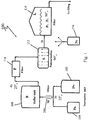
- FIG. 1 is a schematic illustration of a process 100 for pressure build-up and control in a hot-fill line of non-carbonated products.
- water 102 and component A 104 are mixed in mixer unit 106.
- the well mixed product is then passed through a buffer tank 108 to a filtering system 110.
- the temperature so far remains practically unchanged (around 25°C).
- Pasteurization by heat takes place at the thermal unit 112, wherefrom the product is transferred to and maintained in the filler unit 114, at a temperature, T L , ranging from 86°C to 90°C.
- Nitrogen gas 116 from a Nitrogen source N 2 (or any other gases as noted above), is fed into the feed line to the filler unit 114, at pressure P i > P L , where P L is the pressure at the filler unit 114.
- the pressure, P L is maintained at its required (design) value, by the aid of the Nitrogen 116. It should be noted, however, that Nitrogen can be injected anywhere along the line.
- the pressure along the line is roughly about 4 bars. However, due to pressure drop along the line, the pressure at the entrance of the filler unit 114 is somewhat lower, i.e., about 2-3 bars.
- the product is fed into the containers which are usually kept at a surrounding temperature of 25°C.
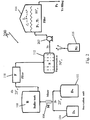
- Fig. 2 is a schematic illustration of a process 200 which is identical to process 100 in most parts aside for pump 202 which is additional to process 200.
- Pump 202 raises the pressure of the product prior to its entry to filler 114.
- Process 100 is of a typical line, whereby the pressure is highest at the entry and decreases along the line, whereas process 200 includes a pressure rise downstream due to pumping of the product to the filler unit 114.
- process 100 is characterized by low pressure at the filler unit 114 while in process 200 the pressure at the filler unit 114 is higher than that of the upstream.
- the product in the filler unit 114 may be in equilibrium or under-saturation corresponding to the pressure P L and temperature T L (86°C, for instance). From the filler unit 114, the product is fed into the containers which are usually at the surrounding temperature of 25°C. The containers may be either close or open at the filling process.
- Table 1 presents typical calculated values of pressure build-up as function of the filler pressure, P L , in a single phase (liquid) closed system.
- Filler pressure P L atm C L *(P L , T L 86°C) gr/liter P*(25°C) ⁇ ps P*(15°C) ⁇ Cs ⁇ Cr1 ⁇ Cr2 2 0.022 1.25 0.25 1.16 0.011 2 1.29 2.5 0.027 1.6 0.6 1.44 0.016 2.4 1.59 3 0.032 1.9 0.9 1.73 0.021 2.9 1.88 3.5 0.038 2.2 1.2 2.02 0.027 3.4 2.23 4 0.043 2.54 1.54 2.3 0.032 3.9 2.53
- the filler pressure, P L is varying from 2.0 to 2.5, 3.0, 3.5 and 4.0.
- P L concentration of CL* is calculated and used for calculating the resulting pressure at 25°C.
- ⁇ ps stands for pressure difference above the ambient pressure, and it represents the driving force for the gas to escape .
- ⁇ ps is relatively low, sustaining the assumption of minor gas loss.
- C*(1, 86°C) 0.011 gr/l by eq (1).
- the parameter ⁇ Cs represents the intensity or the physical driving force that liquid will reject the dissolved gas while filling.
- ⁇ Cr 1 and ⁇ Cr 2 are the ratio of the equilibrium concentration at the filler, C*(P L , 86°C) to either C*(1 atm, 86°C) or C*(1atm, 25°C), respectively;
- ⁇ Cr 1 C * P L , 86 ° C ⁇ C * 1,86 ° C
- ⁇ Cr 2 C * P L , 86 ° C / C * 1,25 ° C
- ⁇ Cr2 ⁇ Cr1 implies that gas nucleation which usually may initiate at the walls but is rather moderate, sustaining the assumption that the gas loss during the relatively short time filling is practically minor.
- filling containers of relatively cold walls are preferable from the point of view of holding the nitrogen in the bulk product.
- Tables 2-4 represent typical results for a variety of possible operations in two-phase systems where:
- the required filler pressure also increases, i.e., the required filler pressure for a 3% head space is 3.73 atm and 3.12 atm for 2% head space, compared to 3.2 and 2.77 atm respectively, when the head space is initially filled with pure nitrogen as in Table 2.
- Table 4 Another mode of interest is presented in Table 4, which refers to a closed system rather than open systems as presented in tables 2 and 3.
- Table 4 presents calculated values of pressure in the liquid phase in a two-phase closed system.
- P 0 Psat (atm) Closed-bottle filling VG/VL % T2 25°C P2 at 25°C T1 86°C P1t at 86°C P1 at 86°C P3 at 10°C *C2 at 25°C 1.58 5 25 1.25 86 1.58 1.58 1.16 0.021 1.62 3 25 1.25 86 1.62 1.62 1.15 0.021 1.66 2 25 1.25 86 1.66 1.66 1.14 0.021 1.73 1 25 1.25 86 1.73 1.73 1.13 0.021 1.43 25 1.10 86 1.43 1.43 1.02 0.019
- the filling process is carried out at a counter pressure identical to the pressure in the filler 114.
- the containers are practically closed during the filling process and the initial pressure in the containers is the filler pressure.
- This mode of filling is generally used in carbonated products.
- the gas may be injected at any point along the line.
- Table 6 includes various situations of pressure and temperature along the filling line, while pointing out in each case the minimal gas concentration to be used so that a sub-saturation is ensured through the whole line.
- Table 6 presents data corresponding to injection of the gas along various locations of the filling line.
- the minimal solubility C m is obviously at the high temperature of 86°C.
- the gas should be injected at a point along the line in which the solubility is minimal.
- C m 0.011 gr/l or corresponds to the highest temperature along the line (e.g., 86°C) which may produce an internal pressure of 0.63 atm at 25°C (see Exp. No. 1).
- micro/nano bubbles are used, late saturation or even oversaturation can be maintained for retaining the gas in the liquid bulk before approaching the gas-liquid interface.
- the gas in the form of micro/nano bubbles can be injected into the liquid prior to entering to the filler, while in the filler, or after exiting the filler just before filling the containers.
Landscapes
- Engineering & Computer Science (AREA)
- Life Sciences & Earth Sciences (AREA)
- Chemical & Material Sciences (AREA)
- Food Science & Technology (AREA)
- Polymers & Plastics (AREA)
- Wood Science & Technology (AREA)
- Zoology (AREA)
- Health & Medical Sciences (AREA)
- Nutrition Science (AREA)
- Chemical Kinetics & Catalysis (AREA)
- Filling Of Jars Or Cans And Processes For Cleaning And Sealing Jars (AREA)
- Vacuum Packaging (AREA)
- Basic Packing Technique (AREA)
Claims (13)
- Procédé de remplissage de contenants à parois souples par du liquide, pour produire une boisson non gazeuse, en laissant un espace de tête et en maintenant l'intégrité des parois souples après ledit remplissage, le procédé comprenant le fait de:prévoir une unité de remplissage (114) présentant un conduit d'accès et un conduit de sortie pour faire passer ledit liquide dans l'unité de remplissage (114) et distribuer le liquide dans les contenants à parois souples;introduire du gaz dans ledit liquide à une température élevée dans l'un ou l'autre parmi le conduit d'accès, l'unité de remplissage (114) et le conduit de sortie, ou dans l'une ou l'autre combinaison de ces derniers,transférer le liquide contenant le gaz dans des contenants à parois souples dans un processus de remplissage à chaud pour remplir une partie des contenants en laissant une partie non remplie des contenants comme espace de tête;fermer les contenants hermétiquement; etpermettre au liquide contenant le gaz d'atteindre une température plus basse, grâce à quoi la pression dans l'espace de tête empêche la déformation des parois souples au cours d'une manipulation normale,caractérisé par le fait que, en combinaison, le gaz introduit dans le liquide est un gaz inerte ou un gaz N2O; et le gaz est introduit dans le liquide à un niveau sous-saturé et est maintenu au niveau de sous-saturation pendant tout le processus de remplissage à chaud.
- Procédé selon la revendication 1, dans lequel l'introduction du gaz dans ledit liquide se fait sous forme de micro/nano-bulles.
- Procédé selon l'une quelconque des revendications 1 et 2, comprenant par ailleurs le fait de: faire passer du liquide à travers un réservoir tampon et un système de filtrage; et pasteuriser le liquide avant de l'introduire dans l'unité de remplissage.
- Procédé selon l'une quelconque des revendications 1 à 3, dans lequel ledit gaz inerte est N2.
- Procédé selon l'une quelconque des revendications 1 à 4, dans lequel ledit gaz inerte ou N2O crée une accumulation de pression et/ou gazéifie le liquide.
- Procédé selon la revendication 3, dans lequel la pasteurisation est réalisée à une température élevée allant de 86°C à 90°C.
- Procédé selon l'une quelconque des revendications 1 à 6, dans lequel la pression du liquide dans le conduit d'accès et/ou l'unité de remplissage et/ou le conduit de sortie est comprise entre 1 et 10 bars.
- Procédé selon l'une quelconque des revendications 1 à 7, comprenant par ailleurs le fait de pomper le liquide à une pression élevée avant son entrée dans l'unité de remplissage.
- Procédé selon l'une quelconque des revendications 1 à 8, dans lequel les contenants à parois souples sont ouverts à l'atmosphère pendant le remplissage.
- Procédé selon l'une quelconque des revendications 1 à 8, dans lequel les contenants sont fermés à l'atmosphère pendant le remplissage.
- Procédé selon l'une quelconque des revendications 1 à 10, dans lequel les contenants sont prévus à ou au-dessous de la température ambiante pendant et après le remplissage.
- Procédé selon l'une quelconque des revendications 1 à 11, dans lequel l'introduction du gaz dans le liquide est réalisée à une température de jusqu'à 95°C.
- Procédé selon l'une quelconque des revendications 1 à 12, comprenant par ailleurs le fait de maintenir la température du liquide dans l'unité de remplissage à 95°C.
Applications Claiming Priority (2)
| Application Number | Priority Date | Filing Date | Title |
|---|---|---|---|
| IL222023A IL222023B (en) | 2012-09-20 | 2012-09-20 | A method for filling bottles |
| PCT/IL2013/050770 WO2014045275A1 (fr) | 2012-09-20 | 2013-09-11 | Procédé permettant de remplir des bouteilles |
Publications (3)
| Publication Number | Publication Date |
|---|---|
| EP2920106A1 EP2920106A1 (fr) | 2015-09-23 |
| EP2920106A4 EP2920106A4 (fr) | 2016-07-06 |
| EP2920106B1 true EP2920106B1 (fr) | 2018-03-07 |
Family
ID=50340664
Family Applications (1)
| Application Number | Title | Priority Date | Filing Date |
|---|---|---|---|
| EP13838156.1A Not-in-force EP2920106B1 (fr) | 2012-09-20 | 2013-09-11 | Procédé permettant de remplir des bouteilles |
Country Status (5)
| Country | Link |
|---|---|
| US (1) | US20150191337A1 (fr) |
| EP (1) | EP2920106B1 (fr) |
| CN (1) | CN104797519B (fr) |
| IL (1) | IL222023B (fr) |
| WO (1) | WO2014045275A1 (fr) |
Families Citing this family (5)
| Publication number | Priority date | Publication date | Assignee | Title |
|---|---|---|---|---|
| KR102455329B1 (ko) | 2014-05-15 | 2022-10-14 | 오토매틱 바 컨트롤즈, 인코포레이티드 | N₂ 주입 냉음료 분배 시스템 및 n₂ 주입 냉음료 준비 및 분배 방법 |
| CN105645334A (zh) * | 2014-11-19 | 2016-06-08 | 山东工大机械有限公司 | 啤酒增压稳定机 |
| DE102017215436A1 (de) * | 2017-09-04 | 2019-03-07 | Krones Ag | Vorrichtung und Verfahren zur Pasteurisierung und Abfüllung von Medium |
| US20190335789A1 (en) * | 2018-05-04 | 2019-11-07 | Michael Dray | Packaged beverages, and a process and device for introducing gases into packaged beverages |
| CN111921446A (zh) * | 2020-08-24 | 2020-11-13 | 赵新颖 | 一种生物医药用药品碾碎搅拌灌装装置 |
Family Cites Families (16)
| Publication number | Priority date | Publication date | Assignee | Title |
|---|---|---|---|---|
| US3191810A (en) * | 1963-09-30 | 1965-06-29 | Richard A Johnston | Composite milk package |
| JPS52116384A (en) * | 1976-03-22 | 1977-09-29 | Continental Group | Packing method using pressurized vessels |
| US4347695A (en) * | 1980-03-26 | 1982-09-07 | General Foods Corporation | Beverage bottling method |
| SE454168B (sv) * | 1982-09-27 | 1988-04-11 | Tetra Pak Ab | Sett och anordning for dosering av fyllgods vid tillverkning av forpackningsbehallare |
| JPS59152194A (ja) * | 1983-02-08 | 1984-08-30 | アサヒビール株式会社 | 非炭酸飲料の充填方法 |
| GB8709281D0 (en) * | 1987-04-16 | 1987-05-20 | Boc Group Plc | Gas dissolving method |
| FR2636918B1 (fr) * | 1988-09-26 | 1991-01-11 | Air Liquide | Procede et installation de conditionnement d'un liquide non carbonate dans des emballages |
| GB9026385D0 (en) * | 1990-12-05 | 1991-01-23 | Boc Group Plc | Dissolving a gas in a liquid |
| US5251424A (en) * | 1991-01-11 | 1993-10-12 | American National Can Company | Method of packaging products in plastic containers |
| SE503788C2 (sv) * | 1994-12-05 | 1996-09-02 | Tetra Laval Holdings & Finance | Anordning för kontinuerlig tillsats av kvävgas till en dryck samt sätt vid tillsatsen |
| US6372276B1 (en) * | 1997-03-14 | 2002-04-16 | Tetra Laval Holdings & Finance S.A. | Method for producing sterile, stable milk |
| AU753940B2 (en) * | 1997-07-10 | 2002-10-31 | Amcor Packaging (Australia) Pty Ltd | Producing liquid products contained in cans, bottles and other suitable containers |
| US20020197364A1 (en) * | 1997-07-10 | 2002-12-26 | Shyong Pan Christopher Chia | Producing liquid products contained in cans, bottles and other suitable containers |
| FR2815937B1 (fr) * | 2000-10-26 | 2003-01-24 | Carboxyque Francaise | Procede et installation et conditionnement de produit liquide dans un emballage |
| JP2007015724A (ja) * | 2005-07-07 | 2007-01-25 | Toyo Seikan Kaisha Ltd | 無菌液体窒素充填装置 |
| US20090130274A1 (en) * | 2005-07-07 | 2009-05-21 | Takeshi Iwashita | Method and Apparatus for Manufacturing a Beverage Contained In a Container |
-
2012
- 2012-09-20 IL IL222023A patent/IL222023B/en not_active IP Right Cessation
-
2013
- 2013-09-11 CN CN201380060722.XA patent/CN104797519B/zh not_active Expired - Fee Related
- 2013-09-11 WO PCT/IL2013/050770 patent/WO2014045275A1/fr not_active Ceased
- 2013-09-11 EP EP13838156.1A patent/EP2920106B1/fr not_active Not-in-force
-
2015
- 2015-03-19 US US14/662,556 patent/US20150191337A1/en not_active Abandoned
Also Published As
| Publication number | Publication date |
|---|---|
| US20150191337A1 (en) | 2015-07-09 |
| WO2014045275A1 (fr) | 2014-03-27 |
| CN104797519B (zh) | 2017-09-29 |
| CN104797519A (zh) | 2015-07-22 |
| HK1215238A1 (en) | 2016-08-19 |
| IL222023B (en) | 2020-01-30 |
| EP2920106A4 (fr) | 2016-07-06 |
| EP2920106A1 (fr) | 2015-09-23 |
Similar Documents
| Publication | Publication Date | Title |
|---|---|---|
| EP2920106B1 (fr) | Procédé permettant de remplir des bouteilles | |
| US4347695A (en) | Beverage bottling method | |
| US11785968B2 (en) | System and method for deaerating beverages | |
| WO2010098231A1 (fr) | Procédé de remplissage aseptique avec un contenu liquide contenant du dioxyde de carbone | |
| JP2001509456A (ja) | カン、ビン及び他の適当な容器に入った液体製品の製造方法 | |
| JP5064657B2 (ja) | 容器入り炭酸飲料の製造方法 | |
| US20140234514A1 (en) | Method for making foamy beverages containing lipids, and related composition | |
| US20020197364A1 (en) | Producing liquid products contained in cans, bottles and other suitable containers | |
| CN102958390A (zh) | 用于在巴氏杀菌以前立即进行氢气的注入而生产氧化敏感性液体的方法和设备 | |
| IE914209A1 (en) | Dissolving a gas in a liquid | |
| HK1215238B (en) | A method for filling bottles | |
| JP2006137463A (ja) | プラスチックボトル詰め飲料の製造方法および装置 | |
| US20230166221A1 (en) | Effervescent beverage in valveless container aerated with sparingly soluble gases, and apparatuses and methods for making the same | |
| US7080670B1 (en) | Method and device for filling a drinks container with a drink produced from an initial liquid, and corresponding drink container | |
| US20200029600A1 (en) | Method of manufacturing beverage within container | |
| CN214693241U (zh) | 用于包装碳酸饮料的灌装线 | |
| EP3498817B1 (fr) | Produit de boisson et système et procédé pour sa fabrication | |
| AU753940B2 (en) | Producing liquid products contained in cans, bottles and other suitable containers | |
| HK40118346A (zh) | 无阀容器中的充有难溶气体的气泡饮料及其制作装置和方法 | |
| JPS643734B2 (fr) |
Legal Events
| Date | Code | Title | Description |
|---|---|---|---|
| PUAI | Public reference made under article 153(3) epc to a published international application that has entered the european phase |
Free format text: ORIGINAL CODE: 0009012 |
|
| 17P | Request for examination filed |
Effective date: 20150417 |
|
| AK | Designated contracting states |
Kind code of ref document: A1 Designated state(s): AL AT BE BG CH CY CZ DE DK EE ES FI FR GB GR HR HU IE IS IT LI LT LU LV MC MK MT NL NO PL PT RO RS SE SI SK SM TR |
|
| AX | Request for extension of the european patent |
Extension state: BA ME |
|
| DAX | Request for extension of the european patent (deleted) | ||
| RA4 | Supplementary search report drawn up and despatched (corrected) |
Effective date: 20160603 |
|
| RIC1 | Information provided on ipc code assigned before grant |
Ipc: A23L 2/54 20060101ALI20160530BHEP Ipc: B67C 3/02 20060101ALI20160530BHEP Ipc: B65B 31/00 20060101ALI20160530BHEP Ipc: B67D 1/04 20060101AFI20160530BHEP Ipc: B01F 3/04 20060101ALI20160530BHEP |
|
| REG | Reference to a national code |
Ref country code: HK Ref legal event code: DE Ref document number: 1215238 Country of ref document: HK |
|
| REG | Reference to a national code |
Ref country code: DE Ref legal event code: R079 Ref document number: 602013034207 Country of ref document: DE Free format text: PREVIOUS MAIN CLASS: B67D0001040000 Ipc: A23L0002540000 |
|
| RIC1 | Information provided on ipc code assigned before grant |
Ipc: A23L 3/16 20060101ALI20170720BHEP Ipc: A23L 2/54 20060101AFI20170720BHEP Ipc: B67C 3/00 20060101ALI20170720BHEP |
|
| GRAP | Despatch of communication of intention to grant a patent |
Free format text: ORIGINAL CODE: EPIDOSNIGR1 |
|
| INTG | Intention to grant announced |
Effective date: 20170829 |
|
| GRAJ | Information related to disapproval of communication of intention to grant by the applicant or resumption of examination proceedings by the epo deleted |
Free format text: ORIGINAL CODE: EPIDOSDIGR1 |
|
| GRAR | Information related to intention to grant a patent recorded |
Free format text: ORIGINAL CODE: EPIDOSNIGR71 |
|
| GRAS | Grant fee paid |
Free format text: ORIGINAL CODE: EPIDOSNIGR3 |
|
| GRAA | (expected) grant |
Free format text: ORIGINAL CODE: 0009210 |
|
| INTC | Intention to grant announced (deleted) | ||
| INTG | Intention to grant announced |
Effective date: 20180125 |
|
| AK | Designated contracting states |
Kind code of ref document: B1 Designated state(s): AL AT BE BG CH CY CZ DE DK EE ES FI FR GB GR HR HU IE IS IT LI LT LU LV MC MK MT NL NO PL PT RO RS SE SI SK SM TR |
|
| REG | Reference to a national code |
Ref country code: GB Ref legal event code: FG4D |
|
| REG | Reference to a national code |
Ref country code: CH Ref legal event code: EP Ref country code: AT Ref legal event code: REF Ref document number: 975551 Country of ref document: AT Kind code of ref document: T Effective date: 20180315 |
|
| REG | Reference to a national code |
Ref country code: IE Ref legal event code: FG4D |
|
| REG | Reference to a national code |
Ref country code: DE Ref legal event code: R096 Ref document number: 602013034207 Country of ref document: DE |
|
| REG | Reference to a national code |
Ref country code: NL Ref legal event code: MP Effective date: 20180307 |
|
| REG | Reference to a national code |
Ref country code: LT Ref legal event code: MG4D |
|
| PG25 | Lapsed in a contracting state [announced via postgrant information from national office to epo] |
Ref country code: ES Free format text: LAPSE BECAUSE OF FAILURE TO SUBMIT A TRANSLATION OF THE DESCRIPTION OR TO PAY THE FEE WITHIN THE PRESCRIBED TIME-LIMIT Effective date: 20180307 Ref country code: LT Free format text: LAPSE BECAUSE OF FAILURE TO SUBMIT A TRANSLATION OF THE DESCRIPTION OR TO PAY THE FEE WITHIN THE PRESCRIBED TIME-LIMIT Effective date: 20180307 Ref country code: NO Free format text: LAPSE BECAUSE OF FAILURE TO SUBMIT A TRANSLATION OF THE DESCRIPTION OR TO PAY THE FEE WITHIN THE PRESCRIBED TIME-LIMIT Effective date: 20180607 Ref country code: HR Free format text: LAPSE BECAUSE OF FAILURE TO SUBMIT A TRANSLATION OF THE DESCRIPTION OR TO PAY THE FEE WITHIN THE PRESCRIBED TIME-LIMIT Effective date: 20180307 Ref country code: CY Free format text: LAPSE BECAUSE OF FAILURE TO SUBMIT A TRANSLATION OF THE DESCRIPTION OR TO PAY THE FEE WITHIN THE PRESCRIBED TIME-LIMIT Effective date: 20180307 Ref country code: FI Free format text: LAPSE BECAUSE OF FAILURE TO SUBMIT A TRANSLATION OF THE DESCRIPTION OR TO PAY THE FEE WITHIN THE PRESCRIBED TIME-LIMIT Effective date: 20180307 |
|
| REG | Reference to a national code |
Ref country code: AT Ref legal event code: MK05 Ref document number: 975551 Country of ref document: AT Kind code of ref document: T Effective date: 20180307 |
|
| PG25 | Lapsed in a contracting state [announced via postgrant information from national office to epo] |
Ref country code: RS Free format text: LAPSE BECAUSE OF FAILURE TO SUBMIT A TRANSLATION OF THE DESCRIPTION OR TO PAY THE FEE WITHIN THE PRESCRIBED TIME-LIMIT Effective date: 20180307 Ref country code: SE Free format text: LAPSE BECAUSE OF FAILURE TO SUBMIT A TRANSLATION OF THE DESCRIPTION OR TO PAY THE FEE WITHIN THE PRESCRIBED TIME-LIMIT Effective date: 20180307 Ref country code: LV Free format text: LAPSE BECAUSE OF FAILURE TO SUBMIT A TRANSLATION OF THE DESCRIPTION OR TO PAY THE FEE WITHIN THE PRESCRIBED TIME-LIMIT Effective date: 20180307 Ref country code: GR Free format text: LAPSE BECAUSE OF FAILURE TO SUBMIT A TRANSLATION OF THE DESCRIPTION OR TO PAY THE FEE WITHIN THE PRESCRIBED TIME-LIMIT Effective date: 20180608 Ref country code: BG Free format text: LAPSE BECAUSE OF FAILURE TO SUBMIT A TRANSLATION OF THE DESCRIPTION OR TO PAY THE FEE WITHIN THE PRESCRIBED TIME-LIMIT Effective date: 20180607 |
|
| REG | Reference to a national code |
Ref country code: HK Ref legal event code: GR Ref document number: 1215238 Country of ref document: HK |
|
| REG | Reference to a national code |
Ref country code: FR Ref legal event code: PLFP Year of fee payment: 6 |
|
| PG25 | Lapsed in a contracting state [announced via postgrant information from national office to epo] |
Ref country code: IT Free format text: LAPSE BECAUSE OF FAILURE TO SUBMIT A TRANSLATION OF THE DESCRIPTION OR TO PAY THE FEE WITHIN THE PRESCRIBED TIME-LIMIT Effective date: 20180307 Ref country code: RO Free format text: LAPSE BECAUSE OF FAILURE TO SUBMIT A TRANSLATION OF THE DESCRIPTION OR TO PAY THE FEE WITHIN THE PRESCRIBED TIME-LIMIT Effective date: 20180307 Ref country code: PL Free format text: LAPSE BECAUSE OF FAILURE TO SUBMIT A TRANSLATION OF THE DESCRIPTION OR TO PAY THE FEE WITHIN THE PRESCRIBED TIME-LIMIT Effective date: 20180307 Ref country code: AL Free format text: LAPSE BECAUSE OF FAILURE TO SUBMIT A TRANSLATION OF THE DESCRIPTION OR TO PAY THE FEE WITHIN THE PRESCRIBED TIME-LIMIT Effective date: 20180307 Ref country code: NL Free format text: LAPSE BECAUSE OF FAILURE TO SUBMIT A TRANSLATION OF THE DESCRIPTION OR TO PAY THE FEE WITHIN THE PRESCRIBED TIME-LIMIT Effective date: 20180307 Ref country code: EE Free format text: LAPSE BECAUSE OF FAILURE TO SUBMIT A TRANSLATION OF THE DESCRIPTION OR TO PAY THE FEE WITHIN THE PRESCRIBED TIME-LIMIT Effective date: 20180307 |
|
| PG25 | Lapsed in a contracting state [announced via postgrant information from national office to epo] |
Ref country code: AT Free format text: LAPSE BECAUSE OF FAILURE TO SUBMIT A TRANSLATION OF THE DESCRIPTION OR TO PAY THE FEE WITHIN THE PRESCRIBED TIME-LIMIT Effective date: 20180307 Ref country code: SM Free format text: LAPSE BECAUSE OF FAILURE TO SUBMIT A TRANSLATION OF THE DESCRIPTION OR TO PAY THE FEE WITHIN THE PRESCRIBED TIME-LIMIT Effective date: 20180307 Ref country code: CZ Free format text: LAPSE BECAUSE OF FAILURE TO SUBMIT A TRANSLATION OF THE DESCRIPTION OR TO PAY THE FEE WITHIN THE PRESCRIBED TIME-LIMIT Effective date: 20180307 Ref country code: SK Free format text: LAPSE BECAUSE OF FAILURE TO SUBMIT A TRANSLATION OF THE DESCRIPTION OR TO PAY THE FEE WITHIN THE PRESCRIBED TIME-LIMIT Effective date: 20180307 |
|
| REG | Reference to a national code |
Ref country code: DE Ref legal event code: R097 Ref document number: 602013034207 Country of ref document: DE |
|
| PG25 | Lapsed in a contracting state [announced via postgrant information from national office to epo] |
Ref country code: PT Free format text: LAPSE BECAUSE OF FAILURE TO SUBMIT A TRANSLATION OF THE DESCRIPTION OR TO PAY THE FEE WITHIN THE PRESCRIBED TIME-LIMIT Effective date: 20180709 |
|
| PLBE | No opposition filed within time limit |
Free format text: ORIGINAL CODE: 0009261 |
|
| STAA | Information on the status of an ep patent application or granted ep patent |
Free format text: STATUS: NO OPPOSITION FILED WITHIN TIME LIMIT |
|
| PG25 | Lapsed in a contracting state [announced via postgrant information from national office to epo] |
Ref country code: DK Free format text: LAPSE BECAUSE OF FAILURE TO SUBMIT A TRANSLATION OF THE DESCRIPTION OR TO PAY THE FEE WITHIN THE PRESCRIBED TIME-LIMIT Effective date: 20180307 |
|
| 26N | No opposition filed |
Effective date: 20181210 |
|
| PG25 | Lapsed in a contracting state [announced via postgrant information from national office to epo] |
Ref country code: SI Free format text: LAPSE BECAUSE OF FAILURE TO SUBMIT A TRANSLATION OF THE DESCRIPTION OR TO PAY THE FEE WITHIN THE PRESCRIBED TIME-LIMIT Effective date: 20180307 |
|
| PG25 | Lapsed in a contracting state [announced via postgrant information from national office to epo] |
Ref country code: MC Free format text: LAPSE BECAUSE OF FAILURE TO SUBMIT A TRANSLATION OF THE DESCRIPTION OR TO PAY THE FEE WITHIN THE PRESCRIBED TIME-LIMIT Effective date: 20180307 |
|
| REG | Reference to a national code |
Ref country code: CH Ref legal event code: PL |
|
| REG | Reference to a national code |
Ref country code: BE Ref legal event code: MM Effective date: 20180930 |
|
| REG | Reference to a national code |
Ref country code: IE Ref legal event code: MM4A |
|
| PG25 | Lapsed in a contracting state [announced via postgrant information from national office to epo] |
Ref country code: LU Free format text: LAPSE BECAUSE OF NON-PAYMENT OF DUE FEES Effective date: 20180911 |
|
| PG25 | Lapsed in a contracting state [announced via postgrant information from national office to epo] |
Ref country code: IE Free format text: LAPSE BECAUSE OF NON-PAYMENT OF DUE FEES Effective date: 20180911 |
|
| PG25 | Lapsed in a contracting state [announced via postgrant information from national office to epo] |
Ref country code: BE Free format text: LAPSE BECAUSE OF NON-PAYMENT OF DUE FEES Effective date: 20180930 Ref country code: CH Free format text: LAPSE BECAUSE OF NON-PAYMENT OF DUE FEES Effective date: 20180930 Ref country code: LI Free format text: LAPSE BECAUSE OF NON-PAYMENT OF DUE FEES Effective date: 20180930 |
|
| PGFP | Annual fee paid to national office [announced via postgrant information from national office to epo] |
Ref country code: DE Payment date: 20190918 Year of fee payment: 7 Ref country code: FR Payment date: 20190927 Year of fee payment: 7 |
|
| PGFP | Annual fee paid to national office [announced via postgrant information from national office to epo] |
Ref country code: GB Payment date: 20190920 Year of fee payment: 7 |
|
| PG25 | Lapsed in a contracting state [announced via postgrant information from national office to epo] |
Ref country code: MT Free format text: LAPSE BECAUSE OF NON-PAYMENT OF DUE FEES Effective date: 20180911 |
|
| PG25 | Lapsed in a contracting state [announced via postgrant information from national office to epo] |
Ref country code: TR Free format text: LAPSE BECAUSE OF FAILURE TO SUBMIT A TRANSLATION OF THE DESCRIPTION OR TO PAY THE FEE WITHIN THE PRESCRIBED TIME-LIMIT Effective date: 20180307 |
|
| PG25 | Lapsed in a contracting state [announced via postgrant information from national office to epo] |
Ref country code: MK Free format text: LAPSE BECAUSE OF NON-PAYMENT OF DUE FEES Effective date: 20180307 Ref country code: HU Free format text: LAPSE BECAUSE OF FAILURE TO SUBMIT A TRANSLATION OF THE DESCRIPTION OR TO PAY THE FEE WITHIN THE PRESCRIBED TIME-LIMIT; INVALID AB INITIO Effective date: 20130911 |
|
| PG25 | Lapsed in a contracting state [announced via postgrant information from national office to epo] |
Ref country code: IS Free format text: LAPSE BECAUSE OF FAILURE TO SUBMIT A TRANSLATION OF THE DESCRIPTION OR TO PAY THE FEE WITHIN THE PRESCRIBED TIME-LIMIT Effective date: 20180707 |
|
| REG | Reference to a national code |
Ref country code: DE Ref legal event code: R119 Ref document number: 602013034207 Country of ref document: DE |
|
| GBPC | Gb: european patent ceased through non-payment of renewal fee |
Effective date: 20200911 |
|
| PG25 | Lapsed in a contracting state [announced via postgrant information from national office to epo] |
Ref country code: DE Free format text: LAPSE BECAUSE OF NON-PAYMENT OF DUE FEES Effective date: 20210401 Ref country code: FR Free format text: LAPSE BECAUSE OF NON-PAYMENT OF DUE FEES Effective date: 20200930 |
|
| PG25 | Lapsed in a contracting state [announced via postgrant information from national office to epo] |
Ref country code: GB Free format text: LAPSE BECAUSE OF NON-PAYMENT OF DUE FEES Effective date: 20200911 |