EP2921293B1 - Holzwerkstoffplatten-Heißpresse - Google Patents
Holzwerkstoffplatten-Heißpresse Download PDFInfo
- Publication number
- EP2921293B1 EP2921293B1 EP14160360.5A EP14160360A EP2921293B1 EP 2921293 B1 EP2921293 B1 EP 2921293B1 EP 14160360 A EP14160360 A EP 14160360A EP 2921293 B1 EP2921293 B1 EP 2921293B1
- Authority
- EP
- European Patent Office
- Prior art keywords
- wood board
- engineered wood
- press
- wood
- projection
- Prior art date
- Legal status (The legal status is an assumption and is not a legal conclusion. Google has not performed a legal analysis and makes no representation as to the accuracy of the status listed.)
- Active
Links
Images
Classifications
-
- B—PERFORMING OPERATIONS; TRANSPORTING
- B30—PRESSES
- B30B—PRESSES IN GENERAL
- B30B15/00—Details of, or accessories for, presses; Auxiliary measures in connection with pressing
- B30B15/06—Platens or press rams
- B30B15/062—Press plates
-
- B—PERFORMING OPERATIONS; TRANSPORTING
- B27—WORKING OR PRESERVING WOOD OR SIMILAR MATERIAL; NAILING OR STAPLING MACHINES IN GENERAL
- B27N—MANUFACTURE BY DRY PROCESSES OF ARTICLES, WITH OR WITHOUT ORGANIC BINDING AGENTS, MADE FROM PARTICLES OR FIBRES CONSISTING OF WOOD OR OTHER LIGNOCELLULOSIC OR LIKE ORGANIC MATERIAL
- B27N3/00—Manufacture of substantially flat articles, e.g. boards, from particles or fibres
- B27N3/08—Moulding or pressing
- B27N3/20—Moulding or pressing characterised by using platen-presses
Definitions
- the invention relates to a wood-based panel manufacturing apparatus according to the preamble of claim 1. According to a second aspect, the invention relates to a method for producing a wood-based panel, in particular a floor laminate.
- the invention is based, without additional requirements to increase the dimensional accuracy of the wood-based panel to be pressed blank, the service life of press elements the task.
- the invention solves the problem by a wood-based panel manufacturing device having the features of claim 1. According to a second aspect, the invention solves the problem by a method having the features of claim 6.
- An advantage of the invention is that the service life of the pressing element can be significantly extended. Experiments have shown that the service life can at least be quadrupled.
- Another advantage is that the significant increase in service life can be achieved by a technically simple means. Thus, the advantage of increased service life does not have to be paid for by expensive technical measures.
- the invention is based on the finding that flow of the resin occurs during pressing. At the edge of the pressing element, a displacement of the molten resin to the side occurs in a conventional pressing element without a projection, so that the surface-distant, hard-containing layers come into contact with the pressing element. Since the press plate expands and contracts during pressing, there is a relative movement between the corundum grains and the press plate, which leads to the increased wear. Due to the surprisingly simple technical means of the peripheral edge a displacement of the resin is avoided at the edge of the pressing element and reduces the tendency to wear drastically. On the other hand, other attempts, such as increasing the layer thickness of the uppermost layer, which need not comprise any hard material particles, surprisingly showed no influence on the press element life.
- the wood-based panel hot press is understood in particular to mean a press which is designed for heating the press element to a temperature of more than 150 ° C., in particular to at least 200 ° C.
- the hot press comprises a heating device, in particular in the form of an electric heating device or a heating device operated by heated hydraulic oil.
- the hot press is also designed to apply a pressure which is sufficiently high to press a synthetic resin, in particular a melamine resin, onto the wood-based board blank so as to form a floor laminate.
- the pressing element Under the pressing element that part of the hot press is understood, which comes into direct contact with the wood material board blank during pressing and transfers the pressure and / or heat to the wood material board blank. Under the pressing element is understood in particular a press plate or a press belt.
- the pressing member adjacent to the edge has a projection, in particular, it is understood that the pressing member at the position where it is in contact with the wooden material board blank during pressing and at which no protrusion is formed along a plane extends, wherein the projection protrudes out of this plane out into the press nip.
- the projection is arranged adjacent to the edge, it is understood in particular that it is possible, but not necessary, that the projection merges with the inner edge. As a rule, it is favorable if the projection has a small distance from the edge. Since the projection leaves an impression in the resulting, refined wood-based panel, it is advantageous if the projection is arranged on an edge of the wood-based panel blank. In particular, a distance of the projection from the edge is less than a tenth of a minimum of the width and length of the pressing element.
- the pressing element is made of steel. It is favorable if the pressing element is chrome-plated in order to increase the service life.
- the projection has a height of at least 20 micrometers, in particular at least 50 micrometers.
- the height is that extent of the projection about which the projection protrudes into the press nip. It is the surprising realization that even such a small projection can multiply the service life of the pressing element.
- the pressing element is a press plate which extends along a pressing element plane.
- the projection protrudes from the pressing element level.
- the projection extends along a rectangle, within which the press plate extends along a pressing element plane.
- the projection extends along the rectangle, it is understood, in particular, that a rectangle exists whose circumferential line is formed entirely or at least partially on the projection. It is particularly favorable if the projection extends completely along the circumferential line. However, it is also conceivable that the projection has interruptions. Generally, it is advantageous if the projection extends along a trapezoid. It is particularly favorable if the trapezoid is a rectangle, since then very easy-to-use wood-based panels are obtained,
- the material plate hot press is preferably a discontinuously operating press, in particular a short-cycle press.
- a short-cycle press is understood to mean a press whose pressing time is less than 20 seconds.
- a wood-based panel manufacturing device which comprises, in addition to a wood-based panel hot press according to the invention at least one application device for applying a resin containing hartstoffpisme pasn.
- the pressing element has a structuring with a structure depth, so that a relief-finished surface is produced on the wood-based material board blank.
- the height of the protrusion is preferably at least 0.8 times a structural depth and / or at most three times the structural depth.
- the height is between 100 and 200 microns.
- the layer thickness can be up to 200 microns.
- the structure depth is the difference between the lowest valley and the highest elevation of the structuring.
- a wood-based panel hot press in the form of a short-cycle press is used, that is, a pressing time for pressing the wood-based panel blank is not more than 20 seconds.
- a method of the invention comprises the steps of applying a first top resin layer comprising hard particles, particularly corundum particles, to a wood material layer, applying a second top resin layer containing cellulose to the first top resin layer, and applying a third top resin layer containing glass particles on the second upper resin layer, wherein the resin layers together have a layer thickness of at least 50 microns, especially 80 microns have.
- a first top resin layer comprising hard particles, particularly corundum particles
- an embossing is embossed in the wood material board blank by means of the pressing element, wherein the height is at least 0.8 times a structural depth and / or at most three times the structural depth.
- the wood-based board blank is so pressed that the projection of the pressing element is disposed adjacent to a wood-based board edge of the wood-based panel blank, so that a displacement of material of the resin layers is reduced to the wood-based panel edge.
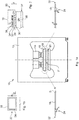
- FIG. 1a shows a wood-based panel hot press 10, which comprises a frame 12, a pressing pressure generator 14 in the form of hydraulic cylinders, a pressing element holder 16 and a pressing member 18.
- the pressing member 18 is fixed to the pressing element holder 16 and is heated by this to a predetermined pressing temperature, for example by means of a thermal oil, which is passed through heating channels.
- the pressing pressure generator 14 is acted upon by a hydraulic unit with pressurized fluid, so that the pressing member 18 can exert a pressing pressure on a schematically drawn wood material board blank 20.
- the wood-based panel blank 20 is arranged in a press nip 21, which is bounded above by the pressing element 18.
- the projection 24 has a height h of 50 micrometers, which is measured relative to a pressing element plane E.
- the wood-based panel hot press 10 is a short-cycle press that presses the wood-based panel blank 20 into a floor laminate within a cycle time of 7 seconds.
- the pressing member 18 has a thickness d of 15 mm and is made of steel.
- The, in particular all-round, projection may have different widths and be designed not only full-surface, but also structured.
- the pressing element is for example a stainless steel press plate, for example, from the special tube 393 SQ.
- the pressing element has a hardness of at least 60 HRC, at least on its surface. If the pressing element has a structuring, this preferably structure preferably has a minimum hardness of at least 60 HRC.
- FIG. 1b shows a schematic view from below of the pressing member 18. It can be seen that the pressing member 18 has a width B and a length L, wherein the width B is greater than 4 m and for example 5 m and wherein the length L is greater than 1.5 m and for example 2.5 m.
- the projection 24 has a distance from the edge 22, which is for example between 1 cm and 10 cm. The length and width, however, is variable by design.
- FIG. 2 shows a schematic structure of a wood-based panel blank 20.
- This comprises a wood-based material layer 26, a first upper resin layer 28 containing hard material particles 30 in the form of corundum particles.
- a second upper resin layer 32 containing cellulose is applied on the first upper resin layer 28 .
- a third upper resin layer 34 containing glass particles 36 is deposited on the second upper resin layer 32 .
- the wood-based panel blank 20 also includes a lower resin layer 38 corresponding to the first upper resin layer 28 and applied below the wood material layer 26 thereon.
- the pressing member 18 is located as it is arranged during pressing of the wood-based material board blank 20. It will be appreciated that the projection 24, when pressed, is positioned adjacent a wood-based panel edge 37 of the wood-based panel blank 20, thus preventing or at least reducing displacement of material of the resin layers 28, 32, 34 sideways.
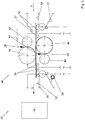
- FIG. 3 shows a section through a wood-based panel manufacturing device 39 according to the invention, which in addition to the wood-based panel hot press 10, an applicator 40, which is arranged in a processing direction V in front of the wood-based panel hot press 10.
- the application device 40 comprises an upper applicator 58 and a lower applicator 60, each of which is designed as an order mills and each have an applicator roll 46 and a metering roller 48.
- material supply lines 44 which are provided with an arrow at the end, mixed, applied hard material particles are introduced between the application roller 46 and the metering roller 48 in mixing containers.
- the applicator roll 46 By the applicator roll 46, the hard particles are applied to the top or bottom of the wood-based panel blank 20.
- the transport of the wood-based panel blank 20 is done both before and after the applicator 40 by means of a pointed lug transport 50. Because this Spitzlaschentransport prepared 50 has only a few, small-area contact points with the wood-based board blank 20, a good quality of the wood-based panel is guaranteed.
- the spiked transport device 50 includes pointed tabs 52 that are cleaned by automatic cleaning brushes 54.
- 60 hold-down 56 can be arranged in front of and behind the respective application devices 58, 60. In this way, it is ensured that the layers on the top and bottom of the wood-based panel 2 can be reproducibly and precisely applied.
- Wood-based panels hot press 56 Stripper plate 12 frame 14 Press pressure generator 58 upper application device 16 Press element holder 60 lower application device 18 press member B width 20 Wood-based panels blank d thickness 21 press nip e Press element level h height 22 edge 24 head Start L length 26 Wood material layer V processing direction 28 first upper resin layer 30 Hard particles 32 second upper resin layer 34 third upper resin layer 36 glass particles 37 Wood-based panels Edge 38 lower resin layer 39 Wood-based panels manufacturing device 40 applicator 44 material supply lines 46 applicator roll 48 metering 50 Spitz Lasch transport device 52 Spitz tab 54 cleaning brushes
Landscapes
- Engineering & Computer Science (AREA)
- Life Sciences & Earth Sciences (AREA)
- Mechanical Engineering (AREA)
- Manufacturing & Machinery (AREA)
- Wood Science & Technology (AREA)
- Forests & Forestry (AREA)
- Dry Formation Of Fiberboard And The Like (AREA)
Description
- Die Erfindung betrifft eine Holzwerkstoffplatten-Herstellvorrichtung gemäß dem Oberbegriff von Anspruch 1. Gemäß einem zweiten Aspekt betrifft die Erfindung ein Verfahren zum Herstellen einer Holzwerkstoffplatte, insbesondere eines Fußbodenlaminats.
- Beim Herstellen von Fußbodenlaminat werden dekorierte Holzwerkstoffplatten-Rohlinge beidseitig mit Kunstharzen versiegelt. Beim Aushärten der Kunstharze, beispielsweise eines Melaminharzes, unter Einwirkung von Druck und Wärme, bilden sich harte und widerstandsfähige Schichten aus, die zudem einen dauerhaften Verbund mit der meist dekorierten Trägerplatte eingehen. Dieser Verbund wird als Laminat bezeichnet. Es ist möglich, dass die Kunstharzschicht von einer Zelluloselage oder von einem sogenannten Imprägnat getragen wird oder dass sie direkt auf den Holzwerkstoffplatten-Rohling aufgetragen wird. Oberseitig werden dem Kunstharz oft Zusätze zugesetzt, die die Abriebfestigkeit erhöhen. Der unterseitige Harzauftrag gleicht Schrumpfspannungen des oberseitigen Harzauftrages aus, die bei der Aushärtung der Kunstharzschichten auftreten.
- Aus der
EP 2 338 693 ist eine Vorrichtung zum Veredeln einer Holzwerkstoffplatte bekannt, bei der Korund- und Glaspartikel zur Erhöhung der Abriebfestigkeit eingesetzt werden. So wird ein sehr robustes Fußbodenlaminat erhalten. Es hat sich jedoch ein erhöhter Verschleiß an den Presselementen der verwendeten Pressen gezeigt. Das gilt insbesondere dann, wenn eine diskontinuierliche Presse eingesetzt wird, beispielsweise eine Kurzzeitpresse, - Aus der
DE 196 33 289 C1 ist eine Heißpresse zum Herstellen kunststoffbeschichteter Platten geringerer Dichte bekannt, bei der um den Pressling ein Rahmen angeordnet ist, dessen Höhe der Dicke des verpressten Presslaminats entspricht. Das dient dem Zweck, die Standzeit des Pressblechs zu erhöhen, Nachteilig an einer solchen Heißpresse sind der hohe apparative Aufwand und die hohen Anforderungen an die Abmessungen des Holzwerkstoffplatten-Rohlings. - Der Erfindung liegt die Aufgabe zugrunde, ohne zusätzliche Anforderungen an die Maßhaltigkeit des zu verpressenden Holzwerkstoffplatten-Rohlings die Standzeit von Presselementen zu erhöhen.
- Die Erfindung löst das Problem durch eine Holzwerkstoffplatten-Herstelivorrichtung mit den Merkmalen von Anspruch 1. Gemäß einem zweiten Aspekt löst die Erfindung das Problem durch ein Verfahren mit den Merkmalen von Anspruch 6.
- Vorteilhaft an der Erfindung ist, dass die Standzeit des Presselements signifikant verlängert werden kann. So haben Versuche gezeigt, dass sich die Standzeit zumindest vervierfachen lässt.
- Vorteilhaft ist zudem, dass die deutliche Erhöhung der Standzeit durch ein technisch einfaches Mittel erreicht werden kann. So muss der Vorteil der erhöhten Standzeit nicht durch aufwendige technische Maßnahmen erkauft werden.
- Der Erfindung liegt die Erkenntnis zugrunde, dass es beim Verpressen zu einem Fließen des Harzes kommt. Am Rand des Presselements kommt es bei einem herkömmlichen Presselement ohne Vorsprung zu einer Verdrängung des aufgeschmolzenen Harzes zur Seite hin, so dass die oberflächenfernen hartstoffhaltigen Schichten in Kontakt mit dem Presselement kommen. Da das Pressblech sich beim Pressen ausdehnt und zusammenzieht, kommt es zu einer Relativbewegung zwischen den Korundkörnern und dem Pressblech, was zu dem erhöhten Verschleiß führt. Durch das überraschend einfache technische Mittel des umlaufenden Randes wird ein Verdrängen des Harzes am Rand des Presselements vermieden und die Verschleißneigung drastisch reduziert. Andere Versuche, wie beispielsweise ein Erhöhen der Schichtdicke der obersten Schicht, die keine Hartstoffpartikel umfassen muss, zeigten hingegen überraschenderweise keinen Einfluss auf die Presselementstandzeit.
- Im Rahmen der vorliegenden Beschreibung wird unter der Holzwerkstoffplatten-Heißpresse insbesondere eine Presse verstanden, die zum Beheizen des Presselements auf eine Temperatur von über 150°C, insbesondere auf zumindest 200°C, ausgebildet ist. Beispielsweise umfasst die Heißpresse eine Heizvorrichtung, insbesondere in Form einer elektrischen Heizvorrichtung oder einer durch erhitztes Hydrauliköl betriebenen Heizvorrichtung. Die Heißpresse ist zudem ausgelegt zum Aufbringen eines Drucks, der hinreichend hoch ist, um ein Kunstharz, insbesondere ein Melaminharz, so auf den Holzwerkstoffplatten-Rohling zu pressen, dass ein Fußbodenlaminat entsteht.
- Unter dem Presselement wird dasjenige Teil der Heißpresse verstanden, das beim Verpressen in direkten Kontakt mit dem Holzwerkstoffplatten-Rohling kommt und den Druck und/oder die Wärme auf den Holzwerkstoffplatten-Rohling überträgt. Unter dem Presselement wird insbesondere eine Pressplatte oder ein Pressband verstanden. Unter dem Merkmal, dass das Presselement benachbart zum Rand einen Vorsprung besitzt, wird insbesondere verstanden, dass das Presselement sich an der Stelle, an der es beim Pressen in Kontakt mit dem Holzwerkstoffplatten-Rohling steht und an der kein Vorsprung ausgebildet ist, entlang einer Ebene erstreckt, wobei der Vorsprung aus dieser Ebene heraus in den Pressspalt ragt.
- Unter dem Merkmal, dass der Vorsprung benachbart zum Rand angeordnet ist, wird insbesondere verstanden, dass es möglich, nicht aber notwendig ist, dass der Vorsprung an den Innenrand übergeht. In aller Regel ist es günstig, wenn der Vorsprung einen kleinen Abstand vom Rand hat. Da der Vorsprung einen Eindruck in der entstehenden, veredelten Holzwerkstoffplatte hinterlässt, ist es günstig, wenn der Vorsprung an einem Rand des Holzwerkstoffplatten-Rohlings angeordnet ist. Insbesondere ist ein Abstand des Vorsprungs vom Rand kleiner als ein Zehntel eines Minimums aus Breite und Länge des Presselements.
- Vorzugsweise ist das Presselement aus Stahl gefertigt. Günstig ist es, wenn das Presselement verchromt ist, um die Standzeit zu erhöhen.
- Gemäß einer bevorzugten Ausführungsform hat der Vorsprung eine Höhe von zumindest 20 Mikrometern, insbesondere zumindest 50 Mikrometern. Die Höhe ist diejenige Ausdehnung des Vorsprungs, um den der Vorsprung in den Pressspalt ragt. Es ist die überraschende Erkenntnis, dass bereits ein so geringer Vorsprung die Standzeit des Presselements vervielfachen kann.
- Vorzugsweise ist das Presselement ein Pressblech, das sich entlang einer Presselementebene erstreckt. Der Vorsprung ragt aus der Presselementebene heraus.
- Gemäß einer bevorzugten Ausführungsform erstreckt sich der Vorsprung entlang eines Rechtecks, innerhalb dessen sich das Pressblech entlang einer Presselementebene erstreckt. Unter dem Merkmal, dass sich der Vorsprung entlang des Rechtecks erstreckt, wird insbesondere verstanden, dass ein Rechteck existiert, dessen Umfangslinie ganz oder zumindest teilweise am Vorsprung gebildet wird. Besonders günstig ist es, wenn sich der Vorsprung vollständig entlang der Umfangslinie erstreckt. Es ist jedoch auch denkbar, dass der Vorsprung Unterbrechungen aufweist. Verallgemeinert ist es vorteilhaft, wenn sich der Vorsprung entlang eines Trapezes erstreckt. Besonders günstig ist es, wenn das Trapez ein Rechteck ist, da dann besonders einfach zu handhabende Holzwerkstoffplatten erhalten werden,
- Vorzugsweise ist die Werkstoffplatten-Heißpresse eine diskontinuierlich arbeitende Presse, insbesondere eine Kurztaktpresse. Unter einer Kurztaktpresse wird eine Presse verstanden, deren Presszeit unterhalb von 20 Sekunden liegt. Erfindungsgemäß ist zudem eine Holzwerkstoffplatten-Herstellvorrichtung, die neben einer erfindungsgemäßen Holzwerkstoffplatten-Heißpresse zumindest eine Auftragsvorrichtung zum Auftragen eines hartstoffpartikelhaltigen Harzes umfasst.
- Gemäß einer bevorzugten Ausführungsform besitzt das Presselement eine Strukturierung mit einer Strukturtiefe, so dass auf dem Holzwerkstoffplatten-Rohling eine reliefierte Oberfläche erzeugt wird. Vorzugsweise beträgt in diesem Fall die Höhe des Vorsprungs zumindest das 0,8-fache einer Strukturtiefe und/oder höchstens das Dreifache der Strukturtiefe. Bei einer Strukturtiefe von 100 Mikrometer liegt die Höhe beispielsweise zwischen 100 und 200 Mikrometer. Die Schichtdicke kann bis zu 200 Mikrometer betragen. Die Strukturtiefe ist die Differenz zwischen dem tiefsten Tal und der höchsten Erhebung der Strukturierung.
- Bei einem erfindungsgemäßen Verfahren wird vorzugsweise eine Holzwerkstoffplatten-Heißpresse in Form einer Kurztaktpresse verwendet, das heißt, dass eine Presszeit zum Verpressen des Holzwerkstoffplatten-Rohlings höchstens 20 Sekunden beträgt.
- Vorzugsweise umfasst ein erfindungsgemäßes Verfahren die Schritte eines Aufbringens einer ersten oberen Harzschicht, die Hartstoffpartikel, insbesondere Korundpartikel, umfasst, auf eine Holzwerkstoffschicht, ein Aufbringen einer zweiten oberen Harzschicht, die Zellulose enthält, auf die erste obere Harzschicht, und ein Aufbringen einer dritten oberen Harzschicht, die Glaspartikel enthält, auf die zweite obere Harzschicht, wobei die Harzschichten gemeinsam eine Schichtdicke von zumindest 50 Mikrometern, insbesondere 80 Mikrometern, haben. Selbstverständlich ist es möglich, dass mehr als drei Harzschichten aufgebracht werden.
- Gemäß einer bevorzugten Ausführungsform wird mittels des Presselements eine Prägung in den Holzwerkstoffplatten-Rohling geprägt, wobei die Höhe zumindest das 0,8-fache einer Strukturtiefe und/oder höchstens das Dreifache der Strukturtiefe beträgt.
- Gemäß einer bevorzugten Ausführungsform wird der Holzwerkstoffplatten-Rohling so gepresst, dass der Vorsprung des Presselements benachbart zu einem Holzwerkstoffplatten-Rand des Holzwerkstoffplatten-Rohlings angeordnet ist, So wird ein Verdrängen von Material der Harzschichten zum Holzwerkstoffplatten-Rand vermindert.
- Im Folgenden wird die Erfindung anhand der beigefügten Zeichnungen näher erläutert, Dabei zeigt
- Figur 1a
- eine schematische Ansicht einer Holzwerkstoffplatten-Heißpresse einer erfindungsgemäßen Holzwerkstoffplatten-Herstellvorrichtung,
- Figur 1b
- eine schematische Draufsicht auf das Presselement und
- Figur 2
- einen schematischen Querschnitt durch einen zu verpressenden Holzwerkstoffplatten-Rohling,
- Figur 3
- zeigt eine erfindungsgemäße Holzwerkstoffplatten-Herstellvorrichtung.
-
Figur 1a zeigt eine Holzwerkstoffplatten-Heißpresse 10, die einen Rahmen 12, einen Pressdruckerzeuger 14 in Form von Hydraulikzylindern, einen Presselementhalter 16 und ein Presselement 18 umfasst. Das Presselement 18 ist am Presselementhalter 16 befestigt und wird von diesem auf eine vorgegebene Presstemperatur aufgeheizt, beispielsweise mittels eines Thermoöls, das durch Heizkanäle geleitet wird. - Der Pressdruckerzeuger 14 wird von einer Hydraulikeinheit mit Druckfluid beaufschlagt, so dass das Presselement 18 einen Pressdruck auf einen schematisch eingezeichneten Holzwerkstoffplatten-Rohling 20 ausüben kann. Der Holzwerkstoffplatten-Rohling 20 ist in einem Pressspalt 21 angeordnet, der nach oben vom Presselement 18 begrenzt ist.
- In den Ausschnitten links und rechts sind Randabschnitte des Presselements 18 gezeigt. Es ist zu erkennen, dass das Presselement 18 benachbart zu einem Rand 22 einen Vorsprung 24 besitzt.
- Der Vorsprung 24 hat eine Höhe h von 50 Mikrometern, die relativ zu einer Presselementebene E gemessen wird. Das Presselement 18, das im vorliegenden Fall als Pressblech ausgebildet ist, erstreckt sich innerhalb der vom Vorsprung 24 berandeten Fläche entlang der Presselementebene E.
- Bei der Holzwerkstoffplatten-Heißpresse 10 handelt es sich um eine Kurztaktpresse, die den Holzwerkstoffplatten-Rohling 20 innerhalb einer Taktzeit von 7 Sekunden zu einem Fußbodenlaminat verpresst. Das Presselement 18 hat eine Dicke d von 15 mm und ist aus Stahl gefertigt. Der, insbesondere rundum verlaufende, Vorsprung kann unterschiedliche Breiten aufweisen und nicht nur vollflächig, sondern auch strukturiert ausgeführt sein. Das Presselement ist beispielsweise ein Edelstahlpressblech, beispielsweise aus dem Sonderrohrstoff 393 SQ.
- Vorzugsweise hat das Presselement zumindest an seiner Oberfläche eine Härte von zumindest 60 HRC. Besitzt das Presselement eine Strukturierung, so hat diese vorzugsweise Struktur bevorzugt eine Mindesthärte von zumindest 60 HRC.
-
Figur 1b zeigt eine schematische Ansicht von unten auf das Presselement 18. Es ist zu erkennen, dass das Presselement 18 eine Breite B und eine Länge L hat, wobei die Breite B größer ist als 4 m und beispielsweise 5 m beträgt und wobei die Länge L größer ist als 1,5 m und beispielsweise 2,5 m beträgt. Der Vorsprung 24 hat einen Abstand vom Rand 22, der beispielsweise zwischen 1 cm und 10 cm liegt. Die Länge und Breite ist jedoch nach Ausführung variabel. -
Figur 2 zeigt einen schematischen Aufbau eines Holzwerkstoffplatten-Rohlings 20. Dieser umfasst eine Holzwerkstoffschicht 26, eine erste obere Harzschicht 28, die Hartstoffpartikel 30 in Form von Korundpartikeln enthält. Auf der ersten oberen Harzschicht 28 ist eine zweite obere Harzschicht 32 aufgebracht, die Zellulose enthält. Auf der zweiten oberen Harzschicht 32 ist eine dritte obere Harzschicht 34 aufgebracht, die Glaspartikel 36 enthält. Der Holzwerkstoffplatten-Rohling 20 enthält zudem eine untere Harzschicht 38, die der ersten oberen Harzschicht 28 entspricht und unterhalb der Holzwerkstoffschicht 26 auf diese aufgebracht ist. Die Harzschichten 28, 32, 34 haben gemeinsam eine Schichtdicke d, die im vorliegenden Fall d = 50 Mikrometer beträgt. - Gestrichelt ist das Presselement 18 eingezeichnet, wie es beim Pressen des Holzwerkstoffplatten-Rohlings 20 angeordnet ist. Es ist zu erkennen, dass der Vorsprung 24 beim Pressen benachbart zu einem Holzwerkstoffplatten-Rand 37 des Holzwerkstoffplatten-Rohlings 20 angeordnet ist und so ein Verdrängen von Material der Harzschichten 28, 32, 34 zur Seite hin verhindert oder zumindest vermindert.
-
Figur 3 zeigt einen Schnitt durch eine erfindungsgemäße Holzwerkstoffplatten-Herstellvorrichtung 39, die zusätzlich zur Holzwerkstoffplatten-Heißpresse 10 eine Auftragsvorrichtung 40, die in einer Verarbeitungsrichtung V vor der Holzwerkstoffplatten-Heißpresse 10 angeordnet ist, aufweist. Die Auftragsvorrichtung 40 umfasst eine obere Auftragsvorrichtung 58 und eine untere Auftragsvorrichtung 60, die jeweils als Auftragswalzwerke ausgebildet sind und jeweils über eine Auftragswalze 46 und eine Dosierwalze 48 verfügen. Entlang von Materialzuleitungen 44, die mit einem Pfeil am Ende versehen sind, werden in Mischbehältern gemischte, aufzubringende Hartstoffpartikel zwischen die Auftragswalze 46 und die Dosierwalze 48 eingebracht. - Durch die Auftragswalze 46 werden die Hartstoffpartikel auf die Oberseite bzw. Unterseite des Holzwerkstoffplatte-Rohlings 20 aufgebracht. Der Transport des Holzwerkstoffplatten-Rohlings 20 geschieht sowohl vor als auch hinter der Auftragsvorrichtung 40 mittels einer Spitzlaschentransporteinrichtung 50. Dadurch, dass diese Spitzlaschentransporteinrichtung 50 nur wenige, kleinflächige Berührungspunkte mit dem Holzwerkstoffplatten-Rohling 20 hat, wird eine gute Qualität der Holzwerkstoffplatte gewährleistet. Die Spitzlaschentransporteinrichtung 50 umfasst Spitzlaschen 52, die über automatische Reinigungsbürsten 54 gereinigt werden.
- Um eine reproduzierbare und genaue Zuführung des Holzwerkstoffplatten-Rohlings 20 in die Auftragsvorrichtung 40 zu gewährleisten, können vor und hinter den jeweiligen Auftragsvorrichtungen 58, 60 Niederhalter 56 angeordnet sein. Auf diese Weise ist gewährleistet, dass die Schichten auf der Ober- und Unterseite der Holzwerkstoffplatte 2 reproduzierbar und präzise aufgebracht werden können.
Bezugszeichenliste 10 Holzwerkstoffplatten-Heißpresse 56 Niederhalter 12 Rahmen 14 Pressdruckerzeuger 58 obere Auftragsvorrichtung 16 Pressenelementhalter 60 untere Auftragsvorrichtung 18 Presselement B Breite 20 Holzwerkstoffplatten-Rohling d Dicke 21 Pressspalt E Presselementebene h Höhe 22 Rand 24 Vorsprung L Länge 26 Holzwerkstoffschicht V Verarbeitungsrichtung 28 erste obere Harzschicht 30 Hartstoffpartikel 32 zweite obere Harzschicht 34 dritte obere Harzschicht 36 Glaspartikel 37 Holzwerkstoffplatten-Rand 38 untere Harzschicht 39 Holzwerkstoffplatten-Herstellvorrichtung 40 Auftragsvorrichtung 44 Materialzuleitungen 46 Auftragswalze 48 Dosierwalze 50 Spitzlaschentransporteinrichtung 52 Spitzlasche 54 Reinigungsbürsten
Claims (10)
- Holzwerkstoffplatten-Herstellvorrichtung mit(i) einer Auftragsvorrichtung (40) zum Auftragen eines hartstoffpartikelhaltigen Harzes und(ii) einer in einer Verarbeitungsrichtung (V) hinter der Auftragsvorrichtung angeordneten Holzwerkstoffplatten-Heißpresse (10) mitdadurch gekennzeichnet, dass(a) zumindest einem Presselement (18), das- einen Rand (22) aufweist und- einen Pressspalt (21) begrenzt, in dem im Betrieb ein zu pressender Holzwerkstoffplatten-Rohling (20) angeordnet ist,(iii) das Presselement (18) benachbart zum Rand (22) einen Vorsprung (24) besitzt, der sich in den Pressspalt (21) erstreckt, und(iv) der Vorsprung (24) eine Höhe (h) von höchstens 500 Mikrometern hat.
- Holzwerkstoffplatten-Herstellvorrichtung nach Anspruch 1, dadurch gekennzeichnet, dass der Vorsprung (24) eine Höhe (h) von zumindest 20 Mikrometern hat.
- Holzwerkstoffplatten-Herstellvorrichtung nach einem der vorstehenden Ansprüche, dadurch gekennzeichnet, dass
sich der Vorsprung (24) entlang eines Rechtecks erstreckt, innerhalb dessen sich das Presselement (18) entlang einer Presselementebene (E) erstreckt. - Holzwerkstoffplatten-Herstellvorrichtung nach einem der vorstehenden Ansprüche, dadurch gekennzeichnet, dass die Holzwerkstoffplatten-Heißpresse eine Kurztaktpresse, ist.
- Holzwerkstoffplatten-Herstellvorrichtung nach einem der vorstehenden Ansprüche, dadurch gekennzeichnet, dass
das Presselement (18) eine Strukturierung mit einer Strukturtiefe aufweist, sodass auf dem Holzwerkstoffplatten-Rohling eine reliefierte Oberfläche erzeugbar ist, und
die Höhe des Vorsprungs (24) höchstens das Dreifache der Strukturtiefe beträgt. - Verfahren zum Herstellen einer Holzwerkstoffplatte bei dem eine Holzwerkstoffplatten-Herstellvorrichtung nach einem der Ansprüche 1 bis 4 eingesetzt wird.
- Verfahren nach Anspruch 6, gekennzeichnet durch die Schritte:- Aufbringen einer ersten oberen Harzschicht (28), die Hartstoffpartikel (30) umfasst, auf eine Holzwerkstoffschicht (26),- Aufbringen einer zweiten oberen Harzschicht (32), die Zellulose enthält, und- Aufbringen einer dritten oberen Harzschicht (34), die Glaspartikel (36) enthält, so dass ein Holzwerkstoffplatten-Rohling (20) entsteht,- wobei die Harzschichten (28, 32, 34) gemeinsam eine Schichtdicke (d) von zumindest 50 Mikrometern haben, und- Pressen des Holzwerkstoffplatten-Rohlings (20).
- Verfahren nach Anspruch 6 oder 7, dadurch gekennzeichnet, dass die Holzwerkstoffplatten-Heißpresse (10) eine Kurztaktpresse ist.
- Verfahren nach einem der Ansprüche 6 bis 8, dadurch gekennzeichnet, dass ein Fußbodenlaminat hergestellt wird.
- Verfahren nach einem der Ansprüche 6 bis 9, dadurch gekennzeichnet, dass mittels des Presselements eine Prägung in den Holzwerkstoffplatten-Rohling geprägt wird und
die Höhe zumindest das 0,8-fache einer Strukturtiefe und/oder höchstens das Dreifache der Strukturtiefe beträgt.
Priority Applications (4)
| Application Number | Priority Date | Filing Date | Title |
|---|---|---|---|
| PL14160360T PL2921293T3 (pl) | 2014-03-17 | 2014-03-17 | Prasa gorąca do płyt z tworzywa drzewnego |
| EP14160360.5A EP2921293B1 (de) | 2014-03-17 | 2014-03-17 | Holzwerkstoffplatten-Heißpresse |
| ES14160360T ES2704847T3 (es) | 2014-03-17 | 2014-03-17 | Prensa en caliente para tableros de material derivado de la madera |
| PT14160360T PT2921293T (pt) | 2014-03-17 | 2014-03-17 | Prensa quente de painéis à base de madeira |
Applications Claiming Priority (1)
| Application Number | Priority Date | Filing Date | Title |
|---|---|---|---|
| EP14160360.5A EP2921293B1 (de) | 2014-03-17 | 2014-03-17 | Holzwerkstoffplatten-Heißpresse |
Publications (2)
| Publication Number | Publication Date |
|---|---|
| EP2921293A1 EP2921293A1 (de) | 2015-09-23 |
| EP2921293B1 true EP2921293B1 (de) | 2018-10-10 |
Family
ID=50289486
Family Applications (1)
| Application Number | Title | Priority Date | Filing Date |
|---|---|---|---|
| EP14160360.5A Active EP2921293B1 (de) | 2014-03-17 | 2014-03-17 | Holzwerkstoffplatten-Heißpresse |
Country Status (4)
| Country | Link |
|---|---|
| EP (1) | EP2921293B1 (de) |
| ES (1) | ES2704847T3 (de) |
| PL (1) | PL2921293T3 (de) |
| PT (1) | PT2921293T (de) |
Cited By (1)
| Publication number | Priority date | Publication date | Assignee | Title |
|---|---|---|---|---|
| EP3666514A1 (de) | 2018-12-12 | 2020-06-17 | Flooring Technologies Ltd. | Pressblech zum erzeugen tiefer strukturen |
Family Cites Families (3)
| Publication number | Priority date | Publication date | Assignee | Title |
|---|---|---|---|---|
| US4675066A (en) * | 1984-10-02 | 1987-06-23 | Meinan Machinery Works, Inc. | Method of bonding veneer sheets and apparatus therefor |
| DE19633289C1 (de) * | 1996-08-19 | 1997-06-05 | Hueck Engraving Gmbh | Heißpresse zum Herstellen kunststoffbeschichteter Platten aus Preßlaminat oder Holzwerkstoffen |
| EP2338693B1 (de) | 2009-12-23 | 2012-06-06 | Flooring Technologies Ltd. | Verfahren und Vorrichtung zum Veredeln einer Holzwerkstoffplatte |
-
2014
- 2014-03-17 PL PL14160360T patent/PL2921293T3/pl unknown
- 2014-03-17 PT PT14160360T patent/PT2921293T/pt unknown
- 2014-03-17 EP EP14160360.5A patent/EP2921293B1/de active Active
- 2014-03-17 ES ES14160360T patent/ES2704847T3/es active Active
Non-Patent Citations (1)
| Title |
|---|
| None * |
Cited By (1)
| Publication number | Priority date | Publication date | Assignee | Title |
|---|---|---|---|---|
| EP3666514A1 (de) | 2018-12-12 | 2020-06-17 | Flooring Technologies Ltd. | Pressblech zum erzeugen tiefer strukturen |
Also Published As
| Publication number | Publication date |
|---|---|
| ES2704847T3 (es) | 2019-03-20 |
| EP2921293A1 (de) | 2015-09-23 |
| PL2921293T3 (pl) | 2019-04-30 |
| PT2921293T (pt) | 2018-12-19 |
Similar Documents
| Publication | Publication Date | Title |
|---|---|---|
| DE102006024305B3 (de) | Paneel und Verfahren zur Herstellung eines Paneels | |
| EP2452829B1 (de) | Verfahren zum Aufbringen eines Dekors auf eine Holzwerkstoffplatte | |
| EP2226201A1 (de) | Verfahren und Anlage zur Herstellung einer Holzfaserplatte | |
| DE3508438C2 (de) | Verfahren zur Herstellung einer Mehrschichtplatte mit verbessertem Abriebverhalten | |
| DE102008012220A1 (de) | Verfahren und Vorrichtung zum Herstellen einer Holzwerkstoffplatte | |
| DE10217919B4 (de) | Verfahren zur Herstellung von Laminat-Paneelen | |
| EP2566700B1 (de) | Verfahren und vorrichtung zum erzeugen von dreidimensionalen oberflächen | |
| EP3126144B1 (de) | Schichtstoff und verfahren zu dessen herstellung | |
| EP2921293B1 (de) | Holzwerkstoffplatten-Heißpresse | |
| EP3666514A1 (de) | Pressblech zum erzeugen tiefer strukturen | |
| EP2036689A1 (de) | Holzwerkstoffplattenvergütungsvorrichtung | |
| EP3802147B1 (de) | Verfahren zur veredlung einer grossformatig bereitgestellten bauplatte | |
| EP3578383B1 (de) | Verfahren zur veredelung einer bereitgestellten bauplatte | |
| EP1776244A1 (de) | Trägerfolie einer prägefolie | |
| DE102006053662A1 (de) | Verfahren und Vorrichtung zur Beschichtung einer Platte | |
| EP3296107B2 (de) | Verfahren zur herstellung eines hochdrucklaminats | |
| DE102022116423B4 (de) | Presswerkzeug und Verfahren zur Herstellung eines Presswerkzeugs | |
| EP3119607B1 (de) | Schichtstoff, pressmittel und verfahren zu dessen herstellung | |
| DE202013006640U1 (de) | Vorrichtung zum Einprägen einer Struktur in eine Faserplatte | |
| DE102007010483B4 (de) | Verfahren zur Herstellung eines Paneels mit Kern und Dekorpapier | |
| DE1914148C3 (de) | Verfahren und Vorrichtung zum Herstellen von Absatzflecken aus warmverformbarem Kunststoff | |
| DE19812523A1 (de) | Verfahren und Vorrichtung zur Strukturierung glatter Holzwerkstoffplatten | |
| EP1621304B1 (de) | Verfahren zum Formen von Holzwerkstoff-Oberflächen | |
| EP3181315B1 (de) | Verfahren zur herstellung einer osb mit glatter oberfläche | |
| DE102022116427A1 (de) | Verfahren zur Bearbeitung einer Oberfläche eines Presswerkzeugs |
Legal Events
| Date | Code | Title | Description |
|---|---|---|---|
| PUAI | Public reference made under article 153(3) epc to a published international application that has entered the european phase |
Free format text: ORIGINAL CODE: 0009012 |
|
| 17P | Request for examination filed |
Effective date: 20141010 |
|
| AK | Designated contracting states |
Kind code of ref document: A1 Designated state(s): AL AT BE BG CH CY CZ DE DK EE ES FI FR GB GR HR HU IE IS IT LI LT LU LV MC MK MT NL NO PL PT RO RS SE SI SK SM TR |
|
| AX | Request for extension of the european patent |
Extension state: BA ME |
|
| RBV | Designated contracting states (corrected) |
Designated state(s): AL AT BE BG CH CY CZ DE DK EE ES FI FR GB GR HR HU IE IS IT LI LT LU LV MC MK MT NL NO PL PT RO RS SE SI SK SM TR |
|
| RAP1 | Party data changed (applicant data changed or rights of an application transferred) |
Owner name: FLOORING TECHNOLOGIES LTD. |
|
| GRAP | Despatch of communication of intention to grant a patent |
Free format text: ORIGINAL CODE: EPIDOSNIGR1 |
|
| STAA | Information on the status of an ep patent application or granted ep patent |
Free format text: STATUS: GRANT OF PATENT IS INTENDED |
|
| INTG | Intention to grant announced |
Effective date: 20180712 |
|
| GRAS | Grant fee paid |
Free format text: ORIGINAL CODE: EPIDOSNIGR3 |
|
| GRAA | (expected) grant |
Free format text: ORIGINAL CODE: 0009210 |
|
| STAA | Information on the status of an ep patent application or granted ep patent |
Free format text: STATUS: THE PATENT HAS BEEN GRANTED |
|
| AK | Designated contracting states |
Kind code of ref document: B1 Designated state(s): AL AT BE BG CH CY CZ DE DK EE ES FI FR GB GR HR HU IE IS IT LI LT LU LV MC MK MT NL NO PL PT RO RS SE SI SK SM TR |
|
| REG | Reference to a national code |
Ref country code: GB Ref legal event code: FG4D Free format text: NOT ENGLISH |
|
| REG | Reference to a national code |
Ref country code: CH Ref legal event code: EP Ref country code: AT Ref legal event code: REF Ref document number: 1050726 Country of ref document: AT Kind code of ref document: T Effective date: 20181015 |
|
| REG | Reference to a national code |
Ref country code: IE Ref legal event code: FG4D Free format text: LANGUAGE OF EP DOCUMENT: GERMAN |
|
| REG | Reference to a national code |
Ref country code: DE Ref legal event code: R096 Ref document number: 502014009670 Country of ref document: DE |
|
| REG | Reference to a national code |
Ref country code: PT Ref legal event code: SC4A Ref document number: 2921293 Country of ref document: PT Date of ref document: 20181219 Kind code of ref document: T Free format text: AVAILABILITY OF NATIONAL TRANSLATION Effective date: 20181213 |
|
| REG | Reference to a national code |
Ref country code: NL Ref legal event code: FP |
|
| REG | Reference to a national code |
Ref country code: CH Ref legal event code: NV Representative=s name: BRAUNPAT BRAUN EDER AG, CH |
|
| REG | Reference to a national code |
Ref country code: SE Ref legal event code: TRGR |
|
| REG | Reference to a national code |
Ref country code: LT Ref legal event code: MG4D |
|
| REG | Reference to a national code |
Ref country code: ES Ref legal event code: FG2A Ref document number: 2704847 Country of ref document: ES Kind code of ref document: T3 Effective date: 20190320 |
|
| PG25 | Lapsed in a contracting state [announced via postgrant information from national office to epo] |
Ref country code: FI Free format text: LAPSE BECAUSE OF FAILURE TO SUBMIT A TRANSLATION OF THE DESCRIPTION OR TO PAY THE FEE WITHIN THE PRESCRIBED TIME-LIMIT Effective date: 20181010 Ref country code: LV Free format text: LAPSE BECAUSE OF FAILURE TO SUBMIT A TRANSLATION OF THE DESCRIPTION OR TO PAY THE FEE WITHIN THE PRESCRIBED TIME-LIMIT Effective date: 20181010 Ref country code: HR Free format text: LAPSE BECAUSE OF FAILURE TO SUBMIT A TRANSLATION OF THE DESCRIPTION OR TO PAY THE FEE WITHIN THE PRESCRIBED TIME-LIMIT Effective date: 20181010 Ref country code: BG Free format text: LAPSE BECAUSE OF FAILURE TO SUBMIT A TRANSLATION OF THE DESCRIPTION OR TO PAY THE FEE WITHIN THE PRESCRIBED TIME-LIMIT Effective date: 20190110 Ref country code: LT Free format text: LAPSE BECAUSE OF FAILURE TO SUBMIT A TRANSLATION OF THE DESCRIPTION OR TO PAY THE FEE WITHIN THE PRESCRIBED TIME-LIMIT Effective date: 20181010 Ref country code: IS Free format text: LAPSE BECAUSE OF FAILURE TO SUBMIT A TRANSLATION OF THE DESCRIPTION OR TO PAY THE FEE WITHIN THE PRESCRIBED TIME-LIMIT Effective date: 20190210 Ref country code: NO Free format text: LAPSE BECAUSE OF FAILURE TO SUBMIT A TRANSLATION OF THE DESCRIPTION OR TO PAY THE FEE WITHIN THE PRESCRIBED TIME-LIMIT Effective date: 20190110 |
|
| PG25 | Lapsed in a contracting state [announced via postgrant information from national office to epo] |
Ref country code: AL Free format text: LAPSE BECAUSE OF FAILURE TO SUBMIT A TRANSLATION OF THE DESCRIPTION OR TO PAY THE FEE WITHIN THE PRESCRIBED TIME-LIMIT Effective date: 20181010 Ref country code: GR Free format text: LAPSE BECAUSE OF FAILURE TO SUBMIT A TRANSLATION OF THE DESCRIPTION OR TO PAY THE FEE WITHIN THE PRESCRIBED TIME-LIMIT Effective date: 20190111 Ref country code: RS Free format text: LAPSE BECAUSE OF FAILURE TO SUBMIT A TRANSLATION OF THE DESCRIPTION OR TO PAY THE FEE WITHIN THE PRESCRIBED TIME-LIMIT Effective date: 20181010 |
|
| REG | Reference to a national code |
Ref country code: DE Ref legal event code: R097 Ref document number: 502014009670 Country of ref document: DE |
|
| PG25 | Lapsed in a contracting state [announced via postgrant information from national office to epo] |
Ref country code: CZ Free format text: LAPSE BECAUSE OF FAILURE TO SUBMIT A TRANSLATION OF THE DESCRIPTION OR TO PAY THE FEE WITHIN THE PRESCRIBED TIME-LIMIT Effective date: 20181010 Ref country code: DK Free format text: LAPSE BECAUSE OF FAILURE TO SUBMIT A TRANSLATION OF THE DESCRIPTION OR TO PAY THE FEE WITHIN THE PRESCRIBED TIME-LIMIT Effective date: 20181010 |
|
| PLBE | No opposition filed within time limit |
Free format text: ORIGINAL CODE: 0009261 |
|
| STAA | Information on the status of an ep patent application or granted ep patent |
Free format text: STATUS: NO OPPOSITION FILED WITHIN TIME LIMIT |
|
| PG25 | Lapsed in a contracting state [announced via postgrant information from national office to epo] |
Ref country code: EE Free format text: LAPSE BECAUSE OF FAILURE TO SUBMIT A TRANSLATION OF THE DESCRIPTION OR TO PAY THE FEE WITHIN THE PRESCRIBED TIME-LIMIT Effective date: 20181010 Ref country code: SM Free format text: LAPSE BECAUSE OF FAILURE TO SUBMIT A TRANSLATION OF THE DESCRIPTION OR TO PAY THE FEE WITHIN THE PRESCRIBED TIME-LIMIT Effective date: 20181010 Ref country code: SK Free format text: LAPSE BECAUSE OF FAILURE TO SUBMIT A TRANSLATION OF THE DESCRIPTION OR TO PAY THE FEE WITHIN THE PRESCRIBED TIME-LIMIT Effective date: 20181010 Ref country code: RO Free format text: LAPSE BECAUSE OF FAILURE TO SUBMIT A TRANSLATION OF THE DESCRIPTION OR TO PAY THE FEE WITHIN THE PRESCRIBED TIME-LIMIT Effective date: 20181010 |
|
| 26N | No opposition filed |
Effective date: 20190711 |
|
| PG25 | Lapsed in a contracting state [announced via postgrant information from national office to epo] |
Ref country code: SI Free format text: LAPSE BECAUSE OF FAILURE TO SUBMIT A TRANSLATION OF THE DESCRIPTION OR TO PAY THE FEE WITHIN THE PRESCRIBED TIME-LIMIT Effective date: 20181010 Ref country code: MC Free format text: LAPSE BECAUSE OF FAILURE TO SUBMIT A TRANSLATION OF THE DESCRIPTION OR TO PAY THE FEE WITHIN THE PRESCRIBED TIME-LIMIT Effective date: 20181010 |
|
| PG25 | Lapsed in a contracting state [announced via postgrant information from national office to epo] |
Ref country code: LU Free format text: LAPSE BECAUSE OF NON-PAYMENT OF DUE FEES Effective date: 20190317 |
|
| PG25 | Lapsed in a contracting state [announced via postgrant information from national office to epo] |
Ref country code: IE Free format text: LAPSE BECAUSE OF NON-PAYMENT OF DUE FEES Effective date: 20190317 |
|
| PG25 | Lapsed in a contracting state [announced via postgrant information from national office to epo] |
Ref country code: MT Free format text: LAPSE BECAUSE OF FAILURE TO SUBMIT A TRANSLATION OF THE DESCRIPTION OR TO PAY THE FEE WITHIN THE PRESCRIBED TIME-LIMIT Effective date: 20181010 |
|
| PG25 | Lapsed in a contracting state [announced via postgrant information from national office to epo] |
Ref country code: CY Free format text: LAPSE BECAUSE OF FAILURE TO SUBMIT A TRANSLATION OF THE DESCRIPTION OR TO PAY THE FEE WITHIN THE PRESCRIBED TIME-LIMIT Effective date: 20181010 |
|
| PG25 | Lapsed in a contracting state [announced via postgrant information from national office to epo] |
Ref country code: HU Free format text: LAPSE BECAUSE OF FAILURE TO SUBMIT A TRANSLATION OF THE DESCRIPTION OR TO PAY THE FEE WITHIN THE PRESCRIBED TIME-LIMIT; INVALID AB INITIO Effective date: 20140317 |
|
| PGFP | Annual fee paid to national office [announced via postgrant information from national office to epo] |
Ref country code: CH Payment date: 20220324 Year of fee payment: 9 Ref country code: AT Payment date: 20220318 Year of fee payment: 9 |
|
| PGFP | Annual fee paid to national office [announced via postgrant information from national office to epo] |
Ref country code: TR Payment date: 20220307 Year of fee payment: 9 Ref country code: SE Payment date: 20220324 Year of fee payment: 9 Ref country code: PT Payment date: 20220314 Year of fee payment: 9 Ref country code: NL Payment date: 20220322 Year of fee payment: 9 Ref country code: BE Payment date: 20220322 Year of fee payment: 9 |
|
| PG25 | Lapsed in a contracting state [announced via postgrant information from national office to epo] |
Ref country code: MK Free format text: LAPSE BECAUSE OF FAILURE TO SUBMIT A TRANSLATION OF THE DESCRIPTION OR TO PAY THE FEE WITHIN THE PRESCRIBED TIME-LIMIT Effective date: 20181010 |
|
| PGFP | Annual fee paid to national office [announced via postgrant information from national office to epo] |
Ref country code: IT Payment date: 20220331 Year of fee payment: 9 Ref country code: ES Payment date: 20220420 Year of fee payment: 9 |
|
| PG25 | Lapsed in a contracting state [announced via postgrant information from national office to epo] |
Ref country code: PT Free format text: LAPSE BECAUSE OF NON-PAYMENT OF DUE FEES Effective date: 20230918 |
|
| REG | Reference to a national code |
Ref country code: CH Ref legal event code: PL Ref country code: SE Ref legal event code: EUG |
|
| REG | Reference to a national code |
Ref country code: NL Ref legal event code: MM Effective date: 20230401 |
|
| REG | Reference to a national code |
Ref country code: AT Ref legal event code: MM01 Ref document number: 1050726 Country of ref document: AT Kind code of ref document: T Effective date: 20230317 |
|
| REG | Reference to a national code |
Ref country code: BE Ref legal event code: MM Effective date: 20230331 |
|
| PG25 | Lapsed in a contracting state [announced via postgrant information from national office to epo] |
Ref country code: NL Free format text: LAPSE BECAUSE OF NON-PAYMENT OF DUE FEES Effective date: 20230401 |
|
| PG25 | Lapsed in a contracting state [announced via postgrant information from national office to epo] |
Ref country code: SE Free format text: LAPSE BECAUSE OF NON-PAYMENT OF DUE FEES Effective date: 20230318 Ref country code: LI Free format text: LAPSE BECAUSE OF NON-PAYMENT OF DUE FEES Effective date: 20230331 Ref country code: CH Free format text: LAPSE BECAUSE OF NON-PAYMENT OF DUE FEES Effective date: 20230331 Ref country code: AT Free format text: LAPSE BECAUSE OF NON-PAYMENT OF DUE FEES Effective date: 20230317 |
|
| PG25 | Lapsed in a contracting state [announced via postgrant information from national office to epo] |
Ref country code: BE Free format text: LAPSE BECAUSE OF NON-PAYMENT OF DUE FEES Effective date: 20230331 |
|
| PG25 | Lapsed in a contracting state [announced via postgrant information from national office to epo] |
Ref country code: IT Free format text: LAPSE BECAUSE OF NON-PAYMENT OF DUE FEES Effective date: 20230317 |
|
| REG | Reference to a national code |
Ref country code: ES Ref legal event code: FD2A Effective date: 20240524 |
|
| PG25 | Lapsed in a contracting state [announced via postgrant information from national office to epo] |
Ref country code: ES Free format text: LAPSE BECAUSE OF NON-PAYMENT OF DUE FEES Effective date: 20230318 |
|
| PG25 | Lapsed in a contracting state [announced via postgrant information from national office to epo] |
Ref country code: ES Free format text: LAPSE BECAUSE OF NON-PAYMENT OF DUE FEES Effective date: 20230318 |
|
| PGFP | Annual fee paid to national office [announced via postgrant information from national office to epo] |
Ref country code: GB Payment date: 20260324 Year of fee payment: 13 |
|
| PGFP | Annual fee paid to national office [announced via postgrant information from national office to epo] |
Ref country code: DE Payment date: 20260323 Year of fee payment: 13 |
|
| PGFP | Annual fee paid to national office [announced via postgrant information from national office to epo] |
Ref country code: FR Payment date: 20260325 Year of fee payment: 13 |
|
| PGFP | Annual fee paid to national office [announced via postgrant information from national office to epo] |
Ref country code: PL Payment date: 20260309 Year of fee payment: 13 |