EP2921469B1 - Wolfram enthaltendes molybdän-disilizid heizelement - Google Patents
Wolfram enthaltendes molybdän-disilizid heizelement Download PDFInfo
- Publication number
- EP2921469B1 EP2921469B1 EP15158469.5A EP15158469A EP2921469B1 EP 2921469 B1 EP2921469 B1 EP 2921469B1 EP 15158469 A EP15158469 A EP 15158469A EP 2921469 B1 EP2921469 B1 EP 2921469B1
- Authority
- EP
- European Patent Office
- Prior art keywords
- sio
- molybdenum disilicide
- tungsten
- heater
- temperature
- Prior art date
- Legal status (The legal status is an assumption and is not a legal conclusion. Google has not performed a legal analysis and makes no representation as to the accuracy of the status listed.)
- Active
Links
Images

Classifications
-
- C—CHEMISTRY; METALLURGY
- C04—CEMENTS; CONCRETE; ARTIFICIAL STONE; CERAMICS; REFRACTORIES
- C04B—LIME, MAGNESIA; SLAG; CEMENTS; COMPOSITIONS THEREOF, e.g. MORTARS, CONCRETE OR LIKE BUILDING MATERIALS; ARTIFICIAL STONE; CERAMICS; REFRACTORIES; TREATMENT OF NATURAL STONE
- C04B35/00—Shaped ceramic products characterised by their composition; Ceramics compositions; Processing powders of inorganic compounds preparatory to the manufacturing of ceramic products
- C04B35/515—Shaped ceramic products characterised by their composition; Ceramics compositions; Processing powders of inorganic compounds preparatory to the manufacturing of ceramic products based on non-oxide ceramics
- C04B35/58—Shaped ceramic products characterised by their composition; Ceramics compositions; Processing powders of inorganic compounds preparatory to the manufacturing of ceramic products based on non-oxide ceramics based on borides, nitrides, i.e. nitrides, oxynitrides, carbonitrides or oxycarbonitrides or silicides
-
- C—CHEMISTRY; METALLURGY
- C04—CEMENTS; CONCRETE; ARTIFICIAL STONE; CERAMICS; REFRACTORIES
- C04B—LIME, MAGNESIA; SLAG; CEMENTS; COMPOSITIONS THEREOF, e.g. MORTARS, CONCRETE OR LIKE BUILDING MATERIALS; ARTIFICIAL STONE; CERAMICS; REFRACTORIES; TREATMENT OF NATURAL STONE
- C04B35/00—Shaped ceramic products characterised by their composition; Ceramics compositions; Processing powders of inorganic compounds preparatory to the manufacturing of ceramic products
- C04B35/515—Shaped ceramic products characterised by their composition; Ceramics compositions; Processing powders of inorganic compounds preparatory to the manufacturing of ceramic products based on non-oxide ceramics
- C04B35/58—Shaped ceramic products characterised by their composition; Ceramics compositions; Processing powders of inorganic compounds preparatory to the manufacturing of ceramic products based on non-oxide ceramics based on borides, nitrides, i.e. nitrides, oxynitrides, carbonitrides or oxycarbonitrides or silicides
- C04B35/58085—Shaped ceramic products characterised by their composition; Ceramics compositions; Processing powders of inorganic compounds preparatory to the manufacturing of ceramic products based on non-oxide ceramics based on borides, nitrides, i.e. nitrides, oxynitrides, carbonitrides or oxycarbonitrides or silicides based on silicides
-
- C—CHEMISTRY; METALLURGY
- C04—CEMENTS; CONCRETE; ARTIFICIAL STONE; CERAMICS; REFRACTORIES
- C04B—LIME, MAGNESIA; SLAG; CEMENTS; COMPOSITIONS THEREOF, e.g. MORTARS, CONCRETE OR LIKE BUILDING MATERIALS; ARTIFICIAL STONE; CERAMICS; REFRACTORIES; TREATMENT OF NATURAL STONE
- C04B35/00—Shaped ceramic products characterised by their composition; Ceramics compositions; Processing powders of inorganic compounds preparatory to the manufacturing of ceramic products
- C04B35/515—Shaped ceramic products characterised by their composition; Ceramics compositions; Processing powders of inorganic compounds preparatory to the manufacturing of ceramic products based on non-oxide ceramics
- C04B35/58—Shaped ceramic products characterised by their composition; Ceramics compositions; Processing powders of inorganic compounds preparatory to the manufacturing of ceramic products based on non-oxide ceramics based on borides, nitrides, i.e. nitrides, oxynitrides, carbonitrides or oxycarbonitrides or silicides
- C04B35/58085—Shaped ceramic products characterised by their composition; Ceramics compositions; Processing powders of inorganic compounds preparatory to the manufacturing of ceramic products based on non-oxide ceramics based on borides, nitrides, i.e. nitrides, oxynitrides, carbonitrides or oxycarbonitrides or silicides based on silicides
- C04B35/58092—Shaped ceramic products characterised by their composition; Ceramics compositions; Processing powders of inorganic compounds preparatory to the manufacturing of ceramic products based on non-oxide ceramics based on borides, nitrides, i.e. nitrides, oxynitrides, carbonitrides or oxycarbonitrides or silicides based on silicides based on refractory metal silicides
-
- C—CHEMISTRY; METALLURGY
- C04—CEMENTS; CONCRETE; ARTIFICIAL STONE; CERAMICS; REFRACTORIES
- C04B—LIME, MAGNESIA; SLAG; CEMENTS; COMPOSITIONS THEREOF, e.g. MORTARS, CONCRETE OR LIKE BUILDING MATERIALS; ARTIFICIAL STONE; CERAMICS; REFRACTORIES; TREATMENT OF NATURAL STONE
- C04B35/00—Shaped ceramic products characterised by their composition; Ceramics compositions; Processing powders of inorganic compounds preparatory to the manufacturing of ceramic products
- C04B35/622—Forming processes; Processing powders of inorganic compounds preparatory to the manufacturing of ceramic products
- C04B35/626—Preparing or treating the powders individually or as batches ; preparing or treating macroscopic reinforcing agents for ceramic products, e.g. fibres; mechanical aspects section B
- C04B35/63—Preparing or treating the powders individually or as batches ; preparing or treating macroscopic reinforcing agents for ceramic products, e.g. fibres; mechanical aspects section B using additives specially adapted for forming the products, e.g.. binder binders
- C04B35/632—Organic additives
-
- C—CHEMISTRY; METALLURGY
- C04—CEMENTS; CONCRETE; ARTIFICIAL STONE; CERAMICS; REFRACTORIES
- C04B—LIME, MAGNESIA; SLAG; CEMENTS; COMPOSITIONS THEREOF, e.g. MORTARS, CONCRETE OR LIKE BUILDING MATERIALS; ARTIFICIAL STONE; CERAMICS; REFRACTORIES; TREATMENT OF NATURAL STONE
- C04B35/00—Shaped ceramic products characterised by their composition; Ceramics compositions; Processing powders of inorganic compounds preparatory to the manufacturing of ceramic products
- C04B35/622—Forming processes; Processing powders of inorganic compounds preparatory to the manufacturing of ceramic products
- C04B35/626—Preparing or treating the powders individually or as batches ; preparing or treating macroscopic reinforcing agents for ceramic products, e.g. fibres; mechanical aspects section B
- C04B35/63—Preparing or treating the powders individually or as batches ; preparing or treating macroscopic reinforcing agents for ceramic products, e.g. fibres; mechanical aspects section B using additives specially adapted for forming the products, e.g.. binder binders
- C04B35/638—Removal thereof
-
- H—ELECTRICITY
- H05—ELECTRIC TECHNIQUES NOT OTHERWISE PROVIDED FOR
- H05B—ELECTRIC HEATING; ELECTRIC LIGHT SOURCES NOT OTHERWISE PROVIDED FOR; CIRCUIT ARRANGEMENTS FOR ELECTRIC LIGHT SOURCES, IN GENERAL
- H05B3/00—Ohmic-resistance heating
- H05B3/10—Heating elements characterised by the composition or nature of the materials or by the arrangement of the conductor
- H05B3/12—Heating elements characterised by the composition or nature of the materials or by the arrangement of the conductor characterised by the composition or nature of the conductive material
- H05B3/14—Heating elements characterised by the composition or nature of the materials or by the arrangement of the conductor characterised by the composition or nature of the conductive material the material being non-metallic
- H05B3/148—Silicon, e.g. silicon carbide, magnesium silicide, heating transistors or diodes
-
- H—ELECTRICITY
- H05—ELECTRIC TECHNIQUES NOT OTHERWISE PROVIDED FOR
- H05B—ELECTRIC HEATING; ELECTRIC LIGHT SOURCES NOT OTHERWISE PROVIDED FOR; CIRCUIT ARRANGEMENTS FOR ELECTRIC LIGHT SOURCES, IN GENERAL
- H05B3/00—Ohmic-resistance heating
- H05B3/62—Heating elements specially adapted for furnaces
-
- C—CHEMISTRY; METALLURGY
- C04—CEMENTS; CONCRETE; ARTIFICIAL STONE; CERAMICS; REFRACTORIES
- C04B—LIME, MAGNESIA; SLAG; CEMENTS; COMPOSITIONS THEREOF, e.g. MORTARS, CONCRETE OR LIKE BUILDING MATERIALS; ARTIFICIAL STONE; CERAMICS; REFRACTORIES; TREATMENT OF NATURAL STONE
- C04B2235/00—Aspects relating to ceramic starting mixtures or sintered ceramic products
- C04B2235/02—Composition of constituents of the starting material or of secondary phases of the final product
- C04B2235/30—Constituents and secondary phases not being of a fibrous nature
- C04B2235/32—Metal oxides, mixed metal oxides, or oxide-forming salts thereof, e.g. carbonates, nitrates, (oxy)hydroxides, chlorides
- C04B2235/3224—Rare earth oxide or oxide forming salts thereof, e.g. scandium oxide
- C04B2235/3225—Yttrium oxide or oxide-forming salts thereof
-
- C—CHEMISTRY; METALLURGY
- C04—CEMENTS; CONCRETE; ARTIFICIAL STONE; CERAMICS; REFRACTORIES
- C04B—LIME, MAGNESIA; SLAG; CEMENTS; COMPOSITIONS THEREOF, e.g. MORTARS, CONCRETE OR LIKE BUILDING MATERIALS; ARTIFICIAL STONE; CERAMICS; REFRACTORIES; TREATMENT OF NATURAL STONE
- C04B2235/00—Aspects relating to ceramic starting mixtures or sintered ceramic products
- C04B2235/02—Composition of constituents of the starting material or of secondary phases of the final product
- C04B2235/30—Constituents and secondary phases not being of a fibrous nature
- C04B2235/34—Non-metal oxides, non-metal mixed oxides, or salts thereof that form the non-metal oxides upon heating, e.g. carbonates, nitrates, (oxy)hydroxides, chlorides
- C04B2235/3418—Silicon oxide, silicic acids or oxide forming salts thereof, e.g. silica sol, fused silica, silica fume, cristobalite, quartz or flint
-
- C—CHEMISTRY; METALLURGY
- C04—CEMENTS; CONCRETE; ARTIFICIAL STONE; CERAMICS; REFRACTORIES
- C04B—LIME, MAGNESIA; SLAG; CEMENTS; COMPOSITIONS THEREOF, e.g. MORTARS, CONCRETE OR LIKE BUILDING MATERIALS; ARTIFICIAL STONE; CERAMICS; REFRACTORIES; TREATMENT OF NATURAL STONE
- C04B2235/00—Aspects relating to ceramic starting mixtures or sintered ceramic products
- C04B2235/02—Composition of constituents of the starting material or of secondary phases of the final product
- C04B2235/30—Constituents and secondary phases not being of a fibrous nature
- C04B2235/34—Non-metal oxides, non-metal mixed oxides, or salts thereof that form the non-metal oxides upon heating, e.g. carbonates, nitrates, (oxy)hydroxides, chlorides
- C04B2235/3427—Silicates other than clay, e.g. water glass
-
- C—CHEMISTRY; METALLURGY
- C04—CEMENTS; CONCRETE; ARTIFICIAL STONE; CERAMICS; REFRACTORIES
- C04B—LIME, MAGNESIA; SLAG; CEMENTS; COMPOSITIONS THEREOF, e.g. MORTARS, CONCRETE OR LIKE BUILDING MATERIALS; ARTIFICIAL STONE; CERAMICS; REFRACTORIES; TREATMENT OF NATURAL STONE
- C04B2235/00—Aspects relating to ceramic starting mixtures or sintered ceramic products
- C04B2235/02—Composition of constituents of the starting material or of secondary phases of the final product
- C04B2235/50—Constituents or additives of the starting mixture chosen for their shape or used because of their shape or their physical appearance
- C04B2235/54—Particle size related information
- C04B2235/5418—Particle size related information expressed by the size of the particles or aggregates thereof
- C04B2235/5436—Particle size related information expressed by the size of the particles or aggregates thereof micrometer sized, i.e. from 1 to 100 micron
-
- C—CHEMISTRY; METALLURGY
- C04—CEMENTS; CONCRETE; ARTIFICIAL STONE; CERAMICS; REFRACTORIES
- C04B—LIME, MAGNESIA; SLAG; CEMENTS; COMPOSITIONS THEREOF, e.g. MORTARS, CONCRETE OR LIKE BUILDING MATERIALS; ARTIFICIAL STONE; CERAMICS; REFRACTORIES; TREATMENT OF NATURAL STONE
- C04B2235/00—Aspects relating to ceramic starting mixtures or sintered ceramic products
- C04B2235/65—Aspects relating to heat treatments of ceramic bodies such as green ceramics or pre-sintered ceramics, e.g. burning, sintering or melting processes
- C04B2235/66—Specific sintering techniques, e.g. centrifugal sintering
- C04B2235/661—Multi-step sintering
-
- C—CHEMISTRY; METALLURGY
- C04—CEMENTS; CONCRETE; ARTIFICIAL STONE; CERAMICS; REFRACTORIES
- C04B—LIME, MAGNESIA; SLAG; CEMENTS; COMPOSITIONS THEREOF, e.g. MORTARS, CONCRETE OR LIKE BUILDING MATERIALS; ARTIFICIAL STONE; CERAMICS; REFRACTORIES; TREATMENT OF NATURAL STONE
- C04B2235/00—Aspects relating to ceramic starting mixtures or sintered ceramic products
- C04B2235/70—Aspects relating to sintered or melt-casted ceramic products
- C04B2235/96—Properties of ceramic products, e.g. mechanical properties such as strength, toughness, wear resistance
- C04B2235/9607—Thermal properties, e.g. thermal expansion coefficient
-
- H—ELECTRICITY
- H05—ELECTRIC TECHNIQUES NOT OTHERWISE PROVIDED FOR
- H05B—ELECTRIC HEATING; ELECTRIC LIGHT SOURCES NOT OTHERWISE PROVIDED FOR; CIRCUIT ARRANGEMENTS FOR ELECTRIC LIGHT SOURCES, IN GENERAL
- H05B2203/00—Aspects relating to Ohmic resistive heating covered by group H05B3/00
- H05B2203/017—Manufacturing methods or apparatus for heaters
Definitions
- the present invention relates to a tungsten-containing molybdenum disilicide heater that can be used at a temperature higher than a conventional molybdenum disilicide heater.
- a heating element which has molybdenum disilicide (MoSi 2 ) as a main component, for having its excellent oxidation resistance characteristic, has been commercially available since around the 1950s to 1960s, especially as a ultra-high-temperature heating element used in the atmosphere or in an oxidizing atmosphere, and is being used in wide applications.
- MoSi 2 molybdenum disilicide
- those heating elements contain MoSi 2 in an amount of 70 wt. % or more as the main component.
- a heating portion (the "heating portion” commonly means a portion that mainly generates heat when energized and that is a part of the heating element having a small diameter other than a terminal portion) is formed in the shape of a letter U (2 shank-type), and is attached to be suspended from the ceiling or the side wall of a furnace, and the maximum use temperature of the furnace reaches 1700 to 1800°C.
- the present invention relates to a heater that can be used at a higher temperature by improving the component composition of a molybdenum disilicide heater which is a center portion of such a heater.
- Cited Document 1 discloses a molybdenum silicide-type electrical resistance element which includes at least one high-temperature belt and at least two lead-in conductors, and the high-temperature belt contains a uniform silicide material that contains molybdenum and tungsten and is represented by a chemical formula MO x W 1-x Si 2 where x is 0.5 to 0.75.
- the electrical resistance element 10 to 40% of the total weight is replaced with at least one type of compound: molybdenum boride or tungsten boride, and the compound is present in the shape of grains in the silicide material.
- molybdenum boride at least one or more types of MoB, Mo 2 B, MoB 2 and Mo 2 B 5 are disclosed, and as the tungsten boride, at least one or more types of WB, W 2 B, WB 2 and W 2 B 5 are disclosed.
- Cited Document 2 discloses a tungsten solid solution-type molybdenum disilicide composite ceramics obtained by combining 5 to 40 volume % of a second phase consisting of one or more types of compounds whose average grain diameter is 5 ⁇ m or less and which are selected from Si 3 N 4 , TiC, ZrC, HfC, TiB, TiB 2 , ZrB 2 , HfB 2 , ZrO 2 , HfO 2 , SiC, MoB, Mo 2 B, MoB 2 , Mo 2 B 5 , WB, W 2 B, WB 2 and W 2 B 5 with a solid solution matrix in which part of Mo in MoSi 2 is replaced with W and which is represented by a general formula (Mo 1-x W x ) Si 2 .
- molybdenum disilicide heater operated at 1800°C or less uses MoSi 2 as a main raw material, for the heater of 1800° C or more as disclosed in D1 and D2, it is described that adding tungsten, which is a high melting point metal, is useful.
- the present invention provides a tungsten-containing molybdenum disilicide heater that has an excellent oxidation resistance characteristic and a low evaporation rate and that can be used at much higher a temperature as compared with a conventional molybdenum disilicide heater.
- a tungsten-containing molybdenum disilicide heater can be used at a higher temperature by adding a yttrium oxide to the tungsten-containing molybdenum disilicide heater.
- the present invention provides a tungsten molybdenum disilicide heater and methods for producing the same as claimed.
- the present invention has an excellent effect of providing a tungsten-containing molybdenum disilicide heater that has an excellent oxidation resistance characteristic and a low evaporation rate and that can be used at a temperature higher than the conventional molybdenum disilicide heater.
- the ratio (x) between Mo and W is set at 0.6 to 0.7 as described above because this is a basic component composition for the life of a heater at a high temperature.
- Y 2 O 3 at 8 to 12 vol. % as an additive is further contained.
- This is a heater that is obtained by further adding the above component to the component composition formed of the tungsten-containing molybdenum disilicide (Mo x W 1-x ) Si 2 . Since the same is applied hereinafter, this description will be omitted.
- the ratio of SiO 2 in the additive described above is set at 65 mol % or less.
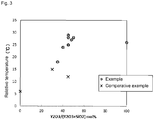
- Y 2 O 3 is an expensive material; it is possible to reduce the amount of Y 2 O 3 used by adding SiO 2 simultaneously. However, when the amount of SiO 2 added is excessively increased, the characteristic of heat resistance that a heater possess is lowered, thus the ratio is set at 65 mol % or less, as described above. With consideration given to the maintenance of the characteristic of the heater and the production cost, it can be said that a more effective range of Y 2 O 3 / (Y 2 O 3 + SiO 2 ) is from 40 to 60 mol %.
- Y 2 SiO 5 at 8 to 12 vol. % can be further contained.
- the powder after synthesis is represented as Y 2 SiO 5 powder.
- (Mo x W 1-x ) Si 2 which is the basic composition of the present invention, can be a solid solution obtained by replacing part of Mo in MoSi 2 with W, whether Mo or W and Si are contained can be estimated by X-ray analysis on a mother phase with an EDX device (device using energy dispersive X-ray spectroscopy) and the like incorporated in a scanning electron microscope (Maker: Hitachi High-Technologies Corporation, device name: S-3000N).
- EDX device device using energy dispersive X-ray spectroscopy
- S-3000N scanning electron microscope
- Y 2 O 3 When Y 2 O 3 is further added, the presence of Y 2 O 3 can be confirmed with the EDX device (device using energy dispersive X-ray spectroscopy) that is attached to the scanning electron microscope (Maker: Hitachi High-Technologies Corporation, device name: S-3000N).
- the EDX device device using energy dispersive X-ray spectroscopy
- S-3000N scanning electron microscope
- Y 2 SiO 5 When Y 2 SiO 5 is added, it is likewise possible to confirm the presence of an oxide including Y and Si and an approximate composition ratio thereof by using the EDX device. However, it is difficult to measure the amount thereof. Hence, the amount of conversion of Y 2 SiO 5 is calculated from the content of Y measured with ICP-OES, and thus it is possible to confirm the added amount.
- the presence of the additive can be confirmed with a scanning electron microscope or the like; and by measuring Mo, W and Y with ICP-OES, it is possible to confirm the basic composition and the amount of each element added. However, it is not possible to measure Si with ICP-OES because it is removed in pretreatment of a sample.
- Al 2 O 3 has a melting point of 2015°C and a thermal expansion coefficient of 7.20 ⁇ 10 -6 1/K
- HfO 2 has a melting point of 2810°C and a thermal expansion coefficient of 3.80 ⁇ 10 -6 1/K.
- the thermal expansion coefficient is not shown with LaB 6 because of the problem present which is described later.
- Y 2 O 3 has a melting point of 2410°C and a thermal expansion coefficient of 7.30 ⁇ 10 -6 1/K; and ZrO 2 has a melting point of 2677°C and a thermal expansion coefficient of 9.20 ⁇ 10 -6 1/K,
- x in (Mo x W 1-x ) Si 2 was set at 0.65.
- the outline of a manufacturing process is shown in Fig. 1 .
- the tungsten-containing molybdenum disilicide (Mo x W 1-x ) Si 2 as a main raw material was prepared, mixed with the additive and subjected to pulverization with an attritor to have the grain diameter being 1 to 3 ⁇ m.
- the amount of additive was set at 8 to 12 vol. % so as to correspond to the electrical characteristics of a MoSi 2 -type heater (hereinafter described as a "conventional heater") used at 1800°C or less.
- a binder was added to the obtained mixture, Henschel mixing was performed thereto.
- the mixture was shaped into a rod which becomes a shape of an original heater, 3 mm to 12 mm in diameter by using an extruder so as to obtain a green material.
- degreasing in an atmosphere of N 2 was performed inside a heating furnace, and primary sintering in an atmosphere of Ar at 1450 to 1550°C or more thereafter was performed.
- the material was removed from the furnace, thereafter secondary sintering, which is current flow sintering in the atmosphere, was performed to produce a heater.
- This step is the same as in the manufacturing process described below. Since these are exemplary, other manufacturing processes may be adopted so as long as the same heater can be produced.
- the characteristics were evaluated by measuring the maximum temperature. With the maximum temperature, a surface temperature was measured at a time when a current flow was applied to the sintered compact. However, since the absolute value of the surface temperature is affected by the open air, it was performed by relative comparison with a "conventional heater.”
- ZrO 2 undergoes phase transition, ZrO 2 at 100 % is not easy to use. Thus, ZrO 2 to which 3 mol % or 20 mol % of Y 2 O 3 was added was used, and it was observed that addition of Y 2 O 3 at 3 mol % was ineffective but at 20 mol % was effective. However, as for the material in that Y 2 O 3 at 20 mol % was added to ZrO 2 , there was a problem that the sintered compact was "chipped" by the increased temperature, and thus, it was considered inappropriate. As a result, the additive of Y 2 O 3 and ZrO 2 is considered to be inappropriate.
- Fig. 2 shows a phase diagram of Y 2 O 3 - SiO 2 .
- the additive amount up to 60 mol % SiO 2 were favorable, and the amount of 65 mol % SiO 2 at most.
- Y 2 O 3 + SiO 2 for example, Y 2 SiO 5 synthesis is performed at 1650°C.
- the results of the maximum temperature of the sintered compact using this method are shown in table 4. Consequently, as shown in test No. 12 in table 4, the maximum temperature increased with respect to the reference temperature (1750°C) by 29°C, which was effective; thus the result as good as those before the synthesis were obtained.
- Y 2 SiO 5 obtained by synthesizing Y 2 O 3 or Y 2 O 3 and SiO 2 has an oxidation resistance characteristic and a low evaporation rate under a high temperature as compared with SiO 2 , and this protects the surface of the tungsten-containing molybdenum disilicide (Mo x W 1-x ) Si 2 and makes it possible to perform the operation at a high temperature.
- Test Number Mo composition x (Mo x W 1 - x )Si 2 Additives MAX temperature 1 1 SiO 2 Reference 7 0.65 Y 2 O 3 + 55 mol%SiO 2 25 12 0.65 Y 2 SiO 5 29
- a binder was further added, and Henschel (the product name "Henschel mixer”: a mixer to mix a raw material by rotating blades in a tank) mixing was performed.
- the mixture was extruded into a rod shape, thereafter degreased in a furnace atmosphere of nitrogen and sintered in argon atmosphere at 1500°C.
- the obtained material was removed from the furnace and thereafter subjected to current flow sintering under the atmosphere.
- the maximum heat generation temperature of the thus obtained sample was measured, it increased by 26°C as compared with a conventional molybdenum disilicide heater. Comparison was made with the reference temperature of 1750°C of a conventional molybdenum disilicide heater.
- a binder was added to the obtained mixture, and Henschel mixing was performed.
- Y 2 SiO 5 used is made from a raw material by previously mixing Y 2 O 3 and SiO 2 at a ratio of 45: 55 (mol %) and synthesizing it at 1650°C or more. A binder was added to the obtained mixture, and Henschel mixing was performed.
- a binder was added to the obtained mixture, and Henschel mixing was performed. Subsequently, the mixture was extruded into a rod shape, thereafter degreased in a furnace atmosphere of nitrogen and sintered in argon atmosphere at 1500°C. The obtained material was removed from the furnace and thereafter subjected to current flow sintering under the atmosphere.
- Y 2 SiO 5 used was made from a raw material by previously mixing Y 2 O 3 and SiO 2 at a ratio of 45 : 55 (mol %) and synthesizing it at 1650°C or more. A binder was added to the obtained mixture, and Henschel mixing was performed.
- Y 2 SiO 5 used was made from a raw material by previously mixing Y 2 O 3 and SiO 2 at a ratio of 45 : 55 (mol %) and synthesizing it at 1650°C or more. A binder was added to the obtained mixture, and Henschel mixing was performed.
- the mixture was extruded into a rod shape, thereafter degreased in a furnace atmosphere of nitrogen and sintered in argon atmosphere at 1500°C.
- the obtained material was removed from the furnace and thereafter subjected to current flow sintering under the atmosphere.
- the maximum heat generation temperature of the thus obtained sample was measured, it increased by 26°C as compared with a conventional molybdenum disilicide heater.
- Y 2 SiO 5 used was made from a raw material by previously mixing Y 2 O 3 and SiO 2 at a ratio of 40 : 60 (mol %) and synthesizing it at 1650°C or more. A binder was added to the obtained mixture, and Henschel mixing was performed.
- the mixture was extruded into a rod shape, thereafter degreased in a furnace atmosphere of nitrogen and sintered in argon atmosphere at 1500°C.
- the obtained material was removed from the furnace and thereafter subjected to current flow sintering under the atmosphere.
- the maximum heat generation temperature of the thus obtained sample was measured, it increased by 24°C as compared with a conventional molybdenum disilicide heater.
- Y 2 SiO 5 used was made from a raw material by previously mixing Y 2 O 3 and SiO 2 at a ratio of 50 : 50 (mol %) and synthesizing it at 1650°C or more. A binder was added to the obtained mixture, and Henschel mixing was performed.
- Y 2 SiO 5 used was made from a raw material by previously mixing Y 2 O 3 and SiO 2 at a ratio of 48: 52 (mol %) and synthesizing it at 1650°C or more. A binder was added to the obtained mixture, and Henschel mixing was performed.
- a binder was added to the obtained mixture, and Henschel mixing was performed. Subsequently, the mixture was extruded into a rod shape, thereafter degreased in a furnace atmosphere of nitrogen and sintered in argon atmosphere at 1500°C. The obtained material was removed from the furnace and thereafter subjected to current flow sintering under the atmosphere.
- a binder was added to the obtained mixture, and Henschel mixing was performed. Subsequently, the mixture was extruded into a rod shape, thereafter degreased in a furnace atmosphere of nitrogen and sintered in argon atmosphere at 1500°C.
- the obtained material was removed from the furnace and thereafter subjected to current flow sintering under the atmosphere.
- the maximum heat generation temperature of the thus obtained sample was measured, it increased by 15°C as compared with a conventional molybdenum disilicide heater. This result was not sufficient compared with those of the examples of the present invention.
- the value in this case, as in example 1, was compared with the reference temperature of 1750°C of a conventional molybdenum disilicide heater.
- Y 2 SiO 5 used was made from a raw material by previously mixing Y 2 O 3 and SiO 2 at a ratio of 45 : 55 mol % and synthesizing it at 1650°C or more. A binder was added to the obtained mixture, and Henschel mixing was performed.
- Mo x W 1-x molybdenum disilicide
- the present invention is able to provide a tungsten-containing molybdenum disilicide heater that has an excellent oxidation resistance characteristic and a low evaporation rate and that can be used at a temperature higher than the conventional molybdenum disilicide heater, and is useful as a heating element (heater) that can be more stable at a high temperature as compared with a conventional heater.
Landscapes
- Chemical & Material Sciences (AREA)
- Engineering & Computer Science (AREA)
- Ceramic Engineering (AREA)
- Manufacturing & Machinery (AREA)
- Materials Engineering (AREA)
- Structural Engineering (AREA)
- Organic Chemistry (AREA)
- Inorganic Chemistry (AREA)
- Resistance Heating (AREA)
- Ceramic Products (AREA)
Claims (6)
- Wolfram-Molybdän-Disilizid-Heizelement, worin Wolfram-Molybdän-Disilizid durch die Zusammensetzungsformel (MoxW1-x) Si2 dargestellt ist, worin x = 0,6 bis 0,7, ferner beinhaltend ein Yttriumoxid oder ein Yttriumsilikat, worin 4,3 bis 6,6 Gew.-% des Yttriumoxids oder des Yttriumsilikats als ein analytischer Wert von Yttrium enthalten sind.
- Wolfram-Molybdän-Disilizid-Heizelement nach Anspruch 1, enthaltend ein Yttriumoxid und ein Siliziumoxid, worin 4,3 bis 6,6 Gew.-% des Yttriumoxids als ein analytischer Wert von Yttrium enthalten sind.
- Verfahren zur Herstellung eines wolframhaltigen Molybdän-Disilizid-Heizelements nach Anspruch 1 oder 2, worin ein Yttriumoxid (Y2O3) zu einem Rohstoffpulver eines wolframhaltigen Molybdän-Disilizids zugesetzt wird, das durch eine Zusammensetzungsformel (MoxW1-x) Si2 dargestellt ist, worin x = 0,6 bis 0,7 und worin das Yttriumoxid(Y2O3)-Pulver mit 8 bis 12 Vol.-% zugesetzt wird;
Pulverisieren und Mischen durchgeführt werden, um eine Mischung davon zu bilden; und danach Stromfluss-Sintern in der Atmosphäre durchgeführt wird. - Verfahren zur Herstellung eines wolframhaltigen Molybdän-Disilizid-Heizelements nach Anspruch 1 oder 2, worin eine Mischung eines Yttriumoxid(Y2O3)-Pulvers und eines Siliziumoxid(SiO2)-Pulvers zu einem Rohstoffpulver eines wolframhaltigen Molybdän-Disilizids zugesetzt wird, das durch eine Zusammensetzungsformel (MoxW1-x) Si2 dargestellt ist, worin x = 0,6 bis 0,7 und worin die Mischung des Yttriumoxids (Y2O3) und des Siliziumoxids (SiO2) mit 8 bis 12 Vol.-% als ein Additiv zugesetzt wird und ein Anteil des Yttriumoxids (Y2O3) in dem Additiv 35 Mol-.% oder mehr beträgt;
Pulverisieren und Mischen durchgeführt werden, um eine Mischung davon zu bilden; und danach Stromfluss-Sintern in der Atmosphäre durchgeführt wird. - Verfahren zur Herstellung eines wolframhaltigen Molybdän-Disilizid-Heizelements nach Anspruch 1 oder 2, worin ein Yttriumsilikat(Y2SiO5)-Pulver zu einem Rohstoffpulver eines wolframhaltigen Molybdän-Disilizids zugesetzt wird, das durch eine Zusammensetzungsformel (MoxW1-x) Si2 dargestellt ist, worin x = 0,6 bis 0,7 und worin das Y2SiO5 mit 8 bis 12 Vol.-% zugesetzt wird und durch Mischen eines Yttriumoxids (Y2O3) und eines Siliziumoxids (SiO2) unter Verwendung von Y2O3 / (Y2O3 + SiO2) = 40 bis 60 Mol.-%, und Erhitzen der Mischung bei 1650 °C oder mehr, synthetisiert wird;
Pulverisieren und Mischen durchgeführt werden, um eine Mischung davon zu bilden; und danach Stromfluss-Sintern in der Atmosphäre durchgeführt wird. - Verfahren nach einem der Ansprüche 3 bis 5, ferner umfassend:Entfetten in einer Atmosphäre von N2 und danach primäres Sintern in einer Atmosphäre von Ar bei 1450 bis 1550 °C oder mehr, bevor das Stromfluss-Sintern durchgeführt wird.
Applications Claiming Priority (2)
| Application Number | Priority Date | Filing Date | Title |
|---|---|---|---|
| JP2015032749A JP6343572B2 (ja) | 2014-03-20 | 2015-02-23 | タングステンを含んだ二珪化モリブデン製ヒーター |
| JP2015057820A JP2016175305A (ja) | 2015-03-20 | 2015-03-20 | 金属箔装飾方法、及び金属箔装飾体 |
Publications (2)
| Publication Number | Publication Date |
|---|---|
| EP2921469A1 EP2921469A1 (de) | 2015-09-23 |
| EP2921469B1 true EP2921469B1 (de) | 2019-01-30 |
Family
ID=53008257
Family Applications (1)
| Application Number | Title | Priority Date | Filing Date |
|---|---|---|---|
| EP15158469.5A Active EP2921469B1 (de) | 2015-02-23 | 2015-03-10 | Wolfram enthaltendes molybdän-disilizid heizelement |
Country Status (1)
| Country | Link |
|---|---|
| EP (1) | EP2921469B1 (de) |
Families Citing this family (1)
| Publication number | Priority date | Publication date | Assignee | Title |
|---|---|---|---|---|
| WO2019185291A1 (de) * | 2018-03-26 | 2019-10-03 | Leister Technologies Ag | Keramischer heizwiderstand, elektrisches heizelement sowie vorrichtung zur erwärmung eines fluides |
Family Cites Families (6)
| Publication number | Priority date | Publication date | Assignee | Title |
|---|---|---|---|---|
| SE504235C2 (sv) | 1995-04-11 | 1996-12-09 | Kanthal Ab | Elektriskt motståndselement av molybdensilicidtyp |
| JPH09132460A (ja) | 1995-11-09 | 1997-05-20 | Riken Corp | タングステン固溶型二珪化モリブデン複合セラミックス及びその製造方法 |
| WO2003087016A1 (en) * | 2002-04-05 | 2003-10-23 | Sandvik Ab | Method of making a heating element of molybdenum silicide type |
| CN100519476C (zh) * | 2005-05-18 | 2009-07-29 | 中钢集团洛阳耐火材料研究院 | 超高温二硅化钼氧化锆复合发热体及其制备方法 |
| JP2009266396A (ja) * | 2008-04-22 | 2009-11-12 | Riken Corp | 二珪化モリブデン系セラミック発熱体 |
| CN101531524B (zh) * | 2009-04-23 | 2012-12-05 | 宜兴市荣利钨钼制品有限公司 | 一种超高温硅钼棒制造方法 |
-
2015
- 2015-03-10 EP EP15158469.5A patent/EP2921469B1/de active Active
Non-Patent Citations (1)
| Title |
|---|
| None * |
Also Published As
| Publication number | Publication date |
|---|---|
| EP2921469A1 (de) | 2015-09-23 |
Similar Documents
| Publication | Publication Date | Title |
|---|---|---|
| KR102039014B1 (ko) | 복합 세라믹 및 반도체 제조장치의 구성 부재 | |
| KR101412404B1 (ko) | 산화물 소결체, 산화물 소결체로 이루어지는 스퍼터링 타깃, 산화물 소결체의 제조 방법 및 산화물 소결체 스퍼터링 타깃 게이트의 제조 방법 | |
| JP6823939B2 (ja) | サーミスタ材料及びその製造方法 | |
| JP6343572B2 (ja) | タングステンを含んだ二珪化モリブデン製ヒーター | |
| EP2921469B1 (de) | Wolfram enthaltendes molybdän-disilizid heizelement | |
| JP2940486B2 (ja) | 電圧非直線抵抗体、電圧非直線抵抗体の製造方法および避雷器 | |
| Gu et al. | Solubility of Si3N4 in liquid SiO2 | |
| CN102227781A (zh) | 基于氧化锡的电极组合物 | |
| KR100518906B1 (ko) | 질화알루미늄 재료 및 반도체 제조용 부재 | |
| JP2013534508A (ja) | コバルトフリーntcセラミックおよびコバルトフリーntcセラミックを製造する方法 | |
| JPWO2012029956A1 (ja) | 誘電体磁器、その製造方法、及び誘電体共振器 | |
| JP5140450B2 (ja) | サーミスタ素子及び温度センサ | |
| US10056174B2 (en) | Thermistor material for a short range of low temperature use and method of manufacturing the same | |
| JP4604247B2 (ja) | テルビウム・ビスマス・タングステン酸化物固溶体からなる電気伝導材料及びその製造方法 | |
| JP2020161759A (ja) | サーミスタ材料 | |
| JP2020057719A (ja) | サーミスタ材料及びその製造方法 | |
| KR102313589B1 (ko) | 질화알루미늄 세라믹스 조성물의 제조방법 | |
| Mrooz et al. | Aging of copper-nickel-cobalt manganite NTC thermistors [Cu/sub 0.1/Ni/sub 0.8/Co/sub 0.2/Mn/sub 1.9/O/sub 4/] | |
| JP3956676B2 (ja) | 電圧依存性非直線抵抗体磁器の製造方法 | |
| JP5603765B2 (ja) | 炭化ケイ素発熱体の製造方法および炭化ケイ素発熱体ならびにハニカムの製造方法およびハニカム | |
| JP2019106497A (ja) | ワイドレンジサーミスタ材料及びその製造方法 | |
| JP2647347B2 (ja) | 窒化アルミニウム焼結体放熱板の製造方法 | |
| JPH05226795A (ja) | 窒化アルミニウム基板の製造方法 | |
| JP2647346B2 (ja) | 窒化アルミニウム焼結体放熱板の製造方法 | |
| JPH0380502A (ja) | サーミスタ材料およびサーミスタ素子 |
Legal Events
| Date | Code | Title | Description |
|---|---|---|---|
| PUAI | Public reference made under article 153(3) epc to a published international application that has entered the european phase |
Free format text: ORIGINAL CODE: 0009012 |
|
| AK | Designated contracting states |
Kind code of ref document: A1 Designated state(s): AL AT BE BG CH CY CZ DE DK EE ES FI FR GB GR HR HU IE IS IT LI LT LU LV MC MK MT NL NO PL PT RO RS SE SI SK SM TR |
|
| AX | Request for extension of the european patent |
Extension state: BA ME |
|
| 17P | Request for examination filed |
Effective date: 20160210 |
|
| RBV | Designated contracting states (corrected) |
Designated state(s): AL AT BE BG CH CY CZ DE DK EE ES FI FR GB GR HR HU IE IS IT LI LT LU LV MC MK MT NL NO PL PT RO RS SE SI SK SM TR |
|
| STAA | Information on the status of an ep patent application or granted ep patent |
Free format text: STATUS: EXAMINATION IS IN PROGRESS |
|
| 17Q | First examination report despatched |
Effective date: 20180508 |
|
| REG | Reference to a national code |
Ref country code: DE Ref legal event code: R079 Ref document number: 602015023861 Country of ref document: DE Free format text: PREVIOUS MAIN CLASS: C04B0035580000 Ipc: H05B0003140000 |
|
| GRAP | Despatch of communication of intention to grant a patent |
Free format text: ORIGINAL CODE: EPIDOSNIGR1 |
|
| STAA | Information on the status of an ep patent application or granted ep patent |
Free format text: STATUS: GRANT OF PATENT IS INTENDED |
|
| INTG | Intention to grant announced |
Effective date: 20181109 |
|
| RIC1 | Information provided on ipc code assigned before grant |
Ipc: C04B 35/632 20060101ALI20181026BHEP Ipc: C04B 35/638 20060101ALI20181026BHEP Ipc: C04B 35/58 20060101ALI20181026BHEP Ipc: H05B 3/14 20060101AFI20181026BHEP |
|
| GRAS | Grant fee paid |
Free format text: ORIGINAL CODE: EPIDOSNIGR3 |
|
| GRAA | (expected) grant |
Free format text: ORIGINAL CODE: 0009210 |
|
| STAA | Information on the status of an ep patent application or granted ep patent |
Free format text: STATUS: THE PATENT HAS BEEN GRANTED |
|
| AK | Designated contracting states |
Kind code of ref document: B1 Designated state(s): AL AT BE BG CH CY CZ DE DK EE ES FI FR GB GR HR HU IE IS IT LI LT LU LV MC MK MT NL NO PL PT RO RS SE SI SK SM TR |
|
| REG | Reference to a national code |
Ref country code: GB Ref legal event code: FG4D |
|
| REG | Reference to a national code |
Ref country code: CH Ref legal event code: EP |
|
| REG | Reference to a national code |
Ref country code: AT Ref legal event code: REF Ref document number: 1094233 Country of ref document: AT Kind code of ref document: T Effective date: 20190215 |
|
| REG | Reference to a national code |
Ref country code: IE Ref legal event code: FG4D |
|
| REG | Reference to a national code |
Ref country code: DE Ref legal event code: R096 Ref document number: 602015023861 Country of ref document: DE |
|
| REG | Reference to a national code |
Ref country code: SE Ref legal event code: TRGR |
|
| REG | Reference to a national code |
Ref country code: LT Ref legal event code: MG4D |
|
| REG | Reference to a national code |
Ref country code: NL Ref legal event code: MP Effective date: 20190130 |
|
| PG25 | Lapsed in a contracting state [announced via postgrant information from national office to epo] |
Ref country code: NL Free format text: LAPSE BECAUSE OF FAILURE TO SUBMIT A TRANSLATION OF THE DESCRIPTION OR TO PAY THE FEE WITHIN THE PRESCRIBED TIME-LIMIT Effective date: 20190130 Ref country code: PT Free format text: LAPSE BECAUSE OF FAILURE TO SUBMIT A TRANSLATION OF THE DESCRIPTION OR TO PAY THE FEE WITHIN THE PRESCRIBED TIME-LIMIT Effective date: 20190530 Ref country code: FI Free format text: LAPSE BECAUSE OF FAILURE TO SUBMIT A TRANSLATION OF THE DESCRIPTION OR TO PAY THE FEE WITHIN THE PRESCRIBED TIME-LIMIT Effective date: 20190130 Ref country code: NO Free format text: LAPSE BECAUSE OF FAILURE TO SUBMIT A TRANSLATION OF THE DESCRIPTION OR TO PAY THE FEE WITHIN THE PRESCRIBED TIME-LIMIT Effective date: 20190430 Ref country code: PL Free format text: LAPSE BECAUSE OF FAILURE TO SUBMIT A TRANSLATION OF THE DESCRIPTION OR TO PAY THE FEE WITHIN THE PRESCRIBED TIME-LIMIT Effective date: 20190130 Ref country code: LT Free format text: LAPSE BECAUSE OF FAILURE TO SUBMIT A TRANSLATION OF THE DESCRIPTION OR TO PAY THE FEE WITHIN THE PRESCRIBED TIME-LIMIT Effective date: 20190130 Ref country code: ES Free format text: LAPSE BECAUSE OF FAILURE TO SUBMIT A TRANSLATION OF THE DESCRIPTION OR TO PAY THE FEE WITHIN THE PRESCRIBED TIME-LIMIT Effective date: 20190130 |
|
| REG | Reference to a national code |
Ref country code: AT Ref legal event code: MK05 Ref document number: 1094233 Country of ref document: AT Kind code of ref document: T Effective date: 20190130 |
|
| PG25 | Lapsed in a contracting state [announced via postgrant information from national office to epo] |
Ref country code: IS Free format text: LAPSE BECAUSE OF FAILURE TO SUBMIT A TRANSLATION OF THE DESCRIPTION OR TO PAY THE FEE WITHIN THE PRESCRIBED TIME-LIMIT Effective date: 20190530 Ref country code: HR Free format text: LAPSE BECAUSE OF FAILURE TO SUBMIT A TRANSLATION OF THE DESCRIPTION OR TO PAY THE FEE WITHIN THE PRESCRIBED TIME-LIMIT Effective date: 20190130 Ref country code: GR Free format text: LAPSE BECAUSE OF FAILURE TO SUBMIT A TRANSLATION OF THE DESCRIPTION OR TO PAY THE FEE WITHIN THE PRESCRIBED TIME-LIMIT Effective date: 20190501 Ref country code: RS Free format text: LAPSE BECAUSE OF FAILURE TO SUBMIT A TRANSLATION OF THE DESCRIPTION OR TO PAY THE FEE WITHIN THE PRESCRIBED TIME-LIMIT Effective date: 20190130 Ref country code: LV Free format text: LAPSE BECAUSE OF FAILURE TO SUBMIT A TRANSLATION OF THE DESCRIPTION OR TO PAY THE FEE WITHIN THE PRESCRIBED TIME-LIMIT Effective date: 20190130 Ref country code: BG Free format text: LAPSE BECAUSE OF FAILURE TO SUBMIT A TRANSLATION OF THE DESCRIPTION OR TO PAY THE FEE WITHIN THE PRESCRIBED TIME-LIMIT Effective date: 20190430 |
|
| PG25 | Lapsed in a contracting state [announced via postgrant information from national office to epo] |
Ref country code: CZ Free format text: LAPSE BECAUSE OF FAILURE TO SUBMIT A TRANSLATION OF THE DESCRIPTION OR TO PAY THE FEE WITHIN THE PRESCRIBED TIME-LIMIT Effective date: 20190130 Ref country code: IT Free format text: LAPSE BECAUSE OF FAILURE TO SUBMIT A TRANSLATION OF THE DESCRIPTION OR TO PAY THE FEE WITHIN THE PRESCRIBED TIME-LIMIT Effective date: 20190130 Ref country code: RO Free format text: LAPSE BECAUSE OF FAILURE TO SUBMIT A TRANSLATION OF THE DESCRIPTION OR TO PAY THE FEE WITHIN THE PRESCRIBED TIME-LIMIT Effective date: 20190130 Ref country code: EE Free format text: LAPSE BECAUSE OF FAILURE TO SUBMIT A TRANSLATION OF THE DESCRIPTION OR TO PAY THE FEE WITHIN THE PRESCRIBED TIME-LIMIT Effective date: 20190130 Ref country code: DK Free format text: LAPSE BECAUSE OF FAILURE TO SUBMIT A TRANSLATION OF THE DESCRIPTION OR TO PAY THE FEE WITHIN THE PRESCRIBED TIME-LIMIT Effective date: 20190130 Ref country code: AL Free format text: LAPSE BECAUSE OF FAILURE TO SUBMIT A TRANSLATION OF THE DESCRIPTION OR TO PAY THE FEE WITHIN THE PRESCRIBED TIME-LIMIT Effective date: 20190130 Ref country code: MC Free format text: LAPSE BECAUSE OF FAILURE TO SUBMIT A TRANSLATION OF THE DESCRIPTION OR TO PAY THE FEE WITHIN THE PRESCRIBED TIME-LIMIT Effective date: 20190130 Ref country code: SK Free format text: LAPSE BECAUSE OF FAILURE TO SUBMIT A TRANSLATION OF THE DESCRIPTION OR TO PAY THE FEE WITHIN THE PRESCRIBED TIME-LIMIT Effective date: 20190130 |
|
| REG | Reference to a national code |
Ref country code: CH Ref legal event code: PL Ref country code: DE Ref legal event code: R097 Ref document number: 602015023861 Country of ref document: DE |
|
| PG25 | Lapsed in a contracting state [announced via postgrant information from national office to epo] |
Ref country code: SM Free format text: LAPSE BECAUSE OF FAILURE TO SUBMIT A TRANSLATION OF THE DESCRIPTION OR TO PAY THE FEE WITHIN THE PRESCRIBED TIME-LIMIT Effective date: 20190130 Ref country code: LU Free format text: LAPSE BECAUSE OF NON-PAYMENT OF DUE FEES Effective date: 20190310 |
|
| REG | Reference to a national code |
Ref country code: BE Ref legal event code: MM Effective date: 20190331 |
|
| PLBE | No opposition filed within time limit |
Free format text: ORIGINAL CODE: 0009261 |
|
| STAA | Information on the status of an ep patent application or granted ep patent |
Free format text: STATUS: NO OPPOSITION FILED WITHIN TIME LIMIT |
|
| GBPC | Gb: european patent ceased through non-payment of renewal fee |
Effective date: 20190430 |
|
| PG25 | Lapsed in a contracting state [announced via postgrant information from national office to epo] |
Ref country code: AT Free format text: LAPSE BECAUSE OF FAILURE TO SUBMIT A TRANSLATION OF THE DESCRIPTION OR TO PAY THE FEE WITHIN THE PRESCRIBED TIME-LIMIT Effective date: 20190130 |
|
| 26N | No opposition filed |
Effective date: 20191031 |
|
| PG25 | Lapsed in a contracting state [announced via postgrant information from national office to epo] |
Ref country code: LI Free format text: LAPSE BECAUSE OF NON-PAYMENT OF DUE FEES Effective date: 20190331 Ref country code: IE Free format text: LAPSE BECAUSE OF NON-PAYMENT OF DUE FEES Effective date: 20190310 Ref country code: GB Free format text: LAPSE BECAUSE OF NON-PAYMENT OF DUE FEES Effective date: 20190430 Ref country code: CH Free format text: LAPSE BECAUSE OF NON-PAYMENT OF DUE FEES Effective date: 20190331 |
|
| PG25 | Lapsed in a contracting state [announced via postgrant information from national office to epo] |
Ref country code: FR Free format text: LAPSE BECAUSE OF NON-PAYMENT OF DUE FEES Effective date: 20190330 Ref country code: SI Free format text: LAPSE BECAUSE OF FAILURE TO SUBMIT A TRANSLATION OF THE DESCRIPTION OR TO PAY THE FEE WITHIN THE PRESCRIBED TIME-LIMIT Effective date: 20190130 Ref country code: BE Free format text: LAPSE BECAUSE OF NON-PAYMENT OF DUE FEES Effective date: 20190331 |
|
| PG25 | Lapsed in a contracting state [announced via postgrant information from national office to epo] |
Ref country code: TR Free format text: LAPSE BECAUSE OF FAILURE TO SUBMIT A TRANSLATION OF THE DESCRIPTION OR TO PAY THE FEE WITHIN THE PRESCRIBED TIME-LIMIT Effective date: 20190130 |
|
| PG25 | Lapsed in a contracting state [announced via postgrant information from national office to epo] |
Ref country code: MT Free format text: LAPSE BECAUSE OF NON-PAYMENT OF DUE FEES Effective date: 20190310 |
|
| PG25 | Lapsed in a contracting state [announced via postgrant information from national office to epo] |
Ref country code: CY Free format text: LAPSE BECAUSE OF FAILURE TO SUBMIT A TRANSLATION OF THE DESCRIPTION OR TO PAY THE FEE WITHIN THE PRESCRIBED TIME-LIMIT Effective date: 20190130 |
|
| PG25 | Lapsed in a contracting state [announced via postgrant information from national office to epo] |
Ref country code: HU Free format text: LAPSE BECAUSE OF FAILURE TO SUBMIT A TRANSLATION OF THE DESCRIPTION OR TO PAY THE FEE WITHIN THE PRESCRIBED TIME-LIMIT; INVALID AB INITIO Effective date: 20150310 |
|
| PG25 | Lapsed in a contracting state [announced via postgrant information from national office to epo] |
Ref country code: MK Free format text: LAPSE BECAUSE OF FAILURE TO SUBMIT A TRANSLATION OF THE DESCRIPTION OR TO PAY THE FEE WITHIN THE PRESCRIBED TIME-LIMIT Effective date: 20190130 |
|
| P01 | Opt-out of the competence of the unified patent court (upc) registered |
Effective date: 20230517 |
|
| PGFP | Annual fee paid to national office [announced via postgrant information from national office to epo] |
Ref country code: SE Payment date: 20260211 Year of fee payment: 12 |
|
| PGFP | Annual fee paid to national office [announced via postgrant information from national office to epo] |
Ref country code: DE Payment date: 20260128 Year of fee payment: 12 |