EP2922178A2 - Moteur - Google Patents
Moteur Download PDFInfo
- Publication number
- EP2922178A2 EP2922178A2 EP15151623.4A EP15151623A EP2922178A2 EP 2922178 A2 EP2922178 A2 EP 2922178A2 EP 15151623 A EP15151623 A EP 15151623A EP 2922178 A2 EP2922178 A2 EP 2922178A2
- Authority
- EP
- European Patent Office
- Prior art keywords
- magnet
- pair
- flux
- corner
- magnets
- Prior art date
- Legal status (The legal status is an assumption and is not a legal conclusion. Google has not performed a legal analysis and makes no representation as to the accuracy of the status listed.)
- Granted
Links
Images





Classifications
-
- H—ELECTRICITY
- H02—GENERATION; CONVERSION OR DISTRIBUTION OF ELECTRIC POWER
- H02K—DYNAMO-ELECTRIC MACHINES
- H02K1/00—Details of the magnetic circuit
- H02K1/06—Details of the magnetic circuit characterised by the shape, form or construction
- H02K1/22—Rotating parts of the magnetic circuit
- H02K1/27—Rotor cores with permanent magnets
- H02K1/2706—Inner rotors
- H02K1/272—Inner rotors the magnetisation axis of the magnets being perpendicular to the rotor axis
- H02K1/274—Inner rotors the magnetisation axis of the magnets being perpendicular to the rotor axis the rotor consisting of two or more circumferentially positioned magnets
- H02K1/2753—Inner rotors the magnetisation axis of the magnets being perpendicular to the rotor axis the rotor consisting of two or more circumferentially positioned magnets the rotor consisting of magnets or groups of magnets arranged with alternating polarity
- H02K1/276—Magnets embedded in the magnetic core, e.g. interior permanent magnets [IPM]
- H02K1/2766—Magnets embedded in the magnetic core, e.g. interior permanent magnets [IPM] having a flux concentration effect
- H02K1/2773—Magnets embedded in the magnetic core, e.g. interior permanent magnets [IPM] having a flux concentration effect consisting of tangentially magnetized radial magnets
-
- H—ELECTRICITY
- H02—GENERATION; CONVERSION OR DISTRIBUTION OF ELECTRIC POWER
- H02K—DYNAMO-ELECTRIC MACHINES
- H02K1/00—Details of the magnetic circuit
- H02K1/06—Details of the magnetic circuit characterised by the shape, form or construction
- H02K1/22—Rotating parts of the magnetic circuit
- H02K1/27—Rotor cores with permanent magnets
- H02K1/2706—Inner rotors
- H02K1/272—Inner rotors the magnetisation axis of the magnets being perpendicular to the rotor axis
- H02K1/274—Inner rotors the magnetisation axis of the magnets being perpendicular to the rotor axis the rotor consisting of two or more circumferentially positioned magnets
- H02K1/2753—Inner rotors the magnetisation axis of the magnets being perpendicular to the rotor axis the rotor consisting of two or more circumferentially positioned magnets the rotor consisting of magnets or groups of magnets arranged with alternating polarity
- H02K1/276—Magnets embedded in the magnetic core, e.g. interior permanent magnets [IPM]
- H02K1/2766—Magnets embedded in the magnetic core, e.g. interior permanent magnets [IPM] having a flux concentration effect
-
- H—ELECTRICITY
- H02—GENERATION; CONVERSION OR DISTRIBUTION OF ELECTRIC POWER
- H02K—DYNAMO-ELECTRIC MACHINES
- H02K2213/00—Specific aspects, not otherwise provided for and not covered by codes H02K2201/00 - H02K2211/00
- H02K2213/03—Machines characterised by numerical values, ranges, mathematical expressions or similar information
Definitions
- the present invention relates to an electric motor.
- a spoke-type interior permanent magnet (IPM) motor in which magnets each having a rectangular cross section perpendicular to a central axis of the motor are arranged in a radial manner in a rotor core, is known.
- each magnet is magnetized such that long-side surfaces of the magnet have magnetic poles, and magnetic poles of the same polarity are arranged opposite to each other between circumferentially adjacent ones of the magnets.
- flux barriers are provided to direct magnetic flux toward a stationary portion of the motor, so that operating efficiency is improved.
- flux barriers which are cut portions each of which has a circumferential extent are provided between an outer circumference of a rotor and a radially outer end portion of each of permanent magnets.
- flux barriers which are a pair of holes are provided at a radially inner end portion of each magnet.
- spaces are arranged radially inside each of permanent magnets arranged in a spoke-like configuration such that the spaces adjoin two radially inner corners of each magnet.
- a motor includes a rotating portion arranged to rotate about a central axis; a stationary portion arranged around the rotating portion; and a bearing mechanism arranged to rotatably support the rotating portion.
- the rotating portion includes a plurality of magnets arranged in a circumferential direction, and a rotor core arranged to hold the plurality of magnets.
- the rotor core includes flux barriers defined therein, the flux barriers including first flux barrier pairs each of which includes a pair of the flux barriers.
- the plurality of magnets include two or more magnet pairs. Each of the plurality of magnets includes a pair of long sides and a pair of short sides in a cross section perpendicular to the central axis.
- the pair of long sides are magnetized to have mutually different polarities.
- magnetic poles of a same polarity are arranged circumferentially opposite to each other, and a center line between the pair of long sides of one of the magnets and a center line between the pair of long sides of the other magnet intersect each other at the central axis or at a point between the central axis and the magnet pair in a cross section perpendicular to the central axis.
- a corner of each of the magnets of each magnet pair, the corner lying on a short-side side closer to the central axis and on a side closer to the other magnet of the magnet pair, is arranged in a separate one of the flux barriers defined in the rotor core.
- the rotor core further includes an outer core portion arranged radially outside of the first flux barrier pairs, each first flux barrier pair adjoining a separate one of the magnet pairs; an inner core portion arranged radially inside of the first flux barrier pairs; and a joining portion arranged to join the outer core portion and the inner core portion to each other between the pair of the flux barriers of each of the first flux barrier pairs.
- the joining portion is arranged to have a minimum circumferential width smaller than a length of each short side.
- a vertical direction is defined as a direction in which a central axis of a motor extends, and that an upper side and a lower side along the central axis in Fig. 1 are referred to simply as an upper side and a lower side, respectively. It should be noted, however, that the above definitions of the vertical direction and the upper and lower sides should not be construed to restrict relative positions or directions of different members or portions when the motor is actually installed in a device.
- axial direction a direction parallel to the central axis
- radial direction a direction parallel to the central axis
- radial direction a direction parallel to the central axis
- radial direction a direction parallel to the central axis
- radial direction a direction parallel to the central axis
- radial direction a direction parallel to the central axis
- radial direction a direction parallel to the central axis
- radial direction centered on the central axis
- circumferential direction a circumferential direction about the central axis
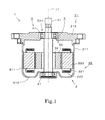
- FIG. 1 is a vertical cross-sectional view of a motor 1 according to a preferred embodiment of the present invention.
- the motor 1 is a rotary electrical machine.
- the motor 1 is of an inner-rotor type.
- the motor 1 includes a stationary portion 2, a rotating portion 3, and a bearing mechanism 4.
- the bearing mechanism 4 is arranged to support the rotating portion 3 such that the rotating portion 3 is rotatable about a central axis J1 of the motor 1 with respect to the stationary portion 2.
- the stationary portion 2 is arranged around the rotating portion 3.
- the stationary portion 2 includes a housing 21 and a stator 22.
- the housing 21 includes a housing member 211 and a cover member 212.
- the housing member 211 has a bottom and is substantially cylindrical.
- the housing member 211 includes a cylindrical portion 511 and a bottom portion 512.
- the cover member 212 is substantially rectangular, and is attached to a top portion of the cylindrical portion 511.
- the cover member 212 includes an opening 521 in a center thereof.
- the stator 22 includes a stator core 223, an insulator 221, and coils 222. Teeth of the stator core 223 are covered with the insulator 221.
- Each coil 222 is arranged on the insulator 221.
- the rotating portion 3 is caused to rotate about the central axis J1 through supply of power to the stationary portion 2.
- the bearing mechanism 4 includes two bearings 41.
- each bearing 41 is a ball bearing.
- the bearings 41 may alternatively have another structure.
- One of the bearings 41 is fixed to the cover member 212 in the opening 521.
- the other bearing 41 is fixed to the bottom portion 512.
- the rotating portion 3 includes a shaft 31, a rotor core 32, and a plurality of magnets 33.
- the shaft 31 is centered on the central axis J1.
- the shaft 31 is supported through the bearing mechanism 4 to be rotatable about the central axis J1.
- the rotor core 32 is substantially cylindrical, and is fixed to an outer circumference of the shaft 31.
- Each magnet 33 is a permanent magnet.
- the rotor core 32 is arranged radially inside of the stator 22. An outer circumferential surface of the rotor core 32 is arranged in proximity to an inner circumferential surface of the stator 22.
- FIG. 2 is a plan view illustrating the stator core 223, the rotor core 32, and the magnets 33.
- the stator core 223 includes a plurality of teeth 531 and a core back 532.
- the core back 532 is annular and is centered on the central axis J1.
- Each of the teeth 531 is arranged to extend radially inward from the core back 532 toward the rotor core 32.
- the stator core 223 is defined by laminated electromagnetic steel sheets.
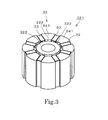
- FIG. 3 is a perspective view illustrating the rotor core 32 and the magnets 33.
- the rotor core 32 is defined by laminated electromagnetic steel sheets.
- the rotor core 32 includes an outer core portion 321, an inner core portion 322, and a plurality of joining portions 323.
- the outer core portion 321 includes a plurality of outer core elements 541.
- the outer core elements 541 are arranged in a circumferential direction.
- the inner core portion 322 is arranged radially inside of the outer core portion 321.
- Each outer core element 541 is joined to the inner core portion 322 through one of the joining portions 323.
- Each joining portion 323 is arranged to extend in a radial direction.
- the outer core portion 321, the inner core portion 322, and the joining portions 323 are defined by a single continuous monolithic member.
- each outer core element 541 is convex, with a circumferential middle thereof being radially outward of both circumferential ends thereof.
- the outer circumferential surface of each outer core element 541 is arranged to have a radius of curvature smaller than a maximum radius of the outer core portion 321.
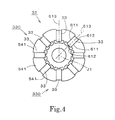
- FIG. 4 is a plan view of the rotor core 32 and the magnets 33.
- the magnets 33 are arranged between the outer core elements 541.
- the magnets 33 are arranged at regular intervals in the circumferential direction.
- the rotor core 32 is arranged to hold each magnet 33.
- Each magnet 33 includes a pair of long sides 611 and a pair of short sides 612 in a cross section perpendicular to the central axis J1.
- a center line 613 between the pair of long sides 611 of each magnet 33 passes through the central axis J1. That is, the center lines 613 of all the magnets 33 intersect one another at the central axis J1.
- the motor 1 is a spoke-type IPM motor.
- the pair of long sides 611 of each magnet 33 are magnetized to have mutually different polarities. Between adjacent ones of the magnets 33, magnetic poles of the same polarity are arranged circumferentially opposite to each other. This arrangement causes some magnetic lines of flux to be directed radially outwardly of the rotor core 32 from the long sides 611 opposed to each other through the outer circumferential surface of the outer core element 541 between the long sides 611, and then to enter back into the rotor core 32 through the outer circumferential surfaces of the adjacent outer core elements 541 on both sides to enter opposite magnetic poles. Of the plurality of magnets 33, pairs of two adjacent magnets 33, each pair having an identical structure, are repetitively arranged in the circumferential direction.
- each of such pairs of two adjacent magnets 33 will be hereinafter referred to as a "magnet pair" 330.
- a magnet pair 330
- four such magnet pairs 330 are arranged in the circumferential direction.
- Each outer core element 541 functions as a magnetic pole portion in relation to the stator 22.
- FIG. 5 is a diagram illustrating the rotor core 32 and the magnets 33 in an enlarged form.
- the outer core portion 321 and the inner core portion 322 are joined to each other through the plurality of joining portions 323.
- Flux barriers 62 are arranged on both circumferential sides of each joining portion 323 between the outer core element 541 and the inner core portion 322.
- Each flux barrier 62 is a space in which neither any portion of the rotor core 32 nor any portion of any magnet 33 exists.
- the outer core portion 321 is arranged radially outside of the flux barriers 62, while the inner core portion 322 is arranged radially inside of the flux barriers 62.
- each joining portion 323 is arranged between a pair of the flux barriers 62 between a separate pair of adjacent ones of the magnets 33.
- each flux barrier 62 is an air space. Because the air space has a magnetic permeability lower than that of the rotor core 32, each flux barrier 62 interferes with flow of magnetic flux.
- each flux barrier 62 may not necessarily be a space in which air exists, as long as the flux barrier 62 is a space that has a magnetic reluctance greater than that of any other portion of the rotor core 32.
- a substance other than air may exist in each flux barrier 62. The same is true of any other flux barrier described below.
- each magnet support portion 542 is arranged between two of the flux barriers 62 which adjoin each magnet 33.
- each magnet support portion 542 is assumed to be a portion of the inner core portion 322.
- the entire inner core portion 322 excluding the magnet support portions 542 will be hereinafter referred to as an "inner core cylindrical portion" 543.
- Each magnet support portion 542 is arranged to project radially outward from the inner core cylindrical portion 543, and a top of the magnet support portion 542 is arranged to be in contact with the short side 612 of a corresponding one of the magnets 33.
- the flux barriers 62 are spaces surrounded by the outer core elements 541, the joining portions 323, the inner core cylindrical portion 543, the magnets 33 and the magnet support portions 542.
- FIG. 6 is a diagram illustrating some of the flux barriers 62 and their vicinity. Since each corner 614 of each magnet 33 is arranged in one of the flux barriers 62, end points of a boundary between the flux barrier 62 and the magnet 33 lie on one of the long sides 611 which includes the corner 614 and one of the short sides 612 which includes the corner 614. Regarding each flux barrier 62, the length L1 of a portion of the long side 611 which lies in the flux barrier 62 is shorter than the length L2 of a portion of the short side 612 which lies in the flux barrier 62.
- a reduction in an extent to which the long side 611 is exposed in the flux barrier 62 makes it possible to efficiently direct magnetic flux from the magnet 33 into the outer core element 541 while reducing a leakage of magnetic flux into the flux barrier 62. Meanwhile, an increase in an extent to which the short side 612 is exposed in the flux barrier 62 contributes to reducing flow of magnetic flux toward the short side 612.
- the output in question here may be either a torque or the amount of energy per unit time.
- the flux barriers 62 can be easily provided when the corners 614 of the magnets 33 are arranged in the flux barriers 62.
- the length L1 of the portion of the long side 611 which lies in the flux barrier 62 were too short, a leakage of the magnetic flux into the flux barrier 62 would be significant. Therefore, the length L1 is preferably arranged to be in the range of 10% inclusive to 20% exclusive of the length of the long side 611.
- the length W1 (hereinafter referred to as the "contact length" W1 as appropriate) of an area over which the magnet support portion 542 and the short side 612 are in contact with each other decreases.
- the contact length W1 does not need to be extremely reduced, because performance of the motor 1 is not significantly affected by an increase in the contact length W1.
- the contact length W1 should have a reasonable magnitude so that the magnet 33 can be supported from radially inward.
- the contact length W1 refers to the length of the area over which the magnet support portion 542 and the short side 612 are actually in contact with each other, and does not refer to a maximum width of the magnet support portion 542.
- the contact length W1 is preferably arranged to be half or less than half the length of the short side 612.
- each joining portion 323 should have a small width in order to reduce flow of magnetic flux into the inner core portion 322.
- a small width of the joining portion 323 makes it easier for the joining portion 323 to reach magnetic saturation to block additional magnetic flux.
- the minimum width W2 of the joining portion 323 as measured in the circumferential direction that is, the minimum width of the joining portion 323 as measured in a direction perpendicular to a center line of the joining portion 323 extending in a radial direction, is preferably arranged to be equal to or smaller than the length of the short side 612.
- the minimum width W2 can be made significantly smaller than the length of the short side 612, and the minimum width W2 is more preferably arranged to be half or less than half the length of the short side 612. This arrangement makes it possible to achieve a reduction in the size of the motor 1 with a limited reduction in the output of the motor 1.
- Each joining portion 323 is preferably elongated, and is arranged to have a radial dimension greater than the circumferential width thereof.
- the radial dimension of the joining portion 323 corresponds to the radial width of the flux barrier 62, and that the circumferential width of the joining portion 323 is the minimum width W2.
- the minimum width W2 of the joining portion 323 is preferably smaller than the contact length W1, i.e., the length of the area over which the magnet support portion 542 and the short side 612 are in contact with each other, since the minimum width W2 of the joining portion 323 produces a greater effect on unwanted flow of magnetic flux than does the contact length W1.
- the joining portion 323 reaches magnetic saturation because of magnetic flux passing from the outer core portion 321 to the inner core portion 322 or magnetic flux passing from the inner core portion 322 to the outer core portion 321, and magnetic lines of flux are greatly directed radially outwardly of the outer core element 541 without permitting magnetic lines of flux to pass from the long side 611 of the magnet 33 to the inner core portion 322. This results in an improvement in the output of the motor 1.
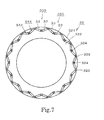
- FIG. 7 is a plan view illustrating a rotor core 32 and magnets 33 according to another preferred embodiment of the present invention.
- sixteen pairs of magnets 33 are provided, that is, the number of magnets 33 is thirty-two.
- a stator not shown includes a greater number of teeth than the number of teeth 531 in FIG. 2 .
- the rotor core 32 includes an inner core portion 322, an outer core portion 321, a plurality of first joining portions 324, and a plurality of second joining portions 325.
- the structure of a motor according to this preferred embodiment of the present invention is similar to the structure of the motor 1 illustrated in FIG. 1 except in that the shape of the rotor core 32 and arrangement of the magnets 33 are different.
- the outer core portion 321 is arranged radially outside of the inner core portion 322.
- the outer core portion 321 and the inner core portion 322 are joined to each other through the plurality of first joining portions 324 and the plurality of second joining portions 325.
- the outer core portion 321, the inner core portion 322, the first joining portions 324, and the second joining portions 325 are defined by a single continuous monolithic member.
- the magnets 33 are inserted in magnet holding holes 544 defined in the rotor core 32. Each magnet holding hole 544 extends in an axial direction.
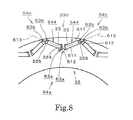
- FIG. 8 is a diagram illustrating a portion of the rotor core 32 and some of the magnets 33 in an enlarged form.
- each magnet 33 includes a pair of long sides 611 and a pair of short sides 612 in a cross section perpendicular to a central axis J1.
- the pair of long sides 611 of each magnet 33 are magnetized to have mutually different polarities.
- magnetic poles of the same polarity are arranged circumferentially opposite to each other.
- magnetic poles of opposite polarities are arranged circumferentially opposite to each other. Accordingly, when the rotor core 32 is viewed from radially outside, the polarity of magnetic poles facing radially outward and arranged in the circumferential direction is reversed every magnet pair 330.
- each magnet pair 330 a center line 613 between the pair of long sides 611 of one of the magnets 33 and a center line 613 between the pair of long sides 611 of the other magnet 33 intersect each other at a point between the central axis J1 and the magnet pair 330 in a cross section perpendicular to the central axis J1. That is, each magnet pair 330 is arranged in the shape of the letter "V", with two arms of the letter "V" being open more widely than they would be if they extended in radial directions centered on the central axis J1.
- Flux barriers 63a and 63b are arranged near both short sides 612 of each magnet 33.
- the flux barriers 63a arranged between the two magnets 33 which together define each magnet pair 330 will be hereinafter referred to as “first flux barriers” 63a, while the flux barriers 63b arranged circumferentially outside of each magnet pair 330 will be hereinafter referred to as “second flux barriers” 63b.
- Each of the first flux barriers 63a and the second flux barriers 63b is a portion of one of the magnet holding holes 544.
- Each of the first joining portions 324 is arranged between adjacent ones of the first flux barriers 63a.
- the adjacent ones of the first flux barriers 63a will be hereinafter referred to collectively as a "first flux barrier pair" 64a.
- Each second joining portion 325 is arranged between adjacent ones of the second flux barriers 63b between adjacent ones of the magnet pairs 330.
- the adjacent ones of the second flux barriers 63b will be hereinafter referred to collectively as a "second flux barrier pair" 64b.
- the outer core portion 321 is arranged radially outside of the first flux barrier pairs 64a, each of which adjoins a separate one of the magnet pairs 330, and radially outside of the second flux barrier pairs 64b.
- the inner core portion 322 is arranged radially inside of the first flux barrier pairs 64a and radially inside of the second flux barrier pairs 64b.
- Each first flux barrier pair 64a contributes to reducing flow of magnetic flux into the inner core portion 322, whereas each second flux barrier pair 64b contributes to preventing a short circuit of magnetic flux within the rotor core 32. Thus, a greater amount of magnetic flux is directed radially outwardly of the rotor core 32.
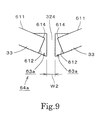
- FIG. 9 is a diagram illustrating one of the first flux barrier pairs 64a and its vicinity in an enlarged form.
- a corner 614 of each of the magnets 33 of each magnet pair 330 is arranged in a separate one of the first flux barriers 63a. End points of a boundary between each magnet 33 and a corresponding one of the first flux barriers 63a lie on one of the long sides 611 which includes the corner 614 and one of the short sides 612 which includes the corner 614 (in the case of FIG. 9 , on an end point of the short side 612).
- the above arrangement contributes to preventing magnetic flux from passing from the long side 611 facing an outer circumference of the rotor core 32 toward the inner core portion 322, making it possible to efficiently direct the magnetic flux radially outwardly of the outer core portion 321.
- the magnets 33 are arranged in the shape of the letter "V"
- a minimum width W2 of each first joining portion 324 is arranged to be smaller than the length of each short side 612. More preferably, the minimum width W2 of each first joining portion 324 is arranged to be half or less than half the length of each short side 612.
- Each first joining portion 324 is preferably arranged to have a small width, and the first joining portion 324 is arranged to have a radial dimension greater than the circumferential width thereof. These conditions also contribute to reducing flow of magnetic flux into the inner core portion 322, and achieving a reduction in the size of the motor 1. Definitions of the radial dimension and the circumferential width of the first joining portion 324 are similar to definitions of the radial dimension and the circumferential width, respectively, of the joining portion 323 illustrated in FIG. 6 .
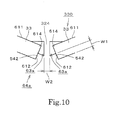
- FIG. 10 is a diagram illustrating a first flux barrier pair 64a according to another preferred embodiment of the present invention. Also in the preferred embodiment illustrated in FIG. 10 , end points of a boundary between a first flux barrier 63a and a magnet 33 lie on a long side 611 which includes a corner 614 and on a short side 612 which includes the corner 614. A portion of an inner core portion 322 which is in contact with the short side 612 functions as a magnet support portion 542. Thus, the magnet 33 is securely held.
- the length W1 (hereinafter referred to as the "contact length" W1 as appropriate) of an area over which the magnet support portion 542 and the short side 612 of the magnet 33 are in contact with each other may have a reasonable magnitude, and therefore, the minimum width W2 of a first joining portion 324 measured in the circumferential direction is preferably arranged to be smaller than the contact length W1, i.e., the length of the area over which the magnet support portion 542 and the short side 612 are in contact with each other.
- the length of a portion of the long side 611 which lies in the first flux barrier 63a is preferably arranged to be in the range of 10% inclusive to 20% exclusive of the length of the long side 611.
- FIG. 11 is a diagram illustrating a first flux barrier pair 64a according to yet another preferred embodiment of the present invention.
- end points of a boundary between a first flux barrier 63a and a corresponding magnet 33 lie on two long sides 611 of the magnet 33.
- a short side 612 of the magnet 33 lies in the first flux barrier 63a in its entirety.
- no magnet support portion 542 is provided, and therefore, the position of each magnet 33 in a corresponding magnet holding hole 544 is fixed by, for example, members attached to both axial ends of a rotor core 32.
- Absence of the magnet support portion 542 contributes to reducing the number of loops of magnetic lines of flux of a magnetic field of the magnet 33 itself which do not contribute to a torque and which enter the short side 612 of the magnet 33, and enables magnetic lines of flux to be greatly directed radially outwardly of an outer core element 541. As a result, an improvement in output of a motor 1 is achieved.
- FIG. 12 is a diagram illustrating a flux barrier 65 according to a modification of the above-described preferred embodiment illustrated in FIG. 6 .
- no magnet support portion 542 is provided in FIG. 12 .
- end points of a boundary between the flux barrier 65 and a corresponding magnet 33 lie on two long sides 611 of the magnet 33 as is similarly the case with the preferred embodiment illustrated in FIG. 11 .
- a short side 612 of the magnet 33 lies in the flux barrier 65 in its entirety.
- FIGS. 11 and 12 a structure illustrated in FIG. 12 corresponds to a modification of a structure illustrated in FIG. 11 in a special condition.
- a structure illustrated in FIG. 6 can be regarded as a modification of a basic structure illustrated in FIG. 10 .
- the first flux barrier pair 64a will be arranged between the two magnets 33 of each magnet pair 330. If the first flux barrier pair 64a is additionally arranged also between every adjacent ones of the magnet pairs 330, a structure equivalent to the structure illustrated in FIG. 6 results.
- FIGS. 6 and 10 suppose that the magnet 33 in the middle in FIG. 6 corresponds to the magnet 33 on the left-hand side in FIG. 10 .
- the magnet 33 in the middle and the magnet 33 on the right together define the magnet pair 330.
- the two flux barriers 62 between these magnets 33 of the magnet pair 330 correspond to the two first flux barriers 63a in FIG. 10 .
- each of the magnets 33 of the magnet pair 330 is arranged in a separate one of the flux barriers 62 between the two magnets 33 of the magnet pair 330. End points of a boundary between each magnet 33 and a corresponding one of the flux barriers 62 lie on the long side 611 including the corner 614 and on the short side 612 including the corner 614.
- another corner 614 of each of the magnets 33 of the magnet pair 330 is arranged in another one of the flux barriers 62.
- the other corner 614 on the left is arranged in another one of the flux barriers 62 than the flux barrier 62 in which the right corner 614 is arranged. End points of a boundary between this other one of the flux barriers 62 and the magnet 33 lie on the other one of the long sides 611 of the magnet 33, which includes the corner 614 on the left, and on the short side 612 which includes the corner 614 on the left.
- each including one magnet pair 330 and four flux barriers 62 are repetitively arranged in the circumferential direction. Therefore, another one of the joining portions 323 arranged to join the outer core portion 321 and the inner core portion 322 to each other is arranged between a pair of the flux barriers 62 which lie between every adjacent ones of the magnet pairs 330
- the outer core elements 541 lie between the two magnets 33 of each magnet pair 330 and between every adjacent ones of the magnet pairs 330.
- the structure illustrated in FIG. 6 corresponds to a modification of the structure illustrated in FIG. 10 as modified such that the magnets 33 are arranged in a radial manner and the flux barriers are arranged on both sides of each magnet 33.
- a structure in which the flux barriers 62 are provided for each of the pair of long sides 611 of each magnet 33 is suitable for the spoke-type IPM motor.
- motor 1 may be modified in a variety of manners.
- the number of poles of the rotating portion 3 and the number of poles of the stationary portion 2 may be modified in a variety of manners.
- a variety of methods may be adopted to fix each of the magnets 33 to the rotor core 32.
- each magnet 33 may be fixed to the rotor core 32 through an adhesive.
- a portion of the laminated electromagnetic steel sheets may be employed to fix the position of each magnet 33.
- the number of magnet pairs 330 may be any number greater than one.
- the housing 21 may be defined by three or more members combined together.
- Motors according to preferred embodiments of the present invention may be used as driving sources for a variety of applications.
Landscapes
- Engineering & Computer Science (AREA)
- Power Engineering (AREA)
- Permanent Field Magnets Of Synchronous Machinery (AREA)
- Iron Core Of Rotating Electric Machines (AREA)
- Permanent Magnet Type Synchronous Machine (AREA)
Applications Claiming Priority (1)
| Application Number | Priority Date | Filing Date | Title |
|---|---|---|---|
| JP2014055035A JP6327446B2 (ja) | 2014-03-18 | 2014-03-18 | モータ |
Publications (3)
| Publication Number | Publication Date |
|---|---|
| EP2922178A2 true EP2922178A2 (fr) | 2015-09-23 |
| EP2922178A3 EP2922178A3 (fr) | 2016-01-20 |
| EP2922178B1 EP2922178B1 (fr) | 2019-12-04 |
Family
ID=52347239
Family Applications (1)
| Application Number | Title | Priority Date | Filing Date |
|---|---|---|---|
| EP15151623.4A Active EP2922178B1 (fr) | 2014-03-18 | 2015-01-19 | Moteur |
Country Status (4)
| Country | Link |
|---|---|
| US (1) | US20150270753A1 (fr) |
| EP (1) | EP2922178B1 (fr) |
| JP (1) | JP6327446B2 (fr) |
| CN (3) | CN108809034A (fr) |
Cited By (1)
| Publication number | Priority date | Publication date | Assignee | Title |
|---|---|---|---|---|
| EP3457546A4 (fr) * | 2016-05-10 | 2019-05-22 | Mitsubishi Electric Corporation | Moteur à aimants permanents |
Families Citing this family (6)
| Publication number | Priority date | Publication date | Assignee | Title |
|---|---|---|---|---|
| JP6327446B2 (ja) * | 2014-03-18 | 2018-05-23 | 日本電産株式会社 | モータ |
| DE102018204300A1 (de) * | 2018-03-21 | 2019-09-26 | Zf Friedrichshafen Ag | Rotor einer permanentmagneterregten elektrischen Maschine |
| US11063485B2 (en) * | 2018-05-11 | 2021-07-13 | Steering Solutions Ip Holding Corporation | Interior permanent magnet machine with hybrid rotor topology |
| DE112019005868T5 (de) | 2018-11-26 | 2021-09-02 | Minebea Mitsumi Inc. | Rotor und den rotor verwendender motor sowie elektronische maschine |
| CN111384804B (zh) * | 2019-09-26 | 2022-03-15 | 广东威灵电机制造有限公司 | 电机和家用电器 |
| JP7545862B2 (ja) | 2020-10-20 | 2024-09-05 | ミネベアミツミ株式会社 | ロータ及び該ロータを用いたモータ、並びに、電子機器 |
Citations (2)
| Publication number | Priority date | Publication date | Assignee | Title |
|---|---|---|---|---|
| JP2001211582A (ja) | 2000-01-26 | 2001-08-03 | Fujitsu General Ltd | 永久磁石電動機 |
| US20110290581A1 (en) | 2010-05-25 | 2011-12-01 | Robert Bosch Gmbh | Steering drive for a motor vehicle |
Family Cites Families (16)
| Publication number | Priority date | Publication date | Assignee | Title |
|---|---|---|---|---|
| US4405873A (en) * | 1981-10-26 | 1983-09-20 | General Electric Company | Rotor for a line-start permanent-magnet motor |
| JPH01144337A (ja) * | 1987-11-30 | 1989-06-06 | Okuma Mach Works Ltd | 永久磁石式電動機のロータ構造 |
| JP3906882B2 (ja) * | 1997-10-24 | 2007-04-18 | 株式会社富士通ゼネラル | 永久磁石電動機 |
| DE60034171T2 (de) * | 1999-02-22 | 2007-12-20 | Kabushiki Kaisha Toshiba, Kawasaki | Rotarische Reluktanzmaschine mit Permanentmagneten |
| FR2791483B1 (fr) * | 1999-03-22 | 2004-06-25 | Valeo Equip Electr Moteur | Machine tournante comportant des aimants de compositions differentes |
| US6707206B2 (en) * | 2002-01-23 | 2004-03-16 | Energy Saving Tech. Corp. | Magnetic material fixing structure of motor rotor |
| US6911756B1 (en) * | 2004-03-23 | 2005-06-28 | Chio-Sung Chang | Rotor core with magnets on the outer periphery of the core having a sine or trapezoidal wave |
| US7772735B2 (en) * | 2006-04-19 | 2010-08-10 | Asmo Co., Ltd. | Embedded magnet type rotating electric machine |
| EP2201663B1 (fr) * | 2007-10-11 | 2016-08-31 | ThyssenKrupp Presta AG | Rotor pour moteur électrique |
| DE102010064259B4 (de) * | 2010-12-28 | 2014-09-04 | Robert Bosch Gmbh | Elektrische Maschine mit einer Magneteinfassung |
| JP5240592B2 (ja) * | 2011-07-08 | 2013-07-17 | 株式会社安川電機 | 回転電機 |
| EP2568578A3 (fr) * | 2011-09-07 | 2017-12-06 | Samsung Electronics Co., Ltd. | Moteur et lave-linge pourvu de ce dernier |
| EP2766976B1 (fr) * | 2011-10-11 | 2016-07-06 | Robert Bosch GmbH | Rotor en étoile à géométrie intérieure optimisée |
| JP5005830B1 (ja) * | 2011-11-30 | 2012-08-22 | 株式会社安川電機 | 回転子コア、回転子および回転電機 |
| EP2592718A2 (fr) * | 2011-11-08 | 2013-05-15 | Kabushiki Kaisha Yaskawa Denki | Noyau de rotor, rotor et machine tournante électrique |
| JP6327446B2 (ja) * | 2014-03-18 | 2018-05-23 | 日本電産株式会社 | モータ |
-
2014
- 2014-03-18 JP JP2014055035A patent/JP6327446B2/ja active Active
- 2014-12-17 US US14/573,107 patent/US20150270753A1/en not_active Abandoned
-
2015
- 2015-01-19 EP EP15151623.4A patent/EP2922178B1/fr active Active
- 2015-03-17 CN CN201810600747.9A patent/CN108809034A/zh active Pending
- 2015-03-17 CN CN201510115694.8A patent/CN104935139A/zh active Pending
- 2015-03-17 CN CN201520151568.3U patent/CN204481659U/zh not_active Expired - Lifetime
Patent Citations (2)
| Publication number | Priority date | Publication date | Assignee | Title |
|---|---|---|---|---|
| JP2001211582A (ja) | 2000-01-26 | 2001-08-03 | Fujitsu General Ltd | 永久磁石電動機 |
| US20110290581A1 (en) | 2010-05-25 | 2011-12-01 | Robert Bosch Gmbh | Steering drive for a motor vehicle |
Cited By (2)
| Publication number | Priority date | Publication date | Assignee | Title |
|---|---|---|---|---|
| EP3457546A4 (fr) * | 2016-05-10 | 2019-05-22 | Mitsubishi Electric Corporation | Moteur à aimants permanents |
| US10916983B2 (en) | 2016-05-10 | 2021-02-09 | Mitsubishi Electric Corporation | Permanent-magnet motor |
Also Published As
| Publication number | Publication date |
|---|---|
| US20150270753A1 (en) | 2015-09-24 |
| JP2015177721A (ja) | 2015-10-05 |
| JP6327446B2 (ja) | 2018-05-23 |
| CN104935139A (zh) | 2015-09-23 |
| CN108809034A (zh) | 2018-11-13 |
| EP2922178A3 (fr) | 2016-01-20 |
| CN204481659U (zh) | 2015-07-15 |
| EP2922178B1 (fr) | 2019-12-04 |
Similar Documents
| Publication | Publication Date | Title |
|---|---|---|
| EP2922178B1 (fr) | Moteur | |
| US10110076B2 (en) | Single-phase brushless motor | |
| US9172279B2 (en) | Automotive embedded permanent magnet rotary electric machine | |
| JP5936060B2 (ja) | 回転電機のロータ | |
| US10312755B2 (en) | Motor | |
| KR101952040B1 (ko) | 회전 전기 기기 | |
| KR20170043464A (ko) | 회전 전기 기기, 회전자 철심의 제조 방법 | |
| CN108768017B (zh) | 电机转子和交替极永磁电机 | |
| CN105191069B (zh) | 永磁体嵌入式旋转电机 | |
| JP2012239327A (ja) | 永久磁石型モータ | |
| JP2014236576A (ja) | インナーロータ型モータ | |
| KR20210036210A (ko) | 로터 및 이를 포함하는 모터 | |
| KR102771167B1 (ko) | 모터 | |
| KR102517688B1 (ko) | 로터 조립체 및 이를 포함하는 모터 | |
| KR101614685B1 (ko) | 권선계자형 동기 전동기 및 그의 회전자 | |
| JP6277648B2 (ja) | 磁石埋込型ロータ | |
| JP2014090541A (ja) | インナーロータ型モータ | |
| JP6358158B2 (ja) | 回転電機 | |
| US20200083766A1 (en) | Rotor and motor using same | |
| WO2023176616A1 (fr) | Moteur | |
| JP2015231253A (ja) | マグネット及びこれを備えた回転電機 | |
| US11955841B2 (en) | Stator and motor assembly including same | |
| JP2017046386A (ja) | 永久磁石電動機 | |
| JP2013093979A (ja) | 同期モータ | |
| KR102921091B1 (ko) | 영구자석 회전기의 회전자 |
Legal Events
| Date | Code | Title | Description |
|---|---|---|---|
| PUAI | Public reference made under article 153(3) epc to a published international application that has entered the european phase |
Free format text: ORIGINAL CODE: 0009012 |
|
| AK | Designated contracting states |
Kind code of ref document: A2 Designated state(s): AL AT BE BG CH CY CZ DE DK EE ES FI FR GB GR HR HU IE IS IT LI LT LU LV MC MK MT NL NO PL PT RO RS SE SI SK SM TR |
|
| AX | Request for extension of the european patent |
Extension state: BA ME |
|
| PUAL | Search report despatched |
Free format text: ORIGINAL CODE: 0009013 |
|
| AK | Designated contracting states |
Kind code of ref document: A3 Designated state(s): AL AT BE BG CH CY CZ DE DK EE ES FI FR GB GR HR HU IE IS IT LI LT LU LV MC MK MT NL NO PL PT RO RS SE SI SK SM TR |
|
| AX | Request for extension of the european patent |
Extension state: BA ME |
|
| RIC1 | Information provided on ipc code assigned before grant |
Ipc: H02K 1/27 20060101AFI20151211BHEP |
|
| 17P | Request for examination filed |
Effective date: 20160719 |
|
| RBV | Designated contracting states (corrected) |
Designated state(s): AL AT BE BG CH CY CZ DE DK EE ES FI FR GB GR HR HU IE IS IT LI LT LU LV MC MK MT NL NO PL PT RO RS SE SI SK SM TR |
|
| STAA | Information on the status of an ep patent application or granted ep patent |
Free format text: STATUS: EXAMINATION IS IN PROGRESS |
|
| 17Q | First examination report despatched |
Effective date: 20180716 |
|
| GRAP | Despatch of communication of intention to grant a patent |
Free format text: ORIGINAL CODE: EPIDOSNIGR1 |
|
| STAA | Information on the status of an ep patent application or granted ep patent |
Free format text: STATUS: GRANT OF PATENT IS INTENDED |
|
| INTG | Intention to grant announced |
Effective date: 20190618 |
|
| GRAS | Grant fee paid |
Free format text: ORIGINAL CODE: EPIDOSNIGR3 |
|
| GRAA | (expected) grant |
Free format text: ORIGINAL CODE: 0009210 |
|
| STAA | Information on the status of an ep patent application or granted ep patent |
Free format text: STATUS: THE PATENT HAS BEEN GRANTED |
|
| AK | Designated contracting states |
Kind code of ref document: B1 Designated state(s): AL AT BE BG CH CY CZ DE DK EE ES FI FR GB GR HR HU IE IS IT LI LT LU LV MC MK MT NL NO PL PT RO RS SE SI SK SM TR |
|
| REG | Reference to a national code |
Ref country code: GB Ref legal event code: FG4D |
|
| REG | Reference to a national code |
Ref country code: CH Ref legal event code: EP |
|
| REG | Reference to a national code |
Ref country code: AT Ref legal event code: REF Ref document number: 1210648 Country of ref document: AT Kind code of ref document: T Effective date: 20191215 |
|
| REG | Reference to a national code |
Ref country code: DE Ref legal event code: R096 Ref document number: 602015042794 Country of ref document: DE |
|
| REG | Reference to a national code |
Ref country code: IE Ref legal event code: FG4D |
|
| REG | Reference to a national code |
Ref country code: NL Ref legal event code: MP Effective date: 20191204 |
|
| REG | Reference to a national code |
Ref country code: LT Ref legal event code: MG4D |
|
| PG25 | Lapsed in a contracting state [announced via postgrant information from national office to epo] |
Ref country code: LV Free format text: LAPSE BECAUSE OF FAILURE TO SUBMIT A TRANSLATION OF THE DESCRIPTION OR TO PAY THE FEE WITHIN THE PRESCRIBED TIME-LIMIT Effective date: 20191204 Ref country code: SE Free format text: LAPSE BECAUSE OF FAILURE TO SUBMIT A TRANSLATION OF THE DESCRIPTION OR TO PAY THE FEE WITHIN THE PRESCRIBED TIME-LIMIT Effective date: 20191204 Ref country code: LT Free format text: LAPSE BECAUSE OF FAILURE TO SUBMIT A TRANSLATION OF THE DESCRIPTION OR TO PAY THE FEE WITHIN THE PRESCRIBED TIME-LIMIT Effective date: 20191204 Ref country code: BG Free format text: LAPSE BECAUSE OF FAILURE TO SUBMIT A TRANSLATION OF THE DESCRIPTION OR TO PAY THE FEE WITHIN THE PRESCRIBED TIME-LIMIT Effective date: 20200304 Ref country code: FI Free format text: LAPSE BECAUSE OF FAILURE TO SUBMIT A TRANSLATION OF THE DESCRIPTION OR TO PAY THE FEE WITHIN THE PRESCRIBED TIME-LIMIT Effective date: 20191204 Ref country code: GR Free format text: LAPSE BECAUSE OF FAILURE TO SUBMIT A TRANSLATION OF THE DESCRIPTION OR TO PAY THE FEE WITHIN THE PRESCRIBED TIME-LIMIT Effective date: 20200305 Ref country code: NO Free format text: LAPSE BECAUSE OF FAILURE TO SUBMIT A TRANSLATION OF THE DESCRIPTION OR TO PAY THE FEE WITHIN THE PRESCRIBED TIME-LIMIT Effective date: 20200304 |
|
| PG25 | Lapsed in a contracting state [announced via postgrant information from national office to epo] |
Ref country code: HR Free format text: LAPSE BECAUSE OF FAILURE TO SUBMIT A TRANSLATION OF THE DESCRIPTION OR TO PAY THE FEE WITHIN THE PRESCRIBED TIME-LIMIT Effective date: 20191204 Ref country code: RS Free format text: LAPSE BECAUSE OF FAILURE TO SUBMIT A TRANSLATION OF THE DESCRIPTION OR TO PAY THE FEE WITHIN THE PRESCRIBED TIME-LIMIT Effective date: 20191204 |
|
| PG25 | Lapsed in a contracting state [announced via postgrant information from national office to epo] |
Ref country code: AL Free format text: LAPSE BECAUSE OF FAILURE TO SUBMIT A TRANSLATION OF THE DESCRIPTION OR TO PAY THE FEE WITHIN THE PRESCRIBED TIME-LIMIT Effective date: 20191204 |
|
| PG25 | Lapsed in a contracting state [announced via postgrant information from national office to epo] |
Ref country code: CZ Free format text: LAPSE BECAUSE OF FAILURE TO SUBMIT A TRANSLATION OF THE DESCRIPTION OR TO PAY THE FEE WITHIN THE PRESCRIBED TIME-LIMIT Effective date: 20191204 Ref country code: RO Free format text: LAPSE BECAUSE OF FAILURE TO SUBMIT A TRANSLATION OF THE DESCRIPTION OR TO PAY THE FEE WITHIN THE PRESCRIBED TIME-LIMIT Effective date: 20191204 Ref country code: ES Free format text: LAPSE BECAUSE OF FAILURE TO SUBMIT A TRANSLATION OF THE DESCRIPTION OR TO PAY THE FEE WITHIN THE PRESCRIBED TIME-LIMIT Effective date: 20191204 Ref country code: EE Free format text: LAPSE BECAUSE OF FAILURE TO SUBMIT A TRANSLATION OF THE DESCRIPTION OR TO PAY THE FEE WITHIN THE PRESCRIBED TIME-LIMIT Effective date: 20191204 Ref country code: NL Free format text: LAPSE BECAUSE OF FAILURE TO SUBMIT A TRANSLATION OF THE DESCRIPTION OR TO PAY THE FEE WITHIN THE PRESCRIBED TIME-LIMIT Effective date: 20191204 Ref country code: PT Free format text: LAPSE BECAUSE OF FAILURE TO SUBMIT A TRANSLATION OF THE DESCRIPTION OR TO PAY THE FEE WITHIN THE PRESCRIBED TIME-LIMIT Effective date: 20200429 |
|
| PG25 | Lapsed in a contracting state [announced via postgrant information from national office to epo] |
Ref country code: IS Free format text: LAPSE BECAUSE OF FAILURE TO SUBMIT A TRANSLATION OF THE DESCRIPTION OR TO PAY THE FEE WITHIN THE PRESCRIBED TIME-LIMIT Effective date: 20200404 Ref country code: SK Free format text: LAPSE BECAUSE OF FAILURE TO SUBMIT A TRANSLATION OF THE DESCRIPTION OR TO PAY THE FEE WITHIN THE PRESCRIBED TIME-LIMIT Effective date: 20191204 Ref country code: SM Free format text: LAPSE BECAUSE OF FAILURE TO SUBMIT A TRANSLATION OF THE DESCRIPTION OR TO PAY THE FEE WITHIN THE PRESCRIBED TIME-LIMIT Effective date: 20191204 |
|
| REG | Reference to a national code |
Ref country code: CH Ref legal event code: PL |
|
| REG | Reference to a national code |
Ref country code: DE Ref legal event code: R097 Ref document number: 602015042794 Country of ref document: DE |
|
| REG | Reference to a national code |
Ref country code: AT Ref legal event code: MK05 Ref document number: 1210648 Country of ref document: AT Kind code of ref document: T Effective date: 20191204 |
|
| PG25 | Lapsed in a contracting state [announced via postgrant information from national office to epo] |
Ref country code: MC Free format text: LAPSE BECAUSE OF FAILURE TO SUBMIT A TRANSLATION OF THE DESCRIPTION OR TO PAY THE FEE WITHIN THE PRESCRIBED TIME-LIMIT Effective date: 20191204 |
|
| PLBE | No opposition filed within time limit |
Free format text: ORIGINAL CODE: 0009261 |
|
| STAA | Information on the status of an ep patent application or granted ep patent |
Free format text: STATUS: NO OPPOSITION FILED WITHIN TIME LIMIT |
|
| REG | Reference to a national code |
Ref country code: BE Ref legal event code: MM Effective date: 20200131 |
|
| PG25 | Lapsed in a contracting state [announced via postgrant information from national office to epo] |
Ref country code: DK Free format text: LAPSE BECAUSE OF FAILURE TO SUBMIT A TRANSLATION OF THE DESCRIPTION OR TO PAY THE FEE WITHIN THE PRESCRIBED TIME-LIMIT Effective date: 20191204 Ref country code: LU Free format text: LAPSE BECAUSE OF NON-PAYMENT OF DUE FEES Effective date: 20200119 Ref country code: FR Free format text: LAPSE BECAUSE OF NON-PAYMENT OF DUE FEES Effective date: 20200204 |
|
| 26N | No opposition filed |
Effective date: 20200907 |
|
| PG25 | Lapsed in a contracting state [announced via postgrant information from national office to epo] |
Ref country code: LI Free format text: LAPSE BECAUSE OF NON-PAYMENT OF DUE FEES Effective date: 20200131 Ref country code: AT Free format text: LAPSE BECAUSE OF FAILURE TO SUBMIT A TRANSLATION OF THE DESCRIPTION OR TO PAY THE FEE WITHIN THE PRESCRIBED TIME-LIMIT Effective date: 20191204 Ref country code: SI Free format text: LAPSE BECAUSE OF FAILURE TO SUBMIT A TRANSLATION OF THE DESCRIPTION OR TO PAY THE FEE WITHIN THE PRESCRIBED TIME-LIMIT Effective date: 20191204 Ref country code: BE Free format text: LAPSE BECAUSE OF NON-PAYMENT OF DUE FEES Effective date: 20200131 Ref country code: PL Free format text: LAPSE BECAUSE OF FAILURE TO SUBMIT A TRANSLATION OF THE DESCRIPTION OR TO PAY THE FEE WITHIN THE PRESCRIBED TIME-LIMIT Effective date: 20191204 Ref country code: CH Free format text: LAPSE BECAUSE OF NON-PAYMENT OF DUE FEES Effective date: 20200131 |
|
| PG25 | Lapsed in a contracting state [announced via postgrant information from national office to epo] |
Ref country code: IT Free format text: LAPSE BECAUSE OF FAILURE TO SUBMIT A TRANSLATION OF THE DESCRIPTION OR TO PAY THE FEE WITHIN THE PRESCRIBED TIME-LIMIT Effective date: 20191204 Ref country code: IE Free format text: LAPSE BECAUSE OF NON-PAYMENT OF DUE FEES Effective date: 20200119 |
|
| GBPC | Gb: european patent ceased through non-payment of renewal fee |
Effective date: 20200304 |
|
| PG25 | Lapsed in a contracting state [announced via postgrant information from national office to epo] |
Ref country code: GB Free format text: LAPSE BECAUSE OF NON-PAYMENT OF DUE FEES Effective date: 20200304 |
|
| PG25 | Lapsed in a contracting state [announced via postgrant information from national office to epo] |
Ref country code: TR Free format text: LAPSE BECAUSE OF FAILURE TO SUBMIT A TRANSLATION OF THE DESCRIPTION OR TO PAY THE FEE WITHIN THE PRESCRIBED TIME-LIMIT Effective date: 20191204 Ref country code: MT Free format text: LAPSE BECAUSE OF FAILURE TO SUBMIT A TRANSLATION OF THE DESCRIPTION OR TO PAY THE FEE WITHIN THE PRESCRIBED TIME-LIMIT Effective date: 20191204 Ref country code: CY Free format text: LAPSE BECAUSE OF FAILURE TO SUBMIT A TRANSLATION OF THE DESCRIPTION OR TO PAY THE FEE WITHIN THE PRESCRIBED TIME-LIMIT Effective date: 20191204 |
|
| PG25 | Lapsed in a contracting state [announced via postgrant information from national office to epo] |
Ref country code: MK Free format text: LAPSE BECAUSE OF FAILURE TO SUBMIT A TRANSLATION OF THE DESCRIPTION OR TO PAY THE FEE WITHIN THE PRESCRIBED TIME-LIMIT Effective date: 20191204 |
|
| P01 | Opt-out of the competence of the unified patent court (upc) registered |
Effective date: 20230519 |
|
| PGFP | Annual fee paid to national office [announced via postgrant information from national office to epo] |
Ref country code: DE Payment date: 20240119 Year of fee payment: 10 |
|
| REG | Reference to a national code |
Ref country code: DE Ref legal event code: R119 Ref document number: 602015042794 Country of ref document: DE |
|
| PG25 | Lapsed in a contracting state [announced via postgrant information from national office to epo] |
Ref country code: DE Free format text: LAPSE BECAUSE OF NON-PAYMENT OF DUE FEES Effective date: 20250801 |