EP2923482B1 - Service de communication voix a partir d'un reseau social - Google Patents
Service de communication voix a partir d'un reseau social Download PDFInfo
- Publication number
- EP2923482B1 EP2923482B1 EP13808089.0A EP13808089A EP2923482B1 EP 2923482 B1 EP2923482 B1 EP 2923482B1 EP 13808089 A EP13808089 A EP 13808089A EP 2923482 B1 EP2923482 B1 EP 2923482B1
- Authority
- EP
- European Patent Office
- Prior art keywords
- communication
- social network
- identifier
- terminal
- notification
- Prior art date
- Legal status (The legal status is an assumption and is not a legal conclusion. Google has not performed a legal analysis and makes no representation as to the accuracy of the status listed.)
- Active
Links
Images


Classifications
-
- H—ELECTRICITY
- H04—ELECTRIC COMMUNICATION TECHNIQUE
- H04M—TELEPHONIC COMMUNICATION
- H04M3/00—Automatic or semi-automatic exchanges
- H04M3/42—Systems providing special services or facilities to subscribers
- H04M3/42025—Calling or Called party identification service
- H04M3/42034—Calling party identification service
- H04M3/42042—Notifying the called party of information on the calling party
-
- H—ELECTRICITY
- H04—ELECTRIC COMMUNICATION TECHNIQUE
- H04L—TRANSMISSION OF DIGITAL INFORMATION, e.g. TELEGRAPHIC COMMUNICATION
- H04L12/00—Data switching networks
- H04L12/28—Data switching networks characterised by path configuration, e.g. LAN [Local Area Networks] or WAN [Wide Area Networks]
- H04L12/2854—Wide area networks, e.g. public data networks
- H04L12/2856—Access arrangements, e.g. Internet access
- H04L12/2869—Operational details of access network equipments
- H04L12/287—Remote access server, e.g. BRAS
-
- H—ELECTRICITY
- H04—ELECTRIC COMMUNICATION TECHNIQUE
- H04L—TRANSMISSION OF DIGITAL INFORMATION, e.g. TELEGRAPHIC COMMUNICATION
- H04L51/00—User-to-user messaging in packet-switching networks, transmitted according to store-and-forward or real-time protocols, e.g. e-mail
- H04L51/52—User-to-user messaging in packet-switching networks, transmitted according to store-and-forward or real-time protocols, e.g. e-mail for supporting social networking services
-
- H—ELECTRICITY
- H04—ELECTRIC COMMUNICATION TECHNIQUE
- H04L—TRANSMISSION OF DIGITAL INFORMATION, e.g. TELEGRAPHIC COMMUNICATION
- H04L63/00—Network architectures or network communication protocols for network security
- H04L63/10—Network architectures or network communication protocols for network security for controlling access to devices or network resources
-
- H—ELECTRICITY
- H04—ELECTRIC COMMUNICATION TECHNIQUE
- H04L—TRANSMISSION OF DIGITAL INFORMATION, e.g. TELEGRAPHIC COMMUNICATION
- H04L67/00—Network arrangements or protocols for supporting network services or applications
- H04L67/01—Protocols
-
- H—ELECTRICITY
- H04—ELECTRIC COMMUNICATION TECHNIQUE
- H04M—TELEPHONIC COMMUNICATION
- H04M7/00—Arrangements for interconnection between switching centres
- H04M7/0024—Services and arrangements where telephone services are combined with data services
- H04M7/003—Click to dial services
-
- H—ELECTRICITY
- H04—ELECTRIC COMMUNICATION TECHNIQUE
- H04W—WIRELESS COMMUNICATION NETWORKS
- H04W4/00—Services specially adapted for wireless communication networks; Facilities therefor
- H04W4/20—Services signaling; Auxiliary data signalling, i.e. transmitting data via a non-traffic channel
- H04W4/21—Services signaling; Auxiliary data signalling, i.e. transmitting data via a non-traffic channel for social networking applications
-
- H—ELECTRICITY
- H04—ELECTRIC COMMUNICATION TECHNIQUE
- H04W—WIRELESS COMMUNICATION NETWORKS
- H04W4/00—Services specially adapted for wireless communication networks; Facilities therefor
- H04W4/60—Subscription-based services using application servers or record carriers, e.g. SIM application toolkits
-
- H—ELECTRICITY
- H04—ELECTRIC COMMUNICATION TECHNIQUE
- H04M—TELEPHONIC COMMUNICATION
- H04M3/00—Automatic or semi-automatic exchanges
- H04M3/42—Systems providing special services or facilities to subscribers
- H04M3/56—Arrangements for connecting several subscribers to a common circuit, i.e. affording conference facilities
-
- H—ELECTRICITY
- H04—ELECTRIC COMMUNICATION TECHNIQUE
- H04W—WIRELESS COMMUNICATION NETWORKS
- H04W88/00—Devices specially adapted for wireless communication networks, e.g. terminals, base stations or access point devices
- H04W88/02—Terminal devices
-
- H—ELECTRICITY
- H04—ELECTRIC COMMUNICATION TECHNIQUE
- H04W—WIRELESS COMMUNICATION NETWORKS
- H04W88/00—Devices specially adapted for wireless communication networks, e.g. terminals, base stations or access point devices
- H04W88/18—Service support devices; Network management devices
Definitions
- the present invention relates both to the field of social networks based on the Internet-type network and to the field of voice communication.
- Social networks based on the Internet allow its users to form groups of friends or professional acquaintances. To this end, they provide their users with tools (or even services) for exchanging information, which can be, for example, photos, attendance reports, topical information, etc. exchanges are accessible via suitable user interfaces.
- a telephone connection initiated from the social network in question For the same user, his identifier in a social network is associated with his telephone number, and thereby this user can be reached by telephone from the social network via his social network identifier.
- a suitable server can be provided for the provision of this service.
- Systems are known in which the server ultimately thus places the caller in telephone communication with the called party by taking charge of the dialing of the called party.
- the called party receives a telephone call and does not have any additional information, apart from possibly that represented by the server number which can be displayed on the screen of his telephone, as is the case. during a typical phone call.
- voice communication is understood to mean any type of telephone communication session established between at least two communication terminals which allows at least two respective users of said communication terminals to communicate by voice with each other.
- Voice communication can thus be implemented for example in a communication network of the telephone network type such as a mobile network (such as a GSM network, UMTS, etc.).
- the term “communication network” is understood to mean any type of network which is suitable for allowing at least two communication terminals to be connected in a telephone communication.
- the communication possible in this type of network which can be of voice type and of data type.
- Such a communication network is therefore a telephone communication network, which can be a network based on mobile communication protocols, such as for example GSM, UMTS, 3G, 4G.
- the communication network considered is both suitable for managing the establishment of voice communication and data communication between the various terminals of this network.
- the term “communication terminal” is understood to mean any type of communication terminal which makes it possible to establish voice communication sessions via a telephone communication network. It can also make it possible to establish data communications in the communications network to which it belongs, that is to say in which it can initiate the establishment of a telephone call or receive and accept communications intended for it.
- This terminal can for example be a mobile phone of any type, a tablet, etc.
- the term “communication identifier” is understood to mean an identifier associated with a communication terminal in the communication network to which it belongs. Such a communication identifier allows the terminal with which it is associated to be reached and therefore to receive a communication in the communication network considered. Such an identifier can be a telephone number in a mobile telephone network.
- the term 'social network' is understood to mean any type of social network on the Internet network which can bring together communities of people on different criteria, such as for example personal affinities, or proximity to professional career, or even centers of research. 'similar interests, etc ...
- Such a social network can be based on a communication network within the meaning of the defined terms above.
- the term 'social network identifier' is understood to mean any type of identifier that identifies an account of a person on the social network. considered. In general, this is a reference created by the user when creating their account. This reference can be a string of characters and / or an image, photo, etc. Such a social network identifier can be indicated within the social network in a format different from that which is visible by the user or by the people from his relationship network.
- the term “communication request” is understood to mean a request aimed at requesting the establishment of communication between at least two communication terminals of the communication network to which these communication terminals belong. Such a request may correspond, in one embodiment of the present invention, to a message received in the communication network from any terminal (which may be different from the communication terminal on which the voice communication will take place) whose user wishes to be placed in voice communication with another person using another terminal. No limitation is attached to the type of this message. It is important to note here that this communication request can be sent from a terminal which is distinct from the first terminal. This can be the case, in particular, when a user is connected to a communication network via a terminal which has no voice communication management capability.
- the terminal of the person wishing the voice communication, from which the communication request is sent is distinct from the communication terminal whose communication identifier is associated with the social network identifier indicated in the communication request.
- a person can initiate the communication request from a PC, while it is his mobile telephone terminal which has his telephone number associated with his social network identifier.
- application notification is understood to mean any type of notification that can be transmitted over the communication network and that can be processed at the application level of a communication terminal of the communication network.
- This application level of a communication terminal according to an embodiment of the present invention is hereinafter referred to under the terms “service application”.
- This service application represents the level application suitable for the implementation of a communication service management method at the terminal level.
- association of the communication identifiers of the terminals with respective social network identifiers in one embodiment of the present invention.
- This association is known from the server. It can be stored in a database without any limitation attached to this aspect, the server having access to this association information between communication identifiers in the communication network and social network identifiers of the social network. Thanks to this association, a voice communication can be implemented by the server on the simple social network identifier information. No limitation is attached to the enrollment phase which allows this association. In particular, provision can be made for a prior phase of registration for the communication management service in which each subscriber declares that he wishes to associate a communication terminal with a social network identifier.
- a server accessible from a communication network is advantageously suitable for sending an application notification to a second communication terminal identified by its communication identifier in the communication network, for example its telephone number, this notification indicating the social network identifier of the first terminal.
- This application notification is, in one embodiment, generated from a communication request received beforehand, indicating the first and second social network identifiers which are respectively associated with the first and second communication identifiers.
- a user of the second communication terminal it is advantageously possible to invite a user of the second communication terminal to be in voice communication with a user of the first communication terminal while informing him of the social network identifier of the one who wishes to join him. .
- Such a notification makes it possible to offer a service for establishing communication between at least two people via their respective communication terminals on the basis of a customer journey that is at the same time clear, simple and reassuring.
- the user of the second communication terminal is able to decide to accept the communication on the basis of clear and important information which allows him to recognize the other person by his identity in the considered social network. This information makes it possible to filter such a communication request in a simple, fast and efficient manner.
- a user of a communication network can be extremely stressed via his communication terminal on a daily basis. Therefore, during a call, he does not want to have to disclose his telephone number in order to protect himself from the multiplication of voice communication requests and to control the distribution of his telephone number.
- this communication network user is requested for a voice communication, he wishes to have information on the context of the communication before accepting it. Indeed, if a request for a communication comes from a masked number for example, the called party will tend to be reluctant to take the call.
- the present invention very advantageously makes it possible to respond to these two problems: on the one hand the need to control and reduce the broadcasting of his telephone number and on the other hand to have information available during a voice call request.
- on the one hand there is no need to reveal his communication identifier when inviting a person to a voice communication. Only the social network identifier is revealed, the server being the only one to use the association of social network identifier and communication identifier. Thus, the confidentiality of the communication identifier can be maintained.
- a communication terminal requested for a voice communication can still have useful information to know the context of the communication, in particular it has at least one social network identifier.
- the application notification it is possible to solicit a person for a voice communication by providing him with contextual information useful for the decision to accept or not the invitation, without however having to transmit to him the communication identifier of the initiator. , like the phone number for example.
- this image possibly being a photo of the corresponding person.
- the user can be offered to accept or decline the connection on the basis of a photo for example of the person wishing this voice connection.
- the server being able to identify the communication identifier of the first terminal on the basis of the first social network identifier, it is also able to send an application notification to the first terminal.
- This application notification can thus trigger a service application residing on the first terminal so as to offer an interface on the terminal relating to the voice communication service offer in question.
- the application notification further indicates at least a third social network identifier.
- This may be the case when the communication request indicates the third social network identifier. This case may correspond to the fact that initially several social network identifiers were invited to the voice communication in the same communication request.
- the server receives several distinct communication requests indicating one the second identifier of the social network and at least another the third identifier of the social network at distinct respective times.
- the server can send a notification indicating all the social network identifiers of the people who are invited to a voice communication in association with the first network identifier, that is to say in this case, the second and third social network identifiers, or send a plurality of communication requests.
- the application notification can also further indicate a communication state associated with said at least third social network identifier.
- the server can inform the user of the second terminal of the communication state of the other guest for voice communication, that is to say of the person to whom the third social network identifier corresponds.
- communication state we can understand the fact that the voice communication is already established with the communication terminal of this other guest or not.
- the application notification can also indicate an associated topic. This involves informing the user of the second communication terminal of the topic that the person who generated the communication request wishes to discuss with him during the requested voice communication.
- This information can be an aid in the decision-making relating to the acceptance of the voice communication.
- This contextual information makes it possible to advantageously enrich the targeted communication service by providing precise and detailed lighting on the current communication context.
- the communication between the communication terminals can be achieved in different ways and no limitation is attached to this aspect of the present invention.
- the application notification can in particular indicate an identifier of the connection allowing the establishment of a voice call. In this case, if the voice communication is accepted, the second communication terminal can itself initiate the communication to this identifier.
- connection identifier may correspond to a telephone number.
- the second communication terminal can dial the telephone number.
- the phone number can be a conference call number. This case is advantageous when several terminals are 'invited' to join the voice communication by the initiator of the communication request.
- connection identifier can correspond to the communication identifier associated with the first communication terminal. This may be the case when the communication service provides for direct communication between the first and second communication terminals.
- steps / d / and / e / can therefore occur in certain embodiments, when a user of the second communication terminal which has received the application notification according to an embodiment of the present invention accepts the voice communication with the person. identified through their social network ID.
- the server on receipt of the voice communication acceptance, the server is responsible for setting up voice communication between the first and second communication terminals. Indeed, on the one hand (step / a /) a communication request indicating the social network identifiers associated with the communication terminals to be placed in voice communication has been received, and on the other hand the acceptance of 'a communication terminal (step / d /).
- the communication acceptance received from the second communication terminal at the server level can be of any type.
- a communication terminal is able to display for its user a social network identifier with an option suitable for triggering a voice communication from this terminal. Thanks to the reception of an application notification according to an embodiment of the present invention, it is possible to provide a decision aid to accept a voice communication, without however having to disclose the telephone number of the caller.
- the communication terminal can have a service application which is adapted to be activated on receipt of the application notification and which offers, via a touch interface for example, a voice communication relating to the displayed social network identifier.
- a service application can be natively on the terminal or even be downloaded from a website for example. It can also contain a connection identifier which allows it to initiate voice communication for the communication terminal in the event that the selectable option is selected. It can also receive this identifier via the application notification or a subsequent application notification.
- the application notification may further indicate at least a third social network identifier and said third social network identifier may further be displayed.
- the application notification can further indicate a communication state associated with said at least third social network identifier, said communication state being further displayed.
- the application notification can also indicate an associated topic.
- connection identifier allowing the establishment of a voice call
- the second communication terminal can then initiate the connection on the basis of said call identifier.
- the connection identifier can be retrieved at the level of the communication terminal by other means, in particular by prior downloading for example.
- the telephone number can correspond to a telephone number and, when the selectable option is selected, the second communication terminal can then initiate the connection by dialing said telephone number. This triggering can be carried out automatically and transparently for the user of the terminal, via a suitable service application.
- the second communication terminal can activate a service application, step / 2 / being performed via said service application.
- the phone number can be automatically dialed by the service application.
- An audible alarm can also be generated, at the level of the communication terminal, upon receipt of the application notification.
- step / 1 / provision can be made for the application notification to indicate a private or public nature of the voice communication.
- This server can be adapted for the implementation of a communication service management method as stated above at the server level.
- the present invention is also aimed at a communication terminal having a communication identifier in a communication network, said communication terminal comprising the characteristics of claim 16.
- This communication terminal can be adapted to implement a communication service management method as described above implemented at the level of the communication terminal.
- the present invention also relates to a communication service management system in a communication network, comprising a server according to one embodiment and at least one communication terminal according to an embodiment of the present invention.
- the present invention further relates to a computer program capable of being implemented on a communication terminal according to claim 16, the program comprising code instructions which, when the program is executed by a processor, carries out the steps of the method. implemented at the terminal level.
- This computer program can correspond to a service application according to an embodiment of the present invention. It can be downloaded from a site for example. It therefore makes it possible to manage the reception of the application notification, as well as to offer a user interface making it possible to display at least the caller's social network identifier, as well as the selectable option to trigger, that is, ie accept, the proposed voice communication.
- the figure 1 represents a communication network 13 according to an embodiment of the present invention.
- a communication terminal 11 and a communication terminal 12, hereinafter referred to as terminal 11 and terminal 12 are terminals of the communication network 13 in the sense that they have communication identifiers recognized in this network, respectively idcom1 and idcom 2.
- a server 10 is also accessible in this communication network, the latter having access to association information 14.
- This information can be stored in a database, they represent an association of the communication identifiers recognized in this network with identifiers.
- social network respectively idsoc1 and isoc2 for the communication identifiers icom1 and idcom2. This information can be filled in beforehand by any mechanism which makes it possible to build this association.
- the network 13 can be a mobile communication network which offers both the possibility of data communications and of voice communication.
- the terminals 11 and 12 are mobile telephone terminals.
- the present invention will be described in this type of context. But this in no way limits the fields of application of the invention, since it is simply a question of illustrating the mechanisms of the present invention, without limiting them.
- the figure 2 illustrates an implementation of a communication service management method according to an embodiment of the present invention.
- a terminal 20 sends a communication request 21 within the meaning of the present invention.
- This terminal can be any type of terminal which is able to transmit a message to the server 10 via the communication network 13. It can correspond to the terminal 11, or even be another terminal.
- the communication request 21 indicates at least the first and second social network identifiers which are associated with idcom1 and idcom2, reference 14, it may be advantageous to provide for generating this request from the terminal 20, and more particularly from the social network considered, the environment most conducive to easily indicating the identifiers of the social network considered. It is possible to provide more precisely that a service application within the meaning of the present invention 'connected' or linked or integrated into the social network. Thus, such an application would allow the user, hereinafter referred to as “caller”, to generate this request from an appropriate interface of the service application.
- the figure 3-a, 3-b illustrates such an interface of such an application.
- the server 10 Upon receipt of the request 21, the server 10 retrieves the idcom2 associated with the idsoc2 indicated in the request 21, in a step 22. Then, it sends an application notification 23 to the terminal 12 on the communication network. On receipt of this application notification 23, a display is triggered in a step 24, providing a user of the terminal 12 with the social network identifier of the one indicated in the request 21.
- this interface it is easy for the calling user to launch a conference call, for example, by quickly selecting the social network identifiers, indicating a topic for the call, before clicking on the icon.
- the figure 3-b illustrates an interface for selecting whether the call to be launched is open (ie public) or private. If the call is public, other people in the social network are able to know the existence of this voice communication and possibly be able to join it. If the call is private, only those invited to the voice call being initiated can learn about it.
- the figure 4 illustrates an interface on the calling side, on terminal 20 for example, when the caller initiated the call.
- the server On receipt of the communication request 21 which therefore indicates the social network identifier selected by the caller, the server consults the associated data 14 in order to retrieve the associated communication identifier. This is the idcom2 identifier.
- idcom2 corresponds to the telephone number of terminal 12.
- the server 10 then sends an application notification 23 to the terminal 12, this notification indicating at least the social network identifier of the caller idsoc1.
- provision can advantageously be made for the terminal 12 to emit an audible alert, preferably distinct from that emitted by the arrival of a conventional incoming call. Provision can also be made for an automatic display without any intervention by the user of the terminal 12 to be triggered so as to bring the terminal 12 out of any standby mode and so as to quickly allow the user to have access to the devices. useful information to make the decision to continue and therefore to accept the voice communication, or to delay this decision.
- the figure 3-c illustrates an interface of a service application according to an embodiment of the present invention.
- a selectable option 44 is suitable for initiating a voice communication from terminal 12 with terminal 11.
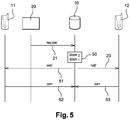
- the figure 5 illustrates a communication service management method according to an embodiment of the present invention.
- the terminal 20 is distinct from the terminal 11. But this mechanism also applies when the communication request comes directly from the terminal 11.
- the server recovers 50 the communication identifiers idcom1 and idcom 2, that is to say in this example the mobile telephone numbers of the terminals 11 and 12, on the basis of the social network identifiers of the request 21.
- This notification 51 can contain a communication setting identifier which makes it possible to put the terminal 11 in voice communication. Provision can be made for the terminal 11 to be put into communication automatically since it corresponds to the calling party, unlike the invited party 12, which may decide not to follow up on the invitation.
- Each of the terminals 11, 12 has a service application which is suitable for receiving the application notification and for providing a user interface for accessing and managing the service at the terminals.
- the establishment of voice communication between the caller, i.e. the one who initiates the transmission of the communication request, and the guests, i.e. those who have been selected and appear in the communication request in the form of social network identifiers, can be done in various ways and in no way limits the scope of the present invention.
- the terminal 11 or 12 is able to initiate the call to this telephone number.
- This step is illustrated by the generation of a 'com' message 52 from terminal 11 and 53 from terminal 13 which correspond to a telephone call to a number known from terminals 11 and 12.
- This telephone number can advantageously be a conference call number.
- the voice communication can accommodate several guests identified under their social network identifiers. The voice communication can then be managed as a conference, so that on-hold messages can be played in particular while waiting, for example, for the caller if the latter joins the conference after some of his guests.
Landscapes
- Engineering & Computer Science (AREA)
- Signal Processing (AREA)
- Computer Networks & Wireless Communication (AREA)
- General Engineering & Computer Science (AREA)
- Computing Systems (AREA)
- Computer Hardware Design (AREA)
- Computer Security & Cryptography (AREA)
- Telephonic Communication Services (AREA)
Description
- La présente invention est relative à la fois au domaine des réseaux sociaux basés sur le réseau de type Internet et au domaine de la communication voix.
- Les réseaux sociaux fondés sur le réseau Internet permettent à ses utilisateurs de constituer des groupes d'amis ou de connaissance professionnelle. A cet effet, ils fournissent à leurs utilisateurs des outils (ou encore services) d'échanges d'information, qui peuvent être par exemple des photos, des états de présence, des informations d'actualité, etc ... Ces services d'échanges sont accessibles via des interfaces utilisateur adaptées.
- Parmi les services qui peuvent être proposés aux utilisateurs de ces réseaux sociaux, il est possible de prévoir une mise en relation téléphonique initiée depuis le réseau social considéré. En effet, pour un même utilisateur, on associe son identifiant dans un réseau social avec son numéro de téléphone, et par là même, cet utilisateur peut être joint par téléphone depuis le réseau social via son identifiant de réseau social. Dans ce contexte, on peut prévoir un serveur adapté pour la fourniture de ce service. On connait des systèmes dans lesquels le serveur in fine met ainsi en communication téléphonique l'appelant avec l'appelé en prenant en charge la numérotation de l'appelé. Dans ce contexte, l'appelé reçoit un appel téléphonique et ne dispose d'aucune information supplémentaire, mis à part éventuellement celle représentée par le numéro du serveur qui peut s'afficher sur l'écran de son téléphone, comme c'est le cas lors d'un appel téléphonique classique.
- L'invention offre une solution ne présentant pas les inconvénients de l'état de la technique. D'autres solutions alternatives pour ce problème sont décrites dans les documents brevet
US2011/0069661 A1 ,US2002/0071539 A1 ,WO2008/098627 A1 etUS2008/0253363 A1 . - L'invention est défini par les revendications indépendantes 1, 7, 14, 16 et 18. Les modes de réalisation préférés sont définis par les revendications dépendantes.
- On entend par les termes 'communication voix', tout type de session de communication téléphonique établie entre au moins deux terminaux de communication qui permet à au moins deux utilisateurs respectifs desdits terminaux de communication de communiquer par la voix entre eux. Une communication voix peut être ainsi mise en œuvre par exemple dans un réseau de communication de type réseau téléphonique comme un réseau mobile (comme réseau GSM, UMTS, etc ..).
- On entend par les termes 'réseau de communication', tout type de réseau qui est adapté pour permettre la mise en relation d'au moins deux terminaux de communication dans une communication téléphonique. La communication possible dans ce type de réseau pouvant être de type voix et de type données. Un tel réseau de communication est donc un réseau de communication téléphonique, qui peut être un réseau basé sur des protocoles de communication mobile, comme par exemple GSM, UMTS, 3G, 4G. Dans un mode de réalisation de la présente invention, le réseau de communication considéré est à la fois adapté pour gérer l'établissement de communication voix et de communication données entre les différents terminaux de ce réseau.
- On entend par les termes 'terminal de communication', tout type de terminal de communication qui permet d'établir des sessions de communication voix via un réseau de communication téléphonique. Il peut également permettre d'établir des communications données dans le réseau de communication auquel il appartient, c'est-à-dire dans lequel il peut initier l'établissement de communication téléphonique ou recevoir et accepter des communications qui lui sont destinées. Ce terminal peut par exemple être un téléphone mobile de tout type, une tablette, etc ...
- On entend par les termes 'identifiant de communication', un identifiant associé à un terminal de communication dans le réseau de communication auquel il appartient. Un tel identifiant de communication permet au terminal auquel il est associé d'être joint et donc de recevoir une communication dans le réseau de communication considéré. Un tel identifiant peut être un numéro de téléphone dans un réseau de téléphonie mobile.
- On entend par les termes 'réseau social', tout type de réseau social sur le réseau Internet qui peut regrouper des communautés de personnes sur différents critères, comme par exemple des affinités personnelles, ou encore des proximité de parcours professionnel, ou encore des centres d'intérêts similaires, etc ... On peut citer à titre d'exemple le réseau social fondé sur Facebook, twitter, Viadeo, LinkedId, etc ... Un tel réseau social peut être basé sur un réseau de communication au sens des termes définis ci-dessus.
- On entend par les termes 'identifiant de réseau social', tout type d'identifiant qui permet d'identifier un compte d'une personne sur le réseau social considéré. En général, il s'agit d'une référence créée par l'utilisateur au moment de la création de son compte. Cette référence peut être une chaîne de caractères et/ou une image, photo, etc...Un tel identifiant de réseau social peut être indiqué au sein du réseau social sous un format différent de celui qui est visible par l'utilisateur ou par les personnes de son réseau de relation.
- On entend par les termes 'requête de communication', un requête visant à demander la mise en communication entre au moins deux terminaux de communication du réseau de communication auquel appartiennent ces terminaux de communication. Une telle requête peut correspondre, dans un mode de réalisation de la présente invention, à un message reçu dans le réseau de communication depuis un terminal quelconque (qui peut être différent du terminal de communication sur lequel la communication voix aura lieu) dont l'utilisateur souhaite être mis en communication vocale avec une autre personne utilisatrice d'un autre terminal. Aucune limitation n'est attachée au type de ce message. Il est important de noter ici que cette requête de communication peut être émise depuis un terminal qui est distinct du premier terminal. Tel peut être le cas, notamment, lorsqu'un utilisateur est connecté sur un réseau de communication via un terminal qui n'a pas de capacité de gestion de communication voix. Dans ce cas, le terminal de la personne souhaitant la communication voix, depuis lequel est émis la requête de communication, est distinct du terminal de communication dont l'identifiant de communication est associé à l'identifiant de réseau social indiqué dans la requête de communication. Ainsi, une personne peut initier la requête de communication depuis un PC, alors que c'est son terminal de téléphonie mobile qui a son numéro de téléphone associé à son identifiant de réseau social.
- On entend par les termes 'notification applicative' tout type de notification pouvant être transmise sur le réseau de communication et pouvant être traitée au niveau applicatif d'un terminal de communication du réseau de communication. Ce niveau applicatif d'un terminal de communication selon un mode de réalisation de la présente invention est par la suite référencée sous les termes 'application de service'. Cette application de service représente le niveau applicatif adapté pour la mise en œuvre d'un procédé de gestion de service de communication au niveau du terminal.
- Il convient de noter qu'il est prévu une association des identifiants de communication des terminaux avec des identifiants de réseau sociaux respectifs, dans un mode de réalisation de la présente invention. Cette association est connue depuis le serveur. Elle peut être stockée dans une base de données sans aucune limitation attachée à cet aspect, le serveur ayant accès à ces informations d'association entre identifiants de communication dans le réseau de communication et identifiants de réseau social du réseau social. Grâce à cette association, une mise en communication voix peut être mise en œuvre par le serveur sur la simple information d'identifiant de réseau social. Aucune limitation n'est attachée à la phase d'enrôlement qui permet cette association. On peut notamment prévoir une phase préalable d'inscription au service de gestion de communication dans laquelle chaque souscripteur déclare souhaiter associer un terminal de communication avec un identifiant de réseau social. A cet effet, il peut fournir à la fois un identifiant de réseau social et l'identifiant de communication du terminal sur lequel il souhaite pouvoir être joint via le réseau social concerné. On peut aisément prévoir qu'un utilisateur déclare plusieurs terminaux de communication associés respectivement à plusieurs réseaux sociaux, étant donné qu'un même utilisateur peut avoir plusieurs comptes dans différents réseaux sociaux. Aucune limitation à ce type de situation n'est attaché à la présente invention.
- Dans un exemple, un serveur accessible depuis un réseau de communication, est avantageusement adapté pour émettre une notification applicative à destination d'un second terminal de communication identifié par son identifiant de communication dans le réseau de communication, par exemple son numéro de téléphone, cette notification indiquant l'identifiant de réseau social du premier terminal. Cette notification applicative est, dans un mode de réalisation, générée à partir d'une requête de communication reçue au préalable, indiquant les premier et second identifiants de réseau social qui sont respectivement associés aux premier et second identifiants de communication.
- Grâce à ces caractéristiques, il est avantageusement possible d'inviter un utilisateur du second terminal de communication à être en communication voix avec un utilisateur du premier terminal de communication tout en l'informant de l'identifiant de réseau social de celui qui souhaite le joindre. Une telle notification permet d'offrir un service de mise en communication entre au moins deux personnes via leurs terminaux de communication respectifs sur la base d'un parcours client à la fois clair, simple et sécurisant. En effet, grâce à cette notification indiquant l'identifiant de réseau social associé au premier terminal de communication, l'utilisateur du second terminal de communication est en mesure de décider d'accepter la communication sur la base d'une information claire et importante qui lui permet de reconnaitre l'autre personne par son identité dans le réseau social considéré. Cette information permet de filtrer de manière simple, rapide et efficace une telle demande de communication.
- De manière générale, un utilisateur d'un réseau de communication peut être extrêmement sollicité via son terminal de communication au quotidien. De ce fait, il ne souhaite pas lors d'un appel devoir divulguer son numéro de téléphone afin de se protéger de la multiplication des sollicitations de communication voix et de contrôler la diffusion de son numéro de téléphone. Mais pour autant, quand cet utilisateur de réseau de communication est sollicité pour une communication voix, il souhaite disposer d'informations sur le contexte de la communication avant d'accepter celle-ci. En effet, si une sollicitation pour une communication provient d'un numéro masqué par exemple, l'appelé aura tendance à être réticent à prendre l'appel.
- La présente invention permet très avantageusement de répondre à ces deux problématiques : d'une part le besoin de contrôler et de réduire la diffusion de son numéro de téléphone et d'autre part de disposer d'informations lors d'une sollicitation de communication voix. En effet, grâce à la présente invention, d'une part, il n'est nul besoin de dévoiler son identifiant de communication lorsqu'on invite une personne à une communication voix. Seul l'identifiant de réseau social est dévoilé, le serveur étant seul à utiliser l'association identifiant de réseau social et identifiant de communication. Ainsi, la confidentialité de l'identifiant de communication peut être conservée. Et, d'autre part, grâce à la présente invention également, un terminal de communication sollicité pour une communication voix peut tout de même disposer d'information utile pour connaître le contexte de la communication, notamment il dispose au moins d'un identifiant de réseau social. Il peut également connaître la raison de la communication via le thème qui peut être transmis dans la requête. Grâce à la notification applicative, il est possible de solliciter une personne pour une communication voix en lui fournissant des informations contextuelles utiles à la décision d'accepter ou non l'invitation, sans toutefois devoir lui transmettre l'identifiant de communication de l'initiateur, comme le numéro de téléphone par exemple.
- Grâce à ces caractéristiques, il est possible d'aider un utilisateur à filtrer ses communications voix sans toutefois exiger de dévoiler les numéros de téléphones des 'appelants'.
- On peut aisément prévoir que la notification application indique également une image associée à l'identifiant de réseau social, cette image pouvant être une photo de la personne correspondante. Ainsi, on peut proposer à l'utilisateur d'accepter ou de décliner la mise en communication sur la base d'une photo par exemple de la personne souhaitant cette mise en communication voix.
- Dans un exemple, le procédé de gestion de service de communication comprend en outre les étapes suivantes, après l'étape /a/:
- /i/ identifier le premier identifiant de communication à partir du premier identifiant de réseau social reçu dans la requête de communication;
- /ii/ émettre une notification applicative à destination du premier terminal de communication sur la base du premier identifiant de communication.
- Ici, le serveur étant en mesure d'identifier l'identifiant de communication du premier terminal sur la base du premier identifiant de réseau social, il est également capable d'émettre une notification applicative à destination du premier terminal. Cette notification applicative peut ainsi déclencher une application de service résidant sur le premier terminal de sorte à offrir une interface sur le terminal afférente à l'offre de service de communication voix considérée.
- On peut notamment prévoir que la requête de communication reçue à l'étape /a/ provienne d'un terminal distinct du premier terminal de communication. Dans ce cas, il peut être avantageux de réveiller l'application de service sur le premier terminal de sorte à provoquer par exemple l'affichage d'une interface adaptée à l'offre du service de communication.
- Dans un mode de réalisation, la notification applicative indique en outre au moins un troisième identifiant de réseau social. Tel peut être le cas lorsque la requête de communication indique le troisième identifiant de réseau social. Ce cas peut correspondre au fait qu'initialement plusieurs identifiants de réseau social ont été conviés à la communication voix dans une même requête de communication. Il est aussi possible que le serveur reçoive plusieurs requêtes de communication distinctes indiquant l'une le second identifiant de réseau social et au moins une autre le troisième identifiant de réseau social à des moments respectifs distincts. Dans ce cas, le serveur peut émettre une notification indiquant tous les identifiants de réseau social des personnes qui sont invitées à une communication voix en association avec le premier identifiant de réseau, c'est-à-dire dans ce cas, les deuxième et troisième identifiants de réseau social, ou bien émettre une pluralité de requêtes de communication.
- La notification applicative peut aussi indiquer en outre un état de communication associé audit au moins troisième identifiant de réseau social. Ainsi, avantageusement, le serveur peut informer l'utilisateur du second terminal de l'état de communication de l'autre invité à la communication voix, c'est-à-dire de la personne à laquelle correspond le troisième identifiant de réseau social. Par 'état de communication' on peut entendre le fait que la communication voix est déjà établie avec le terminal de communication de cet autre invité ou non.
- La notification applicative peut en outre indiquer un thème associé. Il s'agit ici d'informer l'utilisateur du second terminal de communication du thème que celui ayant généré la requête de communication souhaite aborder avec lui lors de la communication voix demandée.
- Cette information, tout comme l'information de l'état de communication des autres invités à la communication peut être une aide à la prise de décision relative à l'acceptation de la communication voix. Ces informations contextuelles permettent d'enrichir avantageusement le service de communication visé en apportant un éclairage précis et détaillé sur le contexte de communication en cours.
- La mise en communication entre les terminaux de communication peut être réalisée de différentes manières et aucune limitation n'est attachée à cet aspect de la présente invention.
- La notification applicative peut notamment indiquer un identifiant de mise en communication permettant l'établissement d'une communication voix. Dans ce cas, en cas d'acceptation de la communication voix, le second terminal de communication peut déclencher lui-même la mise en communication vers cet identifiant.
- L'identifiant de mise en communication peut correspond à un numéro de téléphone. Ici, le second terminal de communication peut composer le numéro de téléphone.
- Le numéro de téléphone peut correspondre à un numéro de conférence téléphonique. Ce cas est avantageux lorsque plusieurs terminaux sont 'invités' à rejoindre la communication voix par l'initiateur de la requête de communication.
- On peut alors prévoir que chaque terminal de communication (premier, second troisième, etc ..) dispose d'une application adaptée pour recevoir la notification applicative et composer le numéro de téléphone de la conférence visée sur acceptation de l'utilisateur à rejoindre la communication voix.
- L'identifiant de mise en communication peut correspondre à l'identifiant de communication associé au premier terminal de communication. Tel peut être le cas lorsque le service de communication prévoit une mise en communication directe entre les premier et second terminaux de communication.
- Dans un exemple, le procédé de gestion de service de communication comprend en outre les étapes suivantes :
- /d/ réception d'une acceptation de communication depuis le second terminal de communication ;
- /e/ mise en communication du second terminal de communication avec le premier terminal de communication, via ledit serveur.
- Ces étapes /d/ et /e/ peuvent donc se produire dans certains modes de réalisation, lorsqu'un utilisateur du second terminal de communication qui a reçu la notification application selon un mode de réalisation de la présente invention accepte la communication voix avec la personne identifiée via son identifiant de réseau social.
- Il convient de noter que ces étapes peuvent être réalisées sur n'importe quel serveur du réseau de communication.
- Ainsi, sur réception de l'acceptation de communication voix, le serveur a en charge la mise en communication voix entre les premier et second terminaux de communication. En effet, d'un côté (étape /a/) a été reçue une requête de communication indiquant les identifiants de réseau social associés aux terminaux de communication à mettre en communication voix, et d'un autre côté a été reçue l'acceptation d'un terminal de communication (étape /d/).
- Aucune limitation n'est attachée à la mise en communication voix entre les premier et second terminaux de communication. Ainsi, l'acception de communication reçue depuis le second terminal de communication au niveau du serveur peut être de tout type.
- La présente invention vise un procédé de gestion de service de communication voix dans un réseau de communication entre un premier et au moins un second terminal de communication, dans lequel lesdits premier et second terminaux de communication ont des identifiants de communication respectifs dans le réseau de communication,
ledit procédé comprenant les étapes suivantes au niveau du second terminal de communication : - /1/ recevoir une notification applicative indiquant un premier identifiant de réseau social ;
- /2/ afficher sur un écran du second terminal de communication au moins ledit premier identifiant de réseau social et une option sélectionnable adaptée pour déclencher une communication voix depuis le second terminal de communication avec le premier terminal de communication.
- Avantageusement ici, un terminal de communication est en mesure d'afficher pour son utilisateur un identifiant de réseau social avec une option adaptée pour déclencher une communication voix depuis ce terminal. Grâce à la réception d'une notification applicative selon un mode de réalisation de la présente invention, on est en mesure de fournir une aide à la décision d'accepter une communication voix, sans toutefois devoir divulguer le numéro de téléphone de l'appelant. Pour ce faire, le terminal de communication peut disposer d'une application de service qui est adaptée pour être activée sur réception de la notification applicative et qui propose via une interface tactile par exemple, une communication voix relative à l'identifiant de réseau social affiché. Une telle application de service peut être de manière native sur le terminal ou encore être téléchargée depuis un site internet par exemple. Elle peut aussi contenir un identifiant de mise en communication qui lui permet d'initier la communication voix pour le terminal de communication dans le cas où l'option sélectionnable est sélectionnée. Elle peut aussi recevoir cet identifiant via la notification applicative ou une notification applicative ultérieure.
- La notification applicative peut indiquer en outre au moins un troisième identifiant de réseau social et ledit troisième identifiant de réseau social peut en outre être affiché.
- La notification applicative peut indiquer en outre un état de communication associé audit au moins troisième identifiant de réseau social, ledit état de communication étant en outre affiché.
- La notification applicative peut indiquer en outre un thème associé.
- Lorsque la notification applicative indique en outre un identifiant de mise en communication permettant l'établissement d'une communication voix, et lorsque l'option sélectionnable est sélectionnée, le second terminal de communication peut alors déclencher la mise en communication sur la base dudit identifiant de mise en communication. Bien sûr, l'identifiant de mise en communication peut être récupéré au niveau du terminal de communication par d'autres moyens, notamment par téléchargement préalable par exemple.
- Le numéro de téléphone peut correspondre à un numéro de téléphone et, lorsque l'option sélectionnable est sélectionnée, le second terminal de communication peut alors déclencher la mise en communication en composant ledit numéro de téléphone. Ce déclenchement peut être réalisé de manière automatique et transparente pour l'utilisateur du terminal, via une application de service adaptée
- Sur réception de la notification applicative, le second terminal de communication peut activer une application de service, l'étape /2/ étant réalisée via ladite application de service.
- Le numéro de téléphone peut être composé automatiquement par l'application de service.
- Une alarme sonore peut aussi être générée, au niveau du terminal de communication, sur réception de la notification applicative.
- A l'étape /1/, on peut prévoir que la notification applicative indique un caractère privé ou public de la communication voix.
- La présente invention vise aussi dans un exemple, un serveur de gestion de service de communication dans un réseau de communication entre un premier et au moins un second terminal de communication, dans lequel lesdits premier et second terminaux de communication ont des identifiants de communication respectifs dans le réseau de communication, lesdits premier et second identifiants de communication étant respectivement associés à des premier et second identifiants de réseau social dans un réseau social au niveau du serveur,
ledit serveur, accessible depuis le réseau de communication, comprenant : - /a/ une unité de réception adaptée pour recevoir une requête de communication indiquant au moins les premier et second identifiants de réseau social;
- /b/ une unité d'identification adaptée pour identifier le second identifiant de communication à partir du second identifiant de réseau social reçu dans la requête de communication;
- /c/ une unité d'émission adaptée pour émettre une notification applicative à destination du second terminal de communication sur la base du second identifiant de communication, ladite notification applicative indiquant le premier identifiant de réseau social.
- Ce serveur peut être adapté pour la mise en œuvre d'un procédé de gestion de service de communication tel qu'énoncé ci-avant au niveau du serveur.
- La présente invention vise aussi un terminal de communication ayant un identifiant de communication dans un réseau de communication, ledit terminal de communication comprenant les caractéristiques de la revendication 16.
- Ce terminal de communication peut être adapté pour mettre en œuvre un procédé de gestion de service de communication tel que décrit ci-avant mis en œuvre au niveau du terminal de communication.
- La présente invention vise aussi un système de gestion de service de communication dans un réseau de communication, comprenant un serveur selon un mode de réalisation et au moins un terminal de communication selon un mode de réalisation de la présente invention.
- La présente invention vise en outre un programme d'ordinateur apte à être mis en œuvre sur un terminal de communication selon la revendication 16, le programme comprenant des instructions de code qui, lorsque le programme est exécuté par un processeur, réalise les étapes du procédé mises en œuvre au niveau du terminal.
- Ce programme d'ordinateur peut correspondre à une application de service selon un mode de réalisation de la présente invention. Il peut être téléchargeable depuis un site par exemple. Il permet donc de gérer la réception de la notification applicative, ainsi que d'offrir une interface utilisateur permettant d'afficher au moins l'identifiant de réseau social de l'appelant, ainsi que l'option sélectionnable pour déclencher, c'est-à-dire accepter, la communication voix proposée.
- L'invention sera mieux comprise à la lecture de la description qui suit, donnée à titre d'exemple et faite en référence aux dessins annexés.
- Les figures:
- La
figure 1 représente un réseau de communication selon un mode de réalisation de la présente invention. - La
figure 2 illustre une mise en œuvre d'un procédé de gestion de service de communication selon un mode de réalisation de la présente invention. - Les
figures 3-a ,3-b et 3-c illustrent une interface d'une application de service selon un mode de réalisation de la présente invention. - La
figure 4 illustre une interface côté appelant selon un mode de réalisation de la présente invention. - La
figure 5 illustre un procédé de gestion de service de communication selon un mode de réalisation de la présente invention. - La
figure 1 représente un réseau de communication 13 selon un mode de réalisation de la présente invention. Un terminal de communication 11 et un terminal de communication 12, ci-après référencé terminal 11 et terminal 12 sont des terminaux du réseau de communication 13 dans le sens où ils ont des identifiants de communication reconnus dans ce réseau, respectivement idcom1 et idcom 2. Un serveur 10 est aussi accessible dans ce réseau de communication, ce dernier ayant accès à des informations d'association 14. Ces informations peuvent être stockées dans une base de données, elles représentent une association des identifiants de communication reconnus dans ce réseau avec des identifiants de réseau social, respectivement idsoc1 et isoc2 pour les identifiants de communication icom1 et idcom2. Ces informations peuvent être renseignées au préalable par tout mécanisme qui permet de construire cette association. - Le réseau 13 peut être un réseau de communication mobile qui offre à la fois la possibilité de communications données et de communication voix. Dans ce cas, les terminaux 11 et 12 sont des terminaux de téléphonie mobile. A titre d'exemple, la présente invention sera décrite dans ce type de contexte. Mais cela ne limite en rien les domaines d'application de l'invention, puisqu'il s'agit seulement et simplement d'illustrer les mécanismes de la présente invention, sans les limiter.
- La
figure 2 illustre une mise en œuvre d'un procédé de gestion de service de communication selon un mode de réalisation de la présente invention. Il est à noter qu'un terminal 20 émet une requête de communication 21 au sens de la présente invention. Ce terminal peut être n'importe quel type de terminal qui est en mesure de transmettre un message au serveur 10 via le réseau de communication 13. Il peut correspondre au terminal 11, ou encore être un autre terminal. - Etant donné que la requête de communication 21 indique au moins les premier et second identifiants de réseau social qui sont associés aux idcom1 et idcom2, référence 14, il peut être avantageux de prévoir de générer cette requête depuis le terminal 20, et plus particulièrement depuis le réseau social considéré, environnement le plus propice à permettre de manière aisée à indiquer les identifiants de réseau social considérés. On peut prévoir plus précisément qu'une application de service au sens de la présente invention 'connectée' ou reliée ou intégrée au réseau social. Ainsi, une telle application permettrait à l'utilisateur, dénommé ci-après 'appelant', de générer cette requête depuis une interface appropriée de l'application de service.
- La
figure 3-a, 3-b illustre une telle interface d'une telle application. - Su réception de la requête 21, le serveur 10 récupère l'idcom2 associé à l'idsoc2 indiqué dans la requête 21, en une étape 22. Puis, il émet une notification applicative 23 à destination du terminal 12 sur le réseau de communication. Sur réception de cette notification applicative 23, un affichage est déclenché en une étape 24, fournissant à un utilisateur du terminal 12, l'identifiant de réseau social de celui indiqué dans la requête 21.
- Sur la
figure 3-a on peut ainsi prévoir différentes fenêtres : - une fenêtre 31 dans laquelle un thème est associé à la communication voix en cours de lancement. Ici, le thème est 'ciné'.
- Cette fenêtre peut aussi indiquer les différents invités à participer à la communication voix. Ici, dans l'exemple ces invités sont identifiés par leur image dans le réseau social, qui peut être un identifiant de réseau social au sens de la présente invention ;
- une fenêtre 32 dans laquelle sont listés les identifiants de réseau social qui peuvent être sélectionnés pour lancer la communication voix ;
- une fenêtre 33 qui permet à l'utilisateur appelant de lancer les invitations pour inviter les personnes sélectionnées sur leur base de leur identifiant de réseau social à se joindre à une communication voix.
- Grâce à cette interface, il est aisé pour l'utilisateur appelant de lancer une conférence téléphonique par exemple, en sélectionnant rapidement les identifiants de réseau social, en indiquant un thème à l'appel, avant de cliquer sur l'icône.
- La
figure 3-b illustre une interface permettant de sélectionner si l'appel à lancer est ouvert (c'est-à-dire public) ou privé. Si l'appel est public, d'autres personnes du réseau social sont en mesure de connaître l'existence de cette communication voix et éventuellement de pouvoir la rejoindre. Si l'appel est privé, seuls les invités à la communication voix en cours de lancement peuvent en avoir connaissance. - La
figure 4 illustre une interface côté appelant, sur le terminal 20 par exemple, lorsque l'appelant a lancé l'appel. - Sur réception de la requête de communication 21 qui indique donc l'identifiant de réseau social sélectionné par l'appelant, le serveur consulte les données associées 14 afin de récupérer l'identifiant de communication associé. Il s'agit ici de l'identifiant idcom2. Dans l'exemple présent, l'idcom2 correspond au numéro de téléphone du terminal 12.
- Le serveur 10 émet alors une notification applicative 23 à destination du terminal 12, cette notification indiquant au moins l'identifiant de réseau social de l'appelant idsoc1.
- A cette étape, sur réception de cette notification 23, on peut avantageusement prévoir que le terminal 12 émet une alerte sonore, de préférence distincte de celle émise par l'arrivée d'un appel entrant classique. On peut aussi prévoir qu'un affichage automatique sans aucune intervention de l'utilisateur du terminal 12 soit déclenché de sorte à sortir le terminal 12 d'un éventuel mode de veille et de sorte à permettre rapidement à l'utilisateur d'avoir accès aux informations utiles pour prendre la décision de poursuivre et donc d'accepter la communication voix, ou encore de retarder cette décision.
- La
figure 3-c illustre une interface d'une application de service selon un mode de réalisation de la présente invention. - Dans l'exemple pris, il y a deux invités 42 à la communication vocale, le thème de la communication est également affiché 41 'ciné' et l'appelant est affiché 43. L'appelant et les invités sont identifiés à travers cet interface simple par leur identifiant de réseau social.
- Une option sélectionnable 44 est adaptée pour déclencher une communication voix depuis le terminal 12 avec le terminal 11.
- La
figure 5 illustre un procédé de gestion de service de communication selon un mode de réalisation de la présente invention. Ici, pour exemple le terminal 20 est distinct du terminal 11. Mais ce mécanisme s'applique aussi lorsque la requête de communication est issue directement du terminal 11. Sur réception de cette requête de communication, le serveur récupère 50 les identifiants de communication idcom1 et idcom 2, c'est-à-dire dans cet exemple les numéros de téléphone mobile des terminaux 11 e 12, sur la base des identifiants de réseau social de la requête 21. Ainsi, il est en mesure d'envoyer une notification applicative 51 également vers le terminal 11. Cette notification 51 peut contenir un identifiant de mise en communication qui permet de mettre le terminal 11 en communication voix. On peut prévoir la mise en communication du terminal 11 est automatique puisqu'elle correspond à la partie appelante, contrairement à la partie invitée 12 qui peut décider de ne pas donner suite à l'invitation. - Dans le cas d'une pluralité d'invités, on peut prévoir d'émettre une ou plusieurs requêtes de communication. Puis le serveur génère alors une notification de communication vers chacun des invités et éventuellement aussi vers la partie appelante 11.
- Chacun des terminaux 11, 12 dispose d'une application de service qui est adaptée pour réceptionner la notification applicative et pour fournir une interface utilisateur pour l'accès et la gestion du service au niveau des terminaux.
- L'établissement de la communication voix entre l'appelant, c'est-à-dire celui qui initie l'émission de la requête de communication, et les invités, c'est-à-dire ceux qui ont été sélectionnés et qui apparaissent dans la requête de communication sous la forme d'identifiants de réseau social, peut se faire de diverses manière et en aucune façon ne limite l'étendue de la présente invention.
- A titre d'exemple, on peut prévoir que soit l'application de service, soit la notification application indique un numéro de téléphone. Ainsi, sur réception d'une telle notification, le terminal 11 ou 12 est en mesure de déclencher l'appel vers ce numéro de téléphone. Cette étape est illustrée par la génération d'un message 'com' 52 depuis le terminal 11 et 53 depuis le terminal 13 qui correspondent à un appel téléphonique vers un numéro connu depuis les terminaux 11 et 12. Ce numéro de téléphone peut avantageusement être un numéro de conférence téléphonique. Dans ce cas, la communication voix peut accueillir plusieurs invités identifiés sous leurs identifiants de réseau social. La communication voix peut alors gérée comme une conférence, de sorte que des messages d'attente peuvent être notamment joués dans l'attente par exemple de l'appelant si ce dernier rejoint la conférence après certains de ses invités.
Claims (18)
- Procédé de gestion de service de communication téléphonique dans un réseau de communication (13) entre un premier (11) et au moins un second terminal de communication (12), dans lequel lesdits premier et second terminaux de communication ont des identifiants de communication respectifs dans le réseau de communication, lesdits premier et second identifiants de communication étant respectivement associés, au niveau d'un serveur (10), à des premier et second identifiants de réseau social d'un réseau social (14), ledit serveur étant accessible depuis le réseau de communication, ledit procédé comprenant les étapes suivantes au niveau du serveur :/a/ recevoir une requête de communication (21) indiquant au moins les premier et second identifiants de réseau social;/b/ identifier (22) le second identifiant de communication à partir du second identifiant de réseau social reçu dans la requête de communication;/c/ émettre une notification applicative (23) à destination du second terminal de communication sur la base du second identifiant de communication, ladite notification applicative indiquant le premier identifiant de réseau social, la notification applicative comportant en outre un numéro de téléphone,le procédé se poursuivant par un appel téléphonique depuis le second terminal de communication (12) vers ledit numéro de téléphone.
- Procédé de gestion de service de communication selon la revendication 1, comprenant en outre les étapes suivantes, après l'étape /a/: /i/ identifier le premier identifiant de communication à partir du premier identifiant de réseau social reçu dans la requête de communication; /ii/ émettre une notification applicative à destination du premier terminal de communication sur la base du premier identifiant de communication.
- Procédé de gestion de service de communication selon la revendication 1 ou 2, dans lequel, la notification applicative indique en outre au moins un troisième identifiant de réseau social.
- Procédé de gestion de service de communication selon l'une quelconque des revendications précédentes, dans lequel la notification applicative indique en outre un état de communication associé audit au moins troisième identifiant de réseau social.
- Procédé de gestion de selon l'une quelconque des revendications précédentes, dans lequel la notification applicative indique en outre un identifiant de mise en communication permettant l'établissement d'une communication voix.
- Procédé de gestion de service de communication selon l'une quelconque des revendications précédentes, comprenant en outre les étapes suivantes au niveau du serveur : /d/ réception d'une acceptation de communication depuis le second terminal de communication ; /e/ mise en communication du second terminal de communication avec le premier terminal de communication, via ledit serveur.
- Procédé de gestion de service de communication voix dans un réseau de communication (13) entre un premier (11) et au moins un second terminal de communication (12), dans lequel lesdits premier et second terminaux de communication ont des identifiants de communication respectifs dans le réseau de communication, ledit procédé comprenant les étapes suivantes au niveau du second terminal de communication :/1/ recevoir une notification applicative (23) émise par un serveur (10) et indiquant un premier identifiant de réseau social, la notification applicative comportant en outre un numéro de téléphone du premier terminal ;/2/ afficher (24) sur un écran du second terminal de communication au moins ledit premier identifiant de réseau social et une option sélectionnable adaptée pour déclencher un appel téléphonique depuis le second terminal de communication avec le premier terminal de communication.
- Procédé de gestion de service de communication selon la revendication 7, dans lequel, la notification applicative indique en outre au moins un troisième identifiant de réseau social et dans lequel ledit troisième identifiant de réseau social est en outre affiché.
- Procédé de gestion de service de communication selon la revendication 8, dans lequel la notification applicative indique en outre un état de communication associé audit au moins troisième identifiant de réseau social, ledit état de communication étant en outre affiché.
- Procédé de gestion de service de communication selon l'une quelconque des revendications 7 à 9, dans lequel la notification applicative indique en outre un thème associé.
- Procédé de gestion de service de communication selon l'une quelconque des revendications 7 à 10, dans lequel la notification applicative indique en outre un identifiant de mise en communication permettant l'établissement de l'appel téléphonique, et dans lequel, lorsque l'option sélectionnable est sélectionnée, le second terminal de communication déclenche la mise en communication sur la base dudit identifiant de mise en communication.
- Procédé de gestion de service de communication selon la revendication 11, dans lequel l'identifiant de mise en communication correspond audit numéro de téléphone et dans lequel, lorsque l'option sélectionnable est sélectionnée, le second terminal de communication déclenche la mise en communication en composant ledit numéro de téléphone.
- Procédé de gestion de service de communication selon l'une quelconque des revendications 7 à 12, dans lequel, sur réception de la notification applicative, le second terminal de communication active une application de service, l'étape /2/ étant réalisée via ladite application de service.
- Serveur (10) de gestion de service de communication dans un réseau de communication entre un premier (11) et au moins un second (12) terminal de communication, dans lequel lesdits premier et second terminaux de communication ont des identifiants de communication respectifs dans le réseau de communication, lesdits premier et second identifiants de communication étant respectivement associés à des premier et second identifiants de réseau social dans un réseau social au niveau du serveur, ledit serveur, accessible depuis le réseau de communication, comprenant :/a/ une unité de réception adaptée pour recevoir une requête de communication indiquant au moins les premier et second identifiants de réseau social et pour recevoir un message (53) correspondant à un appel téléphonique depuis le second terminal de communication (12) vers un numéro de téléphone; /b/ une unité d'identification adaptée pour identifier le second identifiant de communication à partir du second identifiant de réseau social reçu dans la requête de communication; /c/ une unité d'émission adaptée pour émettre une notification applicative à destination du second terminal de communication sur la base du second identifiant de communication, ladite notification applicative indiquant le premier identifiant de réseau social et comportant en outre ledit numéro de téléphone.
- Serveur selon la revendication 14, adapté pour la mise en œuvre d'un procédé de gestion de service de communication selon l'une quelconques des revendications 1 à 6.
- Terminal de communication (11) ayant un identifiant de communication dans un réseau de communication, ledit terminal de communication comprenant : a/ une unité de réception adaptée pour recevoir d'un serveur (10) une notification applicative indiquant un identifiant de réseau social, la notification applicative comportant en outre un numéro de téléphone; b/ une unité d'affichage adaptée pour afficher sur l'écran du terminal de communication au moins ledit identifiant de réseau social et une option sélectionnable adaptée pour déclencher un appel vers ledit numéro de téléphone, le terminal étant adapté à mettre en œuvre le procédé selon l'une quelconques des revendications 7 à 13.
- Système de gestion de service de communication dans un réseau de communication, comprenant un serveur selon l'une des revendications 14 et 15 et au moins un terminal de communication selon la revendication 16.
- Programme d'ordinateur apte à être mis en œuvre sur un terminal de communication selon la revendication 16, le programme comprenant des instructions de code qui, lorsque le programme est exécuté par un processeur (13), réalise les étapes du procédé défini selon l'une des revendications 7 à 13.
Applications Claiming Priority (2)
| Application Number | Priority Date | Filing Date | Title |
|---|---|---|---|
| FR1261100A FR2998435A1 (fr) | 2012-11-21 | 2012-11-21 | Service de communication voix |
| PCT/FR2013/052817 WO2014080131A1 (fr) | 2012-11-21 | 2013-11-21 | Service de communication voix a partir d'un reseau social |
Publications (2)
| Publication Number | Publication Date |
|---|---|
| EP2923482A1 EP2923482A1 (fr) | 2015-09-30 |
| EP2923482B1 true EP2923482B1 (fr) | 2021-10-20 |
Family
ID=47714293
Family Applications (1)
| Application Number | Title | Priority Date | Filing Date |
|---|---|---|---|
| EP13808089.0A Active EP2923482B1 (fr) | 2012-11-21 | 2013-11-21 | Service de communication voix a partir d'un reseau social |
Country Status (5)
| Country | Link |
|---|---|
| US (1) | US12368800B2 (fr) |
| EP (1) | EP2923482B1 (fr) |
| ES (1) | ES2902646T3 (fr) |
| FR (1) | FR2998435A1 (fr) |
| WO (2) | WO2014080134A2 (fr) |
Families Citing this family (2)
| Publication number | Priority date | Publication date | Assignee | Title |
|---|---|---|---|---|
| US10579212B2 (en) | 2014-05-30 | 2020-03-03 | Apple Inc. | Structured suggestions |
| US9961521B2 (en) * | 2015-04-27 | 2018-05-01 | Apple Inc. | Contextual call notification user interface |
Citations (2)
| Publication number | Priority date | Publication date | Assignee | Title |
|---|---|---|---|---|
| EP2028834A1 (fr) * | 2007-08-19 | 2009-02-25 | Vodafone Holding GmbH | Établissement de connections de communication dans un réseau GSM entre des abonnés dans un "chat room" comme "Second Life" |
| US20100020952A1 (en) * | 2008-07-27 | 2010-01-28 | Yiu Kau Leung | Privacy protection and identity verification in online social networks with extension to public switched telephone networks |
Family Cites Families (16)
| Publication number | Priority date | Publication date | Assignee | Title |
|---|---|---|---|---|
| US20020071539A1 (en) * | 2000-07-25 | 2002-06-13 | Marc Diament | Method and apparatus for telephony-enabled instant messaging |
| US20120106728A1 (en) * | 2001-02-27 | 2012-05-03 | Verizon Laboratories Inc. | Methods and systems for integrating communications services |
| US20100146063A1 (en) * | 2007-02-12 | 2010-06-10 | Jan Lidin | Method and system for a communication session initialization in a telecommunication network |
| US7917594B2 (en) * | 2007-03-30 | 2011-03-29 | Verizon Patent And Licensing Inc. | Method and system for notifying an invitee user when an inviting user accesses a social networking application |
| GB0707403D0 (en) * | 2007-04-17 | 2007-05-23 | Hutchison Whampoa Three G Ip | Anonymous telephony services for online communities |
| US20100211638A1 (en) * | 2007-07-27 | 2010-08-19 | Goojet | Method and device for creating computer applications |
| KR100838012B1 (ko) * | 2007-10-02 | 2008-06-12 | 주식회사 케이티프리텔 | 전화번호 표시 숨김 기능을 갖는 무선통신 단말 및 이를위한 방법 |
| US8218744B2 (en) * | 2008-12-12 | 2012-07-10 | At&T Intellectual Property I, L.P. | Method for indicating the context of a call to a called party |
| EP3176704A1 (fr) * | 2009-09-18 | 2017-06-07 | Telesocial, Inc. | Service de télécommunication utilisant un référentiel électronique d'informations mémorisant unutilisateur de réseau social, développeur et informations d'opérateurs de réseau mobile |
| US20110182415A1 (en) * | 2010-01-28 | 2011-07-28 | Jacobstein Mark Williams | Methods and apparatus for providing call conferencing services |
| CN103155606B (zh) * | 2010-06-28 | 2017-08-25 | 斯凯普爱尔兰科技控股公司 | 用于实时处理移动电话上入站语音呼叫的动态呼叫路由 |
| US9319853B2 (en) * | 2010-07-26 | 2016-04-19 | Qualcomm Incorporated | Packet switched communication precedence at a multi-mode communication device |
| US20130179491A1 (en) * | 2012-01-11 | 2013-07-11 | Google Inc. | Access controls for communication sessions |
| US20130218902A1 (en) * | 2012-02-17 | 2013-08-22 | Ring Central, Inc. | Shared directory system |
| US9875239B2 (en) * | 2012-03-19 | 2018-01-23 | David W. Victor | Providing different access to documents in an online document sharing community depending on whether the document is public or private |
| US20150356630A1 (en) * | 2014-06-09 | 2015-12-10 | Atif Hussain | Method and system for managing spam |
-
2012
- 2012-11-21 FR FR1261100A patent/FR2998435A1/fr active Pending
-
2013
- 2013-11-21 WO PCT/FR2013/052821 patent/WO2014080134A2/fr not_active Ceased
- 2013-11-21 ES ES13808089T patent/ES2902646T3/es active Active
- 2013-11-21 EP EP13808089.0A patent/EP2923482B1/fr active Active
- 2013-11-21 US US14/646,659 patent/US12368800B2/en active Active
- 2013-11-21 WO PCT/FR2013/052817 patent/WO2014080131A1/fr not_active Ceased
Patent Citations (2)
| Publication number | Priority date | Publication date | Assignee | Title |
|---|---|---|---|---|
| EP2028834A1 (fr) * | 2007-08-19 | 2009-02-25 | Vodafone Holding GmbH | Établissement de connections de communication dans un réseau GSM entre des abonnés dans un "chat room" comme "Second Life" |
| US20100020952A1 (en) * | 2008-07-27 | 2010-01-28 | Yiu Kau Leung | Privacy protection and identity verification in online social networks with extension to public switched telephone networks |
Also Published As
| Publication number | Publication date |
|---|---|
| WO2014080131A1 (fr) | 2014-05-30 |
| ES2902646T3 (es) | 2022-03-29 |
| EP2923482A1 (fr) | 2015-09-30 |
| US20150319128A1 (en) | 2015-11-05 |
| US12368800B2 (en) | 2025-07-22 |
| WO2014080134A3 (fr) | 2014-08-07 |
| WO2014080134A2 (fr) | 2014-05-30 |
| FR2998435A1 (fr) | 2014-05-23 |
Similar Documents
| Publication | Publication Date | Title |
|---|---|---|
| EP1590931B1 (fr) | Procede de presentation d'etat d'un utilisateur utilisant plusieurs equipements de communication | |
| RU2734114C1 (ru) | Персонализированные аудио/видеоприглашения для телефонных вызовов | |
| FR2931330A1 (fr) | Procede et systeme d'enregistrement automatique d'une session de communication | |
| EP2381683A1 (fr) | Procédé et système de gestion d'une session de diffusion en continu d'un flux vidéo affiché en direct | |
| EP2504986B1 (fr) | Selection d'un mode de communication | |
| FR2879061A1 (fr) | Unite de serveur de presence, procede de commande d'une unite de serveur de presence, dispositif de communication et procede d'exploitation d'un dispositif de communication. | |
| WO2013076420A1 (fr) | Procede de gestion de la mise en relation numerique | |
| EP2923482A1 (fr) | Service de communication voix a partir d'un reseau social | |
| FR3069991A1 (fr) | Procede de creation et de participation a une conference audio ou video | |
| EP2819352B1 (fr) | Dépôt et consultation de messages par des utilisateurs de réseaux sociaux | |
| EP2545437B1 (fr) | Procédé et système de prise de contrôle à distance d'un écran d'affichage | |
| FR2867931A1 (fr) | Procede de mise en relation de personnes jointes par multi-diffusion | |
| EP2351340B1 (fr) | Procede de communication utilisant une image numerique et procede de transmission de donnees | |
| EP2600592B1 (fr) | Procédés et dispositifs de communication permettant un échange asynchrone et privé | |
| FR2837049A1 (fr) | Routage d'appel telephonique | |
| FR3000343A1 (fr) | Procede d'etablissement d'une conference telephonique entre plusieurs terminaux mobiles | |
| EP2979234A1 (fr) | Acces a un sous-ensemble d'informations relatives a un utilisateur | |
| FR3046013A1 (fr) | Procede de gestion d'au moins une communication, dispositif et programme de module logiciel correspondants | |
| OA17512A (en) | Voice communication service from a social network. | |
| EP2541874A1 (fr) | Procédé et système de communication au sein d?une communauté hétérogène d?utilisateurs. | |
| EP2856733A1 (fr) | Procede de sauvegarde de l'anonymat lors d'une communication telephonique et systeme de telecommunication pour la mise en uvre du procede | |
| EP3735001A1 (fr) | Réseau de communication et procédé de gestion décentralisée de communications via le réseau de communication | |
| EP1499139A1 (fr) | Système et procédé d'accès à une communication vocale ou une communication de données type WAP ou MMS à partir d'une connexion USSD | |
| FR3007928A1 (fr) | Depot et consultation de messages par des utilisateurs de reseaux sociaux | |
| FR3007927A1 (fr) | Depot et consultation de messages par des utilisateurs de reseaux sociaux |
Legal Events
| Date | Code | Title | Description |
|---|---|---|---|
| PUAI | Public reference made under article 153(3) epc to a published international application that has entered the european phase |
Free format text: ORIGINAL CODE: 0009012 |
|
| 17P | Request for examination filed |
Effective date: 20150622 |
|
| AK | Designated contracting states |
Kind code of ref document: A1 Designated state(s): AL AT BE BG CH CY CZ DE DK EE ES FI FR GB GR HR HU IE IS IT LI LT LU LV MC MK MT NL NO PL PT RO RS SE SI SK SM TR |
|
| AX | Request for extension of the european patent |
Extension state: BA ME |
|
| DAX | Request for extension of the european patent (deleted) | ||
| STAA | Information on the status of an ep patent application or granted ep patent |
Free format text: STATUS: EXAMINATION IS IN PROGRESS |
|
| 17Q | First examination report despatched |
Effective date: 20180313 |
|
| GRAP | Despatch of communication of intention to grant a patent |
Free format text: ORIGINAL CODE: EPIDOSNIGR1 |
|
| STAA | Information on the status of an ep patent application or granted ep patent |
Free format text: STATUS: GRANT OF PATENT IS INTENDED |
|
| INTG | Intention to grant announced |
Effective date: 20200124 |
|
| RAP1 | Party data changed (applicant data changed or rights of an application transferred) |
Owner name: ORANGE |
|
| RIN1 | Information on inventor provided before grant (corrected) |
Inventor name: BENRIKHI, ANNE Inventor name: GODINIAUX, OLIVIER Inventor name: AMET, BENOIT |
|
| GRAJ | Information related to disapproval of communication of intention to grant by the applicant or resumption of examination proceedings by the epo deleted |
Free format text: ORIGINAL CODE: EPIDOSDIGR1 |
|
| STAA | Information on the status of an ep patent application or granted ep patent |
Free format text: STATUS: EXAMINATION IS IN PROGRESS |
|
| INTC | Intention to grant announced (deleted) | ||
| RAP1 | Party data changed (applicant data changed or rights of an application transferred) |
Owner name: ORANGE |
|
| GRAP | Despatch of communication of intention to grant a patent |
Free format text: ORIGINAL CODE: EPIDOSNIGR1 |
|
| STAA | Information on the status of an ep patent application or granted ep patent |
Free format text: STATUS: GRANT OF PATENT IS INTENDED |
|
| INTG | Intention to grant announced |
Effective date: 20200730 |
|
| GRAJ | Information related to disapproval of communication of intention to grant by the applicant or resumption of examination proceedings by the epo deleted |
Free format text: ORIGINAL CODE: EPIDOSDIGR1 |
|
| STAA | Information on the status of an ep patent application or granted ep patent |
Free format text: STATUS: EXAMINATION IS IN PROGRESS |
|
| GRAJ | Information related to disapproval of communication of intention to grant by the applicant or resumption of examination proceedings by the epo deleted |
Free format text: ORIGINAL CODE: EPIDOSDIGR1 |
|
| GRAP | Despatch of communication of intention to grant a patent |
Free format text: ORIGINAL CODE: EPIDOSNIGR1 |
|
| GRAS | Grant fee paid |
Free format text: ORIGINAL CODE: EPIDOSNIGR3 |
|
| GRAS | Grant fee paid |
Free format text: ORIGINAL CODE: EPIDOSNIGR3 |
|
| STAA | Information on the status of an ep patent application or granted ep patent |
Free format text: STATUS: GRANT OF PATENT IS INTENDED |
|
| INTC | Intention to grant announced (deleted) | ||
| GRAP | Despatch of communication of intention to grant a patent |
Free format text: ORIGINAL CODE: EPIDOSNIGR1 |
|
| GRAJ | Information related to disapproval of communication of intention to grant by the applicant or resumption of examination proceedings by the epo deleted |
Free format text: ORIGINAL CODE: EPIDOSDIGR1 |
|
| GRAS | Grant fee paid |
Free format text: ORIGINAL CODE: EPIDOSNIGR3 |
|
| RIC1 | Information provided on ipc code assigned before grant |
Ipc: H04W 4/21 20180101ALI20201210BHEP Ipc: H04L 12/58 20060101ALI20201210BHEP Ipc: H04M 3/42 20060101ALI20201210BHEP Ipc: H04M 7/00 20060101AFI20201210BHEP Ipc: H04W 4/60 20180101ALI20201210BHEP Ipc: H04M 3/56 20060101ALN20201210BHEP |
|
| GRAP | Despatch of communication of intention to grant a patent |
Free format text: ORIGINAL CODE: EPIDOSNIGR1 |
|
| INTG | Intention to grant announced |
Effective date: 20210112 |
|
| RIC1 | Information provided on ipc code assigned before grant |
Ipc: H04M 3/42 20060101ALI20201216BHEP Ipc: H04L 12/58 20060101ALI20201216BHEP Ipc: H04W 4/60 20180101ALI20201216BHEP Ipc: H04M 7/00 20060101AFI20201216BHEP Ipc: H04W 4/21 20180101ALI20201216BHEP Ipc: H04M 3/56 20060101ALN20201216BHEP |
|
| INTG | Intention to grant announced |
Effective date: 20210121 |
|
| GRAJ | Information related to disapproval of communication of intention to grant by the applicant or resumption of examination proceedings by the epo deleted |
Free format text: ORIGINAL CODE: EPIDOSDIGR1 |
|
| GRAL | Information related to payment of fee for publishing/printing deleted |
Free format text: ORIGINAL CODE: EPIDOSDIGR3 |
|
| GRAP | Despatch of communication of intention to grant a patent |
Free format text: ORIGINAL CODE: EPIDOSNIGR1 |
|
| GRAS | Grant fee paid |
Free format text: ORIGINAL CODE: EPIDOSNIGR3 |
|
| STAA | Information on the status of an ep patent application or granted ep patent |
Free format text: STATUS: EXAMINATION IS IN PROGRESS |
|
| GRAS | Grant fee paid |
Free format text: ORIGINAL CODE: EPIDOSNIGR3 |
|
| STAA | Information on the status of an ep patent application or granted ep patent |
Free format text: STATUS: GRANT OF PATENT IS INTENDED |
|
| GRAP | Despatch of communication of intention to grant a patent |
Free format text: ORIGINAL CODE: EPIDOSNIGR1 |
|
| INTG | Intention to grant announced |
Effective date: 20210512 |
|
| RIC1 | Information provided on ipc code assigned before grant |
Ipc: H04M 3/56 20060101ALN20210503BHEP Ipc: H04M 3/42 20060101ALI20210503BHEP Ipc: H04W 4/60 20180101ALI20210503BHEP Ipc: H04W 4/21 20180101ALI20210503BHEP Ipc: H04L 12/58 20060101ALI20210503BHEP Ipc: H04M 7/00 20060101AFI20210503BHEP |
|
| RAP3 | Party data changed (applicant data changed or rights of an application transferred) |
Owner name: ORANGE |
|
| GRAA | (expected) grant |
Free format text: ORIGINAL CODE: 0009210 |
|
| STAA | Information on the status of an ep patent application or granted ep patent |
Free format text: STATUS: THE PATENT HAS BEEN GRANTED |
|
| AK | Designated contracting states |
Kind code of ref document: B1 Designated state(s): AL AT BE BG CH CY CZ DE DK EE ES FI FR GB GR HR HU IE IS IT LI LT LU LV MC MK MT NL NO PL PT RO RS SE SI SK SM TR |
|
| REG | Reference to a national code |
Ref country code: GB Ref legal event code: FG4D Free format text: NOT ENGLISH |
|
| REG | Reference to a national code |
Ref country code: CH Ref legal event code: EP |
|
| REG | Reference to a national code |
Ref country code: IE Ref legal event code: FG4D Free format text: LANGUAGE OF EP DOCUMENT: FRENCH |
|
| REG | Reference to a national code |
Ref country code: DE Ref legal event code: R096 Ref document number: 602013079736 Country of ref document: DE |
|
| REG | Reference to a national code |
Ref country code: AT Ref legal event code: REF Ref document number: 1440883 Country of ref document: AT Kind code of ref document: T Effective date: 20211115 |
|
| REG | Reference to a national code |
Ref country code: LT Ref legal event code: MG9D |
|
| REG | Reference to a national code |
Ref country code: NL Ref legal event code: MP Effective date: 20211020 |
|
| REG | Reference to a national code |
Ref country code: AT Ref legal event code: MK05 Ref document number: 1440883 Country of ref document: AT Kind code of ref document: T Effective date: 20211020 |
|
| REG | Reference to a national code |
Ref country code: ES Ref legal event code: FG2A Ref document number: 2902646 Country of ref document: ES Kind code of ref document: T3 Effective date: 20220329 |
|
| PG25 | Lapsed in a contracting state [announced via postgrant information from national office to epo] |
Ref country code: RS Free format text: LAPSE BECAUSE OF FAILURE TO SUBMIT A TRANSLATION OF THE DESCRIPTION OR TO PAY THE FEE WITHIN THE PRESCRIBED TIME-LIMIT Effective date: 20211020 Ref country code: LT Free format text: LAPSE BECAUSE OF FAILURE TO SUBMIT A TRANSLATION OF THE DESCRIPTION OR TO PAY THE FEE WITHIN THE PRESCRIBED TIME-LIMIT Effective date: 20211020 Ref country code: FI Free format text: LAPSE BECAUSE OF FAILURE TO SUBMIT A TRANSLATION OF THE DESCRIPTION OR TO PAY THE FEE WITHIN THE PRESCRIBED TIME-LIMIT Effective date: 20211020 Ref country code: BG Free format text: LAPSE BECAUSE OF FAILURE TO SUBMIT A TRANSLATION OF THE DESCRIPTION OR TO PAY THE FEE WITHIN THE PRESCRIBED TIME-LIMIT Effective date: 20220120 Ref country code: AT Free format text: LAPSE BECAUSE OF FAILURE TO SUBMIT A TRANSLATION OF THE DESCRIPTION OR TO PAY THE FEE WITHIN THE PRESCRIBED TIME-LIMIT Effective date: 20211020 |
|
| PG25 | Lapsed in a contracting state [announced via postgrant information from national office to epo] |
Ref country code: IS Free format text: LAPSE BECAUSE OF FAILURE TO SUBMIT A TRANSLATION OF THE DESCRIPTION OR TO PAY THE FEE WITHIN THE PRESCRIBED TIME-LIMIT Effective date: 20220220 Ref country code: SE Free format text: LAPSE BECAUSE OF FAILURE TO SUBMIT A TRANSLATION OF THE DESCRIPTION OR TO PAY THE FEE WITHIN THE PRESCRIBED TIME-LIMIT Effective date: 20211020 Ref country code: PT Free format text: LAPSE BECAUSE OF FAILURE TO SUBMIT A TRANSLATION OF THE DESCRIPTION OR TO PAY THE FEE WITHIN THE PRESCRIBED TIME-LIMIT Effective date: 20220221 Ref country code: PL Free format text: LAPSE BECAUSE OF FAILURE TO SUBMIT A TRANSLATION OF THE DESCRIPTION OR TO PAY THE FEE WITHIN THE PRESCRIBED TIME-LIMIT Effective date: 20211020 Ref country code: NO Free format text: LAPSE BECAUSE OF FAILURE TO SUBMIT A TRANSLATION OF THE DESCRIPTION OR TO PAY THE FEE WITHIN THE PRESCRIBED TIME-LIMIT Effective date: 20220120 Ref country code: NL Free format text: LAPSE BECAUSE OF FAILURE TO SUBMIT A TRANSLATION OF THE DESCRIPTION OR TO PAY THE FEE WITHIN THE PRESCRIBED TIME-LIMIT Effective date: 20211020 Ref country code: LV Free format text: LAPSE BECAUSE OF FAILURE TO SUBMIT A TRANSLATION OF THE DESCRIPTION OR TO PAY THE FEE WITHIN THE PRESCRIBED TIME-LIMIT Effective date: 20211020 Ref country code: HR Free format text: LAPSE BECAUSE OF FAILURE TO SUBMIT A TRANSLATION OF THE DESCRIPTION OR TO PAY THE FEE WITHIN THE PRESCRIBED TIME-LIMIT Effective date: 20211020 Ref country code: GR Free format text: LAPSE BECAUSE OF FAILURE TO SUBMIT A TRANSLATION OF THE DESCRIPTION OR TO PAY THE FEE WITHIN THE PRESCRIBED TIME-LIMIT Effective date: 20220121 |
|
| REG | Reference to a national code |
Ref country code: CH Ref legal event code: PL |
|
| REG | Reference to a national code |
Ref country code: DE Ref legal event code: R097 Ref document number: 602013079736 Country of ref document: DE |
|
| PG25 | Lapsed in a contracting state [announced via postgrant information from national office to epo] |
Ref country code: SM Free format text: LAPSE BECAUSE OF FAILURE TO SUBMIT A TRANSLATION OF THE DESCRIPTION OR TO PAY THE FEE WITHIN THE PRESCRIBED TIME-LIMIT Effective date: 20211020 Ref country code: SK Free format text: LAPSE BECAUSE OF FAILURE TO SUBMIT A TRANSLATION OF THE DESCRIPTION OR TO PAY THE FEE WITHIN THE PRESCRIBED TIME-LIMIT Effective date: 20211020 Ref country code: RO Free format text: LAPSE BECAUSE OF FAILURE TO SUBMIT A TRANSLATION OF THE DESCRIPTION OR TO PAY THE FEE WITHIN THE PRESCRIBED TIME-LIMIT Effective date: 20211020 Ref country code: MC Free format text: LAPSE BECAUSE OF FAILURE TO SUBMIT A TRANSLATION OF THE DESCRIPTION OR TO PAY THE FEE WITHIN THE PRESCRIBED TIME-LIMIT Effective date: 20211020 Ref country code: LU Free format text: LAPSE BECAUSE OF NON-PAYMENT OF DUE FEES Effective date: 20211121 Ref country code: EE Free format text: LAPSE BECAUSE OF FAILURE TO SUBMIT A TRANSLATION OF THE DESCRIPTION OR TO PAY THE FEE WITHIN THE PRESCRIBED TIME-LIMIT Effective date: 20211020 Ref country code: DK Free format text: LAPSE BECAUSE OF FAILURE TO SUBMIT A TRANSLATION OF THE DESCRIPTION OR TO PAY THE FEE WITHIN THE PRESCRIBED TIME-LIMIT Effective date: 20211020 Ref country code: CZ Free format text: LAPSE BECAUSE OF FAILURE TO SUBMIT A TRANSLATION OF THE DESCRIPTION OR TO PAY THE FEE WITHIN THE PRESCRIBED TIME-LIMIT Effective date: 20211020 Ref country code: BE Free format text: LAPSE BECAUSE OF NON-PAYMENT OF DUE FEES Effective date: 20211130 |
|
| REG | Reference to a national code |
Ref country code: BE Ref legal event code: MM Effective date: 20211130 |
|
| PLBE | No opposition filed within time limit |
Free format text: ORIGINAL CODE: 0009261 |
|
| STAA | Information on the status of an ep patent application or granted ep patent |
Free format text: STATUS: NO OPPOSITION FILED WITHIN TIME LIMIT |
|
| 26N | No opposition filed |
Effective date: 20220721 |
|
| PG25 | Lapsed in a contracting state [announced via postgrant information from national office to epo] |
Ref country code: IE Free format text: LAPSE BECAUSE OF NON-PAYMENT OF DUE FEES Effective date: 20211121 Ref country code: AL Free format text: LAPSE BECAUSE OF FAILURE TO SUBMIT A TRANSLATION OF THE DESCRIPTION OR TO PAY THE FEE WITHIN THE PRESCRIBED TIME-LIMIT Effective date: 20211020 |
|
| PG25 | Lapsed in a contracting state [announced via postgrant information from national office to epo] |
Ref country code: SI Free format text: LAPSE BECAUSE OF FAILURE TO SUBMIT A TRANSLATION OF THE DESCRIPTION OR TO PAY THE FEE WITHIN THE PRESCRIBED TIME-LIMIT Effective date: 20211020 |
|
| PG25 | Lapsed in a contracting state [announced via postgrant information from national office to epo] |
Ref country code: HU Free format text: LAPSE BECAUSE OF FAILURE TO SUBMIT A TRANSLATION OF THE DESCRIPTION OR TO PAY THE FEE WITHIN THE PRESCRIBED TIME-LIMIT; INVALID AB INITIO Effective date: 20131121 |
|
| PG25 | Lapsed in a contracting state [announced via postgrant information from national office to epo] |
Ref country code: CY Free format text: LAPSE BECAUSE OF FAILURE TO SUBMIT A TRANSLATION OF THE DESCRIPTION OR TO PAY THE FEE WITHIN THE PRESCRIBED TIME-LIMIT Effective date: 20211020 |
|
| PG25 | Lapsed in a contracting state [announced via postgrant information from national office to epo] |
Ref country code: LI Free format text: LAPSE BECAUSE OF NON-PAYMENT OF DUE FEES Effective date: 20220630 Ref country code: CH Free format text: LAPSE BECAUSE OF NON-PAYMENT OF DUE FEES Effective date: 20220630 |
|
| PG25 | Lapsed in a contracting state [announced via postgrant information from national office to epo] |
Ref country code: MK Free format text: LAPSE BECAUSE OF FAILURE TO SUBMIT A TRANSLATION OF THE DESCRIPTION OR TO PAY THE FEE WITHIN THE PRESCRIBED TIME-LIMIT Effective date: 20211020 |
|
| PG25 | Lapsed in a contracting state [announced via postgrant information from national office to epo] |
Ref country code: MT Free format text: LAPSE BECAUSE OF FAILURE TO SUBMIT A TRANSLATION OF THE DESCRIPTION OR TO PAY THE FEE WITHIN THE PRESCRIBED TIME-LIMIT Effective date: 20211020 |
|
| PG25 | Lapsed in a contracting state [announced via postgrant information from national office to epo] |
Ref country code: TR Free format text: LAPSE BECAUSE OF FAILURE TO SUBMIT A TRANSLATION OF THE DESCRIPTION OR TO PAY THE FEE WITHIN THE PRESCRIBED TIME-LIMIT Effective date: 20211020 |
|
| PGFP | Annual fee paid to national office [announced via postgrant information from national office to epo] |
Ref country code: DE Payment date: 20251022 Year of fee payment: 13 |
|
| PGFP | Annual fee paid to national office [announced via postgrant information from national office to epo] |
Ref country code: GB Payment date: 20251022 Year of fee payment: 13 |
|
| PGFP | Annual fee paid to national office [announced via postgrant information from national office to epo] |
Ref country code: IT Payment date: 20251022 Year of fee payment: 13 |
|
| PGFP | Annual fee paid to national office [announced via postgrant information from national office to epo] |
Ref country code: FR Payment date: 20251022 Year of fee payment: 13 |
|
| PGFP | Annual fee paid to national office [announced via postgrant information from national office to epo] |
Ref country code: ES Payment date: 20251201 Year of fee payment: 13 |