EP2923680A1 - Okklusionsvorrichtung für zähne zur vermeidung der grossen kräfte bei bruxismus - Google Patents
Okklusionsvorrichtung für zähne zur vermeidung der grossen kräfte bei bruxismus Download PDFInfo
- Publication number
- EP2923680A1 EP2923680A1 EP15160467.5A EP15160467A EP2923680A1 EP 2923680 A1 EP2923680 A1 EP 2923680A1 EP 15160467 A EP15160467 A EP 15160467A EP 2923680 A1 EP2923680 A1 EP 2923680A1
- Authority
- EP
- European Patent Office
- Prior art keywords
- teeth
- occlusion device
- flexible material
- bruxism
- block
- Prior art date
- Legal status (The legal status is an assumption and is not a legal conclusion. Google has not performed a legal analysis and makes no representation as to the accuracy of the status listed.)
- Withdrawn
Links
- 206010006514 bruxism Diseases 0.000 title claims abstract description 11
- 239000000463 material Substances 0.000 claims abstract description 37
- 229920001296 polysiloxane Polymers 0.000 claims description 8
- 229920003052 natural elastomer Polymers 0.000 claims description 3
- 229920001194 natural rubber Polymers 0.000 claims description 3
- 229920003051 synthetic elastomer Polymers 0.000 claims description 3
- 239000005061 synthetic rubber Substances 0.000 claims description 3
- 208000031968 Cadaver Diseases 0.000 description 9
- 229920001971 elastomer Polymers 0.000 description 7
- 210000001847 jaw Anatomy 0.000 description 7
- 239000005060 rubber Substances 0.000 description 7
- 238000010586 diagram Methods 0.000 description 5
- 210000004763 bicuspid Anatomy 0.000 description 4
- 235000013305 food Nutrition 0.000 description 4
- 210000004072 lung Anatomy 0.000 description 4
- 208000001705 Mouth breathing Diseases 0.000 description 3
- 208000003443 Unconsciousness Diseases 0.000 description 3
- 230000002093 peripheral effect Effects 0.000 description 3
- 239000004033 plastic Substances 0.000 description 3
- 201000002859 sleep apnea Diseases 0.000 description 3
- 230000033228 biological regulation Effects 0.000 description 2
- 230000001055 chewing effect Effects 0.000 description 2
- 230000007423 decrease Effects 0.000 description 2
- 229940082150 encore Drugs 0.000 description 2
- 210000004283 incisor Anatomy 0.000 description 2
- 210000003254 palate Anatomy 0.000 description 2
- 206010014020 Ear pain Diseases 0.000 description 1
- 206010019233 Headaches Diseases 0.000 description 1
- RRHGJUQNOFWUDK-UHFFFAOYSA-N Isoprene Chemical compound CC(=C)C=C RRHGJUQNOFWUDK-UHFFFAOYSA-N 0.000 description 1
- 206010033433 Pain in jaw Diseases 0.000 description 1
- 206010041235 Snoring Diseases 0.000 description 1
- 206010044565 Tremor Diseases 0.000 description 1
- QVGXLLKOCUKJST-UHFFFAOYSA-N atomic oxygen Chemical compound [O] QVGXLLKOCUKJST-UHFFFAOYSA-N 0.000 description 1
- 238000007664 blowing Methods 0.000 description 1
- 230000007547 defect Effects 0.000 description 1
- 239000000428 dust Substances 0.000 description 1
- 239000000975 dye Substances 0.000 description 1
- 208000007176 earache Diseases 0.000 description 1
- 230000000694 effects Effects 0.000 description 1
- 239000000945 filler Substances 0.000 description 1
- 230000008014 freezing Effects 0.000 description 1
- 238000007710 freezing Methods 0.000 description 1
- PCHJSUWPFVWCPO-UHFFFAOYSA-N gold Chemical compound [Au] PCHJSUWPFVWCPO-UHFFFAOYSA-N 0.000 description 1
- 239000010931 gold Substances 0.000 description 1
- 229910052737 gold Inorganic materials 0.000 description 1
- 231100000869 headache Toxicity 0.000 description 1
- 238000007373 indentation Methods 0.000 description 1
- 238000012423 maintenance Methods 0.000 description 1
- 235000012054 meals Nutrition 0.000 description 1
- 210000004400 mucous membrane Anatomy 0.000 description 1
- 230000003387 muscular Effects 0.000 description 1
- 230000010352 nasal breathing Effects 0.000 description 1
- 229910052760 oxygen Inorganic materials 0.000 description 1
- 239000001301 oxygen Substances 0.000 description 1
- 239000002245 particle Substances 0.000 description 1
- 210000002976 pectoralis muscle Anatomy 0.000 description 1
- 229920001195 polyisoprene Polymers 0.000 description 1
- 230000003252 repetitive effect Effects 0.000 description 1
- 230000029058 respiratory gaseous exchange Effects 0.000 description 1
- 230000001629 suppression Effects 0.000 description 1
- 230000002459 sustained effect Effects 0.000 description 1
- 208000024891 symptom Diseases 0.000 description 1
- 208000004371 toothache Diseases 0.000 description 1
Images


Classifications
-
- A—HUMAN NECESSITIES
- A61—MEDICAL OR VETERINARY SCIENCE; HYGIENE
- A61F—FILTERS IMPLANTABLE INTO BLOOD VESSELS; PROSTHESES; DEVICES PROVIDING PATENCY TO, OR PREVENTING COLLAPSING OF, TUBULAR STRUCTURES OF THE BODY, e.g. STENTS; ORTHOPAEDIC, NURSING OR CONTRACEPTIVE DEVICES; FOMENTATION; TREATMENT OR PROTECTION OF EYES OR EARS; BANDAGES, DRESSINGS OR ABSORBENT PADS; FIRST-AID KITS
- A61F5/00—Orthopaedic methods or devices for non-surgical treatment of bones or joints; Nursing devices ; Anti-rape devices
- A61F5/56—Devices for preventing snoring
- A61F5/566—Intra-oral devices
Definitions
- the present invention relates to a dental occlusion device for suppressing the intensity of bruxism forces.
- bruxism The effects of bruxism generate both a friction of the jaws and serious wear of the teeth and many awakenings.
- the intensity of bruxism forces can cause headaches, jaw pain, toothache, earache without people knowing the cause and then seek help from health professionals.
- occlusal splints it is known to use dental oral orthoses also designated by occlusal splints to correct dental defects or posture.
- an occlusal splint is used to reduce the phenomenon of squeezing and / or grinding the teeth during sleep and this unconsciously.
- the occlusal splint is placed each evening on the lower teeth. It is indeed the lower jaw which is mobile and whose role is to crush the food against the fixed upper jaw, which serves as a block.
- the document DE 10214800 (D1) discloses a dental occlusion device. This device is held in people's mouths by means of a sticker. The user fixes the device in his mouth with a sticker at each setting up.
- the document EP0818213 discloses a dental occlusion device.
- This device is in a hard material.
- the device has an upper surface that conforms to the shape of the person's palate and has a peripheral rim that is positioned between the upper teeth and the lower teeth. Maintaining in the mouth is obtained by this peripheral edge which is provided with orifices allowing the teeth to wedge.
- the document US2012 / 0031411 discloses a dental occlusion device.
- This device is in the form of a clamp.
- the device does not have a shape adapted to occupy a space between the upper teeth and the lower teeth and make it impossible to direct contact between the two teeth.
- WO2010 / 035303 discloses a dental occlusion device and is in the form of a gutter.
- the device does not have a shape adapted to occupy a space between the upper teeth and the lower teeth in order to make any direct contact between the two teeth impossible.
- the document US 5046512 discloses a dental occlusion device.
- the device comprises a cylindrical piece provided with a groove for accommodating the end of the tongue.
- the device has notches for housing the front teeth and is held in front of the mouth between the front teeth.
- the device does not have a shape adapted to occupy a space between the upper teeth and the lower teeth and make it impossible to direct contact between the two teeth.
- the present invention aims to solve this problem by providing a dental occlusion device comprising a body in the form of a pavement of flexible material and having a shape that makes it impossible to direct contact between the two teeth.
- the present invention more particularly relates to a dental occlusion device for suppressing the intensity of bruxism forces, mainly characterized in that it comprises a body comprising a flexible material, said body being in the form of 'a shape pad adapted for occupy a space between the upper toothing and the lower toothing and make it impossible to direct contact between the two sets of teeth, the said block is substantially parallelepipedic and comprises on each face a prominence.
- the block-shaped body has a width greater than or equal to the distance from an outer edge of the teeth located on one side of the lower / upper toothing, to an outer edge of the teeth located on the other side of the the lower / upper teeth and a height greater than the average height of the crown of the teeth.
- Suitable form is understood to occupy the space between the upper and lower teeth, any geometric shape preferably with rounded edges extending from the right toothing to the left toothing and covering said toothing at least from premolars to at the incisors, so as to make any direct contact between the two teeth impossible.
- flexible material is meant a rubbery material.
- the rubbery material is, for example, a natural or synthetic rubber or silicone.
- the flexible material deforms under the pressure of the teeth and absorbs the forces exerted by the teeth.
- Hard material is a material that does not deform under pressure. This is for example a hard plastic.
- the device is in a compact form like a paver.
- This block can be in one block or formed of superposition of glued plates of shape adapted to the final shape.
- the device 100 comprises a body referenced 10 on the figure 1 and 20 on the figure 4 .
- This body is of flexible material and can be hollow or compact.
- the body 10 or 20 is in a compact material and forms a pad.
- the material (or materials) chosen is a chemically inert material that complies with food contact regulations.
- This material is advantageously chosen from organopolysiloxanes. It may possibly include fillers and dyes that appear in a list of products authorized by the Food Contact Products Regulations.
- the flexible material is preferably made of rubber or silicone.
- the body 10 has a cylindrical shape as represented by the Figures 1 to 3 .
- the body 20 and has a substantially parallelepipedal elongate shape as represented by the Figures 4 to 6 .
- the device 100 comprises a body 10 of flexible material of cylindrical shape.
- the borders of the upper 11 and lower 12 surfaces comprise notches 4 arranged in the location provided for the first premolar.
- the cylindrical body 10 is introduced into the mouth until the first premolars meet the notches 4 as illustrated by the figure 2 . These cuts allow to fix / fix the body 10 in the mouth after a slight tightening of the jaws.
- the dotted line 8 illustrates the contact of the lips on the body 10.
- the two bases 11, 12 of the body 10 are not flat, but curved inwards, the lowest level bears the reference 5 on the figure 1 .
- the four incisors very sensitive, are only in slight contact with the flexible body 10 at the location symbolized by the dotted line 6 on this figure 1 , above and below, and the tongue finds its place beneath.
- the first premolars symbolized by the reference 7 on the figure 2 take their place in the notches 4.
- the lips (not shown) are in contact with the rubber 8, above and below.
- the diameter of the body 10 is preferably from 4 cm to 7 cm and preferably from 5.5 cm to 6.5 and more preferably 6 cm.
- the height of the body 10 is 1 cm to 3 cm, and preferably 1.2 cm to 2.5 cm and more preferably 2 cm.
- the device has a different shape. This shape keeps said device 100 in place in the mouth.
- the device is in the form of a substantially parallelepipedal block having a prominence 30.
- the presence of a protrusion 30 as illustrated in the figures makes it possible to wedge the device I00 in the mouth and thus to maintain it despite the fact that the mouth is at this stage almost half open. Even if the mouth unconsciously opens more during sleep, the maintenance of the device 100 between the two jaws is still assured due to the presence of the prominence 30.
- the device 100 comprises a substantially parallelepipedal elongated body 20 provided with a prominence 30 on each side.
- the prominence 30 is in the form of a spherical cap present on the upper and lower faces of the body 100.
- the diameter of the spherical caps 32 is 40 to 45 mm.
- the location of the toothing is illustrated by the dotted line 40 on the upper and lower faces of the body 20.
- the length a of the front part of the body beyond the cap, is 25 to 35 mm, preferably 30 mm.
- the body 20 is of flexible material, preferably rubber or silicone.
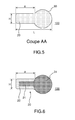
- the figure 5 illustrates an AA cut according to the figure 4 .
- the upper and lower faces have a prominence in the form of a cap.
- the figure 6 illustrates a sectional view AA according to an alternative embodiment.
- the device 100 comprises a substantially parallelepipedal body 20 having a parallelepipedal portion 21 of hard material extending by a spherical portion 31 of hard material forming a ball 31 and a flexible material envelope 22.
- the ball 31 is preferably made of material hard plastic.
- the casing 22 is advantageously made of rubber or silicone.
- the envelope 22 covers the front portion 21 of the body 20. It may be envisaged according to another example not shown, that the envelope 22 covers the entire body 20, thus also covering the ball 31.
- the diameter of the spherical ball 32 is 40 to 45 mm.
- the body has a length l, a width L and a height H.
- the width L of the body 20 is preferably 4 cm to 7 cm and preferably 5.5 cm to 6.5 cm and more preferably 6 cm.
- the height H of the body is preferably 1 cm to 3 cm, and preferably 1.2 cm to 2.5 cm and more preferably 2 cm.
- the block can be made in a single rubber block or by superposition of rubber sheets glued together.
- the plates have a thickness of a few millimeters from 1 mm to 5 mm.
- the envelope 22 is glued on the front part 21 and partly on the ball 31.
- the masticatory movements are removed, as well as the friction of the teeth and the awakeners in a start when the jaw begins to tremble strongly.
- the support of the lips on the rubber completely or almost eliminates the entry of air through the mouth. This is in line with what nature has planned, which only triggers the mouth breathing during intense and sustained muscular efforts, to help the chest muscles that have to increase the flow of oxygen in the lungs. It is very easy, if necessary, to eject the device 100, fully opening the lower jaw and pushing the body 10, 20 with the tongue, as does a baby unconsciously to eject the teat held in his mouth, if his nasal breathing becomes insufficient.
- This anti-bruxism device does not lock the mouth breathing if necessary. On the other hand, it completely or almost suppresses the oral snoring, very loud.
- Tests have been made by introducing the device into a plastic bag for freezing food, so as not to put the mucous membranes of the mouth in direct contact with the flexible material of the body 10, 20. These bags do not have pierced, even after a fortnight. Thus, it has been found that the friction between jaws are removed.
- the device also makes it possible to reduce the risks associated with sleep apnea.
- the use of the device according to the invention is very easily supported without constraint by users when they already use a device for treating sleep apnea.
- Bruxism and sleep apnea are linked. Indeed, eliminating the mouth breathing requires extra energy to inflate the chest and lungs to impose a new distribution of inspired air.
- Gold a small device generating air blowing already generates the slight overpressure that inflates the lungs.
Landscapes
- Health & Medical Sciences (AREA)
- Otolaryngology (AREA)
- Pulmonology (AREA)
- Nursing (AREA)
- Orthopedic Medicine & Surgery (AREA)
- Engineering & Computer Science (AREA)
- Biomedical Technology (AREA)
- Heart & Thoracic Surgery (AREA)
- Vascular Medicine (AREA)
- Life Sciences & Earth Sciences (AREA)
- Animal Behavior & Ethology (AREA)
- General Health & Medical Sciences (AREA)
- Public Health (AREA)
- Veterinary Medicine (AREA)
- Dental Tools And Instruments Or Auxiliary Dental Instruments (AREA)
- Medical Preparation Storing Or Oral Administration Devices (AREA)
Applications Claiming Priority (1)
| Application Number | Priority Date | Filing Date | Title |
|---|---|---|---|
| FR1452536A FR3019034A1 (fr) | 2014-03-25 | 2014-03-25 | Dispositif d'occlusion dentaire pour la suppression de l'intensite des forces de bruxisme |
Publications (1)
| Publication Number | Publication Date |
|---|---|
| EP2923680A1 true EP2923680A1 (de) | 2015-09-30 |
Family
ID=50624845
Family Applications (1)
| Application Number | Title | Priority Date | Filing Date |
|---|---|---|---|
| EP15160467.5A Withdrawn EP2923680A1 (de) | 2014-03-25 | 2015-03-24 | Okklusionsvorrichtung für zähne zur vermeidung der grossen kräfte bei bruxismus |
Country Status (2)
| Country | Link |
|---|---|
| EP (1) | EP2923680A1 (de) |
| FR (1) | FR3019034A1 (de) |
Cited By (2)
| Publication number | Priority date | Publication date | Assignee | Title |
|---|---|---|---|---|
| WO2026027781A1 (de) | 2024-08-02 | 2026-02-05 | MK Network Services GmbH | Vorrichtung und verfahren zur verhinderung von bruxismus und/oder craniomandibuläre dysfunktion (cmd) |
| DE102025140424A1 (de) | 2024-10-02 | 2026-04-02 | MK Network Services GmbH | Vorrichtungen und Verfahren zur Verringerung von Bruxismus, craniomandibuläre Dysfunktion, Schlafapnoe und andere parafunktionale Bewegungen durch Biofeedback |
Citations (5)
| Publication number | Priority date | Publication date | Assignee | Title |
|---|---|---|---|---|
| US5046512A (en) | 1989-03-10 | 1991-09-10 | Murchie John A | Method and apparatus for treatment of snoring |
| EP0818213A2 (de) | 1996-07-09 | 1998-01-14 | William T. Hart | Mundvorrichtung zur Unterdrückung von Schlafapnoe und Schnarchen |
| DE10214800A1 (de) | 2002-04-04 | 2003-10-16 | Thomas Wascher | Wegwerf-Zahnpads als Zahnschutz gegen nächtliches aufeinanderreiben der Zähne (z.B. Zähneknirschen und -schleifen) |
| WO2010035303A1 (en) | 2008-09-25 | 2010-04-01 | Alessandro Rampello | Improved stress-relieving mouthpiece |
| US20120031411A1 (en) | 2010-08-04 | 2012-02-09 | Richard Horian | Oral appliance |
-
2014
- 2014-03-25 FR FR1452536A patent/FR3019034A1/fr not_active Withdrawn
-
2015
- 2015-03-24 EP EP15160467.5A patent/EP2923680A1/de not_active Withdrawn
Patent Citations (5)
| Publication number | Priority date | Publication date | Assignee | Title |
|---|---|---|---|---|
| US5046512A (en) | 1989-03-10 | 1991-09-10 | Murchie John A | Method and apparatus for treatment of snoring |
| EP0818213A2 (de) | 1996-07-09 | 1998-01-14 | William T. Hart | Mundvorrichtung zur Unterdrückung von Schlafapnoe und Schnarchen |
| DE10214800A1 (de) | 2002-04-04 | 2003-10-16 | Thomas Wascher | Wegwerf-Zahnpads als Zahnschutz gegen nächtliches aufeinanderreiben der Zähne (z.B. Zähneknirschen und -schleifen) |
| WO2010035303A1 (en) | 2008-09-25 | 2010-04-01 | Alessandro Rampello | Improved stress-relieving mouthpiece |
| US20120031411A1 (en) | 2010-08-04 | 2012-02-09 | Richard Horian | Oral appliance |
Cited By (2)
| Publication number | Priority date | Publication date | Assignee | Title |
|---|---|---|---|---|
| WO2026027781A1 (de) | 2024-08-02 | 2026-02-05 | MK Network Services GmbH | Vorrichtung und verfahren zur verhinderung von bruxismus und/oder craniomandibuläre dysfunktion (cmd) |
| DE102025140424A1 (de) | 2024-10-02 | 2026-04-02 | MK Network Services GmbH | Vorrichtungen und Verfahren zur Verringerung von Bruxismus, craniomandibuläre Dysfunktion, Schlafapnoe und andere parafunktionale Bewegungen durch Biofeedback |
Also Published As
| Publication number | Publication date |
|---|---|
| FR3019034A1 (fr) | 2015-10-02 |
Similar Documents
| Publication | Publication Date | Title |
|---|---|---|
| EP1750629B1 (de) | Unterkiefervorschiebeorthese | |
| EP2693995B1 (de) | Funktionelle dentofaziale orthopädische vorrichtung | |
| EP0720493B1 (de) | Anatomisches, intrabuccales atmungsanschlussstück | |
| EP0711184B1 (de) | Bukkale atmungsmaske | |
| FR2627379A1 (fr) | Ouvre-bouche | |
| FR2737403A1 (fr) | Dispositif intrabuccal, destine notamment au traitement du ronflement | |
| CA2572079A1 (fr) | Dilatateur nasal et ses applications | |
| EP3377005A1 (de) | Zahnärztlicher ausrichter, verfahren zur herstellung und orthese mit solch einem ausrichter | |
| EP3349699B1 (de) | Intraorale vorrichtung zur repositionierung und rehabilitation der zunge | |
| WO2009062541A1 (fr) | Orthèse d'avancement mandibulaire | |
| EP2923680A1 (de) | Okklusionsvorrichtung für zähne zur vermeidung der grossen kräfte bei bruxismus | |
| WO2012131240A1 (fr) | Sucette orthodontique | |
| EP3153136B1 (de) | Dynamische dentalvorrichtung | |
| EP3096717B1 (de) | Vorrichtung um die atmung durch die nase bei schnarchenden zu vereinfachen | |
| WO1996003173A1 (fr) | Embout respiratoire intra-buccal anatomique | |
| FR2867058A1 (fr) | Appareil de positionnement lingual | |
| EP4319679B1 (de) | Beissblock und mundpropst mit zwei beissbloecken | |
| FR2893833A1 (fr) | Appareil d'orthopedie dento-faciale. | |
| FR2951931A1 (fr) | Dispositif comprenant une gouttiere destine a la prise d'empreinte dentaire et a la protection contre les consequences du bruxisme | |
| WO2025214618A1 (fr) | Dispositif de protection à usage unique du type languette destiné à se positionner de façon amovible sur une face supérieure d'une lame d'intubation | |
| EP3201074A1 (de) | Mundstück zur abgabe von gasen an einen benutzer | |
| CA3015287A1 (fr) | Dispositif pour reduire des nuisances sonores liees au ronflement |
Legal Events
| Date | Code | Title | Description |
|---|---|---|---|
| PUAI | Public reference made under article 153(3) epc to a published international application that has entered the european phase |
Free format text: ORIGINAL CODE: 0009012 |
|
| AK | Designated contracting states |
Kind code of ref document: A1 Designated state(s): AL AT BE BG CH CY CZ DE DK EE ES FI FR GB GR HR HU IE IS IT LI LT LU LV MC MK MT NL NO PL PT RO RS SE SI SK SM TR |
|
| AX | Request for extension of the european patent |
Extension state: BA ME |
|
| STAA | Information on the status of an ep patent application or granted ep patent |
Free format text: STATUS: THE APPLICATION IS DEEMED TO BE WITHDRAWN |
|
| 18D | Application deemed to be withdrawn |
Effective date: 20160331 |