EP2931728B1 - Chlorinderivate für fotodynamische therapie und diagnose - Google Patents
Chlorinderivate für fotodynamische therapie und diagnose Download PDFInfo
- Publication number
- EP2931728B1 EP2931728B1 EP13821500.9A EP13821500A EP2931728B1 EP 2931728 B1 EP2931728 B1 EP 2931728B1 EP 13821500 A EP13821500 A EP 13821500A EP 2931728 B1 EP2931728 B1 EP 2931728B1
- Authority
- EP
- European Patent Office
- Prior art keywords
- sodium
- chlorin
- cancer
- pharmaceutical composition
- treatment
- Prior art date
- Legal status (The legal status is an assumption and is not a legal conclusion. Google has not performed a legal analysis and makes no representation as to the accuracy of the status listed.)
- Active
Links
- BAYNJLMXYJTMOX-HXEPXWAASA-N CCC1=C(C)C(/C=C(/C(C=C)=C2C)\N/C2=C\C([C@@H](C)[C@@H]2CCC(O)=O)=N/C2=C2/C)=N/C1=C\c1c(C)c(C(O)=O)c2[nH]1 Chemical compound CCC1=C(C)C(/C=C(/C(C=C)=C2C)\N/C2=C\C([C@@H](C)[C@@H]2CCC(O)=O)=N/C2=C2/C)=N/C1=C\c1c(C)c(C(O)=O)c2[nH]1 BAYNJLMXYJTMOX-HXEPXWAASA-N 0.000 description 1
Images





Classifications
-
- C—CHEMISTRY; METALLURGY
- C07—ORGANIC CHEMISTRY
- C07D—HETEROCYCLIC COMPOUNDS
- C07D487/00—Heterocyclic compounds containing nitrogen atoms as the only ring hetero atoms in the condensed system, not provided for by groups C07D451/00 - C07D477/00
- C07D487/22—Heterocyclic compounds containing nitrogen atoms as the only ring hetero atoms in the condensed system, not provided for by groups C07D451/00 - C07D477/00 in which the condensed system contains four or more hetero rings
-
- A—HUMAN NECESSITIES
- A61—MEDICAL OR VETERINARY SCIENCE; HYGIENE
- A61K—PREPARATIONS FOR MEDICAL, DENTAL OR TOILETRY PURPOSES
- A61K41/00—Medicinal preparations obtained by treating materials with wave energy or particle radiation ; Therapies using these preparations
- A61K41/0057—Photodynamic therapy with a photosensitizer, i.e. agent able to produce reactive oxygen species upon exposure to light or radiation, e.g. UV or visible light; photocleavage of nucleic acids with an agent
- A61K41/0071—PDT with porphyrins having exactly 20 ring atoms, i.e. based on the non-expanded tetrapyrrolic ring system, e.g. bacteriochlorin, chlorin-e6, or phthalocyanines
-
- A—HUMAN NECESSITIES
- A61—MEDICAL OR VETERINARY SCIENCE; HYGIENE
- A61K—PREPARATIONS FOR MEDICAL, DENTAL OR TOILETRY PURPOSES
- A61K49/00—Preparations for testing in vivo
- A61K49/001—Preparation for luminescence or biological staining
- A61K49/0013—Luminescence
- A61K49/0017—Fluorescence in vivo
- A61K49/0019—Fluorescence in vivo characterised by the fluorescent group, e.g. oligomeric, polymeric or dendritic molecules
- A61K49/0021—Fluorescence in vivo characterised by the fluorescent group, e.g. oligomeric, polymeric or dendritic molecules the fluorescent group being a small organic molecule
- A61K49/0036—Porphyrins
-
- A—HUMAN NECESSITIES
- A61—MEDICAL OR VETERINARY SCIENCE; HYGIENE
- A61P—SPECIFIC THERAPEUTIC ACTIVITY OF CHEMICAL COMPOUNDS OR MEDICINAL PREPARATIONS
- A61P1/00—Drugs for disorders of the alimentary tract or the digestive system
- A61P1/16—Drugs for disorders of the alimentary tract or the digestive system for liver or gallbladder disorders, e.g. hepatoprotective agents, cholagogues, litholytics
-
- A—HUMAN NECESSITIES
- A61—MEDICAL OR VETERINARY SCIENCE; HYGIENE
- A61P—SPECIFIC THERAPEUTIC ACTIVITY OF CHEMICAL COMPOUNDS OR MEDICINAL PREPARATIONS
- A61P17/00—Drugs for dermatological disorders
-
- A—HUMAN NECESSITIES
- A61—MEDICAL OR VETERINARY SCIENCE; HYGIENE
- A61P—SPECIFIC THERAPEUTIC ACTIVITY OF CHEMICAL COMPOUNDS OR MEDICINAL PREPARATIONS
- A61P17/00—Drugs for dermatological disorders
- A61P17/06—Antipsoriatics
-
- A—HUMAN NECESSITIES
- A61—MEDICAL OR VETERINARY SCIENCE; HYGIENE
- A61P—SPECIFIC THERAPEUTIC ACTIVITY OF CHEMICAL COMPOUNDS OR MEDICINAL PREPARATIONS
- A61P17/00—Drugs for dermatological disorders
- A61P17/10—Anti-acne agents
-
- A—HUMAN NECESSITIES
- A61—MEDICAL OR VETERINARY SCIENCE; HYGIENE
- A61P—SPECIFIC THERAPEUTIC ACTIVITY OF CHEMICAL COMPOUNDS OR MEDICINAL PREPARATIONS
- A61P19/00—Drugs for skeletal disorders
-
- A—HUMAN NECESSITIES
- A61—MEDICAL OR VETERINARY SCIENCE; HYGIENE
- A61P—SPECIFIC THERAPEUTIC ACTIVITY OF CHEMICAL COMPOUNDS OR MEDICINAL PREPARATIONS
- A61P19/00—Drugs for skeletal disorders
- A61P19/02—Drugs for skeletal disorders for joint disorders, e.g. arthritis, arthrosis
-
- A—HUMAN NECESSITIES
- A61—MEDICAL OR VETERINARY SCIENCE; HYGIENE
- A61P—SPECIFIC THERAPEUTIC ACTIVITY OF CHEMICAL COMPOUNDS OR MEDICINAL PREPARATIONS
- A61P25/00—Drugs for disorders of the nervous system
-
- A—HUMAN NECESSITIES
- A61—MEDICAL OR VETERINARY SCIENCE; HYGIENE
- A61P—SPECIFIC THERAPEUTIC ACTIVITY OF CHEMICAL COMPOUNDS OR MEDICINAL PREPARATIONS
- A61P27/00—Drugs for disorders of the senses
- A61P27/02—Ophthalmic agents
-
- A—HUMAN NECESSITIES
- A61—MEDICAL OR VETERINARY SCIENCE; HYGIENE
- A61P—SPECIFIC THERAPEUTIC ACTIVITY OF CHEMICAL COMPOUNDS OR MEDICINAL PREPARATIONS
- A61P29/00—Non-central analgesic, antipyretic or antiinflammatory agents, e.g. antirheumatic agents; Non-steroidal antiinflammatory drugs [NSAID]
-
- A—HUMAN NECESSITIES
- A61—MEDICAL OR VETERINARY SCIENCE; HYGIENE
- A61P—SPECIFIC THERAPEUTIC ACTIVITY OF CHEMICAL COMPOUNDS OR MEDICINAL PREPARATIONS
- A61P3/00—Drugs for disorders of the metabolism
-
- A—HUMAN NECESSITIES
- A61—MEDICAL OR VETERINARY SCIENCE; HYGIENE
- A61P—SPECIFIC THERAPEUTIC ACTIVITY OF CHEMICAL COMPOUNDS OR MEDICINAL PREPARATIONS
- A61P3/00—Drugs for disorders of the metabolism
- A61P3/08—Drugs for disorders of the metabolism for glucose homeostasis
- A61P3/10—Drugs for disorders of the metabolism for glucose homeostasis for hyperglycaemia, e.g. antidiabetics
-
- A—HUMAN NECESSITIES
- A61—MEDICAL OR VETERINARY SCIENCE; HYGIENE
- A61P—SPECIFIC THERAPEUTIC ACTIVITY OF CHEMICAL COMPOUNDS OR MEDICINAL PREPARATIONS
- A61P31/00—Antiinfectives, i.e. antibiotics, antiseptics, chemotherapeutics
-
- A—HUMAN NECESSITIES
- A61—MEDICAL OR VETERINARY SCIENCE; HYGIENE
- A61P—SPECIFIC THERAPEUTIC ACTIVITY OF CHEMICAL COMPOUNDS OR MEDICINAL PREPARATIONS
- A61P31/00—Antiinfectives, i.e. antibiotics, antiseptics, chemotherapeutics
- A61P31/04—Antibacterial agents
-
- A—HUMAN NECESSITIES
- A61—MEDICAL OR VETERINARY SCIENCE; HYGIENE
- A61P—SPECIFIC THERAPEUTIC ACTIVITY OF CHEMICAL COMPOUNDS OR MEDICINAL PREPARATIONS
- A61P31/00—Antiinfectives, i.e. antibiotics, antiseptics, chemotherapeutics
- A61P31/10—Antimycotics
-
- A—HUMAN NECESSITIES
- A61—MEDICAL OR VETERINARY SCIENCE; HYGIENE
- A61P—SPECIFIC THERAPEUTIC ACTIVITY OF CHEMICAL COMPOUNDS OR MEDICINAL PREPARATIONS
- A61P31/00—Antiinfectives, i.e. antibiotics, antiseptics, chemotherapeutics
- A61P31/12—Antivirals
-
- A—HUMAN NECESSITIES
- A61—MEDICAL OR VETERINARY SCIENCE; HYGIENE
- A61P—SPECIFIC THERAPEUTIC ACTIVITY OF CHEMICAL COMPOUNDS OR MEDICINAL PREPARATIONS
- A61P31/00—Antiinfectives, i.e. antibiotics, antiseptics, chemotherapeutics
- A61P31/12—Antivirals
- A61P31/14—Antivirals for RNA viruses
- A61P31/16—Antivirals for RNA viruses for influenza or rhinoviruses
-
- A—HUMAN NECESSITIES
- A61—MEDICAL OR VETERINARY SCIENCE; HYGIENE
- A61P—SPECIFIC THERAPEUTIC ACTIVITY OF CHEMICAL COMPOUNDS OR MEDICINAL PREPARATIONS
- A61P31/00—Antiinfectives, i.e. antibiotics, antiseptics, chemotherapeutics
- A61P31/12—Antivirals
- A61P31/14—Antivirals for RNA viruses
- A61P31/18—Antivirals for RNA viruses for HIV
-
- A—HUMAN NECESSITIES
- A61—MEDICAL OR VETERINARY SCIENCE; HYGIENE
- A61P—SPECIFIC THERAPEUTIC ACTIVITY OF CHEMICAL COMPOUNDS OR MEDICINAL PREPARATIONS
- A61P31/00—Antiinfectives, i.e. antibiotics, antiseptics, chemotherapeutics
- A61P31/12—Antivirals
- A61P31/20—Antivirals for DNA viruses
- A61P31/22—Antivirals for DNA viruses for herpes viruses
-
- A—HUMAN NECESSITIES
- A61—MEDICAL OR VETERINARY SCIENCE; HYGIENE
- A61P—SPECIFIC THERAPEUTIC ACTIVITY OF CHEMICAL COMPOUNDS OR MEDICINAL PREPARATIONS
- A61P33/00—Antiparasitic agents
-
- A—HUMAN NECESSITIES
- A61—MEDICAL OR VETERINARY SCIENCE; HYGIENE
- A61P—SPECIFIC THERAPEUTIC ACTIVITY OF CHEMICAL COMPOUNDS OR MEDICINAL PREPARATIONS
- A61P33/00—Antiparasitic agents
- A61P33/02—Antiprotozoals, e.g. for leishmaniasis, trichomoniasis, toxoplasmosis
-
- A—HUMAN NECESSITIES
- A61—MEDICAL OR VETERINARY SCIENCE; HYGIENE
- A61P—SPECIFIC THERAPEUTIC ACTIVITY OF CHEMICAL COMPOUNDS OR MEDICINAL PREPARATIONS
- A61P35/00—Antineoplastic agents
-
- A—HUMAN NECESSITIES
- A61—MEDICAL OR VETERINARY SCIENCE; HYGIENE
- A61P—SPECIFIC THERAPEUTIC ACTIVITY OF CHEMICAL COMPOUNDS OR MEDICINAL PREPARATIONS
- A61P35/00—Antineoplastic agents
- A61P35/02—Antineoplastic agents specific for leukemia
-
- A—HUMAN NECESSITIES
- A61—MEDICAL OR VETERINARY SCIENCE; HYGIENE
- A61P—SPECIFIC THERAPEUTIC ACTIVITY OF CHEMICAL COMPOUNDS OR MEDICINAL PREPARATIONS
- A61P43/00—Drugs for specific purposes, not provided for in groups A61P1/00-A61P41/00
-
- A—HUMAN NECESSITIES
- A61—MEDICAL OR VETERINARY SCIENCE; HYGIENE
- A61P—SPECIFIC THERAPEUTIC ACTIVITY OF CHEMICAL COMPOUNDS OR MEDICINAL PREPARATIONS
- A61P9/00—Drugs for disorders of the cardiovascular system
-
- A—HUMAN NECESSITIES
- A61—MEDICAL OR VETERINARY SCIENCE; HYGIENE
- A61P—SPECIFIC THERAPEUTIC ACTIVITY OF CHEMICAL COMPOUNDS OR MEDICINAL PREPARATIONS
- A61P9/00—Drugs for disorders of the cardiovascular system
- A61P9/10—Drugs for disorders of the cardiovascular system for treating ischaemic or atherosclerotic diseases, e.g. antianginal drugs, coronary vasodilators, drugs for myocardial infarction, retinopathy, cerebrovascula insufficiency, renal arteriosclerosis
Definitions
- the present invention relates to chlorin e4 sodium and a process for its preparation.
- Chlorin e4 sodium is suitable for use in photodynamic therapy, cytoluminescent therapy and photodynamic diagnosis, for example for treating or detecting a tumour.
- the present invention also relates to a pharmaceutical composition comprising chlorin e4 sodium, to the use of chlorin e4 sodium in the manufacture of a phototherapeutic or photodiagnostic agent, and to chlorin e4 sodium for use in photodynamic therapy, cytoluminescent therapy or photodynamic diagnosis, for example, for use in treating or detecting a tumour.
- Porphyrins and their derivatives are known photosensitive chemical compounds, which can absorb light photons and emit them at higher wavelengths. There are many applications for such unique properties and PDT (photodynamic therapy) is one of them.
- Figure 1 shows a modified Jablonski diagram for a typical photosensitizer, outlining the principle photophysical processes of interest.
- T 1 triplet state
- 3 O 2 molecular oxygen
- Singlet oxygen ( 1 O 2 ) is known as a "scavenger" and can destroy abnormal biological cells and remove free radicals.
- the first generation comprises hem porphyrins (blood derivatives), and the second for the most part are chlorophyll derivatives.
- the later compounds are known as chlorins and bacteriochlorins.
- Chlorins show photophysical properties similar to those of the porphyrin systems, but have an enhanced, red-shifted Q band (670nm) which makes chlorin-containing systems better candidates for PDT.
- Chlorophyll a the green photosynthetic pigment, is one prototype of the chlorin class of natural products. It or its derivatives can be extracted from certain Spirulina Platensis species without any contamination with chlorophyll b, thus avoiding a tedious chromatographic separation.
- a water-soluble chlorophyll derivative known as tri-sodium copper(II) chlorin e6 has been used in the treatment of various human ailments with no evidence of toxicity, skin sensitization or other serious side effects.
- Chlorin e4 was studied recently and was shown to display good photosensitive activity. It was indicated that chlorin e4 has a protective effect against indomethacin-induced gastric lesions in rats and TAA- or CCl 4 -induced acute liver injuries in mice. It was therefore suggested that chlorin e4 may be a promising new drug candidate for anti-gastrelcosis and liver injury protection.
- WO 2009/040411 suggests the use of a chlorin e4 zinc complex in photodynamic therapy. Li et al (Oncology Reports, 2012, vol. 27, pages 1455-1460 ) describe chlorin e4 as a photosensitizer in the treatment of bladder cancer cell lines.
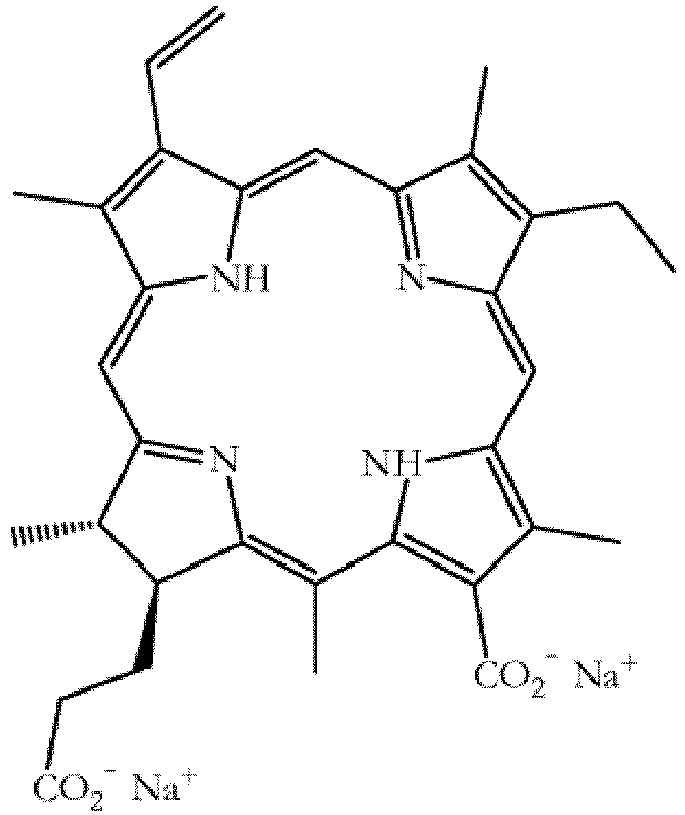
- a first aspect of the present invention provides chlorin e4 sodium, having the structure:
- chlorin e4 sodium has the structure:
- Chlorin e4 sodium has two chiral centres.
- the chlorin e4 sodium of the present invention is preferably substantially enantiomerically pure, which means that the chlorin e4 sodium comprises less than 10% of other stereoisomers, preferably less than 5%, preferably less than 3%, preferably less than 2%, preferably less than 1%.
- a second aspect of the present invention provides a process of preparing chlorin e4 sodium according to the first aspect of the present invention, comprising the step of reacting chlorin e4 with a sodium compound.
- the sodium compound is sodium hydroxide, sodium carbonate, a carboxylic acid sodium salt (such as sodium stearate or sodium acetate), a sodium halide (such as sodium fluoride) or sodium hydride.
- the sodium compound is sodium hydroxide, a carboxylic acid sodium salt (such as sodium stearate or sodium acetate), a sodium halide (such as sodium fluoride) or sodium hydride.
- the sodium compound is sodium hydroxide or sodium carbonate. More preferably the sodium compound is sodium hydroxide.
- the base is an amine base, preferably an aromatic amine base such as thiamine pyrophosphate or DMAP. If used, the base is preferably thiamine pyrophosphate.
- chlorin e4 the sodium compound and the optional base are used in a molar ratio of 0.15-1 : 45-60 : 0-12.
- chlorin e4 is reacted with the sodium compound in the presence of a solvent.
- the solvent is selected from an alcohol (such as methanol, ethanol, n-propanol or isopropanol), water, DMF, chloroform, DMSO, toluene or a mixture thereof.
- the solvent is selected from methanol, ethanol, water or a mixture thereof.
- the solvent is selected from methanol, water or a mixture thereof.
- the solvent is a mixture of methanol and water.
- the reaction is carried out at a temperature of 60°C or less.
- the reaction is carried out at a temperature in the range of 25-60°C.
- reaction is carried out over 1 to 12 hours, preferably over 3 to 8 hours.
- the chlorin e4 sodium obtained may be purified by filtering, for example through a 45 ⁇ m Millipore filter. Alternatively or additionally, the chlorin e4 sodium obtained may be purified by chromatography, for example by flash chromatography on a silica gel column. The chlorin e4 sodium may be isolated by lyophilisation.
- a fourth aspect of the present invention provides a pharmaceutical composition comprising chlorin e4 sodium according to the first aspect of the present invention and a pharmaceutically acceptable carrier or diluent.
- the chlorin e4 sodium according to the first aspect of the present invention is suitable for use in medicine.
- the chlorin e4 sodium according to the first aspect of the present invention and the pharmaceutical composition according to the fourth aspect of the present invention are suitable for use in photodynamic therapy or cytoluminescent therapy.
- the chlorin e4 sodium according to the first aspect of the present invention and the pharmaceutical composition according to the fourth aspect of the present invention are suitable for the treatment of a disease characterised by benign or malignant cellular hyperproliferation or by areas of neovascularisation; a benign or malignant tumour; early cancer; cervical dysplasia; soft tissue sarcoma; a germ cell tumour; retinoblastoma; Hodgkin's lymphoma; or cancer of the blood, prostate, cervix, uterus, vaginal or other female adnexa, breast, naso-pharynx, trachea, larynx, bronchi, bronchioles, lung, hollow organs, esophagus, stomach, bile duct, intestine, colon, colorectum, rectum, bladder, ureter, kidney, liver, gall bladder, spleen, brain, lymphatic system or bones.
- the chlorin e4 sodium according to the first aspect of the present invention and the pharmaceutical composition according to the fourth aspect of the present invention are suitable for the treatment of a disease characterised by benign or malignant cellular hyperproliferation or by areas of neovascularisation.
- the chlorin e4 sodium according to the first aspect of the present invention and the pharmaceutical composition according to the fourth aspect of the present invention are suitable for the treatment of a benign or malignant tumour.
- the chlorin e4 sodium according to the first aspect of the present invention and the pharmaceutical composition according to the fourth aspect of the present invention are suitable for the treatment of early cancer; cervical dysplasia; soft tissue sarcoma; a germ cell tumour; retinoblastoma; lymphoma; Hodgkin's lymphoma; head and neck cancer; oral or mouth cancer; or cancer of the blood, prostate, cervix, uterus, vaginal or other female adnexa, breast, naso-pharynx, trachea, larynx, bronchi, bronchioles, lung, hollow organs, esophagus, stomach, bile duct, intestine, colon, colorectum, rectum, bladder, ureter, kidney, liver, gall bladder, spleen, brain, lymphatic system, bones, skin or pancreas.
- cervix uterus, vaginal or other female adnexa, breast, naso-pharynx, trachea, larynx, bronchi, bronchioles, lung, hollow organs, esophagus, stomach, bile duct, intestine, colon, colorectum, rectum, bladder, ureter, kidney, liver, gall bladder, spleen, brain, lymphatic system or bones.
- lymphoma Preferably they are suitable for the treatment of lymphoma; Hodgkin's lymphoma; oral or mouth cancer; or cancer of the prostate, cervix, vaginal or other female adnexa, breast, naso-pharynx, lung, esophagus, kidney, liver, brain, lymphatic system, bones, skin or pancreas.
- lymphoma Preferably they are suitable for the treatment of lymphoma; oral or mouth cancer; or cancer of the prostate, cervix, vaginal or other female adnexa, breast, naso-pharynx, lung, esophagus, bones or skin.
- chlorin e4 sodium according to the first aspect of the present invention and the pharmaceutical composition according to the fourth aspect of the present invention are suitable for use in photodynamic diagnosis.
- the chlorin e4 sodium according to the first aspect of the present invention and the pharmaceutical composition according to the fourth aspect of the present invention are suitable for the detection of a disease characterised by benign or malignant cellular hyperproliferation or by areas of neovascularisation; a benign or malignant tumour; early cancer; cervical dysplasia; soft tissue sarcoma; a germ cell tumour; retinoblastoma; Hodgkin's lymphoma; or cancer of the blood, prostate, cervix, uterus, vaginal or other female adnexa, breast, naso-pharynx, trachea, larynx, bronchi, bronchioles, lung, hollow organs, esophagus, stomach, bile duct, intestine, colon, colorectum, rectum, bladder, ureter, kidney, liver, gall bladder, spleen, brain, lymphatic system or bones.
- the chlorin e4 sodium according to the first aspect of the present invention and the pharmaceutical composition according to the fourth aspect of the present invention are suitable for the detection of an area that is affected by benign or malignant cellular hyperproliferation or by neovascularisation.
- the chlorin e4 sodium according to the first aspect of the present invention and the pharmaceutical composition according to the fourth aspect of the present invention are suitable for the detection of a benign or malignant tumour.
- the chlorin e4 sodium according to the first aspect of the present invention and the pharmaceutical composition according to the fourth aspect of the present invention are suitable for the detection of early cancer; cervical dysplasia; soft tissue sarcoma; a germ cell tumour; retinoblastoma; lymphoma; Hodgkin's lymphoma; head and neck cancer; oral or mouth cancer; or cancer of the blood, prostate, cervix, uterus, vaginal or other female adnexa, breast, naso-pharynx, trachea, larynx, bronchi, bronchioles, lung, hollow organs, esophagus, stomach, bile duct, intestine, colon, colorectum, rectum, bladder, ureter, kidney, liver, gall bladder, spleen, brain, lymphatic system, bones, skin or pancreas.
- cervix uterus, vaginal or other female adnexa, breast, naso-pharynx, trachea, larynx, bronchi, bronchioles, lung, hollow organs, esophagus, stomach, bile duct, intestine, colon, colorectum, rectum, bladder, ureter, kidney, liver, gall bladder, spleen, brain, lymphatic system or bones.
- lymphoma Hodgkin's lymphoma; oral or mouth cancer; or cancer of the prostate, cervix, vaginal or other female adnexa, breast, naso-pharynx, lung, esophagus, kidney, liver, brain, lymphatic system, bones, skin or pancreas.
- lymphoma oral or mouth cancer; or cancer of the prostate, cervix, vaginal or other female adnexa, breast, naso-pharynx, lung, esophagus, bones or skin.
- the chlorin e4 sodium according to the first aspect of the present invention and the pharmaceutical composition according to the fourth aspect of the present invention are suitable for the fluorescent or phosphorescent detection of the diseases listed above, preferably for the fluorescent or phosphorescent detection and quantification of the said diseases.
- the chlorin e4 sodium according to the first aspect of the present invention and the pharmaceutical composition according to the fourth aspect of the present invention are adapted for administration simultaneous with or prior to administration of irradiation or sound, preferably for administration prior to administration of irradiation.
- chlorin e4 sodium according to the first aspect of the present invention or the pharmaceutical composition according to the fourth aspect of the present invention are for use in photodynamic therapy or cytoluminescent therapy, then they are preferably adapted for administration 5 to 100 hours before the irradiation, preferably 6 to 72 hours before the irradiation, preferably 24 to 48 hours before the irradiation.
- chlorin e4 sodium according to the first aspect of the present invention or the pharmaceutical composition according to the fourth aspect of the present invention are for use in photodynamic diagnosis, then they are preferably adapted for administration 3 to 60 hours before the irradiation, preferably 8 to 40 hours before the irradiation.
- the irradiation used in the photodynamic therapy, cytoluminescent therapy or photodynamic diagnosis is electromagnetic radiation with a wavelength in the range of from 500nm to 1000nm, preferably from 600nm to 790nm.
- the electromagnetic radiation may be administered for about 5-60 minutes, preferably for about 15-20 minutes, at about 0.1-5W, preferably at about 1W.
- two sources of electromagnetic radiation are used (for example a laser light and an LED light), one source with a wavelength in the range of from 600nm to 690nm, preferably about 660nm, the other source with a wavelength in the range of from 700nm to 790nm, preferably about 760nm.
- two sources of electromagnetic radiation are used (for example a laser light and an LED light), both sources adapted to provide irradiation with a wavelength in the range of from 600nm to 690nm, preferably about 660nm, and irradiation with a wavelength in the range of from 700nm to 790nm, preferably about 760nm.
- the irradiation may be provided by a prostate, anal, vaginal, mouth and nasal device for insertion into a body cavity.
- the irradiation may be provided by interstitial light activation, for example, using a fine needle to insert an optical fibre laser into the lung, liver, lymph nodes or breast.
- the irradiation may be provided by endoscopic light activation, for example, for delivering light to the lung, stomach, colon, bladder or neck.
- the pharmaceutical composition according to the fourth aspect of the present invention may be in a form suitable for oral, parenteral (including intravenous, subcutaneous, intramuscular, intradermal, intratracheal, intraperitoneal, intraarticular, intraabdominal, intracranial and epidural), transdermal, airway (aerosol), rectal, vaginal or topical (including buccal, mucosal and sublingual) administration.
- parenteral including intravenous, subcutaneous, intramuscular, intradermal, intratracheal, intraperitoneal, intraarticular, intraabdominal, intracranial and epidural
- transdermal airway (aerosol)
- rectal rectal
- vaginal or topical including buccal, mucosal and sublingual
- the pharmaceutical composition may also be in a form suitable for administration by enema or for administration by injection into a tumour.
- the pharmaceutical composition is in a form suitable for oral, parenteral or airway administration, preferably in a form suitable for oral or
- the pharmaceutical composition is in a form suitable for oral administration.
- the pharmaceutical composition is provided in the form of a tablet, capsule, hard or soft gelatine capsule, caplet, troche or lozenge, as a powder or granules, or as an aqueous solution, suspension or dispersion.
- the pharmaceutical composition is provided in the form of an aqueous solution, suspension or dispersion for oral administration, or alternatively in the form of a freeze-dried powder which can be mixed with water before administration to provide an aqueous solution, suspension or dispersion for oral administration.
- the pharmaceutical composition is in a form suitable for providing 0.01 to 10 mg/kg/day of the chlorin e4 sodium, preferably 0.1 to 5 mg/kg/day, preferably about 3 mg/kg/day.
- the pharmaceutical composition is in a form suitable for parenteral administration.
- the pharmaceutical composition is in a form suitable for intravenous administration.
- the pharmaceutical composition is provided in the form of an aqueous solution for parenteral administration, or alternatively in the form of a freeze-dried powder which can be mixed with water before administration to provide an aqueous solution for parenteral administration.
- the pharmaceutical composition is an aqueous solution or suspension having a pH of from 6 to 8.5.
- the pharmaceutical composition is in a form suitable for airway administration.
- the pharmaceutical composition is provided in the form of an aqueous solution, suspension or dispersion for airway administration, or alternatively in the form of a freeze-dried powder which can be mixed with water before administration to provide an aqueous solution, suspension or dispersion for airway administration.
- the pharmaceutical composition is in a form suitable for providing 0.01 to 10 mg/kg/day of the chlorin e4 sodium, preferably 0.1 to 5 mg/kg/day, preferably about 3 mg/kg/day.
- a fifth aspect of the present invention provides chlorin e4 sodium according to the first aspect of the present invention for use in the treatment of a disease characterised by benign or malignant cellular hyperproliferation or by areas of neovascularisation; a benign or malignant tumour; early cancer; cervical dysplasia; soft tissue sarcoma; a germ cell tumour; retinoblastoma; Hodgkin's lymphoma; or cancer of the blood, prostate, cervix, uterus, vaginal or other female adnexa, breast, naso-pharynx, trachea, larynx, bronchi, bronchioles, lung, hollow organs, esophagus, stomach, bile duct, intestine, colon, colorectum, rectum, bladder, ureter, kidney, liver, gall bladder, spleen, brain, lymphatic system or bones.
- the fifth aspect of the present invention also provides chlorin e4 sodium according to the first aspect of the present invention for use in photodynamic therapy or cytoluminescent therapy.
- the phototherapeutic agent is suitable for the treatment of a disease characterised by benign or malignant cellular hyperproliferation or by areas of neovascularisation; a benign or malignant tumour; early cancer; cervical dysplasia; soft tissue sarcoma; a germ cell tumour; retinoblastoma; Hodgkin's lymphoma; or cancer of the blood, prostate, cervix, uterus, vaginal or other female adnexa, breast, naso-pharynx, trachea, larynx, bronchi, bronchioles, lung, hollow organs, esophagus, stomach, bile duct, intestine, colon, colorectum, rectum, bladder, ureter, kidney, liver, gall bladder, spleen, brain, lymphatic system or bones.
- the chlorin e4 sodium or the phototherapeutic agent of the fifth aspect of the present invention is suitable for the treatment of a disease characterised by benign or malignant cellular hyperproliferation or by areas of neovascularisation.
- the chlorin e4 sodium or the phototherapeutic agent of the fifth aspect of the present invention is suitable for the treatment of a benign or malignant tumour.
- the chlorin e4 sodium or the phototherapeutic agent of the fifth aspect of the present invention is suitable for the treatment of early cancer; cervical dysplasia; soft tissue sarcoma; a germ cell tumour; retinoblastoma; lymphoma; Hodgkin's lymphoma; head and neck cancer; oral or mouth cancer; or cancer of the blood, prostate, cervix, uterus, vaginal or other female adnexa, breast, naso-pharynx, trachea, larynx, bronchi, bronchioles, lung, hollow organs, esophagus, stomach, bile duct, intestine, colon, colorectum, rectum, bladder, ureter, kidney, liver, gall bladder, spleen, brain, lymphatic system, bones, skin or pancreas.
- the treatment of early cancer cervical dysplasia; soft tissue sarcoma; a germ cell tumour; retinoblastoma; Hodgkin's lymphoma; or cancer of the blood, prostate, cervix, uterus, vaginal or other female adnexa, breast, naso-pharynx, trachea, larynx, bronchi, bronchioles, lung, hollow organs, esophagus, stomach, bile duct, intestine, colon, colorectum, rectum, bladder, ureter, kidney, liver, gall bladder, spleen, brain, lymphatic system or bones.
- lymphoma Hodgkin's lymphoma; oral or mouth cancer; or cancer of the prostate, cervix, vaginal or other female adnexa, breast, naso-pharynx, lung, esophagus, kidney, liver, brain, lymphatic system, bones, skin or pancreas.
- lymphoma oral or mouth cancer; or cancer of the prostate, cervix, vaginal or other female adnexa, breast, naso-pharynx, lung, esophagus, bones or skin.
- the fifth aspect of the present invention also provides chlorin e4 sodium according to the first aspect of the present invention for use in photodynamic diagnosis.
- the photodiagnostic agent of the fifth aspect of the present invention is suitable for the detection of a disease characterised by benign or malignant cellular hyperproliferation or by areas of neovascularisation; a benign or malignant tumour; early cancer; cervical dysplasia; soft tissue sarcoma; a germ cell tumour; retinoblastoma; Hodgkin's lymphoma; or cancer of the blood, prostate, cervix, uterus, vaginal or other female adnexa, breast, naso-pharynx, trachea, larynx, bronchi, bronchioles, lung, hollow organs, esophagus, stomach, bile duct, intestine, colon, colorectum, rectum, bladder, ureter, kidney, liver, gall bladder, spleen, brain, lymphatic system or bones.
- a disease characterised by benign or malignant cellular hyperproliferation or by areas of neovascularisation; a
- the photodiagnostic agent of the fifth aspect of the present invention is suitable for the detection of an area that is affected by benign or malignant cellular hyperproliferation or by neovascularisation.
- the photodiagnostic agent of the fifth aspect of the present invention is suitable for the detection of a benign or malignant tumour.
- the photodiagnostic agent of the fifth aspect of the present invention is suitable for the detection of early cancer; cervical dysplasia; soft tissue sarcoma; a germ cell tumour; retinoblastoma; lymphoma; Hodgkin's lymphoma; head and neck cancer; oral or mouth cancer; or cancer of the blood, prostate, cervix, uterus, vaginal or other female adnexa, breast, naso-pharynx, trachea, larynx, bronchi, bronchioles, lung, hollow organs, esophagus, stomach, bile duct, intestine, colon, colorectum, rectum, bladder, ureter, kidney, liver, gall bladder, spleen, brain, lymphatic system, bones, skin or pancreas.
- the detection of early cancer cervical dysplasia; soft tissue sarcoma; a germ cell tumour; retinoblastoma; Hodgkin's lymphoma; or cancer of the blood, prostate, cervix, uterus, vaginal or other female adnexa, breast, naso-pharynx, trachea, larynx, bronchi, bronchioles, lung, hollow organs, esophagus, stomach, bile duct, intestine, colon, colorectum, rectum, bladder, ureter, kidney, liver, gall bladder, spleen, brain, lymphatic system or bones.
- lymphoma Hodgkin's lymphoma; oral or mouth cancer; or cancer of the prostate, cervix, vaginal or other female adnexa, breast, naso-pharynx, lung, esophagus, kidney, liver, brain, lymphatic system, bones, skin or pancreas.
- lymphoma oral or mouth cancer; or cancer of the prostate, cervix, vaginal or other female adnexa, breast, naso-pharynx, lung, esophagus, bones or skin.
- the photodiagnostic agent of the fifth aspect of the present invention is suitable for the fluorescent or phosphorescent detection of the said diseases, preferably the fluorescent or phosphorescent detection and quantification of the said diseases.
- the chlorin e4 sodium, the phototherapeutic agent or the photodiagnostic agent is adapted for administration simultaneous with or prior to administration of irradiation or sound, preferably for administration prior to administration of irradiation.
- the chlorin e4 sodium or the phototherapeutic agent is for use in photodynamic therapy or cytoluminescent therapy, then it is preferably adapted for administration 5 to 100 hours before the irradiation, preferably 6 to 72 hours before the irradiation, preferably 24 to 48 hours before the irradiation.
- the photodiagnostic agent is for use in photodynamic diagnosis, then it is preferably adapted for administration 3 to 60 hours before the irradiation, preferably 8 to 40 hours before the irradiation.
- the irradiation used in the photodynamic therapy, cytoluminescent therapy or photodynamic diagnosis is electromagnetic radiation with a wavelength in the range of from 500nm to 1000nm, preferably from 600nm to 790nm.
- the electromagnetic radiation may be administered for about 5-60 minutes, preferably for about 15-20 minutes, at about 0.1-5W, preferably at about 1W.
- two sources of electromagnetic radiation are used (for example a laser light and an LED light), one source with a wavelength in the range of from 600nm to 690nm, preferably about 660nm, the other source with a wavelength in the range of from 700nm to 790nm, preferably about 760nm.
- two sources of electromagnetic radiation are used (for example a laser light and an LED light), both sources adapted to provide irradiation with a wavelength in the range of from 600nm to 690nm, preferably about 660nm, and irradiation with a wavelength in the range of from 700nm to 790nm, preferably about 760nm.
- the irradiation may be provided by a prostate, anal, vaginal, mouth and nasal device for insertion into a body cavity.
- the irradiation may be provided by interstitial light activation, for example, using a fine needle to insert an optical fibre laser into the lung, liver, lymph nodes or breast.
- the irradiation may be provided by endoscopic light activation, for example, for delivering light to the lung, stomach, colon, bladder or neck.
- Porphyrins and chlorins can form complexes with a wide variety of metals (M). These metal complexes not only protect the inner nitrogen atoms from electrophilic reagents and strong bases, but also have a pronounced effect on the reactivity of the macrocycles. A common geometry of these complexes is octahedral, with the metal ions occupying the centre of the N 4 porphyrin plane and the metal ligands being in trans positions ( Figure 2 ).
- Chlorin e4 has nine side chains, two of which carry a carboxylic acid moiety. These carboxylic acid moieties can form salts with a wide variety of metals (M).
- Method 1 0.15-1mmol of chlorin e4 is dissolved in 60-100ml of methanol. To this solution, 15-20ml of sodium hydroxide (3M water solution) is added. The mixture is stirred until the synthesis is complete after about 6 hours. Then the mixture is filtered through a 45 ⁇ m Millipore filter. The product is purified by flash chromatography with a methanol mobile phase. Then the solution is distilled and lyophilized. In a preferred embodiment of the present invention, the reaction is carried out at a temperature in the range of 25-60°C.
- Method 2 0.15-1mmol of chlorin e4 is dissolved in 60-100ml of methanol. To this solution, 15-20ml of sodium hydroxide (3M water solution) is added. Separately, 5-12mmol of thiamine pyrophosphate is dissolved in 40-60ml of water, and the latter solution is added to the previous one. The mixture is stirred until the synthesis is complete after about 6 hours. Then the mixture is filtered through a 45 ⁇ m Millipore filter. The product is purified by flash chromatography with a methanol mobile phase. Then the solution is distilled and lyophilized. In a preferred embodiment of the present invention, the reaction is carried out at a temperature in the range of 25-60°C.
- Method 1 0.5mmol (276mg) of chlorin e4 was dissolved in 60ml of methanol, and the solution was stirred slowly for 10 minutes at 40°C. 15ml of sodium hydroxide (3M water solution) was added, and stirring was continued for a further 6 hours at 60°C. Then the reaction mixture was filtered through a 45 ⁇ m Millipore filter. The product was purified by flash chromatography on a dry silica gel column using a methanol mobile phase. Then the solution was reduced in volume on a rotary evaporator and the product was isolated as a dry powder by lyophilization in 85% yield.
- 3M water solution sodium hydroxide
- Method 2 0.5mmol (276mg) of chlorin e4 was dissolved in 60ml of methanol, and the solution was stirred slowly for 10 minutes at 40°C. 15ml of sodium hydroxide (3M water solution) was added, and stirring was continued for a further 20 minutes. Separately, 6mmol (378mg) of thiamine pyrophosphate was dissolved in 50ml of water, and the solution was stirred at 60°C. The thiamine pyrophosphate solution was added to the chlorin e4 solution, and the reaction mixture was stirred slowly for 6 hours at 60°C. Then the reaction mixture was filtered through a 45 ⁇ m Millipore filter.
- the product was purified by flash chromatography on a dry silica gel column using a methanol mobile phase. Then the solution was reduced in volume on a rotary evaporator and the product was isolated as a dry powder by lyophilization in 85% yield.
- the chlorin e4 sodium product was characterised by 1 H and 13 C NMR. The same results as for method 1 were obtained.
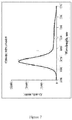
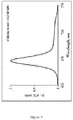
- the fluorescence quantum yields ( ⁇ F ) were determined using as a reference, solutions of TPPS (m-tetrakis(p-sulfonatophenyl)porphine) in ethanol. According to the literature, the most likely fluorescence quantum yield of TPPS in air-saturated water and ethanol is equal to 0.08 ( K. Kalyanasundaram and M. Neumann-Spallart, Photophysical and redox properties of water soluble porphyrins in aqueous media, J. Phys. Chem., 1982, 86, 5163-5169 ; and A.T. Gradyushko, A.N. Sevchenko, K.N. Solovyov and M.P.
- ⁇ F ⁇ TPP ⁇ S c ⁇ 1 ⁇ 10 ⁇ D TPP / 1 ⁇ 10 ⁇ D c S TPP
- ⁇ TPP the quantum yield of TPPS fluorescence
- S c the square under the fluorescence spectrum of the chlorin e4 sodium sample
- S TPP is the square under the fluorescence spectrum of TPPS
- D c and D TPP are absorbance (optical density) of the chlorin e4 sodium and TPPS respectively at the excitation wavelengths.
- the obtained results were collated using relative units of intensity of the excited light at the excitation wavelengths.
- the intensities of the monochromatic light were measured using a calibrated silicon detector from Optical Power Meter System ThorLabs (Karlsfeld, Germany).
- Singlet oxygen phosphorescence was detected using measurement of infrared phosphorescence at 1270 nm corresponding to the transition of oxygen molecules from the singlet to the triplet state. Phosphorescence was recorded at room temperature with the laser phosphorescence spectrometer described at A.A. Krasnovsky Jr., Photodynamic action and singlet oxygen, Biofizika, 2004, 49, 305-321 ; and A.A. Krasnovsky Jr., Singlet oxygen and primary mechanisms of photodynamic therapy and photodynamic diseases, In: Photodynamic therapy at the cellular level, ed. A.B. Uzdensky, Research Singpost, Huawei, India, 2007, 17-62 .
- nanosecond pulses of 511 nm radiation from a copper-vapour laser were employed.
- Laser radiation passed additionally through a green light filter SZS-22 (4 mm), which transmitted laser light and cut off IR laser radiation caused by heating of the laser tube.
- Pulse duration was 20 ns
- pulse energy varied from 18 to 40 ⁇ J
- the pulse repetition rate was 12 kHz.
- the laser light was collimated on the surface of a 1 cm rectangular quartz cuvette.
- the diameter of the illuminated spot on the surface of the cell was 5 mm.
- another spectrometer was used without a monochromator.
- phosphorescence resulting from the right angle to the excitation beam was focused on the photocathode of a cooled S-1 photomultiplier (FEU-112) through a cut-off IR light filter and an interference filter with the transmission maximum at 1270 nm.
- the phosphorescence spectra were measured using a MS-80 high throughput grid monochromator. In this case, phosphorescence was focused on the entry slit of this monochromator. The bandwidth of the monochromator corresponded to a 20 nm spectral interval.
- the monochromatic light was focused on the photocathode of a cooled S-1 photomultiplier (FEU-83).
- the photomultiplier signal was registered using time-correlated single photon counting and averaged over many laser pulses. In most experiments, one-channel on time was equal to 81 ns. When the pigment bleaching reached 10%, the solution was replaced by a fresh one and measurement was continued. As chlorin e4 sodium bleached rather rapidly, the solutions were changed after each 60-180 s irradiation. Reasonable phosphorescent curves were obtained after 10-20 minutes signal accumulation and therefore samples were changed many times. As described previously ( D.A. Butorina, A.A. Krasnovsky Jr. and A.V.
- I t I 0 ⁇ exp ⁇ k decay ⁇ t ⁇ exp ⁇ k rise ⁇ t + n
- k decay and k rise are the rate constants of the decay and rise phases of the phosphorescence curves after a laser pulse
- n the off noise of the photomultiplier
- I 0 is the zero-time phosphorescence intensity
- I(t) is the phosphorescence intensity at time t.
- Origin 6.0 software was used. This software operates using the least-square approximation method. Origin allowed variation of the parameters I 0 , k decay , k rise and n in order to obtain their values corresponding to the minimum coefficient x 2 . In chlorin e4 sodium solutions, measurements always yielded k decay , which was somewhat shorter than in the reference solutions of TPPS in the same solvents. In the solvents used in this study, the lifetime of singlet oxygen, which is responsible for k decay , is independent of the pigments. Therefore this result indicates that "the azide control" does not allow to fully eliminate the rapidly decaying component from the overall decay curves. It is possible that luminescence responsible for this component is partially quenched by sodium azide.
- the second method of singlet oxygen detection was based on photosensitized oxygenation of the singlet oxygen conjugate 1,3-diphenylisobenzofuran (DPIBF) (Acros Organics, United Kingdom). DPIBF chemically binds to two singlet oxygens ( 1 O 2 ) ( Figure 3 ). This method was applied to chlorin e4 sodium solutions in ethanol. The major absorption band of DPIBF is located at 414-415 nm. The molar absorption coefficient in this maximum, ⁇ DPIBF , is known to be 23500 M -1 cm -1 .
- Tested solutions were irradiated by the monochromatic light from a xenon lamp using the excitation system of the spectrofluorimeter Perkin-Elmer MPF-44B, the spectral width of the monochromator bandwidth corresponding to 5 nm. Radiant power was measured using the calibrated detector ThorLabs PM-100 (Germany).
- ⁇ ⁇ ⁇ P ⁇ ⁇ D DPIBF ⁇ DPIBF ⁇ l ⁇ t irr ⁇ V ⁇ N A I irr hv 1 ⁇ T
- ⁇ D DPIBF is the reduction in the optical density of DPIBF at 414 nm during the irradiation time
- ⁇ DPIBF is the molar absorption coefficient of DPIBF at 414 nm
- 1 is the optical path equal to 1 cm
- V is the volume of tested solutions (usually 1.2-1.5 ml)
- N A is the Avogadro constant
- I irr is the radiant power (in W) of the monochromatic light from the excitation system of the Perkin-Elmer spectrofluorimeter that includes the xenon lamp and the excitation monochromator with the bandwidth corresponding to the 5 nm wavelength interval
- hv is the energy of one photon in J
- (1-T) is the ab
- This parameter was calculated using known kinetic equations for singlet oxygen consumption by chemical conjugates and the rate constant of singlet oxygen reaction with DPIBF equal to 10 9 M -1 s -1 (see A.A. Krasnovsky Jr., Y.V. Roumbal and A.A. Strizhakov, Rates of 1O2 production upon direct excitation of molecular oxygen by 1270 nm laser radiation in air-saturated alcohols and micellar aqueous dispersions, Chem. Phys. Lett., 2008, 458, 195-199 ; and references therein).
- chlorin e4 sodium fluorescence quantum yield was still high in water without SDS, showing that an appreciable amount of monomeric chlorin e4 sodium molecules are present in aqueous solutions without detergent.
- the quantum yield of singlet oxygen generation obtained from this experiment was shown to be 0.68 ⁇ 0.05 in ethanol.
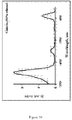
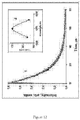
- Kinetic traces of chlorin e4 sodium photosensitized phosphorescence of singlet oxygen after laser pulses are shown in Figures 12-14 .
- Table 2 summarizes kinetic parameters of the phosphorescent curves.
- the rise time reflects the rate of singlet oxygen generation by triplet pigment molecules. It corresponds with the lifetime of the pigment triplet state in air-saturated pigment solution. In ethanol, the rise time was equal to 300 ns.
- the decay time corresponds with the singlet oxygen lifetime in ethanol (13.5 ⁇ s).
- the singlet oxygen quantum yield in ethanol determined using these kinetic curves was equal to 0.63 ⁇ 0.05, which is close to that obtained using DPIBF.
- Chlorin e4 sodium shows strong fluorescence and strong photosensitizing ability in organic solvent (alcohol) and in aqueous media.
- organic solvent alcohol
- the chlorin e4 sodium photosensitizing activity decreases due to aggregation of pigment molecules, but is still high.
- Addition of detergent causes disaggregation and an increase of both fluorescence and photosensitizing ability.
- chlorin e4 sodium is active in both hydrophilic and aqueous media. Therefore this pigment is promising for application in photodynamic medicine.
- a 70 year old female patient with invasive ductile breast cancer and lymph node metastases in the right arm pit was treated successfully. Prior to treatment a large cancer mass in the right breast was observed and a small cancer mass in the right arm pit.
- the treatment consisted of three courses. For each course, five doses of 62.5-187.5mg chlorin e4 sodium were administered orally over the course of eight days. 24-48 hours after each oral dose of chlorin e4 sodium, the patient was treated with laser and LED light having a wavelength of 660nm and 760nm.
- the patient was treated with two further courses. Again, for each course, five doses of 62.5-187.5mg chlorin e4 sodium were administered orally over the course of eight days. 24-48 hours after each oral dose of chlorin e4 sodium, the patient was treated with laser and LED light having a wavelength of 660nm and 760nm. Additionally an interstitial light treatment using a fine needle was performed on the breast with an optical fibre laser having a wavelength of 660nm and 760nm.
- Doppler ultrasound analysis obtained after the fourth treatment course showed that the large cancer mass in the breast had reduced in size by about 25%.
- PET/CT scans obtained after the fifth and final treatment course showed a complete response in the breast and lymph nodes. After each treatment course, an inflammatory response was observed in the breast tumour site, which is typical as the immune system attacks the tumour.
- the patient Towards the end of the second treatment course, the patient experienced a burning sensation in the tumour site of her breast. The patient is currently alive and well, two years and three months after starting her treatment and five months after completion of her treatment.
- the patient was treated with a further course. Again, for the course, five doses of 62.5-187.5mg chlorin e4 sodium were administered orally over the course of eight days. 24-48 hours after each oral dose of chlorin e4 sodium, the patient was treated with laser and LED light having a wavelength of 660nm and 760nm.
- the treatment consisted of three courses. For each course, five doses of 62.5-187.5mg chlorin e4 sodium were administered orally over the course of eight days. 24-48 hours after each oral dose of chlorin e4 sodium, the patient was treated with laser and LED light having a wavelength of 660nm and 760nm.
- PET/CT scans obtained just before treatment and two months, three months, five months and 15 months after treatment, showed that throughout the patient's body some tumours disappeared altogether and the remaining tumours reduced in size. No further metastasis was observed.
- the patient was treated with a further two courses. Again, for each course, five doses of 62.5-187.5mg chlorin e4 sodium were administered orally over the course of eight days. 24-48 hours after each oral dose of chlorin e4 sodium, the patient was treated with laser and LED light having a wavelength of 660nm and 760nm. Additionally an interstitial light treatment using a fine needle was performed on the liver and lung with an optical fibre laser having a wavelength of 660nm and 760nm.
- PET/CT scans again showed a good treatment response.
- Prior to the five treatment courses he was an advanced stage cancer patient with a life expectancy of only six months, but he managed to live an active life for two years and four months.
- the treatment consisted of three courses. For each course, five doses of 62.5-187.5mg chlorin e4 sodium were administered orally over the course of eight days. 24-48 hours after each oral dose of chlorin e4 sodium, the patient was treated with laser and LED light having a wavelength of 660nm and 760nm.
- CT scans showed that in the areas of the patient's body that were treated with laser and LED light so far, some tumours disappeared altogether and some tumours reduced in size.
- the patient was treated with a further two courses. Again, for each course, five doses of 62.5-187.5mg chlorin e4 sodium were administered orally over the course of eight days. 24-48 hours after each oral dose of chlorin e4 sodium, the patient was treated with laser and LED light having a wavelength of 660nm and 760nm.
- PET/CT scans again showed a good treatment response. Unfortunately the patient has recently died. Prior to the five treatment courses, she was in an extremely poor condition, suffering from extreme weight loss and lethargy, too weak to walk, and requiring constant pain relief. Before her treatment, her life expectancy was only two weeks, but she managed to live for two years and two months, at least part of it active.
- a 82 year old male patient with lung cancer was treated successfully.
- the treatment consisted of one course of five doses of 62.5-187.5mg chlorin e4 sodium administered orally over the course of eight days. 24-48 hours after each oral dose of chlorin e4 sodium, the patient was treated with laser and LED light having a wavelength of 660nm and 760nm.
- tumour breakdown Three months after treatment, the patient was coughing up blood and tumour tissue. A CT scan showed tumour breakdown.
- a 46 year old male patient with lung cancer was treated successfully.
- the treatment consisted of three courses. For each course, five doses of 62.5-187.5mg chlorin e4 sodium were administered orally over the course of eight days. 24-48 hours after each oral dose of chlorin e4 sodium, the patient was treated with laser and LED light having a wavelength of 660nm and 760nm.
- a 54 year old female patient with advanced pancreatic cancer with metastases in the liver was treated successfully. Prior to treatment the patient was in poor health generally and suffering from extreme weight loss, pain and other typical symptoms of advanced pancreatic cancer.
- the treatment consisted of three courses. For each course, five doses of 62.5-187.5mg chlorin e4 sodium were administered orally over the course of eight days. About 24 hours after each oral dose of chlorin e4 sodium, the patient was treated with laser and LED light having a wavelength of 660nm and 760nm.
- PET/CT scans of the pancreas obtained before and after treatment, showed improvements and a good treatment response in the pancreatic area.
- the patient had no photosensitive reaction and suffered less pain.
- the treatment consisted of two courses. For each course, five doses of 62.5-187.5mg chlorin e4 sodium were administered orally over the course of eight days. About 24 hours after each oral dose of chlorin e4 sodium, the patient was treated with laser and LED light having a wavelength of 660nm and 760nm.
- PET/CT scans of the lungs obtained before and after treatment, showed a remarkable response to treatment, with many tumours disappearing and the remaining tumours showing no or low metabolic activity after treatment.
- a 54 year old female patient with breast cancer in the right breast was treated successfully.
- the treatment consisted of three courses. For each course, five doses of 62.5-187.5mg chlorin e4 sodium were administered orally over the course of eight days. 24-48 hours after each oral dose of chlorin e4 sodium, the patient was treated with laser and LED light having a wavelength of 660nm and 760nm.
- the treatment consisted of five courses. For each course, five doses of 62.5-187.5mg chlorin e4 sodium were administered orally over the course of eight days. 24-48 hours after each oral dose of chlorin e4 sodium, the patient was treated with laser and LED light having a wavelength of 660nm and 760nm. Additionally an interstitial light treatment using a fine needle was performed on the left lung to a tumour that was large in size with an optical fibre laser having a wavelength of 660nm and 760nm.
- PET/CT scans showed a very good treatment response.
- the patient is currently alive and well, one year and five months after starting his treatment and two months after completion of his treatment.
- an interstitial light treatment using a fine needle was performed on the sacrum bone with an optical fibre laser having a wavelength of 660nm and 760nm. Additionally, mesothelium bone growth therapy was administered for the last two treatment courses.
- PET/CT scans showed a complete response, with no active tumours in the patient's body.
- the patient is currently alive and well, 10 months after starting her treatment and four months after completion of her treatment.
- An MRI scan showed a large tumour mass in the brain.
- the patient had an operation to debulk the tumour pressing against his brain, but he did not have any chemotherapy or radiotherapy.
- PET/CT scans showed active tumours in the brain with metastases in both lungs and the lymph nodes in the right cervical and right supraclavicular regions.
- the patient experienced occasional epileptic seizures and severe headaches.
- the treatment consisted of two courses. For each course, five doses of 62.5-187.5mg chlorin e4 sodium were administered orally over the course of eight days. 24-48 hours after each oral dose of chlorin e4 sodium, the patient was treated with laser and LED light having a wavelength of 660nm and 760nm.
- PET/CT scans showed a complete response in the lungs and no metabolic activity in the area of the brain tumour.
- the lymph nodes were not yet clear, and the patient will undergo a third treatment course.
- Group A had 32 patients who were treated with chlorin e4 sodium.
- Group B had 34 patients who were treated with both chemotherapy and radiotherapy.
- chlorin e4 sodium was administered at a dosage of 2 mg per kilogram of body weight, with two thirds administered by inhalation and one third administered orally.
- an optical fibre for laser treatment purposes was guided into the lung tumor(s) via an interstitial procedure.
- Irradiation light intensity was 200 J/cm 2
- irradiation power was 1,000 mW
- Laser irradiation into the tumor was two to five centimeters in depth. Irradiation was either performed phase by phase (sub-paragraph treatment) based on tumor size or performed repeatedly.
- a 15 MV X-ray radiation therapy irradiation field covered primary lung tumor lesion(s) and mediastinal lymphatic drainage area, with a dosage of 65-70 Gy, administered on every first day in a week of radiotherapy.
- 20 mg cisplatin was administered by intravenous application.
- mice with well grown subcutaneous S180 sarcoma were randomly divided into four groups: (A) Duteroporphyrin group (10mg/kg), (B) chlorin e4 sodium group (20mg/kg), (C) 5-ALA group (100mg/kg) and (D) blank control group.
- the mice in groups A and B were subjected to irradiation 8-10 hours after tail vein injection of the photosensitizers, while the mice in group C were subjected to irradiation 3 hours after tail vein injection of the photosensitizer.
- a laser with a wavelength of 630nm was used for groups A and C, while a duel-frequency laser with wavelengths of 660nm and 760nm was used for group B.
- the local tumour sites were irradiated vertically, with the diameter of the laser spots being 1.2-1.5cm.
- the whole tumour and 3-5mm of normal tissue around the tumour were covered by the laser.
- the lasers were applied to groups A, B and C for 20 minutes, with a power density of 150mW/cm 2 and an energy density of 180J/cm 2 .
- the mice in control group D were not subjected to irradiation.
- tumour changes in appearance were observed.
- Black eschars were seen in groups A and B after treatments, while the eschars observed in group C were thinner and brownish red in colour. Skins and fur were fully recovered in all three treatment groups after the eschars had fallen off; group C was the fastest in skin repairing.
- tumour growth curves From the tumour growth curves it could be seen that there was no obvious difference in sizes of tumours between the treatment groups A, B and C and the control group D six days after the treatments. This was possibly caused by the oedema and eschars caused by the treatment which occurred at the irradiation sites. Observation of the tumours' sizes 21 days after the treatments indicated that the mean volume differences between all treatment groups A, B and C and the control group D were statistically significant (P ⁇ 0.05), the mean volume being statistically significantly smaller in treatment groups A, B and C than the control group D. The mean volume difference between group B and group C was also statistically significant (P ⁇ 0.05), the mean volume being statistically significantly smaller in group B than group C.
- tumour inhibition rates of groups A, B and C were respectively 62.5%, 75.4% and 37.2%.
- tumour tissues were observed via HE staining.
- tumour cells by photodynamic therapy
- the mechanisms of killing tumour cells by photodynamic therapy include directly killing tumour cells, damaging tumour vessels and stimulating patients' immune systems. These factors may benefit each other and they are all long-term tumour-controlling mechanisms.
- Chlorin e4 sodium had a similar or slightly better therapeutic effect than Duteroporphyrin, and a statistically significantly better therapeutic effect than 5-ALA.
Landscapes
- Health & Medical Sciences (AREA)
- Chemical & Material Sciences (AREA)
- Life Sciences & Earth Sciences (AREA)
- Organic Chemistry (AREA)
- Veterinary Medicine (AREA)
- General Health & Medical Sciences (AREA)
- Medicinal Chemistry (AREA)
- Animal Behavior & Ethology (AREA)
- Public Health (AREA)
- Pharmacology & Pharmacy (AREA)
- Nuclear Medicine, Radiotherapy & Molecular Imaging (AREA)
- General Chemical & Material Sciences (AREA)
- Chemical Kinetics & Catalysis (AREA)
- Engineering & Computer Science (AREA)
- Bioinformatics & Cheminformatics (AREA)
- Virology (AREA)
- Oncology (AREA)
- Communicable Diseases (AREA)
- Molecular Biology (AREA)
- Epidemiology (AREA)
- Diabetes (AREA)
- Biomedical Technology (AREA)
- Dermatology (AREA)
- Tropical Medicine & Parasitology (AREA)
- Hematology (AREA)
- Biochemistry (AREA)
- Rheumatology (AREA)
- Heart & Thoracic Surgery (AREA)
- Cardiology (AREA)
- Obesity (AREA)
- Physical Education & Sports Medicine (AREA)
- Endocrinology (AREA)
- AIDS & HIV (AREA)
- Pulmonology (AREA)
- Ophthalmology & Optometry (AREA)
- Emergency Medicine (AREA)
- Neurology (AREA)
- Neurosurgery (AREA)
- Immunology (AREA)
- Orthopedic Medicine & Surgery (AREA)
Claims (17)
- Chlorin-e4-Natrium mit der Struktur:

- Chlorin-e4-Natrium nach Anspruch 1 mit der Struktur:
- Verfahren zum Herstellen des Chlorin-e4-Natriums nach Anspruch 1 oder 2, umfassend den Schritt des Umsetzens von Chlorin e4 mit einer Natriumverbindung.
- Verfahren nach Anspruch 3, wobei die Natriumverbindung Natriumhydroxid ist.
- Verfahren nach Anspruch 3 oder 4, wobei Chlorin e4 mit der Natriumverbindung in Gegenwart einer Base, vorzugsweise einer Aminbase, vorzugsweise Thiaminpyrophosphat, umgesetzt wird.
- Verfahren nach einem der Ansprüche 3 bis 5, wobei Chlorin e4, die Natriumverbindung und die optionale Base in einem Molverhältnis von 0,15-1 : 45-60 : 0-12 verwendet werden.
- Chlorin-e4-Natrium nach Anspruch 1 oder 2 zur Verwendung in der Medizin.
- Chlorin-e4-Natrium nach einem der Ansprüche 1, 2 oder 7 zur Verwendung in der fotodynamischen Therapie oder der Cytolumineszenztherapie.
- Chlorin-e4-Natrium nach einem der Ansprüche 1, 2, 7 oder 8 zur Verwendung bei der Behandlung von:(i) einer Krankheit, die durch gutartige oder bösartige zelluläre Hyperproliferation oder durch Bereiche mit Neovaskularisation gekennzeichnet ist; und/oder(ii) einem gutartigen oder bösartigen Tumor; und/oder(iii) Krebs im Frühstadium; zervikaler Dysplasie; Weichteilsarkom; einem Keimzelltumor; Retinoblastom; Lymphom; Hodgkin-Lymphom; Kopf- und Halskrebs; Oral- oder Mundkrebs; oder Krebs des Blutes, der Prostata, des Gebärmutterhalses, der Gebärmutter, der Scheide oder anderer weiblicher Adnexe, der Brust, des Nasopharynx, der Luftröhre, des Kehlkopfs, der Bronchien, der Bronchiolen, der Lunge, der Hohlorgane, der Speiseröhre, des Magens, des Gallengangs, des Darms, des Dickdarms, des Kolorektums, des Rektums, der Blase, des Harnleiters, der Niere, der Leber, der Gallenblase, der Milz, des Gehirns, des Lymphsystems, der Knochen, der Haut oder der Bauchspeicheldrüse.
- Chlorin-e4-Natrium nach einem der Ansprüche 1, 2 oder 7 zur Verwendung in der fotodynamischen Diagnose.
- Chlorin-e4-Natrium zur Verwendung nach einem der Ansprüche 7 bis 10, wobei das Chlorin-e4-Natrium zur Verabreichung vor einer Verabreichung von Bestrahlung geeignet ist, wobei die Bestrahlung vorzugsweise elektromagnetische Strahlung mit einer Wellenlänge im Bereich von 500 nm bis 1000 nm ist.
- Pharmazeutische Zusammensetzung, umfassend das Chlorin-e4-Natrium nach einem der Ansprüche 1-2 oder 7-11 und einen pharmazeutisch verträglichen Träger oder ein pharmazeutisch verträgliches Verdünnungsmittel.
- Pharmazeutische Zusammensetzung nach Anspruch 12 zur Verwendung in der fotodynamischen Therapie oder der Cytolumineszenztherapie.
- Pharmazeutische Zusammensetzung nach Anspruch 12 oder 13 zur Verwendung bei der Behandlung von:(i) einer Krankheit, die durch gutartige oder bösartige zelluläre Hyperproliferation oder durch Bereiche mit Neovaskularisation gekennzeichnet ist; und/oder(ii) einem gutartigen oder bösartigen Tumor; und/oder(iii) Krebs im Frühstadium; zervikaler Dysplasie; Weichteilsarkom; einem Keimzelltumor; Retinoblastom; Lymphom; Hodgkin-Lymphom; Kopf- und Halskrebs; Oral- oder Mundkrebs; oder Krebs des Blutes, der Prostata, des Gebärmutterhalses, der Gebärmutter, der Scheide oder anderer weiblicher Adnexe, der Brust, des Nasopharynx, der Luftröhre, des Kehlkopfs, der Bronchien, der Bronchiolen, der Lunge, der Hohlorgane, der Speiseröhre, des Magens, des Gallengangs, des Darms, des Dickdarms, des Kolorektums, des Rektums, der Blase, des Harnleiters, der Niere, der Leber, der Gallenblase, der Milz, des Gehirns, des Lymphsystems, der Knochen, der Haut oder der Bauchspeicheldrüse.
- Pharmazeutische Zusammensetzung nach Anspruch 12 zur Verwendung in der fotodynamischen Diagnose.
- Pharmazeutische Zusammensetzung nach einem der Ansprüche 12 bis 15, wobei die pharmazeutische Zusammensetzung zur Verabreichung vor einer Verabreichung von Bestrahlung geeignet ist, wobei die Bestrahlung vorzugsweise elektromagnetische Strahlung mit einer Wellenlänge im Bereich von 500 nm bis 1000 nm ist.
- Pharmazeutische Zusammensetzung nach einem der Ansprüche 12 bis 16, wobei die pharmazeutische Zusammensetzung in einer Form vorliegt, die zur oralen, parenteralen (einschließlich intravenösen, subkutanen, intramuskulären, intradermalen, intratrachealen, intraperitonealen, intraartikulären, intraabdominalen, intrakranialen und epiduralen), transdermalen, Atemwegs- (Aerosol), rektalen, vaginalen oder topischen (einschließlich bukkalen, mukosalen und sublingualen) Verabreichung geeignet ist, wobei die pharmazeutische Zusammensetzung vorzugsweise in einer Form vorliegt, die zur oralen oder parenteralen Verabreichung geeignet ist.
Priority Applications (6)
| Application Number | Priority Date | Filing Date | Title |
|---|---|---|---|
| RS20200533A RS60225B1 (sr) | 2012-12-14 | 2013-12-13 | Derivat hlorina koristan u fotodinamičkoj terapiji i dijagnostici |
| SM20200245T SMT202000245T1 (it) | 2012-12-14 | 2013-12-13 | Derivato della clorina utile nella terapia e nella diagnosi fotodinamica |
| MEP-2020-94A ME03725B (de) | 2012-12-14 | 2013-12-13 | Chlorinderivate für fotodynamische therapie und diagnose |
| HRP20200734TT HRP20200734T1 (hr) | 2012-12-14 | 2013-12-13 | Derivat klorina koristan u fotodinamičkoj terapiji i dijagnozi |
| PL13821500T PL2931728T3 (pl) | 2012-12-14 | 2013-12-13 | Pochodna chloryny przydatna w terapii fotodynamicznej i diagnostyce |
| SI201331722T SI2931728T1 (sl) | 2012-12-14 | 2013-12-13 | Derivat klora, ki je uporaben pri fotodinamičnem zdravljenju in diagnozi |
Applications Claiming Priority (3)
| Application Number | Priority Date | Filing Date | Title |
|---|---|---|---|
| GBGB1222544.7A GB201222544D0 (en) | 2012-12-14 | 2012-12-14 | Photodynamic therapy and diagnosis |
| GB1309337.2A GB2514408A (en) | 2013-05-23 | 2013-05-23 | Photodynamic Therapy and Diagnosis |
| PCT/GB2013/053285 WO2014091241A1 (en) | 2012-12-14 | 2013-12-13 | Chlorin derivative useful in photodynamic therapy and diagnosis |
Publications (2)
| Publication Number | Publication Date |
|---|---|
| EP2931728A1 EP2931728A1 (de) | 2015-10-21 |
| EP2931728B1 true EP2931728B1 (de) | 2020-02-19 |
Family
ID=49958497
Family Applications (1)
| Application Number | Title | Priority Date | Filing Date |
|---|---|---|---|
| EP13821500.9A Active EP2931728B1 (de) | 2012-12-14 | 2013-12-13 | Chlorinderivate für fotodynamische therapie und diagnose |
Country Status (24)
| Country | Link |
|---|---|
| US (1) | US20150315202A1 (de) |
| EP (1) | EP2931728B1 (de) |
| JP (1) | JP6396919B2 (de) |
| KR (1) | KR102242404B1 (de) |
| CN (2) | CN110003225A (de) |
| AU (2) | AU2013357030B2 (de) |
| CA (1) | CA2894968C (de) |
| CY (1) | CY1122834T1 (de) |
| DK (1) | DK2931728T3 (de) |
| ES (1) | ES2791004T3 (de) |
| HR (1) | HRP20200734T1 (de) |
| HU (1) | HUE048861T2 (de) |
| IL (1) | IL239347B (de) |
| LT (1) | LT2931728T (de) |
| ME (1) | ME03725B (de) |
| MY (1) | MY180320A (de) |
| PH (1) | PH12015501341B1 (de) |
| PL (1) | PL2931728T3 (de) |
| PT (1) | PT2931728T (de) |
| RS (1) | RS60225B1 (de) |
| SG (1) | SG11201504595UA (de) |
| SI (1) | SI2931728T1 (de) |
| SM (1) | SMT202000245T1 (de) |
| WO (1) | WO2014091241A1 (de) |
Families Citing this family (10)
| Publication number | Priority date | Publication date | Assignee | Title |
|---|---|---|---|---|
| WO2017027177A1 (en) | 2015-08-08 | 2017-02-16 | Chl Industries, Llc | Improved hyaluronan and modified-hyaluronan in biomedical applications |
| RU2753402C1 (ru) * | 2020-04-15 | 2021-08-16 | Федеральное государтвенное бюджетное учреждение "Российский научный центр радиологии и хирургических технологий имени академика А.М. Гранова" Министерства здравоохранения Российской Федерации | Способ фотодинамической терапии при лечении нерезекабельной аденокарциномы внепеченочных желчных протоков |
| GB202018667D0 (en) * | 2020-11-26 | 2021-01-13 | Rmw Cho Group Ltd | Photodynamic therapy and diagnosis |
| CN113527319B (zh) * | 2021-06-10 | 2023-03-07 | 中国人民解放军海军军医大学 | 一种新型二氢卟吩e4衍生物及其药学上可接受的盐和制备方法与应用 |
| GB202217864D0 (en) | 2022-11-28 | 2023-01-11 | Rmw Cho Group Ltd | Novel compounds |
| GB202217863D0 (en) | 2022-11-28 | 2023-01-11 | Rmw Cho Group Ltd | Novel compounds |
| JP2025539865A (ja) | 2022-11-28 | 2025-12-09 | アールエムダブリュー チョ グループ リミテッド | 新規クロリンe6類似体 |
| JP2025538650A (ja) | 2022-11-28 | 2025-11-28 | アールエムダブリュー チョ グループ リミテッド | 光線力学療法及び診断法のためのポルフィリン及びホスホニウム-ポルフィリン系化合物 |
| GB202308146D0 (en) | 2023-05-31 | 2023-07-12 | Rmw Cho Group Ltd | Photodynamic therapy and diagnosis |
| GB202308145D0 (en) | 2023-05-31 | 2023-07-12 | Rmw Cho Group Ltd | Photodynamic therapy and diagnosis |
Citations (1)
| Publication number | Priority date | Publication date | Assignee | Title |
|---|---|---|---|---|
| CN1687089A (zh) * | 2005-04-08 | 2005-10-26 | 吴华君 | 叶绿酸合铁钠盐衍生物、制备方法及用途 |
Family Cites Families (6)
| Publication number | Priority date | Publication date | Assignee | Title |
|---|---|---|---|---|
| US5002962A (en) * | 1988-07-20 | 1991-03-26 | Health Research, Inc. | Photosensitizing agents |
| JP2963178B2 (ja) * | 1990-09-27 | 1999-10-12 | 株式会社エス・エル・ティ・ジャパン | 水溶性フェオホーバイドaの製造方法 |
| CN1148184C (zh) * | 1999-10-28 | 2004-05-05 | 上海复旦张江生物医药股份有限公司 | 光动力治疗肿瘤药物组合物 |
| RU2183956C1 (ru) * | 2001-03-30 | 2002-06-27 | Общество с ограниченной ответственностью "РАДА-ФАРМА" | Фотосенсибилизатор и способ его получения |
| CA2462261A1 (en) * | 2001-10-03 | 2003-04-10 | Miravant Pharmaceuticals, Inc. | Chlorin photosensitizing agents for use in photodynamic therapy |
| GB0718878D0 (en) * | 2007-09-28 | 2007-11-07 | Photo Diagnostic Devices Pdd L | Photodynamic Theraphy and diagnosis |
-
2013
- 2013-12-13 RS RS20200533A patent/RS60225B1/sr unknown
- 2013-12-13 PL PL13821500T patent/PL2931728T3/pl unknown
- 2013-12-13 PT PT138215009T patent/PT2931728T/pt unknown
- 2013-12-13 DK DK13821500.9T patent/DK2931728T3/da active
- 2013-12-13 SI SI201331722T patent/SI2931728T1/sl unknown
- 2013-12-13 WO PCT/GB2013/053285 patent/WO2014091241A1/en not_active Ceased
- 2013-12-13 SM SM20200245T patent/SMT202000245T1/it unknown
- 2013-12-13 AU AU2013357030A patent/AU2013357030B2/en not_active Ceased
- 2013-12-13 HR HRP20200734TT patent/HRP20200734T1/hr unknown
- 2013-12-13 SG SG11201504595UA patent/SG11201504595UA/en unknown
- 2013-12-13 ES ES13821500T patent/ES2791004T3/es active Active
- 2013-12-13 LT LTEP13821500.9T patent/LT2931728T/lt unknown
- 2013-12-13 ME MEP-2020-94A patent/ME03725B/de unknown
- 2013-12-13 US US14/651,271 patent/US20150315202A1/en not_active Abandoned
- 2013-12-13 CN CN201811587683.XA patent/CN110003225A/zh active Pending
- 2013-12-13 CN CN201380072967.4A patent/CN105008372B/zh active Active
- 2013-12-13 KR KR1020157017350A patent/KR102242404B1/ko not_active Expired - Fee Related
- 2013-12-13 HU HUE13821500A patent/HUE048861T2/hu unknown
- 2013-12-13 JP JP2015547147A patent/JP6396919B2/ja not_active Expired - Fee Related
- 2013-12-13 MY MYPI2015001526A patent/MY180320A/en unknown
- 2013-12-13 EP EP13821500.9A patent/EP2931728B1/de active Active
- 2013-12-13 CA CA2894968A patent/CA2894968C/en active Active
-
2015
- 2015-06-11 IL IL239347A patent/IL239347B/en active IP Right Grant
- 2015-06-15 PH PH12015501341A patent/PH12015501341B1/en unknown
-
2018
- 2018-12-20 AU AU2018282411A patent/AU2018282411A1/en not_active Abandoned
-
2020
- 2020-05-05 CY CY20201100411T patent/CY1122834T1/el unknown
Patent Citations (1)
| Publication number | Priority date | Publication date | Assignee | Title |
|---|---|---|---|---|
| CN1687089A (zh) * | 2005-04-08 | 2005-10-26 | 吴华君 | 叶绿酸合铁钠盐衍生物、制备方法及用途 |
Non-Patent Citations (5)
| Title |
|---|
| D. L. Murphy et al, Poster "Real-time fluorescent photography using Photosoft PDT and metabolic urine studies in prostate cancer patients", USANZ 2017 * |
| E. S. SIMAREMARE ET AL.: "Photophysical and physiochemical properties of Cu(II)chlorin e4 and Cu(II)chlorin e6 as a lead compound of photosensitizer for PDT", INDONESIAN J. PHARM, vol. 26, no. 1, 2015, pages 29 - 36 * |
| HENDRICKSON ET AL: "1310. SOME PHYSICAL AND CHEMICAL CHARAC. TERISTICS OF RHCDOCHLORIN, A NEW CARDJO. TROPIC COMPOUND", FEDERATION PROCEEDINGS, FEDERATION OF AMERICAN SOCIETIES FOR EXPERIMENTAL BIOLOGY, US, vol. 16, 1 January 1957 (1957-01-01), pages 306, XP008183639, ISSN: 0014-9446 * |
| M. J. HENDRICKSON ET AL: "Radial Paper Chromatography...Application to Analysis of Mixtures of Chlorophyll Derivatives", ANALYTICAL CHEMISTRY, vol. 29, no. 12, 1 December 1957 (1957-12-01), US, pages 1810 - 1815, XP055353908, ISSN: 0003-2700, DOI: 10.1021/ac60132a043 * |
| R.B. WOODWARD: "Totalsynthese des Chlorophylls", ANGEWANDTE CHEMIE, vol. 72, no. 18, 1960, pages 651 - 662 * |
Also Published As
Similar Documents
| Publication | Publication Date | Title |
|---|---|---|
| EP2931728B1 (de) | Chlorinderivate für fotodynamische therapie und diagnose | |
| EP3292129B1 (de) | Niedermolekulare halogenierte porphyrin-carboxamid-chlorin- und -bacteriochlorin-derivate zur verwendung in der photodynamischen therapie zur behandlung von krebs | |
| WO2009040411A1 (en) | Photodynamic therapy and diagnosis using a chlorin e4 zinc complex | |
| EP4635513A1 (de) | Nahinfrarot-photosensibilisator zur aktivierung in schwach saurer tumorumgebung sowie herstellungsverfahren dafür und verwendung davon | |
| Zhang et al. | Synthesis of asymmetric cationic zinc porphyrin photosensitizer containing thiophene group for photodynamic therapy in vitro and theoretical calculation of DFT | |
| CN116425732B (zh) | 一种具有线粒体靶向功能的光可控释放no并开启光动力效果的光敏剂及其制备方法和应用 | |
| JP7800874B2 (ja) | 分解可能な近赤外光増感剤、並びにその調製方法および使用 | |
| Tanabe et al. | Fluorescence detection of a new photosensitizer, PAD-S31, in tumour tissues and its use as a photodynamic treatment for skin tumours in dogs and a cat: a preliminary report | |
| HK1216534B (en) | Chlorin derivative useful in photodynamic therapy and diagnosis | |
| CN113735886B (zh) | Pdt化合物及其制备方法和用途 | |
| Huang et al. | Novel pyropheophorbide a dimers: Synthesis and photobiological evaluation as potent photosensitizers for photodynamic therapy | |
| RU2372099C1 (ru) | Иттербиевые комплексы тетрапиразолилпорфиринов как флуоресцентные метки для диагностики злокачественных новообразований | |
| RU2257898C1 (ru) | Фотосенсибилизатор, липосомальная форма фотосенсибилизатора и способ проведения фотодинамической терапии | |
| RU2521327C1 (ru) | Препарат для фотодинамической терапии и способ фотодинамической терапии рака с его использованием | |
| EP4048709B1 (de) | Arzneimittel zur behandlung von gebärmutterhalskrebs | |
| Karges et al. | Ruthenium complexes for 1-and 2-photon photodynamic therapy: From in silico prediction to in vivo applications | |
| CN103446586B (zh) | 二氢卟吩钛合物在制备治疗肿瘤药物中的应用 | |
| CN116284016A (zh) | 用于光敏剂的亲水性细菌叶绿素类化合物及其应用 | |
| GB2514408A (en) | Photodynamic Therapy and Diagnosis | |
| Zhang et al. | In vitro and in vivo antitumor activity of a novel chlorin derivative for photodynamic therapy | |
| Yan | EVALUATION OF PORPHYRIN DERIVATIVE FOR PHOTODYNAMIC THERAPY | |
| CN119751507A (zh) | 一种具有聚集诱导发光的化合物及其在荧光成像、光动力疗法中的应用 | |
| CN118359641A (zh) | 一种长波长光激发的光敏剂及其制备方法和应用 | |
| AP | PALGO JOURNAL OF MEDICI | |
| JP2002212066A (ja) | 新規光化学療法剤 |
Legal Events
| Date | Code | Title | Description |
|---|---|---|---|
| PUAI | Public reference made under article 153(3) epc to a published international application that has entered the european phase |
Free format text: ORIGINAL CODE: 0009012 |
|
| 17P | Request for examination filed |
Effective date: 20150710 |
|
| AK | Designated contracting states |
Kind code of ref document: A1 Designated state(s): AL AT BE BG CH CY CZ DE DK EE ES FI FR GB GR HR HU IE IS IT LI LT LU LV MC MK MT NL NO PL PT RO RS SE SI SK SM TR |
|
| AX | Request for extension of the european patent |
Extension state: BA ME |
|
| REG | Reference to a national code |
Ref country code: HK Ref legal event code: DE Ref document number: 1216534 Country of ref document: HK |
|
| STAA | Information on the status of an ep patent application or granted ep patent |
Free format text: STATUS: EXAMINATION IS IN PROGRESS |
|
| 17Q | First examination report despatched |
Effective date: 20170317 |
|
| GRAP | Despatch of communication of intention to grant a patent |
Free format text: ORIGINAL CODE: EPIDOSNIGR1 |
|
| STAA | Information on the status of an ep patent application or granted ep patent |
Free format text: STATUS: GRANT OF PATENT IS INTENDED |
|
| GRAS | Grant fee paid |
Free format text: ORIGINAL CODE: EPIDOSNIGR3 |
|
| INTG | Intention to grant announced |
Effective date: 20191218 |
|
| GRAA | (expected) grant |
Free format text: ORIGINAL CODE: 0009210 |
|
| STAA | Information on the status of an ep patent application or granted ep patent |
Free format text: STATUS: THE PATENT HAS BEEN GRANTED |
|
| AK | Designated contracting states |
Kind code of ref document: B1 Designated state(s): AL AT BE BG CH CY CZ DE DK EE ES FI FR GB GR HR HU IE IS IT LI LT LU LV MC MK MT NL NO PL PT RO RS SE SI SK SM TR |
|
| AX | Request for extension of the european patent |
Extension state: BA ME |
|
| REG | Reference to a national code |
Ref country code: GB Ref legal event code: FG4D |
|
| REG | Reference to a national code |
Ref country code: CH Ref legal event code: EP |
|
| REG | Reference to a national code |
Ref country code: DE Ref legal event code: R096 Ref document number: 602013065995 Country of ref document: DE |
|
| REG | Reference to a national code |
Ref country code: AT Ref legal event code: REF Ref document number: 1234853 Country of ref document: AT Kind code of ref document: T Effective date: 20200315 |
|
| REG | Reference to a national code |
Ref country code: IE Ref legal event code: FG4D |
|
| REG | Reference to a national code |
Ref country code: NL Ref legal event code: FP |
|
| REG | Reference to a national code |
Ref country code: PT Ref legal event code: SC4A Ref document number: 2931728 Country of ref document: PT Date of ref document: 20200429 Kind code of ref document: T Free format text: AVAILABILITY OF NATIONAL TRANSLATION Effective date: 20200422 |
|
| REG | Reference to a national code |
Ref country code: HR Ref legal event code: TUEP Ref document number: P20200734T Country of ref document: HR |
|
| REG | Reference to a national code |
Ref country code: DK Ref legal event code: T3 Effective date: 20200506 |
|
| REG | Reference to a national code |
Ref country code: FI Ref legal event code: FGE |
|
| REG | Reference to a national code |
Ref country code: CH Ref legal event code: NV Representative=s name: STOLMAR AND PARTNER INTELLECTUAL PROPERTY S.A., CH |
|
| REG | Reference to a national code |
Ref country code: SE Ref legal event code: TRGR |
|
| REG | Reference to a national code |
Ref country code: GR Ref legal event code: EP Ref document number: 20200401216 Country of ref document: GR Effective date: 20200615 |
|
| REG | Reference to a national code |
Ref country code: NO Ref legal event code: T2 Effective date: 20200219 |
|
| REG | Reference to a national code |
Ref country code: EE Ref legal event code: FG4A Ref document number: E019157 Country of ref document: EE Effective date: 20200514 |
|
| REG | Reference to a national code |
Ref country code: SK Ref legal event code: T3 Ref document number: E 34248 Country of ref document: SK |
|
| REG | Reference to a national code |
Ref country code: HU Ref legal event code: AG4A Ref document number: E048861 Country of ref document: HU |
|
| REG | Reference to a national code |
Ref country code: HR Ref legal event code: T1PR Ref document number: P20200734 Country of ref document: HR |
|
| REG | Reference to a national code |
Ref country code: DE Ref legal event code: R082 Ref document number: 602013065995 Country of ref document: DE Representative=s name: VENNER SHIPLEY GERMANY LLP, DE Ref country code: DE Ref legal event code: R082 Ref document number: 602013065995 Country of ref document: DE Representative=s name: VENNER SHIPLEY LLP, DE |
|
| REG | Reference to a national code |
Ref country code: ES Ref legal event code: FG2A Ref document number: 2791004 Country of ref document: ES Kind code of ref document: T3 Effective date: 20201030 |
|
| REG | Reference to a national code |
Ref country code: DE Ref legal event code: R097 Ref document number: 602013065995 Country of ref document: DE |
|
| PLBE | No opposition filed within time limit |
Free format text: ORIGINAL CODE: 0009261 |
|
| REG | Reference to a national code |
Ref country code: HR Ref legal event code: ODRP Ref document number: P20200734 Country of ref document: HR Payment date: 20201211 Year of fee payment: 8 |
|
| STAA | Information on the status of an ep patent application or granted ep patent |
Free format text: STATUS: NO OPPOSITION FILED WITHIN TIME LIMIT |
|
| 26N | No opposition filed |
Effective date: 20201120 |
|
| REG | Reference to a national code |
Ref country code: HU Ref legal event code: HC9C Owner name: RMW CHO GROUP LIMITED, CN |
|
| REG | Reference to a national code |
Ref country code: HR Ref legal event code: ODRP Ref document number: P20200734 Country of ref document: HR Payment date: 20211213 Year of fee payment: 9 |
|
| PGFP | Annual fee paid to national office [announced via postgrant information from national office to epo] |
Ref country code: RS Payment date: 20211213 Year of fee payment: 9 Ref country code: LT Payment date: 20211213 Year of fee payment: 9 |
|
| REG | Reference to a national code |
Ref country code: AT Ref legal event code: UEP Ref document number: 1234853 Country of ref document: AT Kind code of ref document: T Effective date: 20200219 |
|
| PGFP | Annual fee paid to national office [announced via postgrant information from national office to epo] |
Ref country code: SI Payment date: 20211213 Year of fee payment: 9 |
|
| PGFP | Annual fee paid to national office [announced via postgrant information from national office to epo] |
Ref country code: CY Payment date: 20211223 Year of fee payment: 9 |
|
| PGFP | Annual fee paid to national office [announced via postgrant information from national office to epo] |
Ref country code: AL Payment date: 20211223 Year of fee payment: 9 |
|
| REG | Reference to a national code |
Ref country code: HU Ref legal event code: HC9C Owner name: RMW CHO GROUP LIMITED, CN |
|
| REG | Reference to a national code |
Ref country code: HR Ref legal event code: ODRP Ref document number: P20200734 Country of ref document: HR Payment date: 20221213 Year of fee payment: 10 |
|
| PGFP | Annual fee paid to national office [announced via postgrant information from national office to epo] |
Ref country code: SK Payment date: 20221212 Year of fee payment: 10 Ref country code: SE Payment date: 20221230 Year of fee payment: 10 Ref country code: RO Payment date: 20221213 Year of fee payment: 10 Ref country code: PT Payment date: 20221212 Year of fee payment: 10 Ref country code: LV Payment date: 20221230 Year of fee payment: 10 Ref country code: IE Payment date: 20221230 Year of fee payment: 10 Ref country code: GB Payment date: 20221230 Year of fee payment: 10 Ref country code: FR Payment date: 20221230 Year of fee payment: 10 Ref country code: FI Payment date: 20221230 Year of fee payment: 10 Ref country code: EE Payment date: 20221230 Year of fee payment: 10 Ref country code: DK Payment date: 20221230 Year of fee payment: 10 Ref country code: CZ Payment date: 20221213 Year of fee payment: 10 |
|
| PGFP | Annual fee paid to national office [announced via postgrant information from national office to epo] |
Ref country code: PL Payment date: 20221212 Year of fee payment: 10 Ref country code: IS Payment date: 20221230 Year of fee payment: 10 Ref country code: HU Payment date: 20221218 Year of fee payment: 10 Ref country code: HR Payment date: 20221213 Year of fee payment: 10 Ref country code: GR Payment date: 20221229 Year of fee payment: 10 Ref country code: BE Payment date: 20221230 Year of fee payment: 10 |
|
| PGFP | Annual fee paid to national office [announced via postgrant information from national office to epo] |
Ref country code: MT Payment date: 20221230 Year of fee payment: 10 Ref country code: MK Payment date: 20221213 Year of fee payment: 10 |
|
| PGFP | Annual fee paid to national office [announced via postgrant information from national office to epo] |
Ref country code: TR Payment date: 20221212 Year of fee payment: 10 Ref country code: SM Payment date: 20230109 Year of fee payment: 10 Ref country code: NO Payment date: 20230102 Year of fee payment: 10 Ref country code: MC Payment date: 20230111 Year of fee payment: 10 Ref country code: LU Payment date: 20221230 Year of fee payment: 10 Ref country code: ES Payment date: 20230227 Year of fee payment: 10 Ref country code: CH Payment date: 20230111 Year of fee payment: 10 Ref country code: BG Payment date: 20230110 Year of fee payment: 10 Ref country code: AT Payment date: 20230120 Year of fee payment: 10 |
|
| PGFP | Annual fee paid to national office [announced via postgrant information from national office to epo] |
Ref country code: IT Payment date: 20221230 Year of fee payment: 10 Ref country code: DE Payment date: 20230123 Year of fee payment: 10 |
|
| PGFP | Annual fee paid to national office [announced via postgrant information from national office to epo] |
Ref country code: NL Payment date: 20221230 Year of fee payment: 10 |
|
| REG | Reference to a national code |
Ref country code: LT Ref legal event code: MM4D Effective date: 20221213 |
|
| PG25 | Lapsed in a contracting state [announced via postgrant information from national office to epo] |
Ref country code: RS Free format text: LAPSE BECAUSE OF NON-PAYMENT OF DUE FEES Effective date: 20221213 Ref country code: CY Free format text: LAPSE BECAUSE OF NON-PAYMENT OF DUE FEES Effective date: 20221213 |
|
| REG | Reference to a national code |
Ref country code: SI Ref legal event code: KO00 Effective date: 20230811 |
|
| PG25 | Lapsed in a contracting state [announced via postgrant information from national office to epo] |
Ref country code: SI Free format text: LAPSE BECAUSE OF NON-PAYMENT OF DUE FEES Effective date: 20221214 Ref country code: LT Free format text: LAPSE BECAUSE OF NON-PAYMENT OF DUE FEES Effective date: 20221213 |
|
| REG | Reference to a national code |
Ref country code: HR Ref legal event code: PBON Ref document number: P20200734 Country of ref document: HR Effective date: 20231213 |
|
| REG | Reference to a national code |
Ref country code: DE Ref legal event code: R119 Ref document number: 602013065995 Country of ref document: DE |
|
| REG | Reference to a national code |
Ref country code: DK Ref legal event code: EBP Effective date: 20231231 |
|
| PG25 | Lapsed in a contracting state [announced via postgrant information from national office to epo] |
Ref country code: CZ Free format text: LAPSE BECAUSE OF NON-PAYMENT OF DUE FEES Effective date: 20231213 |
|
| REG | Reference to a national code |
Ref country code: SK Ref legal event code: MM4A Ref document number: E 34248 Country of ref document: SK Effective date: 20231213 |
|
| REG | Reference to a national code |
Ref country code: SE Ref legal event code: EUG |
|
| PG25 | Lapsed in a contracting state [announced via postgrant information from national office to epo] |
Ref country code: RO Free format text: LAPSE BECAUSE OF NON-PAYMENT OF DUE FEES Effective date: 20231213 Ref country code: FI Free format text: LAPSE BECAUSE OF NON-PAYMENT OF DUE FEES Effective date: 20231213 Ref country code: CZ Free format text: LAPSE BECAUSE OF NON-PAYMENT OF DUE FEES Effective date: 20231213 Ref country code: BG Free format text: LAPSE BECAUSE OF NON-PAYMENT OF DUE FEES Effective date: 20231213 |
|
| REG | Reference to a national code |
Ref country code: CH Ref legal event code: PL |
|
| PG25 | Lapsed in a contracting state [announced via postgrant information from national office to epo] |
Ref country code: PT Free format text: LAPSE BECAUSE OF NON-PAYMENT OF DUE FEES Effective date: 20240613 |
|
| REG | Reference to a national code |
Ref country code: NL Ref legal event code: MM Effective date: 20240101 |
|
| REG | Reference to a national code |
Ref country code: EE Ref legal event code: MM4A Ref document number: E019157 Country of ref document: EE Effective date: 20231231 Ref country code: AT Ref legal event code: MM01 Ref document number: 1234853 Country of ref document: AT Kind code of ref document: T Effective date: 20231213 |
|
| PG25 | Lapsed in a contracting state [announced via postgrant information from national office to epo] |
Ref country code: LU Free format text: LAPSE BECAUSE OF NON-PAYMENT OF DUE FEES Effective date: 20231213 |
|
| PG25 | Lapsed in a contracting state [announced via postgrant information from national office to epo] |
Ref country code: MC Free format text: LAPSE BECAUSE OF NON-PAYMENT OF DUE FEES Effective date: 20240102 |
|
| GBPC | Gb: european patent ceased through non-payment of renewal fee |
Effective date: 20231213 |
|
| REG | Reference to a national code |
Ref country code: BE Ref legal event code: MM Effective date: 20231231 |
|
| PG25 | Lapsed in a contracting state [announced via postgrant information from national office to epo] |
Ref country code: PT Free format text: LAPSE BECAUSE OF NON-PAYMENT OF DUE FEES Effective date: 20240613 Ref country code: MC Free format text: LAPSE BECAUSE OF NON-PAYMENT OF DUE FEES Effective date: 20240102 Ref country code: LV Free format text: LAPSE BECAUSE OF NON-PAYMENT OF DUE FEES Effective date: 20231213 Ref country code: LU Free format text: LAPSE BECAUSE OF NON-PAYMENT OF DUE FEES Effective date: 20231213 |
|
| PG25 | Lapsed in a contracting state [announced via postgrant information from national office to epo] |
Ref country code: NL Free format text: LAPSE BECAUSE OF NON-PAYMENT OF DUE FEES Effective date: 20240101 |
|
| PG25 | Lapsed in a contracting state [announced via postgrant information from national office to epo] |
Ref country code: NL Free format text: LAPSE BECAUSE OF NON-PAYMENT OF DUE FEES Effective date: 20240101 |
|
| REG | Reference to a national code |
Ref country code: IE Ref legal event code: MM4A |
|
| PG25 | Lapsed in a contracting state [announced via postgrant information from national office to epo] |
Ref country code: HR Free format text: LAPSE BECAUSE OF NON-PAYMENT OF DUE FEES Effective date: 20231213 Ref country code: IE Free format text: LAPSE BECAUSE OF NON-PAYMENT OF DUE FEES Effective date: 20231213 Ref country code: DE Free format text: LAPSE BECAUSE OF NON-PAYMENT OF DUE FEES Effective date: 20240702 |
|
| PG25 | Lapsed in a contracting state [announced via postgrant information from national office to epo] |
Ref country code: GR Free format text: LAPSE BECAUSE OF NON-PAYMENT OF DUE FEES Effective date: 20240712 |
|
| PG25 | Lapsed in a contracting state [announced via postgrant information from national office to epo] |
Ref country code: SM Free format text: LAPSE BECAUSE OF NON-PAYMENT OF DUE FEES Effective date: 20240708 Ref country code: GB Free format text: LAPSE BECAUSE OF NON-PAYMENT OF DUE FEES Effective date: 20231213 |
|
| PG25 | Lapsed in a contracting state [announced via postgrant information from national office to epo] |
Ref country code: BE Free format text: LAPSE BECAUSE OF NON-PAYMENT OF DUE FEES Effective date: 20231231 |
|
| PG25 | Lapsed in a contracting state [announced via postgrant information from national office to epo] |
Ref country code: FR Free format text: LAPSE BECAUSE OF NON-PAYMENT OF DUE FEES Effective date: 20231231 |
|
| PG25 | Lapsed in a contracting state [announced via postgrant information from national office to epo] |
Ref country code: CH Free format text: LAPSE BECAUSE OF NON-PAYMENT OF DUE FEES Effective date: 20231231 |
|
| PG25 | Lapsed in a contracting state [announced via postgrant information from national office to epo] |
Ref country code: EE Free format text: LAPSE BECAUSE OF NON-PAYMENT OF DUE FEES Effective date: 20231231 |
|
| PG25 | Lapsed in a contracting state [announced via postgrant information from national office to epo] |
Ref country code: AT Free format text: LAPSE BECAUSE OF NON-PAYMENT OF DUE FEES Effective date: 20231213 |
|
| PG25 | Lapsed in a contracting state [announced via postgrant information from national office to epo] |
Ref country code: SK Free format text: LAPSE BECAUSE OF NON-PAYMENT OF DUE FEES Effective date: 20231213 Ref country code: HU Free format text: LAPSE BECAUSE OF NON-PAYMENT OF DUE FEES Effective date: 20231214 |
|
| PG25 | Lapsed in a contracting state [announced via postgrant information from national office to epo] |
Ref country code: SM Free format text: LAPSE BECAUSE OF NON-PAYMENT OF DUE FEES Effective date: 20240708 Ref country code: SK Free format text: LAPSE BECAUSE OF NON-PAYMENT OF DUE FEES Effective date: 20231213 Ref country code: NO Free format text: LAPSE BECAUSE OF NON-PAYMENT OF DUE FEES Effective date: 20231231 Ref country code: IE Free format text: LAPSE BECAUSE OF NON-PAYMENT OF DUE FEES Effective date: 20231213 Ref country code: HU Free format text: LAPSE BECAUSE OF NON-PAYMENT OF DUE FEES Effective date: 20231214 Ref country code: HR Free format text: LAPSE BECAUSE OF NON-PAYMENT OF DUE FEES Effective date: 20231213 Ref country code: GR Free format text: LAPSE BECAUSE OF NON-PAYMENT OF DUE FEES Effective date: 20240712 Ref country code: GB Free format text: LAPSE BECAUSE OF NON-PAYMENT OF DUE FEES Effective date: 20231213 Ref country code: FR Free format text: LAPSE BECAUSE OF NON-PAYMENT OF DUE FEES Effective date: 20231231 Ref country code: EE Free format text: LAPSE BECAUSE OF NON-PAYMENT OF DUE FEES Effective date: 20231231 Ref country code: DE Free format text: LAPSE BECAUSE OF NON-PAYMENT OF DUE FEES Effective date: 20240702 Ref country code: CH Free format text: LAPSE BECAUSE OF NON-PAYMENT OF DUE FEES Effective date: 20231231 Ref country code: BE Free format text: LAPSE BECAUSE OF NON-PAYMENT OF DUE FEES Effective date: 20231231 Ref country code: AT Free format text: LAPSE BECAUSE OF NON-PAYMENT OF DUE FEES Effective date: 20231213 |
|
| PG25 | Lapsed in a contracting state [announced via postgrant information from national office to epo] |
Ref country code: DK Free format text: LAPSE BECAUSE OF NON-PAYMENT OF DUE FEES Effective date: 20231231 |
|
| REG | Reference to a national code |
Ref country code: ES Ref legal event code: FD2A Effective date: 20250130 |
|
| PG25 | Lapsed in a contracting state [announced via postgrant information from national office to epo] |
Ref country code: DK Free format text: LAPSE BECAUSE OF NON-PAYMENT OF DUE FEES Effective date: 20231231 |
|
| PG25 | Lapsed in a contracting state [announced via postgrant information from national office to epo] |
Ref country code: ES Free format text: LAPSE BECAUSE OF NON-PAYMENT OF DUE FEES Effective date: 20231214 |
|
| PG25 | Lapsed in a contracting state [announced via postgrant information from national office to epo] |
Ref country code: PL Free format text: LAPSE BECAUSE OF NON-PAYMENT OF DUE FEES Effective date: 20231213 |
|
| PG25 | Lapsed in a contracting state [announced via postgrant information from national office to epo] |
Ref country code: IT Free format text: LAPSE BECAUSE OF NON-PAYMENT OF DUE FEES Effective date: 20231213 |
|
| PG25 | Lapsed in a contracting state [announced via postgrant information from national office to epo] |
Ref country code: SE Free format text: LAPSE BECAUSE OF NON-PAYMENT OF DUE FEES Effective date: 20231214 |
|
| PG25 | Lapsed in a contracting state [announced via postgrant information from national office to epo] |
Ref country code: IS Free format text: LAPSE BECAUSE OF NON-PAYMENT OF DUE FEES Effective date: 20240701 |