EP2933032B1 - Vorrichtung zur verhinderung von mäandern eines stahlbleches in einem vertikalen bandspeicher und verfahren zur verhinderung von mäandern eines stahlbleches - Google Patents
Vorrichtung zur verhinderung von mäandern eines stahlbleches in einem vertikalen bandspeicher und verfahren zur verhinderung von mäandern eines stahlbleches Download PDFInfo
- Publication number
- EP2933032B1 EP2933032B1 EP13862224.6A EP13862224A EP2933032B1 EP 2933032 B1 EP2933032 B1 EP 2933032B1 EP 13862224 A EP13862224 A EP 13862224A EP 2933032 B1 EP2933032 B1 EP 2933032B1
- Authority
- EP
- European Patent Office
- Prior art keywords
- amount
- looper
- tilt
- snaking
- carriage
- Prior art date
- Legal status (The legal status is an assumption and is not a legal conclusion. Google has not performed a legal analysis and makes no representation as to the accuracy of the status listed.)
- Active
Links
Images





Classifications
-
- B—PERFORMING OPERATIONS; TRANSPORTING
- B21—MECHANICAL METAL-WORKING WITHOUT ESSENTIALLY REMOVING MATERIAL; PUNCHING METAL
- B21B—ROLLING OF METAL
- B21B39/00—Arrangements for moving, supporting, or positioning work, or controlling its movement, combined with or arranged in, or specially adapted for use in connection with, metal-rolling mills
- B21B39/02—Feeding or supporting work; Braking or tensioning arrangements, e.g. threading arrangements
- B21B39/08—Braking or tensioning arrangements
- B21B39/084—Looper devices
-
- B—PERFORMING OPERATIONS; TRANSPORTING
- B21—MECHANICAL METAL-WORKING WITHOUT ESSENTIALLY REMOVING MATERIAL; PUNCHING METAL
- B21C—MANUFACTURE OF METAL SHEETS, WIRE, RODS, TUBES, PROFILES OR LIKE SEMI-MANUFACTURED PRODUCTS OTHERWISE THAN BY ROLLING; AUXILIARY OPERATIONS USED IN CONNECTION WITH METAL-WORKING WITHOUT ESSENTIALLY REMOVING MATERIAL
- B21C47/00—Winding-up, coiling or winding-off metal wire, metal band or other flexible metal material characterised by features relevant to metal processing only
- B21C47/34—Feeding or guiding devices not specially adapted to a particular type of apparatus
- B21C47/3408—Feeding or guiding devices not specially adapted to a particular type of apparatus for monitoring the lateral position of the material
- B21C47/3425—Feeding or guiding devices not specially adapted to a particular type of apparatus for monitoring the lateral position of the material without lateral edge contact
-
- B—PERFORMING OPERATIONS; TRANSPORTING
- B21—MECHANICAL METAL-WORKING WITHOUT ESSENTIALLY REMOVING MATERIAL; PUNCHING METAL
- B21C—MANUFACTURE OF METAL SHEETS, WIRE, RODS, TUBES, PROFILES OR LIKE SEMI-MANUFACTURED PRODUCTS OTHERWISE THAN BY ROLLING; AUXILIARY OPERATIONS USED IN CONNECTION WITH METAL-WORKING WITHOUT ESSENTIALLY REMOVING MATERIAL
- B21C49/00—Devices for temporarily accumulating material
-
- B—PERFORMING OPERATIONS; TRANSPORTING
- B65—CONVEYING; PACKING; STORING; HANDLING THIN OR FILAMENTARY MATERIAL
- B65H—HANDLING THIN OR FILAMENTARY MATERIAL, e.g. SHEETS, WEBS, CABLES
- B65H20/00—Advancing webs
- B65H20/24—Advancing webs by looping or like devices
-
- B—PERFORMING OPERATIONS; TRANSPORTING
- B65—CONVEYING; PACKING; STORING; HANDLING THIN OR FILAMENTARY MATERIAL
- B65H—HANDLING THIN OR FILAMENTARY MATERIAL, e.g. SHEETS, WEBS, CABLES
- B65H20/00—Advancing webs
- B65H20/30—Arrangements for accumulating surplus web
- B65H20/32—Arrangements for accumulating surplus web by making loops
- B65H20/34—Arrangements for accumulating surplus web by making loops with rollers
-
- B—PERFORMING OPERATIONS; TRANSPORTING
- B65—CONVEYING; PACKING; STORING; HANDLING THIN OR FILAMENTARY MATERIAL
- B65H—HANDLING THIN OR FILAMENTARY MATERIAL, e.g. SHEETS, WEBS, CABLES
- B65H23/00—Registering, tensioning, smoothing or guiding webs
- B65H23/02—Registering, tensioning, smoothing or guiding webs transversely
- B65H23/032—Controlling transverse register of web
- B65H23/0326—Controlling transverse register of web by moving the unwinding device
-
- B—PERFORMING OPERATIONS; TRANSPORTING
- B65—CONVEYING; PACKING; STORING; HANDLING THIN OR FILAMENTARY MATERIAL
- B65H—HANDLING THIN OR FILAMENTARY MATERIAL, e.g. SHEETS, WEBS, CABLES
- B65H23/00—Registering, tensioning, smoothing or guiding webs
- B65H23/02—Registering, tensioning, smoothing or guiding webs transversely
- B65H23/032—Controlling transverse register of web
- B65H23/038—Controlling transverse register of web by rollers
-
- B—PERFORMING OPERATIONS; TRANSPORTING
- B65—CONVEYING; PACKING; STORING; HANDLING THIN OR FILAMENTARY MATERIAL
- B65H—HANDLING THIN OR FILAMENTARY MATERIAL, e.g. SHEETS, WEBS, CABLES
- B65H2511/00—Dimensions; Position; Numbers; Identification; Occurrences
- B65H2511/20—Location in space
- B65H2511/21—Angle
- B65H2511/214—Inclination
-
- B—PERFORMING OPERATIONS; TRANSPORTING
- B65—CONVEYING; PACKING; STORING; HANDLING THIN OR FILAMENTARY MATERIAL
- B65H—HANDLING THIN OR FILAMENTARY MATERIAL, e.g. SHEETS, WEBS, CABLES
- B65H2701/00—Handled material; Storage means
- B65H2701/10—Handled articles or webs
- B65H2701/17—Nature of material
- B65H2701/173—Metal
Definitions
- the present invention relates to a steel-sheet snaking preventing device for a vertical looper according to the preamble of claim 1.
- a steel-sheet snaking preventing device for a vertical looper according to the preamble of claim 1.
- Such a device is known from JP 2012 223771 A .
- the present invention relates to a steel-sheet snaking preventing method for a vertical looper, using such a device.
- a vertical looper is used, for example, in a continuous annealing facility in a steelmaking plant.
- a vertical looper is provided as a measure against variation in the speed of conveying the steel sheet and also as a measure for connecting the steel sheets.
- the vertical looper is configured to store a predetermined amount of steel sheet.
- the vertical looper includes plural pairs of upper and lower rolls (upper looper rolls 33 and lower looper rolls 34).
- the steel sheet 30 runs while being wound alternately between the upper and lower rolls.
- the upper looper rolls 33 are arranged at predetermined intervals on a looper carriage 32, with which the upper looper rolls 33 are horizontally suspended.
- the looper carriage 32 is coupled, at four corners thereof, by four respective chains or wire ropes 36 via sprockets or sheaves 35 to drive sprockets or drums 38.
- the drive sprockets or drums 38 take up or let out the chains or wire ropes 36 as necessary, so that the upper looper rolls 33 are raised or lowered together with the looper carriage 32.
- a conventional vertical looper due to tilting of a looper carriage caused by variation in the amount of elongation among chains or wire ropes during operation, or due to unevenness in the shape of a steel sheet, the steel sheet may snake and this may prevent the operation.
- the vertical looper has been operated under conditions where there is less occurrence of snaking.
- the looper stroke range of raising and lowering of the looper carriage
- snaking correction rolls may be installed in the vertical looper.
- the correction capability is limited, because the number of installable rolls is limited due to space limitations.
- Patent Literature 1 discloses a steel-sheet snaking preventing device for such a vertical looper.
- an edge position detector 42 detects a steel sheet edge on at least one of entry and exit sides of the vertical looper, and a displacement gauge 43 computes the amount of snaking of a steel sheet 30.
- a control means 44 drives jack mechanism driving sources 46 to cause jack mechanisms 41 to individually adjust the lengths of chains or wire ropes 36 that pull a looper carriage 32, so that the looper carriage 32 is tilted in the direction of the steel sheet width to prevent snaking of the steel sheet in the vertical looper.
- Patent Literature 2 discloses a steel sheet preventing meandering device for a vertical looper. A method for preventing such meandering is also disclosed, in which the meandering of the steel sheet is measured and control means adjust the amount of snaking of the steel sheet within a certain range by tilting the looper carriage. The height of the looper carriage is merely measured and kept at a minimum level in order to avoid elongation of the steel sheet when tilting said looper carriage.
- PTL 1 Japanese Unexamined Patent Application Publication No. 8-267139
- PTL 2 JP 2012 223771 A
- the steel-sheet snaking preventing device for a vertical looper disclosed in Patent Literature 1 has a problem in that it makes the facility complex. That is, the chains or wire ropes may be elongated and the amount of elongation is dependent on the length and the load. Therefore, in order to tilt the looper carriage to prevent snaking on the basis of the detected amount of snaking of the steel sheet, the length of adjustment of each chain or wire rope needs to be determined by taking into account the overall length of the chains or wire ropes (i.e., looper carriage height) and the amount of elongation produced by load (tension) at that time. This requires detectors and controllers for the task, and thus makes the facility complex and costly.
- the conventional steel-sheet snaking preventing device for a vertical looper described above has a problem in that one-sided elongation of the steel sheet occurs when the looper stroke is short.
- one-sided elongation occurs due to plastic deformation of the end portion of the steel sheet.
- one-sided elongation occurs in the conventional device, because the looper carriage is tilted on the basis only of the amount of snaking of the steel sheet.
- the present invention aims to solve the problems described above, and to provide a steel-sheet snaking preventing device and a steel-sheet snaking preventing method for a vertical looper that can prevent snaking of a steel sheet with a simple facility.
- the present invention for solving the problems described above, proposes a steel-sheet snaking preventing device with the features of claim 1 and a steel-sheet snaking preventing method with the features of claim 3, wherein a preferred embodiment of the steel-sheet snaking preventing device is defined in claim 2.
- the tilt meter detects the amount of tilt of the looper carriage
- the level meter detects the height of the looper carriage.
- the amount of tilt of the looper carriage at which the amount of snaking becomes zero is determined.
- a raising or lowering command is sent to the jack mechanism, and the amount of tilt of the looper carriage is controlled in accordance with the command by the jack mechanism.
- a tilt meter detects the amount of tilt of a looper carriage and sends the detection signal to a control means.
- the control means calculates the amount of tilt of the looper carriage at which the amount of snaking becomes zero, from a predetermined relationship between the amount of snaking of a steel sheet and the amount of tilt of the looper carriage.
- the relationship between the amount of snaking of the steel sheet and the amount of tilt of the looper carriage varies depending on the looper carriage height.
- a level meter detects the looper carriage height and, in accordance with the detection signal from the level meter, the amount of tilt of the looper carriage at which the amount of snaking becomes zero is calculated.
- the control means compares the detected amount of tilt of the looper carriage with the calculated amount of tilt of the looper carriage at which the amount of snaking becomes zero. Then, if there is a difference therebetween, the control means sends a raising or lowering command to each jack mechanism.
- a driving source of the jack mechanism rotates a horizontal axis worm, which rotates a worm gear about a vertical axis.
- a vertical axis jack rotating together with the worm gear is raised or lowered with respect to a metal fitting to correct the amount of tilt of the looper carriage.
- the control means sends a stop command to the jack mechanism.
- the amount of tilt of the looper carriage is set to a value at which the amount of snaking becomes zero, so that snaking can be prevented.
- FIG. 1 is a perspective view illustrating a steel-sheet snaking preventing device for a wire rope type vertical looper according to the first embodiment.
- reference numeral 30 denotes a steel sheet
- reference numeral 32 denotes a looper carriage
- reference numeral 33 denotes an upper looper roll
- reference numeral 34 denotes a lower looper roll
- reference numeral 35 denotes a sheave
- reference numeral 36 denotes a wire rope
- reference numeral 37 denotes a carriage driving mechanism
- reference numeral 38 denotes a drum
- reference numeral 40 denotes a metal fitting
- reference numeral 41 denotes a jack mechanism
- reference numeral 46 denotes a jack mechanism driving source.
- Reference numeral 1 denotes a tilt meter
- reference numeral 2 denotes a control means (controller)
- reference numeral 3 denotes a level meter.
- the tilt meter 1 may be of any type as long as it is capable of measuring a tilt.
- the tilt meter 1 used here is one that uses a pendulum, performs servo control such that the pendulum is in the center of a magnetic sensor, and calculates the amount of tilt from the amount of servo control (current output).
- the level meter 3 may be of any type as long as it is capable of calculating the carriage height.
- the level meter 3 detects the amount of rotation by means of a rotation detector (so-called PLG or encoder) attached to an end of a drum shaft, and calculates the carriage height.
- PLG rotation detector
- the jack mechanism 41 is coupled via the metal fitting 40 to the wire rope 36 that pulls the looper carriage 32.
- Fig. 2 shows an exemplary relationship between the amount of snaking A and the amount of tilt C of the looper carriage determined in relation to the looper carriage height Z when, in an entry-side looper in a steel-sheet continuous processing facility, a steel sheet with a thickness of 1.2 mm and a width of 1781 mm was passed through the looper carriage having no tilt and the amount of tilt of the looper carriage was varied during occurrence of snaking.
- the amount of snaking was measured by a CPC sensor 4 that detects the position of the steel sheet in the width direction.
- the looper carriage height Z is represented by its ratio (%) to the maximum height defined in the facility specification.
- the amount of snaking in Fig. 2 is the amount of rightward snaking along the X-axis in Fig. 1 .
- the amount of tilt of the looper carriage is the amount of raising of the right side bearing of the upper looper roll 33 with respect to the left side bearing.
- the amount of tilt of the looper carriage at which the amount of snaking becomes zero is controlled on the basis of the detection signal from the tilt meter 1 and the detection signal from the level meter 3 (see Fig. 4 ).
- the relationship between the amount of snaking A and the amount of tilt C of the looper carriage is stored, in the control means 2, in association with various looper carriage heights Z.
- An allowable range of the amount of snaking is also input and stored in the control means 2.
- the looper includes a roll-out sensor for preventing the steel sheet from running off the roll.
- the tilt meter 1 detects the amount of tilt of the looper carriage 32 and sends the detection signal to the control means 2.
- the control means 2 calculates, from the relationship between the amount of snaking and the amount of tilt of the looper carriage 32, the amount of tilt of the looper carriage 32 at which the amount of snaking becomes zero.
- the relationship between the amount of snaking and the amount of tilt of the looper carriage 32 varies depending on the height of the looper carriage 32. Therefore, the level meter 3 detects the height of the looper carriage 32.
- the amount of tilt of the looper carriage 32 at which the amount of snaking becomes zero is calculated in advance in relation to the height of the looper carriage 32, from tests in the actual facility and analysis of operating conditions.
- the control means 2 compares the detected amount of tilt of the looper carriage 32 with the calculated amount of tilt of the looper carriage 32 at which the amount of snaking becomes zero. Then, if there is a difference therebetween, the control means 2 sends a raising or lowering command to each jack mechanism 41.
- the jack mechanism 41 receives the command signal from the control means, the jack mechanism driving source 46 rotates a horizontal axis worm, which rotates a worm gear about a vertical axis.
- a vertical axis jack rotating together with the worm gear is raised or lowered with respect to the metal fitting 40 to correct the amount of tilt of the looper carriage 32.
- the control means 2 sends a stop command to the jack mechanism 41.
- the amount of tilt of the looper carriage 32 is set to a value at which the amount of snaking becomes zero, so that snaking can be prevented.
- the amount of tilt of the looper carriage 32 at which the amount of snaking becomes zero is calculated in advance in relation to the height of the looper carriage 32.
- a steel-sheet snaking preventing device for a wire rope type vertical looper has been described in the foregoing embodiment. It is obvious that the first embodiment is also applicable to a chain type vertical looper. In the chain type vertical looper, sprockets are used instead of sheaves, and drive sprockets are used instead of drums.
- detection signals from the snaking detector and the tilt meter are sent to the control means.
- the control means sends a command to correct the amount of raising or lowering to a jack mechanism at each corner of the carriage so as to minimize the amount of snaking of the steel sheet.
- a jack mechanism driving source rotates a horizontal axis worm, which rotates a worm gear about a vertical axis.
- a vertical axis jack rotating together with the worm gear is raised or lowered with respect to a metal fitting to vary the amount of tilt of the looper carriage through each chain or wire rope that pulls the looper carriage.
- a level meter detects the looper carriage height. Then, in accordance with the detection signal from the level meter, if the amount of tilt of the looper carriage reaches the allowable amount of tilt at which one-sided elongation of the steel sheet does not occur, the command sent to each jack mechanism to correct the amount of raising or lowering is stopped, and the tilting of the looper carriage is stopped. Therefore, even in a location where the looper stroke is short, it is possible to prevent snaking without one-sided elongation of the steel sheet caused by the tilt of the looper carriage.
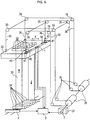
- Fig. 6 is a perspective view illustrating a steel-sheet snaking preventing device for a wire rope type vertical looper according to the second embodiment.
- reference numeral 30 denotes a steel sheet
- reference numeral 32 denotes a looper carriage
- reference numeral 33 denotes an upper looper roll
- reference numeral 34 denotes a lower looper roll
- reference numeral 35 denotes a sheave
- reference numeral 36 denotes a wire rope
- reference numeral 37 denotes a carriage driving mechanism
- reference numeral 38 denotes a drum
- reference numeral 40 denotes a metal fitting
- reference numeral 41 denotes a jack mechanism
- reference numeral 46 denotes a jack mechanism driving source.
- Reference numeral 1 denotes a tilt meter
- reference numeral 2 denotes a control means (controller)
- reference numeral 3 denotes a level meter
- reference numeral 4 denotes a snaking detector (CPC sensor).
- the tilt meter 1 may be of any type as long as it is capable of measuring a tilt.
- the tilt meter 1 used here is one that uses a pendulum, performs servo control such that the pendulum is in the center of a magnetic sensor, and calculates the amount of tilt from the amount of servo control (current output).
- the level meter 3 may be of any type as long as it is capable of calculating the carriage height.
- the level meter 3 detects the amount of rotation by means of a rotation detector (so-called PLG or encoder) attached to an end of a drum shaft, and calculates the carriage height.
- PLG rotation detector
- the jack mechanism 41 is coupled via the metal fitting 40 to the wire rope 36 that pulls the looper carriage 32.
- Fig. 7 shows an exemplary relationship between the amount of snaking A and the amount of tilt C of the looper carriage determined in relation to the looper carriage height Z when, in an entry-side looper in a steel-sheet continuous processing facility, a steel sheet (mild steel) with a thickness of 0.8 mm and a width of 1880 mm was passed through the looper carriage 32 having no tilt (see Fig.
- the looper carriage height Z is represented by its ratio (%) to the maximum height defined in the facility specification.
- the amount of snaking in Fig. 7 is the amount of rightward snaking along the X-axis in Fig. 6 .
- the amount of tilt of the looper carriage is the amount of raising of the right side bearing of the upper looper roll 33 with respect to the left side bearing.
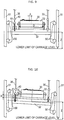
- Fig. 8 shows an exemplary relationship between the looper carriage height Z and the allowable amount of tilt (the maximum amount of tilt C at which one-sided elongation does not occur) determined when, in an entry-side looper in a steel-sheet continuous processing facility, a steel sheet (mild steel) with a thickness of 0.8 mm and a width of 1880 mm was passed through the looper carriage 32 having no tilt.
- the amount of tilt C of the looper carriage at which the amount of snaking is minimized is controlled by the amount of raising or lowering B of the jack mechanism 41 (see Fig. 10 ).
- the relationship between the amount of tilt of the looper carriage and the amount of snaking is stored, in the control means 2, in association with various looper carriage heights Z.
- An allowable amount of tilt at which one-sided elongation of the steel sheet does not occur is also input and stored in the control means 2.
- the tilt meter 1 detects the amount of tilt C of the looper carriage 32, and the snaking detector 4 detects the amount of snaking A of the steel sheet 30 in the looper.
- the detection signals from the tilt meter 1 and the snaking detector 4 are sent to the control means 2.
- the control means 2 calculates the amount of tilt of the looper carriage at which the amount of snaking of the steel sheet is minimized.
- the level meter 3 detects the looper carriage height.
- the control means 2 compares the amount of tilt of the looper carriage detected by the tilt meter 1 with the allowable amount of tilt at which one-sided elongation of the steel sheet does not occur.
- the control means 2 sends a raising or lowering command to the jack mechanism 41 at each corner of the looper carriage such that, for example, the amount of snaking of the steel sheet is minimized, that is, such that the amount of tilt of the looper carriage detected by the tilt meter 1 becomes equal to the allowable amount of tilt at which one-sided elongation of the steel sheet does not occur.
- the jack mechanism 41 When the jack mechanism 41 receives the command signal from the control means 2, the jack mechanism driving source 46 rotates a horizontal axis worm, which rotates a worm gear about a vertical axis. A vertical axis jack rotating together with the worm gear is raised or lowered with respect to the metal fitting 40 to vary the amount of tilt of the looper carriage 32.
- the control means 2 stops the raising or lowering command for the jack mechanisms 41. As a result, the tilting of the looper carriage 32 is stopped.
- a steel-sheet snaking preventing device for a wire rope type vertical looper has been described in the foregoing embodiment. It is obvious that the second embodiment is also applicable to a chain type vertical looper. In the chain type vertical looper, sprockets are used instead of sheaves, and drive sprockets are used instead of drums.
- the amount of tilt C of the looper carriage is 16.5 mm
- the amount of snaking A is 0 mm and a good result can be obtained.
Landscapes
- Engineering & Computer Science (AREA)
- Mechanical Engineering (AREA)
- Winding, Rewinding, Material Storage Devices (AREA)
- Advancing Webs (AREA)
- Chemical & Material Sciences (AREA)
- Physics & Mathematics (AREA)
- Thermal Sciences (AREA)
- Crystallography & Structural Chemistry (AREA)
- Materials Engineering (AREA)
- Metallurgy (AREA)
- Organic Chemistry (AREA)
Claims (3)
- Vorrichtung zum Verhindern von Schlangenbildung auf Stahlblech für einen vertikalen Bandspeicher, wobei die Vorrichtung umfasst:einen Mechanismus (41), der an jeder von wenigstens zwei Ecken eines Bandspeicherwagens (32) bereitgestellt wird und mit einer Kette oder einem Drahtseil (36) gekoppelt ist, das den Bandspeicherwagen (32) zieht,einen Neigungsmesser (1), der konfiguriert ist, um den Umfang der Neigung des Bandspeicherwagens (32) zu erfassen,einen Schlangenbildungsdetektor (4), der konfiguriert ist, um den Umfang der Schlangenbildung eines Stahlblechs (30) in dem Bandspeicher zu erfassen,einen Pegelmesser (3), der konfiguriert ist, um eine Höhe des Bandspeicherwagens (32) zu erfassen, undeine Steuerungseinrichtung (2), die konfiguriert ist, um Erfassungssignale von dem Neigungsmesser und dem Pegelmesser (3) zu empfangen und den Umfang der Neigung des Bandspeicherwagens (32) durch den Mechanismus (41) zu steuern,dadurch gekennzeichnet, dass,die Steuerungseinrichtung (2) konfiguriert ist, um den Umfang der Neigung des Bandspeicherwagens (32) auf der Basis eines Erfassungssignals von dem Neigungsmesser (1) und dem Pegelmesser (3) zu bestimmen, bei dem der Umfang der Schlangenbildung des Stahlblechs (30) Null wird, und die konfiguriert ist, um den bestimmten Umfang der Neigung des Bandspeicherwagens (32) als Befehl an den Mechanismus (41) zu senden, undder Mechanismus (41) ein Hebemechanismus ist, der über einen Metallbeschlag (40) mit der Kette oder dem Drahtseil (36) gekoppelt ist.
- Vorrichtung zum Verhindern von Schlangenbildung auf Stahlblech für einen vertikalen Bandspeicher nach Anspruch 1, dadurch gekennzeichnet, dass die Steuerungseinrichtung (2) konfiguriert sind, um Erfassungssignale von dem Neigungsmesser (1), dem Schlangenbildungsdetektor (4) und dem Pegelmesser (3) zu empfangen, den Umfang des Anhebens oder Absenkens der Ecke des Bandspeicherwagens (32) als Befehl an den Hebemechanismus (41) zu senden und den Umfang der Neigung des Bandspeicherwagens (32) durch den Hebemechanismus (41) zu steuern.
- Verfahren zum Verhindern von Schlangenbildung auf Stahlblech für einen vertikalen Bandspeicher mittels der Vorrichtung zum Verhindern von Schlangenbildung auf Stahlblech für einen vertikalen Bandspeicher nach Anspruch 2, das das Bestimmen des Umfangs der Neigung des Bandspeicherwagens (32) auf der Basis eines vorgegebenen Verhältnisses zwischen dem Umfang der Schlangenbildung des Stahlblechs (30), dem Umfang der Neigung des Bandspeicherwagens (32) und der Höhe des Bandspeicherwagens (32) umfasst, so dass der Umfang der Neigung den zulässigen Umfang der Neigung nicht überschreitet, bei dem eine einseitige Dehnung des Stahlblechs (30) nicht auftritt.
Applications Claiming Priority (3)
| Application Number | Priority Date | Filing Date | Title |
|---|---|---|---|
| JP2012270862A JP5494789B1 (ja) | 2012-12-12 | 2012-12-12 | 竪型ルーパーの鋼板蛇行防止装置 |
| JP2013171835A JP5494875B1 (ja) | 2013-08-22 | 2013-08-22 | 竪型ルーパーの鋼板蛇行防止装置および鋼板の蛇行防止方法 |
| PCT/JP2013/005225 WO2014091642A1 (ja) | 2012-12-12 | 2013-09-04 | 竪型ルーパーの鋼板蛇行防止装置および鋼板の蛇行防止方法 |
Publications (3)
| Publication Number | Publication Date |
|---|---|
| EP2933032A1 EP2933032A1 (de) | 2015-10-21 |
| EP2933032A4 EP2933032A4 (de) | 2016-03-16 |
| EP2933032B1 true EP2933032B1 (de) | 2019-07-17 |
Family
ID=50933957
Family Applications (1)
| Application Number | Title | Priority Date | Filing Date |
|---|---|---|---|
| EP13862224.6A Active EP2933032B1 (de) | 2012-12-12 | 2013-09-04 | Vorrichtung zur verhinderung von mäandern eines stahlbleches in einem vertikalen bandspeicher und verfahren zur verhinderung von mäandern eines stahlbleches |
Country Status (6)
| Country | Link |
|---|---|
| US (1) | US9855590B2 (de) |
| EP (1) | EP2933032B1 (de) |
| KR (1) | KR101750639B1 (de) |
| CN (1) | CN104853860B (de) |
| TW (1) | TWI541484B (de) |
| WO (1) | WO2014091642A1 (de) |
Families Citing this family (6)
| Publication number | Priority date | Publication date | Assignee | Title |
|---|---|---|---|---|
| ES2638003B1 (es) | 2016-03-15 | 2018-05-08 | Manuel Torres Martinez | Horno para el tratamiento térmico de filamentos |
| CN106081692B (zh) * | 2016-08-08 | 2017-11-17 | 青岛新大成塑料机械有限公司 | 滴灌带储带装置及其储带方法 |
| KR102105527B1 (ko) * | 2017-12-26 | 2020-04-28 | 주식회사 포스코 | 소둔 라인 루핑 타워의 스트립 사행방지장치 |
| EP3858770A1 (de) * | 2018-11-02 | 2021-08-04 | JFE Steel Corporation | Zügelvorrichtung, verfahren zur kontrolle der schlängelung eines stahlbands und verfahren zur herstellung eines stahlbandes |
| JP6814323B1 (ja) * | 2020-09-09 | 2021-01-13 | 中外炉工業株式会社 | 縦型ルーパのキャリッジ水平維持装置 |
| JP6988982B1 (ja) * | 2020-10-29 | 2022-01-05 | Jfeスチール株式会社 | 金属ストリップの蛇行量検出方法及び蛇行制御方法 |
Family Cites Families (15)
| Publication number | Priority date | Publication date | Assignee | Title |
|---|---|---|---|---|
| JPH0293017U (de) | 1989-01-11 | 1990-07-24 | ||
| JPH0730168Y2 (ja) | 1989-03-31 | 1995-07-12 | 川崎製鉄株式会社 | 竪型ルーパ設備 |
| WO1991001827A1 (fr) * | 1989-07-31 | 1991-02-21 | Kabushiki Kaisha Toshiba | Dispositif destine a corriger le serpentement d'un materiau lamine |
| JPH0824957B2 (ja) * | 1991-05-14 | 1996-03-13 | 日本鋼管株式会社 | ル−パ−キャリッジ水平度調整装置 |
| JP3079172B2 (ja) * | 1992-03-17 | 2000-08-21 | 東洋鋼鈑株式会社 | 竪型ルーパー |
| JPH05329523A (ja) * | 1992-05-27 | 1993-12-14 | Kawasaki Steel Corp | 縦型ルーパキャリッジの傾斜測定方法 |
| JPH073809U (ja) * | 1993-06-25 | 1995-01-20 | 住友金属工業株式会社 | 鋼帯の蛇行修正装置 |
| JPH08168819A (ja) * | 1994-12-19 | 1996-07-02 | Nkk Corp | 竪型ルーパーの鋼板蛇行防止装置 |
| JP3308757B2 (ja) | 1995-03-29 | 2002-07-29 | 川崎製鉄株式会社 | 金属ストリップの蛇行修正方法およびその装置 |
| JPH09328246A (ja) * | 1996-06-13 | 1997-12-22 | Shikoku Kakoki Co Ltd | ウェッブのアキュムレータ |
| JP3682950B2 (ja) * | 2000-05-19 | 2005-08-17 | Jfe電制株式会社 | 縦型ルーパーキャリッジの傾斜測定装置 |
| TWI319720B (en) * | 2007-04-16 | 2010-01-21 | Conveyor for substrate material | |
| JP5656596B2 (ja) * | 2010-12-08 | 2015-01-21 | キヤノン株式会社 | シート給送装置及び画像形成装置 |
| JP5760629B2 (ja) * | 2011-04-15 | 2015-08-12 | Jfeスチール株式会社 | 鋼帯の蛇行修正方法 |
| JP5910178B2 (ja) | 2012-03-06 | 2016-04-27 | Jfeスチール株式会社 | 竪型ルーパーの鋼板蛇行防止装置および鋼板の蛇行防止方法 |
-
2013
- 2013-09-04 EP EP13862224.6A patent/EP2933032B1/de active Active
- 2013-09-04 US US14/648,756 patent/US9855590B2/en active Active
- 2013-09-04 KR KR1020157014876A patent/KR101750639B1/ko active Active
- 2013-09-04 CN CN201380065122.2A patent/CN104853860B/zh active Active
- 2013-09-04 WO PCT/JP2013/005225 patent/WO2014091642A1/ja not_active Ceased
- 2013-09-05 TW TW102132021A patent/TWI541484B/zh active
Non-Patent Citations (1)
| Title |
|---|
| None * |
Also Published As
| Publication number | Publication date |
|---|---|
| US9855590B2 (en) | 2018-01-02 |
| CN104853860B (zh) | 2016-12-14 |
| TW201423014A (zh) | 2014-06-16 |
| EP2933032A4 (de) | 2016-03-16 |
| KR20150081355A (ko) | 2015-07-13 |
| TWI541484B (zh) | 2016-07-11 |
| WO2014091642A1 (ja) | 2014-06-19 |
| CN104853860A (zh) | 2015-08-19 |
| KR101750639B1 (ko) | 2017-06-23 |
| US20150306649A1 (en) | 2015-10-29 |
| EP2933032A1 (de) | 2015-10-21 |
Similar Documents
| Publication | Publication Date | Title |
|---|---|---|
| EP2933032B1 (de) | Vorrichtung zur verhinderung von mäandern eines stahlbleches in einem vertikalen bandspeicher und verfahren zur verhinderung von mäandern eines stahlbleches | |
| US7950499B2 (en) | Control apparatus for an elevator responsive to car-mounted position detectors | |
| US7686140B2 (en) | Elevator support means monitoring device and a method | |
| TWI597230B (zh) | 具有階梯輸送帶的手扶梯、具有板狀輸送帶的自動走道及導引片 | |
| BRPI1002024A2 (pt) | laminação, método de controle de laminação, método de controle e aparelho de laminação do aparelho de laminação | |
| AU2015371480B2 (en) | Method for operating a chain drive and assembly having a chain drive | |
| JP5050362B2 (ja) | エレベータ | |
| JP6223586B2 (ja) | エレベータロープの伸び検知装置 | |
| JP5760629B2 (ja) | 鋼帯の蛇行修正方法 | |
| CN111942995A (zh) | 电梯的绳索检查系统 | |
| US20210371245A1 (en) | Method and device for monitoring properties of a supporting-means arrangement in an elevator system | |
| US10486935B2 (en) | Elevator diagnosing device | |
| JP5910178B2 (ja) | 竪型ルーパーの鋼板蛇行防止装置および鋼板の蛇行防止方法 | |
| JP5494789B1 (ja) | 竪型ルーパーの鋼板蛇行防止装置 | |
| CN106660765B (zh) | 检测链条中的磨损链节的方法及升降装置 | |
| JP5494875B1 (ja) | 竪型ルーパーの鋼板蛇行防止装置および鋼板の蛇行防止方法 | |
| JP2013128978A (ja) | サイドガイド装置およびサイドガイド方法 | |
| US20200031630A1 (en) | Misalignment monitoring in a people conveyor | |
| JP6648668B2 (ja) | エレベータ装置 | |
| KR102373010B1 (ko) | 수직형 루퍼장치 | |
| EP4238668B1 (de) | Mäandermengenerfassungsverfahren und mäandersteuerverfahren für metallband | |
| JP4412103B2 (ja) | スキンパスミルの速度制御方法及び装置 | |
| KR20040009030A (ko) | 슈트에서의 편적 방지 장치 | |
| HK40041846B (en) | An elevator rope inspection system | |
| HK40041846A (en) | An elevator rope inspection system |
Legal Events
| Date | Code | Title | Description |
|---|---|---|---|
| PUAI | Public reference made under article 153(3) epc to a published international application that has entered the european phase |
Free format text: ORIGINAL CODE: 0009012 |
|
| 17P | Request for examination filed |
Effective date: 20150707 |
|
| AK | Designated contracting states |
Kind code of ref document: A1 Designated state(s): AL AT BE BG CH CY CZ DE DK EE ES FI FR GB GR HR HU IE IS IT LI LT LU LV MC MK MT NL NO PL PT RO RS SE SI SK SM TR |
|
| AX | Request for extension of the european patent |
Extension state: BA ME |
|
| A4 | Supplementary search report drawn up and despatched |
Effective date: 20160211 |
|
| RIC1 | Information provided on ipc code assigned before grant |
Ipc: B65H 23/038 20060101ALI20160205BHEP Ipc: B21B 41/00 20060101ALI20160205BHEP Ipc: B21B 39/14 20060101ALI20160205BHEP Ipc: B21B 39/08 20060101ALI20160205BHEP Ipc: B21C 47/34 20060101ALI20160205BHEP Ipc: B21C 49/00 20060101AFI20160205BHEP |
|
| DAX | Request for extension of the european patent (deleted) | ||
| STAA | Information on the status of an ep patent application or granted ep patent |
Free format text: STATUS: EXAMINATION IS IN PROGRESS |
|
| 17Q | First examination report despatched |
Effective date: 20180511 |
|
| GRAP | Despatch of communication of intention to grant a patent |
Free format text: ORIGINAL CODE: EPIDOSNIGR1 |
|
| STAA | Information on the status of an ep patent application or granted ep patent |
Free format text: STATUS: GRANT OF PATENT IS INTENDED |
|
| INTG | Intention to grant announced |
Effective date: 20190225 |
|
| GRAS | Grant fee paid |
Free format text: ORIGINAL CODE: EPIDOSNIGR3 |
|
| GRAA | (expected) grant |
Free format text: ORIGINAL CODE: 0009210 |
|
| STAA | Information on the status of an ep patent application or granted ep patent |
Free format text: STATUS: THE PATENT HAS BEEN GRANTED |
|
| AK | Designated contracting states |
Kind code of ref document: B1 Designated state(s): AL AT BE BG CH CY CZ DE DK EE ES FI FR GB GR HR HU IE IS IT LI LT LU LV MC MK MT NL NO PL PT RO RS SE SI SK SM TR |
|
| REG | Reference to a national code |
Ref country code: GB Ref legal event code: FG4D |
|
| REG | Reference to a national code |
Ref country code: CH Ref legal event code: EP |
|
| REG | Reference to a national code |
Ref country code: IE Ref legal event code: FG4D |
|
| REG | Reference to a national code |
Ref country code: DE Ref legal event code: R096 Ref document number: 602013058030 Country of ref document: DE |
|
| REG | Reference to a national code |
Ref country code: AT Ref legal event code: REF Ref document number: 1155367 Country of ref document: AT Kind code of ref document: T Effective date: 20190815 |
|
| REG | Reference to a national code |
Ref country code: NL Ref legal event code: MP Effective date: 20190717 |
|
| REG | Reference to a national code |
Ref country code: LT Ref legal event code: MG4D |
|
| REG | Reference to a national code |
Ref country code: AT Ref legal event code: MK05 Ref document number: 1155367 Country of ref document: AT Kind code of ref document: T Effective date: 20190717 |
|
| PG25 | Lapsed in a contracting state [announced via postgrant information from national office to epo] |
Ref country code: SE Free format text: LAPSE BECAUSE OF FAILURE TO SUBMIT A TRANSLATION OF THE DESCRIPTION OR TO PAY THE FEE WITHIN THE PRESCRIBED TIME-LIMIT Effective date: 20190717 Ref country code: LT Free format text: LAPSE BECAUSE OF FAILURE TO SUBMIT A TRANSLATION OF THE DESCRIPTION OR TO PAY THE FEE WITHIN THE PRESCRIBED TIME-LIMIT Effective date: 20190717 Ref country code: BG Free format text: LAPSE BECAUSE OF FAILURE TO SUBMIT A TRANSLATION OF THE DESCRIPTION OR TO PAY THE FEE WITHIN THE PRESCRIBED TIME-LIMIT Effective date: 20191017 Ref country code: NL Free format text: LAPSE BECAUSE OF FAILURE TO SUBMIT A TRANSLATION OF THE DESCRIPTION OR TO PAY THE FEE WITHIN THE PRESCRIBED TIME-LIMIT Effective date: 20190717 Ref country code: PT Free format text: LAPSE BECAUSE OF FAILURE TO SUBMIT A TRANSLATION OF THE DESCRIPTION OR TO PAY THE FEE WITHIN THE PRESCRIBED TIME-LIMIT Effective date: 20191118 Ref country code: FI Free format text: LAPSE BECAUSE OF FAILURE TO SUBMIT A TRANSLATION OF THE DESCRIPTION OR TO PAY THE FEE WITHIN THE PRESCRIBED TIME-LIMIT Effective date: 20190717 Ref country code: NO Free format text: LAPSE BECAUSE OF FAILURE TO SUBMIT A TRANSLATION OF THE DESCRIPTION OR TO PAY THE FEE WITHIN THE PRESCRIBED TIME-LIMIT Effective date: 20191017 Ref country code: AT Free format text: LAPSE BECAUSE OF FAILURE TO SUBMIT A TRANSLATION OF THE DESCRIPTION OR TO PAY THE FEE WITHIN THE PRESCRIBED TIME-LIMIT Effective date: 20190717 Ref country code: HR Free format text: LAPSE BECAUSE OF FAILURE TO SUBMIT A TRANSLATION OF THE DESCRIPTION OR TO PAY THE FEE WITHIN THE PRESCRIBED TIME-LIMIT Effective date: 20190717 |
|
| PG25 | Lapsed in a contracting state [announced via postgrant information from national office to epo] |
Ref country code: LV Free format text: LAPSE BECAUSE OF FAILURE TO SUBMIT A TRANSLATION OF THE DESCRIPTION OR TO PAY THE FEE WITHIN THE PRESCRIBED TIME-LIMIT Effective date: 20190717 Ref country code: IS Free format text: LAPSE BECAUSE OF FAILURE TO SUBMIT A TRANSLATION OF THE DESCRIPTION OR TO PAY THE FEE WITHIN THE PRESCRIBED TIME-LIMIT Effective date: 20191117 Ref country code: AL Free format text: LAPSE BECAUSE OF FAILURE TO SUBMIT A TRANSLATION OF THE DESCRIPTION OR TO PAY THE FEE WITHIN THE PRESCRIBED TIME-LIMIT Effective date: 20190717 Ref country code: GR Free format text: LAPSE BECAUSE OF FAILURE TO SUBMIT A TRANSLATION OF THE DESCRIPTION OR TO PAY THE FEE WITHIN THE PRESCRIBED TIME-LIMIT Effective date: 20191018 Ref country code: RS Free format text: LAPSE BECAUSE OF FAILURE TO SUBMIT A TRANSLATION OF THE DESCRIPTION OR TO PAY THE FEE WITHIN THE PRESCRIBED TIME-LIMIT Effective date: 20190717 Ref country code: ES Free format text: LAPSE BECAUSE OF FAILURE TO SUBMIT A TRANSLATION OF THE DESCRIPTION OR TO PAY THE FEE WITHIN THE PRESCRIBED TIME-LIMIT Effective date: 20190717 |
|
| PG25 | Lapsed in a contracting state [announced via postgrant information from national office to epo] |
Ref country code: TR Free format text: LAPSE BECAUSE OF FAILURE TO SUBMIT A TRANSLATION OF THE DESCRIPTION OR TO PAY THE FEE WITHIN THE PRESCRIBED TIME-LIMIT Effective date: 20190717 |
|
| PG25 | Lapsed in a contracting state [announced via postgrant information from national office to epo] |
Ref country code: DK Free format text: LAPSE BECAUSE OF FAILURE TO SUBMIT A TRANSLATION OF THE DESCRIPTION OR TO PAY THE FEE WITHIN THE PRESCRIBED TIME-LIMIT Effective date: 20190717 Ref country code: PL Free format text: LAPSE BECAUSE OF FAILURE TO SUBMIT A TRANSLATION OF THE DESCRIPTION OR TO PAY THE FEE WITHIN THE PRESCRIBED TIME-LIMIT Effective date: 20190717 Ref country code: IT Free format text: LAPSE BECAUSE OF FAILURE TO SUBMIT A TRANSLATION OF THE DESCRIPTION OR TO PAY THE FEE WITHIN THE PRESCRIBED TIME-LIMIT Effective date: 20190717 Ref country code: EE Free format text: LAPSE BECAUSE OF FAILURE TO SUBMIT A TRANSLATION OF THE DESCRIPTION OR TO PAY THE FEE WITHIN THE PRESCRIBED TIME-LIMIT Effective date: 20190717 Ref country code: RO Free format text: LAPSE BECAUSE OF FAILURE TO SUBMIT A TRANSLATION OF THE DESCRIPTION OR TO PAY THE FEE WITHIN THE PRESCRIBED TIME-LIMIT Effective date: 20190717 |
|
| PG25 | Lapsed in a contracting state [announced via postgrant information from national office to epo] |
Ref country code: SM Free format text: LAPSE BECAUSE OF FAILURE TO SUBMIT A TRANSLATION OF THE DESCRIPTION OR TO PAY THE FEE WITHIN THE PRESCRIBED TIME-LIMIT Effective date: 20190717 Ref country code: CZ Free format text: LAPSE BECAUSE OF FAILURE TO SUBMIT A TRANSLATION OF THE DESCRIPTION OR TO PAY THE FEE WITHIN THE PRESCRIBED TIME-LIMIT Effective date: 20190717 Ref country code: SK Free format text: LAPSE BECAUSE OF FAILURE TO SUBMIT A TRANSLATION OF THE DESCRIPTION OR TO PAY THE FEE WITHIN THE PRESCRIBED TIME-LIMIT Effective date: 20190717 Ref country code: IS Free format text: LAPSE BECAUSE OF FAILURE TO SUBMIT A TRANSLATION OF THE DESCRIPTION OR TO PAY THE FEE WITHIN THE PRESCRIBED TIME-LIMIT Effective date: 20200224 Ref country code: MC Free format text: LAPSE BECAUSE OF FAILURE TO SUBMIT A TRANSLATION OF THE DESCRIPTION OR TO PAY THE FEE WITHIN THE PRESCRIBED TIME-LIMIT Effective date: 20190717 |
|
| REG | Reference to a national code |
Ref country code: CH Ref legal event code: PL |
|
| REG | Reference to a national code |
Ref country code: DE Ref legal event code: R097 Ref document number: 602013058030 Country of ref document: DE |
|
| PLBE | No opposition filed within time limit |
Free format text: ORIGINAL CODE: 0009261 |
|
| STAA | Information on the status of an ep patent application or granted ep patent |
Free format text: STATUS: NO OPPOSITION FILED WITHIN TIME LIMIT |
|
| PG2D | Information on lapse in contracting state deleted |
Ref country code: IS |
|
| PG25 | Lapsed in a contracting state [announced via postgrant information from national office to epo] |
Ref country code: LI Free format text: LAPSE BECAUSE OF NON-PAYMENT OF DUE FEES Effective date: 20190930 Ref country code: CH Free format text: LAPSE BECAUSE OF NON-PAYMENT OF DUE FEES Effective date: 20190930 Ref country code: IE Free format text: LAPSE BECAUSE OF NON-PAYMENT OF DUE FEES Effective date: 20190904 Ref country code: LU Free format text: LAPSE BECAUSE OF NON-PAYMENT OF DUE FEES Effective date: 20190904 |
|
| 26N | No opposition filed |
Effective date: 20200603 |
|
| REG | Reference to a national code |
Ref country code: BE Ref legal event code: MM Effective date: 20190930 |
|
| PG25 | Lapsed in a contracting state [announced via postgrant information from national office to epo] |
Ref country code: SI Free format text: LAPSE BECAUSE OF FAILURE TO SUBMIT A TRANSLATION OF THE DESCRIPTION OR TO PAY THE FEE WITHIN THE PRESCRIBED TIME-LIMIT Effective date: 20190717 Ref country code: BE Free format text: LAPSE BECAUSE OF NON-PAYMENT OF DUE FEES Effective date: 20190930 |
|
| PG25 | Lapsed in a contracting state [announced via postgrant information from national office to epo] |
Ref country code: CY Free format text: LAPSE BECAUSE OF FAILURE TO SUBMIT A TRANSLATION OF THE DESCRIPTION OR TO PAY THE FEE WITHIN THE PRESCRIBED TIME-LIMIT Effective date: 20190717 |
|
| PG25 | Lapsed in a contracting state [announced via postgrant information from national office to epo] |
Ref country code: MT Free format text: LAPSE BECAUSE OF FAILURE TO SUBMIT A TRANSLATION OF THE DESCRIPTION OR TO PAY THE FEE WITHIN THE PRESCRIBED TIME-LIMIT Effective date: 20190717 Ref country code: HU Free format text: LAPSE BECAUSE OF FAILURE TO SUBMIT A TRANSLATION OF THE DESCRIPTION OR TO PAY THE FEE WITHIN THE PRESCRIBED TIME-LIMIT; INVALID AB INITIO Effective date: 20130904 |
|
| PG25 | Lapsed in a contracting state [announced via postgrant information from national office to epo] |
Ref country code: MK Free format text: LAPSE BECAUSE OF FAILURE TO SUBMIT A TRANSLATION OF THE DESCRIPTION OR TO PAY THE FEE WITHIN THE PRESCRIBED TIME-LIMIT Effective date: 20190717 |
|
| PGFP | Annual fee paid to national office [announced via postgrant information from national office to epo] |
Ref country code: DE Payment date: 20250730 Year of fee payment: 13 |
|
| PGFP | Annual fee paid to national office [announced via postgrant information from national office to epo] |
Ref country code: GB Payment date: 20250731 Year of fee payment: 13 |
|
| PGFP | Annual fee paid to national office [announced via postgrant information from national office to epo] |
Ref country code: FR Payment date: 20250808 Year of fee payment: 13 |