EP2933351A1 - Procédé de production pour tôle d'acier galvanisée au trempé à chaud - Google Patents
Procédé de production pour tôle d'acier galvanisée au trempé à chaud Download PDFInfo
- Publication number
- EP2933351A1 EP2933351A1 EP13862056.2A EP13862056A EP2933351A1 EP 2933351 A1 EP2933351 A1 EP 2933351A1 EP 13862056 A EP13862056 A EP 13862056A EP 2933351 A1 EP2933351 A1 EP 2933351A1
- Authority
- EP
- European Patent Office
- Prior art keywords
- steel sheet
- less
- air
- base steel
- case
- Prior art date
- Legal status (The legal status is an assumption and is not a legal conclusion. Google has not performed a legal analysis and makes no representation as to the accuracy of the status listed.)
- Withdrawn
Links
Images
Classifications
-
- C—CHEMISTRY; METALLURGY
- C21—METALLURGY OF IRON
- C21D—MODIFYING THE PHYSICAL STRUCTURE OF FERROUS METALS; GENERAL DEVICES FOR HEAT TREATMENT OF FERROUS OR NON-FERROUS METALS OR ALLOYS; MAKING METAL MALLEABLE, e.g. BY DECARBURISATION OR TEMPERING
- C21D9/00—Heat treatment, e.g. annealing, hardening, quenching or tempering, adapted for particular articles; Furnaces therefor
- C21D9/46—Heat treatment, e.g. annealing, hardening, quenching or tempering, adapted for particular articles; Furnaces therefor for sheet metals
-
- C—CHEMISTRY; METALLURGY
- C21—METALLURGY OF IRON
- C21D—MODIFYING THE PHYSICAL STRUCTURE OF FERROUS METALS; GENERAL DEVICES FOR HEAT TREATMENT OF FERROUS OR NON-FERROUS METALS OR ALLOYS; MAKING METAL MALLEABLE, e.g. BY DECARBURISATION OR TEMPERING
- C21D1/00—General methods or devices for heat treatment, e.g. annealing, hardening, quenching or tempering
- C21D1/74—Methods of treatment in inert gas, controlled atmosphere, vacuum or pulverulent material
-
- C—CHEMISTRY; METALLURGY
- C21—METALLURGY OF IRON
- C21D—MODIFYING THE PHYSICAL STRUCTURE OF FERROUS METALS; GENERAL DEVICES FOR HEAT TREATMENT OF FERROUS OR NON-FERROUS METALS OR ALLOYS; MAKING METAL MALLEABLE, e.g. BY DECARBURISATION OR TEMPERING
- C21D6/00—Heat treatment of ferrous alloys
- C21D6/004—Heat treatment of ferrous alloys containing Cr and Ni
-
- C—CHEMISTRY; METALLURGY
- C21—METALLURGY OF IRON
- C21D—MODIFYING THE PHYSICAL STRUCTURE OF FERROUS METALS; GENERAL DEVICES FOR HEAT TREATMENT OF FERROUS OR NON-FERROUS METALS OR ALLOYS; MAKING METAL MALLEABLE, e.g. BY DECARBURISATION OR TEMPERING
- C21D6/00—Heat treatment of ferrous alloys
- C21D6/005—Heat treatment of ferrous alloys containing Mn
-
- C—CHEMISTRY; METALLURGY
- C21—METALLURGY OF IRON
- C21D—MODIFYING THE PHYSICAL STRUCTURE OF FERROUS METALS; GENERAL DEVICES FOR HEAT TREATMENT OF FERROUS OR NON-FERROUS METALS OR ALLOYS; MAKING METAL MALLEABLE, e.g. BY DECARBURISATION OR TEMPERING
- C21D6/00—Heat treatment of ferrous alloys
- C21D6/008—Heat treatment of ferrous alloys containing Si
-
- C—CHEMISTRY; METALLURGY
- C22—METALLURGY; FERROUS OR NON-FERROUS ALLOYS; TREATMENT OF ALLOYS OR NON-FERROUS METALS
- C22C—ALLOYS
- C22C18/00—Alloys based on zinc
- C22C18/04—Alloys based on zinc with aluminium as the next major constituent
-
- C—CHEMISTRY; METALLURGY
- C22—METALLURGY; FERROUS OR NON-FERROUS ALLOYS; TREATMENT OF ALLOYS OR NON-FERROUS METALS
- C22C—ALLOYS
- C22C38/00—Ferrous alloys, e.g. steel alloys
-
- C—CHEMISTRY; METALLURGY
- C22—METALLURGY; FERROUS OR NON-FERROUS ALLOYS; TREATMENT OF ALLOYS OR NON-FERROUS METALS
- C22C—ALLOYS
- C22C38/00—Ferrous alloys, e.g. steel alloys
- C22C38/02—Ferrous alloys, e.g. steel alloys containing silicon
-
- C—CHEMISTRY; METALLURGY
- C22—METALLURGY; FERROUS OR NON-FERROUS ALLOYS; TREATMENT OF ALLOYS OR NON-FERROUS METALS
- C22C—ALLOYS
- C22C38/00—Ferrous alloys, e.g. steel alloys
- C22C38/04—Ferrous alloys, e.g. steel alloys containing manganese
-
- C—CHEMISTRY; METALLURGY
- C22—METALLURGY; FERROUS OR NON-FERROUS ALLOYS; TREATMENT OF ALLOYS OR NON-FERROUS METALS
- C22C—ALLOYS
- C22C38/00—Ferrous alloys, e.g. steel alloys
- C22C38/06—Ferrous alloys, e.g. steel alloys containing aluminium
-
- C—CHEMISTRY; METALLURGY
- C22—METALLURGY; FERROUS OR NON-FERROUS ALLOYS; TREATMENT OF ALLOYS OR NON-FERROUS METALS
- C22C—ALLOYS
- C22C38/00—Ferrous alloys, e.g. steel alloys
- C22C38/12—Ferrous alloys, e.g. steel alloys containing tungsten, tantalum, molybdenum, vanadium, or niobium
-
- C—CHEMISTRY; METALLURGY
- C22—METALLURGY; FERROUS OR NON-FERROUS ALLOYS; TREATMENT OF ALLOYS OR NON-FERROUS METALS
- C22C—ALLOYS
- C22C38/00—Ferrous alloys, e.g. steel alloys
- C22C38/14—Ferrous alloys, e.g. steel alloys containing titanium or zirconium
-
- C—CHEMISTRY; METALLURGY
- C22—METALLURGY; FERROUS OR NON-FERROUS ALLOYS; TREATMENT OF ALLOYS OR NON-FERROUS METALS
- C22C—ALLOYS
- C22C38/00—Ferrous alloys, e.g. steel alloys
- C22C38/16—Ferrous alloys, e.g. steel alloys containing copper
-
- C—CHEMISTRY; METALLURGY
- C22—METALLURGY; FERROUS OR NON-FERROUS ALLOYS; TREATMENT OF ALLOYS OR NON-FERROUS METALS
- C22C—ALLOYS
- C22C38/00—Ferrous alloys, e.g. steel alloys
- C22C38/18—Ferrous alloys, e.g. steel alloys containing chromium
- C22C38/20—Ferrous alloys, e.g. steel alloys containing chromium with copper
-
- C—CHEMISTRY; METALLURGY
- C22—METALLURGY; FERROUS OR NON-FERROUS ALLOYS; TREATMENT OF ALLOYS OR NON-FERROUS METALS
- C22C—ALLOYS
- C22C38/00—Ferrous alloys, e.g. steel alloys
- C22C38/18—Ferrous alloys, e.g. steel alloys containing chromium
- C22C38/22—Ferrous alloys, e.g. steel alloys containing chromium with molybdenum or tungsten
-
- C—CHEMISTRY; METALLURGY
- C22—METALLURGY; FERROUS OR NON-FERROUS ALLOYS; TREATMENT OF ALLOYS OR NON-FERROUS METALS
- C22C—ALLOYS
- C22C38/00—Ferrous alloys, e.g. steel alloys
- C22C38/18—Ferrous alloys, e.g. steel alloys containing chromium
- C22C38/26—Ferrous alloys, e.g. steel alloys containing chromium with niobium or tantalum
-
- C—CHEMISTRY; METALLURGY
- C22—METALLURGY; FERROUS OR NON-FERROUS ALLOYS; TREATMENT OF ALLOYS OR NON-FERROUS METALS
- C22C—ALLOYS
- C22C38/00—Ferrous alloys, e.g. steel alloys
- C22C38/18—Ferrous alloys, e.g. steel alloys containing chromium
- C22C38/28—Ferrous alloys, e.g. steel alloys containing chromium with titanium or zirconium
-
- C—CHEMISTRY; METALLURGY
- C22—METALLURGY; FERROUS OR NON-FERROUS ALLOYS; TREATMENT OF ALLOYS OR NON-FERROUS METALS
- C22C—ALLOYS
- C22C38/00—Ferrous alloys, e.g. steel alloys
- C22C38/18—Ferrous alloys, e.g. steel alloys containing chromium
- C22C38/32—Ferrous alloys, e.g. steel alloys containing chromium with boron
-
- C—CHEMISTRY; METALLURGY
- C22—METALLURGY; FERROUS OR NON-FERROUS ALLOYS; TREATMENT OF ALLOYS OR NON-FERROUS METALS
- C22C—ALLOYS
- C22C38/00—Ferrous alloys, e.g. steel alloys
- C22C38/18—Ferrous alloys, e.g. steel alloys containing chromium
- C22C38/34—Ferrous alloys, e.g. steel alloys containing chromium with more than 1.5% by weight of silicon
-
- C—CHEMISTRY; METALLURGY
- C22—METALLURGY; FERROUS OR NON-FERROUS ALLOYS; TREATMENT OF ALLOYS OR NON-FERROUS METALS
- C22C—ALLOYS
- C22C38/00—Ferrous alloys, e.g. steel alloys
- C22C38/18—Ferrous alloys, e.g. steel alloys containing chromium
- C22C38/38—Ferrous alloys, e.g. steel alloys containing chromium with more than 1.5% by weight of manganese
-
- C—CHEMISTRY; METALLURGY
- C22—METALLURGY; FERROUS OR NON-FERROUS ALLOYS; TREATMENT OF ALLOYS OR NON-FERROUS METALS
- C22C—ALLOYS
- C22C38/00—Ferrous alloys, e.g. steel alloys
- C22C38/18—Ferrous alloys, e.g. steel alloys containing chromium
- C22C38/40—Ferrous alloys, e.g. steel alloys containing chromium with nickel
- C22C38/42—Ferrous alloys, e.g. steel alloys containing chromium with nickel with copper
-
- C—CHEMISTRY; METALLURGY
- C22—METALLURGY; FERROUS OR NON-FERROUS ALLOYS; TREATMENT OF ALLOYS OR NON-FERROUS METALS
- C22C—ALLOYS
- C22C38/00—Ferrous alloys, e.g. steel alloys
- C22C38/18—Ferrous alloys, e.g. steel alloys containing chromium
- C22C38/40—Ferrous alloys, e.g. steel alloys containing chromium with nickel
- C22C38/44—Ferrous alloys, e.g. steel alloys containing chromium with nickel with molybdenum or tungsten
-
- C—CHEMISTRY; METALLURGY
- C22—METALLURGY; FERROUS OR NON-FERROUS ALLOYS; TREATMENT OF ALLOYS OR NON-FERROUS METALS
- C22C—ALLOYS
- C22C38/00—Ferrous alloys, e.g. steel alloys
- C22C38/18—Ferrous alloys, e.g. steel alloys containing chromium
- C22C38/40—Ferrous alloys, e.g. steel alloys containing chromium with nickel
- C22C38/48—Ferrous alloys, e.g. steel alloys containing chromium with nickel with niobium or tantalum
-
- C—CHEMISTRY; METALLURGY
- C22—METALLURGY; FERROUS OR NON-FERROUS ALLOYS; TREATMENT OF ALLOYS OR NON-FERROUS METALS
- C22C—ALLOYS
- C22C38/00—Ferrous alloys, e.g. steel alloys
- C22C38/18—Ferrous alloys, e.g. steel alloys containing chromium
- C22C38/40—Ferrous alloys, e.g. steel alloys containing chromium with nickel
- C22C38/50—Ferrous alloys, e.g. steel alloys containing chromium with nickel with titanium or zirconium
-
- C—CHEMISTRY; METALLURGY
- C22—METALLURGY; FERROUS OR NON-FERROUS ALLOYS; TREATMENT OF ALLOYS OR NON-FERROUS METALS
- C22C—ALLOYS
- C22C38/00—Ferrous alloys, e.g. steel alloys
- C22C38/18—Ferrous alloys, e.g. steel alloys containing chromium
- C22C38/40—Ferrous alloys, e.g. steel alloys containing chromium with nickel
- C22C38/54—Ferrous alloys, e.g. steel alloys containing chromium with nickel with boron
-
- C—CHEMISTRY; METALLURGY
- C22—METALLURGY; FERROUS OR NON-FERROUS ALLOYS; TREATMENT OF ALLOYS OR NON-FERROUS METALS
- C22C—ALLOYS
- C22C38/00—Ferrous alloys, e.g. steel alloys
- C22C38/18—Ferrous alloys, e.g. steel alloys containing chromium
- C22C38/40—Ferrous alloys, e.g. steel alloys containing chromium with nickel
- C22C38/58—Ferrous alloys, e.g. steel alloys containing chromium with nickel with more than 1.5% by weight of manganese
-
- C—CHEMISTRY; METALLURGY
- C22—METALLURGY; FERROUS OR NON-FERROUS ALLOYS; TREATMENT OF ALLOYS OR NON-FERROUS METALS
- C22C—ALLOYS
- C22C38/00—Ferrous alloys, e.g. steel alloys
- C22C38/60—Ferrous alloys, e.g. steel alloys containing lead, selenium, tellurium, or antimony, or more than 0.04% by weight of sulfur
-
- C—CHEMISTRY; METALLURGY
- C23—COATING METALLIC MATERIAL; COATING MATERIAL WITH METALLIC MATERIAL; CHEMICAL SURFACE TREATMENT; DIFFUSION TREATMENT OF METALLIC MATERIAL; COATING BY VACUUM EVAPORATION, BY SPUTTERING, BY ION IMPLANTATION OR BY CHEMICAL VAPOUR DEPOSITION, IN GENERAL; INHIBITING CORROSION OF METALLIC MATERIAL OR INCRUSTATION IN GENERAL
- C23C—COATING METALLIC MATERIAL; COATING MATERIAL WITH METALLIC MATERIAL; SURFACE TREATMENT OF METALLIC MATERIAL BY DIFFUSION INTO THE SURFACE, BY CHEMICAL CONVERSION OR SUBSTITUTION; COATING BY VACUUM EVAPORATION, BY SPUTTERING, BY ION IMPLANTATION OR BY CHEMICAL VAPOUR DEPOSITION, IN GENERAL
- C23C2/00—Hot-dipping or immersion processes for applying the coating material in the molten state without affecting the shape; Apparatus therefor
- C23C2/003—Apparatus
- C23C2/0038—Apparatus characterised by the pre-treatment chambers located immediately upstream of the bath or occurring locally before the dipping process
-
- C—CHEMISTRY; METALLURGY
- C23—COATING METALLIC MATERIAL; COATING MATERIAL WITH METALLIC MATERIAL; CHEMICAL SURFACE TREATMENT; DIFFUSION TREATMENT OF METALLIC MATERIAL; COATING BY VACUUM EVAPORATION, BY SPUTTERING, BY ION IMPLANTATION OR BY CHEMICAL VAPOUR DEPOSITION, IN GENERAL; INHIBITING CORROSION OF METALLIC MATERIAL OR INCRUSTATION IN GENERAL
- C23C—COATING METALLIC MATERIAL; COATING MATERIAL WITH METALLIC MATERIAL; SURFACE TREATMENT OF METALLIC MATERIAL BY DIFFUSION INTO THE SURFACE, BY CHEMICAL CONVERSION OR SUBSTITUTION; COATING BY VACUUM EVAPORATION, BY SPUTTERING, BY ION IMPLANTATION OR BY CHEMICAL VAPOUR DEPOSITION, IN GENERAL
- C23C2/00—Hot-dipping or immersion processes for applying the coating material in the molten state without affecting the shape; Apparatus therefor
- C23C2/02—Pretreatment of the material to be coated, e.g. for coating on selected surface areas
-
- C—CHEMISTRY; METALLURGY
- C23—COATING METALLIC MATERIAL; COATING MATERIAL WITH METALLIC MATERIAL; CHEMICAL SURFACE TREATMENT; DIFFUSION TREATMENT OF METALLIC MATERIAL; COATING BY VACUUM EVAPORATION, BY SPUTTERING, BY ION IMPLANTATION OR BY CHEMICAL VAPOUR DEPOSITION, IN GENERAL; INHIBITING CORROSION OF METALLIC MATERIAL OR INCRUSTATION IN GENERAL
- C23C—COATING METALLIC MATERIAL; COATING MATERIAL WITH METALLIC MATERIAL; SURFACE TREATMENT OF METALLIC MATERIAL BY DIFFUSION INTO THE SURFACE, BY CHEMICAL CONVERSION OR SUBSTITUTION; COATING BY VACUUM EVAPORATION, BY SPUTTERING, BY ION IMPLANTATION OR BY CHEMICAL VAPOUR DEPOSITION, IN GENERAL
- C23C2/00—Hot-dipping or immersion processes for applying the coating material in the molten state without affecting the shape; Apparatus therefor
- C23C2/02—Pretreatment of the material to be coated, e.g. for coating on selected surface areas
- C23C2/022—Pretreatment of the material to be coated, e.g. for coating on selected surface areas by heating
- C23C2/0222—Pretreatment of the material to be coated, e.g. for coating on selected surface areas by heating in a reactive atmosphere, e.g. oxidising or reducing atmosphere
-
- C—CHEMISTRY; METALLURGY
- C23—COATING METALLIC MATERIAL; COATING MATERIAL WITH METALLIC MATERIAL; CHEMICAL SURFACE TREATMENT; DIFFUSION TREATMENT OF METALLIC MATERIAL; COATING BY VACUUM EVAPORATION, BY SPUTTERING, BY ION IMPLANTATION OR BY CHEMICAL VAPOUR DEPOSITION, IN GENERAL; INHIBITING CORROSION OF METALLIC MATERIAL OR INCRUSTATION IN GENERAL
- C23C—COATING METALLIC MATERIAL; COATING MATERIAL WITH METALLIC MATERIAL; SURFACE TREATMENT OF METALLIC MATERIAL BY DIFFUSION INTO THE SURFACE, BY CHEMICAL CONVERSION OR SUBSTITUTION; COATING BY VACUUM EVAPORATION, BY SPUTTERING, BY ION IMPLANTATION OR BY CHEMICAL VAPOUR DEPOSITION, IN GENERAL
- C23C2/00—Hot-dipping or immersion processes for applying the coating material in the molten state without affecting the shape; Apparatus therefor
- C23C2/02—Pretreatment of the material to be coated, e.g. for coating on selected surface areas
- C23C2/022—Pretreatment of the material to be coated, e.g. for coating on selected surface areas by heating
- C23C2/0224—Two or more thermal pretreatments
-
- C—CHEMISTRY; METALLURGY
- C23—COATING METALLIC MATERIAL; COATING MATERIAL WITH METALLIC MATERIAL; CHEMICAL SURFACE TREATMENT; DIFFUSION TREATMENT OF METALLIC MATERIAL; COATING BY VACUUM EVAPORATION, BY SPUTTERING, BY ION IMPLANTATION OR BY CHEMICAL VAPOUR DEPOSITION, IN GENERAL; INHIBITING CORROSION OF METALLIC MATERIAL OR INCRUSTATION IN GENERAL
- C23C—COATING METALLIC MATERIAL; COATING MATERIAL WITH METALLIC MATERIAL; SURFACE TREATMENT OF METALLIC MATERIAL BY DIFFUSION INTO THE SURFACE, BY CHEMICAL CONVERSION OR SUBSTITUTION; COATING BY VACUUM EVAPORATION, BY SPUTTERING, BY ION IMPLANTATION OR BY CHEMICAL VAPOUR DEPOSITION, IN GENERAL
- C23C2/00—Hot-dipping or immersion processes for applying the coating material in the molten state without affecting the shape; Apparatus therefor
- C23C2/02—Pretreatment of the material to be coated, e.g. for coating on selected surface areas
- C23C2/024—Pretreatment of the material to be coated, e.g. for coating on selected surface areas by cleaning or etching
-
- C—CHEMISTRY; METALLURGY
- C23—COATING METALLIC MATERIAL; COATING MATERIAL WITH METALLIC MATERIAL; CHEMICAL SURFACE TREATMENT; DIFFUSION TREATMENT OF METALLIC MATERIAL; COATING BY VACUUM EVAPORATION, BY SPUTTERING, BY ION IMPLANTATION OR BY CHEMICAL VAPOUR DEPOSITION, IN GENERAL; INHIBITING CORROSION OF METALLIC MATERIAL OR INCRUSTATION IN GENERAL
- C23C—COATING METALLIC MATERIAL; COATING MATERIAL WITH METALLIC MATERIAL; SURFACE TREATMENT OF METALLIC MATERIAL BY DIFFUSION INTO THE SURFACE, BY CHEMICAL CONVERSION OR SUBSTITUTION; COATING BY VACUUM EVAPORATION, BY SPUTTERING, BY ION IMPLANTATION OR BY CHEMICAL VAPOUR DEPOSITION, IN GENERAL
- C23C2/00—Hot-dipping or immersion processes for applying the coating material in the molten state without affecting the shape; Apparatus therefor
- C23C2/04—Hot-dipping or immersion processes for applying the coating material in the molten state without affecting the shape; Apparatus therefor characterised by the coating material
- C23C2/06—Zinc or cadmium or alloys based thereon
-
- C—CHEMISTRY; METALLURGY
- C23—COATING METALLIC MATERIAL; COATING MATERIAL WITH METALLIC MATERIAL; CHEMICAL SURFACE TREATMENT; DIFFUSION TREATMENT OF METALLIC MATERIAL; COATING BY VACUUM EVAPORATION, BY SPUTTERING, BY ION IMPLANTATION OR BY CHEMICAL VAPOUR DEPOSITION, IN GENERAL; INHIBITING CORROSION OF METALLIC MATERIAL OR INCRUSTATION IN GENERAL
- C23C—COATING METALLIC MATERIAL; COATING MATERIAL WITH METALLIC MATERIAL; SURFACE TREATMENT OF METALLIC MATERIAL BY DIFFUSION INTO THE SURFACE, BY CHEMICAL CONVERSION OR SUBSTITUTION; COATING BY VACUUM EVAPORATION, BY SPUTTERING, BY ION IMPLANTATION OR BY CHEMICAL VAPOUR DEPOSITION, IN GENERAL
- C23C2/00—Hot-dipping or immersion processes for applying the coating material in the molten state without affecting the shape; Apparatus therefor
- C23C2/26—After-treatment
- C23C2/28—Thermal after-treatment, e.g. treatment in oil bath
-
- C—CHEMISTRY; METALLURGY
- C23—COATING METALLIC MATERIAL; COATING MATERIAL WITH METALLIC MATERIAL; CHEMICAL SURFACE TREATMENT; DIFFUSION TREATMENT OF METALLIC MATERIAL; COATING BY VACUUM EVAPORATION, BY SPUTTERING, BY ION IMPLANTATION OR BY CHEMICAL VAPOUR DEPOSITION, IN GENERAL; INHIBITING CORROSION OF METALLIC MATERIAL OR INCRUSTATION IN GENERAL
- C23C—COATING METALLIC MATERIAL; COATING MATERIAL WITH METALLIC MATERIAL; SURFACE TREATMENT OF METALLIC MATERIAL BY DIFFUSION INTO THE SURFACE, BY CHEMICAL CONVERSION OR SUBSTITUTION; COATING BY VACUUM EVAPORATION, BY SPUTTERING, BY ION IMPLANTATION OR BY CHEMICAL VAPOUR DEPOSITION, IN GENERAL
- C23C2/00—Hot-dipping or immersion processes for applying the coating material in the molten state without affecting the shape; Apparatus therefor
- C23C2/34—Hot-dipping or immersion processes for applying the coating material in the molten state without affecting the shape; Apparatus therefor characterised by the shape of the material to be treated
- C23C2/36—Elongated material
- C23C2/40—Plates; Strips
-
- C—CHEMISTRY; METALLURGY
- C21—METALLURGY OF IRON
- C21D—MODIFYING THE PHYSICAL STRUCTURE OF FERROUS METALS; GENERAL DEVICES FOR HEAT TREATMENT OF FERROUS OR NON-FERROUS METALS OR ALLOYS; MAKING METAL MALLEABLE, e.g. BY DECARBURISATION OR TEMPERING
- C21D9/00—Heat treatment, e.g. annealing, hardening, quenching or tempering, adapted for particular articles; Furnaces therefor
- C21D9/52—Heat treatment, e.g. annealing, hardening, quenching or tempering, adapted for particular articles; Furnaces therefor for wires; for strips ; for rods of unlimited length
- C21D9/54—Furnaces for treating strips or wire
- C21D9/56—Continuous furnaces for strip or wire
- C21D9/561—Continuous furnaces for strip or wire with a controlled atmosphere or vacuum
Definitions
- the present invention relates to a method for manufacturing a galvanized steel sheet whose base steel sheet is a Si-containing high-strength steel sheet, in particular, a method for manufacturing a galvanized steel sheet having good surface appearance without surface defects such as coating defects or pressing flaws and having excellent coating adhesiveness.
- coated steel sheets in which corrosion resistance is given to the base steel sheet in particular, galvanized steel sheets or galvannealed steel sheets which are excellent in terms of corrosion resistance, are used in the fields of, for example, automobile, domestic electric appliance, and building material.
- a galvanized steel sheet is manufactured using the following method. First, a steel sheet produced by hot-rolling and cold-rolling a steel slab, or followed by heat treatment, is annealed for recrystallization in a non-oxidizing atmosphere or a reducing atmosphere after cleaning the surface of the steel sheet using a degreasing method and/or a pickling method in a pretreatment process, or removing oil on the surface of the steel sheet by combustion in a preheating furnace without performing the pretreatment process.
- the steel sheet is cooled to a temperature suitable for galvanizing in the non-oxidizing atmosphere or the reducing atmosphere and dipped into a galvanizing bath into which a small amount (about 0.1 to 0.2 mass%) of Al is added, without being exposed to air.
- a galvanizing bath into which a small amount (about 0.1 to 0.2 mass%) of Al is added, without being exposed to air.
- the surface of the steel sheet is galvanized so that a galvanized steel sheet is obtained.
- a galvannealed steel sheet is obtained by performing a heat treatment on the galvanized steel sheet in an alloying furnace.
- a base steel sheet is subjected to annealing in a reducing atmosphere before galvanizing as described above.
- Si in steel has a high affinity for oxygen
- Si is selectively oxidized, even in a reducing atmosphere, so as to form oxides on the surface of the base steel sheet.
- oxides decrease the wettability of the base steel sheet with molten zinc, which results in coating defects at galvanizing.
- Patent Literature 1 discloses a technique in which the wettability of the base steel sheet with molten zinc is increased as a result of forming a reduced iron layer on the surface of the base steel sheet by performing a reduction annealing after forming oxidized irons on the surface of the base steel sheet in an oxidizing atmosphere.
- Patent Literature 2 discloses a technique in which satisfactory coating quality is achieved by controlling oxygen concentration in an atmosphere at preheating.
- Patent Literature 3 discloses a technique for manufacturing a galvanized steel sheet having good surface appearance without coating defects or pressing flaws by dividing a heating zone into three zones called A to C zones and appropriately controlling the temperatures and the oxygen concentrations respectively of the three zones.
- the present invention has been completed in view of the situation described above, and the object of the present invention is to provide a method for manufacturing a galvanized steel sheet at a high product yield ratio having good surface appearance without surface defects by using a high-Si-containing steel sheet as a base steel sheet.
- the amount of oxides formed on the surface of the base steel sheet depends on the furnace temperature and the oxygen concentration of the heating zone of the annealing furnace where a heat treatment is performed using a combustion reaction.
- the present inventors conducted investigations regarding factors influencing the variation in the oxidation amount of the high-Si-containing steel sheet other than the furnace temperature and the oxygen concentration of the heating zone. As a result, it was clarified that the variation in the oxidation amount depends strongly on the water vapor partial pressure P H2O in Air of air fed into the heating zone, and that the variation in oxidation amount increases with increasing water vapor partial pressure, in particular, in the case where P H2O in Air is 3000 Pa or less.
- the present invention it is possible to stably manufacture a galvanized steel sheet having good surface appearance without coating defects or pressing flaws.
- the present invention is effective in the case where a steel sheet containing Si in an amount of 0.1% or more, that is, a high-Si-containing steel sheet, which is generally difficult to be galvanized, is used as a base steel sheet, the method of the present invention is effective for significantly increasing a product yield ratio in the manufacture of a high-Si-containing galvanized steel sheet.
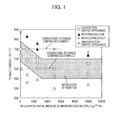
- Fig. 1 is a correlation diagram illustrating the relationship between manufacturing conditions (the furnace temperature T and the water vapor partial pressure P H2O in Air of air fed into the furnace) and the evaluation results of surface appearance.
- the C content be 0.05% or more in order to increase the strength of steel sheet.
- the C content is set to be 0.05% or more and 0.25% or less.
- Si 0.1% or more and 3.0% or less
- the Si content is an element which is the most important for improving the mechanical properties of high-strength steel sheet, it is necessary that the Si content be 0.1% or more. However, in the case where the Si content is more than 3.0%, it is difficult to prevent the formation of oxide layer, which results in a decrease in coating adhesiveness. Therefore, the Si content is set to be 0.1% or more and 3.0% or less.
- Mn 0.5% or more and 3.0% or less
- Mn is an element for solid solution hardening and is effective for increasing the strength of steel sheet, it is necessary that the Mn content be 0.5% or more. On the other hand, in the case where the Mn content is more than 3.0%, there is a decrease in weldability and coating adhesiveness, and it is difficult to achieve a good balance between strength and ductility. Therefore, the Mn content is set to be 0.5% or more and 3.0% or less.
- the P content is set to be 0.001% or more and 0.10% or less.
- Al 0.01% or more and 3.00% or less
- Al and Si are elements which are added in a complementary manner. Since Al is inevitably mixed into steel in a refining process, the lower limit of the Al content is 0.01%. On the other hand, in the case where the Al content is more than 3.00%, it is difficult to prevent the formation of oxide layer, which results in a decrease in coating adhesiveness. Therefore, the Al content is set to be 0.01% or more and 3.00% or less.
- the S content is an element which is inevitably added in a refining process. However, in the case where the S content is large, there is a decrease in weldability. Therefore, the S content is set to be 0.200% or less.
- Mo and/or Cr may further be added.
- Mo is an element which achieves the good balance between strength and ductility
- Mo may be added in an amount of 0.01% or more.
- Mo promotes, like Cr, the inner oxidation of Si and Al, Mo is effective for preventing the surface concentration of Si and Al.
- the Mo content is more than 1.00%, there may be an increase in cost. Therefore, in the case where Mo is added, it is preferable that the Mo content be 0.01% or more and 1.00% or less.
- Cr is an element which achieves the good balance between strength and ductility
- Cr may be added in an amount of 0.01% or more.
- Cr promotes the inner oxidation of Si and Al
- Cr is also effective for preventing the surface concentration of Si and Al.
- the Cr content is more than 1.00%, Cr is concentrated on the surface of steel sheet, which results in a decrease in coating adhesiveness and weldability. Therefore, in the case where Cr is added, it is preferable that the Cr content be 0.01% or more and 1.00% or less.
- Nb 0.005% or more and 0.20% or less
- Nb is an element which achieves the good balance between strength and ductility
- Nb may be added in an amount of 0.005% or more.
- the Nb content is more than 0.20%, there may be an increase in cost. Therefore, in the case where Nb is added, it is preferable that the Nb content be 0.005% or more and 0.20% or less.
- Ti is an element which achieves the good balance between strength and ductility
- Ti may be added in an amount of 0.005% or more.
- the Ti content is more than 0.20%, there may be a decrease in coating adhesiveness. Therefore, in the case where Ti is added, it is preferable that the Ti content be 0.005% or more and 0.20% or less.
- Cu is an element which promotes the formation of residual ⁇ phase
- Cu may be added in an amount of 0.01% or more.
- the Cu content is more than 0.5%, there may be an increase in cost. Therefore, in the case where Cu is added, it is preferable that the Cu content be 0.01% or more and 0.50% or less.
- Ni 0.01% or more and 1.00% or less
- Ni is an element which promotes the formation of residual ⁇ phase
- Ni may be added in an amount of 0.01% or more.
- the Ni content is more than 1.00%, there may be an increase in cost. Therefore, in the case where Ni is added, it is preferable that the Ni content be 0.01% or more and 1.00% or less.
- B is an element which promotes the formation of residual ⁇ phase
- B is added in an amount of 0.0005% or more.
- the B content is more than 0.010%, there may be a decrease in coating adhesiveness. Therefore, in the case where B is added, it is preferable that the B content be 0.0005% or more and 0.010% or less.
- the balance of the chemical composition other than the elements described above consists of Fe and inevitable impurities.
- a steel slab having the chemical composition described above is subjected to hot rolling followed by cold rolling and made into a steel sheet, and further, subjected to annealing and galvanizing using a continuous galvanizing line.
- an alloying treatment may be performed as needed after galvanizing.
- the present invention is characterized in that the steel sheet is heated in the heating zone of an annealing furnace while a furnace temperature T in the heating zone of the annealing furnace is controlled based on the water vapor partial pressure P H2O in Air of air fed into the heating zone, subsequently heated to a temperature of 630°C or higher and 850°C or lower in an atmosphere containing hydrogen gas having a partial pressure P H2 of 1000 Pa or more and 50000 Pa or less, water vapor gas having a partial pressure P H2O of 610 Pa or less, and the balance being N 2 and inevitable impurities, and subjected to galvanizing thereafter.
- This is the most important requirement in the present invention.
- Hot rolling may be performed under commonly used conditions.
- pickling treatment be performed after hot rolling. After scale, which has been formed on the surface of steel sheet, is removed using a pickling process, cold rolling is performed.
- pickling conditions there is no limitation on the pickling conditions.
- cold rolling be performed at a reduction rate of 30% or more and 90% or less.
- the reduction rate is less than 30%, since recrystallization is delayed, there is a tendency for mechanical properties to deteriorate.
- the reduction rate is more than 90%, there is not only an increase in rolling cost but also a deterioration in coating performance due to an increase in surface concentration at annealing.
- the cold-rolled steel sheet is subjected to annealing and then to galvanizing.
- the present invention by heating the steel sheet in the heating zone of an annealing furnace while controlling the furnace temperature T°C of the heating zone of the annealing furnace based on the water vapor partial pressure P H2O in Air of air fed into the furnace, since there is a decrease in variation in the amount of oxides formed on the surface of high-Si-containing steel sheet, it is possible to provide a method for manufacturing a galvanized steel sheet at a high product yield ratio.
- the heating which is performed using a combustion reaction in the heating zone of an annealing furnace is performed in order to form Fe-based oxides on the surface of steel sheet.
- the amount of oxides formed on the surface of steel sheet depends on the furnace temperature and the oxygen concentration in the heating zone of the annealing furnace.
- the present inventors found that the amount of oxides formed on the surface of steel sheet strongly depends on the amount of water vapor contained in air fed into the furnace in addition to the furnace temperature and the oxygen concentration. Specifically, in the case where the water vapor partial pressure P H2O in Air of air fed into the heating zone is 3000 Pa or less, an oxidation rate linearly increases with increasing water vapor partial pressure.
- the present invention is characterized in that the surface of steel sheet is heated at a temperature of 600°C or higher and 790°C or lower while a furnace temperature T°C of the heating zone of the annealing furnace is controlled based on the water vapor partial pressure P H2O in Air of air fed into the heating zone of the annealing furnace.
- the water vapor partial pressure of air fed into the furnace varies depending on the atmospheric temperature and humidity and the performance of a dehumidification and humidification device. It is preferable that P H2O in Air be 20000 Pa or less from the viewpoint of manufacturing costs and protection of the furnace inside.
- the furnace temperature T°C in the heating zone of an annealing furnace be controlled to be within the following range: in the case where P H2O in Air ⁇ 3000 Pa; 690-0.03 ⁇ P H2O in Air ⁇ T ⁇ 790-0.03 ⁇ P H2O in Air , and in the case where 3000 Pa ⁇ P H2O in Air ⁇ 20000 Pa; 600 ⁇ T ⁇ 700.
- the annealing for a steel sheet after the heating is performed in order to perform a reduction treatment on the surface of steel sheet.
- the hydrogen partial pressure P H2 it is necessary that the hydrogen partial pressure P H2 be 1000 Pa or more in order to obtain sufficient reduction capability.
- P H2 is more than 50000 Pa
- P H2O is more than 610 Pa
- oxides are less likely to be reduced, there is a decrease in coating performance.
- annealing is performed in an atmosphere containing hydrogen gas having a partial pressure P H2 of 1000 Pa or more and 50000 Pa or less and water vapor gas having a partial pressure P H2O of 610 Pa or less, and the balance being N 2 and inevitable impurities.
- reduction annealing is performed by heating the steel sheet at a temperature of 630°C or higher and 850°C or lower.
- the temperature of the steel sheet is lower than 630°C, since recrystallization is delayed, there is a deterioration in mechanical properties.
- the temperature of the steel sheet is higher than 850°C, since surface concentration is promoted, coating defects occur.
- galvanizing treatment is performed.
- alloying treatment may be performed as needed in order to manufacture a galvannealed steel sheet.
- the temperature of Zn bath be 440°C or higher and 550°C or lower when galvanizing treatment is performed. It is not appropriate that the bath temperature be lower than 440°C, because the solidification of Zn may occur due to a large variation in temperature inside the bath.
- Al concentration in the bath be 0.14 mass% or more and 0.24 mass% or less.
- Al concentration in the bath be 0.14 mass% or more and 0.24 mass% or less.
- the Al concentration is less than 0.14 mass%, Fe-Zn alloying reaction progresses at galvanizing treatment, which results in a variation in surface appearance.
- the Al concentration is more than 0.24 mass%, since a thick Fe-Al alloy layer is formed at the interface of the coated layer and the base steel sheet at galvanizing treatment, there is a decrease in weldability, and in addition, since the Al concentration in the bath is high, a large amount of Al oxide layer attaches to the surface of steel sheet, there is a significant deterioration in surface appearance.
- the Al concentration in the bath be 0.10% or more and 0.20% or less.
- the Al concentration is less than 0.10%, since a hard and brittle Fe-Zn alloy layer is formed at the interface of the coated layer and the base steel sheet at galvanizing treatment, there is a decrease in coating adhesiveness.
- the Al concentration is more than 0.20%, since a thick Fe-Al alloy layer is formed at the interface of the coated layer and the base steel sheet immediately after the dipping in the bath, there is a decrease in weldability.
- Mg may be added to the Zn bath in order to increase corrosion resistance.
- the alloying temperature be 460°C or higher and 570°C or lower. In the case where the alloying temperature is lower than 460°C, alloying reaction is slow, while, in the case where the alloying temperature is higher than 570°C, since a hard and brittle thick Fe-Zn alloy layer is formed at the interface of the coated layer and the base steel sheet, there is a decrease in coating performance.
- Coating weight is not specified in particular. It is preferable that the coating weight be 10 g/m 2 or more from the viewpoint of corrosion resistance and coating weight control, and it is preferable that coating weight be 120 g/m 2 or less from the viewpoint of formability and economic efficiency.
- the steel sheets were dipped in an Al-containing Zn bath having a temperature of 460°C in order to obtain galvanized steel sheets (GI), and then the galvanized steel sheets were subjected to alloying treatment in order to obtain galvannealed steel sheets (GA).
- the Al concentration in the bath was 0.10% to 0.20%, and the coating weight was controlled to be 45 g/m 2 by using a gas wiping method.
- the alloying treatment was performed at a temperature of 550°C to 560°C.
- the amount per unit length of Zn peeled was determined in terms of Zn count number using a fluorescent X-ray method. Then, coating adhesiveness was evaluated based on the following standard. Here, in this test, the mask diameter was 30 mm, the acceleration voltage of the fluorescent X-ray was 50 kV, the acceleration current of the fluorescent X-ray was 50 mA, and the measuring time was 20 seconds.
- Fig. 1 is a correlation diagram illustrating the relationship between the manufacturing conditions (the furnace temperature T and the water vapor partial pressure P H2O in Air of air fed into the furnace) and the evaluation results of surface appearance in the case of steel A given in Table 2. As Fig. 1 indicates, it is clarified that all the galvanized steel sheets according to the present invention have good surface appearance.
- the comparative examples of conventional techniques are also illustrated in Fig. 1 .
- the furnace temperature in the heating zone is controlled to be 750°C (comparative example 1 of conventional technique)
- the satisfactory surface appearance can be obtained when P H2O in Air is 100 Pa or 1000 Pa.
- P H2O in Air is 2500 Pa or 5000 Pa
- pressing flaws occur.
- the furnace temperature is controlled to be 650°C (comparative example 2 of conventional technique)
- coating defects occur when P H2O in Air is 100 Pa.
- a galvanized steel sheet having good surface appearance and excellent coating adhesiveness is stably manufactured. That is, there is a significant increase in product yield ratio compared with the conventional manufacturing methods.
- the galvanized steel sheet according to the present invention is excellent in terms of surface appearance and coating adhesiveness as well as mechanical properties, it is expected that the galvanized steel sheet according to the present invention is used for wide applications mainly including the fields of automobile, domestic electric appliance, and building material.
Landscapes
- Chemical & Material Sciences (AREA)
- Engineering & Computer Science (AREA)
- Organic Chemistry (AREA)
- Materials Engineering (AREA)
- Mechanical Engineering (AREA)
- Metallurgy (AREA)
- Chemical Kinetics & Catalysis (AREA)
- Physics & Mathematics (AREA)
- Thermal Sciences (AREA)
- Crystallography & Structural Chemistry (AREA)
- Oil, Petroleum & Natural Gas (AREA)
- Coating With Molten Metal (AREA)
- Heat Treatment Of Sheet Steel (AREA)
Applications Claiming Priority (2)
| Application Number | Priority Date | Filing Date | Title |
|---|---|---|---|
| JP2012269879A JP5626324B2 (ja) | 2012-12-11 | 2012-12-11 | 溶融亜鉛めっき鋼板の製造方法 |
| PCT/JP2013/007015 WO2014091702A1 (fr) | 2012-12-11 | 2013-11-29 | Procédé de production pour tôle d'acier galvanisée au trempé à chaud |
Publications (2)
| Publication Number | Publication Date |
|---|---|
| EP2933351A1 true EP2933351A1 (fr) | 2015-10-21 |
| EP2933351A4 EP2933351A4 (fr) | 2016-01-27 |
Family
ID=50934010
Family Applications (1)
| Application Number | Title | Priority Date | Filing Date |
|---|---|---|---|
| EP13862056.2A Withdrawn EP2933351A4 (fr) | 2012-12-11 | 2013-11-29 | Procédé de production pour tôle d'acier galvanisée au trempé à chaud |
Country Status (6)
| Country | Link |
|---|---|
| US (1) | US9677148B2 (fr) |
| EP (1) | EP2933351A4 (fr) |
| JP (1) | JP5626324B2 (fr) |
| KR (1) | KR101707981B1 (fr) |
| CN (1) | CN104919073B (fr) |
| WO (1) | WO2014091702A1 (fr) |
Cited By (1)
| Publication number | Priority date | Publication date | Assignee | Title |
|---|---|---|---|---|
| EP4477771A4 (fr) * | 2022-03-25 | 2025-05-28 | JFE Steel Corporation | Procédé de fabrication de tôle d'acier galvanisée haute résistance par immersion à chaud |
Families Citing this family (5)
| Publication number | Priority date | Publication date | Assignee | Title |
|---|---|---|---|---|
| DE102013004905A1 (de) * | 2012-03-23 | 2013-09-26 | Salzgitter Flachstahl Gmbh | Zunderarmer Vergütungsstahl und Verfahren zur Herstellung eines zunderarmen Bauteils aus diesem Stahl |
| JP6269547B2 (ja) * | 2015-03-23 | 2018-01-31 | Jfeスチール株式会社 | 連続溶融亜鉛めっき装置及び溶融亜鉛めっき鋼板の製造方法 |
| CN105908089B (zh) | 2016-06-28 | 2019-11-22 | 宝山钢铁股份有限公司 | 一种热浸镀低密度钢及其制造方法 |
| CN110914464B (zh) * | 2017-07-31 | 2021-10-15 | 日本制铁株式会社 | 热浸镀锌钢板 |
| KR20250091651A (ko) * | 2023-12-14 | 2025-06-23 | 현대제철 주식회사 | 초고강도 도금강판 및 그 제조방법 |
Family Cites Families (15)
| Publication number | Priority date | Publication date | Assignee | Title |
|---|---|---|---|---|
| JP2587724B2 (ja) | 1990-11-30 | 1997-03-05 | 新日本製鐵株式会社 | めっき密着性の良好な高Si含有高張力溶融亜鉛めっき鋼板の製造方法 |
| JP3415191B2 (ja) | 1993-04-26 | 2003-06-09 | Jfeスチール株式会社 | 高張力溶融亜鉛めっき鋼板の製造方法 |
| JP3887308B2 (ja) | 2002-12-27 | 2007-02-28 | 新日本製鐵株式会社 | 高強度高延性溶融亜鉛めっき鋼板とその製造方法 |
| JP4718782B2 (ja) * | 2003-02-06 | 2011-07-06 | 新日本製鐵株式会社 | 合金化溶融亜鉛めっき鋼板、およびその製造方法 |
| CA2520814C (fr) | 2003-03-31 | 2009-09-15 | Nippon Steel Corporation | Feuille en acier a placage en zinc moule et procede de production connexe |
| JP4192051B2 (ja) | 2003-08-19 | 2008-12-03 | 新日本製鐵株式会社 | 高強度合金化溶融亜鉛めっき鋼板の製造方法と製造設備 |
| CN102260842B (zh) | 2004-12-21 | 2013-12-25 | 株式会社神户制钢所 | 熔融镀锌方法及熔融镀锌设备 |
| JP4972775B2 (ja) * | 2006-02-28 | 2012-07-11 | Jfeスチール株式会社 | 外観性とめっき密着性に優れる高強度溶融亜鉛めっき鋼板の製造方法 |
| JP5162836B2 (ja) * | 2006-03-01 | 2013-03-13 | 新日鐵住金株式会社 | 溶接部の耐水素脆性に優れる高強度冷延鋼板及びその製造方法 |
| JP5564784B2 (ja) | 2008-12-05 | 2014-08-06 | Jfeスチール株式会社 | 高強度溶融亜鉛めっき鋼板及び高強度合金化溶融亜鉛めっき鋼板の製造方法 |
| JP5779847B2 (ja) | 2009-07-29 | 2015-09-16 | Jfeスチール株式会社 | 化成処理性に優れた高強度冷延鋼板の製造方法 |
| JP5614159B2 (ja) * | 2009-10-30 | 2014-10-29 | Jfeスチール株式会社 | 高強度溶融亜鉛めっき鋼板および高強度合金化溶融亜鉛めっき鋼板の製造方法 |
| DE102009044861B3 (de) | 2009-12-10 | 2011-06-22 | ThyssenKrupp Steel Europe AG, 47166 | Verfahren zum Herstellen eines gut umformbaren Stahlflachprodukts, Stahlflachprodukt und Verfahren zur Herstellung eines Bauteils aus einem solchen Stahlflachprodukt |
| JP5513216B2 (ja) | 2010-03-31 | 2014-06-04 | 株式会社神戸製鋼所 | 合金化溶融亜鉛めっき鋼板の製造方法 |
| JP5793971B2 (ja) * | 2011-06-01 | 2015-10-14 | Jfeスチール株式会社 | 材質安定性、加工性およびめっき外観に優れた高強度溶融亜鉛めっき鋼板の製造方法 |
-
2012
- 2012-12-11 JP JP2012269879A patent/JP5626324B2/ja active Active
-
2013
- 2013-11-29 EP EP13862056.2A patent/EP2933351A4/fr not_active Withdrawn
- 2013-11-29 WO PCT/JP2013/007015 patent/WO2014091702A1/fr not_active Ceased
- 2013-11-29 KR KR1020157015262A patent/KR101707981B1/ko active Active
- 2013-11-29 CN CN201380063713.6A patent/CN104919073B/zh active Active
- 2013-11-29 US US14/649,760 patent/US9677148B2/en active Active
Cited By (1)
| Publication number | Priority date | Publication date | Assignee | Title |
|---|---|---|---|---|
| EP4477771A4 (fr) * | 2022-03-25 | 2025-05-28 | JFE Steel Corporation | Procédé de fabrication de tôle d'acier galvanisée haute résistance par immersion à chaud |
Also Published As
| Publication number | Publication date |
|---|---|
| US20150315692A1 (en) | 2015-11-05 |
| WO2014091702A1 (fr) | 2014-06-19 |
| CN104919073A (zh) | 2015-09-16 |
| KR101707981B1 (ko) | 2017-02-17 |
| EP2933351A4 (fr) | 2016-01-27 |
| JP5626324B2 (ja) | 2014-11-19 |
| CN104919073B (zh) | 2017-03-15 |
| JP2014114489A (ja) | 2014-06-26 |
| US9677148B2 (en) | 2017-06-13 |
| KR20150079981A (ko) | 2015-07-08 |
Similar Documents
| Publication | Publication Date | Title |
|---|---|---|
| KR101431317B1 (ko) | 고강도 용융 아연 도금 강판 및 그 제조 방법 | |
| EP2883976B1 (fr) | Tôle d'acier galvanisée pour formage à chaud | |
| US9932659B2 (en) | Hot-dip galvanized steel sheets and galvannealed steel sheets that have good appearance and adhesion to coating and methods for producing the same (as amended) | |
| EP3045559B1 (fr) | Tôles d'acier galvanisées par immersion à chaud et tôles d'acier recuites après galvanisation de bonne apparence et capacité d'adhésion de revêtement, et leurs procédés de fabrication | |
| EP3081665B1 (fr) | Procédé de fabrication d'une tôle d'acier de résistance élevée galvanisée à chaud | |
| KR101692129B1 (ko) | 고강도 용융 아연 도금 강판의 제조 방법 및 고강도 용융 아연 도금 강판 | |
| EP2933351A1 (fr) | Procédé de production pour tôle d'acier galvanisée au trempé à chaud | |
| CN105960480B (zh) | 合金化热镀锌钢板及其制造方法 | |
| JP5552859B2 (ja) | 高強度溶融亜鉛めっき鋼板およびその製造方法 | |
| EP3109338A1 (fr) | Tôle d'acier galvanisée à chaud au trempé de grande résistance et son procédé de fabrication | |
| CN103814148B (zh) | 涂装后耐腐蚀性优良的合金化热镀锌钢板 | |
| EP3396005A1 (fr) | Tôle d'acier contenant du manganèse, recuite après galvanisation par immersion à chaud et son procédé de fabrication | |
| EP2865780B1 (fr) | Feuille d'acier plaquée de zinc allié ayant d'excellentes propriétés anti-farinage | |
| JP2010255108A (ja) | 高強度溶融亜鉛めっき鋼板およびその製造方法 |
Legal Events
| Date | Code | Title | Description |
|---|---|---|---|
| PUAI | Public reference made under article 153(3) epc to a published international application that has entered the european phase |
Free format text: ORIGINAL CODE: 0009012 |
|
| 17P | Request for examination filed |
Effective date: 20150511 |
|
| AK | Designated contracting states |
Kind code of ref document: A1 Designated state(s): AL AT BE BG CH CY CZ DE DK EE ES FI FR GB GR HR HU IE IS IT LI LT LU LV MC MK MT NL NO PL PT RO RS SE SI SK SM TR |
|
| AX | Request for extension of the european patent |
Extension state: BA ME |
|
| A4 | Supplementary search report drawn up and despatched |
Effective date: 20160105 |
|
| RIC1 | Information provided on ipc code assigned before grant |
Ipc: C22C 38/00 20060101ALI20151221BHEP Ipc: C22C 38/60 20060101ALI20151221BHEP Ipc: C23C 2/28 20060101ALI20151221BHEP Ipc: C21D 1/74 20060101AFI20151221BHEP Ipc: C23C 2/06 20060101ALI20151221BHEP Ipc: C23C 2/02 20060101ALI20151221BHEP Ipc: C21D 1/76 20060101ALI20151221BHEP Ipc: C22C 18/04 20060101ALI20151221BHEP Ipc: C21D 9/46 20060101ALI20151221BHEP |
|
| DAX | Request for extension of the european patent (deleted) | ||
| 17Q | First examination report despatched |
Effective date: 20160912 |
|
| STAA | Information on the status of an ep patent application or granted ep patent |
Free format text: STATUS: EXAMINATION IS IN PROGRESS |
|
| STAA | Information on the status of an ep patent application or granted ep patent |
Free format text: STATUS: THE APPLICATION IS DEEMED TO BE WITHDRAWN |
|
| 18D | Application deemed to be withdrawn |
Effective date: 20170323 |