EP2935206B1 - Oxo-nitrogenierter komplex aus kobalt, katalysatorsystem mit diesem oxo-nitrogenierten komplex und verfahren zur (co)polymerisation von konjugierten dienen - Google Patents
Oxo-nitrogenierter komplex aus kobalt, katalysatorsystem mit diesem oxo-nitrogenierten komplex und verfahren zur (co)polymerisation von konjugierten dienen Download PDFInfo
- Publication number
- EP2935206B1 EP2935206B1 EP13828830.3A EP13828830A EP2935206B1 EP 2935206 B1 EP2935206 B1 EP 2935206B1 EP 13828830 A EP13828830 A EP 13828830A EP 2935206 B1 EP2935206 B1 EP 2935206B1
- Authority
- EP
- European Patent Office
- Prior art keywords
- groups
- aluminium
- polymerization
- cobalt
- general formula
- Prior art date
- Legal status (The legal status is an assumption and is not a legal conclusion. Google has not performed a legal analysis and makes no representation as to the accuracy of the status listed.)
- Active
Links
- PZRFMNQRPVQCIT-UTLPMFLDSA-N C/C(/CC(C)=O)=N\CC/N=C(\C)/CC(C)=O Chemical compound C/C(/CC(C)=O)=N\CC/N=C(\C)/CC(C)=O PZRFMNQRPVQCIT-UTLPMFLDSA-N 0.000 description 1
Images




Classifications
-
- C—CHEMISTRY; METALLURGY
- C07—ORGANIC CHEMISTRY
- C07C—ACYCLIC OR CARBOCYCLIC COMPOUNDS
- C07C251/00—Compounds containing nitrogen atoms doubly-bound to a carbon skeleton
- C07C251/02—Compounds containing nitrogen atoms doubly-bound to a carbon skeleton containing imino groups
- C07C251/04—Compounds containing nitrogen atoms doubly-bound to a carbon skeleton containing imino groups having carbon atoms of imino groups bound to hydrogen atoms or to acyclic carbon atoms
- C07C251/06—Compounds containing nitrogen atoms doubly-bound to a carbon skeleton containing imino groups having carbon atoms of imino groups bound to hydrogen atoms or to acyclic carbon atoms to carbon atoms of a saturated carbon skeleton
- C07C251/08—Compounds containing nitrogen atoms doubly-bound to a carbon skeleton containing imino groups having carbon atoms of imino groups bound to hydrogen atoms or to acyclic carbon atoms to carbon atoms of a saturated carbon skeleton being acyclic
-
- C—CHEMISTRY; METALLURGY
- C07—ORGANIC CHEMISTRY
- C07F—ACYCLIC, CARBOCYCLIC OR HETEROCYCLIC COMPOUNDS CONTAINING ELEMENTS OTHER THAN CARBON, HYDROGEN, HALOGEN, OXYGEN, NITROGEN, SULFUR, SELENIUM OR TELLURIUM
- C07F15/00—Compounds containing elements of Groups 8, 9, 10 or 18 of the Periodic Table
- C07F15/06—Cobalt compounds
- C07F15/065—Cobalt compounds without a metal-carbon linkage
-
- C—CHEMISTRY; METALLURGY
- C08—ORGANIC MACROMOLECULAR COMPOUNDS; THEIR PREPARATION OR CHEMICAL WORKING-UP; COMPOSITIONS BASED THEREON
- C08F—MACROMOLECULAR COMPOUNDS OBTAINED BY REACTIONS ONLY INVOLVING CARBON-TO-CARBON UNSATURATED BONDS
- C08F136/00—Homopolymers of compounds having one or more unsaturated aliphatic radicals, at least one having two or more carbon-to-carbon double bonds
- C08F136/02—Homopolymers of compounds having one or more unsaturated aliphatic radicals, at least one having two or more carbon-to-carbon double bonds the radical having only two carbon-to-carbon double bonds
- C08F136/04—Homopolymers of compounds having one or more unsaturated aliphatic radicals, at least one having two or more carbon-to-carbon double bonds the radical having only two carbon-to-carbon double bonds conjugated
- C08F136/06—Butadiene
-
- C—CHEMISTRY; METALLURGY
- C08—ORGANIC MACROMOLECULAR COMPOUNDS; THEIR PREPARATION OR CHEMICAL WORKING-UP; COMPOSITIONS BASED THEREON
- C08F—MACROMOLECULAR COMPOUNDS OBTAINED BY REACTIONS ONLY INVOLVING CARBON-TO-CARBON UNSATURATED BONDS
- C08F36/00—Homopolymers and copolymers of compounds having one or more unsaturated aliphatic radicals, at least one having two or more carbon-to-carbon double bonds
- C08F36/02—Homopolymers and copolymers of compounds having one or more unsaturated aliphatic radicals, at least one having two or more carbon-to-carbon double bonds the radical having only two carbon-to-carbon double bonds
- C08F36/04—Homopolymers and copolymers of compounds having one or more unsaturated aliphatic radicals, at least one having two or more carbon-to-carbon double bonds the radical having only two carbon-to-carbon double bonds conjugated
- C08F36/06—Butadiene
Definitions
- the present invention relates to an oxo-nitrogenated complex of cobalt.
- the present invention relates to an oxo-nitrogenated complex of cobalt and to its use in a catalytic system for the (co)polymerization of conjugated dienes.
- the present invention also relates to a catalytic system for the (co)polymerization of conjugated dienes comprising said oxo-nitrogenated complex of cobalt.
- the present invention relates to a process for the (co)polymerization of conjugated dienes, in particular to a process for the (co)polymerization of 1,3-butadiene or isoprene, characterized in that it uses said catalytic system.
- 1,4-cis polybutadiene is a synthetic elastomer, generally having a content of 1,4-cis units equal to 96% - 97%, a melting point (T m ) of about -2°C, a crystallization temperature (T c ) of about -25°C and a glass transition temperature (T g ) below -100°C, whose properties are very similar to those of natural rubber and whose main use is in the production of tyres for motor vehicles and/or trucks.
- T m melting point
- T c crystallization temperature
- T g glass transition temperature
- 1,4-cis polybutadiene is generally prepared through polymerization processes which use various catalytic systems comprising catalysts based on titanium (Ti), cobalt (Co), nickel (Ni), neodymium (Nd).
- Catalytic systems comprising catalysts based on cobalt have a high catalytic activity and stereospecificity and can be considered as being the most versatile among those listed above as, by varying their formulation, they are capable of providing all the possible stereoisomers of polybutadiene indicated above, as described, for example, in: Porri L. et al., "Comprehensive Polymer Science” (1989), Eastmond G.C. et al. Eds., Pergamon Press, Oxford, UK, Vol.
- the catalytic system cobalt bis-acetylacetonate/diethylaluminium chloride/water [Co(acac) 2 /AlEt 2 Cl/H 2 O], for example, provides a polybutadiene having a content of 1,4-cis units equal to about 97% and it is that normally used for the industrial production of this polymer as described, for example, in Racanelli P. et al., "European Polymer Journal” (1970), Vol. 6, pages 751-761 .
- the catalytic system cobalt tris-acetylacetonate/methylaluminoxane [Co(acac) 3 /MAO] also provides a polybutadiene having a content of 1,4-cis units equal to about 97%, as described, for example in: Ricci G. et al., "Polymer Communication” (1991), Vol. 32, pages 514-517 .
- the catalytic system cobalt tris-acetylacetonate/tri-ethylaluminium/water[Co(acac) 3 / AlEt 3 /H 2 O], on the other hand, provides a polybutadiene having a mixed 1,4-cis/1,2 equibinary structure as described, for example, in: Furukawa J. et al., "Polymer Journal” (1971), Vol. 2, pages 371-378 .
- An extremely active and stereospecific catalytic system for the preparation of 1,2-syndiotactic polybutadiene can be obtained by the combination of the allyl complex of cobalt ( ⁇ 4 -C 4 H 6 ) ( ⁇ 5 -C 8 H 13 ) Co described, for example, by Natta G. et al., "Chemical Communications” (1967), Issue 24, pages 1263-1265 , with carbon disulfide (CS 2 ), as described, for example, in: Ricci G. et al., "Polymer Communication” (1988), Vol. 29, pages 305-307 .
- Said catalytic system is capable of dimerizing 1,3-butadiene at room temperature, as described, for example, in American patent US 5, 879, 805 , but is only capable of giving 1,2-syndiotactic polymers when operating at low temperatures (-30°C) as described, for example, in: Ricci G. et al., "Polymer Communication” (1988), Vol. 29, pages 305-307 .
- 1,2-syndiotactic polybutadienes can also be produced using catalytic systems obtained by a combination of cobalt dichloride (CoCl 2 ) or cobalt dibromide (CoBr 2 ) with organic compounds of aluminium (e.g., alkyl compounds of aluminium), water and phosphines (e.g., triphenylphosphine) as described, for example, in the following American patents: US 5, 879, 805 , US 4, 324, 939 , US 3, 966, 697 , US 4, 285, 833 , US 3,498,963 , US 3,522,332 , US 4,182,813 , US 5,548,045 , US 7,009,013 .
- CoCl 2 cobalt dichloride
- CoBr 2 cobalt dibromide
- organic compounds of aluminium e.g., alkyl compounds of aluminium
- phosphines e.g., triphenylpho
- the regioregularity and crystallinity of the polybutadienes obtained with said catalytic systems are much lower (e.g., 80% - 90% of 1,2 units, melting point (T m ) ranging from 75°C to 90°C) with respect to those of the polybutadienes obtained with the catalytic system described in: Ricci G. et al., "Polymer Communication” (1988), Vol. 29, pages 305-307 , indicated above.
- the tacticity of the polybutadienes obtained greatly depends on the type of complex, i.e. the type of phosphine bound to the cobalt atom and that the syndiotacticity index (expressed as a percentage of syndiotactic triads "rr"), determined by the 13 C-NMR spectra, increases with an increase in the steric requirement of the alkyl group bound to the phosphorous atom.
- T m melting point
- WO 2011/086580 A2 discloses an improved process for production of relatively gel free high cis-1,4-polybutadiuene by polymerizing 1,3-butadiene monomer in presence of organocobalt-alkyl aluminium catalysts and a cycloalkane solvent system, the improvement comprising conducting said process in a predetermined sequence avoiding alkyl or alkoxy substituted benzene as polymerization regulator.
- the Applicant has considered the problem of finding a new complex of cobalt which can be used in a catalytic system capable of giving (co)polymers of conjugated dienes, such as, for example, polybutadiene, polyisoprene, in particular linear or branched polybutadiene, with a high content of 1,4-cis units, i.e. a content of 1,4-cis units ⁇ 96%.
- conjugated dienes such as, for example, polybutadiene, polyisoprene, in particular linear or branched polybutadiene
- the Applicant has now found a new oxo-nitrogenated complex of cobalt having general formula (I) defined hereunder, capable of giving (co)polymers of conjugated dienes, such as, for example, polybutadiene, polyisoprene, in particular linear or branched polybutadiene, with a high content of 1,4-cis units, i.e. a content of 1,4-cis units ⁇ 96%.
- conjugated dienes such as, for example, polybutadiene, polyisoprene, in particular linear or branched polybutadiene
- An object of the present invention therefore relates to an oxo-nitrogenated complex of cobalt having general formula (I): wherein:
- C 1 -C 20 alkyl groups refers to linear or branched alkyl groups having from 1 to 20 carbon atoms. Specific examples of C 1 -C 20 alkyl groups are: methyl, ethyl, n-propyl, iso-propyl, n-butyl, s-butyl, iso- butyl, tert-butyl, pentyl, hexyl, heptyl, octyl, n- nonyl, n-decyl, 2-butyloctyl, 5-methylhexyl, 4-ethylhexyl, 2-ethylheptyl, 2-ethylhexyl.
- C 1 -C 20 alkyl groups optionally halogenated refers to linear or branched alkyl groups having from 1 to 20 carbon atoms, saturated or unsaturated, wherein at least one of the hydrogen atoms is substituted with a halogen atom such as, for example, fluorine, chlorine, bromine, preferably fluorine, chlorine.
- C 1 -C 20 alkyl groups optionally halogenated are: fluoromethyl, difluoromethyl, trifluoromethyl, trichloromethyl, 2,2,2-trifluoroethyl, 2,2,2-trichlororoethyl, 2,2,3,3-tetrafluoropropyl, 2,2,3,3,3-pentafluoropropyl, perfluoropentyl, perfluoroctyl, perfluorodecyl.
- cycloalkyl groups refers to cycloalkyl groups having from 3 to 30 carbon atoms. Said cycloalkyl groups can be optionally substituted with one or more groups, equal to or different from each other, selected from: halogen atoms; hydroxyl groups; C 1 -C 12 alkyl groups; C 1 -C 12 alkoxyl groups; cyano groups; amino groups; nitro groups.
- cycloalkyl groups are: cyclopropyl, 2,2-difluorocyclopropyl, cyclobutyl, cyclopentyl, cyclohexyl, hexamethylcyclohexyl, pentamethyl-cyclopentyl, 2-cyclooctylethyl, methylcyclohexyl, methoxycyclohexyl, fluorocyclohexyl, phenylcyclohexyl.
- aryl groups refers to aromatic carbocyclic groups. Said aromatic carbocyclic groups can be optionally substituted with one or more groups, equal to or different from each other, selected from: halogen atoms such as, for example, fluorine, chlorine, bromine; hydroxyl groups; C 1 -C 12 alkyl groups; C 1 -C 12 alkoxyl groups, cyano groups; amino groups; nitro groups.
- aryl groups are: phenyl, methylphenyl, trimethylphenyl, methoxyphenyl, hydroxyphenyl, phenyloxyphenyl, fluorophenyl, pentafluorophenyl, chlorophenyl, bromophenyl, nitrophenyl, dimethylaminophenyl, naphthyl, phenylnaphthyl, phenanthrene, anthracene.
- the oxo-nitrogenated complex of cobalt having general formula (I), should be considered, according to the present invention, as being in any physical form such as, for example, in the form of an isolated and purified solid, solvated with a suitable solvent, or supported on suitable organic or inorganic solids, preferably having a granular or powder physical form.
- the oxo-nitrogenated complex of cobalt having general formula (I) is prepared starting from ligands known in the art.
- ligands which can be used for the aim of the present invention are those having the following formulae (L1)-(L6):
- Said ligands having formulae (L1)-(L6) can be prepared by means of processes known in the art.
- Said ligands having formulae (L1)-(L6) can be prepared, for example, by means of condensation reactions between primary amines and diketones, as described, for example, in international patent application WO 2001/10875 ; or by: Parks J. E. and Holm R. H. in "Inorganic Chemistry” (1968), Vol 7(7), pages 1408-1416 ; Roberts E. and Turner E. E. in “Journal of Chemical Society” (1927), pages 1832-1857 ; Dudek G. O. and Holm R. H. in “Journal of the American Chemical Society” (1961), Vol. 83, Issue 9, pages 2099-2104 .
- the oxo-nitrogenated complex of cobalt having general formula (I) can be prepared by means of processes known in the art.
- Said oxo-nitrogenated complex of cobalt can be prepared, for example, by the reaction between cobalt compounds having general formula Co(X) 2 wherein X is a halogen atom such as, for example, chlorine, bromine, iodine, preferably chlorine, as such or complexed with ethers [for example, diethylether, tetrahydrofuran (THF), dimethoxyethane], with the ligands having formulae (L1)-(L6) indicated above, in a ligand (L)/cobalt (Co) molar ratio ranging from 1 to 1.5, preferably operating in the presence of at least one solvent which can be selected, for example, from: chlorinated solvents (for example, methylene chloride), ether solvents [for example, tetrahydrofuran (THF)], alcohol solvents (for example
- the oxo-nitrogenated complex of cobalt thus obtained can be subsequently recovered by means of methods known in the art such as, for example, precipitation by means of a non-solvent (for example, pentane), followed by separation by means of filtration or decanting and optional subsequent dissolution in a suitable solvent followed by crystallization at a low temperature.
- a non-solvent for example, pentane
- room temperature refers to a temperature ranging from 20°C to 25°C.
- the present invention also relates to a catalytic system for the (co)polymerization of conjugated dienes comprising said oxo-nitrogenated complex of cobalt having general formula (I).
- a further object of the present invention therefore relates to a catalytic system for the (co)polymerization of conjugated dienes comprising.
- the formation of the catalytic system comprising the oxo-nitrogenated complex of cobalt having general formula (I) and the co-catalyst (b) is generally and preferably carried out in an inert liquid medium, more preferably in a hydrocarbon solvent.
- the choice of the oxo-nitrogenated complex of cobalt having general formula (I) and of the co-catalyst (b), as well as the particular method used, can vary in relation to the molecular structures and to the desired result, according to what is analogously described in specific literature available to experts in the field for other complexes of transition metals with imine ligands, as described, for example, by L. K. Johnson et al.
- said co-catalyst (b) can be selected from (b 1 ) aluminium alkyls having general formula (II): Al(X') n (R 5 ) 3-n (II) wherein X' represents a halogen atom such as, for example, chlorine, bromine, iodine, fluorine; R 5 is selected from linear or branched C 1 -C 20 alkyl groups, cycloalkyl groups, aryl groups, said groups being optionally substituted with one or more silicon or germanium atoms; and n is an integer ranging from 0 to 2.
- said co-catalyst (b) can be selected from (b 2 ) organo-oxygenated compounds of an element M' different from carbon belonging to groups 13 or 14 of the Periodic Table of Elements, preferably organo-oxygenated compounds of aluminium, gallium, tin.
- Said organo-oxygenated compounds (b 2 ) can be defined as organic compounds of M', wherein the latter is bound to at least one oxygen atom and to at least one organic group consisting of an alkyl group having from 1 to 6 carbon atoms, preferably methyl.
- said co-catalyst (b) can be selected from (b 3 ) organometallic compounds or mixtures of organometallic compounds of an element M' different from carbon capable of reacting with the oxo-nitrogenated complex of cobalt having general formula (I), extracting therefrom a substituent X 1 or X 2 ⁇ -bound, to form, on the one hand, at least one neutral compound, and on the other, an ionic compound consisting of a cation containing the metal (Co) coordinated by the ligand, and a non-coordinating organic anion containing the metal M', wherein the negative charge is delocalized on a multicentric structure.
- organometallic compounds or mixtures of organometallic compounds of an element M' different from carbon capable of reacting with the oxo-nitrogenated complex of cobalt having general formula (I), extracting therefrom a substituent X 1 or X 2 ⁇ -bound, to form, on the one hand, at least one neutral compound, and on the other, an
- Periodic Table of Elements refers to the IUPAC version of the " Periodic Table of Elements” dated June 22, 2007, provided in the following Internet website www.iupac.org/fileadmin/user upload/news/IUPAC Periodic Table-1Jun12.pdf .
- aluminium alkyls having general formula (II) which are particularly useful for the aim of the present invention are: tri-methyl-aluminium, tri-(2,3,3-tri-methyl-butyl)-aluminium, tri-(2,3-di-methyl-hexyl)-aluminium, tri-(2,3-di-methylbutyl)-aluminium, tri-(2,3-di-methyl-pentyl)-aluminium, tri-(2,3-di-methyl-heptyl)-aluminium, tri-(2-methyl-3-ethyl-pentyl)-aluminium, tri-(2-methyl-3-ethyl-hexyl)-aluminium, tri-(2-methyl-3-ethyl-heptyl)-aluminium, tri-(2-methyl-3-propyl-hexyl)-aluminium, tri-ethyl-aluminium, tri-(2-ethyl-
- the aluminium alkyls having general formula (II) are preferably put in contact with an oxo-nitrogenated complex of cobalt having general formula (I), in such proportions that the molar ratio between the cobalt present in the oxo-nitrogenated complex of cobalt having general formula (I) and the aluminium present in the aluminium alkyls having general formula (II) can range from 5 to 5000, preferably from 10 to 1000.
- the sequence with which the oxo-nitrogenated complex of cobalt having general formula (I) and the aluminium alkyl having general formula (II) are put in contact with each other, is not particularly critical.
- said organo-oxygenated compounds (b 2 ) can be selected from aluminoxanes having general formula (III): (R 6 ) 2 -Al-O-[-Al(R 7 )-O-] p -Al-(R 8 ) 2 (III) wherein R 6 , R 7 and R 8 , equal to or different from each other, represent a hydrogen atom, a halogen atom such as, for example, chlorine, bromine, iodine, fluorine; or they are selected from linear or branched C 1 -C 20 alkyl groups, cycloalkyl groups, aryl groups, said groups being optionally substituted with one or more silicon or germanium atoms; and p is an integer ranging from 0 to 1,000.
- R 6 , R 7 and R 8 equal to or different from each other, represent a hydrogen atom, a halogen atom such as, for example, chlorine, bromine, iodine, fluorine; or they are selected
- aluminoxanes are compounds containing Al-O-Al bonds, with a variable O/Al ratio, which can be obtained by means of processes known in the art such as, for example, by reaction, under controlled conditions, of an aluminium alkyl, or an aluminium alkyl halide, with water or with other compounds containing predetermined quantities of available water, such as, for example, in the case of the reaction of aluminium trimethyl with aluminium sulfate hexahydrate, copper sulfate pentahydrate or iron sulfate pentahydrate.
- aluminoxanes and particularly methyl aluminoxane (MAO) are compounds which can be obtained by means of known organometallic chemical processes such as, for example, by the addition of aluminium trimethyl to a suspension in hexane of aluminium sulfate hydrate.
- the aluminoxanes having general formula (III) are preferably put in contact with an oxo-nitrogenated complex of cobalt having general formula (I), in such proportions that the molar ratio between the aluminium (Al) present in the aluminoxane having general formula (III) and the cobalt present in the oxo-nitrogenated complex of cobalt having general formula (I) can range from 10 to 10000, preferably from 100 to 5000.
- the sequence with which the oxo-nitrogenated complex of cobalt having general formula (I) and the aluminoxane having general formula (III) are put in contact with each other, is not particularly critical.
- the definition of the compound (b 2 ) according to the present invention can also include galloxanes, wherein, in general formula (III), gallium is present in substitution of the aluminium, and stannoxanes, wherein, in general formula (III), tin is present in substitution of the aluminium, whose use as co-catalysts in the polymerization of olefins in the presence of metallocene complexes, is known. Further details relating to said galloxanes and stannoxanes can be found, for example, in American patents US 5,128,295 and US 5,258,475 .
- aluminoxanes having general formula (III) which are particularly useful for the aim of the present invention are: methylaluminoxane (MAO), ethyl-aluminoxane, n-butyl-aluminoxane, tetra-iso-butyl-aluminoxane (TIBAO), tert-butyl-aluminoxane, tetra-(2,4,4-tri-methyl-pentyl)-aluminoxane (TIOAO), tetra-(2,3-di-methyl-butyl)-aluminoxane (TDMBAO), tetra-(2,3,3-tri-methyl-butyl)-aluminoxane (TTMBAO).
- Methylaluminoxane (MAO) is particularly preferred.
- said compounds or mixtures of compounds (b 3 ) can be selected from organic compounds of aluminium and especially boron, such as, for example, those represented by the following general formulae: [(R C ) W H 4-W ] • [B(R D ) 4 ] - ; B(R D ) 3 ; Al(R D ) 3 ; B(R D ) 3 P; [Ph 3 C] + •[B(R D ) 4 ] - ; [(R C ) 3 PH] + •[B(R D ) 4 ] - ; [Li] + •[B(R D ) 4 ] - ; [Li] + •[A1(R D ) 4 ] - wherein w is an integer ranging from 0 to 3, each group R C independently represents an alkyl group or an aryl group having from 1 to 10 carbon atoms and each group R D independently represents an aryl group partially or totally, preferably totally, fluoride
- the compounds or mixtures of compounds (b 3 ) may be preferably put in contact with an oxo-nitrogenated complex of cobalt having general formula (I), in such proportions that the molar ratio between the metal (M') present in the compounds or mixtures of compounds (b 3 ) and the cobalt present in the oxo-nitrogenated complex of cobalt having general formula (I) ranges from 0.1 to 15, preferably from 0.5 to 10, more preferably from 1 to 6.
- the sequence with which the oxo-nitrogenated complex of cobalt having general formula (I) and the compound or mixture of compounds (b 3 ) are put in contact with each other, is not particularly critical.
- an aluminoxane having general formula (III) such as, for example, methylaluminoxane (MAO), or, preferably, with an aluminium alkyl having general formula (II), more preferably an aluminium trialkyl having from 1 to 8 carbon atoms in each alkyl residue
- the term "mole” and “molar ratio” are used with reference to compounds consisting of molecules and also with reference to atoms and ions, omitting, for the latter, the terms gram atom or atomic ratio, even if scientifically more correct.
- additives or components can be optionally added to the above catalytic system in order to adapt it so as to satisfy specific practical requirements.
- the catalytic systems thus obtained should therefore be considered as being included in the scope of the present invention.
- Additives and/or components which can be added in the preparation and/or formulation of the above catalytic system, object of the present invention are, for example: inert solvents, such as, for example, aliphatic and/or aromatic hydrocarbons, aliphatic and/or aromatic ethers, weakly coordinating additives (e.g.
- Lewis bases selected, for example, from non-polymerizable olefins, sterically hindered or electronically poor ethers, halogenating agents such as, for example, silicon halides, halogenated hydrocarbons, preferably chlorinated; or mixtures thereof.
- said catalytic system can be prepared according to methods known in the art.
- Said catalytic system for example, can be prepared separately (preformed) and subsequently introduced into the (co)polymerization environment.
- said catalytic system can be prepared by reacting at least one oxo-nitrogenated complex of cobalt (a) having general formula (I) with at least one co-catalyst (b), optionally in the presence of other additives or components selected from those listed above, in the presence of a solvent such as, for example, toluene, heptane, at a temperature ranging from 20°C to 60°C, for a time ranging from 10 seconds to 10 hours, preferably from 30 seconds to 5 hours. Further details on the preparation of said catalytic system can be found in the examples provided hereunder.
- said catalytic system can be prepared in situ, i.e. directly in the (co)polymerization environment.
- said catalytic system can be prepared by introducing the oxo-nitrogenated complex of cobalt (a) having general formula (I), the co-catalyst (b) and the preselected conjugated diene(s) to be (co) polymerized, separately, operating under the conditions in which the (co)polymerization is carried out.
- the above catalytic systems can also be supported on inert solids, preferably consisting of silicon and/or aluminium oxides, such as, for example, silica, alumina or silico-aluminates.
- inert solids preferably consisting of silicon and/or aluminium oxides, such as, for example, silica, alumina or silico-aluminates.
- the known supporting techniques can be used for supporting said catalytic systems, generally comprising contact, in a suitable inert liquid medium, between the carrier, optionally activated by heating to temperatures higher than 200°C, and one or both of components (a) and (b) of the catalytic system, object of the present invention.
- the oxo-nitrogenated complex of cobalt (a) having general formula (I) alone, or the co-catalyst (b) alone can be present on the surface of the carrier.
- the missing component on the surface is subsequently put in contact with the supported component, at the moment in which the catalyst active for the polymerization is to be formed.
- the oxo-nitrogenated complex of cobalt having general formula (I), and the catalytic systems based thereon, which have been supported on a solid by the functionalization of the latter and formation of a covalent bond between the solid and oxo-nitrogenated complex of cobalt having general formula (I), are also included in the scope of the present invention.
- the present invention also relates to a process for the (co)polymerization of conjugated dienes, characterized by the use of said catalytic system.
- the quantity of oxo-nitrogenated complex of cobalt (a) having general formula (I) and of co-catalyst (b) that can be used in the (co)polymerization of conjugated dienes varies according to the (co)polymerization process to be carried out.
- Said quantity is in any case such as to obtain a molar ratio between the cobalt present in the oxo-nitrogenated complex of cobalt having general formula (I) and the metal present in the co-catalyst (b), e.g., aluminium when the co-catalyst (b) is selected from aluminium alkyls (b 1 ) or aluminoxanes (b 2 ), boron when the co-catalyst (b) is selected from compounds or mixtures of compounds (b 3 ) having general formula (III), included within the values indicated above.
- a molar ratio between the cobalt present in the oxo-nitrogenated complex of cobalt having general formula (I) and the metal present in the co-catalyst (b) e.g., aluminium when the co-catalyst (b) is selected from aluminium alkyls (b 1 ) or aluminoxanes (b 2 ), boron when the co-
- Preferred (co)polymerizable conjugated dienes are 1,3-butadiene, isoprene.
- the above (co)polymerizable conjugated dienes can be used alone, or in a mixture of two or more dienes. In the latter case, i.e. using a mixture of two or more dienes, a copolymer is obtained.
- the present invention relates to a process for the polymerization of 1,3-butadiene or isoprene, characterized by the use of said catalytic system.
- Said (co)polymerization process can generally be carried out in the presence of a polymerization solvent, generally selected from inert organic solvents such as, for example: saturated aliphatic hydrocarbons such as, for example, butane, pentane, hexane, heptane, or mixtures thereof; saturated cycloaliphatic hydrocarbons such as, for example, cyclopentane, cyclohexane, or mixtures thereof; mono-olefins such as, for example, 1-butene, 2-butene, or mixtures thereof; aromatic hydrocarbons such as, for example, benzene, toluene, xylene, or mixtures thereof; halogenated hydrocarbons such as, for example, methylene chloride, chloroform, carbon tetrachloride, trichloroethylene, perchloroethylene, 1,2-dichloroethane, chlorobenzene, bromobenzene, chlorotoluene, or mixture
- said (co)polymerization can be carried out using, as (co)polymerization solvent, the same conjugated diene(s) to be (co)polymerized, according to the process known as "bulk process".
- the concentration of conjugated diene to be (co)polymerized in said (co)polymerization solvent generally ranges from 5% by weight to 50% by weight, preferably from 10% by weight to 20% by weight, with respect to the total weight of the mixture of conjugated diene and inert organic solvent.
- Said (co)polymerization process can generally be carried out at a temperature ranging from -70°C to +100°C, preferably from -20°C to +80°C.
- Said (co)polymerization can be carried out either in continuous or batchwise.
- said process allows (co)polymers of conjugated dienes to be obtained, such as, for example, polybutadiene, polyisoprene, in particular, linear or branched polybutadiene, with a high content of 1,4-cis units, i.e. a content of 1,4-cis units ⁇ 96%.
- the sample thus prepared was diluted with water having a MilliQ purity up to a weight of about 50 g, weighed exactly, to obtain a solution on which analytical instrumental determination was carried out using an ICP-OES (optical detection plasma) Thermo Optek IRIS Advantage Duo spectrometer, by comparison with solutions at a known concentration.
- ICP-OES optical detection plasma
- Thermo Optek IRIS Advantage Duo spectrometer by comparison with solutions at a known concentration.
- a calibration curve was prepared for each analyte, within the range of 0 ppm - 10 ppm, measuring solutions having a known titre obtained by dilution by weight of certified solutions.
- samples of the oxo-nitrogenated complexes of cobalt used for the aim of the present invention about 30 mg - 50 mg, were weighed exactly in 100 ml glasses in a dry-box under a stream of nitrogen.
- 2 g of sodium carbonate (Na 2 CO 3 ) and 50 ml of MilliQ water were added, outside the dry-box.
- the mixture was brought to boiling point on a plate under magnetic stirring for about 30 minutes. It was left to cool, diluted sulfuric acid (H 2 SO 4 ) 1/5 was added until the reaction became acid and the mixture was titrated with silver nitrate (AgNO 3 ) 0.1N with a potentiometer titrator.
- the 13 C-HMR and 1 H-HMR spectra were registered by means of a nuclear magnetic resonance spectrometer mod.
- Bruker Avance 400 using deuterated tetrachloroethylene (C 2 D 2 Cl 4 ) at 103°C, and hexamethyldisiloxane (HDMS) as internal standard, or using deuterated chloroform (CDCl 3 ), at 25°C, and tetramethylsilane (TMS) as internal standard.
- microstructure of the polymers [i.e. content of 1,4-cis units (%)] was determined by analysis of the above spectra on the basis of what is indicated in literature by Mochel, V. D., in "Journal of Polymer Science Part A-1: Polymer Chemistry” (1972), Vol. 10, Issue 4, pages 1009-1018 .
- the I.R. spectra were registered by means of Thermo Nicolet Nexus 670 and Bruker IFS 48 spectrophotometers.
- the I.R. spectra (FT-IR) of the ligands used in the present invention were obtained by dispersing the ligand to be analyzed in anhydrous potassium bromide (KBr) (disks of KBr), or in a suspension of nujol.
- KBr anhydrous potassium bromide
- the I.R. spectra (FT-IR) of the oxo-nitrogenated complexes of cobalt used in the present invention were obtained by dispersing the oxo-nitrogenated complex of cobalt to be analyzed in anhydrous potassium bromide (KBr) (disks of KBr), or in a suspension of nujol.
- KBr anhydrous potassium bromide
- the I.R. spectra (FT-IR) of the polymers were obtained from polymeric films on tablets of potassium bromide (KBr), said films being obtained by deposition of a solution of the polymer to be analyzed in hot o-dichlorobenzene.
- concentration of the polymeric solutions analyzed was equal to 10% by weight with respect to the total weight of the polymeric solution.
- the DSC Densilica melting point
- T c crystallization temperature
- the DSC Densilica melting Calorimetry thermal analysis, for determining the glass transition temperature (T g ) of the polymers obtained was carried out by means of the above calorimeter, using the following thermal program: isotherm for 3 minutes at +70°C; cooling from +70°C to -90°C at a rate of 10°C/min; isotherm for 3 min at -90°C; heating from - 90°C to +70°C at a rate of 10°C/min.
- M w weight average molecular weight
- PDI polydispersion Index
- the determination of the branching of the polymers obtained was carried out by means of the GPC/MALLS technique obtained by coupling a multi-angle light scattering detector (MALLS) with a traditional SEC/RI elution, operating under the following conditions:
- MALLS multi-angle light scattering detector
- the absolute measurement can be contemporaneously carried out of the molecular weight and gyration radius of the macromolecules that are separated by the chromatographic system: the quantity of light scattered from a macromolecular species in solution can in fact be used directly for obtaining its molecular weight, whereas the angular variation in the scattering is directly correlated to its average dimensions.
- the macromolecular dimensions in solution are directly correlated to their branching degree: for the same molecular weight, the smaller the dimensions of the macromolecule with respect to the linear correspondent, the higher the branching degree will be.
- Information relating to the macrostructure of the polymer is qualitatively deduced from the value of the parameter ⁇ , which represents the slope of the curve which correlates the gyration radius with the molecular weight: when, under the same analysis conditions, this value decreases with respect to a macrostructure of the linear type, there is the presence of a polymer having a branched-type macrostructure.
- the typical value of the parameter ⁇ for linear polybutadiene having a high content of 1,4-cis units, in tetrahydrofuran (THF), is equal to 0.58-0.60.
- the solvent was then removed under vacuum and the residue obtained was dried under vacuum, at room temperature, and subsequently charged onto the porous septum of a hot extractor for solids and was extracted, in continuous, with pentane at boiling point, for 24 hours, in order to remove the non-reacted ligand. Subsequently, the residue remaining on the porous septum was extracted again, in continuous, with dichloromethane at boiling point for 24 hours, obtaining a green-coloured solution.
- the dichloromethane was removed under vacuum and the solid residue remaining on the porous septum was recovered and dried under vacuum, at room temperature, obtaining 0.89 g of a dark green solid product corresponding to the complex CoCl 2 (L1), equal to a conversion of 91.4% with respect to the cobalt dichloride charged.
- the solvent was then removed under vacuum and the residue obtained was dried under vacuum, at room temperature, and subsequently charged onto the porous septum of a hot extractor for solids and was extracted, in continuous, with pentane at boiling point, for 24 hours, in order to remove the non-reacted ligand.
- the residue remaining on the porous septum was subsequently recovered and dried under vacuum, at room temperature, obtaining 0.87 g of an indigo solid product corresponding to the complex CoCl 2 (L4), equal to a conversion of 89.1% with respect to the cobalt dichloride charged.
- Figure 1 shows the FT-IR spectrum of the complex CoCl 2 (L4) obtained (the nujol bands having been subtracted).
- the solvent was then removed under vacuum and the residue obtained was dried under vacuum, at room temperature, and subsequently charged onto the porous septum of a hot extractor for solids and was extracted, in continuous, with pentane at boiling point, for 24 hours, in order to remove the non-reacted ligand.
- the residue remaining on the porous septum was subsequently recovered and dried under vacuum, at room temperature, obtaining 1.81 g of a light blue solid product corresponding to the complex CoCl 2 (L6), equal to a conversion of 80% with respect to the cobalt dichloride charged.
- Figure 2 shows the FT-IR spectrum of the complex CoCl 2 (L6) obtained (the nujol bands having been subtracted).
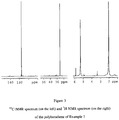
- Figure 3 shows the 1 H-NMR and 13 C-NMR spectra of the polybutadiene obtained.
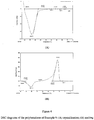
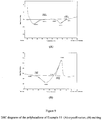
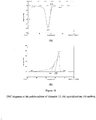
- Figure 4 shows the DSC diagrams of the polybutadiene obtained.
- Figure 5 shows the 1 H-NMR and 13 C-NMR spectra of the polybutadiene obtained.
- Figure 6 shows the DSC diagrams of the polybutadiene obtained.
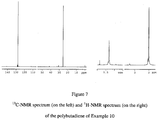
- Figure 7 shows the 1 H-NMR and 13 C-NMR spectra of the polybutadiene obtained.
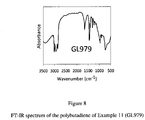
- Figure 8 shows the FT-IR spectrum of the polybutadiene obtained.
- Figure 9 shows the DSC diagrams of the polybutadiene obtained.
- Figure 10 shows the DSC diagrams of the polybutadiene obtained.
- Table 1 Polymerization of 1,3-butadiene with catalytic systems comprising complexes of cobalt Example Times (min) Conversion (%) N (a) (h -1 ) T m (b) (°C) T c (c) (°C) M w (gxmol -1 ) M w /M n ⁇ (e) 7 35 82 3644 -13.7 -50.2 195000 2.3 0.53 8 10 67 10422 -16.2 -65.2 169000 2.2 0.52 9 10 70 10889 -17.5 -66.6 171000 2.0 0.52 10 45 100 3457 -12.6 -48.0 185000 2.1 0.53 11 10 96 14933 -18.0 -66.1 110000 2.0 0.52 12 90 100 1728 -12.4 -45.5 186000 2.3 0.51 ( a ): number of moles of 1,3-butadiene polymerized per hour, per mole of cobalt; ( b ):
Landscapes
- Chemical & Material Sciences (AREA)
- Organic Chemistry (AREA)
- Health & Medical Sciences (AREA)
- Chemical Kinetics & Catalysis (AREA)
- Medicinal Chemistry (AREA)
- Polymers & Plastics (AREA)
- Transition And Organic Metals Composition Catalysts For Addition Polymerization (AREA)
- Addition Polymer Or Copolymer, Post-Treatments, Or Chemical Modifications (AREA)
- Organic Low-Molecular-Weight Compounds And Preparation Thereof (AREA)
- Engineering & Computer Science (AREA)
- Materials Engineering (AREA)
- Low-Molecular Organic Synthesis Reactions Using Catalysts (AREA)
Claims (13)
- Ein oxo-nitrogenierter Komplex aus Cobalt mit der folgenden Allgemeinformel (I):
 - R1 und R2, gleich oder unterschiedlich, ein Wasserstoffatom darstellen oder ausgewählt sind aus linearen oder verzweigten C1-C20-Alkyl-Gruppen, optional halogeniert, Cycloalkyl-Gruppen, optional substituiert; Arylgruppen, optional substituiert;- R3 ein Wasserstoffatom darstellt oder ausgewählt ist aus linearen oder verzweigten C1-C20-Alkylgruppen, optional halogeniert, Cycloalkylgruppen, optional substituiert; Arylgruppen, ausgewählt aus aromatischen carbocyclischen Gruppen, optional substituiert mit einer oder mehreren Gruppen, die gleich sind oder sich voneinander unterscheiden, ausgewählt aus: Halogenatomen wie etwa Fluor, Chlor, Brom; Hydroxylgruppen; C1-C12-Alkylgruppen; C1-C12-Alkoxylgruppen, Cyangruppen; Aminogruppen; Nitrogruppen; oder R3 eine Ketoimingruppe mit der folgenden Formel darstellt:
 - X1 und X2, gleich oder unterschiedlich, ein Halogenatom wie etwa Chlor, Brom, Iod darstellen.
- Oxo-nitrogenierter Komplex aus Cobalt mit der Allgemeinformel (I) gemäß Anspruch 1, wobei:- R1 und R2, einander gleich, ein Wasserstoffatom darstellen, oder sie ausgewählt sind aus linearen oder verzweigten C1-C20-Alkylgruppen, vorzugsweise eine Methylgruppe sind;- R3 ausgewählt ist aus linearen oder verzweigten C1-C20-Alkylgruppen oder Phenylgruppen, optional substituiert mit linearen oder verzweigten C1-C20-Alkylgruppen, vorzugsweise substituiert mit einer oder mehreren Methyl-, Ethyl-, iso-Propylgruppen; oder R3 eine Ketoimingruppe mit der folgenden Formel darstellt:
 - X1 und X2, einander gleich, ein Halogenatom wie etwa Chlor, Brom, Iod, vorzugsweise Chlor, darstellen.
- Ein katalytisches System zur (Co-)Polymerisation konjugierter Diene, beinhaltend:(a) mindestens einen oxo-nitrogenierten Komplex aus Cobalt mit der Allgemeinformel (I) gemäß Anspruch 1 oder 2;(b) mindestens einen Cokatalysator, ausgewählt aus organischen Verbindungen eines Elements M', das anders als Kohlenstoff ist, wobei das Element M' ausgewählt ist aus Elementen, die zu den Gruppen 2, 12, 13 oder 14 des Periodensystems der Elemente gehören, vorzugsweise aus: Bor, Aluminium, Zink, Magnesium, Gallium, Zinn, noch besser Aluminium, Bor.
- Katalytisches System für die (Co-)Polymerisation konjugierter Diene gemäß Anspruch 3, wobei der Cokatalysator (b) aus (b1) Aluminiumalkylen mit der folgenden Allgemeinformel (II) ausgewählt ist:
Al(X')n(R5)3-n (II)
wobei X' ein Halogenatom wie etwa Chlor, Brom, Iod, Fluor darstellt; R5 aus linearen oder verzweigten C1-C20-Alkylgruppen, Cycloalkylgruppen, Arylgruppen ausgewählt ist, wobei die Gruppen optional mit einem oder mehreren Silicium- oder Germaniumatomen substituiert sind; und n eine ganze Zahl in dem Bereich von 0 bis 2 ist. - Katalytisches System für die (Co-)Polymerisation konjugierter Diene gemäß Anspruch 3, wobei der Cokatalysator (b) ausgewählt ist aus (b2) organooxygenierten Verbindungen eines Elements M', das sich von Kohlenstoff unterscheidet, gehörend zu den Gruppen 13 oder 14 des Periodensystems der Elemente, vorzugsweise Verbindungen von Aluminium, Gallium, Zinn.
- Katalytisches System für die (Co-)Polymerisation konjugierter Diene gemäß Anspruch 3, wobei der Cokatalysator (b) ausgewählt ist aus (b3) organometallischen Verbindungen oder Mischungen von organometallischen Verbindungen eines Elements M', das sich von Kohlenstoff unterscheidet, mit dem oxo-nitrogenierten Komplex aus Cobalt reagieren kann und die Allgemeinformel (I) gemäß Anspruch 1 oder 2 aufweist, Extrahieren daraus eines Substituenten X1 oder X2, der σ-gebunden ist, um einerseits mindestens eine neutrale Verbindung zu bilden und andererseits eine ionische Verbindung, bestehend aus einem Kation, enthaltend das Metall (Co), koordiniert durch den Liganden, und ein nicht koordinierendes organisches Anion, enthaltend das Metall M', zu bilden, wobei die negative Ladung auf einer multizentrischen Struktur delokalisiert wird.
- Katalytisches System für die (Co-)Polymerisation konjugierter Diene gemäß Anspruch 4, wobei die Aluminiumalkyle (b1) mit der Allgemeinformel (II) Diethylaluminiumchlorid (DEAC), Monoethylaluminiumdichlorid (EADC), Ethylaluminiumsesquichlorid (EASC) sind.
- Katalytisches System für die (Co-)Polymerisation konjugierter Diene gemäß Anspruch 5, wobei die organooxygenierten Verbindungen (b2) aus Aluminoxanen mit der Allgemeinformel (III) ausgewählt sind:
(R6)2-Al-O-[-Al(R7)-O-]p-Al-(R8)2 (III)
wobei R6, R7 und R8, gleich oder unterschiedlich, ein Wasserstoffatom, ein Halogenatom wie etwa Chlor, Brom, Iod, Fluor darstellen; oder ausgewählt sind aus linearen oder verzweigten C1-C20-Alkylgruppen, Cycloalkylgruppen, Arylgruppen, wobei die Gruppen optional substituiert sind mit einem oder mehreren Silicium- oder Germaniumatomen; und p eine ganze Zahl im Bereich von 0 bis 1000 ist. - Katalytisches System für die (Co-)Polymerisation konjugierter Diene gemäß Anspruch 8, wobei die organooxygenierte Verbindung (b2) Methylaluminoxan (MAO) ist.
- Katalytisches System für die (Co-)Polymerisation konjugierter Diene gemäß Anspruch 6, wobei die Verbindungen oder Mischungen von Verbindungen (b3) ausgewählt sind aus organischen Verbindungen von Aluminium und insbesondere Bor, wie etwa denen, die durch die folgende Allgemeinformel dargestellt werden:
[(Rc)wH4-w]•[B(RD)4]-; B(RD)3; Al(RD)3; B(RD)3P; [Ph3C]+•[B(RD)4]-; [(RC)3PH]+•[B(RD)4]-; [Li]+•[B(RD)4]-; [Li]+•[Al(RD)4]-
wobei w eine ganze Zahl im Bereich von 0 bis 3 ist, jede Gruppe Rc unabhängig eine Alkylgruppe oder eine Arylgruppe mit 1 bis 10 Kohlenstoffatomen darstellt und jede Gruppe RD unabhängig eine teilweise oder gänzlich, vorzugsweise gänzlich, fluorierte Arylgruppe mit 6 bis 20 Kohlenstoffatomen darstellt, P einen optional substituierten Pyrrolrest darstellt. - Ein Verfahren für die (Co-)Polymerisation konjugierter Diene, dadurch gekennzeichnet, dass es ein katalytisches System gemäß einem der Ansprüche 4 bis 10 verwendet.
- (Co-)Polymerisationsverfahren gemäß Anspruch 11, wobei die konjugierten Diene 1,3-Butadien, Isopren sind.
- (Co-)Polymerisationsverfahren von 1,3-Butadien oder Isopren, dadurch gekennzeichnet, dass es ein katalytisches System gemäß einem der Ansprüche 4 bis 10 verwendet.
Priority Applications (3)
| Application Number | Priority Date | Filing Date | Title |
|---|---|---|---|
| HRP20190744TT HRP20190744T1 (hr) | 2012-12-20 | 2013-12-18 | Okso-nitrogenirani kompleks kobalta, katalitički sustav koji sadrži navedeni okso-nitrogenirani kompleks i postupak za (ko)polimerizaciju konjugiranih diena |
| PL13828830T PL2935206T3 (pl) | 2012-12-20 | 2013-12-18 | Okso-azotowany kompleks kobaltu, układ katalityczny zawierający wymieniony okso-azotowany kompleks kobaltu i sposób (ko)polimeryzacji sprzężonych dienów |
| RS20190458A RS58667B1 (sr) | 2012-12-20 | 2013-12-18 | Okso-nitrogenovani kompleks kobalta, katalitički sistem koji sadrži navedeni okso- nitrogenovani kompleks i postupak za (ko)polimerizaciju konjugovanih diena |
Applications Claiming Priority (2)
| Application Number | Priority Date | Filing Date | Title |
|---|---|---|---|
| IT002201A ITMI20122201A1 (it) | 2012-12-20 | 2012-12-20 | Complesso osso-azotato di cobalto, sistema catalitico comprendente detto complesso osso-azotato e procedimento per la (co)polimerizzazione di dieni coniugati |
| PCT/IB2013/061078 WO2014097167A1 (en) | 2012-12-20 | 2013-12-18 | Oxo-nitrogenated complex of cobalt, catalytic system comprising said oxo-nitrogenated complex and process for the (co) polymerization of conjugated dienes |
Publications (2)
| Publication Number | Publication Date |
|---|---|
| EP2935206A1 EP2935206A1 (de) | 2015-10-28 |
| EP2935206B1 true EP2935206B1 (de) | 2019-03-06 |
Family
ID=47683884
Family Applications (1)
| Application Number | Title | Priority Date | Filing Date |
|---|---|---|---|
| EP13828830.3A Active EP2935206B1 (de) | 2012-12-20 | 2013-12-18 | Oxo-nitrogenierter komplex aus kobalt, katalysatorsystem mit diesem oxo-nitrogenierten komplex und verfahren zur (co)polymerisation von konjugierten dienen |
Country Status (19)
| Country | Link |
|---|---|
| US (1) | US9493404B2 (de) |
| EP (1) | EP2935206B1 (de) |
| JP (1) | JP6407164B2 (de) |
| KR (1) | KR102078536B1 (de) |
| CN (1) | CN104854084B (de) |
| BR (1) | BR112015007737A8 (de) |
| CA (1) | CA2885275A1 (de) |
| ES (1) | ES2726817T3 (de) |
| HR (1) | HRP20190744T1 (de) |
| HU (1) | HUE044296T2 (de) |
| IT (1) | ITMI20122201A1 (de) |
| MY (1) | MY170148A (de) |
| PL (1) | PL2935206T3 (de) |
| PT (1) | PT2935206T (de) |
| RS (1) | RS58667B1 (de) |
| RU (1) | RU2636153C2 (de) |
| TR (1) | TR201908485T4 (de) |
| TW (1) | TWI603974B (de) |
| WO (1) | WO2014097167A1 (de) |
Cited By (1)
| Publication number | Priority date | Publication date | Assignee | Title |
|---|---|---|---|---|
| US11872548B2 (en) | 2016-05-30 | 2024-01-16 | Versalis S.P.A. | Oxo-nitrogenated iron complex, catalytic system comprising said oxo-nitrogenated iron complex and process for the (co)polymerization of conjugated dienes |
Families Citing this family (5)
| Publication number | Priority date | Publication date | Assignee | Title |
|---|---|---|---|---|
| ITMI20131830A1 (it) | 2013-11-05 | 2015-05-06 | Versalis Spa | Polibutadieni di-blocco stereoregolari a struttura 1,4-cis/1,2 sindiotattica da polimerizzazione stereospecifica |
| EA031354B1 (ru) * | 2014-12-23 | 2018-12-28 | ВЕРСАЛИС С.п.А. | Оксоазотсодержащий комплекс ванадия, каталитическая система, включающая указанный оксоазотсодержащий комплекс ванадия, и способ (со)полимеризации сопряженных диенов |
| PL3428200T3 (pl) * | 2016-03-11 | 2022-07-18 | Jsr Corporation | Katalizator polimeryzacji, kopolimer, kompozycja polimerowa i usieciowany polimer |
| IT201700006307A1 (it) | 2017-01-20 | 2018-07-20 | Versalis Spa | Complesso osso-azotato di ferro, sistema catalitico comprendente detto complesso osso-azotato di ferro e procedimento per la (co)polimerizzazione di dieni coniugati |
| IT201700059763A1 (it) | 2017-05-31 | 2018-12-01 | Versalis Spa | Copolimeri butadiene-isoprene di-blocco e procedimento per la loro preparazione |
Family Cites Families (33)
| Publication number | Priority date | Publication date | Assignee | Title |
|---|---|---|---|---|
| US3498963A (en) | 1966-09-26 | 1970-03-03 | Japan Synthetic Rubber Co Ltd | Process for the catalytic preparation of 1,2-polybutadiene having a high percentage of vinyl configuration |
| US3522332A (en) | 1967-06-02 | 1970-07-28 | Japan Synthetic Rubber Co Ltd | Process for the preparation of 1,2-polybutadiene |
| US3594216A (en) * | 1969-06-19 | 1971-07-20 | Westinghouse Electric Corp | Vapor phase deposition of metal from a metal-organic beta-ketoamine chelate |
| DE2447203C3 (de) | 1974-10-03 | 1982-03-18 | Chemische Werke Hüls AG, 4370 Marl | Verfahren zur Herstellung von Polybutadien |
| JPS53143685A (en) | 1977-05-23 | 1978-12-14 | Japan Synthetic Rubber Co Ltd | Preparation of 1,2-polybutadiene |
| DE2911262A1 (de) | 1979-03-22 | 1980-10-02 | Bayer Ag | Katalysator, dessen herstellung und verfahren zur polymerisation von butadien |
| DE3000708A1 (de) | 1980-01-10 | 1981-07-16 | Chemische Werke Hüls AG, 4370 Marl | Verfahren zur herstellung von reaktionsprodukten aus konjugierten diolefinen und aromatischen kohlenwasserstoffen |
| PL276385A1 (en) | 1987-01-30 | 1989-07-24 | Exxon Chemical Patents Inc | Method for polymerization of olefines,diolefins and acetylene unsaturated compounds |
| US4950790A (en) * | 1988-11-14 | 1990-08-21 | Air Products And Chemicals, Inc. | Volatile fluorinated β-ketoimines and associated metal complexes |
| IT1231774B (it) | 1989-08-03 | 1991-12-21 | Enichem Anic Spa | Catalizzatore e procedimento per la polimerizzazione e per la copolimerizzazione di alfa olefine. |
| US5064802A (en) | 1989-09-14 | 1991-11-12 | The Dow Chemical Company | Metal complex compounds |
| CA2024830A1 (en) | 1989-09-29 | 1991-03-30 | Richard E. Campbell, Jr. | Process for preparation of syndiotactic vinyl aromatic polymers |
| DE69026907T2 (de) | 1989-10-10 | 1996-10-10 | Fina Technology | Metallocenkatalysator mit Lewissäure und Alkylaluminium |
| EP0672689A1 (de) | 1990-06-22 | 1995-09-20 | Exxon Chemical Patents Inc. | Aluminiumfreie Monocyclopentadienyl-Metallocenkatalysatoren für Olefinpolymerisation |
| CA2090962A1 (en) | 1990-09-14 | 1992-03-15 | Howard W. Turner | Ionic catalyst for the production of poly-.alpha.-olefins of controlled tacticity |
| US5189192A (en) | 1991-01-16 | 1993-02-23 | The Dow Chemical Company | Process for preparing addition polymerization catalysts via metal center oxidation |
| JP3463811B2 (ja) | 1991-04-24 | 2003-11-05 | Jsr株式会社 | ブタジエン系重合体の製造方法 |
| RU2070202C1 (ru) * | 1991-05-29 | 1996-12-10 | Институт элементоорганических соединений им.А.Н.Несмеянова РАН | Комплексы алкилкобальта (iii) с тридентатными лигандами в качестве инициаторов водно-эмульсионной полимеризации и сополимеризации виниловых и диеновых мономеров |
| US5721185A (en) | 1991-06-24 | 1998-02-24 | The Dow Chemical Company | Homogeneous olefin polymerization catalyst by abstraction with lewis acids |
| US5258475A (en) | 1991-07-12 | 1993-11-02 | Mobil Oil Corporation | Catalyst systems for polymerization and copolymerization of olefins |
| EP0816398B1 (de) | 1996-06-28 | 2002-08-14 | Ube Industries, Ltd. | Verfahren zur Herstellung von Polybutadien |
| US5879805A (en) | 1997-09-09 | 1999-03-09 | Union Carbide Chemicals & Plastics Technology Corporation | Gas phase polymerization of vinylpolybutadiene |
| IT1313599B1 (it) * | 1999-08-05 | 2002-09-09 | Enichem Spa | Complessi metallici utilizzabili nella catalisi per la (co)polimerizzazione delle alfa-olefine |
| US6479601B1 (en) | 1999-08-06 | 2002-11-12 | The Goodyear Tire & Rubber Company | Transition metal catalysts for diene polymerizations |
| WO2003064484A1 (en) | 2002-01-28 | 2003-08-07 | Dow Global Technologies Inc. | Metal complex compositions based on cobalt and their use as polymerization catalyst for olefins and dienes |
| EP1367069A1 (de) | 2002-05-28 | 2003-12-03 | Dow Global Technologies Inc. | Verfahren zur Homo- oder Copolymerisation von konjugierten Dienen |
| CN1305913C (zh) | 2002-07-22 | 2007-03-21 | Jsr株式会社 | 结晶性1,2-聚丁二烯的制造方法 |
| JP4925297B2 (ja) * | 2005-01-21 | 2012-04-25 | 独立行政法人理化学研究所 | 三座配位子を含む金属錯体、およびそれを含む重合用触媒 |
| US7868103B2 (en) * | 2006-05-22 | 2011-01-11 | Ube Industries, Ltd. | Method for producing polybutadiene |
| CN101260164B (zh) * | 2008-04-29 | 2010-12-22 | 中国科学院长春应用化学研究所 | 异戊二烯或丁二烯顺1,4-选择性聚合的催化体系及制法和用法 |
| WO2011061151A1 (en) | 2009-11-17 | 2011-05-26 | Basell Polyolefine Gmbh | Ethylene copolymers |
| BR112012017245A2 (pt) * | 2010-01-15 | 2017-09-19 | Reliance Industries Ltd | borracha de polibutadieno com alto teror de cis em solventes benignos e processo para a preparação da mesma |
| ITMI20122199A1 (it) | 2012-12-20 | 2014-06-21 | Versalis Spa | Procedimento per la preparazione di (co)polimeri di dieni coniugati in presenza di un sistema catalitico comprendente un complesso bis-imminico di cobalto |
-
2012
- 2012-12-20 IT IT002201A patent/ITMI20122201A1/it unknown
-
2013
- 2013-12-17 TW TW102146496A patent/TWI603974B/zh active
- 2013-12-18 MY MYPI2015000717A patent/MY170148A/en unknown
- 2013-12-18 JP JP2015548840A patent/JP6407164B2/ja not_active Expired - Fee Related
- 2013-12-18 HR HRP20190744TT patent/HRP20190744T1/hr unknown
- 2013-12-18 RS RS20190458A patent/RS58667B1/sr unknown
- 2013-12-18 HU HUE13828830 patent/HUE044296T2/hu unknown
- 2013-12-18 ES ES13828830T patent/ES2726817T3/es active Active
- 2013-12-18 KR KR1020157010406A patent/KR102078536B1/ko active Active
- 2013-12-18 CA CA2885275A patent/CA2885275A1/en not_active Abandoned
- 2013-12-18 PT PT13828830T patent/PT2935206T/pt unknown
- 2013-12-18 CN CN201380064085.3A patent/CN104854084B/zh active Active
- 2013-12-18 EP EP13828830.3A patent/EP2935206B1/de active Active
- 2013-12-18 PL PL13828830T patent/PL2935206T3/pl unknown
- 2013-12-18 US US14/646,051 patent/US9493404B2/en not_active Expired - Fee Related
- 2013-12-18 TR TR2019/08485T patent/TR201908485T4/tr unknown
- 2013-12-18 WO PCT/IB2013/061078 patent/WO2014097167A1/en not_active Ceased
- 2013-12-18 RU RU2015110464A patent/RU2636153C2/ru not_active IP Right Cessation
- 2013-12-18 BR BR112015007737A patent/BR112015007737A8/pt active Search and Examination
Non-Patent Citations (1)
| Title |
|---|
| None * |
Cited By (1)
| Publication number | Priority date | Publication date | Assignee | Title |
|---|---|---|---|---|
| US11872548B2 (en) | 2016-05-30 | 2024-01-16 | Versalis S.P.A. | Oxo-nitrogenated iron complex, catalytic system comprising said oxo-nitrogenated iron complex and process for the (co)polymerization of conjugated dienes |
Also Published As
| Publication number | Publication date |
|---|---|
| ITMI20122201A1 (it) | 2014-06-21 |
| HRP20190744T1 (hr) | 2019-06-14 |
| JP6407164B2 (ja) | 2018-10-17 |
| MY170148A (en) | 2019-07-09 |
| ES2726817T3 (es) | 2019-10-09 |
| CA2885275A1 (en) | 2014-06-26 |
| BR112015007737A2 (pt) | 2017-07-04 |
| WO2014097167A1 (en) | 2014-06-26 |
| CN104854084A (zh) | 2015-08-19 |
| TWI603974B (zh) | 2017-11-01 |
| US20150329577A1 (en) | 2015-11-19 |
| RU2015110464A (ru) | 2017-01-25 |
| EP2935206A1 (de) | 2015-10-28 |
| RU2636153C2 (ru) | 2017-11-21 |
| KR102078536B1 (ko) | 2020-02-19 |
| CN104854084B (zh) | 2018-01-02 |
| HUE044296T2 (hu) | 2019-10-28 |
| KR20150099507A (ko) | 2015-08-31 |
| RS58667B1 (sr) | 2019-06-28 |
| PT2935206T (pt) | 2019-04-30 |
| JP2016509580A (ja) | 2016-03-31 |
| TW201434846A (zh) | 2014-09-16 |
| BR112015007737A8 (pt) | 2019-07-16 |
| TR201908485T4 (tr) | 2019-07-22 |
| US9493404B2 (en) | 2016-11-15 |
| PL2935206T3 (pl) | 2019-08-30 |
Similar Documents
| Publication | Publication Date | Title |
|---|---|---|
| EP2935361B1 (de) | Verfahren für die herstellung von (co)polymeren von konjugierten dien-monomeren in anwesenheit eines katalytischen systems, beinhaltend einen bis-imino-kobaltkomplex | |
| EP2935362B1 (de) | Verfahren für die herstellung von (co)polymere von konjugierten dien-monomere in anwesenheit eines kobalt komplexes beinhaltend eine bis-imino-pyridin verbindung | |
| EP2935363B1 (de) | Verfahren für die herstellung von (co)polymeren von konjugierten dienen in anwesenheit eines katalytischen systems, beinhaltend einen sauerstoff- und stickstoffhaltigen komplex von kobalt | |
| US9493404B2 (en) | Oxo-nitrogenated complex of cobalt, catalytic system comprising said oxo-nitrogenated complex and process for the (CO) polymerization of conjugated dienes | |
| US10766979B2 (en) | Bis-imine pyridine complex of lanthanides catalytic system comprising said bis-imine pyridine complex and process for the (co)polymerization of conjugated dienes | |
| US9512252B2 (en) | Bis-imine complex of lanthanides, catalytic system comprising said bis-imine complex and process for the (co)polymerization of conjugated dienes | |
| KR20200063195A (ko) | 비스-이민 티타늄 착화합물, 상기 비스-이민 티타늄 착화합물을 포함하는 촉매 시스템 및 공액 디엔의 (공)중합 방법 | |
| EP2756009B1 (de) | Oxo-nitrogenierter komplex aus lanthaniden, katalysatorsystem mit diesem oxo-nitrogenierten komplex und verfahren zur (co) polymerisation von konjugierten dienen | |
| US11518776B2 (en) | Oxo-nitrogenated iron complex, catalytic system comprising said oxo-nitrogenated iron complex and process for the (co)polymerization of conjugated dienes | |
| EP3464393B1 (de) | Oxo-nitrogenierter eisenkomplex, katalysatorsystem mit diesem oxo-nitrogenierten eisenkomplex und verfahren zur (co)polymerisation von konjugierten dienen |
Legal Events
| Date | Code | Title | Description |
|---|---|---|---|
| PUAI | Public reference made under article 153(3) epc to a published international application that has entered the european phase |
Free format text: ORIGINAL CODE: 0009012 |
|
| 17P | Request for examination filed |
Effective date: 20150715 |
|
| AK | Designated contracting states |
Kind code of ref document: A1 Designated state(s): AL AT BE BG CH CY CZ DE DK EE ES FI FR GB GR HR HU IE IS IT LI LT LU LV MC MK MT NL NO PL PT RO RS SE SI SK SM TR |
|
| AX | Request for extension of the european patent |
Extension state: BA ME |
|
| DAX | Request for extension of the european patent (deleted) | ||
| STAA | Information on the status of an ep patent application or granted ep patent |
Free format text: STATUS: EXAMINATION IS IN PROGRESS |
|
| 17Q | First examination report despatched |
Effective date: 20170522 |
|
| GRAP | Despatch of communication of intention to grant a patent |
Free format text: ORIGINAL CODE: EPIDOSNIGR1 |
|
| STAA | Information on the status of an ep patent application or granted ep patent |
Free format text: STATUS: GRANT OF PATENT IS INTENDED |
|
| INTG | Intention to grant announced |
Effective date: 20181002 |
|
| GRAS | Grant fee paid |
Free format text: ORIGINAL CODE: EPIDOSNIGR3 |
|
| GRAA | (expected) grant |
Free format text: ORIGINAL CODE: 0009210 |
|
| STAA | Information on the status of an ep patent application or granted ep patent |
Free format text: STATUS: THE PATENT HAS BEEN GRANTED |
|
| AK | Designated contracting states |
Kind code of ref document: B1 Designated state(s): AL AT BE BG CH CY CZ DE DK EE ES FI FR GB GR HR HU IE IS IT LI LT LU LV MC MK MT NL NO PL PT RO RS SE SI SK SM TR |
|
| REG | Reference to a national code |
Ref country code: GB Ref legal event code: FG4D |
|
| REG | Reference to a national code |
Ref country code: AT Ref legal event code: REF Ref document number: 1104352 Country of ref document: AT Kind code of ref document: T Effective date: 20190315 Ref country code: CH Ref legal event code: EP |
|
| REG | Reference to a national code |
Ref country code: DE Ref legal event code: R096 Ref document number: 602013051984 Country of ref document: DE |
|
| REG | Reference to a national code |
Ref country code: IE Ref legal event code: FG4D |
|
| REG | Reference to a national code |
Ref country code: HR Ref legal event code: TUEP Ref document number: P20190744 Country of ref document: HR |
|
| REG | Reference to a national code |
Ref country code: RO Ref legal event code: EPE |
|
| REG | Reference to a national code |
Ref country code: PT Ref legal event code: SC4A Ref document number: 2935206 Country of ref document: PT Date of ref document: 20190430 Kind code of ref document: T Free format text: AVAILABILITY OF NATIONAL TRANSLATION Effective date: 20190403 |
|
| REG | Reference to a national code |
Ref country code: NL Ref legal event code: FP |
|
| REG | Reference to a national code |
Ref country code: SE Ref legal event code: TRGR |
|
| REG | Reference to a national code |
Ref country code: HR Ref legal event code: T1PR Ref document number: P20190744 Country of ref document: HR |
|
| REG | Reference to a national code |
Ref country code: NO Ref legal event code: T2 Effective date: 20190306 |
|
| REG | Reference to a national code |
Ref country code: LT Ref legal event code: MG4D |
|
| PG25 | Lapsed in a contracting state [announced via postgrant information from national office to epo] |
Ref country code: LT Free format text: LAPSE BECAUSE OF FAILURE TO SUBMIT A TRANSLATION OF THE DESCRIPTION OR TO PAY THE FEE WITHIN THE PRESCRIBED TIME-LIMIT Effective date: 20190306 |
|
| REG | Reference to a national code |
Ref country code: GR Ref legal event code: EP Ref document number: 20190401499 Country of ref document: GR Effective date: 20190708 |
|
| PG25 | Lapsed in a contracting state [announced via postgrant information from national office to epo] |
Ref country code: LV Free format text: LAPSE BECAUSE OF FAILURE TO SUBMIT A TRANSLATION OF THE DESCRIPTION OR TO PAY THE FEE WITHIN THE PRESCRIBED TIME-LIMIT Effective date: 20190306 |
|
| REG | Reference to a national code |
Ref country code: SK Ref legal event code: T3 Ref document number: E 31091 Country of ref document: SK |
|
| REG | Reference to a national code |
Ref country code: ES Ref legal event code: FG2A Ref document number: 2726817 Country of ref document: ES Kind code of ref document: T3 Effective date: 20191009 |
|
| REG | Reference to a national code |
Ref country code: HU Ref legal event code: AG4A Ref document number: E044296 Country of ref document: HU |
|
| PG25 | Lapsed in a contracting state [announced via postgrant information from national office to epo] |
Ref country code: AL Free format text: LAPSE BECAUSE OF FAILURE TO SUBMIT A TRANSLATION OF THE DESCRIPTION OR TO PAY THE FEE WITHIN THE PRESCRIBED TIME-LIMIT Effective date: 20190306 Ref country code: EE Free format text: LAPSE BECAUSE OF FAILURE TO SUBMIT A TRANSLATION OF THE DESCRIPTION OR TO PAY THE FEE WITHIN THE PRESCRIBED TIME-LIMIT Effective date: 20190306 |
|
| PG25 | Lapsed in a contracting state [announced via postgrant information from national office to epo] |
Ref country code: SM Free format text: LAPSE BECAUSE OF FAILURE TO SUBMIT A TRANSLATION OF THE DESCRIPTION OR TO PAY THE FEE WITHIN THE PRESCRIBED TIME-LIMIT Effective date: 20190306 |
|
| REG | Reference to a national code |
Ref country code: DE Ref legal event code: R097 Ref document number: 602013051984 Country of ref document: DE |
|
| REG | Reference to a national code |
Ref country code: HR Ref legal event code: ODRP Ref document number: P20190744 Country of ref document: HR Payment date: 20191205 Year of fee payment: 7 |
|
| PG25 | Lapsed in a contracting state [announced via postgrant information from national office to epo] |
Ref country code: IS Free format text: LAPSE BECAUSE OF FAILURE TO SUBMIT A TRANSLATION OF THE DESCRIPTION OR TO PAY THE FEE WITHIN THE PRESCRIBED TIME-LIMIT Effective date: 20190706 |
|
| PLBE | No opposition filed within time limit |
Free format text: ORIGINAL CODE: 0009261 |
|
| STAA | Information on the status of an ep patent application or granted ep patent |
Free format text: STATUS: NO OPPOSITION FILED WITHIN TIME LIMIT |
|
| PG25 | Lapsed in a contracting state [announced via postgrant information from national office to epo] |
Ref country code: DK Free format text: LAPSE BECAUSE OF FAILURE TO SUBMIT A TRANSLATION OF THE DESCRIPTION OR TO PAY THE FEE WITHIN THE PRESCRIBED TIME-LIMIT Effective date: 20190306 |
|
| PGFP | Annual fee paid to national office [announced via postgrant information from national office to epo] |
Ref country code: NL Payment date: 20191226 Year of fee payment: 7 Ref country code: CZ Payment date: 20191210 Year of fee payment: 7 Ref country code: SE Payment date: 20191227 Year of fee payment: 7 Ref country code: PT Payment date: 20191206 Year of fee payment: 7 Ref country code: RO Payment date: 20191206 Year of fee payment: 7 Ref country code: FI Payment date: 20191227 Year of fee payment: 7 Ref country code: IE Payment date: 20191227 Year of fee payment: 7 Ref country code: BG Payment date: 20191218 Year of fee payment: 7 Ref country code: HU Payment date: 20191216 Year of fee payment: 7 Ref country code: SK Payment date: 20191204 Year of fee payment: 7 |
|
| 26N | No opposition filed |
Effective date: 20191209 |
|
| PG25 | Lapsed in a contracting state [announced via postgrant information from national office to epo] |
Ref country code: SI Free format text: LAPSE BECAUSE OF FAILURE TO SUBMIT A TRANSLATION OF THE DESCRIPTION OR TO PAY THE FEE WITHIN THE PRESCRIBED TIME-LIMIT Effective date: 20190306 |
|
| PGFP | Annual fee paid to national office [announced via postgrant information from national office to epo] |
Ref country code: GR Payment date: 20191230 Year of fee payment: 7 Ref country code: FR Payment date: 20191226 Year of fee payment: 7 Ref country code: BE Payment date: 20191227 Year of fee payment: 7 Ref country code: PL Payment date: 20191203 Year of fee payment: 7 Ref country code: HR Payment date: 20191205 Year of fee payment: 7 Ref country code: RS Payment date: 20191209 Year of fee payment: 7 |
|
| PGFP | Annual fee paid to national office [announced via postgrant information from national office to epo] |
Ref country code: AT Payment date: 20191204 Year of fee payment: 7 |
|
| PGFP | Annual fee paid to national office [announced via postgrant information from national office to epo] |
Ref country code: NO Payment date: 20191227 Year of fee payment: 7 Ref country code: GB Payment date: 20191227 Year of fee payment: 7 Ref country code: DE Payment date: 20191231 Year of fee payment: 7 Ref country code: ES Payment date: 20200102 Year of fee payment: 7 |
|
| REG | Reference to a national code |
Ref country code: CH Ref legal event code: PL |
|
| PG25 | Lapsed in a contracting state [announced via postgrant information from national office to epo] |
Ref country code: MC Free format text: LAPSE BECAUSE OF FAILURE TO SUBMIT A TRANSLATION OF THE DESCRIPTION OR TO PAY THE FEE WITHIN THE PRESCRIBED TIME-LIMIT Effective date: 20190306 |
|
| PG25 | Lapsed in a contracting state [announced via postgrant information from national office to epo] |
Ref country code: LU Free format text: LAPSE BECAUSE OF NON-PAYMENT OF DUE FEES Effective date: 20191218 |
|
| PG25 | Lapsed in a contracting state [announced via postgrant information from national office to epo] |
Ref country code: LI Free format text: LAPSE BECAUSE OF NON-PAYMENT OF DUE FEES Effective date: 20191231 Ref country code: CH Free format text: LAPSE BECAUSE OF NON-PAYMENT OF DUE FEES Effective date: 20191231 |
|
| PG25 | Lapsed in a contracting state [announced via postgrant information from national office to epo] |
Ref country code: CY Free format text: LAPSE BECAUSE OF FAILURE TO SUBMIT A TRANSLATION OF THE DESCRIPTION OR TO PAY THE FEE WITHIN THE PRESCRIBED TIME-LIMIT Effective date: 20190306 |
|
| REG | Reference to a national code |
Ref country code: DE Ref legal event code: R119 Ref document number: 602013051984 Country of ref document: DE |
|
| REG | Reference to a national code |
Ref country code: HR Ref legal event code: PBON Ref document number: P20190744 Country of ref document: HR Effective date: 20201218 |
|
| REG | Reference to a national code |
Ref country code: FI Ref legal event code: MAE |
|
| REG | Reference to a national code |
Ref country code: NO Ref legal event code: MMEP |
|
| PG25 | Lapsed in a contracting state [announced via postgrant information from national office to epo] |
Ref country code: FI Free format text: LAPSE BECAUSE OF NON-PAYMENT OF DUE FEES Effective date: 20201218 Ref country code: RO Free format text: LAPSE BECAUSE OF NON-PAYMENT OF DUE FEES Effective date: 20201218 Ref country code: PT Free format text: LAPSE BECAUSE OF NON-PAYMENT OF DUE FEES Effective date: 20210618 Ref country code: CZ Free format text: LAPSE BECAUSE OF NON-PAYMENT OF DUE FEES Effective date: 20201218 Ref country code: MT Free format text: LAPSE BECAUSE OF FAILURE TO SUBMIT A TRANSLATION OF THE DESCRIPTION OR TO PAY THE FEE WITHIN THE PRESCRIBED TIME-LIMIT Effective date: 20190306 |
|
| REG | Reference to a national code |
Ref country code: SE Ref legal event code: EUG |
|
| REG | Reference to a national code |
Ref country code: NL Ref legal event code: MM Effective date: 20210101 |
|
| REG | Reference to a national code |
Ref country code: AT Ref legal event code: MM01 Ref document number: 1104352 Country of ref document: AT Kind code of ref document: T Effective date: 20201218 |
|
| GBPC | Gb: european patent ceased through non-payment of renewal fee |
Effective date: 20201218 |
|
| REG | Reference to a national code |
Ref country code: SK Ref legal event code: MM4A Ref document number: E 31091 Country of ref document: SK Effective date: 20201218 |
|
| REG | Reference to a national code |
Ref country code: BE Ref legal event code: MM Effective date: 20201231 |
|
| PG25 | Lapsed in a contracting state [announced via postgrant information from national office to epo] |
Ref country code: NL Free format text: LAPSE BECAUSE OF NON-PAYMENT OF DUE FEES Effective date: 20210101 Ref country code: RS Free format text: LAPSE BECAUSE OF NON-PAYMENT OF DUE FEES Effective date: 20201218 |
|
| PG25 | Lapsed in a contracting state [announced via postgrant information from national office to epo] |
Ref country code: FR Free format text: LAPSE BECAUSE OF NON-PAYMENT OF DUE FEES Effective date: 20201231 Ref country code: AT Free format text: LAPSE BECAUSE OF NON-PAYMENT OF DUE FEES Effective date: 20201218 Ref country code: BG Free format text: LAPSE BECAUSE OF NON-PAYMENT OF DUE FEES Effective date: 20210630 Ref country code: IE Free format text: LAPSE BECAUSE OF NON-PAYMENT OF DUE FEES Effective date: 20201218 Ref country code: HU Free format text: LAPSE BECAUSE OF NON-PAYMENT OF DUE FEES Effective date: 20201219 Ref country code: HR Free format text: LAPSE BECAUSE OF NON-PAYMENT OF DUE FEES Effective date: 20201218 |
|
| PG25 | Lapsed in a contracting state [announced via postgrant information from national office to epo] |
Ref country code: DE Free format text: LAPSE BECAUSE OF NON-PAYMENT OF DUE FEES Effective date: 20210701 Ref country code: GB Free format text: LAPSE BECAUSE OF NON-PAYMENT OF DUE FEES Effective date: 20201218 Ref country code: NO Free format text: LAPSE BECAUSE OF NON-PAYMENT OF DUE FEES Effective date: 20201231 Ref country code: SK Free format text: LAPSE BECAUSE OF NON-PAYMENT OF DUE FEES Effective date: 20201218 Ref country code: SE Free format text: LAPSE BECAUSE OF NON-PAYMENT OF DUE FEES Effective date: 20201219 Ref country code: GR Free format text: LAPSE BECAUSE OF NON-PAYMENT OF DUE FEES Effective date: 20210707 |
|
| REG | Reference to a national code |
Ref country code: ES Ref legal event code: FD2A Effective date: 20220222 |
|
| PG25 | Lapsed in a contracting state [announced via postgrant information from national office to epo] |
Ref country code: ES Free format text: LAPSE BECAUSE OF NON-PAYMENT OF DUE FEES Effective date: 20201219 |
|
| PG25 | Lapsed in a contracting state [announced via postgrant information from national office to epo] |
Ref country code: MK Free format text: LAPSE BECAUSE OF FAILURE TO SUBMIT A TRANSLATION OF THE DESCRIPTION OR TO PAY THE FEE WITHIN THE PRESCRIBED TIME-LIMIT Effective date: 20190306 |
|
| PG25 | Lapsed in a contracting state [announced via postgrant information from national office to epo] |
Ref country code: BE Free format text: LAPSE BECAUSE OF NON-PAYMENT OF DUE FEES Effective date: 20201231 |
|
| REG | Reference to a national code |
Ref country code: AT Ref legal event code: UEP Ref document number: 1104352 Country of ref document: AT Kind code of ref document: T Effective date: 20190306 |
|
| PG25 | Lapsed in a contracting state [announced via postgrant information from national office to epo] |
Ref country code: PL Free format text: LAPSE BECAUSE OF NON-PAYMENT OF DUE FEES Effective date: 20201218 |
|
| P01 | Opt-out of the competence of the unified patent court (upc) registered |
Effective date: 20230519 |
|
| PGFP | Annual fee paid to national office [announced via postgrant information from national office to epo] |
Ref country code: IT Payment date: 20241216 Year of fee payment: 12 |
|
| PGFP | Annual fee paid to national office [announced via postgrant information from national office to epo] |
Ref country code: TR Payment date: 20241210 Year of fee payment: 12 |