EP2937014A1 - Corps d'emballage de corps de rétention de solution médicamenteuse pour la peau, et procédé de fabrication dudit corps d'emballage - Google Patents
Corps d'emballage de corps de rétention de solution médicamenteuse pour la peau, et procédé de fabrication dudit corps d'emballage Download PDFInfo
- Publication number
- EP2937014A1 EP2937014A1 EP13865168.2A EP13865168A EP2937014A1 EP 2937014 A1 EP2937014 A1 EP 2937014A1 EP 13865168 A EP13865168 A EP 13865168A EP 2937014 A1 EP2937014 A1 EP 2937014A1
- Authority
- EP
- European Patent Office
- Prior art keywords
- base material
- packaging bag
- vacuum
- drug solution
- package
- Prior art date
- Legal status (The legal status is an assumption and is not a legal conclusion. Google has not performed a legal analysis and makes no representation as to the accuracy of the status listed.)
- Granted
Links
Images



Classifications
-
- B—PERFORMING OPERATIONS; TRANSPORTING
- B65—CONVEYING; PACKING; STORING; HANDLING THIN OR FILAMENTARY MATERIAL
- B65B—MACHINES, APPARATUS OR DEVICES FOR, OR METHODS OF, PACKAGING ARTICLES OR MATERIALS; UNPACKING
- B65B31/00—Packaging articles or materials under special atmospheric or gaseous conditions; Adding propellants to aerosol containers
- B65B31/04—Evacuating, pressurising or gasifying filled containers or wrappers by means of nozzles through which air or other gas, e.g. an inert gas, is withdrawn or supplied
-
- A—HUMAN NECESSITIES
- A45—HAND OR TRAVELLING ARTICLES
- A45D—HAIRDRESSING OR SHAVING EQUIPMENT; EQUIPMENT FOR COSMETICS OR COSMETIC TREATMENTS, e.g. FOR MANICURING OR PEDICURING
- A45D44/00—Other cosmetic or toiletry articles, e.g. for hairdressers' rooms
- A45D44/002—Masks for cosmetic treatment of the face
-
- A—HUMAN NECESSITIES
- A61—MEDICAL OR VETERINARY SCIENCE; HYGIENE
- A61M—DEVICES FOR INTRODUCING MEDIA INTO, OR ONTO, THE BODY; DEVICES FOR TRANSDUCING BODY MEDIA OR FOR TAKING MEDIA FROM THE BODY; DEVICES FOR PRODUCING OR ENDING SLEEP OR STUPOR
- A61M35/00—Devices for applying media, e.g. remedies, on the human body
- A61M35/10—Wearable devices, e.g. garments, glasses or masks
-
- B—PERFORMING OPERATIONS; TRANSPORTING
- B65—CONVEYING; PACKING; STORING; HANDLING THIN OR FILAMENTARY MATERIAL
- B65B—MACHINES, APPARATUS OR DEVICES FOR, OR METHODS OF, PACKAGING ARTICLES OR MATERIALS; UNPACKING
- B65B31/00—Packaging articles or materials under special atmospheric or gaseous conditions; Adding propellants to aerosol containers
-
- B—PERFORMING OPERATIONS; TRANSPORTING
- B65—CONVEYING; PACKING; STORING; HANDLING THIN OR FILAMENTARY MATERIAL
- B65B—MACHINES, APPARATUS OR DEVICES FOR, OR METHODS OF, PACKAGING ARTICLES OR MATERIALS; UNPACKING
- B65B31/00—Packaging articles or materials under special atmospheric or gaseous conditions; Adding propellants to aerosol containers
- B65B31/02—Filling, closing, or filling and closing, containers or wrappers in chambers maintained under vacuum or superatmospheric pressure or containing a special atmosphere, e.g. of inert gas
- B65B31/024—Filling, closing, or filling and closing, containers or wrappers in chambers maintained under vacuum or superatmospheric pressure or containing a special atmosphere, e.g. of inert gas specially adapted for wrappers or bags
-
- B—PERFORMING OPERATIONS; TRANSPORTING
- B65—CONVEYING; PACKING; STORING; HANDLING THIN OR FILAMENTARY MATERIAL
- B65B—MACHINES, APPARATUS OR DEVICES FOR, OR METHODS OF, PACKAGING ARTICLES OR MATERIALS; UNPACKING
- B65B5/00—Packaging individual articles in containers or receptacles, e.g. bags, sacks, boxes, cartons, cans, jars
- B65B5/04—Packaging single articles
- B65B5/045—Packaging single articles in bags
-
- B—PERFORMING OPERATIONS; TRANSPORTING
- B65—CONVEYING; PACKING; STORING; HANDLING THIN OR FILAMENTARY MATERIAL
- B65B—MACHINES, APPARATUS OR DEVICES FOR, OR METHODS OF, PACKAGING ARTICLES OR MATERIALS; UNPACKING
- B65B51/00—Devices for, or methods of, sealing or securing package folds or closures; Devices for gathering or twisting wrappers, or necks of bags
- B65B51/10—Applying or generating heat or pressure or combinations thereof
- B65B51/14—Applying or generating heat or pressure or combinations thereof by reciprocating or oscillating members
- B65B51/146—Closing bags
Definitions
- the present invention relates to a package for a skin drug solution holding body where a drug solution is impregnated into a base material, and a method of making the same.
- This type of skin drug solution holding body includes a face mask where liquid cosmetics as a drug solution is impregnated into a sheet-form base material made of, e.g., a nonwoven fabric.
- the face mask is stored in packaging bag and sealed therein for distribution. Then, a face mask is used by attaching it onto a face after being taken from a packaging bag.
- dripping is likely to occur during use when the viscosity of liquid cosmetics is low. That is, it is important to impregnate liquid cosmetics of high viscosity into a base material so as to prevent dripping.
- Impregnation unevenness is less likely to occur even with liquid cosmetics of high viscosity by such devices, but a way to completely suppress impregnation unevenness has been further pursued.
- the present invention has been made in view of the above conventional problems, and an object thereof is to provide a package for a skin drug solution holding body capable of further suppressing the impregnation unevenness of the drug solution and a method of making the same.
- the package for a skin drug solution holding body according to the invention is a package for a skin drug solution holding body where a drug solution is impregnated into a base material to be used by attaching it to skin, and a base material and a drug solution of high viscosity are placed in a packaging bag and vacuum-sealed.
- the package for a skin drug solution holding body having such configuration is vacuum-sealed and is in a state where there is little air inside the packaging bag. That is, since air is removed from the interior of the packaging bag in vacuum-sealing, there is little air between the inner surface of the packaging bag and the base material and also air hardly exists inside the base material. Additionally, the drug solution spreads to every corner inside the packaging bag, and also permeates every corner inside the base material.
- the base material is in a sheet form and the packaging bag is a flat bag.
- the base material since the base material is in a sheet form, it may be used by simply being attached to skin.
- the packaging bag is a flat bag with no gore or gusset, a drug solution is likely to spread to every corner of the packaging bag.
- the flat bag is in a bag form having no gore or gusset, including a butt-seam bag in addition to a two-sided (two-sided sealed) bag that has a two-folded portion as a bottom and has both right and left sides sealed as well as a three-sided (three-sided sealed) bag that has the bottom and both right and left sides sealed.
- the butt-seam bag is in a bag form where the bottom and the center rear portion are sealed, and the center rear portion has a rear bonding portion where the films overlap each other in a butt-seam way.
- the base material is stored in a packaging bag in a folded state.
- the drug solution securely permeates the interior of the base material by vacuum-sealing even when the base material is in a folded state.
- a method of manufacturing a package for a skin drug solution holding body is that a base material for use by attaching it to skin and a drug solution of high viscosity to be impregnated into the base material are placed in a packaging bag, and that the packaging bag in which the base material and drug solution are placed is vacuum-sealed. It is noted that as a sequence of placing the base material and drug solution in a packaging bag, the base material or the drug solution may be placed first, or both may be placed at the same time.
- the method of manufacturing the package for a skin drug solution holding body having such configuration, air is removed from the interior of the packaging bag during vacuum-sealing, and, in the resulting vacuum-sealed state, a drug solution of high viscosity spreads throughout the interior of the packaging bag and at the same time permeates the interior of the base material. Also, even in a distribution process after manufacture, the package is continuously pressed from outside with air pressure (ordinary pressure), so that it is possible to further suppress the impregnation unevenness of a drug solution and to easily maintain such a state.
- a chamber-type vacuum sealing machine is used for vacuum-sealing.
- a packaging bag is placed into a chamber, and the interior of the chamber is deaerated into a vacuum state. Then, an opening of the packaging bag is heat-sealed when the bag is in a predetermined vacuum state. The interior of the chamber is returned to ordinary pressure after being heat-sealed. While the interior of the chamber is returned to the ordinary pressure, the packaging bag is pressed from the outside with air pressure, so that the drug solution further permeates the interior of the base material with the pressing force.
- the packaging bag containing the base material and drug solution therein prior to vacuum-sealing.
- the package it is also preferable to press, while sandwiching, the package after vacuum-sealing. Because there remains little air inside the packaging bag, it is unnecessary to press the package strongly, and it is sufficient to sandwich the package with a small force. Accordingly, wrinkles formed on a packaging bag with pressing force are also prevented. Then, the drug solution further permeates the base material by pressing the package.
- the amount of a drug solution for use may be small, and the volume of the package may also be reduced.
- the package for a skin drug solution holding body shown in Fig. 1 is a face mask package in which a face mask as a skin drug solution holding body is vacuum-sealed.
- the face mask is the one in which liquid cosmetics 2 as a drug solution is impregnated into a sheet-form base material 1 in use by attaching it to a face.
- the base material 1 is stored in a packaging bag 3 in a folded state. It is noted that the way of folding the base material 1 will be described later.
- the base material 1 is formed in a face shape so as to cover almost an entire face as shown in Fig. 2.
- Fig. 2 is a development view obtained when the base material 1 is seen from the front side thereof, and the front side of the base material 1 is outside when the material is attached to a face.
- a U-shaped cut line 10 for opening downward is formed respectively.
- Upward tongue piece-shaped eyelid-piece portion 11 is formed to be partitioned from other portions with the U-shaped cut line 10.
- There formed is a fold line 12 extending transversely at the base, in other words, at the lower end of the eyelid-piece portion 11.
- both eyelid-piece portions 11 are folded back toward the front respectively so as to form a front valley fold along the fold line 12. Therefore, the side on the folded eyelid-piece portion 11 is the front side, so that the front and reverse of the base material may be easily distinguished thereby.
- various fold ruled lines are applicable to the fold line 12, and may be, for example, a perforation line or a press-ruled line.
- a U-shaped cut line 13 for opening upward is formed at a location corresponding to a nose, and a downward tongue piece-shaped nose-piece portion 14 is formed in a nose shape so as to be partitioned from other portions by the U-shaped cut line 13.
- a mouth opening 15 is formed in a horizontally long elliptic shape.
- a vertical cut line 16 is formed between the nose cut line 13 and the mouth opening 15;
- a vertical cut line 17 is formed between the mouth opening 15 and the center of the outer edge lower end of the base material 1.
- knobs 18 projecting obliquely upward are formed respectively.
- the knobs 18 may be picked when the folded base material 1 is expanded as described later, so that the folded base material 1 may be easily expanded.
- the base material 1 has a horizontally asymmetrical shape. Specifically, a cutout portion 19 is formed at the tip of the knob 18 on the right side seen from the front side (left side of a face when the material is adhered to a face), and the cutout portion is not formed at the knob 18 on the left side seen from the front side.
- the base material 1 may be attached to a face without mistaking the front and reverse. Additionally, a fold line 20 is formed at the base of the knob 18. When the knob 18 is folded back outward and overlapped so as to form a front valley fold along the fold line 20 during use, the tip of the knob 18 is positioned at a location corresponding to the outer corner of the eye. Therefore, the base material 1 is made double at the outer corner of the eye, so that the liquid cosmetics 2 may be supplied in concentration mainly at the outer corner of the eye.
- the base material 1 is in a sheet form.
- the sheet body constituting the base material 1 may be any material capable of absorbing and retaining liquid, but fiber sheets are particularly preferred and nonwoven fabrics are particularly preferable among them.
- various materials may be used. It is possible to use nonwoven fabrics made of at least one fiber selected from the group consisting of, for example, polyolefin fibers, cellulose fibers, nylon fibers, polyester fibers, acrylic fibers, polyacrylic acid fibers, polylactic acid fibers, and polyurethane fibers, and nonwoven fabrics containing cellulose fibers are particularly preferred.
- its weight per area (basis weight) is preferably 20 to 120 g/m 2 , or more preferably 30 to 100 g/m 2 .
- Such base material 1 is stored in the packaging bag 3 in a folded state.
- the material may be folded in any way, but an example thereof is shown in Fig. 3 and Fig. 4 . It is noted that, in Fig. 3 and Fig. 4 , the base material 1 is shown in a state of being turned upside down, it is merely an example and is not limited to this.
- Fig. 3(a) shows a state viewed from the front side of the base material 1.
- a vertical imaginary folding line 21 is shown with a two-dot chain line
- one of right and left sides is folded into a valley fold towards the other side at the side edge of a nose.
- the base material 1 is reversed to the opposite side.
- the opposite side is folded into a valley fold along a vertical imaginary folding line 22 shown with a two-dot chain line, thus folding it into a three-fold Z-shape from side to side.
- Fig. 3(c) cheek areas on the sheet piece folded upward are folded into a valley fold along a vertical imaginary folding line 23 shown with a two-dot chain line.
- Fig. 4(a) the material is reversed to the opposite side.
- the cheek areas on the opposite side are similarly folded into a valley fold along a vertical imaginary folding line 24 shown with a two-dot chain line.
- Fig. 4(b) the material is folded into a two-fold valley at a position above the eyes, that is, along a horizontal imaginary folding line 25 shown with a two-dot chain line.
- Fig. 4(b) the material is folded into a two-fold valley at a position above the eyes, that is, along a horizontal imaginary folding line 25 shown with a two-dot chain line.
- the material is folded into a valley fold at a position above the mouth, that is, along a horizontal imaginary folding line 26 shown with a two-dot chain line.
- the folded base material 1 is achieved as shown in Fig. 4 (d) .
- the base material 1 is folded in a rectangular shape; in particular, a slightly elongated rectangular shape as a whole. In its folded state, the tips of the both knobs 18 protrude right and left respectively.
- the base material 1 may be easily expanded by pinching the both knobs 18 with both hands during use.
- the liquid cosmetics 2 includes cosmetic liquid lotion, lotion, cosmetic liquid, emulsion, and the like, may be water- or oil-based, and is effective to skin, in particular, to face skin.
- liquid cosmetics of high viscosity is used.
- liquid cosmetics having viscosity that is high enough to prevent the base material 1 from dripping during use is used.
- it is high viscosity of 5,000 mPa ⁇ sec (5 Pa ⁇ sec) or above.
- the upper limit is, for example, several tens of thousands mPa ⁇ sec, e.g., at 50,000 mPa ⁇ sec or less.
- Viscosity adjustment may be carried out by various methods.
- the cosmetics is in a cream, paste, or gel form by viscosity adjustment.
- viscosity adjustment for example, a method using various types of thickeners, a method without the use of general thickeners.
- the thickeners it is possible to use water-soluble and oil-based thickeners.
- the water-soluble thickeners any of natural water-soluble polymers, semisynthetic water-soluble polymers, synthetic water-soluble polymers, and the like may be used.
- the natural water-soluble polymers include, for example, xanthan gum, locust bean gum, succinoglucan, guar gum, carrageenan, gum arabic, tragacanth gum, pectin, and the like.
- the semisynthetic water-soluble polymers include, for example, cellulose-based polymers such as methyl cellulose, ethyl cellulose, hydroxyethyl cellulose, carboxymethyl cellulose, and the salts thereof (e.g., sodium salts and potassium salts); starch-based polymers such as soluble starch, carboxymethyl starch, and methyl starch; alginic acid-based polymers such as propylene glycol alginate and alginates; and polysaccharide-based derivatives.
- cellulose-based polymers such as methyl cellulose, ethyl cellulose, hydroxyethyl cellulose, carboxymethyl cellulose, and the salts thereof (e.g., sodium salts and potassium salts)
- starch-based polymers such as soluble starch, carboxymethyl starch, and methyl starch
- alginic acid-based polymers such as propylene glycol alginate and alginates
- polysaccharide-based derivatives include, for example
- Synthetic water-soluble polymers include, for example, polyvinyl alcohol, polyvinyl pyrrolidone, polyvinyl methyl ether, carboxy vinyl polymers, acrylic acid-alkyl methacrylate copolymer, polyacrylic acid salts (e.g., sodium salts, potassium salts, and ammonium salts), polyethylene oxide, and ethylene oxide-propylene oxide block copolymer.
- the oil-based types include, for example, hydrocarbon-based waxes such as polyethylene wax, paraffin wax, synthetic hydrocarbon wax, microcrystalline wax, and ceresin wax; natural waxes such as carnauba wax, beeswax, lanolin wax, and candelilla; silicone waxes such as stearyl-modified methylpolysiloxane and behenyl-modified methylpolysiloxane; dextrin fatty acid ester such as dextrin palmitate, stearic acid dextrin, and isostearic acid dextrin; metal soaps such as isostearic acid aluminum, hydroxy stearic acid, and calcium stearate; organically-modified clay minerals; and oily gelling agents such as 12-hydroxy stearic acid.
- hydrocarbon-based waxes such as polyethylene wax, paraffin wax, synthetic hydrocarbon wax, microcrystalline wax, and ceresin wax
- natural waxes such as carnauba wax, bees
- the thickeners may be used alone or in combination of two or more thereof.
- the viscosity of the liquid cosmetics 2 may be measured by using, for example, BM viscometer (from TOKIMEC Inc.), and may be measured by using Rotor No. 4 at 12 rpm and 25°C for 1 min. However, measurement is carried out with appropriately adjusting a rotor in use and speed conditions based on a viscosity level.
- the injection volume of the liquid cosmetics 2 to the packaging bag 3 is adjusted based on viscosity and application, the size of the base material 1, the size of the packaging bag 3, etc.
- the volume is, for example, about 5 to 20 times as much as the weight of dry base material 1. That is, impregnation magnitude in impregnating the liquid cosmetics 2 to a nonwoven fabric may be appropriately adjusted within the range of, e.g., 5 to 20 times.
- the impregnation magnitude are calculated based on how many times liquid cosmetics 2 are used relative to the weight of a nonwoven fabric to be used. For example, in case of using 10 g of the liquid cosmetics 2 relative to 1 g of a nonwoven fabric, impregnation magnitude is 10 times.
- the residual air ratio inside the packaging bag 3 are preferably 5% or less, or more preferably 2% or less.
- the residual air ratio may be measured by, e.g., the following method. First, a vacuum-sealed package is opened in water, and the air remaining in the package bag 3 is measured by collecting the air into an appliance for measuring volume, such as a graduated cylinder, and the amount is recorded as "capacity 1".
- the packaging bag 3 is made of various types of flexible film.
- Various types of synthetic resin film may be used for a film with flexibility.
- the synthetic resin may be one or more kinds of resins selected from the group consisting of, e.g., polyamide resin, polyethylene resin, polyurethane resin, polystyrene resin, polypropylene resin, polyethylene terephthalate resin, nylon resin, polytrimethylene terephthalate resin, polylactic acid resin, polychlorotrifluoroethylene (PCTFE) resin, tetrafluoroethylene-hexafluoropropylene copolymer (FEP) resin, and ethylene-vinyl acetate copolymer resin.
- PCTFE polychlorotrifluoroethylene
- FEP tetrafluoroethylene-hexafluoropropylene copolymer
- ethylene-vinyl acetate copolymer resin ethylene-vinyl acetate copolymer resin.
- the film may be either a single layer or a multilayer, but a laminate film (multilayer film) having a heat seal layer for a layer constituting the inner surface is particularly preferred.
- a film with a deposit of aluminum or silica may be preferably used for the synthetic resin films.
- a laminated film having a metal foil such as aluminum in the middle may be preferably used.
- the thickness of the film is preferably 30 to 120 ⁇ m, or more preferably 50 to 80 ⁇ m.
- the width of the sealing portion is preferably about 3 to 20 mm or more preferably within the range of 5 to 20 mm at an insertion opening 33 of the packaging bag 3 (see Fig. 5 ).
- heating time during heat sealing within the range of about 1 to 5 seconds from the viewpoint of sealing property, liquid-tightness, etc., or more preferably from about 1 to 3 seconds. Further, it is possible, in the view of liquid-tightness and the like, to perform heat-sealing after applying an adhesive and the like to a portion to be sealed. It is also possible to seal the insertion opening 33 by using an ultrasonic bonding apparatus.
- the packaging bag 3 may be of any bag form, but is a flat bag in this embodiment.
- the size of the packaging bag 3 may also be various depending on the size of the base material 1 therein.
- the bag is in a vertically long rectangular shape, e.g., with the vertical dimension of about 150 mm and the transverse dimension of 100 mm or so.
- the periphery of the packaging bag 3 is heat-sealed over its entire circumference.
- the cross-hatched portion in Fig. 1 is a heat-sealed sealed portion. That is, all of the four sides on both upper and lower ends 30 and 31 and both right and left sides 32 are also heat-sealed at a predetermined width.
- a so-called three-sided sealed flat bag is used for the packaging bag 3, and any one of an upper end 30 and a lower end 31 is used as the insertion opening 33 (see Fig. 5 ).
- a three-sided sealed flat bag having the insertion opening 33 at its lower end 31 is used in this embodiment.
- the insertion opening 33 at the lower end 31 is heat-sealed during vacuum-sealing.
- notches 34 for opening are formed at both upper edges respectively. However, the notch 34 for opening may be provided on the side of the insertion opening 33.
- the manufacturing steps mainly include steps of folding the base material 1, bagging the folded base material 1, injecting the liquid cosmetics 2, pressing the package prior to vacuum-sealing, vacuum-sealing, and pressing the package after vacuum-sealing.
- the step of folding the base material 1 is as described above.
- the bagging step is followed thereafter.
- the folded base material 1 as shown in Fig. 4 (d) is turned upside down.
- the lower end 31 is used as the insertion opening 33 as shown in Fig. 5 , and the material is packed in the packaging bag 3 that is a three-sided sealed flat bag having the upper end 30 as its bottom.
- the injection step will follow thereafter.
- a predetermined amount of the liquid cosmetics 2 is poured from the insertion opening 33 into the interior of the packaging bag 3 in which the folded base material 1 is placed. It is noted that it is preferable to pour the liquid cosmetics 2 in gaps between the sheet pieces of the folded base material 1 themselves.
- the pressing step prior to vacuum-sealing will follow.
- the packaging bag 3 is placed, for example, between a pair of standing pressing walls 40, 41 as shown in Fig. 6 .
- the inner surfaces of the pressing walls 40, 41 are flat.
- the packaging bag 3 has its insertion opening 33 faced up in an upright position.
- One of a pair of pressing walls 40, 41 is movable, and the other is fixed.
- the movable pressing wall 40 is reciprocally movable so as to move close or away from the fixed pressing wall 41.
- the entire packaging bag 3 is pressed in the thickness direction (front-back direction) thereof.
- the packaging bag 3 is sandwiched with both pressing walls 40, 41 for a predetermined period, for example, several seconds, and then the movable pressing wall 40 is separated. Excess air is removed from inside the packing bag 3 in advance by such a pressing step prior to vacuum-sealing. Additionally, it is also possible to apply the liquid cosmetics 2 to the base material 1 in advance by sandwiching the packaging bag 3 with the pressing walls 40, 41.
- a chamber-type vacuum sealing machine is used in the vacuum-sealing step.
- Vacuum-sealing was performed by a vacuum sealing machine with the maximum degree of vacuum-sealing of -0.1 MPa (ordinary pressure basis) in this embodiment. It is possible to appropriately adjust the time for vacuum-sealing by using a vacuum sealing machine, based on the size or the like of the packaging bag 3. For example, a package may be completed by setting the packaging bag 3 in a vacuum sealing machine, then vacuum-sealing the bag for 10 to 120 seconds, and subsequently returning the bag to ordinary pressure. The time for the vacuum-sealing process is appropriately adjusted based on the size or the like of the packaging bag 3.
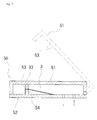
- an upper lid 51 of the chamber 50 is opened by being pivoted upward as shown with a two-dot chain line in Fig. 7 , and the packaging bag 3 is placed in the chamber 50.
- a pair of laterally extending upper and lower seal bars 53, 54 are provided in the chamber 50.
- the upper seal bar 53 is secured to the inner surface of the upper lid 51 of the chamber 50.
- the upper seal bar 53 is a pressing seal bar having no built-in seal line.
- the lower seal bar 54 is fixed on a table 52 inside the chamber 50.
- the lower seal bar 54 is a heating seal bar having a built-in seal line.
- the packaging bag 3 is placed on the table 52 so as to place the insertion opening 33 side of the packaging bag 3 on the lower seal bar 54.
- the upper surface of the lower seal bar 54 is higher than the upper surface of the table 52, so that the packaging bag 3 is inclined with its insertion opening 33 being upward. It is noted that the packaging bag 3 may be kept in an upright position, and the packaging bag 3 is placed in any manner. In any case, the bag is held so as not to spill the liquid cosmetics 2 as its content.
- the upper lid 51 of the chamber 50 is closed.
- a pair of upper and lower seal bars 53, 54 vertically sandwich the insertion opening 33 of the packaging bag 3.
- air inside the chamber 50 is deaerated to decompress the chamber 50.
- the insertion opening 33 is heat-sealed to be sealed.
- Pressure inside the chamber 50 is set at, e.g., -0.1 Mpa (ordinary pressure standard) of gauge pressure. After completing heat sealing, air is supplied into the chamber 50, and the pressure inside the chamber 50 is returned to ordinary pressure.
- the upper lid 51 of the chamber 50 is opened to take out a finished face mask package from the chamber 50.
- packaging bags 3 may be vacuum-sealed individually, but it is preferable to vacuum-seal multiple bags simultaneously. For example, when multiple packaging bags 3 are laterally arranged with a gap therebetween along the lower seal bar 54, it is possible to vacuum-seal the bags efficiently.
- the pressing means can be any, but a roller 60 shown in Fig. 8 , for example, may be used.
- the rollers 60 rotating with a horizontal axis for example, is arranged above a belt conveyor 61 with a gap therebetween, and the package is placed on the belt conveyor 61 in a laid-down position and is carried to pass under the roller 60.
- a symbol A indicates a conveyance direction in Fig. 8 .
- the package By carrying the package on the belt conveyor 61 in this manner, the package may be pressed by vertically sandwiching the package between the roller 60 and the belt conveyor 61. In this case, the orientation of the package may be either vertical or horizontal. Also, it is preferable to arrange a guide plate 62 on the upstream side of the roller 60. The guide plate 62 is arranged above the belt conveyor 61 with a gap therebetween, and the package is pressed from the above with the guide plate 62, so that the thickness of the package may be made uniform. By arranging the guide plate 62 on the upstream side of the roller 60 in this manner, wrinkles are prevented from being formed on the packaging bag 3 when the package is pressed by the roller 60.
- the height of the roller 60 and the guide plate 62 adjustable. It is possible to adjust a gap between the belt conveyor 61 and the roller 60 and a gap between the belt conveyor 61 and the guide plate 62.
- the gap between the belt conveyor 61 and the guide plate 62 is set larger than the gap between the belt conveyor 61 and the roller 60.
- the number of the rollers 60 may be either single or more than one. Further, the roller 60 may be arranged in a vertical, instead of horizontal, direction.
- the package in the upright position, the package may pass through between a pair of the rollers 60 rotating with a vertical axis.
- the liquid cosmetics 2 permeates the base material 1 more evenly. It is also sufficient to press with small force since there remains little air in the packaging bag 3, so that wrinkles are prevented from being formed on the packaging bag 3.
- the thickness of the packages is made uniform, in case of packing multiple packages into a box or the like, it is possible to box packages smoothly and also to place many packages.
- the face mask package in this embodiment there is little air inside the packaging bag 3 by vacuum-sealing; the liquid cosmetics 2 spreads to every corner inside the packaging bag 3; and the liquid cosmetics 2 permeates every corner inside the base material 1. Therefore, it is certainly possible to prevent impregnation unevenness from occurring even when the liquid cosmetics 2 of high viscosity is used. Furthermore, the injection volume of the liquid cosmetics 2 can be small, and the volume of a face mask package may be reduced.
- the base material 1 can be compacted and the size of the packaging bag 3 is also sufficiently small. Moreover, wrinkles or the like are not formed on the base material 1 even if the material is compressed by vacuum-sealing. Further, the liquid cosmetics 2 permeates securely inside the base material 1 by vacuum-sealing even if the base material 1 is in a folded state, so that uneven impregnation may be prevented. Also, since the packaging bag 3 is in the form of a flat bag with no gore or gusset, the liquid cosmetics 2 is likely to spread to every corner of the packaging bag 3. Further, the knob 18 is formed on the base material 1, so that the base material 1 may be easily expanded even if the liquid cosmetics 2 of high viscosity is used.
- the liquid cosmetics 2 is applied well to the base material 1. Furthermore, the interior of the chamber 50 is returned to ordinary pressure after heat sealing, so that the sealed packaging bag 3 is pressed by air pressure, and the liquid cosmetics 2 permeates further with the pressing force.
- a nonwoven fabric of a basis weight of 70 g/m 2 including rayon fiber (40%)/polyester and polyethylene splittable fiber (60%), is used as a base material 1.
- the base material 1 may be folded as described above, but the material is folded into, for example, a three-fold of a horizontally Z-shape and then folded further into a two-fold in the vertical direction, thus being folded into the total of six folds.
- "SIMUL GEL NS" from SEPPIC Corporation is used as a thickener.
- the packaging bag 3 has a three-sided sealed structure using a film of a three-layer structure.
- This film of the three-layer structure is made of, in order from the surface, 12 ⁇ m-thick polyethylene terephthalate film, 9 ⁇ m-thick aluminum foil, and 40 ⁇ m-thick polypropylene film.
- the viscosities of the liquid cosmetics 2 are adjusted to 5,000 mPa ⁇ sec, 10,000 mPa ⁇ sec, 20,000 mPa ⁇ sec, 30,000 mPa ⁇ sec, 40,000 mPa ⁇ sec, and 50,000 mPa ⁇ sec respectively, and the impregnation magnification is also about 10 to 13 times.
- Model TVS-8500B from Nishihara Manufacturing Co., Ltd. is used to vacuum-seal the material by reducing pressure for about 15 to 20 seconds (maximum: -0.1 Mpa). Good impregnation state was confirmed at any viscosity.
- a chamber-type vacuum sealing machine is used, but a nozzle vacuum sealing machine may also be used.
- the packaging bag 3 is pressed with the pressing walls 40, 41, prior to vacuum-sealing; however, the pressing means is not limited to the pressing walls 40, 41, and the bag may be sandwiched with a pair of rollers, for example. Further, the pressing step prior to the vacuum-sealing may be omitted. Similarly, the pressing step after vacuum-sealing is optional and may be omitted.
- the method of folding the base material 1 is optional. Besides the one described above, various ways such as six-fold and 12-fold may be used.
- the material in the packaging bag 3 in a folded state it may be stored in the packaging bag 3, for example, in a rolled-up state. In this case, it may be stored in the packaging bag 3 by, for example, folding the base material 1 into a six-fold or the like and then further winding it into a roll-shape.
- the base material 1 in a flat form without folding or winding it into a roll shape may be stored in the packaging bag 3.
- the base material 1 in a flat form without folding may be stored in the packaging bag 3.
- a flat bag such as a butt-seam bag where the bottom and the center rear portion (rear bonding portion) are sealed.
- a flat bag instead of a flat bag, it may be in a form of a bag with a gore or gusset.
- a cutout portion 19 is formed at one of the knobs 18 to make the base material 1 asymmetrical in its shape.
- the base material 1 may also be shaped asymmetrical.
- the base material 1 may have undistinguishable front and reverse. In that case, the base material 1 may be horizontally asymmetrical or may be horizontally symmetrical.
- the base material 1 made of a nonwoven fabric was explained, but the material may also be made of fibrous material such as a woven fabric and cosmetic cotton and may be porous, such as a sponge. In any case, it is preferable, as long as the material is capable of absorbing and retain liquid, but in particular, a thin material is preferable since it easily adheres to skin, so that the material may be, for example, a thinly sliced sponge.
- the one with 120 to 250 g/m 2 in its basis weight may be appropriately used. Further, the impregnation magnitude in impregnating the liquid cosmetics 2 in cosmetic cotton may be appropriately adjusted within the range of 10 to 30 times.
- the base material 1 may be the one for partially covering a face, such as a point facial pack and a separate mask. Further, it may also be used for skin other than a face. Also, in addition to the one in which the base material 1 keeps of adhering to skin even when released by hands, it may be a type in which the base material 1 needs to be continuously pressed onto skin, or may be one in which the base material 1 is attached on skin only for a short time.
- the drug solution is not limited to this and may be a liquid medicine having medicinal properties, a quasi-drug or the like.
Landscapes
- Engineering & Computer Science (AREA)
- Mechanical Engineering (AREA)
- Dispersion Chemistry (AREA)
- Chemical & Material Sciences (AREA)
- Health & Medical Sciences (AREA)
- Life Sciences & Earth Sciences (AREA)
- General Health & Medical Sciences (AREA)
- Animal Behavior & Ethology (AREA)
- Public Health (AREA)
- Veterinary Medicine (AREA)
- Hematology (AREA)
- Heart & Thoracic Surgery (AREA)
- Biomedical Technology (AREA)
- Anesthesiology (AREA)
- Packages (AREA)
- Birds (AREA)
- Epidemiology (AREA)
- Cosmetics (AREA)
Applications Claiming Priority (2)
| Application Number | Priority Date | Filing Date | Title |
|---|---|---|---|
| JP2012275949 | 2012-12-18 | ||
| PCT/JP2013/083687 WO2014098055A1 (fr) | 2012-12-18 | 2013-12-17 | Corps d'emballage de corps de rétention de solution médicamenteuse pour la peau, et procédé de fabrication dudit corps d'emballage |
Publications (3)
| Publication Number | Publication Date |
|---|---|
| EP2937014A1 true EP2937014A1 (fr) | 2015-10-28 |
| EP2937014A4 EP2937014A4 (fr) | 2016-08-10 |
| EP2937014B1 EP2937014B1 (fr) | 2019-02-06 |
Family
ID=50978382
Family Applications (1)
| Application Number | Title | Priority Date | Filing Date |
|---|---|---|---|
| EP13865168.2A Active EP2937014B1 (fr) | 2012-12-18 | 2013-12-17 | Procédé de fabrication d'un corps d'emballage |
Country Status (7)
| Country | Link |
|---|---|
| US (1) | US20150297297A1 (fr) |
| EP (1) | EP2937014B1 (fr) |
| JP (1) | JP6025225B2 (fr) |
| KR (1) | KR101704950B1 (fr) |
| CN (1) | CN104869864B (fr) |
| CA (1) | CA2890723A1 (fr) |
| WO (1) | WO2014098055A1 (fr) |
Cited By (2)
| Publication number | Priority date | Publication date | Assignee | Title |
|---|---|---|---|---|
| WO2020229317A1 (fr) * | 2019-05-13 | 2020-11-19 | Lessonia | Emballage pour produits cosmétiques, en particulier sac hermétique pour masques cosmétiques intégrant un support imprégné d'une solution |
| JP2021062559A (ja) * | 2019-10-15 | 2021-04-22 | 株式会社カナエテクノス | 積層シート、外用貼付剤、包装構造 |
Families Citing this family (9)
| Publication number | Priority date | Publication date | Assignee | Title |
|---|---|---|---|---|
| ITMI20120031A1 (it) * | 2012-01-13 | 2013-07-14 | Altergon Sa | Struttura di confezionamento per film biomedicali |
| JP2017042303A (ja) * | 2015-08-25 | 2017-03-02 | 一心堂本舗株式会社 | 美容パックシート、美容パックシート製品、及び美容パックシートの製造方法 |
| KR102552250B1 (ko) | 2016-05-26 | 2023-07-06 | 주식회사 카버코리아 | 마스크 포장용 용기 |
| CN109649731A (zh) * | 2017-10-12 | 2019-04-19 | 袁明祯 | 内置湿式面膜的真空包装袋及其成型方法 |
| KR102486488B1 (ko) * | 2017-10-18 | 2023-01-09 | (주)아모레퍼시픽 | 펼침성이 향상된 시트마스크 및 이의 접이 방법 |
| US11937676B2 (en) * | 2019-03-29 | 2024-03-26 | Load Lugger, Llc | Selectively sealable evacuable storage bag and method of making and using the same |
| USD909060S1 (en) | 2019-03-29 | 2021-02-02 | Daniel J. Dooling | Selectively sealable evacuable storage bag |
| CN114449922A (zh) * | 2019-11-15 | 2022-05-06 | 株式会社黛怡茜 | 涂布件包装体以及其制法 |
| KR102662779B1 (ko) | 2021-09-27 | 2024-05-03 | 선윤희 | 마스크팩 포장체 |
Family Cites Families (54)
| Publication number | Priority date | Publication date | Assignee | Title |
|---|---|---|---|---|
| US3735551A (en) * | 1971-12-20 | 1973-05-29 | Pratt Manufactoring Corp | Apparatus for and method of packaging with gas flushing |
| JPS54134172U (fr) * | 1978-03-02 | 1979-09-18 | ||
| JPS5951019A (ja) * | 1982-09-03 | 1984-03-24 | 有限会社柏木研究所 | 羽毛ブトン等の真空包装方法及び装置 |
| JPS59126910U (ja) * | 1983-02-16 | 1984-08-27 | ニュ−ロング株式会社 | 包装装置 |
| JPS6355022A (ja) * | 1986-08-22 | 1988-03-09 | 株式会社 エクス | 真空包装方法 |
| US4981374A (en) * | 1988-09-30 | 1991-01-01 | Rapak, Inc. | Plastic bags carried in a continuous web |
| JPH02169513A (ja) * | 1988-12-21 | 1990-06-29 | Ooishi Toyaji | 洗顔パック |
| US5062252A (en) * | 1990-08-08 | 1991-11-05 | Viskase Corporation | Vacuum packaging method and apparatus |
| JP2835476B2 (ja) * | 1991-03-11 | 1998-12-14 | 東洋自動機株式会社 | 真空包装袋整形装置 |
| US5172854A (en) * | 1991-10-16 | 1992-12-22 | Moshe Epstein | Reclosable, reusable package |
| US5265397A (en) * | 1991-12-20 | 1993-11-30 | Eastman Kodak Company | Flexible apparatus and process for loading and sealing pouches |
| JPH0648917A (ja) * | 1992-07-28 | 1994-02-22 | Momoki Nakagawa | 美容パック |
| US5335478A (en) * | 1993-01-08 | 1994-08-09 | Aronsen Arthur N | Multi-compartment dispenser pouch and method of making |
| WO1995029846A1 (fr) * | 1994-05-03 | 1995-11-09 | Inauen Maschinen Ag | Machine d'emballage sous vide |
| US5551213A (en) * | 1995-03-31 | 1996-09-03 | Eastman Kodak Company | Apparatus and method for vacuum sealing pouches |
| US6630152B2 (en) * | 1999-04-07 | 2003-10-07 | Shen Wei (Usa), Inc. | Aloe vera glove and manufacturing method |
| FR2811302B1 (fr) * | 2000-07-06 | 2002-10-31 | Serge Wendel | Emballage pour support impregne d'un produit pour application cutanee |
| US7921999B1 (en) * | 2001-12-20 | 2011-04-12 | Watson Laboratories, Inc. | Peelable pouch for transdermal patch and method for packaging |
| US20040013713A1 (en) * | 2002-02-20 | 2004-01-22 | Berry Craig J | Skin conditioning article |
| JP3751912B2 (ja) | 2002-04-05 | 2006-03-08 | 憲司 中村 | フェイスマスク |
| US20030215486A1 (en) * | 2002-05-15 | 2003-11-20 | Berry Craig J. | Cleansing or moisturizing mitt or glove |
| US6702792B2 (en) * | 2002-07-18 | 2004-03-09 | Kenji Nakamura | Face mask having excellent usability |
| US7302784B2 (en) * | 2002-09-27 | 2007-12-04 | Depuy Products, Inc. | Vacuum packaging machine |
| KR100421195B1 (ko) * | 2003-08-08 | 2004-03-10 | 세희코프레이션(주) | 엠보싱 형성 수단이 장착된 진공포장기 |
| ATE440032T1 (de) * | 2004-04-30 | 2009-09-15 | Bosch Gmbh Robert | Verfahren zur herstellung von schlauchbeuteln |
| TWI274587B (en) * | 2004-05-03 | 2007-03-01 | Life Spring Biotech Co Ltd | Complex face mask and methods of preparation thereof |
| US8367099B2 (en) * | 2004-09-28 | 2013-02-05 | Atrium Medical Corporation | Perforated fatty acid films |
| US20070110792A9 (en) * | 2005-01-03 | 2007-05-17 | L'oreal | Cosmetic or dermatological article comprising a medium that is soluble in water |
| US7603831B2 (en) * | 2005-03-30 | 2009-10-20 | Sealed Air Corporation (Us) | Packaging machine and method |
| KR100708763B1 (ko) * | 2005-08-02 | 2007-04-18 | (주) 월드비젼 | 은이 코팅된 마스크 팩의 제조 방법 및 이 방법에 의해제조된 마스크 팩 |
| US20070036845A1 (en) * | 2005-08-15 | 2007-02-15 | Persefeld Ellen D | Packeted body lotion towelette |
| JP2007099368A (ja) * | 2005-10-06 | 2007-04-19 | Yoshikawa Kogyo Co Ltd | 液充填機能を有する真空包装装置 |
| US20070083169A1 (en) * | 2005-10-12 | 2007-04-12 | Philip Krugman | Towelette |
| TWI289059B (en) * | 2006-01-24 | 2007-11-01 | Tsung-Ching Shiu | Prototype machine for in time manufacturing of functional adhesive patch in germ-free room |
| KR100659575B1 (ko) * | 2006-04-26 | 2006-12-20 | 이재호 | 파우더 흡착 마스크팩 및 그 제조방법 |
| ITVI20060150A1 (it) * | 2006-05-18 | 2007-11-19 | Alessandra Sambugaro | Macchina confezionatrice con film termosaldabile |
| US20080147022A1 (en) * | 2006-12-15 | 2008-06-19 | Kimberly-Clark Worldwide, Inc. | Skin care delivery device having a releasable backing |
| TWM322395U (en) * | 2007-05-18 | 2007-11-21 | Bioinside Lifesciences Co Ltd | Sealing bag for skin care paste |
| CA2695546A1 (fr) * | 2007-08-16 | 2009-02-19 | Poly-Clip System Corp. | Ensacheuse bi-mode |
| US20090056281A1 (en) * | 2007-08-27 | 2009-03-05 | Pouch Pac Innovations, Llc | Shaped Flexible Pouch With Elongated Neck And Method Of Manufacture |
| JP5647384B2 (ja) * | 2007-10-12 | 2014-12-24 | 出光ユニテック株式会社 | 包装袋のカット装置、その方法および製造装置 |
| TWI491369B (zh) * | 2008-03-05 | 2015-07-11 | Kenji Nakamura | Mask |
| US20090266036A1 (en) * | 2008-04-24 | 2009-10-29 | Kraft Foods Global Brand Llc | Flexible package having an automatic closure feature |
| US20090301034A1 (en) * | 2008-06-10 | 2009-12-10 | Avery Dennison Corporation | Sealed container and method of manufacturing |
| JP5053935B2 (ja) * | 2008-06-12 | 2012-10-24 | 東洋自動機株式会社 | 回転ロータリー式袋詰め真空包装機 |
| JP2010111411A (ja) * | 2008-11-06 | 2010-05-20 | Fuso Sangyo Kk | 包装装置 |
| CA2691390A1 (fr) * | 2009-01-29 | 2010-07-29 | Johnson & Johnson Consumer Companies, Inc. | Masque de beaute a couche isolante |
| JP5522624B2 (ja) * | 2009-06-24 | 2014-06-18 | 株式会社タイキ | フェイスマスク包装体 |
| JP5376514B2 (ja) * | 2009-07-07 | 2013-12-25 | 株式会社タイキ | フェイスマスク包装体 |
| CN102100657A (zh) * | 2009-12-21 | 2011-06-22 | 上海子夏投资管理有限公司 | 中药胶原蛋白面膜及其制作工艺 |
| US8596026B2 (en) * | 2010-08-05 | 2013-12-03 | Kraft Foods Group Brands Llc | Vacuum flow wrap packaging system and method of packaging |
| DE102012017827B4 (de) * | 2012-09-10 | 2021-07-15 | Multivac Sepp Haggenmüller Se & Co. Kg | Verfahren zum Betrieb einer Kammermaschine |
| US9796520B2 (en) * | 2013-02-19 | 2017-10-24 | Taiki Corp., Ltd. | Facial mask sheet package |
| FR3008080B1 (fr) * | 2013-07-02 | 2016-05-06 | Oreal | Dispositif de conditionnement |
-
2013
- 2013-12-17 US US14/648,444 patent/US20150297297A1/en not_active Abandoned
- 2013-12-17 CN CN201380066120.5A patent/CN104869864B/zh active Active
- 2013-12-17 WO PCT/JP2013/083687 patent/WO2014098055A1/fr not_active Ceased
- 2013-12-17 KR KR1020157012450A patent/KR101704950B1/ko active Active
- 2013-12-17 JP JP2014553142A patent/JP6025225B2/ja active Active
- 2013-12-17 EP EP13865168.2A patent/EP2937014B1/fr active Active
- 2013-12-17 CA CA2890723A patent/CA2890723A1/fr not_active Abandoned
Cited By (3)
| Publication number | Priority date | Publication date | Assignee | Title |
|---|---|---|---|---|
| WO2020229317A1 (fr) * | 2019-05-13 | 2020-11-19 | Lessonia | Emballage pour produits cosmétiques, en particulier sac hermétique pour masques cosmétiques intégrant un support imprégné d'une solution |
| FR3095931A1 (fr) * | 2019-05-13 | 2020-11-20 | Lessonia | Emballage pour produits cosmétiques, en particulier sac hermétique pour masques cosmétiques intégrant un support imprégné d’une solution |
| JP2021062559A (ja) * | 2019-10-15 | 2021-04-22 | 株式会社カナエテクノス | 積層シート、外用貼付剤、包装構造 |
Also Published As
| Publication number | Publication date |
|---|---|
| KR20150068999A (ko) | 2015-06-22 |
| CA2890723A1 (fr) | 2014-06-26 |
| EP2937014A4 (fr) | 2016-08-10 |
| CN104869864A (zh) | 2015-08-26 |
| JP6025225B2 (ja) | 2016-11-16 |
| HK1208789A1 (en) | 2016-03-18 |
| US20150297297A1 (en) | 2015-10-22 |
| EP2937014B1 (fr) | 2019-02-06 |
| WO2014098055A1 (fr) | 2014-06-26 |
| KR101704950B1 (ko) | 2017-02-08 |
| CN104869864B (zh) | 2018-04-24 |
| JPWO2014098055A1 (ja) | 2017-01-12 |
Similar Documents
| Publication | Publication Date | Title |
|---|---|---|
| EP2937014B1 (fr) | Procédé de fabrication d'un corps d'emballage | |
| CN102119109B (zh) | 湿片枕式包装体 | |
| EP2258627B1 (fr) | Dispositif d'emballage et procédé d'emballage de produits hygiéniques souples empilés dans un sac en plastique | |
| US20100310198A1 (en) | Plastic bag for stacked soft hygienic products | |
| EP0368240A1 (fr) | Emballage de distribution ainsi que le procédé pour sa fabrication | |
| RU2597825C2 (ru) | Способ и установка для изготовления охлаждающих компрессов и получаемые компрессы в стерильной упаковке | |
| CA2586059C (fr) | Un appareil pour la production d'un sac autoportant pour des balles de materiel en vrac comprime et methode connexe | |
| JPH1042948A (ja) | ペースト状製品の梱包バッグ | |
| KR20170042586A (ko) | 팩 시트 포장체 | |
| US6823649B1 (en) | Method for encapsulating a topical composition | |
| BR112017020950B1 (pt) | Embalagem | |
| ES2345343T3 (es) | Procedimiento de formacion-llenado-sellado. | |
| JP2013151308A (ja) | シート用収納袋及びシートが収納されたシート用収納袋 | |
| JP2008150317A (ja) | 化粧水シート | |
| CN109890726A (zh) | 湿片包装体 | |
| JP2012157613A (ja) | 折り畳みパックシート配列体及びパックシート包装体 | |
| JP2017052532A (ja) | パックシート包装体とその製造方法 | |
| BR112017020688B1 (pt) | Pacote que compreende uma pilha de material de lenço de papel e uma embalagem | |
| HK1208789B (en) | Packaging body for skin drug solution-holding body, and manufacturing method for packaging body | |
| WO2015060351A1 (fr) | Corps d'emballage de lingette | |
| JPS58171368A (ja) | 化粧料封入袋およびその連続製造方法 | |
| US20180009196A1 (en) | Pouch or Semi-Dense or Liquid Product with Applicator |
Legal Events
| Date | Code | Title | Description |
|---|---|---|---|
| PUAI | Public reference made under article 153(3) epc to a published international application that has entered the european phase |
Free format text: ORIGINAL CODE: 0009012 |
|
| 17P | Request for examination filed |
Effective date: 20150709 |
|
| AK | Designated contracting states |
Kind code of ref document: A1 Designated state(s): AL AT BE BG CH CY CZ DE DK EE ES FI FR GB GR HR HU IE IS IT LI LT LU LV MC MK MT NL NO PL PT RO RS SE SI SK SM TR |
|
| AX | Request for extension of the european patent |
Extension state: BA ME |
|
| DAX | Request for extension of the european patent (deleted) | ||
| A4 | Supplementary search report drawn up and despatched |
Effective date: 20160707 |
|
| RIC1 | Information provided on ipc code assigned before grant |
Ipc: A45D 44/22 20060101AFI20160701BHEP Ipc: B65D 81/20 20060101ALI20160701BHEP Ipc: B65D 81/22 20060101ALI20160701BHEP |
|
| STAA | Information on the status of an ep patent application or granted ep patent |
Free format text: STATUS: EXAMINATION IS IN PROGRESS |
|
| 17Q | First examination report despatched |
Effective date: 20180503 |
|
| RIN1 | Information on inventor provided before grant (corrected) |
Inventor name: SADAI, OSAMU Inventor name: KURIBAYASHI, YOSHIMITSU |
|
| RIC1 | Information provided on ipc code assigned before grant |
Ipc: A45D 44/00 20060101ALI20180806BHEP Ipc: A45D 44/22 20060101AFI20180806BHEP |
|
| GRAP | Despatch of communication of intention to grant a patent |
Free format text: ORIGINAL CODE: EPIDOSNIGR1 |
|
| STAA | Information on the status of an ep patent application or granted ep patent |
Free format text: STATUS: GRANT OF PATENT IS INTENDED |
|
| INTG | Intention to grant announced |
Effective date: 20180919 |
|
| GRAS | Grant fee paid |
Free format text: ORIGINAL CODE: EPIDOSNIGR3 |
|
| GRAA | (expected) grant |
Free format text: ORIGINAL CODE: 0009210 |
|
| STAA | Information on the status of an ep patent application or granted ep patent |
Free format text: STATUS: THE PATENT HAS BEEN GRANTED |
|
| AK | Designated contracting states |
Kind code of ref document: B1 Designated state(s): AL AT BE BG CH CY CZ DE DK EE ES FI FR GB GR HR HU IE IS IT LI LT LU LV MC MK MT NL NO PL PT RO RS SE SI SK SM TR |
|
| REG | Reference to a national code |
Ref country code: GB Ref legal event code: FG4D |
|
| REG | Reference to a national code |
Ref country code: CH Ref legal event code: EP Ref country code: AT Ref legal event code: REF Ref document number: 1094303 Country of ref document: AT Kind code of ref document: T Effective date: 20190215 |
|
| REG | Reference to a national code |
Ref country code: DE Ref legal event code: R096 Ref document number: 602013050629 Country of ref document: DE |
|
| REG | Reference to a national code |
Ref country code: IE Ref legal event code: FG4D |
|
| REG | Reference to a national code |
Ref country code: NL Ref legal event code: MP Effective date: 20190206 |
|
| REG | Reference to a national code |
Ref country code: LT Ref legal event code: MG4D |
|
| PG25 | Lapsed in a contracting state [announced via postgrant information from national office to epo] |
Ref country code: PT Free format text: LAPSE BECAUSE OF FAILURE TO SUBMIT A TRANSLATION OF THE DESCRIPTION OR TO PAY THE FEE WITHIN THE PRESCRIBED TIME-LIMIT Effective date: 20190606 Ref country code: NL Free format text: LAPSE BECAUSE OF FAILURE TO SUBMIT A TRANSLATION OF THE DESCRIPTION OR TO PAY THE FEE WITHIN THE PRESCRIBED TIME-LIMIT Effective date: 20190206 Ref country code: LT Free format text: LAPSE BECAUSE OF FAILURE TO SUBMIT A TRANSLATION OF THE DESCRIPTION OR TO PAY THE FEE WITHIN THE PRESCRIBED TIME-LIMIT Effective date: 20190206 Ref country code: NO Free format text: LAPSE BECAUSE OF FAILURE TO SUBMIT A TRANSLATION OF THE DESCRIPTION OR TO PAY THE FEE WITHIN THE PRESCRIBED TIME-LIMIT Effective date: 20190506 Ref country code: SE Free format text: LAPSE BECAUSE OF FAILURE TO SUBMIT A TRANSLATION OF THE DESCRIPTION OR TO PAY THE FEE WITHIN THE PRESCRIBED TIME-LIMIT Effective date: 20190206 Ref country code: FI Free format text: LAPSE BECAUSE OF FAILURE TO SUBMIT A TRANSLATION OF THE DESCRIPTION OR TO PAY THE FEE WITHIN THE PRESCRIBED TIME-LIMIT Effective date: 20190206 |
|
| REG | Reference to a national code |
Ref country code: AT Ref legal event code: MK05 Ref document number: 1094303 Country of ref document: AT Kind code of ref document: T Effective date: 20190206 |
|
| PG25 | Lapsed in a contracting state [announced via postgrant information from national office to epo] |
Ref country code: GR Free format text: LAPSE BECAUSE OF FAILURE TO SUBMIT A TRANSLATION OF THE DESCRIPTION OR TO PAY THE FEE WITHIN THE PRESCRIBED TIME-LIMIT Effective date: 20190507 Ref country code: IS Free format text: LAPSE BECAUSE OF FAILURE TO SUBMIT A TRANSLATION OF THE DESCRIPTION OR TO PAY THE FEE WITHIN THE PRESCRIBED TIME-LIMIT Effective date: 20190606 Ref country code: BG Free format text: LAPSE BECAUSE OF FAILURE TO SUBMIT A TRANSLATION OF THE DESCRIPTION OR TO PAY THE FEE WITHIN THE PRESCRIBED TIME-LIMIT Effective date: 20190506 Ref country code: RS Free format text: LAPSE BECAUSE OF FAILURE TO SUBMIT A TRANSLATION OF THE DESCRIPTION OR TO PAY THE FEE WITHIN THE PRESCRIBED TIME-LIMIT Effective date: 20190206 Ref country code: LV Free format text: LAPSE BECAUSE OF FAILURE TO SUBMIT A TRANSLATION OF THE DESCRIPTION OR TO PAY THE FEE WITHIN THE PRESCRIBED TIME-LIMIT Effective date: 20190206 Ref country code: HR Free format text: LAPSE BECAUSE OF FAILURE TO SUBMIT A TRANSLATION OF THE DESCRIPTION OR TO PAY THE FEE WITHIN THE PRESCRIBED TIME-LIMIT Effective date: 20190206 |
|
| PG25 | Lapsed in a contracting state [announced via postgrant information from national office to epo] |
Ref country code: SK Free format text: LAPSE BECAUSE OF FAILURE TO SUBMIT A TRANSLATION OF THE DESCRIPTION OR TO PAY THE FEE WITHIN THE PRESCRIBED TIME-LIMIT Effective date: 20190206 Ref country code: RO Free format text: LAPSE BECAUSE OF FAILURE TO SUBMIT A TRANSLATION OF THE DESCRIPTION OR TO PAY THE FEE WITHIN THE PRESCRIBED TIME-LIMIT Effective date: 20190206 Ref country code: IT Free format text: LAPSE BECAUSE OF FAILURE TO SUBMIT A TRANSLATION OF THE DESCRIPTION OR TO PAY THE FEE WITHIN THE PRESCRIBED TIME-LIMIT Effective date: 20190206 Ref country code: CZ Free format text: LAPSE BECAUSE OF FAILURE TO SUBMIT A TRANSLATION OF THE DESCRIPTION OR TO PAY THE FEE WITHIN THE PRESCRIBED TIME-LIMIT Effective date: 20190206 Ref country code: AL Free format text: LAPSE BECAUSE OF FAILURE TO SUBMIT A TRANSLATION OF THE DESCRIPTION OR TO PAY THE FEE WITHIN THE PRESCRIBED TIME-LIMIT Effective date: 20190206 Ref country code: DK Free format text: LAPSE BECAUSE OF FAILURE TO SUBMIT A TRANSLATION OF THE DESCRIPTION OR TO PAY THE FEE WITHIN THE PRESCRIBED TIME-LIMIT Effective date: 20190206 Ref country code: ES Free format text: LAPSE BECAUSE OF FAILURE TO SUBMIT A TRANSLATION OF THE DESCRIPTION OR TO PAY THE FEE WITHIN THE PRESCRIBED TIME-LIMIT Effective date: 20190206 Ref country code: EE Free format text: LAPSE BECAUSE OF FAILURE TO SUBMIT A TRANSLATION OF THE DESCRIPTION OR TO PAY THE FEE WITHIN THE PRESCRIBED TIME-LIMIT Effective date: 20190206 |
|
| REG | Reference to a national code |
Ref country code: DE Ref legal event code: R097 Ref document number: 602013050629 Country of ref document: DE |
|
| PG25 | Lapsed in a contracting state [announced via postgrant information from national office to epo] |
Ref country code: PL Free format text: LAPSE BECAUSE OF FAILURE TO SUBMIT A TRANSLATION OF THE DESCRIPTION OR TO PAY THE FEE WITHIN THE PRESCRIBED TIME-LIMIT Effective date: 20190206 Ref country code: SM Free format text: LAPSE BECAUSE OF FAILURE TO SUBMIT A TRANSLATION OF THE DESCRIPTION OR TO PAY THE FEE WITHIN THE PRESCRIBED TIME-LIMIT Effective date: 20190206 |
|
| PLBE | No opposition filed within time limit |
Free format text: ORIGINAL CODE: 0009261 |
|
| STAA | Information on the status of an ep patent application or granted ep patent |
Free format text: STATUS: NO OPPOSITION FILED WITHIN TIME LIMIT |
|
| PG25 | Lapsed in a contracting state [announced via postgrant information from national office to epo] |
Ref country code: AT Free format text: LAPSE BECAUSE OF FAILURE TO SUBMIT A TRANSLATION OF THE DESCRIPTION OR TO PAY THE FEE WITHIN THE PRESCRIBED TIME-LIMIT Effective date: 20190206 |
|
| 26N | No opposition filed |
Effective date: 20191107 |
|
| PG25 | Lapsed in a contracting state [announced via postgrant information from national office to epo] |
Ref country code: SI Free format text: LAPSE BECAUSE OF FAILURE TO SUBMIT A TRANSLATION OF THE DESCRIPTION OR TO PAY THE FEE WITHIN THE PRESCRIBED TIME-LIMIT Effective date: 20190206 |
|
| PG25 | Lapsed in a contracting state [announced via postgrant information from national office to epo] |
Ref country code: TR Free format text: LAPSE BECAUSE OF FAILURE TO SUBMIT A TRANSLATION OF THE DESCRIPTION OR TO PAY THE FEE WITHIN THE PRESCRIBED TIME-LIMIT Effective date: 20190206 |
|
| REG | Reference to a national code |
Ref country code: CH Ref legal event code: PL |
|
| REG | Reference to a national code |
Ref country code: BE Ref legal event code: MM Effective date: 20191231 |
|
| PG25 | Lapsed in a contracting state [announced via postgrant information from national office to epo] |
Ref country code: MC Free format text: LAPSE BECAUSE OF FAILURE TO SUBMIT A TRANSLATION OF THE DESCRIPTION OR TO PAY THE FEE WITHIN THE PRESCRIBED TIME-LIMIT Effective date: 20190206 |
|
| PG25 | Lapsed in a contracting state [announced via postgrant information from national office to epo] |
Ref country code: IE Free format text: LAPSE BECAUSE OF NON-PAYMENT OF DUE FEES Effective date: 20191217 Ref country code: LU Free format text: LAPSE BECAUSE OF NON-PAYMENT OF DUE FEES Effective date: 20191217 |
|
| PG25 | Lapsed in a contracting state [announced via postgrant information from national office to epo] |
Ref country code: BE Free format text: LAPSE BECAUSE OF NON-PAYMENT OF DUE FEES Effective date: 20191231 Ref country code: LI Free format text: LAPSE BECAUSE OF NON-PAYMENT OF DUE FEES Effective date: 20191231 Ref country code: CH Free format text: LAPSE BECAUSE OF NON-PAYMENT OF DUE FEES Effective date: 20191231 |
|
| PG25 | Lapsed in a contracting state [announced via postgrant information from national office to epo] |
Ref country code: CY Free format text: LAPSE BECAUSE OF FAILURE TO SUBMIT A TRANSLATION OF THE DESCRIPTION OR TO PAY THE FEE WITHIN THE PRESCRIBED TIME-LIMIT Effective date: 20190206 |
|
| PG25 | Lapsed in a contracting state [announced via postgrant information from national office to epo] |
Ref country code: MT Free format text: LAPSE BECAUSE OF FAILURE TO SUBMIT A TRANSLATION OF THE DESCRIPTION OR TO PAY THE FEE WITHIN THE PRESCRIBED TIME-LIMIT Effective date: 20190206 Ref country code: HU Free format text: LAPSE BECAUSE OF FAILURE TO SUBMIT A TRANSLATION OF THE DESCRIPTION OR TO PAY THE FEE WITHIN THE PRESCRIBED TIME-LIMIT; INVALID AB INITIO Effective date: 20131217 |
|
| PG25 | Lapsed in a contracting state [announced via postgrant information from national office to epo] |
Ref country code: MK Free format text: LAPSE BECAUSE OF FAILURE TO SUBMIT A TRANSLATION OF THE DESCRIPTION OR TO PAY THE FEE WITHIN THE PRESCRIBED TIME-LIMIT Effective date: 20190206 |
|
| PGFP | Annual fee paid to national office [announced via postgrant information from national office to epo] |
Ref country code: DE Payment date: 20251028 Year of fee payment: 13 |
|
| PGFP | Annual fee paid to national office [announced via postgrant information from national office to epo] |
Ref country code: GB Payment date: 20251030 Year of fee payment: 13 |
|
| PGFP | Annual fee paid to national office [announced via postgrant information from national office to epo] |
Ref country code: FR Payment date: 20251110 Year of fee payment: 13 |