EP2937323A1 - Agent augmentant la concentration de cations, agent modifiant pour structure de béton, procédé pour le fabriquer et procédé de réparation de structure en béton - Google Patents
Agent augmentant la concentration de cations, agent modifiant pour structure de béton, procédé pour le fabriquer et procédé de réparation de structure en béton Download PDFInfo
- Publication number
- EP2937323A1 EP2937323A1 EP14776534.1A EP14776534A EP2937323A1 EP 2937323 A1 EP2937323 A1 EP 2937323A1 EP 14776534 A EP14776534 A EP 14776534A EP 2937323 A1 EP2937323 A1 EP 2937323A1
- Authority
- EP
- European Patent Office
- Prior art keywords
- concrete structure
- concrete
- modifying agent
- agent
- water
- Prior art date
- Legal status (The legal status is an assumption and is not a legal conclusion. Google has not performed a legal analysis and makes no representation as to the accuracy of the status listed.)
- Granted
Links
Images


Classifications
-
- C—CHEMISTRY; METALLURGY
- C04—CEMENTS; CONCRETE; ARTIFICIAL STONE; CERAMICS; REFRACTORIES
- C04B—LIME, MAGNESIA; SLAG; CEMENTS; COMPOSITIONS THEREOF, e.g. MORTARS, CONCRETE OR LIKE BUILDING MATERIALS; ARTIFICIAL STONE; CERAMICS; REFRACTORIES; TREATMENT OF NATURAL STONE
- C04B28/00—Compositions of mortars, concrete or artificial stone, containing inorganic binders or the reaction product of an inorganic and an organic binder, e.g. polycarboxylate cements
- C04B28/18—Compositions of mortars, concrete or artificial stone, containing inorganic binders or the reaction product of an inorganic and an organic binder, e.g. polycarboxylate cements containing mixtures of the silica-lime type
-
- C—CHEMISTRY; METALLURGY
- C04—CEMENTS; CONCRETE; ARTIFICIAL STONE; CERAMICS; REFRACTORIES
- C04B—LIME, MAGNESIA; SLAG; CEMENTS; COMPOSITIONS THEREOF, e.g. MORTARS, CONCRETE OR LIKE BUILDING MATERIALS; ARTIFICIAL STONE; CERAMICS; REFRACTORIES; TREATMENT OF NATURAL STONE
- C04B41/00—After-treatment of mortars, concrete, artificial stone or ceramics; Treatment of natural stone
- C04B41/009—After-treatment of mortars, concrete, artificial stone or ceramics; Treatment of natural stone characterised by the material treated
-
- B—PERFORMING OPERATIONS; TRANSPORTING
- B05—SPRAYING OR ATOMISING IN GENERAL; APPLYING FLUENT MATERIALS TO SURFACES, IN GENERAL
- B05D—PROCESSES FOR APPLYING FLUENT MATERIALS TO SURFACES, IN GENERAL
- B05D3/00—Pretreatment of surfaces to which liquids or other fluent materials are to be applied; After-treatment of applied coatings, e.g. intermediate treating of an applied coating preparatory to subsequent applications of liquids or other fluent materials
- B05D3/007—After-treatment
-
- B—PERFORMING OPERATIONS; TRANSPORTING
- B05—SPRAYING OR ATOMISING IN GENERAL; APPLYING FLUENT MATERIALS TO SURFACES, IN GENERAL
- B05D—PROCESSES FOR APPLYING FLUENT MATERIALS TO SURFACES, IN GENERAL
- B05D5/00—Processes for applying liquids or other fluent materials to surfaces to obtain special surface effects, finishes or structures
- B05D5/005—Repairing damaged coatings
-
- B—PERFORMING OPERATIONS; TRANSPORTING
- B05—SPRAYING OR ATOMISING IN GENERAL; APPLYING FLUENT MATERIALS TO SURFACES, IN GENERAL
- B05D—PROCESSES FOR APPLYING FLUENT MATERIALS TO SURFACES, IN GENERAL
- B05D7/00—Processes, other than flocking, specially adapted for applying liquids or other fluent materials to particular surfaces or for applying particular liquids or other fluent materials
- B05D7/24—Processes, other than flocking, specially adapted for applying liquids or other fluent materials to particular surfaces or for applying particular liquids or other fluent materials for applying particular liquids or other fluent materials
-
- C—CHEMISTRY; METALLURGY
- C02—TREATMENT OF WATER, WASTE WATER, SEWAGE, OR SLUDGE
- C02F—TREATMENT OF WATER, WASTE WATER, SEWAGE, OR SLUDGE
- C02F1/00—Treatment of water, waste water, or sewage
- C02F1/46—Treatment of water, waste water, or sewage by electrochemical methods
- C02F1/461—Treatment of water, waste water, or sewage by electrochemical methods by electrolysis
- C02F1/46104—Devices therefor; Their operating or servicing
- C02F1/4618—Devices therefor; Their operating or servicing for producing "ionised" acidic or basic water
-
- C—CHEMISTRY; METALLURGY
- C04—CEMENTS; CONCRETE; ARTIFICIAL STONE; CERAMICS; REFRACTORIES
- C04B—LIME, MAGNESIA; SLAG; CEMENTS; COMPOSITIONS THEREOF, e.g. MORTARS, CONCRETE OR LIKE BUILDING MATERIALS; ARTIFICIAL STONE; CERAMICS; REFRACTORIES; TREATMENT OF NATURAL STONE
- C04B2/00—Lime, magnesia or dolomite
- C04B2/02—Lime
-
- C—CHEMISTRY; METALLURGY
- C04—CEMENTS; CONCRETE; ARTIFICIAL STONE; CERAMICS; REFRACTORIES
- C04B—LIME, MAGNESIA; SLAG; CEMENTS; COMPOSITIONS THEREOF, e.g. MORTARS, CONCRETE OR LIKE BUILDING MATERIALS; ARTIFICIAL STONE; CERAMICS; REFRACTORIES; TREATMENT OF NATURAL STONE
- C04B24/00—Use of organic materials as active ingredients for mortars, concrete or artificial stone, e.g. plasticisers
- C04B24/04—Carboxylic acids; Salts, anhydrides or esters thereof
-
- C—CHEMISTRY; METALLURGY
- C04—CEMENTS; CONCRETE; ARTIFICIAL STONE; CERAMICS; REFRACTORIES
- C04B—LIME, MAGNESIA; SLAG; CEMENTS; COMPOSITIONS THEREOF, e.g. MORTARS, CONCRETE OR LIKE BUILDING MATERIALS; ARTIFICIAL STONE; CERAMICS; REFRACTORIES; TREATMENT OF NATURAL STONE
- C04B24/00—Use of organic materials as active ingredients for mortars, concrete or artificial stone, e.g. plasticisers
- C04B24/40—Compounds containing silicon, titanium or zirconium or other organo-metallic compounds; Organo-clays; Organo-inorganic complexes
-
- C—CHEMISTRY; METALLURGY
- C04—CEMENTS; CONCRETE; ARTIFICIAL STONE; CERAMICS; REFRACTORIES
- C04B—LIME, MAGNESIA; SLAG; CEMENTS; COMPOSITIONS THEREOF, e.g. MORTARS, CONCRETE OR LIKE BUILDING MATERIALS; ARTIFICIAL STONE; CERAMICS; REFRACTORIES; TREATMENT OF NATURAL STONE
- C04B41/00—After-treatment of mortars, concrete, artificial stone or ceramics; Treatment of natural stone
- C04B41/45—Coating or impregnating, e.g. injection in masonry, partial coating of green or fired ceramics, organic coating compositions for adhering together two concrete elements
- C04B41/50—Coating or impregnating, e.g. injection in masonry, partial coating of green or fired ceramics, organic coating compositions for adhering together two concrete elements with inorganic materials
- C04B41/5076—Coating or impregnating, e.g. injection in masonry, partial coating of green or fired ceramics, organic coating compositions for adhering together two concrete elements with inorganic materials with masses bonded by inorganic cements
- C04B41/5084—Lime, hydraulic lime or magnesium oxide cements
-
- C—CHEMISTRY; METALLURGY
- C04—CEMENTS; CONCRETE; ARTIFICIAL STONE; CERAMICS; REFRACTORIES
- C04B—LIME, MAGNESIA; SLAG; CEMENTS; COMPOSITIONS THEREOF, e.g. MORTARS, CONCRETE OR LIKE BUILDING MATERIALS; ARTIFICIAL STONE; CERAMICS; REFRACTORIES; TREATMENT OF NATURAL STONE
- C04B41/00—After-treatment of mortars, concrete, artificial stone or ceramics; Treatment of natural stone
- C04B41/45—Coating or impregnating, e.g. injection in masonry, partial coating of green or fired ceramics, organic coating compositions for adhering together two concrete elements
- C04B41/52—Multiple coating or impregnating multiple coating or impregnating with the same composition or with compositions only differing in the concentration of the constituents, is classified as single coating or impregnation
-
- C—CHEMISTRY; METALLURGY
- C04—CEMENTS; CONCRETE; ARTIFICIAL STONE; CERAMICS; REFRACTORIES
- C04B—LIME, MAGNESIA; SLAG; CEMENTS; COMPOSITIONS THEREOF, e.g. MORTARS, CONCRETE OR LIKE BUILDING MATERIALS; ARTIFICIAL STONE; CERAMICS; REFRACTORIES; TREATMENT OF NATURAL STONE
- C04B41/00—After-treatment of mortars, concrete, artificial stone or ceramics; Treatment of natural stone
- C04B41/60—After-treatment of mortars, concrete, artificial stone or ceramics; Treatment of natural stone of only artificial stone
- C04B41/61—Coating or impregnation
- C04B41/70—Coating or impregnation for obtaining at least two superposed coatings having different compositions
-
- C—CHEMISTRY; METALLURGY
- C25—ELECTROLYTIC OR ELECTROPHORETIC PROCESSES; APPARATUS THEREFOR
- C25B—ELECTROLYTIC OR ELECTROPHORETIC PROCESSES FOR THE PRODUCTION OF COMPOUNDS OR NON-METALS; APPARATUS THEREFOR
- C25B1/00—Electrolytic production of inorganic compounds or non-metals
-
- B—PERFORMING OPERATIONS; TRANSPORTING
- B05—SPRAYING OR ATOMISING IN GENERAL; APPLYING FLUENT MATERIALS TO SURFACES, IN GENERAL
- B05D—PROCESSES FOR APPLYING FLUENT MATERIALS TO SURFACES, IN GENERAL
- B05D2203/00—Other substrates
- B05D2203/30—Other inorganic substrates, e.g. ceramics, silicon
-
- B—PERFORMING OPERATIONS; TRANSPORTING
- B05—SPRAYING OR ATOMISING IN GENERAL; APPLYING FLUENT MATERIALS TO SURFACES, IN GENERAL
- B05D—PROCESSES FOR APPLYING FLUENT MATERIALS TO SURFACES, IN GENERAL
- B05D2401/00—Form of the coating product, e.g. solution, water dispersion, powders or the like
- B05D2401/20—Aqueous dispersion or solution
-
- C—CHEMISTRY; METALLURGY
- C02—TREATMENT OF WATER, WASTE WATER, SEWAGE, OR SLUDGE
- C02F—TREATMENT OF WATER, WASTE WATER, SEWAGE, OR SLUDGE
- C02F1/00—Treatment of water, waste water, or sewage
- C02F1/46—Treatment of water, waste water, or sewage by electrochemical methods
- C02F1/461—Treatment of water, waste water, or sewage by electrochemical methods by electrolysis
- C02F1/46104—Devices therefor; Their operating or servicing
- C02F1/4618—Devices therefor; Their operating or servicing for producing "ionised" acidic or basic water
- C02F2001/4619—Devices therefor; Their operating or servicing for producing "ionised" acidic or basic water only cathodic or alkaline water, e.g. for reducing
-
- C—CHEMISTRY; METALLURGY
- C02—TREATMENT OF WATER, WASTE WATER, SEWAGE, OR SLUDGE
- C02F—TREATMENT OF WATER, WASTE WATER, SEWAGE, OR SLUDGE
- C02F2209/00—Controlling or monitoring parameters in water treatment
- C02F2209/06—Controlling or monitoring parameters in water treatment pH
-
- C—CHEMISTRY; METALLURGY
- C04—CEMENTS; CONCRETE; ARTIFICIAL STONE; CERAMICS; REFRACTORIES
- C04B—LIME, MAGNESIA; SLAG; CEMENTS; COMPOSITIONS THEREOF, e.g. MORTARS, CONCRETE OR LIKE BUILDING MATERIALS; ARTIFICIAL STONE; CERAMICS; REFRACTORIES; TREATMENT OF NATURAL STONE
- C04B2111/00—Mortars, concrete or artificial stone or mixtures to prepare them, characterised by specific function, property or use
- C04B2111/72—Repairing or restoring existing buildings or building materials
Definitions
- the present invention relates to a cation concentration increasing agent, a modifying agent for a concrete structure, a method for manufacturing the same, and a method for repairing a concrete structure.
- Concrete is high in resistance to various environments, and moreover, strongly alkaline, and hence is used for concrete structures. Due to the strong alkalinity of concrete, a passive film is formed on the surface of reinforcing bars placed inside a concrete structure, and hence the reinforcing bars are protected from the corrosion due to, for example, water or chlorine from the outside. Consequently, concrete structures are known as structures high in durability.
- concrete structures having been considered to have high durability are degraded in durability due to, for example, neutralization, salt damage, frost damage or alkali-aggregate reaction, and doubt comes to be cast on the service life of concrete structures as structures.
- Patent Literature 1 proposes a method in which aqueous solutions of nitrites are used as anticorrosives for reinforcing bars, penetrating deep into inside concrete.
- Patent Literature 2 states that in order to produce a gelled substance contributing to repairing a concrete structure, calcium ions in the concrete and an alkali silicate penetrant are necessary, and in order to promote the production of the gelled substance, it is necessary to set the pH of the concrete at 11 or less.
- Patent Literature 2 proposes a method in which a calcium salt aqueous solution (for example, a calcium chloride aqueous solution) and an alkali silicate penetrant (for example, sodium silicate) are separately allowed to penetrate into concrete, and thus a gelled substance is produced.
- a calcium salt aqueous solution for example, a calcium chloride aqueous solution
- an alkali silicate penetrant for example, sodium silicate
- Patent Literature 1 uses aqueous solutions of nitrites having high carcinogenicity, and hence when this method is applied, a protection measure to protect the intake into the body of such nitrites and sufficient ventilation are required.
- Patent Literature 2 uses a calcium chloride aqueous solution as a source of supply of calcium ions, and hence chlorine to be a causative substance of salt damage is present, as a by-product of the production of the gelled substance.
- the method described in Patent Literature 2 enables a temporary, namely, short-period repair, but is not suitable for a long-period repair.
- the calcium chloride aqueous solution a solution having a concentration as low as not to cause salt damage; in this case, no sufficient amount of the gelled substance is produced, or the production of the gelled substance takes a long time.
- the present invention intends to provide a modifying agent for a concrete structure that allows the modification operation of a concrete structure to be safe for the human body and simple, and is capable of imparting high durability to the concrete structure, and a method for manufacturing the modifying agent.
- the present invention also intends to provide a method for repairing a concrete structure by using the modifying agent for a concrete structure.
- the present invention also intends to provide a cation concentration increasing agent capable of being an effective component of the modifying agent for a concrete structure.
- the modifying agent for a concrete structure of the present invention includes an alkaline electrolyzed water.
- the modifying agent preferably includes calcium ions.
- the alkaline electrolyzed water preferably has a pH of 11 or more.
- the calcium ion concentration is preferably 10 mg/L or more.
- the modifying agent for a concrete structure of the present invention is characterized in that when a substance being supplied to a concrete structure in order to produce the calcium silicate for repairing concrete and including an alkali metal silicate is defined as a concrete protective agent, the modifying agent is supplied to the concrete structure in advance of the supply of the concrete protective agent; and the alkali metal silicate and the calcium ions included in the concrete protective agent contribute to the production of the calcium silicate.
- the modifying agent for a concrete structure is preferably supplied to a concrete structure in order to repair cracks of the concrete structure.
- the method for repairing a concrete structure of the present invention includes, when a substance being supplied to a concrete structure in order to produce the calcium silicate for repairing the concrete structure and including an alkali metal silicate is defined as a concrete protective agent : a protective agent supply step of supplying the concrete protective agent to the concrete structure; and a modifying agent supply step of supplying the modifying agent for a concrete structure according to any one of claims 1 to 6 to the concrete structure, the modifying agent supply step being performed before the protective agent supply step in order to promote the production of the calcium silicate in the protective agent supply step.
- the concrete protective agent is preferably supplied to the concrete structure in a state of being penetrated by the alkaline electrolyzed water.
- the method for repairing a concrete structure preferably includes a drying step of drying the calcium silicate performed after the protective agent supply step.
- the method for repairing a concrete structure preferably further includes a wetting step of supplying water to the calcium silicate in a dry state.
- the present invention is the method for manufacturing a modifying agent for a concrete structure including an alkaline electrolyzed water including calcium ions dissolved therein, wherein the method includes an electrolysis step of performing electrolysis for water including a water-soluble calcium-containing compound, and at least one of a chloride ion and a hydrogencarbonate ion.
- the present invention is a cation concentration increasing agent for increasing the concentration of a cationic ion in a solution, wherein the agent includes an alkaline electrolyzed water.
- the solution is preferably a modifying agent for a concrete structure.
- the modification operation of a concrete structure is safe for the human body and simple, and the present invention is capable of imparting high durability to a concrete structure.
- the modifying agent for a concrete structure is an alkaline electrolyzed water including calcium ions dissolved therein.
- a prescribed solute may also be added to the alkaline electrolyzed water, if necessary.
- the pH of the alkaline electrolyzed water is preferably 11 or more.
- the upper limit of the pH of the alkaline electrolyzed water may be, without particularly limited to, a degree of pH not to cause alkali-aggregate reaction in the case where the alkaline electrolyzed water is supplied to a concrete structure, namely, may fall within a range of the described total amount of the concrete alkali (3.0 kg/m 3 or less in terms of Na 2 O).
- the solubility of calcium ions per 100 g of the alkaline electrolyzed water at 25°C is, for example, 5.0 g, and is higher than the solubility (0.17 g) of calcium ions in the case where calcium hydroxide is dissolved in 100 g of water (25°C, pH 7).
- the alkaline electrolyzed water acts as a calcium ion concentration increasing agent in the modifying agent.
- the calcium ion concentration in the alkaline electrolyzed water is preferably 10 mg/L or more.
- the alkaline electrolyzed water also acts as a concentration increasing agent for the cation (for example, an alkali metal ion such as a lithium ion, a sodium ion or a potassium ion) in a prescribed solution as well as the concentration increasing agent for the calcium ions in the modifying agent.
- concentration increasing agent for the cation for example, an alkali metal ion such as a lithium ion, a sodium ion or a potassium ion
- the solution include, in addition to the modifying agent for a concrete structure, a concrete protective agent (to be described later).
- the reaction time with the concrete protective agent is relatively long, and hence the alkaline electrolyzed water can be allowed to penetrate into deep portions of cracks. Consequently, the concrete structure can be repaired from the surface layer portion to the deep portions of the cracks of the concrete structure.
- the calcium ion concentration in the alkaline electrolyzed water is a high concentration (for example, 1 ⁇ 10 2 mg/L or more), the reaction time with the concrete protective agent is relatively short, and hence the repair of the surface layer portions of the cracks can be performed.
- an alkaline electrolyzed water having a low calcium ion concentration and an alkaline electrolyzed water having a high calcium ion concentration may be used in combination.
- the surface layer portions of the cracks may be repaired with a high-concentration alkaline electrolyzed water.
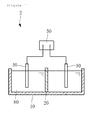
- the manufacturing equipment 2 for the modifying agent for a concrete structure is provided with a water tank 10, an ion-exchange membrane 20, an anode 30, a cathode 40, and an electric power supply 50 applying a predetermined voltage across the anode 30 and the cathode 40.
- tap water including a calcium preparation dissolved therein is stored.
- the calcium preparation include : water-soluble calcium-containing compounds (calcium salts such as calcium lactate, calcium gluconate, and phosphoryl oligosaccharides of calcium).
- the internal space of the water tank 10 is partitioned with an ion-exchange membrane 20, and the anode 30 and the cathode 40 are installed respectively in the two spaces partitioned with the ion-exchange membrane 20. Subsequently, by using an electric power supply 50, a predetermined voltage is applied across the anode 30 and the cathode 40 to perform electrolysis. By the electrolysis, hydrogen is generated on the side of the cathode 40, and at the same time, the alkaline electrolyzed water 80 including calcium ions dissolved therein is produced. On the other hand, on the side of the anode 30, acidic water including lactic acid, a chloride ion, a hydrogencarbonate ion and the like are produced as isolated from the alkaline electrolyzed water.
- the calcium ion-containing alkaline electrolyzed water thus obtained can be used as the modifying agent for a concrete structure.
- Such an alkaline electrolyzed water does not contain substances harmful for human body and environmental pollutants, hence the operations are safe for human body and simple, and the alkaline electrolyzed water can be used without performing any specific preparation.
- a modifying agent supply step 110 is performed.
- the alkaline electrolyzed water including calcium ions dissolved therein is applied as the modifying agent for a concrete structure to the concrete structure.
- any other method may also be adopted in which alkaline electrolyzed water including calcium ions dissolved therein is brought into contact with the concrete structure, and examples of such a method include a method in which the alkaline electrolyzed water including calcium ions dissolved therein is sprayed with a spray as the modifying agent for a concrete structure.
- the concentration of chloride ions hardly exceeds the limiting value at which the corrosion of reinforcing bars starts, and consequently, the corrosion of the reinforcing bars can be suppressed.
- the modifying agent for a concrete structure can also be used as a promoter of the reaction of the concrete protective agent by using the modifying agent in combination with the concrete protective agent.
- the above-described modifying agent supply step 110 and the above-described protective agent supply step 120 for supplying the concrete protective agent to the concrete structure are performed.
- any other method may also be adopted in which the concrete protective agent is brought into contact with the concrete structure, and examples of such a method include a method in which the concrete protective agent is sprayed with a spray.
- the concrete protective agent includes silicates of alkali metals (for example, sodium, potassium and lithium). Additionally, the concrete protective agent is preferably substances free from calcium ions. Yet additionally, the concrete protective agent includes colloidal silicate, if necessary. Examples of the concrete protective agent include Super Shield (registered trademark) (manufactured by Super Shield Corp.).
- calcium hydroxide, alkali metal silicate and water are allowed to react with each other to produce gel-like calcium silicate.
- the produced calcium silicate makes dense the surface layer portion of the concrete structure, can protect the penetration of the degrading substance from the outside, and hence can improve the durability of the concrete structure.
- a concrete structure in a degraded state for example, a concrete structure of less than pH 11, or a concrete structure of an elapsed time of about 10 years or more from being newly constructed
- the calcium ions included at the time of being newly constructed are lost by, for example, the penetration of the degrading substance(s) from the outside.
- the concrete protective agent to the concrete structure as it is in such a state (degraded state) that calcium ions are lost, because no sufficient amount of calcium ions is present, calcium silicate is not produced, or the production of calcium silicate takes a long time.
- the modifying agent supply step 110 is performed for the concrete structure in a degraded state, in advance of the protective agent supply step 120.
- calcium ions can be replenished to the concrete structure.
- the application of the concrete protective agent to the concrete structure replenished with calcium ions allows the replenished calcium ions to contribute to the production of calcium silicate. Consequently, the application of the modifying agent for a concrete structure facilitates the production of calcium silicate in the concrete structure.
- the modifying agent for a concrete structure is higher in the calcium ion concentration than usual calcium hydroxide aqueous solutions, and hence starts the reaction with the concrete protective agent in a short time.
- the alkaline electrolyzed water including calcium ions dissolved therein is applied to the newly constructed concrete, in advance of the application of the silicate-based concrete protective agent, it takes only 10 seconds to 30 seconds until the occurrence of the reaction of the silicate-based concrete protective agent.
- the reaction time of the silicate-based concrete protective agent can be regulated by the calcium ion concentration in the modifying agent for a concrete structure or the amount of the modifying agent for a concrete structure applied.
- the time required for the repair of the concrete structure can be reduced.
- the gel-like calcium silicate (wet gel) produced by the application of the modifying agent for a concrete structure and the application of the concrete protective agent, can block the entrance and exit of liquid and gas.
- the drying step 130 may also be performed after the above-described modifying agent supply step 110 and the protective agent supply step 120. Additionally, a wetting step 140 may also be performed after the drying step 130. Yet additionally, a drying step 150 may also be performed after the wetting step 140.
- the wet gel is dried to yield a dry gel.
- the drying step 130 allows the wet gel to be fixed to the concrete structure. Examples of the specific method for the drying step 130 include the blowing of hot air to the concrete structure (in particular, the applied portion), or the heating of the concrete structure.
- the drying step 150 water is brought into contact with the dry gel. Owing to the wetting step 140, the dry gel is brought back to a wet gel having fluidity.
- the wet gel has fluidity, and hence has a self-repairing function such as filling the subsequently generated defects (such as cracks).
- the drying step 150 may also be performed for the filledportions.
- the drying step 150 may adopt the same method as in the drying step 130.
- the method 200 for repairing a concrete structure may also be performed at the positions in which no cracks are found at the moment, but cracks are likely to be formed in the future.
- the dry gel can be provided beforehand at the positions in which cracks are likely to be formed in the future.
- the self-repairing step 400 shown in Figure 5 may also be performed.
- the wetting step 140 and the drying step 150 are performed.
- the self-repairing step 400 also allows the cracks concerned to be repaired by using the beforehand provided dry gel.
- the method 300 for repairing a concrete structure may also be performed, or alternatively, the method 300 for repairing a concrete structure may be performed in place of the self-repairing step 400.
- a preheating step of preheating the concrete portion undergoing application the modifying agent for a concrete structure or the concrete protective agent may also be performed before the protective agent supply step 120.
- the method in which the alkaline electrolyzed water including calcium ions dissolved therein is used as the modifying agent for a concrete structure in combination with the concrete protective agent is suitable also for the case where the cracks of the concrete structure are repaired.
- the repair of the cracks of the concrete structure based only on the concrete protective agent has hitherto been performed; however, the widths of repairable cracks are approximately of the order of 0.2 mm.
- a large amount of calcium ions is included in the modifying agent for a concrete structure. Accordingly, by using the modifying agent for a concrete structure in combination with the concrete protective agent, the production of calcium silicate can be performed in a short time. Consequently, the repair based on the filling of calcium silicate is made easy for relatively large cracks of the order of 2 mm in width.
- the supply timing of the concrete protective agent may be set at a time after the supplied modifying agent for a concrete structure completely penetrates into the concrete structure; however, from the viewpoint of the time efficiency, the supply timing of the concrete protective agent may also be set at the time of the occurrence of the state in which a part of the modifying agent for a concrete structure penetrates into the concrete structure, but the rest of the modifying agent remains in the cracks.
- Examples of conventional methods for repairing cracks of a concrete structure include a method in which cracked portions are excavated and the excavated portions are filled with filling agents (such as mortar, epoxy resin and urethane).
- filling agents such as mortar, epoxy resin and urethane.
- the portions undergoing the occurrence of exfoliation work as the penetration path for the degrading substance such as seawater, rainwater or carbon dioxide gas.
- the durability of the concrete structure is degraded with time.
- the penetration of water may cause the adhesion failure of epoxy resin
- the penetration of water causes the hydrolysis of urethane itself.
- the modifying agent for a concrete structure of the present invention is free from the occurrence of such exfoliation due to the difference in dry contraction rate as in the mortar filling method.
- the modifying agent for a concrete structure is tough against the water penetrating from the outside as compared with the method for filling epoxy resin or urethane.
- the wet gel blocks the penetration of water with respect to the penetration of water from the outside.
- the dry gel is converted into the wet gel by the contact with the water concerned, and can block the subsequent penetration of water.
- the wet gel can also perform the self-repairing of subsequently caused defects (such as cracks).
- the modifying agent for a concrete structure of the present invention allows the repairing operation to be simple, and additionally, allows very high durability to be imparted to the repaired concrete structure, as compared with conventional methods for repairing cracks of a concrete structure.
- the combined use of the modifying agent for a concrete structure and the concrete protective agent in the boundary between the concrete structure and the mortar also allows the exfoliation in the boundary to be suppressed.
- the alkaline electrolyzed water including calcium ions dissolved therein is applied, as the modifying agent for a concrete structure, to the concrete structure, and hence the following white turbidity phenomenon is suppressed: calcium-containing substances adhere to the surface of the concrete structure. Consequently, the exterior appearance of the concrete structure is not impaired.
- the alkaline electrolyzed water more easily penetrates into the concrete structure than common water.
- the high penetrability of the alkaline electrolyzed water is inferred to be due to the smaller ion radius of a hydroxide ion than the size of a water molecule.
- the calcium ions dissolved in the alkaline electrolyzed water more easily penetrate into a concrete structure than the calcium ions included in common calcium hydroxide aqueous solutions.
- a large amount of calcium ions and a large amount of hydroxide ions can be supplied to the inside of the concrete structure as well as to the surface layer of the concrete structure.
- the production of calcium silicate in the surface layer portion of the concrete structure dose not disturb the penetration of the modifying agent for a concrete structure or the concrete protective agent into the inside of the concrete structure, or the production of calcium silicate in the inside of the concrete structure.
- the concrete protective agent when calcium silicate is present in the surface layer portion, the concrete protective agent, applied to the concrete structure later than the modifying agent for a concrete structure, penetrates into the inside of the concrete structure. Consequently, in the inside of the concrete structure, the reaction between the earlier penetrating modifying agent for a concrete structure and the later penetrating concrete protective agent produces gel-like calcium silicate.
- the modifying agent for a concrete structure namely, the alkaline electrolyzed water including calcium ions dissolved therein is high in the affinity with the concrete protective agent. Accordingly, the concrete protective agent applied later to the concrete structure does not separate from the modifying agent for a concrete structure present in the inside of the concrete structure, with the calcium silicate produced in the surface layer portion serving as the border therebetween.
- the application of the modifying agent for a concrete structure and the application of the concrete protective agent are performed in this order to the concrete structure; however, this combination may be repeated a plurality of times.
- Experiments 1 to 6 were performed by the following methods. The details of each of Experiments are described for Experiment 1, and for Experiments 2 to 6, the description of the same matters as in Experiment 1 and the like is omitted, and the matters different from the matters in Experiment 1 and the like are described.
- a modifying agent for a concrete structure was prepared as follows. In 1000 ml of tap water (25°C), 50 g of calcium lactate (Musashino Chemical Laboratory, Ltd.) was dissolved. As the tap water, the tap waters obtained at the water sampling site Nos. 5 to 7 of Table 1 were used. The water thus obtained was poured into a water tank 10 of the manufacturing equipment 2 for the modifying agent for a concrete structure shown in Figure 1 , and subjected to electrolysis; the alkaline electrolyzed water obtained by the electrolysis was adopted as the modifying agent for a concrete structure. On the basis of ICP atomic emission spectrophotometry (JIS K0101 No.
- Super Shield (registered trademark) manufactured by Super Shield Corp. was used.
- a calcium aqueous solution was prepared by dissolving 1.7 g of calcium hydroxide (special grade hydrated lime, manufactured by Marukyo Sekkai, K.K.) in 1000 ml of tap water (25°C). On the basis of ICP atomic emission spectrophotometry (JIS K0101 No. 49), the amount of Ca ions in the calcium aqueous solution was measured, and the amount of Ca ions in the modifying agent for a concrete structure was found to be 8.1 mg/L.
- calcium hydroxide special grade hydrated lime, manufactured by Marukyo Sekkai, K.K.
- Ca ion-containing water As sprinkling water, Ca ion-containing water was used. On the basis of ICP atomic emission spectrophotometry (JIS K0101 No. 49), the amount of Ca ions in the sprinkling water was found to be 6.4 mg/L.
- a concrete plate C (300-mm square, thickness: 35 mm) was divided into two pieces (specimen CA and specimen CB) by applying a load to the concrete plate.
- the concrete plate was formed from concrete of mortar having a 1:3 composition.
- the specimens CA, CB were arranged so as for the cross sections of the specimens CA, CB to face each other, and thus a crack H (width: 2 mm) composed of the cross sections of the specimens CA, CB was formed simulatively.
- a measuring tube T (diameter: 70 mm) was stood on the concrete plate C so as for the center of the measuring tube T (diameter: 70 mm) to be superposed on the center of the crack H, and was fixed with a sealant (see Figure 7 ).
- the modifying agent for a concrete structure was applied to the surface of the concrete plate C exposed from the inside of the measuring tube T.
- the amount of the modifying agent for a concrete structure applied was 250 ml per m 2 .
- a concrete protective agent (trade name: Super Shield, manufactured by Super Shield Corp.) was applied.
- the amount of the concrete protective agent applied was 250 ml per m 2 .
- test water As a test water, a tap water (400 ml) of Table 1 was poured into the internal space TX of the measuring tube T, and the amount of the test water leaking from the lower surface of the concrete plate C, namely, from the simulatively formed crack H, and the time at which the leakage of the test water ceased were measured. Immediately before the test water poured into the measuring tube T disappeared, 400 ml of the test water was additionally poured into the inside of the measuring tube T.
- Experiment 3 was performed in the same manner as in Experiment 1 except that the concrete protective agent was applied to the surface of the concrete plate C exposed from the inside of the measuring tube T, and the sprinkling water was applied to the surface of the concrete plate C to which the concrete protective agent was applied.
- the amount of each of the concrete protective agent and the sprinkling water applied was 250 ml per m 2 .
- the amount of each of the concrete protective agent and the sprinkling water applied was 250 ml per m 2 .
- the modifying agent for a concrete structure of the present invention As described above, by the application of the modifying agent for a concrete structure of the present invention, an absolutely excellent blocking effect is obtained against a crack having relatively large width. In the case where the modifying agent for a concrete structure of the present invention is applied, even when cracks are regenerated after the application, an absolutely excellent self-repairing effect can be obtained.
- the blocking effect and the self-repairing effect due to the application of the modifying agent for a concrete structure of the present invention are absolutely excellent as compared with the blocking effect and the self-repairing effect due to the application of common calcium aqueous solutions.
Landscapes
- Chemical & Material Sciences (AREA)
- Engineering & Computer Science (AREA)
- Ceramic Engineering (AREA)
- Organic Chemistry (AREA)
- Materials Engineering (AREA)
- Structural Engineering (AREA)
- Inorganic Chemistry (AREA)
- Chemical Kinetics & Catalysis (AREA)
- Electrochemistry (AREA)
- Metallurgy (AREA)
- Life Sciences & Earth Sciences (AREA)
- Wood Science & Technology (AREA)
- General Chemical & Material Sciences (AREA)
- Hydrology & Water Resources (AREA)
- Environmental & Geological Engineering (AREA)
- Water Supply & Treatment (AREA)
- Working Measures On Existing Buildindgs (AREA)
- Aftertreatments Of Artificial And Natural Stones (AREA)
- Dispersion Chemistry (AREA)
Applications Claiming Priority (3)
| Application Number | Priority Date | Filing Date | Title |
|---|---|---|---|
| JP2013071983 | 2013-03-29 | ||
| JP2013176699A JP5514358B1 (ja) | 2013-03-29 | 2013-08-28 | コンクリート構造物の改質剤、及びコンクリート構造物の補修方法 |
| PCT/JP2014/058933 WO2014157545A1 (fr) | 2013-03-29 | 2014-03-27 | Agent augmentant la concentration de cations, agent modifiant pour structure de béton, procédé pour le fabriquer et procédé de réparation de structure en béton |
Publications (3)
| Publication Number | Publication Date |
|---|---|
| EP2937323A1 true EP2937323A1 (fr) | 2015-10-28 |
| EP2937323A4 EP2937323A4 (fr) | 2016-01-27 |
| EP2937323B1 EP2937323B1 (fr) | 2017-03-01 |
Family
ID=51031197
Family Applications (1)
| Application Number | Title | Priority Date | Filing Date |
|---|---|---|---|
| EP14776534.1A Not-in-force EP2937323B1 (fr) | 2013-03-29 | 2014-03-27 | Utilisation d'eau alcaline électrolysée comme agent modifiant pour une structure de béton et procédé de réparation d'une structure en béton |
Country Status (5)
| Country | Link |
|---|---|
| US (2) | US9561984B2 (fr) |
| EP (1) | EP2937323B1 (fr) |
| JP (2) | JP5514358B1 (fr) |
| CN (2) | CN104955788B (fr) |
| WO (1) | WO2014157545A1 (fr) |
Families Citing this family (4)
| Publication number | Priority date | Publication date | Assignee | Title |
|---|---|---|---|---|
| JP5997204B2 (ja) * | 2014-06-03 | 2016-09-28 | 有限会社Aes | コンクリート保護材、コンクリート構造物の補修方法、コンクリート構造物の含浸誘導剤、及びコンクリート構造物の欠陥充填剤 |
| CN104557137A (zh) * | 2015-01-29 | 2015-04-29 | 四川华西绿舍建材有限公司 | 一种双组分混凝土表面增强剂及其制备与使用方法 |
| JP6828875B2 (ja) * | 2016-07-25 | 2021-02-10 | 学校法人福岡大学 | コンクリート保護方法 |
| WO2020040243A1 (fr) * | 2018-08-23 | 2020-02-27 | 国立大学法人名古屋大学 | Matériau de structure, structure, procédé de fabrication de structure, composition d'étanchéité, et matériau d'alimentation en ions |
Family Cites Families (12)
| Publication number | Priority date | Publication date | Assignee | Title |
|---|---|---|---|---|
| JPS5637256A (en) * | 1979-09-01 | 1981-04-10 | Ito Yasuro | Formed article manufacture by hydraulic matter |
| JPS6073967A (ja) * | 1983-09-12 | 1985-04-26 | 戸田建設株式会社 | コンクリート構築物のコンクリート層再生処理方法 |
| JPH0635352B2 (ja) | 1986-01-10 | 1994-05-11 | 日産化学工業株式会社 | セメント系材料の劣化防止施工方法 |
| JPH0867579A (ja) | 1994-08-29 | 1996-03-12 | Tokushin:Kk | セメント硬化強度向上剤とその製造法 |
| JP3438960B2 (ja) * | 1994-10-05 | 2003-08-18 | 電気化学工業株式会社 | コンクリートの補修方法 |
| CA2243946C (fr) * | 1996-10-18 | 2004-10-19 | Miz Co., Ltd. | Eau electrolytique reductrice et procede de preparation de celle-ci |
| JP2000141351A (ja) * | 1998-11-06 | 2000-05-23 | Hoshizaki Electric Co Ltd | セメントペースト |
| SE9803893L (sv) * | 1998-11-16 | 2000-05-17 | Satish Chandra | Tvåkomponentsystem |
| US6638364B2 (en) * | 2000-09-08 | 2003-10-28 | Electric Aquagenics Unlimited | System to clean and disinfect carpets, fabrics, and hard surfaces using electrolyzed alkaline water produced from a solution of NaCl |
| JP2007126309A (ja) * | 2005-11-01 | 2007-05-24 | Akio Miyamoto | アルカリ珪酸塩浸透方法 |
| CN101786837A (zh) * | 2010-01-13 | 2010-07-28 | 北京新桥技术发展有限公司 | 公路工程水泥混凝土结构渗透型防水材料 |
| CN102633462B (zh) * | 2012-04-18 | 2013-09-11 | 上海交通大学 | 一种混凝土保护剂及其制备方法和应用 |
-
2013
- 2013-08-28 JP JP2013176699A patent/JP5514358B1/ja active Active
-
2014
- 2014-03-27 CN CN201480006096.0A patent/CN104955788B/zh not_active Expired - Fee Related
- 2014-03-27 WO PCT/JP2014/058933 patent/WO2014157545A1/fr not_active Ceased
- 2014-03-27 CN CN201710579671.1A patent/CN107253866A/zh active Pending
- 2014-03-27 EP EP14776534.1A patent/EP2937323B1/fr not_active Not-in-force
- 2014-03-27 US US14/762,632 patent/US9561984B2/en active Active
- 2014-03-28 JP JP2014069304A patent/JP6267036B2/ja active Active
-
2016
- 2016-12-22 US US15/387,907 patent/US20170096370A1/en not_active Abandoned
Also Published As
| Publication number | Publication date |
|---|---|
| US20150353425A1 (en) | 2015-12-10 |
| CN107253866A (zh) | 2017-10-17 |
| EP2937323B1 (fr) | 2017-03-01 |
| WO2014157545A1 (fr) | 2014-10-02 |
| JP6267036B2 (ja) | 2018-01-24 |
| CN104955788B (zh) | 2017-08-29 |
| US9561984B2 (en) | 2017-02-07 |
| US20170096370A1 (en) | 2017-04-06 |
| JP2014208563A (ja) | 2014-11-06 |
| JP2014208584A (ja) | 2014-11-06 |
| EP2937323A4 (fr) | 2016-01-27 |
| JP5514358B1 (ja) | 2014-06-04 |
| CN104955788A (zh) | 2015-09-30 |
Similar Documents
| Publication | Publication Date | Title |
|---|---|---|
| US9700916B2 (en) | Concrete protective agent, method for repairing concrete structure, impregnation inducing agent for concrete structure, and defect filling agent for concrete structure | |
| US20170096370A1 (en) | Cation concentration increasing agent, modifying agent for concrete structure, method for manufacturing same, and method for repairing concrete structure | |
| Wombacher et al. | Aminoalcohol based mixed corrosion inhibitors | |
| Kulikova | Estimation of factors of aggressive influence and corrosion wear of underground structures | |
| CN102653990A (zh) | 一种腐蚀混凝土结构的双向电渗修复方法 | |
| Candido et al. | Electrochemical treatment of oil refinery wastewater for NH3-N and COD removal | |
| KR101312085B1 (ko) | 철근 콘크리트 구조물의 손상된 단면을 보수하는 방법 | |
| KR100404316B1 (ko) | 방청성이 있는 철근콘크리트구조물의 알칼리 회복제 | |
| JP6267296B2 (ja) | コンクリート保護材、コンクリート構造物の補修方法 | |
| KR100474665B1 (ko) | 콘크리트 구조물의 단면복구용 항균성 모르타르 조성물 및이를 이용한 단면복구공법 | |
| KR101457124B1 (ko) | 철근콘크리트 구조물의 방청성과 이산화탄소 및 염소이온의 고정이 있는 고알카리 유기계방청제 | |
| KR101498235B1 (ko) | 철근콘크리트 구조물의 수산화칼슘 대량함유, 방청성 확보, 이산화탄소 고정, 및 염소의 고정이 있는 방청표면피복재 | |
| KR100352762B1 (ko) | 강재의 부식 및 무기질재의 성능저하 방지방법 | |
| CN116003017B (zh) | 一种利用冶金废水提高锂渣掺合料抗渗性能的方法 | |
| Masadeh | The Influence of Added Inhibitors on Corrosion of Steel in Concrete Exposed to Chloride Containing Solutions | |
| JP6453989B2 (ja) | コンクリート保護材の製造方法 | |
| JP2003027262A (ja) | 出土遺物、腐食金属、またはコンクリート構造物の内部に含有される陰イオンおよび陽イオンの脱イオン処理方法および該方法に用いる脱イオン抽出処理剤 | |
| CN107352826A (zh) | 一种钢筋阻锈组合物、钢筋阻锈剂及其制备方法和应用 | |
| WO2026058303A1 (fr) | Procédé de traitement d'articles en matériau cimentaire renforcé | |
| Pani et al. | Drinking water disinfection strategies for health risk minimization in case of cement-mortar lined pipes | |
| CA2570414A1 (fr) | Formulation et methode pour chlorer l'eau destinee aux loisirs | |
| ES2537602A1 (es) | Disolución inhibidora de la corrosión en elementos de acero | |
| KR20040025715A (ko) | 무기세라믹을 이용한 콘크리트 균열 보수, 보강공법 | |
| Meyer et al. | A Safe Corrosion Solution for Potable Water Reservoirs | |
| Streicher et al. | The application of electrochemical chloride extraction to reinforced concrete bridge members |
Legal Events
| Date | Code | Title | Description |
|---|---|---|---|
| PUAI | Public reference made under article 153(3) epc to a published international application that has entered the european phase |
Free format text: ORIGINAL CODE: 0009012 |
|
| 17P | Request for examination filed |
Effective date: 20150723 |
|
| AK | Designated contracting states |
Kind code of ref document: A1 Designated state(s): AL AT BE BG CH CY CZ DE DK EE ES FI FR GB GR HR HU IE IS IT LI LT LU LV MC MK MT NL NO PL PT RO RS SE SI SK SM TR |
|
| AX | Request for extension of the european patent |
Extension state: BA ME |
|
| A4 | Supplementary search report drawn up and despatched |
Effective date: 20160105 |
|
| RIC1 | Information provided on ipc code assigned before grant |
Ipc: C04B 41/70 20060101ALI20151221BHEP Ipc: C04B 41/65 20060101AFI20151221BHEP |
|
| 17Q | First examination report despatched |
Effective date: 20160129 |
|
| DAX | Request for extension of the european patent (deleted) | ||
| GRAP | Despatch of communication of intention to grant a patent |
Free format text: ORIGINAL CODE: EPIDOSNIGR1 |
|
| INTG | Intention to grant announced |
Effective date: 20160913 |
|
| GRAS | Grant fee paid |
Free format text: ORIGINAL CODE: EPIDOSNIGR3 |
|
| GRAA | (expected) grant |
Free format text: ORIGINAL CODE: 0009210 |
|
| AK | Designated contracting states |
Kind code of ref document: B1 Designated state(s): AL AT BE BG CH CY CZ DE DK EE ES FI FR GB GR HR HU IE IS IT LI LT LU LV MC MK MT NL NO PL PT RO RS SE SI SK SM TR |
|
| REG | Reference to a national code |
Ref country code: GB Ref legal event code: FG4D |
|
| REG | Reference to a national code |
Ref country code: CH Ref legal event code: EP Ref country code: AT Ref legal event code: REF Ref document number: 871084 Country of ref document: AT Kind code of ref document: T Effective date: 20170315 |
|
| REG | Reference to a national code |
Ref country code: IE Ref legal event code: FG4D |
|
| REG | Reference to a national code |
Ref country code: DE Ref legal event code: R096 Ref document number: 602014007227 Country of ref document: DE |
|
| REG | Reference to a national code |
Ref country code: FR Ref legal event code: PLFP Year of fee payment: 4 |
|
| REG | Reference to a national code |
Ref country code: NL Ref legal event code: MP Effective date: 20170301 |
|
| REG | Reference to a national code |
Ref country code: LT Ref legal event code: MG4D |
|
| REG | Reference to a national code |
Ref country code: AT Ref legal event code: MK05 Ref document number: 871084 Country of ref document: AT Kind code of ref document: T Effective date: 20170301 |
|
| PG25 | Lapsed in a contracting state [announced via postgrant information from national office to epo] |
Ref country code: FI Free format text: LAPSE BECAUSE OF FAILURE TO SUBMIT A TRANSLATION OF THE DESCRIPTION OR TO PAY THE FEE WITHIN THE PRESCRIBED TIME-LIMIT Effective date: 20170301 Ref country code: LT Free format text: LAPSE BECAUSE OF FAILURE TO SUBMIT A TRANSLATION OF THE DESCRIPTION OR TO PAY THE FEE WITHIN THE PRESCRIBED TIME-LIMIT Effective date: 20170301 Ref country code: NO Free format text: LAPSE BECAUSE OF FAILURE TO SUBMIT A TRANSLATION OF THE DESCRIPTION OR TO PAY THE FEE WITHIN THE PRESCRIBED TIME-LIMIT Effective date: 20170601 Ref country code: HR Free format text: LAPSE BECAUSE OF FAILURE TO SUBMIT A TRANSLATION OF THE DESCRIPTION OR TO PAY THE FEE WITHIN THE PRESCRIBED TIME-LIMIT Effective date: 20170301 Ref country code: GR Free format text: LAPSE BECAUSE OF FAILURE TO SUBMIT A TRANSLATION OF THE DESCRIPTION OR TO PAY THE FEE WITHIN THE PRESCRIBED TIME-LIMIT Effective date: 20170602 |
|
| PG25 | Lapsed in a contracting state [announced via postgrant information from national office to epo] |
Ref country code: ES Free format text: LAPSE BECAUSE OF FAILURE TO SUBMIT A TRANSLATION OF THE DESCRIPTION OR TO PAY THE FEE WITHIN THE PRESCRIBED TIME-LIMIT Effective date: 20170301 Ref country code: BG Free format text: LAPSE BECAUSE OF FAILURE TO SUBMIT A TRANSLATION OF THE DESCRIPTION OR TO PAY THE FEE WITHIN THE PRESCRIBED TIME-LIMIT Effective date: 20170601 Ref country code: RS Free format text: LAPSE BECAUSE OF FAILURE TO SUBMIT A TRANSLATION OF THE DESCRIPTION OR TO PAY THE FEE WITHIN THE PRESCRIBED TIME-LIMIT Effective date: 20170301 Ref country code: SE Free format text: LAPSE BECAUSE OF FAILURE TO SUBMIT A TRANSLATION OF THE DESCRIPTION OR TO PAY THE FEE WITHIN THE PRESCRIBED TIME-LIMIT Effective date: 20170301 Ref country code: AT Free format text: LAPSE BECAUSE OF FAILURE TO SUBMIT A TRANSLATION OF THE DESCRIPTION OR TO PAY THE FEE WITHIN THE PRESCRIBED TIME-LIMIT Effective date: 20170301 Ref country code: LV Free format text: LAPSE BECAUSE OF FAILURE TO SUBMIT A TRANSLATION OF THE DESCRIPTION OR TO PAY THE FEE WITHIN THE PRESCRIBED TIME-LIMIT Effective date: 20170301 |
|
| PG25 | Lapsed in a contracting state [announced via postgrant information from national office to epo] |
Ref country code: NL Free format text: LAPSE BECAUSE OF FAILURE TO SUBMIT A TRANSLATION OF THE DESCRIPTION OR TO PAY THE FEE WITHIN THE PRESCRIBED TIME-LIMIT Effective date: 20170301 |
|
| PG25 | Lapsed in a contracting state [announced via postgrant information from national office to epo] |
Ref country code: EE Free format text: LAPSE BECAUSE OF FAILURE TO SUBMIT A TRANSLATION OF THE DESCRIPTION OR TO PAY THE FEE WITHIN THE PRESCRIBED TIME-LIMIT Effective date: 20170301 Ref country code: RO Free format text: LAPSE BECAUSE OF FAILURE TO SUBMIT A TRANSLATION OF THE DESCRIPTION OR TO PAY THE FEE WITHIN THE PRESCRIBED TIME-LIMIT Effective date: 20170301 Ref country code: SK Free format text: LAPSE BECAUSE OF FAILURE TO SUBMIT A TRANSLATION OF THE DESCRIPTION OR TO PAY THE FEE WITHIN THE PRESCRIBED TIME-LIMIT Effective date: 20170301 Ref country code: CZ Free format text: LAPSE BECAUSE OF FAILURE TO SUBMIT A TRANSLATION OF THE DESCRIPTION OR TO PAY THE FEE WITHIN THE PRESCRIBED TIME-LIMIT Effective date: 20170301 |
|
| REG | Reference to a national code |
Ref country code: CH Ref legal event code: PL |
|
| PG25 | Lapsed in a contracting state [announced via postgrant information from national office to epo] |
Ref country code: PT Free format text: LAPSE BECAUSE OF FAILURE TO SUBMIT A TRANSLATION OF THE DESCRIPTION OR TO PAY THE FEE WITHIN THE PRESCRIBED TIME-LIMIT Effective date: 20170703 Ref country code: PL Free format text: LAPSE BECAUSE OF FAILURE TO SUBMIT A TRANSLATION OF THE DESCRIPTION OR TO PAY THE FEE WITHIN THE PRESCRIBED TIME-LIMIT Effective date: 20170301 Ref country code: SM Free format text: LAPSE BECAUSE OF FAILURE TO SUBMIT A TRANSLATION OF THE DESCRIPTION OR TO PAY THE FEE WITHIN THE PRESCRIBED TIME-LIMIT Effective date: 20170301 Ref country code: IS Free format text: LAPSE BECAUSE OF FAILURE TO SUBMIT A TRANSLATION OF THE DESCRIPTION OR TO PAY THE FEE WITHIN THE PRESCRIBED TIME-LIMIT Effective date: 20170701 |
|
| REG | Reference to a national code |
Ref country code: DE Ref legal event code: R097 Ref document number: 602014007227 Country of ref document: DE |
|
| REG | Reference to a national code |
Ref country code: IE Ref legal event code: MM4A |
|
| PLBE | No opposition filed within time limit |
Free format text: ORIGINAL CODE: 0009261 |
|
| STAA | Information on the status of an ep patent application or granted ep patent |
Free format text: STATUS: NO OPPOSITION FILED WITHIN TIME LIMIT |
|
| PG25 | Lapsed in a contracting state [announced via postgrant information from national office to epo] |
Ref country code: LU Free format text: LAPSE BECAUSE OF NON-PAYMENT OF DUE FEES Effective date: 20170327 Ref country code: DK Free format text: LAPSE BECAUSE OF FAILURE TO SUBMIT A TRANSLATION OF THE DESCRIPTION OR TO PAY THE FEE WITHIN THE PRESCRIBED TIME-LIMIT Effective date: 20170301 Ref country code: MC Free format text: LAPSE BECAUSE OF FAILURE TO SUBMIT A TRANSLATION OF THE DESCRIPTION OR TO PAY THE FEE WITHIN THE PRESCRIBED TIME-LIMIT Effective date: 20170301 |
|
| 26N | No opposition filed |
Effective date: 20171204 |
|
| PG25 | Lapsed in a contracting state [announced via postgrant information from national office to epo] |
Ref country code: IE Free format text: LAPSE BECAUSE OF NON-PAYMENT OF DUE FEES Effective date: 20170327 Ref country code: CH Free format text: LAPSE BECAUSE OF NON-PAYMENT OF DUE FEES Effective date: 20170331 Ref country code: SI Free format text: LAPSE BECAUSE OF FAILURE TO SUBMIT A TRANSLATION OF THE DESCRIPTION OR TO PAY THE FEE WITHIN THE PRESCRIBED TIME-LIMIT Effective date: 20170301 Ref country code: LI Free format text: LAPSE BECAUSE OF NON-PAYMENT OF DUE FEES Effective date: 20170331 |
|
| REG | Reference to a national code |
Ref country code: BE Ref legal event code: MM Effective date: 20170331 |
|
| REG | Reference to a national code |
Ref country code: FR Ref legal event code: PLFP Year of fee payment: 5 |
|
| PG25 | Lapsed in a contracting state [announced via postgrant information from national office to epo] |
Ref country code: BE Free format text: LAPSE BECAUSE OF NON-PAYMENT OF DUE FEES Effective date: 20170331 |
|
| PG25 | Lapsed in a contracting state [announced via postgrant information from national office to epo] |
Ref country code: MT Free format text: LAPSE BECAUSE OF NON-PAYMENT OF DUE FEES Effective date: 20170327 |
|
| PGFP | Annual fee paid to national office [announced via postgrant information from national office to epo] |
Ref country code: DE Payment date: 20190327 Year of fee payment: 6 Ref country code: FR Payment date: 20190326 Year of fee payment: 6 Ref country code: IT Payment date: 20190321 Year of fee payment: 6 Ref country code: GB Payment date: 20190325 Year of fee payment: 6 |
|
| PG25 | Lapsed in a contracting state [announced via postgrant information from national office to epo] |
Ref country code: HU Free format text: LAPSE BECAUSE OF FAILURE TO SUBMIT A TRANSLATION OF THE DESCRIPTION OR TO PAY THE FEE WITHIN THE PRESCRIBED TIME-LIMIT; INVALID AB INITIO Effective date: 20140327 |
|
| PG25 | Lapsed in a contracting state [announced via postgrant information from national office to epo] |
Ref country code: CY Free format text: LAPSE BECAUSE OF FAILURE TO SUBMIT A TRANSLATION OF THE DESCRIPTION OR TO PAY THE FEE WITHIN THE PRESCRIBED TIME-LIMIT Effective date: 20170301 |
|
| PG25 | Lapsed in a contracting state [announced via postgrant information from national office to epo] |
Ref country code: MK Free format text: LAPSE BECAUSE OF FAILURE TO SUBMIT A TRANSLATION OF THE DESCRIPTION OR TO PAY THE FEE WITHIN THE PRESCRIBED TIME-LIMIT Effective date: 20170301 |
|
| PG25 | Lapsed in a contracting state [announced via postgrant information from national office to epo] |
Ref country code: TR Free format text: LAPSE BECAUSE OF FAILURE TO SUBMIT A TRANSLATION OF THE DESCRIPTION OR TO PAY THE FEE WITHIN THE PRESCRIBED TIME-LIMIT Effective date: 20170301 |
|
| PG25 | Lapsed in a contracting state [announced via postgrant information from national office to epo] |
Ref country code: AL Free format text: LAPSE BECAUSE OF FAILURE TO SUBMIT A TRANSLATION OF THE DESCRIPTION OR TO PAY THE FEE WITHIN THE PRESCRIBED TIME-LIMIT Effective date: 20170301 |
|
| REG | Reference to a national code |
Ref country code: DE Ref legal event code: R119 Ref document number: 602014007227 Country of ref document: DE |
|
| PG25 | Lapsed in a contracting state [announced via postgrant information from national office to epo] |
Ref country code: DE Free format text: LAPSE BECAUSE OF NON-PAYMENT OF DUE FEES Effective date: 20201001 Ref country code: FR Free format text: LAPSE BECAUSE OF NON-PAYMENT OF DUE FEES Effective date: 20200331 |
|
| GBPC | Gb: european patent ceased through non-payment of renewal fee |
Effective date: 20200327 |
|
| PG25 | Lapsed in a contracting state [announced via postgrant information from national office to epo] |
Ref country code: GB Free format text: LAPSE BECAUSE OF NON-PAYMENT OF DUE FEES Effective date: 20200327 |
|
| PG25 | Lapsed in a contracting state [announced via postgrant information from national office to epo] |
Ref country code: IT Free format text: LAPSE BECAUSE OF NON-PAYMENT OF DUE FEES Effective date: 20200327 |