EP2940139B1 - Induction du saut d'exons dans des cellules eucaryotes - Google Patents
Induction du saut d'exons dans des cellules eucaryotes Download PDFInfo
- Publication number
- EP2940139B1 EP2940139B1 EP15166264.0A EP15166264A EP2940139B1 EP 2940139 B1 EP2940139 B1 EP 2940139B1 EP 15166264 A EP15166264 A EP 15166264A EP 2940139 B1 EP2940139 B1 EP 2940139B1
- Authority
- EP
- European Patent Office
- Prior art keywords
- exon
- skipping
- mrna
- cell
- haon
- Prior art date
- Legal status (The legal status is an assumption and is not a legal conclusion. Google has not performed a legal analysis and makes no representation as to the accuracy of the status listed.)
- Expired - Lifetime
Links
Images




Classifications
-
- C—CHEMISTRY; METALLURGY
- C12—BIOCHEMISTRY; BEER; SPIRITS; WINE; VINEGAR; MICROBIOLOGY; ENZYMOLOGY; MUTATION OR GENETIC ENGINEERING
- C12N—MICROORGANISMS OR ENZYMES; COMPOSITIONS THEREOF; PROPAGATING, PRESERVING, OR MAINTAINING MICROORGANISMS; MUTATION OR GENETIC ENGINEERING; CULTURE MEDIA
- C12N15/00—Mutation or genetic engineering; DNA or RNA concerning genetic engineering, vectors, e.g. plasmids, or their isolation, preparation or purification; Use of hosts therefor
- C12N15/09—Recombinant DNA-technology
- C12N15/11—DNA or RNA fragments; Modified forms thereof; Non-coding nucleic acids having a biological activity
-
- A—HUMAN NECESSITIES
- A61—MEDICAL OR VETERINARY SCIENCE; HYGIENE
- A61K—PREPARATIONS FOR MEDICAL, DENTAL OR TOILETRY PURPOSES
- A61K31/00—Medicinal preparations containing organic active ingredients
- A61K31/70—Carbohydrates; Sugars; Derivatives thereof
- A61K31/7088—Compounds having three or more nucleosides or nucleotides
-
- A—HUMAN NECESSITIES
- A61—MEDICAL OR VETERINARY SCIENCE; HYGIENE
- A61K—PREPARATIONS FOR MEDICAL, DENTAL OR TOILETRY PURPOSES
- A61K48/00—Medicinal preparations containing genetic material which is inserted into cells of the living body to treat genetic diseases; Gene therapy
- A61K48/005—Medicinal preparations containing genetic material which is inserted into cells of the living body to treat genetic diseases; Gene therapy characterised by an aspect of the 'active' part of the composition delivered, i.e. the nucleic acid delivered
-
- A—HUMAN NECESSITIES
- A61—MEDICAL OR VETERINARY SCIENCE; HYGIENE
- A61K—PREPARATIONS FOR MEDICAL, DENTAL OR TOILETRY PURPOSES
- A61K9/00—Medicinal preparations characterised by special physical form
- A61K9/10—Dispersions; Emulsions
- A61K9/127—Synthetic bilayered vehicles, e.g. liposomes or liposomes with cholesterol as the only non-phosphatidyl surfactant
-
- A—HUMAN NECESSITIES
- A61—MEDICAL OR VETERINARY SCIENCE; HYGIENE
- A61P—SPECIFIC THERAPEUTIC ACTIVITY OF CHEMICAL COMPOUNDS OR MEDICINAL PREPARATIONS
- A61P19/00—Drugs for skeletal disorders
- A61P19/04—Drugs for skeletal disorders for non-specific disorders of the connective tissue
-
- A—HUMAN NECESSITIES
- A61—MEDICAL OR VETERINARY SCIENCE; HYGIENE
- A61P—SPECIFIC THERAPEUTIC ACTIVITY OF CHEMICAL COMPOUNDS OR MEDICINAL PREPARATIONS
- A61P21/00—Drugs for disorders of the muscular or neuromuscular system
- A61P21/04—Drugs for disorders of the muscular or neuromuscular system for myasthenia gravis
-
- A—HUMAN NECESSITIES
- A61—MEDICAL OR VETERINARY SCIENCE; HYGIENE
- A61P—SPECIFIC THERAPEUTIC ACTIVITY OF CHEMICAL COMPOUNDS OR MEDICINAL PREPARATIONS
- A61P25/00—Drugs for disorders of the nervous system
-
- A—HUMAN NECESSITIES
- A61—MEDICAL OR VETERINARY SCIENCE; HYGIENE
- A61P—SPECIFIC THERAPEUTIC ACTIVITY OF CHEMICAL COMPOUNDS OR MEDICINAL PREPARATIONS
- A61P31/00—Antiinfectives, i.e. antibiotics, antiseptics, chemotherapeutics
- A61P31/12—Antivirals
-
- A—HUMAN NECESSITIES
- A61—MEDICAL OR VETERINARY SCIENCE; HYGIENE
- A61P—SPECIFIC THERAPEUTIC ACTIVITY OF CHEMICAL COMPOUNDS OR MEDICINAL PREPARATIONS
- A61P35/00—Antineoplastic agents
-
- A—HUMAN NECESSITIES
- A61—MEDICAL OR VETERINARY SCIENCE; HYGIENE
- A61P—SPECIFIC THERAPEUTIC ACTIVITY OF CHEMICAL COMPOUNDS OR MEDICINAL PREPARATIONS
- A61P35/00—Antineoplastic agents
- A61P35/04—Antineoplastic agents specific for metastasis
-
- A—HUMAN NECESSITIES
- A61—MEDICAL OR VETERINARY SCIENCE; HYGIENE
- A61P—SPECIFIC THERAPEUTIC ACTIVITY OF CHEMICAL COMPOUNDS OR MEDICINAL PREPARATIONS
- A61P5/00—Drugs for disorders of the endocrine system
- A61P5/14—Drugs for disorders of the endocrine system of the thyroid hormones, e.g. T3, T4
-
- A—HUMAN NECESSITIES
- A61—MEDICAL OR VETERINARY SCIENCE; HYGIENE
- A61P—SPECIFIC THERAPEUTIC ACTIVITY OF CHEMICAL COMPOUNDS OR MEDICINAL PREPARATIONS
- A61P7/00—Drugs for disorders of the blood or the extracellular fluid
- A61P7/04—Antihaemorrhagics; Procoagulants; Haemostatic agents; Antifibrinolytic agents
-
- C—CHEMISTRY; METALLURGY
- C12—BIOCHEMISTRY; BEER; SPIRITS; WINE; VINEGAR; MICROBIOLOGY; ENZYMOLOGY; MUTATION OR GENETIC ENGINEERING
- C12N—MICROORGANISMS OR ENZYMES; COMPOSITIONS THEREOF; PROPAGATING, PRESERVING, OR MAINTAINING MICROORGANISMS; MUTATION OR GENETIC ENGINEERING; CULTURE MEDIA
- C12N15/00—Mutation or genetic engineering; DNA or RNA concerning genetic engineering, vectors, e.g. plasmids, or their isolation, preparation or purification; Use of hosts therefor
- C12N15/09—Recombinant DNA-technology
- C12N15/11—DNA or RNA fragments; Modified forms thereof; Non-coding nucleic acids having a biological activity
- C12N15/113—Non-coding nucleic acids modulating the expression of genes, e.g. antisense oligonucleotides; Antisense DNA or RNA; Triplex- forming oligonucleotides; Catalytic nucleic acids, e.g. ribozymes; Nucleic acids used in co-suppression or gene silencing
-
- C—CHEMISTRY; METALLURGY
- C12—BIOCHEMISTRY; BEER; SPIRITS; WINE; VINEGAR; MICROBIOLOGY; ENZYMOLOGY; MUTATION OR GENETIC ENGINEERING
- C12N—MICROORGANISMS OR ENZYMES; COMPOSITIONS THEREOF; PROPAGATING, PRESERVING, OR MAINTAINING MICROORGANISMS; MUTATION OR GENETIC ENGINEERING; CULTURE MEDIA
- C12N15/00—Mutation or genetic engineering; DNA or RNA concerning genetic engineering, vectors, e.g. plasmids, or their isolation, preparation or purification; Use of hosts therefor
- C12N15/09—Recombinant DNA-technology
- C12N15/63—Introduction of foreign genetic material using vectors; Vectors; Use of hosts therefor; Regulation of expression
- C12N15/79—Vectors or expression systems specially adapted for eukaryotic hosts
- C12N15/85—Vectors or expression systems specially adapted for eukaryotic hosts for animal cells
- C12N15/86—Viral vectors
-
- A—HUMAN NECESSITIES
- A01—AGRICULTURE; FORESTRY; ANIMAL HUSBANDRY; HUNTING; TRAPPING; FISHING
- A01K—ANIMAL HUSBANDRY; AVICULTURE; APICULTURE; PISCICULTURE; FISHING; REARING OR BREEDING ANIMALS, NOT OTHERWISE PROVIDED FOR; NEW BREEDS OF ANIMALS
- A01K2267/00—Animals characterised by purpose
- A01K2267/03—Animal model, e.g. for test or diseases
-
- A—HUMAN NECESSITIES
- A61—MEDICAL OR VETERINARY SCIENCE; HYGIENE
- A61K—PREPARATIONS FOR MEDICAL, DENTAL OR TOILETRY PURPOSES
- A61K48/00—Medicinal preparations containing genetic material which is inserted into cells of the living body to treat genetic diseases; Gene therapy
-
- C—CHEMISTRY; METALLURGY
- C12—BIOCHEMISTRY; BEER; SPIRITS; WINE; VINEGAR; MICROBIOLOGY; ENZYMOLOGY; MUTATION OR GENETIC ENGINEERING
- C12N—MICROORGANISMS OR ENZYMES; COMPOSITIONS THEREOF; PROPAGATING, PRESERVING, OR MAINTAINING MICROORGANISMS; MUTATION OR GENETIC ENGINEERING; CULTURE MEDIA
- C12N2310/00—Structure or type of the nucleic acid
- C12N2310/10—Type of nucleic acid
- C12N2310/11—Antisense
-
- C—CHEMISTRY; METALLURGY
- C12—BIOCHEMISTRY; BEER; SPIRITS; WINE; VINEGAR; MICROBIOLOGY; ENZYMOLOGY; MUTATION OR GENETIC ENGINEERING
- C12N—MICROORGANISMS OR ENZYMES; COMPOSITIONS THEREOF; PROPAGATING, PRESERVING, OR MAINTAINING MICROORGANISMS; MUTATION OR GENETIC ENGINEERING; CULTURE MEDIA
- C12N2310/00—Structure or type of the nucleic acid
- C12N2310/30—Chemical structure
- C12N2310/31—Chemical structure of the backbone
- C12N2310/315—Phosphorothioates
-
- C—CHEMISTRY; METALLURGY
- C12—BIOCHEMISTRY; BEER; SPIRITS; WINE; VINEGAR; MICROBIOLOGY; ENZYMOLOGY; MUTATION OR GENETIC ENGINEERING
- C12N—MICROORGANISMS OR ENZYMES; COMPOSITIONS THEREOF; PROPAGATING, PRESERVING, OR MAINTAINING MICROORGANISMS; MUTATION OR GENETIC ENGINEERING; CULTURE MEDIA
- C12N2310/00—Structure or type of the nucleic acid
- C12N2310/30—Chemical structure
- C12N2310/32—Chemical structure of the sugar
- C12N2310/321—2'-O-R Modification
-
- C—CHEMISTRY; METALLURGY
- C12—BIOCHEMISTRY; BEER; SPIRITS; WINE; VINEGAR; MICROBIOLOGY; ENZYMOLOGY; MUTATION OR GENETIC ENGINEERING
- C12N—MICROORGANISMS OR ENZYMES; COMPOSITIONS THEREOF; PROPAGATING, PRESERVING, OR MAINTAINING MICROORGANISMS; MUTATION OR GENETIC ENGINEERING; CULTURE MEDIA
- C12N2310/00—Structure or type of the nucleic acid
- C12N2310/30—Chemical structure
- C12N2310/34—Spatial arrangement of the modifications
- C12N2310/346—Spatial arrangement of the modifications having a combination of backbone and sugar modifications
-
- C—CHEMISTRY; METALLURGY
- C12—BIOCHEMISTRY; BEER; SPIRITS; WINE; VINEGAR; MICROBIOLOGY; ENZYMOLOGY; MUTATION OR GENETIC ENGINEERING
- C12N—MICROORGANISMS OR ENZYMES; COMPOSITIONS THEREOF; PROPAGATING, PRESERVING, OR MAINTAINING MICROORGANISMS; MUTATION OR GENETIC ENGINEERING; CULTURE MEDIA
- C12N2320/00—Applications; Uses
- C12N2320/30—Special therapeutic applications
- C12N2320/33—Alteration of splicing
-
- C—CHEMISTRY; METALLURGY
- C12—BIOCHEMISTRY; BEER; SPIRITS; WINE; VINEGAR; MICROBIOLOGY; ENZYMOLOGY; MUTATION OR GENETIC ENGINEERING
- C12N—MICROORGANISMS OR ENZYMES; COMPOSITIONS THEREOF; PROPAGATING, PRESERVING, OR MAINTAINING MICROORGANISMS; MUTATION OR GENETIC ENGINEERING; CULTURE MEDIA
- C12N2750/00—MICROORGANISMS OR ENZYMES; COMPOSITIONS THEREOF; PROPAGATING, PRESERVING, OR MAINTAINING MICROORGANISMS; MUTATION OR GENETIC ENGINEERING; CULTURE MEDIA ssDNA viruses
- C12N2750/00011—Details
- C12N2750/14011—Parvoviridae
- C12N2750/14111—Dependovirus, e.g. adenoassociated viruses
- C12N2750/14141—Use of virus, viral particle or viral elements as a vector
- C12N2750/14142—Use of virus, viral particle or viral elements as a vector virus or viral particle as vehicle, e.g. encapsulating small organic molecule
Definitions
- the present invention addresses this problem by inducing so-called exon-skipping in cells.
- Exon-skipping results in mature mRNA that does not contain the skipped exon and thus, when said exon codes for amino acids can lead to the expression of an altered product.
- Technology for exon-skipping is currently directed toward the use of so-called 'Anti-sense Oligonucleotides'(AON's).
- AON's 'Anti-sense Oligonucleotides'
- dystrophin positive fibers have been observed in mdx muscle tissue. These dystrophin-positive fibers are thought to have arisen from an apparently naturally occurring exon-skipping mechanism, either due to somatic mutations or through alternative splicing. AON's directed to, respectively, the 3' and 5' splice sites of introns 22 and 23 in dystrophin pre-mRNA, have been shown to interfere with factors normally involved in removal of intron 23 so that also exon 23 was removed from the mRNA (Wilton, 1999).
- the present invention provides a method for directing splicing of a pre-mRNA in a system capable of performing a splicing operation comprising contacting said pre-mRNA in said system with an agent capable of specifically inhibiting an exon inclusion signal of at least one exon in said pre-mRNA, said method further comprising allowing splicing of said pre-mRNA.
- EIS exon inclusion signal
- an antisense oligo for the interior of the exon to be skipped, it is possible to interfere with the exon inclusion signal thereby effectively masking the exon from the splicing apparatus.
- the failure of the splicing apparatus to recognize the exon to be skipped thus leads to exclusion of the exon from the final mRNA.
- the present invention does not interfere directly with the enzymatic process of the splicing machinery (the joining of the exons). It is thought that this allows the method to be more robust and reliable.
- an EIS is a particular structure of an exon that allows splice acceptor and donor to assume a particular spatial conformation. In this concept it is the particular spatial conformation that enables the splicing machinery to recognize the exon.
- agents capable of binding to an exon can inhibit an EIS.
- Agents may specifically contact said exon at any point and still be able to specifically inhibit said EIS.
- Said mRNA may be useful in itself. For instance production of an undesired protein can be at least in part reduced by inhibiting inclusion of a required exon into the mRNA.
- a method of the invention further comprises allowing translation of mRNA produced from splicing of said pre-mRNA.
- said mRNA encodes a functional protein.
- said protein comprises two or more domains, wherein at least one of said domains is encoded by said mRNA as a result of skipping of at least part of an exon in said pre-mRNA.
- Exon skipping will typically, though not necessarily be of relevance for proteins in the wild type configuration, having at least two functional domains that each perform a function, wherein said domains are generated from distinct parts of the primary amino-acid sequence.
- transcription factors typically these factors comprise a DNA binding domain and a domain that interacts with other proteins in the cell. Skipping of an exon that encodes a part of the primary amino acid sequence that lies between these two domains can lead to a shorter protein that comprises the same function, at least in part.
- detrimental mutations in this intermediary region can be at least in part repaired by inducing exon skipping to allow synthesis of the shorter (partly) functional protein.
- Using a method of the invention it is also possible to induce partial skipping of the exon.
- said contacting results in activation of a cryptic splice site in a contacted exon.
- This embodiment broadens the potential for manipulation of the pre-mRNA leading to a functional protein.
- said system comprises a cell.
- said cell is cultured in vitro or in the organism in vivo, typically though not necessarily said organism comprises a human or a mouse.
- the disclosure provides a method for at least in part decreasing the production of an aberrant protein in a cell, said cell comprising pre-mRNA comprising exons coding for said protein, the method comprising providing said cell with an agent capable of specifically inhibiting an exon inclusion signal of at least one of said exons, the method further comprising allowing translation of mRNA produced from splicing of said pre-mRNA.
- any agent capable of specifically inhibiting an exon exclusion signal can be used for the present disclosure.
- said agent comprise nucleic acid or a functional equivalent thereof.
- said nucleic acid is in single stranded form.
- Peptide nucleic acid and other molecules comprising the same nucleic acid binding characteristics in kind, not necessarily in amount are suitable equivalents.
- Nucleic acid or an equivalent may comprise modifications to provide additional functionality. For instance, 2'-O-methyl oligoribonucleotides can be used. These ribonucleotides are more resistant to RNAse action than conventional oligo nucleotides.
- said exon inclusion signal is interfered with by an anti sense nucleic acid directed to an exon recognition sequence (ERS).
- ERS exon recognition sequence
- These sequences are relatively purine rich and can be distinguished by scrutinizing the sequence information of the exon to be skipped ( Tanaka et al., 1994 Mol Cell Biol. 14: p. 1347-1354 ).
- Exon recognition sequences are thought to aid inclusion into mRNA of so-called weak exons ( Achsel et al., 1996; J. Biochem. 120; p.53-60 ). These weak exons comprise for instance 5' and or 3' splice sites that are less efficiently recognized by the splicing machinery.
- exon skipping can also be induced in so-called strong exons. i.e. exons which are normally efficiently recognized by the splicing machinery of the cell. From any given sequence it is (almost) always possible to predict whether the sequence comprises putative exons and to determine whether these exons are strong or weak.
- strong exons i.e. exons which are normally efficiently recognized by the splicing machinery of the cell. From any given sequence it is (almost) always possible to predict whether the sequence comprises putative exons and to determine whether these exons are strong or weak.
- Several algorithms for determining the strength of an exon exist. A useful algorithm can be found on the NetGene2 splice site prediction server ( Brunak, et al., 1991; J Mol Biol 220: p. 49-65 .).
- Exon skipping by a means of the invention can be induced in (almost) every exon, independent of whether said exon is a weak exon or a strong exon and also independent of whether said exon comprises an ERS.
- an exon that is targeted for skipping is a strong exon.
- an exon targeted for skipping does not comprise an ERS.
- a method of the disclosure is used to at least in part decrease the production of an aberrant protein.
- Such proteins can for instance be onco-proteins or viral proteins.
- an aberrant protein can for instance be onco-proteins or viral proteins.
- tumors not only the presence of an onco-protein but also its relative level of expression have been associated to the phenotype of the tumor cell.
- viral proteins not only the presence of viral proteins but also the amount of viral protein in a cell determines the virulence of a particular virus.
- the timing of expression in the life cycle and the balance in the amount of certain viral proteins in a cell determines the whether viruses are efficiently or inefficiently produced.
- Using a method of the disclosure it is possible to lower the amount of aberrant protein in a cell such that for instance a tumor cell becomes less tumorigenic (metastatic) and/or a virus infected cell produces less virus.
- a method of the disclosure is used to modify said aberrant protein into a functional protein.
- said functional protein is capable of performing a function of a protein normally present in a cell but absent in the cells to be treated. Very often even partial restoration of function results in significantly improved performance of the cell thus treated. Due to the better performance, such cells can also have a selective advantage over unmodified cells thus aiding to the effectivity of the treatment.
- This aspect of the invention is particularly suited for the restoration of expression of defective genes. This is achieved by causing the specific skipping of targeted exons, thus bypassing or correcting deleterious mutations (typically stop-mutations or frameshifting point mutations, single- or multi-exon deletions or insertions leading to translation termination).
- deleterious mutations typically stop-mutations or frameshifting point mutations, single- or multi-exon deletions or insertions leading to translation termination.
- this novel form of splice-modulation gene therapy requires the administration of much smaller therapeutic reagents, typically, but not limited to, 14-40 nucleotides.
- therapeutic reagents typically, but not limited to, 14-40 nucleotides.
- molecules of 14-25 nucleotides are used since these molecules are easier to produce and enter the cell more effectively.
- the methods of the invention allow much more flexibility in the subsequent design of effective and safe administration systems.
- An important additional advantage of this aspect of the invention is that it restores (at least some of) the activity of the endogenous gene, which still possesses most or all of its gene-regulatory circuitry, thus ensuring proper expression levels and the synthesis of tissue-specific isoforms.
- This aspect of the disclosure can in principle be applied to any genetic disease or genetic predisposition to disease, in which targeted skipping of specific exons would restore the translational reading frame when this has been disrupted by the original mutation, provided that translation of an internally slightly shorter protein is still fully or partly functional.
- Preferred embodiments of the disclosure for which this application can be of therapeutic value are: predisposition to second hit mutations in tumor suppressor genes, e.g. those involved in breast cancer, colon cancer, tuberous sclerosis, neurofibromatosis etc., - where (partial) restoration of activity would preclude the manifestation of nullosomy by second hit mutations and thus would protect against tumorigenesis.
- Another preferred embodiment involves the (partial) restoration of defective gene products which have a direct disease causing effect, e.g., e.g., hemophilia A (clotting factor VIII deficiency, some forms of congenital hypothyroidism (due to thyroglobulin synthesis deficiency) and Duchenne Muscular Dystrophy (DMD), in which frameshifting deletions, duplications and stop mutations in the X-linked dystrophin gene cause severe, progressive muscle degradation.
- DMD is typically lethal in late adolescence or early adulthood, while non-frameshifting deletions or duplications in the same gene cause the much milder Becker muscular dystrophy (BMD), compatible with a life expectancy between 35-40 y to normal.
- the present invention enables exon skipping to extend an existing deletion (or alter the mRNA product of an existing duplication) by as many adjacent exons as required to restore the reading frame and generate an internally slightly shortened, but still functional protein. Based on the much milder clinical symptoms of BMD patients with the equivalent of this induced deletion, the disease in the DMD patients would have a much milder course after AON-therapy.
- dystrophin gene can lead to a dysfunctional protein.
- Table 1 comprises a non-limiting list of exons that can be skipped and lists for the mentioned exons some of the more frequently occurring dystrophin gene mutations that have been observed in humans and that can be treated with a method of the disclosure. Skipping of the mentioned exon leads to a mutant dystrophin protein comprising at least the functionality of a Becker mutant.
- the disclosure provides a method of the disclosure wherein said exon inclusion signal is present in exon numbers 2, 8, 19, 29, 43, 44, 45, 46, 50, 51, 52 or 53 of the human dystrophin gene.
- the invention provides a method of the invention wherein said exon recognition sequence is present in exon number 51 of the human dystrophin gene. The occurrence of certain deletion/insertion variations is more frequent than others. In the present disclosure it was found that by inducing skipping of exon 46 with a means or a method of the disclosure approximately 7% of DMD-deletion containing patients can be treated, resulting in said patients to comprise dystrophin positive muscle fibers.
- said agent comprises a nucleic acid sequence according to hAON#4, hAON#6, hAON#8, hAON#9, hAON#11 and/or one or more of hAON#21-30 or a functional part, derivative and/or analogue of said hAON#.
- a functional part, derivative and/or analogue of said hAON# comprises the same exon skipping activity in kind, in a method of the disclosure, not necessarily in amount.
- a preferred but non-limiting, example of such a case in the DMD deletion database is a 46-50 deletion. Patients comprising a 46-50 deletion do not produce functional dystrophin. However, an at least partially functional dystrophin can be generated by inducing skipping of both exon 45 and exon 51. Another preferred but non-limiting example is patients comprising a duplication of exon 2.
- the disclosure therefore provides a method of the disclosure further comprising providing said cell with another agent capable of inhibiting an exon inclusion signal in another exon of said pre-mRNA.
- another agent capable of inhibiting an exon inclusion signal in another exon of said pre-mRNA.
- the disclosure provides a method for selecting the suitable agents for splice-therapy and their validation as specific exon-skipping agents in pilot experiments.
- a method for determining whether an agent is capable of specifically inhibiting an exon inclusion signal of an exon comprising providing a cell having a pre-mRNA containing said exon, with said agent, culturing said cell to allow the formation of an mRNA from said pre-mRNA and determining whether said exon is absent said mRNA.
- said agent comprises nucleic acid or functional equivalent thereof, said nucleic acid comprising complementarity to a part of said exon.
- Agents capable of inducing specific exon skipping can be identified with a method of the disclosure It is possible to include a prescreen for agents by first identifying whether said agent is capable of binding with a relatively high affinity to exon containing nucleic acid, preferably RNA. To this end a method for determining whether an agent is capable of specifically inhibiting an exon inclusion signal of an exon is provided, further comprising first determining in vitro the relative binding affinity of said nucleic acid or functional equivalent thereof to an RNA molecule comprising said exon.
- the invention provides an in vitro method for determining whether an antisense oligonucleotide of 14-40 nucleotides comprising complementarity to a part of a human dystrophin exon 51 is capable of specifically inhibiting an exon recognition sequence of said exon, comprising:
- an agent is provided that is obtainable by a method of the disclosure.
- said agent comprises nucleic acid or functional equivalent thereof.
- said agent when used to induce exon skipping in a cell, is capable of at least in part reducing the amount of aberrant protein in said cell. More preferably, said exon skipping results in an mRNA encoding a protein that is capable of performing a function in said cell.
- said pre-mRNA is derived from a dystrophin gene.
- said functional protein comprises a mutant or normal dystrophin protein.
- said mutant dystrophin protein comprises at least the functionality of a dystrophin protein in a Becker patient.
- said agent comprises the nucleic acid sequence of hAON#4, hAON#6, hAON#8, hAON#9, hAON#1 1 and/or one or more of hAON#21-30 or a functional part, derivative and/or analogue of said hAON#.
- a functional part, derivative and/or analogue of said hAON# comprises the same exon skipping activity in kind, in a method of the disclosure, not necessarily in amount.
- nucleic acid delivery methods have been widely developed. The artisan is well capable of determining whether a method of delivery is suitable for performing the present invention.
- said method includes the packaging of an agent of the invention into liposomes, said liposomes being provided to cells comprising a target pre-mRNA. Liposomes are particularly suited for delivery of nucleic acid to cells.
- Antisense molecules capable of inducing exon skipping can be produced in a cell upon delivery of nucleic acid containing a transcription unit to produce antisense RNA.
- suitable transcription units are small nuclear RNA (SNRP) or tRNA transcription units.
- the disclosure therefore further provides a nucleic acid delivery vehicle comprising a nucleic acid or functional equivalent thereof of the disclosure capable of inhibiting an exon inclusion signal.
- said delivery vehicle is capable of expressing said nucleic acid of the disclosure.
- single stranded viruses are used as a vehicle, it is entirely within the scope of the disclosure when such a virus comprises only the antisense sequence of an agent of the disclosure.
- AONs of the disclosure are encoded by small nuclear RNA or tRNA transcription units on viral nucleic encapsulated by the virus as vehicle.
- a preferred single stranded virus is adeno-associated virus.
- the oligonucleotide of the method is delivered by means of a nucleic acid delivery vehicle comprising a transcription unit expressing said oligonucleotide.
- the invention provides an antisense oligonucleotide obtainable by the method of the invention, preferably for the preparation of a medicament for the treatment of Duchenne Muscular Dystrophy in a patient.
- the disclosure provides the use of a nucleic acid or a nucleic acid delivery vehicle of the disclosure for the preparation of a medicament.
- said medicament is used for the treatment of an inherited disease. More preferably, said medicament is used for the treatment of Duchenne Muscular Dystrophy.
- exon 45 is one of the most frequently deleted exons in DMD, we initially aimed at inducing the specific skipping of exon 46 ( Fig.1 ). This would produce the shorter, largely functional dystrophin found in BMD patients carrying a deletion of exons 45 and 46.
- the system was initially set up for modulation of dystrophin pre-mRNA splicing of the mouse dystrophin gene. We later aimed for the human dystrophin gene with the intention to restore the translational reading frame and dystrophin synthesis in muscle cells from DMD patients affected by a deletion of exon 45.
- a series of mouse and human-specific AONs was designed, directed at an internal part of exon 46 that contains a stretch of purine-rich sequences and is hypothesized to have a putative regulatory role in the splicing process of exon 46 ( Fig.2 ).
- mAONs and hAONs were designed, directed at an internal part of exon 46 that contains a stretch of purine-rich sequences and is hypothesized to have a putative regulatory role in the splicing process of exon 46 ( Fig.2 ).
- RNA oligonucleotides are known to be resistant to endonucleases and RNaseH, and to bind to RNA with high affinity.
- the sequences of those AONs that were eventually effective and applied in muscle cells in vitro are shown below.
- the corresponding mouse and human-specific AONs are highly homologous but not completely identical.
- the efficacy of the AONs is determined by their binding affinity for the target sequence. Notwithstanding recent improvements in computer simulation programs for the prediction of RNA-folding, it is difficult to speculate which of the designed AONs would be capable of binding the target sequence with a relatively high affinity. Therefore, we performed gel mobility shift assays (according to protocols described by Bruice et al., 1997).
- the exon 46 target RNA fragment was generated by in vitro T7-transcription from a PCR fragment (amplified from either murine or human muscle mRNA using a sense primer that contains the T7 promoter sequence) in the presence of 32P-CTP.
- the binding affinity of the individual AONs (0.5 pmol) for the target transcript fragments was determined by hybridization at 37°C for 30 minutes and subsequent polyacrylamide (8%) gel electrophoresis.
- exon 46-specific AONs which showed the highest target binding affinity in gel mobility shift assays were selected for analysis of their efficacy in inducing the skipping in muscle cells in vitro.
- a non-specific AON as a negative control for the specific skipping of exon 46.
- the system was first set up in mouse muscle cells. We used both proliferating myoblasts and post-mitotic myotube cultures (expressing higher levels of dystrophin) derived from the mouse muscle cell line C2C12. For the subsequent experiments in human-derived muscle cell cultures, we used primary muscle cell cultures isolated from muscle biopsies from one unaffected individual and two unrelated DMD patients carrying a deletion of exon 45.
- RNA was reverse transcribed using C. therm. polymerase (Roche) and an exon 48-specific reverse primer.
- the cDNA was amplified by two rounds of PCR, including a nested amplification using primers in exons 44 and 47 (for the human system), or exons 45 and 47 (for the mouse system).
- exons 44 and 47 for the human system
- exons 45 and 47 for the mouse system.
- a truncated product of which the size corresponded to exon 45 directly spliced to exon 47 Fig.4 .
- Subsequent sequence analysis confirmed the specific skipping of exon 46 from these mouse dystrophin transcripts.
- Exon 51 is an interesting target exon. The skipping of this exon is therapeutically applicable in patients carrying deletions spanning exon 50, exons 45-50, exons 48-50, exons 49-50, exon 52, and exons 52-63, which includes a total of 15% of patients from our Leiden database.
- exon 46 or exon 51 restores the reading frame for a considerable number of different DMD mutations.
- the range of mutations for which this strategy is applicable can be enlarged by the simultaneous skipping of more than one exon. For instance, in DMD patients with a deletion of exon 46 to exon 50, only the skipping of both the deletion-flanking exons 45 and 51 enables the reestablishment of the translational reading frame.
- a mutation in exon 29 leads to the skipping of this exon in two Becker muscular dystrophy patients ( Ginjaar et al., 2000; EJHG, vol. 8, p.793-796 ).
- the mutation is located in a purine rich stretch that could be associated with ERS activity.
- We designed a series of AONs (see below) directed to sequences both within (h29AON#1 to h29AON#6) and outside (h29AON#7 to h29AON#11) the hypothesized ERS.
- Gel mobility shift assays were performed (as described) to identify those AONs with highest affinity for the target RNA ( Fig. 8 ).
- h29AON#1, #2, #4, #6, #9, #10, and #11 were transfected into human control myotube cultures using the PEI transfection reagent.
- RNA was isolated 24 hrs post-transfection, and cDNA was generated using an exon 31 specific reverse primer. PCR-amplification of the targeted region was performed using different primer combinations flanking exon 29.
- This RT-PCR and subsequent sequence analysis revealed that we were able to induce the skipping of exon 29 from the human dystrophin transcript.
- the AONs that facilitated this skipping were directed to sequences both within and outside the hypothesized ERS (h29AON#1, #2, #4, #6, #9, and #11).
- mice dystrophin exon 46-specific AONs were tested in vivo by injecting them, linked to polyethylenimine (PEI), into the gastrocnemius muscles of control mice.
- PEI polyethylenimine
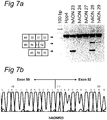
- mAON#4, #6, and #11 previously shown to be effective in mouse muscle cells in vitro, we were able to induce the skipping of exon 46 in muscle tissue in vivo as determined by both RT-PCR and sequence analysis ( Fig. 9 ).
- the in vivo exon 46 skipping was dose-dependent with highest efficiencies (up to 10%) following injection of 20 ⁇ g per muscle per day for two subsequent days.
- a method for directing splicing of a pre-mRNA in a system capable of performing a splicing operation comprising contacting said pre-mRNA in said system with an agent capable of specifically inhibiting an exon inclusion signal of at least one exon in said pre-mRNA, said method further comprising allowing splicing of said pre-mRNA.
- a preferred method further comprises allowing translation of mRNA produced from splicing of said pre-mRNA.
- said mRNA encodes a functional protein.
- said protein comprises two or more domains, wherein at least one of said domains is encoded by said mRNA as a result of skipping of at least part of an exon in said pre-mRNA.
- said contacting results in activation of a cryptic splice site in a contacted exon.
- the methods of the first and second aspect are preferably such that said exon inclusion signal comprises an exon recognition sequence.
- the methods of the first and second aspect are preferably such that said exon inclusion signal is present in an exon comprising a strong splice donor/acceptor pair.
- the methods of the first and second aspect are preferably such that translation results in a mutant or normal dystrophin protein, more preferably wherein said mutant dystrophin protein is equivalent to a dystrophin protein of a Becker patient.
- said exon inclusion signal is present in exon number 2, 8, 43, 44, 45, 46, 50, 51, 52 or 53.
- the methods of the first and second aspect are preferably such that said agent comprises nucleic acid or a functional equivalent thereof. More preferably, said nucleic acid contains between 15-25 nucleotides or a functional equivalent thereof.
- the methods of the first and second aspect are preferably such that they further comprise providing said cell with another agent capable of inhibiting an exon inclusion signal present in another exon of said pre-mRNA.
- a method for determining whether a nucleic acid or functional equivalent thereof, comprising complementarity to a part of an exon, is capable of specifically inhibiting an exon inclusion signal of said exon comprising providing a cell having a pre-mRNA containing said exon, with said nucleic acid, culturing said cell to allow the formation of an mRNA from said pre-mRNA and determining whether said exon is absent from said mRNA.
- a preferred method of the third aspect further comprises determining in vitro the relative binding affinity of said nucleic acid or functional equivalent thereof to an RNA molecule comprising said exon.
- nucleic acid or functional equivalent thereof obtainable by a method of the third aspect.
- nucleic acid delivery vehicle comprising a nucleic acid of the fourth aspect, or the complement thereof.
- nucleic acid delivery vehicle capable of expressing a nucleic acid of the fourth aspect.
- a nucleic acid of the fourth aspect or a nucleic acid delivery vehicle of the fifth or sixth aspect for the preparation of a medicament.
- nucleic acid of the fourth aspect or a nucleic acid delivery vehicle of the fifth or sixth aspect for the preparation of a medicament for the treatment of an inherited disease or predisposition to a disease.
- nucleic acid or an equivalent thereof comprising an exon inclusion signal inhibiting quality for the preparation of a medicament.
- a non-human animal provided with a nucleic acid of the fourth aspect.
- the non-human animal of the tenth aspect further comprises a nucleic acid encoding a human protein or a functional equivalent thereof. Even more preferably this non-human animal further comprises a silencing mutation in the gene encoding an animal homologue of said human protein.
Landscapes
- Health & Medical Sciences (AREA)
- Life Sciences & Earth Sciences (AREA)
- Engineering & Computer Science (AREA)
- Chemical & Material Sciences (AREA)
- Genetics & Genomics (AREA)
- General Health & Medical Sciences (AREA)
- Organic Chemistry (AREA)
- Biomedical Technology (AREA)
- Bioinformatics & Cheminformatics (AREA)
- Medicinal Chemistry (AREA)
- Pharmacology & Pharmacy (AREA)
- Animal Behavior & Ethology (AREA)
- Public Health (AREA)
- Veterinary Medicine (AREA)
- Molecular Biology (AREA)
- Biotechnology (AREA)
- General Engineering & Computer Science (AREA)
- Zoology (AREA)
- Wood Science & Technology (AREA)
- Nuclear Medicine, Radiotherapy & Molecular Imaging (AREA)
- General Chemical & Material Sciences (AREA)
- Chemical Kinetics & Catalysis (AREA)
- Epidemiology (AREA)
- Biochemistry (AREA)
- Microbiology (AREA)
- Plant Pathology (AREA)
- Biophysics (AREA)
- Physics & Mathematics (AREA)
- Virology (AREA)
- Oncology (AREA)
- Neurology (AREA)
- Diabetes (AREA)
- Physical Education & Sports Medicine (AREA)
- Dispersion Chemistry (AREA)
- Hematology (AREA)
- Neurosurgery (AREA)
- Communicable Diseases (AREA)
- Endocrinology (AREA)
- Orthopedic Medicine & Surgery (AREA)
- Medicines That Contain Protein Lipid Enzymes And Other Medicines (AREA)
Claims (9)
- Procédé in vitro permettant de déterminer si un oligonucléotide antisens composé de 14 à 40 nucléotides comprenant de la complémentarité à une partie d'un exon 51 de dystrophine humaine est capable d'inhiber spécifiquement une séquence de reconnaissance d'exon dudit exon, comprenant les étapes suivantes :fourniture d'une cellule possédant un pré-mARN contenant ledit exon avec ledit oligonucléotide antisens,mise en culture de ladite cellule pour permettre la formation d'un mARN à partir dudit pré-mARN etdétermination pour savoir si ledit exon est absent dudit mARN.
- Procédé selon la revendication 1, dans lequel l'oligonucléotide a de 14 à 25 nucléotides.
- Procédé selon la revendication 1 ou la revendication 2, dans lequel l'oligonucléotide est un Acide Nucléique Peptidique (ANP).
- Procédé selon l'une quelconque des revendications 1 à 3, dans lequel chaque T de l'oligonucléotide a été remplacé par un U.
- Procédé selon l'une quelconque des revendications 1 à 4, dans lequel l'oligonucléotide est un 2'-O-méthyloligoribonucléotide.
- Procédé selon la revendication 5, dans lequel l'oligonucléotide est un phosphorothioate de 2'-O-méthyloligoribonucléotide.
- Procédé selon l'une quelconque des revendications 1, 2 ou 4, dans lequel l'oligonucléotide est délivré au moyen d'un véhicule de livraison d'acide nucléique comprenant une unité de transcription exprimant ledit oligonucléotide.
- Oligonucléotide antisens qui peut être obtenu par un procédé selon l'une quelconque des revendications 1 à 7.
- Oligonucléotide antisens selon la revendication 8, destiné à la préparation d'un médicament pour le traitement de la dystrophie musculaire de Duchenne chez un patient.
Priority Applications (3)
| Application Number | Priority Date | Filing Date | Title |
|---|---|---|---|
| EP15166264.0A EP2940139B1 (fr) | 2000-09-21 | 2001-09-21 | Induction du saut d'exons dans des cellules eucaryotes |
| EP18173900.4A EP3382021A1 (fr) | 2000-09-21 | 2001-09-21 | Induction du saut d'exons dans des cellules eucaryotes |
| CY20181100969T CY1121139T1 (el) | 2000-09-21 | 2018-09-19 | Επαγωγη παρακαμψης εξωνιου σε ευκαριωτικα κυτταρα |
Applications Claiming Priority (3)
| Application Number | Priority Date | Filing Date | Title |
|---|---|---|---|
| EP00203283A EP1191097A1 (fr) | 2000-09-21 | 2000-09-21 | Induction du "exon-skipping" dans des cellules eukaryotes |
| EP15166264.0A EP2940139B1 (fr) | 2000-09-21 | 2001-09-21 | Induction du saut d'exons dans des cellules eucaryotes |
| EP01979073A EP1320597A2 (fr) | 2000-09-21 | 2001-09-21 | Induction d'omission d'exon dans des cellules eucaryotes |
Related Parent Applications (1)
| Application Number | Title | Priority Date | Filing Date |
|---|---|---|---|
| EP01979073A Division EP1320597A2 (fr) | 2000-09-21 | 2001-09-21 | Induction d'omission d'exon dans des cellules eucaryotes |
Related Child Applications (2)
| Application Number | Title | Priority Date | Filing Date |
|---|---|---|---|
| EP18173900.4A Division EP3382021A1 (fr) | 2000-09-21 | 2001-09-21 | Induction du saut d'exons dans des cellules eucaryotes |
| EP18173900.4A Division-Into EP3382021A1 (fr) | 2000-09-21 | 2001-09-21 | Induction du saut d'exons dans des cellules eucaryotes |
Publications (2)
| Publication Number | Publication Date |
|---|---|
| EP2940139A1 EP2940139A1 (fr) | 2015-11-04 |
| EP2940139B1 true EP2940139B1 (fr) | 2018-07-04 |
Family
ID=8172043
Family Applications (14)
| Application Number | Title | Priority Date | Filing Date |
|---|---|---|---|
| EP00203283A Withdrawn EP1191097A1 (fr) | 2000-09-21 | 2000-09-21 | Induction du "exon-skipping" dans des cellules eukaryotes |
| EP10177969.2A Expired - Lifetime EP2284264B1 (fr) | 2000-09-21 | 2001-09-21 | Induction du "exon-skipping" dans des céllules eukaryotes |
| EP12198485.0A Expired - Lifetime EP2594641B1 (fr) | 2000-09-21 | 2001-09-21 | Induction du saut d'exons dans des cellules eucaryotes |
| EP12198497.5A Expired - Lifetime EP2594642B1 (fr) | 2000-09-21 | 2001-09-21 | Induction du saut d'exons dans des cellules eucaryotes |
| EP12198517.0A Expired - Lifetime EP2602322B1 (fr) | 2000-09-21 | 2001-09-21 | Induction du saut d'exons dans des cellules eucaryotes |
| EP01979073A Ceased EP1320597A2 (fr) | 2000-09-21 | 2001-09-21 | Induction d'omission d'exon dans des cellules eucaryotes |
| EP13170239.1A Expired - Lifetime EP2636740B1 (fr) | 2000-09-21 | 2001-09-21 | Induction du saut d'exons dans des cellules eucaryotes |
| EP12198465.2A Expired - Lifetime EP2594640B1 (fr) | 2000-09-21 | 2001-09-21 | Induction du saut d'exons dans des cellules eucaryotes |
| EP13170251.6A Expired - Lifetime EP2636742B1 (fr) | 2000-09-21 | 2001-09-21 | Induction du saut d'exons dans des cellules eucaryotes |
| EP05076770.6A Expired - Lifetime EP1619249B2 (fr) | 2000-09-21 | 2001-09-21 | Induction du "exon-skipping" dans des céllules eukaryotes |
| EP13170245.8A Revoked EP2636741B1 (fr) | 2000-09-21 | 2001-09-21 | Induction du saut d'exons dans des cellules eucaryotes |
| EP14176300.3A Expired - Lifetime EP2801618B1 (fr) | 2000-09-21 | 2001-09-21 | Induction du saut d'exons dans des cellules eucaryotes |
| EP15166264.0A Expired - Lifetime EP2940139B1 (fr) | 2000-09-21 | 2001-09-21 | Induction du saut d'exons dans des cellules eucaryotes |
| EP18173900.4A Withdrawn EP3382021A1 (fr) | 2000-09-21 | 2001-09-21 | Induction du saut d'exons dans des cellules eucaryotes |
Family Applications Before (12)
| Application Number | Title | Priority Date | Filing Date |
|---|---|---|---|
| EP00203283A Withdrawn EP1191097A1 (fr) | 2000-09-21 | 2000-09-21 | Induction du "exon-skipping" dans des cellules eukaryotes |
| EP10177969.2A Expired - Lifetime EP2284264B1 (fr) | 2000-09-21 | 2001-09-21 | Induction du "exon-skipping" dans des céllules eukaryotes |
| EP12198485.0A Expired - Lifetime EP2594641B1 (fr) | 2000-09-21 | 2001-09-21 | Induction du saut d'exons dans des cellules eucaryotes |
| EP12198497.5A Expired - Lifetime EP2594642B1 (fr) | 2000-09-21 | 2001-09-21 | Induction du saut d'exons dans des cellules eucaryotes |
| EP12198517.0A Expired - Lifetime EP2602322B1 (fr) | 2000-09-21 | 2001-09-21 | Induction du saut d'exons dans des cellules eucaryotes |
| EP01979073A Ceased EP1320597A2 (fr) | 2000-09-21 | 2001-09-21 | Induction d'omission d'exon dans des cellules eucaryotes |
| EP13170239.1A Expired - Lifetime EP2636740B1 (fr) | 2000-09-21 | 2001-09-21 | Induction du saut d'exons dans des cellules eucaryotes |
| EP12198465.2A Expired - Lifetime EP2594640B1 (fr) | 2000-09-21 | 2001-09-21 | Induction du saut d'exons dans des cellules eucaryotes |
| EP13170251.6A Expired - Lifetime EP2636742B1 (fr) | 2000-09-21 | 2001-09-21 | Induction du saut d'exons dans des cellules eucaryotes |
| EP05076770.6A Expired - Lifetime EP1619249B2 (fr) | 2000-09-21 | 2001-09-21 | Induction du "exon-skipping" dans des céllules eukaryotes |
| EP13170245.8A Revoked EP2636741B1 (fr) | 2000-09-21 | 2001-09-21 | Induction du saut d'exons dans des cellules eucaryotes |
| EP14176300.3A Expired - Lifetime EP2801618B1 (fr) | 2000-09-21 | 2001-09-21 | Induction du saut d'exons dans des cellules eucaryotes |
Family Applications After (1)
| Application Number | Title | Priority Date | Filing Date |
|---|---|---|---|
| EP18173900.4A Withdrawn EP3382021A1 (fr) | 2000-09-21 | 2001-09-21 | Induction du saut d'exons dans des cellules eucaryotes |
Country Status (16)
| Country | Link |
|---|---|
| US (6) | US7973015B2 (fr) |
| EP (14) | EP1191097A1 (fr) |
| JP (7) | JP4846965B2 (fr) |
| AT (1) | ATE409224T2 (fr) |
| AU (4) | AU1106202A (fr) |
| CA (1) | CA2423044C (fr) |
| CY (10) | CY1109601T1 (fr) |
| DE (1) | DE60135936D1 (fr) |
| DK (10) | DK2284264T3 (fr) |
| ES (11) | ES2609421T3 (fr) |
| LT (3) | LT2284264T (fr) |
| NZ (1) | NZ524853A (fr) |
| PT (7) | PT2594640E (fr) |
| SI (1) | SI2801618T1 (fr) |
| TR (1) | TR201810606T4 (fr) |
| WO (1) | WO2002024906A1 (fr) |
Cited By (1)
| Publication number | Priority date | Publication date | Assignee | Title |
|---|---|---|---|---|
| CN112430645A (zh) * | 2020-12-09 | 2021-03-02 | 北京华瑞康源生物科技发展有限公司 | 一种多重实时荧光pcr法检测人dmd基因拷贝数的相对定量方法及试剂盒 |
Families Citing this family (145)
| Publication number | Priority date | Publication date | Assignee | Title |
|---|---|---|---|---|
| JP3165890B2 (ja) | 1997-02-04 | 2001-05-14 | 株式会社 シーズ | プリント配線板のレイアップ方法 |
| US6784291B2 (en) | 2000-05-04 | 2004-08-31 | Avi Biopharma, Inc. | Splice-region antisense composition and method |
| EP1191097A1 (fr) | 2000-09-21 | 2002-03-27 | Leids Universitair Medisch Centrum | Induction du "exon-skipping" dans des cellules eukaryotes |
| ITRM20020253A1 (it) * | 2002-05-08 | 2003-11-10 | Univ Roma | Molecole chimeriche di snrna con sequenze antisenso per le giunzioni di splicing del gene della distrofina e applicazioni terapeutiche. |
| EP2392660A3 (fr) * | 2002-11-25 | 2012-03-28 | Masafumi Matsuo | Médicaments à base d'acide nucléique ENA modifiant l'épissage dans un précurseur d'ARNm |
| AU2003225410A1 (en) | 2003-03-21 | 2004-10-11 | Academisch Ziekenhuis Leiden | Modulation of exon recognition in pre-mrna by interfering with the secondary rna structure |
| US7468418B2 (en) * | 2003-04-29 | 2008-12-23 | Avi Biopharma., Inc. | Compositions for enhancing transport of molecules into cells |
| US20050288246A1 (en) | 2004-05-24 | 2005-12-29 | Iversen Patrick L | Peptide conjugated, inosine-substituted antisense oligomer compound and method |
| USRE48960E1 (en) | 2004-06-28 | 2022-03-08 | The University Of Western Australia | Antisense oligonucleotides for inducing exon skipping and methods of use thereof |
| EP2933332A1 (fr) | 2004-06-28 | 2015-10-21 | The University Of Western Australia | Oligonucléotides antisens permettant d'induire un saut d'exon et leurs procédés d'utilisation |
| FR2874384B1 (fr) * | 2004-08-17 | 2010-07-30 | Genethon | Vecteur viral adeno-associe pour realiser du saut d'exons dans un gene codant une proteine a domaines dispensables |
| EP1855694B1 (fr) | 2005-02-09 | 2020-12-02 | Sarepta Therapeutics, Inc. | Composition antisens permettant de traiter une atrophie musculaire |
| WO2006112705A2 (fr) * | 2005-04-22 | 2006-10-26 | Academisch Ziekenhuis Leiden | Modulation de la reconnaissance d'exon dans un pre-arnm par interference avec la liaison de proteines sr et interference avec une structure d'arn secondaire |
| US8067571B2 (en) | 2005-07-13 | 2011-11-29 | Avi Biopharma, Inc. | Antibacterial antisense oligonucleotide and method |
| US7785834B2 (en) * | 2005-11-10 | 2010-08-31 | Ercole Biotech, Inc. | Soluble TNF receptors and their use in treatment of disease |
| WO2007058894A2 (fr) * | 2005-11-10 | 2007-05-24 | The University Of North Carolina At Chapel Hill | Oligomeres permutant l’epissage destines a la superfamille des recepteurs tnf et leur utilisation lors de traitements de maladies |
| WO2007123391A1 (fr) | 2006-04-20 | 2007-11-01 | Academisch Ziekenhuis Leiden | Intervention thérapeutique dans une maladie génétique chez un individu en modifiant l'expression d'un gène exprimé de manière aberrante. |
| EP1857548A1 (fr) | 2006-05-19 | 2007-11-21 | Academisch Ziekenhuis Leiden | Procédé et moyen permettant d'induire un saut d'exon |
| SI2049664T1 (sl) | 2006-08-11 | 2012-04-30 | Prosensa Technologies Bv | Enojna veriga oligonukleotidov, komplementarna repetitivnim elementom, za zdravljenje genetskih bolezni, povezanih z nestabilnostjo dnk ponovitev |
| US20090264353A1 (en) * | 2007-10-19 | 2009-10-22 | Santaris Pharma A/S | Splice Switching Oligomers for TNF Superfamily Receptors and their Use in Treatment of Disease |
| WO2009005793A2 (fr) * | 2007-06-29 | 2009-01-08 | Avi Biopharma, Inc. | Conjugués peptidiques spécifiques d'un tissu et procédés |
| US20100016215A1 (en) | 2007-06-29 | 2010-01-21 | Avi Biopharma, Inc. | Compound and method for treating myotonic dystrophy |
| WO2009008727A2 (fr) | 2007-07-12 | 2009-01-15 | Prosensa Technologies B.V. | Molécules permettant d'orienter des composés vers divers organes ou tissus sélectionnés |
| CA2693742A1 (fr) | 2007-07-12 | 2009-01-15 | Prosensa Technologies B.V. | Molecules pour cibler des composes vers divers organes, tissus ou cellules tumorales selectionnes |
| ES2639852T3 (es) | 2007-10-26 | 2017-10-30 | Academisch Ziekenhuis Leiden | Medios y métodos para contrarrestar los trastornos musculares |
| USRE48468E1 (en) | 2007-10-26 | 2021-03-16 | Biomarin Technologies B.V. | Means and methods for counteracting muscle disorders |
| WO2009099326A1 (fr) | 2008-02-08 | 2009-08-13 | Prosensa Holding Bv | Méthodes et moyens pour traiter les affections génétiques associées à l’instabilité de répétition d’adn |
| EP2119783A1 (fr) | 2008-05-14 | 2009-11-18 | Prosensa Technologies B.V. | Procédé pour l'omission efficace de l'exon (44) dans la dystrophie musculaire de Duchenne et moyens connexes |
| US8084601B2 (en) | 2008-09-11 | 2011-12-27 | Royal Holloway And Bedford New College Royal Holloway, University Of London | Oligomers |
| BR122020021379B1 (pt) * | 2008-10-24 | 2021-05-11 | Sarepta Therapeutics, Inc. | oligômero morfolino fosforodiamidato, composição que compreende o mesmo e uso do dito oligômero para tratar distrofia muscular |
| CN102282155B (zh) | 2008-12-02 | 2017-06-09 | 日本波涛生命科学公司 | 磷原子修饰的核酸的合成方法 |
| EP2421971B1 (fr) | 2009-04-24 | 2016-07-06 | BioMarin Technologies B.V. | Oligonucléotides comportant une inosine pour le traitement de dmd |
| US20110269665A1 (en) | 2009-06-26 | 2011-11-03 | Avi Biopharma, Inc. | Compound and method for treating myotonic dystrophy |
| RU2612521C2 (ru) | 2009-07-06 | 2017-03-09 | Онтории, Инк. | Новые пролекарства нуклеиновых кислот и способы их применения |
| US20120270930A1 (en) | 2009-10-29 | 2012-10-25 | Academisch Ziekenhuis Leiden H.O.D.N. Lumc | Methods and compositions for dysferlin exon-skipping |
| TR201816523T4 (tr) | 2009-11-12 | 2018-11-21 | Univ Western Australia | Patolojilerin tedavisine yönelik antisens moleküller ve yöntemler. |
| WO2011078672A1 (fr) | 2009-12-24 | 2011-06-30 | Prosensa Technologies B.V. | Molécule pour traiter un trouble inflammatoire |
| EP2601294B1 (fr) * | 2010-08-05 | 2018-11-28 | Academisch Ziekenhuis Leiden h.o.d.n. LUMC | Oligonucléotide antisens destiné à éliminer des sites de clivage protéolytiques de protéines |
| TWI541024B (zh) | 2010-09-01 | 2016-07-11 | 日本新藥股份有限公司 | 反義核酸 |
| JP5868324B2 (ja) | 2010-09-24 | 2016-02-24 | 株式会社Wave Life Sciences Japan | 不斉補助基 |
| AU2012240656A1 (en) | 2011-04-05 | 2013-10-24 | Academisch Ziekenhuis Leiden H.O.D.N. Lumc | Compounds and methods for altering activin receptor-like kinase signalling |
| US9161948B2 (en) | 2011-05-05 | 2015-10-20 | Sarepta Therapeutics, Inc. | Peptide oligonucleotide conjugates |
| CN103796657B (zh) | 2011-07-19 | 2017-07-11 | 波涛生命科学有限公司 | 合成官能化核酸的方法 |
| WO2013033407A2 (fr) | 2011-08-30 | 2013-03-07 | The Regents Of The University Of California | Identification de petites molécules qui améliorent le saut d'exon thérapeutique |
| EP2753694B1 (fr) | 2011-09-05 | 2017-08-23 | Stichting Katholieke Universiteit | Oligonucléotides antisens pour le traitement de l'amaurose congénitale de leber |
| US20130085139A1 (en) | 2011-10-04 | 2013-04-04 | Royal Holloway And Bedford New College | Oligomers |
| CA2861247C (fr) * | 2011-12-28 | 2021-11-16 | Nippon Shinyaku Co., Ltd. | Acide nucleique antisens |
| NZ627896A (en) | 2012-01-27 | 2016-11-25 | Biomarin Technologies B V | Rna modulating oligonucleotides with improved characteristics for the treatment of duchenne and becker muscular dystrophy |
| DE102012103041A1 (de) | 2012-04-10 | 2013-10-10 | Eberhard-Karls-Universität Tübingen Universitätsklinikum | Behandlung der dilativen Kardiomyopathie mittels Antisense-Oligonucleotiden |
| EP2870246B1 (fr) * | 2012-07-03 | 2019-09-11 | BioMarin Technologies B.V. | Oligonucléotide pour le traitement de patients atteints de dystrophie musculaire |
| CA2879066C (fr) | 2012-07-13 | 2019-08-13 | Shin Nippon Biomedical Laboratories, Ltd. | Adjuvant d'acide nucleique chiral |
| KR102213609B1 (ko) | 2012-07-13 | 2021-02-08 | 웨이브 라이프 사이언시스 리미티드 | 키랄 제어 |
| PL2872485T3 (pl) | 2012-07-13 | 2021-05-31 | Wave Life Sciences Ltd. | Asymetryczna grupa pomocnicza |
| US9873739B2 (en) | 2012-08-01 | 2018-01-23 | Ikaika Therapeutics, Llc | Mitigating tissue damage and fibrosis via latent transforming growth factor beta binding protein (LTBP4) |
| CN110218727A (zh) | 2013-03-14 | 2019-09-10 | 萨勒普塔医疗公司 | 用于治疗肌营养不良的外显子跳跃组合物 |
| US20140329762A1 (en) | 2013-03-15 | 2014-11-06 | Sarepta Therapeutics, Inc. | Compositions for treating muscular dystrophy |
| US9849066B2 (en) | 2013-04-24 | 2017-12-26 | Corning Incorporated | Delamination resistant pharmaceutical glass containers containing active pharmaceutical ingredients |
| JPWO2015108047A1 (ja) | 2014-01-15 | 2017-03-23 | 株式会社新日本科学 | 免疫誘導活性を有するキラル核酸アジュバンド及び免疫誘導活性剤 |
| US10322173B2 (en) | 2014-01-15 | 2019-06-18 | Shin Nippon Biomedical Laboratories, Ltd. | Chiral nucleic acid adjuvant having anti-allergic activity, and anti-allergic agent |
| JPWO2015108048A1 (ja) | 2014-01-15 | 2017-03-23 | 株式会社新日本科学 | 抗腫瘍作用を有するキラル核酸アジュバンド及び抗腫瘍剤 |
| BR112016016400A2 (pt) | 2014-01-16 | 2017-10-03 | Wave Life Sciences Ltd | Composições de oligonucleotídeos quiralmente controlados, seu uso, sua composição farmacêutica, e métodos |
| CA2937328C (fr) | 2014-01-24 | 2022-09-27 | Am-Pharma B.V. | Proteines de type phosphatase alcaline chimere |
| ES2810813T3 (es) | 2014-01-24 | 2021-03-09 | Am Pharma Bv | Procesamiento para recuperación y purificación de una fosfatasa alcalina |
| DK3118311T3 (en) * | 2014-03-12 | 2019-03-11 | Nippon Shinyaku Co Ltd | Antisense nucleic acid |
| WO2015171918A2 (fr) | 2014-05-07 | 2015-11-12 | Louisiana State University And Agricultural And Mechanical College | Compositions et leurs utilisations thérapeutiques |
| US10131910B2 (en) | 2014-07-10 | 2018-11-20 | Stichting Katholieke Universiteit | Antisense oligonucleotides for the treatment of Usher syndrome type 2 |
| CN106714845A (zh) * | 2014-08-11 | 2017-05-24 | 得克萨斯州大学系统董事会 | 通过crispr/cas9介导的基因编辑预防肌营养不良 |
| JP7242180B2 (ja) | 2014-09-07 | 2023-03-20 | セレクタ バイオサイエンシーズ インコーポレーテッド | 抗ウイルス導入ベクター免疫応答を減弱化するための方法および組成物 |
| US20170266320A1 (en) * | 2014-12-01 | 2017-09-21 | President And Fellows Of Harvard College | RNA-Guided Systems for In Vivo Gene Editing |
| GB201504124D0 (en) | 2015-03-11 | 2015-04-22 | Proqr Therapeutics B V | Oligonucleotides |
| MA41795A (fr) | 2015-03-18 | 2018-01-23 | Sarepta Therapeutics Inc | Exclusion d'un exon induite par des composés antisens dans la myostatine |
| US11020417B2 (en) | 2015-06-04 | 2021-06-01 | Sarepta Therapeutics, Inc | Methods and compounds for treatment of lymphocyte-related diseases and conditions |
| HUE050061T2 (hu) | 2015-09-15 | 2020-12-28 | Nippon Shinyaku Co Ltd | Antiszensz nukleinsav |
| EP3858993A1 (fr) | 2015-10-09 | 2021-08-04 | Sarepta Therapeutics, Inc. | Compositions et procédés pour le traitement de la dystrophie musculaire de duchenne et de troubles apparentés |
| IL295755A (en) | 2015-10-09 | 2022-10-01 | Wave Life Sciences Ltd | Oligonucleotide compositions and methods thereof |
| WO2017136435A1 (fr) | 2016-02-01 | 2017-08-10 | The Usa, As Represented By The Secretary, Department Of Health And Human Services Office Of Technology Transfer National Institute Of Health | Composés permettant de moduler l'expression de fc-epsilon-ri-bêta et utilisations correspondantes |
| JP2019513371A (ja) | 2016-04-01 | 2019-05-30 | アビディティー バイオサイエンシーズ エルエルシー | 核酸ポリペプチド組成物とその使用 |
| JP7043082B2 (ja) | 2016-04-25 | 2022-03-29 | プロキューアール セラピューティクス ツー ベスローテン フェンノートシャップ | 眼疾患を処置するオリゴヌクレオチド |
| WO2017220751A1 (fr) | 2016-06-22 | 2017-12-28 | Proqr Therapeutics Ii B.V. | Oligonucléotides d'édition d'arn monocaténaire |
| JP2019525742A (ja) | 2016-06-30 | 2019-09-12 | サレプタ セラピューティクス, インコーポレイテッド | 筋ジストロフィーに対するエクソンスキッピングオリゴマー |
| MX2018016253A (es) * | 2016-07-05 | 2019-09-09 | Biomarin Tech Bv | Oligonucleotidos de conmutacion o modulacion de empalme de pre-arnm que comprenden radicales de andamio biciclicos, con caracteristicas mejoradas para el tratamiento de trastornos geneticos. |
| CN110352244B (zh) | 2016-09-01 | 2023-03-21 | ProQR治疗上市公司Ⅱ | 化学修饰的编辑rna的单链寡核苷酸 |
| SG10201607303YA (en) * | 2016-09-01 | 2018-04-27 | Agency Science Tech & Res | Antisense oligonucleotides to induce exon skipping |
| GB201616202D0 (en) | 2016-09-23 | 2016-11-09 | Proqr Therapeutics Ii Bv | Antisense oligonucleotides for the treatment of eye deisease |
| JP7659291B2 (ja) | 2016-12-13 | 2025-04-09 | スティヒティング ラドバウド ユニヴェルシテール メディッシュ セントルム | スターガルト病の治療のためのアンチセンスオリゴヌクレオチド |
| PT3554552T (pt) | 2016-12-19 | 2022-10-03 | Sarepta Therapeutics Inc | Conjugados de oligómero de skipping de exão para distrofia muscular |
| KR20240006023A (ko) | 2016-12-19 | 2024-01-12 | 사렙타 쎄러퓨틱스 인코퍼레이티드 | 근육 이상증에 대한 엑손 스킵핑 올리고머 결합체 |
| KR102810425B1 (ko) | 2016-12-19 | 2025-05-21 | 사렙타 쎄러퓨틱스 인코퍼레이티드 | 근육 이상증에 대한 엑손 스킵핑 올리고머 결합체 |
| MX2019008199A (es) | 2017-01-06 | 2019-11-25 | Avidity Biosciences Llc | Composiciones de acido nucleico polipeptido y metodos de induccion de la omision de exon. |
| GB201706009D0 (en) | 2017-04-13 | 2017-05-31 | Proqr Therapeutics Ii Bv | Antisense oligonucleotides for the treatment of stargardt disease |
| CN111164211B (zh) | 2017-07-18 | 2024-08-02 | 杰特贝林基因治疗股份有限公司 | 用于治疗β-血红蛋白病的组合物和方法 |
| GB201711809D0 (en) | 2017-07-21 | 2017-09-06 | Governors Of The Univ Of Alberta | Antisense oligonucleotide |
| WO2019028440A1 (fr) | 2017-08-04 | 2019-02-07 | Skyhawk Therapeutics, Inc. | Méthodes et compositions permettant de moduler l'épissageé |
| EP3665304A4 (fr) * | 2017-08-11 | 2021-04-28 | Agency for Science, Technology and Research | Procédé de criblage de variants ou d'événements d'épissage |
| EA201991450A1 (ru) | 2017-09-22 | 2019-12-30 | Сарепта Терапьютикс, Инк. | Конъюгаты олигомеров для пропуска экзона при мышечной дистрофии |
| EP3687547A1 (fr) | 2017-09-28 | 2020-08-05 | Sarepta Therapeutics, Inc. | Polythérapies pour traiter une dystrophie musculaire |
| BR112020007157A2 (pt) | 2017-10-13 | 2020-09-24 | Selecta Biosciences, Inc. | métodos e composições para a atenuação de respostas de igm antivetor de transferência viral |
| GB201803010D0 (en) | 2018-02-26 | 2018-04-11 | Royal Holloway & Bedford New College | Neurodegenerative disorders |
| GB201808146D0 (en) | 2018-05-18 | 2018-07-11 | Proqr Therapeutics Ii Bv | Stereospecific Linkages in RNA Editing Oligonucleotides |
| US10758629B2 (en) | 2018-05-29 | 2020-09-01 | Sarepta Therapeutics, Inc. | Exon skipping oligomer conjugates for muscular dystrophy |
| WO2020015959A1 (fr) | 2018-07-19 | 2020-01-23 | Stichting Katholieke Universiteit | Oligonucléotides antisens corrigeant l'épissage aberrant d'abca4 |
| SG11202100928QA (en) | 2018-08-02 | 2021-02-25 | Dyne Therapeutics Inc | Muscle targeting complexes and uses thereof for treating facioscapulohumeral muscular dystrophy |
| US12018087B2 (en) | 2018-08-02 | 2024-06-25 | Dyne Therapeutics, Inc. | Muscle-targeting complexes comprising an anti-transferrin receptor antibody linked to an oligonucleotide and methods of delivering oligonucleotide to a subject |
| CA3108282A1 (fr) | 2018-08-02 | 2020-02-06 | Dyne Therapeutics, Inc. | Complexes de ciblage musculaire et leurs utilisations pour le traitement de dystrophinopathies |
| US11168141B2 (en) | 2018-08-02 | 2021-11-09 | Dyne Therapeutics, Inc. | Muscle targeting complexes and uses thereof for treating dystrophinopathies |
| SG11202103938UA (en) | 2018-11-02 | 2021-05-28 | Biomarin Tech Bv | Bispecific antisense oligonucleotides for dystrophin exon skipping |
| WO2020115106A1 (fr) | 2018-12-04 | 2020-06-11 | Stichting Katholieke Universiteit | Oligonucléotides antisens corrigeant l'épissage aberrant d'abca4 |
| EP3897745A1 (fr) | 2018-12-23 | 2021-10-27 | CSL Behring LLC | Thérapie génique de cellules souches hématopoïétiques pour le syndrome de wiskott-aldrich |
| KR20210118833A (ko) | 2018-12-23 | 2021-10-01 | 씨에스엘 베링 엘엘씨 | 킬 스위치를 갖는 공여 t 세포 |
| WO2020148400A1 (fr) | 2019-01-16 | 2020-07-23 | Stichting Katholieke Universiteit | Oligonucléotides antisens destinés à être utilisés dans le traitement d'un crpc |
| JP2022518808A (ja) | 2019-01-28 | 2022-03-16 | プロキューアール セラピューティクス ツー ベスローテン フェンノートシャップ | レーバー先天黒内障の処置のためのアンチセンスオリゴヌクレオチド |
| WO2020163248A1 (fr) | 2019-02-04 | 2020-08-13 | Skyhawk Therapeutics, Inc. | Procédés et compositions pour moduler l'épissage |
| CN114126613A (zh) | 2019-02-05 | 2022-03-01 | 斯基霍克疗法公司 | 用于调节剪接的方法和组合物 |
| EP3920915A4 (fr) | 2019-02-05 | 2022-10-05 | Skyhawk Therapeutics, Inc. | Procédés et compositions pour moduler l'épissage |
| CN113661162A (zh) | 2019-02-06 | 2021-11-16 | 斯基霍克疗法公司 | 用于调节剪接的方法和组合物 |
| WO2020163544A1 (fr) | 2019-02-06 | 2020-08-13 | Skyhawk Therapeutics, Inc. | Procédés et compositions pour moduler l'épissage |
| US20220177894A1 (en) | 2019-04-02 | 2022-06-09 | Proqr Therapeutics Ii B.V. | Antisense oligonucleotides for immunotherapy |
| CA3136172A1 (fr) | 2019-04-18 | 2020-10-22 | Proqr Therapeutics Ii B.V. | Oligonucleotides antisens pour le traitement du syndrome d'usher |
| CN114206396A (zh) | 2019-05-28 | 2022-03-18 | 西莱克塔生物科技公司 | 用于减弱抗病毒转移载体免疫应答的方法和组合物 |
| WO2020254249A1 (fr) | 2019-06-21 | 2020-12-24 | Proqr Therapeutics Ii B.V. | Administration d'acides nucléiques pour le traitement de troubles auditifs |
| US20220290154A1 (en) | 2019-08-08 | 2022-09-15 | Stichting Radboud Universitair Medisch Centrum | Antisense oligonucleotides rescue aberrant splicing of ABCA4 |
| WO2021087164A1 (fr) * | 2019-10-30 | 2021-05-06 | Shire Human Genetic Therapies, Inc. | Procédés pour la détection d'oligonucléotides |
| WO2021084021A1 (fr) | 2019-10-31 | 2021-05-06 | Stichting Katholieke Universiteit | Thérapie de silençage spécifique d'un allèle pour dfna9 à l'aide d'oligonucléotides antisens |
| EP4058032A4 (fr) | 2019-12-19 | 2024-01-10 | Entrada Therapeutics, Inc. | Compositions pour administrer des composés antisens |
| IL295967A (en) | 2020-02-28 | 2022-10-01 | Nippon Shinyaku Co Ltd | Antisense nucleic acids for splicing on exon 51 |
| CA3166720A1 (fr) | 2020-03-04 | 2021-09-10 | Jim SWILDENS | Oligonucleotides antisens destines a etre utilises dans le traitement d'un syndrome de usher |
| WO2021263070A1 (fr) | 2020-06-26 | 2021-12-30 | Csl Behring Llc | Lymphocytes t de donneur à commutateur d'activité tueuse |
| WO2022090256A1 (fr) | 2020-10-26 | 2022-05-05 | Proqr Therapeutics Ii B.V. | Oligonucléotides antisens pour le traitement de la maladie de stargardt |
| US11987795B2 (en) | 2020-11-24 | 2024-05-21 | The Broad Institute, Inc. | Methods of modulating SLC7A11 pre-mRNA transcripts for diseases and conditions associated with expression of SLC7A11 |
| AU2022271873A1 (en) | 2021-05-10 | 2024-01-04 | Entrada Therapeutics, Inc. | Compositions and methods for intracellular therapeutics |
| AU2022298774A1 (en) | 2021-06-23 | 2023-12-14 | Entrada Therapeutics, Inc. | Antisense compounds and methods for targeting cug repeats |
| EP4359526A1 (fr) | 2021-06-25 | 2024-05-01 | Stichting Radboud universitair medisch centrum | Thérapie d'inactivation spécifique de l'allèle pour dfna21 utilisant des oligonucléotides antisens |
| US11771776B2 (en) | 2021-07-09 | 2023-10-03 | Dyne Therapeutics, Inc. | Muscle targeting complexes and uses thereof for treating dystrophinopathies |
| US11638761B2 (en) | 2021-07-09 | 2023-05-02 | Dyne Therapeutics, Inc. | Muscle targeting complexes and uses thereof for treating Facioscapulohumeral muscular dystrophy |
| JP2024525608A (ja) | 2021-07-09 | 2024-07-12 | ダイン セラピューティクス,インコーポレーテッド | ジストロフィン異常症を処置するための筋標的化複合体および製剤 |
| US11969475B2 (en) | 2021-07-09 | 2024-04-30 | Dyne Therapeutics, Inc. | Muscle targeting complexes and uses thereof for treating facioscapulohumeral muscular dystrophy |
| US20230141563A1 (en) | 2021-10-12 | 2023-05-11 | Selecta Biosciences, Inc. | Methods and compositions for attenuating anti-viral transfer vector igm responses |
| EP4215614A1 (fr) | 2022-01-24 | 2023-07-26 | Dynacure | Thérapie de combinaison pour maladies liées à la dystrophine |
| WO2023172624A1 (fr) | 2022-03-09 | 2023-09-14 | Selecta Biosciences, Inc. | Immunosuppresseurs en association avec des agents anti-igm et dosage associé |
| DE102022124232A1 (de) | 2022-09-21 | 2024-03-21 | Carl von Ossietzky Universität Oldenburg, Körperschaft des öffentlichen Rechts | Antisense-Oligonukleotide für die Behandlung des Joubert-Syndroms |
| EP4599061A1 (fr) | 2022-10-06 | 2025-08-13 | Stichting Radboud universitair medisch centrum | Oligonucléotides antisens pour le traitement de l'usher 2a. exon 68 |
| EP4599060A1 (fr) | 2022-10-06 | 2025-08-13 | Stichting Radboud universitair medisch centrum | Oligonucléotides antisens pour le traitement d'usher 2a. exons 30 à 31 |
| EP4619522A1 (fr) | 2022-11-15 | 2025-09-24 | Stichting Radboud universitair medisch centrum | Oligonucléotides antisens pour le traitement de usher 2a. exons 39-40 |
| GB202305535D0 (en) | 2023-04-14 | 2023-05-31 | Imperial College Innovations Ltd | Oligonucleotide decoy |
| AU2024323932A1 (en) | 2023-08-11 | 2026-03-12 | Stichting Radboud Universitair Medisch Centrum | Antisense oligonucleotides for treatment of usher 2a. exon 53 |
Family Cites Families (64)
| Publication number | Priority date | Publication date | Assignee | Title |
|---|---|---|---|---|
| US5034506A (en) * | 1985-03-15 | 1991-07-23 | Anti-Gene Development Group | Uncharged morpholino-based polymers having achiral intersubunit linkages |
| US5541308A (en) * | 1986-11-24 | 1996-07-30 | Gen-Probe Incorporated | Nucleic acid probes for detection and/or quantitation of non-viral organisms |
| US5766847A (en) * | 1988-10-11 | 1998-06-16 | Max-Planck-Gesellschaft Zur Forderung Der Wissenschaften E.V. | Process for analyzing length polymorphisms in DNA regions |
| US6867195B1 (en) * | 1989-03-21 | 2005-03-15 | Vical Incorporated | Lipid-mediated polynucleotide administration to reduce likelihood of subject's becoming infected |
| US5608046A (en) * | 1990-07-27 | 1997-03-04 | Isis Pharmaceuticals, Inc. | Conjugated 4'-desmethyl nucleoside analog compounds |
| FR2675803B1 (fr) * | 1991-04-25 | 1996-09-06 | Genset Sa | Oligonucleotides fermes, antisens et sens et leurs applications. |
| AU659482B2 (en) | 1991-06-28 | 1995-05-18 | Massachusetts Institute Of Technology | Localized oligonucleotide therapy |
| EP0558697A1 (fr) | 1991-06-28 | 1993-09-08 | Massachusetts Institute Of Technology | Therapie localisee utilisant des oligonucleotides |
| US6200747B1 (en) * | 1992-01-28 | 2001-03-13 | North Shore University Hospital Research Corp. | Method and kits for detection of fragile X specific, GC-rich DNA sequences |
| US5869252A (en) † | 1992-03-31 | 1999-02-09 | Abbott Laboratories | Method of multiplex ligase chain reaction |
| US6172208B1 (en) * | 1992-07-06 | 2001-01-09 | Genzyme Corporation | Oligonucleotides modified with conjugate groups |
| US5418139A (en) * | 1993-02-10 | 1995-05-23 | University Of Iowa Research Foundation | Method for screening for cardiomyopathy |
| DE69435005T2 (de) * | 1993-05-11 | 2008-04-17 | The University Of North Carolina At Chapel Hill | Antisense Oligonukleotide die anomales Splicing verhindern und deren Verwendung |
| US5741645A (en) * | 1993-06-29 | 1998-04-21 | Regents Of The University Of Minnesota | Gene sequence for spinocerebellar ataxia type 1 and method for diagnosis |
| US5624803A (en) * | 1993-10-14 | 1997-04-29 | The Regents Of The University Of California | In vivo oligonucleotide generator, and methods of testing the binding affinity of triplex forming oligonucleotides derived therefrom |
| US5627263A (en) * | 1993-11-24 | 1997-05-06 | La Jolla Cancer Research Foundation | Integrin-binding peptides |
| US5962332A (en) * | 1994-03-17 | 1999-10-05 | University Of Massachusetts | Detection of trinucleotide repeats by in situ hybridization |
| US5968909A (en) | 1995-08-04 | 1999-10-19 | Hybridon, Inc. | Method of modulating gene expression with reduced immunostimulatory response |
| US5854223A (en) | 1995-10-06 | 1998-12-29 | The Trustees Of Columbia University In The City Of New York | S-DC28 as an antirestenosis agent after balloon injury |
| US7034009B2 (en) * | 1995-10-26 | 2006-04-25 | Sirna Therapeutics, Inc. | Enzymatic nucleic acid-mediated treatment of ocular diseases or conditions related to levels of vascular endothelial growth factor receptor (VEGF-R) |
| US6300060B1 (en) * | 1995-11-09 | 2001-10-09 | Dana-Farber Cancer Institute, Inc. | Method for predicting the risk of prostate cancer morbidity and mortality |
| NZ331217A (en) | 1996-02-14 | 2000-02-28 | Novartis Ag | Sugar-modified gapped oligonucleotides for eliciting RNase H activity for strand cleavage in an opposing strand |
| US6251589B1 (en) * | 1996-07-18 | 2001-06-26 | Srl, Inc. | Method for diagnosing spinocerebellar ataxia type 2 and primers therefor |
| US5853995A (en) * | 1997-01-07 | 1998-12-29 | Research Development Foundation | Large scale genotyping of diseases and a diagnostic test for spinocerebellar ataxia type 6 |
| US20020137890A1 (en) * | 1997-03-31 | 2002-09-26 | Genentech, Inc. | Secreted and transmembrane polypeptides and nucleic acids encoding the same |
| US6329501B1 (en) * | 1997-05-29 | 2001-12-11 | Auburn University | Methods and compositions for targeting compounds to muscle |
| US6280938B1 (en) * | 1997-08-19 | 2001-08-28 | Regents Of The University Of Minnesota | SCA7 gene and method of use |
| US6514755B1 (en) * | 1998-08-18 | 2003-02-04 | Regents Of The University Of Minnesota | SCA7 gene and methods of use |
| US6794499B2 (en) * | 1997-09-12 | 2004-09-21 | Exiqon A/S | Oligonucleotide analogues |
| US6130207A (en) * | 1997-11-05 | 2000-10-10 | South Alabama Medical Science Foundation | Cell-specific molecule and method for importing DNA into a nucleus |
| JP3012923B2 (ja) * | 1998-01-26 | 2000-02-28 | 新潟大学長 | Cagリピート病の治療薬 |
| KR100280219B1 (ko) * | 1998-02-26 | 2001-04-02 | 이수빈 | 삼핵산 반복 서열을 이용한 신경정신 질환의 진단 방법 및 진단 시약 |
| US6322978B1 (en) * | 1998-04-20 | 2001-11-27 | Joslin Diabetes Center, Inc. | Repeat polymorphism in the frataxin gene and uses therefore |
| WO1999063975A2 (fr) * | 1998-06-10 | 1999-12-16 | Biognostik Gesellschaft für Biomolekulare Diagnostik mbH | Procede servant a stimuler le systeme immunitaire |
| US20030096955A1 (en) * | 1998-09-01 | 2003-05-22 | Genentech, Inc. | Secreted and transmembrane polypeptides and nucleic acids encoding the same |
| WO2000018895A1 (fr) * | 1998-09-25 | 2000-04-06 | The Children's Medical Center Corporation | Peptides courts modulant selectivement l'activite des proteines kinases |
| US6172216B1 (en) | 1998-10-07 | 2001-01-09 | Isis Pharmaceuticals Inc. | Antisense modulation of BCL-X expression |
| US6210892B1 (en) * | 1998-10-07 | 2001-04-03 | Isis Pharmaceuticals, Inc. | Alteration of cellular behavior by antisense modulation of mRNA processing |
| JP2000125448A (ja) † | 1998-10-14 | 2000-04-28 | Yazaki Corp | 電気接続箱 |
| US6399575B1 (en) * | 1998-11-10 | 2002-06-04 | Auburn University | Methods and compositions for targeting compounds to the central nervous system |
| US6133031A (en) * | 1999-08-19 | 2000-10-17 | Isis Pharmaceuticals Inc. | Antisense inhibition of focal adhesion kinase expression |
| US20040226056A1 (en) * | 1998-12-22 | 2004-11-11 | Myriad Genetics, Incorporated | Compositions and methods for treating neurological disorders and diseases |
| JP2000256547A (ja) | 1999-03-10 | 2000-09-19 | Sumitomo Dow Ltd | 耐熱性プラスチックカード用樹脂組成物 |
| US20020049173A1 (en) | 1999-03-26 | 2002-04-25 | Bennett C. Frank | Alteration of cellular behavior by antisense modulation of mRNA processing |
| US6379698B1 (en) * | 1999-04-06 | 2002-04-30 | Isis Pharmaceuticals, Inc. | Fusogenic lipids and vesicles |
| JP2000325085A (ja) | 1999-05-21 | 2000-11-28 | Masafumi Matsuo | デュシェンヌ型筋ジストロフィー治療剤 |
| US20030236214A1 (en) * | 1999-06-09 | 2003-12-25 | Wolff Jon A. | Charge reversal of polyion complexes and treatment of peripheral occlusive disease |
| AU5625500A (en) * | 1999-06-18 | 2001-01-09 | Emory University | Huntington disease cellular model: stably transfected pc12 cells expressing mutant huntingtin |
| EP1133993A1 (fr) | 2000-03-10 | 2001-09-19 | Max-Planck-Gesellschaft zur Förderung der Wissenschaften e.V. | Substances pour le traitement de l'atrophie musculaire spinale |
| US6653467B1 (en) | 2000-04-26 | 2003-11-25 | Jcr Pharmaceutical Co., Ltd. | Medicament for treatment of Duchenne muscular dystrophy |
| WO2001085751A1 (fr) * | 2000-05-09 | 2001-11-15 | Reliable Biopharmaceutical, Inc. | Composés polymères utiles comme promédicaments |
| US20030124523A1 (en) * | 2000-06-22 | 2003-07-03 | Asselbergs Fredericus Alphonsus Maria | Organic compounds |
| US6794192B2 (en) * | 2000-06-29 | 2004-09-21 | Pfizer Inc. | Target |
| US6727355B2 (en) | 2000-08-25 | 2004-04-27 | Jcr Pharmaceuticals Co., Ltd. | Pharmaceutical composition for treatment of Duchenne muscular dystrophy |
| JP4836366B2 (ja) * | 2000-08-25 | 2011-12-14 | 雅文 松尾 | デュシェンヌ型筋ジストロフィー治療剤 |
| EP1191097A1 (fr) | 2000-09-21 | 2002-03-27 | Leids Universitair Medisch Centrum | Induction du "exon-skipping" dans des cellules eukaryotes |
| JP3995996B2 (ja) * | 2002-06-21 | 2007-10-24 | エスアイアイ・プリンテック株式会社 | インクジェットヘッド及びインクジェット式記録装置 |
| AU2003225410A1 (en) | 2003-03-21 | 2004-10-11 | Academisch Ziekenhuis Leiden | Modulation of exon recognition in pre-mrna by interfering with the secondary rna structure |
| EP2933332A1 (fr) * | 2004-06-28 | 2015-10-21 | The University Of Western Australia | Oligonucléotides antisens permettant d'induire un saut d'exon et leurs procédés d'utilisation |
| ES2639852T3 (es) * | 2007-10-26 | 2017-10-30 | Academisch Ziekenhuis Leiden | Medios y métodos para contrarrestar los trastornos musculares |
| US8084601B2 (en) * | 2008-09-11 | 2011-12-27 | Royal Holloway And Bedford New College Royal Holloway, University Of London | Oligomers |
| WO2011078672A1 (fr) * | 2009-12-24 | 2011-06-30 | Prosensa Technologies B.V. | Molécule pour traiter un trouble inflammatoire |
| NZ627896A (en) * | 2012-01-27 | 2016-11-25 | Biomarin Technologies B V | Rna modulating oligonucleotides with improved characteristics for the treatment of duchenne and becker muscular dystrophy |
| JP5794194B2 (ja) † | 2012-04-19 | 2015-10-14 | 東京エレクトロン株式会社 | 基板処理装置 |
-
2000
- 2000-09-21 EP EP00203283A patent/EP1191097A1/fr not_active Withdrawn
-
2001
- 2001-09-21 PT PT121984652T patent/PT2594640E/pt unknown
- 2001-09-21 LT LTEP10177969.2T patent/LT2284264T/lt unknown
- 2001-09-21 EP EP10177969.2A patent/EP2284264B1/fr not_active Expired - Lifetime
- 2001-09-21 TR TR2018/10606T patent/TR201810606T4/tr unknown
- 2001-09-21 LT LTEP14176300.3T patent/LT2801618T/lt unknown
- 2001-09-21 ES ES10177969.2T patent/ES2609421T3/es not_active Expired - Lifetime
- 2001-09-21 ES ES13170251.6T patent/ES2628349T3/es not_active Expired - Lifetime
- 2001-09-21 EP EP12198485.0A patent/EP2594641B1/fr not_active Expired - Lifetime
- 2001-09-21 PT PT141763003T patent/PT2801618T/pt unknown
- 2001-09-21 DK DK10177969.2T patent/DK2284264T3/en active
- 2001-09-21 DK DK12198517.0T patent/DK2602322T3/en active
- 2001-09-21 EP EP12198497.5A patent/EP2594642B1/fr not_active Expired - Lifetime
- 2001-09-21 EP EP12198517.0A patent/EP2602322B1/fr not_active Expired - Lifetime
- 2001-09-21 DK DK12198485.0T patent/DK2594641T3/en active
- 2001-09-21 PT PT131702516T patent/PT2636742T/pt unknown
- 2001-09-21 DK DK12198465.2T patent/DK2594640T3/en active
- 2001-09-21 ES ES12198485.0T patent/ES2561293T3/es not_active Expired - Lifetime
- 2001-09-21 EP EP01979073A patent/EP1320597A2/fr not_active Ceased
- 2001-09-21 CA CA2423044A patent/CA2423044C/fr not_active Expired - Lifetime
- 2001-09-21 PT PT05076770T patent/PT1619249E/pt unknown
- 2001-09-21 WO PCT/NL2001/000697 patent/WO2002024906A1/fr not_active Ceased
- 2001-09-21 ES ES05076770T patent/ES2315788T5/es not_active Expired - Lifetime
- 2001-09-21 LT LTEP15166264.0T patent/LT2940139T/lt unknown
- 2001-09-21 AU AU1106202A patent/AU1106202A/xx active Pending
- 2001-09-21 JP JP2002529499A patent/JP4846965B2/ja not_active Expired - Lifetime
- 2001-09-21 DK DK14176300.3T patent/DK2801618T3/en active
- 2001-09-21 ES ES12198497.5T patent/ES2561294T3/es not_active Expired - Lifetime
- 2001-09-21 DK DK05076770.6T patent/DK1619249T4/da active
- 2001-09-21 PT PT15166264T patent/PT2940139T/pt unknown
- 2001-09-21 DK DK15166264.0T patent/DK2940139T3/en active
- 2001-09-21 DK DK13170245.8T patent/DK2636741T3/en active
- 2001-09-21 PT PT101779692T patent/PT2284264T/pt unknown
- 2001-09-21 DK DK12198497.5T patent/DK2594642T3/en active
- 2001-09-21 EP EP13170239.1A patent/EP2636740B1/fr not_active Expired - Lifetime
- 2001-09-21 AT AT05076770T patent/ATE409224T2/de active
- 2001-09-21 ES ES12198465.2T patent/ES2561292T3/es not_active Expired - Lifetime
- 2001-09-21 DK DK13170251.6T patent/DK2636742T3/en active
- 2001-09-21 DE DE60135936T patent/DE60135936D1/de not_active Expired - Lifetime
- 2001-09-21 ES ES12198517.0T patent/ES2567417T3/es not_active Expired - Lifetime
- 2001-09-21 EP EP12198465.2A patent/EP2594640B1/fr not_active Expired - Lifetime
- 2001-09-21 ES ES13170239.1T patent/ES2610568T3/es not_active Expired - Lifetime
- 2001-09-21 EP EP13170251.6A patent/EP2636742B1/fr not_active Expired - Lifetime
- 2001-09-21 SI SI200131062A patent/SI2801618T1/sl unknown
- 2001-09-21 AU AU2002211062A patent/AU2002211062C1/en not_active Expired
- 2001-09-21 EP EP05076770.6A patent/EP1619249B2/fr not_active Expired - Lifetime
- 2001-09-21 EP EP13170245.8A patent/EP2636741B1/fr not_active Revoked
- 2001-09-21 ES ES14176300.3T patent/ES2629747T3/es not_active Expired - Lifetime
- 2001-09-21 PT PT131702458T patent/PT2636741E/pt unknown
- 2001-09-21 ES ES15166264.0T patent/ES2690049T3/es not_active Expired - Lifetime
- 2001-09-21 EP EP14176300.3A patent/EP2801618B1/fr not_active Expired - Lifetime
- 2001-09-21 NZ NZ524853A patent/NZ524853A/en not_active IP Right Cessation
- 2001-09-21 ES ES13170245.8T patent/ES2581285T3/es not_active Expired - Lifetime
- 2001-09-21 EP EP15166264.0A patent/EP2940139B1/fr not_active Expired - Lifetime
- 2001-09-21 EP EP18173900.4A patent/EP3382021A1/fr not_active Withdrawn
-
2003
- 2003-03-21 US US10/395,031 patent/US7973015B2/en not_active Expired - Fee Related
-
2007
- 2007-10-31 US US11/982,285 patent/US20080209581A1/en not_active Abandoned
- 2007-11-13 AU AU2007234488A patent/AU2007234488B2/en not_active Expired
-
2008
- 2008-12-23 CY CY20081101494T patent/CY1109601T1/el unknown
-
2009
- 2009-03-30 US US12/383,897 patent/US20090228998A1/en not_active Abandoned
-
2011
- 2011-03-23 AU AU2011201325A patent/AU2011201325B2/en not_active Expired - Fee Related
- 2011-04-27 JP JP2011098952A patent/JP2011200235A/ja active Pending
-
2013
- 2013-12-18 JP JP2013260728A patent/JP6126983B2/ja not_active Expired - Lifetime
-
2014
- 2014-07-15 US US14/331,934 patent/US20140350076A1/en not_active Abandoned
-
2015
- 2015-05-14 US US14/712,753 patent/US20150322434A1/en not_active Abandoned
- 2015-08-28 US US14/839,200 patent/US20150361424A1/en not_active Abandoned
-
2016
- 2016-01-29 JP JP2016014974A patent/JP6250078B2/ja not_active Expired - Lifetime
- 2016-03-10 CY CY20161100207T patent/CY1117521T1/el unknown
- 2016-03-11 CY CY20161100215T patent/CY1117522T1/el unknown
- 2016-03-11 CY CY20161100216T patent/CY1117318T1/el unknown
- 2016-05-23 CY CY20161100443T patent/CY1117887T1/el unknown
- 2016-07-22 CY CY20161100724T patent/CY1117852T1/el unknown
-
2017
- 2017-03-09 CY CY20171100302T patent/CY1118972T1/el unknown
- 2017-06-29 CY CY20171100691T patent/CY1119026T1/el unknown
- 2017-07-14 CY CY20171100750T patent/CY1119088T1/el unknown
- 2017-08-07 JP JP2017152082A patent/JP6425775B2/ja not_active Expired - Lifetime
- 2017-12-26 JP JP2017248568A patent/JP6511124B2/ja not_active Expired - Lifetime
-
2018
- 2018-09-19 CY CY20181100969T patent/CY1121139T1/el unknown
-
2019
- 2019-02-18 JP JP2019026486A patent/JP2019073555A/ja active Pending
Non-Patent Citations (1)
| Title |
|---|
| SHIGA NOBUYUKI ET AL: "Disruption of the splicing enhancer sequence within exon 27 of the dystrophin gene by a nonsense mutation induces partial skipping of the exon and is responsible for Becker muscular dystrophy", 1 November 1997, JOURNAL OF CLINICAL INVESTIGATION, VOL. 100, NR. 9, PAGE(S) 2204-2210, ISSN: 0021-9738 * |
Cited By (1)
| Publication number | Priority date | Publication date | Assignee | Title |
|---|---|---|---|---|
| CN112430645A (zh) * | 2020-12-09 | 2021-03-02 | 北京华瑞康源生物科技发展有限公司 | 一种多重实时荧光pcr法检测人dmd基因拷贝数的相对定量方法及试剂盒 |
Also Published As
Similar Documents
| Publication | Publication Date | Title |
|---|---|---|
| EP2940139B1 (fr) | Induction du saut d'exons dans des cellules eucaryotes | |
| HK1216906B (en) | Induction of exon skipping in eukaryotic cells | |
| HK1203554B (en) | Induction of exon skipping in eukaryotic cells | |
| HK1188250B (en) | Induction of exon skipping in eukaryotic cells | |
| HK1188249B (en) | Induction of exon skipping in eukaryotic cells | |
| HK1184821B (en) | Induction of exon skipping in eukaryotic cells | |
| HK1188251A (en) | Induction of exon skipping in eukaryotic cells | |
| HK1188251B (en) | Induction of exon skipping in eukaryotic cells | |
| HK1261196A1 (en) | Induction of exon skipping in eukaryotic cells | |
| HK1184818B (en) | Induction of exon skipping in eukaryotic cells | |
| HK1184819B (en) | Induction of exon skipping in eukaryotic cells | |
| HK1184820B (en) | Induction of exon skipping in eukaryotic cells | |
| HK1154619B (en) | Induction of exon skipping in eukaryotic cells | |
| HK1154619A (en) | Induction of exon skipping in eukaryotic cells |
Legal Events
| Date | Code | Title | Description |
|---|---|---|---|
| PUAI | Public reference made under article 153(3) epc to a published international application that has entered the european phase |
Free format text: ORIGINAL CODE: 0009012 |
|
| 17P | Request for examination filed |
Effective date: 20150504 |
|
| AC | Divisional application: reference to earlier application |
Ref document number: 1320597 Country of ref document: EP Kind code of ref document: P |
|
| AK | Designated contracting states |
Kind code of ref document: A1 Designated state(s): AT BE CH CY DE DK ES FI FR GB GR IE IT LI LU MC NL PT SE TR |
|
| AX | Request for extension of the european patent |
Extension state: AL LT LV MK RO SI |
|
| REG | Reference to a national code |
Ref country code: HK Ref legal event code: DE Ref document number: 1216906 Country of ref document: HK |
|
| 17Q | First examination report despatched |
Effective date: 20170220 |
|
| GRAP | Despatch of communication of intention to grant a patent |
Free format text: ORIGINAL CODE: EPIDOSNIGR1 |
|
| INTG | Intention to grant announced |
Effective date: 20180125 |
|
| GRAS | Grant fee paid |
Free format text: ORIGINAL CODE: EPIDOSNIGR3 |
|
| GRAA | (expected) grant |
Free format text: ORIGINAL CODE: 0009210 |
|
| AC | Divisional application: reference to earlier application |
Ref document number: 1320597 Country of ref document: EP Kind code of ref document: P |
|
| AK | Designated contracting states |
Kind code of ref document: B1 Designated state(s): AT BE CH CY DE DK ES FI FR GB GR IE IT LI LU MC NL PT SE TR |
|
| AX | Request for extension of the european patent |
Extension state: AL LT LV MK RO SI |
|
| REG | Reference to a national code |
Ref country code: GB Ref legal event code: FG4D |
|
| REG | Reference to a national code |
Ref country code: CH Ref legal event code: EP |
|
| REG | Reference to a national code |
Ref country code: AT Ref legal event code: REF Ref document number: 1014553 Country of ref document: AT Kind code of ref document: T Effective date: 20180715 |
|
| REG | Reference to a national code |
Ref country code: IE Ref legal event code: FG4D |
|
| REG | Reference to a national code |
Ref country code: SE Ref legal event code: TRGR |
|
| REG | Reference to a national code |
Ref country code: DE Ref legal event code: R096 Ref document number: 60150878 Country of ref document: DE |
|
| REG | Reference to a national code |
Ref country code: NL Ref legal event code: FP |
|
| REG | Reference to a national code |
Ref country code: FR Ref legal event code: PLFP Year of fee payment: 18 |
|
| REG | Reference to a national code |
Ref country code: DK Ref legal event code: T3 Effective date: 20181001 |
|
| REG | Reference to a national code |
Ref country code: PT Ref legal event code: SC4A Ref document number: 2940139 Country of ref document: PT Date of ref document: 20181015 Kind code of ref document: T Free format text: AVAILABILITY OF NATIONAL TRANSLATION Effective date: 20180831 |
|
| REG | Reference to a national code |
Ref country code: ES Ref legal event code: FG2A Ref document number: 2690049 Country of ref document: ES Kind code of ref document: T3 Effective date: 20181119 |
|
| REG | Reference to a national code |
Ref country code: GR Ref legal event code: EP Ref document number: 20180402616 Country of ref document: GR Effective date: 20190125 |
|
| REG | Reference to a national code |
Ref country code: DE Ref legal event code: R097 Ref document number: 60150878 Country of ref document: DE |
|
| PLBE | No opposition filed within time limit |
Free format text: ORIGINAL CODE: 0009261 |
|
| STAA | Information on the status of an ep patent application or granted ep patent |
Free format text: STATUS: NO OPPOSITION FILED WITHIN TIME LIMIT |
|
| 26N | No opposition filed |
Effective date: 20190405 |
|
| PGFP | Annual fee paid to national office [announced via postgrant information from national office to epo] |
Ref country code: TR Payment date: 20200907 Year of fee payment: 20 Ref country code: PT Payment date: 20200903 Year of fee payment: 20 Ref country code: NL Payment date: 20200926 Year of fee payment: 20 Ref country code: DE Payment date: 20200929 Year of fee payment: 20 Ref country code: FI Payment date: 20200929 Year of fee payment: 20 Ref country code: LU Payment date: 20200928 Year of fee payment: 20 Ref country code: IE Payment date: 20200928 Year of fee payment: 20 Ref country code: DK Payment date: 20200929 Year of fee payment: 20 Ref country code: GB Payment date: 20200928 Year of fee payment: 20 Ref country code: FR Payment date: 20200925 Year of fee payment: 20 Ref country code: MC Payment date: 20200916 Year of fee payment: 20 Ref country code: GR Payment date: 20200929 Year of fee payment: 20 |
|
| PGFP | Annual fee paid to national office [announced via postgrant information from national office to epo] |
Ref country code: AT Payment date: 20200902 Year of fee payment: 20 Ref country code: BE Payment date: 20200928 Year of fee payment: 20 Ref country code: SE Payment date: 20200929 Year of fee payment: 20 |
|
| PGFP | Annual fee paid to national office [announced via postgrant information from national office to epo] |
Ref country code: CH Payment date: 20201002 Year of fee payment: 20 Ref country code: CY Payment date: 20200904 Year of fee payment: 20 Ref country code: ES Payment date: 20201001 Year of fee payment: 20 Ref country code: IT Payment date: 20200923 Year of fee payment: 20 |
|
| REG | Reference to a national code |
Ref country code: DE Ref legal event code: R071 Ref document number: 60150878 Country of ref document: DE |
|
| REG | Reference to a national code |
Ref country code: NL Ref legal event code: MK Effective date: 20210920 |
|
| REG | Reference to a national code |
Ref country code: DK Ref legal event code: EUP Expiry date: 20210921 |
|
| REG | Reference to a national code |
Ref country code: BE Ref legal event code: MK Effective date: 20210921 Ref country code: LT Ref legal event code: MM9A Effective date: 20210921 |
|
| REG | Reference to a national code |
Ref country code: FI Ref legal event code: MAE |
|
| REG | Reference to a national code |
Ref country code: GB Ref legal event code: PE20 Expiry date: 20210920 |
|
| REG | Reference to a national code |
Ref country code: CH Ref legal event code: PL |
|
| REG | Reference to a national code |
Ref country code: IE Ref legal event code: MK9A |
|
| REG | Reference to a national code |
Ref country code: AT Ref legal event code: MK07 Ref document number: 1014553 Country of ref document: AT Kind code of ref document: T Effective date: 20210921 |
|
| PG25 | Lapsed in a contracting state [announced via postgrant information from national office to epo] |
Ref country code: PT Free format text: LAPSE BECAUSE OF EXPIRATION OF PROTECTION Effective date: 20210929 Ref country code: GB Free format text: LAPSE BECAUSE OF EXPIRATION OF PROTECTION Effective date: 20210920 |
|
| REG | Reference to a national code |
Ref country code: ES Ref legal event code: FD2A Effective date: 20220128 |
|
| PG25 | Lapsed in a contracting state [announced via postgrant information from national office to epo] |
Ref country code: IE Free format text: LAPSE BECAUSE OF EXPIRATION OF PROTECTION Effective date: 20210921 |
|
| REG | Reference to a national code |
Ref country code: AT Ref legal event code: UEP Ref document number: 1014553 Country of ref document: AT Kind code of ref document: T Effective date: 20180704 |
|
| PG25 | Lapsed in a contracting state [announced via postgrant information from national office to epo] |
Ref country code: ES Free format text: LAPSE BECAUSE OF EXPIRATION OF PROTECTION Effective date: 20210922 |