EP2943037A1 - Procédé pour gérer l'accès à un noeud d'accès, dispositif, réseau, noeud et produit de programme informatique - Google Patents
Procédé pour gérer l'accès à un noeud d'accès, dispositif, réseau, noeud et produit de programme informatique Download PDFInfo
- Publication number
- EP2943037A1 EP2943037A1 EP14305680.2A EP14305680A EP2943037A1 EP 2943037 A1 EP2943037 A1 EP 2943037A1 EP 14305680 A EP14305680 A EP 14305680A EP 2943037 A1 EP2943037 A1 EP 2943037A1
- Authority
- EP
- European Patent Office
- Prior art keywords
- group
- node
- preambles
- access
- category
- Prior art date
- Legal status (The legal status is an assumption and is not a legal conclusion. Google has not performed a legal analysis and makes no representation as to the accuracy of the status listed.)
- Withdrawn
Links
- 238000000034 method Methods 0.000 title claims abstract description 18
- 238000004590 computer program Methods 0.000 title claims description 3
- 238000004891 communication Methods 0.000 claims abstract description 18
- 230000004044 response Effects 0.000 claims description 3
- 230000005540 biological transmission Effects 0.000 description 7
- 230000011664 signaling Effects 0.000 description 6
- 230000007246 mechanism Effects 0.000 description 3
- 230000004048 modification Effects 0.000 description 3
- 238000012986 modification Methods 0.000 description 3
- 241000854350 Enicospilus group Species 0.000 description 2
- 230000001360 synchronised effect Effects 0.000 description 2
- 230000001413 cellular effect Effects 0.000 description 1
- 230000000694 effects Effects 0.000 description 1
- 230000000977 initiatory effect Effects 0.000 description 1
- 230000007774 longterm Effects 0.000 description 1
- 238000004519 manufacturing process Methods 0.000 description 1
- 230000005012 migration Effects 0.000 description 1
- 238000013508 migration Methods 0.000 description 1
- 230000008569 process Effects 0.000 description 1
- 230000003068 static effect Effects 0.000 description 1
Images

Classifications
-
- H—ELECTRICITY
- H04—ELECTRIC COMMUNICATION TECHNIQUE
- H04W—WIRELESS COMMUNICATION NETWORKS
- H04W76/00—Connection management
- H04W76/20—Manipulation of established connections
- H04W76/27—Transitions between radio resource control [RRC] states
-
- H—ELECTRICITY
- H04—ELECTRIC COMMUNICATION TECHNIQUE
- H04W—WIRELESS COMMUNICATION NETWORKS
- H04W48/00—Access restriction; Network selection; Access point selection
- H04W48/02—Access restriction performed under specific conditions
- H04W48/06—Access restriction performed under specific conditions based on traffic conditions
-
- H—ELECTRICITY
- H04—ELECTRIC COMMUNICATION TECHNIQUE
- H04W—WIRELESS COMMUNICATION NETWORKS
- H04W28/00—Network traffic management; Network resource management
- H04W28/02—Traffic management, e.g. flow control or congestion control
- H04W28/0215—Traffic management, e.g. flow control or congestion control based on user or device properties, e.g. MTC-capable devices
-
- H—ELECTRICITY
- H04—ELECTRIC COMMUNICATION TECHNIQUE
- H04W—WIRELESS COMMUNICATION NETWORKS
- H04W28/00—Network traffic management; Network resource management
- H04W28/02—Traffic management, e.g. flow control or congestion control
- H04W28/0284—Traffic management, e.g. flow control or congestion control detecting congestion or overload during communication
-
- H—ELECTRICITY
- H04—ELECTRIC COMMUNICATION TECHNIQUE
- H04W—WIRELESS COMMUNICATION NETWORKS
- H04W4/00—Services specially adapted for wireless communication networks; Facilities therefor
- H04W4/06—Selective distribution of broadcast services, e.g. multimedia broadcast multicast service [MBMS]; Services to user groups; One-way selective calling services
- H04W4/08—User group management
-
- H—ELECTRICITY
- H04—ELECTRIC COMMUNICATION TECHNIQUE
- H04W—WIRELESS COMMUNICATION NETWORKS
- H04W4/00—Services specially adapted for wireless communication networks; Facilities therefor
- H04W4/70—Services for machine-to-machine communication [M2M] or machine type communication [MTC]
-
- H—ELECTRICITY
- H04—ELECTRIC COMMUNICATION TECHNIQUE
- H04W—WIRELESS COMMUNICATION NETWORKS
- H04W4/00—Services specially adapted for wireless communication networks; Facilities therefor
- H04W4/06—Selective distribution of broadcast services, e.g. multimedia broadcast multicast service [MBMS]; Services to user groups; One-way selective calling services
-
- H—ELECTRICITY
- H04—ELECTRIC COMMUNICATION TECHNIQUE
- H04W—WIRELESS COMMUNICATION NETWORKS
- H04W74/00—Wireless channel access
- H04W74/002—Transmission of channel access control information
- H04W74/004—Transmission of channel access control information in the uplink, i.e. towards network
Definitions
- the field of the invention relates, in general, to the allocation of communication resources and more particularly, although not exclusively, to the allocation of preambles in a wireless network.
- Wireless telecommunication networks enable communication with user equipment (UE) devices such as mobile telephones for example.
- UE user equipment
- a base station or node of the network will broadcast details of the network and of how to connect to it to UEs within range.
- a device can then signal to the base station that it wishes to connect to the network using one of a predetermined number of preambles, which are specific patterns or signatures used by the network node to differentiate between requests coming from respective different devices.
- Such networks are also increasingly being used by other UE devices for the transmission of other information.
- UE device is a machine type communication (MTC) device that can be used for the communication of information from machines, such as smart utility meters for example.
- MTC device may be static or mobile, and will typically have different requirements to UE devices that utilise a network for voice and data communications.
- An MTC device can be a low cost/complexity MTC (LC-MTC) with limited capability.
- LC-MTC device may have one receive antenna, and may limit the transport block size (TBS) for uplink and downlink to 1000bits. Accordingly, as these UEs cannot be scheduled with high TBS, even with good radio conditions, their presence in a cell can reduce overall network performance.
- TBS transport block size
- an eNodeB (eNB) scheduler needs to be aware that a UE is an LC-MTC UE and this presupposes an eNB that can recognize and handle such UEs. This reduces the number of networks in which LC-MTC UEs can be deployed, which in turn reduces time to market and may make it difficult to achieve economy of scale. If, in certain instances, the number of LC MTC UEs deployed or to be deployed in a network is not significant, this may reduce any incentive for network vendors to implement an eNB that supports such LC-MTC UEs.
- eNBs may only be upgraded area by area. This means that LC-MTC UEs can only be used in areas where the eNB has been upgraded to support such devices, and means that the devices are not supported in the areas where eNB has not yet been upgraded.
- radio resource control (RRC) signaling can be modified in order to control access of LC-MTE UEs to a network.
- RRC radio resource control
- LC-MTC devices can be barred from accessing a network node and therefore using network resource during periods of high network load.
- the access node is able to differentiate between an LC-MTE and other UE in order to enable the LC-MTC UE sub-group to be selectively barred by modifying signalling.
- a legacy node such as a network access node that does not recognize LC-MTC UEs, cannot modify signaling and cannot differentiate between LC-MTC UE and other UE devices.
- the presence of LC-MTC devices in such a legacy network or cell can therefore reduce overall system performance.
- a method for managing access of a category of devices to an access node of a wireless communications network comprising at a device of the said category, receiving a parameter indicating of the size of a group of random access preambles which said category of device is constrained to use, and determining whether access to the node is permitted for the device on the basis of the indicated size of the group.
- Modifying the group of random access preambles at the node can be performed by adjusting a group parameter representing the size of the group to a predetermined value whereby to bar access to the node by the device.
- the predetermined value can be selected such that there is one preamble in the group.
- the group of random access preambles can be constrained by the node in response to an increase in network load, whereby to limit access by devices of the said category to the network.
- modifying the group of random access preambles at the node can be performed by adjusting a group parameter, sizeOfRaPreamblesGroupA, which represents the number of preambles available within a random access preamble Group A whereby to bar access to the node by the device.
- the device can be constrained to use only preambles from random access preamble Group A, and upon receipt a group parameter indicating the size of the Group of preambles, sizeOfRaPreamblesGroupA, can determine whether access to the node is permitted on the basis of the indicated size of the group.
- the sizeOfRaPreamblesGroupA parameter indicating the size of the group of random access preambles can be constrained by the node in response to an increase in network load. As such, access by devices of the said category to the network can be limited.
- a method for managing access of a category of devices to an access node of a wireless communications network comprising, at a device of the said category: receiving a parameter indicating of the size of a group of random access preambles which said category of device is constrained to use; determining whether access to the node is permitted for the device on the basis of the indicated size of the group; wherein the group of random access preambles is modified at the node by adjusting a group parameter representing the size of the group to a predetermined value whereby to bar access to the node by the device.
- the predetermined value can be one.
- a device of a category constrained to use a selected group of random access preambles received from a node of a wireless telecommunications network wherein the device is operable to receive a parameter indicating of the size of the group of random access preambles and to determine whether access to the node is permitted on the basis of the indicated size of the group.
- the device can be operable to disregard group selection criteria representing a procedure for allocating a preamble from multiple groups of preambles of the network.
- the device can be operable, upon receipt of predefined preamble data of the group, not to access the network in the event that only one preamble is provided.
- the device is an MTC UE, and more particularly an LC-MTC UE.
- a wireless telecommunications network including a node operable to modify a group of preambles for receipt by devices of a certain category within coverage range of the node to constrain the group to a predetermined number of preambles, whereby to indicate to the devices of said category that access to the node is barred to those devices.
- the node can be operable to constrain the group of random access preambles by adjusting a group parameter representing the size of the group to a predetermined value.
- the node can be operable to constrain the group of random access preambles to include one preamble.
- the node can be operable to modify a parameter of multiple ones of groups of preambles whereby to enable a group to be used exclusively or non-exclusively by devices of the said category.
- a node in a wireless telecommunications network operable to modify a group of preambles for receipt by devices of a certain category within coverage range of the node to constrain the group to a predetermined number of preambles, whereby to indicate to the devices of the said category that access to the node is barred to those devices.
- the node can be operable to constrain the group of random access preambles by adjusting a group parameter representing the size of the group to a predetermined value.
- the node can be operable to modify a parameter of multiple ones of groups of preambles whereby to enable a group to be used exclusively or non-exclusively by devices of the said category.
- a computer program product comprising a computer usable medium having computer readable program code embodied therein, said computer readable program code adapted to be executed to implement a method for managing access of devices of the said category as provided herein.
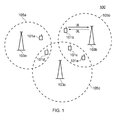
- FIG. 1 is a schematic representation of a wireless communication network according to an example.
- the network 100 incorporates a number of mobile UEs 101a-e and a number of NodeBs 103a-c, respectively serving an area known as a cell (105a-c) in which UE devices within range can be served by the node in question.
- a NodeB is generally a fixed station, and may also be called a base transceiver system (BTS), an access point (AP) or node, a base station (BS), or some other equivalent terminology.
- BTS base transceiver system
- AP access point
- BS base station
- NodeB hardware when deployed, is fixed and stationary, while the UE hardware is portable.
- the mobile UE can be portable hardware.
- User equipment (UE), also commonly referred to as a terminal or a mobile station may be a fixed or mobile device and may be a wireless device, a cellular phone, a personal digital assistant (PDA), a wireless modem card, and so on.
- PDA personal digital assistant
- Uplink communication refers to a communication from the mobile UE to the NodeB, such as UL from UE 101b to node 103b
- downlink refers to communication from the NodeB to the mobile UE, such as DL from UE 101b to node 103b.
- Each NodeB contains radio frequency transmitter(s) and the receiver(s) used to communicate directly with the mobiles, which move freely around it.
- each mobile UE contains radio frequency transmitter(s) and the receiver(s) used to communicate directly with the NodeB.
- LTE wireless networks also known as Evolved Universal Terrestrial Radio Access (E-UTRA)
- E-UTRA Evolved Universal Terrestrial Radio Access
- WG 3GPP working groups
- OFDMA and SC-FDMA single carrier FDMA
- UEs are time and frequency multiplexed on a physical uplink shared channel (PUSCH), and a fine time and frequency synchronization between UEs guarantees optimal intra-cell orthogonality.
- PUSCH physical uplink shared channel
- PRACH Physical Random Access Channel
- the Base Station provides back some allocated UL resource and timing advance information to allow the UE to transmit on the PUSCH.
- PRACH Physical Random Access Channel
- the NodeB functionality evolves; a NodeB in the EUTRA environment is also referred to as an evolved NodeB (eNB). Any one or more of nodes 103a-c can be an eNB.
- Random access transmission denotes a transmission by the mobile terminal, of at least one signal, from a plurality of pre-defined signals.
- the plurality of pre-defined signals is specified by the random access structure.
- the random access signal is based on a preamble based physical structure of the PRACH.
- a number of available preambles are provided that can be used concurrently to minimize the collision probability between UEs accessing the PRACH in a contention-based manner.
- the signatures for random access preambles are partitioned into two configurable-size groups, enabling carrying 1-bit of information on the preamble. This information indicates to the eNB the preferred size of the first post-preamble PUSCH transmission, chosen by the UE from among two possible sizes based on the amount of data available for transmission and the radio conditions.
- a random access procedure can be used.
- an access node 103a-c will broadcast to UE within range details of the network and of how to connect to it.
- a UE device can signal to the base station that it wishes to connect to the network using one of a predetermined number of preambles.
- SIB2 system information block
- the number of preamble in Group B numberofRaPreambles - sizeOfRaPreamblesGroupA
- MessageSizeGroupA - is used for selecting a preamble from a group.
- preambles group A there are two preamble groups.
- sizeOfRA-PreamblesGroupA is equal to numberOfRA-Preambles then there are no Random Access Preamblesgroup B.
- the preambles in Random Access Preamble group A are the preambles 0 to sizeOfRAPreamblesGroupA - 1 and, if it exists, the preambles in Random Access Preamble group B are the preambles sizeOfRA-PreamblesGroupA to numberOfRA-Preambles - 1 from the set of 64 preambles.
- Random Access Preambles group B If Random Access Preambles group B exists, the thresholds, messagePowerOffsetGroupB and messageSizeGroupA, the configured UE transmitted power of the Serving Cell performing the Random Access Procedure, PCMAXc , and the offset between the preamble and Msg3, deltaPreambleMsg3, and the UE selects a group based on the following criteria:
- Random Access Preambles group B exists and if the potential message size (data available for transmission plus MAC header and, where required, MAC control elements) is greater than messageSizeGroupA and if the pathloss is less than PCMAX,c (of the Serving Cell performing the Random Access Procedure)-preambleInitialReceivedTargetPower - deltaPreambleMsg3-messagePowerOffsetGroupB, then UE selects the Random Access Preambles group B. Otherwise, random access preambles group A is selected.
- a device of a certain category such as an MTC or LC-MTC UE device for example, is constrained so as to only use only one Random Access Preamble Group, such as Group A. This is done by forcing or constraining the device to always use Group A disregarding the above group selection criteria.
- MTC UE and more particularly, an LC-MTC UE/device, which is a category of UE device operable within a network according to an example.
- LC-MTC UE/device which is a category of UE device operable within a network according to an example.
- reference herein to a particular category of device, such as an LC-MTC UE device for example is not intended to be limiting, but is provided for the sake of clarity of description.
- LC-MTC UE/device is not intended to be limiting and can more generally be considered as UE.
- the use of LC-MTC is provided as one example of an advantageous implementation of the present mechanism.
- An LC-MTC UE can be constrained by modifying rules embodied in hardware or software/firmware of the device to constrain the device to use only Group A preambles. Such a modification can be performed after manufacture by way of an update to the device, such as a firmware update for example.
- this mechanism can therefore be extended to bar LC-MTC UE from initiating network access.
- this is enabled by setting sizeOfRAPreamblesGroupA to 1 and can therefore be used as a means of access control to prevent access to the network by LC-MTC UE and can be used on top of the access control designed for delay tolerant UE (Extended Access Class Barring).
- the solution is to use the size of Group A for access control of LC MTC UE by adjusting the sizeOfRA-PreamblesGroupA such that there is only Preamble 0.
- LC MTC UE considers access to the cell as barred.
- the mechanism can be used to create a Group A preamble for exclusive or non-exclusive use by LC-MTC UE without the need to create a new group for LC MTC UE (i.e. no additional signaling for such group).
- the Random Access Preambles group B can be made to be used by all the legacy or non-LC MTC UEs by setting the messagePowerOffsetGroupB (and messageSizeGroupA) appropriately such that even the cell edge legacy or non-LC MTC UE will choose Random Access Preambles group B rather than group A (i.e. Group A preambles are made exclusive to LC MTC UE). It can also adjust the messagePowerOffsetGroupB in such a way as to allow some legacy or non-LC MTC UE to use group A (i.e. Group A is made non-exclusive to LC MTC UE as some non-LC MTC UE (e.g. at the cell edge) can use Group A preambles) in the case where there are low number of LC-MTC UE.
- the solution reuses the existing preamble split (Group A and B) in order to indicate the need of extended message 3 size to create a preamble group exclusively or non-exclusively used by LC-MTC UE by adjusting the messagePowerOffsetGroupB (and messageSizeGroupA) to allow Group A to be exclusively or non-exclusively used by LC-MTC UE.
- existing RRC signalling is modified in order to enable LC-MTC UEs to be constrained from accessing a node of a network. That is, a group of preambles, such as Group A for example, which can be provided as part of a SIB2 message, can be modified in the event that LC-MTC UEs are to be barred from network access by constraining the group to only one preamble, such as Preamble 0 for example.
- LC-MTC UEs can be constrained to use only Group A preambles for example, and so, upon reception of the group, can determine whether or not they can access the network.
- the LC-MTC UEs can determine that they are barred from network access. Accordingly, LC MTC UEs use a single preamble group, such as group A. If the preamble group has size of 1, then the LC MTC UEs consider access to the cell as barred or not allowed. Modification of existing signalling enables the selection of LC-MTC UE access by legacy networks, thereby enabling them to control the access of LC-MTC UEs.
- FIG. 2 is a schematic representation of a message flow between an LC-MTC UE and an access node in the form of an eNB according to an example.
- the LC-MTC UE 201 can communicate with an access node 203, such as an eNB, of a wireless communication network 100.
- Access node 203 broadcasts PRACH configuration data 205 in a SIB2 broadcast message, which includes data relating to a preamble group A and optionally a preamble group B.
- the LC-MTC UE 201 receives and decodes the broadcast, and determines whether it can access the node 203 for the use of network services.
- the LC-MTC UE 201 is barred from accessing the node 203 and cannot therefore utilise network services. Otherwise, the LC-MTC UE 201 can connect with the node 203, in which case a message 207 is transmitted by LC-MTC UE 201 to node 203 in which a preamble transmission using a preamble selected from group A is used.
Landscapes
- Engineering & Computer Science (AREA)
- Computer Networks & Wireless Communication (AREA)
- Signal Processing (AREA)
- Computer Security & Cryptography (AREA)
- Multimedia (AREA)
- Mobile Radio Communication Systems (AREA)
Priority Applications (1)
| Application Number | Priority Date | Filing Date | Title |
|---|---|---|---|
| EP14305680.2A EP2943037A1 (fr) | 2014-05-09 | 2014-05-09 | Procédé pour gérer l'accès à un noeud d'accès, dispositif, réseau, noeud et produit de programme informatique |
Applications Claiming Priority (1)
| Application Number | Priority Date | Filing Date | Title |
|---|---|---|---|
| EP14305680.2A EP2943037A1 (fr) | 2014-05-09 | 2014-05-09 | Procédé pour gérer l'accès à un noeud d'accès, dispositif, réseau, noeud et produit de programme informatique |
Publications (1)
| Publication Number | Publication Date |
|---|---|
| EP2943037A1 true EP2943037A1 (fr) | 2015-11-11 |
Family
ID=50774806
Family Applications (1)
| Application Number | Title | Priority Date | Filing Date |
|---|---|---|---|
| EP14305680.2A Withdrawn EP2943037A1 (fr) | 2014-05-09 | 2014-05-09 | Procédé pour gérer l'accès à un noeud d'accès, dispositif, réseau, noeud et produit de programme informatique |
Country Status (1)
| Country | Link |
|---|---|
| EP (1) | EP2943037A1 (fr) |
Cited By (5)
| Publication number | Priority date | Publication date | Assignee | Title |
|---|---|---|---|---|
| WO2018063063A1 (fr) * | 2016-09-30 | 2018-04-05 | Telefonaktiebolaget Lm Ericsson (Publ) | Partitionnement de ressources d'accès aléatoire |
| WO2020056717A1 (fr) * | 2018-09-21 | 2020-03-26 | Oppo广东移动通信有限公司 | Procédé et dispositif d'association de ressources, terminal, et appareil de réseau |
| WO2020147071A1 (fr) * | 2019-01-17 | 2020-07-23 | Zte Corporation | Traitement côté émetteur de préambules et de signaux de référence |
| WO2021012147A1 (fr) * | 2019-07-22 | 2021-01-28 | 海能达通信股份有限公司 | Procédé et appareil de transmission de données, et dispositif électronique |
| WO2021066691A1 (fr) * | 2019-10-04 | 2021-04-08 | Telefonaktiebolaget Lm Ericsson (Publ) | Accès aléatoire pour accès intégré et nœud de réseau terrestre |
Citations (3)
| Publication number | Priority date | Publication date | Assignee | Title |
|---|---|---|---|---|
| US20120077507A1 (en) * | 2010-09-28 | 2012-03-29 | Lee Kidong | Preamble set separation for random access control in large scale cellular networks |
| WO2012150883A1 (fr) * | 2011-05-05 | 2012-11-08 | Telefonaktiebolaget L M Ericsson (Publ) | Procédés et agencements pour adapter une attribution de ressources d'accès aléatoire à des équipements utilisateurs |
| WO2013077622A1 (fr) * | 2011-11-23 | 2013-05-30 | Lg Electronics Inc. | Procédé et appareil de gestion de signaux utilisés pour un accès tolérant les retards dans un système de communication sans fil |
-
2014
- 2014-05-09 EP EP14305680.2A patent/EP2943037A1/fr not_active Withdrawn
Patent Citations (3)
| Publication number | Priority date | Publication date | Assignee | Title |
|---|---|---|---|---|
| US20120077507A1 (en) * | 2010-09-28 | 2012-03-29 | Lee Kidong | Preamble set separation for random access control in large scale cellular networks |
| WO2012150883A1 (fr) * | 2011-05-05 | 2012-11-08 | Telefonaktiebolaget L M Ericsson (Publ) | Procédés et agencements pour adapter une attribution de ressources d'accès aléatoire à des équipements utilisateurs |
| WO2013077622A1 (fr) * | 2011-11-23 | 2013-05-30 | Lg Electronics Inc. | Procédé et appareil de gestion de signaux utilisés pour un accès tolérant les retards dans un système de communication sans fil |
Cited By (7)
| Publication number | Priority date | Publication date | Assignee | Title |
|---|---|---|---|---|
| WO2018063063A1 (fr) * | 2016-09-30 | 2018-04-05 | Telefonaktiebolaget Lm Ericsson (Publ) | Partitionnement de ressources d'accès aléatoire |
| WO2020056717A1 (fr) * | 2018-09-21 | 2020-03-26 | Oppo广东移动通信有限公司 | Procédé et dispositif d'association de ressources, terminal, et appareil de réseau |
| WO2020147071A1 (fr) * | 2019-01-17 | 2020-07-23 | Zte Corporation | Traitement côté émetteur de préambules et de signaux de référence |
| US11963231B2 (en) | 2019-01-17 | 2024-04-16 | Zte Corporation | Transmitter-side processing of preambles and reference signals |
| WO2021012147A1 (fr) * | 2019-07-22 | 2021-01-28 | 海能达通信股份有限公司 | Procédé et appareil de transmission de données, et dispositif électronique |
| WO2021066691A1 (fr) * | 2019-10-04 | 2021-04-08 | Telefonaktiebolaget Lm Ericsson (Publ) | Accès aléatoire pour accès intégré et nœud de réseau terrestre |
| US12500802B2 (en) | 2019-10-04 | 2025-12-16 | Telefonaktiebolaget Lm Ericsson (Publ) | Random access for integrated access and backhaul nodes |
Similar Documents
| Publication | Publication Date | Title |
|---|---|---|
| AU2021215138B2 (en) | Method for configuring transmission direction of time-frequency resource, and apparatus | |
| EP4221417B1 (fr) | Sélection de porteuse de liaison montante pour une transmission prach entre une porteuse dédiée nr et une porteuse partagée lte/nr | |
| EP3963947B1 (fr) | Systèmes et procédés de procédure d'accès aléatoire améliorée | |
| RU2663220C1 (ru) | Беспроводное устройство, первый сетевой узел и способы в них | |
| WO2016047106A1 (fr) | Système de communication | |
| US10568141B2 (en) | Random access method and apparatus therefor | |
| EP2659726B1 (fr) | Procédé et configuration destinés à adapter un temps de garde sur la base d'une avance de temps | |
| KR20170138471A (ko) | 비면허 대역에서의 랜덤 액세스 과정을 수행하는 방법 및 기기 | |
| KR20140005310A (ko) | 반송파 결합 시스템에서의 업링크 전송 방법 및 장치 | |
| JP2017507574A (ja) | 無線通信ネットワークのアクセス方法 | |
| CN111226473A (zh) | 新无线电非授权频谱中随机接入信道的对话前监听和信道接入优先级等级 | |
| WO2015142239A1 (fr) | Nœud de réseau, équipement utilisateur, et procédés d'accès aléatoire | |
| CN112544118A (zh) | 用于随机接入的方法、设备和计算机可读介质 | |
| CN119605269A (zh) | 一种随机接入方法及装置、终端设备、网络设备 | |
| EP2943037A1 (fr) | Procédé pour gérer l'accès à un noeud d'accès, dispositif, réseau, noeud et produit de programme informatique | |
| WO2017069668A1 (fr) | Procédés, nœuds de réseau et dispositif sans fil pour gérer des informations d'accès | |
| EP2633731B1 (fr) | Procédé et dispositif dans un réseau de communication | |
| US20240072971A1 (en) | Methods and systems of uplink cell and scell activation | |
| US12324020B2 (en) | Method and apparatus for data transmission | |
| EP3636019B1 (fr) | Dispositif de communication et procédé d'indication d'une préférence selon une consommation d'énergie d'un dispositif ou une performance de porteuses | |
| JP2024105646A (ja) | 無線ネットワーク一時識別子に関連する方法および装置 | |
| KR20130125075A (ko) | 반 이중 단말 및 반 이중 단말의 랜덤 억세스 방법 | |
| GB2498927A (en) | Configuring random access channels based on an ABS pattern within the vicinity of an apparatus | |
| KR20240056840A (ko) | 신호 송신 방법 및 장치, 및 통신 시스템 | |
| WO2026035177A1 (fr) | Équipement utilisateur (ue) sensible au duplex intégral de sous-bande (sbfd) pour duplex intégral de sous-bande |
Legal Events
| Date | Code | Title | Description |
|---|---|---|---|
| PUAI | Public reference made under article 153(3) epc to a published international application that has entered the european phase |
Free format text: ORIGINAL CODE: 0009012 |
|
| AK | Designated contracting states |
Kind code of ref document: A1 Designated state(s): AL AT BE BG CH CY CZ DE DK EE ES FI FR GB GR HR HU IE IS IT LI LT LU LV MC MK MT NL NO PL PT RO RS SE SI SK SM TR |
|
| AX | Request for extension of the european patent |
Extension state: BA ME |
|
| 17P | Request for examination filed |
Effective date: 20160511 |
|
| RBV | Designated contracting states (corrected) |
Designated state(s): AL AT BE BG CH CY CZ DE DK EE ES FI FR GB GR HR HU IE IS IT LI LT LU LV MC MK MT NL NO PL PT RO RS SE SI SK SM TR |
|
| STAA | Information on the status of an ep patent application or granted ep patent |
Free format text: STATUS: REQUEST FOR EXAMINATION WAS MADE |
|
| STAA | Information on the status of an ep patent application or granted ep patent |
Free format text: STATUS: THE APPLICATION IS DEEMED TO BE WITHDRAWN |
|
| RAP1 | Party data changed (applicant data changed or rights of an application transferred) |
Owner name: ALCATEL LUCENT |
|
| 18D | Application deemed to be withdrawn |
Effective date: 20171201 |