EP2944958A1 - Procédé de prédiction d'instabilité phénotypique dans une cellule - Google Patents
Procédé de prédiction d'instabilité phénotypique dans une cellule Download PDFInfo
- Publication number
- EP2944958A1 EP2944958A1 EP14163519.3A EP14163519A EP2944958A1 EP 2944958 A1 EP2944958 A1 EP 2944958A1 EP 14163519 A EP14163519 A EP 14163519A EP 2944958 A1 EP2944958 A1 EP 2944958A1
- Authority
- EP
- European Patent Office
- Prior art keywords
- cell
- environmental response
- fingerprint
- environmental
- response
- Prior art date
- Legal status (The legal status is an assumption and is not a legal conclusion. Google has not performed a legal analysis and makes no representation as to the accuracy of the status listed.)
- Ceased
Links
- 238000000034 method Methods 0.000 title claims abstract description 29
- 230000004044 response Effects 0.000 claims abstract description 116
- 230000007613 environmental effect Effects 0.000 claims abstract description 84
- 230000012010 growth Effects 0.000 claims abstract description 43
- 238000003556 assay Methods 0.000 claims abstract description 31
- 230000008859 change Effects 0.000 claims abstract description 31
- 239000000126 substance Substances 0.000 claims abstract description 29
- 238000012258 culturing Methods 0.000 claims abstract description 3
- 238000003860 storage Methods 0.000 claims description 15
- 239000003112 inhibitor Substances 0.000 claims description 8
- 238000006243 chemical reaction Methods 0.000 claims description 6
- 238000005094 computer simulation Methods 0.000 claims description 6
- OKTJSMMVPCPJKN-UHFFFAOYSA-N Carbon Chemical compound [C] OKTJSMMVPCPJKN-UHFFFAOYSA-N 0.000 claims description 4
- 229940123587 Cell cycle inhibitor Drugs 0.000 claims description 4
- 150000001413 amino acids Chemical class 0.000 claims description 4
- 230000006907 apoptotic process Effects 0.000 claims description 4
- 229910052799 carbon Inorganic materials 0.000 claims description 4
- 239000012636 effector Substances 0.000 claims description 4
- 230000034659 glycolysis Effects 0.000 claims description 4
- 239000000411 inducer Substances 0.000 claims description 4
- 230000002503 metabolic effect Effects 0.000 claims description 4
- 230000008723 osmotic stress Effects 0.000 claims description 4
- 230000036542 oxidative stress Effects 0.000 claims description 4
- 239000003002 pH adjusting agent Substances 0.000 claims description 4
- 239000003053 toxin Substances 0.000 claims description 4
- 231100000765 toxin Toxicity 0.000 claims description 4
- 210000004027 cell Anatomy 0.000 description 148
- 230000010261 cell growth Effects 0.000 description 8
- KRKNYBCHXYNGOX-UHFFFAOYSA-N citric acid Chemical compound OC(=O)CC(O)(C(O)=O)CC(O)=O KRKNYBCHXYNGOX-UHFFFAOYSA-N 0.000 description 6
- 239000000975 dye Substances 0.000 description 5
- 238000011534 incubation Methods 0.000 description 5
- FAPWRFPIFSIZLT-UHFFFAOYSA-M Sodium chloride Chemical compound [Na+].[Cl-] FAPWRFPIFSIZLT-UHFFFAOYSA-M 0.000 description 4
- 238000013178 mathematical model Methods 0.000 description 4
- 230000002596 correlated effect Effects 0.000 description 3
- 238000004519 manufacturing process Methods 0.000 description 3
- 239000000203 mixture Substances 0.000 description 3
- 238000003909 pattern recognition Methods 0.000 description 3
- 230000000007 visual effect Effects 0.000 description 3
- VRYALKFFQXWPIH-PBXRRBTRSA-N (3r,4s,5r)-3,4,5,6-tetrahydroxyhexanal Chemical compound OC[C@@H](O)[C@@H](O)[C@H](O)CC=O VRYALKFFQXWPIH-PBXRRBTRSA-N 0.000 description 2
- PRRZDZJYSJLDBS-UHFFFAOYSA-N 3-bromo-2-oxopropanoic acid Chemical compound OC(=O)C(=O)CBr PRRZDZJYSJLDBS-UHFFFAOYSA-N 0.000 description 2
- CYDQOEWLBCCFJZ-UHFFFAOYSA-N 4-(4-fluorophenyl)oxane-4-carboxylic acid Chemical compound C=1C=C(F)C=CC=1C1(C(=O)O)CCOCC1 CYDQOEWLBCCFJZ-UHFFFAOYSA-N 0.000 description 2
- NLXLAEXVIDQMFP-UHFFFAOYSA-N Ammonia chloride Chemical compound [NH4+].[Cl-] NLXLAEXVIDQMFP-UHFFFAOYSA-N 0.000 description 2
- 229910021580 Cobalt(II) chloride Inorganic materials 0.000 description 2
- KJQFBVYMGADDTQ-CVSPRKDYSA-N L-buthionine-(S,R)-sulfoximine Chemical compound CCCCS(=N)(=O)CC[C@H](N)C(O)=O KJQFBVYMGADDTQ-CVSPRKDYSA-N 0.000 description 2
- 108700019146 Transgenes Proteins 0.000 description 2
- NIJJYAXOARWZEE-UHFFFAOYSA-N Valproic acid Chemical compound CCCC(C(O)=O)CCC NIJJYAXOARWZEE-UHFFFAOYSA-N 0.000 description 2
- DLAMVQGYEVKIRE-UHFFFAOYSA-N alpha-(methylamino)isobutyric acid Chemical compound CNC(C)(C)C(O)=O DLAMVQGYEVKIRE-UHFFFAOYSA-N 0.000 description 2
- 238000013459 approach Methods 0.000 description 2
- 238000004891 communication Methods 0.000 description 2
- YPHMISFOHDHNIV-FSZOTQKASA-N cycloheximide Chemical compound C1[C@@H](C)C[C@H](C)C(=O)[C@@H]1[C@H](O)CC1CC(=O)NC(=O)C1 YPHMISFOHDHNIV-FSZOTQKASA-N 0.000 description 2
- JXTHNDFMNIQAHM-UHFFFAOYSA-N dichloroacetic acid Chemical compound OC(=O)C(Cl)Cl JXTHNDFMNIQAHM-UHFFFAOYSA-N 0.000 description 2
- 210000003527 eukaryotic cell Anatomy 0.000 description 2
- JVTAAEKCZFNVCJ-UHFFFAOYSA-N lactic acid Chemical compound CC(O)C(O)=O JVTAAEKCZFNVCJ-UHFFFAOYSA-N 0.000 description 2
- 210000004962 mammalian cell Anatomy 0.000 description 2
- 230000035772 mutation Effects 0.000 description 2
- 230000003287 optical effect Effects 0.000 description 2
- 238000012545 processing Methods 0.000 description 2
- 108090000623 proteins and genes Proteins 0.000 description 2
- 239000011780 sodium chloride Substances 0.000 description 2
- 239000001540 sodium lactate Substances 0.000 description 2
- 229940005581 sodium lactate Drugs 0.000 description 2
- 235000011088 sodium lactate Nutrition 0.000 description 2
- SRPZAZGARCFWTO-UHFFFAOYSA-M sodium;2-methyl-1,4-dioxo-3h-naphthalene-2-sulfonate;trihydrate Chemical compound O.O.O.[Na+].C1=CC=C2C(=O)C(C)(S([O-])(=O)=O)CC(=O)C2=C1 SRPZAZGARCFWTO-UHFFFAOYSA-M 0.000 description 2
- NJRXVEJTAYWCQJ-UHFFFAOYSA-N thiomalic acid Chemical compound OC(=O)CC(S)C(O)=O NJRXVEJTAYWCQJ-UHFFFAOYSA-N 0.000 description 2
- UFBJCMHMOXMLKC-UHFFFAOYSA-N 2,4-dinitrophenol Chemical compound OC1=CC=C([N+]([O-])=O)C=C1[N+]([O-])=O UFBJCMHMOXMLKC-UHFFFAOYSA-N 0.000 description 1
- WBXOONOXOHMGQW-UHFFFAOYSA-N 3-aminobicyclo[2.2.1]heptane-4-carboxylic acid Chemical compound C1CC2(C(O)=O)C(N)CC1C2 WBXOONOXOHMGQW-UHFFFAOYSA-N 0.000 description 1
- KLSJWNVTNUYHDU-UHFFFAOYSA-N Amitrole Chemical compound NC1=NC=NN1 KLSJWNVTNUYHDU-UHFFFAOYSA-N 0.000 description 1
- 241000894006 Bacteria Species 0.000 description 1
- COLNVLDHVKWLRT-MRVPVSSYSA-N D-phenylalanine Chemical compound OC(=O)[C@H](N)CC1=CC=CC=C1 COLNVLDHVKWLRT-MRVPVSSYSA-N 0.000 description 1
- 229930182832 D-phenylalanine Natural products 0.000 description 1
- 241000233866 Fungi Species 0.000 description 1
- DGAQECJNVWCQMB-PUAWFVPOSA-M Ilexoside XXIX Chemical compound C[C@@H]1CC[C@@]2(CC[C@@]3(C(=CC[C@H]4[C@]3(CC[C@@H]5[C@@]4(CC[C@@H](C5(C)C)OS(=O)(=O)[O-])C)C)[C@@H]2[C@]1(C)O)C)C(=O)O[C@H]6[C@@H]([C@H]([C@@H]([C@H](O6)CO)O)O)O.[Na+] DGAQECJNVWCQMB-PUAWFVPOSA-M 0.000 description 1
- GQRFOFBPDKFHHS-UHFFFAOYSA-L O.O.O.O.O.O.[Cd+2].CC([O-])=O.CC([O-])=O Chemical compound O.O.O.O.O.O.[Cd+2].CC([O-])=O.CC([O-])=O GQRFOFBPDKFHHS-UHFFFAOYSA-L 0.000 description 1
- 108010026552 Proteome Proteins 0.000 description 1
- 102000007056 Recombinant Fusion Proteins Human genes 0.000 description 1
- 108010008281 Recombinant Fusion Proteins Proteins 0.000 description 1
- PMMURAAUARKVCB-UHFFFAOYSA-N alpha-D-ara-dHexp Natural products OCC1OC(O)CC(O)C1O PMMURAAUARKVCB-UHFFFAOYSA-N 0.000 description 1
- 235000019270 ammonium chloride Nutrition 0.000 description 1
- 238000004458 analytical method Methods 0.000 description 1
- 230000008901 benefit Effects 0.000 description 1
- 230000004640 cellular pathway Effects 0.000 description 1
- 238000007705 chemical test Methods 0.000 description 1
- GVPFVAHMJGGAJG-UHFFFAOYSA-L cobalt dichloride Chemical compound [Cl-].[Cl-].[Co+2] GVPFVAHMJGGAJG-UHFFFAOYSA-L 0.000 description 1
- 150000001875 compounds Chemical class 0.000 description 1
- 238000010276 construction Methods 0.000 description 1
- 230000000875 corresponding effect Effects 0.000 description 1
- 238000011161 development Methods 0.000 description 1
- 229940120124 dichloroacetate Drugs 0.000 description 1
- 239000003814 drug Substances 0.000 description 1
- 230000000694 effects Effects 0.000 description 1
- 238000011156 evaluation Methods 0.000 description 1
- 230000005284 excitation Effects 0.000 description 1
- 230000002068 genetic effect Effects 0.000 description 1
- 230000013595 glycosylation Effects 0.000 description 1
- 238000006206 glycosylation reaction Methods 0.000 description 1
- 239000001963 growth medium Substances 0.000 description 1
- 238000001727 in vivo Methods 0.000 description 1
- 230000002401 inhibitory effect Effects 0.000 description 1
- 239000004310 lactic acid Substances 0.000 description 1
- 235000014655 lactic acid Nutrition 0.000 description 1
- 238000007477 logistic regression Methods 0.000 description 1
- 108020004999 messenger RNA Proteins 0.000 description 1
- 238000012544 monitoring process Methods 0.000 description 1
- 239000003471 mutagenic agent Substances 0.000 description 1
- 238000002360 preparation method Methods 0.000 description 1
- 230000008569 process Effects 0.000 description 1
- 210000001236 prokaryotic cell Anatomy 0.000 description 1
- 102000004169 proteins and genes Human genes 0.000 description 1
- 230000009467 reduction Effects 0.000 description 1
- 230000001105 regulatory effect Effects 0.000 description 1
- 239000011734 sodium Substances 0.000 description 1
- 229910052708 sodium Inorganic materials 0.000 description 1
- MFBOGIVSZKQAPD-UHFFFAOYSA-M sodium butyrate Chemical compound [Na+].CCCC([O-])=O MFBOGIVSZKQAPD-UHFFFAOYSA-M 0.000 description 1
- RQVZIJIQDCGIKI-UHFFFAOYSA-M sodium;oxamate Chemical compound [Na+].NC(=O)C([O-])=O RQVZIJIQDCGIKI-UHFFFAOYSA-M 0.000 description 1
- 230000003068 static effect Effects 0.000 description 1
- 238000012706 support-vector machine Methods 0.000 description 1
- 238000012360 testing method Methods 0.000 description 1
- 229960000604 valproic acid Drugs 0.000 description 1
- 238000011179 visual inspection Methods 0.000 description 1
Images
Classifications
-
- G—PHYSICS
- G01—MEASURING; TESTING
- G01N—INVESTIGATING OR ANALYSING MATERIALS BY DETERMINING THEIR CHEMICAL OR PHYSICAL PROPERTIES
- G01N33/00—Investigating or analysing materials by specific methods not covered by groups G01N1/00 - G01N31/00
- G01N33/48—Biological material, e.g. blood, urine; Haemocytometers
- G01N33/50—Chemical analysis of biological material, e.g. blood, urine; Testing involving biospecific ligand binding methods; Immunological testing
- G01N33/5005—Chemical analysis of biological material, e.g. blood, urine; Testing involving biospecific ligand binding methods; Immunological testing involving human or animal cells
- G01N33/5008—Chemical analysis of biological material, e.g. blood, urine; Testing involving biospecific ligand binding methods; Immunological testing involving human or animal cells for testing or evaluating the effect of chemical or biological compounds, e.g. drugs, cosmetics
-
- G—PHYSICS
- G01—MEASURING; TESTING
- G01N—INVESTIGATING OR ANALYSING MATERIALS BY DETERMINING THEIR CHEMICAL OR PHYSICAL PROPERTIES
- G01N33/00—Investigating or analysing materials by specific methods not covered by groups G01N1/00 - G01N31/00
- G01N33/48—Biological material, e.g. blood, urine; Haemocytometers
- G01N33/50—Chemical analysis of biological material, e.g. blood, urine; Testing involving biospecific ligand binding methods; Immunological testing
- G01N33/5005—Chemical analysis of biological material, e.g. blood, urine; Testing involving biospecific ligand binding methods; Immunological testing involving human or animal cells
- G01N33/5008—Chemical analysis of biological material, e.g. blood, urine; Testing involving biospecific ligand binding methods; Immunological testing involving human or animal cells for testing or evaluating the effect of chemical or biological compounds, e.g. drugs, cosmetics
- G01N33/502—Chemical analysis of biological material, e.g. blood, urine; Testing involving biospecific ligand binding methods; Immunological testing involving human or animal cells for testing or evaluating the effect of chemical or biological compounds, e.g. drugs, cosmetics for testing non-proliferative effects
Definitions
- the invention relates to a method of predicting phenotypic instability in a cell, typically a mammalian producer cell.
- Changes in the cell line can be attributed to changes in gene copy number, mRNA copy number and underlying changes to the cell on the whole (i.e. changes to proteome and metabolome). Changes to a cell's genome implies a degree of phenotypic genetic instability, or a "mutator phenotype" (Loeb et al 1999). It is likely that any cell line clone which has become this phenotype will be subject to other linked changes in phenotype.
- the invention provides a method for predicting the phenotypic stability of a cell line comprising the steps of:
- the step of comparing the plurality of environmental response fingerprints to detect change in the environmental response fingerprint over the assay period comprises the step of detecting a change in the or each chemical cell stressor specific environmental response.
- the environmental response is a growth response.
- the plurality of different time points span one or more passages over the assay period.
- the environmental response fingerprint is generated at three or more time points during the assay period.
- the environmental response fingerprint is generated at four or more time points during the assay period.
- each environmental response fingerprint is generated by determining the environmental response of the cells in the presence of each of at least three different chemical cell stressors.
- each environmental response fingerprint is generated by determining the environmental response of the cells in the presence of each of at least five different chemical cell stressors.
- the chemical cell stressors are selected from amino acid transport inhibitors, cell cycle inhibitors, a source of carbon, a source of osmotic stress, a source of oxidative stress, an inducer of apoptosis, metabolic effectors, a pH modifier, an inhibitor of glycolysis, and a toxin.
- the cell line is a mammalian producer cell line.
- change in the environmental response fingerprint over the assay period is determined means of a mathematical model, suitably a mathematical model generated using one or more environmental response fingerprints of cells having known phenotypic stability or instability, or both.
- the mathematical model employs a means selected from Euclidian distance, mahalanobis distance, LDA distance, PCA distance.
- the invention also provides a system for identifying a cell, the system comprising:
- the environmental response fingerprint is a growth response fingerprint.
- the device is a microtitre plate.
- the comparison system comprises a computational model configured to input an environmental response fingerprints from a cell at a plurality of different time points over an assay period, compare the growth response fingerprints to detect change in the fingerprints, and output a content based in part on the change in the fingerprints.
- the term "cell” refers to any cell type, including prokaryotic or eukaryotic cells.
- the cell is a eukaryotic cell, ideally a mammalian cell.
- the cell is a producer cell, preferably a mammalian producer cell.
- the cell may be clonally-derived or non-clonal.
- the cell is a clone from a panel of clonal cells, derived from a single parental cell population or derived from different transfected cells.
- the cell may also be from a distinct cell line, for example a genetically modified cell (i.e. cells with "knock-out” or "knock-in” mutations.
- the cell line may also be derived by directed evolution, by selection of cells which have adapted to a specific environment of interest.
- panel of distinct cells should be understood to mean a panel of cells that are different from each other.
- the panel of cell may comprise a panel of clones that are all derived from a single parental cell population.
- the panel of cells may comprise cells of independent clonal origin, for example cells carrying different transgenes or different mutations, of the panel of cells may comprise non-clonal cells.
- the cell line may also be derived by directed evolution, by selection of cells which have adapted to a specific environment of interest.
- the panel of cells may also comprise cells of different cell type, for example different cell lines, different strains of bacteria or fungi, cells of the same cell type but at a different stage of development, and cells of the same cell type that differ genetically, for example cells of the same type or origin or cells derived from the same parental cell population that carry different transgenes.
- the term "panel of clonal cells” should be understood to mean a panel of clonal cell populations derived from a single cell line, and comprising from 2 to 500 or more clonal cell populations. Methods for generating panels of clonal cells are well known to a person skilled in the art, and described in Production of recombinant protein therapeutics in cultivated mammalian cells (2004) , Wurm, Florian M, New York, NY, Nature Biotechnology 22 (2004), S. 1393-1398 . Typically, the panel of clonal cell populations include from 10-500, 20-500, 30-500, 40-500, 50-500, 60-500, 70-500, 80-500, 90-500 or 100-500 clonal cell populations. Typically, the panel of clonal cell populations include from 100-500, 100-400, 150-400, 150-350 clonal cell populations.
- the invention involves incubating a cell with a plurality of cell stressor molecules. This means that the cell is incubated with each of the cell stressor molecules individually, to obtain a growth response of the cell in the presence of each cell stressor molecule. Incubation of the cell with the cell stressor molecule may be performed in any suitable reaction vessel, for example in the wells of a microtitre plate.
- the assay involves mixing a cell sample with a chemical cell stressor, and incubating the mixture from 1 to 4 days, and assaying the level of growth of the cells.
- the cell sample is provided at a concentration of from 0.1 to 1.0 x 10 6 cells per ml of mixture.
- the cell stressor is provided at a concentration of 0.5 to 2 x IC50, ideally about 1 x IC50.
- the growth of each clone is assayed after a period of incubation of less than 5 days.
- the growth of each clone is assayed after a period of incubation of between 1-4 days, and ideally after 2 and 3 days.
- the growth of each clone is assayed simultaneously.
- cell stressor molecule or “cell stressor” should be understood to mean a molecule or compound that causes a reduction in cell growth via one or more of multiple cellular pathways.
- the plurality of chemical cell stressors are selected from the group consisting of amino acid transport inhibitors, cell cycle inhibitors, a source of carbon, a source of osmotic stress, a source of oxidative stress, an inducer of apoptosis, metabolic effectors, a pH modifier, an inhibitor of glycolysis, and a toxin.
- the plurality of chemical cell stressors include stressors selected from at least 4, 5, 6 or 7 of the groups consisting of amino acid transport inhibitors, cell cycle inhibitors, a source of carbon, a source of osmotic stress, a source of oxidative stress, an inducer of apoptosis, metabolic effectors, a pH modifier, an inhibitor of glycolysis, and a toxin.
- the term "plurality” as applied to cell stressor molecules should be understood to mean at least three different cell stressor molecules. Typically, the term refers to at least 4, 5, 6, 7, 8, 9, 10, 11, 12, 13, 14, 15, 16, 17, 18, 19 or 20 different cell stressor molecules.
- the method of the invention may be performed by employing as few as three distinct cell stressor molecules to generate the cell-specific growth response fingerprint, for example: CoCl 2 , NAV and MSB; Cadm, MSB and 2DG; Cadm, dphe, MeiAB; dphe, MeIAB, Cadm; Dphe, Cadm, 2dg; Dphe, sodium lactate, 2dg; Dphe, NaOx, citric acid; MeIAB, Cad, 2dg.
- the term "environmental response" refers to a measurable response of the cell when exposed to a cell stressor molecule, for example growth response, production response (for example monoclonal antibody titre), or glycosylation response.
- the environmental response is a normalised environmental response, which is determined by measuring the environmental response of the cell in the presence and absence of the cell stressor molecule and determining the difference in environmental response due to the presence of the cell stressor molecule.
- growth response refers to the growth of the cell in the presence of a cell stressor molecule.
- the growth response is a normalised growth response, which is determined by measuring the growth of in the presence and absence of the cell stressor molecule and determining the difference in growth response due to the presence of the cell stressor molecule. Growth of cells may be determined using any technique known in the art.
- a dye is added to the incubation mixture and a signal emitted by the dye is monitored over time and correlated with growth.
- a fluorescent or phosphorescent dye may be employed.
- suitable dyes are redox dyes, such as Presto blue®. (Invitrogen, Paisley, UK).
- phenotypic instability should be understood to mean instability of one or more phenotypic characteristics of a cell, for example growth, productivity, and reombinant protein product characteristics.
- the term "environmental response fingerprint” refers to a plurality of environmental responses for a specific cell obtained by reacting the cell with a plurality of cell stressor molecules individually.
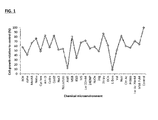
- the fingerprint may be embodied as a plurality of environmental response values, or may be embodied in the form of a graph or any other type of visual presentation such as a pattern. Change in fingerprint over time may be determined by monitoring environmental change in the or each chemical microenvironment.
- growth response fingerprint refers to a plurality of growth responses for a specific cell obtained by reacting the cell with a plurality of cell stressor molecules individually.
- the fingerprint may be embodied as a plurality of growth response values, or may be embodied in the form of a graph or any other type of visual presentation such as a pattern.
- assay period refers to a period of time during which the cells to be tested are cultured. Typically, the assay period spans at least 5, 6, 7, 8, 9,10, 11, 12, 13, 14, 15, 16, 17, 18, 19 or 20 passages of the cells.
- plurality of different time points refers to at least 2, 3, 4, 5, 6, 7, 8, 9, or 10 different time points. Generally each time point is separated by at least 1, 2 or 3 passages.
- One aspect of the invention involves comparing environmental response fingerprints (i.e. growth response fingerprint) for a cell over the course of an assay period to detect change in the environmental response fingerprint, which is then correlated with the stability or instability of the cell.
- the term "change" as applied to an environmental response fingerprint refers to at least one difference in environmental response fingerprint that occurs during the assay period.
- Various methods may be employed to detect changes in environmental response fingerprints over time including mathematical modelling, pattern recognition, or by visual inspection. For example, the environmental responses for a cell at time points A, B and C may be plotted against cell stressors to provide graphs representing the environmental response fingerprint for the cell at time points A, B and C. The environmental response fingerprints may be compared visually to identify changes in the fingerprint over time.
- the comparison step may be performed by mathematical modelling, typically using a mathematical model generated using environmental response fingerprints (or chemical specific environmental response) from cells have known phenotypic stability and/or instability, for example cell lines that have a predetermined stability and predetermined instability.
- the modelling approach may employ'Linear discriminant analysis' and 'nearest neighbour elucidian distance minimisation', using a subset of the chemical growth responses.
- the method involves the steps of inputting an environmental response fingerprint for a test cell line into a computational model, in which the computational model is generated from environmental response fingerprints obtained from a calibration set of cell lines with known phenotypic stability, wherein the computational model is configured to output the predicted stability for the cell line.
- the environmental response fingerprint may be one or more chemical-specific change in environmental responses ( ⁇ CE).
- the invention also provides a system or kit for identifying a cell.
- the system or kit typically comprises a device having a plurality of reaction chambers.
- the device is a microtitre plate, typically a microtitre plate having at least 12, 24, 48, or 96 wells.
- the system or kit typically comprises a plurality of cell stressor molecules.
- the cell stressor molecules are disposed individually within the wells of the microtitre plate, and are preferably adhered to the wells of the microtitre plate.
- the system or kit comprises a determination system for determining the environmental (i.e.growth) response of the cell in the presence of each of the plurality of chemical cell stressors.
- the determination system comprises a microtitre plate reader configured to detect growth of cells in the wells of the microtitre plate. Suitable microtitre plate readers are commercially available, and are sold by the company BMG.
- the determination system typically has computer executable instructions to provide e.g., growth response data in computer readable form.
- the system or kit also comprises a storage system and a comparison system (for comparing growth response fingerprint data for cells at different time points). These functional modules can be executed on one, or multiple, computers, or by using one, or multiple, computer networks.
- the determination system has computer executable instructions to provide e.g., sequence information in computer readable form.
- the information determined in the determination system can be read by the storage system.
- the "storage system” is intended to include any suitable computing or processing apparatus or other device configured or adapted for storing data or information. Examples of an electronic apparatus suitable for use with the present invention include a stand-alone computing apparatus, data telecommunications networks, including local area networks (LAN), wide area networks (WAN), Internet, Intranet, and Extranet, and local and distributed computer processing systems.
- Storage devices also include, but are not limited to: magnetic storage media, such as floppy discs, hard disc storage media, magnetic tape, optical storage media such as CD-ROM, DVD, electronic storage media such as RAM, ROM, EPROM, EEPROM and the like, general hard disks and hybrids of these categories such as magnetic/optical storage media.
- the storage system is adapted or configured for having recorded thereon growth response information and growth response fingerprint information.
- Such information may be provided in digital form that can be transmitted and read electronically, e.g., via the Internet, on diskette, via USB (universal serial bus) or via any other suitable mode of communication.
- the storage system may have reference environmental (i.e.growth) response fingerprint information stored thereon.
- reference environmental (i.e.growth) response fingerprint information stored thereon.
- stored refers to a process for encoding information on the storage device.
- the reference data stored in the storage device to be read by the comparison module is compared, e.g., comparison of a query cell-specific growth response fingerprint with a set or panel of reference growth response fingerprints.
- the “comparison system” can use a variety of available software programs and formats for the comparison operative to compare environmental response fingerprints from a cell at different time points over an assay period to detect change in the environmental (i.e. growth) response fingerprints.
- the comparison module is configured to use pattern recognition techniques to compare information from one or more entries to one or more reference data patterns.
- the comparison module may be configured using existing commercially-available or freely-available software for comparing patterns, and may be optimized for particular data comparisons that are conducted.
- the comparison module provides computer readable information related to the genotype of the sample.
- the comparison system employs a computational model for comparison purposes.
- the comparison module may include an operating system (e.g., UNIX) on which runs a relational database management system, a World Wide Web application, and a World Wide Web server.
- World Wide Web application includes the executable code necessary for generation of database language statements (e.g., Structured Query Language (SQL) statements).
- SQL Structured Query Language
- the executables will include embedded SQL statements.
- the World Wide Web application may include a configuration file which contains pointers and addresses to the various software entities that comprise the server as well as the various external and internal databases which must be accessed to service user requests.
- the Configuration file also directs requests for server resources to the appropriate hardware--as may be necessary should the server be distributed over two or more separate computers.
- the World Wide Web server supports a TCP/IP protocol.
- Local networks such as this are sometimes referred to as "Intranets.”
- An advantage of such Intranets is that they allow easy communication with public domain databases residing on the World Wide Web (e.g., the GenBank or Swiss Pro World Wide Web site).
- users can directly access data (via Hypertext links for example) residing on Internet databases using a HTML interface provided by Web browsers and Web servers.
- the comparison module typically provides a computer readable comparison result that can be processed in computer readable form by predefined criteria, or criteria defined by a user, to provide a content based in part on the comparison result that may be stored and output as requested by a user using a display system.
- the content based on the comparison result is displayed on a computer monitor. In one embodiment of the invention, the content based on the comparison result is displayed through printable media.
- the display module can be any suitable device configured to receive from a computer and display computer readable information to a user. Non-limiting examples include, for example, general-purpose computers such as those based on Intel PENTIUM-type processor, Motorola PowerPC, Sun UltraSPARC, Hewlett-Packard PA-RISC processors, any of a variety of processors available from Advanced Micro Devices (AMD) of Sunnyvale, California, or any other type of processor, visual display devices such as flat panel displays, cathode ray tubes and the like, as well as computer printers of various types.
- AMD Advanced Micro Devices
- a World Wide Web browser is used for providing a user interface for display of the content based on the comparison result.
- modules of the invention can be adapted to have a web browser interface.
- a user may construct requests for retrieving data from the comparison module.
- the user will typically point and click to user interface elements such as buttons, pull down menus, scroll bars and the like conventionally employed in graphical user interfaces.
- inhibitory dose 50 concentrations of the above chemicals were identified through growth studies.
- IC50 is defined as the concentration of the chemical, in question, which inhibits normal cell growth by 50% over a 3 day period.
- the first fingerprint taken is henceforth referred to as the "reference fingerprint”.
- the metrics of interest here are not the growth responses in the microenvironments but the change in growth responses relative to the reference fingerprint.
- ⁇ CE change in chemical specific growth response
- This model employed to predict stability is selected from a variety of models.
- One suitable example is a "linear discriminant model” (LDA) model where linear combinations of the ⁇ CEs are used to maximally separate the stable cell lines from unstable cell lines.
- LDA linear discriminant model
- the model is be a logistic regression model or isbased on simple Euclidian distance or distance in another "space” such as PCA or LDA space. Additionally techniques such as “support vector machines” could be employed.
- ⁇ CE fingerprints For the evaluation of a new cell line of interest, a reference fingerprint and a number of subsequent fingerprints are taken to generate the ⁇ CE fingerprints. These ⁇ CEs from subsequent fingerprints are used in a modeling approach to predict "stable or unstable” or alternatively some other continuous metric of stability such as "degree of instability". In one embodiment, aspects of stability are predicted as soon as the first passage after the "reference fingerprint”.
- a "calibration set" of cell lines is not required and stability is consistently predicted by looking for a change from the reference fingerprint over time, for example by simple distance from the reference fingerprint or any modeling, pattern recognition or “by eye” methods.
Landscapes
- Health & Medical Sciences (AREA)
- Engineering & Computer Science (AREA)
- Life Sciences & Earth Sciences (AREA)
- Biomedical Technology (AREA)
- Immunology (AREA)
- Hematology (AREA)
- Chemical & Material Sciences (AREA)
- Urology & Nephrology (AREA)
- Molecular Biology (AREA)
- Tropical Medicine & Parasitology (AREA)
- Analytical Chemistry (AREA)
- Microbiology (AREA)
- Biotechnology (AREA)
- Toxicology (AREA)
- Bioinformatics & Cheminformatics (AREA)
- Food Science & Technology (AREA)
- Medicinal Chemistry (AREA)
- Physics & Mathematics (AREA)
- Cell Biology (AREA)
- Biochemistry (AREA)
- General Health & Medical Sciences (AREA)
- General Physics & Mathematics (AREA)
- Pathology (AREA)
- Measuring Or Testing Involving Enzymes Or Micro-Organisms (AREA)
- Apparatus Associated With Microorganisms And Enzymes (AREA)
- Investigating Or Analysing Biological Materials (AREA)
Priority Applications (6)
| Application Number | Priority Date | Filing Date | Title |
|---|---|---|---|
| EP14163519.3A EP2944958A1 (fr) | 2014-04-04 | 2014-04-04 | Procédé de prédiction d'instabilité phénotypique dans une cellule |
| US15/301,319 US10591463B2 (en) | 2014-04-04 | 2015-04-02 | Method of predicting phenotypic instability in a cell |
| PCT/EP2015/057392 WO2015150551A1 (fr) | 2014-04-04 | 2015-04-02 | Procédé de prédiction d'instabilité phénotypique dans une cellule |
| CN201580027265.3A CN106662574B (zh) | 2014-04-04 | 2015-04-02 | 一种预测细胞表型不稳定性的方法 |
| EP15718799.8A EP3126833B1 (fr) | 2014-04-04 | 2015-04-02 | Procédé de prédiction d'instabilité phénotypique dans une cellule |
| JP2017503067A JP6581178B2 (ja) | 2014-04-04 | 2015-04-02 | 細胞における表現型不安定性を予測する方法 |
Applications Claiming Priority (1)
| Application Number | Priority Date | Filing Date | Title |
|---|---|---|---|
| EP14163519.3A EP2944958A1 (fr) | 2014-04-04 | 2014-04-04 | Procédé de prédiction d'instabilité phénotypique dans une cellule |
Publications (1)
| Publication Number | Publication Date |
|---|---|
| EP2944958A1 true EP2944958A1 (fr) | 2015-11-18 |
Family
ID=50434087
Family Applications (2)
| Application Number | Title | Priority Date | Filing Date |
|---|---|---|---|
| EP14163519.3A Ceased EP2944958A1 (fr) | 2014-04-04 | 2014-04-04 | Procédé de prédiction d'instabilité phénotypique dans une cellule |
| EP15718799.8A Active EP3126833B1 (fr) | 2014-04-04 | 2015-04-02 | Procédé de prédiction d'instabilité phénotypique dans une cellule |
Family Applications After (1)
| Application Number | Title | Priority Date | Filing Date |
|---|---|---|---|
| EP15718799.8A Active EP3126833B1 (fr) | 2014-04-04 | 2015-04-02 | Procédé de prédiction d'instabilité phénotypique dans une cellule |
Country Status (5)
| Country | Link |
|---|---|
| US (1) | US10591463B2 (fr) |
| EP (2) | EP2944958A1 (fr) |
| JP (1) | JP6581178B2 (fr) |
| CN (1) | CN106662574B (fr) |
| WO (1) | WO2015150551A1 (fr) |
Families Citing this family (3)
| Publication number | Priority date | Publication date | Assignee | Title |
|---|---|---|---|---|
| EP2944958A1 (fr) | 2014-04-04 | 2015-11-18 | Techno-Path (Distribution) | Procédé de prédiction d'instabilité phénotypique dans une cellule |
| EP3075844A1 (fr) | 2015-04-01 | 2016-10-05 | Valitacell Limited | Procédé de détermination d'une caractéristique fonctionnelle ou de composition d'un milieu de culture cellulaire |
| CN108388768A (zh) * | 2018-02-08 | 2018-08-10 | 南京恺尔生物科技有限公司 | 利用生物知识搭建的神经网络模型的生物特性预测方法 |
Citations (5)
| Publication number | Priority date | Publication date | Assignee | Title |
|---|---|---|---|---|
| WO2001081895A2 (fr) * | 2000-04-26 | 2001-11-01 | Cytokinetics, Inc. | Methode et appareil destines a la bioinformatique cellulaire predictive |
| WO2002037102A2 (fr) * | 2000-10-20 | 2002-05-10 | Children's Medical Center Corporation | Procedes d'analyse de changements dynamiques dans l'informatique cellulaire et leurs utilisations |
| US20030235813A1 (en) * | 1999-10-06 | 2003-12-25 | Frank Luyten | In vivo assay and molecular markers for testing the phenotypic stability of cell populations, and selecting cell populations for autologous transplantation |
| WO2006135992A1 (fr) * | 2005-06-24 | 2006-12-28 | Eppendorf Array Technologies S.A. | Methode et moyens de detection et/ou de quantification de modification moleculaire hierarchique d'une cellule en reponse a un stimulus externe |
| US20100330036A1 (en) * | 2007-10-18 | 2010-12-30 | Universiteit Gent | Markers of matrix gene expression and cellular differentiation in chondrocytes |
Family Cites Families (38)
| Publication number | Priority date | Publication date | Assignee | Title |
|---|---|---|---|---|
| US5328985A (en) | 1991-07-12 | 1994-07-12 | The Regents Of The University Of California | Recombinant streptavidin-protein chimeras useful for conjugation of molecules in the immune system |
| US5660991A (en) | 1994-10-28 | 1997-08-26 | Lakowicz; Joseph R. | Long lifetime anisotropy (polarization) probes for clinical chemistry, immunoassays, affinity assays and biomedical research |
| EP0805872A1 (fr) * | 1995-01-23 | 1997-11-12 | Microcide Pharmaceuticals, Inc. | Procedes de triage pour les modulateurs de biomolecules |
| EP0876502A1 (fr) | 1995-12-22 | 1998-11-11 | Microcide Pharmaceuticals, Inc. | Technologie d'identification de marqueurs en fonction de la taille |
| DE19614982C1 (de) | 1996-04-16 | 1997-10-16 | Hatz Motoren | Hochdruckleitungsanschluß |
| CA2250067A1 (fr) | 1996-04-18 | 1997-10-23 | Ariad Pharmaceuticals, Inc. | Dosage in vitro a polarisation de fluorescence |
| ATE317122T1 (de) | 1997-09-05 | 2006-02-15 | Matsushita Electric Industrial Co Ltd | Fluoreszierende polarisation |
| US7741533B2 (en) | 2000-11-07 | 2010-06-22 | Pioneer Hi-Bred International, Inc. | Grain quality through altered expression of seed proteins |
| FR2847268B1 (fr) * | 2002-11-19 | 2006-09-29 | Coletica | Procede d'identification d'une modification eventuelle d'au moins un parametre biologique mettant en oeuvre des cellules vivantes soumises a un stress et des cellules vivantes non soumises a ce meme stress |
| JP2007511760A (ja) | 2003-11-03 | 2007-05-10 | ベックマン コールター インコーポレーティッド | Mhc結合ペプチドを検出するための溶液ベースの方法 |
| US20060105397A1 (en) | 2003-11-05 | 2006-05-18 | Cullum Malford E | Method for the detection of stress biomarkers including cortisol by fluorescence polarization |
| JP4972412B2 (ja) | 2004-02-04 | 2012-07-11 | メルク・シャープ・エンド・ドーム・コーポレイション | E.コリ発酵によるプラスミドdnaの大規模生産のための方法 |
| WO2005082030A2 (fr) | 2004-02-25 | 2005-09-09 | Avalon Pharmaceuticals | Selection chimiocentrique de profils genetiques en rapport avec des maladies |
| JP2005337805A (ja) | 2004-05-25 | 2005-12-08 | Olympus Corp | 抗体または抗原の測定方法 |
| JP4392502B2 (ja) | 2005-06-10 | 2010-01-06 | 国立大学法人 岡山大学 | 蛍光性アミノ酸誘導体 |
| US8364409B2 (en) | 2006-01-12 | 2013-01-29 | Biosense Technologies, Inc. | Method and composition for rapid viability testing of cells |
| CN101395472A (zh) * | 2006-01-17 | 2009-03-25 | 协乐民公司 | 预测生物系统反应的方法 |
| US9034655B2 (en) | 2006-06-19 | 2015-05-19 | Seta Biomedicals, Llc | Highly water-soluble, cationic luminescent labels |
| CN101484572A (zh) | 2006-07-14 | 2009-07-15 | Abb研究有限公司 | 使产物收率最大化的补料-分批发酵设备的在线优化方法 |
| US8823234B2 (en) | 2006-10-13 | 2014-09-02 | Black & Decker Inc. | Motor with permanent magnets having essentially the same inner and outer radius; and method of manufacturing a motor stator housing with permanent magnets |
| US8571690B2 (en) | 2006-10-31 | 2013-10-29 | Rockwell Automation Technologies, Inc. | Nonlinear model predictive control of a biofuel fermentation process |
| CN101186880A (zh) | 2007-11-29 | 2008-05-28 | 上海交通大学 | 异养培养小球藻的补料优化方法 |
| EP2222708A1 (fr) | 2007-12-18 | 2010-09-01 | Bellbrook Labs, Llc | Procédé de dosage pour des réactions de transfert de groupes |
| US20090287320A1 (en) | 2008-05-13 | 2009-11-19 | Macgregor John | System and Method for the Model Predictive Control of Batch Processes using Latent Variable Dynamic Models |
| EP2300600B1 (fr) | 2008-06-13 | 2015-09-30 | Janssen Biotech, Inc. | Procédés pour améliorer la viabilité et la productivité dans une culture cellulaire |
| CA2682439A1 (fr) * | 2008-10-17 | 2010-04-17 | F. Hoffmann-La Roche Ag | Surveillance cellulaire et analyse moleculaire |
| CN107603943B (zh) * | 2009-04-27 | 2019-10-11 | 威盛细胞有限公司 | 支持多能细胞生长的小分子和其方法 |
| US20100291575A1 (en) * | 2009-05-15 | 2010-11-18 | Sru Biosystems, Inc. | Detection of Changes in Cell Populations and Mixed Cell Populations |
| CN201569914U (zh) | 2009-12-21 | 2010-09-01 | 山东省科学院生物研究所 | 发酵流加优化控制系统 |
| CN102220239A (zh) | 2011-03-24 | 2011-10-19 | 苏州百器智能装备系统有限公司 | 一种基于生长预测模型的流加控制系统 |
| GB201205607D0 (en) | 2012-03-29 | 2012-05-16 | Ltd Technopath Distrib | A fluorescence microtitre plate reader |
| US20140199728A1 (en) | 2013-01-14 | 2014-07-17 | Amgen Inc. | Methods of using cell-cycle inhibitors to modulate one or more properties of a cell culture |
| CN109055297A (zh) | 2013-06-26 | 2018-12-21 | 瓦里泰细胞有限公司 | 确定或预测细胞特征的方法 |
| US20170017891A1 (en) | 2014-01-30 | 2017-01-19 | Valitacell Limited | A method of predicting relative fed batch production titer of a panel of clonally-derived producer cells |
| EP2944958A1 (fr) | 2014-04-04 | 2015-11-18 | Techno-Path (Distribution) | Procédé de prédiction d'instabilité phénotypique dans une cellule |
| CN106662581B (zh) | 2014-07-15 | 2019-04-09 | 瓦里泰细胞有限公司 | 一种测定样品中抗体浓度的方法 |
| EP3075844A1 (fr) | 2015-04-01 | 2016-10-05 | Valitacell Limited | Procédé de détermination d'une caractéristique fonctionnelle ou de composition d'un milieu de culture cellulaire |
| EP3391049B1 (fr) | 2015-12-18 | 2020-02-26 | Valitacell Limited | Procédé permettant de déterminer l'abondance d'une molécule cible dans un échantillon |
-
2014
- 2014-04-04 EP EP14163519.3A patent/EP2944958A1/fr not_active Ceased
-
2015
- 2015-04-02 EP EP15718799.8A patent/EP3126833B1/fr active Active
- 2015-04-02 WO PCT/EP2015/057392 patent/WO2015150551A1/fr not_active Ceased
- 2015-04-02 US US15/301,319 patent/US10591463B2/en active Active
- 2015-04-02 JP JP2017503067A patent/JP6581178B2/ja active Active
- 2015-04-02 CN CN201580027265.3A patent/CN106662574B/zh active Active
Patent Citations (5)
| Publication number | Priority date | Publication date | Assignee | Title |
|---|---|---|---|---|
| US20030235813A1 (en) * | 1999-10-06 | 2003-12-25 | Frank Luyten | In vivo assay and molecular markers for testing the phenotypic stability of cell populations, and selecting cell populations for autologous transplantation |
| WO2001081895A2 (fr) * | 2000-04-26 | 2001-11-01 | Cytokinetics, Inc. | Methode et appareil destines a la bioinformatique cellulaire predictive |
| WO2002037102A2 (fr) * | 2000-10-20 | 2002-05-10 | Children's Medical Center Corporation | Procedes d'analyse de changements dynamiques dans l'informatique cellulaire et leurs utilisations |
| WO2006135992A1 (fr) * | 2005-06-24 | 2006-12-28 | Eppendorf Array Technologies S.A. | Methode et moyens de detection et/ou de quantification de modification moleculaire hierarchique d'une cellule en reponse a un stimulus externe |
| US20100330036A1 (en) * | 2007-10-18 | 2010-12-30 | Universiteit Gent | Markers of matrix gene expression and cellular differentiation in chondrocytes |
Non-Patent Citations (7)
| Title |
|---|
| "Production of recombinant protein therapeutics in cultivated mammalian cells", 2004 |
| CHRISTOPHE CUDRÉ-MAUROUX ET AL: "Lentivector-Mediated Transfer of Bmi-1 and Telomerase in Muscle Satellite Cells Yields a Duchenne Myoblast Cell Line with Long-Term Genotypic and Phenotypic Stability", HUMAN GENE THERAPY, vol. 14, no. 16, 2003, pages 1525 - 1533, XP055142786 * |
| DATABASE MEDLINE [online] US NATIONAL LIBRARY OF MEDICINE (NLM), BETHESDA, MD, US; 1993, GIGNAC S M ET AL: "Multiparameter approach in the identification of cross-contaminated leukemia cell lines.", XP002730560, Database accession no. NLM8220135 * |
| LEUKEMIA & LYMPHOMA, vol. 10, no. 4-5, 1993, pages 359 - 368 * |
| N. NAKATSU ET AL: "Evaluation of Action Mechanisms of Toxic Chemicals Using JFCR39, a Panel of Human Cancer Cell Lines", MOLECULAR PHARMACOLOGY, vol. 72, no. 5, 2007, pages 1171 - 1180, XP055101018 * |
| NATURE BIOTECHNOLOGY, vol. 22, 2004, pages 1393 - 1398 |
| SCHWARTZ R ET AL: "Heterogeneity of glycoprotein synthesis in human tumor cell lines", EUROPEAN JOURNAL OF CANCER AND CLINICAL ONCOLOGY, vol. 22, no. 3, 1986, pages 273 - 281, XP026200832 * |
Also Published As
| Publication number | Publication date |
|---|---|
| US10591463B2 (en) | 2020-03-17 |
| WO2015150551A1 (fr) | 2015-10-08 |
| JP2017512501A (ja) | 2017-05-25 |
| JP6581178B2 (ja) | 2019-09-25 |
| EP3126833A1 (fr) | 2017-02-08 |
| CN106662574A (zh) | 2017-05-10 |
| CN106662574B (zh) | 2018-07-17 |
| EP3126833B1 (fr) | 2018-06-13 |
| US20170030894A1 (en) | 2017-02-02 |
Similar Documents
| Publication | Publication Date | Title |
|---|---|---|
| Mittell et al. | Are molecular markers useful predictors of adaptive potential? | |
| EP3014268B1 (fr) | Procédé rapide et à rendement élevé de prédiction de performances d'écoulement continu d'un panneau de cellules dérivées par clonage à partir d'une population de cellules hôtes | |
| EP3099807B1 (fr) | Procédé de prédiction de titre de production en cuvée-alimentée relative d'un panneau de cellules productrices issues de clonage | |
| Fowler‐Finn et al. | The causes of variation in the presence of genetic covariance between sexual traits and preferences | |
| Song et al. | Optimization and validation of patient‐based real‐time quality control procedure using moving average and average of normals with multi‐rules for TT3, TT4, FT3, FT3, and TSH on three analyzers | |
| EP3126833B1 (fr) | Procédé de prédiction d'instabilité phénotypique dans une cellule | |
| Wang et al. | Metabolomics assisted metabolic network modeling and network wide analysis of metabolites in microbiology | |
| Manna et al. | The high‐throughput yeast deletion fitness data and the theories of dominance | |
| Wang et al. | Genetic nurture effects on education: a systematic review and meta-analysis | |
| KR102769408B1 (ko) | 배양 장치 성능을 검증하는 방법 | |
| EP3277798B1 (fr) | Procédé de détermination d'une caractéristique fonctionnelle ou de composition d'un milieu de culture cellulaire | |
| Chapuis et al. | Effects of selection and drift on G matrix evolution in a heterogeneous environment: a multivariate Q st–F st test with the freshwater snail Galba truncatula | |
| Rubio-Ponce et al. | Combined statistical modeling enables accurate mining of circadian transcription | |
| Zarecki et al. | Maximal sum of metabolic exchange fluxes outperforms biomass yield as a predictor of growth rate of microorganisms | |
| Kedzierski et al. | Precision medicine: The future of diagnostic approach to pulmonary hypertension? | |
| Széliová et al. | Error propagation in constraint‐based modeling of Chinese hamster ovary cells | |
| Akkermans et al. | An accurate method for studying individual microbial lag: Experiments and computations | |
| Lepori et al. | Robustness vs productivity during evolutionary community assembly: short-term synergies and long-term trade-offs | |
| Bjurström et al. | Investigating uncharacterised genes in Saccharomyces cerevisiae using robot scientists | |
| Kustatscher et al. | The human proteome co-regulation map reveals functional relationships between proteins | |
| Jalihal | Mathematical modeling of macronutrient signaling in Saccharomyces cerevisiae | |
| Zarecki et al. | Maximal Sum of Metabolic Exchange Fluxes Outperforms Biomass Yield as a | |
| Tak Ka | Uncertainty Component Evaluation in Conventional Microbiological Qualitative Measurements | |
| Crowell | Computational Techniques for Proteome and Genome Wide Circadian Studies | |
| Chen et al. | selscape: A Snakemake Workflow for Investigating Genomic Landscapes of Natural Selection |
Legal Events
| Date | Code | Title | Description |
|---|---|---|---|
| PUAI | Public reference made under article 153(3) epc to a published international application that has entered the european phase |
Free format text: ORIGINAL CODE: 0009012 |
|
| AK | Designated contracting states |
Kind code of ref document: A1 Designated state(s): AL AT BE BG CH CY CZ DE DK EE ES FI FR GB GR HR HU IE IS IT LI LT LU LV MC MK MT NL NO PL PT RO RS SE SI SK SM TR |
|
| AX | Request for extension of the european patent |
Extension state: BA ME |
|
| STAA | Information on the status of an ep patent application or granted ep patent |
Free format text: STATUS: THE APPLICATION HAS BEEN REFUSED |
|
| 18R | Application refused |
Effective date: 20151205 |