EP3126833B1 - Procédé de prédiction d'instabilité phénotypique dans une cellule - Google Patents
Procédé de prédiction d'instabilité phénotypique dans une cellule Download PDFInfo
- Publication number
- EP3126833B1 EP3126833B1 EP15718799.8A EP15718799A EP3126833B1 EP 3126833 B1 EP3126833 B1 EP 3126833B1 EP 15718799 A EP15718799 A EP 15718799A EP 3126833 B1 EP3126833 B1 EP 3126833B1
- Authority
- EP
- European Patent Office
- Prior art keywords
- cell
- response
- environmental response
- environmental
- fingerprint
- Prior art date
- Legal status (The legal status is an assumption and is not a legal conclusion. Google has not performed a legal analysis and makes no representation as to the accuracy of the status listed.)
- Active
Links
Images
Classifications
-
- G—PHYSICS
- G01—MEASURING; TESTING
- G01N—INVESTIGATING OR ANALYSING MATERIALS BY DETERMINING THEIR CHEMICAL OR PHYSICAL PROPERTIES
- G01N33/00—Investigating or analysing materials by specific methods not covered by groups G01N1/00 - G01N31/00
- G01N33/48—Biological material, e.g. blood, urine; Haemocytometers
- G01N33/50—Chemical analysis of biological material, e.g. blood, urine; Testing involving biospecific ligand binding methods; Immunological testing
- G01N33/5005—Chemical analysis of biological material, e.g. blood, urine; Testing involving biospecific ligand binding methods; Immunological testing involving human or animal cells
- G01N33/5008—Chemical analysis of biological material, e.g. blood, urine; Testing involving biospecific ligand binding methods; Immunological testing involving human or animal cells for testing or evaluating the effect of chemical or biological compounds, e.g. drugs, cosmetics
-
- G—PHYSICS
- G01—MEASURING; TESTING
- G01N—INVESTIGATING OR ANALYSING MATERIALS BY DETERMINING THEIR CHEMICAL OR PHYSICAL PROPERTIES
- G01N33/00—Investigating or analysing materials by specific methods not covered by groups G01N1/00 - G01N31/00
- G01N33/48—Biological material, e.g. blood, urine; Haemocytometers
- G01N33/50—Chemical analysis of biological material, e.g. blood, urine; Testing involving biospecific ligand binding methods; Immunological testing
- G01N33/5005—Chemical analysis of biological material, e.g. blood, urine; Testing involving biospecific ligand binding methods; Immunological testing involving human or animal cells
- G01N33/5008—Chemical analysis of biological material, e.g. blood, urine; Testing involving biospecific ligand binding methods; Immunological testing involving human or animal cells for testing or evaluating the effect of chemical or biological compounds, e.g. drugs, cosmetics
- G01N33/502—Chemical analysis of biological material, e.g. blood, urine; Testing involving biospecific ligand binding methods; Immunological testing involving human or animal cells for testing or evaluating the effect of chemical or biological compounds, e.g. drugs, cosmetics for testing non-proliferative effects
Definitions
- the invention relates to a method of predicting phenotypic instability of a cell, typically a mammalian producer cell.
- Changes in the cell line can be attributed to changes in gene copy number, mRNA copy number and underlying changes to the cell on the whole (i.e. changes to proteome and metabolome). Changes to a cell's genome implies a degree of phenotypic genetic instability, or a "mutator phenotype" (Loeb et al 1999). It is likely that any cell line clone which has become this phenotype will be subject to other linked changes in phenotype.
- the invention provides a method for predicting the phenotypic stability of a cell line comprising the steps of:
- the step of comparing the plurality of environmental response fingerprints to detect change in the environmental response fingerprint over the assay period comprises the step of detecting a change in the or each chemical cell stressor specific environmental response.
- the environmental response is a growth response.
- the plurality of different time points span one or more passages over the assay period.
- the environmental response fingerprint is generated at three or more time points during the assay period.
- the environmental response fingerprint is generated at four or more time points during the assay period.
- each environmental response fingerprint is generated by determining the environmental response of the cells in the presence of each of at least three different chemical cell stressors.
- each environmental response fingerprint is generated by determining the environmental response of the cells in the presence of each of at least five different chemical cell stressors.
- the chemical cell stressors are selected from amino acid transport inhibitors, cell cycle inhibitors, a source of carbon, a source of osmotic stress, a source of oxidative stress, an inducer of apoptosis, metabolic effectors, a pH modifier, an inhibitor of glycolysis, and a toxin.
- the cell line is a mammalian producer cell line.
- change in the environmental response fingerprint over the assay period is determined means of a mathematical model, suitably a mathematical model generated using one or more environmental response fingerprints of cells having known phenotypic stability or instability, or both.
- the mathematical model employs a means selected from Euclidian distance, mahalanobis distance, LDA distance, PCA distance.
- the invention also provides a system for identifying a cell, the system comprising:
- the environmental response fingerprint is a growth response fingerprint.
- the device is a microtitre plate.
- the comparison system comprises a computational model configured to input an environmental response fingerprints from a cell at a plurality of different time points over an assay period, compare the growth response fingerprints to detect change in the fingerprints, and output a content based in part on the change in the fingerprints.
- the term "cell” refers to any cell type, including prokaryotic or eukaryotic cells.
- the cell is a eukaryotic cell, ideally a mammalian cell.
- the cell is a producer cell, preferably a mammalian producer cell.
- the cell may be clonally-derived or non-clonal.
- the cell is a clone from a panel of clonal cells, derived from a single parental cell population or derived from different transfected cells.
- the cell may also be from a distinct cell line, for example a genetically modified cell (i.e. cells with "knock-out” or "knock-in” mutations.
- the cell line may also be derived by directed evolution, by selection of cells which have adapted to a specific environment of interest.
- panel of distinct cells should be understood to mean a panel of cells that are different from each other.
- the panel of cells may comprise a panel of clones that are all derived from a single parental cell population.
- the panel of cells may comprise cells of independent clonal origin, for example cells carrying different transgenes or different mutations, of the panel of cells may comprise non-clonal cells.
- the cell line may also be derived by directed evolution, by selection of cells which have adapted to a specific environment of interest.
- the panel of cells may also comprise cells of different cell type, for example different cell lines, different strains of bacteria or fungi, cells of the same cell type but at a different stage of development, and cells of the same cell type that differ genetically, for example cells of the same type or origin or cells derived from the same parental cell population that carry different transgenes.
- the term "panel of clonal cells” should be understood to mean a panel of clonal cell populations derived from a single cell line, and comprising from 2 to 500 or more clonal cell populations. Methods for generating panels of clonal cells are well known to a person skilled in the art, and described in Production of recombinant protein therapeutics in cultivated mammalian cells (2004) ,Wurm, Florian M, New York, NY, Nature Biotechnology 22 (2004), S. 1393-1398 . Typically, the panel of clonal cell populations include from 10-500, 20-500, 30-500, 40-500, 50-500, 60-500, 70-500, 80-500, 90-500 or 100-500 clonal cell populations. Typically, the panel of clonal cell populations include from 100-500, 100-400, 150-400, 150-350 clonal cell populations.
- the invention involves incubating a cell with a plurality of cell stressor molecules. This means that the cell is incubated with each of the cell stressor molecules individually, to obtain a growth response of the cell in the presence of each cell stressor molecule. Incubation of the cell with the cell stressor molecule may be performed in any suitable reaction vessel, for example in the wells of a microtitre plate.
- the assay involves mixing a cell sample with a chemical cell stressor, and incubating the mixture from 1 to 4 days, and assaying the level of growth of the cells.
- the cell sample is provided at a concentration of from 0.1 to 1.0 x 10 6 cells per ml of mixture.
- the cell stressor is provided at a concentration of 0.5 to 2 x IC50, ideally about 1 x IC50.
- the growth of each clone is assayed after a period of incubation of less than 5 days.
- the growth of each clone is assayed after a period of incubation of between 1-4 days, and ideally after 2 and 3 days.
- the growth of each clone is assayed simultaneously.
- cell stressor molecule or “cell stressor” should be understood to mean a molecule or compound that causes a reduction in cell growth via one or more of multiple cellular pathways.
- the plurality of chemical cell stressors are selected from the group consisting of amino acid transport inhibitors, cell cycle inhibitors, a source of carbon, a source of osmotic stress, a source of oxidative stress, an inducer of apoptosis, metabolic effectors, a pH modifier, an inhibitor of glycolysis, and a toxin.
- the plurality of chemical cell stressors include stressors selected from at least 4, 5, 6 or 7 of the groups consisting of amino acid transport inhibitors, cell cycle inhibitors, a source of carbon, a source of osmotic stress, a source of oxidative stress, an inducer of apoptosis, metabolic effectors, a pH modifier, an inhibitor of glycolysis, and a toxin.
- the term "plurality” as applied to cell stressor molecules should be understood to mean at least three different cell stressor molecules. Typically, the term refers to at least 4, 5, 6, 7, 8, 9, 10, 11, 12, 13, 14, 15, 16, 17, 18, 19 or 20 different cell stressor molecules.
- the method of the invention may be performed by employing as few as three distinct cell stressor molecules to generate the cell-specific growth response fingerprint, for example: CoCl 2 , NAV and MSB; Cadm, MSB and 2DG; Cadm, dphe, MeiAB; dphe, MeIAB, Cadm; Dphe, Cadm, 2dg; Dphe, sodium lactate, 2dg; Dphe, NaOx, citric acid; MeIAB, Cad, 2dg.
- the term "environmental response" refers to a measurable response of the cell when exposed to a cell stressor molecule, for example growth response, production response (for example monoclonal antibody titre), or glycosylation response.
- the environmental response is a normalised environmental response, which is determined by measuring the environmental response of the cell in the presence and absence of the cell stressor molecule and determining the difference in environmental response due to the presence of the cell stressor molecule.
- growth response refers to the growth of the cell in the presence of a cell stressor molecule.
- the growth response is a normalised growth response, which is determined by measuring the growth in the presence and absence of the cell stressor molecule and determining the difference in growth response due to the presence of the cell stressor molecule. Growth of cells may be determined using any technique known in the art.
- a dye is added to the incubation mixture and a signal emitted by the dye is monitored over time and correlated with growth.
- a fluorescent or phosphorescent dye may be employed.
- suitable dyes are redox dyes, such as Presto blue®. (Invitrogen, Paisley, UK).
- phenotypic instability should be understood to mean instability of one or more phenotypic characteristics of a cell, for example growth, productivity, and recombinant protein product characteristics.
- the term "environmental response fingerprint” refers to a plurality of environmental responses for a specific cell obtained by reacting the cell with a plurality of cell stressor molecules individually.
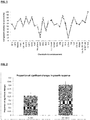
- the fingerprint may be embodied as a plurality of environmental response values, or may be embodied in the form of a graph or any other type of visual presentation such as a pattern. Change in fingerprint over time may be determined by monitoring environmental change in the or each chemical microenvironment.
- growth response fingerprint refers to a plurality of growth responses for a specific cell obtained by reacting the cell with a plurality of cell stressor molecules individually.
- the fingerprint may be embodied as a plurality of growth response values, or may be embodied in the form of a graph or any other type of visual presentation such as a pattern.
- assay period refers to a period of time during which the cells to be tested are cultured. Typically, the assay period spans at least 5, 6, 7, 8, 9,10, 11, 12, 13, 14, 15, 16, 17, 18, 19 or 20 passages of the cells.
- plurality of different time points refers to at least 2, 3, 4, 5, 6, 7, 8, 9, or 10 different time points. Generally each time point is separated by at least 1, 2 or 3 passages.
- One aspect of the invention involves comparing environmental response fingerprints (i.e. growth response fingerprint) for a cell over the course of an assay period to detect change in the environmental response fingerprint, which is then correlated with the stability or instability of the cell.
- the term "change" as applied to an environmental response fingerprint refers to at least one difference in environmental response fingerprint that occurs during the assay period.
- Various methods may be employed to detect changes in environmental response fingerprints over time including mathematical modelling, pattern recognition, or by visual inspection. For example, the environmental responses for a cell at time points A, B and C may be plotted against cell stressors to provide graphs representing the environmental response fingerprint for the cell at time points A, B and C. The environmental response fingerprints may be compared visually to identify changes in the fingerprint over time.
- the comparison step may be performed by mathematical modelling, typically using a mathematical model generated using environmental response fingerprints (or chemical specific environmental response) from cells with known phenotypic stability and/or instability, for example cell lines that have a predetermined stability and predetermined instability.
- the modelling approach may employ 'Linear discriminant analysis' and 'nearest neighbour Euclidian distance minimisation', using a subset of the chemical growth responses.
- the method involves the steps of inputting an environmental response fingerprint for a test cell line into a computational model, in which the computational model is generated from environmental response fingerprints obtained from a calibration set of cell lines with known phenotypic stability, wherein the computational model is configured to output the predicted stability for the cell line.
- the environmental response fingerprint may be one or more chemical-specific change in environmental responses ( ⁇ CE).
- the invention also provides a system or kit for identifying a cell.
- the system or kit typically comprises a device having a plurality of reaction chambers.
- the device is a microtitre plate, typically a microtitre plate having at least 12, 24, 48, or 96 wells.
- the system or kit typically comprises a plurality of cell stressor molecules.
- the cell stressor molecules are disposed individually within the wells of the microtitre plate, and are preferably adhered to the wells of the microtitre plate.
- the system or kit comprises a determination system for determining the environmental (i.e.growth) response of the cell in the presence of each of the plurality of chemical cell stressors.
- the determination system comprises a microtitre plate reader configured to detect growth of cells in the wells of the microtitre plate. Suitable microtitre plate readers are commercially available, and are sold by the company BMG.
- the determination system typically has computer executable instructions to provide e.g., growth response data in computer readable form.
- the system or kit also comprises a storage system and a comparison system (for comparing growth response fingerprint data for cells at different time points). These functional modules can be executed on one, or multiple, computers, or by using one, or multiple, computer networks.
- the determination system has computer executable instructions to provide e.g., sequence information in computer readable form.
- the information determined in the determination system can be read by the storage system.
- the "storage system” is intended to include any suitable computing or processing apparatus or other device configured or adapted for storing data or information. Examples of an electronic apparatus suitable for use with the present invention include a stand-alone computing apparatus, data telecommunications networks, including local area networks (LAN), wide area networks (WAN), Internet, Intranet, and Extranet, and local and distributed computer processing systems.
- Storage devices also include, but are not limited to: magnetic storage media, such as floppy discs, hard disc storage media, magnetic tape, optical storage media such as CD-ROM, DVD, electronic storage media such as RAM, ROM, EPROM, EEPROM and the like, general hard disks and hybrids of these categories such as magnetic/optical storage media.
- the storage system is adapted or configured for having recorded thereon growth response information and growth response fingerprint information.
- Such information may be provided in digital form that can be transmitted and read electronically, e.g., via the Internet, on diskette, via USB (universal serial bus) or via any other suitable mode of communication.
- the storage system may have reference environmental (i.e.growth) response fingerprint information stored thereon.
- reference environmental (i.e.growth) response fingerprint information stored thereon.
- stored refers to a process for encoding information on the storage device.
- the reference data stored in the storage device to be read by the comparison module is compared, e.g., comparison of a query cell-specific growth response fingerprint with a set or panel of reference growth response fingerprints.
- the “comparison system” can use a variety of available software programs and formats for the comparison operative to compare environmental response fingerprints from a cell at different time points over an assay period to detect change in the environmental (i.e. growth) response fingerprints.
- the comparison module is configured to use pattern recognition techniques to compare information from one or more entries to one or more reference data patterns.
- the comparison module may be configured using existing commercially-available or freely-available software for comparing patterns, and may be optimized for particular data comparisons that are conducted.
- the comparison module provides computer readable information related to the genotype of the sample.
- the comparison system employs a computational model for comparison purposes.
- the comparison module may include an operating system (e.g., UNIX) on which runs a relational database management system, a World Wide Web application, and a World Wide Web server.
- World Wide Web application includes the executable code necessary for generation of database language statements (e.g., Structured Query Language (SQL) statements).
- SQL Structured Query Language
- the executables will include embedded SQL statements.
- the World Wide Web application may include a configuration file which contains pointers and addresses to the various software entities that comprise the server as well as the various external and internal databases which must be accessed to service user requests.
- the Configuration file also directs requests for server resources to the appropriate hardware as may be necessary should the server be distributed over two or more separate computers.
- the World Wide Web server supports a TCP/IP protocol.
- Local networks such as this are sometimes referred to as "Intranets.”
- An advantage of such Intranets is that they allow easy communication with public domain databases residing on the World Wide Web (e.g., the GenBank or Swiss Pro World Wide Web site).
- users can directly access data (via Hypertext links for example) residing on Internet databases using a HTML interface provided by Web browsers and Web servers.
- the comparison module typically provides a computer readable comparison result that can be processed in computer readable form by predefined criteria, or criteria defined by a user, to provide a content based in part on the comparison result that may be stored and output as requested by a user using a display system.
- the content based on the comparison result is displayed on a computer monitor. In one embodiment of the invention, the content based on the comparison result is displayed through printable media.
- the display module can be any suitable device configured to receive from a computer and display computer readable information to a user. Non-limiting examples include, for example, general-purpose computers such as those based on Intel PENTIUM-type processor, Motorola PowerPC, Sun UltraSPARC, Hewlett-Packard PA-RISC processors, any of a variety of processors available from Advanced Micro Devices (AMD) of Sunnyvale, California, or any other type of processor, visual display devices such as flat panel displays, cathode ray tubes and the like, as well as computer printers of various types.
- AMD Advanced Micro Devices
- a World Wide Web browser is used for providing a user interface for display of the content based on the comparison result.
- modules of the invention can be adapted to have a web browser interface.
- a user may construct requests for retrieving data from the comparison module.
- the user will typically point and click to user interface elements such as buttons, pull down menus, scroll bars and the like conventionally employed in graphical user interfaces.
- inhibitory dose 50 concentrations of the above chemicals were identified through growth studies.
- IC50 is defined as the concentration of the chemical, in question, which inhibits normal cell growth by 50% over a 3 day period.
- the first fingerprint taken is henceforth referred to as the "reference fingerprint”.
- the metrics of interest here are not the growth responses in the microenvironments but the change in growth responses relative to the reference fingerprint.
- ⁇ CE change in chemical specific growth response
- This model employed to predict stability is selected from a variety of models.
- One suitable example is a "linear discriminant model” (LDA) model where linear combinations of the ⁇ CEs are used to maximally separate the stable cell lines from unstable cell lines.
- LDA linear discriminant model
- the model is be a logistic regression model or isbased on simple Euclidian distance or distance in another "space” such as PCA or LDA space. Additionally techniques such as “support vector machines” could be employed.
- ⁇ CE fingerprints For the evaluation of a new cell line of interest, a reference fingerprint and a number of subsequent fingerprints are taken to generate the ⁇ CE fingerprints. These ⁇ CEs from subsequent fingerprints are used in a modeling approach to predict "stable or unstable” or alternatively some other continuous metric of stability such as "degree of instability". In one embodiment, aspects of stability are predicted as soon as the first passage after the "reference fingerprint”.
- a "calibration set" of cell lines is not required and stability is consistently predicted by looking for a change from the reference fingerprint over time, for example by simple distance from the reference fingerprint or any modeling, pattern recognition or “by eye” methods.
- Chemical fingerprints for each cell line at each different time point were obtained by growth in the chemical screening plates for a period of 3 days prior to measuring the growth and titre in the presence of the above mentioned plurality of chemicals.
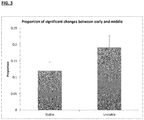
- the measured parameter of interest here was the change in chemical responses over the time period, i.e. early, middle and late.
- the invention also enables the identification of clones at the early stage which are less desirable in standard attributes such as titre, but are identified as highly likely to be stable from observing low changes in chemical fingerprints. These can be taken forward and potentially chosen over clones, which at an early stage perform well but experience a drop in titre in longer term studies.
Landscapes
- Health & Medical Sciences (AREA)
- Engineering & Computer Science (AREA)
- Life Sciences & Earth Sciences (AREA)
- Biomedical Technology (AREA)
- Immunology (AREA)
- Hematology (AREA)
- Chemical & Material Sciences (AREA)
- Urology & Nephrology (AREA)
- Molecular Biology (AREA)
- Tropical Medicine & Parasitology (AREA)
- Analytical Chemistry (AREA)
- Microbiology (AREA)
- Biotechnology (AREA)
- Toxicology (AREA)
- Bioinformatics & Cheminformatics (AREA)
- Food Science & Technology (AREA)
- Medicinal Chemistry (AREA)
- Physics & Mathematics (AREA)
- Cell Biology (AREA)
- Biochemistry (AREA)
- General Health & Medical Sciences (AREA)
- General Physics & Mathematics (AREA)
- Pathology (AREA)
- Measuring Or Testing Involving Enzymes Or Micro-Organisms (AREA)
- Apparatus Associated With Microorganisms And Enzymes (AREA)
- Investigating Or Analysing Biological Materials (AREA)
Claims (16)
- Méthode de prédiction de la stabilité phénotypique d'une lignée cellulaire, comprenant les étapes consistant à :cultiver la lignée cellulaire sur une période d'essai ;générer une empreinte digitale de réponse environnementale pour la lignée cellulaire au niveau d'une pluralité de différents points dans le temps sur la période d'essai, où chaque empreinte digitale de réponse environnementale est générée par la détermination de la réponse environnementale des cellules en présence de chacun parmi trois agents de stress cellulaire chimiques ; etcomparer la pluralité des empreintes digitales de réponse environnementale afin de détecter un changement d'empreinte digitale de réponse environnementale sur la période d'essai ;où le taux de changement d'empreinte digitale de réponse environnementale sur la période d'essai constitue une indication du taux d'instabilité phénotypique prédite dans la lignée cellulaire.
- Méthode selon la revendication 1, dans laquelle l'étape consistant à comparer la pluralité d'empreintes digitales de réponse environnementale afin de détecter un changement d'empreinte digitale de réponse environnementale sur la période d'essai comprend l'étape consistant à détecter un changement de la ou de chaque réponse environnementale spécifique d'un agent de stress cellulaire chimique.
- Méthode selon la revendication 1 ou 2, dans laquelle la réponse environnementale est une réponse de croissance, une réponse de productivité, ou une réponse de glycosylation.
- Méthode selon la revendication 1, 2 ou 3, dans laquelle la pluralité de différents points dans le temps couvre un ou plusieurs repiquages sur la période d'essai.
- Méthode selon l'une quelconque des revendications précédentes, dans laquelle l'empreinte digitale de réponse environnementale est générée au niveau de trois, ou plus, points dans le temps sur la période d'essai.
- Méthode selon l'une quelconque des revendications précédentes, dans laquelle l'empreinte digitale de réponse environnementale est générée au niveau de quatre, ou plus, points dans le temps sur la période d'essai.
- Méthode selon l'une quelconque des revendications précédentes, dans laquelle chaque empreinte digitale de réponse environnementale est générée par la détermination de la réponse environnementale des cellules en présence de chacun parmi au moins trois différents agents de stress cellulaire chimiques.
- Méthode selon l'une quelconque des revendications précédentes, dans laquelle chaque empreinte digitale de réponse environnementale est générée par la détermination de la réponse environnementale des cellules en présence de chacun parmi au moins cinq différents agents de stress cellulaire chimiques.
- Méthode selon l'une quelconque des revendications précédentes, dans laquelle les agents de stress cellulaire chimiques sont choisis parmi les inhibiteurs du transport des acides aminés, les inhibiteurs du cycle cellulaire, une source de carbone, une source de stress osmotique, une source de stress oxydatif, un inducteur d'apoptose, des effecteurs métaboliques, un modificateur de pH, un inhibiteur de glycolyse, et une toxine.
- Méthode selon l'une quelconque des revendications précédentes, dans laquelle la lignée cellulaire est une lignée cellulaire productrice mammalienne.
- Méthode selon l'une quelconque des revendications précédentes, dans laquelle le changement d'empreinte digitale de réponse environnementale sur la période d'essai est déterminé par un moyen choisi parmi la distance euclidienne, la distance de Mahalanobis, la distance par LDA, la distance par PCA.
- Méthode selon l'une quelconque des revendications précédentes, dans laquelle chacun parmi les au moins trois agents de stress cellulaire chimiques est fourni selon une concentration allant de 0,5 à 2 × CI50.
- Système d'identification d'une cellule, le système comprenant :un dispositif comprenant une pluralité de chambres de réaction ;au moins trois agents de stress cellulaire chimiques disposés individuellement au sein des chambres de réaction ;un système de détermination destiné à déterminer une réponse environnementale de la cellule en présence de chacun parmi la pluralité d'agents de stress cellulaire chimiques ;un système de stockage destiné à stocker une pluralité d'empreintes digitales de réponse environnementale, chacune correspondant à la pluralité de réponses environnementales de la cellule ;un système de comparaison configuré pour comparer au moins une partie de la pluralité d'empreintes digitales de réponse environnementale afin de détecter un changement des empreintes digitales de réponse environnementale ; etun système d'affichage destiné à afficher un résultat de l'étape de comparaison.
- Système selon la revendication 13, dans lequel l'empreinte digitale de réponse environnementale est une empreinte digitale de réponse de croissance, une empreinte digitale de réponse de productivité, ou une empreinte digitale de réponse de glycosylation.
- Système selon la revendication 13 ou 14, dans lequel le dispositif est une plaque de microtitration.
- Système selon l'une quelconque des revendications 12 à 14, dans lequel le système de comparaison comprend un modèle informatique configuré afin d'introduire une empreinte digitale de réponse environnementale issue d'une cellule au niveau d'une pluralité de différents points dans le temps sur une période d'essai, comparer les empreintes digitales de réponse de croissance, les empreintes digitales de réponse de productivité, ou les empreintes digitales de réponse de glycosylation, afin de détecter un changement des empreintes digitales, et sortir un contenu basé en partie sur le changement des empreintes digitales.
Applications Claiming Priority (2)
| Application Number | Priority Date | Filing Date | Title |
|---|---|---|---|
| EP14163519.3A EP2944958A1 (fr) | 2014-04-04 | 2014-04-04 | Procédé de prédiction d'instabilité phénotypique dans une cellule |
| PCT/EP2015/057392 WO2015150551A1 (fr) | 2014-04-04 | 2015-04-02 | Procédé de prédiction d'instabilité phénotypique dans une cellule |
Publications (2)
| Publication Number | Publication Date |
|---|---|
| EP3126833A1 EP3126833A1 (fr) | 2017-02-08 |
| EP3126833B1 true EP3126833B1 (fr) | 2018-06-13 |
Family
ID=50434087
Family Applications (2)
| Application Number | Title | Priority Date | Filing Date |
|---|---|---|---|
| EP14163519.3A Ceased EP2944958A1 (fr) | 2014-04-04 | 2014-04-04 | Procédé de prédiction d'instabilité phénotypique dans une cellule |
| EP15718799.8A Active EP3126833B1 (fr) | 2014-04-04 | 2015-04-02 | Procédé de prédiction d'instabilité phénotypique dans une cellule |
Family Applications Before (1)
| Application Number | Title | Priority Date | Filing Date |
|---|---|---|---|
| EP14163519.3A Ceased EP2944958A1 (fr) | 2014-04-04 | 2014-04-04 | Procédé de prédiction d'instabilité phénotypique dans une cellule |
Country Status (5)
| Country | Link |
|---|---|
| US (1) | US10591463B2 (fr) |
| EP (2) | EP2944958A1 (fr) |
| JP (1) | JP6581178B2 (fr) |
| CN (1) | CN106662574B (fr) |
| WO (1) | WO2015150551A1 (fr) |
Families Citing this family (3)
| Publication number | Priority date | Publication date | Assignee | Title |
|---|---|---|---|---|
| EP2944958A1 (fr) | 2014-04-04 | 2015-11-18 | Techno-Path (Distribution) | Procédé de prédiction d'instabilité phénotypique dans une cellule |
| EP3075844A1 (fr) | 2015-04-01 | 2016-10-05 | Valitacell Limited | Procédé de détermination d'une caractéristique fonctionnelle ou de composition d'un milieu de culture cellulaire |
| CN108388768A (zh) * | 2018-02-08 | 2018-08-10 | 南京恺尔生物科技有限公司 | 利用生物知识搭建的神经网络模型的生物特性预测方法 |
Family Cites Families (43)
| Publication number | Priority date | Publication date | Assignee | Title |
|---|---|---|---|---|
| US5328985A (en) | 1991-07-12 | 1994-07-12 | The Regents Of The University Of California | Recombinant streptavidin-protein chimeras useful for conjugation of molecules in the immune system |
| US5660991A (en) | 1994-10-28 | 1997-08-26 | Lakowicz; Joseph R. | Long lifetime anisotropy (polarization) probes for clinical chemistry, immunoassays, affinity assays and biomedical research |
| WO1996023075A1 (fr) * | 1995-01-23 | 1996-08-01 | Microcide Pharmaceuticals, Inc. | Procedes de triage pour les modulateurs de biomolecules |
| WO1997023642A1 (fr) | 1995-12-22 | 1997-07-03 | Microcide Pharmaceuticals, Inc. | Technologie d'identification de marqueurs en fonction de la taille |
| DE19614982C1 (de) | 1996-04-16 | 1997-10-16 | Hatz Motoren | Hochdruckleitungsanschluß |
| EP0898709A2 (fr) | 1996-04-18 | 1999-03-03 | Ariad Pharmaceuticals, Inc. | DOSAGE $i(IN VITRO) A POLARISATION DE FLUORESCENCE |
| CN1157602C (zh) | 1997-09-05 | 2004-07-14 | 松下电器产业株式会社 | 荧光偏振法检测样品的方法及其中使用的试剂 |
| US20030228565A1 (en) * | 2000-04-26 | 2003-12-11 | Cytokinetics, Inc. | Method and apparatus for predictive cellular bioinformatics |
| US7482114B2 (en) * | 1999-10-06 | 2009-01-27 | Tigenix N.V. | In vivo assay and molecular markers for testing the phenotypic stability of cell populations, and selected cell populations for autologous transplantation |
| US20020155422A1 (en) * | 2000-10-20 | 2002-10-24 | Ingber Donald E. | Methods for analyzing dynamic changes in cellular informatics and uses therefor |
| US7741533B2 (en) | 2000-11-07 | 2010-06-22 | Pioneer Hi-Bred International, Inc. | Grain quality through altered expression of seed proteins |
| FR2847268B1 (fr) * | 2002-11-19 | 2006-09-29 | Coletica | Procede d'identification d'une modification eventuelle d'au moins un parametre biologique mettant en oeuvre des cellules vivantes soumises a un stress et des cellules vivantes non soumises a ce meme stress |
| WO2005047902A1 (fr) | 2003-11-03 | 2005-05-26 | Beckman Coulter, Inc. | Procédés à base de solutions de détection de peptides se fixant au cmh |
| US20060105397A1 (en) | 2003-11-05 | 2006-05-18 | Cullum Malford E | Method for the detection of stress biomarkers including cortisol by fluorescence polarization |
| AU2005212237B2 (en) | 2004-02-04 | 2009-06-11 | Merck Sharp & Dohme Llc | Process for large scale production of plasmid DNA by E. coli fermentation |
| US7427473B2 (en) | 2004-02-25 | 2008-09-23 | Avalon Pharmaceuticals, Inc. | Chemo-centric selection of disease-related genetic profiles |
| JP2005337805A (ja) | 2004-05-25 | 2005-12-08 | Olympus Corp | 抗体または抗原の測定方法 |
| JP4392502B2 (ja) | 2005-06-10 | 2010-01-06 | 国立大学法人 岡山大学 | 蛍光性アミノ酸誘導体 |
| EP1736780A1 (fr) * | 2005-06-24 | 2006-12-27 | Eppendorf Array Technologies S.A. | Procédé et dispositives pour la détection et/ou la quantification de changements hierarchicaux moleculairs de une réponse cellulaire à un stimulus externe |
| EP1981983B1 (fr) | 2006-01-12 | 2015-02-18 | Biosense Technologies, Inc. | Procede et composition pour un test de viabilite rapide de cellules |
| CN101395472A (zh) * | 2006-01-17 | 2009-03-25 | 协乐民公司 | 预测生物系统反应的方法 |
| US9034655B2 (en) | 2006-06-19 | 2015-05-19 | Seta Biomedicals, Llc | Highly water-soluble, cationic luminescent labels |
| EP2041262A4 (fr) | 2006-07-14 | 2012-07-18 | Abb Research Ltd | Procede d'optimisation en ligne d'une unite de fermentation a ecoulement discontinu a des fins d'optimisation de la productivite |
| WO2008048492A2 (fr) | 2006-10-13 | 2008-04-24 | Black & Decker Inc. | Moteur à aimants permanents et son procédé de fabrication, et outil mécanique les comprenant |
| US8571690B2 (en) | 2006-10-31 | 2013-10-29 | Rockwell Automation Technologies, Inc. | Nonlinear model predictive control of a biofuel fermentation process |
| GB0720502D0 (en) * | 2007-10-18 | 2007-11-28 | Univ Ghent | Markers of matrix gene expression and cellular differentiation in chondrocytes |
| CN101186880A (zh) | 2007-11-29 | 2008-05-28 | 上海交通大学 | 异养培养小球藻的补料优化方法 |
| WO2009078876A1 (fr) | 2007-12-18 | 2009-06-25 | Bellbrook Labs, Llc | Procédé de dosage pour des réactions de transfert de groupes |
| US20090287320A1 (en) | 2008-05-13 | 2009-11-19 | Macgregor John | System and Method for the Model Predictive Control of Batch Processes using Latent Variable Dynamic Models |
| EA020610B1 (ru) | 2008-06-13 | 2014-12-30 | Сентокор Орто Байотек Инк. | Способ повышения продукции секретируемого белка в культуре клеток |
| CA2682439A1 (fr) * | 2008-10-17 | 2010-04-17 | F. Hoffmann-La Roche Ag | Surveillance cellulaire et analyse moleculaire |
| CN107603943B (zh) * | 2009-04-27 | 2019-10-11 | 威盛细胞有限公司 | 支持多能细胞生长的小分子和其方法 |
| EP2430448A1 (fr) * | 2009-05-15 | 2012-03-21 | SRU Biosystems, Inc. | Détection de changements dans des populations de cellules et des populations de cellules mixtes |
| CN201569914U (zh) | 2009-12-21 | 2010-09-01 | 山东省科学院生物研究所 | 发酵流加优化控制系统 |
| CN102220239A (zh) | 2011-03-24 | 2011-10-19 | 苏州百器智能装备系统有限公司 | 一种基于生长预测模型的流加控制系统 |
| GB201205607D0 (en) | 2012-03-29 | 2012-05-16 | Ltd Technopath Distrib | A fluorescence microtitre plate reader |
| US20150353542A1 (en) | 2013-01-14 | 2015-12-10 | Amgen Inc. | Methods of using cell-cycle inhibitors to modulate one or more properties of a cell culture |
| JP6581975B2 (ja) | 2013-06-26 | 2019-09-25 | バリタセル リミテッド | 細胞の特徴を判定または予測する方法 |
| US20170017891A1 (en) | 2014-01-30 | 2017-01-19 | Valitacell Limited | A method of predicting relative fed batch production titer of a panel of clonally-derived producer cells |
| EP2944958A1 (fr) | 2014-04-04 | 2015-11-18 | Techno-Path (Distribution) | Procédé de prédiction d'instabilité phénotypique dans une cellule |
| JP6629830B2 (ja) | 2014-07-15 | 2020-01-15 | バリタセル リミテッド | 試料中の抗体濃度を測定する方法 |
| EP3075844A1 (fr) | 2015-04-01 | 2016-10-05 | Valitacell Limited | Procédé de détermination d'une caractéristique fonctionnelle ou de composition d'un milieu de culture cellulaire |
| EP3391049B1 (fr) | 2015-12-18 | 2020-02-26 | Valitacell Limited | Procédé permettant de déterminer l'abondance d'une molécule cible dans un échantillon |
-
2014
- 2014-04-04 EP EP14163519.3A patent/EP2944958A1/fr not_active Ceased
-
2015
- 2015-04-02 EP EP15718799.8A patent/EP3126833B1/fr active Active
- 2015-04-02 US US15/301,319 patent/US10591463B2/en active Active
- 2015-04-02 JP JP2017503067A patent/JP6581178B2/ja active Active
- 2015-04-02 WO PCT/EP2015/057392 patent/WO2015150551A1/fr not_active Ceased
- 2015-04-02 CN CN201580027265.3A patent/CN106662574B/zh active Active
Non-Patent Citations (1)
| Title |
|---|
| None * |
Also Published As
| Publication number | Publication date |
|---|---|
| US10591463B2 (en) | 2020-03-17 |
| WO2015150551A1 (fr) | 2015-10-08 |
| JP6581178B2 (ja) | 2019-09-25 |
| US20170030894A1 (en) | 2017-02-02 |
| EP2944958A1 (fr) | 2015-11-18 |
| CN106662574B (zh) | 2018-07-17 |
| JP2017512501A (ja) | 2017-05-25 |
| CN106662574A (zh) | 2017-05-10 |
| EP3126833A1 (fr) | 2017-02-08 |
Similar Documents
| Publication | Publication Date | Title |
|---|---|---|
| EP3014268B1 (fr) | Procédé rapide et à rendement élevé de prédiction de performances d'écoulement continu d'un panneau de cellules dérivées par clonage à partir d'une population de cellules hôtes | |
| EP3099807B1 (fr) | Procédé de prédiction de titre de production en cuvée-alimentée relative d'un panneau de cellules productrices issues de clonage | |
| EP3126833B1 (fr) | Procédé de prédiction d'instabilité phénotypique dans une cellule | |
| Wang et al. | Metabolomics assisted metabolic network modeling and network wide analysis of metabolites in microbiology | |
| Fowler‐Finn et al. | The causes of variation in the presence of genetic covariance between sexual traits and preferences | |
| Blöbaum et al. | Quantifying microbial robustness in dynamic environments using microfluidic single-cell cultivation | |
| EP3277798B1 (fr) | Procédé de détermination d'une caractéristique fonctionnelle ou de composition d'un milieu de culture cellulaire | |
| Futschik et al. | Are we overestimating the number of cell-cycling genes? The impact of background models on time-series analysis | |
| Shokhirev et al. | FlowMax: A computational tool for maximum likelihood deconvolution of CFSE time courses | |
| Rubio-Ponce et al. | Combined statistical modeling enables accurate mining of circadian transcription | |
| Zarecki et al. | Maximal sum of metabolic exchange fluxes outperforms biomass yield as a predictor of growth rate of microorganisms | |
| Széliová et al. | Error propagation in constraint‐based modeling of Chinese hamster ovary cells | |
| Li et al. | High‐throughput yeast one‐hybrid screens using a cell surface gLUC reporter | |
| Lepori et al. | Robustness vs productivity during evolutionary community assembly: short-term synergies and long-term trade-offs | |
| Kustatscher et al. | The human proteome co-regulation map reveals functional relationships between proteins | |
| Nikoloutsos | Investigation and Development of Methods to Produce Budding Yeast Transcriptomic Aging Data | |
| Rêgo et al. | Strong Selection, but low repeatability: Temperature-specific effects on genomic predictions of adaptation | |
| Jalihal | Mathematical modeling of macronutrient signaling in Saccharomyces cerevisiae | |
| Crowell | Computational Techniques for Proteome and Genome Wide Circadian Studies | |
| Zarecki et al. | Maximal Sum of Metabolic Exchange Fluxes Outperforms Biomass Yield as a | |
| Multi et al. | Multi-omics Quality Assessment in Personalized Medicine through EATRIS |
Legal Events
| Date | Code | Title | Description |
|---|---|---|---|
| STAA | Information on the status of an ep patent application or granted ep patent |
Free format text: STATUS: THE INTERNATIONAL PUBLICATION HAS BEEN MADE |
|
| PUAI | Public reference made under article 153(3) epc to a published international application that has entered the european phase |
Free format text: ORIGINAL CODE: 0009012 |
|
| STAA | Information on the status of an ep patent application or granted ep patent |
Free format text: STATUS: REQUEST FOR EXAMINATION WAS MADE |
|
| 17P | Request for examination filed |
Effective date: 20161102 |
|
| AK | Designated contracting states |
Kind code of ref document: A1 Designated state(s): AL AT BE BG CH CY CZ DE DK EE ES FI FR GB GR HR HU IE IS IT LI LT LU LV MC MK MT NL NO PL PT RO RS SE SI SK SM TR |
|
| AX | Request for extension of the european patent |
Extension state: BA ME |
|
| DAV | Request for validation of the european patent (deleted) | ||
| DAX | Request for extension of the european patent (deleted) | ||
| GRAP | Despatch of communication of intention to grant a patent |
Free format text: ORIGINAL CODE: EPIDOSNIGR1 |
|
| STAA | Information on the status of an ep patent application or granted ep patent |
Free format text: STATUS: GRANT OF PATENT IS INTENDED |
|
| INTG | Intention to grant announced |
Effective date: 20171010 |
|
| RAP1 | Party data changed (applicant data changed or rights of an application transferred) |
Owner name: VALITACELL LIMITED |
|
| GRAS | Grant fee paid |
Free format text: ORIGINAL CODE: EPIDOSNIGR3 |
|
| GRAJ | Information related to disapproval of communication of intention to grant by the applicant or resumption of examination proceedings by the epo deleted |
Free format text: ORIGINAL CODE: EPIDOSDIGR1 |
|
| GRAL | Information related to payment of fee for publishing/printing deleted |
Free format text: ORIGINAL CODE: EPIDOSDIGR3 |
|
| STAA | Information on the status of an ep patent application or granted ep patent |
Free format text: STATUS: REQUEST FOR EXAMINATION WAS MADE |
|
| GRAR | Information related to intention to grant a patent recorded |
Free format text: ORIGINAL CODE: EPIDOSNIGR71 |
|
| STAA | Information on the status of an ep patent application or granted ep patent |
Free format text: STATUS: GRANT OF PATENT IS INTENDED |
|
| INTC | Intention to grant announced (deleted) | ||
| RAP1 | Party data changed (applicant data changed or rights of an application transferred) |
Owner name: VALITACELL LIMITED |
|
| RIN1 | Information on inventor provided before grant (corrected) |
Inventor name: CLIFFORD, JERRY Inventor name: JAMES, DAVID Inventor name: THOMPSON, BEN |
|
| INTG | Intention to grant announced |
Effective date: 20180221 |
|
| GRAA | (expected) grant |
Free format text: ORIGINAL CODE: 0009210 |
|
| STAA | Information on the status of an ep patent application or granted ep patent |
Free format text: STATUS: THE PATENT HAS BEEN GRANTED |
|
| AK | Designated contracting states |
Kind code of ref document: B1 Designated state(s): AL AT BE BG CH CY CZ DE DK EE ES FI FR GB GR HR HU IE IS IT LI LT LU LV MC MK MT NL NO PL PT RO RS SE SI SK SM TR |
|
| REG | Reference to a national code |
Ref country code: GB Ref legal event code: FG4D |
|
| REG | Reference to a national code |
Ref country code: CH Ref legal event code: EP Ref country code: AT Ref legal event code: REF Ref document number: 1009023 Country of ref document: AT Kind code of ref document: T Effective date: 20180615 |
|
| REG | Reference to a national code |
Ref country code: IE Ref legal event code: FG4D |
|
| REG | Reference to a national code |
Ref country code: DE Ref legal event code: R096 Ref document number: 602015012240 Country of ref document: DE |
|
| RAP2 | Party data changed (patent owner data changed or rights of a patent transferred) |
Owner name: VALITACELL LIMITED |
|
| REG | Reference to a national code |
Ref country code: SE Ref legal event code: TRGR |
|
| REG | Reference to a national code |
Ref country code: NL Ref legal event code: FP |
|
| REG | Reference to a national code |
Ref country code: LT Ref legal event code: MG4D |
|
| PG25 | Lapsed in a contracting state [announced via postgrant information from national office to epo] |
Ref country code: CY Free format text: LAPSE BECAUSE OF FAILURE TO SUBMIT A TRANSLATION OF THE DESCRIPTION OR TO PAY THE FEE WITHIN THE PRESCRIBED TIME-LIMIT Effective date: 20180613 Ref country code: NO Free format text: LAPSE BECAUSE OF FAILURE TO SUBMIT A TRANSLATION OF THE DESCRIPTION OR TO PAY THE FEE WITHIN THE PRESCRIBED TIME-LIMIT Effective date: 20180913 Ref country code: BG Free format text: LAPSE BECAUSE OF FAILURE TO SUBMIT A TRANSLATION OF THE DESCRIPTION OR TO PAY THE FEE WITHIN THE PRESCRIBED TIME-LIMIT Effective date: 20180913 Ref country code: FI Free format text: LAPSE BECAUSE OF FAILURE TO SUBMIT A TRANSLATION OF THE DESCRIPTION OR TO PAY THE FEE WITHIN THE PRESCRIBED TIME-LIMIT Effective date: 20180613 Ref country code: ES Free format text: LAPSE BECAUSE OF FAILURE TO SUBMIT A TRANSLATION OF THE DESCRIPTION OR TO PAY THE FEE WITHIN THE PRESCRIBED TIME-LIMIT Effective date: 20180613 Ref country code: LT Free format text: LAPSE BECAUSE OF FAILURE TO SUBMIT A TRANSLATION OF THE DESCRIPTION OR TO PAY THE FEE WITHIN THE PRESCRIBED TIME-LIMIT Effective date: 20180613 |
|
| PG25 | Lapsed in a contracting state [announced via postgrant information from national office to epo] |
Ref country code: HR Free format text: LAPSE BECAUSE OF FAILURE TO SUBMIT A TRANSLATION OF THE DESCRIPTION OR TO PAY THE FEE WITHIN THE PRESCRIBED TIME-LIMIT Effective date: 20180613 Ref country code: GR Free format text: LAPSE BECAUSE OF FAILURE TO SUBMIT A TRANSLATION OF THE DESCRIPTION OR TO PAY THE FEE WITHIN THE PRESCRIBED TIME-LIMIT Effective date: 20180914 Ref country code: LV Free format text: LAPSE BECAUSE OF FAILURE TO SUBMIT A TRANSLATION OF THE DESCRIPTION OR TO PAY THE FEE WITHIN THE PRESCRIBED TIME-LIMIT Effective date: 20180613 Ref country code: RS Free format text: LAPSE BECAUSE OF FAILURE TO SUBMIT A TRANSLATION OF THE DESCRIPTION OR TO PAY THE FEE WITHIN THE PRESCRIBED TIME-LIMIT Effective date: 20180613 |
|
| REG | Reference to a national code |
Ref country code: AT Ref legal event code: MK05 Ref document number: 1009023 Country of ref document: AT Kind code of ref document: T Effective date: 20180613 |
|
| PG25 | Lapsed in a contracting state [announced via postgrant information from national office to epo] |
Ref country code: IS Free format text: LAPSE BECAUSE OF FAILURE TO SUBMIT A TRANSLATION OF THE DESCRIPTION OR TO PAY THE FEE WITHIN THE PRESCRIBED TIME-LIMIT Effective date: 20181013 Ref country code: EE Free format text: LAPSE BECAUSE OF FAILURE TO SUBMIT A TRANSLATION OF THE DESCRIPTION OR TO PAY THE FEE WITHIN THE PRESCRIBED TIME-LIMIT Effective date: 20180613 Ref country code: AT Free format text: LAPSE BECAUSE OF FAILURE TO SUBMIT A TRANSLATION OF THE DESCRIPTION OR TO PAY THE FEE WITHIN THE PRESCRIBED TIME-LIMIT Effective date: 20180613 Ref country code: CZ Free format text: LAPSE BECAUSE OF FAILURE TO SUBMIT A TRANSLATION OF THE DESCRIPTION OR TO PAY THE FEE WITHIN THE PRESCRIBED TIME-LIMIT Effective date: 20180613 Ref country code: RO Free format text: LAPSE BECAUSE OF FAILURE TO SUBMIT A TRANSLATION OF THE DESCRIPTION OR TO PAY THE FEE WITHIN THE PRESCRIBED TIME-LIMIT Effective date: 20180613 Ref country code: PL Free format text: LAPSE BECAUSE OF FAILURE TO SUBMIT A TRANSLATION OF THE DESCRIPTION OR TO PAY THE FEE WITHIN THE PRESCRIBED TIME-LIMIT Effective date: 20180613 Ref country code: SK Free format text: LAPSE BECAUSE OF FAILURE TO SUBMIT A TRANSLATION OF THE DESCRIPTION OR TO PAY THE FEE WITHIN THE PRESCRIBED TIME-LIMIT Effective date: 20180613 |
|
| PG25 | Lapsed in a contracting state [announced via postgrant information from national office to epo] |
Ref country code: SM Free format text: LAPSE BECAUSE OF FAILURE TO SUBMIT A TRANSLATION OF THE DESCRIPTION OR TO PAY THE FEE WITHIN THE PRESCRIBED TIME-LIMIT Effective date: 20180613 Ref country code: IT Free format text: LAPSE BECAUSE OF FAILURE TO SUBMIT A TRANSLATION OF THE DESCRIPTION OR TO PAY THE FEE WITHIN THE PRESCRIBED TIME-LIMIT Effective date: 20180613 |
|
| REG | Reference to a national code |
Ref country code: DE Ref legal event code: R097 Ref document number: 602015012240 Country of ref document: DE |
|
| PLBE | No opposition filed within time limit |
Free format text: ORIGINAL CODE: 0009261 |
|
| STAA | Information on the status of an ep patent application or granted ep patent |
Free format text: STATUS: NO OPPOSITION FILED WITHIN TIME LIMIT |
|
| 26N | No opposition filed |
Effective date: 20190314 |
|
| PG25 | Lapsed in a contracting state [announced via postgrant information from national office to epo] |
Ref country code: SI Free format text: LAPSE BECAUSE OF FAILURE TO SUBMIT A TRANSLATION OF THE DESCRIPTION OR TO PAY THE FEE WITHIN THE PRESCRIBED TIME-LIMIT Effective date: 20180613 Ref country code: DK Free format text: LAPSE BECAUSE OF FAILURE TO SUBMIT A TRANSLATION OF THE DESCRIPTION OR TO PAY THE FEE WITHIN THE PRESCRIBED TIME-LIMIT Effective date: 20180613 |
|
| PG25 | Lapsed in a contracting state [announced via postgrant information from national office to epo] |
Ref country code: AL Free format text: LAPSE BECAUSE OF FAILURE TO SUBMIT A TRANSLATION OF THE DESCRIPTION OR TO PAY THE FEE WITHIN THE PRESCRIBED TIME-LIMIT Effective date: 20180613 |
|
| REG | Reference to a national code |
Ref country code: CH Ref legal event code: PL |
|
| PG25 | Lapsed in a contracting state [announced via postgrant information from national office to epo] |
Ref country code: MC Free format text: LAPSE BECAUSE OF FAILURE TO SUBMIT A TRANSLATION OF THE DESCRIPTION OR TO PAY THE FEE WITHIN THE PRESCRIBED TIME-LIMIT Effective date: 20180613 Ref country code: LU Free format text: LAPSE BECAUSE OF NON-PAYMENT OF DUE FEES Effective date: 20190402 |
|
| PG25 | Lapsed in a contracting state [announced via postgrant information from national office to epo] |
Ref country code: CH Free format text: LAPSE BECAUSE OF NON-PAYMENT OF DUE FEES Effective date: 20190430 Ref country code: LI Free format text: LAPSE BECAUSE OF NON-PAYMENT OF DUE FEES Effective date: 20190430 |
|
| PG25 | Lapsed in a contracting state [announced via postgrant information from national office to epo] |
Ref country code: TR Free format text: LAPSE BECAUSE OF FAILURE TO SUBMIT A TRANSLATION OF THE DESCRIPTION OR TO PAY THE FEE WITHIN THE PRESCRIBED TIME-LIMIT Effective date: 20180613 |
|
| PG25 | Lapsed in a contracting state [announced via postgrant information from national office to epo] |
Ref country code: PT Free format text: LAPSE BECAUSE OF FAILURE TO SUBMIT A TRANSLATION OF THE DESCRIPTION OR TO PAY THE FEE WITHIN THE PRESCRIBED TIME-LIMIT Effective date: 20181015 |
|
| PG25 | Lapsed in a contracting state [announced via postgrant information from national office to epo] |
Ref country code: HU Free format text: LAPSE BECAUSE OF FAILURE TO SUBMIT A TRANSLATION OF THE DESCRIPTION OR TO PAY THE FEE WITHIN THE PRESCRIBED TIME-LIMIT; INVALID AB INITIO Effective date: 20150402 Ref country code: MT Free format text: LAPSE BECAUSE OF FAILURE TO SUBMIT A TRANSLATION OF THE DESCRIPTION OR TO PAY THE FEE WITHIN THE PRESCRIBED TIME-LIMIT Effective date: 20180613 |
|
| PG25 | Lapsed in a contracting state [announced via postgrant information from national office to epo] |
Ref country code: MK Free format text: LAPSE BECAUSE OF FAILURE TO SUBMIT A TRANSLATION OF THE DESCRIPTION OR TO PAY THE FEE WITHIN THE PRESCRIBED TIME-LIMIT Effective date: 20180613 |
|
| P01 | Opt-out of the competence of the unified patent court (upc) registered |
Effective date: 20230606 |
|
| PGFP | Annual fee paid to national office [announced via postgrant information from national office to epo] |
Ref country code: NL Payment date: 20250424 Year of fee payment: 11 |
|
| PGFP | Annual fee paid to national office [announced via postgrant information from national office to epo] |
Ref country code: DE Payment date: 20250428 Year of fee payment: 11 |
|
| PGFP | Annual fee paid to national office [announced via postgrant information from national office to epo] |
Ref country code: BE Payment date: 20250424 Year of fee payment: 11 |
|
| PGFP | Annual fee paid to national office [announced via postgrant information from national office to epo] |
Ref country code: FR Payment date: 20250424 Year of fee payment: 11 |
|
| PGFP | Annual fee paid to national office [announced via postgrant information from national office to epo] |
Ref country code: IE Payment date: 20250417 Year of fee payment: 11 |
|
| PGFP | Annual fee paid to national office [announced via postgrant information from national office to epo] |
Ref country code: SE Payment date: 20250424 Year of fee payment: 11 |
|
| PGFP | Annual fee paid to national office [announced via postgrant information from national office to epo] |
Ref country code: GB Payment date: 20260226 Year of fee payment: 12 |