EP2945604B1 - Composition cosmétique ou dermatologique comprenant une mérocyanine et une phase huileuse comprenant au moins un composé amide spécifique - Google Patents
Composition cosmétique ou dermatologique comprenant une mérocyanine et une phase huileuse comprenant au moins un composé amide spécifique Download PDFInfo
- Publication number
- EP2945604B1 EP2945604B1 EP14700916.1A EP14700916A EP2945604B1 EP 2945604 B1 EP2945604 B1 EP 2945604B1 EP 14700916 A EP14700916 A EP 14700916A EP 2945604 B1 EP2945604 B1 EP 2945604B1
- Authority
- EP
- European Patent Office
- Prior art keywords
- group
- formula
- compounds
- alkyl group
- chosen
- Prior art date
- Legal status (The legal status is an assumption and is not a legal conclusion. Google has not performed a legal analysis and makes no representation as to the accuracy of the status listed.)
- Active
Links
- 0 C*N(*=C)C(*)=O Chemical compound C*N(*=C)C(*)=O 0.000 description 3
- KCMDIAVFAMJNNU-PEZBUJJGSA-N CC(C)COC(/C(/C#N)=C(/CCC1)\C=C1NCCCOC)=O Chemical compound CC(C)COC(/C(/C#N)=C(/CCC1)\C=C1NCCCOC)=O KCMDIAVFAMJNNU-PEZBUJJGSA-N 0.000 description 2
- AZAOGOILSGBTSB-QZUPYRSWSA-N CC1(C)OC(COC(/C(/C#N)=C/C=C/N2CCCCC2)=O)CO1 Chemical compound CC1(C)OC(COC(/C(/C#N)=C/C=C/N2CCCCC2)=O)CO1 AZAOGOILSGBTSB-QZUPYRSWSA-N 0.000 description 2
- HWORTNPRRZWVHF-ICFOKQHNSA-N CC(CCOC(/C(/C#N)=C(/CCC1)\C=C1NCCCOC)O)OC Chemical compound CC(CCOC(/C(/C#N)=C(/CCC1)\C=C1NCCCOC)O)OC HWORTNPRRZWVHF-ICFOKQHNSA-N 0.000 description 1
- NFNCRHLPCWFVPM-SDXDJHTJSA-N CC1(C)OC(CCOC(/C(/C#N)=C(/CCC2)\C=C2NCCCOC)=O)CO1 Chemical compound CC1(C)OC(CCOC(/C(/C#N)=C(/CCC2)\C=C2NCCCOC)=O)CO1 NFNCRHLPCWFVPM-SDXDJHTJSA-N 0.000 description 1
- BTKKSEAWSNVTPA-SDXDJHTJSA-N CC1(C)OC(CCOC(/C(/C#N)=C(/CCC2)\C=C2NCCCOC)O)CO1 Chemical compound CC1(C)OC(CCOC(/C(/C#N)=C(/CCC2)\C=C2NCCCOC)O)CO1 BTKKSEAWSNVTPA-SDXDJHTJSA-N 0.000 description 1
- CSLPWCJKPNHDGW-PEZBUJJGSA-N CCC(C)OC(/C(/C#N)=C(/CCC1)\C=C1NCCCOC)=O Chemical compound CCC(C)OC(/C(/C#N)=C(/CCC1)\C=C1NCCCOC)=O CSLPWCJKPNHDGW-PEZBUJJGSA-N 0.000 description 1
- BYFIHRYXKXDXOO-AQPDGSPGSA-N CCCC(COC(/C(/C#N)=C/C=C/N1CCCCC1)=O)O Chemical compound CCCC(COC(/C(/C#N)=C/C=C/N1CCCCC1)=O)O BYFIHRYXKXDXOO-AQPDGSPGSA-N 0.000 description 1
- AKYOWNNMAOLZKY-YIGYUFJTSA-N CCCCC(C)OC(/C(/C#N)=C/C=C/N(CC)CCO)=O Chemical compound CCCCC(C)OC(/C(/C#N)=C/C=C/N(CC)CCO)=O AKYOWNNMAOLZKY-YIGYUFJTSA-N 0.000 description 1
- AKYOWNNMAOLZKY-UHFFFAOYSA-O CCCCC(C)OC(C(C#N)=CC=C[NH+](CC)CCO)=O Chemical compound CCCCC(C)OC(C(C#N)=CC=C[NH+](CC)CCO)=O AKYOWNNMAOLZKY-UHFFFAOYSA-O 0.000 description 1
- XLCZJCHXODFJBC-YQQAFNMCSA-O CCCCN(CCCC)/C=C/C=C(/C([OH+]CC(CO)O)=O)\C#N Chemical compound CCCCN(CCCC)/C=C/C=C(/C([OH+]CC(CO)O)=O)\C#N XLCZJCHXODFJBC-YQQAFNMCSA-O 0.000 description 1
- MLWVEQCPFWTVJH-VLGSPTGOSA-N CCCCOCCOC(/C(/C#N)=C(/CCC1)\C=C1NCCCOC)=O Chemical compound CCCCOCCOC(/C(/C#N)=C(/CCC1)\C=C1NCCCOC)=O MLWVEQCPFWTVJH-VLGSPTGOSA-N 0.000 description 1
- WJJRCSPNUUMJTK-PMHYKQBESA-N CCCN(CCC)/C=C/C=C(/C(OCC(CO)O)=O)\C#N Chemical compound CCCN(CCC)/C=C/C=C(/C(OCC(CO)O)=O)\C#N WJJRCSPNUUMJTK-PMHYKQBESA-N 0.000 description 1
- AMAZPHDPWWEFPL-NTCAYCPXSA-N CCCOC(/C(/N)=C(/CCC1)\C=C1NCC1OCCC1)=O Chemical compound CCCOC(/C(/N)=C(/CCC1)\C=C1NCC1OCCC1)=O AMAZPHDPWWEFPL-NTCAYCPXSA-N 0.000 description 1
- SQQYIAGJKOUURC-JQIJEIRASA-N CCCOCCOC(/C(/N)=C(/CCC1)\C=C1NCCCOC)=O Chemical compound CCCOCCOC(/C(/N)=C(/CCC1)\C=C1NCCCOC)=O SQQYIAGJKOUURC-JQIJEIRASA-N 0.000 description 1
- RFFGHISESHDAPP-OWBHPGMISA-N CCOC(/C(/C#N)=C(/CCC1)\C=C1NCCCOC)=O Chemical compound CCOC(/C(/C#N)=C(/CCC1)\C=C1NCCCOC)=O RFFGHISESHDAPP-OWBHPGMISA-N 0.000 description 1
- NPNDSRGIZUPLNP-PEZBUJJGSA-N CCOCCOC(/C(/C#N)=C(/CCC1)\C=C1NCCCOC)=O Chemical compound CCOCCOC(/C(/C#N)=C(/CCC1)\C=C1NCCCOC)=O NPNDSRGIZUPLNP-PEZBUJJGSA-N 0.000 description 1
- NPNDSRGIZUPLNP-JQIJEIRASA-N CCOCCOC(/C(/C#N)=C(\CCC1)/C=C1NCCCOC)=O Chemical compound CCOCCOC(/C(/C#N)=C(\CCC1)/C=C1NCCCOC)=O NPNDSRGIZUPLNP-JQIJEIRASA-N 0.000 description 1
- RYKKFKMGWSXOHC-ICFOKQHNSA-N CNC/C(/C(NCCCOC)=O)=C(\CCC1)/C=C1NCCCOC Chemical compound CNC/C(/C(NCCCOC)=O)=C(\CCC1)/C=C1NCCCOC RYKKFKMGWSXOHC-ICFOKQHNSA-N 0.000 description 1
- BQSVDKDKFFGRDI-VLGSPTGOSA-N COCCCCCC(/C(/C#[N-])=C(/CCC1)\C=C1NCCCOC)=O Chemical compound COCCCCCC(/C(/C#[N-])=C(/CCC1)\C=C1NCCCOC)=O BQSVDKDKFFGRDI-VLGSPTGOSA-N 0.000 description 1
- XDBDZPTYVUSBNC-SQFISAMPSA-N COCCCNC(CCC1)=C/C1=C(\C(OCCCO)=O)/C#N Chemical compound COCCCNC(CCC1)=C/C1=C(\C(OCCCO)=O)/C#N XDBDZPTYVUSBNC-SQFISAMPSA-N 0.000 description 1
- RGWUDKYYCAWKLJ-FYWRMAATSA-N COCCCNC(CCC1)=C/C1=C(\C(OCCCOC)=O)/N Chemical compound COCCCNC(CCC1)=C/C1=C(\C(OCCCOC)=O)/N RGWUDKYYCAWKLJ-FYWRMAATSA-N 0.000 description 1
- KAYMCDNNUYUKNN-ADFKOCOGSA-N COCCN(CCOC)/C=C/C=C(/C(OCCOC)=O)\C#N Chemical compound COCCN(CCOC)/C=C/C=C(/C(OCCOC)=O)\C#N KAYMCDNNUYUKNN-ADFKOCOGSA-N 0.000 description 1
Classifications
-
- A—HUMAN NECESSITIES
- A61—MEDICAL OR VETERINARY SCIENCE; HYGIENE
- A61K—PREPARATIONS FOR MEDICAL, DENTAL OR TOILETRY PURPOSES
- A61K8/00—Cosmetics or similar toiletry preparations
- A61K8/18—Cosmetics or similar toiletry preparations characterised by the composition
- A61K8/30—Cosmetics or similar toiletry preparations characterised by the composition containing organic compounds
- A61K8/40—Cosmetics or similar toiletry preparations characterised by the composition containing organic compounds containing nitrogen
- A61K8/42—Amides
-
- A—HUMAN NECESSITIES
- A61—MEDICAL OR VETERINARY SCIENCE; HYGIENE
- A61K—PREPARATIONS FOR MEDICAL, DENTAL OR TOILETRY PURPOSES
- A61K8/00—Cosmetics or similar toiletry preparations
- A61K8/02—Cosmetics or similar toiletry preparations characterised by special physical form
- A61K8/04—Dispersions; Emulsions
- A61K8/06—Emulsions
- A61K8/062—Oil-in-water emulsions
-
- A—HUMAN NECESSITIES
- A61—MEDICAL OR VETERINARY SCIENCE; HYGIENE
- A61K—PREPARATIONS FOR MEDICAL, DENTAL OR TOILETRY PURPOSES
- A61K8/00—Cosmetics or similar toiletry preparations
- A61K8/18—Cosmetics or similar toiletry preparations characterised by the composition
- A61K8/30—Cosmetics or similar toiletry preparations characterised by the composition containing organic compounds
- A61K8/40—Cosmetics or similar toiletry preparations characterised by the composition containing organic compounds containing nitrogen
- A61K8/41—Amines
-
- A—HUMAN NECESSITIES
- A61—MEDICAL OR VETERINARY SCIENCE; HYGIENE
- A61Q—SPECIFIC USE OF COSMETICS OR SIMILAR TOILETRY PREPARATIONS
- A61Q17/00—Barrier preparations; Preparations brought into direct contact with the skin for affording protection against external influences, e.g. sunlight, X-rays or other harmful rays, corrosive materials, bacteria or insect stings
- A61Q17/04—Topical preparations for affording protection against sunlight or other radiation; Topical sun tanning preparations
-
- A—HUMAN NECESSITIES
- A61—MEDICAL OR VETERINARY SCIENCE; HYGIENE
- A61Q—SPECIFIC USE OF COSMETICS OR SIMILAR TOILETRY PREPARATIONS
- A61Q19/00—Preparations for care of the skin
-
- A—HUMAN NECESSITIES
- A61—MEDICAL OR VETERINARY SCIENCE; HYGIENE
- A61Q—SPECIFIC USE OF COSMETICS OR SIMILAR TOILETRY PREPARATIONS
- A61Q19/00—Preparations for care of the skin
- A61Q19/004—Aftersun preparations
-
- A—HUMAN NECESSITIES
- A61—MEDICAL OR VETERINARY SCIENCE; HYGIENE
- A61Q—SPECIFIC USE OF COSMETICS OR SIMILAR TOILETRY PREPARATIONS
- A61Q19/00—Preparations for care of the skin
- A61Q19/08—Anti-ageing preparations
-
- A—HUMAN NECESSITIES
- A61—MEDICAL OR VETERINARY SCIENCE; HYGIENE
- A61K—PREPARATIONS FOR MEDICAL, DENTAL OR TOILETRY PURPOSES
- A61K2800/00—Properties of cosmetic compositions or active ingredients thereof or formulation aids used therein and process related aspects
- A61K2800/40—Chemical, physico-chemical or functional or structural properties of particular ingredients
- A61K2800/59—Mixtures
- A61K2800/592—Mixtures of compounds complementing their respective functions
Definitions
- the present invention relates to a cosmetic or dermatological composition
- a cosmetic or dermatological composition comprising, in a physiologically acceptable support:
- the present invention also relates to a non-therapeutic cosmetic process for caring for and/or making up a keratin material, comprising the application, to the surface of the said keratin material, of at least one composition according to the invention as defined above.
- the invention also relates to a non-therapeutic cosmetic process for limiting the darkening of the skin and/or improving the colour and/or uniformity of the complexion, comprising the application, to the surface of the keratin material, of at least one composition as defined previously.
- the invention also relates to a non-therapeutic cosmetic process for preventing and/or treating the signs of ageing of a keratin material, comprising the application, to the surface of the keratin material, of at least one composition as defined previously.
- UV-B rays radiation with wavelengths of between 280 nm and 400 nm permits tanning of the human epidermis and that radiation with wavelengths of between 280 and 320 nm, known as UV-B rays, harms the development of a natural tan. Exposure is also liable to bring about a detrimental change in the biomechanical properties of the epidermis, which is reflected by the appearance of wrinkles, leading to premature ageing of the skin.
- UV-A rays with wavelengths of between 320 and 400 nm penetrate more deeply into the skin than UV-B rays. UV-A rays cause immediate and persistent browning of the skin. Daily exposure to UVA rays, even of short duration, under normal conditions can result in damage to the collagen fibres and the elastin, which is reflected by a modification in the microrelief of the skin, the appearance of wrinkles and uneven pigmentation (liver spots, lack of uniformity of the complexion).
- UVA and UVB rays Protection against UVA and UVB rays is thus necessary.
- An efficient photoprotective product should protect against both UVA and UVB radiation.
- compositions have been proposed to date to overcome the effects induced by UVA and/or UVB radiation.
- They generally contain organic or mineral UV-screening agents, which function according to their own chemical nature and according to their own properties by absorption, reflection or scattering of the UV radiation.
- They generally comprise mixtures of liposoluble organic screening agents and/or water-soluble UV screening agents in combination with metal oxide pigments, such as titanium dioxide or zinc oxide.
- compositions for limiting the darkening of the skin and improving the colour and uniformity of the complexion have been proposed to date. It is well known in the field of antisun products that such compositions may be obtained by using UV-screening agents, and in particular UVB-screening agents. Certain compositions may also contain UVA-screening agents. This screening system should cover UVB protection for the purpose of limiting and controlling the neosynthesis of melanin, which promotes the overall pigmentation, but should also cover UVA protection so as to limit and control the oxidation of the already-existing melanin leading to darkening of the skin colour.
- composition which contains a particular combination of UV-screening agents that would be especially suited to photoprotecting the skin and particularly to improving the quality of the skin as regards both the colour and its mechanical elasticity properties.
- this improvement is particularly sought on already-pigmented skin so as not to increase the melanin pigmentary load or the structure of the melanin already present in the skin.
- the majority of the organic UV-screening agents consist of aromatic compounds which absorb in the wavelength range between 280 and 370 nm.
- the desired photoprotective compounds should also have good cosmetic properties, good solubility in the usual solvents and in particular in fatty substances such as oils, and also good chemical stability and good photostability alone or in combination with other UV-screening agents. They should also be colourless or at least have a colour that is cosmetically acceptable to the consumer.
- the merocyanine compounds of formula (1) or (2) herein below present admirably the advantage to be significantly less colored than the merocyanine compounds as disclosed in the application WO2008/090066 as the compound MC11 also called MC03 in the application WO2009/027258 .
- a cosmetic or dermatological composition comprising, in a physiologically acceptable support:
- the present invention also relates to a non-therapeutic cosmetic process for caring for and/or making up a keratin material, comprising the application, to the surface of the said keratin material, of at least one composition according to the invention as defined above.
- the invention also relates to a non-therapeutic cosmetic process for limiting the darkening of the skin and/or improving the colour and/or uniformity of the complexion, comprising the application, to the surface of the keratin material, of at least one composition as defined previously.
- the invention also relates to a non-therapeutic cosmetic process for preventing and/or treating the signs of ageing of a keratin material, comprising the application, to the surface of the keratin material, of at least one composition as defined previously.
- human keratin materials means the skin (body, face, area around the eyes), hair, eyelashes, eyebrows, body hair, nails, lips or mucous membranes.
- physiologically acceptable means compatible with the skin and/or its integuments, having a pleasant colour, odour and feel and not causing any unacceptable discomfort (stinging, tautness or redness) liable to discourage the consumer from using this composition.
- the term "preventing” or “prevention” means reducing the risk of occurrence or slowing down the occurrence of a given phenomenon, namely, according to the present invention, the signs of ageing of a keratin material.
- the merocyanine compounds in accordance with the invention correspond to formula (1) or (2) below in which:
- the preferred compounds are those of formula (1) or (2) in which:
- R 6 is a C 1 -C 12 alkyl group which may be substituted with one or more hydroxyls.
- the even more preferential compounds are those of formula (1) or (2) in which: R 1 and R 2 , on the one hand, and R 7 and R 8 , on the other hand, respectively form, together with the nitrogen atom to which they are respectively attached, a piperidyl radical or a morpholinyl radical.
- the preferred compounds are also those of formula (1) or (2) in which: R 4 and R 5 and R 9 and R 10 respectively form a carbon-based ring which contains 6 carbon atoms.
- the merocyanine compounds of the invention may be in the E/E-, E/Z- or Z/Z geometrical isomer form.
- alkyl, cycloalkyl, alkenyl, alkylidene or cycloalkenyl chains may be linear or branched, monocyclic or polycyclic chains.
- a C 1 -C 22 alkyl group is, for example, a methyl, ethyl, n-propyl, isopropyl, n-butyl, sec-butyl, isobutyl, tert-butyl, n-pentyl, 2-pentyl, 3-pentyl, 2,2-dimethylpropyl, n-hexyl, n-octyl, 1,1,3,3-tetramethylbutyl, 2-ethylhexyl, nonyl, decyl, n-octadecyl, eicosyl or dodecyl.
- a substituted alkyl group is, for example, a methoxyethyl, ethoxypropyl, 2-ethylhexyl, hydroxyethyl, chloropropyl, N,N-diethylaminopropyl, cyanoethyl, phenethyl, benzyl, p-tert-butylphenethyl, p-tert-octylphenoxyethyl, 3-(2,4-di-tert-amylphenoxy)propyl, ethoxycarbonylmethyl-2-(2-hydroxyethoxy)ethyl or 2-furylethyl.
- a hydroxyalkyl group is, for example, a hydroxymethyl, hydroxyethyl, hydroxypropyl, hydroxybutyl, hydroxypentyl, hydroxyhexyl, hydroxyheptyl, hydroxyoctyl, hydroxynonyl or hydroxydecyl.
- a C 2 -C 22 alkenyl group is, for example, a linear C 2 -C 12 alkenyl chain or, preferentially, a branched C 3 -C 12 alkenyl.
- a C 2 -C 22 alkenyl is, for example, a vinyl, allyl, 2-propen-2-yl, 2-buten-1-yl, 3-butane-1-yl, 1,3-butadien-2-yl, 2-cyclobuten-1-yl, 2-penten-1-yl, 3-penten-2-yl, 2-methyl-1-buten-3-yl, 2-methyl-3-buten-2-yl, 3-methyl-2-buten-1-yl, 1,4-pentadien-3-yl, 2-cyclopenten-1-yl, 2-cyclohexen-1-yl, 3-cyclohexen-1-yl, 2,4-cyclohexadien-1-yl, 1-p-menthen-8-yl, 4(10)-thujen-10-
- a C 3 -C 12 cycloalkyl group is, for example, a cyclopropyl, cyclobutyl, cyclopentyl, trimethylcyclohexyl or, preferentially, cyclohexyl.
- Table A Compound Structure Compound Structure 1 2 3 4 5 6 7 8 9 10 11 12 13 14 15 16 17 18 19 20 21 22 23 24 25 26 27 28 29 30 31 32 33 34 35 36 37 38 39 40 41 42 43 44 45 46 47
- the merocyanine compounds of the invention may be in their E/E- or E/Z-geometrical isomer forms.
- the even more preferential compounds of formula (3) are those in which: A is -O-; R is a C 1 -C 22 alkyl, which may be interrupted with one or more O.
- the E/Z form has the following structure:
- the E/E form has the following structure:
- the screening merocyanines in accordance with the invention may be present in the compositions according to the invention in a concentration ranging from 0.1% to 10% by weight and preferentially from 0.2% to 5% by weight relative to the total weight of the composition.
- the compounds of formulae (1) and (2) and especially of formula (3) may be prepared according to known processes, as described, for example, in J. Org. Chem. USSR (English translation) 26(8), p. 1562f (1990 ); J. Heterocycl. Chem. 33(3), p. 763-766 (1996 ); Khimiya Geterotsiklicheskikh Soedinenii 11, p. 1537-1543 (1984 ); Khimiya Geterotsiklicheskikh Soedinenii 3, p. 397-404 (1982 ); Chem.Heterocycl.Comp. (English translation) 24(8), 914-919 (1988 ) and in Synthetic Communications Vol. 33, No. 3, 2003, p 367-371 .
- CH-acid vinylogen compounds are reacted with amide acetals.
- radicals R', R" and R''' may be identical or different.
- fatty amides of formula (I) in accordance with the invention are known per se and are especially described in patent US 5 206 225 and in patent application US 2008/0 269 355 .
- amide compounds of formula (I) mention may be made of the following compounds: CAS No. NAME Structure 14433-76-2 N,N Dimethylcapramide 1118-92-9 N,N Dimethyl caprylamide 142-78-9 Lauryl Monoethanolamide 111-57-9 Stearyl Ethanolamide 111-58-0 Oleyl Ethanolamide 111-05-7 Oleyl Monoisopropanolamide 120-40-1 Lauryl Diethanolamide 7545-23-5 Myristyl Diethanolamide 3352-87-2 N,N-Diethyldodecanamide 3007-53-2 N,N-Dimethyldodecanamide 2602-61-1 N,N-diethyldecanamide 70974-45-7 1-dodecanoyl pyrrolidine 996-97-4: N,N-diethyloctanamide 59227-89-3 N-lauryl caprolactame 59227-88-2 N-octyl caprolactame 17598-10-6 N-hexanoylmorph
- C 6 -C 12 alkyl radicals mention may be made of hexyl, octyl, capryl, lauryl, myristyl, dodecyl, decyl, stearyl and oleyl radicals.
- heterocycles formed by the radicals R" and R''' with the nitrogen atom to which they are attached mention may be made of pyrrolidine, morpholine and azacycloheptane.
- N,N-Dimethylcapramide will be used even more particularly.
- the amide compounds according to the invention are preferably present in the compositions according to the invention in a concentration ranging from 0.1% to 50% by weight, preferentially from 0.2% to 30% by weight and even more preferentially from 0.3% to 15% by weight relative to the total weight of the composition.
- compositions in accordance with the invention comprise at least one oily phase.
- oil phase means a phase comprising at least one oil and all of the liposoluble and lipophilic ingredients and the fatty substances used for the formulation of the compositions of the invention.
- oil means any fatty substance which is in liquid form at room temperature (20 - 25°C) and at atmospheric pressure (760 mmHg).
- the oily phase may comprise, in addition to the merocyanine screening agent(s) and, where appropriate, the additional lipophilic screening agents and the amide-based compound(s) according to the invention, at least one volatile or non-volatile hydrocarbon-based oil and/or one volatile and/or non-volatile silicone oil and/or one volatile and/or non-volatile fluoro oil.
- silicon oil means an oil comprising at least one silicon atom, and especially at least one Si-O group.
- hydrocarbon-based oil means an oil comprising mainly hydrogen and carbon atoms.
- fluoro oil means an oil comprising at least one fluorine atom.
- volatile oil means an oil that is capable of evaporating on contact with the skin or the keratin fibre in less than one hour, at room temperature and atmospheric pressure.
- volatile oil(s) of the invention are volatile cosmetic oils which are liquid at room temperature and which have a non-zero vapour pressure, at room temperature and atmospheric pressure, ranging in particular from 0.13 Pa to 40 000 Pa (10 -3 to 300 mmHg), in particular ranging from 1.3 Pa to 13 000 Pa (0.01 to 100 mmHg) and more particularly ranging from 1.3 Pa to 1300 Pa (0.01 to 10 mmHg).
- non-volatile oil means an oil which remains on the skin or the keratin fibre, at room temperature and atmospheric pressure, for at least several hours and which in particular has a vapour pressure of less than 10 -3 mmHg (0.13 Pa).
- non-volatile hydrocarbon-based oils that may be used according to the invention, mention may be made especially of:
- non-volatile hydrocarbon-based oils that may be used according to the invention, to glyceride triesters and in particular to caprylic/capric acid triglycerides, synthetic esters and in particular isononyl isononanoate, oleyl erucate, C 12 -C 15 alkyl benzoate, 2-ethylphenyl benzoate and fatty alcohols, in particular octyldodecanol.
- volatile hydrocarbon-based oils that may be used according to the invention, of hydrocarbon-based oils containing from 8 to 16 carbon atoms and in particular of branched C 8 -C 16 alkanes, such as C 8 -C 16 isoalkanes of petroleum origin (also known as isoparaffins), such as isododecane (also known as 2,2,4,4,6-pentamethylheptane), isodecane or isohexadecane, the oils sold under the Isopar or Permethyl trade names, branched C 8 -C 16 esters, isohexyl neopentanoate, and mixtures thereof.
- C 8 -C 16 alkanes such as C 8 -C 16 isoalkanes of petroleum origin (also known as isoparaffins), such as isododecane (also known as 2,2,4,4,6-pentamethylheptane), isodecane or isohexadecane
- n-dodecane C 12
- n-tetradecane C 14
- Sasol n-dodecane sold by Sasol under the respective references Parafol 12-97 and Parafol 14-97®, and also mixtures thereof.
- volatile hydrocarbon-based oils such as petroleum distillates, in particular those sold under the name Shell Solt® by Shell.
- the volatile solvent is chosen from volatile hydrocarbon-based oils containing from 8 to 16 carbon atoms, and mixtures thereof.
- the non-volatile silicone oils may be chosen in particular from non-volatile polydimethylsiloxanes (PDMSs), polydimethylsiloxanes comprising alkyl or alkoxy groups which are pendent and/or at the end of the silicone chain, which groups each contain from 2 to 24 carbon atoms, or phenyl silicones, such as phenyl trimethicones, phenyl dimethicones, phenyl(trimethylsiloxy)diphenylsiloxanes, diphenyl dimethicones, diphenyl(methyldiphenyl)trisiloxanes or (2-phenylethyl)trimethylsiloxysilicates.
- PDMSs non-volatile polydimethylsiloxanes
- phenyl silicones such as phenyl trimethicones, phenyl dimethicones, phenyl(trimethylsiloxy)diphenylsiloxanes, diphenyl
- volatile silicone oils examples include volatile linear or cyclic silicone oils, especially those with a viscosity ⁇ 8 centistokes (8 ⁇ 10 -6 m 2 /s) and especially containing from 2 to 7 silicon atoms, these silicones optionally comprising alkyl or alkoxy groups containing from 1 to 10 carbon atoms.
- volatile silicone oils that may be used in the invention, mention may be made especially of octamethylcyclotetrasiloxane, decamethylcyclopentasiloxane, dodecamethylcyclohexasiloxane, heptamethylhexyltrisiloxane, heptamethyloctyltrisiloxane, hexamethyldisiloxane, octamethyltrisiloxane, decamethyltetrasiloxane and dodecamethylpentasiloxane, and mixtures thereof.
- Use may also be made of volatile fluoro oils, such as nonafluoromethoxybutane, decafluoropentane, tetradecafluorohexane, dodecafluoropentane, and mixtures thereof.
- volatile fluoro oils such as nonafluoromethoxybutane, decafluoropentane, tetradecafluorohexane, dodecafluoropentane, and mixtures thereof.
- An oily phase according to the invention may also comprise other fatty substances, mixed with or dissolved in the oil.
- Another fatty substance that may be present in the oily phase may be, for example:
- the overall oily phase including all the lipophilic substances of the composition that are capable of being dissolved in this same phase, represents from 5% to 95% by weight and preferably from 10% to 80% by weight, relative to the total weight of the composition.
- compositions according to the invention may also comprise at least one aqueous phase.
- the aqueous phase contains water, and optionally other water-soluble or water-miscible organic solvents.
- An aqueous phase that is suitable for use in the invention may comprise, for example, a water chosen from a water from a natural source, such as water from La Roche-Posay, water from Vittel or water from Vichy, or a floral water.
- the water-soluble or water-miscible solvents that are suitable for use in the invention comprise short-chain, for example C 1 -C 4 , monoalcohols such as ethanol and isopropanol; diols or polyols, for instance ethylene glycol, 1,2-propylene glycol, 1,3-butylene glycol, hexylene glycol, diethylene glycol, dipropylene glycol, 2-ethoxyethanol, diethylene glycol monomethyl ether, triethylene glycol monomethyl ether, glycerol and sorbitol, and mixtures thereof.
- monoalcohols such as ethanol and isopropanol
- diols or polyols for instance ethylene glycol, 1,2-propylene glycol, 1,3-butylene glycol, hexylene glycol, diethylene glycol, dipropylene glycol, 2-ethoxyethanol, diethylene glycol monomethyl ether, triethylene glycol monomethyl ether, glycerol and sorbi
- use may be made more particularly of ethanol, propylene glycol or glycerol, and mixtures thereof.
- the overall aqueous phase including all the hydrophilic substances of the composition that are capable of being dissolved in this same phase, represents from 5% to 95% by weight and preferentially from 10% to 80% by weight relative to the total weight of the composition.
- compositions according to the invention may also contain one or more additional UV-screening agents chosen from hydrophilic, lipophilic or insoluble organic UV-screening agents and/or one or more mineral pigments. Preferentially, it will consist of at least one hydrophilic, lipophilic or insoluble organic UV-screening agent.
- hydrophilic UV-screening agent means any cosmetic or dermatological organic or mineral compound for screening out UV radiation which is capable of being fully dissolved in molecular form in a liquid aqueous phase or of being dissolved in colloidal form (for example in micellar form) in a liquid aqueous phase.
- lipophilic screening agent means any cosmetic or dermatological organic or mineral compound for screening out UV radiation, which can be fully dissolved in molecular state in a liquid fatty phase or which can be dissolved in colloidal form (for example in micellar form) in a liquid fatty phase.
- insoluble UV-screening agent means any cosmetic or dermatological organic or mineral compound for screening out UV radiation which has a water-solubility of less than 0.5% by weight and a solubility of less than 0.5% by weight in the majority of organic solvents such as liquid paraffin, fatty alkyl benzoates and fatty acid triglycerides, for example Miglyol 812® sold by the company Dynamit Nobel.
- This solubility, determined at 70°C, is defined as the amount of product in solution in the solvent at equilibrium with an excess of solid in suspension after returning to room temperature. It may be readily evaluated in the laboratory.
- the additional organic UV-screening agents are chosen in particular from cinnamic compounds; anthranilate compounds; salicylic compounds; dibenzoylmethane compounds; benzylidenecamphor compounds; benzophenone compounds; ⁇ , ⁇ -diphenylacrylate compounds; triazine compounds; benzotriazole compounds; benzalmalonate compounds, in particular those cited in patent US 5 624 663 ; benzimidazole derivatives; imidazolin compounds; bis-benzoazolyl compounds, as described in patents EP 669 323 and US 2 463 264 ; p-aminobenzoic acid (PABA) compounds; methylenebis(hydroxyphenyl-benzotriazole) compounds, such as described in patent applications US 5 237 071 , US 5 166 355 , GB 2 303 549 , DE 197 26 184 and EP 893 119 ; benzoxazole compounds, as described in patent applications EP 0 832 642 , EP 1
- organic photoprotective agents mention may be made of those denoted hereinbelow under their INCI name:
- Cinnamic compounds are Cinnamic compounds:
- Ethylhexyl Methoxycinnamate sold in particular under the trade name Parsol MCX® by DSM Nutritional Products, Isopropyl Methoxycinnamate, Isoamyl p-methoxycinnamate sold under the trade name Neo Heliopan E 1000® by Symrise, DEA Methoxycinnamate, Diisopropyl Methyl Cinnamate, Glyceryl Ethylhexanoate Dimethoxycinnamate.
- PABA Ethyl PABA, Ethyl Dihydroxypropyl PABA, Ethylhexyl Dimethyl PABA, sold in particular under the name Escalol 507® by ISP, Glyceryl PABA, PEG-25 PABA, sold under the name Uvinul P 25® by BASF.
- Octocrylene sold in particular under the trade name Uvinul N 539® by BASF
- Etocrylene sold in particular under the trade name Uvinul N 35® by BASF.
- 3-Benzylidene Camphor manufactured under the name Mexoryl SD® by Chimex, 4-Methylbenzylidene Camphor, sold under the name Eusolex 6300® by Merck, Benzylidene Camphor Sulfonic Acid, manufactured under the name Mexoryl SL® by Chimex, Camphor Benzalkonium Methosulfate, manufactured under the name Mexoryl SO® by Chimex, Terephthalylidene Dicamphor Sulfonic Acid, manufactured under the name Mexoryl SX® by Chimex, Polyacrylamidomethyl Benzylidene Camphor, manufactured under the name Mexoryl SW® by Chimex.
- Phenylbenzimidazole Sulfonic Acid sold in particular under the trade name Eusolex 232® by Merck.
- Disodium Phenyl Dibenzimidazole Tetrasulfonate sold under the trade name Neo Heliopan AP® by Haarmann and Reimer.
- Methylenebis(benzotriazolyl)tetramethylbutylphenol especially in solid form, for instance the product sold under the trade name Mixxim BB/100® by Fairmount Chemical or in the form of an aqueous dispersion of micronized particles with a mean particle size ranging from 0.01 to 5 ⁇ m, more preferentially from 0.01 to 2 ⁇ m and more particularly from 0.020 to 2 ⁇ m with at least one alkylpolyglycoside surfactant of structure C n H 2n+1 O(C 6 H 10 O 5 ) x H, in which n is an integer from 8 to 16 and x is the mean degree of polymerization of the (C 6 H 10 O 5 ) unit and ranges from 1.4 to 1.6, such as described in patent GB-A-2 303 549 , sold in particular under the trade name Tinosorb M® by BASF, or in the form of an aqueous dispersion of micronized particles with a mean particle size ranging from 0.02 to 2 ⁇ m,
- Neo Heliopan MA® Menthyl Anthranilate, sold under the trade name Neo Heliopan MA® by Symrise.
- Polyorganosiloxane comprising benzalmalonate functional groups, such as Polysilicone-15, sold under the trade name Parsol SLX® by Hoffmann-LaRoche.
- the preferred organic screening agents are chosen from:
- the particularly preferred organic screening agents are chosen from:
- the mineral UV-screening agents used in accordance with the present invention are metal oxide pigments. More preferentially, the mineral UV-screening agents are metal oxide particles with a mean elementary particle size of less than or equal to 0.5 ⁇ m, more preferentially between 0.005 and 0.5 ⁇ m, even more preferentially between 0.01 and 0.2 ⁇ m, better still between 0.01 and 0.1 ⁇ m and more particularly between 0.015 and 0.05 ⁇ m.
- They may be selected in particular from titanium oxide, zinc oxide, iron oxide, zirconium oxide and cerium oxide, or mixtures thereof.
- Such coated or uncoated metal oxide pigments are described in particular in patent application EP-A-0 518 773 .
- Commercial pigments that may be mentioned include the products sold by the companies Sachtleben Pigments, Tayca, Merck and Degussa.
- the metal oxide pigments may be coated or uncoated.
- the coated pigments are pigments that have undergone one or more surface treatments of chemical, electronic, mechanochemical and/or mechanical nature with compounds such as amino acids, beeswax, fatty acids, fatty alcohols, anionic surfactants, lecithins, sodium, potassium, zinc, iron or aluminium salts of fatty acids, metal alkoxides (of titanium or aluminium), polyethylene, silicones, proteins (collagen, elastin), alkanolamines, silicon oxides, metal oxides or sodium hexametaphosphate.
- compounds such as amino acids, beeswax, fatty acids, fatty alcohols, anionic surfactants, lecithins, sodium, potassium, zinc, iron or aluminium salts of fatty acids, metal alkoxides (of titanium or aluminium), polyethylene, silicones, proteins (collagen, elastin), alkanolamines, silicon oxides, metal oxides or sodium hexametaphosphate.
- coated pigments are more particularly titanium oxides that have been coated:
- TiO 2 pigments doped with at least one transition metal such as iron, zinc or manganese and more particularly manganese are in the form of an oily dispersion.
- the oil present in the oily dispersion is preferably chosen from triglycerides including those of capric/caprylic acids.
- the oily dispersion of titanium oxide particles may also comprise one or more dispersants, for instance a sorbitan ester, for instance sorbitan isostearate, or a polyoxyalkylenated fatty acid ester of glycerol, for instance TRI-PPG3 myristyl ether citrate and polyglyceryl-3 polyricinoleate.
- the oily dispersion of titanium oxide particles comprises at least one dispersant chosen from polyoxyalkylenated fatty acid esters of glycerol.
- the uncoated titanium oxide pigments are sold, for example, by the company Tayca under the trade names Microtitanium Dioxide MT 500 B or Microtitanium Dioxide MT 600 B®, by the company Degussa under the name P 25, by the company Wackher under the name Transparent titanium oxide PW®, by the company Miyoshi Kasei under the name UFTR®, by the company Tomen under the name ITS® and by the company Tioxide under the name Tioveil AQ.
- the uncoated zinc oxide pigments are for example:
- coated zinc oxide pigments are for example:
- the uncoated cerium oxide pigments may be, for example, those sold under the name Colloidal Cerium Oxide® by the company Rhone-Poulenc.
- the uncoated iron oxide pigments are sold, for example, by the company Arnaud under the names Nanogard WCD 2002® (FE 45B®), Nanogard Iron FE 45 BL AQ, Nanogard FE 45R AQ® and Nanogard WCD 2006® (FE 45R®) or by the company Mitsubishi under the name TY-220®.
- the coated iron oxide pigments are sold, for example, by the company Arnaud under the names Nanogard WCD 2008 (FE 45B FN)®, Nanogard WCD 2009® (FE 45B 556®), Nanogard FE 45 BL 345® and Nanogard FE 45 BL® or by the company BASF under the name Transparent Iron Oxide®.
- coated or uncoated titanium oxide pigments are particularly preferred.
- the additional UV-screening agents according to the invention are preferably present in the compositions according to the invention in a proportion ranging from 0.1% to 45% by weight and in particular from 5% to 30% by weight, relative to the total weight of the composition.
- aqueous compositions in accordance with the present invention may also comprise conventional cosmetic adjuvants chosen in particular from organic solvents, ionic or nonionic thickeners, softeners, humectants, opacifiers, stabilizers, emollients, silicones, antifoams, fragrances, preserving agents, anionic, cationic, nonionic, zwitterionic or amphoteric surfactants, active agents, fillers, polymers, propellants, acidifying or basifying agents, or any other ingredient commonly used in the cosmetic and/or dermatological field.
- conventional cosmetic adjuvants chosen in particular from organic solvents, ionic or nonionic thickeners, softeners, humectants, opacifiers, stabilizers, emollients, silicones, antifoams, fragrances, preserving agents, anionic, cationic, nonionic, zwitterionic or amphoteric surfactants, active agents, fillers, polymers, propellants
- organic solvents that may be mentioned are alcohols other than C 1 -C 4 monoalkanols as defined above and in particular short-chain C 2 -C 8 polyols, for instance glycerol, diols, for instance caprylylglycol, 1,2-pentanediol, propanediol, butanediol, glycols and glycol ethers, for instance ethylene glycol, propylene glycol, butylene glycol, dipropylene glycol or diethylene glycol.
- glycerol glycerol
- diols for instance caprylylglycol
- 1,2-pentanediol propanediol
- butanediol propanediol
- glycols and glycol ethers for instance ethylene glycol, propylene glycol, butylene glycol, dipropylene glycol or diethylene glycol.
- Thickeners that may be mentioned include carboxyvinyl polymers such as the Carbopol® products (Carbomers) and the Pemulen products, for instance Pemulen TR1® and Pemulen TR2® (acrylate/C 10 -C 30 alkyl acrylate copolymer); polyacrylamides, for instance the crosslinked copolymers sold under the names Sepigel 305® (CTFA name: polyacrylamide/C 13-14 isoparaffin/Laureth 7) or Simulgel 600 (CTFA name: acrylamide/sodium acryloyldimethyltaurate copolymer/isohexadecane/polysorbate 80) by the company SEPPIC; 2-acrylamido-2-methylpropanesulfonic acid polymers and copolymers, optionally crosslinked and/or neutralized, for instance poly(2-acrylamido-2-methylpropanesulfonic acid) sold by the company Hoechst under the trade name Hostacerin AMPS® (CTFA name: ammonium
- acidifying agents examples that may be mentioned include mineral or organic acids, for instance hydrochloric acid, orthophosphoric acid, sulfuric acid, carboxylic acids, for instance acetic acid, tartaric acid, citric acid or lactic acid, and sulfonic acids.
- mineral or organic acids for instance hydrochloric acid, orthophosphoric acid, sulfuric acid, carboxylic acids, for instance acetic acid, tartaric acid, citric acid or lactic acid, and sulfonic acids.
- basifying agents examples that may be mentioned include aqueous ammonia, alkali metal carbonates, alkanolamines such as monoethanolamine, diethanolamine and triethanolamine, and also derivatives thereof, sodium hydroxide and potassium hydroxide.
- the cosmetic composition comprises one or more basifying agents chosen from alkanolamines, in particular triethanolamine, and sodium hydroxide.
- the pH of the composition in accordance with the invention is generally between 3 and 12 approximately, preferably between 5 and 11 approximately and even more particularly from 6 to 8.5.
- active agents for caring for keratin materials such as the skin, the lips, the scalp, the hair, the eyelashes or the nails
- active agents for caring for keratin materials such as the skin, the lips, the scalp, the hair, the eyelashes or the nails
- examples that may be mentioned include:
- compositions according to the invention may be prepared according to the techniques that are well known to those skilled in the art. They may be, in particular, in the form of a simple or complex emulsion (O/W, W/O, O/W/O or W/O/W) such as a cream, a milk or of a gel cream.
- a simple or complex emulsion O/W, W/O, O/W/O or W/O/W
- a cream such as a milk or of a gel cream.
- anhydrous composition means a composition containing less than 1% by weight of water, or even less than 0.5% of water, and especially free of water, the water not being added during the preparation of the composition, but corresponding to the residual water provided by the mixed ingredients. They may optionally be packaged as aerosols and may be in the form of a mousse or a spray.
- compositions in the form of oil-in-water or water-in-oil emulsions are of the paddle or impeller, rotor-stator and HPH type.
- the emulsions generally comprise at least one emulsifier chosen from amphoteric, anionic, cationic and nonionic emulsifiers, used alone or as a mixture.
- the emulsifiers are appropriately chosen according to the emulsion to be obtained (W/O or O/W).
- W/O emulsifying surfactants examples include alkyl esters or ethers of sorbitan, of glycerol, of polyol or of sugars; silicone surfactants, for instance dimethicone copolyols, such as the mixture of cyclomethicone and of dimethicone copolyol, sold under the name DC 5225 C® by the company Dow Corning, and alkyldimethicone copolyols such as laurylmethicone copolyol sold under the name Dow Corning 5200 Formulation Aid by the company Dow Corning; cetyldimethicone copolyol, such as the product sold under the name Abil EM 90R® by the company Goldschmidt, and the mixture of cetyldimethicone copolyol, of polyglyceryl isostearate (4 mol) and of hexyl laurate, sold under the name Abil WE O9® by the company Goldschmidt.
- non-silicone emulsifying surfactants in particular alkyl esters or ethers of sorbitan, of glycerol, of polyol or of sugars.
- Polyol alkyl esters that may especially be mentioned include polyethylene glycol esters, for instance PEG-30 dipolyhydroxystearate, such as the product sold under the name Arlacel P135® by the company ICI.
- glycerol and/or sorbitan esters examples include polyglyceryl isostearate, such as the product sold under the name Isolan GI 34® by the company Goldschmidt; sorbitan isostearate, such as the product sold under the name Arlacel 987® by the company ICI; sorbitan glyceryl isostearate, such as the product sold under the name Arlacel 986® by the company ICI, and mixtures thereof.
- nonionic emulsifying surfactants examples include polyoxyalkylenated (more particularly polyoxyethylenated and/or polyoxypropylenated) esters of fatty acids and of glycerol; oxyalkylenated esters of fatty acids and of sorbitan; polyoxyalkylenated (in particular polyoxyethylenated and/or polyoxypropylenated) esters of fatty acids, optionally in combination with an ester of fatty acid and of glycerol, such as the PEG-100 stearate/glyceryl stearate mixture sold, for example, by ICI under the name Arlacel 165; oxyalkylenated (oxyethylenated and/or oxypropylenated) ethers of fatty alcohols; esters of sugars, such as sucrose stearate; or ethers of fatty alcohol and of sugar, in particular alkyl polyglu
- the mixture of the alkylpolyglucoside as defined above with the corresponding fatty alcohol may be in the form of a self-emulsifying composition, for example as described in document WO-A-92/06778 .
- the aqueous phase of this emulsion may comprise a nonionic vesicular dispersion prepared according to known processes ( Bangham, Standish and Watkins, J. Mol. Biol., 13, 238 (1965 ), FR 2 315 991 and FR 2 416 008 ).
- compositions according to the invention find their application in a large number of treatments, especially cosmetic treatments, of the skin, the lips and the hair, including the scalp, especially for protecting and/or caring for the skin, the lips and/or the hair, and/or for making up the skin and/or the lips.
- compositions according to the invention as defined above for the manufacture of products for the cosmetic treatment of the skin, the lips, the nails, the hair, the eyelashes, the eyebrows and/or the scalp, especially care products, antisun products and makeup products.
- the cosmetic compositions according to the invention may be used, for example, as makeup products.
- Another subject of the present invention consists of a non-therapeutic cosmetic process for caring for and/or making up a keratin material, which consists in applying, to the surface of the said keratin material, at least one composition according to the invention as defined above.
- compositions according to the invention may be used, for example, as care products and/or antisun protection products for the face and/or the body, of liquid to semi-liquid consistency, such as milks, more or less smooth creams, gel creams, and pastes. They may optionally be packaged in aerosol form and may be in the form of a mousse or a spray.
- compositions according to the invention in the form of vaporizable fluid lotions in accordance with the invention are applied to the skin or the hair in the form of fine particles by means of pressurization devices.
- the devices in accordance with the invention are well known to those skilled in the art and comprise non-aerosol pumps or "atomizers", aerosol containers comprising a propellant and aerosol pumps using compressed air as propellant. These devices are described in patents US 4 077 441 and US 4 850 517 .
- compositions packaged as an aerosol in accordance with the invention generally comprise conventional propellants, such as, for example, hydrofluoro compounds, dichlorodifluoromethane, difluoroethane, dimethyl ether, isobutane, n-butane, propane or trichlorofluoromethane. They are preferably present in amounts ranging from 15% to 50% by weight relative to the total weight of the composition.
- propellants such as, for example, hydrofluoro compounds, dichlorodifluoromethane, difluoroethane, dimethyl ether, isobutane, n-butane, propane or trichlorofluoromethane.
- the invention also relates to a cosmetic assembly comprising:
- the container may be, for example, in the form of a jar or a box.
- the closing member may be in the form of a lid comprising a cap mounted so as to be able to move by translation or by pivoting relative to the container housing the said makeup and/or care composition(s).
- composition ingredients are given as % by weight, relative to the total weight of the composition.
- Example Base Solvent Example A1.1 DBU (1,8-diazabicyclo[5.4.0]undec-7-ene) dimethylacetamide
- Example A1.2 triethylamine isopropanol
- Example A1.3 3-methoxypropylamine isopropanol
- Example A1.4 3-methoxypropylamine tert-amyl alcohol
- Example A1.5 3-methoxypropylamine toluene
- Example A1.7 3-methoxypropylamine no solvent Example A1.8 N-morpholine isopropanol
- the completion of the alkylation reaction may be monitored, for example, via methods such as TLC, GC or HPLC.
- 101.00 g of 3-[(3-methoxypropyl)amino]-2-cyclohexen-1-one are alkylated with dimethyl sulfate or alternatively with diethyl sulfate and treated with 86.00 g of 2-cyano-N-(3-methoxypropyl)acetamide in approximately equimolar proportions in the presence of a base and optionally of a solvent.
- Example Base Solvent Example A2.1 DBU (1,8-diazabicyclo[5.4.0]undec-7-ene) dimethylacetamide
- Example A2.2 triethylamine isopropanol
- Example A2.3 3-methoxypropylamine isopropanol
- Example A2.4 3-methoxypropylamine tert-amyl alcohol
- Example A2.5 3-methoxypropylamine toluene
- the crude product (15) is obtained in the form of a dark brown oil.
- Example Base Solvent Example A3.1 DBU (1,8-diazabicyclo[5.4.0]undec-7-ene) dimethylacetamide
- Example A3.2 triethylamine isopropanol
- Example A3.3 3-methoxypropylamine isopropanol
- Example A3.4 N-methylmorpholine tert-amyl alcohol
- Example A3.5 3-methoxypropylamine toluene
- Example A3.6 3-methoxypropylamine dimethylformamide
- Example Base Solvent Example A4.1 DBU (1,8-diazabicyclo[5.4.0]undec-7-ene) dimethylacetamide
- Example A4.2 triethylamine isopropanol
- Example A4.3 3-methoxypropylamine isopropanol
- Example A4.4 N-methylmorpholine tert-amyl alcohol
- Example A4.5 3-methoxypropylamine toluene
- Example A4.6 3-methoxypropylamine dimethylformamide
- the oily solutions described in the examples are prepared in the following manner: the merocyanine and the oil are successively introduced into a container before being stirred using a magnetic stirrer and being heated at 90°C for between 10 minutes and 1 hour, until the merocyanine has dissolved.
- the solubility of the merocyanine in the oily solutions is evaluated macroscopically and microscopically. It is estimated that the merocyanine is soluble if, at room temperature, the solution appears clear and translucent to the eye, and if it does not have any visible crystals under a microscope in white or polarized light ( ⁇ 20 to x40 objective lens).
- the solubility is evaluated at room temperature, on the day of preparation of the solution ("solubility at t 0 "), 1 week later ("solubility at t 1wk "), 2 weeks later (“solubility at t 2wks ”) and 2 months after preparation ("solubility at t 2M "). During this interval, the solutions are stored at room temperature.
- Formulation 4 (invention) Formulation 5 (outside the invention)
- Ammonium acryloyldimethyltaurate/steareth-8 methacrylate copolymer (aqueous solution at 92% by weight - Aristoflex SNC® from Clariant) 0.5 0.5
- Compound 25 1 1 N,N-Dimethylcapramide (Hallcomid® M-10 by the company Stepan) 15 - Isopropyl lauroyl sarcosinate (Eldew SL 205®) - 30
- Stearyl alcohol 1 1 Glyceryl isostearate 0.5
- Preserving agent 1 1 C Isohexadecane 1 1 Xanthan gum 0.2
- the aqueous phase A and oily phase B were prepared by mixing the starting materials with mechanical stirring at 80°C. Once the oily solution B and aqueous solution A were macroscopically homogeneous, the emulsion was prepared by introducing phase B into phase A, stirred using a rotor-stator homogenizer at a stirring speed of 4500 rpm for 20 minutes. Phase C was then added, with continued stirring. The emulsion was finally cooled to room temperature. The final emulsion is characterized by drops between 1 ⁇ m and 20 ⁇ m in size.
- the maintenance of the solubility of the merocyanine in the emulsions is evaluated by observing the emulsions under polarized light with a x20 objective lens.
- the solubility is considered to be maintained if no crystals responding to the polarized light are detected after 2 months of storage of the formulation at 4°C.
Landscapes
- Health & Medical Sciences (AREA)
- Life Sciences & Earth Sciences (AREA)
- Veterinary Medicine (AREA)
- Animal Behavior & Ethology (AREA)
- General Health & Medical Sciences (AREA)
- Public Health (AREA)
- Dermatology (AREA)
- Epidemiology (AREA)
- Birds (AREA)
- Chemical & Material Sciences (AREA)
- Gerontology & Geriatric Medicine (AREA)
- Oil, Petroleum & Natural Gas (AREA)
- Dispersion Chemistry (AREA)
- Cosmetics (AREA)
Claims (22)
- Composition cosmétique ou dermatologique comprenant, dans un support physiologiquement acceptable :a) au moins une mérocyanine répondant à l'une des formules (1) ou (2) suivantes ou l'une de ses formes isomères géométriques E/E- ou E/Z-:
 R1 et R2, indépendants l'un de l'autre, sont l'hydrogène ; un groupement alkyle en C1-C22, un groupement alcényle en C2-C22, un groupement alcinyle en C2-C22, ces groupements pouvant être substitués par au moins un groupement hydroxyle ou bien interrompus par au moins un -O- ; ou bien R1 et R2 forment ensemble avec l'atome d'azote qui les relie un cycle -(CH2)n- qui peut être éventuellement interrompu par -O- ou -NH-;R3 est un groupement -(C=O)OR6 ou un groupement-(CO)NHR6;R6 est un groupement alkyle en C1-C22, un groupement alcényle en C2-C22, un groupement alcinyle en C2-C22, un groupement cycloalkyle en C3-C22 ou un groupement cycloalcényle en C3-C22, lesdits groupements pouvant être substitués par un ou plusieurs OH;R4 et R5 sont des hydrogènes; ou R4 et R5 forment un cycle -(CH2)n- pouvant être substitué par un groupement alkyle en C1-C4 et/ou interrompu par un ou plusieurs -O- ou par -NH-;n est un nombre entre 2 et 7;R7 et R8, indépendants l'un de l'autre, sont l'hydrogène ; un groupement alkyle en C1-C22, un groupement alcényle en C2-C22, un groupement alcényle en C2-C22, lesdits groupements pouvant être interrompus par un ou plusieurs O et/ou substitués par un ou plusieurs OH ;un groupement cycloalkyle en C3-C22 ou un groupement cycloalcényle en C3-C22, lesdits groupements pouvant être interrompus par un ou plusieurs swall-O-;ou bien R7 et R8 forment ensemble avec l'azote qui les relie un cycle -(CH2)n- pouvant être interrompu par un ou plusieurs -O- ;R9 et R10 sont l'hydrogène; ou R9 et R10 forment un cycle -(CH2)n- pouvant être substitué par un alkyle en C1-C4 et/ou interrompu par un -O- ou -NH-;Aest -O- ou -NH;R11 est un groupement alkyle en C1-C22 ; un groupement alcényle en C2-C22 ; un groupement alcinyle en C2-C22 ; un groupement cycloalkyle en C3-C22 ou un groupement cycloalcényle en C3-C22, lesdits groupements pouvant être interrompus par un ou plusieurs O ; ou un groupement alkyle en C1-C22 ou un groupement alcényle en C2-C22 qui est substitué par un groupement cycloalkyle en C3-C22 ou un groupement cycloalcenyle en C3-C22, ledit groupement cycloalkyle en C3-C22 ou groupement cycloalcényle en C3-C22 pouvant être interrompu par un ou plusieurs -O-;sous réserve que :(I) au moins un des groupements R1, R2 ou R6 est substitué par un hydroxyle;(II) si l'un des R1 désigne un hydroxyéthyle, R2 ne désigne pas un hydrogène, un méthyle ou un éthyle ou un hydroxyéthyle; et si R1 désigne hydrogène, R2 n'est pas le 1-hydroxy-3-méthyl-but-2-yle ;(III) si R6 est substitué par un ou plusieurs OH, l'un de R1 ou R2 est un groupement alkyle en C4-C22 ; ou bien R1 et R2 forment ensemble avec l'azote auquel ils sont liés un radical pipéridyle ou morpholinyle;(IV) au moins l'un parmi les radicaux R7, R8, ou R11 est interrompu par un ou plusieurs -O- ; etb) au moins une phase huileuse comprenant au moins un composé amide de formule (I) suivante :
 R' est un radical alkyle en C4-C22, linéaire ou ramifié, saturé ou insaturé etR" et R"' sont des radicaux alkyles en C2-C10, linéaires ou ramifiés, éventuellement substitués par un groupe hydroxyle ;R' et R"' peuvent former avec l'atome d'azote et le groupe carbonyle un cycle caprolactame ;R" et R"' peuvent former avec l'atome d'azote auquel ils sont liés un hétérocycle comprenant de 4 à 6 atomes de carbone pouvant contenir un atome d'oxygène.
 - Composition selon la revendication 1, où les composés de formule (1) sont choisis parmi ceux pour lesquels :
R6 est un groupement alkyle en C1-C12, pouvant être substitué par un ou plusieurs hydroxyle. - Composition selon la revendication 1 ou 2, où les composés de formule (1) sont choisis parmi ceux pour lesquels :R6 est un groupement alkyle en C1-C12, pouvant être substitué par un ou plusieurs hydroxyle ;l'un des radicaux R1 ou R2 est un groupement alkyle en C4-C22; ou bien R1 et R2 forment ensemble avec l'azote qui les relie un cycle -(CH2)n- pouvant être interrompu par -O- et/ou -NH-; etR4 et R5 et n ont les même significations indiquées dans la revendication 1.
- Composition selon la revendication 1, où les composés de formule (2) sont choisis parmi ceux pour lesquels :R11 est un radical - (CH2)m-O-R12, oùR12 est un groupement alkyle en C1-C12 ; ou un groupement C1-C6 alkoxy-C1-C6 alkyle;m est un nombre de 1 à 5; etR7, R8, R9, R10 et A ont les même significations indiquées dans la revendication 1.
- Composition selon l'une quelconque des revendications 1 à 4, où les composés de formule (1) ou (2) sont choisis parmi ceux pour lesquels :
R1 et R2 d'une part, et R7 et R8 d'autre part, forment respectivement ensemble avec l'atome d'azote auquel ils sont respectivement liés un radical pipéridyle ou un radical morpholinyle. - Composition selon l'une quelconque des revendications 1 à 5, où les composés de formule (1) ou (2) sont choisis parmi ceux pour lesquels :
R4 et R5 et R9 et R10 forment respectivement un cycle carboné qui contient 6 atomes de carbone. - Composition selon la revendication 1, où les composés de formule (1) sont choisis parmi ceux pour lesquels :R1 et R2 indépendamment l'un de l'autre sont un hydrogène; ou un groupement alkyle en C1-C22; ou un groupement hydroxyalkyle en C1-C22; ou R1 et R2 sont forment ensemble avec l'azote auquel ils sont liés un radical pipéridyle ou morpholinyle ;R3 est un groupement -(C=O)OR6 ou un groupement -(CO)NHR6 ;R6 est un groupement alkyle en C1-C22, pouvant être substitué par un ou plusieurs -OH;R4 et R5 sont un hydrogène ; ou R4 et R5 sont reliés ensemble pour former un cycle carboné qui contient 6 atomes de carbone.
- Composition selon la revendication 1, où les composés de formule (1) sont choisis parmi ceux pour lesquels :R1 et R2 indépendamment l'un de l'autre sont un hydrogène; ou un groupement hydroxyalkyle en C1-C22; où au moins l'un des radicaux R1 et R2 est un groupement hydroxyalkyle en C1-C22 ;R3 est un groupement -(C=O)OR6 ou un groupement - (C=O)NHR6 ;R6 est un groupement alkyle en C1-C12 ;R4 et R5 sont des hydrogènes ; ou R4 et R5 sont liés entre eux pour former un cycle carboné qui contient 6 atomes de carbone.
- Composition selon la revendication 1, où les composés de formule (2) sont choisis parmi ceux pour lesquels :R7 et R8 indépendamment l'un de l'autre sont un hydrogène ou un groupement alkyle en C1-C8, pouvant être interrompu par un ou plusieurs -O-;A est -O- ou -NH;R11 est un alkyle en C1-C22 ; etR9 et R10 sont un hydrogène ; ou R9 et R10 sont liés entre eux pour former un cycle carboné qui contient 6 atomes de carbone.
- Composition selon la revendication 1, où les composés de formule (2) sont choisis parmi ceux pour lesquels :R7 et R8 forment ensemble avec l'atome d'azote auquel ils sont liés, un radical morpholinyle ou pipéridyle ;A est -O-ou -NH;R11 est un groupement alkyle en C1-C22 pouvant être interrompu par un ou plusieurs -O-; etR9 et R10 sont des hydrogènes ; ou R9 et R10 sont liés ensemble pour former un cycle carboné qui contient 6 atomes de carbone.
- Composition selon la revendication 1, où les composés de formule (2) sont choisis parmi ceux pour lesquels :R11 est un radical -(CH2)m-O-R12, oùR12 est un groupement alkyle en C1-C4 ; ou un groupement C1-C4 alkoxy-C1-C4 alkyle ;m est un nombre de 1 à 3;R7 et R8 indépendamment l'un de l'autre sont un hydrogène ; un groupement alkyle en C1-C12, pouvant être interrompu par un ou plusieurs O; ou R7 et R8 forment ensemble avec l'atome d'azote auquel ils sont liés un radical morpholinyle ou pipéridyle ;R9 et R10 sont des hydrogènes ou forment ensemble un cycle carboné qui contient 6 atomes de carbone ; etA est -O- ou -NH.
- Composition selon l'une des revendications précédentes, où les composés de formule (1) ou (2) sont choisis parmi les composés suivants ainsi que leurs formes isomères géométriques E/E- ou E/Z-:
Tableau A Composé Structure Composé Structure 1 
2 
3 
4 
5 
6 
7 
8 
9 
10 
11 
12 
13 
14 
15 
16 
17 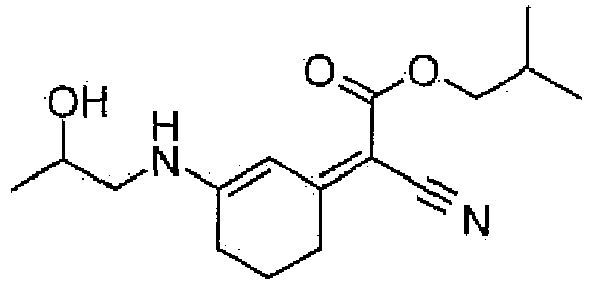
18 
19 
20 
21 
22 
23 
24 
25 
26 
27 
28 
29 
30 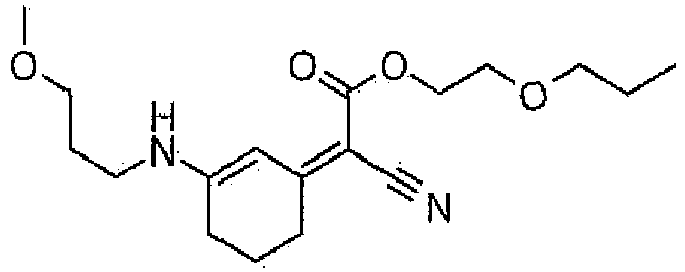
31 
32 
33 
34 
35 
36 
37 
38 
39 
40 
41 
42 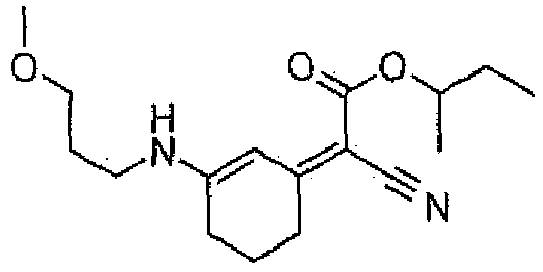
43 
44 
45 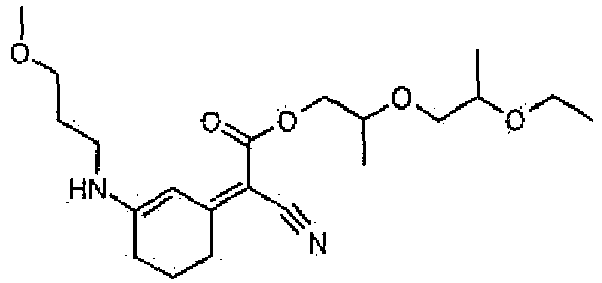
46 
47 
- Composition selon l'une des revendications précédentes, où les composés de formule (1) ou (2) sont choisis parmi ceux répondant à la formule (3) suivante ainsi que leurs formes isomères géométriques E/E- ou E/Z-:
 A est -O- ou -NH;R est un groupement alkyle en C1-C22, un groupement alcényle en C2-C22, un groupement alcinyle en C2-C22, un groupement cycloalkyle en C3-C22 ou un cycloalcényle en G3-C22, lesdits groupements pouvant être interrompus par un ou plusieurs O.
 - Composition selon la revendication 13, où les mérocyanines de formule (3) sont choisies parmi les composés suivants ainsi que leurs formes isomères géométriques E/E-, E/Z-.:
14 
ethyl (2Z)-cyano{3-[(3-methoxypropyl)amino]cyclohex-2-en-1-ylidene}ethanoate 15 
(2Z)-2-cyano-N-(3-methoxypropyl)-2-{3-[(3-methoxypropyl)amino]cyclohex-2-en-1-ylidene}ethanamide 25 
2-ethoxyethyl (2Z)-cyano{3-[(3-methoxypropyl)amino]cyclohex-2-en-1-ylidene}ethanoate 27 
2-methylpropyl (2Z)-cyano{3-[(3-methoxypropyl)amino]cyclohex-2-en-1-ylidene}ethanoate 29 
2-butoxyethyl (2Z)-cyano{3-[(3-methoxypropyl)amino]cyclohex-2-en-1-ylidene}ethanoate 31 
3-methoxypropyl (2Z)-cyano{3-[(3-methoxypropyl)amino]cyclohex-2-en-1-ylidene}ethanoate 37 
3-ethoxypropyl (2Z)-cyano{3-[(3-methoxypropyl)amino]cyclohex-2-en-1-ylidene}ethanoate - Composition selon la revendication 14, où la mérocyanine de formule (3) est le composé 2-éthoxyéthyle (2Z)-cyano{3-[(3-méthoxypropyl)amino]cyclohex-2-èn-1-ylidène}éthanoate (25) dans sa configuration géométrique E/Z de structure suivante :


- Composition selon l'une quelconque des revendications 1 à 15, où le ou les composés mérocyanines sont présents dans une concentration allant de 0,1% à 10% en poids, et préférentiellement de 0,2% à 5% en poids par rapport au poids total de la composition.
- Composition selon l'une quelconque des revendications 1 à 16, où le composé amide de formule (I) est choisi parmi ceux pour lesquels :R' est un alkyle linéaire ou ramifié, en C6-C16 ; etR" et R"' sont l'hydrogène, un méthyle, un éthyle éventuellement substitué par un hydroxyle, et encore plus préférentiellement choisi parmi ceux pour lesquels :R' est un alkyle linéaire ou ramifié, en C6-C12 ; etR''et R"' sont un méthyle ou un éthyle-
- Composition selon la revendication 17, où le composé amide de formule (I) est choisi parmi- le N,N-diméthylcapramide,- le N,N diméthylcaprylamide ou leurs mélanges et encore mieux le N,N-diméthylcapramide.
- Composition selon l'une quelconque des revendications 1 à 18, où le ou les composés amides de formule (I) sont présents dans une concentration allant de 0,1% à 50% en poids, et préférentiellement de 0,2% à 30% en poids, et encore plus préférentiellement de 0,3% à 15% en poids par rapport au poids total de la composition.
- Composition telle que définie dans l'une quelconque des revendications précédentes pour utilisation dans un procédé de soin et/ou de maquillage d'une matière kératinique comprenant l'application sur la surface de ladite matière kératinique d'au moins une composition telle que définie dans l'une quelconque des revendications précédentes.
- Composition telle que définie dans l'une quelconque des revendications précédentes pour utilisation dans un procédé pour limiter l'assombrissement de la peau et/ou améliorer la couleur et/ou l'homogénéité du teint comprenant l'application sur la surface de la matière kératinique d'au moins une composition telle que définie dans l'une quelconque des revendications précédentes.
- Composition telle que définie dans l'une quelconque des revendications précédentes pour utilisation dans un procédé pour prévenir et/ou traiter les signes du vieillissement d'une matière kératinique comprenant l'application sur la surface de la matière kératinique d'au moins une composition telle que définie dans les revendications précédentes.
Applications Claiming Priority (2)
| Application Number | Priority Date | Filing Date | Title |
|---|---|---|---|
| FR1350486A FR3001133B1 (fr) | 2013-01-21 | 2013-01-21 | Composition cosmetique ou dermatologique comprenant une merocyanine et une phase huileuse comprenant au moins un compose amide particulier |
| PCT/EP2014/051018 WO2014111570A2 (fr) | 2013-01-21 | 2014-01-20 | Composition cosmétique ou dermatologique comprenant une mérocyanine et une phase huileuse comprenant au moins un composé amide spécifique |
Publications (2)
| Publication Number | Publication Date |
|---|---|
| EP2945604A2 EP2945604A2 (fr) | 2015-11-25 |
| EP2945604B1 true EP2945604B1 (fr) | 2019-04-10 |
Family
ID=48083339
Family Applications (1)
| Application Number | Title | Priority Date | Filing Date |
|---|---|---|---|
| EP14700916.1A Active EP2945604B1 (fr) | 2013-01-21 | 2014-01-20 | Composition cosmétique ou dermatologique comprenant une mérocyanine et une phase huileuse comprenant au moins un composé amide spécifique |
Country Status (10)
| Country | Link |
|---|---|
| US (1) | US9993405B2 (fr) |
| EP (1) | EP2945604B1 (fr) |
| JP (2) | JP6830317B2 (fr) |
| CN (1) | CN105101946B (fr) |
| BR (1) | BR112015015838B1 (fr) |
| ES (1) | ES2731813T3 (fr) |
| FR (1) | FR3001133B1 (fr) |
| MX (1) | MX358727B (fr) |
| WO (1) | WO2014111570A2 (fr) |
| ZA (1) | ZA201504714B (fr) |
Families Citing this family (7)
| Publication number | Priority date | Publication date | Assignee | Title |
|---|---|---|---|---|
| WO2013010590A1 (fr) * | 2011-07-21 | 2013-01-24 | L'oreal | Composition cosmétique et/ou dermatologique contenant un dérivé de mérocyanine qui comprend des groupes polaires spécifiques constitués de fonctionnalités hydroxyle et éther |
| JP6789822B6 (ja) * | 2014-04-09 | 2020-12-16 | ビーエイエスエフ・ソシエタス・エウロパエアBasf Se | 化粧品製剤におけるuvフィルター用可溶化剤 |
| FR3046927B1 (fr) * | 2016-01-26 | 2018-03-02 | L'oreal | Composition cosmetique ou dermatologique comprenant une merocyanine et une phase huileuse comprenant au moins un ether d'isosorbide |
| FR3046928B1 (fr) * | 2016-01-26 | 2019-08-09 | L'oreal | Composition cosmetique ou dermatologique comprenant une merocyanine et une phase huileuse comprenant au moins un amide n-substitue |
| FR3046930B1 (fr) * | 2016-01-26 | 2018-03-02 | L'oreal | Composition cosmetique ou dermatologique comprenant une merocyanine et une phase huileuse comprenant au moins un polyalkyleneglycol |
| FR3083097B1 (fr) * | 2018-06-28 | 2020-11-27 | Oreal | Composition cosmetique ou dermatologique comprenant une merocyanine et une phase huileuse comprenant au moins un carbonate d’alkyle ou d’alkylene |
| FR3130595B1 (fr) | 2021-12-17 | 2025-03-21 | Oreal | Composition cosmétique ou dermatologique comprenant au moins une mérocyanine et un hydrotrope |
Family Cites Families (59)
| Publication number | Priority date | Publication date | Assignee | Title |
|---|---|---|---|---|
| US2463264A (en) | 1942-12-23 | 1949-03-01 | Ciba Ltd | Derivatives of cyclic amidines and process of making same |
| US4085217A (en) * | 1964-01-29 | 1978-04-18 | L'oreal | Process and cosmetic compositions for the treatment of skin and scalp |
| FR2315991A1 (fr) | 1975-06-30 | 1977-01-28 | Oreal | Procede de fabrication de dispersions aqueuses de spherules lipidiques et nouvelles compositions correspondantes |
| US4077441A (en) | 1976-08-16 | 1978-03-07 | National Instrument Company | Convertible filling machine |
| JPS53128333A (en) | 1977-04-15 | 1978-11-09 | Fuji Photo Film Co Ltd | Prevention of influences of ultraviolet ray upon photosensitive material of silver halogenide |
| FR2416008A1 (fr) | 1978-02-02 | 1979-08-31 | Oreal | Lyophilisats de liposomes |
| DE3531383A1 (de) | 1985-09-03 | 1987-03-05 | Agfa Gevaert Ag | Fotografisches aufzeichnungsmaterial mit einem uv-absorber und neue uv-absorber |
| NL8502651A (nl) | 1985-09-27 | 1987-04-16 | Airspray Int Bv | Verstuiver voor een houder voor een te verstuiven vloeistof. |
| US5624663A (en) | 1987-08-28 | 1997-04-29 | L'oreal | Photostable cosmetic filter composition cotaining a UV-A filter and a substituted dialkylbenzalmalonate, the use of substituted dialkylbenzalmalonates in cosmetics as broad-band solar filters and novel substituted dialkyl malonates |
| DE4013522A1 (de) | 1990-04-27 | 1991-10-31 | Bayer Ag | Verwendung von alkylcarbonsaeure-dimethylamiden als kristallisationsinhibitoren |
| FR2668080B1 (fr) | 1990-10-17 | 1993-08-13 | Seppic Sa | Compositions auto-emulsionnables a base d'alcools gras, leur procede de preparation et leur utilisation pour la realisation d'emulsions. |
| US5237071A (en) | 1991-01-22 | 1993-08-17 | Fairmount Chemical Company, Inc. | Process for preparing 2,2'-methylene-bis(6-(2H-benzotriazol-2-yl)-4-hydrocarbyl phenols) |
| US5166355A (en) | 1991-02-04 | 1992-11-24 | Fairmount Chemical Co., Inc. | Process for preparing substituted 2,2'-methylene-bis-[6-(2H-benzotriazol-2-yl)-4-hydrocarbyl-phenols] |
| FR2677544B1 (fr) | 1991-06-14 | 1993-09-24 | Oreal | Composition cosmetique contenant un melange de nanopigments d'oxydes metalliques et de pigments melaniques. |
| FR2680683B1 (fr) | 1991-08-29 | 1993-11-12 | Oreal | Composition cosmetique filtrante contenant un polymere filtre a structure hydrocarbonee et une silicone filtre. |
| ES2157268T5 (es) | 1994-02-24 | 2004-12-01 | SYMRISE GMBH & CO KG | Preparados cosmeticos y dermatologicos que contienen acidos fenilen-1,4-bisbencimidazolsulfonicos. |
| GB9515048D0 (en) | 1995-07-22 | 1995-09-20 | Ciba Geigy Ag | Sunscreen compositions |
| IT1284525B1 (it) | 1996-09-13 | 1998-05-21 | 3V Sigma Spa | Derivati di benzossazolo loro uso come stabilizzanti contro le radiazioni uv |
| FR2755692B1 (fr) | 1996-11-08 | 1998-12-04 | Oreal | Nouveaux filtres solaires, compositions cosmetiques photoprotectrices les contenant et utilisations |
| DE19726184A1 (de) | 1997-06-20 | 1998-12-24 | Beiersdorf Ag | Kosmetische und dermatologische Lichtschutzformulierungen in Form von Emulsionen, insbesondere O/W-Makroemulsionen, O/W-Mikroemulsionen oder O/W/O-Emulsionen, mit einem Gehalt an lichtschutzwirksamen Benzotriazolderivaten |
| GB9715751D0 (en) | 1997-07-26 | 1997-10-01 | Ciba Geigy Ag | Formulations |
| DE19746654A1 (de) | 1997-08-13 | 1999-02-18 | Basf Ag | Photostabile UV-Filter enthaltende kosmetische und pharmazeutische Zubereitungen |
| DE19755649A1 (de) | 1997-12-15 | 1999-06-17 | Basf Ag | Photostabile UV-Filter enthaltende kosmetische und pharmazeutische Zubereitungen |
| DE19828463A1 (de) | 1998-06-26 | 1999-12-30 | Basf Ag | 4,4-Diarylbutadiene als wasserlösliche photostabile UV-Filter für kosmetische und pharmazeutische Zubereitungen |
| DE19855649A1 (de) | 1998-12-03 | 2000-06-08 | Basf Ag | Dimere alpha-Alkyl-Styrolderivate als photostabile UV-Filter in kosmetischen und pharmazeutischen Zubereitungen |
| DE19857127A1 (de) | 1998-12-11 | 2000-06-15 | Basf Ag | Oligomere Diarylbutadiene |
| IT1312374B1 (it) | 1999-01-11 | 2002-04-15 | 3V Sigma Spa | Associazioni di filtri solari e composizioni cosmetiche che licontengono |
| US6225467B1 (en) | 2000-01-21 | 2001-05-01 | Xerox Corporation | Electroluminescent (EL) devices |
| DE10012413A1 (de) | 2000-03-15 | 2001-09-20 | Basf Ag | Verwendung von Lichtschutzmittelkombinationen, die als wesentlichen Bestandteil 4,4'-Diarylbutadiene enthalten als photostabile UV-Filter in kosmetischen und pharmazeutischen Zubereitungen |
| DE10012408A1 (de) | 2000-03-15 | 2001-09-20 | Basf Ag | Verwendung von Lichtschutzmittelkombinationen, die als wesentlichen Bestandteil aminosubstituierte Hydroxybenzophenone enthalten als photostabile UV-Filter in kosmetischen und pharmazeutischen Zubereitungen |
| FR2815961B1 (fr) | 2000-10-26 | 2008-11-28 | Centre Nat Rech Scient | Nouveaux intermediaires utiles pour la synthese de retinoides |
| ITMI20012037A1 (it) | 2001-10-02 | 2003-04-02 | 3V Sigma Spa | Associazioni di filtri solari |
| DE10162844A1 (de) | 2001-12-20 | 2003-07-03 | Beiersdorf Ag | Kosmetische und dermatologische Lichtschutzformulierungen mit einem Gehalt an Bis-Resorcinyltriazinderivaten und Benzoxazol-Derivaten |
| JP3973941B2 (ja) | 2002-03-25 | 2007-09-12 | 富士フイルム株式会社 | δ−アミノペンタジエン酸エステル誘導体の製造方法 |
| AU2003250866B2 (en) * | 2002-07-10 | 2008-10-02 | Ciba Holding Inc. | Merocyanine derivatives for cosmetic use |
| BRPI0408994B1 (pt) | 2003-03-24 | 2015-07-14 | Ciba Specialty Chemicals Holding Inc. | Uso não terapêutico de derivados de triazina simétrica, sua preparação cosmética, bem como seu processo de preparação |
| DE102004047285A1 (de) | 2004-09-27 | 2006-04-20 | Beiersdorf Ag | Organische Mikropigmente enthaltende kosmetische Lichtschutzemulsion |
| DE102004047283A1 (de) | 2004-09-27 | 2006-04-13 | Beiersdorf Ag | O/W-Emulsionen mit anorganischen UV-Lichtschutzfilterpigmenten |
| DE102004047288B4 (de) | 2004-09-27 | 2006-11-30 | Beiersdorf Ag | Lichtschutzemulsion mit hohem Anteil an Lichtschutzfilterpigmenten |
| DE102004047282A1 (de) | 2004-09-27 | 2006-04-20 | Beiersdorf Ag | W/O-Emulsion mit UV-Lichtschutzfilterpigmenten |
| DE102004047286B4 (de) | 2004-09-27 | 2006-11-23 | Beiersdorf Ag | Kosmetische Lichtschutzzubereitung auf Basis von Mikropigmenten |
| DE102004047281A1 (de) | 2004-09-27 | 2006-04-20 | Beiersdorf Ag | Lichtschutzkonzentrat mit organischen Mikropigmenten |
| SE0800638L (sv) | 2005-09-22 | 2008-06-10 | Ramachandran Radhakrishnan | Ny löslighetsförbättrare och användning därav |
| EP1798213A1 (fr) | 2005-12-14 | 2007-06-20 | Cognis IP Management GmbH | Procédé pour la production d'hydrocarbures |
| GB2433499A (en) | 2005-12-20 | 2007-06-27 | Ciba Sc Holding Ag | Merocyanine derivatives useful as UV absorbing agents |
| GB2433439A (en) | 2005-12-21 | 2007-06-27 | Ciba Sc Holding Ag | Use of transmission dyes to protect human skin from UV radiation |
| GB2445832A (en) * | 2007-01-04 | 2008-07-23 | Ciba Sc Holding Ag | Composition comprising organic UV absorbing agent with enhanced oil/film solubility |
| WO2008090066A2 (fr) | 2007-01-25 | 2008-07-31 | Ciba Holding Inc. | Stabilisation d'ingrédients actifs sensibles aux ultraviolets |
| WO2008155059A2 (fr) | 2007-06-19 | 2008-12-24 | Cognis Ip Management Gmbh | Mélanges d'hydrocarbures et leur utilisation |
| CN101808615B (zh) | 2007-08-24 | 2013-05-15 | 巴斯夫欧洲公司 | 包含苯并三唑和部花青的混合物 |
| JP5270134B2 (ja) | 2007-11-12 | 2013-08-21 | 株式会社コーセー | 紫外線吸収剤水分散組成物 |
| FR2943541B1 (fr) * | 2009-03-31 | 2011-04-22 | Oreal | Composition filtrante fluide anhydre oleoalcoolique comprenant un polycondensat polyamide lipophile |
| EP2501359A1 (fr) * | 2009-11-20 | 2012-09-26 | L'Oréal | Composition cosmétique ou dermatologique peu collante contenant un principe actif lipophile |
| US8961941B2 (en) * | 2010-03-15 | 2015-02-24 | L'oreal | Composition comprising a dibenzoylmethane screening agent and a merocyanine dicyano or cyanoacetate derivative; method for the photostabilization of the dibenzoylmethane screening agent |
| FR2957249B1 (fr) * | 2010-03-15 | 2022-12-02 | Oreal | Composition contenant un filtre dibenzoylmethane et un derive dicyano ou cyanoacetate de merocyanine ; procede de photostabilisation du filtre dibenzoylmethane |
| JP2013522259A (ja) * | 2010-03-15 | 2013-06-13 | ロレアル | ジベンゾイルメタン系遮断剤と親水性又は水溶性のメロシアニン系uv遮断剤とを含有する組成物、及びジベンゾイルメタン系遮断剤を光安定化させる方法 |
| FR2957251B1 (fr) * | 2010-03-15 | 2012-03-02 | Oreal | Composition contenant une s-triazine siliciee substituee par au moins deux groupes alkylaminobenzoates et un filtre uv merocyanine hydrophile ou hydrosoluble |
| WO2013010590A1 (fr) | 2011-07-21 | 2013-01-24 | L'oreal | Composition cosmétique et/ou dermatologique contenant un dérivé de mérocyanine qui comprend des groupes polaires spécifiques constitués de fonctionnalités hydroxyle et éther |
| JP2014527039A (ja) * | 2011-07-21 | 2014-10-09 | ビーエーエスエフ ソシエタス・ヨーロピア | メロシアニン誘導体 |
-
2013
- 2013-01-21 FR FR1350486A patent/FR3001133B1/fr not_active Expired - Fee Related
-
2014
- 2014-01-20 CN CN201480016797.2A patent/CN105101946B/zh active Active
- 2014-01-20 EP EP14700916.1A patent/EP2945604B1/fr active Active
- 2014-01-20 JP JP2015553113A patent/JP6830317B2/ja active Active
- 2014-01-20 MX MX2015008783A patent/MX358727B/es active IP Right Grant
- 2014-01-20 US US14/762,052 patent/US9993405B2/en active Active
- 2014-01-20 WO PCT/EP2014/051018 patent/WO2014111570A2/fr not_active Ceased
- 2014-01-20 ES ES14700916T patent/ES2731813T3/es active Active
- 2014-01-20 BR BR112015015838-2A patent/BR112015015838B1/pt active IP Right Grant
-
2015
- 2015-06-30 ZA ZA2015/04714A patent/ZA201504714B/en unknown
-
2019
- 2019-07-04 JP JP2019125332A patent/JP2019182872A/ja active Pending
Non-Patent Citations (1)
| Title |
|---|
| "International Cosmetic Ingredient Dictionary and Handbook", vol. 1, December 2012, PERSONAL CARE PRODUCTS COUNCIL, Washington, pages: 1003 * |
Also Published As
| Publication number | Publication date |
|---|---|
| ZA201504714B (en) | 2016-06-29 |
| US9993405B2 (en) | 2018-06-12 |
| CN105101946A (zh) | 2015-11-25 |
| FR3001133A1 (fr) | 2014-07-25 |
| MX358727B (es) | 2018-09-03 |
| JP2019182872A (ja) | 2019-10-24 |
| JP2016508993A (ja) | 2016-03-24 |
| EP2945604A2 (fr) | 2015-11-25 |
| BR112015015838A2 (pt) | 2017-07-11 |
| JP6830317B2 (ja) | 2021-02-17 |
| CN105101946B (zh) | 2018-08-21 |
| WO2014111570A3 (fr) | 2015-01-15 |
| WO2014111570A2 (fr) | 2014-07-24 |
| FR3001133B1 (fr) | 2015-03-20 |
| BR112015015838B1 (pt) | 2020-03-10 |
| US20150359718A1 (en) | 2015-12-17 |
| ES2731813T3 (es) | 2019-11-19 |
| MX2015008783A (es) | 2015-11-13 |
Similar Documents
| Publication | Publication Date | Title |
|---|---|---|
| US11679069B2 (en) | Cosmetic or dermatological composition comprising a merocyanine and an oily phase comprising at least one alkyl or alkylene carbonate | |
| EP2945604B1 (fr) | Composition cosmétique ou dermatologique comprenant une mérocyanine et une phase huileuse comprenant au moins un composé amide spécifique | |
| EP3709958B1 (fr) | Composition cosmetique ou dermatologique comprenant une merocyanine et un polymere acrylique | |
| US11000460B2 (en) | Cosmetic or dermatological composition comprising a merocyanine, an oily phase and a C1—C4 monoalkanol | |
| EP2945601B1 (fr) | Composition cosmétique ou dermatologique comprenant une mérocyanine et un agent anti-uv à base de benzotriazole et/ou un composé bis-résorcinyl triazine | |
| EP2945605B1 (fr) | Composition cosmétique ou dermatologique comprenant une mérocyanine, un agent anti-uvb organique et un agent anti-uva organique supplémentaire | |
| EP2945606B1 (fr) | Émulsion d'eau dans l'huile cosmétique ou dermatologique comprenant une mérocyanine et au moins un polymère émulsifiant du type ester d'acide gras polyoxyalkylénique | |
| EP3407862B1 (fr) | Composition cosmétique ou dermatologique comprenant une mérocyanine et une phase huileuse comprenant au moins un polyalkylèneglycol | |
| EP2945603B1 (fr) | Composition cosmétique ou dermatologique comprenant une mérocyanine et un agent anti-uva du type 2-hydroxybenzophénone à substitution amino et/ou un agent anti-uva organique hydrophile | |
| WO2017129673A1 (fr) | Composition cosmétique ou dermatologique comprenant une mérocyanine et une phase huileuse comprenant au moins un ester d'acide dicarboxylique ou tricarboxylique | |
| US10667996B2 (en) | Cosmetic or dermatological composition comprising a merocyanine and an oily phase comprising at least one isosorbide ether | |
| US10888507B2 (en) | Cosmetic or dermatological composition comprising a merocyanine and an oily phase comprising at least one N-substituted amide |
Legal Events
| Date | Code | Title | Description |
|---|---|---|---|
| PUAI | Public reference made under article 153(3) epc to a published international application that has entered the european phase |
Free format text: ORIGINAL CODE: 0009012 |
|
| 17P | Request for examination filed |
Effective date: 20150821 |
|
| AK | Designated contracting states |
Kind code of ref document: A2 Designated state(s): AL AT BE BG CH CY CZ DE DK EE ES FI FR GB GR HR HU IE IS IT LI LT LU LV MC MK MT NL NO PL PT RO RS SE SI SK SM TR |
|
| AX | Request for extension of the european patent |
Extension state: BA ME |
|
| DAX | Request for extension of the european patent (deleted) | ||
| STAA | Information on the status of an ep patent application or granted ep patent |
Free format text: STATUS: EXAMINATION IS IN PROGRESS |
|
| 17Q | First examination report despatched |
Effective date: 20170622 |
|
| REG | Reference to a national code |
Ref country code: DE Ref legal event code: R079 Ref document number: 602014044361 Country of ref document: DE Free format text: PREVIOUS MAIN CLASS: A61K0008410000 Ipc: A61K0008060000 |
|
| GRAP | Despatch of communication of intention to grant a patent |
Free format text: ORIGINAL CODE: EPIDOSNIGR1 |
|
| STAA | Information on the status of an ep patent application or granted ep patent |
Free format text: STATUS: GRANT OF PATENT IS INTENDED |
|
| RIC1 | Information provided on ipc code assigned before grant |
Ipc: A61Q 17/04 20060101ALI20180918BHEP Ipc: A61Q 19/08 20060101ALI20180918BHEP Ipc: A61K 8/42 20060101ALI20180918BHEP Ipc: A61Q 19/00 20060101ALI20180918BHEP Ipc: A61K 8/06 20060101AFI20180918BHEP Ipc: A61K 8/41 20060101ALI20180918BHEP |
|
| INTG | Intention to grant announced |
Effective date: 20181009 |
|
| GRAJ | Information related to disapproval of communication of intention to grant by the applicant or resumption of examination proceedings by the epo deleted |
Free format text: ORIGINAL CODE: EPIDOSDIGR1 |
|
| STAA | Information on the status of an ep patent application or granted ep patent |
Free format text: STATUS: EXAMINATION IS IN PROGRESS |
|
| GRAP | Despatch of communication of intention to grant a patent |
Free format text: ORIGINAL CODE: EPIDOSNIGR1 |
|
| STAA | Information on the status of an ep patent application or granted ep patent |
Free format text: STATUS: GRANT OF PATENT IS INTENDED |
|
| INTC | Intention to grant announced (deleted) | ||
| INTG | Intention to grant announced |
Effective date: 20190108 |
|
| GRAS | Grant fee paid |
Free format text: ORIGINAL CODE: EPIDOSNIGR3 |
|
| GRAA | (expected) grant |
Free format text: ORIGINAL CODE: 0009210 |
|
| STAA | Information on the status of an ep patent application or granted ep patent |
Free format text: STATUS: THE PATENT HAS BEEN GRANTED |
|
| AK | Designated contracting states |
Kind code of ref document: B1 Designated state(s): AL AT BE BG CH CY CZ DE DK EE ES FI FR GB GR HR HU IE IS IT LI LT LU LV MC MK MT NL NO PL PT RO RS SE SI SK SM TR |
|
| REG | Reference to a national code |
Ref country code: GB Ref legal event code: FG4D |
|
| REG | Reference to a national code |
Ref country code: CH Ref legal event code: EP Ref country code: AT Ref legal event code: REF Ref document number: 1117704 Country of ref document: AT Kind code of ref document: T Effective date: 20190415 |
|
| REG | Reference to a national code |
Ref country code: IE Ref legal event code: FG4D |
|
| REG | Reference to a national code |
Ref country code: DE Ref legal event code: R096 Ref document number: 602014044361 Country of ref document: DE |
|
| REG | Reference to a national code |
Ref country code: NL Ref legal event code: MP Effective date: 20190410 |
|
| REG | Reference to a national code |
Ref country code: LT Ref legal event code: MG4D |
|
| REG | Reference to a national code |
Ref country code: AT Ref legal event code: MK05 Ref document number: 1117704 Country of ref document: AT Kind code of ref document: T Effective date: 20190410 |
|
| PG25 | Lapsed in a contracting state [announced via postgrant information from national office to epo] |
Ref country code: NL Free format text: LAPSE BECAUSE OF FAILURE TO SUBMIT A TRANSLATION OF THE DESCRIPTION OR TO PAY THE FEE WITHIN THE PRESCRIBED TIME-LIMIT Effective date: 20190410 |
|
| PG25 | Lapsed in a contracting state [announced via postgrant information from national office to epo] |
Ref country code: LT Free format text: LAPSE BECAUSE OF FAILURE TO SUBMIT A TRANSLATION OF THE DESCRIPTION OR TO PAY THE FEE WITHIN THE PRESCRIBED TIME-LIMIT Effective date: 20190410 Ref country code: HR Free format text: LAPSE BECAUSE OF FAILURE TO SUBMIT A TRANSLATION OF THE DESCRIPTION OR TO PAY THE FEE WITHIN THE PRESCRIBED TIME-LIMIT Effective date: 20190410 Ref country code: NO Free format text: LAPSE BECAUSE OF FAILURE TO SUBMIT A TRANSLATION OF THE DESCRIPTION OR TO PAY THE FEE WITHIN THE PRESCRIBED TIME-LIMIT Effective date: 20190710 Ref country code: SE Free format text: LAPSE BECAUSE OF FAILURE TO SUBMIT A TRANSLATION OF THE DESCRIPTION OR TO PAY THE FEE WITHIN THE PRESCRIBED TIME-LIMIT Effective date: 20190410 Ref country code: PT Free format text: LAPSE BECAUSE OF FAILURE TO SUBMIT A TRANSLATION OF THE DESCRIPTION OR TO PAY THE FEE WITHIN THE PRESCRIBED TIME-LIMIT Effective date: 20190910 Ref country code: AL Free format text: LAPSE BECAUSE OF FAILURE TO SUBMIT A TRANSLATION OF THE DESCRIPTION OR TO PAY THE FEE WITHIN THE PRESCRIBED TIME-LIMIT Effective date: 20190410 Ref country code: FI Free format text: LAPSE BECAUSE OF FAILURE TO SUBMIT A TRANSLATION OF THE DESCRIPTION OR TO PAY THE FEE WITHIN THE PRESCRIBED TIME-LIMIT Effective date: 20190410 |
|
| REG | Reference to a national code |
Ref country code: ES Ref legal event code: FG2A Ref document number: 2731813 Country of ref document: ES Kind code of ref document: T3 Effective date: 20191119 |
|
| PG25 | Lapsed in a contracting state [announced via postgrant information from national office to epo] |
Ref country code: BG Free format text: LAPSE BECAUSE OF FAILURE TO SUBMIT A TRANSLATION OF THE DESCRIPTION OR TO PAY THE FEE WITHIN THE PRESCRIBED TIME-LIMIT Effective date: 20190710 Ref country code: GR Free format text: LAPSE BECAUSE OF FAILURE TO SUBMIT A TRANSLATION OF THE DESCRIPTION OR TO PAY THE FEE WITHIN THE PRESCRIBED TIME-LIMIT Effective date: 20190711 Ref country code: LV Free format text: LAPSE BECAUSE OF FAILURE TO SUBMIT A TRANSLATION OF THE DESCRIPTION OR TO PAY THE FEE WITHIN THE PRESCRIBED TIME-LIMIT Effective date: 20190410 Ref country code: PL Free format text: LAPSE BECAUSE OF FAILURE TO SUBMIT A TRANSLATION OF THE DESCRIPTION OR TO PAY THE FEE WITHIN THE PRESCRIBED TIME-LIMIT Effective date: 20190410 Ref country code: RS Free format text: LAPSE BECAUSE OF FAILURE TO SUBMIT A TRANSLATION OF THE DESCRIPTION OR TO PAY THE FEE WITHIN THE PRESCRIBED TIME-LIMIT Effective date: 20190410 |
|
| PG25 | Lapsed in a contracting state [announced via postgrant information from national office to epo] |
Ref country code: AT Free format text: LAPSE BECAUSE OF FAILURE TO SUBMIT A TRANSLATION OF THE DESCRIPTION OR TO PAY THE FEE WITHIN THE PRESCRIBED TIME-LIMIT Effective date: 20190410 Ref country code: IS Free format text: LAPSE BECAUSE OF FAILURE TO SUBMIT A TRANSLATION OF THE DESCRIPTION OR TO PAY THE FEE WITHIN THE PRESCRIBED TIME-LIMIT Effective date: 20190810 |
|
| REG | Reference to a national code |
Ref country code: DE Ref legal event code: R097 Ref document number: 602014044361 Country of ref document: DE |
|
| PG25 | Lapsed in a contracting state [announced via postgrant information from national office to epo] |
Ref country code: SK Free format text: LAPSE BECAUSE OF FAILURE TO SUBMIT A TRANSLATION OF THE DESCRIPTION OR TO PAY THE FEE WITHIN THE PRESCRIBED TIME-LIMIT Effective date: 20190410 Ref country code: CZ Free format text: LAPSE BECAUSE OF FAILURE TO SUBMIT A TRANSLATION OF THE DESCRIPTION OR TO PAY THE FEE WITHIN THE PRESCRIBED TIME-LIMIT Effective date: 20190410 Ref country code: DK Free format text: LAPSE BECAUSE OF FAILURE TO SUBMIT A TRANSLATION OF THE DESCRIPTION OR TO PAY THE FEE WITHIN THE PRESCRIBED TIME-LIMIT Effective date: 20190410 Ref country code: RO Free format text: LAPSE BECAUSE OF FAILURE TO SUBMIT A TRANSLATION OF THE DESCRIPTION OR TO PAY THE FEE WITHIN THE PRESCRIBED TIME-LIMIT Effective date: 20190410 Ref country code: EE Free format text: LAPSE BECAUSE OF FAILURE TO SUBMIT A TRANSLATION OF THE DESCRIPTION OR TO PAY THE FEE WITHIN THE PRESCRIBED TIME-LIMIT Effective date: 20190410 |
|
| PLBE | No opposition filed within time limit |
Free format text: ORIGINAL CODE: 0009261 |
|
| STAA | Information on the status of an ep patent application or granted ep patent |
Free format text: STATUS: NO OPPOSITION FILED WITHIN TIME LIMIT |
|
| PG25 | Lapsed in a contracting state [announced via postgrant information from national office to epo] |
Ref country code: SM Free format text: LAPSE BECAUSE OF FAILURE TO SUBMIT A TRANSLATION OF THE DESCRIPTION OR TO PAY THE FEE WITHIN THE PRESCRIBED TIME-LIMIT Effective date: 20190410 |
|
| 26N | No opposition filed |
Effective date: 20200113 |
|
| PG25 | Lapsed in a contracting state [announced via postgrant information from national office to epo] |
Ref country code: TR Free format text: LAPSE BECAUSE OF FAILURE TO SUBMIT A TRANSLATION OF THE DESCRIPTION OR TO PAY THE FEE WITHIN THE PRESCRIBED TIME-LIMIT Effective date: 20190410 |
|
| PG25 | Lapsed in a contracting state [announced via postgrant information from national office to epo] |
Ref country code: SI Free format text: LAPSE BECAUSE OF FAILURE TO SUBMIT A TRANSLATION OF THE DESCRIPTION OR TO PAY THE FEE WITHIN THE PRESCRIBED TIME-LIMIT Effective date: 20190410 |
|
| PG25 | Lapsed in a contracting state [announced via postgrant information from national office to epo] |
Ref country code: MC Free format text: LAPSE BECAUSE OF FAILURE TO SUBMIT A TRANSLATION OF THE DESCRIPTION OR TO PAY THE FEE WITHIN THE PRESCRIBED TIME-LIMIT Effective date: 20190410 |
|
| REG | Reference to a national code |
Ref country code: CH Ref legal event code: PL |
|
| REG | Reference to a national code |
Ref country code: BE Ref legal event code: MM Effective date: 20200131 |
|
| PG25 | Lapsed in a contracting state [announced via postgrant information from national office to epo] |
Ref country code: LU Free format text: LAPSE BECAUSE OF NON-PAYMENT OF DUE FEES Effective date: 20200120 |
|
| PG25 | Lapsed in a contracting state [announced via postgrant information from national office to epo] |
Ref country code: BE Free format text: LAPSE BECAUSE OF NON-PAYMENT OF DUE FEES Effective date: 20200131 Ref country code: CH Free format text: LAPSE BECAUSE OF NON-PAYMENT OF DUE FEES Effective date: 20200131 Ref country code: LI Free format text: LAPSE BECAUSE OF NON-PAYMENT OF DUE FEES Effective date: 20200131 |
|
| PG25 | Lapsed in a contracting state [announced via postgrant information from national office to epo] |
Ref country code: IE Free format text: LAPSE BECAUSE OF NON-PAYMENT OF DUE FEES Effective date: 20200120 |
|
| PG25 | Lapsed in a contracting state [announced via postgrant information from national office to epo] |
Ref country code: MT Free format text: LAPSE BECAUSE OF FAILURE TO SUBMIT A TRANSLATION OF THE DESCRIPTION OR TO PAY THE FEE WITHIN THE PRESCRIBED TIME-LIMIT Effective date: 20190410 Ref country code: CY Free format text: LAPSE BECAUSE OF FAILURE TO SUBMIT A TRANSLATION OF THE DESCRIPTION OR TO PAY THE FEE WITHIN THE PRESCRIBED TIME-LIMIT Effective date: 20190410 |
|
| PG25 | Lapsed in a contracting state [announced via postgrant information from national office to epo] |
Ref country code: MK Free format text: LAPSE BECAUSE OF FAILURE TO SUBMIT A TRANSLATION OF THE DESCRIPTION OR TO PAY THE FEE WITHIN THE PRESCRIBED TIME-LIMIT Effective date: 20190410 |
|
| PGFP | Annual fee paid to national office [announced via postgrant information from national office to epo] |
Ref country code: GB Payment date: 20251204 Year of fee payment: 13 |
|
| PGFP | Annual fee paid to national office [announced via postgrant information from national office to epo] |
Ref country code: FR Payment date: 20251208 Year of fee payment: 13 |
|
| PGFP | Annual fee paid to national office [announced via postgrant information from national office to epo] |
Ref country code: ES Payment date: 20260209 Year of fee payment: 13 |
|
| PGFP | Annual fee paid to national office [announced via postgrant information from national office to epo] |
Ref country code: DE Payment date: 20251203 Year of fee payment: 13 |
|
| PGFP | Annual fee paid to national office [announced via postgrant information from national office to epo] |
Ref country code: IT Payment date: 20251219 Year of fee payment: 13 |