EP2947647A2 - Procédés de commande d'affichages électro-optiques - Google Patents
Procédés de commande d'affichages électro-optiques Download PDFInfo
- Publication number
- EP2947647A2 EP2947647A2 EP15000723.5A EP15000723A EP2947647A2 EP 2947647 A2 EP2947647 A2 EP 2947647A2 EP 15000723 A EP15000723 A EP 15000723A EP 2947647 A2 EP2947647 A2 EP 2947647A2
- Authority
- EP
- European Patent Office
- Prior art keywords
- pixel
- impulse
- display
- transition
- pixels
- Prior art date
- Legal status (The legal status is an assumption and is not a legal conclusion. Google has not performed a legal analysis and makes no representation as to the accuracy of the status listed.)
- Withdrawn
Links
- 238000000034 method Methods 0.000 title claims description 117
- 230000007704 transition Effects 0.000 claims description 177
- 230000003287 optical effect Effects 0.000 claims description 123
- 239000011159 matrix material Substances 0.000 claims description 46
- 230000001419 dependent effect Effects 0.000 claims description 5
- 230000000694 effects Effects 0.000 description 15
- 230000008859 change Effects 0.000 description 14
- 238000001208 nuclear magnetic resonance pulse sequence Methods 0.000 description 13
- 239000002245 particle Substances 0.000 description 9
- 230000006870 function Effects 0.000 description 8
- 230000005684 electric field Effects 0.000 description 7
- 238000003384 imaging method Methods 0.000 description 6
- 239000000463 material Substances 0.000 description 6
- 239000000872 buffer Substances 0.000 description 5
- 230000006872 improvement Effects 0.000 description 5
- 238000003780 insertion Methods 0.000 description 5
- 230000037431 insertion Effects 0.000 description 5
- 238000012986 modification Methods 0.000 description 5
- 230000004048 modification Effects 0.000 description 5
- 238000009825 accumulation Methods 0.000 description 4
- 238000013459 approach Methods 0.000 description 4
- 239000002775 capsule Substances 0.000 description 4
- 230000007423 decrease Effects 0.000 description 4
- 230000001934 delay Effects 0.000 description 4
- 238000005265 energy consumption Methods 0.000 description 4
- 230000007774 longterm Effects 0.000 description 4
- 230000008569 process Effects 0.000 description 4
- 230000009467 reduction Effects 0.000 description 4
- 230000002829 reductive effect Effects 0.000 description 4
- 230000006399 behavior Effects 0.000 description 3
- 230000008901 benefit Effects 0.000 description 3
- 125000004122 cyclic group Chemical group 0.000 description 3
- 230000003247 decreasing effect Effects 0.000 description 3
- 238000007599 discharging Methods 0.000 description 3
- 239000012530 fluid Substances 0.000 description 3
- 238000004519 manufacturing process Methods 0.000 description 3
- 230000002441 reversible effect Effects 0.000 description 3
- 230000000007 visual effect Effects 0.000 description 3
- 238000003491 array Methods 0.000 description 2
- 230000005540 biological transmission Effects 0.000 description 2
- 230000001010 compromised effect Effects 0.000 description 2
- 238000009826 distribution Methods 0.000 description 2
- 230000000670 limiting effect Effects 0.000 description 2
- 239000003094 microcapsule Substances 0.000 description 2
- 241001270131 Agaricus moelleri Species 0.000 description 1
- 238000012935 Averaging Methods 0.000 description 1
- 241000114304 Laterallus jamaicensis Species 0.000 description 1
- 239000004988 Nematic liquid crystal Substances 0.000 description 1
- 239000000853 adhesive Substances 0.000 description 1
- 230000001070 adhesive effect Effects 0.000 description 1
- 238000004364 calculation method Methods 0.000 description 1
- 238000012937 correction Methods 0.000 description 1
- 230000002939 deleterious effect Effects 0.000 description 1
- 238000005516 engineering process Methods 0.000 description 1
- 238000011156 evaluation Methods 0.000 description 1
- 230000005032 impulse control Effects 0.000 description 1
- 238000003475 lamination Methods 0.000 description 1
- 239000004973 liquid crystal related substance Substances 0.000 description 1
- 238000004020 luminiscence type Methods 0.000 description 1
- 230000007246 mechanism Effects 0.000 description 1
- 239000012528 membrane Substances 0.000 description 1
- 238000005457 optimization Methods 0.000 description 1
- 230000036278 prepulse Effects 0.000 description 1
- 238000012827 research and development Methods 0.000 description 1
- 230000000717 retained effect Effects 0.000 description 1
- 238000012216 screening Methods 0.000 description 1
- 239000007787 solid Substances 0.000 description 1
- 230000006641 stabilisation Effects 0.000 description 1
- 230000016776 visual perception Effects 0.000 description 1
- 239000002023 wood Substances 0.000 description 1
Images



Classifications
-
- G—PHYSICS
- G09—EDUCATION; CRYPTOGRAPHY; DISPLAY; ADVERTISING; SEALS
- G09G—ARRANGEMENTS OR CIRCUITS FOR CONTROL OF INDICATING DEVICES USING STATIC MEANS TO PRESENT VARIABLE INFORMATION
- G09G3/00—Control arrangements or circuits, of interest only in connection with visual indicators other than cathode-ray tubes
- G09G3/20—Control arrangements or circuits, of interest only in connection with visual indicators other than cathode-ray tubes for presentation of an assembly of a number of characters, e.g. a page, by composing the assembly by combination of individual elements arranged in a matrix no fixed position being assigned to or needed to be assigned to the individual characters or partial characters
- G09G3/34—Control arrangements or circuits, of interest only in connection with visual indicators other than cathode-ray tubes for presentation of an assembly of a number of characters, e.g. a page, by composing the assembly by combination of individual elements arranged in a matrix no fixed position being assigned to or needed to be assigned to the individual characters or partial characters by control of light from an independent source
- G09G3/3433—Control arrangements or circuits, of interest only in connection with visual indicators other than cathode-ray tubes for presentation of an assembly of a number of characters, e.g. a page, by composing the assembly by combination of individual elements arranged in a matrix no fixed position being assigned to or needed to be assigned to the individual characters or partial characters by control of light from an independent source using light modulating elements actuated by an electric field and being other than liquid crystal devices and electrochromic devices
- G09G3/344—Control arrangements or circuits, of interest only in connection with visual indicators other than cathode-ray tubes for presentation of an assembly of a number of characters, e.g. a page, by composing the assembly by combination of individual elements arranged in a matrix no fixed position being assigned to or needed to be assigned to the individual characters or partial characters by control of light from an independent source using light modulating elements actuated by an electric field and being other than liquid crystal devices and electrochromic devices based on particles moving in a fluid or in a gas, e.g. electrophoretic devices
-
- G—PHYSICS
- G09—EDUCATION; CRYPTOGRAPHY; DISPLAY; ADVERTISING; SEALS
- G09G—ARRANGEMENTS OR CIRCUITS FOR CONTROL OF INDICATING DEVICES USING STATIC MEANS TO PRESENT VARIABLE INFORMATION
- G09G2310/00—Command of the display device
- G09G2310/06—Details of flat display driving waveforms
- G09G2310/068—Application of pulses of alternating polarity prior to the drive pulse in electrophoretic displays
-
- G—PHYSICS
- G09—EDUCATION; CRYPTOGRAPHY; DISPLAY; ADVERTISING; SEALS
- G09G—ARRANGEMENTS OR CIRCUITS FOR CONTROL OF INDICATING DEVICES USING STATIC MEANS TO PRESENT VARIABLE INFORMATION
- G09G3/00—Control arrangements or circuits, of interest only in connection with visual indicators other than cathode-ray tubes
- G09G3/20—Control arrangements or circuits, of interest only in connection with visual indicators other than cathode-ray tubes for presentation of an assembly of a number of characters, e.g. a page, by composing the assembly by combination of individual elements arranged in a matrix no fixed position being assigned to or needed to be assigned to the individual characters or partial characters
- G09G3/2007—Display of intermediate tones
- G09G3/2044—Display of intermediate tones using dithering
Definitions
- This invention relates to methods for driving electro-optic displays.
- the methods of the present invention are especially, though not exclusively, intended for use in driving bistable electrophoretic displays.
- optical-optic as applied to a material or a display, is used herein in its conventional meaning in the imaging art to refer to a material having first and second display states differing in at least one optical property, the material being changed from its first to its second display state by application of an electric field to the material.
- the optical property is typically color perceptible to the human eye, it may be another optical property, such as optical transmission, reflectance, luminescence or, in the case of displays intended for machine reading, pseudo-color in the sense of a change in reflectance of electromagnetic wavelengths outside the visible range.
- gray state is used herein in its conventional meaning in the imaging art to refer to a state intermediate two extreme optical states of a pixel, and does not necessarily imply a black-white transition between these two extreme states.
- extreme states are white and deep blue, so that an intermediate "gray state” would actually be pale blue. Indeed, as already mentioned the transition between the two extreme states may not be a color change at all.
- bistable and “bistability” are used herein in their conventional meaning in the imaging art to refer to displays comprising display elements having first and second display states differing in at least one optical property, and such that after any given element has been driven, by means of an addressing pulse of finite duration, to assume either its first or second display state, after the addressing pulse has terminated, that state will persist for at least several times, for example at least four times, the minimum duration of the addressing pulse required to change the state of the display element.
- WO 02/079869 some particle-based electrophoretic displays capable of gray scale are stable not only in their extreme black and white states but also in their intermediate gray states, and the same is true of some other types of electro-optic displays. This type of display is properly called “multi-stable” rather than bistable, although for convenience the term “bistable” may be used herein to cover both bistable and multi-stable displays.
- impulse is used herein in its conventional meaning in the imaging art of the integral of voltage with respect to time.
- bistable electro-optic media act as charge transducers, and with such media an alternative definition of impulse, namely the integral of current over time (which is equal to the total charge applied) may be used.
- the appropriate definition of impulse should be used, depending on whether the medium acts as a voltage-time impulse transducer or a charge impulse transducer.
- electro-optic displays are known, for example the rotating bichromal member type as described, for example, in U.S. Patents Nos. 5,808,783 ; 5,777,782 ; 5,760,761 ; 6,054,071 6,055,091 ; 6,097,531 ; 6,128,124 ; 6,137,467 ; and 6,147,791 and the electrochromic type; see, for example O'Regan, B., et al., Nature 1991, 353, 737 ; and Wood, D., Information Display, 18(3), 24 (March 2002 ). See also Bach, U., et al., Adv.
- Nanochromic films of this type are also described, for example, in U.S. Patent No. 6,301,038 , International Application Publication No. WO 01/27690 , and in U.S. Patent Application 2003/0214695 .
- WO 99/67678 WO 00/05704 ; WO 00/38000 ; WO 00/38001 ; WO00/36560 ; WO 00/67110 ; WO 00/67327 ; WO 01/07961 ; WO 01/08241 ; WO 03/092077 ; WO 03/107315 ; WO 2004/017035 ; and WO 2004/023202 .
- microcell electrophoretic display A related type of electrophoretic display is a so-called "microcell electrophoretic display".
- the charged particles and the suspending fluid are not encapsulated within capsules but instead are retained within a plurality of cavities formed within a carrier medium, typically a polymeric film.
- a carrier medium typically a polymeric film.
- electrophoretic media are often opaque (since, for example, in many electrophoretic media, the particles substantially block transmission of visible light through the display) and operate in a reflective mode
- many electrophoretic displays can be made to operate in a so-called "shutter mode" in which one display state is substantially opaque and one is light-transmissive. See, for example, the aforementioned U.S. Patents Nos. 6,130,774 and 6,172,798 , and U.S. Patents Nos. 5,872,552 ; 6,144,361 ; 6,271,823 ; 6,225,971 ; and 6,184,856 .
- Dielectrophoretic displays which are similar to electrophoretic displays but rely upon variations in electric field strength, can operate in a similar mode; see U.S. Patent No. 4,418,346 .
- Other types of electro-optic displays may also be capable of operating in shutter mode.
- LC displays liquid crystal
- Twisted nematic liquid crystals act are not bi- or multi-stable but act as voltage transducers, so that applying a given electric field to a pixel of such a display produces a specific gray level at the pixel, regardless of the gray level previously present at the pixel.
- LC displays are only driven in one direction (from non-transmissive or "dark” to transmissive or “light”), the reverse transition from a lighter state to a darker one being effected by reducing or eliminating the electric field.
- bistable electro-optic displays act, to a first approximation, as impulse transducers, so that the final state of a pixel depends not only upon the electric field applied and the time for which this field is applied, but also upon the state of the pixel prior to the application of the electric field.
- general grayscale image flow suffers from an "accumulation of errors" phenomenon which may produce deviations in gray levels apparent to the average observer on certain types of images. This accumulation of errors phenomenon applies to errors of all the types listed above. As described in the aforementioned 2003/0137521 , compensating for such errors is possible, but only to a limited degree of precision. Thus, general grayscale image flow requires very precise control of applied impulse to give good results, and empirically it has been found that, in the present state of the technology of electro-optic displays, general grayscale image flow is infeasible in a commercial display.
- electro-optic medium have a built-in resetting (error limiting) mechanism, namely their extreme (typically black and white) optical states, which function as "optical rails".
- error limiting error limiting
- a specific impulse has been applied to a pixel of an electro-optic display, that pixel cannot get any whiter (or blacker).
- whiter or blacker
- all the electrophoretic particles are forced against one another or against the capsule wall, and cannot move further, thus producing a limiting optical state or optical rail.
- this invention seeks to provide methods for achieving control of gray levels in electro-optic displays which achieve stability of gray levels similar to those achieved by slide show drive schemes but which do not suffer from the distracting flashing of slide show drive schemes.
- Preferred methods of the present invention can give the viewer a visual experience similar to that provided by a pure general grayscale image flow drive scheme.
- this invention seeks to provide methods for achieving fine control of gray levels in displays driven by pulse width modulation.
- pulse width modulation driving of active matrix displays is effected by scanning the matrix multiple times, with the drive voltage being applied during none, some or all of the scans, depending upon the change desired in the gray level of the specific pixel.
- Each scan may be regarded as a frame of the drive waveform, with the complete addressing pulse being a superframe formed by a plurality of successive frames.
- the drive voltage is only applied to any specific pixel electrode for one line address time during each scan, the drive voltage persists on the pixel electrodes during the time between successive selections of the same line, only slowly decaying, so that the pixel is driven between successive selections of the same line.
- each row of the matrix needs to be individually selected during each frame so that for high resolution displays (for example, 800 x 600 pixel displays) in practice the frame rate cannot exceed about 50 to 100 Hz; thus each frame typically lasts 10 to 20 ms. Frames of this length lead to difficulties in fine control of gray scale with many fast switching electro-optic medium.
- some encapsulated electrophoretic media substantially complete a switch between their extreme optical states (a transition of about 30 L* units) within about 100 ms, and with such a medium a 20 ms frame corresponds to a gray scale shift of about 6 L* units.
- this invention provides a method for driving an electro-optic display having at least one pixel capable of achieving any one of at least four different gray levels including two extreme optical states.
- the method comprises:
- This method may hereinafter for convenience be referred to as the "limited transitions method" of the present invention.
- the rewriting of the display is effected such that, once a pixel has been driven from one extreme optical state towards the opposed extreme optical state by a pulse of one polarity, the pixel does not receive a pulse of the opposed polarity until it has reached the opposed extreme optical state.
- the predetermined value is not greater than N/2, where N is the total number of gray levels capable of being displayed by a pixel.
- the limited transitions method may be effected using a tri-level driver, i.e., the rewriting of the display may be effected by applying to the or each pixel any one or more of voltages -V, 0 and . +V.
- the limited transitions method may also be DC-balanced, i.e., the rewriting of the display may be effected such that, for any series of transitions undergone by a pixel, the integral of the applied voltage with time is bounded.
- the rewriting of the display may be effected such that the impulse applied to a pixel during a transition depends only upon the initial and final gray levels of that transition.
- the method may be adapted to take account of other states of the display, as described in more detail below.
- the aforementioned -x/ ⁇ IP/x sequences may contain additional pulses.
- such sequences may comprise an additional pair of pulses of the form [+y][-y], where y is an impulse value, which may be either negative or positive, the [+y] and [-y] pulses being inserted into the -x/ ⁇ IP/x sequence.
- the sequence may further comprise a second additional pair of pulses of the form [+z][-z], where z is an impulse value different from y and may be either negative or positive, the [+z] and [-z] pulses being inserted into the -x/ ⁇ IP/x sequence.
- the -x/ ⁇ IP/x sequences may further comprise a period when no voltage is applied to the pixel. This "no voltage" period may occur between two elements of the -x/ ⁇ IP/x sequence, or within a single element thereof.
- the -x/ ⁇ IP/x sequences may include two or more "no voltage" periods.
- the display may comprise a plurality of pixels divided into a plurality of groups, and the transition may be effected by (a) selecting each of the plurality of groups of pixels in succession and applying to each of the pixels in the selected group either a drive voltage or a non-drive voltage, the scanning of all the groups of pixels being completed in a first frame period; (b) repeating the scanning of the groups of pixels during a second frame period; and (c) interrupting the scanning of the groups of pixels during a pause period between the first and second frame periods, this pause period being not longer than the first or second frame period.
- the rewriting of the display may be effected such that a transition to a given gray level is always effected by a final pulse of the same polarity.
- gray levels other than the two extreme optical states may be approached from the direction of the nearer extreme optical state.
- This invention also provides a method for driving an electro-optic display having a plurality of pixels divided into a plurality of groups. This method comprises:
- This method may hereinafter for convenience be referred to as the "interrupted scanning" method of the present invention.
- the first and second frame periods are equal in length.
- the length of the pause period may be a sub-multiple of the length of one of the first and second frame periods.
- the interrupted scanning method may include multiple pause periods; thus the method may comprise scanning the groups of pixels during at least first, second and third frame periods, and interrupting the scanning of the groups of pixels during at least first and second pause periods between successive frame periods.
- the first, second and third frame periods may be substantially equal in length, and the total length of the pause periods be equal to one frame period or one frame period minus one pause period.
- the pixels are arranged in a matrix having a plurality of rows and a plurality of columns with each pixel defined by the intersection of a given row and a given column, and each group of pixels comprises one row or one column of the matrix.
- the interrupted scanning method is preferably DC balanced, i.e., the scanning of the display is preferably effected such that, for any series of transitions undergone by a pixel, the integral of the applied voltage with time is bounded.
- this invention provides a method for driving an electro-optic display having a plurality of pixels, the pixels being driven with a pulse width modulated waveform capable of applying a plurality of differing impulses to each pixel.
- This method comprises:
- This method may hereinafter for convenience be referred to as the "balanced gray level" method of the present invention.
- the pixels may be divided into two groups such that each pixel has at least one neighbor of the opposite group, and different drive schemes be used for the two groups.
- electro-optic displays comprising an electrochromic or rotating bichromal member electro-optic medium, an encapsulated electrophoretic medium, or a microcell electrophoretic medium.
- electro-optic media may also be employed.
- Figures 1A and 1B illustrate two parts of a limited transitions drive scheme of the present invention.
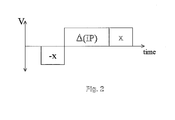
- Figure 2 illustrates the preferred -x/ ⁇ IP/x sequence for use in the methods of the present invention.
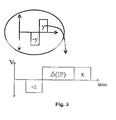
- FIG 3 illustrates schematically how the waveform shown in Figure 2 may be modified to include an additional pair of drive pulses.
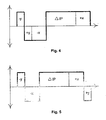
- Figure 4 illustrates one waveform produced by modifying the waveform of Figure 2 in the manner illustrated in Figure 3 .
- Figure 5 illustrates a second waveform produced by modifying the waveform of Figure 2 in the manner illustrated in Figure 3 .
- Figure 6 illustrates schematically how the waveform shown in Figure 5 may be further modified to include an additional pair of drive pulses.
- Figure 7 illustrates one waveform produced by modifying the waveform of Figure 5 in the manner illustrated in Figure 6 .
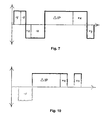
- Figures 8-10 illustrate three modifications of the waveform shown in Figure 2 to incorporate a period of zero voltage.
- the present invention provides several different improvements in methods for driving electro-optic displays.
- the various different improvements provided by the present invention will normally be described separately, although it will be understood by those skilled in the imaging art that in practice a single display may make use of more than one of these major aspects; for example, a display which uses the limited transitions method of the present invention may also make use of the interrupted scanning method.
- the improvements provided by the present invention can be applied to a wide variety of methods for driving electro-optic displays described in the aforementioned WO 03/044765 and PCT/US2004/10091 , the following description will assume familiarity with the basic driving methods shown in Figures 1-10 of WO 03/044765 and the related description.
- n-PP SS uncompensated n-prepulse slide show
- the black and white flashes which appear on the display during the reset steps of such drive schemes described above are of course visible to the user and may be objectionable to many users.
- the spatial distribution of the two groups is chosen carefully and the pixels are sufficiently small, the user will experience the reset step as an interval of gray on the display (with perhaps some slight flicker), and such a gray interval is typically less objectionable than a series of black and white flashes.
- the pixel in odd-numbered columns may be assigned to one "odd” group and the pixels in the even-numbered columns to the second "even” group.
- the odd pixels could then make use of a drive scheme shown in Figure 9 in which, during the erase step, the pixels are driven to a black state, while the even pixels could make use of a variant of this drive scheme in which, during the erase step, the pixels are driven to a white state.
- Both groups of pixels would then be subjected to an even number of reset pulses during reset step, so that the reset pulses for the two groups are essentially 180° out of phase, and the display appears gray throughout this reset step.
- the odd pixels are driven from black to their final state, while the even pixels are driven from white to their final state.
- the controller In order to ensure that every pixel is reset in the same manner over the long term (and thus that the manner of resetting does not introduce any artifacts on to the display), it is advantageous for the controller to switch the drive schemes between successive images, so that as a series of new images are written to the display, each pixel is written to its final state alternately from black and white states.
- the pixels in odd-numbered rows form the first group and the pixels in even-numbered rows the second group.
- the first group comprises pixels in odd-numbered columns and odd-numbered rows, and even-numbered columns and even-numbered rows
- the second group comprises in odd-numbered columns and even-numbered rows, and even-numbered columns and odd-numbered rows, so that the two groups are disposed in a checkerboard fashion.
- the pixels may be divided into groups which use different reset steps differing in number and frequency of pulses. For example, one group could use a six pulse reset sequence, while the second could use a similar sequence having twelve pulses of twice the frequency.
- the pixels could be divided into four groups, with the first and second groups using the six pulse scheme but 180° out of phase with each other, while the third and fourth groups use the twelve pulse scheme but 180° out of phase with each other.
- a drive scheme which permits any given to assume a non-zero but limited number of successive gray states before touching an optical rail.
- any pixel which has undergone a number of transitions exceeding a predetermined value without touching an extreme optical state, is driven to at least one extreme optical state before driving that pixel to its final optical state.
- a pixel driven to an extreme optical state is driven to the extreme optical state which is closer in gray level to the optical state desired after the transition, assuming of course that this desired optical state is not one of the extreme optical states.
- the maximum number of transitions which a pixel is allowed to undergo without touching an optical rail is set equal to the number of prior optical states taken into account in the transition matrix; such a method requires no extra controller logic or memory.
- Driving methods which limit the maximum number of transitions before touching an optical rail need not significantly increase the time taken for a complete rewriting of the display. For example, consider a four gray level (2 bit) display in which a transition from white to black or vice versa takes 200 msec, so that a general grayscale image flow drive scheme takes this time to completely rewrite the display.
- the only case where a transition needs to be modified in such a display is when a pixel is repeatedly toggled between the two central gray levels. If such a pixel is toggled between the two central gray levels for a number of transitions which exceeds the predetermined number, the limited transitions method of the present invention requires that the next toggling be effected via one optical rail (extreme optical state).
- the transition to the optical rail takes about 70 msec, while the subsequent transition to the gray level takes about 130 msec, so that the total transition time is only about 200 msec.
- the present limited transitions method does not require any increase in transition time as compared with general grayscale image flow.
- Figure 1A shows an even pixel undergoing a transition from black (level 0) to gray level 1. This is achieved with a single white-going pulse (shown of course with a positive gradient in Figure 1A ) designated 1102. Next, the pixel is driven to gray level 3. Since gray level 3 is a dark gray level, according to rule (a) it must be reached by a white-going pulse, and the level 1/level 3 transition can thus be handled by a single white-going pulse 1104, which has an impulse different from that of pulse 1102.
- the pixel is next driven to gray level 4. Since this is a light gray level, by an argument exactly similar to that employed for the level 1/level 3 transition discussed earlier, the level 6/level 4 transition is effected by a single black-going pulse 1110. The next transition is to level 3. Since this is a dark gray level, by an argument exactly similar to that employed for the level 3/level 6 transition discussed earlier, the level 4/level 3 transition is handled by a two-pulse sequence, namely a first black-going pulse 1112, which drives the pixel black (level 0), followed by a second white-going pulse 1114, which drives the pixels from level 0 to the desired level 3.
- the final transition shown in Figure 1A is from level 3 to level 1. Since level 1 is a dark gray level, it must, according to rule (a) be approached by a white-going pulse. Accordingly, applying rules (a) and (c), the level 3/level 1 transition must be handled by a three-pulse sequence comprising a first white-going pulse 1116, which drives the pixel white (level 7), a second black-going pulse 1118, which drives the pixel black (level 0), and a third white-going pulse 1120, which drives the pixel from black to the desired level 1 state.
- Figure 1B shows an odd pixel effecting the same 0-1-3-6-4-3-1 sequence of gray states as the even pixel in Figure 1A . It will be seen, however, that the pulse sequences employed are very different. Rule (b) requires that level 1, a dark gray level, be approached by a black-going pulse. Hence, the 0-1 transition is effected by a first white-going pulse 1122, which drives the pixel white (level 7), followed by a black-going pulse 1124, which drives the pixel from level 7 to the desired level 1.
- the 1-3 transition requires a three-pulse sequence, a first black-going pulse 1126, which drives the pixel black (level 0), a second white-going pulse 1128, which drives the pixel white (level 7), and a third black-going pulse 1130, which drives the pixel from level 7 to the desired level 3.
- level 6 is a light gray level, which according to rule (b) is approached by a white-going pulse
- the level 3/level 6 transition is effected by a two-pulse sequence comprising a black-going pulse 1132, which drives the pixel black (level 0), and a white-going pulse 1134, which drives the pixel to the desired level 6.
- the level 6/level 4 transition is effected by a three-pulse sequence, namely a white-going pulse 1136, which drives the pixel white (level 7), a black-going pulse 1138, which drives the pixel black (level 0) and a white-going pulse 1140, which drives the pixel to the desired level 4.
- the level 4/level transition 3 transition is effected by a two-pulse sequence comprising a white-going pulse 1142, which drives the pixel white (level 7), followed by a black-going pulse 1144, which drives the pixel to the desired level 3.
- the level 3/level 1 transition is effected by a single black-going pulse 1146.
- this drive scheme is a "rail-stabilized gray scale" or “RSGS” drive scheme.
- RSGS rail-stabilized gray scale
- Such a RSGS drive scheme is a special case of a limited transitions drive scheme which ensures that a pixel can only undergo, at most, a number of transitions equal to N/2 (or more accurately (N-1)/2) transitions, where N is the total number of gray levels capable of being displayed, without requiring a transition to take place via an optical rail.
- N is the total number of gray levels capable of being displayed, without requiring a transition to take place via an optical rail.
- Such a drive scheme prevents slight errors in individual transitions (caused, for example, by unavoidable minor fluctuations in voltages applied by drivers) accumulating indefinitely to the point where serious distortion of a gray scale image is apparent to an observer.
- this drive scheme is designed so that even and odd pixels always approach a given intermediate gray level from opposed directions, i.e., the final pulse of the sequence is white-going in one case and black-going in the other. If a substantial area of the display, containing substantially equal numbers of even and odd pixels, is being written to a single gray level, this "opposed directions" feature minimizes flashing of the area.
- a reasonable compromise between energy consumption and the desire to avoid large contiguous areas of pixels of the same group is to have pixels of each group assigned to rectangles, the pixels of which all lie in the same column but extend for several pixels along that column. With such an arrangement, when rewriting areas having the same gray level, discharging and recharging of the column electrodes will only be necessary when shifting from one rectangle to the next.
- the rectangles are 1 x 4 pixels, and are arranged so that rectangles in adjacent columns do not end on the same row, i.e., the rectangles in adjacent columns should have differing "phases".
- the assignment of rectangles in columns to phases may be effected either randomly or in a cyclic manner.
- any areas of the image which are monochrome are simply updated with a single pulse, either black to white or white to black, as part of the overall updating of the display.
- the maximum time taken for rewriting such monochrome areas is only one-half of the maximum time for rewriting areas which require gray to gray transitions, and this feature can be used to advantage for rapid updating of image features such as characters input by a user, drop-down menus etc.
- the controller can check whether an image update requires any gray to gray transitions; if not, the areas of the image which need rewriting can be rewritten using the rapid monochrome update mode.
- a user can have fast updating of input characters, drop-down menus and other user-interaction features of the display seamlessly superimposed upon a slower updating of a general grayscale image.
- a limited transitions drive scheme does not necessarily require the use of counters to measure the number of transitions undergone by each pixel of a display, and does not bar the use of drive schemes (such as the cyclic RSGS drive scheme already described with reference to Figures 1A and 1B ) which require certain transitions to take place via an optical rail even if the predetermined number of transitions has not been reached, provided that the algorithm used to determine the manner of effecting transitions does not permit any pixel to undergo more than the predetermined number of transitions without touching an optical rail.
- the check on the number of transitions undergone by a given pixel without touching an optical rail need not be made at every rewriting of the image on the display, especially in the case of displays (for example in watches) which are updated at frequent intervals.
- the check might be made on only alternate updates, provided that all pixels which either exceeded with predetermined number of transitions or might exceed this number after the next update were driven to optical rails.
- the display controller is a tri-level pulse width modulation (PWM) controller capable of applying -V, 0 or +V to each pixel electrode relative to the common front electrode, which is held at 0.
- PWM pulse width modulation
- the display controller contains two RAM image buffers.
- One buffer (“A") stores the image currently on the display. Normally, the controller is in sleep mode, preserving the data in the RAM and keeping the display drivers inactive. The bistability of the electro-optic medium keeps the same image on the display.
- the controller loads the new image into the second buffer (“B”). Then, for each pixel of the display, the controller looks up (in FLASH memory) a multi-frame drive waveform, based on the desired final state R1 of the pixel (from buffer 'B") and the current, initial state R2 of each pixel (from buffer "A").
- the data in the flash memory file is organized as a three-dimensional array of voltage values, V(R1, R2, frame), where as already indicated R1 and R2 are each integers from 1 to 4 (corresponding to the four available gray levels), and "frame" is the frame number, i.e., the number of the relevant frame within the superframe used for each transition.
- the superframe might be 1 second long, with each frame occupying 20 ms, so that the frame number can range from 1 to 50.
- each of the 800 array entries may have any one of the three possible voltage values, there are a huge number of possible arrays (waveforms), the number being far too large to search exhaustively.
- existing knowledge about the behavior of electro-optic displays, and especially the need for DC balance therein impose additional constraints upon the possible waveforms and enable the search for an optimum or near optimum waveform to be confined within practicable limits.
- the look-up table can store multiple impulses for a given transition, together with a value for the total current provided by each of these impulses, and the controller can maintain, for each pixel, a register arranged to store the algebraic sum of the impulses applied to the pixel since some prior time (for example, since the pixel was last in a black state).
- the controller can examine the register associated with that pixel, determine the current required to DC balance the overall sequence of transitions from the previous black state to the forthcoming black state, and choose that one of the multiple stored impulses for the white/gray to black transition needed which will either accurately reduce the associated register to zero, or at least to as small a remainder as possible (in which case the associated register will retain the value of this remainder and add it to the currents applied during later transitions). It will be apparent that repeated applications of this process can achieve accurate long term DC balancing of each pixel.
- This waveform is clearly DC balanced, but the integral of applied voltage is not zero at every point in time; this integral varies between 0 and ⁇ 4.5 V-sec. However, this waveform DC is balanced in as much as the integral is bounded; the integral never reaches 9 or 18 V-sec, for example.
- impulse has already been defined as meaning the definite integral of voltage with respect to time (in V-sec) applied during a particular interval, usually an addressing pulse or pulse element.
- impulse potential will be used to mean the sum of all impulses applied to the display since an arbitrary starting point (typically the beginning of a series of transitions under consideration. At the starting point, the impulse potential is arbitrarily set to zero, and as impulses are applied the impulse potential rises and falls.
- DC balance is that a waveform is DC balanced if and only if the impulse potential is bounded. Having a bounded impulse potential means that one must be able to say what the impulse potential will be in each of a finite number of possible cases.
- a time-independent controller i. e., a controller in which the impulse of the waveform is influenced only by the initial and final states of the transition under consideration, and not dwell times, temperature, or other factors, such as the R1/R2 controller mentioned above
- the impulse potential can be expressed as a function of a fixed number of prior states, and this provides a working concept of DC balance for controllers for electro-optic displays, i.e., that the impulse potential can be expressed as a function of a finite number of prior and current optical states. Note that the impulse potential of any pixel of the display does not change from the end of one image update to the beginning of another image update, because no voltage is applied during this period.
- the controller applies a fixed impulse (the impulse determined by the data in the flash memory already mentioned), and these fixed impulses can be listed. To list them, it is necessary to enumerate prior state combinations back by at least the number of prior states being used in the controller (i.e. for an R1/R2 controller, the number of prior states used in the enumeration needs to be defined for all combinations of prior states two back).
- each combination of R1 and R2 must leave the electro-optic medium at the same impulse potential, independent of R3.
- the controller has to "know" the impulse potential of the electro-optic medium when it starts the transition being considered, so it can apply the right impulse to produce the proper value of impulse potential following the transition. If the impulse potential in the above example were allowed to vary based on all of R1, R2, and R3, then, in the next transition, there would be no way for the controller to "know” the starting impulse potential, since the R3 information previously used would have been discarded.
- the limited transitions method of the present invention is preferably carried out using an R1/R2 controller (i.e., a controller in which the impulse applied during any transition depends only upon the initial and final gray levels of that transition), and from the foregoing discussion it will be seen that in such a controller the impulse potential must be uniquely defined as a function of R1 only.
- R1/R2 controller i.e., a controller in which the impulse applied during any transition depends only upon the initial and final gray levels of that transition
- This impulse hysteresis produces an inherent "restoring force" tending to bring the electro-optic medium towards middle gray levels, and confounds efforts to drive the medium from state to state with unipolar pulses (as in general gray scale image flow) while still maintaining DC balance.
- the medium rides the three-dimensional R1/R2/impulse hysteresis surface until it reaches an equilibrium. This equilibrium is fixed for each pulse length and is generally in the center of the optical range. For example, it has been found empirically that driving one encapsulated four gray level electro-optic medium from black to dark gray required a 100 ms x -15 V unipolar impulse, but driving it back from dark gray to black required a 300 ms x 15 V unipolar impulse. This waveform was not DC balanced, for obvious reasons.
- a solution to the impulse hysteresis problem is to use a bipolar drive, that is to say to drive the electro-optic medium on a (potentially) non-direct path from one gray level to the next, first applying an impulse to drive the pixel into either optical rail as required to maintain DC balance and then applying a second impulse to reach the desired optical state.
- a bipolar drive that is to say to drive the electro-optic medium on a (potentially) non-direct path from one gray level to the next, first applying an impulse to drive the pixel into either optical rail as required to maintain DC balance and then applying a second impulse to reach the desired optical state.
- the impulse hysteresis phenomenon and the prior state dependence of electro-optic media require that the waveform for each transition vary depending upon the prior state history of the pixel being considered.
- the optimum waveform for each transition may be determined (i.e., the transition table corresponding to the aforementioned data array may be "tuned") by using an initial "guessed" transition matrix to create a waveform, which is used to address the electro-optic medium through a fixed, typically pseudo-random or priorstate-complete series of optical states.
- a program subtracts the actual optical state achieved in each prior state combination from the target gray states for the same combination to compute an error matrix, which is the same dimensions as the transition matrix.
- Each element in the error matrix corresponds to an element in the transition matrix. If an element in the transition matrix is too high, the corresponding element in the error matrix will be pushed higher.
- PID proportional-integral-differential
- control can then be used to drive the error matrix toward zero.
- There are cross-terms (each element in the transition matrix affects more than one element in the error matrix) but these effects are minor and tend to decrease as the magnitudes of the values in the error matrix decrease, as the tuning proceeds through multiple iterations. (Note that sometimes the I or D constants of the PID controller may be set to 0, yielding PI, PD, or P control.)
- TM dimension The correlation between the number of dimensions in the transition matrix ("TM dimension") and the maximum optical error for this waveform was found to be as set out in Table 1 below: Table 1 TM Dimension Maximum Optical Error (L*) 1 10.6 2 3.8 3 2.1 4 1.7
- the data in this table indicate that it is very useful to have more than one dimension in the transition matrix, with a two dimensional matrix being superior to a one dimensional, a three dimensional matrix being superior to a two dimensional, etc.
- the values in the transition matrix could be adjusted as desired, without worrying about DC balance, because the net impulse of the first and third sections of this waveform is always zero.
- the difference in impulse potential between the initial and final state is applied in the middle section of the waveform.
- the transition matrix for this waveform can be tuned with the same PID approach described above.
- the values set for the impulse potentials influence the update speed of the waveform for fixed final gray levels. For example, all the impulse potentials could be set to zero, but this results in a long update time, because the final drive pulse (third section) is always countered by an equally long initial pulse (first section). Thus, the final drive pulse, in this case, cannot be longer than half the total update time.
- By careful selection of impulse potentials it is possible to use a much larger fraction of the total update time for the final pulse; for example, one can achieve final drive pulses occupying more than half, and as much as 80% of the total maximum update time.
- the lengths of the various pulses are selected by computer, using a gradient following optimization method, like PID control, finite difference combination evaluation, etc.
- transitions in electro-optic media are typically temperature sensitive, and it has been found that the uncompensated stability of gray levels versus temperature is increased when all of the transitions to a particular gray level always come from the same optical rail.
- the reason for this is straightforward; as the temperature varies, the switching speed of the electro-optic medium becomes gets faster or slower.
- the dark gray to light gray transition bounces off the black rail, but the white to light gray transition bounces off the white rail. If the switching speed of the medium becomes slower, the light gray state addressed from black will become darker, but the light gray state addressed from black will become lighter.
- This preferred waveform is fully compatible with techniques such as insertion of short pause periods into the waveform to increase impulse resolution, as described below.
- the aforementioned -x/ ⁇ IP/x pulse sequences may be modified to contain additional pulses.
- One such modification allows the inclusion of an additional class of pulses, hereinafter referred to as "y" pulses.
- "y" pulses are characterized by being of the form [+y][-y], where y is an impulse value, and may be either negative or positive (in other words, the form [-y][+y] is equally valid.
- the y pulse is distinct from the previously-described "x" pulses, in that the [-x] and [+x] halves of the "x" pulse pair are disposed before and after the ⁇ IP pulse, whereas the "y” pulses can be disposed at other locations within the pulse sequence.
- a second such modification adds a 0 V "pulse" (i.e., a period when no voltage is applied to the relevant pixel) at an arbitrary point within the pulse sequence to improve the performance of that sequence, by, for example, shifting the gray level resulting from the transition up or down by a small amount, or reducing or changing the impact of prior state information on the final state of the pixel.
- 0 V sections may be inserted either between the different pulse elements, or in the middle of a single pulse element.
- a preferred method for constructing a rail-stabilized waveform, using a transition table as described in the aforementioned WO 03/044765 is as follows:
- Figure 2 shows the basic -x/ ⁇ IP/+x structure of the waveform for one transition, it being assumed for the sake of illustration that the values of both x and ⁇ IP are positive. Unless it is desired to provide a 0 V interval between the ⁇ IP and the +x pulses, it is not necessary to reduce the voltage applied at the junction between these two pulses, so that the ⁇ IP and +x pulses form, in effect, one long positive pulse.
- Figure 3 illustrates symbolically the insertion of a [-y][+y] pair of pulses into the basic -x/ ⁇ IP/+x waveform shown in Figure 2 .
- the -y and +y pulses do not have to be consecutive, but can be inserted at different places into the original waveform. There are two especially advantageous special cases.
- the "-y, +y" pulse pair is placed at the beginning of the -x/ ⁇ IP/+x waveform, before the -x pulse, to produce the waveform shown in Figure 4 .
- the final optical state can be finely tuned by even moderately coarse adjustment of the duration y.
- the value of x can be adjusted for coarse control and the value of y for final control of the final optical state of the electro-optic medium. This is believed to happen because the y pulse augments the -x pulse, thus changing the degree to which the electro-optic medium is pushed into one of its optical rails.
- the degree of pushing into one of the optical rails is known to give fine adjustment of the final optical state after a pulse away from that optical rail (in this case, provided by the x pulse).
- the -y pulse is again placed at the beginning of the -x/ ⁇ IP+x waveform, before the -x pulse, but the +y pulse is placed at the end of the waveform, after the +x pulse.
- the final y pulse provides coarse tuning because the final optical state is very sensitive to the magnitude of y.
- the x pulse provides a finer tuning, since the final optical state typically does not depend as strongly on the magnitude of the drive into the optical rail.
- FIG. 6 illustrates symbolically, in a manner similar to that of Figure 3 , the insertion of a second pair of y-type pulses (denoted “-z", “+z") into the waveform of Figure 5 . It will readily be apparent that since the -z and +z pulses can be introduced at any pulse boundary of the waveform shown in Figure 5 , a large number of different waveforms can result from the introduction of the -z and +z pulses.
- a preferred resulting waveform is shown in Figure 7 ; this type of waveform is useful for fine tuning of the final optical state, for the following reasons.
- the x pulse element is used for fine tuning, and the final optical state can be decreased by increasing x and increased by decreasing x.
- it is undesirable to decrease x beyond a certain point because then the electro-optic medium is not brought sufficiently close to an optical rail, as required for stability of the waveform.
- the +z pulse augments the -x pulse, while the -z pulse maintains the transition at the desired net impulse, thus maintaining an overall DC balanced transition table.
- Any given transition table element may contain zero or more sets of x and/or y pulses.
- the limited transitions method of the present invention may also make use of pause periods between adjacent frames of a transition; such pause periods are discussed in more detail below with reference to the interrupted scanning method of the present invention.
- the pixels are divided into a series of groups (normally a plurality of rows), each of these plurality of groups is selected in succession (i.e., typically the rows of the matrix are scanned) and there is applied to each of the pixels in the selected group either a drive voltage or a non-drive voltage.
- the scanning of all the groups of pixels is completed within a frame period.
- the scanning of the groups of pixels is repeated, and, in a typical electro-optic display, the scanning will be repeated more than once during the group of frames (conveniently referred to as a superframe) required for a complete rewriting of the display.
- a fixed scan rate is used for updating, for example 50 Hz, which allows for 20 msec frames.
- this frame length may provide insufficient resolution for optimal waveform performance.
- frames of length t/2 are desirable, for example 10 msec frames in a normally 20 msec frame length waveform. It is possible to combine frames of differing delay times to generate a pulse resolution of n/2.
- a single frame of length 1.5*t may be inserted at the beginning of the waveform, and a similar frame at the end of the waveform (immediately before the terminating 0 V frame, which should occur at the ordinary frame rate and which is normally used at the end of the waveform to prevent undesirable effects caused by varying residual voltages on pixels).
- the two longer frames can be realized by simply adding a 0.5*t delay time between the scanning of two adjacent frames.
- the waveform would then have the structure:
- the initial and final frames plus their respective delays would amount to 30 msec each.
- the initial and final pulses are allowed to vary by 10 msec in length, by using the following algorithm:
- the initial and final pulses must be start- and end-justified, respectively, for this algorithm to work properly.
- the initial and final pulses may be corresponding parts of a -x/+x pair.
- the effect of the waveform used to effect a transition is modified by the presence of a period of zero voltage (in effect a time delay) during or before any of the pulses in the waveform
- the limited transitions method of the present invention may include periods of zero voltage within or between successive pulses in the waveform, i.e., the waveform may be "non-contiguous" as that term is used above and in the aforementioned PCT/US2004/010091 .
- Figures 8 to 10 illustrate variations of the basic -x/ ⁇ IP/+x waveform of Figure 2 incorporating such zero voltage periods. In the waveform of Figure 8 , a time delay is inserted between the -x pulse and the ⁇ IP pulse.
- a time delay is inserted within the ⁇ IP pulse, or, which amounts to the same thing, the ⁇ IP pulse is split into two separate pulses separated by the time delay.
- the waveform of Figure 10 is similar to that of Figure 9 , except that the time delay is inserted within the +x pulse.
- Time delays can be incorporated into a waveform to achieve optical states not achievable without such delays. Time delays can also be used to fine-tune the final optical state. This fine-tuning ability is important, because in an active matrix drive, the time resolution of each pulse is defined by the scan rate of the display. The time resolution offered by the scan rate can be coarse enough that precise final optical states cannot be achieved without some additional means of fine tuning.
- this invention provides an "interrupted scanning" method for driving an electro-optic display having a plurality of pixels divided into a plurality of groups.
- the method comprises selecting each of the plurality of groups of pixels in succession and applying to each of the pixels in the selected group either a drive voltage or a non-drive voltage, the scanning of all the groups of pixels being completed in a first frame period.
- the scanning of the groups of pixels is repeated during a second frame period (it being understood that any specific pixel may have the drive voltage applied during the first frame period and the non-drive voltage applied during the second frame period, or vice versa ) .
- the scanning of the groups of pixels is interrupted during a pause period between the first and second frame periods, this pause period being not longer than the first or second frame period.
- the first and second frame periods are typically equal in length, and the length of the pause period is typically a sub-multiple (desirably, one half, one fourth etc.) of the length of one of the frame periods.
- the interrupted scanning method may include multiple pause periods between different pairs of adjacent frame periods. Such multiple pause periods are preferably of substantially equal length, and the total length the multiple pause periods is preferably equal to either one complete frame period, or equal to one frame period less one pause period. For example, as discussed in more detail below, one embodiment of the first method might use multiple 20 ms frame periods, and either three or four 5 ms pause periods.
- the groups of pixels will of course typically be the rows of a conventional row/column active matrix pixel array.
- the interrupted scanning method comprises selecting each of the plurality of groups of pixels in succession (i.e., typically, scanning the rows of the matrix) and applying to each of the pixels in the selected group either a drive voltage or a non-drive voltage, the scanning of all the groups of pixels being completed in a first frame period.
- the scanning of the groups of pixels is repeated, and in a typical electro-optic display, the scanning will be repeated more than once during the superframe required for a complete rewriting of the display.
- the scanning of the groups of pixels is interrupted during a pause period between the first and second frame periods, this pause period being not longer than the first or second frame period.
- a drive voltage is only applied to any specific pixel electrode for one line address time during each scan, the drive voltage persists on the pixel electrodes during the time between successive selections of the same line, only slowly decaying, so that the pixel continues to driven during the time when other lines of the matrix are being selected, and the interrupted scanning method relies upon this continued driving of the pixel during its "non-selected" time. Ignoring for the moment the slow decay of the voltage on the pixel electrode during its non-selected time, a pixel which is set to the driving voltage during the frame period immediately preceding the pause period will continue to experience the driving voltage during the pause period, so that for such a pixel the preceding frame period is in effect lengthened by the length of the pause period.
- a pixel which is set to the non-driving (typically zero) voltage during the frame period immediately preceding the pause period will continue to experience the zero voltage during the pause period. It may be desirable to adjust the length of the pause period to allow for the slow decay of the voltage on the pixel electrode in order to ensure that the total impulse delivered to the pixel during the pause period has the desired value.
- a 10 ms pause period may be inserted between two successive 20 ms frames, and this simple modification halves the maximum possible difference between the applied impulse and the impulse ideally needed to complete a given transition, thereby in practice approximately halving the maximum deviation in achieved gray scale level.
- the 10 ms pause period is conveniently inserted after the penultimate frame in each superframe but may be inserted at other points in the superframe if desired.
- the pause periods can of course be of any number and length required to achieve the desired control over the impulse applied.
- the drive scheme could be modified to include three 5 ms pause periods after different 20 ms drive frames, desirably with the addition to the drive scheme of three further 20 ms drive frames not followed by pause periods.
- This modified drive scheme permits one to apply to any given pixel impulses of:
- bistable electro-optic media require application of impulses of both polarities.
- some drive schemes such as slide show drive schemes, before a new image is written to the display, all the pixels of the display are first driven to one extreme optical state, either black or white, and thereafter the pixels are driven to their final gray states by impulses of a single polarity.
- Such drive schemes can be modified in accordance with the interrupted scanning method in the manner already described.
- Other drive schemes require application of impulses of both polarities to drive the pixels to their final gray states.
- the impulses of the two polarities may be applied in separate frames or impulses of the two polarities may be applied in the same frames, for example using a tri-level drive scheme in which the common front electrode is held at a voltage of V/2, while individual pixel electrodes are held at 0, V/2 or V.
- the interrupted scanning method is desirably effected by providing at least two separate pause periods, one following a frame in which impulses of one polarity are applied and the second following a frame in which impulses of the opposed polarity are applied.
- the interrupted scanning method may make use of only a single pause period since, as will be apparent from the foregoing discussion, the effect of including a pause period after a frame is to increase the magnitude of the impulse applied to any pixel to which a driving voltage was applied in the frame, regardless of the polarity of this driving voltage.
- bistable electro-optic media are desirably driven with drive schemes which achieve long term direct current (DC) balance, and such DC balance is conveniently effected using a drive scheme in which a DC balance section, which does not substantially change the gray level of the pixel, is applied before the main drive section, which does change the gray level, the two sections being chosen so that the algebraic sum of the impulses applied is zero or at least very small.
- a DC balance section which does not substantially change the gray level of the pixel
- the main drive section which does change the gray level
- DC balance section it is not necessary that the DC balance section be modified in a manner which is an exact mirror image of the modification of the main drive section, since the DC balance section can have gaps (zero voltage frames) and most electro-optic medium are not harmed by short term DC imbalances.
- DC balance can be achieved by making the first frame of the drive scheme 30 ms in duration. Applying or not applying a driving voltage to a pixel during this frame brings the overall impulse to a multiple of 20 units, so that this impulse can readily be balanced later.
- the first two frames of the drive scheme can similarly be 25 and 30 ms in duration (in either order), again bringing the overall impulse to a multiple of 20 units.
- the interrupted scanning method of the present invention requires a trade-off between increased addressing time caused by the need to include one additional frame in each superframe for each pause period inserted, and the improved control of impulse and hence gray scale produced by the method.
- the interrupted scanning method can provide very substantial improvement in impulse control with only modest increase in addressing time; for example, the drive scheme described above in which a superframe comprising ten 20 ms frames is modified to include three 5 ms pause periods yields a four-fold improvement in impulse accuracy at the cost of less than a 40 per cent increase in addressing time.
- this invention also provides a balanced gray level method for driving an electro-optic display having a plurality of pixels arranged in an array.
- the pixels are driven with a pulse width modulated waveform capable of applying a plurality of differing impulses.
- Drive circuitry stores data indicating whether application of a given impulse will produce a gray level higher or lower than a desired gray level.
- the impulses applied to the two pixels are adjusted to that one pixel is below the desired gray level, while the other pixel is above the desired gray level.
- the pixels are divided into two groups, hereinafter designated “even” and “odd”.
- the two groups of pixels may be arranged in a checkerboard pattern (so that the pixels in each row and column alternate between the two groups) or in other arrangements as described in the aforementioned WO 03/044765 , provided that each pixel has at least one neighbor of the opposite group, and different drive schemes are used for the two groups. If the stored data indicates that one of the available impulses will produce substantially the desired gray level transition, this impulse is applied for that transition for both the even and odd pixels.
- the stored data indicates that the impulse required for a particular gray level transition is substantially half-way between two of the available impulses, one of these impulses is used for the transition in even pixels and the other of these impulses is used for the transition in odd pixels.
- two adjacent pixels are intended to be in the same gray state (the condition where precise control of gray scale is of maximum importance) one of these pixels will have a gray level slightly above the desired level, while the other will have a gray level slightly below the desired level. Ocular and optical averaging will result in an average of the two gray levels being seen, thus producing an apparent gray level closer to the desired level than can be achieved with the available impulses.
- this balanced gray level method uses small-signal spatial dithering (applied to correct errors in applied impulse) superimposed on large signal true gray scale to increase by a factor of two the available impulse levels. Since each pixel is still at approximately the correct gray scale level, the effective resolution of the display is not compromised.
- the pixels of the display are already divided into two groups and different drive schemes are applied to the two groups, so that the magnitude of the impulses needed to achieve the desired gray level will be different of the two groups.
- Such "two group” drive schemes can be modified in accordance with the balanced gray level method but the detailed implementation of the method differs somewhat from the simple case discussed above. Instead of simply comparing the available impulses with that required for the desired transition, one calculates the errors in gray scale for the two groups separately, takes the arithmetic average of the errors, and determines whether this arithmetic average would be reduced by shifting one of the groups to a different available impulse. Note that in this case, the reduction in arithmetic average may differ depending upon which group is shifted to a different impulse, and obviously whichever shift produces the smaller average should be effected.
- this method can be thought of as small-signal spatial dithering implemented on top of large signal intrinsic gray scale, with the small signal dithering used to correct for errors in impulse due to the limitation of the pulse width modulation drive scheme used. Because each pixel is still approximately at the correct gray level in this scheme, and the corrections are only to correct for impulse rounding errors, effective display resolution is not compromised. To put it another way, this method implements small signal spatial dithering on top of large signal true gray scale.
- the various methods of the present invention may make use of various additional variations and techniques described in the aforementioned applications, especially the aforementioned WO 03/044765 and PCT/US2004/010091 . It will be appreciated that in the overall waveform used to drive an electro-optic display, in at least some cases certain transitions may be effected in accordance with the various methods of the present invention, while other transitions may not make use of the methods of the present invention but may make use of other types of transitions described below. For example, the various methods of the present invention may make use of any one or more of:
Landscapes
- Engineering & Computer Science (AREA)
- Physics & Mathematics (AREA)
- Computer Hardware Design (AREA)
- General Physics & Mathematics (AREA)
- Theoretical Computer Science (AREA)
- Control Of Indicators Other Than Cathode Ray Tubes (AREA)
- Electrochromic Elements, Electrophoresis, Or Variable Reflection Or Absorption Elements (AREA)
- Liquid Crystal Display Device Control (AREA)
Applications Claiming Priority (5)
| Application Number | Priority Date | Filing Date | Title |
|---|---|---|---|
| US48104003P | 2003-06-30 | 2003-06-30 | |
| US48105303P | 2003-07-02 | 2003-07-02 | |
| US48140503P | 2003-09-22 | 2003-09-22 | |
| US10/814,205 US7119772B2 (en) | 1999-04-30 | 2004-03-31 | Methods for driving bistable electro-optic displays, and apparatus for use therein |
| EP04777306.4A EP1639574B1 (fr) | 2003-06-30 | 2004-06-30 | Procedes d'attaque d'afficheurs electro-optiques |
Related Parent Applications (2)
| Application Number | Title | Priority Date | Filing Date |
|---|---|---|---|
| EP04777306.4A Division-Into EP1639574B1 (fr) | 2003-06-30 | 2004-06-30 | Procedes d'attaque d'afficheurs electro-optiques |
| EP04777306.4A Division EP1639574B1 (fr) | 2003-06-30 | 2004-06-30 | Procedes d'attaque d'afficheurs electro-optiques |
Publications (2)
| Publication Number | Publication Date |
|---|---|
| EP2947647A2 true EP2947647A2 (fr) | 2015-11-25 |
| EP2947647A3 EP2947647A3 (fr) | 2015-12-16 |
Family
ID=34069332
Family Applications (2)
| Application Number | Title | Priority Date | Filing Date |
|---|---|---|---|
| EP04777306.4A Expired - Lifetime EP1639574B1 (fr) | 2003-06-30 | 2004-06-30 | Procedes d'attaque d'afficheurs electro-optiques |
| EP15000723.5A Withdrawn EP2947647A3 (fr) | 2003-06-30 | 2004-06-30 | Procédés de commande d'affichages électro-optiques |
Family Applications Before (1)
| Application Number | Title | Priority Date | Filing Date |
|---|---|---|---|
| EP04777306.4A Expired - Lifetime EP1639574B1 (fr) | 2003-06-30 | 2004-06-30 | Procedes d'attaque d'afficheurs electro-optiques |
Country Status (3)
| Country | Link |
|---|---|
| EP (2) | EP1639574B1 (fr) |
| JP (4) | JP5904690B2 (fr) |
| WO (1) | WO2005006290A1 (fr) |
Families Citing this family (12)
| Publication number | Priority date | Publication date | Assignee | Title |
|---|---|---|---|---|
| US20080303780A1 (en) | 2007-06-07 | 2008-12-11 | Sipix Imaging, Inc. | Driving methods and circuit for bi-stable displays |
| US8373649B2 (en) * | 2008-04-11 | 2013-02-12 | Seiko Epson Corporation | Time-overlapping partial-panel updating of a bistable electro-optic display |
| JP5338622B2 (ja) * | 2009-11-04 | 2013-11-13 | セイコーエプソン株式会社 | 電気泳動表示装置の駆動方法、電気泳動表示装置、及び電子機器 |
| JP5540880B2 (ja) * | 2010-05-18 | 2014-07-02 | セイコーエプソン株式会社 | 電気泳動表示装置の駆動方法、並びに電気泳動表示装置及び電子機器 |
| EP3783597A1 (fr) * | 2012-02-01 | 2021-02-24 | E Ink Corporation | Procédés de commande d'affichages électro-optiques |
| US11030936B2 (en) | 2012-02-01 | 2021-06-08 | E Ink Corporation | Methods and apparatus for operating an electro-optic display in white mode |
| JP6186781B2 (ja) * | 2013-03-19 | 2017-08-30 | セイコーエプソン株式会社 | 制御装置、電気光学装置、電子機器および制御方法 |
| AU2017301435B2 (en) * | 2016-07-25 | 2022-07-14 | Magic Leap, Inc. | Imaging modification, display and visualization using augmented and virtual reality eyewear |
| US10762866B2 (en) * | 2018-08-30 | 2020-09-01 | Synaptics Incorporated | Display rescan |
| CN114641820B (zh) * | 2019-11-14 | 2024-01-05 | 伊英克公司 | 用于驱动电光显示器的方法 |
| CN116097343A (zh) * | 2020-10-01 | 2023-05-09 | 伊英克公司 | 电光显示器以及用于驱动电光显示器的方法 |
| CN118762658B (zh) * | 2024-07-30 | 2025-06-13 | 惠科股份有限公司 | 电子纸的驱动方法、驱动集成电路和显示面板 |
Citations (110)
| Publication number | Priority date | Publication date | Assignee | Title |
|---|---|---|---|---|
| US4418346A (en) | 1981-05-20 | 1983-11-29 | Batchelder J Samuel | Method and apparatus for providing a dielectrophoretic display of visual information |
| US5760761A (en) | 1995-12-15 | 1998-06-02 | Xerox Corporation | Highlight color twisting ball display |
| US5777782A (en) | 1996-12-24 | 1998-07-07 | Xerox Corporation | Auxiliary optics for a twisting ball display |
| US5808783A (en) | 1996-06-27 | 1998-09-15 | Xerox Corporation | High reflectance gyricon display |
| US5872552A (en) | 1994-12-28 | 1999-02-16 | International Business Machines Corporation | Electrophoretic display |
| US5930026A (en) | 1996-10-25 | 1999-07-27 | Massachusetts Institute Of Technology | Nonemissive displays and piezoelectric power supplies therefor |
| US5961804A (en) | 1997-03-18 | 1999-10-05 | Massachusetts Institute Of Technology | Microencapsulated electrophoretic display |
| WO1999067678A2 (fr) | 1998-06-22 | 1999-12-29 | E-Ink Corporation | Systeme d'adressage de support de visuel encapsule |
| US6017584A (en) | 1995-07-20 | 2000-01-25 | E Ink Corporation | Multi-color electrophoretic displays and materials for making the same |
| WO2000005704A1 (fr) | 1998-07-22 | 2000-02-03 | E-Ink Corporation | Dispositif d'affichage electronique |
| US6055091A (en) | 1996-06-27 | 2000-04-25 | Xerox Corporation | Twisting-cylinder display |
| US6054071A (en) | 1998-01-28 | 2000-04-25 | Xerox Corporation | Poled electrets for gyricon-based electric-paper displays |
| US6067185A (en) | 1997-08-28 | 2000-05-23 | E Ink Corporation | Process for creating an encapsulated electrophoretic display |
| WO2000036560A1 (fr) | 1998-12-18 | 2000-06-22 | E Ink Corporation | Support de presentation electronique a encre utilise a des fins de securite et d'authentification |
| WO2000038001A1 (fr) | 1998-12-21 | 2000-06-29 | E Ink Corporation | Electrodes de protection pour afficheurs par electrophorese |
| WO2000038000A1 (fr) | 1998-12-22 | 2000-06-29 | E Ink Corporation | Procede de fabrication d'un dispositif electronique discret |
| US6097531A (en) | 1998-11-25 | 2000-08-01 | Xerox Corporation | Method of making uniformly magnetized elements for a gyricon display |
| US6118426A (en) | 1995-07-20 | 2000-09-12 | E Ink Corporation | Transducers and indicators having printed displays |
| US6120588A (en) | 1996-07-19 | 2000-09-19 | E Ink Corporation | Electronically addressable microencapsulated ink and display thereof |
| US6120839A (en) | 1995-07-20 | 2000-09-19 | E Ink Corporation | Electro-osmotic displays and materials for making the same |
| US6124851A (en) | 1995-07-20 | 2000-09-26 | E Ink Corporation | Electronic book with multiple page displays |
| US6128124A (en) | 1998-10-16 | 2000-10-03 | Xerox Corporation | Additive color electric paper without registration or alignment of individual elements |
| US6130774A (en) | 1998-04-27 | 2000-10-10 | E Ink Corporation | Shutter mode microencapsulated electrophoretic display |
| US6137467A (en) | 1995-01-03 | 2000-10-24 | Xerox Corporation | Optically sensitive electric paper |
| US6144361A (en) | 1998-09-16 | 2000-11-07 | International Business Machines Corporation | Transmissive electrophoretic display with vertical electrodes |
| WO2000067327A1 (fr) | 1999-05-05 | 2000-11-09 | E Ink Corporation | Dispositifs semi-conducteurs a structure minimale pour applications d'affichage |
| WO2000067110A1 (fr) | 1999-05-03 | 2000-11-09 | E Ink Corporation | Unite d'affichage pour systeme electronique d'etiquettes de prix sur presentoir |
| US6147791A (en) | 1998-11-25 | 2000-11-14 | Xerox Corporation | Gyricon displays utilizing rotating elements and magnetic latching |
| US6177921B1 (en) | 1997-08-28 | 2001-01-23 | E Ink Corporation | Printable electrode structures for displays |
| WO2001008241A1 (fr) | 1999-07-21 | 2001-02-01 | E Ink Corporation | Formation reactive de couches dielectriques et protection de couches organiques dans un dispositif a semi-conducteurs organiques |
| WO2001007961A1 (fr) | 1999-07-21 | 2001-02-01 | E Ink Corporation | Utilisation d'un condensateur de memorisation pour ameliorer la performance d'un affichage electronique matriciel actif |
| US6184856B1 (en) | 1998-09-16 | 2001-02-06 | International Business Machines Corporation | Transmissive electrophoretic display with laterally adjacent color cells |
| WO2001027690A2 (fr) | 1999-10-11 | 2001-04-19 | University College Dublin | Dispositif electrochromique |
| US6225971B1 (en) | 1998-09-16 | 2001-05-01 | International Business Machines Corporation | Reflective electrophoretic display with laterally adjacent color cells using an absorbing panel |
| US6232950B1 (en) | 1997-08-28 | 2001-05-15 | E Ink Corporation | Rear electrode structures for displays |
| US6249721B1 (en) | 1996-05-28 | 2001-06-19 | Continental Teves Ag & Co. Ohg | Arrangement for detecting and evaluating yawing movements |
| US6252564B1 (en) | 1997-08-28 | 2001-06-26 | E Ink Corporation | Tiled displays |
| US6262706B1 (en) | 1995-07-20 | 2001-07-17 | E Ink Corporation | Retroreflective electrophoretic displays and materials for making the same |
| US6262833B1 (en) | 1998-10-07 | 2001-07-17 | E Ink Corporation | Capsules for electrophoretic displays and methods for making the same |
| US6271823B1 (en) | 1998-09-16 | 2001-08-07 | International Business Machines Corporation | Reflective electrophoretic display with laterally adjacent color cells using a reflective panel |
| US6301038B1 (en) | 1997-02-06 | 2001-10-09 | University College Dublin | Electrochromic system |
| US6300932B1 (en) | 1997-08-28 | 2001-10-09 | E Ink Corporation | Electrophoretic displays with luminescent particles and materials for making the same |
| US6312971B1 (en) | 1999-08-31 | 2001-11-06 | E Ink Corporation | Solvent annealing process for forming a thin semiconductor film with advantageous properties |
| US6312304B1 (en) | 1998-12-15 | 2001-11-06 | E Ink Corporation | Assembly of microencapsulated electronic displays |
| US6323989B1 (en) | 1996-07-19 | 2001-11-27 | E Ink Corporation | Electrophoretic displays using nanoparticles |
| US6327072B1 (en) | 1999-04-06 | 2001-12-04 | E Ink Corporation | Microcell electrophoretic displays |
| WO2002001281A2 (fr) | 2000-06-28 | 2002-01-03 | Sipix Imaging, Inc. | Procede de fabrication de dispositifs d'affichage electrophoretiques |
| US20020019081A1 (en) | 2000-04-18 | 2002-02-14 | Denis Kevin L. | Process for fabricating thin film transistors |
| US20020021270A1 (en) | 2000-08-17 | 2002-02-21 | Albert Jonathan D. | Bistable electro-optic desplay, and method for addressing same |
| US6376828B1 (en) | 1998-10-07 | 2002-04-23 | E Ink Corporation | Illumination system for nonemissive electronic displays |
| US6377387B1 (en) | 1999-04-06 | 2002-04-23 | E Ink Corporation | Methods for producing droplets for use in capsule-based electrophoretic displays |
| US20020053900A1 (en) | 1998-07-08 | 2002-05-09 | Joseph M. Jacobson | Method and apparatus for sensing the state of an electrophoretic display |
| US6392786B1 (en) | 1999-07-01 | 2002-05-21 | E Ink Corporation | Electrophoretic medium provided with spacers |
| US20020060321A1 (en) | 2000-07-14 | 2002-05-23 | Kazlas Peter T. | Minimally- patterned, thin-film semiconductor devices for display applications |
| US20020063661A1 (en) | 2000-11-29 | 2002-05-30 | E Ink Corporation | Addressing schemes for electronic displays |
| US20020063677A1 (en) | 1998-04-10 | 2002-05-30 | Paul Drzaic | Electronic displays using organic-based field effect transistors |
| US20020075556A1 (en) | 2000-03-03 | 2002-06-20 | Rong-Chang Liang | Electrophoretic display and novel process for its manufacture |
| US6413790B1 (en) | 1999-07-21 | 2002-07-02 | E Ink Corporation | Preferred methods for producing electrical circuit elements used to control an electronic display |
| US20020090980A1 (en) | 2000-12-05 | 2002-07-11 | Wilcox Russell J. | Displays for portable electronic apparatus |
| US20020113770A1 (en) | 1998-07-08 | 2002-08-22 | Joseph M. Jacobson | Methods for achieving improved color in microencapsulated electrophoretic devices |
| US6445489B1 (en) | 1998-03-18 | 2002-09-03 | E Ink Corporation | Electrophoretic displays and systems for addressing such displays |
| US20020131147A1 (en) | 1998-08-27 | 2002-09-19 | Paolini Richard J. | Electrophoretic medium and process for the production thereof |
| US20020130832A1 (en) | 2001-03-13 | 2002-09-19 | Baucom Allan Scott | Apparatus for displaying drawings |
| US6459418B1 (en) | 1995-07-20 | 2002-10-01 | E Ink Corporation | Displays combining active and non-active inks |
| US20020145792A1 (en) | 1996-07-19 | 2002-10-10 | Jacobson Joseph M | Electrophoretic displays using nanoparticles |
| WO2002079869A1 (fr) | 2001-04-02 | 2002-10-10 | E Ink Corporation | Milieu electrophoretique a stabilite d'image amelioree |
| US6473072B1 (en) | 1998-05-12 | 2002-10-29 | E Ink Corporation | Microencapsulated electrophoretic electrostatically-addressed media for drawing device applications |
| US6480182B2 (en) | 1997-03-18 | 2002-11-12 | Massachusetts Institute Of Technology | Printable electronic display |
| US20020171910A1 (en) | 2001-05-15 | 2002-11-21 | Pullen Anthony Edward | Electrophoretic displays containing magnetic particles |
| US20020180688A1 (en) | 1998-04-10 | 2002-12-05 | E Ink Corporation | Full color reflective display with multichromatic sub-pixels |
| US20020185378A1 (en) | 2001-05-15 | 2002-12-12 | Honeyman Charles H. | Electrophoretic particles and processes for the production thereof |
| US6498114B1 (en) | 1999-04-09 | 2002-12-24 | E Ink Corporation | Method for forming a patterned semiconductor film |
| US6504524B1 (en) | 2000-03-08 | 2003-01-07 | E Ink Corporation | Addressing methods for displays having zero time-average field |
| US6506438B2 (en) | 1998-12-15 | 2003-01-14 | E Ink Corporation | Method for printing of transistor arrays on plastic substrates |
| US20030011560A1 (en) | 1998-08-27 | 2003-01-16 | E Ink Corporation | Electrophoretic display comprising optical biasing element |
| US20030011868A1 (en) | 1998-03-18 | 2003-01-16 | E Ink Corporation | Electrophoretic displays in portable devices and systems for addressing such displays |
| US20030020844A1 (en) | 2001-07-27 | 2003-01-30 | Albert Jonathan D. | Microencapsulated electrophoretic display with integrated driver |
| US6515649B1 (en) | 1995-07-20 | 2003-02-04 | E Ink Corporation | Suspended particle displays and materials for making the same |
| US20030025855A1 (en) | 2001-07-09 | 2003-02-06 | E Lnk Corporation | Electro-optic display and lamination adhesive |
| US20030038755A1 (en) | 2001-08-16 | 2003-02-27 | E Ink Corporation | Light modulation by frustration of total internal reflection |
| US6531997B1 (en) | 1999-04-30 | 2003-03-11 | E Ink Corporation | Methods for addressing electrophoretic displays |
| US20030053189A1 (en) | 2001-09-14 | 2003-03-20 | E Ink Corporation | Methods for addressing electro-optic materials |
| US6545291B1 (en) | 1999-08-31 | 2003-04-08 | E Ink Corporation | Transistor design for use in the construction of an electronically driven display |
| WO2003044765A2 (fr) | 2001-11-20 | 2003-05-30 | E Ink Corporation | Procedes pour piloter des afficheurs electro-optiques bistables |
| US20030102858A1 (en) | 1998-07-08 | 2003-06-05 | E Ink Corporation | Method and apparatus for determining properties of an electrophoretic display |
| US6580545B2 (en) | 2001-04-19 | 2003-06-17 | E Ink Corporation | Electrochromic-nanoparticle displays |
| US20030132908A1 (en) | 1999-05-03 | 2003-07-17 | Herb Craig A. | Electrophoretic ink composed of particles with field dependent mobilities |
| US20030137717A1 (en) | 1997-08-28 | 2003-07-24 | Albert Jonathan D. | Encapsulated electrophoretic displays having a monolayer of capsules and materials and methods for making the same |
| US20030137521A1 (en) | 1999-04-30 | 2003-07-24 | E Ink Corporation | Methods for driving bistable electro-optic displays, and apparatus for use therein |
| US20030151702A1 (en) | 2002-02-08 | 2003-08-14 | Morrison Ian D. | Electro-optic displays and optical systems for addressing such displays |
| US6639578B1 (en) | 1995-07-20 | 2003-10-28 | E Ink Corporation | Flexible displays |
| WO2003092077A2 (fr) | 2002-04-24 | 2003-11-06 | E Ink Corporation | Fonds de panier pour applications d'affichage |
| US20030214697A1 (en) | 2001-12-13 | 2003-11-20 | E Ink Corporation | Electrophoretic electronic displays with low-index films |
| US20030214695A1 (en) | 2002-03-18 | 2003-11-20 | E Ink Corporation | Electro-optic displays, and methods for driving same |
| US6657772B2 (en) | 2001-07-09 | 2003-12-02 | E Ink Corporation | Electro-optic display and adhesive composition for use therein |
| US6664944B1 (en) | 1995-07-20 | 2003-12-16 | E-Ink Corporation | Rear electrode structures for electrophoretic displays |
| WO2003107315A2 (fr) | 2002-06-13 | 2003-12-24 | E Ink Corporation | Procedes de pilotage d'affichages electro-optiques |
| US20040008398A1 (en) | 2002-06-27 | 2004-01-15 | E Ink Corporation | Illumination system for nonemissive electronic displays |
| US20040012839A1 (en) | 2002-05-23 | 2004-01-22 | E Ink Corporation | Capsules, materials for use therein and electrophoretic media and displays containing such capsules |
| US20040014265A1 (en) | 2002-04-24 | 2004-01-22 | E Ink Corporation | Processes for forming backplanes for electro-optic displays |
| US20040027327A1 (en) | 2002-06-10 | 2004-02-12 | E Ink Corporation | Components and methods for use in electro-optic displays |
| WO2004017035A2 (fr) | 2002-08-14 | 2004-02-26 | Sigma Systems Corporation | Procede et appareil de regulation de la temperature latente d'un dispositif soumis a un essai |
| US6704133B2 (en) | 1998-03-18 | 2004-03-09 | E-Ink Corporation | Electro-optic display overlays and systems for addressing such displays |
| WO2004023202A1 (fr) | 2002-09-03 | 2004-03-18 | E Ink Corporation | Milieu electrophoretique a fluide de suspension gazeux |
| US6710540B1 (en) | 1995-07-20 | 2004-03-23 | E Ink Corporation | Electrostatically-addressable electrophoretic display |
| US6721083B2 (en) | 1996-07-19 | 2004-04-13 | E Ink Corporation | Electrophoretic displays using nanoparticles |
| US6724519B1 (en) | 1998-12-21 | 2004-04-20 | E-Ink Corporation | Protective electrodes for electrophoretic displays |
| US20040075634A1 (en) | 2002-06-28 | 2004-04-22 | E Ink Corporation | Voltage modulated driver circuits for electro-optic displays |
| US6727881B1 (en) | 1995-07-20 | 2004-04-27 | E Ink Corporation | Encapsulated electrophoretic displays and methods and materials for making the same |
| US20040094422A1 (en) | 2002-08-07 | 2004-05-20 | E Ink Corporation | Electrophoretic media containing specularly reflective particles |
Family Cites Families (12)
| Publication number | Priority date | Publication date | Assignee | Title |
|---|---|---|---|---|
| EP0186519A2 (fr) * | 1984-12-27 | 1986-07-02 | Epid Inc. | Ecriture d'informations dans un dispositif d'affichage |
| US5245328A (en) * | 1988-10-14 | 1993-09-14 | Compaq Computer Corporation | Method and apparatus for displaying different shades of gray on a liquid crystal display |
| JPH05119734A (ja) * | 1991-10-28 | 1993-05-18 | Canon Inc | 表示制御装置 |
| JP3548811B2 (ja) * | 1995-06-26 | 2004-07-28 | カシオ計算機株式会社 | アクティブマトリクス液晶表示装置及びアクティブマトリクス液晶表示素子の駆動方法 |
| JP3900663B2 (ja) * | 1997-06-25 | 2007-04-04 | ソニー株式会社 | 光学空間変調素子及び画像表示装置 |
| US6462837B1 (en) * | 1998-03-05 | 2002-10-08 | Ricoh Company, Ltd. | Gray-scale conversion based on SIMD processor |
| US7119772B2 (en) * | 1999-04-30 | 2006-10-10 | E Ink Corporation | Methods for driving bistable electro-optic displays, and apparatus for use therein |
| JP3750566B2 (ja) * | 2000-06-22 | 2006-03-01 | セイコーエプソン株式会社 | 電気泳動表示装置の駆動方法、駆動回路、電気泳動表示装置および電子機器 |
| JP3357666B2 (ja) * | 2000-07-07 | 2002-12-16 | 松下電器産業株式会社 | 表示装置および表示方法 |
| JP3458851B2 (ja) * | 2000-12-01 | 2003-10-20 | セイコーエプソン株式会社 | 液晶表示装置、画像信号補正回路、画像信号補正方法および電子機器 |
| CN1554081A (zh) * | 2001-07-09 | 2004-12-08 | ���µ�����ҵ��ʽ���� | 等离子体显示面板的驱动方法以及等离子体显示面板的驱动装置 |
| WO2004090857A1 (fr) * | 2003-03-31 | 2004-10-21 | E Ink Corporation | Procedes de commande d'afficheurs electro-optiques bistables |
-
2004
- 2004-06-30 EP EP04777306.4A patent/EP1639574B1/fr not_active Expired - Lifetime
- 2004-06-30 WO PCT/US2004/021000 patent/WO2005006290A1/fr not_active Ceased
- 2004-06-30 JP JP2006517795A patent/JP5904690B2/ja not_active Expired - Fee Related
- 2004-06-30 EP EP15000723.5A patent/EP2947647A3/fr not_active Withdrawn
-
2013
- 2013-11-05 JP JP2013229048A patent/JP5931038B2/ja not_active Expired - Fee Related
-
2014
- 2014-07-31 JP JP2014155835A patent/JP2014211651A/ja not_active Withdrawn
-
2016
- 2016-07-21 JP JP2016143045A patent/JP2016194724A/ja not_active Withdrawn
Patent Citations (128)
| Publication number | Priority date | Publication date | Assignee | Title |
|---|---|---|---|---|
| US4418346A (en) | 1981-05-20 | 1983-11-29 | Batchelder J Samuel | Method and apparatus for providing a dielectrophoretic display of visual information |
| US5872552A (en) | 1994-12-28 | 1999-02-16 | International Business Machines Corporation | Electrophoretic display |
| US6137467A (en) | 1995-01-03 | 2000-10-24 | Xerox Corporation | Optically sensitive electric paper |
| US6017584A (en) | 1995-07-20 | 2000-01-25 | E Ink Corporation | Multi-color electrophoretic displays and materials for making the same |
| US6262706B1 (en) | 1995-07-20 | 2001-07-17 | E Ink Corporation | Retroreflective electrophoretic displays and materials for making the same |
| US6515649B1 (en) | 1995-07-20 | 2003-02-04 | E Ink Corporation | Suspended particle displays and materials for making the same |
| US6639578B1 (en) | 1995-07-20 | 2003-10-28 | E Ink Corporation | Flexible displays |
| US6710540B1 (en) | 1995-07-20 | 2004-03-23 | E Ink Corporation | Electrostatically-addressable electrophoretic display |
| US6727881B1 (en) | 1995-07-20 | 2004-04-27 | E Ink Corporation | Encapsulated electrophoretic displays and methods and materials for making the same |
| US6680725B1 (en) | 1995-07-20 | 2004-01-20 | E Ink Corporation | Methods of manufacturing electronically addressable displays |
| US6124851A (en) | 1995-07-20 | 2000-09-26 | E Ink Corporation | Electronic book with multiple page displays |
| US6120839A (en) | 1995-07-20 | 2000-09-19 | E Ink Corporation | Electro-osmotic displays and materials for making the same |
| US6459418B1 (en) | 1995-07-20 | 2002-10-01 | E Ink Corporation | Displays combining active and non-active inks |
| US6118426A (en) | 1995-07-20 | 2000-09-12 | E Ink Corporation | Transducers and indicators having printed displays |
| US6664944B1 (en) | 1995-07-20 | 2003-12-16 | E-Ink Corporation | Rear electrode structures for electrophoretic displays |
| US5760761A (en) | 1995-12-15 | 1998-06-02 | Xerox Corporation | Highlight color twisting ball display |
| US6249721B1 (en) | 1996-05-28 | 2001-06-19 | Continental Teves Ag & Co. Ohg | Arrangement for detecting and evaluating yawing movements |
| US6055091A (en) | 1996-06-27 | 2000-04-25 | Xerox Corporation | Twisting-cylinder display |
| US5808783A (en) | 1996-06-27 | 1998-09-15 | Xerox Corporation | High reflectance gyricon display |
| US6323989B1 (en) | 1996-07-19 | 2001-11-27 | E Ink Corporation | Electrophoretic displays using nanoparticles |
| US6538801B2 (en) | 1996-07-19 | 2003-03-25 | E Ink Corporation | Electrophoretic displays using nanoparticles |
| US6120588A (en) | 1996-07-19 | 2000-09-19 | E Ink Corporation | Electronically addressable microencapsulated ink and display thereof |
| US20020145792A1 (en) | 1996-07-19 | 2002-10-10 | Jacobson Joseph M | Electrophoretic displays using nanoparticles |
| US6652075B2 (en) | 1996-07-19 | 2003-11-25 | E Ink Corporation | Electronically addressable microencapsulated ink and display thereof |
| US6721083B2 (en) | 1996-07-19 | 2004-04-13 | E Ink Corporation | Electrophoretic displays using nanoparticles |
| US6422687B1 (en) | 1996-07-19 | 2002-07-23 | E Ink Corporation | Electronically addressable microencapsulated ink and display thereof |
| US6130773A (en) | 1996-10-25 | 2000-10-10 | Massachusetts Institute Of Technology | Nonemissive displays and piezoelectric power supplies therefor |
| US5930026A (en) | 1996-10-25 | 1999-07-27 | Massachusetts Institute Of Technology | Nonemissive displays and piezoelectric power supplies therefor |
| US5777782A (en) | 1996-12-24 | 1998-07-07 | Xerox Corporation | Auxiliary optics for a twisting ball display |
| US6301038B1 (en) | 1997-02-06 | 2001-10-09 | University College Dublin | Electrochromic system |
| US6480182B2 (en) | 1997-03-18 | 2002-11-12 | Massachusetts Institute Of Technology | Printable electronic display |
| US5961804A (en) | 1997-03-18 | 1999-10-05 | Massachusetts Institute Of Technology | Microencapsulated electrophoretic display |
| US6067185A (en) | 1997-08-28 | 2000-05-23 | E Ink Corporation | Process for creating an encapsulated electrophoretic display |
| US6300932B1 (en) | 1997-08-28 | 2001-10-09 | E Ink Corporation | Electrophoretic displays with luminescent particles and materials for making the same |
| US6177921B1 (en) | 1997-08-28 | 2001-01-23 | E Ink Corporation | Printable electrode structures for displays |
| US6232950B1 (en) | 1997-08-28 | 2001-05-15 | E Ink Corporation | Rear electrode structures for displays |
| US20030137717A1 (en) | 1997-08-28 | 2003-07-24 | Albert Jonathan D. | Encapsulated electrophoretic displays having a monolayer of capsules and materials and methods for making the same |
| US6252564B1 (en) | 1997-08-28 | 2001-06-26 | E Ink Corporation | Tiled displays |
| US6445374B2 (en) | 1997-08-28 | 2002-09-03 | E Ink Corporation | Rear electrode structures for displays |
| US6535197B1 (en) | 1997-08-28 | 2003-03-18 | E Ink Corporation | Printable electrode structures for displays |
| US6392785B1 (en) | 1997-08-28 | 2002-05-21 | E Ink Corporation | Non-spherical cavity electrophoretic displays and materials for making the same |
| US20030034949A1 (en) | 1997-08-28 | 2003-02-20 | E Ink Corporation | Rear electrode structures for displays |
| US6054071A (en) | 1998-01-28 | 2000-04-25 | Xerox Corporation | Poled electrets for gyricon-based electric-paper displays |
| US6445489B1 (en) | 1998-03-18 | 2002-09-03 | E Ink Corporation | Electrophoretic displays and systems for addressing such displays |
| US6704133B2 (en) | 1998-03-18 | 2004-03-09 | E-Ink Corporation | Electro-optic display overlays and systems for addressing such displays |
| US20030011868A1 (en) | 1998-03-18 | 2003-01-16 | E Ink Corporation | Electrophoretic displays in portable devices and systems for addressing such displays |
| US20020180688A1 (en) | 1998-04-10 | 2002-12-05 | E Ink Corporation | Full color reflective display with multichromatic sub-pixels |
| US20020063677A1 (en) | 1998-04-10 | 2002-05-30 | Paul Drzaic | Electronic displays using organic-based field effect transistors |
| US6518949B2 (en) | 1998-04-10 | 2003-02-11 | E Ink Corporation | Electronic displays using organic-based field effect transistors |
| US6130774A (en) | 1998-04-27 | 2000-10-10 | E Ink Corporation | Shutter mode microencapsulated electrophoretic display |
| US6172798B1 (en) | 1998-04-27 | 2001-01-09 | E Ink Corporation | Shutter mode microencapsulated electrophoretic display |
| US6473072B1 (en) | 1998-05-12 | 2002-10-29 | E Ink Corporation | Microencapsulated electrophoretic electrostatically-addressed media for drawing device applications |
| WO1999067678A2 (fr) | 1998-06-22 | 1999-12-29 | E-Ink Corporation | Systeme d'adressage de support de visuel encapsule |
| US20030102858A1 (en) | 1998-07-08 | 2003-06-05 | E Ink Corporation | Method and apparatus for determining properties of an electrophoretic display |
| US6512354B2 (en) | 1998-07-08 | 2003-01-28 | E Ink Corporation | Method and apparatus for sensing the state of an electrophoretic display |
| US20020053900A1 (en) | 1998-07-08 | 2002-05-09 | Joseph M. Jacobson | Method and apparatus for sensing the state of an electrophoretic display |
| US20020113770A1 (en) | 1998-07-08 | 2002-08-22 | Joseph M. Jacobson | Methods for achieving improved color in microencapsulated electrophoretic devices |
| WO2000005704A1 (fr) | 1998-07-22 | 2000-02-03 | E-Ink Corporation | Dispositif d'affichage electronique |
| US20030011560A1 (en) | 1998-08-27 | 2003-01-16 | E Ink Corporation | Electrophoretic display comprising optical biasing element |
| US20020131147A1 (en) | 1998-08-27 | 2002-09-19 | Paolini Richard J. | Electrophoretic medium and process for the production thereof |
| US6184856B1 (en) | 1998-09-16 | 2001-02-06 | International Business Machines Corporation | Transmissive electrophoretic display with laterally adjacent color cells |
| US6225971B1 (en) | 1998-09-16 | 2001-05-01 | International Business Machines Corporation | Reflective electrophoretic display with laterally adjacent color cells using an absorbing panel |
| US6271823B1 (en) | 1998-09-16 | 2001-08-07 | International Business Machines Corporation | Reflective electrophoretic display with laterally adjacent color cells using a reflective panel |
| US6144361A (en) | 1998-09-16 | 2000-11-07 | International Business Machines Corporation | Transmissive electrophoretic display with vertical electrodes |
| US6262833B1 (en) | 1998-10-07 | 2001-07-17 | E Ink Corporation | Capsules for electrophoretic displays and methods for making the same |
| US6376828B1 (en) | 1998-10-07 | 2002-04-23 | E Ink Corporation | Illumination system for nonemissive electronic displays |
| US6128124A (en) | 1998-10-16 | 2000-10-03 | Xerox Corporation | Additive color electric paper without registration or alignment of individual elements |
| US6147791A (en) | 1998-11-25 | 2000-11-14 | Xerox Corporation | Gyricon displays utilizing rotating elements and magnetic latching |
| US6097531A (en) | 1998-11-25 | 2000-08-01 | Xerox Corporation | Method of making uniformly magnetized elements for a gyricon display |
| US6506438B2 (en) | 1998-12-15 | 2003-01-14 | E Ink Corporation | Method for printing of transistor arrays on plastic substrates |
| US6312304B1 (en) | 1998-12-15 | 2001-11-06 | E Ink Corporation | Assembly of microencapsulated electronic displays |
| WO2000036560A1 (fr) | 1998-12-18 | 2000-06-22 | E Ink Corporation | Support de presentation electronique a encre utilise a des fins de securite et d'authentification |
| WO2000038001A1 (fr) | 1998-12-21 | 2000-06-29 | E Ink Corporation | Electrodes de protection pour afficheurs par electrophorese |
| US6724519B1 (en) | 1998-12-21 | 2004-04-20 | E-Ink Corporation | Protective electrodes for electrophoretic displays |
| WO2000038000A1 (fr) | 1998-12-22 | 2000-06-29 | E Ink Corporation | Procede de fabrication d'un dispositif electronique discret |
| US6327072B1 (en) | 1999-04-06 | 2001-12-04 | E Ink Corporation | Microcell electrophoretic displays |
| US6377387B1 (en) | 1999-04-06 | 2002-04-23 | E Ink Corporation | Methods for producing droplets for use in capsule-based electrophoretic displays |
| US6498114B1 (en) | 1999-04-09 | 2002-12-24 | E Ink Corporation | Method for forming a patterned semiconductor film |
| US6531997B1 (en) | 1999-04-30 | 2003-03-11 | E Ink Corporation | Methods for addressing electrophoretic displays |
| US20030137521A1 (en) | 1999-04-30 | 2003-07-24 | E Ink Corporation | Methods for driving bistable electro-optic displays, and apparatus for use therein |
| WO2000067110A1 (fr) | 1999-05-03 | 2000-11-09 | E Ink Corporation | Unite d'affichage pour systeme electronique d'etiquettes de prix sur presentoir |
| US20030132908A1 (en) | 1999-05-03 | 2003-07-17 | Herb Craig A. | Electrophoretic ink composed of particles with field dependent mobilities |
| WO2000067327A1 (fr) | 1999-05-05 | 2000-11-09 | E Ink Corporation | Dispositifs semi-conducteurs a structure minimale pour applications d'affichage |
| US6392786B1 (en) | 1999-07-01 | 2002-05-21 | E Ink Corporation | Electrophoretic medium provided with spacers |
| WO2001008241A1 (fr) | 1999-07-21 | 2001-02-01 | E Ink Corporation | Formation reactive de couches dielectriques et protection de couches organiques dans un dispositif a semi-conducteurs organiques |
| US6521489B2 (en) | 1999-07-21 | 2003-02-18 | E Ink Corporation | Preferred methods for producing electrical circuit elements used to control an electronic display |
| WO2001007961A1 (fr) | 1999-07-21 | 2001-02-01 | E Ink Corporation | Utilisation d'un condensateur de memorisation pour ameliorer la performance d'un affichage electronique matriciel actif |
| US6413790B1 (en) | 1999-07-21 | 2002-07-02 | E Ink Corporation | Preferred methods for producing electrical circuit elements used to control an electronic display |
| US6545291B1 (en) | 1999-08-31 | 2003-04-08 | E Ink Corporation | Transistor design for use in the construction of an electronically driven display |
| US6312971B1 (en) | 1999-08-31 | 2001-11-06 | E Ink Corporation | Solvent annealing process for forming a thin semiconductor film with advantageous properties |
| WO2001027690A2 (fr) | 1999-10-11 | 2001-04-19 | University College Dublin | Dispositif electrochromique |
| US20020075556A1 (en) | 2000-03-03 | 2002-06-20 | Rong-Chang Liang | Electrophoretic display and novel process for its manufacture |
| US6504524B1 (en) | 2000-03-08 | 2003-01-07 | E Ink Corporation | Addressing methods for displays having zero time-average field |
| US20020019081A1 (en) | 2000-04-18 | 2002-02-14 | Denis Kevin L. | Process for fabricating thin film transistors |
| WO2002001281A2 (fr) | 2000-06-28 | 2002-01-03 | Sipix Imaging, Inc. | Procede de fabrication de dispositifs d'affichage electrophoretiques |
| US20020106847A1 (en) | 2000-07-14 | 2002-08-08 | Kazlas Peter T. | Fabrication of electronic circuit elements using unpatterned semiconductor layers |
| US6683333B2 (en) | 2000-07-14 | 2004-01-27 | E Ink Corporation | Fabrication of electronic circuit elements using unpatterned semiconductor layers |
| US20020060321A1 (en) | 2000-07-14 | 2002-05-23 | Kazlas Peter T. | Minimally- patterned, thin-film semiconductor devices for display applications |
| US20020021270A1 (en) | 2000-08-17 | 2002-02-21 | Albert Jonathan D. | Bistable electro-optic desplay, and method for addressing same |
| US20020063661A1 (en) | 2000-11-29 | 2002-05-30 | E Ink Corporation | Addressing schemes for electronic displays |
| US20020090980A1 (en) | 2000-12-05 | 2002-07-11 | Wilcox Russell J. | Displays for portable electronic apparatus |
| US20020130832A1 (en) | 2001-03-13 | 2002-09-19 | Baucom Allan Scott | Apparatus for displaying drawings |
| WO2002079869A1 (fr) | 2001-04-02 | 2002-10-10 | E Ink Corporation | Milieu electrophoretique a stabilite d'image amelioree |
| US20020180687A1 (en) | 2001-04-02 | 2002-12-05 | E Ink Corporation | Electrophoretic medium and display with improved image stability |
| US6580545B2 (en) | 2001-04-19 | 2003-06-17 | E Ink Corporation | Electrochromic-nanoparticle displays |
| US20030189749A1 (en) | 2001-04-19 | 2003-10-09 | E Ink Corporation | Electrochromic-nanoparticle displays |
| US20020185378A1 (en) | 2001-05-15 | 2002-12-12 | Honeyman Charles H. | Electrophoretic particles and processes for the production thereof |
| US20020171910A1 (en) | 2001-05-15 | 2002-11-21 | Pullen Anthony Edward | Electrophoretic displays containing magnetic particles |
| US6657772B2 (en) | 2001-07-09 | 2003-12-02 | E Ink Corporation | Electro-optic display and adhesive composition for use therein |
| US20030025855A1 (en) | 2001-07-09 | 2003-02-06 | E Lnk Corporation | Electro-optic display and lamination adhesive |
| US20030020844A1 (en) | 2001-07-27 | 2003-01-30 | Albert Jonathan D. | Microencapsulated electrophoretic display with integrated driver |
| US20030038755A1 (en) | 2001-08-16 | 2003-02-27 | E Ink Corporation | Light modulation by frustration of total internal reflection |
| US20030053189A1 (en) | 2001-09-14 | 2003-03-20 | E Ink Corporation | Methods for addressing electro-optic materials |
| WO2003044765A2 (fr) | 2001-11-20 | 2003-05-30 | E Ink Corporation | Procedes pour piloter des afficheurs electro-optiques bistables |
| US20030214697A1 (en) | 2001-12-13 | 2003-11-20 | E Ink Corporation | Electrophoretic electronic displays with low-index films |
| US20030151702A1 (en) | 2002-02-08 | 2003-08-14 | Morrison Ian D. | Electro-optic displays and optical systems for addressing such displays |
| US20030214695A1 (en) | 2002-03-18 | 2003-11-20 | E Ink Corporation | Electro-optic displays, and methods for driving same |
| WO2003092077A2 (fr) | 2002-04-24 | 2003-11-06 | E Ink Corporation | Fonds de panier pour applications d'affichage |
| US20040014265A1 (en) | 2002-04-24 | 2004-01-22 | E Ink Corporation | Processes for forming backplanes for electro-optic displays |
| US20030222315A1 (en) | 2002-04-24 | 2003-12-04 | E Ink Corporation | Backplanes for display applications, and components for use therein |
| US20040012839A1 (en) | 2002-05-23 | 2004-01-22 | E Ink Corporation | Capsules, materials for use therein and electrophoretic media and displays containing such capsules |
| US20040027327A1 (en) | 2002-06-10 | 2004-02-12 | E Ink Corporation | Components and methods for use in electro-optic displays |
| WO2003107315A2 (fr) | 2002-06-13 | 2003-12-24 | E Ink Corporation | Procedes de pilotage d'affichages electro-optiques |
| US20040008398A1 (en) | 2002-06-27 | 2004-01-15 | E Ink Corporation | Illumination system for nonemissive electronic displays |
| US20040075634A1 (en) | 2002-06-28 | 2004-04-22 | E Ink Corporation | Voltage modulated driver circuits for electro-optic displays |
| US20040094422A1 (en) | 2002-08-07 | 2004-05-20 | E Ink Corporation | Electrophoretic media containing specularly reflective particles |
| WO2004017035A2 (fr) | 2002-08-14 | 2004-02-26 | Sigma Systems Corporation | Procede et appareil de regulation de la temperature latente d'un dispositif soumis a un essai |
| WO2004023202A1 (fr) | 2002-09-03 | 2004-03-18 | E Ink Corporation | Milieu electrophoretique a fluide de suspension gazeux |
Non-Patent Citations (3)
| Title |
|---|
| BACH, U. ET AL., ADV. MATER., vol. 14, no. 11, 2002, pages 845 |
| O'REGAN, B. ET AL., NATURE, vol. 353, 1991, pages 737 |
| WOOD, D., INFORMATION DISPLAY, vol. 18, no. 3, March 2002 (2002-03-01), pages 24 |
Also Published As
| Publication number | Publication date |
|---|---|
| JP5931038B2 (ja) | 2016-06-08 |
| JP5904690B2 (ja) | 2016-04-20 |
| EP1639574B1 (fr) | 2015-04-22 |
| EP1639574A4 (fr) | 2009-01-21 |
| JP2016194724A (ja) | 2016-11-17 |
| JP2014074913A (ja) | 2014-04-24 |
| HK1150466A1 (en) | 2011-12-30 |
| EP1639574A1 (fr) | 2006-03-29 |
| JP2014211651A (ja) | 2014-11-13 |
| JP2007529018A (ja) | 2007-10-18 |
| EP2947647A3 (fr) | 2015-12-16 |
| WO2005006290A1 (fr) | 2005-01-20 |
Similar Documents
| Publication | Publication Date | Title |
|---|---|---|
| JP6075934B2 (ja) | 電気光学ディスプレイを駆動するための方法 | |
| JP5931038B2 (ja) | 電気光学ディスプレイを駆動するための方法 | |
| EP1446791B1 (fr) | Procedes pour piloter des afficheurs electrophoretiques | |
| US20160314749A1 (en) | Methods for driving electro-optic displays | |
| US9269311B2 (en) | Methods and apparatus for driving electro-optic displays | |
| US7312794B2 (en) | Methods for driving electro-optic displays, and apparatus for use therein | |
| US7952557B2 (en) | Methods and apparatus for driving electro-optic displays | |
| WO2006031347A2 (fr) | Procedes et appareil de commande d'affichages electro-optiques | |
| CN100504997C (zh) | 驱动电光显示器用的方法 | |
| EP3420553A1 (fr) | Procédés et appareils destinés à piloter des unités d'affichage d'optique électronique | |
| HK1093254B (en) | Methods for driving electro-optic displays | |
| HK1118936B (en) | Methods for driving electro-optic displays | |
| HK1150466B (en) | Methods for driving electro-optic displays | |
| HK1254151A1 (en) | Method for driving electro-optic displays with multiple pixels |
Legal Events
| Date | Code | Title | Description |
|---|---|---|---|
| PUAL | Search report despatched |
Free format text: ORIGINAL CODE: 0009013 |
|
| PUAI | Public reference made under article 153(3) epc to a published international application that has entered the european phase |
Free format text: ORIGINAL CODE: 0009012 |
|
| AC | Divisional application: reference to earlier application |
Ref document number: 1639574 Country of ref document: EP Kind code of ref document: P |
|
| AK | Designated contracting states |
Kind code of ref document: A2 Designated state(s): AT BE BG CH CY CZ DE DK EE ES FI FR GB GR HU IE IT LI LU MC NL PL PT RO SE SI SK TR |
|
| AK | Designated contracting states |
Kind code of ref document: A3 Designated state(s): AT BE BG CH CY CZ DE DK EE ES FI FR GB GR HU IE IT LI LU MC NL PL PT RO SE SI SK TR |
|
| RIC1 | Information provided on ipc code assigned before grant |
Ipc: G09G 3/36 20060101ALI20151106BHEP Ipc: G09G 3/34 20060101AFI20151106BHEP Ipc: G09G 3/30 20060101ALI20151106BHEP Ipc: G09G 3/32 20060101ALI20151106BHEP |
|
| RIN1 | Information on inventor provided before grant (corrected) |
Inventor name: KNAIAN, ARA, N. Inventor name: ZEHNER, ROBERT, W. Inventor name: ZION, BENJAMIN Inventor name: AMUNDSON, KARL, R. |
|
| 17P | Request for examination filed |
Effective date: 20160616 |
|
| RBV | Designated contracting states (corrected) |
Designated state(s): AT BE BG CH CY CZ DE DK EE ES FI FR GB GR HU IE IT LI LU MC NL PL PT RO SE SI SK TR |
|
| GRAP | Despatch of communication of intention to grant a patent |
Free format text: ORIGINAL CODE: EPIDOSNIGR1 |
|
| RIC1 | Information provided on ipc code assigned before grant |
Ipc: G09G 3/34 20060101ALI20171005BHEP Ipc: G09G 3/20 20060101AFI20171005BHEP |
|
| INTG | Intention to grant announced |
Effective date: 20171106 |
|
| GRAS | Grant fee paid |
Free format text: ORIGINAL CODE: EPIDOSNIGR3 |
|
| STAA | Information on the status of an ep patent application or granted ep patent |
Free format text: STATUS: THE APPLICATION IS DEEMED TO BE WITHDRAWN |
|
| 18D | Application deemed to be withdrawn |
Effective date: 20180317 |