EP2947856B1 - Dispositif de commande télématique et procédé de commande télématique - Google Patents
Dispositif de commande télématique et procédé de commande télématique Download PDFInfo
- Publication number
- EP2947856B1 EP2947856B1 EP13871776.4A EP13871776A EP2947856B1 EP 2947856 B1 EP2947856 B1 EP 2947856B1 EP 13871776 A EP13871776 A EP 13871776A EP 2947856 B1 EP2947856 B1 EP 2947856B1
- Authority
- EP
- European Patent Office
- Prior art keywords
- sim
- chip
- unit
- card
- sim card
- Prior art date
- Legal status (The legal status is an assumption and is not a legal conclusion. Google has not performed a legal analysis and makes no representation as to the accuracy of the status listed.)
- Not-in-force
Links
Images





Classifications
-
- H—ELECTRICITY
- H04—ELECTRIC COMMUNICATION TECHNIQUE
- H04W—WIRELESS COMMUNICATION NETWORKS
- H04W4/00—Services specially adapted for wireless communication networks; Facilities therefor
- H04W4/90—Services for handling of emergency or hazardous situations, e.g. earthquake and tsunami warning systems [ETWS]
-
- H—ELECTRICITY
- H04—ELECTRIC COMMUNICATION TECHNIQUE
- H04B—TRANSMISSION
- H04B1/00—Details of transmission systems, not covered by a single one of groups H04B3/00 - H04B13/00; Details of transmission systems not characterised by the medium used for transmission
- H04B1/06—Receivers
- H04B1/08—Constructional details, e.g. cabinet
- H04B1/082—Constructional details, e.g. cabinet to be used in vehicles
-
- H—ELECTRICITY
- H04—ELECTRIC COMMUNICATION TECHNIQUE
- H04B—TRANSMISSION
- H04B1/00—Details of transmission systems, not covered by a single one of groups H04B3/00 - H04B13/00; Details of transmission systems not characterised by the medium used for transmission
- H04B1/38—Transceivers, i.e. devices in which transmitter and receiver form a structural unit and in which at least one part is used for functions of transmitting and receiving
- H04B1/3816—Mechanical arrangements for accommodating identification devices, e.g. cards or chips; with connectors for programming identification devices
-
- H—ELECTRICITY
- H04—ELECTRIC COMMUNICATION TECHNIQUE
- H04W—WIRELESS COMMUNICATION NETWORKS
- H04W4/00—Services specially adapted for wireless communication networks; Facilities therefor
- H04W4/30—Services specially adapted for particular environments, situations or purposes
- H04W4/40—Services specially adapted for particular environments, situations or purposes for vehicles, e.g. vehicle-to-pedestrians [V2P]
-
- H—ELECTRICITY
- H04—ELECTRIC COMMUNICATION TECHNIQUE
- H04W—WIRELESS COMMUNICATION NETWORKS
- H04W8/00—Network data management
- H04W8/18—Processing of user or subscriber data, e.g. subscribed services, user preferences or user profiles; Transfer of user or subscriber data
-
- G—PHYSICS
- G08—SIGNALLING
- G08G—TRAFFIC CONTROL SYSTEMS
- G08G1/00—Traffic control systems for road vehicles
- G08G1/20—Monitoring the location of vehicles belonging to a group, e.g. fleet of vehicles, countable or determined number of vehicles
- G08G1/205—Indicating the location of the monitored vehicles as destination, e.g. accidents, stolen, rental
-
- H—ELECTRICITY
- H04—ELECTRIC COMMUNICATION TECHNIQUE
- H04W—WIRELESS COMMUNICATION NETWORKS
- H04W12/00—Security arrangements; Authentication; Protecting privacy or anonymity
- H04W12/40—Security arrangements using identity modules
- H04W12/45—Security arrangements using identity modules using multiple identity modules
-
- H—ELECTRICITY
- H04—ELECTRIC COMMUNICATION TECHNIQUE
- H04W—WIRELESS COMMUNICATION NETWORKS
- H04W76/00—Connection management
- H04W76/50—Connection management for emergency connections
Definitions
- the present invention relates to a telematics control technique.
- the present invention claims priority to Japanese Patent Application No. 2013-6755, filed on January 17, 2013 .
- Patent Literature 1 discloses a technique for such a device.
- the document GB 2336507 A discloses a cellular telephone in a vehicle including multiple SIM modules, one of them being a preferred SIM module.
- the other module is used only when certain tasks are performed which render the preferred module inoperative.
- the document US 7 991 381 B1 discloses a telematics communication method involves attempting voice communication using two different voice communication facilities upon detecting a condition signifying an emergency. Upon failure of the voice communication attempts, the method attempts to establish a wireless data communication with a call center, using a non-voice wireless communication facility.
- Patent Literature 1 JP 2002-345046 A
- the SIM card in a case where a SIM card used for communication is selected from a plurality of SIM cards, the SIM card is selected using charge information for the purpose of suppressing communication charges to be inexpensive.
- the SIM card in a case where a SIM card having a restriction in an available situation is included as a selection target, the SIM card may not actually be in an available situation, and as a result, the selected SIM card may not be appropriate.
- the present invention provides an apparatus according to claim 1 and a method according to claim 5 to enable a SIM interface to be selected more appropriately.
- a telematics controller includes: a vehicle information collecting unit that collects vehicle information about a vehicle mounted with the telematics controller; a SIM switching unit that enables one of a plurality of SIM interfaces to communicate; and a switching instructing unit that instructs the SIM switching unit to switch the SIM interface to a SIM interface associated in advance according to the vehicle information collected by the vehicle information collecting unit.
- a vehicle includes a vehicle information collecting unit that collects vehicle information, a SIM switching unit that enables one of a plurality of SIM interfaces to communicate, and a switching instructing unit that instructs the SIM switching unit to switch the SIM interface to a SIM interface associated in advance according to the vehicle information collected by the vehicle information collecting unit.
- a telematics control method is a telematics control method based on a telematics controller which includes a SIM switching unit that enables one of a plurality of SIM interfaces to communicate, and includes a vehicle information collecting step of collecting vehicle information, and a switching instructing step of instructing the SIM switching unit to switch the SIM interface to a SIM interface associated in advance according to the vehicle information collected in the vehicle information collecting step.
- Fig. 1 illustrates an overall configuration of a telematics control unit 100.
- the telematics control unit 100 includes a control unit 110, a SIM connection condition storing unit 111, a vehicle information acquiring unit 120, a modem 130, a SIM switching unit 131, an eCall SIM interface 132, an ERA Glonass SIM interface 133, an Stolen Vehicle Tracking (SVT) SIM interface 134, a general-purpose SIM interface 135, and a location information receiving unit 140.
- the telematics control unit 100 is installed in a vehicle.
- the control unit 110 is a central unit that performs various processes of the telematics control unit 100. For example, a SIM interface to be used is selected according a vehicle situation of a vehicle mounted with the telematics control unit 100. In addition, the start/end of communication using the SIM interface is controlled. In addition, in a case where interruption to a SIM interface having a low priority occurs, a line of the SIM interface is controlled. In other words, the control unit 110 instructs the SIM switching unit 131 to enable the SIM interface associated to a situation in advance in order to communicate according to the collected vehicle information.
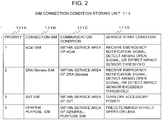
- the SIM connection condition storing unit 111 stores information including priority 111A specifying priority, a SIM communication condition 111C, and a service start condition 111D, for each connection SIM 111B specifying a connected SIM interface.
- the SIM interface is not limited to a SIM card, and another SIM chip having the same function as that of the SIM card may be employed.
- priority "1" is associated with an eCall SIM interface for emergency support, communication is validated within a service area of eCall, and it is stored that an emergency support service of eCall should start, when an emergency notification signal is received, when a signal specifying that an airbag is opened is detected, or when it is detected that an output of a predetermined impact sensor exceeds a threshold value.
- priority "2" is associated with an ERA Glonass SIM interface for emergency support, communication is validated within a service area of ERA Glonass, and it is stored that an emergency support service of ERA Glonass should start, when an emergency notification signal is received, when a signal specifying that an airbag is opened is detected, or when it is detected that an output of a predetermined impact sensor exceeds the threshold value.
- priority "3" is associated with an SVT SIM interface for stolen vehicle tracking, communication is validated within a service area in the range of SVT, and it is stored that an emergency support service of SVT should start when it is detected that an accessory power of a vehicle mounted with the subject unit is turned off.
- priority "4" is associated with a general-purpose SIM interface including a user SIM interface independently contracted by a user and a car maker SIM interface provided by a car maker, communication is validated within a service area of the general-purpose SIM interface, and it is stored that an individual service should start using the general-purpose SIM interface, such as transmitting information about a vehicle (including an error history and an operation history of the vehicle) to a predetermined server, when a speed of a vehicle mounted with the subject unit is equal to or lower than a predetermined value.
- a vehicle including an error history and an operation history of the vehicle
- the vehicle information acquiring unit 120 is connected to a vehicle bus 200 constituting a vehicle-mounted network such as a Controller Area Network (CAN), and acquires and stores information about a vehicle state.
- a vehicle bus 200 constituting a vehicle-mounted network such as a Controller Area Network (CAN), and acquires and stores information about a vehicle state.
- CAN Controller Area Network
- the modem 130 is connected to the SIM interface and an antenna 150 communicating with the other devices through a wireless network, and performs a process such as modulation and demodulation necessary for the communication.
- the SIM switching unit 131 controls the connection between various kinds of SIM interfaces and the modem 130 to be electrically switched.
- the SIM switching unit 131 is a SIM switching unit enabling one of the plurality of SIM interfaces to communicate.
- the eCall SIM interface 132 is a SIM interface for an eCall system communicating for emergency support mainly in regions such as Europe.
- the ERA Glonass SIM interface 133 is a SIM interface for an ERA Glonass system communicating for emergency support mainly in regions such as Russia.
- the SVT SIM interface 134 is a SIM interface for an SVT system communicating for stolen vehicle tracking in regions such as Europe and Brazil.
- the general-purpose SIM interface 135 includes a car maker SIM interface provided by a car maker and a user SIM interface which users independently have.
- the location information receiving unit 140 is connected to an antenna 160 for receiving location information, measures a location according to electric waves received by the antenna 160 from an artificial satellite, and transmits and receives information of latitude and longitude specifying the measured location to and from the control unit 110.
- a network connected by the antenna 150 is a wireless network such as a mobile phone network, a public network, a Local Area Network (LAN), or a Wide Area Network (WAN).
- the location information received by the antenna 160 is information about a Global Positioning System (GPS) system, but the present invention is not limited thereto, and the location information may be information about a Global Navigation Satellite System (Glonass) system, or may be information received from any one of the GPS and the Glonass.
- GPS Global Positioning System
- Galonass Global Navigation Satellite System
- the control unit 110 of the telematics control unit 100 has a configuration in which devices are connected through a bus 110E.
- the control unit 110 includes a Central Processing Unit (CPU) 110A that performs various processes such as a numerical operation and a control of devices, a Random Access Memory (RAM) 110B that stores data read from the SIM connection condition storing unit 111, a Read Only Memory (ROM) 110C that stores programs and data, and an interface (I/F) 110D for connecting various kinds of hardware units to the control unit 110.
- CPU Central Processing Unit
- RAM Random Access Memory
- ROM Read Only Memory
- I/F interface
- the SIM connection condition storing unit 111 includes a storage medium which is at least readable such as a Hard Disk Drive (HDD) and a nonvolatile memory card.
- HDD Hard Disk Drive
- a CPU 110A reads and executes a predetermined program to construct the control unit 110. For this reason, programs for realizing processes of functional units are stored in the RAM 110B and the ROM 110C.
- the constituent elements described above are mainly classified according to processing contents in order to help with understanding on the configuration of the telematics control unit 100. Therefore, the present invention is not limited by the method of classifying the constituent elements or the names thereof.
- the configuration of the telematics control unit 100 may be classified into more constituent elements according to the processing contents. In addition, the classification may be made such that one constituent element performs many processes.
- control unit 110 may be constructed by hardware units (ASIC, GPU, and the like). In addition, each process may be performed by one hardware unit, or may be performed by a plurality of hardware units.
- FIG. 3 is a flowchart illustrating a flow of a vehicle information collecting process performed by the telematics control unit 100. This flow is performed at a proper time period, for example, at a regular time period, after the other devices connected to the telematics control unit 100 and the vehicle bus 200 are operated to some extent.
- the control unit 110 acquires information specifying a communication situation of eCall (Step S001). Specifically, the control unit 110 requests and acquires information on whether it is within a communication area for the eCall SIM interface 132 together with a degree of electric wave intensity thereof.
- the control unit 110 acquires information about a communication situation of ERA Glonass (Step S002). Specifically, the control unit 110 requests and acquires information on whether it is within a communication area for the ERA Glonass SIM interface 133 together with a degree of electric wave intensity thereof.
- the control unit 110 acquires information about a communication situation of SVT (Step S003). Specifically, the control unit 110 requests and acquires information on whether it is within a communication area for the SVT SIM interface 134 together with a degree of electric wave intensity thereof.
- the control unit 110 acquires information about a communication situation based on general-purpose SIM (StepS004). Specifically, the control unit 110 requests and acquires information on whether it is within a communication area for the general-purpose SIM interface 135 together with a degree of electric wave intensity thereof.
- the vehicle information acquiring unit 120 acquires whether an emergency notification signal is generated, whether an airbag open signal specifying that an airbag is open is generated, and whether an impact detection signal of an impact sensor is generated (Step S005). Specifically, the vehicle information acquiring unit 120 monitors various kinds of signal information transmitted through the vehicle bus 200, specifies information on whether each predetermined signal described above is transmitted through the vehicle bus 200 within a predetermined period, and records the information in a predetermined buffer recording area.
- the vehicle information acquiring unit 120 acquires vehicle speed information (Step S006). Specifically, the vehicle information acquiring unit 120 acquires vehicle speed information transmitted through the vehicle bus 200, and records the vehicle speed information in a predetermined buffer recording area on the RAM 110B.
- a vehicle method acquiring unit may be a vehicle information collecting device that collects vehicle information specifying a situation of a vehicle mounted with the subject unit.
- Fig. 4 is a flowchart illustrating a flow of a SIM selecting process performed by the telematics control unit 100. This flow is performed at a proper time period, for example, at a regular time period, after the other devices connected to the telematics control unit 100 and the vehicle bus 200 are operated to some extent.
- control unit 110 specifies one SIM interface having a low priority of unprocessed SIM interfaces (Step S101). Specifically, the control unit 110 specifies an unprocessed connection SIM 111B having low priority 111A with reference to the SIM connection condition storing unit 111.
- the control unit 110 determines whether a communication condition of the specified SIM interface is satisfied (Step S102). Specifically, the control unit 110 reads a communication condition 111C of the SIM interface specified in Step S101 from the SIM connection condition storing unit 111, and determines whether the information collected in the vehicle information collecting process satisfies the communication condition 111C. In a case where the information does not satisfy the communication condition 111C, the process proceeds to Step S104 as described below.
- Step S102 the control unit 110 selects the SIM interface as an operation target (Step S103). The process proceeds to Step S104.
- the control unit 110 determines whether priority of the specified SIM interface corresponds to the SIM interface having the highest priority (Step S104). Specifically, the control unit 110 determines whether the connection SIM 111B having the priority 111A higher than that of the SIM interface specified in Step S101 is stored in the SIM connection condition storing unit 111. Then, in a case where it is determined that the connection SIM having the high priority 111A is stored, the control unit 110 determines that the priority is not the highest, and the process is returned to Step S101.
- the control unit 110 operates the SIM interface lastly selected as the operation target to communicate (Step S105). Specifically, the control unit 110 controls the SIM switching unit 131 to connect the SIM interface lastly selected as the operation target to the modem 130. The control unit 110 instructs the SIM interface as the operation target to transmit information for registering the location information acquired by the location information receiving unit 140 to a network connected to the SIM interface lastly selected as the operation target.
- control unit 110 may operate the SIM interface having the highest priority as the operation target.
- the SIM interface having a high priority can be operated to communicate. That is, the control unit 110 specifies a SIM interface for which the present location specified by the vehicle information is included in the service available area, and may enable the specified SIM interface to communicate. In addition, the control unit 110 specifies a SIM interface communicating with a high priority in communication based on the SIM interface for which the present location specified by the vehicle information is included in the service available area, and may enable the specified SIM interface to communicate.
- Fig. 5 is a flowchart illustrating a flow of a communication process performed by the telematics control unit 100.
- the SIM interface for which the vehicle information satisfies the service start condition 111D is selected by the control unit 110, and this flow is started at a proper time after the other devices connected to the telematics control unit 100 and the vehicle bus 200 are operated to some extent and after the SIM interface is operated to communicate by the SIM selecting process.
- the control unit 110 determines whether there is a higher SIM interface which is in communication or is out of communication (Step S201). Specifically, the control unit 110 determines, for the SIM interface having a priority higher than the SIM interface operated to communicate, whether a state where communication was ended within a predetermined time from the time of a process time point or a state of being communicating at a process time point. In a case of any one state, the control unit 110 ends the communication process. It is not a situation where communication in the SIM interface having a lower priority is positively necessary, that is, it is because an accident or stealing may be occurring.
- Step S201 the control unit 110 determines whether there is a SIM interface having the same priority in communication. Specifically, the control unit 110 determines whether there is a SIM interface which is in communication at the process time point and has the exactly same priority.
- Step S203 the control unit 110 waits until the communication of the SIM interface having the same priority in communication is ended.
- Step S203 the control unit 110 makes the process proceed to Step S206 as described below.
- the control unit 110 determines whether there is a low SIM interface which is in communication (Step S204). Specifically, the control unit 110 determines whether there is a SIM interface having the lower priority in communication at the process time point.
- Step S204 the control unit 110 makes the process proceed to Step S206 as described below.
- Step S204 the control unit 110 performs an interrupt process to the lower SIM interface as described below (Step S205).
- the control unit 110 makes the process proceed to Step S206 as described below.
- the control unit 110 performs communication based on the selected SIM interface (Step S206).
- the telematics control unit 100 does not perform the communication process using the lower SIM interface in a case where the higher SIM interface is out of communication or in communication.
- the SIM interface having the same priority is in communication, it waits for the end of the communication based on the SIM interface in communication, and starts the communication.
- the lower SIM interface is in communication, the communication is started through the interruption. In such a manner, since the communication based on the SIM interface having a higher priority comes first, the communication of the higher SIM interface having a high emergency is firstly performed in a situation having a high emergency. That is, in a case where the vehicle information represents a predetermined emergency state, the SIM interface communicating for emergency support may be enabled to communicate.
- Fig. 6 is a flowchart illustrating the interrupt process to the lower SIM interface performed by the telematics control unit 100.
- the SIM interface for which the vehicle information satisfies the service start condition 111D is selected by the control unit 110, and this flow is started at a proper time after the other devices connected to the telematics control unit 100 and the vehicle bus 200 are operated to some extent and after the SIM interface is operated to communicate by the SIM selecting process, in a case where the SIM interface lower than the selected SIM interface has been already in communication.
- control unit 110 disconnects a line of the lower SIM interface which is in communication (Step S301).
- the control unit 110 disconnects a logical port between the modem 130 and the control unit 110 (Step S302).
- the SIM switching unit 131 switches the SIM interface to the interrupting SIM interface (Step S303). Specifically, the SIM switching unit 131 detaches the lower SIM interface from the modem 130, and interruptingly connects the selected SIM interface to the modem 130.
- the SIM switching unit 131 registers a location in a network of the interrupting SIM interface (Step S304). Specifically, the SIM switching unit 131 instructs the interrupted SIM interface to transmit the information of the location registration to the network of the interrupting SIM interface.
- the interrupted SIM interface receives the location information from the location information receiving unit 140, and transmits the location information as the registration information to a near base station or the like that is a registration information transmission destination.
- control unit 110 performs processes of Step S305 to Step S307 as described below in parallel with the processes of Step S303 and Step S304.
- the control unit 110 performs an end process of an application which is in communication using the lower SIM interface (Step S305). Specifically, the control unit 110 transmits and receives information prompting the process to end, for example, communication end information to and from the application which is using the lower SIM interface that performs the communication disconnected in Step S301.
- the control unit 110 registers a DTC (error code) (Step S306) . Specifically, the control unit 110 specifies an error code causing that the communication is ended, and registers the error code as the DTC.
- the control unit 110 disconnects the power of a device unused in the interrupting SIM interface (Step S307). Specifically, the control unit 110 disconnects the power of an electronic component predetermined for each SIM interface in advance. It is because unnecessary power consumption is removed, for example, in a case of an accident. That is, in a case where the communication based on the SIM interface having a priority lower than that of the interrupting SIM interface is performed, the SIM switching unit 131 disconnects the communication based on the SIM interface which is in communication and starts the communication based on the interrupting SIM interface, whereby the control unit 110 ends the processing unit that is in communication on the basis of the SIM interface having the lower priority.
- Fig. 7 is a diagram illustrating an example of a screen output to an output device in a case where the telematics control unit is connected to an apparatus having the output device such as a display to output an output screen. More specifically, it is a diagram illustrating an example of a screen display 300 representing a state where the eCall SIM interface that is the SIM interface for emergency support is used. In the screen display 300, a message area 301 is displayed in which a message such as "In emergency communication based on eCall SIM" with horizontal texts at a lower end of the screen is displayed.
- the message area 301 is not limited to the lower end of the screen, but may be disposed at an upper end, a left end, a right end, a center, or other predetermined positions, or may be displayed to be overlapped with the display screen of the output device.
- the message area 301 may be displayed to transparently overlap at the lower end of a map display screen of a navigation device.
- Fig. 8 is a diagram illustrating, in a case where the telematics control unit is connected to an apparatus having an output device such as a display to output an output screen, an example of a screen output to the output device. More specifically, it is a diagram illustrating an example of a screen display 310 representing a state where a SIM interface for receiving an information service independently provided by a car maker or the like is being used. As for the screen display 310, a message area 311 is displayed in which a message such as "In communication based on car maker SIM" with horizontal texts at a lower end of the screen is displayed.
- the message area 311 is not limited to the lower end of the screen, but may be disposed at an upper end, a left end, a right end, a center, or other predetermined positions, and may be displayed to overlap with the display screen of the output device.
- the message area 311 may be displayed to be transparently overlapped at the lower end of a map display screen of a navigation device.
- the display such as the message areas 301 and 311 be not output. The reason is because the existence of the SVT SIM interface is known and it may be released by destruction or the like of the SIM interface.
- the telematics control unit enables the SIM interface to be selected more appropriately.
- the present invention is not limited to the embodiment described above.
- the first embodiment described above may be variously modified within the technical scope of the present invention.
- the present invention is achieved by an application to a navigation device 500.
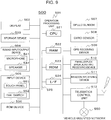
- Fig. 9 is a diagram illustrating an overall configuration of the navigation device 500 according to the second embodiment.
- the navigation device is employed for the convenience of explanation, the present invention is not limited thereto, and a multifunctional communication device such as a so-called vehicle-mounted device that performs various controls of a vehicle may be employed.
- the navigation device 500 is a so-called navigation device capable of indicating a spot representing a present location of the navigation device 500 and information for guiding along a route to a predetermined destination by displaying map information.
- the navigation device 500 includes an operation processing unit 501, a display 502, a storage device 503, a sound input/output device 504 (including a microphone 541 as a sound input device and a speaker 542 as a sound output device), an input device 505 (including at least any one of a touch panel 551 and a dial switch 552), a ROM device 506, a vehicle speed sensor 507, a gyro sensor 508, a GPS receiving device 509, an FM multiplex broadcasting receiving device 510, a beacon receiving device 511, and a telematics control unit 512.
- an operation processing unit 501 includes an operation processing unit 501, a display 502, a storage device 503, a sound input/output device 504 (including a microphone 541 as a sound input device and a speaker 542 as a sound output device), an input device 505 (including at least any one of a touch panel 551 and a dial switch 552), a ROM device 506, a vehicle speed sensor 507,
- the operation processing unit 501 is a central unit that performs various processes. For example, the present location is calculated on the basis of information output from various sensors 507 and 508, the GPS receiving device 509, the FMmultiplex broadcasting receiving device 510, and the like. In addition, map data necessary for display is read from the storage device 503 or the ROM device 506 on the basis of the information of the obtained present location.
- the operation processing unit 501 graphically develops the read map data, overlaps a mark representing the present location thereon, and displays it on the display 502.
- a recommended route that is an optimal route connecting a departure location or a present location to a destination instructed from a user is searched using the map data or the like stored in the storage device 503 or the ROM device 506.
- a user is induced using the speaker 542 or the display 502.
- the operation processing unit 501 receives information specifying a location as an input, and specifies a communication service for which the location is included in a service area. Specifically, the operation processing unit 501 overlaps the input location with the map information stored in the storage device 503 and determines whether the input location is overlapped with communication area information of various communication services, thereby specifying a communication service for which the location is included in a service area. For example, the operation processing unit 501 specifies whether it is within the service area of eCall or specifies whether it is within the service area of ERA Glonass. In addition, the operation processing unit 501 may specify whether it is within the service area of SVT or may specify whether it is within the service area of the communication service using the general-purpose SIM.
- the operation processing unit 501 of the navigation device 500 has a configuration in which the respective devices are connected through a bus 525.
- the operation processing unit 501 includes a CPU 521 that performs various processes such as a numerical operation and a control of the respective devices, a RAM 522 that stores map data and operation data read from the storage device 503 or the ROM device 506, a ROM 523 that stores programs and data, and an I/F 524 for connecting various kinds of hardware units to the operation processing unit 501.
- the display 502 is a unit that displays graphic information generated by the operation processing unit 501 or the like.
- the display 502 includes a liquid crystal display, an organic EL display, and the like.
- the storage device 503 includes a storage medium which is at least readable and writable such as a HDD and a nonvolatile memory card.
- map data (including link data of links constituting roads on the map) necessary for a general route searching device and information of a service area about SIM are stored.
- Fig. 10 is a diagram illustrating a data structure of a service area storing unit 600.
- information of an approximate latitude longitude 600A considered as approximating a predetermined representative spot on the map and a spot around that predetermined representative spot, and an available service 600B in the approximate latitude longitude 600A are associated and stored. That is, considering that the spot included in a predetermined range centered on the location specified by the latitude and longitude specified by the approximate latitude longitude 600A is the location specified by the latitude and longitude specified by the approximate latitude longitude 600A, the available service 600B may be associated.
- the sound input/output device 504 includes a microphone 541 as a sound input device and a speaker 542 as a sound output device.
- the microphone 541 acquires an external sound of the navigation device 500 such as a sound of a user or another person.
- the speaker 542 outputs a sound message generated by the operation processing unit 501 to the user.
- the microphone 541 and the speaker 542 may be separately disposed at predetermined positions of environment used by the user, for example, a moving object into which the user gets. However, the microphone 541 and the speaker 542 may be housed in one case.
- the navigation device 500 may be provided with a plurality of microphones 541 and speakers 542.
- the input device 505 is a device that receives an instruction from a user through an operation of the user.
- the input device 505 includes a touch panel 551 and a dial switch 552, and besides a scroll key, a scale change key, a keyboard, and a software keyboard which are hard switches (not illustrated).
- the input device 505 includes a remote controller capable of remotely instructing the navigation device 500 to operate.
- the remote controller includes a dial switch, a scroll key, a scale change key, and the like, and can transmit information indicating the reception of an operation of each key or switch to the navigation device 500.
- the touch panel 551 is mounted on a display side of the display 502, and the display screen can be seen therethrough.
- the touch panel 551 specifies a touch position corresponding to XY coordinates of an image displayed on the display 502, converts the touch position into coordinates, and outputs the coordinates .
- the touch panel 551 is configured by a pressure-sensitive or electrostatic input detecting element or the like.
- the touch panel 551 may realize a multi-touch capable of simultaneously detecting a plurality of touch positions.
- the dial switch 552 is configured to be rotatable clockwise and anticlockwise, generates a pulse signal for each rotation at a predetermined angle, and outputs the pulse signal to the operation processing unit 501.
- the operation processing unit 501 acquires a rotation angle from the number of pulse signals.
- the ROM device 506 is configured by a storage medium which is at least readable, for example, a ROM such as a CD-ROM or a DVD-ROM, and an Integrated Circuit (IC) card.
- a storage medium which is at least readable, for example, a ROM such as a CD-ROM or a DVD-ROM, and an Integrated Circuit (IC) card.
- IC Integrated Circuit
- the vehicle speed sensor 507, the gyro sensor 508, and the GPS receiving device 509 are used to detect the present location (for example, a vehicle position) by the navigation device 500.
- the vehicle speed sensor 507 is a sensor that outputs a value used to calculate a movement speed, that is, a vehicle speed.
- the gyro sensor 508 is configured by an optical-fiber gyro device or a vibration gyro device to detect an angular speed based on rotation of the navigation device 500.
- the GPS receiving device 509 receives signals from GPS satellites, and measures distances from the GPS satellites and change rates of the distances for three or more satellites by the navigation device 500, thereby measuring a present location, a movement speed, and a movement direction of the moving object.
- the GPS receiving device 509 is not limited to the GPS, but may measure a location using a satellite such as Glonass, or may raise precision in measuring a location using the GPS and Glonass together.
- the FM multiplex broadcasting receiving device 510 receives FM multiplex broadcasting signals transmitted from the FM broadcasting station.
- the FM multiplex broadcasting includes schematic status traffic information of Vehicle Information Communication System (VICS: Registered Trademark) information, regulation information, Service Area/Parking Area (SA/PA) information, parking lot information, weather information, and text information provided as FM multiplex general information by a radio station.
- VICS Vehicle Information Communication System
- SA/PA Service Area/Parking Area
- the beacon receiving device 511 receives the schematic status traffic information of the VICS information or the like, the regulation information, the Service Area/Parking Area (SA/PA) information, the parking lot information, the weather information, or an emergency alert.
- SA/PA Service Area/Parking Area
- the beacon receiving device 511 receives the schematic status traffic information of the VICS information or the like, the regulation information, the Service Area/Parking Area (SA/PA) information, the parking lot information, the weather information, or an emergency alert.
- SA/PA Service Area/Parking Area
- it is a device receiving an optical beacon communicating by light and an electric wave beacon communicating by an electric wave.
- the telematics control unit 512 switches one or more SIM interfaces to connect the navigation device 500 to a network such as a mobile phone network using any of several SIM interfaces.
- the telematics control unit 512 receives an instruction on whether to use which SIM interface from the external operation processing unit 501 or the like, and performs a switching process to use the received SIM interface.
- the telematics control unit 512 communicates with another device connected to the vehicle-mounted network 550 such as CAN through which the vehicle information is transmitted and received.
- Fig. 11 is a functional block diagram of the operation processing unit 501.
- the operation processing unit 501 includes a basic control unit 601, a SIM selecting unit 602, a communication processing unit 603, and an output processing unit 604.
- the basic control unit 601 is a central functional unit that performs various processes, and controls the other processing units according to the processing content.
- information of various sensors and the GPS receiving device 509 is acquired, and a map matching process or the like is performed to specify the present location.
- driving date and time are associated with a location, and a movement history is stored in the storage device 503 for each link constituting a road.
- the present time is output in response to a request from each processing unit.
- the basic control unit 601 searches an optimal route (a recommended route) connecting the present location to the destination.
- a route searching logic such as Dijkstra's algorithm, a route of minimizing a link cost is searched on the basis of a preset link cost for a predetermined section (link) of a road.
- the basic control unit 601 induces a user through visual and auditory senses using the speaker 542 and the display 502 while displaying the recommended route such that the present location does not deviate from the recommended route.
- the SIM selecting unit 602 selects the SIM interface to be used according to the vehicle situation of the vehicle mounted with the navigation device 500. In addition, the start/end of the communication using the SIM interface is controlled. In addition, in a case where interrupt into the SIM interface having the lower priority occurs, a control such as continuation and disconnection of the line of the SIM interface is performed.
- the SIM selecting unit 602 receives the information specifying a location, and specifies a communication service for which the location is included in the service area.
- the operation processing unit 501 overlaps the input location with the map information stored in the storage device 503 to determine whether the input location is overlapped with the communication area information of various communication services, thereby specifying the communication service for which the location is included in the service area.
- the operation processing unit 501 specifies whether it is within the service area of eCall or specifies whether it is within the service area of ERA Glonass.
- the operation processing unit 501 may specify whether it is within the service area of SVT, and may specify whether it is within the service area of the communication service using the general-purpose SIM interface.
- the communication processing unit 603 performs the communication process using the SIM interface selected by the SIM selecting unit 602 or a dedicated SIM interface for each service. According to the communication process, the navigation device 500 firstly performs the communication of the higher SIM interface having a higher emergency in a situation of high emergency, since the communication based on the SIM interface having a high priority is preferentially performed.
- the output processing unit 604 receives information constituting a screen to be displayed, for example, polygonal information, converts the information into a signal for drawing the information on the display 502, and instructs the display 502 to draw information.
- the functional units of the operation processing unit 501 described above, that is, the basic control unit 601, the SIM selecting unit 602, the communication processing unit 603, and the output processing unit 604 are constructed by predetermined programs which are read and executed by the CPU 521. For this reason, in the RAM 522, the programs for realizing the processes of the functional units are stored.
- the constituent elements described above are mainly classified according to the processing contents in order to help with understanding on the configuration of the navigation device 500. Therefore, the present invention is not limited by the method of classifying the constituent elements or the names thereof.
- the configuration of the navigation device 500 may be classified into more constituent elements according to the processes. In addition, it may be classified such that one constituent element performs many processes.
- each functional unit may be constructed by hardware units (ASIC, GPU, and the like).
- the process of each functional unit may be performed by one unit of hardware, and may be performed by a plurality of hardware units.
- FIGs. 12 and Fig. 13 are flowcharts illustrating a flow of a process of selecting a SIM interface performed by the navigation device 500. This flow is operated after the navigation device 500 is operated.
- the SIM selecting unit 602 selects an emergency situation notification SIM interface (Step S502).
- the SIM selecting unit 602 determines whether the present location is within a service area of either eCall or ERA Glonass (Step S503). In a case where it is not within the service area for any service, the process proceeds to Step S601 as described below.
- the SIM selecting unit 602 determines whether the vehicle mounted with the navigation device 500 is driving (Step S504) . Specifically, when a speed of the vehicle obtained from the vehicle speed sensor 507 is equal to or higher than a predetermined value, the SIM selecting unit 602 determines that the vehicle is driving. In a case where it is determined that the vehicle is driving, the process proceeds to Step S507.
- the SIM selecting unit 602 determines whether there is a request of communication for a service using a user SIM independently contracted and used by a user within a predetermined period from a predetermined application (Step S505) . In a case where there is no request, the process proceeds to Step S507 as described below.
- Step S506 the SIM selecting unit 602 issues a user SIM selection flag (a flag is set) (Step S506).
- the SIM selecting unit 602 determines whether a predetermined emergency situation occurs (Step S507). Specifically, the SIM selecting unit 602 determines whether any signal of an emergency notification signal, an airbag open signal, and a signal representing that a detection value of an impact sensor exceeds a threshold value is included in communication contents of a vehicle-mounted network 550 within a predetermined period.
- Step S507 the communication processing unit 603 starts an emergency situation notification service (Step S508). Specifically, the communication processing unit 603 starts the communication based on the emergency situation notification service of either eCall or ERA Glonass.
- the SIM selecting unit 602 determines whether there is a user SIM selection flag (whether the flag is set) (Step S509) . In a case where there is no flag (the flag is not set), the SIM selecting unit 602 makes the process proceed to Step S518 as described below.
- the SIM selecting unit 602 disconnects the emergency situation notification SIM (Step S510).
- the SIM selecting unit 602 selects the user SIM (Step S511) .
- the communication processing unit 603 communicates using the user SIM, and determines whether the use of the communication using the user SIM is completed (Step S512).
- the SIM selecting unit 602 determines whether a predetermined emergency situation occurs (Step S513). Specifically, the SIM selecting unit 602 determines whether anysignalof an emergency notification signal, an airbag open signal, and a signal representing that a detection value of an impact sensor exceeds a threshold value is included in communication contents of a vehicle-mounted network 550 within a predetermined period. In a case where the predetermined emergency situation does not occur, the process is returned to Step S512.
- Step S513 the SIM selecting unit 602 disconnects the communication based on the user SIM interface (Step S514).
- the SIM selecting unit 602 selects the emergency situation notification SIM interface (Step S515). The process proceeds to Step S508.
- the SIM selecting unit 602 disconnects the communication with the base station based on the user SIM interface (Step S516).
- the SIM selecting unit 602 selects the emergency situation notification SIM interface (Step S517).
- the SIM selecting unit 602 determines whether it is a timing of uploading vehicle information (Step S518). Specifically, the SIM selecting unit 602 determines whether there is a request of communication for a service using a car maker SIM interface provided by a car maker within a predetermined period from a predetermined application. Then, in a case where it is determined that there is a request, the SIM selecting unit 602 determines that it is the timing of uploading the vehicle information. In a case where it is not the timing of uploading the vehicle information, that is, in a case where there is no request of communication, the process is returned to Step S503.
- the SIM selecting unit 602 disconnects the emergency situation notification SIM interface (Step S519).
- the SIM selecting unit 602 selects the car maker SIM interface, that is, a SIM interface for uploading the vehicle information (Step S520).
- the communication processing unit 603 communicates using the car maker SIM interface, and determines whether the use of the communication using the car maker SIM interface is completed (Step S521).
- the communication using the car maker SIM interface is downloading of predetermined update data or uploading of vehicle information representing an operation situation of a vehicle, but is not limited thereto, and includes transmission and reception of various kinds of data.
- the SIM selecting unit 602 determines whether a predetermined emergency situation occurs (Step S522). Specifically, the SIM selecting unit 602 determines whether any signal of an emergency notification signal, an airbag open signal, and a signal representing that a detection value of an impact sensor exceeds a threshold value is included in communication contents of a vehicle-mounted network 550 within a predetermined period. In a case where the predetermined emergency situation does not occur, the process is returned to Step S521.
- Step S523 the SIM selecting unit 602 disconnects the communication based on the car maker SIM interface (Step S523).
- the SIM selecting unit 602 selects the emergency situation notification SIM interface (Step S524). The process proceeds to Step S508.
- the SIM selecting unit 602 disconnects the communication with the base station based on the car maker SIM interface (Step S525).
- the SIM selecting unit 602 selects the emergency situation notification SIM interface (Step S526). The process proceeds to Step S503.
- Step S601 in a case where the present location is not within any service area of eCall and ERA Glonass (No in Step S503), the SIM selecting unit 602 disconnects the emergency situation notification SIM interface (Step S601).
- the SIM selecting unit 602 determines whether the vehicle mounted with the navigation device 500 is driving (Step S602). Specifically, when the speed of the vehicle obtained from the vehicle speed sensor 507 is equal to or higher than a predetermined value, the SIM selecting unit 602 determines that the vehicle is driving. In a case where it is determined that the vehicle is not driving, the process proceeds to Step S605 as described below.
- Step S602 determines whether the present location is within the service area of either eCall or ERA Glonass (Step S603). In a case where the present location is not within the service area for any service, the process proceeds to Step S615 as described below.
- Step S603 the SIM selecting unit 602 selects the emergency situation notification SIM interface (Step S604). The process proceeds to Step S507 described above.
- the SIM selecting unit 602 determines whether the present location is within the service area of SVT that is a stolen vehicle tracking system (Step S605).
- the SIM selecting unit 602 determines whether there is a request of communication for a service using a user SIM independently contracted and used by a user, within a predetermined period from a predetermined application (Step S606). In a case where there is no request, the process proceeds to Step S615 as described below.
- Step S606 In a case where there is the request of the communication for the service using the user SIM interface (Yes in Step S606), the SIM selecting unit 602 issues a user SIM selection flag (a flag is set) (S607). The process proceeds to Step S615 as described below.
- Step S605 the SIM selecting unit 602 inquires the basic control unit 601 whether an accessory power of the vehicle mounted with the navigation device 500 is disconnected, and determines whether the power is disconnected, that is, the vehicle is in a parking state (Step S608). In a case where the vehicle is not in the parking state, the SIM selecting unit 602 makes the process proceed to Step S606.
- the SIM selecting unit 602 selects a vehicle steal notification SIM interface, that is, a SIM interface for a stolen vehicle tracking system (Step S609).
- the SIM selecting unit 602 determines whether the vehicle steal occurs (Step S610) . Specifically, the SIM selecting unit 602 determines whether vehicle steal occurs according to whether a steal occurrence signal emitted from a vehicle steal detecting device (for example, a detection device such as an immobilizer) is transmitted through the vehicle-mounted network 550 within a predetermined period.
- a steal occurrence signal emitted from a vehicle steal detecting device for example, a detection device such as an immobilizer
- Step S610 the communication processing unit 603 starts the communication based on the vehicle steal notification service (Step S611) .
- the SIM selecting unit 602 inquires the basic control unit 601 whether the accessory power of the vehicle mounted with the navigation device 500 is input so as to determine whether it is in a power-inputting state, that is, a driving state (Step S612). In a case where the accessory power of the vehicle mounted with the navigation device 500 is not input, the SIM selecting unit 602 returns the process to Step S610.
- Step S612 In a case where the accessory power of the vehicle mounted with the navigation device 500 is input (Yes in Step S612), the SIM selecting unit 602 disconnects the communication based on the vehicle steal notification SIM interface (Step S613). The SIM selecting unit 602 returns the process to Step S502 described above (Step S614).
- the SIM selecting unit 602 determines whether there is a user SIM selection flag (whether a flag is set) (Step S615) . In a case where there is no flag (the flag is not set), the SIM selecting unit 602 makes the process proceed to Step S619 as described below.
- the SIM selecting unit 602 selects the user SIM interface (Step S616).
- the communication processing unit 603 communicates using the user SIM interface, and determines whether the use of the communication using the user SIM interface is completed (Step S617).
- Step S617 the SIM selecting unit 602 returns the process to Step S617.
- Step S617 the SIM selecting unit 602 disconnects the communication with the base station based on the user SIM interface (Step S618).
- the SIM selecting unit 602 determines whether it is a timing of uploading the vehicle information (Step S619). Specifically, the SIM selecting unit 602 determines whether there is a request of communication for a service using a car maker SIM interface provided by a car maker within a predetermined period from a predetermined application. Then, in a case where it is determined that there is a request, the SIM selecting unit 602 determines that it is the timing of uploading the vehicle information. In a case where it is not the timing of uploading the vehicle information, that is, in a case where there is no request of communication, the process is returned to Step S602.
- the SIM selecting unit 602 selects the car maker SIM interface, that is, a SIM interface for uploading the vehicle information (Step S620).
- the communication processing unit 603 communicates using the car maker SIM interface, and determines whether the use of the communication using the car maker SIM interface is completed (Step S621).
- the communication using the car maker SIM interface is downloading of predetermined update data or uploading of vehicle information representing an operation situation of a vehicle, but is not limited thereto, and includes transmission and reception of various kinds of data.
- Step S621 In a case where the use of the communication using the car maker SIM interface is not completed (No in Step S621), the SIM selecting unit 602 makes the process proceed to Step S621.
- Step S621 the SIM selecting unit 602 disconnects the communication with the base station based on the car maker SIM interface (Step S622). The process is returned to Step S602.
- the above description has been made about the operation of selecting the SIM interface performed by the navigation device 500 according to the second embodiment.
- the number of switchable SIM interfaces is predetermined, but the present invention is not limited thereto, and the number of used SIM interfaces may be freely increased. In such a manner, it is possible to more flexibly use the SIM interfaces.
- the present invention has been described mainly with reference to the embodiments.
- the navigation device 500 has been assumed for description, but the present invention is not limited to the navigation device, and may be applied to all apparatuses capable of acquiring a vehicle state.
Landscapes
- Engineering & Computer Science (AREA)
- Computer Networks & Wireless Communication (AREA)
- Signal Processing (AREA)
- Health & Medical Sciences (AREA)
- Databases & Information Systems (AREA)
- Public Health (AREA)
- Environmental & Geological Engineering (AREA)
- Business, Economics & Management (AREA)
- Emergency Management (AREA)
- Navigation (AREA)
- Traffic Control Systems (AREA)
- Telephonic Communication Services (AREA)
- Telephone Function (AREA)
- Emergency Alarm Devices (AREA)
- Mobile Radio Communication Systems (AREA)
- Alarm Systems (AREA)
- Computing Systems (AREA)
- General Health & Medical Sciences (AREA)
- Medical Informatics (AREA)
Claims (8)
- Contrôleur télématique comprenant :une unité de recueil d'informations de véhicule configurée pour recueillir des informations de véhicule relatives à un véhicule monté avec le contrôleur télématique ;une unité (131) de commutation SIM configurée pour permettre qu'une d'une pluralité de cartes SIM ou de puces SIM (132-135) communique ; etune unité d'instruction de commutation configurée pour donner àl'unité (131) de commutation SIM l'instruction de commuter la carte SIM ou la puce SIM sur une carte SIM ou une puce SIM associée au préalable en fonction des informations de véhicule recueillies parl'unité de recueil d'informations de véhicule,caractérisé en ce que lecontrôleur télématique inclut :- lapluralité de cartes SIM ou de puces SIM (132-135) sont configurées pour communiquer pour un support d'urgence,- une unité (503) de stockage est configurée pour stocker des informations de zones de service spécifiant une zone de service disponible pour chacune descartes SIM ou des puces SIM (132-135) communiquantpour un support d'urgence, et- une unité (111) de stockage de conditions de connexion SIM configurée pour stocker des informations incluant une priorité (111A) spécifiant une priorité, une condition (111C) de communication SIM, etune condition (111D) de début de service, pour chaque SIM (111B) de connexion spécifiant chacune descartes SIM ou des puces SIM (132-135)communiquantpour un support d'urgence ;dans lequel l'unité d'instruction de commutation est configurée pour sélectionner une carte SIM ou une puce SIM spécifiée parmi lescartes SIM ou les puces SIM pour laquelle un emplacement actuel spécifié par les informations de véhicule est inclus dans la zone de service disponible, ladite sélection étant basée sur des informations stockées dans laditeunité (111) de stockage de conditions de connexion SIM, et pour donner àl'unité (131) de commutation SIM l'instruction de commuter la carte SIM ou la puce SIM surla carte SIM ou la puce SIM spécifiée.
- Contrôleur télématique selon la revendication 1,
dans lequell'unité d'instruction de commutation est configurée pourcommuter la carte SIM ou la puce SIM surla carte SIM ou la puce SIM spécifiée communiquant pour un support d'urgence lorsque les informations de véhicule représentent un état d'urgence prédéterminé. - Contrôleur télématique selon la revendication 1,
dans lequel les informations de priorité spécifiant une priorité entre une carte SIM ou une puce SIM et une autrecarte SIM ou une autre puce SIM de lapluralité de cartes SIM ou de puces SIM (132-135) sont stockées dansl'unité (111) de stockage de conditions de connexion SIM, et
l'unité d'instruction de commutation est configurée pour spécifierune carte SIM ou une puce SIM communiquant avec une priorité élevée dans une communication basée sur la carte SIM ou la puce SIM pour laquelleun emplacement actuel spécifié par les informations de véhicule est inclus dans la zone de service disponible, et pour donner àl'unité (131) de commutation SIM l'instruction de commuterla carte SIM ou la puce SIM sur la carte SIM ou la puce SIM spécifiée. - Contrôleur télématique selon la revendication 3,
dans lequel, lorsque l'unité (131) de commutation SIM est configurée pour recevoir l'instructionde commuterla carte SIM ou la puce SIM sur la carte SIM ou la puce SIM spécifiée dans laquelleune carte SIM ou une puce SIM couramment communiquanta une priorité inférieure à celle de la carte SIM ou de la puce SIM spécifiée,l'unité (131) de commutation SIM est configurée pour exécuter un processus d'interruption de lacarte SIM ou de la puce SIM couramment communiquant, pour déconnecterlacarte SIM ou de la puce SIM couramment communiquant, et pour démarrer une communication sur la base dela carte SIM ou de la puce SIM spécifiée. - Procédé de commande télématique basé sur uncontrôleur télématique (100) qui inclutune unité (131) de commutation SIM qui permet qu'une d'une pluralité de cartes SIM ou de puces SIM (132-135) communique, le procédéde commande télématique comprenant :une étape derecueil d'informations de véhicule pour recueillir des informations de véhicule ; etune étape d'instruction de commutation pour donner àl'unité (131) de commutation SIM l'instruction decommuter la carte SIM ou la puce SIM sur une carte SIM ou une puce SIM associée au préalable en fonction des informations de véhicule recueillies à l'étape de recueil d'informations de véhicule,caractérisé en ce quelecontrôleur télématique inclut lapluralité de cartes SIM ou de puces SIM (132-135) communiquant pour un support d'urgence,lecontrôleur télématique inclut une unité de stockage dans laquelledes informations de zones de service spécifiant une zone de service disponible sont stockées pour chacune des cartes SIM ou des puces SIM (132-135) communiquant pour un support d'urgence, et uneunité (111) de stockage de conditions de connexion SIM qui stocke des informations incluant une priorité (111A) spécifiant une priorité, une condition (111C) de communication SIM etune condition (111D) de début de service, pour chaque SIM (111B) de connexion spécifiant chacune des cartes SIM ou des puces SIM (132-135) communiquant pour un support d'urgence ; età l'étape d'instruction de commutation,une carte SIM ou une puce SIM spécifiée est sélectionnée parmi les cartes SIM ou les puces SIM pour laquelle un emplacement actuel spécifié par les informations de véhicule est inclus dans la zone de service disponible, ladite sélection étant basée sur des informations stockées dans ladite unité (111) de stockage de conditions de connexion SIM, et donner à l'unité (131) de commutation SIM l'instruction de commuter la carte SIM ou la puce SIM sur la carte SIM ou la puce SIM spécifiée.
- Procédé de commande télématique selon la revendication 5,
dans lequell'unité (131) de commutation SIM reçoit l'instruction decommuter la carte SIM ou la puce SIM sur la carte SIM ou la puce SIM spécifiée communiquant pour un support d'urgence lorsque les informations de véhicule représentent un état d'urgence prédéterminé. - Procédé de commande télématique selon la revendication 5,
dans lequel le contrôleur télématique inclutunité (111) de stockage de conditions de connexion SIM qui stocke desinformations de priorité spécifiant une priorité entre une carte SIM ou une puce SIM et une autre carte SIM ou une autre puce SIM de la pluralité de cartes SIM ou de puces SIM (132-135), et
à l'étape d'instruction de commutation, une carte SIM ou une puce SIM communiquant avec une priorité élevée dans une communication basée sur la carte SIM ou la puce SIM pour laquelle un emplacement actuel spécifié par les informations de véhicule est inclus dans la zone de service disponible est spécifiée, et l'unité (131) de commutation SIM reçoit l'instruction de commuter la carte SIM ou la puce SIM sur la carte SIM ou la puce SIM spécifiée. - Procédé de commande télématique selon la revendication 7,
dans lequel,lorsque l'unité (131) de commutation SIM reçoit l'instruction de commuter la carte SIM ou la puce SIM sur la carte SIM ou la puce SIM spécifiée dans laquelle une carte SIM ou une puce SIM couramment communiquant a une priorité inférieure à celle de la carte SIM ou de la puce SIM spécifiée,l'unité (131) de commutation SIM exécute une étape de commutation SIM dans laquelle l'unité (131) de commutation SIM exécute un processus d'interruption de la carte SIM ou de la puce SIM couramment communiquant, déconnecte la carte SIM ou la puce SIM couramment communiquant et démarre une communication sur la base de la carte SIM ou de la puce SIM spécifiée.
Applications Claiming Priority (2)
| Application Number | Priority Date | Filing Date | Title |
|---|---|---|---|
| JP2013006755 | 2013-01-17 | ||
| PCT/JP2013/072428 WO2014112149A1 (fr) | 2013-01-17 | 2013-08-22 | Dispositif de commande télématique, véhicule et procédé de commande télématique |
Publications (3)
| Publication Number | Publication Date |
|---|---|
| EP2947856A1 EP2947856A1 (fr) | 2015-11-25 |
| EP2947856A4 EP2947856A4 (fr) | 2016-09-07 |
| EP2947856B1 true EP2947856B1 (fr) | 2018-11-07 |
Family
ID=51209263
Family Applications (1)
| Application Number | Title | Priority Date | Filing Date |
|---|---|---|---|
| EP13871776.4A Not-in-force EP2947856B1 (fr) | 2013-01-17 | 2013-08-22 | Dispositif de commande télématique et procédé de commande télématique |
Country Status (5)
| Country | Link |
|---|---|
| US (1) | US9532203B2 (fr) |
| EP (1) | EP2947856B1 (fr) |
| JP (1) | JP6277136B2 (fr) |
| CN (1) | CN104919785B (fr) |
| WO (1) | WO2014112149A1 (fr) |
Cited By (1)
| Publication number | Priority date | Publication date | Assignee | Title |
|---|---|---|---|---|
| US11462096B1 (en) | 2021-04-28 | 2022-10-04 | Qualcomm Incorporated | High capability switch movement for automotive modems |
Families Citing this family (26)
| Publication number | Priority date | Publication date | Assignee | Title |
|---|---|---|---|---|
| EP2942697B1 (fr) * | 2014-05-07 | 2021-01-20 | Haltian Oy | Réglage de la mesure d'un capteur et des intervalles de transmission dans un appareil mobile |
| US10173642B2 (en) * | 2015-01-23 | 2019-01-08 | Continental Automotive Systems, Inc. | Telematics system with PIN-controlled external SIM to prevent vehicle piracy |
| EP3065447B1 (fr) * | 2015-03-02 | 2023-11-01 | Rohde & Schwarz GmbH & Co. KG | Procédure et appareil de test pour tester un appareil télématique automobile d'un système d'appel d'urgence automobile basé sur la téléphonie mobile |
| JP6214688B2 (ja) * | 2016-01-25 | 2017-10-18 | レノボ・シンガポール・プライベート・リミテッド | 情報処理装置 |
| US20170272925A1 (en) * | 2016-03-15 | 2017-09-21 | Qualcomm Incorporated | Reception of emergency messages in mobile devices |
| CN105871816A (zh) * | 2016-03-22 | 2016-08-17 | 乐卡汽车智能科技(北京)有限公司 | 服务器、通信方法、车辆终端、防攻击方法及系统 |
| US20170332222A1 (en) * | 2016-05-13 | 2017-11-16 | Qualcomm Incorporated | Methods to prioritize mobile originated emergency calls over existing mobile terminated call related signaling on other subscription |
| US10159028B2 (en) | 2016-05-17 | 2018-12-18 | Ford Global Technologies, Llc | Method and apparatus for dynamic telematics network selection and utilization |
| EP3503068B1 (fr) * | 2016-08-22 | 2023-03-29 | Sony Mobile Communications Inc. | Véhicule et son procédé de commande |
| WO2018082105A1 (fr) * | 2016-11-07 | 2018-05-11 | 华为技术有限公司 | Procédé et dispositif de commutation de service embarqué à l'aide d'une carte sim externe |
| JP6872225B2 (ja) * | 2017-01-16 | 2021-05-19 | 株式会社パインベース | 移動体通信装置及び運行管理システム |
| DE112017001823B4 (de) * | 2017-01-25 | 2024-02-22 | Kyocera Corporation | Drahtloskommunikationsvorrichtung, verfahren zum steuern einer drahtloskommunikationsvorrichtung und drahtloskommunikationssystem |
| US11627612B2 (en) * | 2017-03-21 | 2023-04-11 | Ford Global Technologies, Llc | Method and apparatus for efficient vehicle data reporting |
| US10922424B2 (en) * | 2017-08-17 | 2021-02-16 | M2MD Technologies, Inc. | Method and system for securely providing vehicle services data to a vehicle |
| WO2019087349A1 (fr) * | 2017-11-02 | 2019-05-09 | 株式会社Leis | Système de commande de transactions financières, application associée, procédé de transactions financières l'utilisant, et procédé de commande de transactions financières |
| JP2020043536A (ja) * | 2018-09-13 | 2020-03-19 | アルパイン株式会社 | 無線通信装置、方法およびプログラム |
| JP7143724B2 (ja) * | 2018-11-01 | 2022-09-29 | トヨタ自動車株式会社 | 通信装置および通信装置の制御方法 |
| JP7107193B2 (ja) * | 2018-11-30 | 2022-07-27 | 株式会社デンソー | 管理装置、及び車両の制御装置 |
| JP7081534B2 (ja) * | 2019-02-27 | 2022-06-07 | トヨタ自動車株式会社 | 処理装置、処理方法及び処理プログラム |
| EP3767980B1 (fr) * | 2019-07-15 | 2021-09-22 | Deutsche Telekom AG | Procédé d'utilisation d'un système embarqué dans au moins un premier et un second pays ou une zone géographique à l'intérieur d'un pays et système embarqué |
| EP3767978B1 (fr) * | 2019-07-15 | 2021-12-08 | Deutsche Telekom AG | Procédé d'acheminement amélioré d'appel d'urgence utilisant un système embarqué |
| WO2021039774A1 (fr) | 2019-08-28 | 2021-03-04 | 京セラ株式会社 | Dispositif de communication sans fil, véhicule et procédé de communication |
| FR3111204B1 (fr) * | 2020-06-04 | 2023-12-22 | Renault | Sécurisation de la connexion entre un véhicule et un serveur distant de gestion dudit véhicule |
| US11418938B1 (en) | 2021-03-25 | 2022-08-16 | Qualcomm Incorporated | Location-assisted in-vehicle system (IVS) modem configuration management |
| US12056963B2 (en) * | 2022-05-27 | 2024-08-06 | Calamp Corp. | Technologies for switching between communication modes in a telematics device |
| US20240147212A1 (en) * | 2022-10-31 | 2024-05-02 | Deere & Company | Telecommunications system on a work vehicle with automated sim selection controller |
Family Cites Families (8)
| Publication number | Priority date | Publication date | Assignee | Title |
|---|---|---|---|---|
| GB2336507B (en) * | 1998-04-16 | 2003-02-12 | Motorola Ltd | Data carrier system |
| JP2000299642A (ja) * | 1999-04-13 | 2000-10-24 | Matsushita Electric Ind Co Ltd | トンネル内緊急通信装置及び異常監視センター |
| TW508933B (en) | 2001-04-23 | 2002-11-01 | Inventec Appliances Corp | Method for automatically switching SIM card of mobile phone and device therefor |
| US8781442B1 (en) * | 2006-09-08 | 2014-07-15 | Hti Ip, Llc | Personal assistance safety systems and methods |
| US7991381B1 (en) * | 2007-04-18 | 2011-08-02 | Cellco Partnership | Hierarchical telematics emergency call direction |
| JP2009124279A (ja) * | 2007-11-13 | 2009-06-04 | Hitachi Ltd | 車載通信端末 |
| US8988249B2 (en) * | 2009-10-08 | 2015-03-24 | Connectif Solutions Inc. | System, method and integrated circuit chip for wireless multi-network meter reading |
| US8417212B2 (en) * | 2010-05-18 | 2013-04-09 | General Motors Llc | Methods for providing emergency services to a mobile vehicle |
-
2013
- 2013-08-22 EP EP13871776.4A patent/EP2947856B1/fr not_active Not-in-force
- 2013-08-22 JP JP2014557313A patent/JP6277136B2/ja not_active Expired - Fee Related
- 2013-08-22 WO PCT/JP2013/072428 patent/WO2014112149A1/fr not_active Ceased
- 2013-08-22 CN CN201380070776.4A patent/CN104919785B/zh not_active Expired - Fee Related
- 2013-08-22 US US14/761,438 patent/US9532203B2/en not_active Expired - Fee Related
Non-Patent Citations (1)
| Title |
|---|
| None * |
Cited By (2)
| Publication number | Priority date | Publication date | Assignee | Title |
|---|---|---|---|---|
| US11462096B1 (en) | 2021-04-28 | 2022-10-04 | Qualcomm Incorporated | High capability switch movement for automotive modems |
| WO2022232718A1 (fr) * | 2021-04-28 | 2022-11-03 | Qualcomm Incorporated | Changement d'abonnement pour appels d'urgence embarqué sur la base d'une probabilité prédite d'un accident |
Also Published As
| Publication number | Publication date |
|---|---|
| US9532203B2 (en) | 2016-12-27 |
| WO2014112149A1 (fr) | 2014-07-24 |
| JP6277136B2 (ja) | 2018-02-07 |
| CN104919785A (zh) | 2015-09-16 |
| EP2947856A4 (fr) | 2016-09-07 |
| JPWO2014112149A1 (ja) | 2017-01-19 |
| CN104919785B (zh) | 2018-05-11 |
| US20150358798A1 (en) | 2015-12-10 |
| EP2947856A1 (fr) | 2015-11-25 |
Similar Documents
| Publication | Publication Date | Title |
|---|---|---|
| EP2947856B1 (fr) | Dispositif de commande télématique et procédé de commande télématique | |
| EP2291835B1 (fr) | Dispositif et procédé de navigation pour fournir une disponibilité d'une place de stationnement | |
| US8618945B2 (en) | In-vehicle communication system and in-vehicle apparatus | |
| CN100545671C (zh) | 使用移动通信系统的位置信息共享系统和方法 | |
| US9774718B2 (en) | Information display apparatus and information display method | |
| EP1777497A1 (fr) | Dispositif de guidage du deplacement, dispositif portatif de guidage du deplacement, systeme de guidage du deplacement, methode de guidage du deplacement, programme de guidage du deplacement et support d'enregistrement sur lequelle programme est enregistre | |
| JP2013148419A (ja) | 誘導システム、携帯端末装置および車載装置 | |
| WO2014073028A1 (fr) | Dispositif de navigation | |
| JP2011203174A (ja) | 車両経路案内装置及び車両経路案内システム | |
| JP2012043260A (ja) | 移動体通信装置 | |
| JP5013276B2 (ja) | 車載用ナビゲーション装置及びプログラム | |
| WO2014030263A1 (fr) | Dispositif de terminal portable, procédé de commande de dispositif de terminal portable, programme exécuté par un dispositif de terminal portable, et berceau pour un dispositif de terminal portable | |
| US20150350420A1 (en) | Call Control Device, Server, and Program | |
| JP2009031010A (ja) | ナビゲーション装置 | |
| JP4277730B2 (ja) | 位置情報通信機及び通信システム | |
| JP3767671B2 (ja) | ナビゲーション装置及びナビゲーション方法 | |
| JP4797641B2 (ja) | 交通制御システム | |
| US10291728B2 (en) | Location information display system, portable communication terminal, vehicular communication device, and computer program product | |
| JP2011223510A (ja) | 車載通信システム及び車載装置 | |
| JP4228759B2 (ja) | 情報端末装置 | |
| JP6564190B2 (ja) | 端末装置、情報処理方法、およびプログラム | |
| JP2010175317A (ja) | ナビゲーション装置 | |
| JP2019045282A (ja) | ナビゲーションシステム、及びナビゲーション方法 | |
| JP5365988B2 (ja) | 車両位置通信システム | |
| JP2008011246A (ja) | 通信手段報知装置 |
Legal Events
| Date | Code | Title | Description |
|---|---|---|---|
| PUAI | Public reference made under article 153(3) epc to a published international application that has entered the european phase |
Free format text: ORIGINAL CODE: 0009012 |
|
| 17P | Request for examination filed |
Effective date: 20150716 |
|
| AK | Designated contracting states |
Kind code of ref document: A1 Designated state(s): AL AT BE BG CH CY CZ DE DK EE ES FI FR GB GR HR HU IE IS IT LI LT LU LV MC MK MT NL NO PL PT RO RS SE SI SK SM TR |
|
| AX | Request for extension of the european patent |
Extension state: BA ME |
|
| DAX | Request for extension of the european patent (deleted) | ||
| A4 | Supplementary search report drawn up and despatched |
Effective date: 20160804 |
|
| RIC1 | Information provided on ipc code assigned before grant |
Ipc: H04B 1/08 20060101ALI20160729BHEP Ipc: H04W 76/00 20090101ALI20160729BHEP Ipc: H04W 4/04 20090101ALI20160729BHEP Ipc: H04W 4/22 20090101ALI20160729BHEP Ipc: H04W 92/08 20090101ALI20160729BHEP Ipc: H04W 88/06 20090101ALI20160729BHEP Ipc: H04W 48/18 20090101ALN20160729BHEP Ipc: H04L 29/08 20060101ALI20160729BHEP Ipc: G08G 1/00 20060101ALI20160729BHEP Ipc: H04M 1/00 20060101AFI20160729BHEP Ipc: H04B 1/3816 20150101ALI20160729BHEP |
|
| STAA | Information on the status of an ep patent application or granted ep patent |
Free format text: STATUS: EXAMINATION IS IN PROGRESS |
|
| 17Q | First examination report despatched |
Effective date: 20170712 |
|
| GRAP | Despatch of communication of intention to grant a patent |
Free format text: ORIGINAL CODE: EPIDOSNIGR1 |
|
| STAA | Information on the status of an ep patent application or granted ep patent |
Free format text: STATUS: GRANT OF PATENT IS INTENDED |
|
| RIC1 | Information provided on ipc code assigned before grant |
Ipc: H04B 1/3816 20150101ALI20180607BHEP Ipc: H04W 8/18 20090101ALI20180607BHEP Ipc: H04M 1/00 20060101AFI20180607BHEP Ipc: H04L 29/08 20060101ALI20180607BHEP Ipc: G08G 1/00 20060101ALI20180607BHEP Ipc: H04W 4/90 20180101ALI20180607BHEP Ipc: H04W 48/18 20090101ALN20180607BHEP Ipc: H04B 1/08 20060101ALI20180607BHEP Ipc: H04W 92/08 20090101ALI20180607BHEP Ipc: H04W 76/00 20090101ALI20180607BHEP Ipc: H04W 88/06 20090101ALI20180607BHEP |
|
| INTG | Intention to grant announced |
Effective date: 20180621 |
|
| RIC1 | Information provided on ipc code assigned before grant |
Ipc: H04L 29/08 20060101ALI20180613BHEP Ipc: H04W 8/18 20090101ALI20180613BHEP Ipc: G08G 1/00 20060101ALI20180613BHEP Ipc: H04W 88/06 20090101ALI20180613BHEP Ipc: H04W 76/00 20090101ALI20180613BHEP Ipc: H04W 48/18 20090101ALN20180613BHEP Ipc: H04W 92/08 20090101ALI20180613BHEP Ipc: H04B 1/08 20060101ALI20180613BHEP Ipc: H04M 1/00 20060101AFI20180613BHEP Ipc: H04W 4/90 20180101ALI20180613BHEP Ipc: H04B 1/3816 20150101ALI20180613BHEP |
|
| GRAS | Grant fee paid |
Free format text: ORIGINAL CODE: EPIDOSNIGR3 |
|
| GRAA | (expected) grant |
Free format text: ORIGINAL CODE: 0009210 |
|
| STAA | Information on the status of an ep patent application or granted ep patent |
Free format text: STATUS: THE PATENT HAS BEEN GRANTED |
|
| AK | Designated contracting states |
Kind code of ref document: B1 Designated state(s): AL AT BE BG CH CY CZ DE DK EE ES FI FR GB GR HR HU IE IS IT LI LT LU LV MC MK MT NL NO PL PT RO RS SE SI SK SM TR |
|
| REG | Reference to a national code |
Ref country code: GB Ref legal event code: FG4D |
|
| REG | Reference to a national code |
Ref country code: CH Ref legal event code: EP Ref country code: AT Ref legal event code: REF Ref document number: 1063469 Country of ref document: AT Kind code of ref document: T Effective date: 20181115 |
|
| REG | Reference to a national code |
Ref country code: DE Ref legal event code: R096 Ref document number: 602013046490 Country of ref document: DE |
|
| REG | Reference to a national code |
Ref country code: IE Ref legal event code: FG4D |
|
| REG | Reference to a national code |
Ref country code: NL Ref legal event code: MP Effective date: 20181107 |
|
| REG | Reference to a national code |
Ref country code: LT Ref legal event code: MG4D |
|
| REG | Reference to a national code |
Ref country code: AT Ref legal event code: MK05 Ref document number: 1063469 Country of ref document: AT Kind code of ref document: T Effective date: 20181107 |
|
| PG25 | Lapsed in a contracting state [announced via postgrant information from national office to epo] |
Ref country code: IS Free format text: LAPSE BECAUSE OF FAILURE TO SUBMIT A TRANSLATION OF THE DESCRIPTION OR TO PAY THE FEE WITHIN THE PRESCRIBED TIME-LIMIT Effective date: 20190307 Ref country code: ES Free format text: LAPSE BECAUSE OF FAILURE TO SUBMIT A TRANSLATION OF THE DESCRIPTION OR TO PAY THE FEE WITHIN THE PRESCRIBED TIME-LIMIT Effective date: 20181107 Ref country code: NO Free format text: LAPSE BECAUSE OF FAILURE TO SUBMIT A TRANSLATION OF THE DESCRIPTION OR TO PAY THE FEE WITHIN THE PRESCRIBED TIME-LIMIT Effective date: 20190207 Ref country code: LT Free format text: LAPSE BECAUSE OF FAILURE TO SUBMIT A TRANSLATION OF THE DESCRIPTION OR TO PAY THE FEE WITHIN THE PRESCRIBED TIME-LIMIT Effective date: 20181107 Ref country code: HR Free format text: LAPSE BECAUSE OF FAILURE TO SUBMIT A TRANSLATION OF THE DESCRIPTION OR TO PAY THE FEE WITHIN THE PRESCRIBED TIME-LIMIT Effective date: 20181107 Ref country code: AT Free format text: LAPSE BECAUSE OF FAILURE TO SUBMIT A TRANSLATION OF THE DESCRIPTION OR TO PAY THE FEE WITHIN THE PRESCRIBED TIME-LIMIT Effective date: 20181107 Ref country code: BG Free format text: LAPSE BECAUSE OF FAILURE TO SUBMIT A TRANSLATION OF THE DESCRIPTION OR TO PAY THE FEE WITHIN THE PRESCRIBED TIME-LIMIT Effective date: 20190207 Ref country code: FI Free format text: LAPSE BECAUSE OF FAILURE TO SUBMIT A TRANSLATION OF THE DESCRIPTION OR TO PAY THE FEE WITHIN THE PRESCRIBED TIME-LIMIT Effective date: 20181107 Ref country code: LV Free format text: LAPSE BECAUSE OF FAILURE TO SUBMIT A TRANSLATION OF THE DESCRIPTION OR TO PAY THE FEE WITHIN THE PRESCRIBED TIME-LIMIT Effective date: 20181107 |
|
| PG25 | Lapsed in a contracting state [announced via postgrant information from national office to epo] |
Ref country code: RS Free format text: LAPSE BECAUSE OF FAILURE TO SUBMIT A TRANSLATION OF THE DESCRIPTION OR TO PAY THE FEE WITHIN THE PRESCRIBED TIME-LIMIT Effective date: 20181107 Ref country code: AL Free format text: LAPSE BECAUSE OF FAILURE TO SUBMIT A TRANSLATION OF THE DESCRIPTION OR TO PAY THE FEE WITHIN THE PRESCRIBED TIME-LIMIT Effective date: 20181107 Ref country code: SE Free format text: LAPSE BECAUSE OF FAILURE TO SUBMIT A TRANSLATION OF THE DESCRIPTION OR TO PAY THE FEE WITHIN THE PRESCRIBED TIME-LIMIT Effective date: 20181107 Ref country code: GR Free format text: LAPSE BECAUSE OF FAILURE TO SUBMIT A TRANSLATION OF THE DESCRIPTION OR TO PAY THE FEE WITHIN THE PRESCRIBED TIME-LIMIT Effective date: 20190208 Ref country code: NL Free format text: LAPSE BECAUSE OF FAILURE TO SUBMIT A TRANSLATION OF THE DESCRIPTION OR TO PAY THE FEE WITHIN THE PRESCRIBED TIME-LIMIT Effective date: 20181107 Ref country code: PT Free format text: LAPSE BECAUSE OF FAILURE TO SUBMIT A TRANSLATION OF THE DESCRIPTION OR TO PAY THE FEE WITHIN THE PRESCRIBED TIME-LIMIT Effective date: 20190307 |
|
| PG25 | Lapsed in a contracting state [announced via postgrant information from national office to epo] |
Ref country code: IT Free format text: LAPSE BECAUSE OF FAILURE TO SUBMIT A TRANSLATION OF THE DESCRIPTION OR TO PAY THE FEE WITHIN THE PRESCRIBED TIME-LIMIT Effective date: 20181107 Ref country code: PL Free format text: LAPSE BECAUSE OF FAILURE TO SUBMIT A TRANSLATION OF THE DESCRIPTION OR TO PAY THE FEE WITHIN THE PRESCRIBED TIME-LIMIT Effective date: 20181107 Ref country code: DK Free format text: LAPSE BECAUSE OF FAILURE TO SUBMIT A TRANSLATION OF THE DESCRIPTION OR TO PAY THE FEE WITHIN THE PRESCRIBED TIME-LIMIT Effective date: 20181107 Ref country code: CZ Free format text: LAPSE BECAUSE OF FAILURE TO SUBMIT A TRANSLATION OF THE DESCRIPTION OR TO PAY THE FEE WITHIN THE PRESCRIBED TIME-LIMIT Effective date: 20181107 |
|
| REG | Reference to a national code |
Ref country code: DE Ref legal event code: R097 Ref document number: 602013046490 Country of ref document: DE |
|
| PG25 | Lapsed in a contracting state [announced via postgrant information from national office to epo] |
Ref country code: EE Free format text: LAPSE BECAUSE OF FAILURE TO SUBMIT A TRANSLATION OF THE DESCRIPTION OR TO PAY THE FEE WITHIN THE PRESCRIBED TIME-LIMIT Effective date: 20181107 Ref country code: SM Free format text: LAPSE BECAUSE OF FAILURE TO SUBMIT A TRANSLATION OF THE DESCRIPTION OR TO PAY THE FEE WITHIN THE PRESCRIBED TIME-LIMIT Effective date: 20181107 Ref country code: RO Free format text: LAPSE BECAUSE OF FAILURE TO SUBMIT A TRANSLATION OF THE DESCRIPTION OR TO PAY THE FEE WITHIN THE PRESCRIBED TIME-LIMIT Effective date: 20181107 Ref country code: SK Free format text: LAPSE BECAUSE OF FAILURE TO SUBMIT A TRANSLATION OF THE DESCRIPTION OR TO PAY THE FEE WITHIN THE PRESCRIBED TIME-LIMIT Effective date: 20181107 |
|
| PLBE | No opposition filed within time limit |
Free format text: ORIGINAL CODE: 0009261 |
|
| STAA | Information on the status of an ep patent application or granted ep patent |
Free format text: STATUS: NO OPPOSITION FILED WITHIN TIME LIMIT |
|
| 26N | No opposition filed |
Effective date: 20190808 |
|
| PG25 | Lapsed in a contracting state [announced via postgrant information from national office to epo] |
Ref country code: SI Free format text: LAPSE BECAUSE OF FAILURE TO SUBMIT A TRANSLATION OF THE DESCRIPTION OR TO PAY THE FEE WITHIN THE PRESCRIBED TIME-LIMIT Effective date: 20181107 |
|
| PG25 | Lapsed in a contracting state [announced via postgrant information from national office to epo] |
Ref country code: TR Free format text: LAPSE BECAUSE OF FAILURE TO SUBMIT A TRANSLATION OF THE DESCRIPTION OR TO PAY THE FEE WITHIN THE PRESCRIBED TIME-LIMIT Effective date: 20181107 |
|
| PG25 | Lapsed in a contracting state [announced via postgrant information from national office to epo] |
Ref country code: LI Free format text: LAPSE BECAUSE OF NON-PAYMENT OF DUE FEES Effective date: 20190831 Ref country code: LU Free format text: LAPSE BECAUSE OF NON-PAYMENT OF DUE FEES Effective date: 20190822 Ref country code: MC Free format text: LAPSE BECAUSE OF FAILURE TO SUBMIT A TRANSLATION OF THE DESCRIPTION OR TO PAY THE FEE WITHIN THE PRESCRIBED TIME-LIMIT Effective date: 20181107 Ref country code: CH Free format text: LAPSE BECAUSE OF NON-PAYMENT OF DUE FEES Effective date: 20190831 |
|
| REG | Reference to a national code |
Ref country code: BE Ref legal event code: MM Effective date: 20190831 |
|
| PG25 | Lapsed in a contracting state [announced via postgrant information from national office to epo] |
Ref country code: IE Free format text: LAPSE BECAUSE OF NON-PAYMENT OF DUE FEES Effective date: 20190822 |
|
| PG25 | Lapsed in a contracting state [announced via postgrant information from national office to epo] |
Ref country code: BE Free format text: LAPSE BECAUSE OF NON-PAYMENT OF DUE FEES Effective date: 20190831 |
|
| PG25 | Lapsed in a contracting state [announced via postgrant information from national office to epo] |
Ref country code: CY Free format text: LAPSE BECAUSE OF FAILURE TO SUBMIT A TRANSLATION OF THE DESCRIPTION OR TO PAY THE FEE WITHIN THE PRESCRIBED TIME-LIMIT Effective date: 20181107 |
|
| PG25 | Lapsed in a contracting state [announced via postgrant information from national office to epo] |
Ref country code: MT Free format text: LAPSE BECAUSE OF FAILURE TO SUBMIT A TRANSLATION OF THE DESCRIPTION OR TO PAY THE FEE WITHIN THE PRESCRIBED TIME-LIMIT Effective date: 20181107 Ref country code: HU Free format text: LAPSE BECAUSE OF FAILURE TO SUBMIT A TRANSLATION OF THE DESCRIPTION OR TO PAY THE FEE WITHIN THE PRESCRIBED TIME-LIMIT; INVALID AB INITIO Effective date: 20130822 |
|
| PGFP | Annual fee paid to national office [announced via postgrant information from national office to epo] |
Ref country code: GB Payment date: 20210720 Year of fee payment: 9 |
|
| PG25 | Lapsed in a contracting state [announced via postgrant information from national office to epo] |
Ref country code: MK Free format text: LAPSE BECAUSE OF FAILURE TO SUBMIT A TRANSLATION OF THE DESCRIPTION OR TO PAY THE FEE WITHIN THE PRESCRIBED TIME-LIMIT Effective date: 20181107 |
|
| GBPC | Gb: european patent ceased through non-payment of renewal fee |
Effective date: 20220822 |
|
| PG25 | Lapsed in a contracting state [announced via postgrant information from national office to epo] |
Ref country code: GB Free format text: LAPSE BECAUSE OF NON-PAYMENT OF DUE FEES Effective date: 20220822 |
|
| PGFP | Annual fee paid to national office [announced via postgrant information from national office to epo] |
Ref country code: FR Payment date: 20230720 Year of fee payment: 11 Ref country code: DE Payment date: 20230720 Year of fee payment: 11 |
|
| REG | Reference to a national code |
Ref country code: DE Ref legal event code: R119 Ref document number: 602013046490 Country of ref document: DE |
|
| PG25 | Lapsed in a contracting state [announced via postgrant information from national office to epo] |
Ref country code: DE Free format text: LAPSE BECAUSE OF NON-PAYMENT OF DUE FEES Effective date: 20250301 |
|
| PG25 | Lapsed in a contracting state [announced via postgrant information from national office to epo] |
Ref country code: FR Free format text: LAPSE BECAUSE OF NON-PAYMENT OF DUE FEES Effective date: 20240831 |