EP2953070A1 - Verbesserung der Arbeitskräfteoptimierung durch verbesserte Bereitstellung eines beruflichen Leistungsplans - Google Patents
Verbesserung der Arbeitskräfteoptimierung durch verbesserte Bereitstellung eines beruflichen Leistungsplans Download PDFInfo
- Publication number
- EP2953070A1 EP2953070A1 EP14171360.2A EP14171360A EP2953070A1 EP 2953070 A1 EP2953070 A1 EP 2953070A1 EP 14171360 A EP14171360 A EP 14171360A EP 2953070 A1 EP2953070 A1 EP 2953070A1
- Authority
- EP
- European Patent Office
- Prior art keywords
- data
- job
- updated
- computer
- locations
- Prior art date
- Legal status (The legal status is an assumption and is not a legal conclusion. Google has not performed a legal analysis and makes no representation as to the accuracy of the status listed.)
- Ceased
Links
Images



Classifications
-
- G—PHYSICS
- G06—COMPUTING OR CALCULATING; COUNTING
- G06Q—INFORMATION AND COMMUNICATION TECHNOLOGY [ICT] SPECIALLY ADAPTED FOR ADMINISTRATIVE, COMMERCIAL, FINANCIAL, MANAGERIAL OR SUPERVISORY PURPOSES; SYSTEMS OR METHODS SPECIALLY ADAPTED FOR ADMINISTRATIVE, COMMERCIAL, FINANCIAL, MANAGERIAL OR SUPERVISORY PURPOSES, NOT OTHERWISE PROVIDED FOR
- G06Q10/00—Administration; Management
- G06Q10/06—Resources, workflows, human or project management; Enterprise or organisation planning; Enterprise or organisation modelling
- G06Q10/063—Operations research, analysis or management
- G06Q10/0631—Resource planning, allocation, distributing or scheduling for enterprises or organisations
- G06Q10/06311—Scheduling, planning or task assignment for a person or group
- G06Q10/063112—Skill-based matching of a person or a group to a task
-
- G—PHYSICS
- G06—COMPUTING OR CALCULATING; COUNTING
- G06F—ELECTRIC DIGITAL DATA PROCESSING
- G06F16/00—Information retrieval; Database structures therefor; File system structures therefor
- G06F16/20—Information retrieval; Database structures therefor; File system structures therefor of structured data, e.g. relational data
- G06F16/29—Geographical information databases
-
- G—PHYSICS
- G06—COMPUTING OR CALCULATING; COUNTING
- G06Q—INFORMATION AND COMMUNICATION TECHNOLOGY [ICT] SPECIALLY ADAPTED FOR ADMINISTRATIVE, COMMERCIAL, FINANCIAL, MANAGERIAL OR SUPERVISORY PURPOSES; SYSTEMS OR METHODS SPECIALLY ADAPTED FOR ADMINISTRATIVE, COMMERCIAL, FINANCIAL, MANAGERIAL OR SUPERVISORY PURPOSES, NOT OTHERWISE PROVIDED FOR
- G06Q10/00—Administration; Management
- G06Q10/06—Resources, workflows, human or project management; Enterprise or organisation planning; Enterprise or organisation modelling
- G06Q10/063—Operations research, analysis or management
- G06Q10/0631—Resource planning, allocation, distributing or scheduling for enterprises or organisations
- G06Q10/06311—Scheduling, planning or task assignment for a person or group
- G06Q10/063114—Status monitoring or status determination for a person or group
-
- G—PHYSICS
- G06—COMPUTING OR CALCULATING; COUNTING
- G06Q—INFORMATION AND COMMUNICATION TECHNOLOGY [ICT] SPECIALLY ADAPTED FOR ADMINISTRATIVE, COMMERCIAL, FINANCIAL, MANAGERIAL OR SUPERVISORY PURPOSES; SYSTEMS OR METHODS SPECIALLY ADAPTED FOR ADMINISTRATIVE, COMMERCIAL, FINANCIAL, MANAGERIAL OR SUPERVISORY PURPOSES, NOT OTHERWISE PROVIDED FOR
- G06Q10/00—Administration; Management
- G06Q10/06—Resources, workflows, human or project management; Enterprise or organisation planning; Enterprise or organisation modelling
- G06Q10/063—Operations research, analysis or management
- G06Q10/0631—Resource planning, allocation, distributing or scheduling for enterprises or organisations
- G06Q10/06311—Scheduling, planning or task assignment for a person or group
- G06Q10/063116—Schedule adjustment for a person or group
-
- G—PHYSICS
- G06—COMPUTING OR CALCULATING; COUNTING
- G06Q—INFORMATION AND COMMUNICATION TECHNOLOGY [ICT] SPECIALLY ADAPTED FOR ADMINISTRATIVE, COMMERCIAL, FINANCIAL, MANAGERIAL OR SUPERVISORY PURPOSES; SYSTEMS OR METHODS SPECIALLY ADAPTED FOR ADMINISTRATIVE, COMMERCIAL, FINANCIAL, MANAGERIAL OR SUPERVISORY PURPOSES, NOT OTHERWISE PROVIDED FOR
- G06Q10/00—Administration; Management
- G06Q10/06—Resources, workflows, human or project management; Enterprise or organisation planning; Enterprise or organisation modelling
- G06Q10/063—Operations research, analysis or management
- G06Q10/0639—Performance analysis of employees; Performance analysis of enterprise or organisation operations
- G06Q10/06398—Performance of employee with respect to a job function
-
- G—PHYSICS
- G06—COMPUTING OR CALCULATING; COUNTING
- G06Q—INFORMATION AND COMMUNICATION TECHNOLOGY [ICT] SPECIALLY ADAPTED FOR ADMINISTRATIVE, COMMERCIAL, FINANCIAL, MANAGERIAL OR SUPERVISORY PURPOSES; SYSTEMS OR METHODS SPECIALLY ADAPTED FOR ADMINISTRATIVE, COMMERCIAL, FINANCIAL, MANAGERIAL OR SUPERVISORY PURPOSES, NOT OTHERWISE PROVIDED FOR
- G06Q10/00—Administration; Management
- G06Q10/10—Office automation; Time management
- G06Q10/103—Workflow collaboration or project management
-
- G—PHYSICS
- G06—COMPUTING OR CALCULATING; COUNTING
- G06Q—INFORMATION AND COMMUNICATION TECHNOLOGY [ICT] SPECIALLY ADAPTED FOR ADMINISTRATIVE, COMMERCIAL, FINANCIAL, MANAGERIAL OR SUPERVISORY PURPOSES; SYSTEMS OR METHODS SPECIALLY ADAPTED FOR ADMINISTRATIVE, COMMERCIAL, FINANCIAL, MANAGERIAL OR SUPERVISORY PURPOSES, NOT OTHERWISE PROVIDED FOR
- G06Q10/00—Administration; Management
- G06Q10/10—Office automation; Time management
- G06Q10/105—Human resources
-
- H—ELECTRICITY
- H04—ELECTRIC COMMUNICATION TECHNIQUE
- H04M—TELEPHONIC COMMUNICATION
- H04M2203/00—Aspects of automatic or semi-automatic exchanges
- H04M2203/40—Aspects of automatic or semi-automatic exchanges related to call centers
- H04M2203/402—Agent or workforce management
-
- H—ELECTRICITY
- H04—ELECTRIC COMMUNICATION TECHNIQUE
- H04W—WIRELESS COMMUNICATION NETWORKS
- H04W4/00—Services specially adapted for wireless communication networks; Facilities therefor
- H04W4/02—Services making use of location information
- H04W4/021—Services related to particular areas, e.g. point of interest [POI] services, venue services or geofences
Definitions
- the present invention generally relates to computers, and more in particular relates to computers that schedule jobs that are performed by service organizations.
- services such as equipment installation, equipment maintenance or repair works are often performed by service organizations that respond to service requests from customers. For example, customers frequently order certain services to be performed by the service organisation. The organization then dispatches service persons, such as technicians, to the location of the customers to actually perform the service.
- Service requests are related to a variety of requirements. From a time aspect, service requests can have an appointment window during that the service has to be performed. The window usually has an earliest start time and a latest end time. From a space aspect, the service has to be performed at a geographical location that is identified, for example, by a street address, or by geographical coordinates. The technician has to move physically to and from the location. Further aspects include - to name only a few - skill sets of the service persons, priorities in comparison to other requests, or potential gains or benefits for the organization.
- the service organization has to optimize the use of its workforce, and assigning services to persons or equipment has become a computer technique.
- the computer receives the details for all requests including locations and time slots, and the computer receives data regarding the service persons such as skill sets and allowable duty times.
- the computer calculates plans or schedules, and personalizes the results to particular persons as duty-rosters or the like.
- Such a duty-roster can be a document that lists a sequence of jobs to be performed by the person along a calculated route or tour of geographical locations.
- the requests can change.
- the customer may cancel a request, move to a different location, desire a different appointment window etc.
- Service persons may become non-available, or transportation along the calculated routes may become interrupted.
- the computer receives data that is continuously changing. The changes usually become evident when the duty-rosters have been distributed, very often during day-times.
- the changing data comes from a variety of sources, for example, from call centres, traffic information control systems, from applications that monitor equipment.
- a computer-implemented method, a computer, and computer program product is presented to provide a job performance plan in an improved data processing approach by clustering elements of a data-structure into sub-structures.
- the plan is the data output of the computer, and the data relates to a plurality of jobs that are to be performed at geographical locations by job performers (such as humans and/or technical equipment).
- job performers such as humans and/or technical equipment.
- the computer assigns the job performers to the jobs.
- the computer operates according to technical optimization goals that are related to the amount of data to be processed and to the processing time.
- the computer provides an initial job performance plan optimized for a high number of performer-to-location assignments and for minimal use of resources for travel, including time and distance. Triggered by change requests, the computer provides an updated performance plan optimized with a minimal number of re-assignments in comparison to the initial plan.
- the computer uses technical representations or elements, such as a data-structure to represent the geographical locations, route vectors in the data-structure to represent directed concatenations of locations (or routes), job data to represent requirements and availability, and a sub-set of the data-structure with portions to represent geographical areas.
- technical representations or elements such as a data-structure to represent the geographical locations, route vectors in the data-structure to represent directed concatenations of locations (or routes), job data to represent requirements and availability, and a sub-set of the data-structure with portions to represent geographical areas.
- the computer processes the data-structure to identify routes between the geographical locations.
- the computer receives job data with job requirements for particular locations and with availability information of the job performers.
- the computer processes the job data with the data-structure to provide an initial job performance plan. In the plan, some of the routes - and locations as well - are assigned to particular job performers.
- the computer receives job data again, but as an update.
- the updated job data may represent an updated location.
- An updated location is a geographical location with an updated job requirement. Since locations in combination with job assignments to locations around the updated location are candidates for re-assignments, the computer identifies a sub-set of the data-structure that is to be processed again. In other words, the computer determines a data cluster that represents jobs that are likely affected by the update and that will be affected by re-scheduling.
- the sub-set of the data-structure has a first portion and has a second portion. The computer selects both portions differently.
- the first portion of the sub-set represents a first area
- the second portions of the sub-set represents a second area with geographical locations.
- the computer scans the data-structure for geographical locations that comply with a first condition in relation to the updated location.
- the first condition is a condition that relates locations to locations, to identify locations belonging to areas.
- the complying geographical locations - first locations - are in the first area.
- the computer then scans the data-structure for performers for that locations of the first area are assigned to.
- the computer can identify a set of performers that have assigned locations in the first area: the first area performers are performers that are already in the first area, or that are scheduled to travel to the first area.
- the computer scans the data-structure for geographical locations that are also assigned to the set of performers. These are second locations in the second area. In that sense, the first area is enlarged by the second area.
- the first area identified by a location-to-location condition and the second area is identified by using the existing performer-to-location assignments.
- the computer then processes the updated job data with both portions of the sub-set of the data-structure and provides an updated job performance plan.
- that updated plan some of the routes are re-assigned to particular job performers.
- pre-processing the data-structure to identify routes between the geographical locations can be executed with a graph data structure in that nodes represent the geographical locations, and in that edges represent travel parameters for the job performers travelling between the geographical locations.
- the edges can be directed edges, so-called arcs.
- This approach allows distinguishing directed traffic infrastructure - including one-way-streets or construction sites in a motorway - from non-directed infrastructure.
- the computer can select the first portion to include a first sub-set of nodes that correspond to the first area with geographical locations, and can select the second portion to include a second sub-set of nodes that correspond to the second area with geographical locations.
- the computer can pre-process the data-structure to identify routes between the geographical locations.
- the computer can store routes vectors and corresponding accumulated travel parameters in data attributes at the nodes of the data- structure.
- the computer can pre-process the data-structure to identify routes between the geographical locations by removing route vectors and corresponding accumulated travel parameters if the accumulated travel parameters exceed predefined threshold values. Such an approach avoids to store and to process data that does not support the above-mentioned optimization goals.
- the computer can process the updated job data with the sub-set of the data-structure to provide an updated job performance plan.
- This can include processing the updated job data together with (the representation of) the updated location.
- the updated location is a location that is no longer to be included into the performance plan, for example, in case of cancellations, (the representation of) the removed location is usually not processed.
- the first condition for the first area of geographical locations can be complied with for geographical locations that surround the updated location with a predetermined maximal distance value.
- the maximal distance value can be the direct distance or geographical air distance calculated from geographical coordinates of the locations, a distance calculated under consideration of travel ways, the overall time or the energy consumption that is required to travel, or emissions caused by the travel.
- the first condition for the first area of geographical locations can be complied with for a plurality of geographical locations that are assigned to an assigned job performer and that have an average distance value that is shorter than the predetermined maximal distance value.
- a complete re-assignment is not required, but in repetitions, assignments are added.
- the computer can process the updated job data to an updated job performance plan in that a particular location remains without a job performer assigned to that location.
- the computer identifies the sub-set of the data-structure again and processes the updated job data again, but with a representation of the particular location being received as updated job data. In other words, gaps in the updated performance plan are allowed if the plan is recalculated.
- the computer repeats the calculation with modified conditions.
- the computer can use a second condition that is related to the first condition by a numerical factor.
- the factor can make the first area for an updated first portion smaller in comparison to the previously used first area.
- a computer that re-calculates a plan for a smaller geographical area uses less computation resources that represent the location in the area, such as nodes. As a consequence, the computation is more efficient.
- the geographical area for an updated first portion can however have substantially the same size as the previously used area.
- the computer can have a processing engine that executes the processing steps.
- the engine can be implemented as a separate solver program that runs on the same computer or that runs on a different computer.
- FIGS. 1-4 illustrate an overview to a scenario by way of simplified examples.
- the left sides of the figures illustrate the real world with locations, routes between the locations, job performers etc.; and the right sides illustrate representations of the real world as they are processed by a computer.
- Numbers XX1 refer to initial states and numbers XX2, XX3 etc. refer to updates. Distinctions into “first” and "second” can be given as XXX-1 and XXX-2.
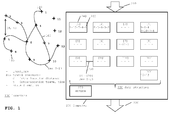
- FIG. 1 illustrates the computer and the reality; FIG.
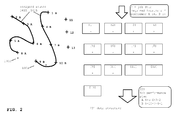
- FIG. 2 illustrates the computer having received job data and having provided an initial job performance plan
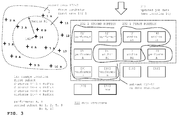
- FIG. 3 and FIG. 4 illustrate how the computer accommodates data updates and provides an updated job performance plan
- FIG. 5 illustrates how the computer accommodates gaps by repeating the process with modified conditions.
- FIGS. 6-7 summarize the explanation in method flow charts, and the remaining FIGS. 8-10 illustrate further options.
- FIG. 1 illustrates an overview to a scenario with the real world 100 and with computer 200 prior to receiving job requirements.
- Real world 100 is illustrated similar as a geographical map with locations 140 (+ symbols).
- the locations are connectable by traffic ways such as streets, but the ways are left out for simplicity.
- Locations 140 can be numbered, in the example of FIG. 1 , from 1 to 13.
- At least one job performer 190 performs jobs at some of the geographical locations 140 and travels between some of the locations along routes 160.
- job performer 190 is illustrated by a dot symbol near location 8.
- the job performer is an entity that performs a particular task that is related to the location.
- the job performer can be a combination of
- job performer 190 is a team of three service technicians travelling by car. The team visits various customers to install equipment. The service technicians use special tools, including special measurement devices for the equipment.
- Job performer 190 can also be a non-human entity such as a self-moving tool, a robot or the like.
- Travelling between locations 140 consumes intra-location travel parameters (Res) that can be measured (during the travel) or estimated (before travelling).
- Travel parameters (Res) can comprise data that stands for technical phenomena such as
- the travel parameters (Res) can depend on the direction of travel. For example, Res 9 ⁇ 10 indicates the resources (e.g., time, consumption) needed to travel from location 9 to location 10. (Res 10 ⁇ 9 would indicate the opposite direction).
- Computer 200 has processor and memory and other hardware components.
- Computer 200 can be implemented as a computer system of physically separate computers that are connected by a network. Some of the functions can be executed by a so-called engine 270.
- Computer 200 further has an input interface 210 to receive input data, and an output interface 220 to provide output data. The interfaces are illustrated by large arrow symbols. Both interfaces 210, 220 can be communicatively coupled to devices that are carried by job performers 190. For example, the performers carry mobile devices.
- the memory stores data-structure 230 that represents some aspects of the real world that is modified during processing (input/output).
- data structure 230 is illustrated as a graph structure with nodes 240 and edges 250. It should be noted that persons of skill in the art can implement the structure otherwise, without the need of graphs, for example, in tables or matrixes.
- nodes 240 represent geographical locations 140. Particular nodes are symbolized by rectangles that are numbered from [1] to [13]. Edges 250 (or “arcs") represent travel parameters (Res) for job performers potentially travelling between the geographical locations. The edges are symbolized by lines, and particular edges are numbered by combinations of node numbers, such as [9] ⁇ [10]. For simplicity, most of the edges are left out from illustration. Using nodes for locations and edges for intra-location parameters is convenient for illustration, using the nodes for the inter-location parameters and the edges for the locations would also be possible.
- Data attributes that can be associated with the nodes (and optionally with the edges) are also referred to as "labels". In the figures, such data attributes are illustrated by text written inside the nodes or along the edges.
- Computer 200 receives the data for the attributes, for example, through input interface 210.
- Computer 200 can access data-structure 230 to identify potential travel routes 160 between geographical locations and can store the routes and corresponding accumulated travel parameters. It is convenient to store potential travel routes to particular locations as data attribute in the corresponding nodes. Data attributes that relate to routes 160 are route vectors 260.
- node [1] that corresponds to location 1 can store various potential routes that lead to location 1.
- vector 9 ⁇ 10 ⁇ 7 ⁇ 4 ⁇ 1 stands for a route from location 9 to location 1 via locations 10, 7 and 4 in that order.
- route 8 ⁇ 5 ⁇ 6 ⁇ 3 ⁇ 2 is stored as a vector in node [2] for travelling from location 8 to location 2 via locations 5, 6 and 3.
- route 9 ⁇ 6 ⁇ 4 and route 9 ⁇ 10 ⁇ 7 ⁇ 4 are stored as vectors in node 4 to indicate alternative routes from location 9 to location 4.
- some nodes illustrate the route vectors by " ⁇ ⁇ ⁇ " without giving further details.
- the routes have common start and end points, for example, the location of a depot.
- start/end points are locations where jobs are not to be performed, but the scheduling system incorporates traveling from the start point to the first job location and from the last job location to the end point.
- performer 190 starts at location 8.
- the performers are usually already on the way, so that the current location is used as start point for a modified route.
- Nodes and edges store data that represents the travel parameters (Res).
- the data attributes labels
- AccRes accumulated travel parameters
- route 9 ⁇ 10 ⁇ 7 ⁇ 4 ⁇ 1 can have travel times 9 ⁇ 10 (30 min), 10 ⁇ 7 (30 min), 7 ⁇ 4 (60 min) and 4 ⁇ 1 (30 min) that accumulate to 2 hours 30 minutes.
- Travel parameter data (accumulated or not accumulated) for technical phenomena (as mentioned above) can be converted into more business oriented data, such as monetary costs or preference points.
- travel time and fuel consumption could also be summarized to monetary amounts (e.g., 9 ⁇ 10 ⁇ 7 ⁇ 4 ⁇ 1: 10 € + 15 € + 20 € + 10 €, or other currencies).
- Parameter data can be discarded if the parameters would reach and surpass a threshold, for example, a new potential route with a travel parameter that is 50 per cent higher than a travel parameter attributed to the same node would be discarded.
- Computer 200 can collect attributes all the time in an ongoing process that can run in parallel to the other processes described herein.
- FIG. 2 illustrates the overview of the scenario in that computer 200 receives initial job data 211 (via input interface 210) and that calculates an initial performance plan (available at output interface 220). For simplicity, some details already introduced in connection with FIG. 1 are left out.
- Job data 211 stand for constraints to perform the jobs.
- job data 211 stand for job requirements for particular locations.
- jobs are required to be performed at locations 1, 2, 3, 4, 5, 6, 7, 8, 9 and 10, and the data attributes in edges [1], [2], [3], [4], [5], [6], [7], [8], [9] and [10] are set accordingly.
- the figure uses the * symbol in data structure 231 (that is updated with respect to structure 230). Locations 11, 12 and 13 are locations for which performing jobs is not required.
- Job data 211 can also stand for job performer availability.
- the limitation can be set to a time interval. In the above example, the two service technician teams are available, during a working day.
- plan 221 is a schedule that is communicated to performer 190-A to go along assigned route 161A (8 ⁇ 5 ⁇ 6 ⁇ 3 ⁇ 2), and communicated to performer 190-B to go along assigned route 161B (9 ⁇ 10 ⁇ 7 ⁇ 4 ⁇ 1).
- the other routes, non-selected routes can remain in the data-structure.
- Operating engine 270 that provides the job performance plan with the assigned routes can be implemented by a variety of techniques.
- Data-structure 230, 231, job data 211 as well as the resulting plan 221 can be implemented in a matrix. Solving the matrix is a so-called linear problem.
- engine 270 can use techniques that are commercially available, for example, by calling to linear problem solvers from VENTYX or IBM ILOG CPLEX.
- Plan 221 is usually available in a column of that matrix. For example, the column can have variables that indicate that performs are assigned to locations (e.g., "1" for assignment, "0" for no assignment).
- Job data 211 can contain further details to be considered, such as the requirement of the job performers to prepare for the job, to take breaks, to switch the tool, to fuel the car, to wait for data, to clean up after finishing the job, to have time reserved etc.
- Job data 211 could include matching requirements (e.g., human skills, tool compatibility), time restrictions (e.g., appointment window for mandatory job performance, or exclusion window during that the job must not be performed).
- FIG. 3 illustrates the overview of the scenario in that computer 200 receives updated job data 212 and selects a sub-set 232-12 of data-structure 232 for further processing. It is not necessary to process the data-structure in total: Processing the data-structure only partially lead to the overall saving in computation, especially in time.
- Updated job data 212 stand for updated job requirements for particular locations or stand for updated job performer availability. Updated job requirements for particular locations can include that performing the job is no longer required (e.g., a customer of the service technician team has cancelled the appointment), performing the job is required for a different geographical location (e.g., the customer has moved), or performing a new job is required.
- Updated job data 212 that stand for updated job performer availability can include non-availability of the performer (e.g., illness of a person, repair of the vehicle or tool). It also can include positive change, in the sense of additional availability. There are many other constraints that might change.
- node [14] represents the updated location 14.
- node [14] is new to the structure, so that computer 200 starts collecting data attributes, such as accumulated travel times, for potential routes etc. as described above in connection with FIG. 1 .
- engine 270 selects the routes and assigns the selected routes to the job performers by accessing a sub-set 232-12 (and not accessing the data-structure 231 as a whole).
- First area 172-1 has geographical locations that comply with a first condition in relation to updated location 142.
- the first condition is a physical condition, for example, the distance value.
- the distance value can be a geographical air distance calculated from geographical coordinates, a distance calculated under consideration of travel ways, the overall time or energy consumption that is required to travel, emissions caused by the travel, and other values.
- Sub-set 232-12 will be a combination of first portion 232-1 (corresponding to the first area 172-1) with second portion 232-2 (corresponding to the first area 172-1).
- computer 200 identifies sub-set 232-12 of data-structure 232 by the exemplary first condition being a distance.
- the computer identifies at least a first set of nodes [3], [4], [6] and [7] that correspond to a first set of geographical locations 3, 4, 6 and 7 that are within a predetermined minimal geographical distance value (R1) from location 14. Looking from a different perspective, the locations of the first area 172-2 are located around location 14.
- Illustration and description use the circle as a symbol for the first area, but it is noted that any other limitations to a search area are possible to use. For example, a rectangle (or even a square) can be used, especially if the computer uses (x,y) coordinates to represent the locations.
- Other area limitations can be suitable as well, for example, limitations taken from geo-location libraries that consider natural travel obstacles (e.g., rivers, lakes or mountains), administrative borders (e.g., between countries, administrative regions), areas defined by the service organisation, or other factors that relate locations to each other (e.g., languages in the region vs. languages of the technicians).
- the computer identifies a set of performers that are assigned to the locations of first area 172-1.
- locations 3, 6 and 7 are assigned to performer A
- location 4 is assigned to performer B.
- the locations are implicitly assigned to the performers through the assigned routes.
- the computer identifies second portion 232-2.
- the second set of nodes comprises two sub-sets: [1], [2], [5] and [8] for performer A and [9] and [10] for performer B.
- Nodes [1], [2], [5], [8], [9] and [10] correspond to second area 172-2.
- FIG. 3 illustrates the sub-set 232-12 by a dotted line around the nodes.
- Sub-set 232-12 has less data to be processed than data-structure 232.
- - location 14 is new - computer 200 includes node [14] into processing.
- the computer selects routes and assigns the selected routes to the job performers to provide updated job performance plan 222 by accessing sub-set 232-12 of data-structure 231 with the first set of nodes [3], [4], [6] and [7] and the second set of nodes [10] and [11].
- FIG. 4 illustrates the outcome of processing sub-set 232-12 of data-structure 232.
- Updated job performance plan 222 plans performer A to travel the new route 8 ⁇ 6 ⁇ 14 ⁇ 3 ⁇ 2; and plans performer B to travel along the existing route 9 ⁇ 10 ⁇ 7 ⁇ 4 ⁇ 1.
- plan 221 cf. FIG. 2
- location 5 does not have a performer any longer and has turned into non-assigned location 143. Nevertheless, the requirement to perform a job at location 5 remains unchanged (cf. job data 211, FIG. 2 ).
- processing updated job data 212 has led to an updated job performance plan 222 in that a particular location 143, 5 remains without a job performer assigned to that location. This problem is solved as explained in the following example.
- FIG. 5 illustrates a further update in a repetition to accommodate non-assigned locations.
- the computer identifies a sub-set again, but takes particular location 143, 5 as updated job data 213.
- the computer can use a second condition that is related to the first condition by a numerical factor.
- the second condition can be derived from the first condition.
- Area 173-1 (smaller area) has locations 5 and 8. In the data-structure that corresponds to nodes [5] and [8].
- the computer continues the identification as described above to find the second area, the computer processes the sub-set and provides updated performance plan 223.
- the computer can further repeat the steps by cascading further first areas out of non-assigned locations. Details are given in FIGS. 8-10 .
- FIG. 6 illustrates a flow-chart diagram of computer-implemented method 300 for providing the job performance plan (cf. FIGS. 2 , 4 , 5 : 221, 222, 223) for a plurality of jobs to be performed at geographical locations and being assigned to job performers.
- the job performance plan is represented by computer data.
- Method 300 is an approach to improve data processing that optimizes the use of computation resources such as memory, processor and computation time.
- Method 300 is illustrated with 3 activities 301, 302, 303.
- Activity 301 leads to initial job performance plan 211.
- Activities 302 and 303 lead to updated job performance plans 222 and 223.
- a dashed line from the end of 303 indicates the possibility to repeat activities 302 and 303.
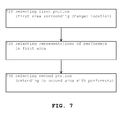
- FIG. 7 illustrates details for a step in activity 302 to identify the data-structure sub-set.
- activity 301 starts with pre-processing 311.
- the computer provides and accesses a data-structure to identify routes between the geographical locations.
- the computer receives 321 job data with job requirements for particular locations and with availability information for the job performers.
- the computer processes 341 the job data with the data-structure to provide initial job performance plan 221 in that some of the routes are assigned to particular job performers.
- Activity 302 starts with receiving 332 updated job data with an updated location (as explained, the geographical location with an updated job requirement).
- the computer identifies a sub-set of the data-structure.
- the sub-set has a first portion and a second portion. More in detail - FIG. 7 - the computer selects 710 in the data-structure the first portion to correspond to a first area with geographical locations that comply with a first condition in relation to the updated location.
- the computer selects 720 the performers for that locations of the first area are assigned to.
- the computer selects the set of representations of the performers.
- the computer selects 730 the second portion to correspond to a second area having geographical locations that are also assigned to the performers.
- the computer processes 342 the updated job data with both portions of the sub-set (of the data-structure) and provides updated job performance plan 222 in that some of the routes are re-assigned to particular job performers.
- Activity 303 is optionally executed in case that some of the jobs and locations are excluded from updated plan 222.
- the computer treats 333 gaps as updated job data, and repeats the identification 333 of the sub-set (cf. FIG. 7 ) with a second condition.
- the computer processes 343 the updated job data with both portions of the sub-set and provides updated job performance plan 223.
- Activity 303 is optionally repeated. The number of repetitions can be predefined, or the repetitions are stopped if a predefined computation time is reached.
- the data-structure can be a graph structure.
- Pre-processing 311 the data-structure to identify routes between the geographical locations can be executed with a data structure in that nodes correspond to the geographical locations and in that edges correspond to travel parameters (Res) for the job performers travelling between the geographical locations.
- Selecting (710) the first portion includes to select a first sub-set of nodes that correspond to the first area with geographical locations.
- Selecting 730 the second portion includes to select a second sub-set of nodes that correspond to the second area with geographical locations.
- Pre-processing 311 the data-structure to identify routes between the geographical locations can include to store routes vectors and corresponding accumulated travel parameters in data attributes at the nodes of the data-structure.
- Pre-processing 311 the data-structure to identify routes between the geographical locations can include to remove route vectors and corresponding accumulated travel parameters (AccRes) if the accumulated travel parameters (AccRes) exceed predefined threshold values.
- Processing 342 the updated job data with the sub-set of the data-structure to provide an updated job performance plan can include to process the updated job data together with the updated location.
- the first condition for the first area of geographical locations can be complied with for geographical locations that surround the updated location with a predetermined maximal distance value (R1, R2).
- processing 342 the updated job data leads to an updated job performance plan in that a particular location remains without a job performer assigned to that location, activity 303 is triggered (identifying 332, 333 the sub-set of the data-structure, and processing 342, 343 the updated job data to be repeated with a particular location being received 333 by updated job data).
- the repetition of the identifying step 332, 333 can use a second condition that is related to the first condition by a numerical factor. The factor makes the first area for an updated first portion smaller in comparison to the previously used first area.
- the repetition of the identifying step 332, 333 can be executed for a geographical area for an updated first portion with substantially the same size as the previously used area.
- activity 301 can be executed overnight (day-ahead, or offline), while activities 302, 303 can be executed during the day in short response to changes (intra-day, or online).
- activity 301 provides the basic performance plan that allows the job performers to start, activity 302 accommodates changes within short a computation time, and activity 303 maintains the accuracy of the assignment so that substantially no location remains without service.
- FIGS. 6-7 also illustrate a computer program or a computer program product.
- blocks stand for program modules and illustrate that the method can be implemented by a computer under the control of the program.
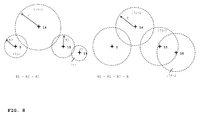
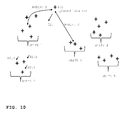
- FIGS. 8-10 illustrate further options for the identification of the sub-set.
- FIG. 8 illustrates the repetition of the identifying step (332, 333) in cascades.
- Geographical area 173-1 is a first area that is derived by "circling around" non-assigned locations (e.g., location 5, or location 15). Further first areas can be derived from further non-assigned locations (e.g., location 16). In other words, there are original first areas (173-1) and subsequent first areas (174-1).
- FIG. 8 illustrates two options.
- the distance value to the non-assigned location in the centre
- the distance value to the non-assigned location becomes smaller with every repetition (R1 around location 15 is larger than R2 around locations 5 and 15, larger than R3 around location 16.
- the distance value remains substantially equal so that original first area and the subsequent first area have substantially the same sizes.
- FIG. 9 illustrates modifications in the step order (cf. FIGS. 6-7 ).
- the computation time of processing steps 342 and 343 (sub-set only) is expected to be shorter than the computation time of overall processing 341 (complete data-structure), various modification are possible, especially in the order of steps.
- the first area surrounding location 14 is gradually enlarged, with - first option - the radius being incremented equally (by a fixed delta amount), or with - second option - the radius being incremented non-equally (factor).
- the most suitable distance can be determined in iterations as well, with distances getting larger and smaller until a suitable distance is determined that is used for future calculations.
- FIG. 10 illustrates modifications in the determination of locations in that the first condition is given as a rule to identify distance value between the updated location 142 and an average location of performers.
- the first condition can be complied with for a plurality of geographical locations that are assigned to an assigned job performer and that have an average distance value that is shorter than the predetermined maximal distance value.
- the condition includes to inspect the average distance value of a group of locations (i.e., assigned to shifts) to the updated location.
- An example to calculate the average distance value is given for the 3 locations 1, 2, 3 for shift 2:
- AVERAGE DISTANCE VALUE 2 D ⁇ 2.1 + D ⁇ 2.2 + D ⁇ 2.3 / 3
- the average distance values can be ordered, and the lowest average distances values can be taken (Distance 1 and Distance 3). If the distance values are geographical distances, the lowest values corresponds to the shortest distance.
- a representative distance can be calculated by not taking all locations of a particular shift, but taking one location, or a percentage of the locations.
- Embodiments of the invention can be implemented in digital electronic circuitry, or in computer hardware, firmware, software, or in combinations of them.
- the invention can be implemented as a computer program product, for example, a computer program tangibly embodied in an information carrier, for example, in a machine-readable storage device, for execution by, or to control the operation of, data processing apparatus, for example, a programmable processor, a computer, or multiple computers.
- a computer program as claimed can be written in any form of programming language, including compiled or interpreted languages, and it can be deployed in any form, including as a standalone program or as a module, component, subroutine, or other unit suitable for use in a computing environment.
- a computer program can be deployed to be executed on one computer or on multiple computers at one site or distributed across multiple sites and interconnected by a communication network.
- the described methods can all be executed by corresponding computer products on the respective devices, for example, the first and second computers, the trusted computers and the communication means.
- Method steps of the invention can be performed by one or more programmable processors executing a computer program to perform functions of the invention by operating on input data and generating output. Method steps can also be performed by, and apparatus of the invention can be implemented as, special purpose logic circuitry, for example, a field programmable gate array (FPGA) or an application-specific integrated circuit (ASIC).
- FPGA field programmable gate array
- ASIC application-specific integrated circuit
- processors suitable for the execution of a computer program include, by way of example, both general and special purpose microprocessors, and any one or more processors of any kind of digital computing device.
- a processor will receive instructions and data from a read-only memory or a random access memory or both.
- the essential elements of a computer are at least one processor for executing instructions and one or more memory devices for storing instructions and data.
- a computer will also include, or be operatively coupled to receive data from or transfer data to, or both, one or more mass storage devices for storing data, for example, magnetic, magneto-optical disks, optical disks or solid state disks.
- mass storage devices for storing data, for example, magnetic, magneto-optical disks, optical disks or solid state disks.
- Such storage means may also provisioned on demand and be accessible through the Internet (e.g., Cloud Computing).
- Information carriers suitable for embodying computer program instructions and data include all forms of non-volatile memory, including by way of example semiconductor memory devices, for example, EPROM, EEPROM, and flash memory devices; magnetic disks, e.g., internal hard disks or removable disks; magneto-optical disks; and CD-ROM and DVD-ROM disks.
- semiconductor memory devices for example, EPROM, EEPROM, and flash memory devices
- magnetic disks e.g., internal hard disks or removable disks
- magneto-optical disks e.g., CD-ROM and DVD-ROM disks.
- the processor and the memory can be supplemented by, or incorporated in special purpose logic circuitry.
- the invention can be implemented on a computer having a display device, for example, a cathode ray tube (CRT) or liquid crystal display (LCD) monitor, for displaying information to the user and an input device such as a keyboard, touchscreen or touchpad, a pointing device, for example, a mouse or a trackball, by which the user can provide input to the computer.
- a display device for example, a cathode ray tube (CRT) or liquid crystal display (LCD) monitor
- an input device such as a keyboard, touchscreen or touchpad, a pointing device, for example, a mouse or a trackball, by which the user can provide input to the computer.
- Other kinds of devices can be used to provide for interaction with a user as well; for example, feedback provided to the user can be any form of sensory feedback, for example, visual feedback, auditory feedback, or tactile feedback; and input from the user can be received in any form, including acoustic, speech, or tactile input.
- the invention can be implemented in a computing system that includes a back-end component, for example, as a data server, or that includes a middleware component, for example, an application server, or that includes a front-end component, for example, a client computer having a graphical user interface or a Web browser through which a user can interact with an implementation of the invention, or any combination of such back-end, middleware, or front-end components.
- Client computers can also be mobile devices, such as smartphones, tablet PCs or any other handheld or wearable computing device.
- the components of the system can be interconnected by any form or medium of digital data communication, for example, a communication network. Examples of communication networks include a local area network (LAN) and a wide area network (WAN), for example, the Internet or wireless LAN or telecommunication networks.
- LAN local area network
- WAN wide area network
- the computing system can include clients and servers.
- a client and a server are generally remote from each other and typically interact through a communication network.
- the relationship of client and server arises by virtue of computer programs running on the respective computers and having a client-server relationship to each other.
Landscapes
- Business, Economics & Management (AREA)
- Human Resources & Organizations (AREA)
- Engineering & Computer Science (AREA)
- Strategic Management (AREA)
- Entrepreneurship & Innovation (AREA)
- Economics (AREA)
- Theoretical Computer Science (AREA)
- General Physics & Mathematics (AREA)
- Physics & Mathematics (AREA)
- Educational Administration (AREA)
- General Business, Economics & Management (AREA)
- Quality & Reliability (AREA)
- Tourism & Hospitality (AREA)
- Operations Research (AREA)
- Marketing (AREA)
- Development Economics (AREA)
- Game Theory and Decision Science (AREA)
- Data Mining & Analysis (AREA)
- Databases & Information Systems (AREA)
- Remote Sensing (AREA)
- General Engineering & Computer Science (AREA)
- Management, Administration, Business Operations System, And Electronic Commerce (AREA)
Priority Applications (2)
| Application Number | Priority Date | Filing Date | Title |
|---|---|---|---|
| EP14171360.2A EP2953070A1 (de) | 2014-06-05 | 2014-06-05 | Verbesserung der Arbeitskräfteoptimierung durch verbesserte Bereitstellung eines beruflichen Leistungsplans |
| US14/732,370 US10423904B2 (en) | 2014-06-05 | 2015-06-05 | Workforce optimization by improved provision of job performance plan |
Applications Claiming Priority (1)
| Application Number | Priority Date | Filing Date | Title |
|---|---|---|---|
| EP14171360.2A EP2953070A1 (de) | 2014-06-05 | 2014-06-05 | Verbesserung der Arbeitskräfteoptimierung durch verbesserte Bereitstellung eines beruflichen Leistungsplans |
Publications (1)
| Publication Number | Publication Date |
|---|---|
| EP2953070A1 true EP2953070A1 (de) | 2015-12-09 |
Family
ID=50897421
Family Applications (1)
| Application Number | Title | Priority Date | Filing Date |
|---|---|---|---|
| EP14171360.2A Ceased EP2953070A1 (de) | 2014-06-05 | 2014-06-05 | Verbesserung der Arbeitskräfteoptimierung durch verbesserte Bereitstellung eines beruflichen Leistungsplans |
Country Status (2)
| Country | Link |
|---|---|
| US (1) | US10423904B2 (de) |
| EP (1) | EP2953070A1 (de) |
Cited By (4)
| Publication number | Priority date | Publication date | Assignee | Title |
|---|---|---|---|---|
| WO2017187223A1 (en) * | 2016-04-25 | 2017-11-02 | Telefonaktiebolaget Lm Ericsson (Publ) | Method and apparatus for automating physical equipment replacement and maintenance |
| CN108133321A (zh) * | 2017-12-21 | 2018-06-08 | 广州供电局有限公司 | 专变运维托管工作管理方法、系统、介质和计算机设备 |
| CN113760887A (zh) * | 2020-10-29 | 2021-12-07 | 北京沃东天骏信息技术有限公司 | 数据处理的方法、装置、设备及存储介质 |
| US12078985B1 (en) * | 2023-09-19 | 2024-09-03 | Morgan Stanley Services Group Inc. | System and method for work task management using application-level blue-green topology with parallel infrastructure rails |
Families Citing this family (3)
| Publication number | Priority date | Publication date | Assignee | Title |
|---|---|---|---|---|
| SG10201507834SA (en) * | 2015-09-21 | 2017-04-27 | Yokogawa Electric Corp | Mobile based on collaborative and interactive operations with smart mobile devices |
| WO2022196475A1 (ja) * | 2021-03-19 | 2022-09-22 | 富士フイルム株式会社 | 調査計画生成装置、調査計画生成方法及びプログラム |
| CN116151697B (zh) * | 2023-04-24 | 2023-07-21 | 之江实验室 | 基于动态时间压力的长航时作业人机交互方法和装置 |
Citations (1)
| Publication number | Priority date | Publication date | Assignee | Title |
|---|---|---|---|---|
| WO1998022897A1 (en) * | 1996-11-22 | 1998-05-28 | British Telecommunications Public Limited Company | Resource allocation |
Family Cites Families (7)
| Publication number | Priority date | Publication date | Assignee | Title |
|---|---|---|---|---|
| US6738815B1 (en) * | 1998-07-01 | 2004-05-18 | Telcordia Technologies, Inc. | Systems and methods for utilizing a communications network for providing mobile users access to legacy systems |
| US20030167199A1 (en) * | 2002-03-01 | 2003-09-04 | Thomann Karen S. | Automated workflow means and method for pension products |
| US8788375B2 (en) * | 2010-06-23 | 2014-07-22 | Canadian National Railway Company | Method and system for pre-populating job assignment submissions |
| US8583462B2 (en) * | 2010-06-23 | 2013-11-12 | Canadian National Railway Company | Method and system for assessing penalties associated with an employee without a job assignment |
| WO2012033602A1 (en) * | 2010-08-11 | 2012-03-15 | Steven Nielsen | Methods, apparatus and systems for facilitating generation and assessment of engineering plans |
| EP2737439A4 (de) * | 2011-07-26 | 2015-04-01 | United Parcel Service Inc | Systeme und verfahren zur beurteilung der leistungsfähigkeit mobiler assets |
| US10423929B2 (en) * | 2013-05-03 | 2019-09-24 | Transform Sr Brands Llc | Learning management system |
-
2014
- 2014-06-05 EP EP14171360.2A patent/EP2953070A1/de not_active Ceased
-
2015
- 2015-06-05 US US14/732,370 patent/US10423904B2/en active Active
Patent Citations (1)
| Publication number | Priority date | Publication date | Assignee | Title |
|---|---|---|---|---|
| WO1998022897A1 (en) * | 1996-11-22 | 1998-05-28 | British Telecommunications Public Limited Company | Resource allocation |
Cited By (4)
| Publication number | Priority date | Publication date | Assignee | Title |
|---|---|---|---|---|
| WO2017187223A1 (en) * | 2016-04-25 | 2017-11-02 | Telefonaktiebolaget Lm Ericsson (Publ) | Method and apparatus for automating physical equipment replacement and maintenance |
| CN108133321A (zh) * | 2017-12-21 | 2018-06-08 | 广州供电局有限公司 | 专变运维托管工作管理方法、系统、介质和计算机设备 |
| CN113760887A (zh) * | 2020-10-29 | 2021-12-07 | 北京沃东天骏信息技术有限公司 | 数据处理的方法、装置、设备及存储介质 |
| US12078985B1 (en) * | 2023-09-19 | 2024-09-03 | Morgan Stanley Services Group Inc. | System and method for work task management using application-level blue-green topology with parallel infrastructure rails |
Also Published As
| Publication number | Publication date |
|---|---|
| US20150356491A1 (en) | 2015-12-10 |
| US10423904B2 (en) | 2019-09-24 |
Similar Documents
| Publication | Publication Date | Title |
|---|---|---|
| US10423904B2 (en) | Workforce optimization by improved provision of job performance plan | |
| Li et al. | A decision support system for the single-depot vehicle rescheduling problem | |
| CN109840648B (zh) | 用于输出储位信息的方法和装置 | |
| Zheng et al. | A two-stage stochastic programming for single yard crane scheduling with uncertain release times of retrieval tasks | |
| EP2685441B1 (de) | Verallgemeinerter Ankunftsplaner | |
| CN111985755B (zh) | 使用机器学习技术使风险最小化的方法和系统 | |
| US20110202382A1 (en) | Workforce planning | |
| US20100106539A1 (en) | Method and system for fast local search and insertion heuristics for vehicle routing | |
| EP2953069A1 (de) | Verfahren und System zur Verbesserung der Routenzuweisung | |
| Bernardo et al. | Robust solution approach for the dynamic and stochastic vehicle routing problem | |
| Liu et al. | A bi-objective model for robust yard allocation scheduling for outbound containers | |
| Lacomme et al. | Simultaneous job input sequencing and vehicle dispatching in a single-vehicle automated guided vehicle system: a heuristic branch-and-bound approach coupled with a discrete events simulation model | |
| Amini et al. | A robust location-arc routing problem under uncertainty: mathematical model with lower and upper bounds: A. Amini et al. | |
| Zamiri Marvizadeh et al. | Entropy-based dispatching for automatic guided vehicles | |
| US8756177B1 (en) | Methods and systems for estimating subject intent from surveillance | |
| Saint-Guillain et al. | The static and stochastic VRP with time windows and both random customers and reveal times | |
| US7239930B2 (en) | Method, system, and computer program product for improved flow of development lots in a manufacturing facility | |
| Chen et al. | Adaptive scheduling and tool flow control in flexible job shops | |
| Ankita et al. | An efficient heuristic method for dynamic berth allocation problem | |
| Alam et al. | Assessment of assignment problem using Hungarian method | |
| Ray et al. | Dynamic Stacking Optimization in Unpredictable Environments: A Focus on Crane Scheduling | |
| Manna | On-line dynamic station redeployments in bike-sharing systems | |
| Le-Anh et al. | Performance evaluation of dynamic scheduling approaches in vehicle-based internal transport systems | |
| Kyngäs et al. | Workforce scheduling using the PEAST algorithm | |
| CN114693135A (zh) | 一种跨场地配送方法、装置、设备及介质 |
Legal Events
| Date | Code | Title | Description |
|---|---|---|---|
| PUAI | Public reference made under article 153(3) epc to a published international application that has entered the european phase |
Free format text: ORIGINAL CODE: 0009012 |
|
| AK | Designated contracting states |
Kind code of ref document: A1 Designated state(s): AL AT BE BG CH CY CZ DE DK EE ES FI FR GB GR HR HU IE IS IT LI LT LU LV MC MK MT NL NO PL PT RO RS SE SI SK SM TR |
|
| AX | Request for extension of the european patent |
Extension state: BA ME |
|
| 17P | Request for examination filed |
Effective date: 20160520 |
|
| RAP1 | Party data changed (applicant data changed or rights of an application transferred) |
Owner name: ABB SCHWEIZ AG |
|
| 17Q | First examination report despatched |
Effective date: 20181120 |
|
| STAA | Information on the status of an ep patent application or granted ep patent |
Free format text: STATUS: THE APPLICATION HAS BEEN REFUSED |
|
| 18R | Application refused |
Effective date: 20200127 |