EP2953527B1 - Mesure de fréquence respiratoire - Google Patents
Mesure de fréquence respiratoire Download PDFInfo
- Publication number
- EP2953527B1 EP2953527B1 EP14749044.5A EP14749044A EP2953527B1 EP 2953527 B1 EP2953527 B1 EP 2953527B1 EP 14749044 A EP14749044 A EP 14749044A EP 2953527 B1 EP2953527 B1 EP 2953527B1
- Authority
- EP
- European Patent Office
- Prior art keywords
- respiration
- quality metric
- signal
- peak
- weighted
- Prior art date
- Legal status (The legal status is an assumption and is not a legal conclusion. Google has not performed a legal analysis and makes no representation as to the accuracy of the status listed.)
- Active
Links
Images


Classifications
-
- A—HUMAN NECESSITIES
- A61—MEDICAL OR VETERINARY SCIENCE; HYGIENE
- A61B—DIAGNOSIS; SURGERY; IDENTIFICATION
- A61B5/00—Measuring for diagnostic purposes; Identification of persons
- A61B5/08—Measuring devices for evaluating the respiratory organs
-
- A—HUMAN NECESSITIES
- A61—MEDICAL OR VETERINARY SCIENCE; HYGIENE
- A61B—DIAGNOSIS; SURGERY; IDENTIFICATION
- A61B5/00—Measuring for diagnostic purposes; Identification of persons
- A61B5/08—Measuring devices for evaluating the respiratory organs
- A61B5/0816—Measuring devices for examining respiratory frequency
-
- A—HUMAN NECESSITIES
- A61—MEDICAL OR VETERINARY SCIENCE; HYGIENE
- A61B—DIAGNOSIS; SURGERY; IDENTIFICATION
- A61B5/00—Measuring for diagnostic purposes; Identification of persons
- A61B5/0002—Remote monitoring of patients using telemetry, e.g. transmission of vital signals via a communication network
- A61B5/0015—Remote monitoring of patients using telemetry, e.g. transmission of vital signals via a communication network characterised by features of the telemetry system
- A61B5/002—Monitoring the patient using a local or closed circuit, e.g. in a room or building
-
- A—HUMAN NECESSITIES
- A61—MEDICAL OR VETERINARY SCIENCE; HYGIENE
- A61B—DIAGNOSIS; SURGERY; IDENTIFICATION
- A61B5/00—Measuring for diagnostic purposes; Identification of persons
- A61B5/02—Detecting, measuring or recording for evaluating the cardiovascular system, e.g. pulse, heart rate, blood pressure or blood flow
- A61B5/024—Measuring pulse rate or heart rate
- A61B5/02405—Determining heart rate variability
-
- A—HUMAN NECESSITIES
- A61—MEDICAL OR VETERINARY SCIENCE; HYGIENE
- A61B—DIAGNOSIS; SURGERY; IDENTIFICATION
- A61B5/00—Measuring for diagnostic purposes; Identification of persons
- A61B5/24—Detecting, measuring or recording bioelectric or biomagnetic signals of the body or parts thereof
- A61B5/316—Modalities, i.e. specific diagnostic methods
- A61B5/318—Heart-related electrical modalities, e.g. electrocardiography [ECG]
- A61B5/346—Analysis of electrocardiograms
- A61B5/349—Detecting specific parameters of the electrocardiograph cycle
- A61B5/366—Detecting abnormal QRS complex, e.g. widening
-
- A—HUMAN NECESSITIES
- A61—MEDICAL OR VETERINARY SCIENCE; HYGIENE
- A61B—DIAGNOSIS; SURGERY; IDENTIFICATION
- A61B5/00—Measuring for diagnostic purposes; Identification of persons
- A61B5/48—Other medical applications
- A61B5/4806—Sleep evaluation
- A61B5/4818—Sleep apnoea
-
- A—HUMAN NECESSITIES
- A61—MEDICAL OR VETERINARY SCIENCE; HYGIENE
- A61B—DIAGNOSIS; SURGERY; IDENTIFICATION
- A61B5/00—Measuring for diagnostic purposes; Identification of persons
- A61B5/72—Signal processing specially adapted for physiological signals or for diagnostic purposes
- A61B5/7221—Determining signal validity, reliability or quality
-
- A—HUMAN NECESSITIES
- A61—MEDICAL OR VETERINARY SCIENCE; HYGIENE
- A61B—DIAGNOSIS; SURGERY; IDENTIFICATION
- A61B5/00—Measuring for diagnostic purposes; Identification of persons
- A61B5/08—Measuring devices for evaluating the respiratory organs
- A61B5/082—Evaluation by breath analysis, e.g. determination of the chemical composition of exhaled breath
-
- A—HUMAN NECESSITIES
- A61—MEDICAL OR VETERINARY SCIENCE; HYGIENE
- A61B—DIAGNOSIS; SURGERY; IDENTIFICATION
- A61B5/00—Measuring for diagnostic purposes; Identification of persons
- A61B5/08—Measuring devices for evaluating the respiratory organs
- A61B5/085—Measuring impedance of respiratory organs or lung elasticity
- A61B5/086—Measuring impedance of respiratory organs or lung elasticity by impedance pneumography
-
- A—HUMAN NECESSITIES
- A61—MEDICAL OR VETERINARY SCIENCE; HYGIENE
- A61B—DIAGNOSIS; SURGERY; IDENTIFICATION
- A61B5/00—Measuring for diagnostic purposes; Identification of persons
- A61B5/08—Measuring devices for evaluating the respiratory organs
- A61B5/087—Measuring breath flow
-
- A—HUMAN NECESSITIES
- A61—MEDICAL OR VETERINARY SCIENCE; HYGIENE
- A61B—DIAGNOSIS; SURGERY; IDENTIFICATION
- A61B5/00—Measuring for diagnostic purposes; Identification of persons
- A61B5/103—Measuring devices for testing the shape, pattern, colour, size or movement of the body or parts thereof, for diagnostic purposes
- A61B5/11—Measuring movement of the entire body or parts thereof, e.g. head or hand tremor or mobility of a limb
- A61B5/113—Measuring movement of the entire body or parts thereof, e.g. head or hand tremor or mobility of a limb occurring during breathing
-
- A—HUMAN NECESSITIES
- A61—MEDICAL OR VETERINARY SCIENCE; HYGIENE
- A61B—DIAGNOSIS; SURGERY; IDENTIFICATION
- A61B5/00—Measuring for diagnostic purposes; Identification of persons
- A61B5/103—Measuring devices for testing the shape, pattern, colour, size or movement of the body or parts thereof, for diagnostic purposes
- A61B5/11—Measuring movement of the entire body or parts thereof, e.g. head or hand tremor or mobility of a limb
- A61B5/113—Measuring movement of the entire body or parts thereof, e.g. head or hand tremor or mobility of a limb occurring during breathing
- A61B5/1135—Measuring movement of the entire body or parts thereof, e.g. head or hand tremor or mobility of a limb occurring during breathing by monitoring thoracic expansion
-
- A—HUMAN NECESSITIES
- A61—MEDICAL OR VETERINARY SCIENCE; HYGIENE
- A61B—DIAGNOSIS; SURGERY; IDENTIFICATION
- A61B5/00—Measuring for diagnostic purposes; Identification of persons
- A61B5/68—Arrangements of detecting, measuring or recording means, e.g. sensors, in relation to patient
- A61B5/6801—Arrangements of detecting, measuring or recording means, e.g. sensors, in relation to patient specially adapted to be attached to or worn on the body surface
Definitions
- the present invention relates to a sensor device, and associated method, utilized to measure respiratory rate and determine a quality metric of the respiration rate.
- Respiratory rate is an important vital sign that is useful for examining periods of distress.
- High and low respiratory rates are often symptoms of serious diseases including heart failure (Cheyne-Stokes breathing), obstructive sleep apnea (cessation of breathing), and metabolic acidosis (hyperventilation).
- heart failure Chronic stokes breathing
- obstructive sleep apnea cessation of breathing
- metabolic acidosis hypoventilation
- US2011/257554 discloses a system for measuring respiratory rate from a patient.
- a motion sensor measures a motion signal describing movement of a portion of the patient's body to which it is attached.
- a processing system receives an impedance pneumography signal and the motion signal, and processes them to determine frequency-domain impedance pneumography and motion spectra respectfully. During the processing, an algorithm determines motion frequency components from the frequency-domain motion spectrum, and then using a digital filter removes these from the impedance pneumography spectrum.
- JP2005253610 discloses a biosensor belt for detecting biological information such as blood pressure, pulse and respiratory rate.
- the respiratory rate can be estimated from QRS width and amplitude.
- a method and system for measuring respiratory rate comprises measuring at least one respiration signal and filtering the respiration signal using a lowpass filter.
- the method includes peak-picking the respiration signal to determine the respiratory rate and determining a quality metric of the respiratory rate.
- the method includes weighting the quality metric using previously learned weights to determine an estimation of the error in the respiration signal.
- the system comprises a wireless sensor device coupled to a user via at least one electrode, wherein the wireless sensor device includes a processor and a memory device coupled to the processor, wherein the memory device stores an application which, when executed by the processor, causes the processor to measure at least one respiration signal and filter the respiration signal using a lowpass filter.
- the system further causes the processor to peak-pick the respiration signal to determine the respiratory rate and to determine a quality metric of the respiratory rate.
- the system further causes the processor to weight the quality metric using previously learned weights to determine an estimation of the error in the respiration signal.
- the present disclosure relates to sensors, and more particularly, to a sensor device utilized to measure respiratory rate using a combination of respiration signals.
- a sensor device utilized to measure respiratory rate using a combination of respiration signals.
- RR respiratory rate
- a method and system in accordance with the present invention's combination requires knowledge of the quality of the respiratory signal obtained from each individual sensor.
- the respiratory signals from a variety of sources can be utilized as inputs to the method and system in accordance with the present invention. These sources include but are not limited to mechanical signals from a chest-mounted accelerometer, EKG-derived respiration signals, bend sensors, stretch sensors (respiratory inductance plethysomography), impedance pneumography, flow sensors, and CO 2 sensors.
- a method and system in accordance with the present disclosure determines a person's respiratory rate using respiration signals derived from a plurality of sources.
- the plurality of sources include a chest-mounted accelerometer where the correct axis is perpendicular to gravity, a QRS area/amplitude where the area/amplitude of the QRS complex of an EKG signal is computed, a respiratory sinus arrhythmia (RSA) where times between subsequent R peaks of the EKG signal (R-R intervals) are computed, and any other respiration signals of interest.
- each signal is filtered by the wireless sensor device to get activity in a respiratory frequency range.
- the filtering is done by a lowpass filter at 0.7 Hertz (Hz).
- An application stored on the wireless sensor device conducts peak-picking of each respiration signal to detect a number of breaths that the person takes and computes the respiratory rate by using a changing threshold based on a standard deviation of the signal at that time point.
- the wireless sensor device analyzes the respiratory rate and determines a quality metric between 0 and 1 based on regularity of minima times and amplitudes and a noisiness of the respiration signal.
- the quality metric enables the wireless sensor device to determine whether each derived respiratory rate can be trusted.
- the quality metric is inversely correlated to expected error with 0 denoting high error and 1 denoting low error. Additionally, smoothing is performed on the respiratory rate to reduce effects of missed/extraneous peaks using a trimmed mean.
- wireless sensor devices can be utilized to measure the person's respiratory rate including portable wireless sensor devices with embedded circuitry in a patch form factor.
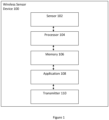
- FIG. 1 illustrates a wireless sensor device 100 in accordance with an embodiment.
- the wireless sensor device 100 includes a sensor 102, a processor 104 coupled to the sensor 102, a memory 106 coupled to the processor 104, an application 108 coupled to the memory 106, and a transmitter 110 coupled to the application 108.
- the sensor 102 obtains data from the user and transmits the data to the memory 106 and in turn to the application 108.
- the processor 104 executes the application 108 to process ECG signal information of the user. The information is transmitted to the transmitter 110 and in turn relayed to another user or device.
- the senor 102 comprises two electrodes to measure cardiac activity and an accelerometer to record physical activity and posture and the processor 104 comprises a microprocessor.
- the processor 104 comprises a microprocessor.
- FIG. 2 illustrates a flow chart of a method 200 for measuring respiratory rate in accordance with an embodiment.
- the method 200 comprises the wireless sensor device 100 measuring at least one respiration signal, via 202, and filtering the respiration signal using a lowpass filter, via 204.
- the method 200 includes peak-picking the respiration signal to determine a number of breaths and the respiratory rate, via 206, and determining a quality metric of the respiratory rate, via 208.
- at least one respiration signal is derived from a variety of sources including but not limited to a chest-mounted accelerometer, a QRS-area and a QRS-amplitude of an EKG signal, and a respiratory sinus arrhythmia (RSA).
- RSA respiratory sinus arrhythmia
- a chest-mounted accelerometer embedded within a wireless sensor device that has been attached to a person, breathing can be detected during periods of low activity.
- inspiration the chest expands and the angle of the accelerometer to gravity changes slightly.
- An angle change of e yields a magnitude change of sine approximately equal to e when e is close to 0.
- the best axis to examine is the anterior-posterior axis and when the person is supine, the best axis to examiner is the inferior-superior axis (head to toe).
- the respiration signal derived from a chest-mounted accelerometer has minima and maxima that correspond to inspiration and expiration.
- the minima and maxima can correspond to either the inspiration or the expiration.
- the magnitudes of the respiration signal's peaks are not uniform so a method and system in accordance with the present disclosure utilizes an accelerometer respiration process with a time-varying threshold based on a standard deviation of the respiration signal in a small predetermined time period window. By determining differences between the peak times of the respiration signal, an instantaneous respiratory rate is computed.
- FIG. 3 illustrates a flow chart of an accelerometer respiration process 300 in accordance with an embodiment.
- the accelerometer respiration process 300 obtains rotated acceleration signals A x , A y , A z , via 302, and computes respiratory signal (R[n]) based upon the correct axis that is perpendicular to gravity, via 304.
- a peak detection process is utilized to determine the minima and maxima of the respiratory signal R[n], via 310.
- G [g x , g y , g z ].
- G x [0;1;0] [0;0;1].
- low-pass filter accelerations below 0.02 Hz for gravity G and low-pass filter accelerations below 0.7 Hz for respiration A LP are determined.
- the peak detection/peak-picking process that is utilized to determine the minima and maxima of the respiratory signal via 310 utilizes a changing threshold based on a standard deviation of the respiration signal at a certain time point.
- the peak detection process ensures that a peak-to-peak amplitude of the respiration signal is greater than a certain threshold (th[n]) that depends on the variability of the respiration signal.
- FIG. 4 illustrates a flow chart of a peak detection process 400 in accordance with an embodiment.
- the peak detection process 400 can be utilized for respiration signals from a variety of sources including but not limited to the chest-mounted accelerometer, QRS-area, and RSA.
- temp_max R[n-1] + th[n-1]
- the peak detection process 400 determines that the first difference of the respiration signal (R[n]-R[n-1]) moves from positive to negative, the process 400 analyzes whether a peak of the respiration signal is greater than left_min + th[n] and whether the peak is greater than the last temp_max. If both of these conditions are met, the peak is set as the new temp_max. If the peak detection process 400 determines a derivative of the respiration signal moves from negative to positive, the process 400 analyzes whether the valley is less than th[n] of the temp_max and if so, the process 400 sets the temp_max as an actual maxima and the left_min as an actual minima.
- the process 400 sets the valley as the new left_min. Every time a minima/maxima pair is found, the process 400 sets the current temp_max to - ⁇ and sets the current left_min to ⁇ .
- the respiratory rate quality metric determination via 312 is derived within a predetermined time period (e.g. 45 seconds) and is derived based on features including but not limited to a coefficient of variation (standard deviation over the mean) of a difference in minima times (c t ), a coefficient of variation (standard deviation over the mean) of peak-to-peak values (c p ), a mean peak-to-peak value (m p ), and a ratio of a number of picked extrema to a total number of all local extrema (r ext ).
- the quality metric is weighted using previously learned weights and transformed using an exponential to get the quality metric to a value between 0 and 1.
- the quality metric for each input signal is estimated in 45 second windows using the aforementioned features that judge the regularity of the respiration peaks.
- a smaller c t equates to more regular peak times and thus a higher respiration signal quality.
- a smaller c p equates to more regular peak heights and thus a higher respiration signal quality.
- a larger m p indicates motion artifacts/noise and thus a lower respiration signal quality.
- a r ext closer to 1 indicates the respiration signal has a minimal spurious peaks and thus a higher respiration signal quality.
- E the error in the respiration signal.
- Weights are learned by least-squares regression on a collected dataset so that the learned weights allow for the best prediction of the error.
- the ⁇ parameter is variable depending on the desired correspondence between estimated error and quality. The smaller the value of ⁇ , the more the quality is reduced for a given error.
- Q gets closer to 0 which indicates a lower respiration signal quality.
- Q gets closer to 1 which indicates a higher respiration signal quality.
- the quality of the respiration signal (Q) is reduced by multiplying it by m p /min_p2p. Because m p /min_p2p is less than 1, the quality will become smaller.
- the small peak-to-peak values occur when the respiration signal is too small, and near noise, thereby making it more difficult to accurately estimate a respiratory rate from this respiration signal. Therefore, by reducing the quality metric in these situations, the algorithm is prevented from relying upon these signals.
- FIG. 5 illustrates a flow chart of a quality metric process 500 in accordance with an embodiment.
- the quality metric process 500 obtains minima and maxima within a 45 second time window of the respiration signal as R min [i], R max [i], t min [i], and t max [i] via 502.
- the process 500 also obtains the minima and maxima from the last 45 second time window (R half min [i] and R half max [i]) using half the original threshold (th[n]/2) via 508.
- the quality metric process 500 can be utilized for respiration signals from a variety of sources including but not limited to the chest-mounted accelerometer, a QRS-area, a QRS-amplitude, and an RSA.
- the weights for estimating the error (E) are calibrated for the particular respiration signal that is utilized.
- FIG. 6 illustrates a diagram 600 that compares the quality metric to the respiration signal in accordance with an embodiment. As the respiration signal experiences noise during the start and end of the time window, the quality metric is closer to 0 but as the respiration signal experiences minimal noise during the middle of the time window, the quality metric is closer to 1.
- the respiration signal can also be derived via a QRS wave of an EKG signal.
- the sensor 102 comprises electrodes that enable the wireless sensor device 100 to measure an EKG signal of a person when attached.
- the QRS wave of the EKG is modulated with respiration due to the mechanical effect of breathing on the heart. Breathing shifts the heart within the thorax and changes the cardiac axis which results in a change in QRS-amplitude during inspiration/expiration.
- the QRS-area or QRS-amplitude is computed as a measure of modulation of the QRS wave due to respiration using a QRS respiration process.
- an EKG signal is detected by the wireless sensor device 100 and the EKG signal is filtered using 20 Hz of high-pass filtering. After the filtering, R-wave peaks are detected and an R-wave peak is analyzed utilizing a predetermined time window (e.g. 100 milliseconds) that is centered around the R-wave peak.
- the absolute value of the respiration signal in the predetermined time window is summed which results in a single QRS-area number for each QRS complex. These numbers are resampled at 4 Hz to result in a smoother and more accurate respiratory rate.
- the minimum value within the 100 millisecond (ms) predetermined time window is subtracted from the maximum value and the resulting output is resampled at 4 Hz to result in a smoother and more accurate respiratory rate.
- the QRS respiration process is similar to the accelerometer respiration process 300 except for the computation of the respiration signal.
- a quality metric process of the QRS based respiration signal is generated using the same computations as the quality metric process 500.
- FIG. 7 illustrates a flow chart of a QRS respiration process 700 in accordance with an embodiment.
- the QRS respiration process 700 obtains an EKG signal via 702 and high-pass filters the EKG signal at 20 Hz via 704.
- the QRS respiration process 700 determines R-peaks via 706 and computes a QRS-area/QRS-amplitude respiration signal via 708.
- the steps 710-722 of the QRS respiration process 700 resemble steps 306-318 of the accelerometer respiration process 300.
- the QRS-area computation via 708 comprises obtaining the latest R-peak time t R and extracting a 100 ms time period window around the current R-peak to determine a current QRS wave.
- the QRS-area derived respiration signal is resampled at 4 Hz to determine the QRS-area derived respiratory rate.
- the QRS-amplitude computation via 708 comprises the same process except that the amplitude is computed as a maximum/minimum instead of summing the values in the 100 ms time period window. Therefore, after obtaining the latest R-peak time and extracting a 100 ms time period window around the current R-peak, the maximum and minimum values in the 100 ms time period window are determined as QRS MAX and QRS MIN .
- the QRS-amplitude is computed as the maximum minus the minimum or QRS MAX - QRS MIN and the QRS-amplitude derived respiration signal is resample at 4 Hz to determine the QRS-amplitude derived respiratory rate.
- the respiration signal can also be derived from heart rates computed via an EKG signal.
- breathing also changes the heart rate such that the heart rate increases during inspiration and decreases during expiration. This is known as the respiratory sinus arrhythmia (RSA).
- RSA respiratory sinus arrhythmia
- the R-R intervals of the EKG signal are calculated to determine another signal that is correlated to breathing as R-R intervals decrease with inspiration and increase with expiration.
- an RSA respiration process is utilized to determine a respiration signal from heart rates computed from an EKG signal.
- the RSA respiration process is similar to the QRS-area computation via 708 except that instead of computing the area of each QRS complex, the time between the current and last QRS complex is computed and then resampled at 4 Hz to determine the RSA derived respiratory rate.
- RSA decreases with age thereby making the RSA respiration process derived respiration signal less reliable and increasing the importance of the quality metric determination.
- Respiration signals can be determined via the aforementioned accelerometer respiration process 300 (resulting in RR ACCEL ), the QRS respiration process 700 (resulting in RR QRS ), and the RSA respiration process (resulting in RR RSA ).
- FIG. 8 illustrates a diagram 800 of respiration rate computations in accordance with an embodiment.
- the diagram 800 includes respiratory rates derived from an accelerometer, QRS-area, RSA, and a NOX RIP-band reference.
- Weighting the respiration rates that are derived by the accelerometer (RR ACCEL ) and the EKG signals (RR QRS and RR RSA ) by their respective quality metrics overcomes issues such as motion artifacts, increased respiration rates, and patient ages that can diminish respiration signal quality. For example, utilizing the RR weighted combination results in an output that weighs the RR ACCEL less during the presence of motion artifacts, weighs RR QRS less during high respiration rates, and weighs RR RSA less if the patient is elderly.
- QRS-area and RSA derived respiration signals cannot detect breathing rates of higher than half the heart rate (HR) because they are EKG-based. This is known as cardiac aliasing.
- HR heart rate
- F s sampling rate
- NS Nyquist Frequency
- a wireless sensor device determines a plurality of respiration signals from a variety of sources including but not limited to a chest-mounted accelerometer, a QRS-area of an EKG signal, a QRS-amplitude of an EKG signal, and an RSA.
- the wireless sensor device then computes a quality metric for each of the plurality of respiration signals, and combines the plurality of quality metrics to compute a weighted respiratory rate.
- the weighted respiratory rate is an accurate measurement of a person's respiratory rate that reduces the effects of quality issues including but not limited to motion artifacts and the person's age.
- Embodiments described herein can take the form of an entirely hardware implementation, an entirely software implementation, or an implementation containing both hardware and software elements.
- Embodiments may be implemented in software, which includes, but is not limited to, application software, firmware, resident software, microcode, etc.
- the steps described herein may be implemented using any suitable controller or processor, and software application, which may be stored on any suitable storage location or computer-readable medium.
- the software application provides instructions that enable the processor to cause the receiver to perform the functions described herein.
- embodiments may take the form of a computer program product accessible from a computer-usable or computer-readable storage medium providing program code or program instructions for use by or in connection with a computer or any instruction execution system.
- a computer-usable or computer-readable storage medium can be any apparatus that can contain, store, communicate, propagate, or transport the program for use by or in connection with the instruction execution system, apparatus, or device.
- the computer-readable storage medium may be an electronic, magnetic, optical, electromagnetic, infrared, semiconductor system (or apparatus or device), or a propagation medium.
- Examples of a computer-readable storage medium include a semiconductor or solid state memory, magnetic tape, a removable computer diskette, a random access memory (RAM), a read-only memory (ROM), a rigid magnetic disk, and an optical disk.
- Current examples of optical disks include DVD, compact disk-read-only memory (CD-ROM), and compact disk - read/write (CD-R/W).
Landscapes
- Health & Medical Sciences (AREA)
- Life Sciences & Earth Sciences (AREA)
- Engineering & Computer Science (AREA)
- Public Health (AREA)
- Molecular Biology (AREA)
- Veterinary Medicine (AREA)
- General Health & Medical Sciences (AREA)
- Physics & Mathematics (AREA)
- Animal Behavior & Ethology (AREA)
- Biophysics (AREA)
- Pathology (AREA)
- Biomedical Technology (AREA)
- Heart & Thoracic Surgery (AREA)
- Medical Informatics (AREA)
- Surgery (AREA)
- Cardiology (AREA)
- Physiology (AREA)
- Pulmonology (AREA)
- Computer Vision & Pattern Recognition (AREA)
- Signal Processing (AREA)
- Artificial Intelligence (AREA)
- Psychiatry (AREA)
- Computer Networks & Wireless Communication (AREA)
- Measurement Of The Respiration, Hearing Ability, Form, And Blood Characteristics Of Living Organisms (AREA)
- Measurement And Recording Of Electrical Phenomena And Electrical Characteristics Of The Living Body (AREA)
Claims (16)
- Procédé (200) de mesure de fréquence respiratoire, ce procédé étant réalisé par un dispositif de détection sans fil incluant un processeur et un dispositif de mémoire couplé au processeur, le dispositif de mémoire sauvegardant une application qui, une fois exécutée par le processeur, amène le processeur à réaliser les étapes suivantes :mesure (202) d'au moins un signal respiratoire ;filtrage (204) du signal respiratoire en utilisant un filtre passe-bas ;collecte de pic (206) du signal respiratoire pour déterminer la fréquence respiratoire ;détermination (208) d'une métrique de qualité de la fréquence respiratoire, caractérisé en ce que la métrique de qualité est dérivée en se basant sur un coefficient de variation d'une différence de temps minimaux (ct), un coefficient de variation de valeurs de pic à pic (cp), une valeur de pic à pic moyenne (mp), et un rapport entre un nombre d'extrêmes collectés et un nombre total de tous les extrêmes locaux (rext) ;pondération de la métrique de qualité en utilisant des poids appris précédemment ; ettransformation de la métrique de qualité pondérée en utilisant une exponentielle pour obtenir la métrique de qualité à une valeur entre 0 et 1.
- Procédé selon la revendication 1, dans lequel l'au moins un signal respiratoire est dérivé en utilisant l'un quelconque parmi un accéléromètre monté sur la poitrine, une zone QRS d'un signal EKG, une amplitude QRS du signal EKG, et une arythmie sinusoïdale respiratoire (RSA).
- Procédé selon la revendication 1, dans lequel la collecte de pic utilise un seuil variable en se basant sur une déviation standard du signal respiratoire à un point temporel.
- Procédé selon la revendication 1, dans lequel la métrique de qualité est dérivée pendant une période prédéterminée.
- Procédé selon la revendication 4, dans lequel la période prédéterminée est de 45 secondes.
- Procédé selon la revendication 1, comprenant en outre la réalisation d'un lissage de la fréquence respiratoire pour réduire les effets des pics manqués et extrinsèques en utilisant une moyenne ajustée.
- Procédé selon la revendication 1, dans lequel la mesure d'au moins un signal respiratoire est la mesure d'une pluralité de signaux respiratoires pour déterminer une pluralité de fréquences respiratoires (RR1...N), comprenant en outre :la détermination d'une métrique de qualité (Q1...N) pour chacune de la pluralité de fréquences respiratoires ; etla combinaison de la pluralité de fréquences respiratoires en pondérant la métrique de qualité pour chacune de la pluralité de fréquences respiratoires en se basant sur un processus de qualité pour calculer une fréquence respiratoire pondérée (RRweighted).
- Procédé selon la revendication 7, dans lequel la fréquence respiratoire pondérée (RRweighted) comprend

- Système de mesure de fréquence respiratoire, ce système comprenant :un dispositif de détection sans fil (100) couplé à un utilisateur via au moins une électrode, le dispositif de détection sans fil incluant un processeur (104) ; etun dispositif de mémoire (106) couplé au processeur (104), le dispositif de mémoire sauvegardant une application qui, une fois exécutée par le processeur, amène le processeur à :mesurer (202) au moins un signal respiratoire ;filtrer (204) le signal respiratoire en utilisant un filtre passe-bas ;collecter le pic (206) du signal respiratoire pour déterminer la fréquence respiratoire ;déterminer (208) une métrique de qualité de la fréquence respiratoire, caractérisé en ce que la métrique de qualité est dérivée en se basant sur un coefficient de variation d'une différence de temps minimaux (ct), un coefficient de variation de valeurs de pic à pic (cp), une valeur de pic à pic moyenne (mp), et un rapport entre un nombre d'extrêmes collectés et un nombre total de tous les extrêmes locaux (rext) ; etpondérer la métrique de qualité en utilisant des poids appris précédemment ; ettransformer la métrique de qualité pondérée en utilisant une exponentielle pour obtenir la métrique de qualité à une valeur entre 0 et 1.
- Système selon la revendication 9, dans lequel l'au moins un signal respiratoire est dérivé en utilisant l'un quelconque parmi un accéléromètre monté sur la poitrine, une zone QRS d'un signal EKG, une amplitude QRS du signal EKG, et une arythmie sinusoïdale respiratoire (RSA).
- Système selon la revendication 9, dans lequel la collecte de pic utilise un seuil variable en se basant sur une déviation standard du signal respiratoire à un point temporel.
- Système selon la revendication 9, dans lequel la métrique de qualité est dérivée pendant une période prédéterminée.
- Système selon la revendication 12, dans lequel la période prédéterminée est de 45 secondes.
- Système selon la revendication 9, dans lequel l'application amène en outre le processeur à réaliser un lissage de la fréquence respiratoire pour réduire les effets des pics manqués et extrinsèques en utilisant une moyenne ajustée.
- Système selon la revendication 9, dans lequel la mesure d'au moins un signal respiratoire est la mesure d'une pluralité de signaux respiratoires pour déterminer une pluralité de fréquences respiratoires (RR1...N), l'application amenant en outre le processeur à :déterminer une métrique de qualité (Q1...N) pour chacune de la pluralité de fréquences respiratoires ; etcombiner la pluralité de fréquences respiratoires en pondérant la métrique de qualité pour chacune de la pluralité de fréquences respiratoires en se basant sur un processus de qualité pour calculer une fréquence respiratoire pondérée (RRweighted).
- Système selon la revendication 15, dans lequel la fréquence respiratoire pondérée (RRweighted) comprend

Applications Claiming Priority (2)
| Application Number | Priority Date | Filing Date | Title |
|---|---|---|---|
| US13/763,391 US9872634B2 (en) | 2013-02-08 | 2013-02-08 | Respiratory rate measurement using a combination of respiration signals |
| PCT/US2014/015398 WO2014124320A1 (fr) | 2013-02-08 | 2014-02-07 | Mesure de fréquence respiratoire au moyen d'une combinaison de signaux respiratoires |
Publications (3)
| Publication Number | Publication Date |
|---|---|
| EP2953527A1 EP2953527A1 (fr) | 2015-12-16 |
| EP2953527A4 EP2953527A4 (fr) | 2016-09-21 |
| EP2953527B1 true EP2953527B1 (fr) | 2024-04-10 |
Family
ID=51297926
Family Applications (1)
| Application Number | Title | Priority Date | Filing Date |
|---|---|---|---|
| EP14749044.5A Active EP2953527B1 (fr) | 2013-02-08 | 2014-02-07 | Mesure de fréquence respiratoire |
Country Status (4)
| Country | Link |
|---|---|
| US (2) | US9872634B2 (fr) |
| EP (1) | EP2953527B1 (fr) |
| JP (2) | JP6158354B2 (fr) |
| WO (1) | WO2014124320A1 (fr) |
Families Citing this family (38)
| Publication number | Priority date | Publication date | Assignee | Title |
|---|---|---|---|---|
| EP2957226B1 (fr) * | 2014-06-20 | 2019-06-12 | Georg Schmidt | Procédé et dispositif pour évaluer un risque de mortalité d'un patient cardiaque sur la base d'arythmie respiratoire |
| EP3265172B1 (fr) * | 2015-03-04 | 2018-12-19 | Cardiac Pacemakers, Inc. | Systèmes de traitement d'arythmies cardiaques |
| AU2016315947B2 (en) | 2015-08-31 | 2021-02-18 | Masimo Corporation | Wireless patient monitoring systems and methods |
| US11076793B2 (en) | 2015-11-10 | 2021-08-03 | Nippon Telegraph And Telephone Corporation | Respiration estimation method and apparatus |
| CN108289636B (zh) * | 2015-11-20 | 2021-07-13 | 皇家飞利浦有限公司 | 用于确定对象的呼吸速率的方法和装置 |
| WO2017090732A1 (fr) | 2015-11-25 | 2017-06-01 | 日本電信電話株式会社 | Procédé et dispositif d'évaluation respiratoire |
| JP6455827B2 (ja) * | 2016-01-29 | 2019-01-23 | パナソニックIpマネジメント株式会社 | 呼吸数検出装置、呼吸数検出方法、及び、プログラム記憶媒体 |
| US11185251B2 (en) * | 2016-01-29 | 2021-11-30 | Pioneer Corporation | Biological sound analyzing apparatus, biological sound analyzing method, computer program, and recording medium |
| WO2017178817A1 (fr) | 2016-04-15 | 2017-10-19 | Oxford University Innovation Limited | Sonde à aiguille, appareil de détection d'informations de composition, drain médical, procédé de mesure de propriété thermique, et procédé de détection d'informations de composition |
| US11324950B2 (en) | 2016-04-19 | 2022-05-10 | Inspire Medical Systems, Inc. | Accelerometer-based sensing for sleep disordered breathing (SDB) care |
| GB201608170D0 (en) | 2016-05-10 | 2016-06-22 | Isis Innovation | A method of determining the frequency of a periodic physiological process of a subject, and a device and system for determining the frequency |
| PL417418A1 (pl) * | 2016-06-06 | 2017-12-18 | Neuro Device Group Spółka Akcyjna | System pomiarowy i sposób pomiaru parametrów życiowych podczas snu |
| JP6538620B2 (ja) * | 2016-07-21 | 2019-07-03 | 日本電信電話株式会社 | 呼吸推定方法および装置 |
| US11076777B2 (en) | 2016-10-13 | 2021-08-03 | Masimo Corporation | Systems and methods for monitoring orientation to reduce pressure ulcer formation |
| KR101800739B1 (ko) * | 2016-10-13 | 2017-11-24 | 한국한의학연구원 | 호흡수 검출 장치 및 방법 |
| US11317857B2 (en) * | 2016-12-20 | 2022-05-03 | Koninklijke Philips N.V. | Patient monitoring |
| US20200060546A1 (en) * | 2017-05-08 | 2020-02-27 | Akash Madnani | A System and Method for Monitoring Human Performance |
| US11246530B2 (en) * | 2017-05-08 | 2022-02-15 | Intel Corporation | Respiratory biological sensing |
| WO2018213360A1 (fr) * | 2017-05-16 | 2018-11-22 | San Diego State University Research Foundation | Procédé et système de surveillance d'un sujet dans un état de sommeil ou de repos |
| WO2019076211A1 (fr) * | 2017-10-20 | 2019-04-25 | Mindfio Limited | Système et méthode d'analyse d'un comportement ou d'une activité d'un sujet |
| CN111432866B (zh) | 2017-11-22 | 2024-03-19 | 费雪派克医疗保健有限公司 | 用于呼吸流治疗系统的呼吸速率监测 |
| US11294464B2 (en) * | 2018-02-22 | 2022-04-05 | TRIPP, Inc. | Adapting media content to a sensed state of a user |
| WO2020075049A2 (fr) * | 2018-10-10 | 2020-04-16 | Bat-Call Ltd. | Diagnostic d'obstructions partielles pour quantifier la dynamique respiratoire |
| CN114401665A (zh) | 2019-07-25 | 2022-04-26 | 启迪医疗仪器公司 | 呼吸检测 |
| US11738197B2 (en) | 2019-07-25 | 2023-08-29 | Inspire Medical Systems, Inc. | Systems and methods for operating an implantable medical device based upon sensed posture information |
| CN113017559A (zh) * | 2019-12-24 | 2021-06-25 | 青岛中物云传智能科技有限公司 | 一种基于压电薄膜传感器的生命体征提取算法及系统 |
| US12213772B2 (en) * | 2020-02-18 | 2025-02-04 | Vayyar Imaging Ltd. | Systems and methods for remotely tracking life signs with a millimeter-wave radar |
| JP7737391B2 (ja) | 2020-03-20 | 2025-09-10 | マシモ・コーポレイション | 非侵襲的な体温測定のためのウェアラブルデバイス |
| USD980091S1 (en) | 2020-07-27 | 2023-03-07 | Masimo Corporation | Wearable temperature measurement device |
| USD974193S1 (en) | 2020-07-27 | 2023-01-03 | Masimo Corporation | Wearable temperature measurement device |
| EP3973866A1 (fr) * | 2020-09-25 | 2022-03-30 | Koninklijke Philips N.V. | Processeur et procédé pour déterminer une fréquence respiratoire |
| USD1072837S1 (en) | 2020-10-27 | 2025-04-29 | Masimo Corporation | Display screen or portion thereof with graphical user interface |
| EP4366620A1 (fr) * | 2021-08-26 | 2024-05-15 | St. Jude Medical, Cardiology Division, Inc. | Procédé et système de génération de signaux respiratoires destinés à être utilisés dans des procédures d'électrophysiologie |
| US12521021B2 (en) | 2021-09-22 | 2026-01-13 | Masimo Corporation | Wearable device for noninvasive body temperature measurement |
| USD1000975S1 (en) | 2021-09-22 | 2023-10-10 | Masimo Corporation | Wearable temperature measurement device |
| USD1048908S1 (en) | 2022-10-04 | 2024-10-29 | Masimo Corporation | Wearable sensor |
| CN116350206A (zh) * | 2023-04-12 | 2023-06-30 | 南京大学 | 从心动相关信号导出呼吸波及从呼吸波计算呼吸率的方法 |
| FR3150944A1 (fr) * | 2023-07-11 | 2025-01-17 | Sentinhealth | Procédé de traitement de signaux pour déterminer un paramètre respiratoire |
Family Cites Families (22)
| Publication number | Priority date | Publication date | Assignee | Title |
|---|---|---|---|---|
| US8185191B1 (en) * | 2003-12-29 | 2012-05-22 | Michael Evan Shapiro | Pulse monitoring and warning system for infants |
| JP4633374B2 (ja) | 2004-03-10 | 2011-02-16 | 公立大学法人会津大学 | 生体センサ装置 |
| AU2005306358A1 (en) * | 2004-11-19 | 2006-05-26 | Vivometrics, Inc. | Methods and systems for real time breath rate determination with limited processor resources |
| CN1977767B (zh) | 2005-12-08 | 2010-10-06 | 深圳迈瑞生物医疗电子股份有限公司 | 提高呼吸波识别率的方法 |
| CN101133954B (zh) * | 2006-08-28 | 2010-09-29 | 深圳迈瑞生物医疗电子股份有限公司 | 一种呼吸率检测方法及装置 |
| DE102006060819A1 (de) * | 2006-12-21 | 2008-07-03 | Fresenius Medical Care Deutschland Gmbh | Verfahren und Vorrichtung zur Bestimmung der Atemfrequenz |
| JP5405500B2 (ja) * | 2008-03-12 | 2014-02-05 | コーヴェンティス,インク. | 心調律に基づく心代償不全予測 |
| US20100152600A1 (en) * | 2008-04-03 | 2010-06-17 | Kai Sensors, Inc. | Non-contact physiologic motion sensors and methods for use |
| US20100331715A1 (en) | 2009-06-30 | 2010-12-30 | Nellcor Puritan Bennett Ireland | Systems and methods for detecting effort events |
| US8622922B2 (en) | 2009-09-14 | 2014-01-07 | Sotera Wireless, Inc. | Body-worn monitor for measuring respiration rate |
| US9220440B2 (en) | 2009-09-21 | 2015-12-29 | Nellcor Puritan Bennett Ireland | Determining a characteristic respiration rate |
| KR101758669B1 (ko) * | 2010-01-13 | 2017-07-18 | 아브 이니티오 테크놀로지 엘엘시 | 매치를 특징화하는 규칙을 사용하는 메타데이터 소스의 매칭 |
| CA2787170C (fr) * | 2010-01-14 | 2018-05-08 | Venture Gain LLC | Indicateur sanitaire base sur des residuels a variables multiples pour la surveillance de la sante d'un etre humain |
| JP5797208B2 (ja) | 2010-02-11 | 2015-10-21 | コーニンクレッカ フィリップス エヌ ヴェ | 呼吸信号を決定するための方法と装置 |
| US8747330B2 (en) | 2010-04-19 | 2014-06-10 | Sotera Wireless, Inc. | Body-worn monitor for measuring respiratory rate |
| US8498683B2 (en) | 2010-04-30 | 2013-07-30 | Covidien LLP | Method for respiration rate and blood pressure alarm management |
| US20110306858A1 (en) | 2010-06-10 | 2011-12-15 | Nellcor Puritan Bennett Ireland | Systems And Methods For Wavelet Transform Using Mean-Adjusted Wavelets |
| US8725469B2 (en) * | 2011-03-03 | 2014-05-13 | Mks Instruments, Inc. | Optimization of data processing parameters |
| EP2683296A1 (fr) * | 2011-03-11 | 2014-01-15 | Koninklijke Philips N.V. | Appareil de surveillance pour surveiller un signal physiologique |
| GB201209413D0 (en) | 2012-05-28 | 2012-07-11 | Obs Medical Ltd | Respiration rate extraction from cardiac signals |
| US9454530B2 (en) * | 2012-10-04 | 2016-09-27 | Netflix, Inc. | Relationship-based search and recommendations |
| US20140180044A1 (en) * | 2012-12-22 | 2014-06-26 | Covidien Lp | Methods and systems for determining signal quality of a physiological signal |
-
2013
- 2013-02-08 US US13/763,391 patent/US9872634B2/en active Active
-
2014
- 2014-02-07 JP JP2015557141A patent/JP6158354B2/ja active Active
- 2014-02-07 EP EP14749044.5A patent/EP2953527B1/fr active Active
- 2014-02-07 WO PCT/US2014/015398 patent/WO2014124320A1/fr not_active Ceased
-
2017
- 2017-06-07 JP JP2017112340A patent/JP6555692B2/ja active Active
- 2017-11-30 US US15/827,168 patent/US10617325B2/en active Active
Also Published As
| Publication number | Publication date |
|---|---|
| US20180078174A1 (en) | 2018-03-22 |
| EP2953527A1 (fr) | 2015-12-16 |
| JP6158354B2 (ja) | 2017-07-05 |
| WO2014124320A1 (fr) | 2014-08-14 |
| US10617325B2 (en) | 2020-04-14 |
| JP2017196425A (ja) | 2017-11-02 |
| US20140228692A1 (en) | 2014-08-14 |
| EP2953527A4 (fr) | 2016-09-21 |
| JP6555692B2 (ja) | 2019-08-07 |
| JP2016509870A (ja) | 2016-04-04 |
| US9872634B2 (en) | 2018-01-23 |
Similar Documents
| Publication | Publication Date | Title |
|---|---|---|
| EP2953527B1 (fr) | Mesure de fréquence respiratoire | |
| EP3381364B1 (fr) | Procédé et dispositif d'évaluation respiratoire | |
| EP3334337B1 (fr) | Surveillance des phénomènes de sommeil | |
| CN101528126B (zh) | 用于确定呼吸频率的方法和装置 | |
| EP2819571B1 (fr) | Traitement d'un signal représentant un rythme physiologique | |
| US20220167856A1 (en) | Lung function monitoring from heart signals | |
| JP6689285B2 (ja) | 被験者のバイタルサインを監視する際に用いる加速度計信号を処理する処理装置、システム、及び方法 | |
| US9980664B2 (en) | Biological signal measurement system, apparatus, method, and computer program thereof | |
| EP3375368B1 (fr) | Procédé et dispositif d'estimation de la frequence respiratoire | |
| EP1116474A2 (fr) | Appareil de mesure pour informations périodiques physiques | |
| EP3203900A1 (fr) | Indicateur de maturité pour le sevrage, dispositif d'enregistrement de l'état de sommeil, et système de fourniture d'air appliquant une analyse temps-fréquence non linéaire | |
| JP6212943B2 (ja) | 複数のセンサを備えた生理学的適応性システム | |
| EP4247248B1 (fr) | Techniques d'extraction de paramètres respiratoires à partir de mesures d'impédance thoracique de courte durée bruitées | |
| Krishnapriya et al. | A Resource-Efficient Time-Domain-Based Algorithm to Estimate Respiration Rate From Single-Lead ECG Signal | |
| KR20140114181A (ko) | 심전도 신호에 기반하여 스트레스를 분석하고 추정하는 방법 및 장치 | |
| Mansour et al. | Monitoring of various breathing rate with an accelerometer | |
| US20230009478A1 (en) | Estimation of tidal volume using load cells on a hospital bed | |
| JP4323277B2 (ja) | 睡眠時無呼吸型判別方法 | |
| US20250331736A1 (en) | Inferring lung function directly from heart signals | |
| US12178585B2 (en) | Multi sensor and method | |
| EP2037800B1 (fr) | Procede et dispositif d'analyse destines a l'analyse de la respiration |
Legal Events
| Date | Code | Title | Description |
|---|---|---|---|
| PUAI | Public reference made under article 153(3) epc to a published international application that has entered the european phase |
Free format text: ORIGINAL CODE: 0009012 |
|
| 17P | Request for examination filed |
Effective date: 20150825 |
|
| AK | Designated contracting states |
Kind code of ref document: A1 Designated state(s): AL AT BE BG CH CY CZ DE DK EE ES FI FR GB GR HR HU IE IS IT LI LT LU LV MC MK MT NL NO PL PT RO RS SE SI SK SM TR |
|
| AX | Request for extension of the european patent |
Extension state: BA ME |
|
| DAX | Request for extension of the european patent (deleted) | ||
| A4 | Supplementary search report drawn up and despatched |
Effective date: 20160819 |
|
| RIC1 | Information provided on ipc code assigned before grant |
Ipc: A61B 5/00 20060101AFI20160815BHEP Ipc: A61B 5/08 20060101ALI20160815BHEP Ipc: A61B 5/087 20060101ALN20160815BHEP Ipc: A61B 5/024 20060101ALI20160815BHEP Ipc: A61B 5/04 20060101ALI20160815BHEP Ipc: A61B 5/0472 20060101ALI20160815BHEP Ipc: A61B 5/1455 20060101ALI20160815BHEP Ipc: A61B 5/113 20060101ALN20160815BHEP |
|
| STAA | Information on the status of an ep patent application or granted ep patent |
Free format text: STATUS: REQUEST FOR EXAMINATION WAS MADE |
|
| STAA | Information on the status of an ep patent application or granted ep patent |
Free format text: STATUS: EXAMINATION IS IN PROGRESS |
|
| 17Q | First examination report despatched |
Effective date: 20210201 |
|
| REG | Reference to a national code |
Ref country code: DE Ref legal event code: R079 Free format text: PREVIOUS MAIN CLASS: A61B0005000000 Ipc: A61B0005080000 Ref country code: DE Ref legal event code: R079 Ref document number: 602014089897 Country of ref document: DE Free format text: PREVIOUS MAIN CLASS: A61B0005000000 Ipc: A61B0005080000 |
|
| GRAP | Despatch of communication of intention to grant a patent |
Free format text: ORIGINAL CODE: EPIDOSNIGR1 |
|
| STAA | Information on the status of an ep patent application or granted ep patent |
Free format text: STATUS: GRANT OF PATENT IS INTENDED |
|
| RIC1 | Information provided on ipc code assigned before grant |
Ipc: A61B 5/087 20060101ALI20230927BHEP Ipc: A61B 5/024 20060101ALI20230927BHEP Ipc: A61B 5/366 20210101ALI20230927BHEP Ipc: A61B 5/113 20060101ALI20230927BHEP Ipc: A61B 5/00 20060101ALI20230927BHEP Ipc: A61B 5/08 20060101AFI20230927BHEP |
|
| INTG | Intention to grant announced |
Effective date: 20231026 |
|
| GRAS | Grant fee paid |
Free format text: ORIGINAL CODE: EPIDOSNIGR3 |
|
| GRAA | (expected) grant |
Free format text: ORIGINAL CODE: 0009210 |
|
| STAA | Information on the status of an ep patent application or granted ep patent |
Free format text: STATUS: THE PATENT HAS BEEN GRANTED |
|
| AK | Designated contracting states |
Kind code of ref document: B1 Designated state(s): AL AT BE BG CH CY CZ DE DK EE ES FI FR GB GR HR HU IE IS IT LI LT LU LV MC MK MT NL NO PL PT RO RS SE SI SK SM TR |
|
| P01 | Opt-out of the competence of the unified patent court (upc) registered |
Effective date: 20240304 |
|
| REG | Reference to a national code |
Ref country code: GB Ref legal event code: FG4D |
|
| REG | Reference to a national code |
Ref country code: CH Ref legal event code: EP |
|
| REG | Reference to a national code |
Ref country code: DE Ref legal event code: R096 Ref document number: 602014089897 Country of ref document: DE |
|
| REG | Reference to a national code |
Ref country code: IE Ref legal event code: FG4D |
|
| REG | Reference to a national code |
Ref country code: LT Ref legal event code: MG9D |
|
| REG | Reference to a national code |
Ref country code: NL Ref legal event code: MP Effective date: 20240410 |
|
| REG | Reference to a national code |
Ref country code: AT Ref legal event code: MK05 Ref document number: 1674032 Country of ref document: AT Kind code of ref document: T Effective date: 20240410 |
|
| PG25 | Lapsed in a contracting state [announced via postgrant information from national office to epo] |
Ref country code: NL Free format text: LAPSE BECAUSE OF FAILURE TO SUBMIT A TRANSLATION OF THE DESCRIPTION OR TO PAY THE FEE WITHIN THE PRESCRIBED TIME-LIMIT Effective date: 20240410 |
|
| PG25 | Lapsed in a contracting state [announced via postgrant information from national office to epo] |
Ref country code: NL Free format text: LAPSE BECAUSE OF FAILURE TO SUBMIT A TRANSLATION OF THE DESCRIPTION OR TO PAY THE FEE WITHIN THE PRESCRIBED TIME-LIMIT Effective date: 20240410 |
|
| PG25 | Lapsed in a contracting state [announced via postgrant information from national office to epo] |
Ref country code: IS Free format text: LAPSE BECAUSE OF FAILURE TO SUBMIT A TRANSLATION OF THE DESCRIPTION OR TO PAY THE FEE WITHIN THE PRESCRIBED TIME-LIMIT Effective date: 20240810 |
|
| PG25 | Lapsed in a contracting state [announced via postgrant information from national office to epo] |
Ref country code: BG Free format text: LAPSE BECAUSE OF FAILURE TO SUBMIT A TRANSLATION OF THE DESCRIPTION OR TO PAY THE FEE WITHIN THE PRESCRIBED TIME-LIMIT Effective date: 20240410 |
|
| PG25 | Lapsed in a contracting state [announced via postgrant information from national office to epo] |
Ref country code: HR Free format text: LAPSE BECAUSE OF FAILURE TO SUBMIT A TRANSLATION OF THE DESCRIPTION OR TO PAY THE FEE WITHIN THE PRESCRIBED TIME-LIMIT Effective date: 20240410 Ref country code: FI Free format text: LAPSE BECAUSE OF FAILURE TO SUBMIT A TRANSLATION OF THE DESCRIPTION OR TO PAY THE FEE WITHIN THE PRESCRIBED TIME-LIMIT Effective date: 20240410 |
|
| PG25 | Lapsed in a contracting state [announced via postgrant information from national office to epo] |
Ref country code: GR Free format text: LAPSE BECAUSE OF FAILURE TO SUBMIT A TRANSLATION OF THE DESCRIPTION OR TO PAY THE FEE WITHIN THE PRESCRIBED TIME-LIMIT Effective date: 20240711 |
|
| PG25 | Lapsed in a contracting state [announced via postgrant information from national office to epo] |
Ref country code: PT Free format text: LAPSE BECAUSE OF FAILURE TO SUBMIT A TRANSLATION OF THE DESCRIPTION OR TO PAY THE FEE WITHIN THE PRESCRIBED TIME-LIMIT Effective date: 20240812 |
|
| PG25 | Lapsed in a contracting state [announced via postgrant information from national office to epo] |
Ref country code: ES Free format text: LAPSE BECAUSE OF FAILURE TO SUBMIT A TRANSLATION OF THE DESCRIPTION OR TO PAY THE FEE WITHIN THE PRESCRIBED TIME-LIMIT Effective date: 20240410 |
|
| PG25 | Lapsed in a contracting state [announced via postgrant information from national office to epo] |
Ref country code: AT Free format text: LAPSE BECAUSE OF FAILURE TO SUBMIT A TRANSLATION OF THE DESCRIPTION OR TO PAY THE FEE WITHIN THE PRESCRIBED TIME-LIMIT Effective date: 20240410 |
|
| PG25 | Lapsed in a contracting state [announced via postgrant information from national office to epo] |
Ref country code: PL Free format text: LAPSE BECAUSE OF FAILURE TO SUBMIT A TRANSLATION OF THE DESCRIPTION OR TO PAY THE FEE WITHIN THE PRESCRIBED TIME-LIMIT Effective date: 20240410 |
|
| PG25 | Lapsed in a contracting state [announced via postgrant information from national office to epo] |
Ref country code: LV Free format text: LAPSE BECAUSE OF FAILURE TO SUBMIT A TRANSLATION OF THE DESCRIPTION OR TO PAY THE FEE WITHIN THE PRESCRIBED TIME-LIMIT Effective date: 20240410 |
|
| PG25 | Lapsed in a contracting state [announced via postgrant information from national office to epo] |
Ref country code: PT Free format text: LAPSE BECAUSE OF FAILURE TO SUBMIT A TRANSLATION OF THE DESCRIPTION OR TO PAY THE FEE WITHIN THE PRESCRIBED TIME-LIMIT Effective date: 20240812 Ref country code: PL Free format text: LAPSE BECAUSE OF FAILURE TO SUBMIT A TRANSLATION OF THE DESCRIPTION OR TO PAY THE FEE WITHIN THE PRESCRIBED TIME-LIMIT Effective date: 20240410 Ref country code: NO Free format text: LAPSE BECAUSE OF FAILURE TO SUBMIT A TRANSLATION OF THE DESCRIPTION OR TO PAY THE FEE WITHIN THE PRESCRIBED TIME-LIMIT Effective date: 20240710 Ref country code: LV Free format text: LAPSE BECAUSE OF FAILURE TO SUBMIT A TRANSLATION OF THE DESCRIPTION OR TO PAY THE FEE WITHIN THE PRESCRIBED TIME-LIMIT Effective date: 20240410 Ref country code: IS Free format text: LAPSE BECAUSE OF FAILURE TO SUBMIT A TRANSLATION OF THE DESCRIPTION OR TO PAY THE FEE WITHIN THE PRESCRIBED TIME-LIMIT Effective date: 20240810 Ref country code: HR Free format text: LAPSE BECAUSE OF FAILURE TO SUBMIT A TRANSLATION OF THE DESCRIPTION OR TO PAY THE FEE WITHIN THE PRESCRIBED TIME-LIMIT Effective date: 20240410 Ref country code: GR Free format text: LAPSE BECAUSE OF FAILURE TO SUBMIT A TRANSLATION OF THE DESCRIPTION OR TO PAY THE FEE WITHIN THE PRESCRIBED TIME-LIMIT Effective date: 20240711 Ref country code: FI Free format text: LAPSE BECAUSE OF FAILURE TO SUBMIT A TRANSLATION OF THE DESCRIPTION OR TO PAY THE FEE WITHIN THE PRESCRIBED TIME-LIMIT Effective date: 20240410 Ref country code: ES Free format text: LAPSE BECAUSE OF FAILURE TO SUBMIT A TRANSLATION OF THE DESCRIPTION OR TO PAY THE FEE WITHIN THE PRESCRIBED TIME-LIMIT Effective date: 20240410 Ref country code: BG Free format text: LAPSE BECAUSE OF FAILURE TO SUBMIT A TRANSLATION OF THE DESCRIPTION OR TO PAY THE FEE WITHIN THE PRESCRIBED TIME-LIMIT Effective date: 20240410 Ref country code: AT Free format text: LAPSE BECAUSE OF FAILURE TO SUBMIT A TRANSLATION OF THE DESCRIPTION OR TO PAY THE FEE WITHIN THE PRESCRIBED TIME-LIMIT Effective date: 20240410 Ref country code: RS Free format text: LAPSE BECAUSE OF FAILURE TO SUBMIT A TRANSLATION OF THE DESCRIPTION OR TO PAY THE FEE WITHIN THE PRESCRIBED TIME-LIMIT Effective date: 20240710 |
|
| REG | Reference to a national code |
Ref country code: DE Ref legal event code: R097 Ref document number: 602014089897 Country of ref document: DE |
|
| PG25 | Lapsed in a contracting state [announced via postgrant information from national office to epo] |
Ref country code: DK Free format text: LAPSE BECAUSE OF FAILURE TO SUBMIT A TRANSLATION OF THE DESCRIPTION OR TO PAY THE FEE WITHIN THE PRESCRIBED TIME-LIMIT Effective date: 20240410 |
|
| PG25 | Lapsed in a contracting state [announced via postgrant information from national office to epo] |
Ref country code: EE Free format text: LAPSE BECAUSE OF FAILURE TO SUBMIT A TRANSLATION OF THE DESCRIPTION OR TO PAY THE FEE WITHIN THE PRESCRIBED TIME-LIMIT Effective date: 20240410 |
|
| PG25 | Lapsed in a contracting state [announced via postgrant information from national office to epo] |
Ref country code: CZ Free format text: LAPSE BECAUSE OF FAILURE TO SUBMIT A TRANSLATION OF THE DESCRIPTION OR TO PAY THE FEE WITHIN THE PRESCRIBED TIME-LIMIT Effective date: 20240410 |
|
| PG25 | Lapsed in a contracting state [announced via postgrant information from national office to epo] |
Ref country code: RO Free format text: LAPSE BECAUSE OF FAILURE TO SUBMIT A TRANSLATION OF THE DESCRIPTION OR TO PAY THE FEE WITHIN THE PRESCRIBED TIME-LIMIT Effective date: 20240410 Ref country code: SK Free format text: LAPSE BECAUSE OF FAILURE TO SUBMIT A TRANSLATION OF THE DESCRIPTION OR TO PAY THE FEE WITHIN THE PRESCRIBED TIME-LIMIT Effective date: 20240410 |
|
| PG25 | Lapsed in a contracting state [announced via postgrant information from national office to epo] |
Ref country code: SM Free format text: LAPSE BECAUSE OF FAILURE TO SUBMIT A TRANSLATION OF THE DESCRIPTION OR TO PAY THE FEE WITHIN THE PRESCRIBED TIME-LIMIT Effective date: 20240410 |
|
| PG25 | Lapsed in a contracting state [announced via postgrant information from national office to epo] |
Ref country code: SM Free format text: LAPSE BECAUSE OF FAILURE TO SUBMIT A TRANSLATION OF THE DESCRIPTION OR TO PAY THE FEE WITHIN THE PRESCRIBED TIME-LIMIT Effective date: 20240410 Ref country code: SK Free format text: LAPSE BECAUSE OF FAILURE TO SUBMIT A TRANSLATION OF THE DESCRIPTION OR TO PAY THE FEE WITHIN THE PRESCRIBED TIME-LIMIT Effective date: 20240410 Ref country code: RO Free format text: LAPSE BECAUSE OF FAILURE TO SUBMIT A TRANSLATION OF THE DESCRIPTION OR TO PAY THE FEE WITHIN THE PRESCRIBED TIME-LIMIT Effective date: 20240410 Ref country code: EE Free format text: LAPSE BECAUSE OF FAILURE TO SUBMIT A TRANSLATION OF THE DESCRIPTION OR TO PAY THE FEE WITHIN THE PRESCRIBED TIME-LIMIT Effective date: 20240410 Ref country code: DK Free format text: LAPSE BECAUSE OF FAILURE TO SUBMIT A TRANSLATION OF THE DESCRIPTION OR TO PAY THE FEE WITHIN THE PRESCRIBED TIME-LIMIT Effective date: 20240410 Ref country code: CZ Free format text: LAPSE BECAUSE OF FAILURE TO SUBMIT A TRANSLATION OF THE DESCRIPTION OR TO PAY THE FEE WITHIN THE PRESCRIBED TIME-LIMIT Effective date: 20240410 |
|
| PG25 | Lapsed in a contracting state [announced via postgrant information from national office to epo] |
Ref country code: IT Free format text: LAPSE BECAUSE OF FAILURE TO SUBMIT A TRANSLATION OF THE DESCRIPTION OR TO PAY THE FEE WITHIN THE PRESCRIBED TIME-LIMIT Effective date: 20240410 |
|
| PLBE | No opposition filed within time limit |
Free format text: ORIGINAL CODE: 0009261 |
|
| STAA | Information on the status of an ep patent application or granted ep patent |
Free format text: STATUS: NO OPPOSITION FILED WITHIN TIME LIMIT |
|
| 26N | No opposition filed |
Effective date: 20250113 |
|
| PG25 | Lapsed in a contracting state [announced via postgrant information from national office to epo] |
Ref country code: SI Free format text: LAPSE BECAUSE OF FAILURE TO SUBMIT A TRANSLATION OF THE DESCRIPTION OR TO PAY THE FEE WITHIN THE PRESCRIBED TIME-LIMIT Effective date: 20240410 |
|
| PG25 | Lapsed in a contracting state [announced via postgrant information from national office to epo] |
Ref country code: SE Free format text: LAPSE BECAUSE OF FAILURE TO SUBMIT A TRANSLATION OF THE DESCRIPTION OR TO PAY THE FEE WITHIN THE PRESCRIBED TIME-LIMIT Effective date: 20240410 |
|
| PG25 | Lapsed in a contracting state [announced via postgrant information from national office to epo] |
Ref country code: MC Free format text: LAPSE BECAUSE OF FAILURE TO SUBMIT A TRANSLATION OF THE DESCRIPTION OR TO PAY THE FEE WITHIN THE PRESCRIBED TIME-LIMIT Effective date: 20240410 |
|
| REG | Reference to a national code |
Ref country code: CH Ref legal event code: PL |
|
| PG25 | Lapsed in a contracting state [announced via postgrant information from national office to epo] |
Ref country code: LU Free format text: LAPSE BECAUSE OF NON-PAYMENT OF DUE FEES Effective date: 20250207 |
|
| PG25 | Lapsed in a contracting state [announced via postgrant information from national office to epo] |
Ref country code: CH Free format text: LAPSE BECAUSE OF NON-PAYMENT OF DUE FEES Effective date: 20250228 |
|
| REG | Reference to a national code |
Ref country code: BE Ref legal event code: MM Effective date: 20250228 |
|
| PG25 | Lapsed in a contracting state [announced via postgrant information from national office to epo] |
Ref country code: BE Free format text: LAPSE BECAUSE OF NON-PAYMENT OF DUE FEES Effective date: 20250228 |
|
| PG25 | Lapsed in a contracting state [announced via postgrant information from national office to epo] |
Ref country code: IE Free format text: LAPSE BECAUSE OF NON-PAYMENT OF DUE FEES Effective date: 20250207 |
|
| PGFP | Annual fee paid to national office [announced via postgrant information from national office to epo] |
Ref country code: GB Payment date: 20260224 Year of fee payment: 13 |
|
| PGFP | Annual fee paid to national office [announced via postgrant information from national office to epo] |
Ref country code: DE Payment date: 20260116 Year of fee payment: 13 |
|
| PGFP | Annual fee paid to national office [announced via postgrant information from national office to epo] |
Ref country code: FR Payment date: 20260224 Year of fee payment: 13 |