EP2955631B1 - Commande de fonctions de réseau virtualisées à usage dans un réseau de communication - Google Patents
Commande de fonctions de réseau virtualisées à usage dans un réseau de communication Download PDFInfo
- Publication number
- EP2955631B1 EP2955631B1 EP14171639.9A EP14171639A EP2955631B1 EP 2955631 B1 EP2955631 B1 EP 2955631B1 EP 14171639 A EP14171639 A EP 14171639A EP 2955631 B1 EP2955631 B1 EP 2955631B1
- Authority
- EP
- European Patent Office
- Prior art keywords
- virtualized network
- function
- network function
- communication
- network
- Prior art date
- Legal status (The legal status is an assumption and is not a legal conclusion. Google has not performed a legal analysis and makes no representation as to the accuracy of the status listed.)
- Active
Links
Images


Classifications
-
- H—ELECTRICITY
- H04—ELECTRIC COMMUNICATION TECHNIQUE
- H04L—TRANSMISSION OF DIGITAL INFORMATION, e.g. TELEGRAPHIC COMMUNICATION
- H04L47/00—Traffic control in data switching networks
- H04L47/70—Admission control; Resource allocation
-
- H—ELECTRICITY
- H04—ELECTRIC COMMUNICATION TECHNIQUE
- H04L—TRANSMISSION OF DIGITAL INFORMATION, e.g. TELEGRAPHIC COMMUNICATION
- H04L41/00—Arrangements for maintenance, administration or management of data switching networks, e.g. of packet switching networks
- H04L41/08—Configuration management of networks or network elements
- H04L41/0894—Policy-based network configuration management
-
- H—ELECTRICITY
- H04—ELECTRIC COMMUNICATION TECHNIQUE
- H04L—TRANSMISSION OF DIGITAL INFORMATION, e.g. TELEGRAPHIC COMMUNICATION
- H04L41/00—Arrangements for maintenance, administration or management of data switching networks, e.g. of packet switching networks
- H04L41/08—Configuration management of networks or network elements
- H04L41/0895—Configuration of virtualised networks or elements, e.g. virtualised network function or OpenFlow elements
-
- H—ELECTRICITY
- H04—ELECTRIC COMMUNICATION TECHNIQUE
- H04L—TRANSMISSION OF DIGITAL INFORMATION, e.g. TELEGRAPHIC COMMUNICATION
- H04L41/00—Arrangements for maintenance, administration or management of data switching networks, e.g. of packet switching networks
- H04L41/08—Configuration management of networks or network elements
- H04L41/0896—Bandwidth or capacity management, i.e. automatically increasing or decreasing capacities
- H04L41/0897—Bandwidth or capacity management, i.e. automatically increasing or decreasing capacities by horizontal or vertical scaling of resources, or by migrating entities, e.g. virtual resources or entities
-
- H—ELECTRICITY
- H04—ELECTRIC COMMUNICATION TECHNIQUE
- H04L—TRANSMISSION OF DIGITAL INFORMATION, e.g. TELEGRAPHIC COMMUNICATION
- H04L41/00—Arrangements for maintenance, administration or management of data switching networks, e.g. of packet switching networks
- H04L41/12—Discovery or management of network topologies
- H04L41/122—Discovery or management of network topologies of virtualised topologies, e.g. software-defined networks [SDN] or network function virtualisation [NFV]
-
- H—ELECTRICITY
- H04—ELECTRIC COMMUNICATION TECHNIQUE
- H04L—TRANSMISSION OF DIGITAL INFORMATION, e.g. TELEGRAPHIC COMMUNICATION
- H04L41/00—Arrangements for maintenance, administration or management of data switching networks, e.g. of packet switching networks
- H04L41/40—Arrangements for maintenance, administration or management of data switching networks, e.g. of packet switching networks using virtualisation of network functions or resources, e.g. SDN or NFV entities
-
- H—ELECTRICITY
- H04—ELECTRIC COMMUNICATION TECHNIQUE
- H04L—TRANSMISSION OF DIGITAL INFORMATION, e.g. TELEGRAPHIC COMMUNICATION
- H04L41/00—Arrangements for maintenance, administration or management of data switching networks, e.g. of packet switching networks
- H04L41/50—Network service management, e.g. ensuring proper service fulfilment according to agreements
- H04L41/508—Network service management, e.g. ensuring proper service fulfilment according to agreements based on type of value added network service under agreement
- H04L41/5096—Network service management, e.g. ensuring proper service fulfilment according to agreements based on type of value added network service under agreement wherein the managed service relates to distributed or central networked applications
-
- H—ELECTRICITY
- H04—ELECTRIC COMMUNICATION TECHNIQUE
- H04L—TRANSMISSION OF DIGITAL INFORMATION, e.g. TELEGRAPHIC COMMUNICATION
- H04L43/00—Arrangements for monitoring or testing data switching networks
- H04L43/08—Monitoring or testing based on specific metrics, e.g. QoS, energy consumption or environmental parameters
- H04L43/0805—Monitoring or testing based on specific metrics, e.g. QoS, energy consumption or environmental parameters by checking availability
- H04L43/0817—Monitoring or testing based on specific metrics, e.g. QoS, energy consumption or environmental parameters by checking availability by checking functioning
-
- H—ELECTRICITY
- H04—ELECTRIC COMMUNICATION TECHNIQUE
- H04L—TRANSMISSION OF DIGITAL INFORMATION, e.g. TELEGRAPHIC COMMUNICATION
- H04L43/00—Arrangements for monitoring or testing data switching networks
- H04L43/20—Arrangements for monitoring or testing data switching networks the monitoring system or the monitored elements being virtualised, abstracted or software-defined entities, e.g. SDN or NFV
-
- H—ELECTRICITY
- H04—ELECTRIC COMMUNICATION TECHNIQUE
- H04L—TRANSMISSION OF DIGITAL INFORMATION, e.g. TELEGRAPHIC COMMUNICATION
- H04L43/00—Arrangements for monitoring or testing data switching networks
- H04L43/16—Threshold monitoring
Definitions
- the present invention relates to apparatuses, methods, systems, computer programs, computer program products and computer-readable media usable for controlling at least one virtualized network function for usage in a communication network.
- ETSI / Draft ETSI GS NFV-SWA 001 v0.2.0 (2014-05 ); Network Functions Virtualisation (NFV); Virtual Network Functions Architecture / 02.06.2014 discloses that a virtual network function requiring metrics to be collected for proper operation may indicate the need for batch delivery of metrics (e.g., round trip delay, jitter, etc.), providing a list of metrics required and eventually the source providing those (i.e. NFV1, other VNF, etc.), a set of conditions applying to those metrics, e.g. alarms critical or CPU > 70% and time range (e.g., last 3 days).
- metrics e.g., round trip delay, jitter, etc.
- Embodiments of the present invention are related to a communication network including at least one virtualized network function.
- a virtualized network function may be of any type, such as a virtual core network function, a virtual access network function, a virtual IMS element, a function or element capable to an M2M communication, or the like.
- a method including obtaining a plurality of data sets each describing a specific virtualized network function, acquiring and processing control information, characterized in that the method further comprises: the control information being related to a communication traffic situation in a communication network for which at least one virtualized network function is implementable and a resource usage situation in a virtualization infrastructure in which at least one virtualized network function can be instantiated, and the control information including at least one: of information about a traffic pattern or traffic mix of control and user plane traffic conducted in the communication network, an indication that a traffic load level in the communication network exceeds a threshold, and information about at least one of processing resources, storing resources, and data transmission resources of the virtualization infrastructure available for an instantiation of at least one virtualized network function, and adjusting an amount and type of at least one virtualized network function instantiated in the virtualization infrastructure for usage in the communication network by, based on the processed control information, selecting at least one virtualized network function from the obtained data sets, and instantiating the
- an apparatus including at least one processing circuitry, and at least one memory for storing instructions to be executed by the processing circuitry, wherein the at least one memory and the instructions are configured to, with the at least one processing circuitry, cause the apparatus at least: to obtain a plurality of data sets each describing a specific virtualized network function, acquire and process control information characterized in that the apparatus further comprises: the control information being related a communication traffic situation in a communication network for which at least one virtualized network function is implementable and a resource usage situation in a virtualization infrastructure in which at least one virtualized network function can be instantiated, and the control information including at least one: of information about a traffic pattern or traffic mix of control and user plane traffic conducted in the communication network, an indication that a traffic load level in the communication network exceeds a threshold, and information about at least one of processing resources, storing resources, and data transmission resources of the virtualization infrastructure available for an instantiation of at least one virtualized network function, and adjust an amount and type
- these examples may include one or more of the following features:
- a computer program product for a computer including software code portions for performing the steps of the above defined methods, when said product is run on the computer.
- the computer program product may include a computer-readable medium on which said software code portions are stored.
- the computer program product may be directly loadable into the internal memory of the computer and/or transmittable via a network by means of at least one of upload, download and push procedures.
- communication networks e.g. of wire based communication networks, such as the Integrated Services Digital Network (ISDN), DSL, or wireless communication networks, such as the cdma2000 (code division multiple access) system, cellular 3rd generation (3G) like the Universal Mobile Telecommunications System (UMTS), and fourth generation (4G) communication networks or enhanced communication networks based e.g.
- wire based communication networks such as the Integrated Services Digital Network (ISDN), DSL, or wireless communication networks, such as the cdma2000 (code division multiple access) system, cellular 3rd generation (3G) like the Universal Mobile Telecommunications System (UMTS), and fourth generation (4G) communication networks or enhanced communication networks based e.g.
- ISDN Integrated Services Digital Network
- DSL wireless communication networks
- cdma2000 code division multiple access
- 3G cellular 3rd generation
- UMTS Universal Mobile Telecommunications System
- 4G fourth generation
- cellular 2nd generation (2G) communication networks like the Global System for Mobile communications (GSM), the General Packet Radio System (GPRS), the Enhanced Data Rates for Global Evolution (EDGE), or other wireless communication system, such as the Wireless Local Area Network (WLAN), Bluetooth or Worldwide Interoperability for Microwave Access (WiMAX), took place all over the world.
- GSM Global System for Mobile communications
- GPRS General Packet Radio System
- EDGE Enhanced Data Rates for Global Evolution
- WLAN Wireless Local Area Network
- WiMAX Worldwide Interoperability for Microwave Access
- 3GPP 3rd Generation Partnership Project
- Telecoms & Internet converged Services & Protocols for Advanced Networks TISPAN
- ITU International Telecommunication Union
- 3GPP2 3rd Generation Partnership Project 2
- IETF Internet Engineering Task Force
- IEEE Institute of Electrical and Electronics Engineers
- terminal devices such as a user device or user equipment (UE) and another communication network element or user device, a database, a server, host etc.
- network elements such as communication network control elements, for example access network elements like access points, base stations, eNBs etc. and core network elements or functions, for example control nodes, support nodes, service nodes, gateways etc. are involved, which may belong to different communication network systems.
- Such communication networks include, for example, a large variety of proprietary hardware appliances. Launching a new network service often requires yet another appliance and finding the space and power to accommodate these boxes is becoming increasingly difficult. Moreover, hardware-based appliances rapidly reach end of life. Due to this, it has been considered to use, instead of hardware based network elements, virtually generated network functions, which is also referred to as network functions virtualization (NFV).
- NFV network functions virtualization
- NFV network node functions are virtualized into building blocks that may be connected, or chained, together to create communication services.
- a virtualized network function may consist of one or more virtual machines (VM) running different software and processes, e.g. on top of standard high volume servers, switches and storage, or even cloud computing infrastructure, instead of having custom hardware appliances for each network function.
- VM virtual machines
- a service provider who follows the NFV design can implement one or more virtualized network functions.
- Another aspect of implementing NFV is the orchestration process. In order to build highly reliable and scalable services, NFV requires that the network be able, for example, to instantiate VNF instances, monitor them, repair them, and bill for the services rendered. This task is allocated to an orchestration layer, referred to also as orchestrator.
- NFV is also useful in view of the fact that data traffic growth is permanently increasing and predicted for mobile networks. Operators are forced to provide increased traffic volumes by flat or moderate price increase only. This leads to efforts to reduce TCO, OPEX and CAPEX.
- NFV and using a suitable virtualization infrastructure, such as common data centre (DC) hardware for different network functions, allows to keep control about the above mentioned costs.
- DC common data centre
- corresponding implementations which are also termed as “cloud computing and virtualization” are characterized generally by a centralization of network management and control functions in DC, the possibility to allow network elasticity and flexibility to cope with changing traffic demands by more dynamically assigning of resources and "programming" of the network functionality needed, and a higher HW utilization in virtualization infrastructures such as cloud computing environments sharing the same HW by different functions.
- Examples for deployments for network functions are centralized network functions like BSS/OSS or control functions like IMS.
- specific considerations are to be made for user plane processing, since it is demanding in terms of bandwidth that need to path the DC, and latency requirements which directly impact the user experience (QoS/QoE).
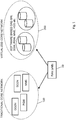
- Fig. 1 shows an example of a general configuration of communication networks where some examples of embodiments are implementable.
- network functions may be implemented as "traditional" network elements, i.e. as dedicated hardware entities forming e.g. a traditional core network 100 of a communication network system consisting of e.g. GGSN, SGSN, PGW, MME, SGW etc. (i.e. core network elements like EPC elements, but also IMS network elements, etc.).
- corresponding network functions may also be implemented in the form of virtual/virtualized network functions (corresponding to network elements or specific functions thereof), i.e. as software running on corresponding computing devices like servers or the like and forming a virtualized core network 200.
- Such a virtualized core network includes, for example, software based PGW, MME, HSS, SGW, etc., which execute the same or at least similar functions like corresponding hardware based network elements.
- An access network subsystem 20, such as a RAN (including one or more BS or eNBs) or a fixed access network, may be controlled by and have access to the core networks 100 and 200, as shown in Fig. 1 .
- a core network being employed for services includes virtual and "real" network elements or functions interacting which each other.
- other network functions besides those of a core network (like e.g. EPC or IMS), such as network functions of an access network element like an eNB or BS may be provided as virtualized network functions.
- NFV involves the implementation of network functions in software that can run on server hardware, and that can be moved to, or instantiated/setup in, various locations in a network or cloud/datacenters as required, without the need for installation of new equipment.
- Dynamically placing the NF into the virtualization infrastructure allows also that all or a part of the VNFs or some parts or functions of the related network (e.g. the core network) is/are dynamically withdrawn completely from the virtualization infrastructure (i.e. de-instantiated), while other parts (legacy or SDN based or virtualized network functions) remain in the network structure and virtualization infrastructure as deemed necessary.
- the term "instantiated” means in the context of the following description, for example, that a virtual network function acting in a communication network in the virtualized network part (see e.g. Fig. 1 ), i.e. in the virtualization infrastructure, is set up, turned on, activated or made in some other manner available for other communication network elements or functions.
- the term “de-instantiated” may be understood, for example, that a virtual network function acting in a communication network in the virtualized network part (see e.g. Fig. 1 ) is turned off, deactivated or made in some other manner not available for other communication network elements or functions, i.e. the instantiation of the virtual network function in question is removed or cancelled, at least temporarily.
- One possible approach is to redesign network elements, for example a gateway, into a centralized control part and a distributed GW that is based on SDN/OF switches and a mobility tunnel termination. This allows for separating the UP processing on dedicated HW while keeping the control plane in DC.
- CP and UP of a GW can run in different hardware or VMs and this way scale independently. This is especially useful in case the traffic pattern of terminal devices is difficult to predict and changes over time or locations. For example, there may be devices (such as for example terminal devices like sensors or other machine type devices) requiring little UP traffic capacity but generating a high amount of signalling/CP traffic (e.g. by attaching and detaching from the network etc). On the other hand, other devices (such as for example smart phones or tablets) may be always on and not generating a high amount of signalling/CP traffic but generating a high amount of data/UP traffic. Therefore, an independent scaling is useful.
- devices such as for example terminal devices like sensors or other machine type devices
- other devices such as for example smart phones or tablets
- the number of VMs used to run a specific network functions may be increased (or in other words scaled out) or decreased (or in other words scaled in).
- the number of VMs used to run a specific network functions may be increased (or in other words scaled out) or decreased (or in other words scaled in).
- With collocated CP and UP software in a single standard VM image it is however difficult to serve different variations of subscribers (high CP activity such as sensors, and high UP activity such as smart phones) in an optimal way.
- the virtualization infrastructure such as a DC
- the SW stacks provide an abstracted view of resources (like computing or memory) to allow SW portability and simplify programming. How the requests by the VNF are implemented during runtime depends, for example, on the algorithms of a possible infrastructure manager and orchestrator, the current load situation and others. Thus, it cannot be predicted during SW design if requirements e.g. for high efficient communication between VNF components can be fulfilled by those scaling methods.
- network functions for example core network functions like GW, MME etc., other functions like IMS related functions, etc.
- network functions for example core network functions like GW, MME etc., other functions like IMS related functions, etc.
- network functions for example core network functions like GW, MME etc., other functions like IMS related functions, etc.
- measures and configurations are provided which allow for a dynamic orchestration and adaptation of virtualized network functions (for example gateways) in a virtualization infrastructure (such as for example a DC, the cloud etc.) according to a traffic mix in a communication network.
- measures and configurations are provided which allow for a co-existence of CP and UP of a GW (e.g. a SAE-GW) in one VM while at the same time advantages provided by a separation of CP and UP into different VMs can be achieved.
- multiple data sets including e.g. SW images, SW instance flavors, descriptors etc. are provided to address different traffic mix possibilities.
- examples and examples of embodiments of the invention are related to a case where a virtualized network function, such as a virtualized core network function (such as for example MME, SGW, PGW, HSS etc.) or a virtualized access network function (such as for example an eNB), a virtualized IMS function (such as for example a P-CSCF, IBCF, BGCF, MGCF etc.) is instantiated.
- a virtualized network function such as a virtualized core network function (such as for example MME, SGW, PGW, HSS etc.) or a virtualized access network function (such as for example an eNB), a virtualized IMS function (such as for example a P-CSCF, IBCF, BGCF, MGCF etc.) is instantiated.
- examples of embodiments of the invention are related to a scenario where an UE attaches or registers to an eNB which in turn connects to a virtualized GW or the like.
- attach or "register” is to be understood as representing different forms of connecting or establishing and maintaining a connection between elements, functions or applications communicate with each other, such as e.g. a connection between a communication element like a UE and a network (i.e. one or more network elements or functions), an M2M (machine to machine) communication, a communication involving one or more applications (such as for example video data providing applications or services, communication related application or services like Skype, etc.) and the like, such as “attach” in the sense of LTE systems, "register” in the sense of IMS systems, etc..
- a cellular wireless communication network such as an LTE or LTE-Advanced based system
- LTE Long Term Evolution
- LTE-Advanced based system a cellular wireless communication network
- the present invention is not limited to an application using such types of communication systems, but is also applicable in other types of communication systems, be it wireless systems, wired systems or systems using a combination thereof.
- a basic system architecture of a communication system may include an architecture of one or more communication networks including a wired or wireless access network subsystem and a core network.
- Such an architecture may include one or more communication network control elements, access network elements, radio access network elements, access service network gateways or base transceiver stations, such as a base station (BS), an access point or an eNB, which control a respective coverage area or cell and with which one or more communication elements or terminal devices such as a UE or another device having a similar function, such as a modem chipset, a chip, a module etc., which can also be part of an element, function or application capable of conducting a communication, such as a UE, an element or function usable in a M2M communication architecture, or attached as a separate element to such an element, function or application capable of conducting a communication, or the like, are capable to communicate via one or more channels for transmitting several types of data.
- core network elements such as gateway network elements, policy and charging control network elements, mobility management
- the communication network is also able to communicate with other networks, such as a public switched telephone network or the Internet.
- the communication network may also be able to support the usage of cloud services.
- network elements of the access system such as BSs and/or eNBs, of a core network, an IMS network etc., and/or respective functionalities may be implemented by using any node, host, server or access node etc. entity suitable for such a usage.
- network elements, such as access network elements or core network elements, or elements, functions or applications capable of conducting a communication may also be implemented by using a corresponding virtualized communication function or application.
- the described network elements such as terminal devices, communication network control elements of a cell, like a BS or an eNB, access network elements like APs and the like, core network elements etc. as well as corresponding functions as described herein, and other elements, functions or application capable of conducting a communication may be implemented by software, e.g. by a computer program product for a computer, and/or by hardware.
- nodes or network elements may include several means, modules, units, components, etc. (not shown) which are required for control, processing and/or communication/signaling functionality.
- Such means, modules, units and components may include, for example, one or more processors or processor units including one or more processing portions for executing instructions and/or programs and/or for processing data, storage or memory units or means for storing instructions, programs and/or data, for serving as a work area of the processor or processing portion and the like (e.g. ROM, RAM, EEPROM, and the like), input or interface means for inputting data and instructions by software (e.g. floppy disc, CD-ROM, EEPROM, and the like), a user interface for providing monitor and manipulation possibilities to a user (e.g. a screen, a keyboard and the like), other interface or means for establishing links and/or connections under the control of the processor unit or portion (e.g.
- radio interface means including e.g. an antenna unit or the like, means for forming a radio communication part etc.) and the like, wherein respective means forming an interface, such as a radio communication part, can be also located on a remote site (e.g. a radio head or a radio station etc.).
- a remote site e.g. a radio head or a radio station etc.
- a so-called “liquid” or flexible network concept may be employed where the operations and functionalities of a communication network element, network function, or of another entity of the communication network, such as of one or more of RAN elements like a BS or eNB, may be performed in different entities or functions, such as in a node, host or server, in a flexible manner.
- a "division of labour" between involved network elements, functions or entities may vary case by case.
- Fig. 2 shows a diagram illustrating an example of an implementation of a virtualized network function.
- Fig. 2 illustrates a decomposition of a monolithic GW node (e.g. a SGW or the like) 300 into a virtualized network function 400 acting as a de-composed GW in the virtual environment, i.e. in a virtualization infrastructure such as a DC or cloud environment.
- a monolithic GW node 300 UP and CP are located in a composed manner.
- NFV generates in the virtualization infrastructure (DC, cloud) a corresponding VNF 400 which is configured to act as a GW similar to the GW node 300.
- the VNF 400 consists of several VMs and a hypervisor as a virtual machine managing function. At least one VM is used as a GW VM for CP and at least one other VM is used as a GW VM for UP.
- Fig. 3 shows a diagram illustrating instantiation examples of virtualized network functions.
- the VNFs considered in connection with Fig. 3 are GWs comparable to that described in connection with Fig. 2 .
- the VNFs are not limited to one specific type and may be related to other functions, such as MME etc..
- a network control element or function is provided which is referred to, for example, as an orchestrator 500.
- the orchestrator 500 is used to (directly or indirectly via a suitable managing entity to be described later) manage the virtualization of network functions, i.e. to instantiate (or de-instantiate) the respective VNFs in the virtualization infrastructure (DC, cloud environment) and to generate and manage the links to other network elements and functions of the communication network.
- some sort of interface from the orchestrator 500 to the cloud/DC is provided which may be designed to dynamically host software related to the virtualized network function, such as a GW software etc., which can be instantiated or withdrawn, or the like.
- the orchestrator 500 may be able to instantiate any virtualized network function etc.. Furthermore, also links between the respective network elements or function (wherever they may be located, i.e. in a physical entity or in a cloud/datacenter) might be implicitly/explicitly or indirectly/directly be triggered by the orchestrator 500 to be instantiated. Furthermore, it is to be noted that according to examples of embodiments the type of network function or application etc. which may be instantiated by the orchestrator 500 (via a manager or directly) is not limited to a specific type only. For example, any core network element, such as an SGW or PGW (e.g. decomposed SGW and PGW), IMS network function, access network function (e.g. an eNB function) etc. may be instantiated.
- the type of the network function, communication function or application to be instantiated by the orchestrator 500 may be selected and instructed by an operator according to a current need or the like.
- a corresponding VNF type or functionality (e.g. VNF1 410 or VNF2 420) is input in the form of a corresponding SW image (SW image 1 and SW image 2, respectively) together with a corresponding VNF description (VNF descriptor 1 and VNF descriptor 2, respectively) into the orchestrator 500.
- the VNF1 410 is input in case a GW (like a PGW) is required having a large session state memory (e.g. in case a GW is assumed to host a high number of sessions/users so that a comparative high amount of memory is to be assigned for a session state data base).
- the VNF2 420 is input in case a GW (like a PGW) is required needing only a small session state memory (e.g. in case a GW is assumed to host a small number of sessions/users so that a comparative low amount of memory is to be assigned for a session state data base).
- a GW like a PGW
- different run time resources/requirements are required like the described memory requirements.
- an adaption of resources used from a virtualization infrastructure e.g. the DC 60 is executed by the instantiation process of VNF1 instance 41 and VNF2 instance 42, respectively. That is, resources of the virtualization infrastructure are allocated according to a template description or the like at the VNF instantiation time. That is, for the same functionality (defined by the "SW image"), e.g. a PGW function, different amount of resources are allocated during the instantiation.
- a process and configuration is provided which enables an efficient use of available hardware capability by a VNF to be instantiated (such as for example a GW). At the same time, it allows flexible resource split for different communication functions, such as CP and UP, based on the traffic model.
- a virtualization infrastructure such as a cloud environment, is utilized that an operator can select automatically a separate SW image for the same virtualized functionality depending on the utilization of computing and hardware resources.
- data sets for different types of SW images for a VNF which support different hardware profiles, are generated and provided to the orchestrator so that the orchestrator being responsible for the VNF instantiation can obtain these data sets.
- data sets are assumed which includes SW images and VNF descriptors.
- the provision of the data sets can be done basically at any time, for example in a software build phase of the orchestrator, in connection with an update of data in the orchestrator (e.g. a content update or version update of the software), during operation and managing of the VNFs by using a suitable signaling procedure, e.g. from an operator managing function, etc..
- Fig. 4 shows a diagram illustrating instantiation examples of virtualized network functions according to examples of embodiments. Similar to the example described in connection with Fig. 3 , a mobile network GW function (such as for example a SGW, PGW) is used for explaining the principles, but corresponding measures can be applied also to other network functions.
- a mobile network GW function such as for example a SGW, PGW
- a network control element or function is provided which is referred to, for example, as an orchestrator 50. Similar to the orchestrator 500 of Fig. 3 , the orchestrator 50 is used to (directly or indirectly via a suitable managing entity to be described later) manage the virtualization of network functions, i.e. to instantiate (or de-instantiate) the respective VNFs in the virtualization infrastructure (DC, cloud environment) and to generate and manage the links to other network elements and functions of the communication network. In addition, the orchestrator 50 includes a selection function which is used to select a suitable type of VNF based on data sets and control data, as described in the following.
- a pluralitiy of data sets 410, 420 is generated and made available to the orchestrator 50.
- Each data set 410, 420 defines one of different types of VNFs (e.g. for a respective type of GW).
- a respective descriptor is included which provides a description of the respective VNF capabilities in templates and catalogs.
- the data sets are made available to the orchestrator by a suitable on-boarding process (i.e. the orchestrator 50 obtains the data sets).
- the data sets are made available in the software build phase of the orchestrator 50 or later in time during operation, e.g. in connection with a data update.
- the corresponding VNF type or functionality (e.g. VNF1 410 or VNF2 420) is specified for a specific network function type or flavor and may, for example, have allocated a different amount of resources to CP processing and UP processing.
- the VNF1 410 describes a GW (like a PGW) having a high number of processing core allocation for CP.
- the VNF2 420 describes a GW (like a PGW) having a lower number of processing core allocation for CP.
- the same run time resources/requirements can be required.
- Table 1 An example is indicated for an allocation of processing resources for VNF1 and VNF2. Specifically, an example is provided which describes a multi-core processor with 16 cores and two VNF types (implemented by different SW images). Table 1: Different multi-processor core allocation for a GW CP and UP VNF #cores for CP #cores for UP #cores for management ratio CP/UP VNF1 1 14 1 1/14 VNF2 3 12 1 1/4
- VNF1 requires a larger number of resources being allocated to UP than VNF2.
- parameters used in a data set are not limited to those indicated in table 1.
- the parameters in the data sets may include additional or different parameters than the amount of internal processor cores.
- parameters related to an internal memory an I/O capacity and/or other resources and information (such as for example a ratio) can be used.
- parameters are not explicitly indicated in a data set when it is possible to derive necessary information from other sources, e.g. implicitly from a specific SW image.
- the VNF descriptor contains parameters that link the type or flavor of the VNF (e.g. VNF1 and VNF2 in Fig. 3 and Fig. 4 ) to conditions in the virtualization infrastructure (e.g. a cloud environment or a DC) and network that are monitored during the runtime of the network.
- VNF1 and VNF2 in Fig. 3 and Fig. 4 the type or flavor of the VNF
- the virtualization infrastructure e.g. a cloud environment or a DC
- the orchestrator 50 is able to select a suitable VNF type and start an instantiation.
- the assignment of parts of different resources to components of a VNF to be instantiated and their relation is done at a compilation time of the SW of the VNF type, wherein an instantiation of the VNF is done after a corresponding selection assigning the overall resources for the complete VNF.
- overall infrastructure requirements (processor, computing resources) for a VFN are described in the VNF descriptor and instantiated by the orchestrator.
- Internal resource consumption parts or the relation of the internal components of a VNF, such as CP and UP components, are defined by the SW image at a compilation time of the VNF type.
- control information are acquired and processed which represent, for example, the needs in the communication network and the capability of the virtualization infrastructure. A corresponding control process is explained in the following with regard to Fig. 5 .
- Fig. 5 shows a signaling diagram illustrating a control procedure according to some examples of embodiments.
- entities involved in control procedure for adjusting the amount and type of VNFs to be instantiated include an OSS 30, the VNF orchestrator 50, a VNF infrastructure manager 55 and the virtualization infrastructure (e.g. of the DC) 60 providing a HW capability.
- the OSS 30 represents an example for a management system used for managing a communication network such as a cellular communication network and which supports management functions such as service provisioning, network configuration, fault management and traffic monitoring.
- the VNF infrastructure manager 55 represents an example for a managing element or function which manages resources of the virtualization infrastructure, such as the DC or the cloud environment, so as to monitor the resource usage and to allocate resources for the VNF instantiation.
- the VNF orchestrator 50 has already obtained data sets indicating the various VNFs, as described in connection with Fig. 4 . Then, as indicated in Fig. 5 , in S10, the OSS 30 sends an indication to the VNF orchestrator 50 that a load level in the present communication network is exceeded, for example due to a high traffic load or the like. This information in S10 can be seen as a trigger for the VNF orchestrator 50 to conduct an adjustment of amount and type of VNFs being instantiated in the virtualization infrastructure for a usage in the communication network managed by the OSS 30.
- the OSS 30 sends control information containing traffic pattern information or traffic mix information of communications conducted in the communication network, such as a periodic traffic profile or the like, to the VNF orchestrator 50. It is to be noted that also the signaling in S10 can be regarded as part of the control information.
- the VNF orchestrator 50 requests also control information from the virtualization infrastructure 60, e.g. via the VNF infrastructure manager 55, in order to learn the available hardware capability or resources which can be used by the VNF orchestrator 50 for the instantiation of at least one VNF.
- the VNF orchestrator 50 receives a corresponding response.
- the response in S40 indicates, as parameters, available resources or utilized resources (e.g. memory space, processing cores, etc.) in the virtualization infrastructure, a utilisation level of different resources in the virtualization infrastructure used by a VNF (e.g. inside a processor running a VM of the VNF), etc..
- thresholds or limits to be considered for a virtualization or instantiation process can be provided (e.g. maximum amount of memory space or processing cores allowed to be used for one instantiation, etc.).
- the VNF orchestrator 50 conducts a processing for selecting at least one suitable VNF for usage in the communication network.
- the selection is based, for example, on a comparison of parameters derived from the control information (i.e. traffic pattern, HW resources) and corresponding parameters indicated in the data sets, which are provided e.g. in the VNF description types. That is, it is determined which VNF described in the data sets fits best to the observed traffic mix, wherein also available resources in the virtualization infrastructure may play a role for the selection process.
- a suitable VM flavour as indicated in the data sets is then selected based on the acquired traffic and HW information.
- the orchestrator has monitored in the past a network behaviour and/or is continuously monitoring the network behaviour. Based on this monitoring, the orchestrator is able to predict what type of VNF is to be instantiated, for example at a certain point in time. For example, when the network behaviour shows at a certain daytime an increased demand for UP traffic, the VNFs being instantiated or to be instantiated can be selected and/or configured so as to satisfy this requirement.
- a traffic pattern to be observed may be represented by a ratio between normalized CP transactions per UP throughput. For a range of such ratios one or more of the VNFs as indicated in the data sets (see also table 1) with a corresponding SW image can be found a optimal or best fitting and hence selected to be used in the further processing.
- the VNF orchestrator 50 conducts an instantiation process, i.e. takes the necessary actions to adjust the VNF amount and type of instantiations, by instructing the VNF infrastructure manager 55 to set up the selected VNF in the virtualization infrastructure.
- the selection of the appropriate VM flavour depends on the available variations, i.e. how many different data sets are prepared from which the VNF can be selected. Furthermore, also an operator specific setup can be considered in the selection processing. For example, the operator may define limits or thresholds, like a number of VNFs allowed to be instantiated or an amount of resources allowed to be used, which are to be considered in the selection process.
- VNF orchestrator 50 is described to conduct measures as illustrated in Fig. 5
- another element or function can be implemented for conducting this processing.
- any suitable management system can be employed in order to adjust the amount and type of VNFs in order to follow a requirement in the communication network.
- Fig. 6 shows a diagram illustrating the processing conducted in a communication network environment according to some examples of embodiments. It is to be noted that Fig. 6 shows an example diagram illustrating a configuration of a communication network where some examples of embodiments are implementable, wherein only those devices, network elements, functions, applications and/or parts are indicated which are useful for understanding principles underlying the examples and embodiments. As also known by those skilled in the art, there may be several other network elements, functions, applications or devices involved in a suitable network structure which are omitted here for the sake of simplicity.
- Fig. 6 a network structure is illustrated which is for example based on 3GPP and ETSI ISG NFV (European Telecommunications Standards Institute Industry Specification Group Network Function Virtualization) specifications. It is to be noted that the general functions of the elements and functions described in connection with Fig. 6 as well as of reference points/interfaces between the elements are known to those skilled in the art so that a detailed description thereof is omitted here for the sake of simplicity. Furthermore, as also known to persons skilled in the art, the number of elements, functions and applications indicated in Fig. 6 may vary, i.e. there may be implemented or instantiated more corresponding elements, functions and application than those shown in Fig. 6 .
- the OSS is connected with a EMS 35 which provides, for example, managing functions for one or more types of network elements.
- the EMS 35 is responsible for the management of GW (e.g. SGW, PGW) elements in the communication network.
- the EMS 35 is linked to corresponding network elements or functions, for example a normal "real" instance of a GW 45 and a VNF instance 41. It is to be noted that the number of instances to be considered is not limited to that shown in Fig. 6 and may vary. From the linked instances 41, 45, the EMS 35 can monitor the traffic situation and report corresponding indications, such as KPIs to the OSS 30 (for example, a CP and UP traffic or load in the GWs).
- VNF infrastructure resources 60 (such as for example memory space, processing cores etc. in a DC) are managed by a VIM 55 and provide resources for the instantiated VNF 41.
- the VIM 55 is linked to the VNF orchestrator 50 and sends, for example, indications such as KPIs for reporting on a load situation in the virtualization infrastructure, e.g. the load for cores in a processor, etc.
- the VNF orchestrator 50 is in turn connected to a VNFM 65 which manages the VNFs (such as for example the VNF 41).
- VNFM 65 which manages the VNFs (such as for example the VNF 41).
- the VNF orchestrator 50 instructs the VNFM 65 to instantiate a (new) VNF or de-instantiate an existing VNF.
- resources to be used for an instantiation e.g. number of cores etc.
- the VNFM 65 manages the VNFs (e.g. VNF instance 41).
- the VNF orchestrator 50 acquires information about the resource usage in the virtualization infrastructure 60 (e.g. the DC) and provides a control loop for adjusting or adapting the VNF type to a resource requirement.
- the necessary information can be collected e.g. from the GW EMS 35 via the OSS 30, i.e. by collecting corresponding KPIs (describing a communication situation in the communication network, e.g. the number of transactions (related to the CP traffic) and a throughput in the GW (related to the UP traffic)).
- the VIM 55 can collect information about the resource situation in the virtualization infrastructure (e.g. a load of different cores of the processors indicating a balanced or unbalanced core usage), and/or information about the hardware capabilities of the DC. This information is used by the VNF orchestrator 50 (or the VNFM 65) to match with templates available for the VNF images.
- information about the resource situation in the virtualization infrastructure e.g. a load of different cores of the processors indicating a balanced or unbalanced core usage
- This information is used by the VNF orchestrator 50 (or the VNFM 65) to match with templates available for the VNF images.
- the orchestrator 50 is configured to monitor the network behaviour over the time, such as a history of a communication traffic situation in the communication network, and use the experience made in the monitoring to predict a requirement for a specific VNF for example at a specific point of time. Then this prediction result can be used by the VNF orchestrator 50 to instantiate in the virtualization infrastructure the then required VNF for a usage in the communication network.
- VNF orchestrator 50 a special type of VNF
- different VNF types are instantiated in parallel, wherein users are assigned to the VNF according to a subscription type or other characteristics. That is, for example, different VNF types are instantiated in parallel to cope with different traffic requirements, e.g. from different terminals/UEs like sensors and smart phones.
- the differentiation between VNFs being instantiated is based on a relation between CP and UP. That is, settings of the VNFs are based on a prediction of the relation between CP and UP for specific user types (e.g. for MTC devices).
- the VNF orchestrator 50 starts with an instantiation of different types of GWs according to an observed traffic type mix in the past.
- the instantiated VNFs includes also those usable as Internet GWs, wherein e.g. the number of cores to be used for UP is high.
- the instantiated VNFs includes those usable as voice GWs, wherein e.g. the number of cores to be used for CP is higher compared to the Internet GW case.
- the instantiated VNFs includes those usable as MTC GWs, wherein e.g. the number of cores to be used for CP is high.
- the correct (i.e. suitable) GW type is selected in the communication network, including the instantiated VNFs. According to a possible increase of decrease of the traffic amount per traffic type, the VNF can then be scaled independently per GW type.
- the VNF orchestrator 50 may be configured to act according to the automation algorithm only when a new instance is to be added e.g. for capacity increase, i.e. for example during a GW VM scaling out, in order to select a new VNF type/SW version that reflects the currently observed load situation (e.g. the average CP/UP load).
- the VNF orchestrator 50 may be configured to act according to the automation algorithm by removing a running VNF and replace it by new type of VNF, in order to reflect the currently observed load situation, for example.
- VNF/VM mix which ensures an optimal resource utilization wherein it is not required to introduce a decomposition of communication properties into separated VNFs and VMs, such as CP and UP of a GW.
- Fig. 7 shows a flow chart of a processing conducted in a communication network control element or function according to some examples of embodiments.
- the processing is executed by one of a communication network control element or communication network control function acting as an orchestrator for implementing or instantiating virtualized communication functions or applications, an VNF manager element or function of a communication network, or a communication network control element or communication network control function of a communication network using virtualized communication functions or applications.
- the virtualized network function, communication function or application being instantiated is related to a communication network control function of the communication network (e.g. core network function, access network function, IMS network function, etc.), a M2M communication function, an application, a terminal function etc..
- each data set describes a specific virtualized network function.
- each of the plurality of data sets includes a software image corresponding to the specific virtualized network function.
- each of the data sets includes information about capabilities of the specific virtualized network function for a usage in a communication network (e.g. SW image, VNF descriptor etc.), and an amount and type of resources to be allocated in the virtualization infrastructure (e.g. number of processing cores, storage amount etc.).
- the amount and type of resources to be allocated in a virtualization infrastructure are separable with regard to resources to be allocated in the virtualization infrastructure for a usage in a CP of a VNF in the communication network and for a usage in a UP of the same VNF in the communication network.
- the data sets are obtained in a software build phase for implementing an orchestrator element or function for virtualized network functions.
- data sets are obtained during an operation phase of the orchestrator element or function for virtualized network functions.
- corresponding data sets can be obtained at any time before the orchestrator element or function for virtualized network functions executes an instantiation process for instantiating a virtualized network function, i.e. after the orchestrator element or function is implemented (e.g. in the form of an update).
- control information related to a communication traffic situation in the communication network for which at least one virtualized network function is implementable and/or a resource usage situation in the virtualization infrastructure in which at least one virtualized network function can be instantiated are acquired and processed.
- the control information includes information about a traffic pattern or traffic mix of communications conducted in the communication network, an indication that a load level in the communication network exceeds a threshold (for example as a trigger for the adjustment process), information about processing resources, storing resources, and data transmission resources (interfaces, I/O bandwidth etc.) of the virtualization infrastructure available for an instantiation of at least one virtualized network function.
- the processing of the control information includes a comparison of parameters derived from the control information (actually required properties for communication network, which resources are available in the virtualization infrastructure) with parameters derived from the plurality of data sets (e.g. type of VNF to be instantiated, required resources for specific type of VNF in virtualization infrastructure etc.). Based on this comparison, a specific data set of the plurality of data sets is selected whose parameters matches (best) with the parameters derived from the control information.
- parameters derived from the control information actually required properties for communication network, which resources are available in the virtualization infrastructure
- parameters derived from the plurality of data sets e.g. type of VNF to be instantiated, required resources for specific type of VNF in virtualization infrastructure etc.
- an adjustment of an amount and type of at least one virtualized network function instantiated in the virtualization infrastructure for a usage in the communication network is made. According to examples of embodiments, this is executed by, based on the processed control information, selecting at least one virtualized network function from the obtained data sets, and by instantiating the selected at least one virtualized network function in the virtualization infrastructure.
- the selecting of the at least one virtualized network function considers variations in the plurality of data sets (e.g. selects one of the data sets which matches best, based on e.g. certain criteria and weighting factors) and an operator specific setup (e.g. considering thresholds of a maximum number of resources in the virtualization infrastructure under certain conditions, etc.).
- a control loop is implemented which is based on the processed control information.
- the control loop allows a permanent and repeated adjustment of the amount and type of at least one virtualized network function instantiated in the virtualization infrastructure for usage in the communication network.
- a requirement for a specific virtualized network function is predicted, wherein the adjustment of the amount and type of at least one virtualized network function instantiated in the virtualization infrastructure for usage in the communication network is based on the prediction.
- a plurality of different virtualized network functions is instantiated in parallel based on the data sets (for example based on an observed typical traffic mix pattern).
- User communications can then be assigned to a respective one of the different virtualized network functions according to at least one of a subscription type of the user communication, a service type for the user communication, and an access point type of the user communication.
- a further adjustment of the amount and type of virtualized network functions can be further conducted, e.g. by using a control loop as described above.
- an activity level for adjusting the amount and type of at least one virtualized network function instantiated in the virtualization infrastructure for usage in the communication network is set in accordance with a resource usage state in the virtualization infrastructure.
- the activity level is an activity level where the adjustment of the amount and type of at least one virtualized network function is conducted only in a case of scaling out for adding a new virtualized network function.
- the activity level is an activity level where the adjustment of the amount and type of at least one virtualized network function is conducted for removing a virtualized network function by replacing it with a new virtualized network function.
- Fig. 8 shows a diagram of a communication network control element or function acting as an instantiation element or function for instantiating and adjusting virtualized network functions according to some examples of embodiments, which is configured to implement the control procedure as described in connection with some of the examples of embodiments.
- the communication network control element or function like the orchestrator 50, which is shown in Fig. 8 , may include further elements or functions besides those described herein below.
- the element or function may be also another device or function having a similar task, such as a chipset, a chip, a module, an application etc., which can also be part of a communication network control element or function or attached as a separate element or function to a communication network control element or function, or the like. It should be understood that each block and any combination thereof may be implemented by various means or their combinations, such as hardware, software, firmware, one or more processors and/or circuitry.
- the communication network control element or function shown in Fig. 8 may include a processing circuitry, a processing function, a control unit or a processor 51, such as a CPU or the like, which is suitable for executing instructions given by programs or the like related to the control procedure.
- the processor 51 may include one or more processing portions or functions dedicated to specific processing as described below, or the processing may be run in a single processor or processing function. Portions for executing such specific processing may be also provided as discrete elements or within one or more further processors, processing functions or processing portions, such as in one physical processor like a CPU or in one or more physical or virtual entities, for example.
- Reference sign 52 denotes transceiver or input/output (I/O) units or functions (interfaces) connected to the processor or processing function 51.
- the I/O units 52 may be used for communicating with one or more network elements, such as OSS elements, managing elements or functions, core network elements or functions, databases/datacenters and the like.
- the I/O units 52 may be a combined unit including communication equipment towards several network elements, or may include a distributed structure with a plurality of different interfaces for different network elements.
- Reference sign 54 denotes a memory usable, for example, for storing data and programs to be executed by the processor or processing function 51 and/or as a working storage of the processor or processing function 51.
- the processor or processing function 51 is configured to execute processing related to the above described control procedure.
- the processor or processing circuitry or function 51 includes a sub-portion 510 as a processing portion which is usable for obtaining data sets.
- the portion 510 may be configured to perform processing according to S100 of Fig. 7 .
- the processor or processing circuitry or function 51 includes a sub-portion 511 usable as a portion for acquiring and processing control information.
- the portion 511 may be configured to perform processing according to S110 of Fig. 7 .
- the processor or processing circuitry or function 51 includes a sub-portion 512 usable as a portion adjusting amount and type of VNF.
- the portion 512 may be configured to perform a processing according to S120 of Fig. 7 .
- an apparatus including means for obtaining a plurality of data sets each describing a specific virtualized network function, means for acquiring and processing control information related to at least one of a communication traffic situation in a communication network for which at least one virtualized network function is implementable and a resource usage situation in a virtualization infrastructure in which at least one virtualized network function can be instantiated, and means for adjusting an amount and type of at least one virtualized network function instantiated in the virtualization infrastructure for usage in the communication network by, based on the processed control information, selecting at least one virtualized network function from the obtained data sets, and instantiating the selected at least one virtualized network function.
- an apparatus including at least one processing circuitry, and at least one memory for storing instructions to be executed by the processing circuitry, wherein the at least one memory and the instructions are configured to, with the at least one processing circuitry, cause the apparatus at least:
- the data sets each include information about at least one of capabilities of the specific virtualized network function for a usage in the communication network, and an amount and type of resources to be allocated in the virtualization infrastructure.
- the amount and type of resources to be allocated in the virtualization infrastructure are separable with regard to resources to be allocated in the virtualization infrastructure for a usage in a control plane of a virtualized network in the communication network and for a usage in a user plane of the same virtualized network in the communication network.
- the at least one memory and the instructions are further configured to, with the at least one processing circuitry, cause the apparatus to obtain the plurality of data sets in at least one of a software build phase for implementing an orchestrator element or function for virtualized network functions, an operation phase of the orchestrator element or function for virtualized network functions, and at any time before the orchestrator element or function for virtualized network functions executes an instantiation process for instantiating a virtualized network function.
- control information includes at least one of information about a traffic pattern or traffic mix of communications conducted in the communication network, an indication that a load level in the communication network exceeds a threshold, and information about at least one of processing resources, storing resources, and data transmission resources of the virtualization infrastructure available for an instantiation of at least one virtualized network function.
- the at least one memory and the instructions are further configured to, with the at least one processing circuitry, cause the apparatus, in the processing of the control information, to compare parameters derived from the control information with parameters derived from the plurality of data sets, and to determine a data set of the plurality of data sets whose parameters matches with the parameters derived from the control information.
- the at least one memory and the instructions are further configured to, with the at least one processing circuitry, cause the apparatus to consider, in the selecting of the at least one virtualized network function, variations in the plurality of data sets and an operator specific setup.
- the at least one memory and the instructions are further configured to, with the at least one processing circuitry, cause the apparatus to implement a control loop based on the processed control information for adjusting the amount and type of at least one virtualized network function instantiated in the virtualization infrastructure for usage in the communication network, and/or to predict, based on a monitored history of the communication traffic situation in the communication network, a requirement for a specific virtualized network function, wherein the adjustment of the amount and type of at least one virtualized network function instantiated in the virtualization infrastructure for usage in the communication network is based on the prediction.
- the at least one memory and the instructions are further configured to, with the at least one processing circuitry, cause the apparatus to instantiate in parallel a plurality of different virtualized network functions based on the data sets, wherein user communications are assigned to a respective one of the different virtualized network functions according to at least one of a subscription type of the user communication, a service type for the user communication, and an access point type of the user communication.
- the at least one memory and the instructions are further configured to, with the at least one processing circuitry, cause the apparatus to set an activity level for adjusting the amount and type of at least one virtualized network function instantiated in the virtualization infrastructure for usage in the communication network according to a resource usage state in the virtualization infrastructure, wherein the activity level is one of an activity level where the adjustment of the amount and type of at least one virtualized network function is conducted only in a case of scaling out for adding a new virtualized network function, and an activity level where the adjustment of the amount and type of at least one virtualized network function is conducted for removing a virtualized network function by replacing it with a new virtualized network function.
- the apparatus according to any of aspects A to A9 is implemented by one of a communication network control element or communication network control function acting as a orchestrator for instantiating virtualized network functions, and a communication network control element or communication network control function of acting as a manager for the virtualized network function wherein the at least one virtualized network function being instantiated is related to a communication network control function of the communication network.
- a GW is used as an example for the virtualized network function being instantiated, the invention is not limited thereto.
- other network entities such as, SGSN, GGSN, MME, SGW, PGW etc., or a RAN element like an eNB may be used as examples of a virtualized network function to which the described examples of embodiments are applicable.
- examples of embodiments of the invention are also applicable for other network systems, such as an IMS based system, where elements like a P-CSCF, IBCF, BGCF, MGCF etc may be instantiated as virtualized network functions where examples of embodiments of the invention are applicable
Landscapes
- Engineering & Computer Science (AREA)
- Computer Networks & Wireless Communication (AREA)
- Signal Processing (AREA)
- Environmental & Geological Engineering (AREA)
- Data Exchanges In Wide-Area Networks (AREA)
- Mobile Radio Communication Systems (AREA)
Claims (14)
- Procédé comprenant :l'obtention (S100) d'une pluralité d'ensembles de données décrivant chacun une fonction réseau virtualisée spécifique, etl'acquisition et le traitement (S110) d'informations de contrôle,caractérisé en ce que le procédé comprend en outre :les informations de contrôle étant associées à une situation de trafic de communication dans un réseau de communication pour lequel au moins une fonction réseau virtualisée peut être mise en oeuvre et à une situation d'utilisation de ressource dans une infrastructure de virtualisation dans laquelle au moins une fonction réseau virtualisée peut être instanciée, et les informations de contrôle comportant au moins un élément parmi : des informations concernant un modèle de trafic ou un mélange de trafic de trafic de plan de contrôle et de plan utilisateur réalisé dans le réseau de communication, une indication qu'un niveau de charge de trafic dans le réseau de communication excède un seuil, et des informations concernant au moins un élément parmi des ressources de traitement, des ressources de stockage, et des ressources de transmission de données de l'infrastructure de virtualisation disponibles pour une instanciation d'au moins une fonction réseau virtualisée, etl'ajustement (S120) d'une quantité et d'un type d'au moins une fonction réseau virtualisée instanciée dans l'infrastructure de virtualisation à usage dans le réseau de communication ensur la base des informations de contrôle traitées, sélectionnant au moins une fonction réseau virtualisée à partir des ensembles de données obtenus, etinstanciant ladite fonction réseau virtualisée sélectionnée.
- Procédé selon la revendication 1, dans lequel chacun de la pluralité d'ensembles de données comprend une image logicielle correspondant à la fonction réseau virtualisée spécifique.
- Procédé selon la revendication 1 ou 2, dans lequel les ensembles de données comportent chacun des informations concernant au moins un élément parmi
des capacités de la fonction réseau virtualisée spécifique pour une utilisation dans le réseau de communication, et
une quantité et un type de ressources devant être attribués dans l'infrastructure de virtualisation. - Procédé selon la revendication 3, dans lequel la quantité et le type de ressources devant être attribués dans l'infrastructure de virtualisation sont séparables quant aux ressources devant être attribuées dans l'infrastructure de virtualisation pour une utilisation dans un plan de contrôle d'une fonction réseau virtualisée dans le réseau de communication et pour une utilisation dans un plan utilisateur de la même fonction réseau virtualisée dans le réseau de communication.
- Procédé selon l'une quelconque des revendications 1 à 4, dans lequel la pluralité d'ensembles de données est obtenue dans au moins un élément parmi une phase de développement logiciel pour mettre en oeuvre un élément ou une fonction d'orchestration pour des fonctions réseau virtualisées, une phase d'exploitation de l'élément ou de la fonction d'orchestration pour des fonctions réseau virtualisées, et à tout moment avant que l'élément ou la fonction d'orchestration pour des fonctions réseau virtualisées n'exécute un processus d'instanciation pour instancier une fonction réseau virtualisée.
- Procédé selon l'une quelconque des revendications 1 à 5, dans lequel l'étape de traitement des informations de contrôle comprend
la comparaison de paramètres dérivés à partir des informations de contrôle avec des paramètres dérivés à partir de la pluralité d'ensembles de données, et
la détermination d'un ensemble de données de la pluralité d'ensembles de données dont les paramètres correspondent aux paramètres dérivés à partir des informations de contrôle. - Procédé selon l'une quelconque des revendications 1 à 6, dans lequel l'étape de sélection de ladite fonction réseau virtualisée considère des variations de la pluralité d'ensembles de données et une configuration spécifique à l'opérateur.
- Procédé selon l'une quelconque des revendications 1 à 7, comprenant en outre au moins un élément parmi
la mise en oeuvre d'une boucle de contrôle sur la base des informations de contrôle traitées pour ajuster la quantité et le type d'au moins une fonction réseau virtualisée instanciée dans l'infrastructure de virtualisation à usage dans le réseau de communication, et
la prédiction, sur la base d'un historique contrôlé de la situation de trafic de communication dans le réseau de communication, d'une exigence d'une fonction réseau virtualisée spécifique, l'ajustement de la quantité et du type d'au moins une fonction réseau virtualisée instanciée dans l'infrastructure de virtualisation à usage dans le réseau de communication étant basé sur la prédiction. - Procédé selon l'une quelconque des revendications 1 à 8, comprenant en outre
l'instanciation en parallèle d'une pluralité de différentes fonctions réseau virtualisées sur la base des ensembles de données, des communications utilisateur étant affectées à une fonction respective des différentes fonctions réseau virtualisées selon au moins un élément parmi un type d'abonnement de la communication utilisateur, un type de service pour la communication utilisateur, et un type de point d'accès de la communication utilisateur. - Procédé selon l'une quelconque des revendications 1 à 9, comprenant en outre
la fixation d'un niveau d'activité pour réaliser l'ajustement de la quantité et du type d'au moins une fonction réseau virtualisée instanciée dans l'infrastructure de virtualisation à usage dans le réseau de communication selon un état d'utilisation de ressource dans l'infrastructure de virtualisation, le niveau d'activité étant un élément parmi
un niveau d'activité dans lequel l'ajustement de la quantité et du type d'au moins une fonction réseau virtualisée est réalisé uniquement dans un cas de scaling-out pour ajouter une nouvelle fonction réseau virtualisée, et
un niveau d'activité dans lequel l'ajustement de la quantité et du type d'au moins une fonction réseau virtualisée est réalisé pour supprimer une fonction réseau virtualisée en la remplaçant par une nouvelle fonction réseau virtualisée. - Elément de contrôle de réseau de communication (50) ou fonction de contrôle de réseau de communication (50) agissant comme un orchestrateur destiné à instancier des fonctions réseau virtualisées ou agissant comme un gestionnaire pour la fonction réseau virtualisée et conçu pour exécuter toutes les étapes du procédé selon l'une quelconque des revendications 1 à 10.
- Appareil (50) comprenant
au moins un processeur (51) configuré pour :obtenir (510) une pluralité d'ensembles de données décrivant chacun une fonction réseau virtualisée spécifique ; etacquérir et traiter (511) des informations de contrôle ;caractérisé en ce que l'appareil (50) comprend en outre :les informations de contrôle étant associées à une situation de trafic de communication dans un réseau de communication pour lequel au moins une fonction réseau virtualisée peut être mise en oeuvre et à une situation d'utilisation de ressource dans une infrastructure de virtualisation dans laquelle au moins une fonction réseau virtualisée peut être instanciée, et les informations de contrôle comportant au moins un élément parmi : des informations concernant un modèle de trafic ou un mélange de trafic de trafic de plan de contrôle et de plan utilisateur réalisé dans le réseau de communication, une indication qu'un niveau de charge de trafic dans le réseau de communication excède un seuil, et des informations concernant au moins un élément parmi des ressources de traitement, des ressources de stockage, et des ressources de transmission de données de l'infrastructure de virtualisation disponibles pour une instanciation d'au moins une fonction réseau virtualisée ; etajuster (512) une quantité et un type d'au moins une fonction réseau virtualisée instanciée dans l'infrastructure de virtualisation à usage dans le réseau de communication ensur la base des informations de contrôle traitées, sélectionnant au moins une fonction réseau virtualisée à partir des ensembles de données obtenus, etinstanciant ladite fonction réseau virtualisée sélectionnée. - Produit programme d'ordinateur destiné à un ordinateur, comportant des parties de code logiciel permettant de mettre en oeuvre les étapes de l'une quelconque des revendications 1 à 10 lorsque ledit produit est exécuté sur l'ordinateur.
- Produit programme d'ordinateur selon la revendication 13, dans lequel
le produit programme d'ordinateur comprend un support lisible par ordinateur sur lequel lesdites parties de code logiciel sont stockées, et/ou
le produit programme d'ordinateur est chargeable directement dans la mémoire interne de l'ordinateur et/ou transmissible par le biais d'un réseau au moyen d'au moins une procédure parmi télécharger vers le serveur, télécharger et pousser.
Priority Applications (3)
| Application Number | Priority Date | Filing Date | Title |
|---|---|---|---|
| EP14171639.9A EP2955631B1 (fr) | 2014-06-09 | 2014-06-09 | Commande de fonctions de réseau virtualisées à usage dans un réseau de communication |
| US14/728,059 US10904158B2 (en) | 2014-06-09 | 2015-06-02 | Controlling of virtualized network functions for usage in communication network |
| CN201510536475.7A CN105262664B (zh) | 2014-06-09 | 2015-06-09 | 用于在通信网络中使用的虚拟化网络功能的控制 |
Applications Claiming Priority (1)
| Application Number | Priority Date | Filing Date | Title |
|---|---|---|---|
| EP14171639.9A EP2955631B1 (fr) | 2014-06-09 | 2014-06-09 | Commande de fonctions de réseau virtualisées à usage dans un réseau de communication |
Publications (2)
| Publication Number | Publication Date |
|---|---|
| EP2955631A1 EP2955631A1 (fr) | 2015-12-16 |
| EP2955631B1 true EP2955631B1 (fr) | 2019-05-01 |
Family
ID=50982767
Family Applications (1)
| Application Number | Title | Priority Date | Filing Date |
|---|---|---|---|
| EP14171639.9A Active EP2955631B1 (fr) | 2014-06-09 | 2014-06-09 | Commande de fonctions de réseau virtualisées à usage dans un réseau de communication |
Country Status (3)
| Country | Link |
|---|---|
| US (1) | US10904158B2 (fr) |
| EP (1) | EP2955631B1 (fr) |
| CN (1) | CN105262664B (fr) |
Families Citing this family (121)
| Publication number | Priority date | Publication date | Assignee | Title |
|---|---|---|---|---|
| US9578664B1 (en) | 2013-02-07 | 2017-02-21 | Sprint Communications Company L.P. | Trusted signaling in 3GPP interfaces in a network function virtualization wireless communication system |
| US10749905B2 (en) * | 2017-07-31 | 2020-08-18 | Amdocs Development Limited | System, method, and computer program providing security in network function virtualization (NFV) based communication networks and software defined networks (SDNS) |
| CN106464540B (zh) * | 2014-06-26 | 2019-11-19 | 华为技术有限公司 | 虚拟网络功能策略管理的系统与方法 |
| CN105323085A (zh) * | 2014-07-10 | 2016-02-10 | 中兴通讯股份有限公司 | 创建性能测量任务、性能测量结果的处理方法及装置 |
| US11856457B2 (en) * | 2014-08-07 | 2023-12-26 | Apple Inc. | Virtualized network function management |
| US10291689B2 (en) | 2014-08-20 | 2019-05-14 | At&T Intellectual Property I, L.P. | Service centric virtual network function architecture for development and deployment of open systems interconnection communication model layer 4 through layer 7 services in a cloud computing system |
| US9473567B2 (en) | 2014-08-20 | 2016-10-18 | At&T Intellectual Property I, L.P. | Virtual zones for open systems interconnection layer 4 through layer 7 services in a cloud computing system |
| US9742690B2 (en) | 2014-08-20 | 2017-08-22 | At&T Intellectual Property I, L.P. | Load adaptation architecture framework for orchestrating and managing services in a cloud computing system |
| US9749242B2 (en) | 2014-08-20 | 2017-08-29 | At&T Intellectual Property I, L.P. | Network platform as a service layer for open systems interconnection communication model layer 4 through layer 7 services |
| US9800673B2 (en) * | 2014-08-20 | 2017-10-24 | At&T Intellectual Property I, L.P. | Service compiler component and service controller for open systems interconnection layer 4 through layer 7 services in a cloud computing system |
| KR102438042B1 (ko) * | 2014-09-25 | 2022-08-29 | 애플 인크. | 네트워크 기능 가상화 |
| US9652277B2 (en) * | 2014-10-03 | 2017-05-16 | At&T Intellectual Property I, L.P. | Scalable network function virtualization |
| US9946614B2 (en) | 2014-12-16 | 2018-04-17 | At&T Intellectual Property I, L.P. | Methods, systems, and computer readable storage devices for managing faults in a virtual machine network |
| US9560078B2 (en) | 2015-02-04 | 2017-01-31 | Intel Corporation | Technologies for scalable security architecture of virtualized networks |
| WO2016154917A1 (fr) * | 2015-03-31 | 2016-10-06 | 华为技术有限公司 | Procédé et appareil de gestion de fonction de réseau virtualisé |
| US9578008B2 (en) * | 2015-05-11 | 2017-02-21 | Intel Corporation | Technologies for secure bootstrapping of virtual network functions |
| CN106304035A (zh) * | 2015-05-22 | 2017-01-04 | 中兴通讯股份有限公司 | 一种能力开放方法及系统、能力开放功能实体 |
| US10015201B2 (en) | 2015-06-30 | 2018-07-03 | At&T Intellectual Property I, L.P. | Implementing application level multimedia services as a switching function |
| US9686240B1 (en) | 2015-07-07 | 2017-06-20 | Sprint Communications Company L.P. | IPv6 to IPv4 data packet migration in a trusted security zone |
| US9749294B1 (en) | 2015-09-08 | 2017-08-29 | Sprint Communications Company L.P. | System and method of establishing trusted operability between networks in a network functions virtualization environment |
| US10542115B1 (en) | 2015-10-01 | 2020-01-21 | Sprint Communications Company L.P. | Securing communications in a network function virtualization (NFV) core network |
| US9811686B1 (en) | 2015-10-09 | 2017-11-07 | Sprint Communications Company L.P. | Support systems interactions with virtual network functions in a trusted security zone |
| US10938895B2 (en) * | 2015-10-19 | 2021-03-02 | Nokia Solutions And Networks Oy | Instantiating a virtual network function comprising at least one virtual network function component |
| US10140146B2 (en) * | 2015-10-22 | 2018-11-27 | Genband Us Llc | Network management for elastic virtual network functions |
| US9781016B1 (en) | 2015-11-02 | 2017-10-03 | Sprint Communications Company L.P. | Dynamic addition of network function services |
| US10911529B2 (en) * | 2015-11-06 | 2021-02-02 | Ribbon Communications Operating Company, Inc. | Independent groups of virtual network function components |
| US10938665B2 (en) * | 2015-12-15 | 2021-03-02 | At&T Intellectual Property I, L.P. | Method and apparatus for creating a custom service |
| US10447800B2 (en) * | 2015-12-17 | 2019-10-15 | Dell Products L.P. | Network cache deduplication analytics based compute cluster load balancer |
| FR3046015A1 (fr) * | 2015-12-21 | 2017-06-23 | Orange | Procede d'allocation de ressources d'execution |
| JP2019506662A (ja) * | 2015-12-23 | 2019-03-07 | コンプテル オーユー | ネットワーク管理 |
| CN106998560A (zh) * | 2016-01-25 | 2017-08-01 | 中兴通讯股份有限公司 | 一种虚拟化网络功能的管理方法、网络设备及系统 |
| EP3402121B1 (fr) * | 2016-02-06 | 2020-01-08 | Huawei Technologies Co., Ltd. | Procédé et dispositif de transmission de règles dans un système nfv |
| EP3203686B1 (fr) * | 2016-02-08 | 2019-12-11 | Comptel Corporation | Interaction de fonctions dans un réseau virtualisé |
| KR20180110095A (ko) * | 2016-02-08 | 2018-10-08 | 노키아 솔루션스 앤드 네트웍스 오와이 | 네트워크 가상화 시나리오들의 자원 배치 제어 |
| US10135701B2 (en) | 2016-02-19 | 2018-11-20 | At&T Intellectual Property I, L.P. | Context-aware virtualized control decision support system for providing quality of experience assurance for internet protocol streaming video services |
| CN107154951B (zh) * | 2016-03-02 | 2020-10-02 | 南京中兴软件有限责任公司 | 一种虚拟化网络应用功能单元vnf伸缩管理方法及装置 |
| EP3402131B1 (fr) * | 2016-03-02 | 2021-05-26 | Huawei Technologies Co., Ltd. | Procédé de configuration de ressources, gestionnaire virtualisé de fonction de réseau et système de gestion d'élément de réseau |
| WO2017167688A1 (fr) * | 2016-03-29 | 2017-10-05 | Nokia Solutions And Networks Oy | Procédés et appareils pour déplacer des instances de fonction de réseau virtualisée entre des instances de service de réseau |
| CN107294752A (zh) * | 2016-04-01 | 2017-10-24 | 中兴通讯股份有限公司 | 实现网络功能通信的架构、方法及装置 |
| US10454771B2 (en) * | 2016-04-06 | 2019-10-22 | Alcatel Lucent | Virtual infrastructure |
| WO2017177042A1 (fr) * | 2016-04-06 | 2017-10-12 | Nokia Solutions And Networks Oy | Appareils et procédés de gestion directe de fonction de réseau virtualisé (vnf) |
| CN107277898A (zh) * | 2016-04-08 | 2017-10-20 | 中兴通讯股份有限公司 | 虚拟化网络节能方法及装置 |
| US10430258B2 (en) | 2016-04-20 | 2019-10-01 | At&T Intellectual Property I, L.P. | Discovery and chaining of virtual functions |
| US10719348B2 (en) * | 2016-04-28 | 2020-07-21 | Nec Corporation | Network function virtualization management and orchestration apparatus, method, and program |
| US10454877B2 (en) | 2016-04-29 | 2019-10-22 | Cisco Technology, Inc. | Interoperability between data plane learning endpoints and control plane learning endpoints in overlay networks |
| WO2017189015A1 (fr) * | 2016-04-29 | 2017-11-02 | Intel IP Corporation | Virtualisation des fonctions réseau |
| CN107404441B (zh) * | 2016-05-19 | 2020-02-14 | 华为技术有限公司 | 一种切片网络中数据流分流的方法及设备 |
| US10498765B2 (en) | 2016-06-01 | 2019-12-03 | At&T Intellectual Property I, L.P. | Virtual infrastructure perimeter regulator |
| US10091070B2 (en) * | 2016-06-01 | 2018-10-02 | Cisco Technology, Inc. | System and method of using a machine learning algorithm to meet SLA requirements |
| US10149193B2 (en) | 2016-06-15 | 2018-12-04 | At&T Intellectual Property I, L.P. | Method and apparatus for dynamically managing network resources |
| US10348590B2 (en) | 2016-06-15 | 2019-07-09 | At&T Intellectual Property I, L.P. | Intelligent analytics virtual network orchestration system and method |
| US10097421B1 (en) * | 2016-06-16 | 2018-10-09 | Sprint Communications Company L.P. | Data service policy control based on software defined network (SDN) key performance indicators (KPIs) |
| WO2017219361A1 (fr) * | 2016-06-24 | 2017-12-28 | 华为技术有限公司 | Procédé de distribution de données de signaux électriques dans un réseau otn, et appareil associé |
| US10341195B1 (en) | 2016-06-29 | 2019-07-02 | Sprint Communications Company L.P. | Virtual network function (VNF) resource management in a software defined network (SDN) |
| WO2018014356A1 (fr) * | 2016-07-22 | 2018-01-25 | 华为技术有限公司 | Procédé et appaeil de chargement |
| WO2018023338A1 (fr) * | 2016-08-01 | 2018-02-08 | 华为技术有限公司 | Procédé de gestion de fonction réseau, et dispositif de gestion de fonction réseau |
| CN107689882B (zh) | 2016-08-05 | 2020-04-21 | 华为技术有限公司 | 一种虚拟化网络中业务部署的方法和装置 |
| WO2018024341A1 (fr) * | 2016-08-05 | 2018-02-08 | Telefonaktiebolaget Lm Ericsson (Publ) | Procédé et appareil de contrôle d'attribution de licences dans un environnement de réseau virtuel |
| EP3282359A1 (fr) * | 2016-08-09 | 2018-02-14 | Alcatel Lucent | Procédé de gestion d'un réseau d'accès radio virtuel et procédé d'étalonnage d'un composant logiciel |
| CN106452842B (zh) * | 2016-09-14 | 2019-09-24 | 上海海事大学 | 基于网络功能虚拟化中介系统架构的网络系统 |
| US10250498B1 (en) | 2016-10-03 | 2019-04-02 | Sprint Communications Company L.P. | Session aggregator brokering of data stream communication |
| CN109845191B (zh) * | 2016-10-10 | 2022-02-25 | 诺基亚通信公司 | 多态虚拟化网络功能 |
| WO2018068202A1 (fr) * | 2016-10-11 | 2018-04-19 | Nokia Technologies Oy | Orchestration d'enrobage de sécurité de fonctions de réseau virtualisées dans l'environnement en nuage |
| US10489180B2 (en) | 2016-10-31 | 2019-11-26 | Hewlett Packard Enterprise Development Lp | Determining virtual network function configurations |
| US10505870B2 (en) | 2016-11-07 | 2019-12-10 | At&T Intellectual Property I, L.P. | Method and apparatus for a responsive software defined network |
| CN108073423B (zh) * | 2016-11-09 | 2020-01-17 | 华为技术有限公司 | 一种加速器加载方法、系统和加速器加载装置 |
| CN111813459B (zh) | 2016-11-09 | 2024-12-27 | 华为技术有限公司 | 一种加速器加载方法、系统和加速器加载装置 |
| WO2018090386A1 (fr) * | 2016-11-21 | 2018-05-24 | 华为技术有限公司 | Procédé, dispositif et système de traitement d'anomalies de modules nf |
| WO2018095518A1 (fr) * | 2016-11-23 | 2018-05-31 | Nokia Solutions And Networks Oy | Mise à l'échelle de capacité pour applications de réseautage en nuage |
| US10594625B2 (en) * | 2016-11-29 | 2020-03-17 | At&T Intellectual Property I, L.P. | Managing physical resources for virtual network functions |
| CN108121587B (zh) * | 2016-11-30 | 2021-05-04 | 华为技术有限公司 | 一种数据加速方法及虚拟加速器 |
| US10708314B2 (en) * | 2016-12-23 | 2020-07-07 | Genband Us Llc | Hybrid distributed communication |
| CN108540991B (zh) * | 2017-03-01 | 2023-03-10 | 中兴通讯股份有限公司 | 一种基站管理方法及装置 |
| US10762452B2 (en) | 2017-03-09 | 2020-09-01 | At&T Intellectual Property I, L.P. | System and method for designing and executing control loops in a cloud environment |
| CN108632161B (zh) * | 2017-03-20 | 2022-04-12 | 中兴通讯股份有限公司 | 一种虚拟网络功能及其实现业务处理的方法 |
| US11237862B2 (en) * | 2017-03-27 | 2022-02-01 | British Telecommunications Public Limited Company | Virtualized network function deployment |
| US20200110627A1 (en) * | 2017-04-25 | 2020-04-09 | Intel IP Corporation | Centralized unit and distributed unit connection in a virtualized radio access network |
| US10819606B2 (en) | 2017-04-27 | 2020-10-27 | At&T Intellectual Property I, L.P. | Method and apparatus for selecting processing paths in a converged network |
| US10749796B2 (en) | 2017-04-27 | 2020-08-18 | At&T Intellectual Property I, L.P. | Method and apparatus for selecting processing paths in a software defined network |
| US10673751B2 (en) | 2017-04-27 | 2020-06-02 | At&T Intellectual Property I, L.P. | Method and apparatus for enhancing services in a software defined network |
| US10963813B2 (en) | 2017-04-28 | 2021-03-30 | Cisco Technology, Inc. | Data sovereignty compliant machine learning |
| US10257668B2 (en) | 2017-05-09 | 2019-04-09 | At&T Intellectual Property I, L.P. | Dynamic network slice-switching and handover system and method |
| US10382903B2 (en) | 2017-05-09 | 2019-08-13 | At&T Intellectual Property I, L.P. | Multi-slicing orchestration system and method for service and/or content delivery |
| CN107231296B (zh) * | 2017-05-11 | 2020-04-14 | 京信通信系统(中国)有限公司 | 一种网关装置 |
| US10200463B2 (en) * | 2017-05-22 | 2019-02-05 | At&T Intellectual Property I, L.P. | Systems and methods to improve the performance of a network by more efficient virtual network resource allocation |
| CN108934013B (zh) * | 2017-05-26 | 2023-05-26 | 中兴通讯股份有限公司 | 一种无线网络功能虚拟化方法及装置 |
| EP3635548A1 (fr) * | 2017-06-07 | 2020-04-15 | Intel IP Corporation | Mesures de performances liées à des ressources virtualisées |
| US10477148B2 (en) | 2017-06-23 | 2019-11-12 | Cisco Technology, Inc. | Speaker anticipation |
| CN107426109B (zh) * | 2017-06-27 | 2020-10-09 | 上海华为技术有限公司 | 一种流量调度方法、vnf模块及流量调度服务器 |
| WO2019006649A1 (fr) * | 2017-07-04 | 2019-01-10 | Telefonaktiebolaget Lm Ericsson (Publ) | Procédé et dispositif pour une capacité de fonction réseau et une gestion d'échelle |
| US10608901B2 (en) | 2017-07-12 | 2020-03-31 | Cisco Technology, Inc. | System and method for applying machine learning algorithms to compute health scores for workload scheduling |
| US11003516B2 (en) * | 2017-07-24 | 2021-05-11 | At&T Intellectual Property I, L.P. | Geographical redundancy and dynamic scaling for virtual network functions |
| US10091348B1 (en) | 2017-07-25 | 2018-10-02 | Cisco Technology, Inc. | Predictive model for voice/video over IP calls |
| US10070344B1 (en) | 2017-07-25 | 2018-09-04 | At&T Intellectual Property I, L.P. | Method and system for managing utilization of slices in a virtual network function environment |
| CN109391499A (zh) * | 2017-08-11 | 2019-02-26 | 中国电信股份有限公司 | 用于加载虚拟网络功能的装置及方法 |
| US10348488B1 (en) | 2017-08-25 | 2019-07-09 | Sprint Communications Company L.P. | Tiered distributed ledger technology (DLT) in a network function virtualization (NFV) core network |
| US10555278B2 (en) * | 2017-11-03 | 2020-02-04 | Comptel Oy | Method and arrangement for allocating communication resources in a communication network |
| US10104548B1 (en) | 2017-12-18 | 2018-10-16 | At&T Intellectual Property I, L.P. | Method and apparatus for dynamic instantiation of virtual service slices for autonomous machines |
| US11663027B2 (en) | 2017-12-29 | 2023-05-30 | Nokia Technologies Oy | Virtualized network functions |
| CN110167080A (zh) | 2018-02-13 | 2019-08-23 | 中兴通讯股份有限公司 | 订阅信息更新的方法及装置 |
| US10867067B2 (en) | 2018-06-07 | 2020-12-15 | Cisco Technology, Inc. | Hybrid cognitive system for AI/ML data privacy |
| US10764113B2 (en) * | 2018-07-05 | 2020-09-01 | At&T Intellectual Property I, L.P. | Self-adjusting control loop |
| US11729067B2 (en) | 2018-08-06 | 2023-08-15 | Apple Inc. | Management data analytical KPIS for 5G network traffic and resource |
| US10805164B2 (en) * | 2018-12-14 | 2020-10-13 | At&T Intellectual Property I, L.P. | Controlling parallel data processing for service function chains |
| CN111399969B (zh) * | 2019-01-02 | 2023-03-31 | 中国移动通信有限公司研究院 | 一种虚拟资源编排系统、方法、装置、介质和设备 |
| US11128556B2 (en) * | 2019-02-20 | 2021-09-21 | Accenture Global Solutions Limited | Deploying, testing, monitoring, scaling, and healing virtual network functions in a software-defined network |
| US10965523B1 (en) | 2019-05-06 | 2021-03-30 | Sprint Communications Company L.P. | Virtual network element provisioning |
| EP3745761A1 (fr) * | 2019-05-28 | 2020-12-02 | Samsung Electronics Co., Ltd. | Virtualisation des fonctions ran basée sur la charge des stations de base |
| US11219032B2 (en) * | 2019-05-28 | 2022-01-04 | Samsung Electronics Co., Ltd. | Method and apparatus for performing function of radio access network |
| CN110381605B (zh) * | 2019-07-08 | 2021-02-02 | 中国联合网络通信集团有限公司 | 一种基站以及终端接入基站的方法 |
| US10887818B1 (en) * | 2019-07-15 | 2021-01-05 | At&T Mobility Ii Llc | SD-WAN orchestrator for 5G CUPS networks |
| US11924925B2 (en) * | 2019-07-26 | 2024-03-05 | Parallel Wireless, Inc. | 5G enhanced HetNet gateway |
| WO2021164888A1 (fr) * | 2020-02-21 | 2021-08-26 | Nokia Solutions And Networks Oy | Découverte d'instance de service |
| US11442703B2 (en) | 2020-09-22 | 2022-09-13 | Cisco Technology, Inc. | Domain-specific language for serverless network functions |
| US11625230B2 (en) * | 2020-09-22 | 2023-04-11 | Cisco Technology, Inc. | Identifying execution environments for deploying network functions |
| CN112367632B (zh) * | 2020-10-16 | 2021-10-29 | 中国电子科技集团公司第七研究所 | 一种适合平流层无人机的网络化测控系统及其测控方法 |
| US11847205B1 (en) | 2020-10-26 | 2023-12-19 | T-Mobile Innovations Llc | Trusted 5G network function virtualization of virtual network function elements embedded on a system-on-chip |
| US11601348B2 (en) * | 2020-12-10 | 2023-03-07 | Amazon Technologies, Inc. | Managing radio-based private networks |
| US11871240B2 (en) | 2021-06-28 | 2024-01-09 | Amazon Technologies, Inc. | Interfaces for creating radio-based private networks |
| US12494982B2 (en) * | 2022-03-15 | 2025-12-09 | Boost SubscriberCo L.L.C. | Testing environment for communication services |
| CN115915205B (zh) * | 2022-10-24 | 2026-02-10 | 西安电子科技大学 | 一种服务化无线接入网 |
Family Cites Families (16)
| Publication number | Priority date | Publication date | Assignee | Title |
|---|---|---|---|---|
| JP2002202959A (ja) * | 2000-12-28 | 2002-07-19 | Hitachi Ltd | 動的な資源分配をする仮想計算機システム |
| US8365184B2 (en) * | 2007-08-31 | 2013-01-29 | Apple Inc. | Multi-core resource utilization planning |
| US8789041B2 (en) * | 2009-12-18 | 2014-07-22 | Verizon Patent And Licensing Inc. | Method and system for bulk automated virtual machine deployment |
| US8954564B2 (en) * | 2010-05-28 | 2015-02-10 | Red Hat, Inc. | Cross-cloud vendor mapping service in cloud marketplace |
| WO2012045342A1 (fr) | 2010-10-06 | 2012-04-12 | Nokia Siemens Networks Oy | Traitement d'abonnés dans des réseaux de télécommunication radio |
| US8863138B2 (en) * | 2010-12-22 | 2014-10-14 | Intel Corporation | Application service performance in cloud computing |
| US9154549B2 (en) * | 2011-10-27 | 2015-10-06 | Cisco Technology, Inc. | Dynamic server farms |
| US8850442B2 (en) * | 2011-10-27 | 2014-09-30 | Verizon Patent And Licensing Inc. | Virtual machine allocation in a computing on-demand system |
| US8856339B2 (en) * | 2012-04-04 | 2014-10-07 | Cisco Technology, Inc. | Automatically scaled network overlay with heuristic monitoring in a hybrid cloud environment |
| CN102857363B (zh) | 2012-05-04 | 2016-04-20 | 运软网络科技(上海)有限公司 | 一种虚拟网络的自主管理系统和方法 |
| US20140007097A1 (en) * | 2012-06-29 | 2014-01-02 | Brocade Communications Systems, Inc. | Dynamic resource allocation for virtual machines |
| US8825550B2 (en) * | 2012-08-23 | 2014-09-02 | Amazon Technologies, Inc. | Scaling a virtual machine instance |
| US8792941B2 (en) | 2012-09-13 | 2014-07-29 | Alcatel Lucent | Method and apparatus of virtualized resource sharing in cellular networks |
| WO2014062796A1 (fr) * | 2012-10-16 | 2014-04-24 | Intel Corporation | Virtualisation par fonction croisée d'un réseau central de télécommunications |
| KR101540631B1 (ko) * | 2012-12-28 | 2015-07-30 | 삼성에스디에스 주식회사 | 가상 클러스터의 동적 확장 시스템, 방법 및 그 프로그램이 저장된 기록매체 |
| US9392050B2 (en) * | 2013-03-15 | 2016-07-12 | Cisco Technology, Inc. | Automatic configuration of external services based upon network activity |
-
2014
- 2014-06-09 EP EP14171639.9A patent/EP2955631B1/fr active Active
-
2015
- 2015-06-02 US US14/728,059 patent/US10904158B2/en active Active
- 2015-06-09 CN CN201510536475.7A patent/CN105262664B/zh active Active
Non-Patent Citations (2)
| Title |
|---|
| "Network Functions Virtualisation (NFV); Virtual Network Functions Architecture;NFV-SWA01v020-VNF_Architecture", ETSI DRAFT; NFV-SWA01V020-VNF_ARCHITECTURE, EUROPEAN TELECOMMUNICATIONS STANDARDS INSTITUTE (ETSI), 650, ROUTE DES LUCIOLES ; F-06921 SOPHIA-ANTIPOLIS ; FRANCE, vol. ISG, no. V0.2.0, 2 June 2014 (2014-06-02), pages 1 - 94, XP014184871 * |
| KING LANCASTER UNIVERSITY M LIEBSCH P WILLIS J RYOO ETRI D: "Virtualisation of Mobile Core Network Use Case; draft-king-vnfpool-mobile-use-case-01.txt", VIRTUALISATION OF MOBILE CORE NETWORK USE CASE; DRAFT-KING-VNFPOOL-MOBILE-USE-CASE-01.TXT, INTERNET ENGINEERING TASK FORCE, IETF; STANDARDWORKINGDRAFT, INTERNET SOCIETY (ISOC) 4, RUE DES FALAISES CH- 1205 GENEVA, SWITZERLAND, 8 June 2014 (2014-06-08), pages 1 - 14, XP015099466 * |
Also Published As
| Publication number | Publication date |
|---|---|
| US10904158B2 (en) | 2021-01-26 |
| CN105262664A (zh) | 2016-01-20 |
| CN105262664B (zh) | 2019-11-19 |
| US20150358248A1 (en) | 2015-12-10 |
| EP2955631A1 (fr) | 2015-12-16 |
Similar Documents
| Publication | Publication Date | Title |
|---|---|---|
| EP2955631B1 (fr) | Commande de fonctions de réseau virtualisées à usage dans un réseau de communication | |
| US12294886B2 (en) | Communication apparatus, system, method, allocation apparatus, and non-transitory recording medium | |
| CN112672383B (zh) | 通信方法和网络设备 | |
| US20210204148A1 (en) | Real-time intelligent ran controller to support self-driving open ran | |
| US10230573B2 (en) | Management of network entity selection | |
| US10498659B2 (en) | System and method for managing virtual radio access network slicing | |
| US20190253907A1 (en) | Performance measurement job control for 5g networks and network slicing | |
| EP3720189A1 (fr) | Procédé d'acheminement de données et terminal | |
| WO2018137499A1 (fr) | Procédé de commande de partage de ressources, entité d'exécution et entité de configuration de partage de ressources | |
| WO2018095537A1 (fr) | Fourniture d'applications à un serveur périphérique mobile | |
| CN112314033A (zh) | 选择和管理网络切片 | |
| Hirschman et al. | High-performance evolved packet core signaling and bearer processing on general-purpose processors | |
| US11445422B2 (en) | Adaptable network communications | |
| US9781631B2 (en) | Optimizing capacity expansion in a mobile network | |
| CN110225555A (zh) | 副链路通信的服务质量控制方法、装置、介质及电子设备 | |
| CN113746649B (zh) | 一种网络切片控制方法及通信装置 | |
| EP3326406B1 (fr) | Commande de fonction d'accélération dans un réseau | |
| EP3011448A1 (fr) | Sélection de machines virtuelles ou d'entités de réseau virtualisé | |
| US20240236649A9 (en) | Data-centric computing and communication infrastructure | |
| CN106792923A (zh) | 一种配置QoS策略的方法及装置 | |
| US20240121156A1 (en) | Instantiation support of cloud eas | |
| US20240224070A1 (en) | Management apparatus, management method, and management program | |
| CN110999371A (zh) | 无锚移动网络中的虚拟锚 | |
| Ferguson et al. | CoreKube: An Efficient, Autoscaling and Resilient Mobile Core System | |
| US20250267560A1 (en) | Network slice notifications in wireless communication networks |
Legal Events
| Date | Code | Title | Description |
|---|---|---|---|
| PUAI | Public reference made under article 153(3) epc to a published international application that has entered the european phase |
Free format text: ORIGINAL CODE: 0009012 |
|
| AK | Designated contracting states |
Kind code of ref document: A1 Designated state(s): AL AT BE BG CH CY CZ DE DK EE ES FI FR GB GR HR HU IE IS IT LI LT LU LV MC MK MT NL NO PL PT RO RS SE SI SK SM TR |
|
| AX | Request for extension of the european patent |
Extension state: BA ME |
|
| 17P | Request for examination filed |
Effective date: 20160616 |
|
| RBV | Designated contracting states (corrected) |
Designated state(s): AL AT BE BG CH CY CZ DE DK EE ES FI FR GB GR HR HU IE IS IT LI LT LU LV MC MK MT NL NO PL PT RO RS SE SI SK SM TR |
|
| STAA | Information on the status of an ep patent application or granted ep patent |
Free format text: STATUS: EXAMINATION IS IN PROGRESS |
|
| 17Q | First examination report despatched |
Effective date: 20170707 |
|
| GRAP | Despatch of communication of intention to grant a patent |
Free format text: ORIGINAL CODE: EPIDOSNIGR1 |
|
| STAA | Information on the status of an ep patent application or granted ep patent |
Free format text: STATUS: GRANT OF PATENT IS INTENDED |
|
| INTG | Intention to grant announced |
Effective date: 20181129 |
|
| GRAS | Grant fee paid |
Free format text: ORIGINAL CODE: EPIDOSNIGR3 |
|
| GRAA | (expected) grant |
Free format text: ORIGINAL CODE: 0009210 |
|
| STAA | Information on the status of an ep patent application or granted ep patent |
Free format text: STATUS: THE PATENT HAS BEEN GRANTED |
|
| AK | Designated contracting states |
Kind code of ref document: B1 Designated state(s): AL AT BE BG CH CY CZ DE DK EE ES FI FR GB GR HR HU IE IS IT LI LT LU LV MC MK MT NL NO PL PT RO RS SE SI SK SM TR |
|
| REG | Reference to a national code |
Ref country code: GB Ref legal event code: FG4D |
|
| REG | Reference to a national code |
Ref country code: CH Ref legal event code: EP Ref country code: AT Ref legal event code: REF Ref document number: 1127832 Country of ref document: AT Kind code of ref document: T Effective date: 20190515 |
|
| REG | Reference to a national code |
Ref country code: DE Ref legal event code: R096 Ref document number: 602014045631 Country of ref document: DE |
|
| REG | Reference to a national code |
Ref country code: IE Ref legal event code: FG4D |
|
| REG | Reference to a national code |
Ref country code: SE Ref legal event code: TRGR |
|
| RAP2 | Party data changed (patent owner data changed or rights of a patent transferred) |
Owner name: NOKIA SOLUTIONS AND NETWORKS OY |
|
| REG | Reference to a national code |
Ref country code: NL Ref legal event code: MP Effective date: 20190501 |
|
| REG | Reference to a national code |
Ref country code: LT Ref legal event code: MG4D |
|
| PG25 | Lapsed in a contracting state [announced via postgrant information from national office to epo] |
Ref country code: FI Free format text: LAPSE BECAUSE OF FAILURE TO SUBMIT A TRANSLATION OF THE DESCRIPTION OR TO PAY THE FEE WITHIN THE PRESCRIBED TIME-LIMIT Effective date: 20190501 Ref country code: NO Free format text: LAPSE BECAUSE OF FAILURE TO SUBMIT A TRANSLATION OF THE DESCRIPTION OR TO PAY THE FEE WITHIN THE PRESCRIBED TIME-LIMIT Effective date: 20190801 Ref country code: AL Free format text: LAPSE BECAUSE OF FAILURE TO SUBMIT A TRANSLATION OF THE DESCRIPTION OR TO PAY THE FEE WITHIN THE PRESCRIBED TIME-LIMIT Effective date: 20190501 Ref country code: ES Free format text: LAPSE BECAUSE OF FAILURE TO SUBMIT A TRANSLATION OF THE DESCRIPTION OR TO PAY THE FEE WITHIN THE PRESCRIBED TIME-LIMIT Effective date: 20190501 Ref country code: PT Free format text: LAPSE BECAUSE OF FAILURE TO SUBMIT A TRANSLATION OF THE DESCRIPTION OR TO PAY THE FEE WITHIN THE PRESCRIBED TIME-LIMIT Effective date: 20190901 Ref country code: NL Free format text: LAPSE BECAUSE OF FAILURE TO SUBMIT A TRANSLATION OF THE DESCRIPTION OR TO PAY THE FEE WITHIN THE PRESCRIBED TIME-LIMIT Effective date: 20190501 Ref country code: HR Free format text: LAPSE BECAUSE OF FAILURE TO SUBMIT A TRANSLATION OF THE DESCRIPTION OR TO PAY THE FEE WITHIN THE PRESCRIBED TIME-LIMIT Effective date: 20190501 Ref country code: LT Free format text: LAPSE BECAUSE OF FAILURE TO SUBMIT A TRANSLATION OF THE DESCRIPTION OR TO PAY THE FEE WITHIN THE PRESCRIBED TIME-LIMIT Effective date: 20190501 |
|
| PG25 | Lapsed in a contracting state [announced via postgrant information from national office to epo] |
Ref country code: BG Free format text: LAPSE BECAUSE OF FAILURE TO SUBMIT A TRANSLATION OF THE DESCRIPTION OR TO PAY THE FEE WITHIN THE PRESCRIBED TIME-LIMIT Effective date: 20190801 Ref country code: RS Free format text: LAPSE BECAUSE OF FAILURE TO SUBMIT A TRANSLATION OF THE DESCRIPTION OR TO PAY THE FEE WITHIN THE PRESCRIBED TIME-LIMIT Effective date: 20190501 Ref country code: GR Free format text: LAPSE BECAUSE OF FAILURE TO SUBMIT A TRANSLATION OF THE DESCRIPTION OR TO PAY THE FEE WITHIN THE PRESCRIBED TIME-LIMIT Effective date: 20190802 Ref country code: LV Free format text: LAPSE BECAUSE OF FAILURE TO SUBMIT A TRANSLATION OF THE DESCRIPTION OR TO PAY THE FEE WITHIN THE PRESCRIBED TIME-LIMIT Effective date: 20190501 |
|
| REG | Reference to a national code |
Ref country code: AT Ref legal event code: MK05 Ref document number: 1127832 Country of ref document: AT Kind code of ref document: T Effective date: 20190501 |
|
| PG25 | Lapsed in a contracting state [announced via postgrant information from national office to epo] |
Ref country code: IS Free format text: LAPSE BECAUSE OF FAILURE TO SUBMIT A TRANSLATION OF THE DESCRIPTION OR TO PAY THE FEE WITHIN THE PRESCRIBED TIME-LIMIT Effective date: 20190901 |
|
| PG25 | Lapsed in a contracting state [announced via postgrant information from national office to epo] |
Ref country code: SK Free format text: LAPSE BECAUSE OF FAILURE TO SUBMIT A TRANSLATION OF THE DESCRIPTION OR TO PAY THE FEE WITHIN THE PRESCRIBED TIME-LIMIT Effective date: 20190501 Ref country code: EE Free format text: LAPSE BECAUSE OF FAILURE TO SUBMIT A TRANSLATION OF THE DESCRIPTION OR TO PAY THE FEE WITHIN THE PRESCRIBED TIME-LIMIT Effective date: 20190501 Ref country code: CZ Free format text: LAPSE BECAUSE OF FAILURE TO SUBMIT A TRANSLATION OF THE DESCRIPTION OR TO PAY THE FEE WITHIN THE PRESCRIBED TIME-LIMIT Effective date: 20190501 Ref country code: RO Free format text: LAPSE BECAUSE OF FAILURE TO SUBMIT A TRANSLATION OF THE DESCRIPTION OR TO PAY THE FEE WITHIN THE PRESCRIBED TIME-LIMIT Effective date: 20190501 Ref country code: AT Free format text: LAPSE BECAUSE OF FAILURE TO SUBMIT A TRANSLATION OF THE DESCRIPTION OR TO PAY THE FEE WITHIN THE PRESCRIBED TIME-LIMIT Effective date: 20190501 Ref country code: DK Free format text: LAPSE BECAUSE OF FAILURE TO SUBMIT A TRANSLATION OF THE DESCRIPTION OR TO PAY THE FEE WITHIN THE PRESCRIBED TIME-LIMIT Effective date: 20190501 Ref country code: MC Free format text: LAPSE BECAUSE OF FAILURE TO SUBMIT A TRANSLATION OF THE DESCRIPTION OR TO PAY THE FEE WITHIN THE PRESCRIBED TIME-LIMIT Effective date: 20190501 |
|
| REG | Reference to a national code |
Ref country code: CH Ref legal event code: PL |
|
| REG | Reference to a national code |
Ref country code: DE Ref legal event code: R097 Ref document number: 602014045631 Country of ref document: DE |
|
| PG25 | Lapsed in a contracting state [announced via postgrant information from national office to epo] |
Ref country code: IT Free format text: LAPSE BECAUSE OF FAILURE TO SUBMIT A TRANSLATION OF THE DESCRIPTION OR TO PAY THE FEE WITHIN THE PRESCRIBED TIME-LIMIT Effective date: 20190501 Ref country code: SM Free format text: LAPSE BECAUSE OF FAILURE TO SUBMIT A TRANSLATION OF THE DESCRIPTION OR TO PAY THE FEE WITHIN THE PRESCRIBED TIME-LIMIT Effective date: 20190501 |
|
| PLBE | No opposition filed within time limit |
Free format text: ORIGINAL CODE: 0009261 |
|
| STAA | Information on the status of an ep patent application or granted ep patent |
Free format text: STATUS: NO OPPOSITION FILED WITHIN TIME LIMIT |
|
| REG | Reference to a national code |
Ref country code: BE Ref legal event code: MM Effective date: 20190630 |
|
| PG25 | Lapsed in a contracting state [announced via postgrant information from national office to epo] |
Ref country code: TR Free format text: LAPSE BECAUSE OF FAILURE TO SUBMIT A TRANSLATION OF THE DESCRIPTION OR TO PAY THE FEE WITHIN THE PRESCRIBED TIME-LIMIT Effective date: 20190501 |
|
| 26N | No opposition filed |
Effective date: 20200204 |
|
| PG25 | Lapsed in a contracting state [announced via postgrant information from national office to epo] |
Ref country code: PL Free format text: LAPSE BECAUSE OF FAILURE TO SUBMIT A TRANSLATION OF THE DESCRIPTION OR TO PAY THE FEE WITHIN THE PRESCRIBED TIME-LIMIT Effective date: 20190501 Ref country code: IE Free format text: LAPSE BECAUSE OF NON-PAYMENT OF DUE FEES Effective date: 20190609 |
|
| PG25 | Lapsed in a contracting state [announced via postgrant information from national office to epo] |
Ref country code: SI Free format text: LAPSE BECAUSE OF FAILURE TO SUBMIT A TRANSLATION OF THE DESCRIPTION OR TO PAY THE FEE WITHIN THE PRESCRIBED TIME-LIMIT Effective date: 20190501 Ref country code: LI Free format text: LAPSE BECAUSE OF NON-PAYMENT OF DUE FEES Effective date: 20190630 Ref country code: CH Free format text: LAPSE BECAUSE OF NON-PAYMENT OF DUE FEES Effective date: 20190630 Ref country code: BE Free format text: LAPSE BECAUSE OF NON-PAYMENT OF DUE FEES Effective date: 20190630 Ref country code: LU Free format text: LAPSE BECAUSE OF NON-PAYMENT OF DUE FEES Effective date: 20190609 |
|
| REG | Reference to a national code |
Ref country code: FR Ref legal event code: PLFP Year of fee payment: 8 |
|
| PG25 | Lapsed in a contracting state [announced via postgrant information from national office to epo] |
Ref country code: CY Free format text: LAPSE BECAUSE OF FAILURE TO SUBMIT A TRANSLATION OF THE DESCRIPTION OR TO PAY THE FEE WITHIN THE PRESCRIBED TIME-LIMIT Effective date: 20190501 |
|
| PG25 | Lapsed in a contracting state [announced via postgrant information from national office to epo] |
Ref country code: HU Free format text: LAPSE BECAUSE OF FAILURE TO SUBMIT A TRANSLATION OF THE DESCRIPTION OR TO PAY THE FEE WITHIN THE PRESCRIBED TIME-LIMIT; INVALID AB INITIO Effective date: 20140609 Ref country code: MT Free format text: LAPSE BECAUSE OF FAILURE TO SUBMIT A TRANSLATION OF THE DESCRIPTION OR TO PAY THE FEE WITHIN THE PRESCRIBED TIME-LIMIT Effective date: 20190501 |
|
| PGFP | Annual fee paid to national office [announced via postgrant information from national office to epo] |
Ref country code: FR Payment date: 20210513 Year of fee payment: 8 |
|
| PGFP | Annual fee paid to national office [announced via postgrant information from national office to epo] |
Ref country code: SE Payment date: 20210610 Year of fee payment: 8 |
|
| PG25 | Lapsed in a contracting state [announced via postgrant information from national office to epo] |
Ref country code: MK Free format text: LAPSE BECAUSE OF FAILURE TO SUBMIT A TRANSLATION OF THE DESCRIPTION OR TO PAY THE FEE WITHIN THE PRESCRIBED TIME-LIMIT Effective date: 20190501 |
|
| REG | Reference to a national code |
Ref country code: SE Ref legal event code: EUG |
|
| PG25 | Lapsed in a contracting state [announced via postgrant information from national office to epo] |
Ref country code: SE Free format text: LAPSE BECAUSE OF NON-PAYMENT OF DUE FEES Effective date: 20220610 Ref country code: FR Free format text: LAPSE BECAUSE OF NON-PAYMENT OF DUE FEES Effective date: 20220630 |
|
| PGFP | Annual fee paid to national office [announced via postgrant information from national office to epo] |
Ref country code: DE Payment date: 20250429 Year of fee payment: 12 |
|
| PGFP | Annual fee paid to national office [announced via postgrant information from national office to epo] |
Ref country code: GB Payment date: 20250501 Year of fee payment: 12 |