EP2956285B1 - Verfahren und vorrichtung zur kontinuierlichen gewinnung eines durch ein trockenes granuliertes additiv verstärkten polymermaterials - Google Patents
Verfahren und vorrichtung zur kontinuierlichen gewinnung eines durch ein trockenes granuliertes additiv verstärkten polymermaterials Download PDFInfo
- Publication number
- EP2956285B1 EP2956285B1 EP14704557.9A EP14704557A EP2956285B1 EP 2956285 B1 EP2956285 B1 EP 2956285B1 EP 14704557 A EP14704557 A EP 14704557A EP 2956285 B1 EP2956285 B1 EP 2956285B1
- Authority
- EP
- European Patent Office
- Prior art keywords
- additive
- polymer material
- particles
- solid
- styrene
- Prior art date
- Legal status (The legal status is an assumption and is not a legal conclusion. Google has not performed a legal analysis and makes no representation as to the accuracy of the status listed.)
- Active
Links
Images

Classifications
-
- B—PERFORMING OPERATIONS; TRANSPORTING
- B29—WORKING OF PLASTICS; WORKING OF SUBSTANCES IN A PLASTIC STATE IN GENERAL
- B29B—PREPARATION OR PRETREATMENT OF THE MATERIAL TO BE SHAPED; MAKING GRANULES OR PREFORMS; RECOVERY OF PLASTICS OR OTHER CONSTITUENTS OF WASTE MATERIAL CONTAINING PLASTICS
- B29B9/00—Making granules
- B29B9/02—Making granules by dividing preformed material
-
- B—PERFORMING OPERATIONS; TRANSPORTING
- B01—PHYSICAL OR CHEMICAL PROCESSES OR APPARATUS IN GENERAL
- B01F—MIXING, e.g. DISSOLVING, EMULSIFYING OR DISPERSING
- B01F33/00—Other mixers; Mixing plants; Combinations of mixers
- B01F33/80—Mixing plants; Combinations of mixers
- B01F33/836—Mixing plants; Combinations of mixers combining mixing with other treatments
- B01F33/8361—Mixing plants; Combinations of mixers combining mixing with other treatments with disintegrating
- B01F33/83613—Mixing plants; Combinations of mixers combining mixing with other treatments with disintegrating by grinding or milling
-
- B—PERFORMING OPERATIONS; TRANSPORTING
- B29—WORKING OF PLASTICS; WORKING OF SUBSTANCES IN A PLASTIC STATE IN GENERAL
- B29B—PREPARATION OR PRETREATMENT OF THE MATERIAL TO BE SHAPED; MAKING GRANULES OR PREFORMS; RECOVERY OF PLASTICS OR OTHER CONSTITUENTS OF WASTE MATERIAL CONTAINING PLASTICS
- B29B9/00—Making granules
- B29B9/16—Auxiliary treatment of granules
-
- F—MECHANICAL ENGINEERING; LIGHTING; HEATING; WEAPONS; BLASTING
- F26—DRYING
- F26B—DRYING SOLID MATERIALS OR OBJECTS BY REMOVING LIQUID THEREFROM
- F26B1/00—Preliminary treatment of solid materials or objects to facilitate drying, e.g. mixing or backmixing the materials to be dried with predominantly dry solids
- F26B1/005—Preliminary treatment of solid materials or objects to facilitate drying, e.g. mixing or backmixing the materials to be dried with predominantly dry solids by means of disintegrating, e.g. crushing, shredding, milling the materials to be dried
-
- B—PERFORMING OPERATIONS; TRANSPORTING
- B29—WORKING OF PLASTICS; WORKING OF SUBSTANCES IN A PLASTIC STATE IN GENERAL
- B29B—PREPARATION OR PRETREATMENT OF THE MATERIAL TO BE SHAPED; MAKING GRANULES OR PREFORMS; RECOVERY OF PLASTICS OR OTHER CONSTITUENTS OF WASTE MATERIAL CONTAINING PLASTICS
- B29B9/00—Making granules
- B29B9/12—Making granules characterised by structure or composition
- B29B2009/125—Micropellets, microgranules, microparticles
-
- B—PERFORMING OPERATIONS; TRANSPORTING
- B29—WORKING OF PLASTICS; WORKING OF SUBSTANCES IN A PLASTIC STATE IN GENERAL
- B29B—PREPARATION OR PRETREATMENT OF THE MATERIAL TO BE SHAPED; MAKING GRANULES OR PREFORMS; RECOVERY OF PLASTICS OR OTHER CONSTITUENTS OF WASTE MATERIAL CONTAINING PLASTICS
- B29B9/00—Making granules
- B29B9/16—Auxiliary treatment of granules
- B29B2009/161—Absorbing, i.e. introducing a gas, a liquid or a solid material into the granules
-
- B—PERFORMING OPERATIONS; TRANSPORTING
- B29—WORKING OF PLASTICS; WORKING OF SUBSTANCES IN A PLASTIC STATE IN GENERAL
- B29B—PREPARATION OR PRETREATMENT OF THE MATERIAL TO BE SHAPED; MAKING GRANULES OR PREFORMS; RECOVERY OF PLASTICS OR OTHER CONSTITUENTS OF WASTE MATERIAL CONTAINING PLASTICS
- B29B9/00—Making granules
- B29B9/16—Auxiliary treatment of granules
- B29B2009/165—Crystallizing granules
-
- B—PERFORMING OPERATIONS; TRANSPORTING
- B29—WORKING OF PLASTICS; WORKING OF SUBSTANCES IN A PLASTIC STATE IN GENERAL
- B29B—PREPARATION OR PRETREATMENT OF THE MATERIAL TO BE SHAPED; MAKING GRANULES OR PREFORMS; RECOVERY OF PLASTICS OR OTHER CONSTITUENTS OF WASTE MATERIAL CONTAINING PLASTICS
- B29B9/00—Making granules
- B29B9/16—Auxiliary treatment of granules
- B29B2009/166—Deforming granules to give a special form, e.g. spheroidizing, rounding
-
- B—PERFORMING OPERATIONS; TRANSPORTING
- B29—WORKING OF PLASTICS; WORKING OF SUBSTANCES IN A PLASTIC STATE IN GENERAL
- B29B—PREPARATION OR PRETREATMENT OF THE MATERIAL TO BE SHAPED; MAKING GRANULES OR PREFORMS; RECOVERY OF PLASTICS OR OTHER CONSTITUENTS OF WASTE MATERIAL CONTAINING PLASTICS
- B29B9/00—Making granules
- B29B9/16—Auxiliary treatment of granules
- B29B2009/168—Removing undesirable residual components, e.g. solvents, unreacted monomers; Degassing
Definitions
- the invention relates to a method for continuously obtaining a dry granular additive polymer material, as well as a device for implementing this method. It applies, in particular, to the continuous production of a dry granular additive polymer material from a starting polymer material in the form of solid and moist blocks.
- additive refers to a chemical substance that is often liquid or in powder form, which is generally introduced before or during the shaping of the material to provide or improve at least one specific property. Bulk incorporation is low, a few percent maximum, unlike a load.
- the additives are compatible with the material to obtain a homogeneous mixture, and stable to shaping conditions, especially at temperature, and over time. They can be used to achieve a positive effect during the production, storage, treatment and / or during and after the product use phase.
- the additives may represent, in the final product, a percentage by weight greater than ten percent or even more than half of the final product. They thus cover both the traditional notion of additive and the traditional notion of charge.
- the present invention aims to remedy all or part of these disadvantages.
- a dry granular additive polymer material is continuously obtained from a starting polymer material in the form of solid and moist blocks.
- This process is simple, inexpensive to set up and operate, adaptable and low risk.
- this method can be fully automated, the human intervention being limited to the introduction of the polymer material blocks and empty packaging means and the withdrawal of the packaging means full of dry granular additive polymer material.
- the ground polymer material is transported to a solid / gas separation means carrying out the separation step.
- the ground polymer material is in motion during the addition step and can receive, successively, the various additives.
- the method that is the subject of the present invention further comprises a second step of mixing the smaller particles resulting from the particle separation step, before the conditioning step.
- the smaller particles are better mixed with each additive and the dry granular additive polymer material is more homogeneous.
- each first additive is selected from the group consisting of silica, talc, polyphthalamides (“PPA”), antioxidants, calcium carbonate, barium sulfate and mixtures of these compounds.
- each second additive is selected from the group consisting of polyethylene glycol (“PEG”), polyphthalamides (“PPA”) and mixtures thereof.
- the additives have a particle size of at most 100 microns and in which, during the particle separation step, the smallest particles have a particle size of less than 2000 microns.
- the starting polymer material comprises at least one polymer selected from the group consisting of styrene-butadiene-styrene (“SBS”), styrene-ethylene-butadiene-styrene (“SEBS”) or butadiene polymers.
- SBS styrene-butadiene-styrene
- SEBS styrene-ethylene-butadiene-styrene
- butadiene polymers acrylonitrile
- fluoropolymers fluoropolymers
- coagulated or wet polymers high viscosity fluorinated elastomers and high molecular weight polymers which can not be extruded.
- the first metering and addition means of each first metered additive is configured to transport the ground polymer material to the solid / gas separation means.
- the device which is the subject of the present invention further comprises a second mixer for mixing smaller particles originating from the particle separator.
- each first additive is selected from the group consisting of silica, talc, polyphthalamides (“PPA”), antioxidants, calcium carbonate, barium sulfate and mixtures of these compounds.
- each second additive is chosen from the group consisting of polyethylene glycol (“PEG”), polyphthalamides (“PPA”) and mixtures of these compounds.
- the starting polymer material comprises at least one polymer selected from the group consisting of styrene-butadiene-styrene (“SBS”), styrene-ethylene-butadiene-styrene (“SEBS”) or butadiene polymers.
- SBS styrene-butadiene-styrene
- SEBS styrene-ethylene-butadiene-styrene
- butadiene polymers acrylonitrile
- fluoropolymers fluoropolymers
- coagulated or wet polymers high viscosity fluorinated elastomers and high molecular weight polymers which can not be extruded.
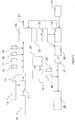
- figure 1 is not to scale.
- an additive polymer formulation is defined by giving parameter values, such as the proportions of polymer and additives, to a computer program implemented by a control unit 20.
- clumps a polymer material which is in the form of agglomerated solid and wet blocks, commonly called "clumps".
- These blocks have, for example, dimensions of between 100 x 100 x 100 mm and 500 x 500 x 500 mm, and more particularly between 200 x 200 x 200 mm and 400 x 400 x 200 mm.
- blocks of solid and wet material are deposited manually or, preferably, automated, on an introduction means 11 such as a conveyor belt, then introduced into a first mill 12 where they are ground, step 50 of the figure 2 .
- the blocks are crushed while being dried by a hot gas, generally air, from a first hot gas production means 13, such as a fan or a blower, for example.
- the ground and partially dried material is then removed from the mill 12 and then conveyed by a suitable transport means 14 such as a conveyor belt or pipe to a solid / gas separation means such as a filter.
- a suitable transport means 14 such as a conveyor belt or pipe to a solid / gas separation means such as a filter.
- first additives are determined in the course of dosing steps 51 and 52 illustrated in FIGS. figure 2 .
- the first electronic control unit 20 such as a metering cabinet, controls each first metering device 17 to 19 to deliver a quantity of a first additive which is a function of a predetermined formulation parameterized in this unit. order 20.
- step 55 of the figure 2 inside the solid / gas separation means is separation, step 55 of the figure 2 , all of the crushed and partially dried material and first additives and hot air, the latter being largely expelled to an outlet 21.
- the whole milled and partially dried material and first additives are then directed to a mixer 22 where it is mixed, step 56 of the figure 2 , so that each first additive is incorporated well and homogeneously to the ground material.
- Mixer 22 also temporarily and temporarily stores the mixture before it is removed and conveyed by gravity or pneumatic transport into a particle separator 23, such as a sieve, in which the larger particles are separated from the smaller ones. 57 of the figure 2 .
- a particle separator 23 such as a sieve
- the large particles are then sent by gravity or pneumatic transport to a second mill 24 where they are ground, step 58 of the figure 2 while being dried by a hot gas, usually air, from a second hot gas producing means 25, such as a fan or a blower. Then, the larger particles, crushed and partially dried, as well as hot air are returned, step 59 of the figure 2 in the solid / gas separation means 15.
- a hot gas usually air
- a second hot gas producing means 25 such as a fan or a blower
- the smaller particles are sent by gravity or pneumatic transport to a second mixer 26 in which they are mixed, step 60 of the figure 2 between them before being supplied to a suitable transport means 27 such as a conveyor belt or pipe for transport to a conditioning means 28.
- a suitable transport means 27 such as a conveyor belt or pipe for transport to a conditioning means 28.
- the smaller particles are preferably added with a precise amount of a second additive by a second metering device 29, and optionally another precise quantity of another second additive by another second metering device. , and where appropriate other precise amounts of other second additives by other second metering devices not shown in the figure.
- the aforementioned first electronic control unit 20 also controls each second doser 29 and 30 so that it delivers a quantity of second additive which is also a function of the predetermined formulation parameterized in the control unit 20.
- the obtained dry granular additive polymer material is conditioned, step 61 of the figure 2 in a known manner.
- a second metering device 29 has the advantage of allowing proportional recycling of the conforming or non-compliant dry polymer materials.
- A between 12 and 14 for dry polymer materials, the particle size of which does not comply.
- B between 27 and 30 for dry polymer materials, whose grain size is in accordance.
- a second electronic control unit 31 for controlling the operation of the grinders 12 and 24, the transport means 14 and 27, the separation means 15 and 23, the mixers 22 and 26 as well as the means of production hot gas 13 and 25.
- the first control unit 20 and the second control unit 31 are provided to cooperate with each other.
- the additives are preferably pulverulent, that is to say that they have a particle size, measured by sieving, of at most 100 microns. Preferably, their particle size is less than 50 microns.
- the second control unit 31 adjusts the particle separator 23 so that only particles having a particle size less than 2000 microns pass through.
- the starting polymeric material may have a moisture content of between 2% and 30%. It may consist of a single polymer or a mixture of polymers of various kinds. By way of example, mention may be made of polymers group consisting of polymers of the styrene-butadiene-styrene (“SBS”), styrene-ethylene-butadiene-styrene (“SEBS”) or butadiene-acrylonitrile (“NBR”) type, fluoropolymers, polymers obtained by coagulation or wet, fluorinated elastomers with high viscosity that can not be extrusion dried and high molecular weight polymers, such as polyphthalamide (“PPA”) with a density of 1.8.
- SBS styrene-butadiene-styrene
- SEBS styrene-ethylene-butadiene-styrene
- NBR butadiene-acrylonitrile
- fluoropolymers polymers obtained
- first additives mention may be made, for example, of silica, talc, polyphthalamides ("PPA”), antioxidants such as those sold under the trademark IRGANOX, calcium carbonate, barium sulfate.
- PPA polyphthalamides
- antioxidants such as those sold under the trademark IRGANOX
- calcium carbonate calcium carbonate
- barium sulfate calcium carbonate
- the first addition may be at a temperature between 70 ° C and 80 ° C.
- second additives mention may be made of polyethylene glycol (“PEG”) and polyphthalamides (“PPA”) such as those recycled because of nonconformity or lack of quality. Of course, a mixture of PEG and PPA can be used. Preferably, polyethylene glycol is used. It is noted that the second additives may represent, in the final product, more than half of the mass. The second addition may be at a temperature below 40 ° C.
- the distribution of the additives between the first metering units and the second metering units takes into account the difference in humidity in the material and the difference in temperature of the material, humidity and temperature which decrease during the course of the material in the device and during the process.
- the additives have the function of preserving the final product, for example for two years, to prevent it from forming aggregates.
- the additives are compatible with the intended subsequent uses of the final product. For example, they are food grade when using the final product in the food industry, for example in the form of films.
- the second mill 24 is provided to provide at its outlet micronized particles, that is to say having a particle size of between 30 and 2000 microns.
- the second control unit 31 regulates the first hot gas production means 13 supplying the first mill 12 and / or the second hot gas production means 25 supplying the second mill 24 so that the percentage residual moisture of the granular additive polymer material arriving in the conditioning means is less than 1%. In some cases, it is even possible to obtain an end product having a residual moisture content of less than 0.15%.
- the method and the device described with reference to the figures makes it possible to obtain, from a discontinuous feed of starting material, a smooth, continuous output of final material.
- this method and this device make it possible, whatever the moisture content of the starting material, provided that this level is at most 30% by weight relative to the total weight of material, to lead to a material final with a moisture content always lower than 1%.
- This method and this device make it possible to obtain a dry micronized material, regardless of the percentage of moisture contained in the starting solid material.
- the control units 20 and 31 manage to establish a continuous flow of dry micronized material and with a stabilized flow rate, which makes it possible to inject the additives with the aid of the feeders in accordance with the predetermined percentages for the formulation chosen and this, regardless of the percentage of moisture contained in the moist solid material introduced by the introduction means 11 into the mill 12.
- the introduction means 11 is an introduction means which makes it possible to dose and therefore to regulate the flow (mass, time) of entry of the starting solid and wet material into the mill 12.
- Obtaining the desired particle size is obtained by the mill 12 and / or the second mill 24 which receives (s) the material from the introduction means 11 and / or the particle separator, or sieve, 23.
- the mill 12 is configured to reduce the solid and moist material to particles of about 10 mm and the mill 17 further lowers the particle size of the previously crushed material and sieved, so as to produce fine particles, that is to say having preferentially a particle size less than 2000 microns and preferably micronized.
- the mixer 22 acts not only to mix but also to contribute to regulating the flow rate of the solid material ground a first time, by increasing its residence time, the latter being, for example, about 17 minutes but which can be varied by setting.
- Each first feeder 16 to 19 also stabilizes the flow rate of the material which has been ground a first time and mixed with the first additives.
- Each first doser divides the flow, according to the desired particle size, which is variable by adjustment.
- the mixer 26 stabilizes and continues the mixing of the micronized and dry material and the first additives. Preferably, the mixer 26 doses per overflow the materials before transporting them by the transport means 27 to the conditioning means 28.
- the means for producing hot gas, 13 and 25, which are for example blowers, provide a large volume of filtered hot air which is injected into the grinders 12 and 24 and into the pipes between the various elements of the device in order to evaporate the water contained in the materials, that is to say the starting material and additives.
- the charged air, even saturated with water, is released into the atmosphere via the outlet 21.
- the second feeders 29 and 30 serve to introduce in the stream of dry granular material preferably granular or powdery additives, depending on the formulation and the beginning of the dry milled material, for example micronized.
- the first control unit 20 known in itself, comprises a logic sub-unit which makes it possible to parameterize and manage formulations of different additives via the first and second proportioners, as a function of the apparent density, or " MVA ", these additives, and this in proportion to the wet solid material introduced by the introduction means 11.
- This first control unit 20 also allows the implementation of signals making it possible to automatically manage the defects of the means 11, 22, 23 and 26 and the first proportioners 16, 17, 18, 19 and second proportioners 29, 30 in a predefined order if they work, so as not to disturb the stabilized flow of material and additives in the device according to the invention.
- the second control unit 31 is also known in itself and it comprises a logic sub-unit which makes it possible to parameterize and manage the operation of the various means constituting the device according to the invention. In particular, it can regulate the temperature of the means for producing hot gas, 13 and 25, which are for example blowers, depending on the temperature in the mills 12 and 24.
- the second control unit 31 is preferably connected to the first control unit 20 in order to cooperate with it.
- PPA Complementary polyphthalamide
- Polyphthalamide balls are deposited on the introduction means 11 and then crushed. Silica, talc and calcium carbonate are delivered respectively by the first metering units 16, 17 and 18.
- the finished product is packaged in plastic bags, themselves packaged in cartons, under the packaging hopper, inside a box. gray room.
- Additives are dosed continuously.
- the total cycle time for a 10 kg dry weight starter ball is 320 seconds, ie one ball is placed on the measuring mat every 320 seconds.
- the starting material the polyphthalamide bales, has a moisture content of twenty percent by weight, i.e., each bale weighs a total of 12.5 kg.
- PPA Complementary polyphthalamide
- Polyphthalamide balls are deposited on the introduction means 11 and then crushed.
- Silica, talc and calcium carbonate are delivered respectively by the metering units 16, 17 and 18.
- PEG polyethylene glycol
- the finished product is packaged in plastic bags and cartons under the packaging hopper, inside a gray room.
- Additives are dosed continuously.
- the total cycle time for a twelve kilogram ball of starting material is 327 seconds.
- PPA Complementary polyphthalamide
- Polyphthalamide balls are deposited on the introduction means 11 and then crushed.
- Talcum, recycled polyphthalamide, calcium carbonate and antioxidant brand IRGANOX are delivered respectively by the proportioners 16, 17, 18 and 19.
- Additives are dosed continuously.
- the total cycle time for a ball of 12.5 kilograms of starting material is 100 seconds.
Landscapes
- Engineering & Computer Science (AREA)
- Mechanical Engineering (AREA)
- General Engineering & Computer Science (AREA)
- Chemical & Material Sciences (AREA)
- Chemical Kinetics & Catalysis (AREA)
- Compositions Of Macromolecular Compounds (AREA)
- Processing And Handling Of Plastics And Other Materials For Molding In General (AREA)
- Processes Of Treating Macromolecular Substances (AREA)
Claims (15)
- Verfahren für den Erhalt eines trockenen körnigen additivierten Polymermaterials, das einen ersten Schritt (50) zum Zerkleinern von Blöcken eines Ausgangspolymermaterials in einem ersten Zerkleinerer (12) umfasst, der mit heißem Gas versorgt wird, um ein zerkleinertes Polymermaterial in Form von Teilchen zu erhalten, weiter umfassend:- einen ersten Schritt (51, 16 bis 19) zum Dosieren von mindestens einem ersten Additiv,- einen ersten Schritt (53, 16 bis 19) zum Beigeben zu den Teilchen aus zerkleinertem Polymermaterial jedes ersten dosierten Additivs;- einen Schritt (55, 15) zum Trennen von Feststoff/Gas im Laufe dessen man die Feststoffe und das feuchte Gas aus dem ersten Schritt zum Beigeben trennt;- einen ersten Schritt (56) zum Mischen der Feststoffe durch Anwenden eines Mischers (22);- einen Schritt (57, 23) zum Trennen von Teilchen zum Trennen der größeren Teilchen aus dem Mischer (22) von den kleineren Teilchen aus dem Mischer (22);- einen zweiten Schritt (58) zum Zerkleinern der größeren Teilchen mit einem zweiten Zerkleinerer (24) der mit heißem Gas versorgt wird,- einen Schritt (59) zur erneuten Injektion der Teilchen aus dem zweiten Schritt (58, 24) zum Zerkleinern, um sie zum Schritt (15) zum Trennen von Feststoff/Gas zurückzuführen,- einen Schritt (61, 28) zum Konditionieren der kleineren gemischten Teilchen, die aus trockenem körnigem additiviertem Polymermaterial gebildet werden.
- Verfahren nach Anspruch 1, wobei man das zerkleinerte Polymermaterial im Laufe des ersten Schrittes (53) zum Beigeben jedes ersten dosierten Additivs zu einem Mittel (15) zum Trennen von Feststoff/Gas transportiert, das den Schritt zum Trennen von Feststoff/Gas durchführt.
- Verfahren nach einem der Ansprüche 1 oder 2, das weiter einen zweiten Schritt (60,26) zum Mischen der kleineren Teilchen aus dem Schritt (57, 23) zum Trennen von Teilchen vor dem Schritt (61, 28) zum Konditionieren umfasst.
- Verfahren nach einem der Ansprüche 1 bis 3, wobei jedes erste Additiv aus der Gruppe ausgewählt wird, die aus Kieselsäure, Talk, Polyphtalamiden ("PPA"), Antioxidantien, Kalziumkarbonat, Bariumsulfat und Gemischen dieser Verbindungen besteht.
- Verfahren nach einem der Ansprüche 1 à 4, das weiter umfasst:- einen zweiten Schritt (52, 29, 30) zum Dosieren von mindestens einem zweiten Additiv,- einen zweiten Schritt (54) zum Beigeben zu den kleinsten Teilchen aus dem Schritt (57, 23) zum Trennen von Teilchen, jedes zweiten dosierten Additivs.
- Verfahren nach Anspruch 5, wobei jedes zweite Additiv aus der Gruppe ausgewählt wird, die aus Polyethylenglycol ("PEG"), Polyphtalamiden ("PPA") und deren Gemischen besteht.
- Verfahren nach einem der Ansprüche 1 bis 6, wobei die Additive eine Korngröße von höchstens 100 Mikron aufweisen und wobei im Laufe des Schrittes (57, 23) zum Trennen von Teilchen die kleineren Teilchen eine Korngröße von weniger als 2000 Mikron aufweisen.
- Verfahren nach einem der Ansprüche 1 bis 7, wobei das Ausgangspolymermaterial mindestens ein Polymer umfasst, das aus der Gruppe ausgewählt wird, die aus den Polymeren des Typs Styrol-Butadien-Styrol ("SBS"), Styrol-Ethylen-Butadien-Styrol ("SEBS") oder Butadien-Acrylnitril ("NBR"), Fluorpolymeren, Polymeren, die durch Koagulation oder durch Nassverfahren erhalten werden, Fluorpolymeren mit hoher Viskosität und Polymeren mit hohem Molekulargewicht, besteht, der nicht extrudiert werden kann.
- Vorrichtung für den Erhalt eines trockenen körnigen additivierten Polymermaterials, die einen ersten Zerkleinerer (12) für Blöcke eines Ausgangspolymermaterials umfasst, der mit heißem Gas versorgt wird, um ein zerkleinertes Polymermaterial in Form von Teilchen zu erhalten, weiter umfassend:- ein erstes Mittel (16 bis 19) zum Dosieren von mindestens einem ersten Additiv und zum Beigeben zu den Teilchen aus zerkleinertem Polymermaterial jedes ersten dosierten Additivs;- ein Mittel zum Trennen (15) von Feststoff/Gas zum Trennen von Feststoffen und dem feuchten Gas aus dem ersten Mittel zum Beigeben;- einen ersten Mischer (22) zum Mischen der Feststoffe;- eine Trenneinrichtung (23) für Teilchen zum Trennen der größeren Teilchen aus dem Mischer von den kleineren Teilchen aus dem Mischer;- einen zweiten Zerkleinerer (24) zum Zerkleinern der größeren Teilchen, der mit heißem Gas versorgt wird,- ein Mittel zur erneuten Injektion der Teilchen aus dem zweiten Zerkleinerer herauskommen, in das Mittel zum Trennen (15) von Feststoff/Gas und- ein Mittel (28) zum Konditionieren der kleineren gemischten Teilchen, die aus trockenem körnigem additiviertem Polymermaterial gebildet werden.
- Vorrichtung nach Anspruch 9, wobei das erste Mittel (16 à 19) zum Dosieren und zum Beigeben jedes ersten dosierten Additivs konfiguriert ist, um das zerkleinerte Polymermaterial zum Mittel zum Trennen (15) von Feststoff/Gas zu transportieren.
- Vorrichtung nach einem der Ansprüche 9 oder 10, die weiter einen zweiten Mischer (26) zum Mischen der kleineren Teilchen aus der Trenneinrichtung (23) für Teilchen umfasst.
- Vorrichtung nach einem der Ansprüche 9 bis 10, wobei das erste Mittel zum Dosieren konfiguriert ist, um mindestens ein erstes Additiv zuzuführen, das aus der Gruppe ausgewählt wird, die aus Kieselsäure, Talk, Polyphtalamiden ("PPA"), Antioxidantien, Kalziumkarbonat, dem Bariumsulfat und den Gemischen dieser Verbindungen besteht.
- Vorrichtung nach einem der Ansprüche 9 bis 12, die weiter umfasst:- ein zweites Mittel (29, 30) zum Dosieren von mindestens einem zweiten Additiv,- ein zweites Mittel (29, 30) zum Beigeben zu den kleinsten Teilchen aus der Trenneinrichtung (23) von Teilchen jedes zweiten dosierten Additivs.
- Vorrichtung nach Anspruch 13, wobei das zweite Mittel zum Dosieren konfiguriert ist, um mindestens ein zweites Additiv bereitzustellen, das aus der Gruppe ausgewählt wird, die aus dem Polyethylenglycol ("PEG"), Polyphtalamiden ("PPA") und deren Gemischen besteht.
- Vorrichtung nach einem der Ansprüche 9 bis 14, wobei der erste Zerkleinerer konfiguriert ist, um Polymermaterial bereitzustellen, das mindestens ein Polymer umfasst, das aus der Gruppe ausgewählt wird, die aus den Polymeren des Typs Styrol-Butadien-Styrol ("SBS"), Styrol-Ethylen-Butadien-Styrol ("SEBS") oder Butadien-Acrylnitril ("NBR"), Fluorpolymeren, Polymeren, die durch Koagulation oder durch Nassverfahren erhalten werden, Fluorpolymeren mit hoher Viskosität und Polymeren mit hohem Molekulargewicht, besteht, der nicht extrudiert werden kann.
Priority Applications (1)
| Application Number | Priority Date | Filing Date | Title |
|---|---|---|---|
| EP14704557.9A EP2956285B1 (de) | 2013-02-12 | 2014-02-11 | Verfahren und vorrichtung zur kontinuierlichen gewinnung eines durch ein trockenes granuliertes additiv verstärkten polymermaterials |
Applications Claiming Priority (4)
| Application Number | Priority Date | Filing Date | Title |
|---|---|---|---|
| EP13356001 | 2013-02-12 | ||
| FR1357864A FR3001910B1 (fr) | 2013-02-12 | 2013-08-07 | Procede et dispositif pour l'obtention en continu d'un materiau polymere additive granulaire sec. |
| PCT/EP2014/052672 WO2014124947A1 (fr) | 2013-02-12 | 2014-02-11 | Procedé et dispositif pour l'obtention en continu d'un matériau polymère additivé granulaire sec |
| EP14704557.9A EP2956285B1 (de) | 2013-02-12 | 2014-02-11 | Verfahren und vorrichtung zur kontinuierlichen gewinnung eines durch ein trockenes granuliertes additiv verstärkten polymermaterials |
Publications (2)
| Publication Number | Publication Date |
|---|---|
| EP2956285A1 EP2956285A1 (de) | 2015-12-23 |
| EP2956285B1 true EP2956285B1 (de) | 2018-03-28 |
Family
ID=47877960
Family Applications (1)
| Application Number | Title | Priority Date | Filing Date |
|---|---|---|---|
| EP14704557.9A Active EP2956285B1 (de) | 2013-02-12 | 2014-02-11 | Verfahren und vorrichtung zur kontinuierlichen gewinnung eines durch ein trockenes granuliertes additiv verstärkten polymermaterials |
Country Status (3)
| Country | Link |
|---|---|
| EP (1) | EP2956285B1 (de) |
| FR (1) | FR3001910B1 (de) |
| WO (1) | WO2014124947A1 (de) |
Families Citing this family (1)
| Publication number | Priority date | Publication date | Assignee | Title |
|---|---|---|---|---|
| CH712233A2 (de) * | 2016-03-15 | 2017-09-15 | Arcolor Ag | Verfahren zur Herstellung von Dispersionen mit definierter Partikelgrösse. |
Family Cites Families (7)
| Publication number | Priority date | Publication date | Assignee | Title |
|---|---|---|---|---|
| FR2167291A5 (en) * | 1972-01-12 | 1973-08-24 | Guerin Robert | Drying moist materials - partic manure, fodder and clays |
| US5375778A (en) * | 1991-10-21 | 1994-12-27 | Lundquist; Lynn C. | Continuous method for reclaiming plastic scrap |
| DE4327164A1 (de) * | 1993-08-09 | 1995-02-16 | Helmut Prof Dr Kaeufer | Verfahren zur direkten Verarbeitung von Altprodukten aus Thermoplasten zu Halbzeugen oder Fertigprodukten |
| US6270708B1 (en) * | 1999-03-12 | 2001-08-07 | Tamer International, Ltd. | Agglomerating and drying apparatus |
| TW445202B (en) * | 1999-11-02 | 2001-07-11 | Nippon Kokan Kk | Molded lump and its production method thereof |
| US7207505B2 (en) * | 2004-06-04 | 2007-04-24 | Bender Martin P | Method for producing small granules |
| FR2933326A1 (fr) * | 2008-07-02 | 2010-01-08 | Alain Lejosne | Appareil de production de granules a partir de vegetaux |
-
2013
- 2013-08-07 FR FR1357864A patent/FR3001910B1/fr not_active Expired - Fee Related
-
2014
- 2014-02-11 EP EP14704557.9A patent/EP2956285B1/de active Active
- 2014-02-11 WO PCT/EP2014/052672 patent/WO2014124947A1/fr not_active Ceased
Also Published As
| Publication number | Publication date |
|---|---|
| FR3001910B1 (fr) | 2015-05-01 |
| FR3001910A1 (fr) | 2014-08-15 |
| WO2014124947A1 (fr) | 2014-08-21 |
| EP2956285A1 (de) | 2015-12-23 |
Similar Documents
| Publication | Publication Date | Title |
|---|---|---|
| US8871345B2 (en) | Method for producing composite pellet for extrusion molding, and composite pellet for extrusion molding produced by the method | |
| US6544452B1 (en) | Polymer processing method and tablet-forming apparatus | |
| US20150023742A1 (en) | Device for feeding granulate and filler material to an extruder screw of an extruder | |
| EP1273412A1 (de) | Verfahren und Vorrichtung zum Herstellen von gefüllten thermoplastischen Polymeren | |
| US20130119575A1 (en) | Plastic Waste Recycling Apparatus and System | |
| EP0737123B1 (de) | Verfahren zur behandlung eines talkumpuders bei dem einbringen in eine kunststoffmasse | |
| EP2928944B1 (de) | Bituminöse zusammensetzung in form von granulaten und ihr herstellungsverfahren | |
| US20140234463A1 (en) | Powder filling device with redundant powder collection mechanism, and rotary compression molding machine | |
| CN112638617B (zh) | 挤出机的控制方法以及使用了该挤出机的控制方法的香味源的制造方法、和挤出机以及使用了该挤出机的挤出成型系统 | |
| EP2956285B1 (de) | Verfahren und vorrichtung zur kontinuierlichen gewinnung eines durch ein trockenes granuliertes additiv verstärkten polymermaterials | |
| RU2486850C1 (ru) | Линия производства гранулированных комбикормов | |
| EP1730255B1 (de) | Verfahren und anlage zur herstellung eines aus abfall gewonnenen festen brennstoffs | |
| WO2001093698A1 (en) | Method for producing pelletized fuzzy cottonseed | |
| CA2723467C (en) | An extrusion method and a plant therefor | |
| DK2828058T3 (en) | Process and plant for continuous manufacture of a composite containing a matrix of a polymer and natural fibers | |
| EP0955082A1 (de) | Verfahren und Anlage zur Herstellung von Granulaten aus pulverigem Rohmaterial und Granulate daraus | |
| RU2817769C1 (ru) | Линия производства функциональных псевдокапсулированных комбикормов | |
| CN1303236A (zh) | 口香糖的弹体制备装置 | |
| RU2451600C1 (ru) | Линия производства функциональных псевдокапсулированных аквакормов | |
| RU2686635C1 (ru) | Линия производства экструдированных комбикормов | |
| WO2024013248A1 (fr) | Procede de fabrication d'un panneau isolant opitimise, panneau isolant et structure isolante comportant un tel panneau | |
| FR2904826A1 (fr) | Mortier ou beton sec ne presentant pas de segregation. | |
| US264035A (en) | Process of and apparatus for the manufacture of saccharine compounds | |
| CA2178336C (fr) | Procede de traitement d'une poudre de talc en vue de l'incorporer dans une matiere thermoplastique | |
| FI121700B (fi) | Menetelmä ja laitteisto syötön raaka-aineen homogenisoimiseksi |
Legal Events
| Date | Code | Title | Description |
|---|---|---|---|
| PUAI | Public reference made under article 153(3) epc to a published international application that has entered the european phase |
Free format text: ORIGINAL CODE: 0009012 |
|
| 17P | Request for examination filed |
Effective date: 20150810 |
|
| AK | Designated contracting states |
Kind code of ref document: A1 Designated state(s): AL AT BE BG CH CY CZ DE DK EE ES FI FR GB GR HR HU IE IS IT LI LT LU LV MC MK MT NL NO PL PT RO RS SE SI SK SM TR |
|
| AX | Request for extension of the european patent |
Extension state: BA ME |
|
| DAX | Request for extension of the european patent (deleted) | ||
| STAA | Information on the status of an ep patent application or granted ep patent |
Free format text: STATUS: EXAMINATION IS IN PROGRESS |
|
| 17Q | First examination report despatched |
Effective date: 20170131 |
|
| GRAP | Despatch of communication of intention to grant a patent |
Free format text: ORIGINAL CODE: EPIDOSNIGR1 |
|
| STAA | Information on the status of an ep patent application or granted ep patent |
Free format text: STATUS: GRANT OF PATENT IS INTENDED |
|
| RIC1 | Information provided on ipc code assigned before grant |
Ipc: B29B 9/16 20060101ALI20170809BHEP Ipc: B29B 9/02 20060101AFI20170809BHEP Ipc: F26B 1/00 20060101ALI20170809BHEP Ipc: B01F 13/10 20060101ALN20170809BHEP Ipc: B29B 9/12 20060101ALN20170809BHEP |
|
| INTG | Intention to grant announced |
Effective date: 20170823 |
|
| GRAS | Grant fee paid |
Free format text: ORIGINAL CODE: EPIDOSNIGR3 |
|
| GRAA | (expected) grant |
Free format text: ORIGINAL CODE: 0009210 |
|
| STAA | Information on the status of an ep patent application or granted ep patent |
Free format text: STATUS: THE PATENT HAS BEEN GRANTED |
|
| AK | Designated contracting states |
Kind code of ref document: B1 Designated state(s): AL AT BE BG CH CY CZ DE DK EE ES FI FR GB GR HR HU IE IS IT LI LT LU LV MC MK MT NL NO PL PT RO RS SE SI SK SM TR |
|
| REG | Reference to a national code |
Ref country code: GB Ref legal event code: FG4D Free format text: NOT ENGLISH |
|
| REG | Reference to a national code |
Ref country code: CH Ref legal event code: EP |
|
| REG | Reference to a national code |
Ref country code: AT Ref legal event code: REF Ref document number: 982987 Country of ref document: AT Kind code of ref document: T Effective date: 20180415 |
|
| REG | Reference to a national code |
Ref country code: IE Ref legal event code: FG4D Free format text: LANGUAGE OF EP DOCUMENT: FRENCH |
|
| REG | Reference to a national code |
Ref country code: DE Ref legal event code: R096 Ref document number: 602014022933 Country of ref document: DE |
|
| PG25 | Lapsed in a contracting state [announced via postgrant information from national office to epo] |
Ref country code: FI Free format text: LAPSE BECAUSE OF FAILURE TO SUBMIT A TRANSLATION OF THE DESCRIPTION OR TO PAY THE FEE WITHIN THE PRESCRIBED TIME-LIMIT Effective date: 20180328 Ref country code: NO Free format text: LAPSE BECAUSE OF FAILURE TO SUBMIT A TRANSLATION OF THE DESCRIPTION OR TO PAY THE FEE WITHIN THE PRESCRIBED TIME-LIMIT Effective date: 20180628 Ref country code: LT Free format text: LAPSE BECAUSE OF FAILURE TO SUBMIT A TRANSLATION OF THE DESCRIPTION OR TO PAY THE FEE WITHIN THE PRESCRIBED TIME-LIMIT Effective date: 20180328 Ref country code: HR Free format text: LAPSE BECAUSE OF FAILURE TO SUBMIT A TRANSLATION OF THE DESCRIPTION OR TO PAY THE FEE WITHIN THE PRESCRIBED TIME-LIMIT Effective date: 20180328 |
|
| REG | Reference to a national code |
Ref country code: NL Ref legal event code: MP Effective date: 20180328 |
|
| REG | Reference to a national code |
Ref country code: LT Ref legal event code: MG4D |
|
| PG25 | Lapsed in a contracting state [announced via postgrant information from national office to epo] |
Ref country code: GR Free format text: LAPSE BECAUSE OF FAILURE TO SUBMIT A TRANSLATION OF THE DESCRIPTION OR TO PAY THE FEE WITHIN THE PRESCRIBED TIME-LIMIT Effective date: 20180629 Ref country code: BG Free format text: LAPSE BECAUSE OF FAILURE TO SUBMIT A TRANSLATION OF THE DESCRIPTION OR TO PAY THE FEE WITHIN THE PRESCRIBED TIME-LIMIT Effective date: 20180628 Ref country code: RS Free format text: LAPSE BECAUSE OF FAILURE TO SUBMIT A TRANSLATION OF THE DESCRIPTION OR TO PAY THE FEE WITHIN THE PRESCRIBED TIME-LIMIT Effective date: 20180328 Ref country code: SE Free format text: LAPSE BECAUSE OF FAILURE TO SUBMIT A TRANSLATION OF THE DESCRIPTION OR TO PAY THE FEE WITHIN THE PRESCRIBED TIME-LIMIT Effective date: 20180328 Ref country code: LV Free format text: LAPSE BECAUSE OF FAILURE TO SUBMIT A TRANSLATION OF THE DESCRIPTION OR TO PAY THE FEE WITHIN THE PRESCRIBED TIME-LIMIT Effective date: 20180328 |
|
| PG25 | Lapsed in a contracting state [announced via postgrant information from national office to epo] |
Ref country code: MT Free format text: LAPSE BECAUSE OF FAILURE TO SUBMIT A TRANSLATION OF THE DESCRIPTION OR TO PAY THE FEE WITHIN THE PRESCRIBED TIME-LIMIT Effective date: 20180328 |
|
| PG25 | Lapsed in a contracting state [announced via postgrant information from national office to epo] |
Ref country code: PL Free format text: LAPSE BECAUSE OF FAILURE TO SUBMIT A TRANSLATION OF THE DESCRIPTION OR TO PAY THE FEE WITHIN THE PRESCRIBED TIME-LIMIT Effective date: 20180328 Ref country code: NL Free format text: LAPSE BECAUSE OF FAILURE TO SUBMIT A TRANSLATION OF THE DESCRIPTION OR TO PAY THE FEE WITHIN THE PRESCRIBED TIME-LIMIT Effective date: 20180328 Ref country code: EE Free format text: LAPSE BECAUSE OF FAILURE TO SUBMIT A TRANSLATION OF THE DESCRIPTION OR TO PAY THE FEE WITHIN THE PRESCRIBED TIME-LIMIT Effective date: 20180328 Ref country code: ES Free format text: LAPSE BECAUSE OF FAILURE TO SUBMIT A TRANSLATION OF THE DESCRIPTION OR TO PAY THE FEE WITHIN THE PRESCRIBED TIME-LIMIT Effective date: 20180328 Ref country code: RO Free format text: LAPSE BECAUSE OF FAILURE TO SUBMIT A TRANSLATION OF THE DESCRIPTION OR TO PAY THE FEE WITHIN THE PRESCRIBED TIME-LIMIT Effective date: 20180328 Ref country code: AL Free format text: LAPSE BECAUSE OF FAILURE TO SUBMIT A TRANSLATION OF THE DESCRIPTION OR TO PAY THE FEE WITHIN THE PRESCRIBED TIME-LIMIT Effective date: 20180328 |
|
| PG25 | Lapsed in a contracting state [announced via postgrant information from national office to epo] |
Ref country code: SK Free format text: LAPSE BECAUSE OF FAILURE TO SUBMIT A TRANSLATION OF THE DESCRIPTION OR TO PAY THE FEE WITHIN THE PRESCRIBED TIME-LIMIT Effective date: 20180328 Ref country code: SM Free format text: LAPSE BECAUSE OF FAILURE TO SUBMIT A TRANSLATION OF THE DESCRIPTION OR TO PAY THE FEE WITHIN THE PRESCRIBED TIME-LIMIT Effective date: 20180328 Ref country code: CZ Free format text: LAPSE BECAUSE OF FAILURE TO SUBMIT A TRANSLATION OF THE DESCRIPTION OR TO PAY THE FEE WITHIN THE PRESCRIBED TIME-LIMIT Effective date: 20180328 |
|
| REG | Reference to a national code |
Ref country code: AT Ref legal event code: MK05 Ref document number: 982987 Country of ref document: AT Kind code of ref document: T Effective date: 20180328 |
|
| PG25 | Lapsed in a contracting state [announced via postgrant information from national office to epo] |
Ref country code: PT Free format text: LAPSE BECAUSE OF FAILURE TO SUBMIT A TRANSLATION OF THE DESCRIPTION OR TO PAY THE FEE WITHIN THE PRESCRIBED TIME-LIMIT Effective date: 20180730 |
|
| REG | Reference to a national code |
Ref country code: DE Ref legal event code: R097 Ref document number: 602014022933 Country of ref document: DE |
|
| PG25 | Lapsed in a contracting state [announced via postgrant information from national office to epo] |
Ref country code: DK Free format text: LAPSE BECAUSE OF FAILURE TO SUBMIT A TRANSLATION OF THE DESCRIPTION OR TO PAY THE FEE WITHIN THE PRESCRIBED TIME-LIMIT Effective date: 20180328 Ref country code: AT Free format text: LAPSE BECAUSE OF FAILURE TO SUBMIT A TRANSLATION OF THE DESCRIPTION OR TO PAY THE FEE WITHIN THE PRESCRIBED TIME-LIMIT Effective date: 20180328 |
|
| PLBE | No opposition filed within time limit |
Free format text: ORIGINAL CODE: 0009261 |
|
| STAA | Information on the status of an ep patent application or granted ep patent |
Free format text: STATUS: NO OPPOSITION FILED WITHIN TIME LIMIT |
|
| PG25 | Lapsed in a contracting state [announced via postgrant information from national office to epo] |
Ref country code: IT Free format text: LAPSE BECAUSE OF FAILURE TO SUBMIT A TRANSLATION OF THE DESCRIPTION OR TO PAY THE FEE WITHIN THE PRESCRIBED TIME-LIMIT Effective date: 20180328 |
|
| 26N | No opposition filed |
Effective date: 20190103 |
|
| PG25 | Lapsed in a contracting state [announced via postgrant information from national office to epo] |
Ref country code: SI Free format text: LAPSE BECAUSE OF FAILURE TO SUBMIT A TRANSLATION OF THE DESCRIPTION OR TO PAY THE FEE WITHIN THE PRESCRIBED TIME-LIMIT Effective date: 20180328 |
|
| REG | Reference to a national code |
Ref country code: DE Ref legal event code: R119 Ref document number: 602014022933 Country of ref document: DE |
|
| REG | Reference to a national code |
Ref country code: CH Ref legal event code: PL |
|
| GBPC | Gb: european patent ceased through non-payment of renewal fee |
Effective date: 20190211 |
|
| PG25 | Lapsed in a contracting state [announced via postgrant information from national office to epo] |
Ref country code: MC Free format text: LAPSE BECAUSE OF FAILURE TO SUBMIT A TRANSLATION OF THE DESCRIPTION OR TO PAY THE FEE WITHIN THE PRESCRIBED TIME-LIMIT Effective date: 20180328 Ref country code: LU Free format text: LAPSE BECAUSE OF NON-PAYMENT OF DUE FEES Effective date: 20190211 |
|
| REG | Reference to a national code |
Ref country code: BE Ref legal event code: MM Effective date: 20190228 |
|
| REG | Reference to a national code |
Ref country code: IE Ref legal event code: MM4A |
|
| PG25 | Lapsed in a contracting state [announced via postgrant information from national office to epo] |
Ref country code: LI Free format text: LAPSE BECAUSE OF NON-PAYMENT OF DUE FEES Effective date: 20190228 Ref country code: CH Free format text: LAPSE BECAUSE OF NON-PAYMENT OF DUE FEES Effective date: 20190228 |
|
| PG25 | Lapsed in a contracting state [announced via postgrant information from national office to epo] |
Ref country code: DE Free format text: LAPSE BECAUSE OF NON-PAYMENT OF DUE FEES Effective date: 20190903 Ref country code: GB Free format text: LAPSE BECAUSE OF NON-PAYMENT OF DUE FEES Effective date: 20190211 Ref country code: IE Free format text: LAPSE BECAUSE OF NON-PAYMENT OF DUE FEES Effective date: 20190211 |
|
| PG25 | Lapsed in a contracting state [announced via postgrant information from national office to epo] |
Ref country code: BE Free format text: LAPSE BECAUSE OF NON-PAYMENT OF DUE FEES Effective date: 20190228 |
|
| PG25 | Lapsed in a contracting state [announced via postgrant information from national office to epo] |
Ref country code: TR Free format text: LAPSE BECAUSE OF FAILURE TO SUBMIT A TRANSLATION OF THE DESCRIPTION OR TO PAY THE FEE WITHIN THE PRESCRIBED TIME-LIMIT Effective date: 20180328 |
|
| PG25 | Lapsed in a contracting state [announced via postgrant information from national office to epo] |
Ref country code: CY Free format text: LAPSE BECAUSE OF FAILURE TO SUBMIT A TRANSLATION OF THE DESCRIPTION OR TO PAY THE FEE WITHIN THE PRESCRIBED TIME-LIMIT Effective date: 20180328 |
|
| PG25 | Lapsed in a contracting state [announced via postgrant information from national office to epo] |
Ref country code: IS Free format text: LAPSE BECAUSE OF FAILURE TO SUBMIT A TRANSLATION OF THE DESCRIPTION OR TO PAY THE FEE WITHIN THE PRESCRIBED TIME-LIMIT Effective date: 20180728 |
|
| PG25 | Lapsed in a contracting state [announced via postgrant information from national office to epo] |
Ref country code: HU Free format text: LAPSE BECAUSE OF FAILURE TO SUBMIT A TRANSLATION OF THE DESCRIPTION OR TO PAY THE FEE WITHIN THE PRESCRIBED TIME-LIMIT; INVALID AB INITIO Effective date: 20140211 |
|
| PG25 | Lapsed in a contracting state [announced via postgrant information from national office to epo] |
Ref country code: MK Free format text: LAPSE BECAUSE OF FAILURE TO SUBMIT A TRANSLATION OF THE DESCRIPTION OR TO PAY THE FEE WITHIN THE PRESCRIBED TIME-LIMIT Effective date: 20180328 |
|
| PGFP | Annual fee paid to national office [announced via postgrant information from national office to epo] |
Ref country code: FR Payment date: 20260109 Year of fee payment: 13 |