EP2956928B1 - Technologie de conversion vidéo - Google Patents
Technologie de conversion vidéo Download PDFInfo
- Publication number
- EP2956928B1 EP2956928B1 EP14752106.6A EP14752106A EP2956928B1 EP 2956928 B1 EP2956928 B1 EP 2956928B1 EP 14752106 A EP14752106 A EP 14752106A EP 2956928 B1 EP2956928 B1 EP 2956928B1
- Authority
- EP
- European Patent Office
- Prior art keywords
- modified
- color layer
- color
- stream
- video content
- Prior art date
- Legal status (The legal status is an assumption and is not a legal conclusion. Google has not performed a legal analysis and makes no representation as to the accuracy of the status listed.)
- Active
Links
Images


Classifications
-
- H—ELECTRICITY
- H04—ELECTRIC COMMUNICATION TECHNIQUE
- H04N—PICTORIAL COMMUNICATION, e.g. TELEVISION
- H04N7/00—Television systems
- H04N7/01—Conversion of standards, e.g. involving analogue television standards or digital television standards processed at pixel level
- H04N7/0117—Conversion of standards, e.g. involving analogue television standards or digital television standards processed at pixel level involving conversion of the spatial resolution of the incoming video signal
-
- G—PHYSICS
- G09—EDUCATION; CRYPTOGRAPHY; DISPLAY; ADVERTISING; SEALS
- G09G—ARRANGEMENTS OR CIRCUITS FOR CONTROL OF INDICATING DEVICES USING STATIC MEANS TO PRESENT VARIABLE INFORMATION
- G09G5/00—Control arrangements or circuits for visual indicators common to cathode-ray tube indicators and other visual indicators
- G09G5/003—Details of a display terminal, the details relating to the control arrangement of the display terminal and to the interfaces thereto
- G09G5/005—Adapting incoming signals to the display format of the display terminal
-
- G—PHYSICS
- G09—EDUCATION; CRYPTOGRAPHY; DISPLAY; ADVERTISING; SEALS
- G09G—ARRANGEMENTS OR CIRCUITS FOR CONTROL OF INDICATING DEVICES USING STATIC MEANS TO PRESENT VARIABLE INFORMATION
- G09G5/00—Control arrangements or circuits for visual indicators common to cathode-ray tube indicators and other visual indicators
- G09G5/02—Control arrangements or circuits for visual indicators common to cathode-ray tube indicators and other visual indicators characterised by the way in which colour is displayed
- G09G5/026—Control of mixing and/or overlay of colours in general
-
- G—PHYSICS
- G09—EDUCATION; CRYPTOGRAPHY; DISPLAY; ADVERTISING; SEALS
- G09G—ARRANGEMENTS OR CIRCUITS FOR CONTROL OF INDICATING DEVICES USING STATIC MEANS TO PRESENT VARIABLE INFORMATION
- G09G5/00—Control arrangements or circuits for visual indicators common to cathode-ray tube indicators and other visual indicators
- G09G5/14—Display of multiple viewports
-
- H—ELECTRICITY
- H04—ELECTRIC COMMUNICATION TECHNIQUE
- H04N—PICTORIAL COMMUNICATION, e.g. TELEVISION
- H04N21/00—Selective content distribution, e.g. interactive television or video on demand [VOD]
- H04N21/20—Servers specifically adapted for the distribution of content, e.g. VOD servers; Operations thereof
- H04N21/23—Processing of content or additional data; Elementary server operations; Server middleware
- H04N21/234—Processing of video elementary streams, e.g. splicing of video streams or manipulating encoded video stream scene graphs
- H04N21/2343—Processing of video elementary streams, e.g. splicing of video streams or manipulating encoded video stream scene graphs involving reformatting operations of video signals for distribution or compliance with end-user requests or end-user device requirements
- H04N21/234363—Processing of video elementary streams, e.g. splicing of video streams or manipulating encoded video stream scene graphs involving reformatting operations of video signals for distribution or compliance with end-user requests or end-user device requirements by altering the spatial resolution, e.g. for clients with a lower screen resolution
-
- H—ELECTRICITY
- H04—ELECTRIC COMMUNICATION TECHNIQUE
- H04N—PICTORIAL COMMUNICATION, e.g. TELEVISION
- H04N7/00—Television systems
- H04N7/01—Conversion of standards, e.g. involving analogue television standards or digital television standards processed at pixel level
- H04N7/0125—Conversion of standards, e.g. involving analogue television standards or digital television standards processed at pixel level one of the standards being a high definition standard
-
- H—ELECTRICITY
- H04—ELECTRIC COMMUNICATION TECHNIQUE
- H04N—PICTORIAL COMMUNICATION, e.g. TELEVISION
- H04N19/00—Methods or arrangements for coding, decoding, compressing or decompressing digital video signals
- H04N19/85—Methods or arrangements for coding, decoding, compressing or decompressing digital video signals using pre-processing or post-processing specially adapted for video compression
-
- H—ELECTRICITY
- H04—ELECTRIC COMMUNICATION TECHNIQUE
- H04N—PICTORIAL COMMUNICATION, e.g. TELEVISION
- H04N21/00—Selective content distribution, e.g. interactive television or video on demand [VOD]
- H04N21/40—Client devices specifically adapted for the reception of or interaction with content, e.g. set-top-box [STB]; Operations thereof
- H04N21/43—Processing of content or additional data, e.g. demultiplexing additional data from a digital video stream; Elementary client operations, e.g. monitoring of home network or synchronising decoder's clock; Client middleware
- H04N21/44—Processing of video elementary streams, e.g. splicing a video clip retrieved from local storage with an incoming video stream or rendering scenes according to encoded video stream scene graphs
- H04N21/4402—Processing of video elementary streams, e.g. splicing a video clip retrieved from local storage with an incoming video stream or rendering scenes according to encoded video stream scene graphs involving reformatting operations of video signals for household redistribution, storage or real-time display
- H04N21/440263—Processing of video elementary streams, e.g. splicing a video clip retrieved from local storage with an incoming video stream or rendering scenes according to encoded video stream scene graphs involving reformatting operations of video signals for household redistribution, storage or real-time display by altering the spatial resolution, e.g. for displaying on a connected PDA
Definitions
- This disclosure relates to video conversion technology.
- the “upconversion” process acquires an NTSC signal and simply “upconverts” or “blow ups” the image. This process addressed the dimensions and speed, but not the aliasing and increase of noise in the image.
- the “upconversion” was popularized in the 1990s when HD was first being sold.
- US 2012/0154527 A1 describes a 3-dimensional video rendering device that may convert a first left view video of a decompressed 3D video having a first frame rate to generate a second left view video having a second frame rate, and convert a first right view video having the first frame rate to generate a second right view video having the second frame rate.
- the second left view video having a particular pixel resolution may be converted by the 3D video rendering device to generate a third left view video having full pixel resolution of the decompressed 3D video.
- the second right view video having the particular pixel resolution may be converted to generate a third right view video having the full pixel resolution.
- the 3D video rendering device may generate a sequence of video frames for 3D video display based on the third left view video and the third right view video.
- WO 2012/012444 A2 describes enhancement methods for sampled and multiplexed image and video data. Each component picture is separately processed either after demultiplexing or on the fly.
- US 5,191,416 A describes an image processing system for converting a conventional lowresolution video signal to a format suitable for transfer to high-resolution film.
- EP 0320300 (A2 ) describes a television image processing system in which images from a composite or component RGB video source may be fed into a signal processing circuit where they are digitized for processing in real time, then reconverted to analog form and displayed on an RGB analog television screen. During this process, users can capture a frame of the digitized video at random and store it in digitized format as a full size image in the memory of the graphics.
- WO2006/015107A2 discloses converting non-linear image information to linear information prior to performing processing thereon.
- a method in one aspect, includes accessing a first stream of video content, the first stream of the video content having a first resolution. The method also includes extracting, from the first stream of the video content, multiple, different layers that each have the first resolution and separately processing each of the multiple, different layers to convert the multiple, different layers into modified layers that each have a second resolution that is higher than the first resolution. The method further includes reassembling, by at least one processor, the modified layers into a second stream of the video content storing, in electronic storage, the second stream of the video content. The second stream of the video content has the second resolution that is higher than the first resolution.
- Implementations may include one or more of the following features.
- the method may include extracting, from the first stream of the video content, multiple, different color layers that each correspond to a different color, separately processing each of the multiple, different color layers to convert the multiple, different color layers into modified color layers that each correspond to a different color, and reassembling the modified color layers into a second stream of the video content.
- the method may include extracting, from the first stream of the video content, a first layer, extracting, from the first stream of the video content, a second layer that is different than the first layer, and extracting, from the first stream of the video content, a third layer that is different than the first layer and the second layer.
- the method may include processing the first layer to convert the first layer into a modified first layer, processing the second layer to convert the second layer into a modified second layer that is different than the modified first layer, processing the third layer to convert the third layer into a modified third layer that is different than the modified first layer and the modified second layer, and reassembling the modified first layer, the modified second layer, and the modified third layer into a second stream of the video content.
- the method may include extracting, from the first stream of the video content, first images of a scene, extracting, from the first stream of the video content, second images of the scene, and extracting, from the first stream of the video content, third images of the scene.
- the second images of the scene may be a different representation of the scene than the first images of the scene and the third images of the scene may be a different representation of the scene than the first images of the scene and the second images of the scene.
- the method also may include processing the first images of the scene to convert the first images of the scene into modified first images of the scene that have a higher resolution than the first images of the scene, processing the second images of the scene to convert the second images of the scene into modified second images of the scene that have a higher resolution than the second images of the scene, and processing the third images of the scene to convert the third images of the scene into modified third images of the scene that have a higher resolution than the third images of the scene.
- the method further may include reassembling the modified first images of the scene, the modified second images of the scene, and the modified third images of the scene into a second stream of the video content.
- the method may include extracting, from the first stream of the video content, a first color layer, extracting, from the first stream of the video content, a second color layer that is different than the first color layer, and extracting, from the first stream of the video content, a third color layer that is different than the first color layer and the second color layer.
- the method may include processing the first color layer to convert the first color layer into a modified first color layer, processing the second color layer to convert the second color layer into a modified second color layer that is different than the modified first color layer, and processing the third color layer to convert the third color layer into a modified third color layer that is different than the modified first color layer and the modified second color layer.
- the method may include reassembling the modified first color layer, the modified second color layer, and the modified third color layer into the second stream of the video content.
- the method may include extracting, from the first stream of the video content, a red color layer, extracting, from the first stream of the video content, a green color layer that is different than the red color layer, and extracting, from the first stream of the video content, a blue color layer that is different than the red color layer and the green color layer.
- the method may include processing the red color layer to convert the red color layer into a modified red color layer, processing the green color layer to convert the green color layer into a modified green color layer that is different than the modified red color layer, and processing the blue color layer to convert the blue color layer into a modified blue color layer that is different than the modified red color layer and the modified green color layer.
- the method may include reassembling the modified red color layer, the modified green color layer, and the modified blue color layer into the second stream of the video content.
- the method may include identifying red color values in the first stream of the video content and separating the identified red color values into the red color layer.
- the method may include identifying green color values in the first stream of the video content and separating the identified green color values into the green color layer.
- the method may include identifying blue color values in the first stream of the video content and separating the identified blue color values into the blue color layer.
- the method may include extracting, from the first stream of the video content, first images of a scene that reflect red color values of the scene, extracting, from the first stream of the video content, second images of the scene that reflect green color values of the scene, and extracting, from the first stream of the video content, third images of the scene that reflect blue color values of the scene.
- the method may include processing the first images of the scene to convert the first images of the scene into modified first images of the scene that reflect red color values of the scene at a higher resolution than the first images of the scene, processing the second images of the scene to convert the second images of the scene into modified second images of the scene that reflect green color values of the scene at a higher resolution than the second images of the scene, and processing the third images of the scene to convert the third images of the scene into modified third images of the scene that reflect blue color values of the scene at a higher resolution than the third images of the scene. Further, in these examples, the method may include reassembling the modified first images of the scene, the modified second images of the scene, and the modified third images of the scene into the second stream of the video content.
- the method may include separately performing a blurring process on each of the multiple, different layers and, after performing the blurring process on each of the multiple, different layers, converting the multiple, different layers into modified layers that each have the second resolution that is higher than the first resolution.
- the method also may include separately performing a sharpening process on each of the multiple, different layers and, after performing the sharpening process on each of the multiple, different layers, converting the multiple, different layers into modified layers that each have the second resolution that is higher than the first resolution.
- the method further may include separately performing a chromatic adjustment process on each of the multiple, different layers and, after performing the chromatic adjustment process on each of the multiple, different layers, converting the multiple, different layers into modified layers that each have the second resolution that is higher than the first resolution.
- the method may include separately performing a de-interlace process on each of the multiple, different layers and, after performing the de-interlace process on each of the multiple, different layers, converting the multiple, different layers into modified layers that each have the second resolution that is higher than the first resolution.
- the method may include separately converting each of the multiple, different layers into modified layers that each have the second resolution that is higher than the first resolution and, after converting each of the multiple, different layers, changing a speed of each of the modified layers.
- the method may include extracting, from the first stream of the video content, multiple, different color layers that each correspond to a different color and separately processing each of the multiple, different color layers to convert the multiple, different color layers into modified color layers that each correspond to a different color.
- the method may include reassembling the modified color layers into a second stream of the video content by performing a chromatic level adjustment process that weights, in the second stream of the video content, a first color layer included in the modified color layers more heavily than a second, different color layer included in the modified color layers.
- the method may include identifying features that are present in each of the modified layers and using the identified features to align the modified layers in the second stream of the video content.
- the method may include accessing a first video signal in NTSC (National Television System Committee) format and reassembling the modified layers into a second video signal in a high definition format that has a higher resolution than the first video signal in the NTSC format.
- the method also may include accessing a standard definition television video program and reassembling the modified layers into a modified high definition television video program.
- the method may include accessing a first stream of video content with a 29.97 frame rate and 525 lines of resolution, the first stream of video content being based on a red, green, and blue colorimetry platform.
- the method may include extracting, from the first stream of the video content, red, green, and blue layers that each have a 29.97 frame rate and 525 lines of resolution and separately processing each of the red, green, and blue layers to convert the red, green, and blue layers into modified red, green, and blue layers that each have a 23.98 frame rate and 1080 lines of resolution.
- the method may include reassembling the modified red, green, and blue layers into a second stream of the video content with a 23.98 frame rate and 1080 lines of resolution.
- a video conversion system includes at least one processor and at least one memory coupled to the at least one processor having stored thereon instructions which, when executed by the at least one processor, causes the at least one processor to perform operations.
- the operations include accessing a first stream of video content, the first stream of the video content having a first resolution.
- the operations also include extracting, from the first stream of the video content, multiple, different layers that each have the first resolution and separately processing each of the multiple, different layers to convert the multiple, different layers into modified layers that each have a second resolution that is higher than the first resolution.
- the operations further include reassembling the modified layers into a second stream of the video content and storing, in electronic storage, the second stream of the video content.
- the second stream of the video content has the second resolution that is higher than the first resolution.
- At least one computer-readable storage medium is encoded with executable instructions that, when executed by at least one processor, cause the at least one processor to perform operations.
- the operations include accessing a first stream of video content, the first stream of the video content having a first resolution.
- the operations also include extracting, from the first stream of the video content, multiple, different layers that each have the first resolution and separately processing each of the multiple, different layers to convert the multiple, different layers into modified layers that each have a second resolution that is higher than the first resolution.
- the operations further include reassembling the modified layers into a second stream of the video content and storing, in electronic storage, the second stream of the video content.
- the second stream of the video content has the second resolution that is higher than the first resolution.
- a process divides a single NTSC signal into three unique red, green, and blue images for cleanup and filtering in individual layers. Once each sequence is restored, the files are merged back into one video stream to create a modified HD representation of the NTSC signal.
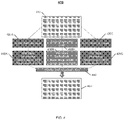
- FIG. 1 illustrates an exemplary system 100 for converting a lower resolution video stream 110 into a higher resolution video stream 150.
- the lower resolution video stream 110 can be, for example, in the NTSC format or can be a standard definition television video program.
- the higher resolution video stream 150 can be, for example, in HD format.
- Each of the multiple, different layers can have the same resolution as the lower resolution video stream 110 or can be converted into layers of different resolution.
- a first layer extraction module 120A, a second layer extraction module 120B, and a third layer extraction module 120C can extract and convert first, second, and third layers, respectively.
- Each of the extracted layers can be separately processed to convert a respective extracted layer into a respective modified layer.
- Modified layers can, for example, have a same resolution as the higher resolution video stream 150.
- a first layer conversion module 130A, a second layer conversion module 130B, and a third layer conversion module 130C can convert the first, second, and third layers into first, second, and third modified layers, respectively.
- a reassembly module 140 can reassemble the first, second, and third modified layers into the higher resolution video stream 150.
- a transcoding process can be used to convert from a first format signal to a second format signal.
- the first format signal can be a 4:2:2 standard definition digital video source which can be associated with a Y'CbCr color space and the second format signal can be a 4:4:4 high definition digital video source that is associated with a RGB color space.
- the "4" in the "4:2:2” label represents a luminance of the first format signal and the "2:2" in the "4:2:2” label represents color difference signals associated with the first format signal.
- the "4:4:4" label represents the three primary colors R,G,B.
- picture techniques may be used, which include 4:2:0.
- the "0” represents a non-sampled value.
- This non sampled value when transcoded, can represent an actual value based on the mathematical differences between the "4:2" or luminance and first color samples. Increasing the value from a "0" value using neighboring values may enable information to be manipulated to create a higher value or a better overall image.
- the first format signal can use a "lossy" scheme which is used to save space in transmission or recording systems.
- the first format signal can support 10,648,000 colors while the second format signal can support 16,777,000 colors.
- the first format signal is an 8-bit signal and the second format signal is a 10-bit signal.
- the transcoding process can transcode an 8-bit standard definition signal into a 10-bit high definition digital.
- the larger color space associated with the high definition signal can enable subsequent processes to manipulate the high definition signal for visual improvement, such as in frequency and time domains, which can result in improved quality in the high definition signal as compared to the standard definition signal.
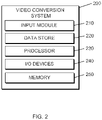
- FIG. 2 illustrates an exemplary video conversion system 200.
- the system 200 includes an input module 210, a data store 220, one or more processors 230, one or more I/O (Input/Output) devices 240, and memory 250.
- the input module 220 may be used to input any type of information used in video conversion.
- the input module 210 may be used to receive video data or receive data describing how video data stored in the data store 220 is to be processed during conversion.
- data from the input module 210 is stored in the data store 220.
- the data included in the data store 220 may include, for example, any type of video data (e.g., images, streams, etc.) and parameters that define how video conversion processes operate.
- the data store 220 may be a relational database that logically organizes data into a series of database tables. Each database table in the data store 220 may arrange data in a series of columns (where each column represents an attribute of the data stored in the database) and rows (where each row represents attribute values).
- the data store 220 may be an object-oriented database that logically or physically organizes data into a series of objects. Each object may be associated with a series of attribute values.
- the data store 220 may be a type of database management system that is not necessarily a relational or object-oriented database.
- XML Extensible Mark-up Language
- XML file or document includes attributes and attribute values.
- Other types of data files and/or database technologies may be used.
- Data included in the data store 220 may be identified by a unique identifier such that data related to a particular process may be retrieved from the data store 220.
- the processor 230 may be a processor suitable for the execution of a computer program such as a general or special purpose microprocessor, and any one or more processors of any kind of digital computer.
- the system 200 includes more than one processor 230.
- the processor 230 may receive instructions and data from the memory 250.
- the memory 250 may store instructions and data corresponding to any or all of the components of the system 200.
- the memory 250 may include read-only memory, random-access memory, or both.
- the I/O devices 240 are configured to provide input to and output from the system 200.
- the I/O devices 240 may include a mouse, a keyboard, a stylus, or any other device that allows the input of data.
- the I/O devices 240 may also include a display, a printer, or any other device that outputs data.
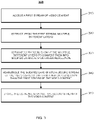
- FIGS. 3 and 4 illustrate processes 300 and 400, respectively, for increasing resolution of a video stream.
- the operations of the processes 300 and 400 are described generally as being performed by the system 200.
- operations of the process 300 and/or the process 400 may be performed by one or more components of the system 100.
- Operations of the process 300 and/or the process 400 also may be performed by one or more processors included in one or more electronic devices.
- the system 200 accesses a first stream of video content (310).
- the system 200 can access a first stream of the video content that has a first resolution.
- the system 200 can access a video signal in NTSC format, which can have 525 lines of resolution.
- the system 200 can access a standard definition television video program.
- the system 200 accesses a standard definition television video program (410).
- the standard definition television video program has a frame rate of 29.97 frames per second (FPS) and has a resolution of 720x486.
- the standard definition television video program can be processed with interlacing and field interpolation.
- the standard definition television video program is based on an RGB (Red, Green, Blue) colorimetry platform.
- An RGB color colorimetry platform can use an additive color space that is based on a RGB color model.
- a particular RGB color space can be defined by three chromaticies of red, green, and blue additive primaries, and can produce any chromaticity that can be represented as a tuple defined by percentages or values of red, green, and blue amounts.
- an original analog version of the standard definition television video program is accessed.
- a digital version that includes information encoded from an original analog version is accessed. If an original analog version is accessed, a decoding process can be performed to create a digital version, such as by using a three-dimensional comb decoder with 12 bit analog to digital conversion.
- the standard definition television video program can include degradations resulting from encoding and recording processes, including analog recording deficiencies used during an original capture. For example, use of analog magnetic oxide tapes and subsequent duplication of those tapes may have introduced analog tape noise, differential gain and phase distortions, and loss of recorded RF (Radio Frequency) energy and drop-out of signals recorded on the magnetic tape. Such degradations can result in visual impairments embedded in the original recordings.
- analog recording deficiencies used during an original capture.
- analog magnetic oxide tapes and subsequent duplication of those tapes may have introduced analog tape noise, differential gain and phase distortions, and loss of recorded RF (Radio Frequency) energy and drop-out of signals recorded on the magnetic tape.
- RF Radio Frequency
- first, second, and third layers can be extracted, where the second layer is different than the first layer and the third layer is different than the first layer and the second layer.
- first, second, and third layers can be extracted, where the second layer is different than the first layer and the third layer is different than the first layer and the second layer.
- a set of first images of a scene can be extracted from the first stream of video content into the first layer.
- a set of second images of the scene can be extracted from the first stream of video content into the second layer, where the second images of the scene are a different representation of the scene than the first images.
- a set of third images of the scene can be extracted from the first stream of video content into the third layer, where the third images of the scene are a different representation of the scene than the first images and the second images.
- the system 200 can extract multiple, different layers that each have the first resolution.
- each of the multiple, different layers can be a color layer that corresponds to a different color.
- the system 200 extracts from the standard definition television video program a red color layer (220A), a green color layer (220B), and a blue color layer (220C).
- the green color layer is a different layer than the red color layer
- the blue color layer is a different layer than the green color layer and the blue color layer.
- the extraction of the red color layer, the green color layer, and the blue color layer can involve, for example, identifying red, green, or blue color values in the standard definition television video program and separating the identified red, green, or blue color values into the respective red, green, or blue color layer.
- extracting the red, green, and blue color layers includes extracting, from the standard definition television video program, first, second, and third images of a scene that reflect red color values, green color values, and blue color values of the scene, respectively.
- the extractions of the red color layer, the green color layer, and the blue color layer are performed using a three-line adaptive comb filter technique.
- a comb filter applies a mathematical combing process to a luminance signal in a fashion similar to vertical lines of a comb, and can filter color information from the standard definition television video program.
- a 3D (Three Dimensional) digital comb filter is used, which can provide a greater degree of accuracy than a non-digital filter and can reduce dot crawl and cross color artifacts which can occur in three line comb filter results.
- the system 200 separately processes each of the multiple, different layers to convert them into modified layers having higher resolution (330).
- the system 200 can process the first, second, and third layers to convert the first, second, and third layers into modified first, second, and third layers, respectively, where the modified second layer is different than the modified first layer and the modified third layer is different than the modified first layer and the modified second layer.
- the system 200 can process the first images of the scene to convert the first images of the scene into modified first images of the scene that have a higher resolution than the first images of the scene, process the second images of the scene to convert the second images of the scene into modified second images of the scene that have a higher resolution than the second images of the scene, and process the third images of the scene to convert the third images of the scene into modified third images of the scene that have a higher resolution than the third images of the scene.
- the system 200 can separately process each of multiple, different color layers to convert the multiple, different color layers into modified color layers that each correspond to a different color.
- the system 200 can process the red color layer to convert the red color layer into a modified red color layer (430A), process the green color layer to convert the green color layer into a modified green color layer that is different than the modified red color layer (430B), and process the blue color layer to convert the blue color layer into a modified blue color layer that is different than the modified red color layer and the modified green color layer (430C).
- processing the red, green, and blue color layers can include processing the first images of the scene to convert the first images of the scene into modified first images of the scene that reflect red color values of the scene at a higher resolution than the first images of the scene, processing the second images of the scene to convert the second images of the scene into modified second images of the scene that reflect green color values of the scene at a higher resolution than the second images of the scene, and processing the third images of the scene to convert the third images of the scene into modified third images of the scene that reflect blue color values of the scene at a higher resolution than the third images of the scene.
- a number of sub-processing steps can be performed in each of the steps 430A, 430B, and 430C.
- the sub-processing steps can be used to improve the resolution of each of the modified red, green, and blue color layers as compared to the respective red, green, and blue color layers.
- the extracted red, green, and blue color layers can include degradation of cross-color / luma-chroma crosstalk contamination (e.g., a "rainbow" effect), which can be caused by varying luminance signal frequencies crossing at a coincident points.
- the steps 430A, 430B, and 430C can each include sub-processing operations that include any combination of blurring, de-interlacing, resizing, and speed-changing.
- the steps 430A, 430B, and 430C can include sharpening and/or chromatic adjustment sub-processing.
- the speed changing can be used to change a frame rate of each of the red, green, and blue color layers from 29.97 frames per second to a frame rate of 23.98 frames per second for each of the modified red, green, and blue color layers.
- the blurring sub-processing can include frame by frame detection and blurring of channel edges in a respective red, green, or blue color layer.
- the blurring sub-processing can improve resolution included in the body of an image.
- the sharpening sub-processing can include application of a sharpening mask to a respective red, green, or blue color layer.
- the sharpening mask can be applied so that edges do not become over-sharpened and so that noise in an extracted color layer is not amplified.
- the standard definition television video program can include interlaced video.
- the interlaced video can include images that are split into two images. Each half of an image can be stored in a field, and fields can be interlaced with each other as odd and even fields. Using interlaced video can increase the bandwidth of the video.
- the de-interlacing sub processing can include processing odd-and-even field based images into single frames, including interpolating with motion tracking estimation.
- each of the red, green, and blue color layers are separately de-interlaced.
- frames of the standard definition television video program are de-interlaced into combined frames, and the red, green, and blue color layers are extracted from the combined frames.
- the standard definition television video program may have a resolution of 720x486.
- the resizing sub-processing can resize images included in each of the modified red, green, and blue color layers to have a resolution of 1480x1080 (e.g., a resolution associated with HD television programming).
- 1480x1080 e.g., a resolution associated with HD television programming.
- pixels included in each of the modified red, green, and blue color layers can be re-sampled on a field by field basis to generate a new picture frame that includes 1480 pixels horizontally by 1080 lines.
- Such a picture frame can be used for a full top to bottom HD mapped picture when displayed on a HD television.
- the re-sampling process can preserve the aspect ratio of an original standard definition image.
- the system 200 can perform a chromatic adjustment process on each of the modified red, green, and blue color layers (440).
- a chromatic adjustment process can be performed to compensate for degradation and loss of color intensity information from analog processes used in recording the standard definition television video program.
- a modified red, blue or green color layer can be adjusted by a manipulation of a red, green, or blue color space, such as by adding, subtracting or multiplying channels on an isolated basis to restore contrast and colors which had been reduced by encoding / decoding processes.
- Chromatic adjustment can be accomplished by computing equipment with a series of software processes which can be under the control of a colorist user who can control a subjective look of an adjusted color layer. Values for chromatic adjustment for each color layer may be stored in a table and the table may be referenced to perform the chromatic adjustment of each color layer.
- the system 200 reassembles the modified layers into a second stream of the video content that has a higher resolution than the first stream of the video content (340). For instance, in implementations where first, second and third images of a scene are extracted from the first stream of the video content, the system 200 can reassemble the modified first images of the scene, the modified second images of the scene, and the modified third images of the scene into the second stream of the video content. As another example, the system 200 can perform a chromatic level adjustment process that weights, in the second stream of the video content, a first color layer included in the modified color layers more heavily than a second, different color layer included in the modified color layers.
- the modified red color layer, the modified green color layer, and the modified blue color layer can be reassembled into a modified high definition television video program (450).
- the modified high definition television video program has a frame rate of 23.98 frames per second, has a resolution of 1480x1080 (e.g., higher than the standard definition television video program), is based on an RGB colorimetry platform, and is based on a progressive format in which a full frame is displayed after another full frame (e.g., in contrast to interlaced video).
- a chromatic adjustment process can be performed on a combined file which includes a reassembly of the modified red, green, and blue color layers.
- Reassembly processing can include identification of features in each of the modified red, green, and blue color layers and determination of alignment vectors for matching and aligning features identified in one layer to features identified in the other layers.
- Feature identification and alignment can be performed, for example, to correct for the modified red, green, and blue layers not being exactly the same size and not having exactly the same content at exactly the same positions.
- the feature identification and alignment can correct for shifting of features in the respective modified red, green, and blue color layers.
- Features can include, for example, edges, objects, contours and other items.
- An alignment vector can be determined, for example, by comparing sets of edges identified in each of the modified red, green, and blue layers.
- One of the red, green, and blue modified color layers can be used as a reference layer and the other two of the modified red, green, and blue color layers can be aligned to the reference layer.
- the system 200 stores, in electronic storage, the second stream of the video content (350).
- the system 200 can store the second stream of the video content in the data store 220.
- the system 200 also may record the second stream of the video content onto a device readable medium, such as a DVD, a Blu-Ray Disc, a HDCAM SR videocassette, a FireWire drive, or other suitable content medium, such as in a DPX (Digital Picture Exchange), QuickTime (e.g., a .MOV file), D-5, or LTO (Linear Tape Open) format, to name a few examples.
- a device readable medium such as a DVD, a Blu-Ray Disc, a HDCAM SR videocassette, a FireWire drive, or other suitable content medium, such as in a DPX (Digital Picture Exchange), QuickTime (e.g., a .MOV file), D-5, or LTO (Linear Tape Open) format, to name a few examples.
- DPX
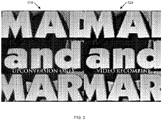
- FIG. 5 illustrates example images 510 and 520 that result from two, different conversion processes that increase resolution of an image.
- the image 510 was processed using a traditional upconversion process involving real-time processing usually associated with electronic recursive noise reducers and image enhancement which attempt to process the video fields and frames in real time.
- the upconversion process can be designed to interface with equipment, such as a digital video disc player and/or with a Betacam, Digital Betacam, one-inch, or other digital or analog tape deck, in real-time, and such a design can impose restrictions on the upconversion process.
- the upconversion process can be designed to "blow up" a lower resolution image. Such a process can magnify degradation artifacts from encoding / decoding processes used to produce the lower resolution image.
- the image 520 was processed using the extraction, processing, reassembly, and storing processes described for the process 400.
- the image 520 like the image 510, has an increased resolution as compared to a source image, but the image 520 includes less noise and distortion as compared to the image 510.
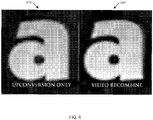
- FIG. 6 illustrates example magnified images 610 and 620 which are magnifications of letter "a" content included in the image 510 and image 520, respectively. The inclusion of less noise and distortion in the image 620 as compared to the image 610 is visually apparent.
- FIG. 7 is a schematic diagram of an example of a generic computer system 700.
- the system 700 can be used for the operations described in association with the processes 300 and 400, according to some implementations.
- the system 700 may be included in the systems 100 and 200.
- the system 700 includes a processor 710, a memory 720, a storage device 730, and an input/output device 740. Each of the components 710, 720, 730, and 740 are interconnected using a system bus 750.
- the processor 710 is capable of processing instructions for execution within the system 700. In one implementation, the processor 710 is a single-threaded processor. In another implementation, the processor 710 is a multi-threaded processor.
- the processor 710 is capable of processing instructions stored in the memory 720 or on the storage device 730 to display graphical information for a user interface on the input/output device 740.
- the memory 720 stores information within the system 700.
- the memory 720 is a computer-readable medium.
- the memory 720 is a volatile memory unit.
- the memory 720 is a non-volatile memory unit.
- the storage device 730 is capable of providing mass storage for the system 700.
- the storage device 730 is a computer-readable medium.
- the storage device 730 may be a floppy disk device, a hard disk device, an optical disk device, or a tape device.
- the input/output device 740 provides input/output operations for the system 700.
- the input/output device 740 includes a keyboard and/or pointing device.
- the input/output device 740 includes a display unit for displaying graphical user interfaces.
- the features described can be implemented in digital electronic circuitry, or in computer hardware, firmware, software, or in combinations of them.
- the apparatus can be implemented in a computer program product tangibly embodied in an information carrier, e.g., in a machine-readable storage device, for execution by a programmable processor; and method steps can be performed by a programmable processor executing a program of instructions to perform functions of the described implementations by operating on input data and generating output.
- the described features can be implemented advantageously in one or more computer programs that are executable on a programmable system including at least one programmable processor coupled to receive data and instructions from, and to transmit data and instructions to, a data storage system, at least one input device, and at least one output device.
- a computer program is a set of instructions that can be used, directly or indirectly, in a computer to perform a certain activity or bring about a certain result.
- a computer program can be written in any form of programming language, including compiled or interpreted languages, and it can be deployed in any form, including as a stand-alone program or as a module, component, subroutine, or other unit suitable for use in a computing environment.
- Suitable processors for the execution of a program of instructions include, by way of example, both general and special purpose microprocessors, and the sole processor or one of multiple processors of any kind of computer.
- a processor will receive instructions and data from a read-only memory or a random access memory or both.
- the elements of a computer are a processor for executing instructions and one or more memories for storing instructions and data.
- a computer will also include, or be operatively coupled to communicate with, one or more mass storage devices for storing data files; such devices include magnetic disks, such as internal hard disks and removable disks; magneto-optical disks; and optical disks.
- Storage devices suitable for tangibly embodying computer program instructions and data include all forms of non-volatile memory, including by way of example semiconductor memory devices, such as EPROM, EEPROM, and flash memory devices; magnetic disks such as internal hard disks and removable disks; magneto-optical disks; and CD-ROM and DVD-ROM disks.
- semiconductor memory devices such as EPROM, EEPROM, and flash memory devices
- magnetic disks such as internal hard disks and removable disks
- magneto-optical disks and CD-ROM and DVD-ROM disks.
- the processor and the memory can be supplemented by, or incorporated in, ASICs (application-specific integrated circuits).
- ASICs application-specific integrated circuits
- the features can be implemented on a computer having a display device such as a CRT (cathode ray tube) or LCD (liquid crystal display) monitor for displaying information to the user and a keyboard and a pointing device such as a mouse or a trackball by which the user can provide input to the computer.
- a display device such as a CRT (cathode ray tube) or LCD (liquid crystal display) monitor for displaying information to the user and a keyboard and a pointing device such as a mouse or a trackball by which the user can provide input to the computer.
- the features can be implemented in a computer system that includes a back-end component, such as a data server, or that includes a middleware component, such as an application server or an Internet server, or that includes a front-end component, such as a client computer having a graphical user interface or an Internet browser, or any combination of them.
- the components of the system can be connected by any form or medium of digital data communication such as a communication network. Examples of communication networks include, e.g., a LAN, a WAN, and the computers and networks forming the Internet.
- the computer system can include clients and servers.
- a client and server are generally remote from each other and typically interact through a network, such as the described one.
- the relationship of client and server arises by virtue of computer programs running on the respective computers and having a client-server relationship to each other.
Landscapes
- Engineering & Computer Science (AREA)
- Multimedia (AREA)
- Signal Processing (AREA)
- Physics & Mathematics (AREA)
- Computer Hardware Design (AREA)
- General Physics & Mathematics (AREA)
- Theoretical Computer Science (AREA)
- Computer Graphics (AREA)
- Television Systems (AREA)
- Image Processing (AREA)
- Compression Or Coding Systems Of Tv Signals (AREA)
- Color Television Systems (AREA)
Claims (10)
- Procédé de conversion vidéo comprenant :l'accès (310, 410) à un premier flux (110) de contenu vidéo, le premier flux du contenu vidéo ayant une première résolution ;l'extraction (320, 420), du premier flux (110) du contenu vidéo, plusieurs couches de couleurs différentes qui ont chacune la première résolution et qui correspondent chacune à une couleur différente ;le traitement séparé (330, 430) de chacune des multiples couches de couleurs différentes pour convertir les multiples couches de couleurs différentes en couches de couleurs modifiées qui ont chacune une deuxième résolution qui est supérieure à la première résolution et qui correspondent chacune à une couleur différente, y compris l'exécution séparée d'au moins l'un parmi le brouillage, la conversion de fréquence de trame et l'ajustement chromatique ;le réassemblage (340, 450) des couches de couleur modifiées en un deuxième flux du contenu vidéo, le deuxième flux du contenu vidéo ayant la deuxième résolution qui est supérieure à la première résolution ; etle stockage (350), dans un stockage électronique (220), du deuxième flux du contenu vidéo,dans lequel :
le réassemblage comprend :l'identification de caractéristiques comprenant des bords, des objets, des contours présents dans chacune des couches de couleur modifiées ;la détection de vecteurs d'alignement en comparant des ensembles de caractéristiques identifiées dans chacune des couches de couleur modifiées ; etl'utilisation de l'une des couches de couleur modifiées comme référence et l'alignement des autres couches de couleur modifiées dans le deuxième flux du contenu vidéo à l'aide des caractéristiques identifiées et des vecteurs d'alignement. - Procédé selon la revendication 1 :
dans lequel l'extraction, du premier flux du contenu vidéo, de plusieurs couches de couleurs différentes qui ont chacune la première résolution comprend :l'extraction, du premier flux du contenu vidéo, d'une première couche de couleurs ;l'extraction, du premier flux du contenu vidéo, d'une deuxième couche de couleur différente de la première couche ; etl'extraction, du premier flux du contenu vidéo, d'une troisième couche de couleur qui est différente de la première couche et de la deuxième couche ;dans lequel le traitement séparé de chacune des multiples couches de couleurs différentes pour convertir les multiples couches de couleurs différentes en couches de couleur modifiées qui ont chacune une deuxième résolution qui est supérieure à la première résolution comprend :le traitement de la première couche de couleur pour convertir la première couche de couleur en une première couche de couleur modifiée ;le traitement de la deuxième couche de couleur pour convertir la deuxième couche de couleur en une deuxième couche de couleur modifiée qui est différente de la première couche de couleur modifiée ; etle traitement de la troisième couche de couleur pour convertir la troisième couche de couleur en une troisième couche de couleur modifiée qui est différente de la première couche de couleur modifiée et de la deuxième couche de couleur modifiée ; etdans lequel le réassemblage des couches de couleur modifiées dans le deuxième flux du contenu vidéo comprend le réassemblage de la première couche de couleur modifiée, de la deuxième couche de couleur modifiée et de la troisième couche de couleur modifiée dans un deuxième flux du contenu vidéo. - Procédé selon la revendication 1 :dans lequel l'extraction, du premier flux du contenu vidéo, de la première couche de couleur comprend l'extraction, du premier flux du contenu vidéo, d'une couche de couleur rouge ;dans lequel l'extraction, du premier flux du contenu vidéo, de la deuxième couche de couleur qui est différente de la première couche de couleur comprend l'extraction, du premier flux du contenu vidéo, d'une couche de couleur verte qui est différente de la couche de couleur rouge ;dans lequel l'extraction, du premier flux du contenu vidéo, de la troisième couche de couleur qui est différente de la première couche de couleur et de la deuxième couche de couleur comprend l'extraction, du premier flux du contenu vidéo, d'une couche de couleur bleue qui est différente de la couche de couleur rouge et de la couche de couleur verte ;dans lequel le traitement de la première couche de couleur pour convertir la première couche de couleur en la première couche de couleur modifiée comprend le traitement de la couche de couleur rouge pour convertir la couche de couleur rouge en une couche de couleur rouge modifiée ;dans lequel le traitement de la deuxième couche de couleur pour convertir la deuxième couche de couleur en la deuxième couche de couleur modifiée qui est différente de la première couche de couleur modifiée comprend le traitement de la couche de couleur verte pour convertir la couche de couleur verte en une couche de couleur verte modifiée qui est différente de la couche de couleur rouge modifiée ;dans lequel le traitement de la troisième couche de couleur pour convertir la troisième couche de couleur en une troisième couche de couleur modifiée qui est différente de la première couche de couleur modifiée et de la deuxième couche de couleur modifiée comprend le traitement de la couche de couleur bleue pour convertir la couche de couleur bleue en une couche de couleur bleue modifiée qui est différente de la couche de couleur rouge modifiée et de la couche de couleur verte modifiée ; etdans lequel le réassemblage de la première couche de couleur modifiée, de la deuxième couche de couleur modifiée et de la troisième couche de couleur modifiée dans le deuxième flux du contenu vidéo comprend le réassemblage de la couche de couleur rouge modifiée, de la couche de couleur verte modifiée et de la couche de couleur bleue modifiée dans le deuxième flux du contenu vidéo.
- Procédé selon la revendication 3 :dans lequel l'extraction, du premier flux du contenu vidéo, de la couche de couleur rouge comprend l'identification de valeurs de couleur rouge dans le premier flux du contenu vidéo et la séparation des valeurs de couleur rouge identifiées dans la couche de couleur rouge ;dans lequel l'extraction, du premier flux du contenu vidéo, de la couche de couleur verte comprend l'identification de valeurs de couleur verte dans le premier flux du contenu vidéo et la séparation des valeurs de couleur verte identifiées dans la couche de couleur verte ; etdans lequel l'extraction, du premier flux du contenu vidéo, de la couche de couleur bleue comprend l'identification de valeurs de couleur bleue dans le premier flux du contenu vidéo et la séparation des valeurs de couleur bleue identifiées dans la couche de couleur bleue.
- Procédé selon la revendication 3 :dans lequel l'extraction, du premier flux du contenu vidéo, de la couche de couleur rouge comprend l'extraction, du premier flux du contenu vidéo, de premières images d'une scène qui reflètent les valeurs de couleur rouge de la scène ;dans lequel l'extraction, du premier flux du contenu vidéo, de la couche de couleur verte qui est différente de la couche de couleur rouge comprend l'extraction, du premier flux du contenu vidéo, de deuxièmes images de la scène qui reflètent les valeurs de couleur verte de la scène ;dans lequel l'extraction, du premier flux du contenu vidéo, de la couche de couleur bleue qui est différente de la couche de couleur rouge et de la couche de couleur verte comprend l'extraction, du premier flux du contenu vidéo, de troisièmes images de la scène qui reflètent les valeurs de couleur bleue de la scène ;dans lequel le traitement de la couche de couleur rouge pour convertir la couche de couleur rouge en la couche de couleur rouge modifiée comprend le traitement des premières images de la scène pour convertir les premières images de la scène en premières images modifiées de la scène qui reflètent les valeurs de couleur rouge de la scène à une résolution supérieure aux premières images de la scène ;dans lequel le traitement de la couche de couleur verte pour convertir la couche de couleur verte en la couche de couleur verte modifiée qui est différente de la couche de couleur rouge modifiée comprend le traitement des deuxièmes images de la scène pour convertir les deuxièmes images de la scène en deuxièmes images modifiées de la scène qui reflètent les valeurs de couleur verte de la scène à une résolution supérieure aux deuxièmes images de la scène ;dans lequel le traitement de la couche de couleur bleue pour convertir la couche de couleur bleue en la couche de couleur bleue modifiée qui est différente de la couche de couleur rouge modifiée et de la couche de couleur verte modifiée comprend le traitement des troisièmes images de la scène pour convertir les troisièmes images de la scène en troisièmes images modifiées de la scène qui reflètent des valeurs de couleur bleue de la scène à une résolution supérieure aux troisièmes images de la scène ; etdans lequel le réassemblage de la couche de couleur rouge modifiée, de la couche de couleur verte modifiée et de la couche de couleur bleue modifiée dans le deuxième flux du contenu vidéo comprend le réassemblage des premières images modifiées de la scène, des deuxièmes images modifiées de la scène et des troisièmes images de la scène dans le deuxième flux du contenu vidéo.
- Procédé selon la revendication 1, dans lequel le traitement séparé de chacune des multiples couches de couleurs différentes pour convertir les multiples couches de couleurs différentes en couches de couleurs modifiées qui ont chacune la deuxième résolution qui est supérieure à la première résolution comprend l'exécution séparée d'un processus de brouillage sur chacune des multiples couches de couleurs différentes et, après l'exécution du processus de brouillage sur chacune des multiples couches de couleurs différentes, la conversion des multiples couches de couleurs différentes en couches de couleurs modifiées qui ont chacune la deuxième résolution qui est supérieure à la première résolution.
- Procédé selon la revendication 1, dans lequel le traitement séparé de chacune des multiples couches de couleurs différentes pour convertir les multiples couches de couleurs différentes en couches de couleurs modifiées qui ont chacune la deuxième résolution qui est supérieure à la première résolution comprend la conversion séparée de chacune des multiples couches de couleurs différentes en couches de couleurs modifiées qui ont chacune la deuxième résolution qui est supérieure à la première résolution et, après la conversion de chacune des multiples couches de couleurs différentes, la modification de la fréquence de trame de chacune des couches de couleurs modifiées.
- Procédé selon la revendication 1 :dans lequel l'accès au premier flux de contenu vidéo comprend l'accès à un programme vidéo de télévision à définition standard ; etdans lequel le réassemblage des couches de couleur modifiées dans le deuxième flux du contenu vidéo comprend le réassemblage des couches de couleur modifiées dans un programme vidéo de télévision haute définition modifié.
- Système de conversion vidéo comprenant :au moins un processeur ; etau moins une mémoire couplée à l'au moins un processeur sur laquelle sont stockées des instructions qui, lorsqu'elles sont exécutées par l'au moins un processeur, amènent l'au moins un processeur à exécuter des opérations comprenant le procédé selon l'une quelconque des revendications 1 à 8.
- Au moins un support de stockage lisible par ordinateur codé avec des instructions exécutables qui, lorsqu'elles sont exécutées par au moins un processeur, amènent l'au moins un processeur à effectuer des opérations comprenant le procédé selon l'une quelconque des revendications 1 à 8.
Applications Claiming Priority (2)
| Application Number | Priority Date | Filing Date | Title |
|---|---|---|---|
| US13/767,440 US9241128B2 (en) | 2013-02-14 | 2013-02-14 | Video conversion technology |
| PCT/US2014/016069 WO2014127024A1 (fr) | 2013-02-14 | 2014-02-12 | Technologie de conversion vidéo |
Publications (3)
| Publication Number | Publication Date |
|---|---|
| EP2956928A1 EP2956928A1 (fr) | 2015-12-23 |
| EP2956928A4 EP2956928A4 (fr) | 2016-10-19 |
| EP2956928B1 true EP2956928B1 (fr) | 2023-01-04 |
Family
ID=51297221
Family Applications (1)
| Application Number | Title | Priority Date | Filing Date |
|---|---|---|---|
| EP14752106.6A Active EP2956928B1 (fr) | 2013-02-14 | 2014-02-12 | Technologie de conversion vidéo |
Country Status (3)
| Country | Link |
|---|---|
| US (6) | US9241128B2 (fr) |
| EP (1) | EP2956928B1 (fr) |
| WO (1) | WO2014127024A1 (fr) |
Families Citing this family (3)
| Publication number | Priority date | Publication date | Assignee | Title |
|---|---|---|---|---|
| US10360704B2 (en) | 2017-08-11 | 2019-07-23 | Microsoft Technology Licensing, Llc | Techniques for providing dynamic multi-layer rendering in graphics processing |
| CN110177229B (zh) * | 2019-04-24 | 2020-12-29 | 深圳大学 | 基于多任务对抗学习的视频转换方法、存储介质及终端 |
| CN116913193B (zh) * | 2023-07-06 | 2026-02-06 | 华为技术有限公司 | 图像显示方法和显示设备 |
Citations (3)
| Publication number | Priority date | Publication date | Assignee | Title |
|---|---|---|---|---|
| EP0320300A2 (fr) * | 1987-12-11 | 1989-06-14 | Idr Inc. | Système de traitement d'image de télévision ayant la capacité de saisie, de fondu et d'affichage |
| EP0730386A2 (fr) * | 1995-03-03 | 1996-09-04 | Sun Microsystems, Inc. | Conversion de format de couleur dans un processeur parallèle |
| WO2006015107A2 (fr) * | 2004-07-29 | 2006-02-09 | Microsoft Corporation | Traitement d'image par indices de lumination lineaires et autres perfectionnements dans le traitement d'image |
Family Cites Families (107)
| Publication number | Priority date | Publication date | Assignee | Title |
|---|---|---|---|---|
| WO2002091302A2 (fr) | 2001-05-04 | 2002-11-14 | Legend Films, Llc | Systeme et procede d'amelioration de sequence d'image |
| DE2229953B1 (de) | 1972-06-20 | 1973-07-05 | Dr C Otto & Co GmbH, 4630 Bochum | Koksofentuer mit umlaufender dichtungsschneide |
| JPS525042U (fr) | 1975-06-27 | 1977-01-13 | ||
| JPS55145493A (en) | 1979-04-27 | 1980-11-13 | Toshiba Corp | Color television camera device |
| JPS5664933A (en) | 1979-10-31 | 1981-06-02 | Toa Gosei Chem Ind | Vessel for alphaacyanoacrylate group adhesive |
| US4285004A (en) | 1980-02-25 | 1981-08-18 | Ampex Corporation | Total raster error correction apparatus and method for the automatic set up of television cameras and the like |
| US4832485A (en) | 1982-09-03 | 1989-05-23 | Commonwealth Technology, Inc. | Image enhancer |
| US4641244A (en) | 1985-04-05 | 1987-02-03 | Opti-Copy, Inc. | Method and apparatus for registering color separation film |
| JPS6236198Y2 (fr) | 1985-08-15 | 1987-09-14 | ||
| WO1987005769A1 (fr) | 1986-03-19 | 1987-09-24 | British Broadcasting Corporation | Mesurage du mouvement d'images tv |
| JPS63182961A (ja) | 1987-01-24 | 1988-07-28 | Agency Of Ind Science & Technol | カラ−画像の歪検出方式 |
| US4849914A (en) | 1987-09-22 | 1989-07-18 | Opti-Copy, Inc. | Method and apparatus for registering color separation film |
| JP2534747B2 (ja) * | 1988-03-16 | 1996-09-18 | 株式会社日立製作所 | Y/c分離回路 |
| US5023815A (en) | 1989-08-04 | 1991-06-11 | Wilson Monti R | Method and apparatus for registering color film separations |
| US5161035A (en) | 1989-10-31 | 1992-11-03 | Brother Kogyo Kabushiki Kaisha | Digital image processing device for enlarging original image with high fidelity |
| US5022089A (en) | 1990-01-19 | 1991-06-04 | Wilson Monti R | Method and apparatus for fast registration using crosshair register marks |
| US5781666A (en) | 1990-04-17 | 1998-07-14 | Canon Kabushiki Kaisha | Image processing method and apparatus suitable for both high-resolution and low-resolution image data |
| US5129009A (en) | 1990-06-04 | 1992-07-07 | Motorola, Inc. | Method for automatic semiconductor wafer inspection |
| FR2665597B1 (fr) | 1990-07-31 | 1995-11-17 | Thomson Trt Defense | Procede et dispositif de localisation en temps reel de contours rectilignes dans une image numerisee, notamment pour la reconnaissance de formes dans un traitement d'analyse de scene. |
| US5191416A (en) * | 1991-01-04 | 1993-03-02 | The Post Group Inc. | Video signal processing system |
| US5185808A (en) | 1991-06-06 | 1993-02-09 | Eastman Kodak Company | Method for merging images |
| JP3253125B2 (ja) | 1991-07-04 | 2002-02-04 | 株式会社東芝 | カラー画像読取り補正装置 |
| US5416510A (en) * | 1991-08-28 | 1995-05-16 | Stereographics Corporation | Camera controller for stereoscopic video system |
| JPH05161145A (ja) | 1991-10-09 | 1993-06-25 | Olympus Optical Co Ltd | 面順次撮像装置 |
| US5657402A (en) | 1991-11-01 | 1997-08-12 | Massachusetts Institute Of Technology | Method of creating a high resolution still image using a plurality of images and apparatus for practice of the method |
| US7006881B1 (en) | 1991-12-23 | 2006-02-28 | Steven Hoffberg | Media recording device with remote graphic user interface |
| US8032477B1 (en) | 1991-12-23 | 2011-10-04 | Linda Irene Hoffberg | Adaptive pattern recognition based controller apparatus and method and human-factored interface therefore |
| US7242988B1 (en) | 1991-12-23 | 2007-07-10 | Linda Irene Hoffberg | Adaptive pattern recognition based controller apparatus and method and human-factored interface therefore |
| JP3127598B2 (ja) | 1992-09-07 | 2001-01-29 | 松下電器産業株式会社 | 画像中の濃度変動構成画素抽出方法および濃度変動塊判定方法 |
| US5418574A (en) | 1992-10-12 | 1995-05-23 | Matsushita Electric Industrial Co., Ltd. | Video signal correction apparatus which detects leading and trailing edges to define boundaries between colors and corrects for bleeding |
| US5734915A (en) | 1992-11-25 | 1998-03-31 | Eastman Kodak Company | Method and apparatus for composing digital medical imagery |
| US5308116A (en) | 1992-11-30 | 1994-05-03 | General Motors Corporation | Rear seat shoulder belt guide |
| JPH06233144A (ja) | 1993-01-29 | 1994-08-19 | Fujitsu Ltd | カラー読取装置 |
| US5475428A (en) | 1993-09-09 | 1995-12-12 | Eastman Kodak Company | Method for processing color image records subject to misregistration |
| US5548326A (en) | 1993-10-06 | 1996-08-20 | Cognex Corporation | Efficient image registration |
| TW297202B (fr) | 1993-10-13 | 1997-02-01 | Rca Thomson Licensing Corp | |
| US5517234A (en) | 1993-10-26 | 1996-05-14 | Gerber Systems Corporation | Automatic optical inspection system having a weighted transition database |
| JPH07220056A (ja) | 1993-11-26 | 1995-08-18 | Philips Electron Nv | 画像合成方法及び同方法を遂行する画像装置 |
| JPH07203298A (ja) | 1993-12-28 | 1995-08-04 | Nec Corp | 画像合成回路 |
| US5630037A (en) | 1994-05-18 | 1997-05-13 | Schindler Imaging, Inc. | Method and apparatus for extracting and treating digital images for seamless compositing |
| US5640200A (en) | 1994-08-31 | 1997-06-17 | Cognex Corporation | Golden template comparison using efficient image registration |
| JPH08163594A (ja) | 1994-12-12 | 1996-06-21 | Sony Corp | 動画像復号化方法及び動画像復号化装置 |
| DE69625313T2 (de) | 1995-05-12 | 2003-10-16 | Sony Corp., Tokio/Tokyo | Vorrichtung zur erzeugung von stanzsignalen, vorrichtung zur bilderstellung, verfahren zur erzeugung von stanzsignalen und verfahren zur bilderstellung |
| US5892554A (en) | 1995-11-28 | 1999-04-06 | Princeton Video Image, Inc. | System and method for inserting static and dynamic images into a live video broadcast |
| JP3568279B2 (ja) * | 1995-06-30 | 2004-09-22 | 富士写真フイルム株式会社 | 画像再生方法および装置 |
| US5641596A (en) | 1995-12-05 | 1997-06-24 | Eastman Kodak Company | Adjusting film grain properties in digital images |
| US5905819A (en) | 1996-02-05 | 1999-05-18 | Eastman Kodak Company | Method and apparatus for hiding one image or pattern within another |
| US5812214A (en) | 1996-03-14 | 1998-09-22 | Sierra Video Systems, Inc. | Apparatus and method for compositing video images |
| US6075905A (en) | 1996-07-17 | 2000-06-13 | Sarnoff Corporation | Method and apparatus for mosaic image construction |
| US5917987A (en) | 1996-08-16 | 1999-06-29 | Neyman; Yuri | System for controlling the transfer of an image on a first medium to a second medium |
| GB9619119D0 (en) | 1996-09-12 | 1996-10-23 | Discreet Logic Inc | Processing image |
| GB9619117D0 (en) | 1996-09-12 | 1996-10-23 | Pandora Int Ltd | Digital image processing |
| US6539120B1 (en) | 1997-03-12 | 2003-03-25 | Matsushita Electric Industrial Co., Ltd. | MPEG decoder providing multiple standard output signals |
| KR100238673B1 (ko) * | 1997-05-30 | 2000-01-15 | 윤종용 | 고선명 텔레비젼 수상기의 모니터 출력장치 |
| US6002424A (en) | 1997-06-12 | 1999-12-14 | Schick Technologies, Inc. | Dental imaging system with white balance compensation |
| US5926568A (en) | 1997-06-30 | 1999-07-20 | The University Of North Carolina At Chapel Hill | Image object matching using core analysis and deformable shape loci |
| US6233356B1 (en) | 1997-07-08 | 2001-05-15 | At&T Corp. | Generalized scalability for video coder based on video objects |
| JPH11161773A (ja) | 1997-11-28 | 1999-06-18 | Konica Corp | 画像処理方法及び画像入力装置 |
| DE69712115T2 (de) | 1997-11-28 | 2002-09-26 | Hamamatsu Photonics K.K., Hamamatsu | Festkörperbildaufnahmevorrichtung für analysevorrichtung |
| US6690731B1 (en) * | 1997-12-01 | 2004-02-10 | Neostar, Inc. | Method and apparatus for diagonal processing of video data |
| DE19855885A1 (de) | 1997-12-04 | 1999-08-05 | Fuji Photo Film Co Ltd | Bildverarbeitungsverfahren und -vorrichtung |
| JP3783817B2 (ja) | 1998-03-11 | 2006-06-07 | 富士写真フイルム株式会社 | 画像処理方法および画像処理装置 |
| US6295083B1 (en) | 1998-02-27 | 2001-09-25 | Tektronix, Inc. | High precision image alignment detection |
| JP3863294B2 (ja) | 1998-07-02 | 2006-12-27 | 株式会社日立製作所 | ノイズ低減信号処理回路および映像表示装置 |
| JP2000050054A (ja) | 1998-07-31 | 2000-02-18 | Canon Inc | 記録システム |
| US6870564B1 (en) | 1998-10-02 | 2005-03-22 | Eastman Kodak Company | Image processing for improvement of color registration in digital images |
| US6393150B1 (en) | 1998-12-04 | 2002-05-21 | Eastman Kodak Company | Region-based image binarization system |
| US6317223B1 (en) | 1998-12-14 | 2001-11-13 | Eastman Kodak Company | Image processing system for reducing vertically disposed patterns on images produced by scanning |
| US6282326B1 (en) | 1998-12-14 | 2001-08-28 | Eastman Kodak Company | Artifact removal technique for skew corrected images |
| US6373970B1 (en) | 1998-12-29 | 2002-04-16 | General Electric Company | Image registration using fourier phase matching |
| US7966078B2 (en) | 1999-02-01 | 2011-06-21 | Steven Hoffberg | Network media appliance system and method |
| JP3538055B2 (ja) | 1999-02-15 | 2004-06-14 | 日本電気株式会社 | 動きベクトル検出装置 |
| JP2000308021A (ja) * | 1999-04-20 | 2000-11-02 | Niigata Seimitsu Kk | 画像処理回路 |
| AU6320300A (en) | 1999-08-05 | 2001-03-05 | Hamamatsu Photonics K.K. | Solid-state imaging device and range finding device |
| JP4005277B2 (ja) | 1999-09-06 | 2007-11-07 | 富士フイルム株式会社 | 画像処理装置、方法及び記録媒体 |
| US6874420B2 (en) | 1999-10-22 | 2005-04-05 | Cc1, Inc. | System and method for register mark recognition |
| US6816604B2 (en) | 1999-12-30 | 2004-11-09 | Eastman Kodak Company | Digital film processing feature location method and system |
| US7276643B2 (en) | 2000-02-18 | 2007-10-02 | The Regents Of The University Of California | Transgenic animals, cell lines derived therefrom, and methods for screening for anti-amyloidogenic agents |
| US6453124B2 (en) * | 2000-03-27 | 2002-09-17 | Minolta Co., Ltd. | Digital camera |
| US6610387B1 (en) | 2000-04-19 | 2003-08-26 | Dai Nippon Printing Co., Ltd. | Thermal transfer film and image forming method |
| JP4195958B2 (ja) | 2000-05-24 | 2008-12-17 | パナソニック株式会社 | カラー画像記録装置 |
| DE10041750C2 (de) | 2000-08-25 | 2003-02-27 | Agfa Gevaert Ag | Auf- oder Durchlichtscanner und Bildverarbeitungsverfahren für eingescannte Bildvorlagen |
| AU1342502A (en) | 2000-09-20 | 2002-04-02 | Nik Multimedia Inc | Digital image sharpening system |
| JP2002185980A (ja) * | 2000-12-12 | 2002-06-28 | Matsushita Electric Ind Co Ltd | マルチフォーマット記録再生装置 |
| JP2002344724A (ja) | 2001-05-17 | 2002-11-29 | Fuji Photo Film Co Ltd | 撮像装置、画像処理装置、画像処理方法、及びプログラム |
| US7127125B2 (en) | 2002-01-04 | 2006-10-24 | Warner Bros. Entertainment Inc. | Registration of separations |
| US6947607B2 (en) | 2002-01-04 | 2005-09-20 | Warner Bros. Entertainment Inc. | Reduction of differential resolution of separations |
| US7092584B2 (en) | 2002-01-04 | 2006-08-15 | Time Warner Entertainment Company Lp | Registration of separations |
| US6713242B2 (en) | 2002-01-23 | 2004-03-30 | Agfa-Gevaert | Method for processing a black-and-white negative recording film material for motion picture soundtrack |
| US6792071B2 (en) | 2002-03-27 | 2004-09-14 | Agfa-Gevaert | Method of performing geometric measurements on digital radiological images |
| US6969991B2 (en) | 2002-12-11 | 2005-11-29 | The Board Of Trustees Of The Leland Stanford Junior University | Correction of the effect of spatial gradient field distortions in diffusion-weighted imaging |
| US6879731B2 (en) | 2003-04-29 | 2005-04-12 | Microsoft Corporation | System and process for generating high dynamic range video |
| US7245783B2 (en) | 2003-06-24 | 2007-07-17 | Eastman Kodak Company | System and method for estimating, synthesizing and matching noise in digital images and image sequences |
| US7346109B2 (en) | 2003-12-23 | 2008-03-18 | Genesis Microchip Inc. | Motion vector computation for video sequences |
| US7400776B2 (en) | 2005-01-10 | 2008-07-15 | International Business Machines Corporation | Visual enhancement for reduction of visual noise in a text field |
| JP5205042B2 (ja) | 2006-12-20 | 2013-06-05 | 株式会社半導体エネルギー研究所 | 半導体装置の作製方法 |
| CN103193222B (zh) | 2007-05-17 | 2015-08-12 | 株式会社钟化 | 石墨膜及石墨复合膜 |
| US20090083811A1 (en) * | 2007-09-26 | 2009-03-26 | Verivue, Inc. | Unicast Delivery of Multimedia Content |
| US8120960B2 (en) | 2007-11-07 | 2012-02-21 | Spansion Israel Ltd. | Method and apparatus for accessing a non-volatile memory array comprising unidirectional current flowing multiplexers |
| US8098957B2 (en) * | 2008-02-13 | 2012-01-17 | Qualcomm Incorporated | Shared block comparison architechture for image registration and video coding |
| JPWO2010035777A1 (ja) | 2008-09-26 | 2012-02-23 | 日本電気株式会社 | 配信サーバ及び配信システムと方法 |
| TW201021541A (en) | 2008-11-19 | 2010-06-01 | Altek Corp | Image compensation method and digital image acquisition device using the same |
| EP3467816A1 (fr) * | 2010-02-24 | 2019-04-10 | Dolby Laboratories Licensing Corp. | Procédés et appareil de gestion d'affichage |
| US8698961B2 (en) * | 2010-05-21 | 2014-04-15 | Vixs Systems, Inc. | Enhanced histogram equalization |
| WO2012012444A2 (fr) | 2010-07-19 | 2012-01-26 | Dolby Laboratories Licensing Corporation | Procédés d'amélioration de données d'image et de vidéo échantillonnées et multiplexées |
| US9521392B2 (en) | 2010-12-21 | 2016-12-13 | Broadcom Corporation | Method and system for frame rate conversion of 3D frames |
| JP6233144B2 (ja) | 2014-03-31 | 2017-11-22 | 東洋インキScホールディングス株式会社 | 活性エネルギー線硬化型インキ組成物および印刷物 |
-
2013
- 2013-02-14 US US13/767,440 patent/US9241128B2/en active Active
-
2014
- 2014-02-12 EP EP14752106.6A patent/EP2956928B1/fr active Active
- 2014-02-12 WO PCT/US2014/016069 patent/WO2014127024A1/fr not_active Ceased
-
2015
- 2015-12-10 US US14/965,398 patent/US9723257B2/en active Active
-
2017
- 2017-07-31 US US15/664,813 patent/US10277862B2/en active Active
-
2019
- 2019-04-29 US US16/397,090 patent/US10687017B2/en active Active
-
2020
- 2020-06-15 US US16/902,252 patent/US11997417B2/en active Active
-
2024
- 2024-05-03 US US18/654,204 patent/US12610022B2/en active Active
Patent Citations (3)
| Publication number | Priority date | Publication date | Assignee | Title |
|---|---|---|---|---|
| EP0320300A2 (fr) * | 1987-12-11 | 1989-06-14 | Idr Inc. | Système de traitement d'image de télévision ayant la capacité de saisie, de fondu et d'affichage |
| EP0730386A2 (fr) * | 1995-03-03 | 1996-09-04 | Sun Microsystems, Inc. | Conversion de format de couleur dans un processeur parallèle |
| WO2006015107A2 (fr) * | 2004-07-29 | 2006-02-09 | Microsoft Corporation | Traitement d'image par indices de lumination lineaires et autres perfectionnements dans le traitement d'image |
Also Published As
| Publication number | Publication date |
|---|---|
| US20140226065A1 (en) | 2014-08-14 |
| US11997417B2 (en) | 2024-05-28 |
| US20190253661A1 (en) | 2019-08-15 |
| US12610022B2 (en) | 2026-04-21 |
| US10277862B2 (en) | 2019-04-30 |
| US20240348745A1 (en) | 2024-10-17 |
| US9241128B2 (en) | 2016-01-19 |
| US20170332040A1 (en) | 2017-11-16 |
| WO2014127024A1 (fr) | 2014-08-21 |
| EP2956928A4 (fr) | 2016-10-19 |
| US20200389620A1 (en) | 2020-12-10 |
| EP2956928A1 (fr) | 2015-12-23 |
| US20160100128A1 (en) | 2016-04-07 |
| US10687017B2 (en) | 2020-06-16 |
| US9723257B2 (en) | 2017-08-01 |
Similar Documents
| Publication | Publication Date | Title |
|---|---|---|
| US12610022B2 (en) | Video conversion technology | |
| US8269886B2 (en) | Methods and systems for improving low-resolution video | |
| US9628740B2 (en) | Method, apparatus and machine-readable medium for describing video processing | |
| US7760209B2 (en) | Video format conversion using 3D graphics pipeline of a GPU | |
| US8139887B2 (en) | Image-signal processing apparatus, image-signal processing method and image-signal processing program | |
| JP4597983B2 (ja) | ビデオフレームを適応的に再生する方法 | |
| US20090208123A1 (en) | Enhanced video processing using motion vector data | |
| CN101647292B (zh) | 色度视频信号的运动自适应上采样 | |
| KR20050059251A (ko) | 이미지 변환을 위한 유닛 및 방법 | |
| JP2000050305A (ja) | 映像の色差信号フィルタリング方法及び装置 | |
| TW200423744A (en) | Apparatus and method for signal processing of format conversion and combination of video signals | |
| KR102095518B1 (ko) | 영상의 고해상도 변환을 위한 리마스터링 시스템 및 그 방법 | |
| US20040213547A1 (en) | Method and system for video compression and resultant media | |
| JP5066041B2 (ja) | 画像信号処理装置、画像信号処理方法 | |
| US7733355B2 (en) | Apparatus and method of transforming three color signals into multi-color signal | |
| KR101098300B1 (ko) | 공간 신호 변환 | |
| Thompson | Investigations With Prototype Workflows and Specialist Cameras for Wider Target Platform Coverage Reduced Complexity and Universal Distribution | |
| KR102216391B1 (ko) | 디지털 리마스터링 기술을 이용한 실시간 화상송출 시스템 및 방법 | |
| KR20200042742A (ko) | 영상의 고해상도 변환을 위한 리마스터링 시스템 및 그 방법 | |
| WO2012114373A1 (fr) | Procédé et dispositif de traitement de signal d'image | |
| Pokorny | Using Chroma Subsampling in Lossy Compression | |
| Hightower | Transitioning from NTSC analog to HD digital Video | |
| Norman | The Design and Implementation of a Broadcast Quality Real-Time Aspect Ratio Converter | |
| Oujezdský | OPTIMIZING VIDEO CLIPS IN EDUCATIONAL MATERIALS | |
| JPH11243559A (ja) | 信号変換装置および方法、並びに学習装置および方法 |
Legal Events
| Date | Code | Title | Description |
|---|---|---|---|
| PUAI | Public reference made under article 153(3) epc to a published international application that has entered the european phase |
Free format text: ORIGINAL CODE: 0009012 |
|
| 17P | Request for examination filed |
Effective date: 20150909 |
|
| AK | Designated contracting states |
Kind code of ref document: A1 Designated state(s): AL AT BE BG CH CY CZ DE DK EE ES FI FR GB GR HR HU IE IS IT LI LT LU LV MC MK MT NL NO PL PT RO RS SE SI SK SM TR |
|
| AX | Request for extension of the european patent |
Extension state: BA ME |
|
| DAX | Request for extension of the european patent (deleted) | ||
| A4 | Supplementary search report drawn up and despatched |
Effective date: 20160920 |
|
| RIC1 | Information provided on ipc code assigned before grant |
Ipc: H04N 7/01 20060101AFI20160914BHEP Ipc: H04N 19/85 20140101ALN20160914BHEP Ipc: G09G 5/02 20060101ALI20160914BHEP Ipc: H04N 21/4402 20110101ALN20160914BHEP Ipc: H04N 21/2343 20110101ALI20160914BHEP |
|
| 17Q | First examination report despatched |
Effective date: 20161006 |
|
| STAA | Information on the status of an ep patent application or granted ep patent |
Free format text: STATUS: EXAMINATION IS IN PROGRESS |
|
| REG | Reference to a national code |
Ref country code: DE Ref legal event code: R079 Ref document number: 602014085993 Country of ref document: DE Free format text: PREVIOUS MAIN CLASS: G09G0005020000 Ipc: H04N0007010000 |
|
| GRAP | Despatch of communication of intention to grant a patent |
Free format text: ORIGINAL CODE: EPIDOSNIGR1 |
|
| STAA | Information on the status of an ep patent application or granted ep patent |
Free format text: STATUS: GRANT OF PATENT IS INTENDED |
|
| RIC1 | Information provided on ipc code assigned before grant |
Ipc: H04N 21/4402 20110101ALN20220630BHEP Ipc: H04N 19/85 20140101ALN20220630BHEP Ipc: G09G 5/14 20060101ALI20220630BHEP Ipc: G09G 5/00 20060101ALI20220630BHEP Ipc: G09G 5/02 20060101ALI20220630BHEP Ipc: H04N 21/2343 20110101ALI20220630BHEP Ipc: H04N 7/01 20060101AFI20220630BHEP |
|
| INTG | Intention to grant announced |
Effective date: 20220720 |
|
| GRAS | Grant fee paid |
Free format text: ORIGINAL CODE: EPIDOSNIGR3 |
|
| GRAA | (expected) grant |
Free format text: ORIGINAL CODE: 0009210 |
|
| STAA | Information on the status of an ep patent application or granted ep patent |
Free format text: STATUS: THE PATENT HAS BEEN GRANTED |
|
| AK | Designated contracting states |
Kind code of ref document: B1 Designated state(s): AL AT BE BG CH CY CZ DE DK EE ES FI FR GB GR HR HU IE IS IT LI LT LU LV MC MK MT NL NO PL PT RO RS SE SI SK SM TR |
|
| REG | Reference to a national code |
Ref country code: GB Ref legal event code: FG4D |
|
| REG | Reference to a national code |
Ref country code: CH Ref legal event code: EP |
|
| REG | Reference to a national code |
Ref country code: AT Ref legal event code: REF Ref document number: 1542750 Country of ref document: AT Kind code of ref document: T Effective date: 20230115 |
|
| REG | Reference to a national code |
Ref country code: DE Ref legal event code: R096 Ref document number: 602014085993 Country of ref document: DE |
|
| REG | Reference to a national code |
Ref country code: IE Ref legal event code: FG4D |
|
| REG | Reference to a national code |
Ref country code: LT Ref legal event code: MG9D |
|
| REG | Reference to a national code |
Ref country code: NL Ref legal event code: MP Effective date: 20230104 |
|
| REG | Reference to a national code |
Ref country code: AT Ref legal event code: MK05 Ref document number: 1542750 Country of ref document: AT Kind code of ref document: T Effective date: 20230104 |
|
| PG25 | Lapsed in a contracting state [announced via postgrant information from national office to epo] |
Ref country code: NL Free format text: LAPSE BECAUSE OF FAILURE TO SUBMIT A TRANSLATION OF THE DESCRIPTION OR TO PAY THE FEE WITHIN THE PRESCRIBED TIME-LIMIT Effective date: 20230104 |
|
| PG25 | Lapsed in a contracting state [announced via postgrant information from national office to epo] |
Ref country code: RS Free format text: LAPSE BECAUSE OF FAILURE TO SUBMIT A TRANSLATION OF THE DESCRIPTION OR TO PAY THE FEE WITHIN THE PRESCRIBED TIME-LIMIT Effective date: 20230104 Ref country code: PT Free format text: LAPSE BECAUSE OF FAILURE TO SUBMIT A TRANSLATION OF THE DESCRIPTION OR TO PAY THE FEE WITHIN THE PRESCRIBED TIME-LIMIT Effective date: 20230504 Ref country code: NO Free format text: LAPSE BECAUSE OF FAILURE TO SUBMIT A TRANSLATION OF THE DESCRIPTION OR TO PAY THE FEE WITHIN THE PRESCRIBED TIME-LIMIT Effective date: 20230404 Ref country code: LV Free format text: LAPSE BECAUSE OF FAILURE TO SUBMIT A TRANSLATION OF THE DESCRIPTION OR TO PAY THE FEE WITHIN THE PRESCRIBED TIME-LIMIT Effective date: 20230104 Ref country code: LT Free format text: LAPSE BECAUSE OF FAILURE TO SUBMIT A TRANSLATION OF THE DESCRIPTION OR TO PAY THE FEE WITHIN THE PRESCRIBED TIME-LIMIT Effective date: 20230104 Ref country code: HR Free format text: LAPSE BECAUSE OF FAILURE TO SUBMIT A TRANSLATION OF THE DESCRIPTION OR TO PAY THE FEE WITHIN THE PRESCRIBED TIME-LIMIT Effective date: 20230104 Ref country code: ES Free format text: LAPSE BECAUSE OF FAILURE TO SUBMIT A TRANSLATION OF THE DESCRIPTION OR TO PAY THE FEE WITHIN THE PRESCRIBED TIME-LIMIT Effective date: 20230104 Ref country code: AT Free format text: LAPSE BECAUSE OF FAILURE TO SUBMIT A TRANSLATION OF THE DESCRIPTION OR TO PAY THE FEE WITHIN THE PRESCRIBED TIME-LIMIT Effective date: 20230104 |
|
| PG25 | Lapsed in a contracting state [announced via postgrant information from national office to epo] |
Ref country code: SE Free format text: LAPSE BECAUSE OF FAILURE TO SUBMIT A TRANSLATION OF THE DESCRIPTION OR TO PAY THE FEE WITHIN THE PRESCRIBED TIME-LIMIT Effective date: 20230104 Ref country code: PL Free format text: LAPSE BECAUSE OF FAILURE TO SUBMIT A TRANSLATION OF THE DESCRIPTION OR TO PAY THE FEE WITHIN THE PRESCRIBED TIME-LIMIT Effective date: 20230104 Ref country code: IS Free format text: LAPSE BECAUSE OF FAILURE TO SUBMIT A TRANSLATION OF THE DESCRIPTION OR TO PAY THE FEE WITHIN THE PRESCRIBED TIME-LIMIT Effective date: 20230504 Ref country code: GR Free format text: LAPSE BECAUSE OF FAILURE TO SUBMIT A TRANSLATION OF THE DESCRIPTION OR TO PAY THE FEE WITHIN THE PRESCRIBED TIME-LIMIT Effective date: 20230405 Ref country code: FI Free format text: LAPSE BECAUSE OF FAILURE TO SUBMIT A TRANSLATION OF THE DESCRIPTION OR TO PAY THE FEE WITHIN THE PRESCRIBED TIME-LIMIT Effective date: 20230104 |
|
| REG | Reference to a national code |
Ref country code: CH Ref legal event code: PL |
|
| REG | Reference to a national code |
Ref country code: DE Ref legal event code: R097 Ref document number: 602014085993 Country of ref document: DE |
|
| REG | Reference to a national code |
Ref country code: BE Ref legal event code: MM Effective date: 20230228 |
|
| PG25 | Lapsed in a contracting state [announced via postgrant information from national office to epo] |
Ref country code: SM Free format text: LAPSE BECAUSE OF FAILURE TO SUBMIT A TRANSLATION OF THE DESCRIPTION OR TO PAY THE FEE WITHIN THE PRESCRIBED TIME-LIMIT Effective date: 20230104 Ref country code: RO Free format text: LAPSE BECAUSE OF FAILURE TO SUBMIT A TRANSLATION OF THE DESCRIPTION OR TO PAY THE FEE WITHIN THE PRESCRIBED TIME-LIMIT Effective date: 20230104 Ref country code: MC Free format text: LAPSE BECAUSE OF FAILURE TO SUBMIT A TRANSLATION OF THE DESCRIPTION OR TO PAY THE FEE WITHIN THE PRESCRIBED TIME-LIMIT Effective date: 20230104 Ref country code: LU Free format text: LAPSE BECAUSE OF NON-PAYMENT OF DUE FEES Effective date: 20230212 Ref country code: LI Free format text: LAPSE BECAUSE OF NON-PAYMENT OF DUE FEES Effective date: 20230228 Ref country code: EE Free format text: LAPSE BECAUSE OF FAILURE TO SUBMIT A TRANSLATION OF THE DESCRIPTION OR TO PAY THE FEE WITHIN THE PRESCRIBED TIME-LIMIT Effective date: 20230104 Ref country code: DK Free format text: LAPSE BECAUSE OF FAILURE TO SUBMIT A TRANSLATION OF THE DESCRIPTION OR TO PAY THE FEE WITHIN THE PRESCRIBED TIME-LIMIT Effective date: 20230104 Ref country code: CZ Free format text: LAPSE BECAUSE OF FAILURE TO SUBMIT A TRANSLATION OF THE DESCRIPTION OR TO PAY THE FEE WITHIN THE PRESCRIBED TIME-LIMIT Effective date: 20230104 Ref country code: CH Free format text: LAPSE BECAUSE OF NON-PAYMENT OF DUE FEES Effective date: 20230228 |
|
| PLBE | No opposition filed within time limit |
Free format text: ORIGINAL CODE: 0009261 |
|
| STAA | Information on the status of an ep patent application or granted ep patent |
Free format text: STATUS: NO OPPOSITION FILED WITHIN TIME LIMIT |
|
| PG25 | Lapsed in a contracting state [announced via postgrant information from national office to epo] |
Ref country code: SK Free format text: LAPSE BECAUSE OF FAILURE TO SUBMIT A TRANSLATION OF THE DESCRIPTION OR TO PAY THE FEE WITHIN THE PRESCRIBED TIME-LIMIT Effective date: 20230104 |
|
| 26N | No opposition filed |
Effective date: 20231005 |
|
| REG | Reference to a national code |
Ref country code: IE Ref legal event code: MM4A |
|
| PG25 | Lapsed in a contracting state [announced via postgrant information from national office to epo] |
Ref country code: SI Free format text: LAPSE BECAUSE OF FAILURE TO SUBMIT A TRANSLATION OF THE DESCRIPTION OR TO PAY THE FEE WITHIN THE PRESCRIBED TIME-LIMIT Effective date: 20230104 Ref country code: IE Free format text: LAPSE BECAUSE OF NON-PAYMENT OF DUE FEES Effective date: 20230212 |
|
| PG25 | Lapsed in a contracting state [announced via postgrant information from national office to epo] |
Ref country code: BE Free format text: LAPSE BECAUSE OF NON-PAYMENT OF DUE FEES Effective date: 20230228 |
|
| PG25 | Lapsed in a contracting state [announced via postgrant information from national office to epo] |
Ref country code: IT Free format text: LAPSE BECAUSE OF FAILURE TO SUBMIT A TRANSLATION OF THE DESCRIPTION OR TO PAY THE FEE WITHIN THE PRESCRIBED TIME-LIMIT Effective date: 20230104 |
|
| PG25 | Lapsed in a contracting state [announced via postgrant information from national office to epo] |
Ref country code: BG Free format text: LAPSE BECAUSE OF FAILURE TO SUBMIT A TRANSLATION OF THE DESCRIPTION OR TO PAY THE FEE WITHIN THE PRESCRIBED TIME-LIMIT Effective date: 20230104 |
|
| PG25 | Lapsed in a contracting state [announced via postgrant information from national office to epo] |
Ref country code: BG Free format text: LAPSE BECAUSE OF FAILURE TO SUBMIT A TRANSLATION OF THE DESCRIPTION OR TO PAY THE FEE WITHIN THE PRESCRIBED TIME-LIMIT Effective date: 20230104 |
|
| PG25 | Lapsed in a contracting state [announced via postgrant information from national office to epo] |
Ref country code: CY Free format text: LAPSE BECAUSE OF FAILURE TO SUBMIT A TRANSLATION OF THE DESCRIPTION OR TO PAY THE FEE WITHIN THE PRESCRIBED TIME-LIMIT; INVALID AB INITIO Effective date: 20140212 |
|
| PG25 | Lapsed in a contracting state [announced via postgrant information from national office to epo] |
Ref country code: HU Free format text: LAPSE BECAUSE OF FAILURE TO SUBMIT A TRANSLATION OF THE DESCRIPTION OR TO PAY THE FEE WITHIN THE PRESCRIBED TIME-LIMIT; INVALID AB INITIO Effective date: 20140212 |
|
| PG25 | Lapsed in a contracting state [announced via postgrant information from national office to epo] |
Ref country code: TR Free format text: LAPSE BECAUSE OF FAILURE TO SUBMIT A TRANSLATION OF THE DESCRIPTION OR TO PAY THE FEE WITHIN THE PRESCRIBED TIME-LIMIT Effective date: 20230104 |
|
| PGFP | Annual fee paid to national office [announced via postgrant information from national office to epo] |
Ref country code: FR Payment date: 20251208 Year of fee payment: 13 |
|
| PGFP | Annual fee paid to national office [announced via postgrant information from national office to epo] |
Ref country code: GB Payment date: 20260106 Year of fee payment: 13 |
|
| PGFP | Annual fee paid to national office [announced via postgrant information from national office to epo] |
Ref country code: DE Payment date: 20251216 Year of fee payment: 13 |