EP2958086B1 - Procédé de contrôle d'un document de sécurité - Google Patents
Procédé de contrôle d'un document de sécurité Download PDFInfo
- Publication number
- EP2958086B1 EP2958086B1 EP15172242.8A EP15172242A EP2958086B1 EP 2958086 B1 EP2958086 B1 EP 2958086B1 EP 15172242 A EP15172242 A EP 15172242A EP 2958086 B1 EP2958086 B1 EP 2958086B1
- Authority
- EP
- European Patent Office
- Prior art keywords
- information
- pieces
- security document
- document
- security
- Prior art date
- Legal status (The legal status is an assumption and is not a legal conclusion. Google has not performed a legal analysis and makes no representation as to the accuracy of the status listed.)
- Active
Links
Images


Classifications
-
- G—PHYSICS
- G07—CHECKING-DEVICES
- G07C—TIME OR ATTENDANCE REGISTERS; REGISTERING OR INDICATING THE WORKING OF MACHINES; GENERATING RANDOM NUMBERS; VOTING OR LOTTERY APPARATUS; ARRANGEMENTS, SYSTEMS OR APPARATUS FOR CHECKING NOT PROVIDED FOR ELSEWHERE
- G07C9/00—Individual registration on entry or exit
- G07C9/20—Individual registration on entry or exit involving the use of a pass
- G07C9/22—Individual registration on entry or exit involving the use of a pass in combination with an identity check of the pass holder
- G07C9/25—Individual registration on entry or exit involving the use of a pass in combination with an identity check of the pass holder using biometric data, e.g. fingerprints, iris scans or voice recognition
- G07C9/253—Individual registration on entry or exit involving the use of a pass in combination with an identity check of the pass holder using biometric data, e.g. fingerprints, iris scans or voice recognition visually
-
- G—PHYSICS
- G02—OPTICS
- G02B—OPTICAL ELEMENTS, SYSTEMS OR APPARATUS
- G02B17/00—Systems with reflecting surfaces, with or without refracting elements
-
- G—PHYSICS
- G06—COMPUTING OR CALCULATING; COUNTING
- G06F—ELECTRIC DIGITAL DATA PROCESSING
- G06F1/00—Details not covered by groups G06F3/00 - G06F13/00 and G06F21/00
- G06F1/16—Constructional details or arrangements
-
- G—PHYSICS
- G06—COMPUTING OR CALCULATING; COUNTING
- G06F—ELECTRIC DIGITAL DATA PROCESSING
- G06F16/00—Information retrieval; Database structures therefor; File system structures therefor
- G06F16/20—Information retrieval; Database structures therefor; File system structures therefor of structured data, e.g. relational data
- G06F16/24—Querying
- G06F16/245—Query processing
-
- G—PHYSICS
- G06—COMPUTING OR CALCULATING; COUNTING
- G06F—ELECTRIC DIGITAL DATA PROCESSING
- G06F16/00—Information retrieval; Database structures therefor; File system structures therefor
- G06F16/90—Details of database functions independent of the retrieved data types
- G06F16/93—Document management systems
-
- G—PHYSICS
- G06—COMPUTING OR CALCULATING; COUNTING
- G06F—ELECTRIC DIGITAL DATA PROCESSING
- G06F21/00—Security arrangements for protecting computers, components thereof, programs or data against unauthorised activity
- G06F21/30—Authentication, i.e. establishing the identity or authorisation of security principals
- G06F21/31—User authentication
- G06F21/32—User authentication using biometric data, e.g. fingerprints, iris scans or voiceprints
-
- G—PHYSICS
- G06—COMPUTING OR CALCULATING; COUNTING
- G06F—ELECTRIC DIGITAL DATA PROCESSING
- G06F21/00—Security arrangements for protecting computers, components thereof, programs or data against unauthorised activity
- G06F21/30—Authentication, i.e. establishing the identity or authorisation of security principals
- G06F21/31—User authentication
- G06F21/34—User authentication involving the use of external additional devices, e.g. dongles or smart cards
- G06F21/35—User authentication involving the use of external additional devices, e.g. dongles or smart cards communicating wirelessly
-
- G—PHYSICS
- G06—COMPUTING OR CALCULATING; COUNTING
- G06F—ELECTRIC DIGITAL DATA PROCESSING
- G06F3/00—Input arrangements for transferring data to be processed into a form capable of being handled by the computer; Output arrangements for transferring data from processing unit to output unit, e.g. interface arrangements
-
- G—PHYSICS
- G06—COMPUTING OR CALCULATING; COUNTING
- G06T—IMAGE DATA PROCESSING OR GENERATION, IN GENERAL
- G06T19/00—Manipulating three-dimensional [3D] models or images for computer graphics
- G06T19/006—Mixed reality
-
- G—PHYSICS
- G06—COMPUTING OR CALCULATING; COUNTING
- G06T—IMAGE DATA PROCESSING OR GENERATION, IN GENERAL
- G06T7/00—Image analysis
- G06T7/70—Determining position or orientation of objects or cameras
- G06T7/73—Determining position or orientation of objects or cameras using feature-based methods
-
- H—ELECTRICITY
- H04—ELECTRIC COMMUNICATION TECHNIQUE
- H04N—PICTORIAL COMMUNICATION, e.g. TELEVISION
- H04N23/00—Cameras or camera modules comprising electronic image sensors; Control thereof
- H04N23/60—Control of cameras or camera modules
- H04N23/64—Computer-aided capture of images, e.g. transfer from script file into camera, check of taken image quality, advice or proposal for image composition or decision on when to take image
-
- G—PHYSICS
- G06—COMPUTING OR CALCULATING; COUNTING
- G06F—ELECTRIC DIGITAL DATA PROCESSING
- G06F2221/00—Indexing scheme relating to security arrangements for protecting computers, components thereof, programs or data against unauthorised activity
- G06F2221/21—Indexing scheme relating to G06F21/00 and subgroups addressing additional information or applications relating to security arrangements for protecting computers, components thereof, programs or data against unauthorised activity
- G06F2221/2111—Location-sensitive, e.g. geographical location, GPS
Definitions
- the invention relates to a method for checking a security document, the use of an augmented reality system for checking a security document, and an augmented reality system.
- Security documents are widely used in many areas of the public, government, and private sectors.
- identity cards or passports contain a variety of different information, such as data from the card holder, security elements to increase protection against forgery or biometric data stored on a chip, which must be checked by the inspector during controls.
- security elements of the security document must also be checked in a verification process in order to detect forgery or manipulation of the security document.
- the invention is now based on the task of improving the checking of a security document.
- This object is achieved by a method with the features of claim 1 and by the use of an augmented reality system for checking a security document of claim 14 and an augmented reality system with the features of claim 15.
- AR system stands for Augmented Reality System and is used.
- the scope of the test is more comprehensive than a test by a control person, on the one hand, because a large amount of recorded information is checked, and, on the other hand, it is faster and safer because the recorded information is checked directly by comparing it with a database. This enables a more user-friendly and intuitive check compared to the authentication systems mentioned above.
- detection is understood to mean the detection of the one or more items of information by means of suitable sensors.
- the one or more pieces of information can be present in analog or digital form after the detection by means of the suitable sensors.
- the one or more pieces of information can be recorded as soon as, for example, a corresponding sensor, such as a camera, has captured or detected the security document. It is also possible for the user to trigger the acquisition of the one or more pieces of information by manually operating a device, preferably a touch-sensitive device such as a touchscreen. It is also possible that the AR system is, for example, voice-controlled and the recording of the one or more pieces of information is triggered by voice commands. It is also possible for the user, for example, to have barcodes with stored programs / processes available in a display area. A detection is also possible in which, for example, orientation frames are displayed and the corresponding information is recorded by manual triggering.
- information is understood to mean various features, in particular of the security document, which have information content.
- information or features can be information from the document holder, for example.
- a photo can be taken of the document holder and the physiological characteristics of the document holder can be determined.
- Features of the environment can also be recorded as additional information during the test process, for example.
- the license plate number of a vehicle can also be recorded as information or feature.
- further information can of course be recorded.
- comparison is understood to mean checking information, for example the one or more first information items and associated information items in the database, for equality, correspondence and / or the degree of correspondence, or for the presence of the one or more items of information. For example, a captured image can be checked to see whether or not it matches an image stored in the database There are differences. If the recorded information is not available in the database, this information can be stored in the database and used for further checks. If, for example, the comparison with the database shows that the recorded information is not available in the database, the recorded information can be stored in the database in order to be used, for example, for further comparisons.
- An AR system is to be understood as any device that expands the perception of a user by means of technical aids.
- other devices can of course also be used.
- devices instead of the multi-purpose devices mentioned, it is also possible to use devices that are specifically designed only to carry out this method.
- existing data glasses can be adapted to the implementation of the method according to the invention by adapting the software and / or hardware.
- the control device of the AR system preferably has a device for communication with the database.
- the AR system can have an interface for wireless or wired communication with the database.
- Instructions are displayed in what relative position and / or at what distance from the AR system the security document is to be held and / or moved while the one or more first pieces of information are being captured. It can thus be ensured that even inexperienced users can reliably capture the one or more first pieces of information in the security document by means of the AR system. If the one or more first pieces of information cannot be appropriately recorded by means of the AR system, then additional information can also be displayed to the user that, for example, draws his attention to an error and instructs him on how to avoid it. The user can also be shown further additional specific information on the basis of which features he can recognize forgeries.
- the distance between the security document and the AR system is preferably determined by means of the AR system, in particular through transit time measurements.
- the distance between the security document and the AR system can be determined by means of optical, for example by using a laser, or acoustic, for example by using ultrasound, time-of-flight measurements.
- optical and acoustic transit time measurement already mentioned to determine the distance between the security document and the AR system, other measurement methods can of course be used, such as transit time measurements using electromagnetic waves in the radio wavelength range or interferometric measurement methods.
- the one or more first information items of the security document include information about security features, photos, coded identifiers and personal data, in particular name, address and date of birth.
- the one or more first pieces of information preferably include information about the optical appearance of optically variable security features of the security document, which are characterized by relief structures, in particular diffractive structures, zero-order diffraction structures, blaze grids, linear or crossed sinusoidal grating structures, binary grating structures or multilevel grating structures, free-form lens structures, macrostructures, in particular lens structures or Microprismatic structures, mirror surfaces, matt structures, in particular anisotropic or isotropic matt structures or combinations of these structures, can be generated in an optically detectable manner.
- relief structures in particular diffractive structures, zero-order diffraction structures, blaze grids, linear or crossed sinusoidal grating structures, binary grating structures or multilevel grating structures, free-form lens structures, macrostructures, in particular lens structures or Microprismatic structures, mirror surfaces, matt structures, in particular anisotropic or isotropic matt structures or combinations of these structures, can be generated in an optically detectable manner.
- optically variable security features can also include volume holograms, liquid crystal layers, elements based on Fabry-Perot three-layer structures for generating viewing angle-dependent color shift effects or also contain security pigments or dyes.
- security pigments or dyes can produce different optical effects, in particular optically variable effects, either under visible light and / or UV light and / or IR light, or they can only be visible to the human eye when exposed to light from a specific wavelength range. Examples are UV-active or IR-active pigments or OVI® pigments.
- These security pigments or dyes can be applied partially or over the entire surface using known printing processes such as offset printing, gravure printing, intaglio printing or screen printing.
- fine-line security patterns such as complex guilloche patterns or other motifs can also be formed with it.
- Optical security features can also be formed by watermarks or by metallic or non-metallic reflective layers. These reflective layers, individually or in combination with other security features, can be printed or vapor-deposited and finely chiseled over the entire surface or partially, in particular with particularly forgery-proof Shapes and motifs be formed. Security documents designed in this way have a particularly high level of protection against forgery.
- one or more of the first information items is read optically, electromagnetically, magnetically, electrically and / or electronically from the security document by machine. This ensures that the security document is automatically recorded as completely as possible.
- security documents often include further features which are introduced, for example, into electrically conductive areas of the security document. Security documents also often have machine-readable areas, for example, which are designed in such a way that they can be read out by means of optical text recognition.
- the reading step includes reading out from one or more, in particular electronic, storage media of the security document, for example a memory chip.
- additional information of the security document that cannot be optically recorded can be recorded. For example, it is possible to compare a photo that is stored on one or more storage media of the security document with a photo of the security document and thus to further improve the checking of the security document.
- further information that is helpful for checking the security document can be made available here, such as For example, check regulations for highly secure security elements of the security document.
- the one or more storage media preferably contain biometric data.
- biometric data such as biometric passport photos
- biometric information is understood to mean information that is used for personal identification.
- biometric information for face recognition for example, the body measurements or the fingerprints or the iris of the human eye or the course of the hand veins also relate to biometric information.
- the one or more storage media can be read out by means of electromagnetic waves, in particular an RFID reader. This enables the one or more storage media to be read out quickly and without contact.
- the reading step includes reading out one or more optical first items of information that are not visually recognizable to the human observer and can be read out by machine in particular with one or more image acquisition systems, preferably IR cameras.
- Visually not recognizable should be understood to mean that the one or more first pieces of information at a usual viewing distance of about 30 cm, preferably from 10 to 50 cm, and at a usual illuminance of 1000 lx, preferably from 10 lx to 10000 lx from the human Eye cannot be resolved or that the one or more first pieces of information in one The spectral range lies outside the range visible to the human eye. What is achieved hereby is that one or more first pieces of information are recorded which cannot be perceived by a purely visual inspection. Thus, for example, the check is improved, in particular in a short period of time.
- At least one of the detection devices of the AR system detects electromagnetic waves in the wavelength range from 200 nm to 50 ⁇ m, preferably 380 nm to 3 ⁇ m.
- Such a configuration ensures that spectral ranges outside the range visible to the human eye, in particular in the UV and IR range, and in the spectral range visible to the human eye, are recorded.
- the detection of the above-mentioned spectral ranges enables the security document to be checked by means of a spectral analysis, for example.
- a wavelength range from 380 nm to 3 ⁇ m is detected by means of a detection device.
- a spectral analysis is carried out based on the recorded wavelength range.
- the corresponding spectral components can then be determined using a threshold value method and compared with the spectral components of the security document to be checked that are stored in the database. Furthermore, for example, the brightness distribution, an analysis of the color space, the color temperature or the print image of the personalization (e.g. pixelation) of the one or more of the captured optical first information items can be used to check the security document.
- the one or more first pieces of information of the security document can be used in addition to the information already mentioned above Information such as the photo, the name of the document holder or the security elements of the security document can also be other entries in the passport such as visas or other control stamps. So z. B. in the case of a passport, not only the actual security document is checked, but also any additions or entries made within the passport.
- the security document is a luggage tag or a plane ticket.
- the one or more first pieces of information can be, for example, a barcode of the affiliation of the item of luggage, the place of posting or the assignment to the document holder.
- One or more pieces of additional information can be assigned to this one or more first pieces of information during the check, as described further below.
- one or more second pieces of information from the document holder are recorded by means of the AR system.
- the acquisition of one or more second pieces of information from the document holder makes it possible to further improve the checking of the security document since, in addition to the one or more first pieces of information from the security document, the one or more second pieces of information from the document holder can be compared for matches or deviations. For example, it can be checked whether the document holder is identical to the person for whom the security document was issued. Deviations in the anatomical-physiological features of the document holder can also be displayed, which simplifies handling and the checking process and accelerates it accordingly.
- the one or more second information items of the document holder are preferably biometric information, in particular of the head, and are determined by an image processing algorithm, in particular a face recognition algorithm.
- the one or more second items of information may include one or more parameters that specify a pathognomics, physiognomics and / or physiology of the document carrier.
- the pathognomics here relates to the mood, the physiognomics to the facial features and the physiology to the emotions of the document carrier, which can be determined, for example, by adapting the software and / or hardware of the AR system.
- further criteria can of course be used.
- Such information makes it possible to determine the mood of the document holder and to output anomalies or notices to the user.
- this type of information can be carried out many times more effectively, purposefully and objectively. If, on the other hand, this information is determined by border guards, for example, in order to obtain clues about suspicious persons, a successful determination of this information depends heavily on the personal talent / experience / intuition of the border guards.
- the one or more first information items or one or more information items from the database are compared with the one or more second information items.
- This comparison preferably takes place in the database.
- the comparison is carried out, for example, by means of the AR system is carried out so that the one or more second items of information do not have to be transmitted to the database by means of a suitable device.
- one or more of the recorded first items of information are output by means of the AR system, in particular in visual, acoustic and / or tangible form, in particular before the check is carried out.
- This enables the presentation of the one or more first items of information with regard to a prioritization, for example as a function of the check that has been carried out.
- the one or more first pieces of information can be output according to their relevance. This enables the testing process to be carried out quickly and in a user-friendly manner.
- the AR system preferably superimposes one or more of the results of the check on the security document optically by means of an optical overlay.
- Such a configuration makes it possible to visually represent the results of the check directly for a user and to visualize inconsistencies or contradictions on the security document. For example, deviating security features of the security document or deviations with regard to personal data can be displayed. User-friendly handling is achieved in this way. This also results in better control of the test for the user, for example, since the results of the test can be evaluated according to their relevance.
- one or more of the results of the check, which are superimposed on the security document by means of the optical overlay information about inconsistencies / contradictions on the security document, inconsistent security features, content information or anatomical-physiological Features include.
- the optical overlays which represent the results of the check contain information about inconsistencies / contradictions on the security document, inconsistent security features, content information or anatomical-physiological features.
- the result of the check is only output if the result of the check is an indication that is useful for the user, for example a suspicion of a forgery.
- a whole range of information can be analyzed and evaluated in the background without giving the user all the details. If there is sufficient suspicion, it is sufficient if the user receives, for example, a warning that a more detailed identity check is required in a certain case. This in-depth examination can then be carried out separately with other aids and may require more time / resources.
- the AR system has an output device, in particular an info screen of data glasses, a head-up display or a screen.
- a head-up display is understood to mean an output device that projects information into the user's field of vision. For example, by using a screen, the information or results recorded by means of the method according to the invention can be made available to further users.
- one or more of the results of the checking of the one or more first pieces of information in the security document are output in visual, acoustic and / or tangible form by means of the AR system. This makes it possible to inform the user of the results of the test process promptly according to a possible prioritization of the results. If, for example, the comparison of the one or more first pieces of information in the security document with the database shows that they do not match, then for example an acoustic or visual advance notice regarding the discrepancy can take place. The attention of the user can also be increased, for example, by outputting in tangible form.
- a classification for authenticity in particular a probability of authenticity, is created as a result of the checking of the one or more first items of information.
- a classification for authenticity in particular a probability of authenticity
- a classification for authenticity is created as a result of the checking of the one or more first items of information.
- the AR system can map one or more orientation frames in which the security document or parts of the security document should be placed.
- further optical aids or displays can be provided, for example to avoid perspective distortions and / or To reduce twisting.
- the movable crosshairs, registration marks or register marks or other elements that are to be positioned relative to one another by means of movement of the security document.
- the checking of the one or more first pieces of information for authenticity can be improved if an image sequence with several individual images is optically captured from the security document. It is then checked whether at least one predefined of the one or more first items of information is present in at least one individual image of the image sequence.
- the image sequence preferably comprises a multiplicity of individual images of the security feature, in particular more than 2 individual images of the security feature. It is also preferred if each individual image has more than 480 x 320 pixels, in particular more than 1920 x 1280 pixels.
- the image sequence can be a plurality of discretely created individual images that have no temporal relationship, but it can also be a film, i.e. consist of individual images that are at a predetermined time interval, in particular with a recording frequency of 5 to 60 images per second.
- At least two individual images of the image sequence are used to check whether the security document comprises an optically variable structure (security element) as a security feature.
- security element optically variable structure
- optically recorded information can be broken down into several sub-areas and then the respective sub-areas can be analyzed.
- an angle between the acquisition device and the security document and / or an angle between a light source (e.g. a flashing light of the AR system) and the security document can be changed.
- the angle between a light source and the security document is to be understood as the angle of incidence of the light that illuminates the security document with respect to the surface normal of the security document.
- the angle of incidence of the light coincides relatively precisely with the optical axis of the detection device (running from the security document through a lens of the detection device to its image sensor).
- the security document has an optically variable security element, the change in the viewing angle and / or illumination angle also changes its detectable / measurable appearance. In this way it can first be verified whether the security element of the security document recorded in the image sequence is actually optically variable, or whether it is a static copy of an OVD (OVD: optical variable device).
- ODD optical variable device
- an image recognition algorithm in particular a Haar-Cascade algorithm, is used to check whether one or more objects are present.
- Such algorithms allow quick and reliable classification of image content.
- the Haar Cascade algorithm is based on the evaluation of a large number of so-called "hair-like” features in a single image. These are structures that are related to Haar wavelets, i.e. square wave trains of a given wavelength. In two dimensions, these are simply adjacent, alternating light and dark rectangular areas in the image.
- the "hair-like” features present are determined by moving a rectangular mask over the individual image. The present "hair-like” features are then compared with those that should be present in the object to be recognized. This can be done using a filter cascade.
- Haar-Cascade algorithm has the advantage of requiring very little computing time and computer resources. However, it is also possible to use other image recognition algorithms.
- the image recognition is advantageously based on some form of computer learning. For example, to check whether one or more objects are present, the image recognition algorithm can be used to compare the individual image with a previously recorded training data set. The algorithm is not given any specific parameters on the basis of which the image content is classified; rather, the algorithm learns these parameters on the basis of the training data set.
- a plurality of images are preferably created to record the training data set, a first subset of the images each having the object to be recognized and a second subset of the images not having the object to be recognized, and each image of the first subset having all the respective image coordinates of the to be recognized features of the object to be recognized are assigned.
- Training of the image recognition algorithm is then preferably carried out on the basis of the first and second subsets and the assigned image coordinates.
- the algorithm learns to classify the images correctly and, if necessary, to ignore interference factors deliberately introduced into the training data set, such as reflections in the images, random shadows or the like. This enables fast and reliable image recognition.
- one or more features of at least one object of the one or more objects are preferably determined, in particular determined by means of an image processing algorithm.
- At least one feature of the one or more features is the contours of the at least one object of the one or more objects and the image processing algorithm is an edge detection algorithm.
- An edge detection algorithm in particular a Canny algorithm, is preferably carried out to determine the contour.
- the Canny algorithm is a particularly robust algorithm for edge detection and delivers fast and reliable results.
- edges are characterized by strong fluctuations in brightness, i. H. a strong contrast between neighboring pixels and can thus be described as discontinuities in the gray value function of the image.
- noise filtering in particular by means of a Gaussian filter with a preferred kernel size of 3 to 7, is carried out when the edge detection algorithm is executed.
- a kernel is understood here to be a convolution matrix that is applied to the image information.
- the convolution matrix of the Gaussian filter corresponds to the normal distribution and acts as a low-pass filter.
- the gray value of a filtered pixel thus corresponds to the mean value of the gray values of the surrounding pixels weighted with the normal distribution up to a maximum distance defined by the kernel size. Smaller structures caused by noise are lost, while the main structures of the depicted object are retained.
- an edge detection is preferably carried out by using a Sobel operator in at least one preferred direction of the individual image, preferably in two orthogonal preferred directions of the individual image.
- the Sobel operator is also a convolution operator that acts as a discrete differentiator. By convolution of the image with the Sobel operator, the partial derivatives of the gray value function are obtained in the two orthogonal preferred directions. The edge direction and edge strength can then be determined from this.
- edge filtering is carried out when the edge detection algorithm is executed. This can be done, for example, by means of what is known as “non-maximum suppression”, which ensures that only the maxima are retained along an edge, so that an edge perpendicular to its direction of extension is not wider than a pixel.
- a threshold value-based determination of the image coordinates of the contour of the object is carried out. It is therefore determined from which edge thickness a pixel is to be counted as an edge.
- a hysteresis-based method for example, can be used for this purpose.
- two threshold values T 1 and T 2 are established, T 2 being greater than T 1 .
- T 2 being greater than T 1 .
- a pixel with an edge thickness greater than T 2 is considered to be part of an edge. All pixels connected to this pixel with an edge thickness greater than T 1 are also assigned to this edge.
- the image coordinates of all pixels belonging to an edge of the object in the examined individual image are thus obtained. These can be analyzed further, for example to identify simple geometric shapes.
- one or more additional items of information are determined from the database as at least one result of the check by comparison with the database.
- Additional information is understood here to mean information that is not contained on the security document, but is transmitted from the database to the AR system. This provides the user with additional information which can be useful for carrying out the test process. For example, this concerns messages relating to wanted persons or other features relating to the document holder.
- the one or more additional pieces of information preferably include information on time references to security documents that have already been checked, information on general conditions / incidents, information on events on site or with a location / person reference, cross-references to further checks / inspections of the security document, information on the relationship field of the document holder , Notes on further security features of the security document, notes on manual checking of the security features and statistics. For example, it is possible that further recorded information with regard to special features / anomalies of the document holder is stored in the database, which information provides information about missing limbs, for example.
- situational information about the document holder is stored in the database as part of previous tests / inspections, which informs, for example, that the document holder has the hair on his head deviating from the photo on the security document and / or the stored image in the database with reference to a key date / recording, which means that, taking plausibility into account, it cannot be possible for the document holder to wear long hair again after a short period of time.
- the one or more additional items of information can include information about groups of people, so-called “clusters”. For example, family members or travel groups can be assigned to a group of people and thus recorded or checked one after the other. This facilitates or accelerates the test process. For example, when checking passengers who have come out of an aircraft and a suspicious person is found in their group of people, other people from the same group of people who have one or more matching characteristics are subjected to a comprehensive check. This allows risk groups to be checked more comprehensively, which increases security.
- a change for example in the number of people in the cluster, can also be determined. For example, it is possible for a cluster of 5 people to enter a country, but only 4 people to leave again.
- Such additional information can be used to carry out a more comprehensive check of the people in the cluster or, if there is sufficient suspicion, to search for the missing person.
- Such additional information can be used to carry out a more comprehensive check of the people in the cluster or, if there is sufficient suspicion, to search for the missing person.
- the one or more results preferably include results on personal data, in particular the name, date of birth or gender of the document holder, place of issue of the security document and status of the security document, in particular the validity of the security document.
- the document type is determined as at least one result.
- a method can be used to assign the security document to a specific type of document. For example, the user can see directly from which country the security document originates. If the document type cannot be determined, for example because the security document is not known, an alarm signal can be output to the user, for example, or details of the document can be recorded by means of the AR system, which can be stored in the database.
- the security document for example an ID document such as a passport or an identity card
- OCR-B machine-readable area
- the database for example Keesing Documentchecker, IDENTT®, etc.
- detailed information on the security document is then made available, for example on the individual features of an OVD of the security document (for example specific movement effects / transformations / changes when tilting by a horizontal or a vertical axis, colored or achromatic contrast changes when rotating by 90 ° or 180 °, color changes when rotating by 90 °, image change with two or three different motifs, the presence of nano-information, nano-texts, micro-texts, deliberate micro-text errors, etc.).
- the method further comprises the step of acquiring one or more third items of information from the spatial environment.
- the one or more third items of information are preferably visual, acoustic, thermal or chemical information of the spatial environment.
- additional information about the spatial environment is provided in this way.
- the number of features that contribute to the checking of the security document can be increased further on the basis of the one or more third items of information from the spatial environment.
- the license plate number of the vehicle of the document holder can also be recorded as part of a plausibility check.
- the one or more third items of information are recorded by means of one or more microphones, moisture sensors, photodetectors or temperature sensors.
- the one or more third items of information detected by means of these sensors or detectors can thus be present in digital and analog signal form.
- analog signals can be converted into digital signals by means of an AD converter or DA converter, and vice versa. These can be processed further using signal processing methods, for example.
- one or more of the detection devices of the AR system prefferably be one or more microphones, moisture sensors, photodetectors, or temperature sensors.
- Deviations with respect to one or more third items of information can, in addition to those already described above for the visual information, also represent, for example, interfering noises such as traffic noise, for example for the acoustic information. Such sources of interference can be reduced, for example, by means of suitable filter methods from signal processing.
- the one or more third pieces of information can be used to form one or more groups of people, so-called “clusters”, as described above. For example, it is possible to assign people in a motor vehicle or an airplane to a group of people. It is thus possible for a cluster of people to be formed using one or more additional information items from the database, as described above, or using one or more third information items the spatial environment is formed.
- the corresponding data of the groups of people formed on the basis of the one or more third pieces of information can be stored in the database, for example. For example, it is possible to compare one or more of the second information items with the information of a cluster that was formed using one or more of the third information items in order to better interpret the one or more of the second information items.
- the method or the AR system advantageously has a supporting effect when checking the security document.
- questions it is possible for questions to be proposed for a dialogue between the user and the document holder.
- Such a survey can, for. B. capture one or more second information of the document holder.
- the user it is thus possible for the user to be shown, for example, a country or region map which corresponds to the country of origin and / or the place of birth of the document holder. This enables the user, for example, to ask so-called trick questions, which can uncover logical contradictions between the answer of the document holder and the information available to the method or the AR system.
- a time specification of a person to be checked with regard to a travel duration can be checked, on the one hand, by proposing the question relating to the travel duration and, on the other hand, by determining the answer from the AR system.
- a train journey takes about 1 hour, but the person to be checked states that the train took more than 2 hours.
- the time information from the timetable can be retrieved from the database, for example. This makes it possible to uncover contradictions in the statements of a person to be checked and thus to further improve the check.
- Corresponding information from dialogues is already used today as a means of determining the consistency of information used, for example, as part of an identity check.
- the present invention enables a more extensive, more interactive and more complex use of dialogues for checking a security document. It is possible here for the AR system to output specifications to the user, preferably in the form of guidelines in acoustic form, in particular by means of earphones (not audible for document holders). However, the guidelines can also be output in visual and / or tangible form.
- the method further comprises the step of acquiring one or more fourth items of information, in particular determining the position and / or orientation of the AR system in space.
- the one or more fourth pieces of information are preferably determined by a global position determination system, in particular GPS, Galileo, GLONASS or BeiDou, via location-specific communication networks such as WLAN or other transmission stations (for position determination) and / or by at least one acceleration sensor and / or orientation sensor.
- a global position determination system in particular GPS, Galileo, GLONASS or BeiDou
- location-specific communication networks such as WLAN or other transmission stations (for position determination) and / or by at least one acceleration sensor and / or orientation sensor.
- location-specific communication networks such as WLAN or other transmission stations (for position determination) and / or by at least one acceleration sensor and / or orientation sensor.
- Such a configuration thus provides additional information relating to the position and / or location determination of the AR system in space.
- one or more fourth items of information relating to the position determination can be used for location-based references to a previous check of the security document that has already taken place or cross-references to locations of other checks can be made by other users.
- the presence, position, and illuminance of any light sources that may occur are also included corresponding sensors, such as directional light sensors, measured. Knowing these movements and the details of the security features, the user can be shown a realistic animation of the security feature to be verified.
- At least one of the detection devices of the AR system is preferably a position determination system, in particular GPS, Galileo, GLONASS or BeiDou system, and / or an acceleration sensor and / or an orientation sensor.
- a position determination system in particular GPS, Galileo, GLONASS or BeiDou system, and / or an acceleration sensor and / or an orientation sensor.
- an image recognition algorithm can e.g. B. learn the characteristics of a document type (for example typical passport layouts) using a training data set. On the basis of these learned features, the above check can be carried out more quickly and / or more precisely. This can be used, for example, to quickly check the one or more first, second, third or fourth pieces of information.
- the one or more first information items and / or second information items are optically recorded by means of one or more optical image recording devices, in particular a camera.
- the one or more optical image acquisition devices are generally cameras, for example CCD cameras (CCD: charged coupled device).
- CCD arrays are preferably used, that is to say CCD arrangements in which individual CCDs are arranged in a two-dimensional matrix.
- the images generated by such a camera are then available in the form of a pixel matrix, with each pixel corresponding to an individual CCD of the camera.
- the CCD camera preferably has separate CCDs for the colors red, green and blue (RGB), so that these individual colors or mixed colors are particularly easy to detect therefrom.
- CMOS Complementary metal-oxide-semiconductor
- TOF Time of flight
- Individual images are preferably captured with a resolution of 2 to 20 megapixels, preferably 5 to 10 megapixels. It is also advantageous to record an image sequence with a large number of individual images.
- the image sequence can be a plurality of discretely captured individual images that are not related to time, but it can also be a film act, ie consist of individual images that are recorded at a predetermined time interval, preferably with a recording frequency of 5 to 500 images per second, more preferably with a recording frequency of 5 to 60 images per second.
- the recording of image sequences is particularly advantageous for recording optically variable security elements (OVD: optical variable devices).
- OVDs are elements that show different optical effects under different viewing or lighting conditions.
- At least one image acquisition device of the AR system is a camera, in particular a CCD camera or CMOS camera.
- the aforementioned image acquisition devices can work in the spectral range that is directly perceptible to the human eye, or they can also work outside this spectral range, for example in the IR or UV spectrum.
- the one or more recorded first items of information and / or second items of information can thus be recorded in the spectral range that is directly perceptible to the human eye.
- the optical sensitivity of the image capturing devices is particularly increased in order to, for. B. to work in particularly dark ambient light conditions.
- the one or more first information items and / or second information items to be recorded, for example, by means of an image converter and / or residual light intensifier.
- the AR system is designed as data glasses. Such a configuration enables the method according to the invention to be carried out in a particularly user-friendly and flexible manner.
- the illuminance Prior to the acquisition of one or more first pieces of information from the security document by means of the AR system, in particular data glasses, the illuminance is preferably measured and, if the illuminance is less than 800 Ix, a light source of the AR system is activated. This can be done automatically by the AR system or manually by the user. This ensures that the security document is sufficiently illuminated to enable a reliable check.
- An illuminance of 800 Ix corresponds roughly to a normally lit office room. It is also possible for reference values to be stored in the database for specific security documents, for example, and for the illuminance to be adjusted automatically after the security document has been recognized.
- the comparison with the database takes place via an Internet connection, in particular a wireless Internet connection.
- an Internet connection in particular a wireless Internet connection.
- the comparison with the database is preferably carried out via a secure Internet connection.
- the transmitted data can be transmitted in encrypted form.
- the encryption is preferably carried out using an encryption algorithm.
- the control device of the AR system preferably has a communication interface for access, in particular wireless access, to the database.
- the database and / or parts of the database are stored on the control device of the AR system, in particular on a storage medium of the control device of the AR system.
- This enables location-independent use of the use of the AR system according to the invention, for example in the context of personal checks.
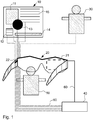
- Fig. 1 shows a schematic representation of a checking process of a security document 10 by means of an augmented reality system 20.
- the abbreviation AR system 20 is intended to stand and be used below for augmented reality system 20.
- the security document 10 can be, for example, a passport, a visa, a birth certificate, a bank note, an identification document, a security paper, a credit card, a ticket or a voucher. It is thus possible that the security document 10 originates from the public, government and private sectors.
- the security document 10 for example an identity card, preferably comprises a photo 11, a storage medium 12, a security element 13, coded identifiers 14, in particular a machine-readable area, and an area 15 with personal data, such as the name, address and date of birth of the document holder 30.
- the area of the coded identifiers 14 has, for example, the OCR-B font which, for example, encodes the ID number.
- the security element 13 is preferably an optically variable security element and can, for example, be a relief structure, in particular a diffractive structure, linear or crossed sinusoidal grating structures or binary grating structures, asymmetrical blazed grating structures, an overlay of a macrostructure with a diffractive and / or matt microstructure, diffraction structures of zero order, Blaze grids, macrostructures, in particular lens structures or microprismatic structures, mirror surfaces, matt structures, in particular anisotropic and isotropic matt structures, thin film layer elements or liquid crystal layers for generating viewing angle dependent color shift effects, volume holograms or optically variable pigments comprising layers / indica and / or luminescent, photochromic, electrochromic or thermochromic substances.
- a relief structure in particular a diffractive structure, linear or crossed sinusoidal grating structures or binary grating structures, asymmetrical blazed grating structures, an overlay of a macrostructure with a diffractive and / or matt micro
- OVD optical variable device
- the security document 10 can also have different or additional information or features.
- the security document 10 can include symbols, logos, images, characters, alphanumeric characters or numbers.
- An AR system is to be understood as any device that expands the user's perception of reality by means of technical aids.
- a tablet, a smartphone or a PDA Personal Digital Assistant
- other devices can of course also be used.
- PDA Personal Digital Assistant
- devices that are specifically designed only to carry out this method instead of the multi-purpose devices mentioned, it is also possible to use devices that are specifically designed only to carry out this method.
- existing data glasses can be adapted to the implementation of the method according to the invention by adapting the software and / or hardware.
- the AR system 20 has one or more detection devices, in particular the detection device 22, a control device, in particular the Control device 24, and preferably one or more output devices, in particular the output device 21.
- the AR system 20, for example data glasses, thus comprises, for example, the output device 21, for example an info screen.
- the info screen displays visual displays to the human eye, for example by means of a waveguide and a correspondingly shaped reflector.
- the AR system 20 includes, for example, the detection device 22, such as a camera, which detects images with a resolution of 5 megapixels in a wavelength range of 380 nm to 3 ⁇ m and thus both the spectral range visible to the human eye and the near-by Infrared range also detected.
- the detection device 22 preferably comprises a device for reading out the storage medium 12, such as an RFID reader. The RFID reader enables the storage medium 12 to be read out in a contactless manner.
- the user 50 for example a police officer or a customs officer, now uses the detection device 22 of the AR system 20 to capture the security document 10 and the document holder 30 by taking an image of the security document 10 and the document holder 30 Understand information by means of the detection device 22.
- the image recording can, for example, by a touch-sensitive sensor of the AR system 20, such as a touchscreen, can be triggered.
- the storage medium 12 of the security document 10 is read out.
- the reading out of the storage medium 12 can also be triggered by a touch-sensitive sensor.
- the individual information or features such as the photo 11, the security element 13, the coded identifier 14 and the area 15 with the personal data, can be captured in an overall image or sequentially as individual images containing the individual features or information.
- the captured information in the form of the images of the security document 10, of the document holder 30 and the information of the storage medium are transmitted from the control device of the AR system 20 to a database 40 via a communication connection 60.
- the control device of the AR system requests the information associated with this information in the database 40 for the comparison from the database 40 via the communication link 60.
- the communication connection takes place, for example, via a wireless Internet connection using UMTS, LTE or GPRS.
- the communication link 60 it is also possible for the communication link 60 to be wired. Further communication connections such as via satellite or local connections such as Bluetooth or WLAN are also possible.
- the database 40 or a part of the database 40 it is also possible for the database 40 or a part of the database 40 to be contained locally in the AR system.
- the database 40 for example a central computer or a so-called cloud from a plurality of networked, jointly calculating individual computers, and / or the control device of the AR system 20, now compares the received information with the assigned information stored in the database 40.
- the document type is determined, for example using the OCR-B font in the coded identifier 14.
- the other information can be checked for authenticity. It is first checked whether the information or characteristics assigned to the document type are present. This information or features are typically in the form of one or more objects or motifs, such as the photo 11 or the security element 13, on the security document.
- an image recognition algorithm in particular a Haar-Cascade algorithm, is used to check whether one or more objects are present.
- Such algorithms allow quick and reliable classification of image content.
- the Haar Cascade algorithm is based on the evaluation of a large number of so-called "hair-like” features in a single image. These are structures that are related to Haar wavelets, i.e. square wave trains of a given wavelength. In two dimensions, these are simply adjacent, alternating light and dark rectangular areas in the image. By moving a rectangular mask over the single image, the present “Hair-like” characteristics determined. The present “hair-like” features are then compared with those that are to be present in the object to be recognized, such as the photo 11 or the security element 13. This can be done using a filter cascade.
- Haar-Cascade algorithm has the advantage of requiring very little computing time and computer resources. However, it is also possible to use other image recognition algorithms.
- a form of computer learning is used for image recognition.
- the algorithm is not given any specific parameters on the basis of which the image content is classified; rather, the algorithm learns these parameters on the basis of the training data set.
- a plurality of images are recorded, a first subset of the images each having the object to be recognized, such as the photo 11 or the security element 13, and a second subset of the images each having the object to be recognized, such as for example the photo 11 or the security element 13, and with each image of the first subset being assigned all the respective image coordinates of the features to be recognized of the object to be recognized, such as the photo 11 or the security element 13.
- the image recognition algorithm is then trained on the basis of the first and second subsets and the assigned image coordinates. As a result, the algorithm learns to classify the images correctly and, if necessary, to ignore interference factors deliberately introduced into the training data set, such as reflections in the images, random shadows or the like.
- the contour is then determined from at least one object, such as the photo 11 or the security element 13.
- the simple image recognition described above which only provides a yes / no classification or a probability statement as to whether the object to be recognized, such as the photo 11 or the security element 13, is present in the single image
- additional information is provided in this way.
- the presence or absence of detailed features of the object to be recognized, such as the photo 11 or the security element 13 can be checked on the basis of the determined contour. This provides further features that can contribute to the verification of the security document.
- an edge recognition algorithm such as the Canny algorithm can be used.
- edges are characterized by strong fluctuations in brightness between neighboring pixels and can therefore be described as discontinuities in the gray value function of the image.
- noise filtering in particular by means of a Gaussian filter with a preferred kernel size of 3 to 7, is carried out when the edge detection algorithm is executed.
- a kernel is understood here to be a convolution matrix that is applied to the image information.
- the convolution matrix of the Gaussian filter corresponds to the normal distribution and acts as a low-pass filter.
- the gray value of a filtered pixel thus corresponds to the mean value of the gray values of the surrounding pixels weighted with the normal distribution up to a maximum distance defined by the kernel size. Smaller structures resulting from noise are lost, while the main structures of the object to be recognized, such as the photo 11 or the security element 13, are retained.
- an edge detection is preferably carried out by using a Sobel operator in at least one preferred direction of the individual image, preferably in two orthogonal preferred directions of the individual image.
- the Sobel operator is also a convolution operator that acts as a discrete differentiator. By folding the image with the Sobel operator, the partial derivatives of the gray value function are obtained in the two preferred orthogonal directions. The edge direction and edge strength can then be determined from this.
- edge filtering is then carried out. This can take place, for example, by means of what is known as non-maximum suppression, which ensures that only the maxima are retained along an edge, so that an edge perpendicular to its direction of extension is not wider than a pixel.
- a threshold value-based determination of the image coordinates of the contour of the object to be recognized such as the Photos 11 or of the security element 13. It is therefore determined from which edge thickness a pixel is to be counted as an edge.
- a hysteresis-based method for example, can be used for this purpose.
- two threshold values T 1 and T 2 are established, T 2 being greater than T 1 .
- T 2 being greater than T 1 .
- a pixel with an edge thickness greater than T 2 is considered to be part of an edge. All pixels connected to this pixel with an edge thickness greater than T 1 are also assigned to this edge.
- the image coordinates of all pixels belonging to an edge of the object to be recognized, such as, for example, the photo 11 or the security element 13, in the individual image being examined are thus obtained. These can be analyzed further, for example to identify simple geometric shapes.
- the information on the storage medium 12 is also compared with information stored in the database 40 and with information already recorded, preferably by the control device of the AR system 20 matched.
- a photo of the document holder 30 stored on the storage medium 12 matches the captured photo of the document holder 30 and the photo 11 of the security document 10.
- a photo additionally stored in the database 40 can be used for a further comparison with the photo 11 of the security document 10.
- the results of the check or the data required for the check are transmitted from the database to the AR system 20 via a communication link 60 and output to the user 50 via the output device 21.
- the results can be stored in the database 40.
- the information recorded in the security document 10 can also be output to the user 50.
- the recorded information can be output according to its relevance for the user 50 by means of the output device 21 of the AR system 20.
- Fig. 2 shows a schematic representation of a test system with the AR system 20.
- the AR system 20 has the acquisition device 22, the output device 21 and the control device 24.
- the detection device 22 detects a large number of different items of information. This information can be recorded by means of suitable sensors, such as cameras, position determination systems, temperature sensors, microphones, humidity sensors or photo detectors. Thus, the detector 22 is in FIG Fig. 2 configured in such a way that this information about the humidity 221 and the temperature 222 of the spatial environment, the position 223 of the AR system 20, acoustic signals 224 of the spatial Environment, a security document 10, a document holder 30 and a vehicle 225 detected.
- the license plate number of the vehicle 225 of the document holder 30 can be included in the checking process and, for example, a plausibility check can be carried out.
- the control device 24 checks the information acquired by the acquisition device 22 by comparing it with the database 40.
- the acquired information can be transmitted to the database 40 via a communication interface or information assigned to the acquired information can be requested from the database 40.
- the control device preferably comprises a hardware platform, preferably with one or more processes, a memory and one or more output modules; a software platform, in particular comprising an operating system; and one or more application programs running on this, which, when executed, provide the functions of the control device.
- the recorded information can be checked in the control device 24.
- the ones required for verification Data is retrieved from the database 40 from this.
- computationally intensive checks such as checking images for authenticity, can be carried out in database 40, whereas character strings are checked in control device 24, for example.
- the database and / or parts of the database are stored on the control device 24 of the AR system 20, in particular are stored on a storage medium of the control device 24 of the AR system 20. This enables a location-independent use of the AR system 20, for example in the context of personal checks.
- the AR system 20 has a device, such as a photodiode, to measure the illuminance. If the illuminance falls below a predetermined threshold value, preferably less than 800 Ix, a light source of the AR system 20 is activated, so that sufficient illumination of the security document 10 is ensured.
- the light source of the AR system 20 is preferably an arrangement of LEDs which in particular emit white light, in particular daylight.
- the comparison with the database 40 is preferably carried out via a secure Internet connection 61.
- the transmitted data can be transmitted in encrypted form. Encryption algorithms are used for encryption.
- the results of the check are output by means of the output device 21.
- the output of the results of the verification can, as in Fig. 2 shown, take place on a storage medium 211.
- This storage medium 211 can be, for example, a transportable storage medium such as a USB memory stick or a hard disk.
- the output can take place in visual form via an info screen 212 of data glasses, via a head-up display 213 or via a screen 214.
- the output can also take place in acoustic form via a loudspeaker 215. For example, it can be output to a user of the AR system 20 by means of headphones. It is also possible for the output to take place in tangible form for a user, for example by a piezo element 216 which exerts a pressure stimulus on the user.
- FIG. 3 shows a flow chart.
- the flowchart of the Fig. 3 FIG. 10 illustrates an exemplary sequence of a test process 300 which is controlled by the control device 24.
- the checking process 300 can of course be carried out by acquiring further information, for example in FIG Fig. 2 described, expanded. According to the above statements, the results can also be output in visual, acoustic and / or tactile form.
- step 301 an image of the security document is first recorded by the detection device 22, controlled by the control device 24. This is done, for example, by means of a camera in data glasses.
- step 302 one or more pieces of information, such as, for example, the machine-readable area, of the security document are recorded.
- the document type can be determined using the machine-readable area or personal data can be recorded.
- the one or more captured information items, controlled by the control device 24, are preferably output by means of the output device 21, for example on a display such as the info screen of the smart glasses.
- the one or more recorded items of information can be displayed according to their relevance for the checking process.
- the relevance for the checking process is determined, for example, by the document type. In the case of a personal check, for example, the name and address of the document holder can be displayed first.
- step 304 the one or more pieces of information recorded are checked by the control device 24 by comparison with the database 40.
- the checking of the one or more pieces of information recorded by comparison with the database reference is made to the above statements.
- step 305 controlled by the control device 24, one or more results of the checking of the one or more recorded items of information output by means of the output device 20, for example by means of a display, are displayed.
- the one or more results are displayed according to their priority. For example, discrepancies or an indication that the person is wanted can be listed first.
- step 306 one or more of the results of the checking of the one or more recorded information items are stored in a controlled manner by the control device 24 and / or transmitted to the database 40. If checks have been carried out by the control device 24, for example, the results of the check are preferably transmitted to the database 40 and stored there.
- FIGS. 4 to 7 represent the acquisition and checking of a security document by means of an AR system.
- the AR system 401 for performing the in the FIGS. 4 to 7 specified process is here preferably like the AR system 20 according to Fig. 1 and Fig. 2 configured, so that reference is made to the above statements.
- the AR system 401 preferably has a connection to a database and can be used locally, for example by security personnel at airports or border officials, or at any location / mobile, for example for personal checks or traffic controls.
- the AR system 401 initially captures the security document in a step 402 as in FIG Fig. 4 shown. As in Fig. 5 shown, in a step 505 it is initially determined whether the security document is known or can be assigned. If the security document is known and can be assigned, the information from the security document is read out.
- the machine-readable area (MRZ: machine readable zone) can be read out.
- MZ machine readable zone
- OCR-B font is used for labeling. In the OCR-B font, every character has the same spacing and is therefore specially designed to be machine-readable.
- the information in the machine-readable area is compared with the database.
- the result of the comparison gives a hint or contradicts further information of the Security document, so that the user will be given an alarm notice.
- further information relating to the checked security document is stored in the database, such as a missing person report or a wanted report, so that a corresponding alarm notice is output to the user. If all of the checked information is genuine or if no further information is stored in the database, a corresponding message is given to the user.
- undetectable is understood to mean that the check has found deviations or inconsistencies through comparison with the database or that the information cannot be detected due to disruptive factors such as contamination and / or shielding.
- the storage medium of the security document can be read out in a step 509, for example.
- the storage medium can contain biometric information such as fingerprints, body measurements or a photo of the document holder.
- the information on the storage medium is compared with the database.
- the result of the comparison gives an indication of inconsistencies or contradicts further information in the security document, so that the user has a corresponding alarm notice will be output.
- further information relating to the checked security document is stored in the database, such as a missing person report or a wanted report, so that a corresponding alarm notice is output to the user. If all of the checked information is genuine or if no further information is stored in the database, a corresponding message is given to the user.
- the photo of the security document can be captured and compared with the database, for example.
- the document layout of the security document can be detected and compared with the database.
- the document layout can be assigned to a document type and does not contradict other information in the security document, a corresponding note is issued to the user. If the result of the comparison gives an indication or if it contradicts further information in the security document, a corresponding alarm indication is output to the user.
- the area with personal data of the security document can be read out and compared with the database.
- the security elements of the security document can be recorded and compared with the database.
- the presence of the security elements on the security document is checked. This can be done, for example, by recognizing the shape using image processing algorithms such as the Haar-Cascade algorithm or the Canny algorithm. With regard to these two algorithms, reference is made to the above statements. In addition, other image recognition algorithms can also be used.
- the check of the presence of the security elements of the security document can show, for example, that the security elements of the security document match the security elements of the security document stored in the database match or contradict the security document. The user receives a corresponding notification about this.
- the database may include further information relating to the checked security element of the security document, such as an animation of the security element, in particular in the case of special viewing angle or lighting angle-dependent optical effects of an OVD, or detailed information on the security element.
- the database in addition to the additional information relating to the security elements, to include further information which is determined during the checking process.
- additional information reference is made to the further statements and to the statements above.
- graphic codes of the security document can be read out and compared with the database.
- Graphic codes can be, for example, guilloches or other special patterns, motifs or ornaments.
- the result of the comparison of the graphic codings with the database gives an indication of discrepancies or contradicts further information in the security document so that a corresponding alarm message is issued to the user.
- further information relating to the checked security document may be stored in the database, such as, for example, references to forgeries, so that the user is given an alarm notice. If all of the checked information is genuine or if no further information is stored in the database, a corresponding message is given to the user.
- the security document can be recorded in detail in order to include the features of the unknown security document in the database. Furthermore, the detailed recording of the security document can be compared with the database in order to determine whether certain features of the unknown security document are already known.
- the recorded wave spectrum can be compared with the database, for example for matches with the document type.
- the results of the check can be displayed to the user.
- the AR system 401 detects the document holder in a step 403, as in FIG Fig. 4 shown.
- the biometric features of the document holder are recorded in a step 606. This can be, for example, a photo of the face of the document holder Act.
- the biometric features of the document holder can be compared, for example, with the biometric data of the storage medium of the security document, the photo of the security document in a step 608 or the database in a step 609.
- Possible inconsistencies can be superimposed on the security document or the document carrier by means of optical overlays.
- different anatomical-physiological features can be superimposed on the document holder.
- information that includes one or more parameters that specify a pathognomics, physiognomics and / or physiology of the document carrier can be acquired in a step 607.
- the pathognomics here relates to the mood, the physiognomics to the facial features and the physiology to the emotions of the document carrier, which can be determined, for example, by adapting the software and / or hardware of the AR system.
- further criteria can of course be used.
- the one or more parameters can, for example, be compared with tables of values assign a mood image to the document holder. Such information makes it possible to determine the mood of the document holder and to output anomalies or notices to the user.
- the AR system 401 can output messages and messages, such as messages from authorities or other document checking centers, messages from colleagues or control centers.
- messages and messages such as messages from authorities or other document checking centers, messages from colleagues or control centers.
- System recording is understood here to mean the storage of the recorded information, the results of the checks carried out and / or the user.
- the AR system 401 as in Fig. 4 is shown to acquire further information of the spatial environment in a step 406, in particular in the case of a location-independent / mobile use of the AR system 401.
- further information is initially recorded.
- further information can be recorded visually, for example by means of one or more cameras or by means of a laser scanner.
- further visually recorded information can be the license plate number of the document holder.
- further information can relate, for example, to the voice of the document holder.
- the recorded voice can be compared with the database by means of a frequency analysis, in particular enabling a statement to be made with regard to the (mother) language and / or the dialect and / or detected changes in the voice provide an indication of possible lies or false statements.
- a step 711 to acquire further information about the surroundings by further sensors such as, for example, moisture sensors, an infrared camera or temperature sensors.
- further sensors such as, for example, moisture sensors, an infrared camera or temperature sensors.
- moisture sensors such as, for example, an infrared camera or temperature sensors.
- Inclusion of the further information relating to the spatial environment can further improve the verification of the security document.
- the AR system 401 can be used as in Fig. 4 further carry out a position determination in a step 407.
- position determination reference is made to the above statements.
- the information relating to the determination of the position of the AR system can furthermore be used in particular for location-related references to further checks of the security document or to cross-references to locations of other checks.
Landscapes
- Engineering & Computer Science (AREA)
- Theoretical Computer Science (AREA)
- Physics & Mathematics (AREA)
- General Physics & Mathematics (AREA)
- General Engineering & Computer Science (AREA)
- Computer Security & Cryptography (AREA)
- Databases & Information Systems (AREA)
- Computer Hardware Design (AREA)
- Software Systems (AREA)
- Human Computer Interaction (AREA)
- Data Mining & Analysis (AREA)
- Computer Vision & Pattern Recognition (AREA)
- Optics & Photonics (AREA)
- Computational Linguistics (AREA)
- Computer Networks & Wireless Communication (AREA)
- Business, Economics & Management (AREA)
- General Business, Economics & Management (AREA)
- Signal Processing (AREA)
- Multimedia (AREA)
- Computer Graphics (AREA)
- Credit Cards Or The Like (AREA)
- Collating Specific Patterns (AREA)
- Inspection Of Paper Currency And Valuable Securities (AREA)
- Measurement Of The Respiration, Hearing Ability, Form, And Blood Characteristics Of Living Organisms (AREA)
Claims (14)
- Procédé de contrôle d'un document de sécurité (10), dans lequel le document de sécurité (10) est une pièce d'identité, un visa, un certificat de naissance, un billet de banque, un papier de valeur ou une carte de crédit,
avec les étapes :- de détection d'une ou de plusieurs premières informations du document de sécurité (10) au moyen d'un système de réalité augmentée (20), en particulier de lunettes de réalité augmentée ;- de vérification d'une ou de plusieurs premières informations par confrontation avec une base de données (40), dans lequel la base de données est un ordinateur central ou un nuage composé d'une pluralité d'ordinateurs individuels mis en réseau, calculant conjointement ;- de stockage d'un ou de plusieurs résultats de la vérification d'une ou de plusieurs premières informations et
d'envoi d'un ou de plusieurs résultats de la vérification d'une ou de plusieurs premières informations au moyen du système de réalité augmentée (20) ;- de détection d'une ou de plusieurs deuxièmes informations du détenteur de document (30), en particulier d'un titulaire de pièce d'identité, au moyen du système de réalité augmentée (20), dans lequel une ou plusieurs premières informations ou une ou plusieurs informations issues de la base de données (40) sont confrontées avec une ou plusieurs des deuxièmes informations lors de la vérification d'une ou de plusieurs premières informations ;dans lequel une ou plusieurs informations supplémentaires issues de la base de données (40) sont déterminées en tant qu'au moins un résultat du contrôle lors de la vérification d'une ou de plusieurs premières informations ; et
dans lequel une ou plusieurs premières informations comprennent des informations portant sur l'aspect optique de caractéristiques de sécurité optiquement variables du document de sécurité, lesquelles sont générées de manière à pouvoir être détectées optiquement par des structures en relief, en particulier des structures diffractives, des structures de diffraction d'ordre zéro, des réseaux Blaze, des macrostructures, en particulier des structures à lentilles ou des structures à microprismes, des surfaces réfléchissantes, des structures mattes, en particulier des structures mattes anisotropes ou isotropes, ou des combinaisons desdites structures. - Procédé selon la revendication 1,
caractérisé en ce
que sont affichées, avant et/ou pendant la détection d'une ou de plusieurs des premières informations du document de sécurité (10), au moyen du système de réalité augmentée (20), en particulier des lunettes de réalité augmentée, des instructions sur la position relative dans laquelle et/ou la distance par rapport au système de réalité augmentée (20) à laquelle le document de sécurité (10) est à maintenir et/ou à déplacer pendant la détection d'une ou de plusieurs premières informations. - Procédé selon l'une quelconque des revendications précédentes,
caractérisé en ce
qu'une ou plusieurs premières informations comprennent des informations portant sur des caractéristiques de sécurité (13), des photos (11), des identifiants codés (14) et des données personnelles (15), en particulier le nom, l'adresse et la date de naissance. - Procédé selon l'une quelconque des revendications précédentes,
caractérisé en ce
que lors de la détection d'une ou de plusieurs premières informations, une ou plusieurs des premières informations sont lues de manière optique, électromagnétique, magnétique, électrique et/ou par une machine électronique du document de sécurité (10), en particulier
que l'étape de la lecture comprend la lecture depuis un ou plusieurs supports de stockage (12) du document de sécurité (10), et/ou
que l'étape de la lecture comprend la lecture d'une ou de plusieurs premières informations optiques ne pouvant pas être identifiées visuellement par l'observateur, lesquelles sont lues par une machine en particulier avec un ou plusieurs systèmes de détection d'image, de préférence des caméras infrarouges. - Procédé selon la revendication 1,
caractérisé en ce
qu'une ou plusieurs deuxièmes informations du détenteur de document (30) sont des informations biométriques en particulier de la tête, et sont définies par un algorithme de traitement d'image, en particulier un algorithme de reconnaissance faciale. - Procédé selon l'une quelconque des revendications précédentes,
caractérisé en ce
que le système de réalité augmentée (20) superpose optiquement un ou plusieurs des résultats de la vérification au document de sécurité (10) au moyen d'un masque optique, en particulier
qu'un ou plusieurs des résultats de la vérification superposés au moyen du masque optique au document de sécurité (10) comprennent des informations portant sur des incohérences/contradictions sur le document de sécurité (10), des caractéristiques de sécurité (13) incohérentes, des informations de contenu ou des caractéristiques anatomiques physiologiques. - Procédé selon l'une quelconque des revendications précédentes,
caractérisé en ce
qu'un classement par authenticité, en particulier une probabilité d'authenticité, est créé en tant que résultat de la vérification d'une ou de plusieurs premières informations, en particulier
que lors de la vérification, l'authenticité d'une ou de plusieurs premières informations est tout d'abord vérifiée pour établir si un ou plusieurs objets sont présents. - Procédé selon l'une quelconque des revendications précédentes,
caractérisé en ce
qu'une ou plusieurs informations supplémentaires comprennent des informations sur des liens chronologiques à des documents de sécurité déjà contrôlés, des remarques sur des occasions/faits d'ordre général, des informations concernant des événements sur site ou avec une référence à un lieu/des personnes, des références croisées à d'autres contrôles/inspections du document de sécurité (10), des remarques sur le champ relationnel du détenteur de document, des remarques sur d'autres caractéristiques de sécurité (13) du document de sécurité (10), des remarques sur la vérification manuelle des caractéristiques de sécurité (13) et des statistiques. - Procédé selon l'une quelconque des revendications précédentes,
caractérisé en ce
qu'un ou plusieurs résultats comprennent des résultats sur des données à caractère personnel, en particulier le nom, la date de naissance ou le sexe du détenteur de document (30), le lieu d'édition du document de sécurité (10) et le statut du document de sécurité (10), en particulier la validité du document de sécurité (10), et/ou
que lors de l'étape de la vérification d'une ou de plusieurs premières informations par confrontation avec une base de données (40), le type de document est défini en tant qu'au moins un résultat. - Procédé selon l'une quelconque des revendications précédentes, qui comprend par ailleurs l'étape :- de détection d'une ou de plusieurs troisièmes informations de l'environnement spatial.
- Procédé selon la revendication 10,
caractérisé en ce
qu'une ou plusieurs des troisièmes informations sont des informations visuelles, acoustiques, thermiques ou chimiques de l'environnement spatial, et/ou
qu'une ou plusieurs des troisièmes informations sont détectées au moyen d'un ou de plusieurs microphones, capteurs d'humidité, de photodétecteurs ou de capteurs de température, et/ou
que lors de la vérification d'une ou de plusieurs premières informations, une comparaison, en particulier sur la plausibilité, d'une ou plusieurs des premières informations à une ou plusieurs des troisièmes informations est effectuée par confrontation avec la base de données (40). - Procédé selon l'une quelconque des revendications précédentes, qui comprend par ailleurs l'étape :- de détection d'une ou de plusieurs quatrièmes informations, en particulier une définition de positionnement et/ou de position du système de réalité augmentée (20) dans l'espace, en particulier dans lequelune ou plusieurs quatrièmes informations sont définies par un système de définition de position mondial, en particulier par GPS, Galileo, GLONASS ou BeiDou, et/ou par au moins un capteur d'accélération.
- Utilisation d'un système de réalité augmentée (20) pour contrôler un document de sécurité (10) pour mettre en œuvre le procédé selon l'une quelconque des revendications 1 à 12.
- Système de réalité augmentée (20) pour mettre en œuvre le procédé selon l'une quelconque des revendications 1 à 12, qui présente les composants suivants :- un ou plusieurs systèmes de détection (22) pour détecter une ou plusieurs premières informations du document de sécurité (10) ;- un dispositif de commande (24), dans lequel le dispositif de commande (24) est configuré de telle manière que celui-ci vérifie une ou plusieurs premières informations par confrontation avec une base de données (40) et stocke et/ou envoie un ou plusieurs des résultats de la vérification d'une ou de plusieurs premières informations.
Priority Applications (1)
| Application Number | Priority Date | Filing Date | Title |
|---|---|---|---|
| RS20211314A RS62495B1 (sr) | 2014-06-18 | 2015-06-16 | Postupak za ispitivanje sigurnosnog dokumenta |
Applications Claiming Priority (1)
| Application Number | Priority Date | Filing Date | Title |
|---|---|---|---|
| DE102014108578.7A DE102014108578A1 (de) | 2014-06-18 | 2014-06-18 | Verfahren zur Prüfung eines Sicherheitsdokuments |
Publications (2)
| Publication Number | Publication Date |
|---|---|
| EP2958086A1 EP2958086A1 (fr) | 2015-12-23 |
| EP2958086B1 true EP2958086B1 (fr) | 2021-09-01 |
Family
ID=53397970
Family Applications (1)
| Application Number | Title | Priority Date | Filing Date |
|---|---|---|---|
| EP15172242.8A Active EP2958086B1 (fr) | 2014-06-18 | 2015-06-16 | Procédé de contrôle d'un document de sécurité |
Country Status (6)
| Country | Link |
|---|---|
| US (1) | US10109109B2 (fr) |
| EP (1) | EP2958086B1 (fr) |
| DE (1) | DE102014108578A1 (fr) |
| ES (1) | ES2892523T3 (fr) |
| HU (1) | HUE055499T2 (fr) |
| RS (1) | RS62495B1 (fr) |
Families Citing this family (19)
| Publication number | Priority date | Publication date | Assignee | Title |
|---|---|---|---|---|
| US10122888B2 (en) * | 2015-10-26 | 2018-11-06 | Ricoh Company, Ltd. | Information processing system, terminal device and method of controlling display of secure data using augmented reality |
| IL299710A (en) * | 2016-06-03 | 2023-03-01 | Magic Leap Inc | Identity verification in augmented reality |
| ES2621929B1 (es) * | 2016-08-31 | 2018-04-10 | Mikel Aingeru ARDANAZ JIMENEZ | Método y sistema de entrenamiento deportivo. |
| US10158634B2 (en) | 2016-11-16 | 2018-12-18 | Bank Of America Corporation | Remote document execution and network transfer using augmented reality display devices |
| US10768425B2 (en) * | 2017-02-14 | 2020-09-08 | Securiport Llc | Augmented reality monitoring of border control systems |
| CN108509824B (zh) * | 2017-02-24 | 2020-08-18 | 亮风台(上海)信息科技有限公司 | 基于ar设备的物品特征标识方法以及检查物品的系统 |
| DE102017001879A1 (de) | 2017-02-27 | 2018-08-30 | Giesecke+Devrient Mobile Security Gmbh | Verfahren zur Verifizierung der Identität eines Nutzers |
| US10068403B1 (en) * | 2017-09-21 | 2018-09-04 | Universal City Studios Llc | Locker management techniques |
| WO2019119038A1 (fr) * | 2017-12-19 | 2019-06-27 | Ccl Secure Pty Ltd | SYSTÈME ET PROCÉDÉ DE GÉNÉRATION D'UNE REPRÉSENTATION VIRTUELLE D'UN DOCUMENT DE SÉCURITÉ <i /> |
| DE102018129721A1 (de) * | 2018-11-26 | 2020-05-28 | Bayerische Motoren Werke Aktiengesellschaft | Bildschirmeinheit zum umgebungslichtabhängigen Darstellen grafischer Elemente |
| CN109784339A (zh) * | 2018-12-13 | 2019-05-21 | 平安普惠企业管理有限公司 | 图片识别测试方法、装置、计算机设备及存储介质 |
| DE102019207855A1 (de) | 2019-05-28 | 2020-12-03 | Tesa Scribos Gmbh | Augmented Reality Animation |
| CN111784131A (zh) * | 2020-06-19 | 2020-10-16 | 江苏金匮通供应链管理有限公司 | 基于通关数据分析的通关处理方法及系统 |
| CN111950415A (zh) * | 2020-07-31 | 2020-11-17 | 北京捷通华声科技股份有限公司 | 一种图像检测方法和装置 |
| EP4229533A1 (fr) | 2020-10-19 | 2023-08-23 | Google LLC | Mappage d'une instance tangible d'un document |
| US11893551B2 (en) | 2021-04-15 | 2024-02-06 | Bank Of America Corporation | Information security system and method for augmented reality check generation |
| US11449841B1 (en) | 2021-04-15 | 2022-09-20 | Bank Of America Corporation | Information security system and method for augmented reality check realization |
| US11823148B2 (en) | 2021-04-15 | 2023-11-21 | Bank Of America Corporation | Augmented reality-enabled ATM for secure augmented reality check realization |
| CN113411477B (zh) * | 2021-06-10 | 2023-03-10 | 支付宝(杭州)信息技术有限公司 | 一种图像的采集方法、装置及设备 |
Family Cites Families (15)
| Publication number | Priority date | Publication date | Assignee | Title |
|---|---|---|---|---|
| GB9524319D0 (en) * | 1995-11-23 | 1996-01-31 | Kodak Ltd | Improvements in or relating to the recording of images |
| US6220515B1 (en) * | 1998-01-16 | 2001-04-24 | Ralph R. Bello | Identification system and method |
| US7346184B1 (en) * | 2000-05-02 | 2008-03-18 | Digimarc Corporation | Processing methods combining multiple frames of image data |
| US20030218328A1 (en) * | 2002-05-22 | 2003-11-27 | Conwell Kent Thomas | Method and system for securing the visual identity of travelers to their travel documents |
| AU2007204608A1 (en) * | 2006-01-16 | 2007-07-19 | Securency International Pty Ltd | Data storage in a diffractive optical element |
| US20070252001A1 (en) * | 2006-04-25 | 2007-11-01 | Kail Kevin J | Access control system with RFID and biometric facial recognition |
| GB0704947D0 (en) * | 2007-03-15 | 2007-04-25 | Wesby Philip B | System and method for encoding and authentication |
| RS51531B (sr) * | 2009-05-29 | 2011-06-30 | Vlatacom D.O.O. | Ručni prenosni uređaj za proveru putnih i ličnih dokumenata, očitavanje biometrijskih podataka i prepoznavanje lica koja nose te dokumente |
| KR101164647B1 (ko) * | 2009-07-08 | 2012-07-20 | 대한민국 | 도로 및 교량의 안개 저감 및 차폐 시스템 |
| KR101114542B1 (ko) * | 2009-10-28 | 2012-02-27 | (주)이컴앤드시스템 | 유가증권 진위 판단 방법, 장치 및 그 기록 매체 |
| US9128281B2 (en) | 2010-09-14 | 2015-09-08 | Microsoft Technology Licensing, Llc | Eyepiece with uniformly illuminated reflective display |
| US8941560B2 (en) | 2011-09-21 | 2015-01-27 | Google Inc. | Wearable computer with superimposed controls and instructions for external device |
| EP2634754A1 (fr) * | 2012-03-01 | 2013-09-04 | Gemalto SA | Procédé de vérification de documents, et dispositif de mise en oeuvre d'un tel procédé |
| JP6040715B2 (ja) | 2012-11-06 | 2016-12-07 | ソニー株式会社 | 画像表示装置及び画像表示方法、並びにコンピューター・プログラム |
| AU2013100154B4 (en) * | 2013-02-14 | 2013-10-10 | Innovia Security Pty Ltd | Security document including at least one marker element and methods of their manufacture |
-
2014
- 2014-06-18 DE DE102014108578.7A patent/DE102014108578A1/de not_active Ceased
-
2015
- 2015-06-15 US US14/739,568 patent/US10109109B2/en active Active
- 2015-06-16 ES ES15172242T patent/ES2892523T3/es active Active
- 2015-06-16 HU HUE15172242A patent/HUE055499T2/hu unknown
- 2015-06-16 RS RS20211314A patent/RS62495B1/sr unknown
- 2015-06-16 EP EP15172242.8A patent/EP2958086B1/fr active Active
Also Published As
| Publication number | Publication date |
|---|---|
| DE102014108578A1 (de) | 2015-12-24 |
| US10109109B2 (en) | 2018-10-23 |
| US20150371445A1 (en) | 2015-12-24 |
| EP2958086A1 (fr) | 2015-12-23 |
| HUE055499T2 (hu) | 2021-11-29 |
| ES2892523T3 (es) | 2022-02-04 |
| RS62495B1 (sr) | 2021-11-30 |
Similar Documents
| Publication | Publication Date | Title |
|---|---|---|
| EP2958086A1 (fr) | Procédé de contrôle d'un document de sécurité | |
| CN105934779B (zh) | 用于验证安全元件的方法和光学可变的安全元件 | |
| DE112007001791B4 (de) | Verfahren und Vorrichtung zum Vergleichen von Dokumentmerkmalen mittels einer Texturanalyse | |
| EP2948891B2 (fr) | Identification de l'utilisateur | |
| EP3424024B1 (fr) | Document de sécurite et procédé permettant d'authentifier ce document | |
| Pugliese | Biometrics: Bodies, technologies, biopolitics | |
| EP3889922B1 (fr) | Vérification de l'intégrité d'un document comportant des données à caractère personnel | |
| EP3025200A1 (fr) | Procédé et dispositif permettant de vérifier des éléments diffractifs | |
| DE102013113340A1 (de) | Verfahren zum Authentifizieren eines Sicherheitselements und optisch variables Sicherheitselement | |
| DE102020101559A1 (de) | Verfahren zum Authentifizieren eines Sicherheitsdokuments | |
| DE102022100551A1 (de) | Materialspektroskopie | |
| EP3024666B1 (fr) | Procédé pour vérifier l'authenticité de documents | |
| Xu et al. | PSFNet: a deep learning network for fake passport detection | |
| EP2394250B1 (fr) | Procédé et dispositif pour vérifier des documents par utilisation d'une transformation en ondelettes | |
| EP3234928A1 (fr) | Procédé de vérification de l'authenticité d'une caractéristique de sécurité qui est disposée sur un document | |
| DE102015116708A1 (de) | Dokument und Verfahren zum Verifizieren eines Dokuments | |
| EP4075397B1 (fr) | Procédé d'identification d'une personne en fonction d'une caractéristique biométrique faciale au moyen d'un appareil mobile et appareil mobile | |
| DE102011084818A1 (de) | Verfahren zur Verifikation eines Sicherheitsdokuments mit einer Sichtbarriere unter Verwendung einer Anzeigevorrichtung | |
| EP4192692A1 (fr) | Production de modèles de documents dotés de caractéristiques de sécurité | |
| EP4214689B1 (fr) | Procédé de détection d'une manipulation ou d'une contrefaçon d'un objet et système correspondant | |
| EP3185221B1 (fr) | Dispositif d'authentification et procede de reconnaissance optique ou acoustique | |
| DE102011084820B4 (de) | Verfahren zur Verifikation eines Sicherheitsdokuments unter Verwendung einer Anzeigevorrichtung | |
| DE102023135932A1 (de) | Verfahren zur Verifikation von Sicherheitsdokumenten | |
| EP3035301A1 (fr) | Contrôle de l'authenticité d'un document en utilsent une charactéristique de sécurité photochrome | |
| DE102007023708A1 (de) | Photonisches Betriebssystem |
Legal Events
| Date | Code | Title | Description |
|---|---|---|---|
| PUAI | Public reference made under article 153(3) epc to a published international application that has entered the european phase |
Free format text: ORIGINAL CODE: 0009012 |
|
| AK | Designated contracting states |
Kind code of ref document: A1 Designated state(s): AL AT BE BG CH CY CZ DE DK EE ES FI FR GB GR HR HU IE IS IT LI LT LU LV MC MK MT NL NO PL PT RO RS SE SI SK SM TR |
|
| AX | Request for extension of the european patent |
Extension state: BA ME |
|
| 17P | Request for examination filed |
Effective date: 20160621 |
|
| RBV | Designated contracting states (corrected) |
Designated state(s): AL AT BE BG CH CY CZ DE DK EE ES FI FR GB GR HR HU IE IS IT LI LT LU LV MC MK MT NL NO PL PT RO RS SE SI SK SM TR |
|
| RAP1 | Party data changed (applicant data changed or rights of an application transferred) |
Owner name: OVD KINEGRAM AG |
|
| REG | Reference to a national code |
Ref country code: DE Ref legal event code: R079 Ref document number: 502015015128 Country of ref document: DE Free format text: PREVIOUS MAIN CLASS: G07C0009000000 Ipc: G06F0021320000 |
|
| GRAP | Despatch of communication of intention to grant a patent |
Free format text: ORIGINAL CODE: EPIDOSNIGR1 |
|
| STAA | Information on the status of an ep patent application or granted ep patent |
Free format text: STATUS: GRANT OF PATENT IS INTENDED |
|
| RIC1 | Information provided on ipc code assigned before grant |
Ipc: G06F 1/16 20060101ALI20210329BHEP Ipc: G02B 17/00 20060101ALI20210329BHEP Ipc: G07C 9/25 20200101ALI20210329BHEP Ipc: G06T 7/73 20170101ALI20210329BHEP Ipc: G06F 16/93 20190101ALI20210329BHEP Ipc: G06F 16/245 20190101ALI20210329BHEP Ipc: G06F 21/35 20130101ALI20210329BHEP Ipc: G06F 21/32 20130101AFI20210329BHEP |
|
| INTG | Intention to grant announced |
Effective date: 20210421 |
|
| GRAS | Grant fee paid |
Free format text: ORIGINAL CODE: EPIDOSNIGR3 |
|
| GRAA | (expected) grant |
Free format text: ORIGINAL CODE: 0009210 |
|
| STAA | Information on the status of an ep patent application or granted ep patent |
Free format text: STATUS: THE PATENT HAS BEEN GRANTED |
|
| AK | Designated contracting states |
Kind code of ref document: B1 Designated state(s): AL AT BE BG CH CY CZ DE DK EE ES FI FR GB GR HR HU IE IS IT LI LT LU LV MC MK MT NL NO PL PT RO RS SE SI SK SM TR |
|
| REG | Reference to a national code |
Ref country code: GB Ref legal event code: FG4D Free format text: NOT ENGLISH |
|
| REG | Reference to a national code |
Ref country code: CH Ref legal event code: EP Ref country code: AT Ref legal event code: REF Ref document number: 1426967 Country of ref document: AT Kind code of ref document: T Effective date: 20210915 |
|
| REG | Reference to a national code |
Ref country code: DE Ref legal event code: R096 Ref document number: 502015015128 Country of ref document: DE |
|
| REG | Reference to a national code |
Ref country code: IE Ref legal event code: FG4D Free format text: LANGUAGE OF EP DOCUMENT: GERMAN |
|
| REG | Reference to a national code |
Ref country code: FI Ref legal event code: FGE |
|
| REG | Reference to a national code |
Ref country code: HU Ref legal event code: AG4A Ref document number: E055499 Country of ref document: HU |
|
| REG | Reference to a national code |
Ref country code: LT Ref legal event code: MG9D |
|
| REG | Reference to a national code |
Ref country code: NL Ref legal event code: MP Effective date: 20210901 |
|
| PG25 | Lapsed in a contracting state [announced via postgrant information from national office to epo] |
Ref country code: HR Free format text: LAPSE BECAUSE OF FAILURE TO SUBMIT A TRANSLATION OF THE DESCRIPTION OR TO PAY THE FEE WITHIN THE PRESCRIBED TIME-LIMIT Effective date: 20210901 Ref country code: SE Free format text: LAPSE BECAUSE OF FAILURE TO SUBMIT A TRANSLATION OF THE DESCRIPTION OR TO PAY THE FEE WITHIN THE PRESCRIBED TIME-LIMIT Effective date: 20210901 Ref country code: NO Free format text: LAPSE BECAUSE OF FAILURE TO SUBMIT A TRANSLATION OF THE DESCRIPTION OR TO PAY THE FEE WITHIN THE PRESCRIBED TIME-LIMIT Effective date: 20211201 Ref country code: LT Free format text: LAPSE BECAUSE OF FAILURE TO SUBMIT A TRANSLATION OF THE DESCRIPTION OR TO PAY THE FEE WITHIN THE PRESCRIBED TIME-LIMIT Effective date: 20210901 |
|
| REG | Reference to a national code |
Ref country code: ES Ref legal event code: FG2A Ref document number: 2892523 Country of ref document: ES Kind code of ref document: T3 Effective date: 20220204 |
|
| PG25 | Lapsed in a contracting state [announced via postgrant information from national office to epo] |
Ref country code: PL Free format text: LAPSE BECAUSE OF FAILURE TO SUBMIT A TRANSLATION OF THE DESCRIPTION OR TO PAY THE FEE WITHIN THE PRESCRIBED TIME-LIMIT Effective date: 20210901 Ref country code: LV Free format text: LAPSE BECAUSE OF FAILURE TO SUBMIT A TRANSLATION OF THE DESCRIPTION OR TO PAY THE FEE WITHIN THE PRESCRIBED TIME-LIMIT Effective date: 20210901 Ref country code: GR Free format text: LAPSE BECAUSE OF FAILURE TO SUBMIT A TRANSLATION OF THE DESCRIPTION OR TO PAY THE FEE WITHIN THE PRESCRIBED TIME-LIMIT Effective date: 20211202 |
|
| PG25 | Lapsed in a contracting state [announced via postgrant information from national office to epo] |
Ref country code: IS Free format text: LAPSE BECAUSE OF FAILURE TO SUBMIT A TRANSLATION OF THE DESCRIPTION OR TO PAY THE FEE WITHIN THE PRESCRIBED TIME-LIMIT Effective date: 20220101 Ref country code: SM Free format text: LAPSE BECAUSE OF FAILURE TO SUBMIT A TRANSLATION OF THE DESCRIPTION OR TO PAY THE FEE WITHIN THE PRESCRIBED TIME-LIMIT Effective date: 20210901 Ref country code: SK Free format text: LAPSE BECAUSE OF FAILURE TO SUBMIT A TRANSLATION OF THE DESCRIPTION OR TO PAY THE FEE WITHIN THE PRESCRIBED TIME-LIMIT Effective date: 20210901 Ref country code: RO Free format text: LAPSE BECAUSE OF FAILURE TO SUBMIT A TRANSLATION OF THE DESCRIPTION OR TO PAY THE FEE WITHIN THE PRESCRIBED TIME-LIMIT Effective date: 20210901 Ref country code: PT Free format text: LAPSE BECAUSE OF FAILURE TO SUBMIT A TRANSLATION OF THE DESCRIPTION OR TO PAY THE FEE WITHIN THE PRESCRIBED TIME-LIMIT Effective date: 20220103 Ref country code: NL Free format text: LAPSE BECAUSE OF FAILURE TO SUBMIT A TRANSLATION OF THE DESCRIPTION OR TO PAY THE FEE WITHIN THE PRESCRIBED TIME-LIMIT Effective date: 20210901 Ref country code: EE Free format text: LAPSE BECAUSE OF FAILURE TO SUBMIT A TRANSLATION OF THE DESCRIPTION OR TO PAY THE FEE WITHIN THE PRESCRIBED TIME-LIMIT Effective date: 20210901 Ref country code: AL Free format text: LAPSE BECAUSE OF FAILURE TO SUBMIT A TRANSLATION OF THE DESCRIPTION OR TO PAY THE FEE WITHIN THE PRESCRIBED TIME-LIMIT Effective date: 20210901 |
|
| REG | Reference to a national code |
Ref country code: DE Ref legal event code: R097 Ref document number: 502015015128 Country of ref document: DE |
|
| PLBE | No opposition filed within time limit |
Free format text: ORIGINAL CODE: 0009261 |
|
| STAA | Information on the status of an ep patent application or granted ep patent |
Free format text: STATUS: NO OPPOSITION FILED WITHIN TIME LIMIT |
|
| PG25 | Lapsed in a contracting state [announced via postgrant information from national office to epo] |
Ref country code: DK Free format text: LAPSE BECAUSE OF FAILURE TO SUBMIT A TRANSLATION OF THE DESCRIPTION OR TO PAY THE FEE WITHIN THE PRESCRIBED TIME-LIMIT Effective date: 20210901 |
|
| 26N | No opposition filed |
Effective date: 20220602 |
|
| PG25 | Lapsed in a contracting state [announced via postgrant information from national office to epo] |
Ref country code: SI Free format text: LAPSE BECAUSE OF FAILURE TO SUBMIT A TRANSLATION OF THE DESCRIPTION OR TO PAY THE FEE WITHIN THE PRESCRIBED TIME-LIMIT Effective date: 20210901 |
|
| PG25 | Lapsed in a contracting state [announced via postgrant information from national office to epo] |
Ref country code: MC Free format text: LAPSE BECAUSE OF FAILURE TO SUBMIT A TRANSLATION OF THE DESCRIPTION OR TO PAY THE FEE WITHIN THE PRESCRIBED TIME-LIMIT Effective date: 20210901 |
|
| REG | Reference to a national code |
Ref country code: BE Ref legal event code: MM Effective date: 20220630 |
|
| PG25 | Lapsed in a contracting state [announced via postgrant information from national office to epo] |
Ref country code: LU Free format text: LAPSE BECAUSE OF NON-PAYMENT OF DUE FEES Effective date: 20220616 Ref country code: IE Free format text: LAPSE BECAUSE OF NON-PAYMENT OF DUE FEES Effective date: 20220616 |
|
| PG25 | Lapsed in a contracting state [announced via postgrant information from national office to epo] |
Ref country code: BE Free format text: LAPSE BECAUSE OF NON-PAYMENT OF DUE FEES Effective date: 20220630 |
|
| REG | Reference to a national code |
Ref country code: AT Ref legal event code: MM01 Ref document number: 1426967 Country of ref document: AT Kind code of ref document: T Effective date: 20220616 |
|
| PG25 | Lapsed in a contracting state [announced via postgrant information from national office to epo] |
Ref country code: AT Free format text: LAPSE BECAUSE OF NON-PAYMENT OF DUE FEES Effective date: 20220616 |
|
| PG25 | Lapsed in a contracting state [announced via postgrant information from national office to epo] |
Ref country code: MK Free format text: LAPSE BECAUSE OF FAILURE TO SUBMIT A TRANSLATION OF THE DESCRIPTION OR TO PAY THE FEE WITHIN THE PRESCRIBED TIME-LIMIT Effective date: 20210901 Ref country code: CY Free format text: LAPSE BECAUSE OF FAILURE TO SUBMIT A TRANSLATION OF THE DESCRIPTION OR TO PAY THE FEE WITHIN THE PRESCRIBED TIME-LIMIT Effective date: 20210901 |
|
| PG25 | Lapsed in a contracting state [announced via postgrant information from national office to epo] |
Ref country code: MT Free format text: LAPSE BECAUSE OF FAILURE TO SUBMIT A TRANSLATION OF THE DESCRIPTION OR TO PAY THE FEE WITHIN THE PRESCRIBED TIME-LIMIT Effective date: 20210901 |
|
| PGFP | Annual fee paid to national office [announced via postgrant information from national office to epo] |
Ref country code: FI Payment date: 20250617 Year of fee payment: 11 |
|
| PGFP | Annual fee paid to national office [announced via postgrant information from national office to epo] |
Ref country code: DE Payment date: 20250515 Year of fee payment: 11 |
|
| PGFP | Annual fee paid to national office [announced via postgrant information from national office to epo] |
Ref country code: GB Payment date: 20250620 Year of fee payment: 11 |
|
| PGFP | Annual fee paid to national office [announced via postgrant information from national office to epo] |
Ref country code: RS Payment date: 20250603 Year of fee payment: 11 |
|
| PGFP | Annual fee paid to national office [announced via postgrant information from national office to epo] |
Ref country code: HU Payment date: 20250613 Year of fee payment: 11 Ref country code: FR Payment date: 20250627 Year of fee payment: 11 |
|
| PGFP | Annual fee paid to national office [announced via postgrant information from national office to epo] |
Ref country code: BG Payment date: 20250613 Year of fee payment: 11 |
|
| PGFP | Annual fee paid to national office [announced via postgrant information from national office to epo] |
Ref country code: TR Payment date: 20250613 Year of fee payment: 11 |
|
| PGFP | Annual fee paid to national office [announced via postgrant information from national office to epo] |
Ref country code: CZ Payment date: 20250605 Year of fee payment: 11 |
|
| PGFP | Annual fee paid to national office [announced via postgrant information from national office to epo] |
Ref country code: ES Payment date: 20250718 Year of fee payment: 11 |
|
| PGFP | Annual fee paid to national office [announced via postgrant information from national office to epo] |
Ref country code: IT Payment date: 20250630 Year of fee payment: 11 |
|
| PGFP | Annual fee paid to national office [announced via postgrant information from national office to epo] |
Ref country code: CH Payment date: 20250701 Year of fee payment: 11 |