EP2958271A1 - Procédé de fonctionnement d'un système de communication, notamment système d'accès - Google Patents
Procédé de fonctionnement d'un système de communication, notamment système d'accès Download PDFInfo
- Publication number
- EP2958271A1 EP2958271A1 EP14173031.7A EP14173031A EP2958271A1 EP 2958271 A1 EP2958271 A1 EP 2958271A1 EP 14173031 A EP14173031 A EP 14173031A EP 2958271 A1 EP2958271 A1 EP 2958271A1
- Authority
- EP
- European Patent Office
- Prior art keywords
- mobile terminal
- communication
- communication device
- technical
- camera
- Prior art date
- Legal status (The legal status is an assumption and is not a legal conclusion. Google has not performed a legal analysis and makes no representation as to the accuracy of the status listed.)
- Withdrawn
Links
Images
Classifications
-
- G—PHYSICS
- G07—CHECKING-DEVICES
- G07C—TIME OR ATTENDANCE REGISTERS; REGISTERING OR INDICATING THE WORKING OF MACHINES; GENERATING RANDOM NUMBERS; VOTING OR LOTTERY APPARATUS; ARRANGEMENTS, SYSTEMS OR APPARATUS FOR CHECKING NOT PROVIDED FOR ELSEWHERE
- G07C9/00—Individual registration on entry or exit
- G07C9/00174—Electronically operated locks; Circuits therefor; Nonmechanical keys therefor, e.g. passive or active electrical keys or other data carriers without mechanical keys
- G07C9/00309—Electronically operated locks; Circuits therefor; Nonmechanical keys therefor, e.g. passive or active electrical keys or other data carriers without mechanical keys operated with bidirectional data transmission between data carrier and locks
-
- G—PHYSICS
- G06—COMPUTING OR CALCULATING; COUNTING
- G06F—ELECTRIC DIGITAL DATA PROCESSING
- G06F21/00—Security arrangements for protecting computers, components thereof, programs or data against unauthorised activity
- G06F21/60—Protecting data
- G06F21/62—Protecting access to data via a platform, e.g. using keys or access control rules
- G06F21/6218—Protecting access to data via a platform, e.g. using keys or access control rules to a system of files or objects, e.g. local or distributed file system or database
-
- H—ELECTRICITY
- H04—ELECTRIC COMMUNICATION TECHNIQUE
- H04L—TRANSMISSION OF DIGITAL INFORMATION, e.g. TELEGRAPHIC COMMUNICATION
- H04L12/00—Data switching networks
- H04L12/28—Data switching networks characterised by path configuration, e.g. LAN [Local Area Networks] or WAN [Wide Area Networks]
- H04L12/2803—Home automation networks
- H04L12/2816—Controlling appliance services of a home automation network by calling their functionalities
- H04L12/2818—Controlling appliance services of a home automation network by calling their functionalities from a device located outside both the home and the home network
-
- H—ELECTRICITY
- H04—ELECTRIC COMMUNICATION TECHNIQUE
- H04L—TRANSMISSION OF DIGITAL INFORMATION, e.g. TELEGRAPHIC COMMUNICATION
- H04L12/00—Data switching networks
- H04L12/28—Data switching networks characterised by path configuration, e.g. LAN [Local Area Networks] or WAN [Wide Area Networks]
- H04L12/2803—Home automation networks
- H04L12/2816—Controlling appliance services of a home automation network by calling their functionalities
- H04L12/282—Controlling appliance services of a home automation network by calling their functionalities based on user interaction within the home
-
- H—ELECTRICITY
- H04—ELECTRIC COMMUNICATION TECHNIQUE
- H04L—TRANSMISSION OF DIGITAL INFORMATION, e.g. TELEGRAPHIC COMMUNICATION
- H04L12/00—Data switching networks
- H04L12/28—Data switching networks characterised by path configuration, e.g. LAN [Local Area Networks] or WAN [Wide Area Networks]
- H04L12/2803—Home automation networks
- H04L12/283—Processing of data at an internetworking point of a home automation network
- H04L12/2834—Switching of information between an external network and a home network
-
- H—ELECTRICITY
- H04—ELECTRIC COMMUNICATION TECHNIQUE
- H04L—TRANSMISSION OF DIGITAL INFORMATION, e.g. TELEGRAPHIC COMMUNICATION
- H04L67/00—Network arrangements or protocols for supporting network services or applications
- H04L67/01—Protocols
- H04L67/12—Protocols specially adapted for proprietary or special-purpose networking environments, e.g. medical networks, sensor networks, networks in vehicles or remote metering networks
- H04L67/125—Protocols specially adapted for proprietary or special-purpose networking environments, e.g. medical networks, sensor networks, networks in vehicles or remote metering networks involving control of end-device applications over a network
-
- H—ELECTRICITY
- H04—ELECTRIC COMMUNICATION TECHNIQUE
- H04L—TRANSMISSION OF DIGITAL INFORMATION, e.g. TELEGRAPHIC COMMUNICATION
- H04L67/00—Network arrangements or protocols for supporting network services or applications
- H04L67/50—Network services
- H04L67/56—Provisioning of proxy services
-
- H—ELECTRICITY
- H04—ELECTRIC COMMUNICATION TECHNIQUE
- H04W—WIRELESS COMMUNICATION NETWORKS
- H04W4/00—Services specially adapted for wireless communication networks; Facilities therefor
- H04W4/80—Services using short range communication, e.g. near-field communication [NFC], radio-frequency identification [RFID] or low energy communication
Definitions
- the invention relates to a method for operating a communication system, in particular access system, with a technical device, in particular an electronic door lock, and a mobile terminal having a data communication interface.
- Such methods are known in the art. They serve, for example, to remotely control technical devices such as door locks.
- Technical facilities include, in particular, technical installations such as cameras, electronic door locks, elevator systems and / or the like.
- a direct data communications link is formed between a technical device on the one hand, for example a door entry system, and a mobile terminal on the other hand.
- a data exchange for example a voice transmission, takes place directly between the two devices.
- a data communication with a door lock is inadequate in this way possible.
- One reason is the usually low energy available in the door lock.
- These are usually encapsulated systems which have a self-sufficient power supply in the form of a battery and / or the like. Extensive communication, for example via the Internet, therefore fails due to the associated high energy consumption.
- the invention is based on the core idea that a communication between a mobile terminal of a user on the one hand and a technical device such as a door lock on the other hand advantageously can be done indirectly.
- This communication connection can basically be chosen arbitrarily.
- a wide-area network connection may be considered, for example via the Internet, such as GSM and / or the like.
- communication links such as WLAN, LAN, Bluetooth and / or the like come into consideration.
- the communication device serves as a kind of converter. It allows communication with the technical device, in particular the electronic door lock by means of each provided by the technical device communication interface.
- this may be, for example, a Bluetooth, RFID and / or NFC interface.
- another communication interface on the part of the technical device is eliminated because it requires too much energy.
- Communication interfaces that excrete are, for example, an Internet and / or GSM interface.
- the invention enables the control of such technical devices by users with their mobile terminals, which can also be far away from the door lock, for example, on business, on vacation and / or the like.
- the users can advantageously communicate over the Internet with the communication device communicate, which in turn allows the communication connection to the technical facility.
- a user can open the electronic door lock of his front door at home, if, for example, a cleaning service in the house wants and / or the like by smartphone from vacation.
- the communication device is a type of computer system which has a first data communication interface for communication with mobile terminals and a second data communication interface for communication with the technical device. These two communication interfaces can be designed differently. Preferably, the communication device can simultaneously operate both communication interfaces.
- the communication device may include a camera.
- the entire communication device may be a device encapsulated in a housing, possibly with additional functions such as a CCD chip and / or the like.
- the technical device is preferably an electronic door lock.
- a building services equipment is a facility in the field of building technology. This may be a device for gas / water technology, room air technology, electrical engineering / communications engineering, security technology and / or the like. These are, for example, a door-entry / loudspeaker system, an access control system, a building automation system, a camera, a heating system, a (passenger) elevator, a lighting device and / or the like.
- the communication device may comprise a camera.
- This is preferably a self-sufficient unit.
- the camera has an image sensor, a microprocessor, a memory, a data communication interface and / or the like.
- the camera can thus be operated autonomously within the method as such and as a communication device, in particular without relying on an external computer, an external operating system and / or the like for communication.
- a stable system can be provided, which is independent of the software of an external computer and the like.
- the mobile terminal is a wirelessly communicating device. It may be a mobile phone, a smartphone, a tablet computer, a laptop and / or the like. In particular, the mobile terminal has a self-sufficient power supply, for example a rechargeable battery.
- the communication device and the mobile terminal have data communication interfaces. It is in particular the same communication interface. These may be communication interfaces for a wired and / or wireless data communication. In particular, it may be a Bluetooth, NFC, RFID, Local Area Network, Wireless Local Area Network and / or Wide Aera Network interface. Bluetooth has the advantage of a so-called low energy profile from version 4.0. As a result, this communication interface can be operated particularly energy-saving.
- the communication device is physically separated from the technical device on the one hand and the mobile terminal on the other hand. This means that it is not part of the mobile terminal or the technical equipment. It is arranged in particular spaced from the technical device and / or the mobile terminal. It can be assigned to a household to be monitored and / or made accessible. It can be arranged within the household. It may be a home server and / or the like.
- the communication device can be designed to be coupled in a modular manner with a large number of technical devices and / or mobile terminals in terms of data technology. It is preferably assigned to the user of the technical facilities individually. Only the user himself has access to the communication device.
- the communication device is a device operable independently of the technical devices and the mobile terminal.
- the mobile terminal can be pre-authorized.
- the mobile terminal sends a request to the communication device. This can be done via the Internet, mobile network, WLAN, Bluetooth and / or the like.
- the communication device decides whether the mobile terminal is authorized. For this purpose, a prior activation of the mobile terminal in the communication device may be required. It can also be a code query on the mobile terminal.
- the mobile terminal may be identified by the communication device based on one-to-one features, such as a MAC address and / or the like.
- a direct data communications link between the terminal and the communication device can be formed.
- the formation of this communication connection can be initiated by the communication device. It may alternatively or additionally be provided that the authorized mobile terminal, for example with the aid of an application installed thereon, is enabled to directly address the communication device on its own.
- This network is characterized by (exclusively) direct computer-to-computer connections.
- An alternative term for this is "cross communication".
- An advantage of such a system is that during a previously initiated communication, no central server is required whose performance, bandwidth, transmission speed and so forth would limit the performance of the overall system. For example, within a larger system for making technical equipment available, it is conceivable that two or more mobile terminals each communicate completely independently with one technical device each. For each communication connection, only the performance of the two communicating participants is important.
- the process according to the invention thus synergistically combines several advantages. At the same time disadvantages of known systems are overcome.
- the authorization of each mobile device ensures a particularly high level of security. It can be ensured that only user-enabled mobile terminals can access the technical facilities.
- the invention makes it possible for technical devices, such as electronic door locks, which are not suitable for particular communication paths to be actuated using completely different communication paths.
- the communication device according to the invention provides a kind of converter, which makes use of the data communications capabilities of the technical facilities on the one hand and the mobile terminals on the other hand and makes each other understandable.
- a data communications link is formed between the mobile terminal and the communication device via the Internet.
- This can be done for example via the mobile network, a WLAN and / or the like.
- the mobile terminal in this way can basically be used at any place in the world to monitor and / or operate the communication device and / or a technical device.
- provision is made in particular for a data communication link to be formed between the mobile terminal and the technical device both via the Internet and via short-distance radio technology.
- This data communication link can be formed only if the mobile terminal has previously been authorized by the communication device via the Internet connection.
- the basic idea of the peer-to-peer network discussed above can therefore also be implemented with mobile terminals which are located remotely from the technical facilities, that is to say they can only communicate with the technical facilities via a public, in particular global data network.
- the data communication link by short-distance radio technology between the communication device and the technical device can be formed by Bluetooth, RFID, NFC and / or the like.
- an authorization of the mobile terminal and / or a technical device is canceled.
- a manipulation attempt may be to break up one of the devices mechanically. It can be provided corresponding sensors that detect such a break-in attempt.
- the authorization of the mobile terminal and / or the technical device is subsequently canceled. This means that no data communications link between the mobile terminal on the one hand and the technical device on the other hand can be formed more.
- the technical device may have a memory. A list of authorized mobile terminals may be stored in this memory.
- a manipulation attempt can be provided that the entire memory, that is, all authorizations are deleted.
- the authorization can be canceled in addition or alternatively but also in the mobile device and / or the technical device itself.
- the application on the mobile terminal to a corresponding function for automatically canceling the authorization.
- manipulation attempts are reported to the communication device and sends this to the technical facilities and / or the mobile terminal commands corresponding to cancel all authorizations. Safety is further enhanced by the measures described.
- an image of a camera is transmitted to the previously authorized mobile terminal.
- the users can thus use their mobile terminals to monitor the entrance area of, for example, a door.
- a door with bell and electronic door lock can be provided that the mobile terminal opening and / or closing commands are transmitted to the electronic lock used as a technical device.
- the user can operate the door lock in this way from anywhere in the house. He can even operate it from any location in the world if connected to the Internet. This makes it possible, for example, to lassan a known and authorized person into an apartment if it is correspondingly detected, for example, on a camera image transmitted to the mobile terminal.
- the communication device and / or a technical device is assigned an externally fixed identifier by DDNS.
- This is a so-called dynamic DNS service.
- this is used to assign a constant domain name to this changing IP address.
- This is meant by identifier in the sense of this development. This makes it possible to address the technical equipment and / or the computer system at any time in the case of a private household via the Internet.
- data can be stored by one or more technical devices. It can be audio, video and / or image data. This can increase the functionality and increase security.
- a temperature measuring device can be provided as a technical device.
- the measured temperature for example blinds, windows, a heating system and / or the like, in particular automated, can be controlled.
- preprogrammed scenarios can be automated if the camera and, if applicable, other sensors provide specific triggering signals.
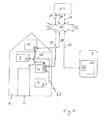
- Fig. 1 schematically shows a building 1. This has a door 2.
- the door 2 is closed by means of an electronic door lock 3.
- the door lock 3 comprises a control device located next to the door 2, for example a bell, a numeric keypad and / or the like.
- Above the door lock 3, a camera 4 is arranged. This serves to visually monitor the space in front of the door 2. It also serves as a communication device.
- a video recorder 5 is located in the building 1.
- a computer system 12 can be installed in the building 1.
- the technical devices door lock 3, camera 4 and VCR 5 and the computer system 12 can communicate with each other in terms of data technology.
- the technical devices door lock 3, camera 4 and / or video recorder 5 communicate in this way directly with each other, in the sense of a peer-to-peer network. The possibility of communication The technical equipment with the computer system 12 may possibly be unnecessary.
- a user 9 has a mobile terminal 10. This is, for example, a smartphone.
- the mobile terminal 10 has a communication interface 11.
- the communication interface 11 is used to communicate with a wide area network, in particular mobile network 15.
- the mobile radio network 15 has an exchange 14. This establishes a connection between two subscribers of the mobile radio network 15.
- the switching center 14 comprises, for example, a computer unit with a microprocessor, a memory, communication interfaces and / or the like.
- the camera 4 is individually associated with the building 1, in particular the user 9. It can be provided that only the user 9 has access to the camera 4.
- the camera 4 has the communication interface 13. This is designed as an interface for the Internet, in particular the mobile radio network 15. With a corresponding request, a communication connection between the mobile terminal 10 of the user 9 and the camera 4 can be formed. For this purpose, two data communication links 16, 17 are each formed via the mobile network 15 with the exchange 14.
- the mobile terminal 10 of the user 9 can be authorized by the camera 4.
- Authorized means that the mobile terminal 10 is enabled for direct communication with a technical device.
- the technical devices can be programmed to be set up for communication with the mobile terminal 10.
- the authorized mobile terminal 10 can communicate with the computer system 12 via the mobile radio network 15.
- a communication connection 18 between the computer system 12 and the mobile radio network 15 or the switching center 14 can be formed.
- the mobile terminal 10 can communicate directly with the computer system 12 in terms of data technology.
- the computer system 12 can in turn communicate with the camera 4 via communication link 25.
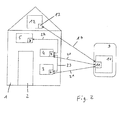
- Fig. 2 shows an alternative embodiment of the method according to the invention. Unlike the embodiment according to Fig. 1 communicate the mobile terminal 10 on the one hand and the computer system 12 and the technical devices door lock 3, camera 4 and VCR 5 on the other hand not via a mobile network 15, but rather via a local data communications link.
- a data communication link 19 is formed between the mobile terminal 10 and the computer system 12 and / or the camera 4. It is a direct communication link.
- the mobile terminal 10 can communicate with the technical facilities, for example the door lock 3. This is done with the interposition of the camera 4. Optionally, but also a direct data communications link 21 between the door lock 3 and the mobile terminal 10 are formed. Likewise, such would be conceivable with the video recorder 5.
Landscapes
- Engineering & Computer Science (AREA)
- Computer Networks & Wireless Communication (AREA)
- Signal Processing (AREA)
- Automation & Control Theory (AREA)
- Theoretical Computer Science (AREA)
- Physics & Mathematics (AREA)
- General Physics & Mathematics (AREA)
- Health & Medical Sciences (AREA)
- Computing Systems (AREA)
- General Health & Medical Sciences (AREA)
- Medical Informatics (AREA)
- Databases & Information Systems (AREA)
- Bioethics (AREA)
- Computer Hardware Design (AREA)
- Computer Security & Cryptography (AREA)
- Software Systems (AREA)
- General Engineering & Computer Science (AREA)
- Human Computer Interaction (AREA)
- Lock And Its Accessories (AREA)
- Selective Calling Equipment (AREA)
- Mobile Radio Communication Systems (AREA)
Priority Applications (2)
| Application Number | Priority Date | Filing Date | Title |
|---|---|---|---|
| EP14173031.7A EP2958271A1 (fr) | 2014-06-17 | 2014-06-18 | Procédé de fonctionnement d'un système de communication, notamment système d'accès |
| EP18209062.1A EP3481034A1 (fr) | 2014-06-17 | 2014-06-18 | Procédé de fonctionnement d'un système de communication, en particulier d'un système d'accès |
Applications Claiming Priority (2)
| Application Number | Priority Date | Filing Date | Title |
|---|---|---|---|
| EP14172814 | 2014-06-17 | ||
| EP14173031.7A EP2958271A1 (fr) | 2014-06-17 | 2014-06-18 | Procédé de fonctionnement d'un système de communication, notamment système d'accès |
Related Child Applications (1)
| Application Number | Title | Priority Date | Filing Date |
|---|---|---|---|
| EP18209062.1A Division EP3481034A1 (fr) | 2014-06-17 | 2014-06-18 | Procédé de fonctionnement d'un système de communication, en particulier d'un système d'accès |
Publications (1)
| Publication Number | Publication Date |
|---|---|
| EP2958271A1 true EP2958271A1 (fr) | 2015-12-23 |
Family
ID=51014156
Family Applications (2)
| Application Number | Title | Priority Date | Filing Date |
|---|---|---|---|
| EP14173031.7A Withdrawn EP2958271A1 (fr) | 2014-06-17 | 2014-06-18 | Procédé de fonctionnement d'un système de communication, notamment système d'accès |
| EP18209062.1A Withdrawn EP3481034A1 (fr) | 2014-06-17 | 2014-06-18 | Procédé de fonctionnement d'un système de communication, en particulier d'un système d'accès |
Family Applications After (1)
| Application Number | Title | Priority Date | Filing Date |
|---|---|---|---|
| EP18209062.1A Withdrawn EP3481034A1 (fr) | 2014-06-17 | 2014-06-18 | Procédé de fonctionnement d'un système de communication, en particulier d'un système d'accès |
Country Status (1)
| Country | Link |
|---|---|
| EP (2) | EP2958271A1 (fr) |
Cited By (1)
| Publication number | Priority date | Publication date | Assignee | Title |
|---|---|---|---|---|
| CN106097491A (zh) * | 2016-06-03 | 2016-11-09 | 广州赛生电子科技有限公司 | 一种物联网智能锁 |
Families Citing this family (1)
| Publication number | Priority date | Publication date | Assignee | Title |
|---|---|---|---|---|
| CN110942539A (zh) * | 2019-12-06 | 2020-03-31 | 上海新微技术研发中心有限公司 | 一种智能门锁无感开锁方法 |
Citations (3)
| Publication number | Priority date | Publication date | Assignee | Title |
|---|---|---|---|---|
| EP1806703A2 (fr) * | 2006-01-09 | 2007-07-11 | Samsung Electronics Co., Ltd. | Système d'authentification d'accès et procédé utilisant un communicateur intelligent |
| US20080129498A1 (en) * | 2006-12-01 | 2008-06-05 | Embarq Holdings Company, Llc | System and method for receiving security content from wireless cameras |
| US20130215266A1 (en) * | 2009-10-02 | 2013-08-22 | Alarm.Com Incorporated | Image surveillance and reporting technology |
-
2014
- 2014-06-18 EP EP14173031.7A patent/EP2958271A1/fr not_active Withdrawn
- 2014-06-18 EP EP18209062.1A patent/EP3481034A1/fr not_active Withdrawn
Patent Citations (3)
| Publication number | Priority date | Publication date | Assignee | Title |
|---|---|---|---|---|
| EP1806703A2 (fr) * | 2006-01-09 | 2007-07-11 | Samsung Electronics Co., Ltd. | Système d'authentification d'accès et procédé utilisant un communicateur intelligent |
| US20080129498A1 (en) * | 2006-12-01 | 2008-06-05 | Embarq Holdings Company, Llc | System and method for receiving security content from wireless cameras |
| US20130215266A1 (en) * | 2009-10-02 | 2013-08-22 | Alarm.Com Incorporated | Image surveillance and reporting technology |
Cited By (1)
| Publication number | Priority date | Publication date | Assignee | Title |
|---|---|---|---|---|
| CN106097491A (zh) * | 2016-06-03 | 2016-11-09 | 广州赛生电子科技有限公司 | 一种物联网智能锁 |
Also Published As
| Publication number | Publication date |
|---|---|
| EP3481034A1 (fr) | 2019-05-08 |
Similar Documents
| Publication | Publication Date | Title |
|---|---|---|
| EP3440640B1 (fr) | Stations de porte avec communication améliorée entre propriétaire et visiteur | |
| DE102014202637A1 (de) | Anordnung zum autorisierten Ansprechen mindestens eines in einem Gebäude befindlichen Bauelements | |
| DE10042969C2 (de) | Verfahren zum Fernsteuern, sowie Fernsteuersystem | |
| EP3349185B1 (fr) | Procédé d'exécution d'un contrôle de fonctionnement d'au moins un système de porte | |
| EP2958271A1 (fr) | Procédé de fonctionnement d'un système de communication, notamment système d'accès | |
| EP2890191B1 (fr) | Procédé de communication sûre dans un réseau de communication | |
| DE102012108062B4 (de) | Verfahren zur sicheren Authentifizierung eines Sensors oder Aktors eines Hausautomatisierungssystems | |
| EP3348767A1 (fr) | Système permettant d'obtenir au moins un paramètre d'entraînement d'un système de porte | |
| EP2634969B1 (fr) | Procédé de fonctionnement d'un système destiné à la domotique ainsi qu'un système domotique | |
| EP3816946A1 (fr) | Système de contrôle d'accès pour un bâtiment ainsi que procédé correspondant | |
| EP3349189A1 (fr) | Système d'évaluation d'au moins un paramètre d'entraînement d'au moins un système de porte | |
| DE102021211579A1 (de) | Verfahren zum Betreiben eines Zutrittskontrollsystems | |
| EP3116167A1 (fr) | Contrôle de pièce à l'aide de capteurs d'un smartphone | |
| EP3349188B1 (fr) | Système de portes et unité de communication d'adaptation d'un fonctionnement du système de portes | |
| EP3970323A1 (fr) | Station de charge de véhicules électriques | |
| EP3349187B1 (fr) | Procédé permettant d'obtenir au moins un paramètre de commande d'au moins un système de porte | |
| DE102014004490A1 (de) | Gebäudekommunikationssystem mit öffentlichen Kontaktinformationen | |
| DE60300239T2 (de) | Tortelefon und Anwendungsverfahren dafür | |
| WO2016173977A1 (fr) | Commande de fonctions de la domotique | |
| EP3349186B1 (fr) | Procédé d'évaluation d'au moins un paramètre d'entraînement | |
| EP4610952A1 (fr) | Dispositif de fermeture | |
| EP3349079B1 (fr) | Procédé d'adaptation d'un fonctionnement d'au moins un système de porte | |
| WO2026002472A1 (fr) | Système pour bâtiment avec système d'ascenseur et système d'interphone de porte | |
| DE102019110515A1 (de) | Zutrittskontrollsystem, umfassend ein elektronisches Schloss, sowie ein elektronisches Schloss | |
| DE202013011935U1 (de) | Hauskommunikations- und/oder -automationssystem |
Legal Events
| Date | Code | Title | Description |
|---|---|---|---|
| PUAI | Public reference made under article 153(3) epc to a published international application that has entered the european phase |
Free format text: ORIGINAL CODE: 0009012 |
|
| 17P | Request for examination filed |
Effective date: 20150907 |
|
| AK | Designated contracting states |
Kind code of ref document: A1 Designated state(s): AL AT BE BG CH CY CZ DE DK EE ES FI FR GB GR HR HU IE IS IT LI LT LU LV MC MK MT NL NO PL PT RO RS SE SI SK SM TR |
|
| AX | Request for extension of the european patent |
Extension state: BA ME |
|
| GRAP | Despatch of communication of intention to grant a patent |
Free format text: ORIGINAL CODE: EPIDOSNIGR1 |
|
| STAA | Information on the status of an ep patent application or granted ep patent |
Free format text: STATUS: GRANT OF PATENT IS INTENDED |
|
| RIC1 | Information provided on ipc code assigned before grant |
Ipc: G07C 9/00 20060101ALI20180625BHEP Ipc: H04W 4/80 20180101ALI20180625BHEP Ipc: G06F 21/62 20130101ALI20180625BHEP Ipc: H04L 29/08 20060101AFI20180625BHEP |
|
| INTG | Intention to grant announced |
Effective date: 20180730 |
|
| RIC1 | Information provided on ipc code assigned before grant |
Ipc: H04L 29/08 20060101AFI20180625BHEP Ipc: G06F 21/62 20130101ALI20180625BHEP Ipc: G07C 9/00 20060101ALI20180625BHEP Ipc: H04W 4/80 20180101ALI20180625BHEP |
|
| STAA | Information on the status of an ep patent application or granted ep patent |
Free format text: STATUS: THE APPLICATION IS DEEMED TO BE WITHDRAWN |
|
| 18D | Application deemed to be withdrawn |
Effective date: 20181211 |