EP2960736A2 - Traitement de composant - Google Patents
Traitement de composant Download PDFInfo
- Publication number
- EP2960736A2 EP2960736A2 EP15169550.9A EP15169550A EP2960736A2 EP 2960736 A2 EP2960736 A2 EP 2960736A2 EP 15169550 A EP15169550 A EP 15169550A EP 2960736 A2 EP2960736 A2 EP 2960736A2
- Authority
- EP
- European Patent Office
- Prior art keywords
- locator
- support
- mounting portion
- component
- frame
- Prior art date
- Legal status (The legal status is an assumption and is not a legal conclusion. Google has not performed a legal analysis and makes no representation as to the accuracy of the status listed.)
- Withdrawn
Links
Images


Classifications
-
- B—PERFORMING OPERATIONS; TRANSPORTING
- B24—GRINDING; POLISHING
- B24B—MACHINES, DEVICES, OR PROCESSES FOR GRINDING OR POLISHING; DRESSING OR CONDITIONING OF ABRADING SURFACES; FEEDING OF GRINDING, POLISHING, OR LAPPING AGENTS
- B24B21/00—Machines or devices using grinding or polishing belts; Accessories therefor
- B24B21/16—Machines or devices using grinding or polishing belts; Accessories therefor for grinding other surfaces of particular shape
- B24B21/165—Machines or devices using grinding or polishing belts; Accessories therefor for grinding other surfaces of particular shape for vanes or blades of turbines, propellers, impellers, compressors and the like
-
- F—MECHANICAL ENGINEERING; LIGHTING; HEATING; WEAPONS; BLASTING
- F01—MACHINES OR ENGINES IN GENERAL; ENGINE PLANTS IN GENERAL; STEAM ENGINES
- F01D—NON-POSITIVE DISPLACEMENT MACHINES OR ENGINES, e.g. STEAM TURBINES
- F01D5/00—Blades; Blade-carrying members; Heating, heat-insulating, cooling or antivibration means on the blades or the members
- F01D5/12—Blades
- F01D5/14—Form or construction
- F01D5/141—Shape, i.e. outer, aerodynamic form
-
- G—PHYSICS
- G05—CONTROLLING; REGULATING
- G05B—CONTROL OR REGULATING SYSTEMS IN GENERAL; FUNCTIONAL ELEMENTS OF SUCH SYSTEMS; MONITORING OR TESTING ARRANGEMENTS FOR SUCH SYSTEMS OR ELEMENTS
- G05B19/00—Program-control systems
- G05B19/02—Program-control systems electric
- G05B19/18—Numerical control [NC], i.e. automatically operating machines, in particular machine tools, e.g. in a manufacturing environment, so as to execute positioning, movement or co-ordinated operations by means of program data in numerical form
- G05B19/402—Numerical control [NC], i.e. automatically operating machines, in particular machine tools, e.g. in a manufacturing environment, so as to execute positioning, movement or co-ordinated operations by means of program data in numerical form characterised by control arrangements for positioning, e.g. centring a tool relative to a hole in the workpiece, additional detection means to correct position
-
- B—PERFORMING OPERATIONS; TRANSPORTING
- B23—MACHINE TOOLS; METAL-WORKING NOT OTHERWISE PROVIDED FOR
- B23Q—DETAILS, COMPONENTS, OR ACCESSORIES FOR MACHINE TOOLS, e.g. ARRANGEMENTS FOR COPYING OR CONTROLLING; MACHINE TOOLS IN GENERAL CHARACTERISED BY THE CONSTRUCTION OF PARTICULAR DETAILS OR COMPONENTS; COMBINATIONS OR ASSOCIATIONS OF METAL-WORKING MACHINES, NOT DIRECTED TO A PARTICULAR RESULT
- B23Q17/00—Arrangements for observing, indicating or measuring on machine tools
- B23Q17/22—Arrangements for observing, indicating or measuring on machine tools for indicating or measuring existing or desired position of tool or work
-
- B—PERFORMING OPERATIONS; TRANSPORTING
- B23—MACHINE TOOLS; METAL-WORKING NOT OTHERWISE PROVIDED FOR
- B23Q—DETAILS, COMPONENTS, OR ACCESSORIES FOR MACHINE TOOLS, e.g. ARRANGEMENTS FOR COPYING OR CONTROLLING; MACHINE TOOLS IN GENERAL CHARACTERISED BY THE CONSTRUCTION OF PARTICULAR DETAILS OR COMPONENTS; COMBINATIONS OR ASSOCIATIONS OF METAL-WORKING MACHINES, NOT DIRECTED TO A PARTICULAR RESULT
- B23Q17/00—Arrangements for observing, indicating or measuring on machine tools
- B23Q17/24—Arrangements for observing, indicating or measuring on machine tools using optics or electromagnetic waves
- B23Q17/2409—Arrangements for indirect observation of the working space using image recording means, e.g. a camera
-
- B—PERFORMING OPERATIONS; TRANSPORTING
- B23—MACHINE TOOLS; METAL-WORKING NOT OTHERWISE PROVIDED FOR
- B23Q—DETAILS, COMPONENTS, OR ACCESSORIES FOR MACHINE TOOLS, e.g. ARRANGEMENTS FOR COPYING OR CONTROLLING; MACHINE TOOLS IN GENERAL CHARACTERISED BY THE CONSTRUCTION OF PARTICULAR DETAILS OR COMPONENTS; COMBINATIONS OR ASSOCIATIONS OF METAL-WORKING MACHINES, NOT DIRECTED TO A PARTICULAR RESULT
- B23Q17/00—Arrangements for observing, indicating or measuring on machine tools
- B23Q17/24—Arrangements for observing, indicating or measuring on machine tools using optics or electromagnetic waves
- B23Q17/2428—Arrangements for observing, indicating or measuring on machine tools using optics or electromagnetic waves for measuring existing positions of tools or workpieces
-
- B—PERFORMING OPERATIONS; TRANSPORTING
- B23—MACHINE TOOLS; METAL-WORKING NOT OTHERWISE PROVIDED FOR
- B23Q—DETAILS, COMPONENTS, OR ACCESSORIES FOR MACHINE TOOLS, e.g. ARRANGEMENTS FOR COPYING OR CONTROLLING; MACHINE TOOLS IN GENERAL CHARACTERISED BY THE CONSTRUCTION OF PARTICULAR DETAILS OR COMPONENTS; COMBINATIONS OR ASSOCIATIONS OF METAL-WORKING MACHINES, NOT DIRECTED TO A PARTICULAR RESULT
- B23Q17/00—Arrangements for observing, indicating or measuring on machine tools
- B23Q17/24—Arrangements for observing, indicating or measuring on machine tools using optics or electromagnetic waves
- B23Q17/2452—Arrangements for observing, indicating or measuring on machine tools using optics or electromagnetic waves for measuring features or for detecting a condition of machine parts, tools or workpieces
-
- B—PERFORMING OPERATIONS; TRANSPORTING
- B25—HAND TOOLS; PORTABLE POWER-DRIVEN TOOLS; MANIPULATORS
- B25J—MANIPULATORS; CHAMBERS PROVIDED WITH MANIPULATION DEVICES
- B25J11/00—Manipulators not otherwise provided for
- B25J11/005—Manipulators for mechanical processing tasks
- B25J11/0065—Polishing or grinding
-
- B—PERFORMING OPERATIONS; TRANSPORTING
- B25—HAND TOOLS; PORTABLE POWER-DRIVEN TOOLS; MANIPULATORS
- B25J—MANIPULATORS; CHAMBERS PROVIDED WITH MANIPULATION DEVICES
- B25J19/00—Accessories fitted to manipulators, e.g. for monitoring, for viewing; Safety devices combined with or specially adapted for use in connection with manipulators
- B25J19/02—Sensing devices
- B25J19/021—Optical sensing devices
-
- B—PERFORMING OPERATIONS; TRANSPORTING
- B25—HAND TOOLS; PORTABLE POWER-DRIVEN TOOLS; MANIPULATORS
- B25J—MANIPULATORS; CHAMBERS PROVIDED WITH MANIPULATION DEVICES
- B25J9/00—Program-controlled manipulators
- B25J9/16—Program controls
- B25J9/1694—Program controls characterised by use of sensors other than normal servo-feedback from position, speed or acceleration sensors, perception control, multi-sensor controlled systems, sensor fusion
- B25J9/1697—Vision controlled systems
-
- G—PHYSICS
- G01—MEASURING; TESTING
- G01B—MEASURING LENGTH, THICKNESS OR SIMILAR LINEAR DIMENSIONS; MEASURING ANGLES; MEASURING AREAS; MEASURING IRREGULARITIES OF SURFACES OR CONTOURS
- G01B11/00—Measuring arrangements characterised by the use of optical techniques
- G01B11/002—Measuring arrangements characterised by the use of optical techniques for measuring two or more coordinates
-
- G—PHYSICS
- G01—MEASURING; TESTING
- G01B—MEASURING LENGTH, THICKNESS OR SIMILAR LINEAR DIMENSIONS; MEASURING ANGLES; MEASURING AREAS; MEASURING IRREGULARITIES OF SURFACES OR CONTOURS
- G01B21/00—Measuring arrangements or details thereof, where the measuring technique is not covered by the other groups of this subclass, unspecified or not relevant
- G01B21/02—Measuring arrangements or details thereof, where the measuring technique is not covered by the other groups of this subclass, unspecified or not relevant for measuring length, width, or thickness
- G01B21/04—Measuring arrangements or details thereof, where the measuring technique is not covered by the other groups of this subclass, unspecified or not relevant for measuring length, width, or thickness by measuring coordinates of points
-
- F—MECHANICAL ENGINEERING; LIGHTING; HEATING; WEAPONS; BLASTING
- F05—INDEXING SCHEMES RELATING TO ENGINES OR PUMPS IN VARIOUS SUBCLASSES OF CLASSES F01-F04
- F05D—INDEXING SCHEME FOR ASPECTS RELATING TO NON-POSITIVE-DISPLACEMENT MACHINES OR ENGINES, GAS-TURBINES OR JET-PROPULSION PLANTS
- F05D2220/00—Application
- F05D2220/30—Application in turbines
- F05D2220/32—Application in turbines in gas turbines
-
- F—MECHANICAL ENGINEERING; LIGHTING; HEATING; WEAPONS; BLASTING
- F05—INDEXING SCHEMES RELATING TO ENGINES OR PUMPS IN VARIOUS SUBCLASSES OF CLASSES F01-F04
- F05D—INDEXING SCHEME FOR ASPECTS RELATING TO NON-POSITIVE-DISPLACEMENT MACHINES OR ENGINES, GAS-TURBINES OR JET-PROPULSION PLANTS
- F05D2230/00—Manufacture
- F05D2230/10—Manufacture by removing material
- F05D2230/14—Micromachining
-
- G—PHYSICS
- G05—CONTROLLING; REGULATING
- G05B—CONTROL OR REGULATING SYSTEMS IN GENERAL; FUNCTIONAL ELEMENTS OF SUCH SYSTEMS; MONITORING OR TESTING ARRANGEMENTS FOR SUCH SYSTEMS OR ELEMENTS
- G05B2219/00—Program-control systems
- G05B2219/30—Nc systems
- G05B2219/37—Measurements
- G05B2219/37458—Reference on machine, on workpiece and on tool
-
- G—PHYSICS
- G05—CONTROLLING; REGULATING
- G05B—CONTROL OR REGULATING SYSTEMS IN GENERAL; FUNCTIONAL ELEMENTS OF SUCH SYSTEMS; MONITORING OR TESTING ARRANGEMENTS FOR SUCH SYSTEMS OR ELEMENTS
- G05B2219/00—Program-control systems
- G05B2219/30—Nc systems
- G05B2219/45—Nc applications
- G05B2219/45147—Machining blade, airfoil
-
- G—PHYSICS
- G05—CONTROLLING; REGULATING
- G05B—CONTROL OR REGULATING SYSTEMS IN GENERAL; FUNCTIONAL ELEMENTS OF SUCH SYSTEMS; MONITORING OR TESTING ARRANGEMENTS FOR SUCH SYSTEMS OR ELEMENTS
- G05B2219/00—Program-control systems
- G05B2219/30—Nc systems
- G05B2219/50—Machine tool, machine tool null till machine tool work handling
- G05B2219/50052—Orienting workpiece relative to tool
-
- G—PHYSICS
- G05—CONTROLLING; REGULATING
- G05B—CONTROL OR REGULATING SYSTEMS IN GENERAL; FUNCTIONAL ELEMENTS OF SUCH SYSTEMS; MONITORING OR TESTING ARRANGEMENTS FOR SUCH SYSTEMS OR ELEMENTS
- G05B2219/00—Program-control systems
- G05B2219/30—Nc systems
- G05B2219/50—Machine tool, machine tool null till machine tool work handling
- G05B2219/50127—Modular fixture, use of clamps and locators, the latter also for positioning
-
- G—PHYSICS
- G05—CONTROLLING; REGULATING
- G05B—CONTROL OR REGULATING SYSTEMS IN GENERAL; FUNCTIONAL ELEMENTS OF SUCH SYSTEMS; MONITORING OR TESTING ARRANGEMENTS FOR SUCH SYSTEMS OR ELEMENTS
- G05B2219/00—Program-control systems
- G05B2219/30—Nc systems
- G05B2219/50—Machine tool, machine tool null till machine tool work handling
- G05B2219/50136—With sensor, potentiometer to measure relative displacement
Definitions
- the present invention relates to an apparatus and method for processing a component, e.g. for processing a fan blade of a gas turbine engine.
- components e.g. metal components such as fan blades for gas turbine engines, to remove surface projections from the exterior profile and/or to polish/linish the surface to create the desired surface finish.
- polishing/linishing is typically an automated process where a robotic arm moves a linishing belt over the surface of the component using a standard toolpath which may be manually- or computer-generated.
- a robotic arm moves a linishing belt over the surface of the component using a standard toolpath which may be manually- or computer-generated.
- polishing/linishing of metal components is ideally carried out in a wet environment using a coolant to avoid thermal damage to the component/tool.
- One problem with using a robotic arm and a standard toolpath for polishing/linishing a component is that no account is taken of any inaccuracy or drift in the position of the robotic arm relative to the component.
- Some components e.g. fan blades for gas turbine engines, are hollow components and therefore the exterior surface needs to be processed to obtain both the desired surface finish and the desired wall thickness in the vicinity of the internal cavity. It is known to use ultrasound to measure cavity dimensions. Ultrasonic probes typically use a couplant such as water which must be circulated separately from any coolant and which, in some cases (e.g. when the couplant is a gel couplant) must be subsequently thoroughly removed from the component.
- a couplant such as water which must be circulated separately from any coolant and which, in some cases (e.g. when the couplant is a gel couplant) must be subsequently thoroughly removed from the component.
- GB 2498333 Another attempt to improve an automated polishing/linishing process is described in GB 2498333 which describes mounting a turbine blade on a robotic arm provided with a measurement fixture having a series of circumferentially spaced posts, each post bearing a number of LEDs.
- the position of the measurement fixture, and thus the position of the turbine blade, relative to a fixed linishing machine is continuously monitored by a camera and associated image processing system determining which LEDs are visible at any time.
- This provides a continuous or static feedback to a computer controlling the robotic arm to adjust the position of the robotic arm in the event that the position of the measurement fixture was deemed to be incorrect.
- This process is not suitable if the component is large (e.g. a fan blade for a gas turbine engine).
- the apparatus and process described in GB2498333 only monitors and corrects for the position of the moving component. It does not correct for positional or orientational inaccuracy in the position of the static tool/machine.
- the present invention provides an apparatus for processing a component, the apparatus comprising:
- a calibration step is carried out in which the detector detects the position of the at least one frame locator, the at least one support locator and the at least one mounting portion locator to establish the relative spatial positions and orientations of the support frame, first support and the robotic arm.
- the first support on the support frame holds the first part whilst the mounting portion of the robotic arm holds the second part.
- the first support locator is on the first support and thus will rotate with the first support (and the first part) as it rotates on the support frame.
- the mounting portion locator is in a fixed spatial relationship with the mounting portion and thus will rotate with the mounting portion (and the second part) as it rotates on the robotic arm.
- the presence of the frame, first support and mounting portion locators allows the detector to detect (both prior to processing (during the calibration step) and during processing) the relative spatial positions and the orientations of the first part supported by the first support and the second part supported on the mounting portion. This allows corrections to be made to the position and orientation of the second part (mounted on the robotic arm) during processing to take account of any inaccuracy in the position/orientation of either/both part(s).
- the first support comprises a plurality of first support locators.
- the plurality of first support locators may be circumferentially, axially and/or radially spaced from one another, e.g. equally spaced about the rotational axis of the first support.
- Each of the plurality of first support locators may have a unique identifier e.g. a unique reference number.
- the first support comprises a plate with a peripheral edge and the or each first support locator is provided on the peripheral edge.
- the plate is a circular plate (disc) having a radially outer peripheral edge and the or each first support locator is provided on the radially outer peripheral edge, e.g. equally spaced about the circumference of the radially outer peripheral edge.
- the or each first support locator may be an optically detectable locator e.g. an LED such as an infra-red LED.
- the first support may be provided with a measurement fixture having a plurality of LEDs as described in GB 2498333 .
- the unique identifier for each first support locator may be a unique strobing pattern which is detectable (by the detector) as described in GB2498333 .
- the or each first support locator is a projection e.g. a sphere or cone, or an indentation.
- the or each projecting/indented first support locator is used to position a probe, e.g. a hand-held probe, having at least one and preferably a plurality of optically detectable probe locators e.g. LEDs such as infra-red LEDs.
- a hand-held probe forms part of Nikon's proprietary metrology system.
- the probe locator(s) is/are detected by the detector in a calibration step in order to detect the position of the first support locator(s) and thus the orientation of the first support.
- the unique identifier for each first support locator may be a unique reference number or sign.
- the at least one frame locator is mounted on the support frame.
- the or each frame locator may be an optically detectable locator e.g. an LED such as an infra-red LED.
- each of the plurality of frame locators may have a unique identifier e.g. a unique reference number.
- the unique identifier for each frame locator may be a unique strobing pattern which is detectable (by the detector) as described in GB2498333 .
- the or each first support locator is a projection/indentation on the first support and the or each frame locator is an optically detectable locator (e.g. LED) mounted on the support frame.
- an optically detectable locator e.g. LED
- the support frame further comprises a rotatably mounted second support mounted on a common rotational axis between the first and second supports.
- the second support may comprise at least one or a plurality of second support locators as described above for the first support locators or it may be a simple plate/disc without any locators.
- At least one may be proximal the first support and at least one may be proximal the second support.
- the at least one frame locator may be located on the support frame between the first and second supports.
- the first and/or second support comprises a cover for covering the at least one first and/or second support locator(s) to protect them during processing.
- the apparatus comprises a plurality of mounting portion locators.
- the plurality of mounting portion locators may be circumferentially and/or axially and/or radially spaced from one another, e.g. equally spaced about the rotational axis of the mounting portion.
- Each of the mounting portion locators may have a unique identifier.
- the or each mounting portion locator may be an optically detectable locator e.g. an LED such as an infra-red LED.
- the unique identifier for each mounting portion locator may be a unique strobing pattern which is detectable (by the detector) as described in GB2498333 .
- the at least one or plurality of mounting portion locator(s) may be provided on the mounting portion of the robotic arm.
- the mounting portion may be provided with a measurement fixture having a plurality of LEDs as described in GB 2498333 .
- the first part (supported by the first support) is the component and the second part (supported by the mounting portion) is the processing tool.
- the apparatus comprises at least one processing tool for mounting on the mounting portion of the robotic arm and the mounting portion locator(s) may be provided on the at least one processing tool.
- the plurality of mounting portion locators may be circumferentially, radially and/or axially spaced from each other, e.g. equally spaced on the processing tool around the rotational axis of the mounting portion on the robotic arm.
- One processing tool may be a scanning head for scanning e.g. laser scanning an exterior profile of the component and/or the first support locators during a processing step.
- the apparatus further comprises a computer system comprising an image processing system e.g. a CAD/CAM system for viewing a 3D profile of the component obtained by the scanning head.
- the computer system may be adapted to generate a toolpath or to adjust a standard toolpath by comparing the 3D profile of the component with a desired profile of the component.
- One processing tool may be an ultrasound probe for measuring wall thickness of a hollow component in the vicinity of an internal cavity in the component.
- the ultrasound probe may comprise a non-contact squirter system where coolant (e.g. water) is fed (e.g. from a tank) to a nozzle on the ultrasound probe.
- coolant e.g. water
- One processing tool may comprise a tool comprising an abrasive belt to abrade the component into the required shape e.g. by removing surface projections and/or adjusting wall thickness in the vicinity of an internal cavity in a hollow component.
- One processing tool may comprise a tool comprising a polishing belt for polishing/linishing the exterior surface of the component to create a desirable surface finish.
- One processing tool may comprise a tool for cleaning and/or drying the exterior surface of the component.
- the detector is a camera.
- the camera may form part of Nikon's proprietary metrology system which allows multiple frame tracking and visibility to a precision of up to 100 ⁇ m.
- the detector may include a cover e.g. a retractable or openable cover to protect the detector during processing.
- the present invention provides a processing cell comprising an apparatus according to the first aspect of the present invention.
- the apparatus of the first aspect allows complete automated processing of a component within a single processing cell.
- the present invention provides a method of processing a component, said method comprising:
- Detecting the first support locator(s) and mounting portion locator(s) allows for correction to the position and orientation of the second (moving) part during processing (scanning) to take account of any inaccuracy in the position/orientation of either/both part(s).
- the scanning head is a laser scanning head and the method comprises laser scanning the component (e.g. the exterior profile of the component) and optionally the at least one support locator.
- the method comprises using the scanning head to detect the at least one first support locator.
- the method comprises using the detector to detect the at least one first support locator.
- the method may be preceded by a calibration step comprising using the detector to detect the position of the at least one frame locator and the at least one mounting portion locator to establish the relative positions of the support frame and the robotic arm.
- the method may also include a second calibration step comprising using the detector to detect the position and orientation of the first support by detecting the position of the at least one first support locator.
- This second calibration step need only be carried out before first use.
- the first part (supported on the first support) is the component and the second part (mounted on the mounting portion) is the processing tool (scanning head).
- the method comprises mounting the component on the support frame using the first support (and optionally the second support).
- the method further comprises mounting the scanning head on the mounting portion of the robotic arm.
- the method further comprises using a computer system comprising an image processing system (e.g. CAD/CAM system) to generate a 3D profile of the component using the data obtained by the scanning head.
- the method further comprises comparing the 3D profile with a desired component profile and generating a toolpath based on the comparison.
- the toolpath may be, for example, an ultrasound toolpath, an abrading toolpath or a polishing toolpath.
- the method further comprises replacing the scanning head with a further processing tool and processing the component whilst using the detector to detect the position and orientation of the mounting portion and thus the second part by detecting the position of the at least one mounting portion locator.
- the further processing tool may be an ultrasound probe, a tool comprising an abrasive belt, a tool comprising a polishing belt or a tool to facilitate cleaning and/or drying. This may be done automatically without user intervention. In some embodiments, a number of processing tools are mounted (one at a time) e.g. automatically mounted, on the mounting portion of the robotic arm.
- the method comprises using an ultrasound probe (e.g. as the second part mounted on the mounting portion of the robotic arm) for measuring wall thickness of a hollow component.
- the method then comprises measuring wall thickness in the vicinity of the internal cavity whilst detecting the positions/orientations of the at least one mounting portion locator (provided on the mounting portion or on the ultrasound probe) to establish (and adjust if necessary) the position/orientation of the ultrasound probe relative to the component.
- the method may comprise using the ultrasound toolpath generated by the computer system using the scanning data to position the ultrasound probe in the vicinity of the cavity prior to or during measuring the wall thickness.
- the method may comprise incrementally adjusting the angle of the ultrasound probe relative to the component until a strong signal (preferably greater than 99% from the front wall of the cavity and 60% from back wall of the cavity) is achieved.
- the angle may be adjusted sequentially in two perpendicular planes.
- the method comprises using a processing tool comprising an abrasive belt (e.g. as the second part mounted on the mounting portion of the robotic arm) to abrade the component into the required shape e.g. by removing surface projections and/or adjusting wall thickness in the vicinity of internal cavities.
- the method then comprises abrading the component whilst detecting the positions/orientations of the at least one mounting portion locator (provided on the mounting portion or on the abrasive belt tool) to establish (and adjust if necessary) the position/orientation of the abrasive belt tool relative to the component.
- the method may comprise using the abrading tool path generated by the computer system using the scanning data to position the abrasive belt tool relative to the component.
- the method may comprise washing/drying the component after processing with the abrasive belt tool.
- the method may comprise re-scanning the component by re-mounting the scanning head and scanning (e.g. laser scanning) the abraded exterior profile of the component whilst detecting the positions/orientations of the at least one mounting portion locator (provided on the mounting portion or on the scanning head) to establish the position/orientation of the scanning head relative to the component.
- scanning e.g. laser scanning
- the data generated by re-scanning may be transmitted to the computer system (e.g. CAD/CAM system) to generate a second 3D profile of the component.
- the method further comprises comparing the 3D profile with a desired component profile and generating a further tool path (e.g. a re-abrading toolpath or a polishing toolpath) based on the comparison.
- the re-abrading toolpath may be used to re-process the component using the abrasive belt tool if the 3D profile generated after abrading the component is not sufficiently matched to the desired 3D profile.
- the method comprises comprises using a processing tool comprising a polishing belt (e.g. as the second part mounted on the mounting portion of the robotic arm) to polish/linish the surface of the component.
- the method then comprises polishing/linishing the component whilst detecting the positions/orientations of the at least one mounting portion locator (provided on the mounting portion or on the polishing belt tool) to establish (and adjust if necessary) the position/orientation of the polishing belt tool relative to the component.
- the method may comprise using the polishing toolpath generated by the computer system using the re-scanning data to move the robotic arm with the mounted polishing belt tool relative to the component.
- the present invention provides a component processed using an apparatus according to the first aspect and a method according to the third aspect.
- the component is a fan blade for a gas turbine engine.
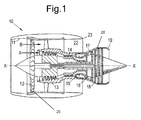
- a ducted fan gas turbine engine is generally indicated at 10 and has a principal and rotational axis X-X.
- the engine comprises, in axial flow series, an air intake 11, a propulsive fan 12, an intermediate pressure compressor 13, a high-pressure compressor 14, combustion equipment 15, a high-pressure turbine 16, an intermediate pressure turbine 17, a low-pressure turbine 18 and a core engine exhaust nozzle 19.
- a nacelle 21 generally surrounds the engine 10 and defines the intake 11, a bypass duct 22 and a bypass exhaust nozzle 23.
- air entering the intake 11 is accelerated by the fan 12 to produce two air flows: a first air flow A into the intermediate pressure compressor 13 and a second air flow B which passes through the bypass duct 22 to provide propulsive thrust.
- the intermediate pressure compressor 13 compresses the air flow A directed into it before delivering that air to the high pressure compressor 14 where further compression takes place.
- the compressed air exhausted from the high-pressure compressor 14 is directed into the combustion equipment 15 where it is mixed with fuel and the mixture combusted.
- the resultant hot combustion products then expand through, and thereby drive the high, intermediate and low-pressure turbines 16, 17, 18 before being exhausted through the nozzle 19 to provide additional propulsive thrust.
- the high, intermediate and low-pressure turbines respectively drive the high and intermediate pressure compressors 14, 13 and the fan 12 by suitable interconnecting shafts.
- the propulsive fan 12 comprises a plurality of blades 25 formed by processing a metal component 41 using an embodiment of the present invention as described below.
- FIG. 2 A first embodiment of the apparatus according to the first aspect is shown in Figure 2 .
- the apparatus is provided within a single working cell 40 and comprises a support frame 26 with a first support 27 and a second support 28 both rotatably mounted and axially aligned on the support frame 26.
- Each of the first and second supports 27, 28 is a circular plate (disc) with a radially outer peripheral edge.
- the radially outer peripheral edge of the first support comprises a plurality of first support locators in the form of spherical projections 29 equally spaced around the rotational axis of the first support on the circumference of the radially outer peripheral edge.
- the radially outer peripheral edge of the second support comprises a plurality of second support locators in the form of spherical projections 29' equally spaced around the rotational axis of the second support (which is common with the rotational axis of the first support) on circumference of the radially outer peripheral edge.
- the first and second supports each comprise a cover (not shown) for covering the spherical projections 29, 29' to protect them during processing.
- the apparatus further comprises a plurality of frame locators 30 in a fixed spatial relationship with (mounted on) the support frame 26.
- the frame locators 30 are optically detectable locators i.e. infra-red LEDs.
- the frame locators 30 may be positioned between the first and second supports (as shown) or they may be positioned on the support frame 26 proximal the first and second supports 27, 28.
- the first and second supports each comprise a clamp 31, 31' for clamping and supporting the component 41.
- the clamp may be replaced with an alternative fixing device.
- the apparatus further comprises a robotic arm 32 with a rotatably mounted mounting portion 33 for supporting a processing tool.
- the apparatus further comprises a detector 34 which is a Nikon camera.
- the detector 34 is provided with a retractable cover 35 for protecting the camera when not in use.
- the apparatus comprises a plurality of processing tools for mounting (one at a time) on the mounting portion 33 of the robotic arm 32.
- Each processing tool comprises a plurality of mounting portion locators (not shown) which are affixed to the processing tool such that, when the processing tool is mounted on the mounting portion, the plurality of mounting portion locators are equally spaced about the rotational axis of the mounting portion on the robotic arm.
- the mounting portion locators are optically detectable locators i.e. infra-red LEDs.
- One processing tool is a scanning head 42 (in Figure 3 ) for laser scanning an exterior profile of the component.
- One processing tool is an ultrasound probe 43 for measuring wall thickness of a hollow component.
- One processing tool is a tool comprising an abrasive belt 44 to abrade the component into the required shape e.g. by removing surface projections and/or adjusting wall thickness in the vicinity of internal cavities.
- One processing tool is a tool comprising a polishing belt 45 for polishing/linishing the exterior surface of the component to create a desirable surface finish. Further processing tools may facilitate cleaning and drying of the component.
- the scanning head 42 and ultrasound probe 43 are stored within the working cell in a protective housing 50.
- the abrasive belt tool 44 and the polishing belt tool 45 are stored within the cell in a tool rack 36.
- the robotic arm 32 is movable to automatically mount one of the processing tools on the mounting portion and, subsequently un-mount the processing tool to replace it with an alternative processing tool.
- the apparatus further comprises a computer system comprising an image processing system i.e. a CAD/CAM system 37 which is located outside the working cell.
- a computer system comprising an image processing system i.e. a CAD/CAM system 37 which is located outside the working cell.
- the camera 34 initially detects the positions of the LED frame locators 30 within the cell 40 (step A in Figure 3 ) in order to establish to position of the frame 26, the first and second supports 27, 28 and thus the position of the component within the cell.
- a calibration step for the robotic arm 32 is carried out by mounting a measurement fixture having a plurality of LEDs as described in GB 2498333 on the mounting portion and moving the robotic arm to a plurality of (e.g. ten) different spatial positions. At each spatial position, the camera detects the position of the LEDs on the measurement fixture and the position of the LED frame locators and this data is supplied to and digitally processed by the CAD/CAM system 37 to establish the spatial relationship between the robotic arm 33 and the frame 26.
- step B in Figure 3 the orientation of the component is determined (step B in Figure 3 ).
- a hand-held probe (not shown) having a plurality LEDs (part of Nikon's proprietary metrology system) is positioned at one of the spherical projections 29 and the camera detects the position of the LEDs and thus detects the position of the selected spherical projection. This is repeated for the remaining spherical projections 29 to establish the position and orientation of the first support and thus the position and orientation of the component.
- the robotic arm 32 moves to automatically mount the laser scanning head 42 on the mounting portion 33 (step C in Figure 3 ).
- the laser scanning head 42 has a plurality of LEDs 46 mounted such that they are equally spaced about the rotational axis of the mounting portion 33 on the robotic arm 32.
- the camera detects the position and orientation of the scanning head 42 by viewing the LEDs 46 (step D in Figure 3 ).
- the robotic arm 32 is moved using a standard toolpath over the surface of the component 41 to scan the exterior profile of the component 41 (step E in Figure 3 ).
- the scanning head 42 scans the spheres 29, 29' to detect the orientation of the component and thus determine the portion of the exterior profile which has been scanned.
- the component 41 is rotated about the rotational axis of the first and second supports 27, 28 to present another portion of the component 41 to the scanning head 42.
- the CAD/CAM system 37 uses the scanning data to generate a 3D profile of the component.
- the CAD/CAM system 37 compares the 3D profile of the component with the desired profile and (if ultrasound is to be used) generates an ultrasound toolpath based on the comparison.
- the method then comprises (automatically) replacing the scanning head 42 with an ultrasound probe 43 on the mounting portion 33 (step F in Figure 3 ).
- the ultrasound probe 43 has a plurality of LEDs 47 mounted such that they are equally spaced about the rotational axis of the mounting portion 33 on the robotic arm 32.
- the camera 34 detects the position and orientation of the ultrasound probe 43 by viewing the LEDs 47 (step G in Figure 3 ).
- the ultrasound probe 43 uses the ultrasound toolpath generated by the CAD/CAM system 37 to move to the vicinity of the cavity within the component 41.
- the ultrasound probe 43 measures the thickness of the component wall defining the cavity (step H in Figure 3 ) whilst the camera 34 detects the positions/orientations of the LEDs 47 on the ultrasound probe 43 (step G in Figure 3 ) to establish and adjust (if necessary) the position/orientation of the ultrasound probe 43 relative to the first support (and thus the component).
- the angle of the ultrasound probe 43 relative to the component 41 is incrementally adjusted first in one plane and then in a second, perpendicular plane until a strong signal (preferably greater than 99% from the front wall of the cavity and 60% from back wall of the cavity) is achieved.
- the data from the ultrasound probe 43 is passed to the CAD/CAM system 37 and this data, combined with the data from the scanning head 42 is used to generate an abrading toolpath.
- the method then comprises (automatically) replacing the ultrasound head 43 with a tool comprising an abrasive belt 44 on the mounting portion 33 (step I in Figure 3 ).
- the abrasive belt tool 44 has a plurality of LEDs 48 mounted such that they are equally spaced about the rotational axis of the mounting portion 33 on the robotic arm 32.
- the LEDs 48 may be provided on a measurement fixture as described in GB 2498333 .
- the camera 34 detects the position and orientation of the abrasive belt tool 44 by viewing the LEDs 48 (step J in Figure 3 ).
- the abrasive belt tool 44 uses the abrading toolpath generated by the CAD/CAM system 37 to process (abrade) the component 41 into the required shape (e.g. by removing surface projections and/or adjusting wall thickness in the vicinity of an internal cavity) (step K in Figure 3 ) whilst the camera 34 detects the positions/orientations of the LEDs 48 on the abrasive belt tool 44 to establish (step J in Figure 3 ) and adjust (if necessary) the position/orientation of the abrasive belt tool 44 relative to the first support 27 (and thus the component).
- the method then comprises washing/drying the component 41 to remove abraded material.
- the robotic arm 32 moves to automatically re-mount the laser scanning head 42 on the mounting portion (step C' in Figure 3 ).
- the camera detects the position and orientation of the scanning head 42 by viewing the LEDs 46 on the scanning head 42 as before (step D' in Figure 3 ).
- the robotic arm 32 is moved using a standard toolpath over the surface of the component 41 to re-scan the exterior profile of the component 41 (step E' in Figure 3 ). Again, the scanning head 42 scans the spheres 29, 29' to detect the orientation of the component and thus determine the portion of the exterior profile which has been scanned. After scanning one portion, the component 41 is rotated about the rotational axis of the first and second supports 27, 28 to present another portion of the component 41 to the scanning head 42.
- the CAD/CAM system 37 uses the re-scanning data to generate a further 3D profile of the component.
- the CAD/CAM system 37 compares the further 3D profile of the component with the desired profile.
- the next step is polishing/linishing as described below.
- a second abrading toolpath is generated and used to move the robotic arm with the mounted abrasive belt tool 44 to re-abrade the component 41.
- the CAD/CAM system 37 When the 3D profile is sufficiently matched to the desired profile, the CAD/CAM system 37 generates a polishing toolpath and the polishing belt tool 45 is automatically mounted on the mounting portion 33 of the robotic arm 32 (step L in Figure 3 ).
- the polishing belt tool 45 has a plurality of LEDs 49 mounted such that they are equally spaced about the rotational axis of the mounting portion 33 on the robotic arm 32.
- the camera 34 detects the position and orientation of the polishing belt tool 45 by viewing the LEDs 49 (step M in Figure 3 ).
- the polishing belt tool 45 uses the polishing toolpath generated by the CAD/CAM system 37 to process (polish) the component 41 (step N in Figure 3 ) whilst the camera 34 detects the positions/orientations of the LEDs 49 on the polishing belt tool 45 (step M in Figure 3 ) to establish and adjust (if necessary) the position/orientation of the polishing belt tool 45 relative to the first support 27 (and thus the component).
- the method then comprises washing/drying the component 41 to remove any debris from the processed component.
Landscapes
- Engineering & Computer Science (AREA)
- Mechanical Engineering (AREA)
- Physics & Mathematics (AREA)
- General Physics & Mathematics (AREA)
- Optics & Photonics (AREA)
- Automation & Control Theory (AREA)
- Manufacturing & Machinery (AREA)
- Human Computer Interaction (AREA)
- Robotics (AREA)
- Fluid Mechanics (AREA)
- General Engineering & Computer Science (AREA)
- Grinding And Polishing Of Tertiary Curved Surfaces And Surfaces With Complex Shapes (AREA)
- Structures Of Non-Positive Displacement Pumps (AREA)
- Turbine Rotor Nozzle Sealing (AREA)
Applications Claiming Priority (1)
| Application Number | Priority Date | Filing Date | Title |
|---|---|---|---|
| GBGB1411232.0A GB201411232D0 (en) | 2014-06-25 | 2014-06-25 | Component processing |
Publications (2)
| Publication Number | Publication Date |
|---|---|
| EP2960736A2 true EP2960736A2 (fr) | 2015-12-30 |
| EP2960736A3 EP2960736A3 (fr) | 2016-06-29 |
Family
ID=51410053
Family Applications (1)
| Application Number | Title | Priority Date | Filing Date |
|---|---|---|---|
| EP15169550.9A Withdrawn EP2960736A3 (fr) | 2014-06-25 | 2015-05-28 | Traitement de composant |
Country Status (4)
| Country | Link |
|---|---|
| US (1) | US20150377028A1 (fr) |
| EP (1) | EP2960736A3 (fr) |
| GB (2) | GB201411232D0 (fr) |
| SG (1) | SG10201504344VA (fr) |
Cited By (2)
| Publication number | Priority date | Publication date | Assignee | Title |
|---|---|---|---|---|
| CN110727245A (zh) * | 2019-10-09 | 2020-01-24 | 西北工业大学 | 面向叶片加工弹性变形控制的辅助支撑布局优化方法 |
| CN110900379A (zh) * | 2019-11-26 | 2020-03-24 | 华中科技大学 | 一种压气机叶片机器人砂带磨抛加工方法 |
Families Citing this family (3)
| Publication number | Priority date | Publication date | Assignee | Title |
|---|---|---|---|---|
| CN109238196B (zh) * | 2018-09-03 | 2021-04-02 | 宁海县正达模塑有限公司 | 一种发动机支臂检测方法 |
| CN118720868B (zh) * | 2024-09-02 | 2024-12-06 | 太原科技大学 | 一种基于视觉测量的中厚板缺陷轴-径向柔性智能打磨方法及系统 |
| CN121083462B (zh) * | 2025-11-13 | 2026-03-17 | 大连誉洋工业智能有限公司 | 铸件磨削设备用打磨机构 |
Family Cites Families (30)
| Publication number | Priority date | Publication date | Assignee | Title |
|---|---|---|---|---|
| US4531192A (en) * | 1982-09-23 | 1985-07-23 | Crc Welding Systems, Inc. | Apparatus and method for sensing a workpiece with an electrical arc |
| GB8423023D0 (en) * | 1984-09-12 | 1984-10-17 | Short Brothers Ltd | Ultrasonic scanning system |
| US4698775A (en) * | 1985-05-17 | 1987-10-06 | Flexible Manufacturing Systems, Inc. | Self-contained mobile reprogrammable automation device |
| US5416321A (en) * | 1993-04-08 | 1995-05-16 | Coleman Research Corporation | Integrated apparatus for mapping and characterizing the chemical composition of surfaces |
| JP3448951B2 (ja) * | 1993-08-25 | 2003-09-22 | マツダ株式会社 | 塗装における塗装タレの評価方法及び塗装制御装置 |
| US5567881A (en) * | 1995-05-05 | 1996-10-22 | Mcdonnell Douglas Corporation | Method and apparatus for inspecting a structural part having surface irregularities |
| US5666202A (en) * | 1995-08-22 | 1997-09-09 | Kyrazis; Demos | High bandwidth, dynamically rigid metrology system for the measurement and control of intelligent manufacturing processes |
| US6681145B1 (en) * | 1996-06-06 | 2004-01-20 | The Boeing Company | Method for improving the accuracy of machines |
| US5994909A (en) * | 1997-08-25 | 1999-11-30 | Lucas; Brian K. | Robotic twin probe for measurement on printed circuit boards and electrical and electronic assemblies |
| US6064717A (en) * | 1997-11-21 | 2000-05-16 | Rigaku/Usa, Inc. | Unrestricted motion apparatus and method for x-ray diffraction analysis |
| EP1219389A1 (fr) * | 2000-12-27 | 2002-07-03 | Siemens Aktiengesellschaft | Procédé pour le lissage de la surface extérieure d'une aube d'une turbine à gaz |
| US6873880B2 (en) * | 2001-12-26 | 2005-03-29 | Lockheed Martin Corporation | Machine for performing machining operations on a workpiece and method of controlling same |
| US6898484B2 (en) * | 2002-05-01 | 2005-05-24 | Dorothy Lemelson | Robotic manufacturing and assembly with relative radio positioning using radio based location determination |
| DE10300827A1 (de) * | 2003-01-10 | 2004-07-22 | Intelligendt Systems & Services Gmbh & Co Kg | Einrichtung zur Ultraschallprüfung eines Werkstückes in Durchschallungstechnik |
| EP1475602A1 (fr) * | 2003-05-06 | 2004-11-10 | Bayerische Motoren Werke Aktiengesellschaft | Procédé et système de métrologie pour un gabarit de production |
| US7433799B2 (en) * | 2003-11-17 | 2008-10-07 | Agency For Science, Technology And Research | Method of determining shape data |
| US20050159840A1 (en) * | 2004-01-16 | 2005-07-21 | Wen-Jong Lin | System for surface finishing a workpiece |
| DE102005014911B4 (de) * | 2005-04-01 | 2018-01-25 | Zf Friedrichshafen Ag | Fertigungszelle zur Schleifbearbeitung und Radsatzprüfung und Verfahren zum Betreiben der Fertigungszelle |
| US7869896B2 (en) * | 2006-08-24 | 2011-01-11 | Jtekt Corporation | Tangential grinding resistance measuring method and apparatus, and applications thereof to grinding condition decision and wheel life judgment |
| US8290618B2 (en) * | 2007-03-05 | 2012-10-16 | CNOS Automations Software GmbH | Determining positions |
| EP2014413A1 (fr) * | 2007-07-12 | 2009-01-14 | Lufthansa Technik AG | Agencement, procédé et dispositif destinés à l'entretien d'aubes de turbines à gaz |
| JP5155693B2 (ja) * | 2008-02-26 | 2013-03-06 | 東芝プラントシステム株式会社 | 超音波検査装置 |
| US8185240B2 (en) * | 2008-08-29 | 2012-05-22 | Williams Robotics, Llc | Automated apparatus for constructing assemblies of building components |
| DE102010031248A1 (de) * | 2010-07-12 | 2012-01-12 | Kuka Roboter Gmbh | Verfahren zum Vermessen eines Roboterarms eines Industrieroboters |
| FR2965201B1 (fr) * | 2010-09-28 | 2013-08-23 | Snecma | Procede et dispositif d'usinage du bord d'attaque d'une aube de turbomachine |
| FR2972802B1 (fr) * | 2011-03-16 | 2013-09-20 | Snecma | Installation de controle non destructif, par ultrasons en immersion, de pieces |
| JP2012232370A (ja) * | 2011-04-28 | 2012-11-29 | Seiko Epson Corp | ロボットコントローラー、簡易設置型ロボット、及び簡易設置型ロボットの制御方法 |
| US8833169B2 (en) * | 2011-12-09 | 2014-09-16 | General Electric Company | System and method for inspection of a part with dual multi-axis robotic devices |
| GB2498333A (en) * | 2011-12-21 | 2013-07-17 | Rolls Royce Plc | Measurement fixture for use in determining position and orientation of object and method of determining position, orientation of object relative to reference |
| US20160236413A1 (en) * | 2015-02-17 | 2016-08-18 | Michael Daniel Armani | Nozzle cover coating |
-
2014
- 2014-06-25 GB GBGB1411232.0A patent/GB201411232D0/en not_active Ceased
-
2015
- 2015-05-28 US US14/724,227 patent/US20150377028A1/en not_active Abandoned
- 2015-05-28 GB GB1509127.5A patent/GB2528368B/en not_active Expired - Fee Related
- 2015-05-28 EP EP15169550.9A patent/EP2960736A3/fr not_active Withdrawn
- 2015-06-03 SG SG10201504344VA patent/SG10201504344VA/en unknown
Cited By (3)
| Publication number | Priority date | Publication date | Assignee | Title |
|---|---|---|---|---|
| CN110727245A (zh) * | 2019-10-09 | 2020-01-24 | 西北工业大学 | 面向叶片加工弹性变形控制的辅助支撑布局优化方法 |
| CN110900379A (zh) * | 2019-11-26 | 2020-03-24 | 华中科技大学 | 一种压气机叶片机器人砂带磨抛加工方法 |
| CN110900379B (zh) * | 2019-11-26 | 2021-08-17 | 华中科技大学 | 一种压气机叶片机器人砂带磨抛加工方法 |
Also Published As
| Publication number | Publication date |
|---|---|
| GB2528368B (en) | 2016-10-26 |
| GB2528368A (en) | 2016-01-20 |
| GB201509127D0 (en) | 2015-07-15 |
| EP2960736A3 (fr) | 2016-06-29 |
| SG10201504344VA (en) | 2016-01-28 |
| GB201411232D0 (en) | 2014-08-06 |
| US20150377028A1 (en) | 2015-12-31 |
Similar Documents
| Publication | Publication Date | Title |
|---|---|---|
| EP2960736A2 (fr) | Traitement de composant | |
| US9157865B2 (en) | Machine tool—based, optical coordinate measuring machine calibration device | |
| US11536670B2 (en) | System and method for engine inspection | |
| US6664499B1 (en) | Tube and duct trim machine | |
| EP3553282B1 (fr) | Système et procédé d'inspection et/ou de réparation d'une ou de plusieurs aubes fixées à un rotor d'un moteur à turbine à gaz à l'aide d'un système robotique | |
| EP2149424B1 (fr) | Usinage et procédé d'inspection combinés pour l'usinage de bandes de frottement de carter de ventilateur | |
| US9476842B2 (en) | On-the-fly dimensional imaging inspection | |
| US9417624B2 (en) | Method of making a part and related system | |
| US8597073B2 (en) | Method and device for machining the leading edge of a turbine engine blade | |
| JP6537810B2 (ja) | 機械を動作させるとともに品質保証を行うためのシステム及び方法 | |
| EP2385364A1 (fr) | Inspection au vol par imagerie dimensionnelle | |
| CN107000091A (zh) | 放电加工刀具的几何控制和最佳拟合 | |
| US7017431B2 (en) | Methods for inspecting components | |
| JP2007010654A (ja) | 孔のパターンの位置および角度方向の特定方法および特定装置 | |
| CN110359970A (zh) | 用于检查、清洁和/或修理叶片的系统和方法 | |
| EP4124822B1 (fr) | Système et procédé d'utilisation d'un ensemble outil | |
| EP2050928A2 (fr) | Procédé et appareil pour la suppression de craquelures et de trous | |
| EP3869005B1 (fr) | Systèmes et procédés à utiliser pour effectuer la maintenance d'un rotor de turbine | |
| CA2509030C (fr) | Methode et dispositif d'inspection de contour d'angle abattu a queue d'aronde | |
| EP4464978A1 (fr) | Procédé et système de balayage d'une pièce | |
| CN112414330B (zh) | 一种用于叶片小微孔角度测量的气体装置 | |
| EP2789809A1 (fr) | Procédé de positionnement automatique d'un rotor de turbine à gaz | |
| WO2013130185A1 (fr) | Dispositif d'étalonnage de machine mesurant des coordonnées optiques, sur machine-outil | |
| US20250347593A1 (en) | Blade tip wear detection system and methods for aerospace components | |
| US20250114863A1 (en) | Assembly and method for machining a component |
Legal Events
| Date | Code | Title | Description |
|---|---|---|---|
| PUAI | Public reference made under article 153(3) epc to a published international application that has entered the european phase |
Free format text: ORIGINAL CODE: 0009012 |
|
| AK | Designated contracting states |
Kind code of ref document: A2 Designated state(s): AL AT BE BG CH CY CZ DE DK EE ES FI FR GB GR HR HU IE IS IT LI LT LU LV MC MK MT NL NO PL PT RO RS SE SI SK SM TR |
|
| AX | Request for extension of the european patent |
Extension state: BA ME |
|
| PUAL | Search report despatched |
Free format text: ORIGINAL CODE: 0009013 |
|
| AK | Designated contracting states |
Kind code of ref document: A3 Designated state(s): AL AT BE BG CH CY CZ DE DK EE ES FI FR GB GR HR HU IE IS IT LI LT LU LV MC MK MT NL NO PL PT RO RS SE SI SK SM TR |
|
| AX | Request for extension of the european patent |
Extension state: BA ME |
|
| RIC1 | Information provided on ipc code assigned before grant |
Ipc: G05B 19/402 20060101AFI20160526BHEP Ipc: F01D 5/14 20060101ALI20160526BHEP |
|
| STAA | Information on the status of an ep patent application or granted ep patent |
Free format text: STATUS: THE APPLICATION HAS BEEN PUBLISHED |
|
| STAA | Information on the status of an ep patent application or granted ep patent |
Free format text: STATUS: THE APPLICATION IS DEEMED TO BE WITHDRAWN |
|
| 18D | Application deemed to be withdrawn |
Effective date: 20170103 |