EP2964978B1 - Hydrauliksystem für ein doppelkupplungsgetriebe - Google Patents
Hydrauliksystem für ein doppelkupplungsgetriebe Download PDFInfo
- Publication number
- EP2964978B1 EP2964978B1 EP14707653.3A EP14707653A EP2964978B1 EP 2964978 B1 EP2964978 B1 EP 2964978B1 EP 14707653 A EP14707653 A EP 14707653A EP 2964978 B1 EP2964978 B1 EP 2964978B1
- Authority
- EP
- European Patent Office
- Prior art keywords
- pressure
- clutch
- accumulator
- dual
- hydraulic
- Prior art date
- Legal status (The legal status is an assumption and is not a legal conclusion. Google has not performed a legal analysis and makes no representation as to the accuracy of the status listed.)
- Not-in-force
Links
Images

Classifications
-
- F—MECHANICAL ENGINEERING; LIGHTING; HEATING; WEAPONS; BLASTING
- F16—ENGINEERING ELEMENTS AND UNITS; GENERAL MEASURES FOR PRODUCING AND MAINTAINING EFFECTIVE FUNCTIONING OF MACHINES OR INSTALLATIONS; THERMAL INSULATION IN GENERAL
- F16H—GEARING
- F16H61/00—Control functions within control units of change-speed- or reversing-gearings for conveying rotary motion ; Control of exclusively fluid gearing, friction gearing, gearings with endless flexible members or other particular types of gearing
- F16H61/0021—Generation or control of line pressure
- F16H61/0025—Supply of control fluid; Pumps therefor
-
- F—MECHANICAL ENGINEERING; LIGHTING; HEATING; WEAPONS; BLASTING
- F16—ENGINEERING ELEMENTS AND UNITS; GENERAL MEASURES FOR PRODUCING AND MAINTAINING EFFECTIVE FUNCTIONING OF MACHINES OR INSTALLATIONS; THERMAL INSULATION IN GENERAL
- F16D—COUPLINGS FOR TRANSMITTING ROTATION; CLUTCHES; BRAKES
- F16D48/00—External control of clutches
- F16D48/06—Control by electric or electronic means, e.g. of fluid pressure
- F16D48/062—Control by electric or electronic means, e.g. of fluid pressure of a clutch system with a plurality of fluid actuated clutches
-
- F—MECHANICAL ENGINEERING; LIGHTING; HEATING; WEAPONS; BLASTING
- F16—ENGINEERING ELEMENTS AND UNITS; GENERAL MEASURES FOR PRODUCING AND MAINTAINING EFFECTIVE FUNCTIONING OF MACHINES OR INSTALLATIONS; THERMAL INSULATION IN GENERAL
- F16D—COUPLINGS FOR TRANSMITTING ROTATION; CLUTCHES; BRAKES
- F16D48/00—External control of clutches
- F16D48/06—Control by electric or electronic means, e.g. of fluid pressure
- F16D48/066—Control of fluid pressure, e.g. using an accumulator
-
- F—MECHANICAL ENGINEERING; LIGHTING; HEATING; WEAPONS; BLASTING
- F16—ENGINEERING ELEMENTS AND UNITS; GENERAL MEASURES FOR PRODUCING AND MAINTAINING EFFECTIVE FUNCTIONING OF MACHINES OR INSTALLATIONS; THERMAL INSULATION IN GENERAL
- F16H—GEARING
- F16H61/00—Control functions within control units of change-speed- or reversing-gearings for conveying rotary motion ; Control of exclusively fluid gearing, friction gearing, gearings with endless flexible members or other particular types of gearing
- F16H61/68—Control functions within control units of change-speed- or reversing-gearings for conveying rotary motion ; Control of exclusively fluid gearing, friction gearing, gearings with endless flexible members or other particular types of gearing specially adapted for stepped gearings
- F16H61/684—Control functions within control units of change-speed- or reversing-gearings for conveying rotary motion ; Control of exclusively fluid gearing, friction gearing, gearings with endless flexible members or other particular types of gearing specially adapted for stepped gearings without interruption of drive
- F16H61/688—Control functions within control units of change-speed- or reversing-gearings for conveying rotary motion ; Control of exclusively fluid gearing, friction gearing, gearings with endless flexible members or other particular types of gearing specially adapted for stepped gearings without interruption of drive with two inputs, e.g. selection of one of two torque-flow paths by clutches
-
- F—MECHANICAL ENGINEERING; LIGHTING; HEATING; WEAPONS; BLASTING
- F16—ENGINEERING ELEMENTS AND UNITS; GENERAL MEASURES FOR PRODUCING AND MAINTAINING EFFECTIVE FUNCTIONING OF MACHINES OR INSTALLATIONS; THERMAL INSULATION IN GENERAL
- F16D—COUPLINGS FOR TRANSMITTING ROTATION; CLUTCHES; BRAKES
- F16D48/00—External control of clutches
- F16D48/02—Control by fluid pressure
- F16D2048/0203—Control by fluid pressure with an accumulator; Details thereof
-
- F—MECHANICAL ENGINEERING; LIGHTING; HEATING; WEAPONS; BLASTING
- F16—ENGINEERING ELEMENTS AND UNITS; GENERAL MEASURES FOR PRODUCING AND MAINTAINING EFFECTIVE FUNCTIONING OF MACHINES OR INSTALLATIONS; THERMAL INSULATION IN GENERAL
- F16D—COUPLINGS FOR TRANSMITTING ROTATION; CLUTCHES; BRAKES
- F16D48/00—External control of clutches
- F16D48/02—Control by fluid pressure
- F16D2048/0257—Hydraulic circuit layouts, i.e. details of hydraulic circuit elements or the arrangement thereof
- F16D2048/0281—Complex circuits with more than two valves in series or special arrangements thereof not provided for in previous groups
-
- F—MECHANICAL ENGINEERING; LIGHTING; HEATING; WEAPONS; BLASTING
- F16—ENGINEERING ELEMENTS AND UNITS; GENERAL MEASURES FOR PRODUCING AND MAINTAINING EFFECTIVE FUNCTIONING OF MACHINES OR INSTALLATIONS; THERMAL INSULATION IN GENERAL
- F16D—COUPLINGS FOR TRANSMITTING ROTATION; CLUTCHES; BRAKES
- F16D48/00—External control of clutches
- F16D48/02—Control by fluid pressure
- F16D2048/0257—Hydraulic circuit layouts, i.e. details of hydraulic circuit elements or the arrangement thereof
- F16D2048/0287—Hydraulic circuits combining clutch actuation and other hydraulic systems
- F16D2048/0293—Hydraulic circuits combining clutch and transmission actuation
-
- F—MECHANICAL ENGINEERING; LIGHTING; HEATING; WEAPONS; BLASTING
- F16—ENGINEERING ELEMENTS AND UNITS; GENERAL MEASURES FOR PRODUCING AND MAINTAINING EFFECTIVE FUNCTIONING OF MACHINES OR INSTALLATIONS; THERMAL INSULATION IN GENERAL
- F16D—COUPLINGS FOR TRANSMITTING ROTATION; CLUTCHES; BRAKES
- F16D2500/00—External control of clutches by electric or electronic means
- F16D2500/10—System to be controlled
- F16D2500/102—Actuator
- F16D2500/1021—Electrical type
- F16D2500/1023—Electric motor
- F16D2500/1024—Electric motor combined with hydraulic actuation
-
- F—MECHANICAL ENGINEERING; LIGHTING; HEATING; WEAPONS; BLASTING
- F16—ENGINEERING ELEMENTS AND UNITS; GENERAL MEASURES FOR PRODUCING AND MAINTAINING EFFECTIVE FUNCTIONING OF MACHINES OR INSTALLATIONS; THERMAL INSULATION IN GENERAL
- F16D—COUPLINGS FOR TRANSMITTING ROTATION; CLUTCHES; BRAKES
- F16D2500/00—External control of clutches by electric or electronic means
- F16D2500/30—Signal inputs
- F16D2500/302—Signal inputs from the actuator
- F16D2500/3024—Pressure
-
- F—MECHANICAL ENGINEERING; LIGHTING; HEATING; WEAPONS; BLASTING
- F16—ENGINEERING ELEMENTS AND UNITS; GENERAL MEASURES FOR PRODUCING AND MAINTAINING EFFECTIVE FUNCTIONING OF MACHINES OR INSTALLATIONS; THERMAL INSULATION IN GENERAL
- F16D—COUPLINGS FOR TRANSMITTING ROTATION; CLUTCHES; BRAKES
- F16D2500/00—External control of clutches by electric or electronic means
- F16D2500/30—Signal inputs
- F16D2500/31—Signal inputs from the vehicle
- F16D2500/3108—Vehicle speed
- F16D2500/3111—Standing still, i.e. signal detecting when the vehicle is standing still or bellow a certain limit speed
-
- F—MECHANICAL ENGINEERING; LIGHTING; HEATING; WEAPONS; BLASTING
- F16—ENGINEERING ELEMENTS AND UNITS; GENERAL MEASURES FOR PRODUCING AND MAINTAINING EFFECTIVE FUNCTIONING OF MACHINES OR INSTALLATIONS; THERMAL INSULATION IN GENERAL
- F16D—COUPLINGS FOR TRANSMITTING ROTATION; CLUTCHES; BRAKES
- F16D2500/00—External control of clutches by electric or electronic means
- F16D2500/30—Signal inputs
- F16D2500/314—Signal inputs from the user
- F16D2500/3148—Detection of user presence
-
- F—MECHANICAL ENGINEERING; LIGHTING; HEATING; WEAPONS; BLASTING
- F16—ENGINEERING ELEMENTS AND UNITS; GENERAL MEASURES FOR PRODUCING AND MAINTAINING EFFECTIVE FUNCTIONING OF MACHINES OR INSTALLATIONS; THERMAL INSULATION IN GENERAL
- F16D—COUPLINGS FOR TRANSMITTING ROTATION; CLUTCHES; BRAKES
- F16D2500/00—External control of clutches by electric or electronic means
- F16D2500/70—Details about the implementation of the control system
- F16D2500/704—Output parameters from the control unit; Target parameters to be controlled
- F16D2500/70402—Actuator parameters
- F16D2500/70406—Pressure
-
- F—MECHANICAL ENGINEERING; LIGHTING; HEATING; WEAPONS; BLASTING
- F16—ENGINEERING ELEMENTS AND UNITS; GENERAL MEASURES FOR PRODUCING AND MAINTAINING EFFECTIVE FUNCTIONING OF MACHINES OR INSTALLATIONS; THERMAL INSULATION IN GENERAL
- F16H—GEARING
- F16H61/00—Control functions within control units of change-speed- or reversing-gearings for conveying rotary motion ; Control of exclusively fluid gearing, friction gearing, gearings with endless flexible members or other particular types of gearing
- F16H61/0021—Generation or control of line pressure
- F16H61/0025—Supply of control fluid; Pumps therefor
- F16H2061/0034—Accumulators for fluid pressure supply; Control thereof
Definitions
- the invention relates to a dual-clutch transmission for a vehicle and to a method for carrying out a pressure-reducing mode in such a hydraulic system.
- a dual-clutch transmission according to the preamble of claim 1 is made US2012 / 144946A known.
- the clutches and the switching elements for engaging the gears are usually hydraulically controlled.
- the required hydraulic system works while driving at a storage pressure, for example, in the order of 30 bar, which is provided by a pressure accumulator of the hydraulic system.
- a control unit electrically controllable control valves. With the aid of the control valves, the hydraulic pressure applied to the first clutch and the second clutch can be adjusted.
- the control unit is also associated with first and second pressure sensors which respectively monitor the hydraulic pressure applied to the first clutch and to the second clutch. For example, if the detected pressure sensor signals do not correspond to the operating state of the first / second clutch, the control unit can detect a malfunction of the dual-clutch transmission.
- the pressure accumulator of the hydraulic system can be completely emptied when detecting longer vehicle stance phases, but this does not make energy sense.
- the accumulator pressure can be reduced to, for example, 10 bar.
- hydraulic oil deposits are prevented in the control valves.
- at least some of the pressure energy stored in the hydraulic system can nevertheless be used for the next drive during pressure build-up.
- the object of the invention is to provide a dual-clutch transmission with a hydraulic system, in which the pressure-reducing mode can be performed reliably without additional sensor-technical effort.
- the invention is based on the fact that in the known from the prior art Druckreduziermodus the control unit is a hydraulic control valve cyclically switched back and forth between the open and closed position with a predetermined number of actuating movements, so that as a result of leakage to pressure losses and thus to a reduced accumulator pressure.
- the number of actuating movements of the hydraulic control valve is chosen so that in any case the risk of oil deposits is eliminated, but without having more accurate information about the IstSpeicherbuch.
- the control unit is integrated in the pressure reduction mode in a control loop in which the first pressure sensor detecting the hydraulic pressure applied to the first clutch takes over the accumulator pressure actual value detection.
- the accumulator pressure actual value detection is thus carried out by the pressure sensor required anyway for safety reasons.
- An additional pressure sensor in the region of the pressure accumulator, however, is not required in terms of component reduction.
- the control unit the first clutch associated control valve continuously or permanently in an open position. The first pressure sensor associated with the first clutch is therefore continuously exposed to the accumulator pressure during the pressure-reducing mode.
- the first pressure sensor is fluidically in the pressure line between the first control valve and the hydraulic cylinder of the first clutch.
- the second pressure sensor is fluidically in the pressure line between the second control valve and the hydraulic cylinder of the second clutch.
- the storage pressure reduction taking place in the pressure reduction mode does not require additional pressure reducing components, for example a pressure relief valve, but already existing components in double function are also used in the pressure reduction mode.
- Prefers can therefore be adjusted cyclically between its open position and its closed position to reduce the pressure of the second clutch associated control valve. In this way, as a result of hydraulic oil leakage in the adjusting movement to pressure losses and thus to the reduced accumulator pressure.
- the control unit may, in the pressure reducing mode, actuate the control valve of the second clutch by means of a suitable function, for example a trapezoidal control, in which the control valve of the second clutch is cyclically closed and opened, whereby the accumulator is slowly emptied.
- the control valve associated with the second clutch acts as an actuator of the control loop.
- control valves assigned to the gearshift elements can also be cyclically moved back and forth between the open and closed positions in order to achieve a pressure drop by hydraulic oil leakage.
- the sole use of the control valve associated with the second clutch is advantageous.
- the two, the first and the second clutch associated pressure sensors meet in normal driving a safety function in which is monitored whether the first clutch or the second clutch is depressurized or pressurized.
- pressure sensors is no additional pressure sensor for memory pressure actual value to provide for carrying out the Druckreduziermodus invention.
- the pressure lines between the pressure accumulator and the control valves of the clutches and the gear shift elements are therefore component-technically preferably free of further pressure sensors.
- the accumulator pressure specified by the accumulator pressure may be of the order of 30 bar. After the pressure reduction mode, the accumulator pressure of these 30 bar can be reduced to a range of 0 to 10 bar.
- the pressure reducing mode may be activated based on input parameters detected by the control unit. For example, the pressure reduction mode is activated when the control unit detects that the vehicle has been decommissioned and the driver has left the vehicle. Alternatively, the pressure reduction mode may be activated by factory operation of a transfer switch in the event of a longer delivery time.
- the hydraulic system of the dual clutch transmission can be divided into a clutch hydraulic circuit and a gear actuator hydraulic circuit, both of which are pressurized by the accumulator with accumulator pressure.
- the clutch hydraulic circuit the first and second clutches are hydraulically controlled.
- the gear actuator hydraulic circuit the switching elements are hydraulically controlled.
- the gear actuator hydraulic circuit is depressurized, that is shut down by appropriate positioning of the control valves.
- a block diagram of a dual-clutch transmission for a motor vehicle with four-wheel drive is shown.
- the dual-clutch transmission has seven forward gears (see circled numerals 1 to 7) and one reverse RW.
- the dual-clutch transmission is described below only insofar as it is necessary for the understanding of the invention.
- the dual-clutch transmission on two input shafts 12, 14 which are arranged coaxially with each other and via two hydraulically actuated multi-plate clutches K1 and K2 alternately with the drive source, for example, a (not shown) internal combustion engine, are connectable.
- the input shaft 14 is designed as a hollow shaft in which the solid shaft designed as input shaft 12 is guided.
- the input shafts 12, 14 drive via gear sets of the forward gears 1 to 7 and a reverse gear RW on an axially parallel output shaft 16 and an intermediate shaft formed as a hollow shaft 18.
- the gear sets of forward gears 1 to 7 each have fixed gears and switch elements 22 via switchable idler gears.
- the switching elements 22 may be exemplified double synchronizer clutches, which can each switch from a neutral position, two adjacent Losyak21.
- the third gear switching Switching element 22, however, according to the Fig. 1 a single clutch that couples only one loose gear on the intermediate shaft 18.
- the partial transmission I of the dual-clutch transmission has the gears for the odd forward gears 1, 3, 5 and 7, which are driven via the hollow input shaft 14.
- the partial transmission II, the straight forward gears 2, 4, 6 and the reverse gear RW are assigned, which can be activated via the clutch K2 and the input shaft 12, wherein the gears are connected by respective closing of the respective switching elements 22.
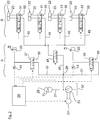
- the hydraulic system of the dual clutch transmission is shown as a simplified block diagram.
- the hydraulic cylinders 23 of the clutches K1, K2 and the switching elements 22 can be actuated.
- the hydraulic system is roughly divided into a clutch hydraulic circuit A and a gear actuator hydraulic circuit B.
- the two hydraulic circuits A, B are acted upon via a pressure accumulator 25 with the accumulator pressure p S.
- a main line 27 connected to the pressure accumulator 25 is led to a branch point 29 at which a first part line 31 to the hydraulic cylinder 23 of the first clutch K1 and a second part line 33 to the hydraulic cylinder 23 of the second clutch K2 is performed.
- a first control valve 35 and a second control valve 37 are arranged in each case, which can be controlled via a central control unit 39.
- the control unit 39 is a first pressure sensor 41 and a second pressure sensor 43 signal technology in conjunction.
- the pressure sensors 41, 43 respectively detect the hydraulic pressure applied to the first clutch K1 and to the second clutch K2.
- branching point 29 branches one, fluidly connected to the gear actuator hydraulic circuit B.
- the connecting line 45 is divided downstream of the control valve 47 in a total of four sub-lines 49, which are each guided via further control valves 51 to the hydraulic cylinders 23 of the switching elements 22.
- the hydraulic system has a pressure pump 53 which is connected on the input side to an oil sump 55.
- the pressure pump 53 can be actuated by the control unit 39 for charging the pressure accumulator via an electric motor 57.
- the hydraulic system has according to the Fig. 2 or 3 a clutch hydraulic circuit A, with which the clutches K1, K2 are hydraulically actuated, and a gear selector hydraulic circuit B, with which the gear shift elements 22 are hydraulically actuated.
- control unit 39 controls the control valves 35, 37, 47, 51 of the clutches K1, K2 and the gear shift elements 22 of the dual-clutch transmission to ensure a fully automatic gear change without interruption of traction.
- the predetermined during driving from the pressure accumulator 25 storage pressure p s may be exemplary in the order of 30 bar.
- control unit 39 can detect input parameters that indicate a longer service life of the vehicle. In this case, the control unit 39 activates a pressure reducing mode in which the accumulator pressure p s provided from the accumulator 25 is reduced.
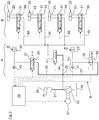
- the pressure sensor 41 assigned to the first clutch K1 together with the control unit 39 is in a control circuit R (FIG. Fig. 3 ), in which the first pressure sensor 41 assumes the accumulator pressure actual value acquisition p actual .
- the control valve 37 of the second clutch K2 is included in the control loop R, as an actuator which is cyclically adjusted between the open and closed positions, so that it as a result of leakage during the adjusting movement to pressure losses and thus to a reduced Accumulator pressure p s comes.
- the control circuit R the accumulator pressure p S is reduced from the abovementioned 30 bar to an exemplary value of 10 bar given by the control unit 39.
- control valve 35 associated with the first clutch K1 In order for the control valve 35 associated with the first clutch K1 to be able to perform a flawless actual value detection, it is continuously in the open position in the pressure reduction mode (FIG. Fig. 3 ). Furthermore, in the pressure reduction mode, the gear actuator hydraulic circuit B is permanently depressurized, that is shut down.
Landscapes
- Engineering & Computer Science (AREA)
- General Engineering & Computer Science (AREA)
- Mechanical Engineering (AREA)
- Physics & Mathematics (AREA)
- Fluid Mechanics (AREA)
- Control Of Transmission Device (AREA)
- Hydraulic Clutches, Magnetic Clutches, Fluid Clutches, And Fluid Joints (AREA)
Description
- Die Erfindung betrifft ein Doppelkupplungsgetriebe für ein Fahrzeug sowie ein Verfahren zur Durchführung eines Druckreduziermodus in einem solchen Hydrauliksystem.
- Ein Doppelkupplungsgetriebe gemäß dem Oberbegriff des Anspruchs 1 ist aus
US2012/144946A bekannt. - Bei einem Doppelkupplungsgetriebe ist mittels zweier Teilgetriebe ein vollautomatischer Gangwechsel ohne Zugkraftunterbrechung ermöglicht. Die Übertragung des Momentes erfolgt über eine von zwei Kupplungen, die die zwei Teilgetriebe mit dem Antrieb verbinden. Dadurch erfolgt ein Gangwechsel ohne Zugkraftunterbrechung, indem gleichzeitig eine der Kupplungen schließt, während die andere öffnet.
- Die Kupplungen sowie die Schaltelemente zum Einlegen der Gänge sind üblicherweise hydraulisch ansteuerbar. Das hierzu erforderliche Hydrauliksystem arbeitet im Fahrbetrieb bei einem Speicherdruck zum Beispiel in einer Größenordnung von 30 bar, der von einem Druckspeicher des Hydrauliksystems bereitgestellt ist. In den, zu den Hydraulikzylindern der beiden Kupplungen sowie der Gangschaltelemente geführten Druckleitungen sind jeweils, von einer Steuereinheit elektrisch ansteuerbare Steuerventile angeordnet. Mit Hilfe der Steuerventile kann der an der ersten Kupplung und der zweiten Kupplung anliegende Hydraulikdruck eingestellt werden. Der Steuereinheit sind außerdem erste und zweite Drucksensoren zugeordnet, die jeweils den an der ersten Kupplung und an der zweiten Kupplung anliegenden Hydraulikdruck überwachen. Wenn zum Beispiel die erfassten Drucksensor-Signale nicht mit dem Betätigungszustand der ersten/zweiten Kupplung korrespondieren, so kann die Steuereinheit einen Fehlbetrieb des Doppelkupplungsgetriebes erkennen.
- Durch die sehr geringen Spaltmaße von Steuerventilen in der Hydraulik und aufgrund der relativ dazu großen Öl-Additive kann es bei hohem Speicherdruck sowie bei längeren Fahrzeug-Standphasen (zum Beispiel Überseetransport, Urlaub, etc.) zu Ablagerungen an den Ventilspalten kommen. Diese Ablagerungen führen zu Komfort/Funktionseinbußen. Das vollständige Entleeren des Druckspeichers wäre als Gegenmaßnahme zwar geeignet.
- Aus diesem Grund kann bei Detektion längerer Fahrzeug-Standphasen der Druckspeicher des Hydrauliksystems vollständig entleert werden, was jedoch energetisch nicht sinnvoll ist. Alternativ kann der Speicherdruck auf zum Beispiel 10 bar reduziert werden. Dadurch werden einerseits Hydrauliköl-Ablagerungen in den Steuerventilen verhindert. Andererseits kann trotzdem zumindest ein Teil der im Hydrauliksystem gespeicherten Druckenergie beim Druckaufbau für den nächsten Fahrbetrieb genutzt werden.
- Die Aufgabe der Erfindung besteht darin, ein Doppelkupplungsgetriebe mit einem Hydrauliksystem bereitzustellen, bei dem der Druckreduziermodus ohne zusätzlichen sensortechnischen Aufwand betriebssicher durchführbar ist.
- Die Aufgabe ist durch die Merkmale des Patentanspruches 1 gelöst. Bevorzugte Weiterbildungen der Erfindung sind in den Unteransprüchen offenbart.
- Die Erfindung beruht auf dem Sachverhalt, dass im aus dem Stand der Technik bekannten Druckreduziermodus die Steuereinheit ein Hydraulik-Steuerventil mit einer vorgegebenen Anzahl von Stellbewegungen zyklisch zwischen der Offen- und Geschlossenstellung hin- und herverstellt, so dass es als Folge einer Leckage zu Druckverlusten und damit zu einem reduzierten Speicherdruck kommt. Die Anzahl von Stellbewegungen des HydraulikSteuerventils ist so gewählt, dass in jedem Fall die Gefahr von ÖlAblagerungen beseitigt ist, ohne jedoch genauere Informationen über den IstSpeicherdruck zu haben. Vor diesem Hintergrund wird gemäß dem kennzeichnenden Teil des Patentanspruches 1 die Steuereinheit im Druckreduziermodus in einem Regelkreis eingebunden, bei dem der, den an der ersten Kupplung anliegenden Hydraulikdruck erfassende erste Drucksensor die Speicherdruck-Istwerterfassung übernimmt. Die Speicherdruck-Istwerterfassung wird also durch den aus Sicherheitsgründen ohnehin erforderlichen Drucksensor durchgeführt. Ein zusätzlicher Drucksensor im Bereich des Druckspeichers ist dagegen im Hinblick auf eine Bauteilreduzierung nicht erforderlich. Beim erfindungsgemäßen Druckreduziermodus die Steuereinheit das, der ersten Kupplung zugeordnete Steuerventil durchgängig beziehungsweise dauerhaft in eine Offenstellung. Der der ersten Kupplung zugeordnete erste Drucksensor ist daher während des Druckreduziermodus durchgängig mit dem Speicherdruck beaufschlagt.
- Der erste Drucksensor liegt strömungstechnisch in der Druckleitung zwischen dem ersten Steuerventil und dem Hydraulikzylinder der ersten Kupplung. Der zweite Drucksensor liegt strömungstechnisch in der Druckleitung zwischen dem zweiten Steuerventil und dem Hydraulikzylinder der zweiten Kupplung.
- Von Vorteil ist es, wenn die im Druckreduziermodus erfolgende Speicherdruck-Reduzierung ohne zusätzliche Druckreduzier-Komponenten, etwa einem Druckablassventil, auskommt, sondern bereits vorhandene Komponenten in Doppelfunktion auch im Druckreduziermodus verwendet werden. Bevorzugt kann daher zur Druckreduzierung das der zweiten Kupplung zugeordnete Steuerventil zyklisch zwischen seiner Offenstellung und seiner Geschlossenstellung verstellt werden. Auf diese Weise kommt es als Folge einer Hydrauliköl-Leckage bei der Stellbewegung zu Druckverlusten und damit zu dem reduzierten Speicherdruck. Die Steuereinheit kann im Druckreduziermodus das Steuerventil der zweiten Kupplung mittels einer geeigneten Funktion ansteuern, zum Beispiel eine trapezförmige Ansteuerung, bei der das Steuerventil der zweiten Kupplung zyklisch geschlossen und geöffnet wird, wodurch der Speicher langsam entleert wird. Im obigen Fall wirkt daher das der zweiten Kupplung zugeordnete Steuerventil als ein Stellglied des Regelkreises.
- Alternativ oder zusätzlich zum Steuerventil der zweiten Kupplung können auch die den Gangschaltelementen zugeordneten Steuerventile zyklisch zwischen der Offen- und Geschlossenstellung hin- und herbewegt werden, um durch Hydrauliköl-Leckage einen Druckabfall zu erreichen. Im Hinblick auf eine Feinjustierung des Speicherdruckes auf einen reduzierten Wert ist jedoch die alleinige Verwendung des der zweiten Kupplung zugeordneten Steuerventils von Vorteil.
- Die beiden, der ersten und der zweiten Kupplung zugeordneten Drucksensoren erfüllen im normalen Fahrbetrieb eine Sicherheitsfunktion, bei der überwacht wird, ob die erste Kupplung oder die zweite Kupplung drucklos beziehungsweise druckbeaufschlagt ist. Abgesehen von den beiden, ohnehin aus Sicherheitsgründen erforderlichen Drucksensoren ist für die Durchführung des erfindungsgemäßen Druckreduziermodus kein zusätzlicher Drucksensor zur Speicherdruck-Istwerterfassung vorzusehen. Die Druckleitungen zwischen dem Druckspeicher und den Steuerventilen der Kupplungen sowie der Gangschaltelemente sind daher bauteiltechnisch bevorzugt frei von weiteren Drucksensoren.
- Im normalen Fahrbetrieb kann der vom Speicherdruck vorgegebene Speicherdruck in einer Größenordnung von 30 bar liegen. Nach erfolgtem Druckreduziermodus kann der Speicherdruck von diesen 30 bar auf einen Bereich von 0 bis 10 bar reduziert sein.
- Der Druckreduziermodus kann auf der Grundlage von, durch die Steuereinheit erfassten Eingangsparametern aktiviert werden. Beispielsweise wird der Druckreduziermodus aktiviert, wenn die Steuereinheit detektiert, dass das Fahrzeug stillgelegt ist und der Fahrer das Fahrzeug verlassen hat. Alternativ dazu kann der Druckreduziermodus durch eine werksseitige Betätigung eines Transportschalters aktiviert werden, und zwar für den Fall einer längeren Auslieferzeit.
- Das Hydrauliksystem des Doppelkupplungsgetriebes kann in einen Kupplungs-Hydraulikkreis und in einen Gangsteller-Hydraulikkreis aufgeteilt werden, die beide vom Druckspeicher mit Speicherdruck beaufschlagt werden. Über den Kupplungs-Hydraulikkreis werden die ersten und zweiten Kupplungen hydraulisch angesteuert. Über den Gangsteller-Hydraulikkreis werden die Schaltelemente hydraulisch angesteuert. Bevorzugt ist im Druckreduziermodus der Gangsteller-Hydraulikkreis drucklos geschaltet, das heißt durch entsprechende Positionierungen der Steuerventile stillgelegt.
- Die Erfindung und ihre vorteilhaften Aus- und Weiterbildungen sowie deren Vorteile werden nachfolgend anhand von Zeichnungen näher erläutert.
- Es zeigen:
- Fig. 1
- ein Blockschaltbild eines Doppelkupplungsgetriebes für ein Kraftfahrzeug mit sieben Vorwärtsgängen sowie einem Rückwärtsgang;
- Fig. 2
- das Hydrauliksystem des Doppelkupplungsgetriebes aus der
Fig. 1 ; und - Fig. 3
- eine Ansicht entsprechend der
Fig. 2 , anhand der der Druckreduziermodus veranschaulicht ist. - In der
Fig. 1 ist ein Blockschaltbild eines Doppelkupplungsgetriebes für ein Kraftfahrzeug mit Allradantrieb gezeigt. Das Doppelkupplungsgetriebe weist sieben Vorwärtsgänge (siehe die eingekreisten Ziffern 1 bis 7) sowie einen Rückwärtsgang RW auf. Das Doppelkupplungsgetriebe ist nachfolgend nur insoweit beschrieben, als es für das Verständnis der Erfindung erforderlich ist. So weist das Doppelkupplungsgetriebe zwei Eingangswellen 12, 14 auf, die koaxial zueinander angeordnet sind und über zwei hydraulisch betätigbare Lamellenkupplungen K1 und K2 alternierend mit der Antriebsquelle, zum Beispiel eine (nicht dargestellte) Brennkraftmaschine, verbindbar sind. Die Eingangswelle 14 ist als Hohlwelle ausgeführt, in der die als Vollwelle ausgeführte Eingangswelle 12 geführt ist. Die Eingangswellen 12, 14 treiben über Zahnradsätze der Vorwärtsgänge 1 bis 7 und einen Rückwärtsgang RW auf eine achsparallel angeordnete Abtriebswelle 16 und eine als Hohlwelle gebildete Zwischenwelle 18. Die Zahnradsätze der Vorwärtsgänge 1 bis 7 weisen jeweils Festzahnräder und über Schaltelemente 22 schaltbare Loszahnräder auf. Die Schaltelemente 22 können beispielhaft Doppelsynchronkupplungen sein, die jeweils aus einer Neutralstellung heraus zwei benachbarte Loszahnräder schalten können. Das den dritten Gang schaltende Schaltelement 22 ist dagegen gemäß derFig. 1 eine Einfachkupplung, die nur ein Loszahnrad auf der Zwischenwelle 18 kuppelt. - Das Teilgetriebe I des Doppelkupplungsgetriebes weist die Zahnräder für die ungeraden Vorwärtsgänge 1, 3, 5 und 7 auf, die über die hohle Eingangswelle 14 angetrieben sind. Dem Teilgetriebe II sind die geraden Vorwärtsgänge 2, 4, 6 und der Rückwärtsgang RW zugeordnet, die über die Kupplung K2 und die Eingangswelle 12 aktivierbar sind, wobei die Gänge durch jeweiliges Schließen der entsprechenden Schaltelemente 22 geschaltet sind.
- In der
Fig. 2 ist das Hydrauliksystem des Doppelkupplungsgetriebes als vereinfachtes Blockschaltbild gezeigt. Mit Hilfe des Hydrauliksystems können die Hydraulikzylinder 23 der Kupplungen K1, K2 sowie der Schaltelemente 22 betätigt werden. In derFig.2 ist das Hydrauliksystem grob in einen Kupplungs-Hydraulikkreis A und in einen Gangsteller-Hydraulikkreis B aufgeteilt. Die beiden Hydraulikkreise A, B sind über einen Druckspeicher 25 mit dem Speicherdruck pS beaufschlagt. Hierzu ist eine am Druckspeicher 25 angeschlossene Hauptleitung 27 bis zu einer Verzweigungsstelle 29 geführt, an der eine erste Teilleitung 31 zum Hydraulikzylinder 23 der ersten Kupplung K1 und eine zweite Teilleitung 33 zum Hydraulikzylinder 23 der zweiten Kupplung K2 geführt ist. In den beiden Teilleitungen 31, 33 sind jeweils ein erstes Steuerventil 35 und ein zweites Steuerventil 37 angeordnet, die über eine zentrale Steuereinheit 39 ansteuerbar sind. Zudem ist die Steuereinheit 39 einem ersten Drucksensor 41 und einem zweiten Drucksensor 43 signaltechnisch in Verbindung. Die Drucksensoren 41, 43 erfassen jeweils den an der ersten Kupplung K1 und an der zweiten Kupplung K2 anliegenden Hydraulikdruck. - Von der oben genannten Verzweigungsstelle 29 zweigt eine, strömungstechnisch mit dem Gangsteller-Hydraulikkreis B verbundene Verbindungsleitung 45 ab, in der ein weiteres Steuerventil 47 vorgesehen ist. Die Verbindungsleitung 45 teilt sich stromab des Steuerventiles 47 in insgesamt vier Teilleitungen 49 auf, die jeweils über weitere Steuerventile 51 zu den Hydraulikzylindern 23 der Schaltelemente 22 geführt sind.
- Zudem weist das Hydrauliksystem eine Druckpumpe 53 auf, die eingangsseitig mit einem Ölsumpf 55 verbunden ist. Die Druckpumpe 53 ist zum Aufladen des Druckspeichers über einen Elektromotor 57 von der Steuereinheit 39 ansteuerbar.
- Das Hydrauliksystem weist gemäß der
Fig. 2 oder3 einen Kupplungs-Hydraulikkreis A, mit dem die Kupplungen K1, K2 hydraulisch ansteuerbar sind, und einen Gangsteller-Hydraulikkreis B auf, mit dem die Gangschaltelemente 22 hydraulisch ansteuerbar sind. - Im normalen Fahrbetrieb steuert die Steuereinheit 39 die Steuerventile 35, 37, 47, 51 der Kupplungen K1, K2 und der Gangschaltelemente 22 des Doppelkupplungsgetriebes, um einen vollautomatischen Gangwechsel ohne Zugkraftunterbrechung zu gewährleisten. Die strömungstechnisch unmittelbar vor den Hydraulikzylindern 23 der Kupplungen K1, K2 positionierten ersten und zweiten Drucksensoren 41, 43 erfassen im Fahrbetrieb den an den Kupplungen K1, K2 anliegenden Hydraulikdruck. Der im Fahrbetrieb vom Druckspeicher 25 vorgegebene Speicherdruck ps kann beispielhaft in einer Größenordnung von 30 bar liegen.
- Nach einer Fahrzeug-Stilllegung kann die Steuereinheit 39 Eingangsparameter erfassen, die auf eine längere Standzeit des Fahrzeugs hindeuten. In diesem Fall aktiviert die Steuereinheit 39 einen Druckreduziermodus, bei dem der vom Druckspeicher 25 bereitgestellte Speicherdruck ps reduziert wird.
- Im Druckreduziermodus ist der der ersten Kupplung K1 zugeordnete Drucksensor 41 zusammen mit der Steuereinheit 39 in einem Regelkreis R (
Fig. 3 ) eingebunden, bei dem der erste Drucksensor 41 die SpeicherdruckIstwerterfassung pIst übernimmt. Zudem wird auch das Steuerventil 37 der zweiten Kupplung K2 in dem Regelkreis R eingebunden, und zwar als ein Stellglied, das zyklisch zwischen der Offen- und Geschlossenstellung verstellt wird, so dass es als Folge einer Leckage bei der Stellbewegung zu Druckverlusten und damit zu einem reduzierten Speicherdruck ps kommt. Mittels des Regelkreises R wird der Speicherdruck pS von den oben erwähnten 30 bar auf einen von der Steuereinheit 39 vorgebebenen Sollwert von beispielhaft 10 bar reduziert. - Damit das der ersten Kupplung K1 zugeordnete Steuerventil 35 eine einwandfreie Istwert-Erfassung vornehmen kann, ist es im Druckreduziermodus durchgängig in der Offenstellung (
Fig. 3 ). Weiterhin ist im Druckreduziermodus der Gangsteller-Hydraulikkreis B dauerhaft drucklos geschaltet, das heißt stillgelegt.
Claims (8)
- Doppelkupplungsgetriebe für ein Fahrzeug, mit einem Hydrauliksystem zur Betätigung von Hydraulikzylindern (23) der Kupplungen (K1, K2) und der Gangschaltelemente (22) des Doppelkupplungsgetriebes, welches Hydrauliksystem einen Druckspeicher (25) zur Bereitstellung eines Speicherdruckes (ps) im Hydrauliksystem aufweist, wobei in den, zu den Hydraulikzylindern (23) der ersten Kupplung (K1) und der zweiten Kupplung (K2) geführten Druckleitungen (31, 33) jeweils ein von einer Steuereinheit (39) ansteuerbares Steuerventil (35, 37) angeordnet ist, mit denen der an der ersten und zweiten Kupplung (K1, K2) anliegende Hydraulikdruck einstellbar ist, welcher Steuereinheit (39) erste und zweite Drucksensoren (41, 43) zugeordnet sind, die den an der ersten und zweiten Kupplung (K1, K2) anliegenden Hydraulikdruck erfassen, und welche Steuereinheit (39) bei Detektion einer längeren Stillstandzeit des Fahrzeugs einen Druckreduziermodus aktiviert, bei dem der vom Druckspeicher (25) bereitgestellte Speicherdruck (ps) reduzierbar ist, dadurch gekennzeichnet, dass im Druckreduziermodus die Steuereinheit (39) das, der ersten Kupplung (K1) zugeordnete Steuerventil (35) durchgängig öffnet, und dass der der ersten Kupplung (K1) zugeordnete Drucksensor (41) zusammen mit der Steuereinheit (39) in einem Regelkreis (R) eingebunden ist, bei dem der erste Drucksensor (41) die Speicherdruck-Istwerterfassung (PIst) übernimmt.
- Doppelkupplungsgetriebe nach Anspruch 1, dadurch gekennzeichnet, dass im Druckreduziermodus die Steuereinheit (39) das Steuerventil (37) der zweiten Kupplung (K2) zyklisch zwischen der Offen- und Geschlossenstellung verstellt, so dass es als Folge einer Leckage bei der Stellbewegung zu Druckverlusten und damit zu einem reduzierten Speicherdruck (ps) kommt.
- Doppelkupplungsgetriebe nach Anspruch 1 oder 2, dadurch gekennzeichnet, dass das Hydrauliksystem einen Kupplungs-Hydraulikkreis (A), mit dem die Kupplungen (K1, K2) hydraulisch ansteuerbar sind, und einen Gangsteller-Hydraulikkreis (B) aufweist, mit dem die Gangschaltelemente (22) hydraulisch ansteuerbar sind, und dass insbesondere in dem Druckreduziermodus der Gangsteller-Hydraulikkreis (B) drucklos geschaltet ist, das heißt, stillgelegt ist.
- Doppelkupplungsgetriebe nach einem der vorhergehenden Ansprüche, dadurch gekennzeichnet, dass die Druckleitungen (27, 31, 33, 45, 49) zwischen dem Druckspeicher (25) und den Steuerventilen (35, 37, 51) der Kupplungen (K1, K2) sowie der Gangschaltelemente (22) frei von Drucksensoren sind.
- Doppelkupplungsgetriebe nach einem der vorhergehenden Ansprüche, dadurch gekennzeichnet, dass im normalen Fahrbetrieb mittels der ersten und zweiten Drucksensoren (41, 43) der an der ersten Kupplung (K1) und an der zweiten Kupplung (K2) anliegende Hydraulikdruck erfassbar ist, und insbesondere erfasst wird, ob die ersten und zweite Kupplung (K1, K2) drucklos oder druckbeaufschlagt ist.
- Doppelkupplungsgetriebe nach einem der vorhergehenden Ansprüche, dadurch gekennzeichnet, dass der vom Druckspeicher (25) vorgegebene Speicherdruck (ps) im normalen Fahrbetrieb in einer Größenordnung von 30 bar liegt, und nach erfolgtem Druckreduziermodus der Speicherdruck (ps) auf 0 bis 10 bar reduziert ist.
- Doppelkupplungsgetriebe nach einem der vorhergehenden Ansprüche, dadurch gekennzeichnet, dass der Druckreduziermodus aktivierbar ist, wenn die Steuereinheit (39) erkennt, dass das Fahrzeug stillgelegt ist und der Fahrer das Fahrzeug verlässt, oder durch eine werksseitige Betätigung eines Transportschalters im Falle einer längeren Auslieferzeitdauer.
- Verfahren zur Durchführung eines Druckreduziermodus in einem Hydrauliksystem eines Doppelkupplungsgetriebes nach einem der vorhergehenden Ansprüche.
Applications Claiming Priority (2)
| Application Number | Priority Date | Filing Date | Title |
|---|---|---|---|
| DE102013003894.4A DE102013003894A1 (de) | 2013-03-06 | 2013-03-06 | Hydrauliksystem für ein Doppelkupplungsgetriebe |
| PCT/EP2014/000520 WO2014135257A1 (de) | 2013-03-06 | 2014-02-27 | Hvdrauliksvstem für ein doppelkuppluhgsgetriebe |
Publications (2)
| Publication Number | Publication Date |
|---|---|
| EP2964978A1 EP2964978A1 (de) | 2016-01-13 |
| EP2964978B1 true EP2964978B1 (de) | 2017-02-01 |
Family
ID=50193439
Family Applications (1)
| Application Number | Title | Priority Date | Filing Date |
|---|---|---|---|
| EP14707653.3A Not-in-force EP2964978B1 (de) | 2013-03-06 | 2014-02-27 | Hydrauliksystem für ein doppelkupplungsgetriebe |
Country Status (5)
| Country | Link |
|---|---|
| US (1) | US9709160B2 (de) |
| EP (1) | EP2964978B1 (de) |
| CN (1) | CN105026798B (de) |
| DE (1) | DE102013003894A1 (de) |
| WO (1) | WO2014135257A1 (de) |
Families Citing this family (21)
| Publication number | Priority date | Publication date | Assignee | Title |
|---|---|---|---|---|
| JP2014201132A (ja) * | 2013-04-02 | 2014-10-27 | トヨタ自動車株式会社 | 車両の制御装置 |
| JP6368966B2 (ja) * | 2014-10-28 | 2018-08-08 | ヤンマー株式会社 | 油圧式変速クラッチ用制御バルブ機構 |
| AT518761B1 (de) * | 2016-04-26 | 2019-02-15 | Avl Commercial Driveline & Tractor Eng Gmbh | Hydraulikkreislauf, Drehmomentübertragungsvorrichtung mit einem Hydraulikkreislauf, Verfahren zum Betrieb eines Hydraulikkreislaufs |
| DE102016214378A1 (de) | 2016-08-03 | 2018-02-08 | Audi Ag | Hydrauliksystem für ein Automatikgetriebe eines Kraftfahrzeugs |
| DE102016214367B3 (de) | 2016-08-03 | 2018-01-11 | Audi Ag | Hydrauliksystem für ein Automatikgetriebe eines Kraftfahrzeugs |
| DE102016214364B3 (de) * | 2016-08-03 | 2018-01-04 | Audi Ag | Hydrauliksystem für ein Automatikgetriebe eines Kraftfahrzeugs |
| DE102016214357B4 (de) | 2016-08-03 | 2018-08-23 | Audi Ag | Hydrauliksystem für ein Automatikgetriebe eines Kraftfahrzeugs |
| DE102016214370B3 (de) * | 2016-08-03 | 2017-12-14 | Audi Ag | Hydrauliksystem für ein Automatikgetriebe eines Kraftfahrzeugs |
| DE102016214375B3 (de) | 2016-08-03 | 2017-11-16 | Audi Ag | Hydrauliksystem für ein Automatikgetriebe eines Kraftfahrzeugs |
| DE102016214373B3 (de) * | 2016-08-03 | 2017-12-14 | Audi Ag | Hydrauliksystem für ein Automatikgetriebe eines Kraftfahrzeugs |
| DE102016215220A1 (de) * | 2016-08-16 | 2018-02-22 | Zf Friedrichshafen Ag | Verfahren zum Betreiben eines Doppelkupplungsgetriebes mit einem zwei Kupplungen umfassenden Doppelkupplungssystem |
| US10316963B2 (en) * | 2017-04-25 | 2019-06-11 | GM Global Technology Operations LLC | Pressure sensor rationality diagnostic for a dual clutch transmission |
| RU2664618C1 (ru) * | 2017-09-18 | 2018-08-21 | Федеральное государственное унитарное предприятие "Центральный ордена Трудового Красного Знамени научно-исследовательский автомобильный и автомоторный институт "НАМИ" (ФГУП "НАМИ") | Электрогидравлическая система управления коробкой передач с двойным сцеплением |
| RU2706557C1 (ru) * | 2019-02-06 | 2019-11-19 | Федеральное государственное унитарное предприятие "Центральный ордена Трудового Красного Знамени научно-исследовательский автомобильный и автомоторный институт "НАМИ" (ФГУП "НАМИ") | Электрогидравлическая система управления коробкой передач с двойным сцеплением |
| DE102019108875A1 (de) * | 2019-04-04 | 2020-10-08 | Fte Automotive Gmbh | Doppelkupplungs-Aktuator und Antriebsbaugruppe mit einem solchen Aktuator |
| US10801612B1 (en) | 2019-04-26 | 2020-10-13 | Caterpillar Inc. | Machine transmission with clutch element hydraulic control |
| CN111059174A (zh) * | 2019-12-24 | 2020-04-24 | 贵州凯星液力传动机械有限公司 | 一种变速器的离合器油压控制系统 |
| CN113048163A (zh) * | 2021-03-11 | 2021-06-29 | 合升智能技术(无锡)有限公司 | 一种干式离合器液压控制系统 |
| RU2756859C1 (ru) * | 2021-04-21 | 2021-10-06 | Федеральное государственное унитарное предприятие "Центральный ордена Трудового Красного Знамени научно-исследовательский автомобильный и автомоторный институт "НАМИ" | Система гидравлического управления зубчатой муфтой коробки передач |
| RU2762838C1 (ru) * | 2021-06-17 | 2021-12-23 | Федеральное государственное унитарное предприятие "Центральный ордена Трудового Красного Знамени научно-исследовательский автомобильный и автомоторный институт "НАМИ" | Система гидравлического управления зубчатой муфтой коробки передач транспортного средства |
| RU2762847C1 (ru) * | 2021-06-17 | 2021-12-23 | Федеральное государственное унитарное предприятие "Центральный ордена Трудового Красного Знамени научно-исследовательский автомобильный и автомоторный институт "НАМИ" | Система гидравлического управления зубчатой муфтой коробки передач |
Family Cites Families (19)
| Publication number | Priority date | Publication date | Assignee | Title |
|---|---|---|---|---|
| JP4128992B2 (ja) * | 2003-10-15 | 2008-07-30 | 本田技研工業株式会社 | 油圧アクチュエータの油圧制御装置 |
| DE102006014756A1 (de) * | 2006-03-30 | 2007-10-04 | Zf Friedrichshafen Ag | Vorrichtung zum Speichern von Hydraulikfluid eines Hydrauliksystems einer Getriebeeinrichtung |
| JP4682922B2 (ja) * | 2006-06-06 | 2011-05-11 | 日産自動車株式会社 | 油圧制御装置 |
| DE112007002438A5 (de) | 2006-11-08 | 2009-07-16 | Luk Lamellen Und Kupplungsbau Beteiligungs Kg | Hydraulische Steuerung für ein Doppelkupplungsgetriebe |
| DE102007037589B4 (de) | 2007-08-09 | 2019-03-28 | Conti Temic Microelectronic Gmbh | Verfahren zur Steuerung einer Doppelkupplung, insbesondere der Doppelkupplung eines Doppelkupplungsgetriebes |
| US7878932B2 (en) * | 2007-09-13 | 2011-02-01 | GM Global Technology Operations LLC | Method and apparatus to monitor a valve adapted to control mode to gear transitions during operation of an electro-mechanical transmission |
| DE102007056767B4 (de) * | 2007-11-23 | 2009-11-26 | Gertrag Ford Transmissions Gmbh | Verfahren zum Betrieb eines Drucksteuerventils eines Drucksystems zur Betätigung einer Kupplung |
| US8113988B2 (en) * | 2008-04-04 | 2012-02-14 | GM Global Technology Operations LLC | Hydraulic control module for vehicle transmission and diagnostic detection method for the same |
| DE102008032245B4 (de) * | 2008-07-01 | 2012-10-11 | Getrag Getriebe- Und Zahnradfabrik Hermann Hagenmeyer Gmbh & Cie Kg | Verfahren zum Ansteuern einer Kupplungsanordnung |
| US8434603B2 (en) | 2010-02-17 | 2013-05-07 | GM Global Technology Operations LLC | Low content control system for a dual clutch transmission |
| DE102010011305A1 (de) * | 2010-03-13 | 2011-09-15 | Daimler Ag | Verfahren zum Betrieb einer hydraulischen Steuerung für ein Getriebe eines Kraftfahrzeugs |
| DE102010037243B4 (de) * | 2010-08-31 | 2016-11-17 | Hofer Mechatronik Gmbh | Hydraulische Steuerung eines Doppelkupplungsgetriebes und Verfahren zum Betrieb zweier als Aktuatoren ausgebildeter Kupplungen |
| DE102010042194A1 (de) | 2010-10-08 | 2012-04-12 | Robert Bosch Gmbh | Vorrichtung zur Steuerung eines hydraulischen Speichers eines Hydrauliksystems |
| DE102010042189A1 (de) | 2010-10-08 | 2012-04-12 | Robert Bosch Gmbh | Vorrichtung zur Steuerung eines hydraulischen Speichers eines Hydrauliksystems |
| US8702564B2 (en) | 2010-12-09 | 2014-04-22 | GM Global Technology Operations LLC | Electro-hydraulic control system and method for a dual clutch transmission |
| US8942901B2 (en) * | 2010-12-09 | 2015-01-27 | Gm Global Technology Operations, Llc | Method of controlling a hydraulic control system for a dual clutch transmission |
| DE102011100857A1 (de) | 2011-05-06 | 2012-11-08 | Audi Ag | Doppelkupplungsgetriebe |
| DE102011100800A1 (de) * | 2011-05-06 | 2012-11-08 | Volkswagen Ag | Kupplungsgetriebe, Verfahren zum Betreiben |
| JP6212446B2 (ja) * | 2014-07-16 | 2017-10-11 | 本田技研工業株式会社 | 自動変速機の油圧異常検出装置 |
-
2013
- 2013-03-06 DE DE102013003894.4A patent/DE102013003894A1/de not_active Ceased
-
2014
- 2014-02-27 WO PCT/EP2014/000520 patent/WO2014135257A1/de not_active Ceased
- 2014-02-27 US US14/772,277 patent/US9709160B2/en not_active Expired - Fee Related
- 2014-02-27 EP EP14707653.3A patent/EP2964978B1/de not_active Not-in-force
- 2014-02-27 CN CN201480012014.3A patent/CN105026798B/zh not_active Expired - Fee Related
Also Published As
| Publication number | Publication date |
|---|---|
| WO2014135257A1 (de) | 2014-09-12 |
| CN105026798A (zh) | 2015-11-04 |
| US20160003347A1 (en) | 2016-01-07 |
| EP2964978A1 (de) | 2016-01-13 |
| DE102013003894A1 (de) | 2014-09-11 |
| US9709160B2 (en) | 2017-07-18 |
| CN105026798B (zh) | 2017-06-16 |
Similar Documents
| Publication | Publication Date | Title |
|---|---|---|
| WO2014135257A1 (de) | Hvdrauliksvstem für ein doppelkuppluhgsgetriebe | |
| EP2057393B1 (de) | Hydraulische oder pneumatische steuerungseinrichtung eines automatisierten schaltgetriebes | |
| EP1767824B1 (de) | Hydraulische Steuerungsvorrichtung für ein automatisiertes Doppelkupplungsgetriebe | |
| EP2705277B1 (de) | Doppelkupplungsgetriebe | |
| EP1635091B1 (de) | Hydraulische Steuerungsvorrichtung für ein automatisiertes Doppelkupplungsgetriebe | |
| EP1950463B1 (de) | Hydraulische Steuerungsvorrichtung für ein automatisiertes Doppelkupplungsgetriebe | |
| EP1517059B1 (de) | Doppelkupplungsgetriebe mit Zustandshaltefunktion | |
| DE102004031021B4 (de) | Getriebeanordnung mit einer Schaltelement-Sicherungseinrichtung zur Sicherung gegen ein Einlegen mehrerer Gänge eines Schaltgetriebes oder eines Teilgetriebes eines Schaltgetriebes | |
| DE112007002509B4 (de) | Hydraulische Steuerung für ein Doppelkupplungsgetriebe | |
| DE102009005755A1 (de) | Steuerungseinrichtung für ein automatisiertes Zahnräderwechselgetriebe | |
| EP1710477A1 (de) | Schaltventilvorrichtung für ein Schaltsystem eines Schaltgetriebes | |
| DE10243282A1 (de) | Hydraulische Steuerungsvorrichtung eines Doppelkupplungsgetriebes | |
| DE102009005753A1 (de) | Hydraulische Steuerung für ein automatisiertes Getriebe | |
| EP2173594B1 (de) | Verfahren zum schalten eines stufengetriebegangs eines kraftfahrzeugs in abhängigkeit von der antriebswellendrehzahl | |
| EP1767825B1 (de) | Hydraulische Steuerungsvorrichtung für ein automatisiertes Doppelkupplungsgetriebe | |
| EP2520832A2 (de) | Doppelkupplungsgetriebe | |
| DE102013202708B4 (de) | Verfahren zum Betreiben einer Getriebevorrichtung, insbesondere eines 9-Gang-Getriebes | |
| DE102009005756A1 (de) | Steuerungseinrichtung für ein automatisiertes Zahnräderwechselgetriebe | |
| WO2007101418A1 (de) | Verfahren und vorrichtung zum steuern des betriebs eines parallelschaltgetriebes | |
| DE102011100862B4 (de) | Doppelkupplungsgetriebe | |
| DE60011961T2 (de) | Steuersystem für Automatikgetriebe | |
| DE102012006355B4 (de) | Getriebesteuervorrichtung, Kraftwagen mit einer Getriebesteuervorrichtung und Verfahren zum Betreiben einer Getriebesteuervorrichtung | |
| DE102011100799B4 (de) | Doppelkupplungsgetriebe, Verfahren zum Betreiben | |
| DE102011100809A1 (de) | Kupplungsgetriebe mit Sicherheitsventilanordnung | |
| DE102013219386B4 (de) | Hydraulische Steuerungsvorrichtung eines Doppelkupplungsgetriebes |
Legal Events
| Date | Code | Title | Description |
|---|---|---|---|
| PUAI | Public reference made under article 153(3) epc to a published international application that has entered the european phase |
Free format text: ORIGINAL CODE: 0009012 |
|
| 17P | Request for examination filed |
Effective date: 20151006 |
|
| AK | Designated contracting states |
Kind code of ref document: A1 Designated state(s): AL AT BE BG CH CY CZ DE DK EE ES FI FR GB GR HR HU IE IS IT LI LT LU LV MC MK MT NL NO PL PT RO RS SE SI SK SM TR |
|
| AX | Request for extension of the european patent |
Extension state: BA ME |
|
| DAX | Request for extension of the european patent (deleted) | ||
| RIC1 | Information provided on ipc code assigned before grant |
Ipc: F16H 61/688 20060101ALI20160905BHEP Ipc: F16D 48/06 20060101ALI20160905BHEP Ipc: F16H 61/00 20060101AFI20160905BHEP |
|
| GRAP | Despatch of communication of intention to grant a patent |
Free format text: ORIGINAL CODE: EPIDOSNIGR1 |
|
| INTG | Intention to grant announced |
Effective date: 20161117 |
|
| GRAS | Grant fee paid |
Free format text: ORIGINAL CODE: EPIDOSNIGR3 |
|
| GRAA | (expected) grant |
Free format text: ORIGINAL CODE: 0009210 |
|
| AK | Designated contracting states |
Kind code of ref document: B1 Designated state(s): AL AT BE BG CH CY CZ DE DK EE ES FI FR GB GR HR HU IE IS IT LI LT LU LV MC MK MT NL NO PL PT RO RS SE SI SK SM TR |
|
| REG | Reference to a national code |
Ref country code: GB Ref legal event code: FG4D Free format text: NOT ENGLISH |
|
| REG | Reference to a national code |
Ref country code: CH Ref legal event code: EP Ref country code: AT Ref legal event code: REF Ref document number: 865879 Country of ref document: AT Kind code of ref document: T Effective date: 20170215 |
|
| REG | Reference to a national code |
Ref country code: FR Ref legal event code: PLFP Year of fee payment: 4 |
|
| REG | Reference to a national code |
Ref country code: IE Ref legal event code: FG4D Free format text: LANGUAGE OF EP DOCUMENT: GERMAN |
|
| REG | Reference to a national code |
Ref country code: DE Ref legal event code: R096 Ref document number: 502014002620 Country of ref document: DE |
|
| REG | Reference to a national code |
Ref country code: NL Ref legal event code: MP Effective date: 20170201 |
|
| REG | Reference to a national code |
Ref country code: LT Ref legal event code: MG4D |
|
| PG25 | Lapsed in a contracting state [announced via postgrant information from national office to epo] |
Ref country code: GR Free format text: LAPSE BECAUSE OF FAILURE TO SUBMIT A TRANSLATION OF THE DESCRIPTION OR TO PAY THE FEE WITHIN THE PRESCRIBED TIME-LIMIT Effective date: 20170502 Ref country code: NO Free format text: LAPSE BECAUSE OF FAILURE TO SUBMIT A TRANSLATION OF THE DESCRIPTION OR TO PAY THE FEE WITHIN THE PRESCRIBED TIME-LIMIT Effective date: 20170501 Ref country code: HR Free format text: LAPSE BECAUSE OF FAILURE TO SUBMIT A TRANSLATION OF THE DESCRIPTION OR TO PAY THE FEE WITHIN THE PRESCRIBED TIME-LIMIT Effective date: 20170201 Ref country code: LT Free format text: LAPSE BECAUSE OF FAILURE TO SUBMIT A TRANSLATION OF THE DESCRIPTION OR TO PAY THE FEE WITHIN THE PRESCRIBED TIME-LIMIT Effective date: 20170201 Ref country code: FI Free format text: LAPSE BECAUSE OF FAILURE TO SUBMIT A TRANSLATION OF THE DESCRIPTION OR TO PAY THE FEE WITHIN THE PRESCRIBED TIME-LIMIT Effective date: 20170201 Ref country code: IS Free format text: LAPSE BECAUSE OF FAILURE TO SUBMIT A TRANSLATION OF THE DESCRIPTION OR TO PAY THE FEE WITHIN THE PRESCRIBED TIME-LIMIT Effective date: 20170601 |
|
| PG25 | Lapsed in a contracting state [announced via postgrant information from national office to epo] |
Ref country code: BG Free format text: LAPSE BECAUSE OF FAILURE TO SUBMIT A TRANSLATION OF THE DESCRIPTION OR TO PAY THE FEE WITHIN THE PRESCRIBED TIME-LIMIT Effective date: 20170501 Ref country code: SE Free format text: LAPSE BECAUSE OF FAILURE TO SUBMIT A TRANSLATION OF THE DESCRIPTION OR TO PAY THE FEE WITHIN THE PRESCRIBED TIME-LIMIT Effective date: 20170201 Ref country code: PT Free format text: LAPSE BECAUSE OF FAILURE TO SUBMIT A TRANSLATION OF THE DESCRIPTION OR TO PAY THE FEE WITHIN THE PRESCRIBED TIME-LIMIT Effective date: 20170601 Ref country code: PL Free format text: LAPSE BECAUSE OF FAILURE TO SUBMIT A TRANSLATION OF THE DESCRIPTION OR TO PAY THE FEE WITHIN THE PRESCRIBED TIME-LIMIT Effective date: 20170201 Ref country code: LV Free format text: LAPSE BECAUSE OF FAILURE TO SUBMIT A TRANSLATION OF THE DESCRIPTION OR TO PAY THE FEE WITHIN THE PRESCRIBED TIME-LIMIT Effective date: 20170201 Ref country code: NL Free format text: LAPSE BECAUSE OF NON-PAYMENT OF DUE FEES Effective date: 20170201 Ref country code: RS Free format text: LAPSE BECAUSE OF FAILURE TO SUBMIT A TRANSLATION OF THE DESCRIPTION OR TO PAY THE FEE WITHIN THE PRESCRIBED TIME-LIMIT Effective date: 20170201 Ref country code: ES Free format text: LAPSE BECAUSE OF FAILURE TO SUBMIT A TRANSLATION OF THE DESCRIPTION OR TO PAY THE FEE WITHIN THE PRESCRIBED TIME-LIMIT Effective date: 20170201 |
|
| REG | Reference to a national code |
Ref country code: CH Ref legal event code: PL |
|
| PG25 | Lapsed in a contracting state [announced via postgrant information from national office to epo] |
Ref country code: SK Free format text: LAPSE BECAUSE OF FAILURE TO SUBMIT A TRANSLATION OF THE DESCRIPTION OR TO PAY THE FEE WITHIN THE PRESCRIBED TIME-LIMIT Effective date: 20170201 Ref country code: CH Free format text: LAPSE BECAUSE OF NON-PAYMENT OF DUE FEES Effective date: 20170228 Ref country code: EE Free format text: LAPSE BECAUSE OF FAILURE TO SUBMIT A TRANSLATION OF THE DESCRIPTION OR TO PAY THE FEE WITHIN THE PRESCRIBED TIME-LIMIT Effective date: 20170201 Ref country code: CZ Free format text: LAPSE BECAUSE OF FAILURE TO SUBMIT A TRANSLATION OF THE DESCRIPTION OR TO PAY THE FEE WITHIN THE PRESCRIBED TIME-LIMIT Effective date: 20170201 Ref country code: RO Free format text: LAPSE BECAUSE OF FAILURE TO SUBMIT A TRANSLATION OF THE DESCRIPTION OR TO PAY THE FEE WITHIN THE PRESCRIBED TIME-LIMIT Effective date: 20170201 Ref country code: IT Free format text: LAPSE BECAUSE OF FAILURE TO SUBMIT A TRANSLATION OF THE DESCRIPTION OR TO PAY THE FEE WITHIN THE PRESCRIBED TIME-LIMIT Effective date: 20170201 Ref country code: LI Free format text: LAPSE BECAUSE OF NON-PAYMENT OF DUE FEES Effective date: 20170228 |
|
| REG | Reference to a national code |
Ref country code: DE Ref legal event code: R097 Ref document number: 502014002620 Country of ref document: DE |
|
| REG | Reference to a national code |
Ref country code: IE Ref legal event code: MM4A |
|
| PG25 | Lapsed in a contracting state [announced via postgrant information from national office to epo] |
Ref country code: SM Free format text: LAPSE BECAUSE OF FAILURE TO SUBMIT A TRANSLATION OF THE DESCRIPTION OR TO PAY THE FEE WITHIN THE PRESCRIBED TIME-LIMIT Effective date: 20170201 Ref country code: MC Free format text: LAPSE BECAUSE OF FAILURE TO SUBMIT A TRANSLATION OF THE DESCRIPTION OR TO PAY THE FEE WITHIN THE PRESCRIBED TIME-LIMIT Effective date: 20170201 Ref country code: DK Free format text: LAPSE BECAUSE OF FAILURE TO SUBMIT A TRANSLATION OF THE DESCRIPTION OR TO PAY THE FEE WITHIN THE PRESCRIBED TIME-LIMIT Effective date: 20170201 |
|
| PLBE | No opposition filed within time limit |
Free format text: ORIGINAL CODE: 0009261 |
|
| STAA | Information on the status of an ep patent application or granted ep patent |
Free format text: STATUS: NO OPPOSITION FILED WITHIN TIME LIMIT |
|
| PG25 | Lapsed in a contracting state [announced via postgrant information from national office to epo] |
Ref country code: LU Free format text: LAPSE BECAUSE OF NON-PAYMENT OF DUE FEES Effective date: 20170227 |
|
| 26N | No opposition filed |
Effective date: 20171103 |
|
| REG | Reference to a national code |
Ref country code: BE Ref legal event code: MM Effective date: 20170228 |
|
| REG | Reference to a national code |
Ref country code: FR Ref legal event code: PLFP Year of fee payment: 5 |
|
| PG25 | Lapsed in a contracting state [announced via postgrant information from national office to epo] |
Ref country code: IE Free format text: LAPSE BECAUSE OF NON-PAYMENT OF DUE FEES Effective date: 20170227 Ref country code: SI Free format text: LAPSE BECAUSE OF FAILURE TO SUBMIT A TRANSLATION OF THE DESCRIPTION OR TO PAY THE FEE WITHIN THE PRESCRIBED TIME-LIMIT Effective date: 20170201 |
|
| PG25 | Lapsed in a contracting state [announced via postgrant information from national office to epo] |
Ref country code: BE Free format text: LAPSE BECAUSE OF NON-PAYMENT OF DUE FEES Effective date: 20170228 |
|
| PG25 | Lapsed in a contracting state [announced via postgrant information from national office to epo] |
Ref country code: MT Free format text: LAPSE BECAUSE OF FAILURE TO SUBMIT A TRANSLATION OF THE DESCRIPTION OR TO PAY THE FEE WITHIN THE PRESCRIBED TIME-LIMIT Effective date: 20170201 |
|
| PG25 | Lapsed in a contracting state [announced via postgrant information from national office to epo] |
Ref country code: HU Free format text: LAPSE BECAUSE OF FAILURE TO SUBMIT A TRANSLATION OF THE DESCRIPTION OR TO PAY THE FEE WITHIN THE PRESCRIBED TIME-LIMIT; INVALID AB INITIO Effective date: 20140227 |
|
| PG25 | Lapsed in a contracting state [announced via postgrant information from national office to epo] |
Ref country code: CY Free format text: LAPSE BECAUSE OF FAILURE TO SUBMIT A TRANSLATION OF THE DESCRIPTION OR TO PAY THE FEE WITHIN THE PRESCRIBED TIME-LIMIT Effective date: 20170201 |
|
| PG25 | Lapsed in a contracting state [announced via postgrant information from national office to epo] |
Ref country code: MK Free format text: LAPSE BECAUSE OF FAILURE TO SUBMIT A TRANSLATION OF THE DESCRIPTION OR TO PAY THE FEE WITHIN THE PRESCRIBED TIME-LIMIT Effective date: 20170201 |
|
| PG25 | Lapsed in a contracting state [announced via postgrant information from national office to epo] |
Ref country code: TR Free format text: LAPSE BECAUSE OF FAILURE TO SUBMIT A TRANSLATION OF THE DESCRIPTION OR TO PAY THE FEE WITHIN THE PRESCRIBED TIME-LIMIT Effective date: 20170201 |
|
| REG | Reference to a national code |
Ref country code: AT Ref legal event code: MM01 Ref document number: 865879 Country of ref document: AT Kind code of ref document: T Effective date: 20190227 |
|
| PG25 | Lapsed in a contracting state [announced via postgrant information from national office to epo] |
Ref country code: AT Free format text: LAPSE BECAUSE OF NON-PAYMENT OF DUE FEES Effective date: 20190227 |
|
| PG25 | Lapsed in a contracting state [announced via postgrant information from national office to epo] |
Ref country code: AL Free format text: LAPSE BECAUSE OF FAILURE TO SUBMIT A TRANSLATION OF THE DESCRIPTION OR TO PAY THE FEE WITHIN THE PRESCRIBED TIME-LIMIT Effective date: 20170201 |
|
| PGFP | Annual fee paid to national office [announced via postgrant information from national office to epo] |
Ref country code: FR Payment date: 20230222 Year of fee payment: 10 |
|
| PGFP | Annual fee paid to national office [announced via postgrant information from national office to epo] |
Ref country code: GB Payment date: 20230220 Year of fee payment: 10 Ref country code: DE Payment date: 20230228 Year of fee payment: 10 |
|
| P01 | Opt-out of the competence of the unified patent court (upc) registered |
Effective date: 20230530 |
|
| REG | Reference to a national code |
Ref country code: DE Ref legal event code: R119 Ref document number: 502014002620 Country of ref document: DE |
|
| GBPC | Gb: european patent ceased through non-payment of renewal fee |
Effective date: 20240227 |
|
| PG25 | Lapsed in a contracting state [announced via postgrant information from national office to epo] |
Ref country code: DE Free format text: LAPSE BECAUSE OF NON-PAYMENT OF DUE FEES Effective date: 20240903 |
|
| PG25 | Lapsed in a contracting state [announced via postgrant information from national office to epo] |
Ref country code: GB Free format text: LAPSE BECAUSE OF NON-PAYMENT OF DUE FEES Effective date: 20240227 |
|
| PG25 | Lapsed in a contracting state [announced via postgrant information from national office to epo] |
Ref country code: FR Free format text: LAPSE BECAUSE OF NON-PAYMENT OF DUE FEES Effective date: 20240229 |
|
| PG25 | Lapsed in a contracting state [announced via postgrant information from national office to epo] |
Ref country code: GB Free format text: LAPSE BECAUSE OF NON-PAYMENT OF DUE FEES Effective date: 20240227 Ref country code: FR Free format text: LAPSE BECAUSE OF NON-PAYMENT OF DUE FEES Effective date: 20240229 Ref country code: DE Free format text: LAPSE BECAUSE OF NON-PAYMENT OF DUE FEES Effective date: 20240903 |