EP2965710A1 - Moules personnalisées - Google Patents
Moules personnalisées Download PDFInfo
- Publication number
- EP2965710A1 EP2965710A1 EP14176188.2A EP14176188A EP2965710A1 EP 2965710 A1 EP2965710 A1 EP 2965710A1 EP 14176188 A EP14176188 A EP 14176188A EP 2965710 A1 EP2965710 A1 EP 2965710A1
- Authority
- EP
- European Patent Office
- Prior art keywords
- individualized
- negative mold
- mold
- negative
- particular multi
- Prior art date
- Legal status (The legal status is an assumption and is not a legal conclusion. Google has not performed a legal analysis and makes no representation as to the accuracy of the status listed.)
- Withdrawn
Links
Images

Classifications
-
- A—HUMAN NECESSITIES
- A61—MEDICAL OR VETERINARY SCIENCE; HYGIENE
- A61C—DENTISTRY; APPARATUS OR METHODS FOR ORAL OR DENTAL HYGIENE
- A61C9/00—Impression cups, i.e. impression trays; Impression methods
- A61C9/004—Means or methods for taking digitized impressions
-
- A—HUMAN NECESSITIES
- A61—MEDICAL OR VETERINARY SCIENCE; HYGIENE
- A61C—DENTISTRY; APPARATUS OR METHODS FOR ORAL OR DENTAL HYGIENE
- A61C13/00—Dental prostheses; Making same
- A61C13/0003—Making bridge-work, inlays, implants or the like
- A61C13/0004—Computer-assisted sizing or machining of dental prostheses
-
- A—HUMAN NECESSITIES
- A61—MEDICAL OR VETERINARY SCIENCE; HYGIENE
- A61C—DENTISTRY; APPARATUS OR METHODS FOR ORAL OR DENTAL HYGIENE
- A61C13/00—Dental prostheses; Making same
- A61C13/08—Artificial teeth; Making same
- A61C13/082—Cosmetic aspects, e.g. inlays; Determination of the colour
-
- A—HUMAN NECESSITIES
- A61—MEDICAL OR VETERINARY SCIENCE; HYGIENE
- A61C—DENTISTRY; APPARATUS OR METHODS FOR ORAL OR DENTAL HYGIENE
- A61C13/00—Dental prostheses; Making same
- A61C13/20—Methods or devices for soldering, casting, moulding or melting
-
- A—HUMAN NECESSITIES
- A61—MEDICAL OR VETERINARY SCIENCE; HYGIENE
- A61C—DENTISTRY; APPARATUS OR METHODS FOR ORAL OR DENTAL HYGIENE
- A61C5/00—Filling or capping teeth
- A61C5/20—Repairing attrition damage, e.g. facets
-
- G—PHYSICS
- G16—INFORMATION AND COMMUNICATION TECHNOLOGY [ICT] SPECIALLY ADAPTED FOR SPECIFIC APPLICATION FIELDS
- G16H—HEALTHCARE INFORMATICS, i.e. INFORMATION AND COMMUNICATION TECHNOLOGY [ICT] SPECIALLY ADAPTED FOR THE HANDLING OR PROCESSING OF MEDICAL OR HEALTHCARE DATA
- G16H20/00—ICT specially adapted for therapies or health-improving plans, e.g. for handling prescriptions, for steering therapy or for monitoring patient compliance
- G16H20/40—ICT specially adapted for therapies or health-improving plans, e.g. for handling prescriptions, for steering therapy or for monitoring patient compliance relating to mechanical, radiation or invasive therapies, e.g. surgery, laser therapy, dialysis or acupuncture
Definitions
- the invention relates to a method for producing an individualized, in particular multi-part, negative mold, such a negative mold, a method for producing a dental prosthesis by means of an individualized, in particular multi-part, negative mold and such a denture.
- Missing tooth hard tissue is usually restored either directly by the dentist with composite materials or indirectly with prefabricated crowns in the laboratory, inlays or veneers.
- impressions are no longer obtained only physically by applying plastic mass to a tooth, curing and removing the impression, but increasingly also by digitally scanning the tooth situation.
- the resulting 3-dimensional data of the geometric tooth situation can be processed with appropriate software solutions to a 3-dimensional model of a dental prosthesis.
- the 3-dimensional model is used to make a Dental prosthesis transmitted to a CNC milling machine and milled accordingly from a block of denture material.
- at least two sessions of the patient are usually required at the treating dentist and thus the treatment is time-consuming and costly.
- a disadvantage of the known milling method is that it is only possible to produce monochrome restorations from prefabricated dental restorations, which does not satisfy a natural and aesthetic appearance of the restoration.
- the restoration should be made up of at least two colors, for example an opaque core and a translucent sheath. Two-color blocks are known. However, the color transitions can not be defined sufficiently with these.
- Standardized negatives are also known, such as available as Frasaco strip crowns, which also allow cost effective and rapid patient care.
- EP 1 954 211 B1 describes a method for producing a dental prosthesis with a framework, a veneer and a model. These can be produced by additive processes and serve to form a negative mold, which can be filled with denture material.
- the dental prosthesis to be introduced into the defect situation is accordingly constructed in several parts, consisting of a metal or ceramic framework, which must be prepared in advance. In the form we then made the veneering of the framework. As a result, the process is complicated to perform.
- Further objects of the invention are to provide an individualized, in particular multi-part, negative mold and an individualized dental prosthesis.
- step i) the step of constructing a 3-dimensional model of an individualized dental prosthesis and / or a 3-dimensional model of the individualized, in particular multi-part, negative form, in particular by means of a software-based expert system based on the Capture scan data.
- a cost and time-efficient method for producing an individualized, in particular multi-part, negative mold for the production of dental prostheses is provided.
- An individualized negative mold can be produced with the method in a short time, and by means of the negative mold obtained, an individualized denture can also be produced in a short time.
- the method according to the invention does not require a second patient session with the treating dentist, since all method steps up to the production of a dental prosthesis can be carried out during a single patient session.
- Dental parts can be directly produced by means of rapid prototyping or similar methods. However, this is not possible because the current composite materials can not be processed with 3D printing. On the other hand, dental parts manufactured from currently available printable materials do not meet the necessary mechanical requirements.
- the computer-controlled method in particular the CNC method, can be a removing method, in particular a milling, grinding or blasting method.
- the computer-controlled method in particular the CNC method, can be an additive method, in particular stereo lithography, selective laser sintering, selective laser melting, digital light processing, polyjet printing, multijet modeling, fused deposition molding.
- the individualized, in particular multi-part negative mold is produced time-efficiently and by means of a small amount of material. This may occur in some of the aforementioned methods on the spot during the single treatment session with the dentist.
- the individualized, in particular multi-part, negative mold may consist of metal selected from the group comprising light metals and light metal alloys, in particular aluminum, magnesium, non-ferrous metals and non-ferrous metal alloys, in particular brass and bronze. Characterized properties such as a defined stiffness and a defined thermal conductivity can be ensured, in particular with regard to a heat input for the polymerization of a dental prosthesis in the negative mold. With the use of metal, the heat input is particularly advantageous when the composite is thermally cured. The strength and rigidity of the mold allow high compression pressures. Furthermore, Selective Laser Sintering or Machining can be performed using metal.
- polymers can be used selected from the group comprising polyolefins, polyoxmethylenes, polyamides, polyurethanes, polyesters, in particular PET, PLA, polycaprolactone, polycarbonates, polystyrenes, acrylates, in particular acrylate copolymers and acrylate mixtures.
- polyolefins polyoxmethylenes
- polyamides polyamides
- polyurethanes polyesters
- polyesters in particular PET, PLA, polycaprolactone
- polycarbonates polystyrenes
- acrylates in particular acrylate copolymers and acrylate mixtures.
- mixtures of the aforementioned polymers can be used.
- PC polycarbonate
- PS polystyrene
- PMMA polymethyl methacrylate
- SAN styrene-acrylonitrile
- photo-polymerizable acrylic resins can be used with particular preference, for example "Clear Guide” by EnvisionTec or “SubG +” by Maker Juices Labs LLC.
- the aforementioned polymers may contain inorganic components and / or additives. These may be fine powders ( ⁇ 1 ⁇ m), nanoparticles, glass powders, in particular materials with a set refractive index, ceramics, glass ceramics, fumed silica. In this way, the individualized, in particular multi-part, negative mold can be strengthened to better withstand the pressing pressures, but also to ensure advantageous transparency for subsequent light curing of the composite restoration
- the individualized, in particular multi-part, negative mold produced by means of the method can be translucent for light in the visible wavelength range and / or in the UV range and / or in the IR range.
- translucent is here and below also partially translucent understood.
- Translucent is not to be construed as necessarily complete translucency. In this way, a material introduced into the negative mold, which cures by means of light-induced polymerization, can be cured by means of irradiation in the corresponding wavelength range.
- the individualized negative mold may have predetermined breaking points, which considerably simplifies removal of a polymerized material, in particular an individualized dental prosthesis, from the negative mold by breaking it open at the predetermined breaking points.
- the invention relates to a method for producing a dental prosthesis by means of an individualized, in particular multi-part, negative mold, which with one of previously described method is made.
- composite material is introduced in particular in layers in the negative mold. This can be done by means of known application or application methods, in particular by means of extrusion of a composite material. In this way, an individualized dentures can be provided cost and time efficient.
- the composite materials for the layers may differ in at least one property selected from the group consisting of color, translucency, composition of fillers, mechanical properties, and abrasion resistance.
- the restoration can be modeled on the natural tooth.
- Other properties, such as the aforementioned, can also be influenced by the composition of the composite material.
- the composite material can be introduced in the flowable state into the individualized, in particular multi-part, negative mold under pressure. In this way, the occurrence of air bubbles is avoided.
- the entry can be made manually or mechanically.
- the pressure or pressure range may vary. In plastic molds, the pressure is in the range of 2 to 20 bar, preferably 4 to 10 bar. For metal molds, the pressure is in the range of several 100 bar. High compression pressures facilitate complete mold filling and compression / expulsion of gas bubbles.
- reinforcing fibers in particular in the form of a mat, can be introduced into the individualized, in particular multi-part, negative mold prior to introduction of the composite material.
- X-ray opaque glass fibers can be used as reinforcing fibers.
- the glass fibers may be modified with a silane, preferably acrylic silane or vinyl silane.
- the composite material for the production of the denture may have one or more additives, in particular for the purpose of reinforcement.
- the invention furthermore relates to an individualized, in particular multi-part, negative mold.
- This can be produced, in particular, by a method described above and is suitable for a method for producing a dental prosthesis as described above.
- individualized negative form is understood in advance, here and below, a negative form, which is based on a specific tooth and / or defect situation of a patient.
- individualized dentures is understood in advance, here and below, a denture based on a specific tooth and / or defect situation of a patient.
- the individualized, in particular multi-part, negative mold may have one or more predetermined breaking points. In this way, an introduced and cured composite material, in particular in a one-piece mold, can be removed in a simplified manner.
- the invention further relates to an individualized dental prosthesis manufactured by means of an individualized, in particular multi-part negative mold which can be produced by one of the above-described methods, and / or by means of a previously described method for producing a dental prosthesis, and / or by means of an individualized, in particular multi-part, negative mold made of composite Material as described above.
- an individualized dentures can be provided cost and time efficient.
- the individualized dental prosthesis which can be produced by the method described above, has a flexural strength of .gtoreq.80 MPa according to ISO 4049 and / or Flexural modulus of at least 6000 MPA.
- the individualized dental prosthesis has advantageous mechanical resistance and abrasion resistance.
- a treatment method can be provided, which can ideally be carried out within a patient session, and thereby combine the advantageous properties of the individualized, in particular multi-part, negative form, the individualized dentures and their manufacturing processes.
- the individualized denture can be fixed in the application or defect site with a Resinzement known from the field of adhesive technology.
- a virtual 3-dimensional model of the individualized dental prosthesis , and / or the, in particular multi-part, negative form of the dental situation are generated.
- This allows, in addition to the visual representation of such a model, the use of exact parameters / dimensions of the individualized dental prosthesis and / or the, in particular multi-part, negative mold.
- the construction of the abovementioned 3-dimenional models takes place with the aid of a software-based expert system on the basis of the acquired scan data.
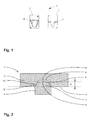
- FIG. 1 shows a negative mold 1 according to the invention comprising a first mold part 2 and a second mold part 3.
- the mold part 2 has inter alia the mold surface 6 on.
- the mold part 3 has inter alia the stamp element 7.
- FIG. 2 shows a sectional view through a negative mold according to the invention 1.
- the cross section is perpendicular to a longitudinal direction of the moldable with the negative mold 1 Zahnverblendungselements, wherein the longitudinal direction of the Zahnverblendungselements is defined as the direction which is arranged at the intended application to a tooth parallel to its axial direction ,
- the negative mold 1 comprises a first mold part 2 and a second mold part 3. At a parting surface 4 of the first mold part 2, a recess 5 is formed, in which a first mold surface 6 of the first mold part 2 is arranged.
- the molding surface 6 serves to form an outer surface of the tooth veneering element, which remains substantially visible after its application.
- the second mold part 3 comprises a stamp element 7, which is arranged in the depression 5 in the closed state of the negative mold 1. At the front side on the stamp element 7, a molding surface 8 of the second mold part 3 is formed.
- the Shaping surface 8 essentially serves to form an inner side of the tooth veneering element, with which it is applied substantially on a tooth or a tooth stump.
- the mold surfaces 6 and 8 define the cavity 9 of the negative mold 1 for forming a dental veneer element.
- the stamp element 7 is formed integrally with the mold part 3.
- An edge 6a (see eg. Fig. 3 ) of the molding surface 6 of the first mold part 2 is arranged at a distance A from the separating surface 4, offset into the mold part 2.
- An edge of the mold surface 8 of the mold part 3 is arranged directly at the edge 6a of the mold surface 6, so that the cavity 9 is largely completely enclosed by the mold surfaces 6 and 8.
- the surface portion 10 forms an inner wall of the recess 5 and extends from an edge of the opening of the recess 5 at the parting surface 4 to the edge 6a of the molding surface 6 (see. Fig. 3 ). In cross-section, the surface portion 10 converges toward the molding surface 6. In the present case, a lateral surface 12 of the stamp element 7 is designed to be complementary to the surface section 10.
- FIG. 3 shows for better illustration schematically a view of the mold surface 6 with edge 6a without further elements of the mold part. 2
- FIGS. 4 and 5 illustrate the inventive method for producing an individualized, in particular multi-part, negative mold in two embodiments.
- FIG. 4 illustrates a first embodiment of the method.
- digital scan data of a tooth or a defect location are detected, in particular by means of an interoral scanner.
- an individualized, in particular multi-part, negative mold is produced with a CNC method based on the acquired scan data of the first step A.
- FIG. 5 shows a second embodiment, wherein between the steps detecting scan data A and producing the negative mold B further steps are performed.
- These are a post-processing C of the acquired scan data with suitable software solutions (software-based expert systems), in particular in an automated manner, and generating D a virtual 3-dimensional model of the dental situation and / or the negative shape of the dental situation.
Landscapes
- Health & Medical Sciences (AREA)
- Oral & Maxillofacial Surgery (AREA)
- Dentistry (AREA)
- Epidemiology (AREA)
- Life Sciences & Earth Sciences (AREA)
- Animal Behavior & Ethology (AREA)
- General Health & Medical Sciences (AREA)
- Public Health (AREA)
- Veterinary Medicine (AREA)
- Dental Prosthetics (AREA)
Priority Applications (1)
| Application Number | Priority Date | Filing Date | Title |
|---|---|---|---|
| EP14176188.2A EP2965710A1 (fr) | 2014-07-08 | 2014-07-08 | Moules personnalisées |
Applications Claiming Priority (1)
| Application Number | Priority Date | Filing Date | Title |
|---|---|---|---|
| EP14176188.2A EP2965710A1 (fr) | 2014-07-08 | 2014-07-08 | Moules personnalisées |
Publications (1)
| Publication Number | Publication Date |
|---|---|
| EP2965710A1 true EP2965710A1 (fr) | 2016-01-13 |
Family
ID=51167694
Family Applications (1)
| Application Number | Title | Priority Date | Filing Date |
|---|---|---|---|
| EP14176188.2A Withdrawn EP2965710A1 (fr) | 2014-07-08 | 2014-07-08 | Moules personnalisées |
Country Status (1)
| Country | Link |
|---|---|
| EP (1) | EP2965710A1 (fr) |
Cited By (3)
| Publication number | Priority date | Publication date | Assignee | Title |
|---|---|---|---|---|
| DE102015112800A1 (de) * | 2015-04-09 | 2016-10-13 | Fraunhofer-Gesellschaft zur Förderung der angewandten Forschung e.V. | Mehrteilig aufgebaute Dentalprothese sowie Verfahren und Vorrichtung zu ihrer Herstellung |
| US10518477B1 (en) * | 2019-05-24 | 2019-12-31 | Travis Edward Williamson | Precise faux wood reproduction system and method |
| EP3654873B1 (fr) * | 2017-10-04 | 2023-01-18 | Kulzer GmbH | Bloc de fraisage composite monochrome et son procédé de fabrication |
Citations (10)
| Publication number | Priority date | Publication date | Assignee | Title |
|---|---|---|---|---|
| US6488503B1 (en) * | 1999-12-21 | 2002-12-03 | Dentsply Research & Development Corp. | Prosthetic teeth and method of making therefor |
| EP1240878B1 (fr) | 2001-03-12 | 2004-01-02 | Firma Ivoclar Vivadent AG | Procédé pour produire une pièce en plastique et élément de restauration dentaire |
| EP1252867B1 (fr) | 2001-04-23 | 2005-07-27 | Cicero Dental Systems B.V. | Méthode de production d'une dent artificielle |
| US7029279B2 (en) | 2002-10-07 | 2006-04-18 | Mark Schomann | Prosthodontia system |
| US20090319068A1 (en) * | 2004-02-06 | 2009-12-24 | Sager Robert D | System and method for mass custom manufacturing of dental crowns and crown components |
| EP1954211B1 (fr) | 2005-11-22 | 2010-04-28 | BEGO Bremer Goldschlägerei Wilh. Herbst GmbH & Co. KG | Procede et systeme de fabrication d'une prothese dentaire |
| US20100203478A1 (en) * | 2006-10-16 | 2010-08-12 | Natural Dental Implants, Ag | Customized Dental Prosthesis for Periodontal or Osseointegration and Related Systems and Methods |
| EP2532322A1 (fr) * | 2011-06-09 | 2012-12-12 | WESTCAM Projeckmanagement GmbH | Structure d'une dent raccordée à et dépassant entièrement d'un support d'information |
| US20130101962A1 (en) * | 2011-09-27 | 2013-04-25 | Devon O. Howe | Denture and method and apparatus of making same |
| US20130130202A1 (en) * | 2010-02-26 | 2013-05-23 | William C. Vuillemot | Method for dental restoration and related kit |
-
2014
- 2014-07-08 EP EP14176188.2A patent/EP2965710A1/fr not_active Withdrawn
Patent Citations (10)
| Publication number | Priority date | Publication date | Assignee | Title |
|---|---|---|---|---|
| US6488503B1 (en) * | 1999-12-21 | 2002-12-03 | Dentsply Research & Development Corp. | Prosthetic teeth and method of making therefor |
| EP1240878B1 (fr) | 2001-03-12 | 2004-01-02 | Firma Ivoclar Vivadent AG | Procédé pour produire une pièce en plastique et élément de restauration dentaire |
| EP1252867B1 (fr) | 2001-04-23 | 2005-07-27 | Cicero Dental Systems B.V. | Méthode de production d'une dent artificielle |
| US7029279B2 (en) | 2002-10-07 | 2006-04-18 | Mark Schomann | Prosthodontia system |
| US20090319068A1 (en) * | 2004-02-06 | 2009-12-24 | Sager Robert D | System and method for mass custom manufacturing of dental crowns and crown components |
| EP1954211B1 (fr) | 2005-11-22 | 2010-04-28 | BEGO Bremer Goldschlägerei Wilh. Herbst GmbH & Co. KG | Procede et systeme de fabrication d'une prothese dentaire |
| US20100203478A1 (en) * | 2006-10-16 | 2010-08-12 | Natural Dental Implants, Ag | Customized Dental Prosthesis for Periodontal or Osseointegration and Related Systems and Methods |
| US20130130202A1 (en) * | 2010-02-26 | 2013-05-23 | William C. Vuillemot | Method for dental restoration and related kit |
| EP2532322A1 (fr) * | 2011-06-09 | 2012-12-12 | WESTCAM Projeckmanagement GmbH | Structure d'une dent raccordée à et dépassant entièrement d'un support d'information |
| US20130101962A1 (en) * | 2011-09-27 | 2013-04-25 | Devon O. Howe | Denture and method and apparatus of making same |
Cited By (4)
| Publication number | Priority date | Publication date | Assignee | Title |
|---|---|---|---|---|
| DE102015112800A1 (de) * | 2015-04-09 | 2016-10-13 | Fraunhofer-Gesellschaft zur Förderung der angewandten Forschung e.V. | Mehrteilig aufgebaute Dentalprothese sowie Verfahren und Vorrichtung zu ihrer Herstellung |
| EP3654873B1 (fr) * | 2017-10-04 | 2023-01-18 | Kulzer GmbH | Bloc de fraisage composite monochrome et son procédé de fabrication |
| US10518477B1 (en) * | 2019-05-24 | 2019-12-31 | Travis Edward Williamson | Precise faux wood reproduction system and method |
| US10800107B1 (en) * | 2019-05-24 | 2020-10-13 | Travis Edward Williamson | Precise faux wood reproduction system and method |
Similar Documents
| Publication | Publication Date | Title |
|---|---|---|
| DE102012011371B4 (de) | Herstellung individueller dentaler Prothesen via CAD/CAM und Rapid Manufacturing/Rapid Prototyping aus digital erhobenen Daten der Mundsituation | |
| EP3223742B1 (fr) | Fabrication d'une prothèse dentaire par impression de la base prothétique sur les dents prothétiques | |
| EP2046233B1 (fr) | Jeu d'éléments pour la preparation d'une prothèse dentaire, système de préparation d'une prothèse ou d'un jeu d'éléments et procédé de fabrication correspondant | |
| EP1406554B1 (fr) | Fabriquer une prothese dentaire a partir d'un modele positif mesure et numerise en trois dimensions | |
| EP1954211B1 (fr) | Procede et systeme de fabrication d'une prothese dentaire | |
| EP3649983B1 (fr) | Procédé de fabrication de prothèses dentaires | |
| EP3494922B1 (fr) | Procédé de fabrication de prothèses partielles ou totales | |
| EP3169270B1 (fr) | Prothèse dentaire pour la détermination de facettes d'abrasion | |
| EP3930625B1 (fr) | Procédé de fabrication d'un corps moulé et corps moulé multicouches | |
| DE202009018724U1 (de) | Formkörper aus formstabilisiertem Material | |
| EP1974688A1 (fr) | Procédé destiné à la fabrication de prothèses dentaires, procédé d'établissement d'un ensemble de données et support lisible sur ordinateur | |
| EP0850601A2 (fr) | Produit semi-fini destiné à la fabrication de prothèses dentaires | |
| EP3235467A1 (fr) | Méthode de fabrication d'une restauration dentaire | |
| EP1832245B1 (fr) | Fabrication de prothèse dentaire | |
| EP2464306B1 (fr) | Procédé de fabrication d'une prothèse dentaire complète ou partielle | |
| EP3200720B1 (fr) | Moule pour la préparation d'une ébauche preformée d'une base de prothèse | |
| DE102015112800A1 (de) | Mehrteilig aufgebaute Dentalprothese sowie Verfahren und Vorrichtung zu ihrer Herstellung | |
| AT411816B (de) | Verfahren zur herstellung einer belastbaren struktur aus oxidkeramik, insbesondere aus zirkondioxid | |
| DE102015106424A1 (de) | Verfahren zur Herstellung von Zahnersatz mit einem Kunststoffkern | |
| DE102004013939A1 (de) | Verfahren zur Herstellung eines zahnärztlichen Formteils | |
| EP1264581A2 (fr) | Dent artificielle et son procédé de fabrication | |
| EP4477417A1 (fr) | Procédé de fabrication d'une restauration dentaire | |
| EP1818040A1 (fr) | Procédé destiné à la fabrication de restaurations de dents ou d'éléments de prothèses dentaires |
Legal Events
| Date | Code | Title | Description |
|---|---|---|---|
| PUAI | Public reference made under article 153(3) epc to a published international application that has entered the european phase |
Free format text: ORIGINAL CODE: 0009012 |
|
| AK | Designated contracting states |
Kind code of ref document: A1 Designated state(s): AL AT BE BG CH CY CZ DE DK EE ES FI FR GB GR HR HU IE IS IT LI LT LU LV MC MK MT NL NO PL PT RO RS SE SI SK SM TR |
|
| AX | Request for extension of the european patent |
Extension state: BA ME |
|
| STAA | Information on the status of an ep patent application or granted ep patent |
Free format text: STATUS: THE APPLICATION IS DEEMED TO BE WITHDRAWN |
|
| 18D | Application deemed to be withdrawn |
Effective date: 20160714 |