EP3654873B1 - Bloc de fraisage composite monochrome et son procédé de fabrication - Google Patents
Bloc de fraisage composite monochrome et son procédé de fabrication Download PDFInfo
- Publication number
- EP3654873B1 EP3654873B1 EP18785284.3A EP18785284A EP3654873B1 EP 3654873 B1 EP3654873 B1 EP 3654873B1 EP 18785284 A EP18785284 A EP 18785284A EP 3654873 B1 EP3654873 B1 EP 3654873B1
- Authority
- EP
- European Patent Office
- Prior art keywords
- pressure
- composite material
- casting mould
- mould
- resistant
- Prior art date
- Legal status (The legal status is an assumption and is not a legal conclusion. Google has not performed a legal analysis and makes no representation as to the accuracy of the status listed.)
- Active
Links
Images


Classifications
-
- A—HUMAN NECESSITIES
- A61—MEDICAL OR VETERINARY SCIENCE; HYGIENE
- A61C—DENTISTRY; APPARATUS OR METHODS FOR ORAL OR DENTAL HYGIENE
- A61C13/00—Dental prostheses; Making same
- A61C13/0003—Making bridge-work, inlays, implants or the like
- A61C13/0022—Blanks or green, unfinished dental restoration parts
-
- A—HUMAN NECESSITIES
- A61—MEDICAL OR VETERINARY SCIENCE; HYGIENE
- A61C—DENTISTRY; APPARATUS OR METHODS FOR ORAL OR DENTAL HYGIENE
- A61C13/00—Dental prostheses; Making same
- A61C13/08—Artificial teeth; Making same
- A61C13/081—Making teeth by casting or moulding
-
- A—HUMAN NECESSITIES
- A61—MEDICAL OR VETERINARY SCIENCE; HYGIENE
- A61C—DENTISTRY; APPARATUS OR METHODS FOR ORAL OR DENTAL HYGIENE
- A61C13/00—Dental prostheses; Making same
- A61C13/12—Tools for fastening artificial teeth; Holders, clamps, or stands for artificial teeth
- A61C13/14—Vulcanising devices for artificial teeth
-
- B—PERFORMING OPERATIONS; TRANSPORTING
- B29—WORKING OF PLASTICS; WORKING OF SUBSTANCES IN A PLASTIC STATE IN GENERAL
- B29C—SHAPING OR JOINING OF PLASTICS; SHAPING OF MATERIAL IN A PLASTIC STATE, NOT OTHERWISE PROVIDED FOR; AFTER-TREATMENT OF THE SHAPED PRODUCTS, e.g. REPAIRING
- B29C39/00—Shaping by casting, i.e. introducing the moulding material into a mould or between confining surfaces without significant moulding pressure; Apparatus therefor
- B29C39/22—Component parts, details or accessories; Auxiliary operations
- B29C39/26—Moulds or cores
-
- B—PERFORMING OPERATIONS; TRANSPORTING
- B29—WORKING OF PLASTICS; WORKING OF SUBSTANCES IN A PLASTIC STATE IN GENERAL
- B29C—SHAPING OR JOINING OF PLASTICS; SHAPING OF MATERIAL IN A PLASTIC STATE, NOT OTHERWISE PROVIDED FOR; AFTER-TREATMENT OF THE SHAPED PRODUCTS, e.g. REPAIRING
- B29C39/00—Shaping by casting, i.e. introducing the moulding material into a mould or between confining surfaces without significant moulding pressure; Apparatus therefor
- B29C39/22—Component parts, details or accessories; Auxiliary operations
- B29C39/38—Heating or cooling
-
- B—PERFORMING OPERATIONS; TRANSPORTING
- B29—WORKING OF PLASTICS; WORKING OF SUBSTANCES IN A PLASTIC STATE IN GENERAL
- B29C—SHAPING OR JOINING OF PLASTICS; SHAPING OF MATERIAL IN A PLASTIC STATE, NOT OTHERWISE PROVIDED FOR; AFTER-TREATMENT OF THE SHAPED PRODUCTS, e.g. REPAIRING
- B29C39/00—Shaping by casting, i.e. introducing the moulding material into a mould or between confining surfaces without significant moulding pressure; Apparatus therefor
- B29C39/22—Component parts, details or accessories; Auxiliary operations
- B29C39/42—Casting under special conditions, e.g. vacuum
-
- B—PERFORMING OPERATIONS; TRANSPORTING
- B29—WORKING OF PLASTICS; WORKING OF SUBSTANCES IN A PLASTIC STATE IN GENERAL
- B29C—SHAPING OR JOINING OF PLASTICS; SHAPING OF MATERIAL IN A PLASTIC STATE, NOT OTHERWISE PROVIDED FOR; AFTER-TREATMENT OF THE SHAPED PRODUCTS, e.g. REPAIRING
- B29C35/00—Heating, cooling or curing, e.g. crosslinking or vulcanising; Apparatus therefor
- B29C35/02—Heating or curing, e.g. crosslinking or vulcanizing during moulding, e.g. in a mould
-
- B—PERFORMING OPERATIONS; TRANSPORTING
- B29—WORKING OF PLASTICS; WORKING OF SUBSTANCES IN A PLASTIC STATE IN GENERAL
- B29K—INDEXING SCHEME ASSOCIATED WITH SUBCLASSES B29B, B29C OR B29D, RELATING TO MOULDING MATERIALS OR TO MATERIALS FOR MOULDS, REINFORCEMENTS, FILLERS OR PREFORMED PARTS, e.g. INSERTS
- B29K2033/00—Use of polymers of unsaturated acids or derivatives thereof as moulding material
- B29K2033/04—Polymers of esters
- B29K2033/12—Polymers of methacrylic acid esters, e.g. PMMA, i.e. polymethylmethacrylate
Definitions
- the invention relates to a method for producing material blocks of a polymerized, dental composite material and the material blocks obtainable by the method by (i) converting a polymerizable, dental composite material into a pressure-resistant casting mold, the pressure-resistant casting mold being in several parts and comprising a) at least a base part with at least one integral middle part with at least two nests and at least one cover or b) at least one base part, at least one middle part with at least two nests and at least one cover, (ii) the polymerizable, dental composite material in the pressure-resistant mold with a pressure in range from 100 to 500 MPa and (iii) at least part of the mold or the polymerizable material is heated to a temperature of 90 to 150 °C in a defined manner, the polymerizable dental composite material being hot isostatically pressed and polymerized in the pressure-resistant mold will.
- the object was therefore to provide a method for producing composite milling blocks which is suitable for material-removing methods, preferably milling or composite material-removing processing using laser energy. Furthermore, milling blocks of a defined dimension should be able to be produced economically using the process. The method should reliably avoid, preferably prevent, the formation of defects, cavities, cracks, bubbles, changes in the external geometry and/or stresses within the milling blocks.
- the milling blocks manufactured according to the method are suitable for the manufacture of single crowns and small-unit bridges.
- the object is achieved in that a highly filled and highly viscous composite, preferably in a metal mold, with at least two cavities of the desired sizes, is filled to produce the blocks of material and polymerized under defined heating and defined high pressure.
- the dental composite material is thermally polymerized and preferably at least one block of material is obtained.
- the casting mold can cool down a) under pressure or b) under atmospheric pressure (1 bar). It is preferably cooled to 20 to 23.degree.
- the at least one block of material can be removed from the mold, in particular from the nest. Preferably, one block of material can be obtained for each nest, which is suitable for the production of prosthetic fittings in a material-removing process.
- the polymerizable dental composite material is preferably hot isostatically pressed and polymerized in the pressure-resistant casting mold (referred to below as HIPP).
- the polymerizable dental composite material is cast in the pressure-resistant mold hot isostatically pressed and thermally polymerized (HIPP), in particular by applying heat from one side.
- HIPP thermally polymerized
- a spatially directed polymerization front in the polymerizable composite material is understood to be thermally directed. This polymerization front can be generated by one-sided temperature control of the polymerizable composite material, in particular the composite material located in a geometric nest of the mold.
- the pressure with which the casting mold is subjected in the process is 100 to 500 MPa, preferably 100 to 250 MPa, particularly preferably 100 to 200 MPa. In the present invention, the pressure may preferably be 125 to 250 MPa.
- the pressure at the mold is maintained throughout the process, adjusted if necessary to maintain the set pressure.
- the composite in particular a pasty composite, is pressed into the mold under a defined pressure and optionally at a defined temperature. The mold is then closed with the at least one cover, so that the pressure-resistant mold with cover can also be referred to as a press mold.
- the three-dimensional material blocks preferably have a geometric shape, in particular the material blocks have a defined geometric three-dimensional figure.
- a three-dimensional block of material preferably has at least one edge length of at least 10 mm, preferably 14 mm.
- Blocks of material used as milling blocks are preferably in the form of cuboids, with the cuboids preferably having an area of 12 mm x 14 mm and a height of 17 or 18 mm, alternatively an area of 14 x 14 mm or 15 x 15 mm and a height of 17 to 18 mm.
- One to all edges and corners can be straight or rounded.
- a block of dental material which has no blowholes, cracks and/or cavities which have an extent of greater than or equal to 0.05 mm in one dimension, preferably the dimension of which is less than or equal to 100 ⁇ m, particularly preferably less than or equal to 50 ⁇ m preferably less than or equal to 20 ⁇ m.
- a block of material is also disclosed, in particular a cuboid, which has at least a first edge length or a diameter of greater than or equal to 14 mm and at least a second edge length of greater than or equal to 14 mm and optionally a further edge length of greater than or equal to 14 mm.
- the composite material is transferred to the casting mold without preheating at room temperature (20°C) or preferably preheated, in particular it is preheated to 25 to 50°C. Preferably, the composite material is preheated to 35 to 45°C.
- the casting mold may be present at a temperature of 25 to 45° C. or preheated, into which the preheated composite material is then transferred.
- the mold can be preheated to 30 to 40°C.
- the polymerizable dental composite material in the method in step (i) in (i.1), is preheated to a temperature in the range from 25 to 50° C., preferably from 30 to 45° C., in particular in the range from 35 to 40°C plus/minus 5°C, preferably in the range of 35°C plus/minus 3°C, transferred into at least one cavity of the pressure-resistant mold, in particular under pressure, preferably transferred into at least two nests of the mold, and (i.2) at least one nest filled with preheated composite material is obtained or at least two nests filled with preheated composite material are obtained.
- the mold can preferably have two to a hundred cavities, preferably two to ten cavities, or for example four to ten cavities.
- the composite material is also filled into the nests, preferably under pressure, and is then preferably kept under pressure with the press ram.
- the pressure under which the composite material is transferred into the nests is preferably in the range from 2 to 10 bar, in particular 2.5 to 5 bar.
- a highly filled and highly viscous composite comprises an inorganic filler content of 60 to 85% by weight in relation to the total composition of 100% by weight.
- a cover of the pressure-resistant casting mold is placed on the at least one nest filled with preheated composite material, with at least one press ram preferably being arranged on the cover, and the pressing ram as a male part in a nest as a female part of the casting mold, intervenes.
- a cover of the pressure-resistant casting mold can be placed on the at least one nest filled with composite material, with at least one press die preferably being arranged on the cover, and the press die as the male part, in a nest as the female part of the mold, intervenes.
- a cover of the pressure-resistant mold can be placed on at least two nests filled with preheated composite material, with at least two rams preferably being arranged on the cover, and each ram as a male part engaging in a nest as a female part of the mold.
- the ram and nests can engage in one another, preferably in such a way that a slight horizontal and/or vertical movement of the ram in the cavity of the nests is possible.
- Press ram and nest are designed in such a way that the press ram can compress the composite material located in the nest; in particular, the press ram can build up a defined pressure on the composite material in a reproducible manner.
- the press rams and nests that match one another are designed in such a way that the respective press ram can compress the composite material located in the respective nest; in particular, the press ram can reproducibly build up a defined pressure on the composite material.
- the pressure mentioned below is preferably transferred to the composite material via the press ram.
- a circumferential sealing surface is formed around the nest, and a sealing surface is also formed as a negative all the way around the press ram. Outside the peripheral sealing surface of the nest, at least one overflow channel is provided in the central part for receiving composite material that overflows or is pressed out.
- process step (ii) the polymerizable, dental composite material in the pressure-resistant casting mold is subjected to a pressure in the range from 125 to 250 MPa.
- the casting mold in process step (ii), can be subjected to a weight of 10 to 25 tons, preferably 12 to 25 tons, particularly preferably 15 to 20 tons.
- At least part of the casting mold and/or the polymerizable material is/are heated to a defined temperature of 110 to 150.degree.
- the bottom part of the mold and/or the lid of the mold is heated to a temperature in the range of 110°C to 150°C, preferably 110 to 130°C.
- the base part or the cover is preferably only heated on one side in order to ensure directional polymerization.
- at least part of the casting mold and/or the polymerizable material is preferably heated in a defined manner to a temperature of 110 to 150° C. for 0.1 to 60 minutes.
- the polymerizable material is heated to 110 to 150° C. within 30 minutes, preferably to 110 to 140° C. within 20 minutes, more preferably to 130° C. within 15 minutes.
- the bottom part of the mold and/or the lid of the mold is heated to a temperature in the range from 110 to 150° C. within 5 to 30 minutes, preferably to 110 to 140° C. within 20 minutes , more preferably within 15 minutes is heated to 130 ° C.
- the polymerizable dental material is heated and polymerized via thermal conduction.
- At least part of the mold, in particular the bottom part, is heated to a temperature of 90 to 150° C. within 20 minutes, preferably to a temperature of 90 to 150° C. within 15 minutes, particularly preferably within 15 minutes 110 to 140°C. Preferably to 120 to 140°C plus/minus 5°C within about 10 minutes plus/minus 3 minutes.
- the base part is preferably heated and the polymerizable composite material is heated via the heat conduction of the casting mold.
- the lid can be heated accordingly, or the lid and the bottom part can be heated together.
- the hot isostatic pressing is preferably performed with the pressure applied from the opposite side of the heated component in the mold, i.e. the mold is pressurized from one side and heated from the opposite side.
- a material block in particular a geometric material block of a polymerized composite material, which has a defect volume in relation to the entire material block of 15 • 10 -6 vol .-% to 14• 10 -4 % by volume.
- a composite material can be used as the polymerizable, dental composite material which comprises (i) 70 to 85% by weight of an inorganic filler component comprising at least one dental glass and optionally at least one amorphous metal oxide, such as in particular silicon dioxide and/or zirconium dioxide, ( ii) 10 to 30% by weight of a mixture of at least two different urethane (meth)acrylates, (iii) 0.01 to 5% by weight of at least one di-, tri-, tetra- or multi-functional monomer, the is not a urethane (meth)acrylate, (iv) 0.01 to 10% by weight of at least one initiator, an initiator system and optionally at least one stabilizer and optionally at least one pigment, the total composition of the composite material being 100% by weight.
- an inorganic filler component comprising at least one dental glass and optionally at least one amorphous metal oxide, such as in particular silicon dioxide and/or zirconium dioxide
- the invention relates to a polymerizable, dental composite material comprising (i) 70 to 85% by weight of at least one inorganic filler component comprising at least one dental glass and at least one amorphous metal oxide, (ii) 10 to 30% by weight of a mixture of at least two different ones urethane (meth)acrylates, (iii) 0.01 to 5% by weight of at least one di-, tri-, tetra- or multi-functional monomer other than a urethane (meth)acrylate, and (iv) 0.01 up to 10 wt .
- the dental composite material (ii) comprises 10 to 30% by weight of a mixture of at least two different urethane (meth)acrylates comprising at least one difunctional urethane (meth)acrylate with a divalent alicyclic group and a difunctional urethane (meth) acrylate with a divalent alkylene group, such as UDMA, and optionally at least one at least tetrafunctional dendritic urethane (meth)acrylate.
- Particularly preferred difunctional urethane (meth)acrylates with a divalent alicyclic group include a difunctional 2'-aza-alkylenetetrahydrodicyclopentadiene having 5 to 20 carbon atoms and optionally having 2 to 5 oxygen atoms and optionally a further 1 to 3 nitrogen atoms in the alkylene -Rest.
- Bis-(4',7'-dioxa-3',8'-dioxo-2'-aza-decyl-9'-ene)tetra-hydro-dicyclopentadiene, bis-(4',7'-dioxa) are particularly preferred -3',8'-dioxo-2'-aza-9'-methyl-decyl-9'-en)-tetrahydrodicyclopentadiene and/or mixtures thereof and mixtures of the isomers.
- the isomers can include the 3,8- / 3,9- / 4,8- / 3,10- / 4,10-isomers, optionally as cis- or trans-isomer may exist.
- the content of component (iii) is preferably 0.15 to 5% by weight, particularly preferably 1.0 to 2% by weight, of a di-methacrylic ester of a polyether, such as preferably a dimethacrylate polyethylene glycol, dimethacrylate polypropylene glycol. Dimethacrylate triethylene glycol (TEGDMA) and diethylene glycol dimethacrylate (DEGMA) are particularly preferred.
- a di-methacrylic ester of a polyether such as preferably a dimethacrylate polyethylene glycol, dimethacrylate polypropylene glycol.
- Dimethacrylate triethylene glycol (TEGDMA) and diethylene glycol dimethacrylate (DEGMA) are particularly preferred.
- a material block of a polymerized, dental composite material in particular a geometric material block, obtainable by the method according to the invention, which preferably has a flexural strength of greater than or equal to 230 MPa and a modulus of elasticity of 15 to 20 GPa.
- the ISO6872 standard is chosen for the determination based on the dimension of the test sticks.
- the block of material is suitable for being used in a method for material-removing machining by means of milling and/or a method for material-removing by means of laser energy.
- Such a material block of a polymerized composite material preferably has a defect volume in relation to the entire material block of 15 • 10 -6 vol. % to 14 • 10 -4 vol. %, preferably from 20 • 10 -6 vol. % to 10 • 10-5 % by volume.
- the block of material is preferably a cylinder with the following dimensions: height of greater than or equal to 10 mm to less than or equal to 15 mm and a radius of greater than or equal to 3 mm to less than or equal to 7 mm, alternatively with a height of greater than or equal to 10 mm to less than or equal to 20 mm and a radius of greater than or equal to 5 mm to less than or equal to 7 mm, the dimensions of a cuboid of the material block are preferably a, b and c greater than or equal to 4 mm, in particular greater than or equal to 10 mm and a less than or equal to 20 mm, in particular a less than or equal to 18 mm , b is less than or equal to 14 mm and c is less than or equal to 20 mm, in particular c is less than or equal to 18 mm.
- the block of material is a monochrome block of material made from a composite material, in particular a homogeneous, monochrome block of material.
- the material block made of polymerized composite material can be used for the production of dental prosthetic supplies including crowns, inlays, onlays, superstructures, artificial teeth, prosthetic teeth, dental bridges, dental bars, spacers, veneers, a milling blank, dental prostheses, part of a surgical prosthesis, an implant and orthodontic appliances.
- the polymerizable composite material can also be used as a composite material for the production of direct, adhesive, dental restorations, orthodontic appliances and instruments.
- the subject of the invention is a method in which a pressure-resistant casting mold is used, which is multi-part and a) at least one base part with at least one integral middle part with at least one cavity, preferably with at least two cavities to 20 cavities, advantageously with 2 to 6 cavities , and has at least one lid.
- the multi-part casting mold b) can have at least one base part, in particular a planar base part, at least one middle part, with at least one nest, preferably with at least two nests, and at least one cover.
- the bottom part and the middle part can be made of one piece of material or in multiple parts. Integral is to be understood as meaning that the bottom part and the middle part with at least one nest, preferably with at least two optionally up to 50 nests, are produced in one piece from an integral workpiece.
- the pressure-resistant mold, the bottom part, the middle part with at least one nest, preferably with at least two nests and/or the lid can each be formed independently from a metal, a metallic alloy or a temperature-resistant plastic, such as a high-performance polymer, or a temperature-resistant hybrid material.
- a metal a metallic alloy or a temperature-resistant plastic, such as a high-performance polymer, or a temperature-resistant hybrid material.
- a temperature-resistant plastic such as a high-performance polymer, or a temperature-resistant hybrid material.
- all the components of the mold are made of the same material.
- ⁇ are preferably made of a steel
- preferred steels are chromium and/or molybdenum-containing steels, such as 1.2343 (C 0.37 / Si 1.0 / Cr 5.3 / Mo 1.3 / V 0.4), preferably Hardened, 1.2312 (C 0.4 / Mn 1.4 / Cr 1.9 / Mo 0.2 / S 0.05) or 1.4571 (Cr 17 / Mo 2 / No 11.5 / Ti 0.7), stainless steel , preferably the surface of the stainless steel is not electropolished (the figures are in % by weight).
- the surface of the cavities in the mold is preferably provided with a defined surface roughness.
- Other materials that can be considered are ceramic, silicon carbide and pressure-resistant hybrid materials.
- the invention also relates to a pressure-resistant casting mold, particularly suitable for use in the method according to the invention, the pressure-resistant casting mold being in several parts and having at least one base part, in particular a planar base part, at least one middle part with at least two cavities, which have an inner surface with a defined surface roughness have an average roughness value of R a N3 to N9, and at least one cover. All components of the pressure-resistant mold are preferably made of stainless steel.
- the at least one nest in the mold preferably has a geometric shape, in particular the nest has a defined three-dimensional geometric figure.
- the geometric shape is preferably formed without undercut(s).
- the geometric shape of a nest has a draft, in particular with an opening angle of 0.5° to 2°, preferably of 1° to 2°.
- the at least one nest is preferably designed to be essentially rectangular and tapered.
- the inner surface of the at least one cavity preferably has a defined surface roughness, in particular with an average roughness value of R a N3 to N9, preferably N4 to N8, preferably N4 to N7, particularly preferably N6.
- R a is preferably less than 1.0 ⁇ m.
- the nest 2 has a small draft of about 1 to 2°, in order to facilitate demoulding of the geometric block of material 3 after the polymerization process. Furthermore, it has proven advantageous for demolding if the inner surface 11 of the nest 2 is not extremely smooth but has a defined—low—surface roughness (approximately less than or equal to R a 7 or R a 6). Too high a roughness prevents/prevents demolding again.
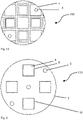
- the pressure-resistant casting mold 100 can comprise three individual components or consist of three components, a planar bottom part 0 (see figure 1 ), a middle part 1 with the corresponding nests (see Figures 1a, 1b and 1c ) and a cover 7 with the integrated press stamps 8 (see figure 2 ).
- the components are via corresponding components such as guide bolts 4 and corresponding blind holes 5 in just one arrange position to each other.
- Figure 1b a cross-section of the nests is shown in a generalized manner, in that the inner surface 11 as well as the sealing surface 10 on the nest 2 and the overflow channel 9 are shown.
- the middle part 1 is placed on the base plate 0 and connected to one another via the guide bolts 4 in the blind holes 5 provided.
- the nests 2 are then filled with a defined quantity of preheated, unpolymerized composite material, which has a temperature of approx. 35° C., with as few bubbles as possible.
- the cover 7 is put on in such a way that the rams 8 are oriented exactly over the nests 2 . Since the dimensions of the press ram 8 and nest 2 are exactly matched to one another, the precise positioning of the press ram and nests relative to one another is important for the production of high-quality material blocks that are suitable for dental use. Due to this precise coordination, the remaining gap with a defined gap size, preferably less than or equal to 5 1/100 mm, preferably less than or equal to 3 1/100 mm, between the nest and the press ram is kept as small as possible.
- the pressure-resistant casting mold 100 is now transferred to a hot press 12 (see 3 ) and the pressure on the pressure-resistant casting mold 100 within approx. 5 - 10 seconds to approx. 15 - 20 tons.
- the slightly conical press ram 8 which improves the accuracy of fit and allows better sealing of the nest, press excess material out of the nest into an overflow channel 9 and then seal with increasing pressing force via the corresponding sealing surfaces (6 sealing surface on the press ram, 10 sealing surface on the nest). nest off. Due to the selected geometry of the nests 2, the ram 8 and the sealing surfaces 6/10 , the ram 8 can exert pressure on the composite material, as a result of which the polymerization shrinkage can be compensated and preferably minimized or avoided.
- any bubbles that may be present in the composite can be pressed isostatically.
- the temperature is increased to start the polymerization.
- the pressing pressure is maintained and readjusted during the entire hot polymerisation process.
- the pressing pressure is first adjusted and optionally later the temperature is heated in a defined manner to 90 to 150° C., with the pressing pressure preferably being readjusted over the entire period of time during which heating is taking place.
- the pressing pressure is also maintained during cooling.
- the entire mold 100 is advantageously made from the aforementioned steel, with the central part 1 also being hardened so that the nest is not geometrically deformed.
- the mold 100 After closing the press plates 13 of the hot press 12 according to figure 3 the mold 100 is slowly heated to 120°C in about 10 minutes by thermal conduction to start the polymerization reaction.
- the pressure-resistant casting mold 100 is held under a pressure 14 of 125 to 250 MPa by a force applied to the cover 7 .
- the opposite pressing ram in the lid 7 can be re-pressed until the end and compensate for the polymerization shrinkage.
- the cover plate 7 is heated and the base plate 0 is further subjected to pressure 14 .
- the mold After completion of the polymerisation process, the mold is cooled down to approx. 40 °C within 10 minutes to avoid tension, the mold is disassembled and the fully polymerisation blocks are removed. Cooling is preferably carried out symmetrically from both sides via the cover and the base part to avoid stresses during cooling.
- the material blocks can be checked for non-visible bubbles using X-ray CT. in the in figure 4
- cavities can be detected as defect volumes in defined incremental layers of a defined thickness.
- material blocks of a polymerized composite material can be obtained which have a defect volume in relation to the entire material block of less than or equal to 15 ⁇ 10 -6 % by volume to 14 ⁇ 10 -4 % by volume.
- the samples are analyzed using the non-destructive X-ray CT method.
Landscapes
- Health & Medical Sciences (AREA)
- General Health & Medical Sciences (AREA)
- Dentistry (AREA)
- Epidemiology (AREA)
- Life Sciences & Earth Sciences (AREA)
- Animal Behavior & Ethology (AREA)
- Oral & Maxillofacial Surgery (AREA)
- Public Health (AREA)
- Veterinary Medicine (AREA)
- Engineering & Computer Science (AREA)
- Manufacturing & Machinery (AREA)
- Mechanical Engineering (AREA)
- Dental Prosthetics (AREA)
- Moulds For Moulding Plastics Or The Like (AREA)
Claims (14)
- Procédé de fabrication d'au moins un bloc de matériau (3) d'un matériau composite dentaire polymérisé, dans lequel(i) un matériau composite dentaire polymérisable est transféré dans un moule résistant à la pression (100), le moule résistant à la pression (100) étant en plusieurs parties et comprenant a) au moins une partie formant un fond (0) avec au moins une partie centrale intégrale (1) avec au moins deux empreintes (2) ainsi qu'au moins un couvercle (7) ou b) au moins une partie formant un fond (0), au moins une partie centrale (1) avec au moins deux empreintes (2), ainsi qu'au moins un couvercle (7),(ii) le matériau composite dentaire polymérisable est soumis à une pression de l'ordre de 100 à 500 MPa dans le moule résistant à la pression,(iii) au moins une partie du moule ainsi que le matériau polymérisable sont chauffés de manière définie à une température de 90 à 150 °C,le matériau composite dentaire polymérisable étant compacté isostatiquement à chaud et polymérisé dans le moule résistant à la pression.
- Procédé selon la revendication 1, caractérisé en ce que le moule résistant à la pression, la partie formant un fond, la partie centrale avec au moins une empreinte et/ou le couvercle sont chacun indépendamment faits d'un métal, d'un alliage métallique ou d'un plastique résistant à la température ou d'un matériau hybride résistant à la température.
- Procédé selon la revendication 1 ou 2, dans lequel le matériau composite dentaire polymérisable préchauffé à une température comprise entre 25 et 50°C est transféré dans au moins une empreinte du moule résistant à la pression dans (i.1) et dans lequel on obtient au moins une empreinte remplie de matériau composite préchauffé dans (i.2).
- Procédé selon l'une des revendications 1 à 3, dans lequel a) un couvercle du moule résistant à la pression est placé sur l'au moins une empreinte remplie de matériau composite préchauffé dans (i.3), au moins un poinçon de pressage (8) étant de préférence disposé sur le couvercle, et le poinçon de pressage comme partie mâle s'engageant dans une empreinte (2) comme partie femelle du moule (100), ou b) un couvercle du moule résistant à la pression est placé sur l'au moins une empreinte remplie de matériau composite dans (i.1), au moins un poinçon de pressage étant de préférence disposé sur le couvercle, et le poinçon de pressage comme partie mâle s'engageant dans une empreinte comme partie femelle du moule.
- Procédé selon l'une des revendications 1 à 4, caractérisé en ce que (ii) le matériau composite dentaire polymérisable est soumis à une pression de l'ordre de 125 à 250 MPa dans le moule résistant à la pression.
- Procédé selon l'une des revendications 1 à 5, caractérisé en ce que (iii) au moins une partie du moule ou le matériau polymérisable est chauffé de manière définie à une température de 110 à 150 °C pendant 0,1 à 60 minutes.
- Procédé selon l'une des revendications 1 à 6, caractérisé en ce que le matériau composite dentaire polymérisable est compacté isostatiquement à chaud et polymérisé dans le moule résistant à la pression, la face de polymérisation étant essentiellement perpendiculaire au vecteur de la force de compression (N).
- Procédé selon l'une des revendications 1 à 7, caractérisé en ce que le matériau composite dentaire polymérisable est polymérisé (HIPP) en étant compacté isostatiquement à chaud et dirigé thermiquement dans le moule résistant à la pression.
- Procédé selon l'une des revendications 1 à 8, caractérisé en ce que une face de polymérisation orientée dans l'espace est créée par une mise en température unilatérale du matériau composite polymérisable se trouvant dans une empreinte géométrique du moule.
- Procédé selon l'une des revendications 1 à 9, caractérisé en ce que le matériau composite dentaire polymérisable comprend(i) de 70 à 85 % en poids d'un composant de charge inorganique comprenant au moins un verre dentaire ainsi qu'en option au moins un oxyde de métal amorphe, notamment du dioxyde de silicium et/ou du dioxyde de zirconium amorphe,(ii) de 10 à 30 % en poids d'un mélange d'au moins deux (méth)acrylates d'uréthane différents,(iii) de 0,01 à 5 % en poids d'au moins un monomère difonctionnel, trifonctionnel, tétrafonctionnel ou multifonctionnel, qui n'est pas un (méth)acrylate d'uréthane,(iv) de 0,01 à 10 % en poids d'au moins un initiateur, un système d'initiateur ainsi qu'en option d'au moins un stabilisateur et en option d'au moins un pigment, la composition totale du matériau composite étant de 100 % en poids.
- Procédé selon l'une des revendications 1 à 10, caractérisé en ce que l'on obtient un bloc de matériau, en particulier un bloc de matériau géométrique d'un matériau composite polymérisé, lequel présente un volume de défauts par rapport au bloc de matériau total de 15• 10-6 % en vol. à 14• 10-4 % en vol.
- Moule résistant à la pression (100), destiné à être utilisé dans un procédé selon l'une des revendications 1 à 11, caractérisé en ce que le moule résistant à la pression (100) est en plusieurs parties et comprend au moins une partie formant un fond (0), au moins une partie centrale (1) avec au moins deux empreintes (2) qui présentent une surface intérieure avec une rugosité définie d'une valeur moyenne de Ra N3 à N9 , ainsi qu'au moins un couvercle (7).
- Moule résistant à la pression selon la revendication 12, caractérisé en ce que les empreintes présentent une forme géométrique.
- Moule résistant à la pression selon la revendication 12 ou 13, caractérisé en ce que la au moins une partie formant un fond (0) est une partie formant un fond plane.
Applications Claiming Priority (2)
| Application Number | Priority Date | Filing Date | Title |
|---|---|---|---|
| DE102017122993.0A DE102017122993B4 (de) | 2017-10-04 | 2017-10-04 | Monochrome Komposit-Fräsblöcke sowie Verfahren zu deren Herstellung |
| PCT/EP2018/076592 WO2019068612A1 (fr) | 2017-10-04 | 2018-10-01 | Bloc de fraisage composite monochrome et son procédé de fabrication |
Publications (2)
| Publication Number | Publication Date |
|---|---|
| EP3654873A1 EP3654873A1 (fr) | 2020-05-27 |
| EP3654873B1 true EP3654873B1 (fr) | 2023-01-18 |
Family
ID=63832379
Family Applications (1)
| Application Number | Title | Priority Date | Filing Date |
|---|---|---|---|
| EP18785284.3A Active EP3654873B1 (fr) | 2017-10-04 | 2018-10-01 | Bloc de fraisage composite monochrome et son procédé de fabrication |
Country Status (6)
| Country | Link |
|---|---|
| US (1) | US20200345466A1 (fr) |
| EP (1) | EP3654873B1 (fr) |
| JP (1) | JP7431726B2 (fr) |
| CN (1) | CN111372535A (fr) |
| DE (1) | DE102017122993B4 (fr) |
| WO (1) | WO2019068612A1 (fr) |
Families Citing this family (4)
| Publication number | Priority date | Publication date | Assignee | Title |
|---|---|---|---|---|
| JP1664598S (fr) * | 2019-09-19 | 2020-07-27 | ||
| JP1664520S (fr) * | 2019-09-19 | 2020-07-27 | ||
| JP1664599S (fr) * | 2019-09-19 | 2020-07-27 | ||
| DE102021106798B4 (de) | 2021-03-19 | 2022-10-06 | Kulzer Gmbh | Verfahren zur Herstellung eines Kunststoffkörpers mit strukturierten Schichten zur Herstellung von Zahnprothesen und Vorrichtung hierfür |
Citations (9)
| Publication number | Priority date | Publication date | Assignee | Title |
|---|---|---|---|---|
| GB1457935A (en) * | 1973-09-04 | 1976-12-08 | Gen Tire & Rubber Co | In-mould coating composition and method of applying same |
| DE10055312A1 (de) * | 1999-11-10 | 2001-05-17 | Gc Corp Tokyo Tokio | Verfahren zur Herstellung einer Zahnprothese |
| CN104688367A (zh) * | 2015-02-15 | 2015-06-10 | 山东沪鸽口腔材料股份有限公司 | 一种活动义齿的制作方法 |
| JP2015137251A (ja) * | 2014-01-22 | 2015-07-30 | クラレノリタケデンタル株式会社 | 有機無機複合フィラーの製造方法 |
| DE102014209085A1 (de) * | 2014-05-14 | 2015-11-19 | Precis GmbH | Herstellung eines Formkörpers aus einer Dentallegierung |
| EP2965710A1 (fr) * | 2014-07-08 | 2016-01-13 | Coltène/Whaledent AG | Moules personnalisées |
| US9662189B2 (en) * | 2013-03-14 | 2017-05-30 | Cmp Industries Llc | Stress-reduced denture base disc |
| DE102015121858A1 (de) * | 2015-12-15 | 2017-06-22 | Heraeus Kulzer Gmbh | Verfahren zur Herstellung grosser polymerisierter dentaler Materialblöcke |
| WO2018074583A1 (fr) * | 2016-10-20 | 2018-04-26 | Yamakin株式会社 | Matériau de résine composite pour travail de coupe dentaire, et procédé de production de matériau de résine composite pour travail de coupe dentaire |
Family Cites Families (19)
| Publication number | Priority date | Publication date | Assignee | Title |
|---|---|---|---|---|
| DE3910438A1 (de) * | 1989-03-31 | 1990-10-04 | Kulzer & Co Gmbh | Verfahren und vorrichtung zur polymerisation eines koerpers aus dentalkunststoff |
| US5773794A (en) * | 1991-10-23 | 1998-06-30 | Zimet-Sternberg; Lilian | Method for making permanent dental acrylic parts without the use of a dental flask |
| CN2277245Y (zh) * | 1996-11-19 | 1998-04-01 | 中国人民解放军第四军医大学口腔医学院 | 自动控制牙用树脂聚合器 |
| JPH10323353A (ja) * | 1997-05-26 | 1998-12-08 | G C:Kk | 歯科用レジン材料及びその作製方法 |
| US7186108B2 (en) * | 2002-04-11 | 2007-03-06 | Pentron Laboratory Technologies, Llc | Curing unit for dental materials |
| US20050040551A1 (en) * | 2003-08-19 | 2005-02-24 | Biegler Robert M. | Hardenable dental article and method of manufacturing the same |
| JP2008073229A (ja) * | 2006-09-21 | 2008-04-03 | Shiyoufuu:Kk | 技工用加圧重合器 |
| JP2008167810A (ja) | 2007-01-09 | 2008-07-24 | Hideyuki Tatsunami | 合成樹脂製義歯床の製造方法において用いられる脱ろう方法 |
| RU2557961C2 (ru) * | 2009-12-22 | 2015-07-27 | 3М Инновейтив Пропертиз Компани | Стоматологические композиции, заготовки для стоматологического протезирования и способы |
| FR2967568B1 (fr) * | 2010-11-19 | 2013-11-08 | Michael Sadoun | Procede de fabrication d'une prothese dentaire |
| JP2012214398A (ja) | 2011-03-31 | 2012-11-08 | Panasonic Corp | 歯科切削加工用レジン材料 |
| WO2012157568A1 (fr) | 2011-05-16 | 2012-11-22 | 三井化学株式会社 | Nouveau composé, composition le contenant, et produit durci |
| EP2740553A1 (fr) * | 2012-12-07 | 2014-06-11 | Sandvik Intellectual Property AB | Procédé de fabrication d'un composant consolidé HIP |
| CN105283146B (zh) * | 2013-09-24 | 2020-05-05 | 株式会社Gc | 牙科用树脂块的制造方法 |
| US10470980B2 (en) | 2015-03-31 | 2019-11-12 | Mitsui Chemicals, Inc. | Dental polymerizable monomers, compositions, adhesive dental materials and kits |
| CN204874312U (zh) * | 2015-08-10 | 2015-12-16 | 南宁越洋科技有限公司 | 用于牙科氧化锆陶瓷后期烧结的微波热等静压烧结炉 |
| JP6725814B2 (ja) | 2015-10-26 | 2020-07-22 | 株式会社トクヤマデンタル | 樹脂ブロック及びその製造方法 |
| JP6571511B2 (ja) * | 2015-12-18 | 2019-09-04 | クラレノリタケデンタル株式会社 | 歯科用ミルブランクの製造方法及びその製造方法により得られた歯科用ミルブランク |
| DE102016106370A1 (de) * | 2016-03-23 | 2017-09-28 | Degudent Gmbh | Verfahren zur Herstellung eines eingefärbten Rohlings sowie Rohling |
-
2017
- 2017-10-04 DE DE102017122993.0A patent/DE102017122993B4/de active Active
-
2018
- 2018-10-01 WO PCT/EP2018/076592 patent/WO2019068612A1/fr not_active Ceased
- 2018-10-01 US US16/642,575 patent/US20200345466A1/en not_active Abandoned
- 2018-10-01 CN CN201880064879.2A patent/CN111372535A/zh active Pending
- 2018-10-01 EP EP18785284.3A patent/EP3654873B1/fr active Active
- 2018-10-01 JP JP2020519314A patent/JP7431726B2/ja active Active
Patent Citations (9)
| Publication number | Priority date | Publication date | Assignee | Title |
|---|---|---|---|---|
| GB1457935A (en) * | 1973-09-04 | 1976-12-08 | Gen Tire & Rubber Co | In-mould coating composition and method of applying same |
| DE10055312A1 (de) * | 1999-11-10 | 2001-05-17 | Gc Corp Tokyo Tokio | Verfahren zur Herstellung einer Zahnprothese |
| US9662189B2 (en) * | 2013-03-14 | 2017-05-30 | Cmp Industries Llc | Stress-reduced denture base disc |
| JP2015137251A (ja) * | 2014-01-22 | 2015-07-30 | クラレノリタケデンタル株式会社 | 有機無機複合フィラーの製造方法 |
| DE102014209085A1 (de) * | 2014-05-14 | 2015-11-19 | Precis GmbH | Herstellung eines Formkörpers aus einer Dentallegierung |
| EP2965710A1 (fr) * | 2014-07-08 | 2016-01-13 | Coltène/Whaledent AG | Moules personnalisées |
| CN104688367A (zh) * | 2015-02-15 | 2015-06-10 | 山东沪鸽口腔材料股份有限公司 | 一种活动义齿的制作方法 |
| DE102015121858A1 (de) * | 2015-12-15 | 2017-06-22 | Heraeus Kulzer Gmbh | Verfahren zur Herstellung grosser polymerisierter dentaler Materialblöcke |
| WO2018074583A1 (fr) * | 2016-10-20 | 2018-04-26 | Yamakin株式会社 | Matériau de résine composite pour travail de coupe dentaire, et procédé de production de matériau de résine composite pour travail de coupe dentaire |
Also Published As
| Publication number | Publication date |
|---|---|
| JP2020535915A (ja) | 2020-12-10 |
| DE102017122993A1 (de) | 2019-04-04 |
| DE102017122993B4 (de) | 2021-03-11 |
| CN111372535A (zh) | 2020-07-03 |
| JP7431726B2 (ja) | 2024-02-15 |
| EP3654873A1 (fr) | 2020-05-27 |
| US20200345466A1 (en) | 2020-11-05 |
| WO2019068612A1 (fr) | 2019-04-11 |
Similar Documents
| Publication | Publication Date | Title |
|---|---|---|
| DE102017122993B4 (de) | Monochrome Komposit-Fräsblöcke sowie Verfahren zu deren Herstellung | |
| DE602004002033T2 (de) | Verfahren zur Herstellung einer Zahnrestauration | |
| EP1021997B2 (fr) | Procédé de manufacture de prothèses dentaires et d'accessoires orthodontiques | |
| DE69522047T2 (de) | Verfahren zur Herstellung einer Zahnprothese und härtbares System | |
| EP2779937B1 (fr) | Ébauche de dent artificielle présentant plusieurs couches de couleurs différentes et son procédé de fabrication | |
| EP3280349B1 (fr) | Prothèse dentaire en plusieurs parties ainsi que procédé pour sa fabrication | |
| EP3389554B1 (fr) | Procédé de fabrication de grands blocs de matière dentaires polymérisés | |
| DE3936247A1 (de) | Verfahren und giesskaesten zur herstellung von dentalplatten aus harz | |
| DE2312934A1 (de) | Verfahren und vorrichtung zur herstellung von medizinischen und dentalmedizinischen praezisions-formteilen aus kunststoff | |
| EP1601304A1 (fr) | Procede de fabrication d'un implant dentaire en materiaux metalliques et ebauche correspondante | |
| EP4389063A1 (fr) | Procédé de fabrication d'une prothèse dentaire par remplissage d'un espace intermédiaire | |
| EP2246008A2 (fr) | Procédé destiné à la fabrication d'une prothèse dentaire artificielle | |
| DE10055312A1 (de) | Verfahren zur Herstellung einer Zahnprothese | |
| DE102021106798B4 (de) | Verfahren zur Herstellung eines Kunststoffkörpers mit strukturierten Schichten zur Herstellung von Zahnprothesen und Vorrichtung hierfür | |
| DE10150647A1 (de) | Verfahren und Formelement zur Herstellung von Zahnersatz | |
| EP2965710A1 (fr) | Moules personnalisées | |
| EP1264581B1 (fr) | Dent artificielle et son procédé de fabrication | |
| DE102005041033B4 (de) | Verfahren zur Herstellung eines Pressglasproduktes | |
| DE102006037883A1 (de) | Gesenk zum Hochtemperaturschmieden | |
| DE102014108632A1 (de) | "Prothesenbasis sowie Verfahren zur stoffschlüssigen Verbindung mindestens eines künstlichen Zahns mit einer Prothesenbasis" | |
| DE10201574A1 (de) | Verfahren und Spritzgußform zur Herstellung eines Formteils | |
| DE202014103288U1 (de) | Muffelform zur Herstellung von zahnprothetischen Formkörpern, daraus hergestellter zahnprothetischer Formkörper und Modell zur Herstellung einer Muffelform | |
| AT512985B1 (de) | Verfahren zum Herstellen eines Zahnersatzes | |
| DE1491026B (de) | Verfahren und Vorrichtung zur Herste! lung von individuellen Metall Gussobjekten fur zahntechnische Zwecke | |
| DE10330919A1 (de) | Verfahren und Vorrichtung zur Herstellung eines Faserverbundwerkstoff-Bauteils |
Legal Events
| Date | Code | Title | Description |
|---|---|---|---|
| STAA | Information on the status of an ep patent application or granted ep patent |
Free format text: STATUS: UNKNOWN |
|
| STAA | Information on the status of an ep patent application or granted ep patent |
Free format text: STATUS: THE INTERNATIONAL PUBLICATION HAS BEEN MADE |
|
| PUAI | Public reference made under article 153(3) epc to a published international application that has entered the european phase |
Free format text: ORIGINAL CODE: 0009012 |
|
| STAA | Information on the status of an ep patent application or granted ep patent |
Free format text: STATUS: REQUEST FOR EXAMINATION WAS MADE |
|
| 17P | Request for examination filed |
Effective date: 20200221 |
|
| AK | Designated contracting states |
Kind code of ref document: A1 Designated state(s): AL AT BE BG CH CY CZ DE DK EE ES FI FR GB GR HR HU IE IS IT LI LT LU LV MC MK MT NL NO PL PT RO RS SE SI SK SM TR |
|
| AX | Request for extension of the european patent |
Extension state: BA ME |
|
| DAV | Request for validation of the european patent (deleted) | ||
| DAX | Request for extension of the european patent (deleted) | ||
| PUAG | Search results despatched under rule 164(2) epc together with communication from examining division |
Free format text: ORIGINAL CODE: 0009017 |
|
| STAA | Information on the status of an ep patent application or granted ep patent |
Free format text: STATUS: EXAMINATION IS IN PROGRESS |
|
| 17Q | First examination report despatched |
Effective date: 20210223 |
|
| B565 | Issuance of search results under rule 164(2) epc |
Effective date: 20210223 |
|
| RIC1 | Information provided on ipc code assigned before grant |
Ipc: A61C 13/14 20060101ALI20210218BHEP Ipc: B29C 35/02 20060101ALI20210218BHEP Ipc: A61C 13/08 20060101ALI20210218BHEP Ipc: A61C 13/00 20060101AFI20210218BHEP |
|
| GRAP | Despatch of communication of intention to grant a patent |
Free format text: ORIGINAL CODE: EPIDOSNIGR1 |
|
| STAA | Information on the status of an ep patent application or granted ep patent |
Free format text: STATUS: GRANT OF PATENT IS INTENDED |
|
| INTG | Intention to grant announced |
Effective date: 20220506 |
|
| GRAJ | Information related to disapproval of communication of intention to grant by the applicant or resumption of examination proceedings by the epo deleted |
Free format text: ORIGINAL CODE: EPIDOSDIGR1 |
|
| STAA | Information on the status of an ep patent application or granted ep patent |
Free format text: STATUS: EXAMINATION IS IN PROGRESS |
|
| INTC | Intention to grant announced (deleted) | ||
| RIN1 | Information on inventor provided before grant (corrected) |
Inventor name: HAMBACH, ANDREA Inventor name: DEKERT, STEPHAN Inventor name: HOHMANN, ALFRED Inventor name: RUPPERT, KLAUS |
|
| RIN1 | Information on inventor provided before grant (corrected) |
Inventor name: HAMBACH, ANDREA Inventor name: DEKERT, STEPHAN Inventor name: HOHMANN, ALFRED Inventor name: RUPPERT, KLAUS |
|
| GRAS | Grant fee paid |
Free format text: ORIGINAL CODE: EPIDOSNIGR3 |
|
| STAA | Information on the status of an ep patent application or granted ep patent |
Free format text: STATUS: GRANT OF PATENT IS INTENDED |
|
| GRAP | Despatch of communication of intention to grant a patent |
Free format text: ORIGINAL CODE: EPIDOSNIGR1 |
|
| INTG | Intention to grant announced |
Effective date: 20220928 |
|
| GRAA | (expected) grant |
Free format text: ORIGINAL CODE: 0009210 |
|
| STAA | Information on the status of an ep patent application or granted ep patent |
Free format text: STATUS: THE PATENT HAS BEEN GRANTED |
|
| AK | Designated contracting states |
Kind code of ref document: B1 Designated state(s): AL AT BE BG CH CY CZ DE DK EE ES FI FR GB GR HR HU IE IS IT LI LT LU LV MC MK MT NL NO PL PT RO RS SE SI SK SM TR |
|
| REG | Reference to a national code |
Ref country code: GB Ref legal event code: FG4D Free format text: NOT ENGLISH |
|
| RIN1 | Information on inventor provided before grant (corrected) |
Inventor name: HAMBACH, ANDREA Inventor name: DEKERT, STEPHAN Inventor name: HOHMANN, ALFRED Inventor name: RUPPERT, KLAUS |
|
| REG | Reference to a national code |
Ref country code: DE Ref legal event code: R096 Ref document number: 502018011474 Country of ref document: DE |
|
| REG | Reference to a national code |
Ref country code: CH Ref legal event code: EP |
|
| REG | Reference to a national code |
Ref country code: AT Ref legal event code: REF Ref document number: 1544273 Country of ref document: AT Kind code of ref document: T Effective date: 20230215 Ref country code: IE Ref legal event code: FG4D Free format text: LANGUAGE OF EP DOCUMENT: GERMAN |
|
| REG | Reference to a national code |
Ref country code: LT Ref legal event code: MG9D |
|
| REG | Reference to a national code |
Ref country code: NL Ref legal event code: MP Effective date: 20230118 |
|
| PG25 | Lapsed in a contracting state [announced via postgrant information from national office to epo] |
Ref country code: NL Free format text: LAPSE BECAUSE OF FAILURE TO SUBMIT A TRANSLATION OF THE DESCRIPTION OR TO PAY THE FEE WITHIN THE PRESCRIBED TIME-LIMIT Effective date: 20230118 |
|
| PG25 | Lapsed in a contracting state [announced via postgrant information from national office to epo] |
Ref country code: RS Free format text: LAPSE BECAUSE OF FAILURE TO SUBMIT A TRANSLATION OF THE DESCRIPTION OR TO PAY THE FEE WITHIN THE PRESCRIBED TIME-LIMIT Effective date: 20230118 Ref country code: PT Free format text: LAPSE BECAUSE OF FAILURE TO SUBMIT A TRANSLATION OF THE DESCRIPTION OR TO PAY THE FEE WITHIN THE PRESCRIBED TIME-LIMIT Effective date: 20230518 Ref country code: NO Free format text: LAPSE BECAUSE OF FAILURE TO SUBMIT A TRANSLATION OF THE DESCRIPTION OR TO PAY THE FEE WITHIN THE PRESCRIBED TIME-LIMIT Effective date: 20230418 Ref country code: LV Free format text: LAPSE BECAUSE OF FAILURE TO SUBMIT A TRANSLATION OF THE DESCRIPTION OR TO PAY THE FEE WITHIN THE PRESCRIBED TIME-LIMIT Effective date: 20230118 Ref country code: LT Free format text: LAPSE BECAUSE OF FAILURE TO SUBMIT A TRANSLATION OF THE DESCRIPTION OR TO PAY THE FEE WITHIN THE PRESCRIBED TIME-LIMIT Effective date: 20230118 Ref country code: HR Free format text: LAPSE BECAUSE OF FAILURE TO SUBMIT A TRANSLATION OF THE DESCRIPTION OR TO PAY THE FEE WITHIN THE PRESCRIBED TIME-LIMIT Effective date: 20230118 Ref country code: ES Free format text: LAPSE BECAUSE OF FAILURE TO SUBMIT A TRANSLATION OF THE DESCRIPTION OR TO PAY THE FEE WITHIN THE PRESCRIBED TIME-LIMIT Effective date: 20230118 |
|
| PG25 | Lapsed in a contracting state [announced via postgrant information from national office to epo] |
Ref country code: SE Free format text: LAPSE BECAUSE OF FAILURE TO SUBMIT A TRANSLATION OF THE DESCRIPTION OR TO PAY THE FEE WITHIN THE PRESCRIBED TIME-LIMIT Effective date: 20230118 Ref country code: PL Free format text: LAPSE BECAUSE OF FAILURE TO SUBMIT A TRANSLATION OF THE DESCRIPTION OR TO PAY THE FEE WITHIN THE PRESCRIBED TIME-LIMIT Effective date: 20230118 Ref country code: IS Free format text: LAPSE BECAUSE OF FAILURE TO SUBMIT A TRANSLATION OF THE DESCRIPTION OR TO PAY THE FEE WITHIN THE PRESCRIBED TIME-LIMIT Effective date: 20230518 Ref country code: GR Free format text: LAPSE BECAUSE OF FAILURE TO SUBMIT A TRANSLATION OF THE DESCRIPTION OR TO PAY THE FEE WITHIN THE PRESCRIBED TIME-LIMIT Effective date: 20230419 Ref country code: FI Free format text: LAPSE BECAUSE OF FAILURE TO SUBMIT A TRANSLATION OF THE DESCRIPTION OR TO PAY THE FEE WITHIN THE PRESCRIBED TIME-LIMIT Effective date: 20230118 |
|
| REG | Reference to a national code |
Ref country code: DE Ref legal event code: R097 Ref document number: 502018011474 Country of ref document: DE |
|
| PG25 | Lapsed in a contracting state [announced via postgrant information from national office to epo] |
Ref country code: SM Free format text: LAPSE BECAUSE OF FAILURE TO SUBMIT A TRANSLATION OF THE DESCRIPTION OR TO PAY THE FEE WITHIN THE PRESCRIBED TIME-LIMIT Effective date: 20230118 Ref country code: RO Free format text: LAPSE BECAUSE OF FAILURE TO SUBMIT A TRANSLATION OF THE DESCRIPTION OR TO PAY THE FEE WITHIN THE PRESCRIBED TIME-LIMIT Effective date: 20230118 Ref country code: EE Free format text: LAPSE BECAUSE OF FAILURE TO SUBMIT A TRANSLATION OF THE DESCRIPTION OR TO PAY THE FEE WITHIN THE PRESCRIBED TIME-LIMIT Effective date: 20230118 Ref country code: DK Free format text: LAPSE BECAUSE OF FAILURE TO SUBMIT A TRANSLATION OF THE DESCRIPTION OR TO PAY THE FEE WITHIN THE PRESCRIBED TIME-LIMIT Effective date: 20230118 Ref country code: CZ Free format text: LAPSE BECAUSE OF FAILURE TO SUBMIT A TRANSLATION OF THE DESCRIPTION OR TO PAY THE FEE WITHIN THE PRESCRIBED TIME-LIMIT Effective date: 20230118 |
|
| PLBE | No opposition filed within time limit |
Free format text: ORIGINAL CODE: 0009261 |
|
| STAA | Information on the status of an ep patent application or granted ep patent |
Free format text: STATUS: NO OPPOSITION FILED WITHIN TIME LIMIT |
|
| PG25 | Lapsed in a contracting state [announced via postgrant information from national office to epo] |
Ref country code: SK Free format text: LAPSE BECAUSE OF FAILURE TO SUBMIT A TRANSLATION OF THE DESCRIPTION OR TO PAY THE FEE WITHIN THE PRESCRIBED TIME-LIMIT Effective date: 20230118 |
|
| 26N | No opposition filed |
Effective date: 20231019 |
|
| PG25 | Lapsed in a contracting state [announced via postgrant information from national office to epo] |
Ref country code: SI Free format text: LAPSE BECAUSE OF FAILURE TO SUBMIT A TRANSLATION OF THE DESCRIPTION OR TO PAY THE FEE WITHIN THE PRESCRIBED TIME-LIMIT Effective date: 20230118 |
|
| PG25 | Lapsed in a contracting state [announced via postgrant information from national office to epo] |
Ref country code: MC Free format text: LAPSE BECAUSE OF FAILURE TO SUBMIT A TRANSLATION OF THE DESCRIPTION OR TO PAY THE FEE WITHIN THE PRESCRIBED TIME-LIMIT Effective date: 20230118 |
|
| REG | Reference to a national code |
Ref country code: BE Ref legal event code: MM Effective date: 20231031 |
|
| PG25 | Lapsed in a contracting state [announced via postgrant information from national office to epo] |
Ref country code: LU Free format text: LAPSE BECAUSE OF NON-PAYMENT OF DUE FEES Effective date: 20231001 |
|
| PG25 | Lapsed in a contracting state [announced via postgrant information from national office to epo] |
Ref country code: LU Free format text: LAPSE BECAUSE OF NON-PAYMENT OF DUE FEES Effective date: 20231001 |
|
| PG25 | Lapsed in a contracting state [announced via postgrant information from national office to epo] |
Ref country code: FR Free format text: LAPSE BECAUSE OF NON-PAYMENT OF DUE FEES Effective date: 20231031 |
|
| PG25 | Lapsed in a contracting state [announced via postgrant information from national office to epo] |
Ref country code: BE Free format text: LAPSE BECAUSE OF NON-PAYMENT OF DUE FEES Effective date: 20231031 |
|
| PG25 | Lapsed in a contracting state [announced via postgrant information from national office to epo] |
Ref country code: IE Free format text: LAPSE BECAUSE OF NON-PAYMENT OF DUE FEES Effective date: 20231001 |
|
| PG25 | Lapsed in a contracting state [announced via postgrant information from national office to epo] |
Ref country code: IE Free format text: LAPSE BECAUSE OF NON-PAYMENT OF DUE FEES Effective date: 20231001 |
|
| PG25 | Lapsed in a contracting state [announced via postgrant information from national office to epo] |
Ref country code: BG Free format text: LAPSE BECAUSE OF FAILURE TO SUBMIT A TRANSLATION OF THE DESCRIPTION OR TO PAY THE FEE WITHIN THE PRESCRIBED TIME-LIMIT Effective date: 20230118 |
|
| PG25 | Lapsed in a contracting state [announced via postgrant information from national office to epo] |
Ref country code: BG Free format text: LAPSE BECAUSE OF FAILURE TO SUBMIT A TRANSLATION OF THE DESCRIPTION OR TO PAY THE FEE WITHIN THE PRESCRIBED TIME-LIMIT Effective date: 20230118 |
|
| REG | Reference to a national code |
Ref country code: AT Ref legal event code: MM01 Ref document number: 1544273 Country of ref document: AT Kind code of ref document: T Effective date: 20231001 |
|
| PG25 | Lapsed in a contracting state [announced via postgrant information from national office to epo] |
Ref country code: AT Free format text: LAPSE BECAUSE OF NON-PAYMENT OF DUE FEES Effective date: 20231001 |
|
| PG25 | Lapsed in a contracting state [announced via postgrant information from national office to epo] |
Ref country code: AT Free format text: LAPSE BECAUSE OF NON-PAYMENT OF DUE FEES Effective date: 20231001 |
|
| PG25 | Lapsed in a contracting state [announced via postgrant information from national office to epo] |
Ref country code: CY Free format text: LAPSE BECAUSE OF FAILURE TO SUBMIT A TRANSLATION OF THE DESCRIPTION OR TO PAY THE FEE WITHIN THE PRESCRIBED TIME-LIMIT; INVALID AB INITIO Effective date: 20181001 |
|
| PG25 | Lapsed in a contracting state [announced via postgrant information from national office to epo] |
Ref country code: HU Free format text: LAPSE BECAUSE OF FAILURE TO SUBMIT A TRANSLATION OF THE DESCRIPTION OR TO PAY THE FEE WITHIN THE PRESCRIBED TIME-LIMIT; INVALID AB INITIO Effective date: 20181001 |
|
| REG | Reference to a national code |
Ref country code: CH Ref legal event code: U11 Free format text: ST27 STATUS EVENT CODE: U-0-0-U10-U11 (AS PROVIDED BY THE NATIONAL OFFICE) Effective date: 20251101 |
|
| PG25 | Lapsed in a contracting state [announced via postgrant information from national office to epo] |
Ref country code: TR Free format text: LAPSE BECAUSE OF FAILURE TO SUBMIT A TRANSLATION OF THE DESCRIPTION OR TO PAY THE FEE WITHIN THE PRESCRIBED TIME-LIMIT Effective date: 20230118 |
|
| PGFP | Annual fee paid to national office [announced via postgrant information from national office to epo] |
Ref country code: DE Payment date: 20251021 Year of fee payment: 8 |
|
| PGFP | Annual fee paid to national office [announced via postgrant information from national office to epo] |
Ref country code: GB Payment date: 20251022 Year of fee payment: 8 |
|
| PGFP | Annual fee paid to national office [announced via postgrant information from national office to epo] |
Ref country code: IT Payment date: 20251024 Year of fee payment: 8 |
|
| PGFP | Annual fee paid to national office [announced via postgrant information from national office to epo] |
Ref country code: CH Payment date: 20251101 Year of fee payment: 8 |