EP2966218B1 - Substrat en cuir artificiel, cuir artificiel à fausse fleur, procédé de fabrication d'un substrat en cuir artificiel et agent de modification de substrat en cuir artificiel - Google Patents
Substrat en cuir artificiel, cuir artificiel à fausse fleur, procédé de fabrication d'un substrat en cuir artificiel et agent de modification de substrat en cuir artificiel Download PDFInfo
- Publication number
- EP2966218B1 EP2966218B1 EP14756855.4A EP14756855A EP2966218B1 EP 2966218 B1 EP2966218 B1 EP 2966218B1 EP 14756855 A EP14756855 A EP 14756855A EP 2966218 B1 EP2966218 B1 EP 2966218B1
- Authority
- EP
- European Patent Office
- Prior art keywords
- artificial leather
- filler
- leather substrate
- mass
- accordance
- Prior art date
- Legal status (The legal status is an assumption and is not a legal conclusion. Google has not performed a legal analysis and makes no representation as to the accuracy of the status listed.)
- Active
Links
Images



Classifications
-
- D—TEXTILES; PAPER
- D06—TREATMENT OF TEXTILES OR THE LIKE; LAUNDERING; FLEXIBLE MATERIALS NOT OTHERWISE PROVIDED FOR
- D06N—WALL, FLOOR, OR LIKE COVERING MATERIALS, e.g. LINOLEUM, OILCLOTH, ARTIFICIAL LEATHER, ROOFING FELT, CONSISTING OF A FIBROUS WEB COATED WITH A LAYER OF MACROMOLECULAR MATERIAL; FLEXIBLE SHEET MATERIAL NOT OTHERWISE PROVIDED FOR
- D06N3/00—Artificial leather, oilcloth or other material obtained by covering fibrous webs with macromolecular material, e.g. resins, rubber or derivatives thereof
- D06N3/12—Artificial leather, oilcloth or other material obtained by covering fibrous webs with macromolecular material, e.g. resins, rubber or derivatives thereof with macromolecular compounds obtained otherwise than by reactions only involving carbon-to-carbon unsaturated bonds, e.g. gelatine proteins
- D06N3/14—Artificial leather, oilcloth or other material obtained by covering fibrous webs with macromolecular material, e.g. resins, rubber or derivatives thereof with macromolecular compounds obtained otherwise than by reactions only involving carbon-to-carbon unsaturated bonds, e.g. gelatine proteins with polyurethanes
-
- D—TEXTILES; PAPER
- D06—TREATMENT OF TEXTILES OR THE LIKE; LAUNDERING; FLEXIBLE MATERIALS NOT OTHERWISE PROVIDED FOR
- D06M—TREATMENT, NOT PROVIDED FOR ELSEWHERE IN CLASS D06, OF FIBRES, THREADS, YARNS, FABRICS, FEATHERS OR FIBROUS GOODS MADE FROM SUCH MATERIALS
- D06M15/00—Treating fibres, threads, yarns, fabrics, or fibrous goods made from such materials, with macromolecular compounds; Such treatment combined with mechanical treatment
- D06M15/19—Treating fibres, threads, yarns, fabrics, or fibrous goods made from such materials, with macromolecular compounds; Such treatment combined with mechanical treatment with synthetic macromolecular compounds
- D06M15/37—Macromolecular compounds obtained otherwise than by reactions only involving carbon-to-carbon unsaturated bonds
- D06M15/564—Polyureas, polyurethanes or other polymers having ureide or urethane links; Precondensation products forming them
-
- D—TEXTILES; PAPER
- D06—TREATMENT OF TEXTILES OR THE LIKE; LAUNDERING; FLEXIBLE MATERIALS NOT OTHERWISE PROVIDED FOR
- D06M—TREATMENT, NOT PROVIDED FOR ELSEWHERE IN CLASS D06, OF FIBRES, THREADS, YARNS, FABRICS, FEATHERS OR FIBROUS GOODS MADE FROM SUCH MATERIALS
- D06M23/00—Treatment of fibres, threads, yarns, fabrics or fibrous goods made from such materials, characterised by the process
- D06M23/08—Processes in which the treating agent is applied in powder or granular form
-
- D—TEXTILES; PAPER
- D06—TREATMENT OF TEXTILES OR THE LIKE; LAUNDERING; FLEXIBLE MATERIALS NOT OTHERWISE PROVIDED FOR
- D06N—WALL, FLOOR, OR LIKE COVERING MATERIALS, e.g. LINOLEUM, OILCLOTH, ARTIFICIAL LEATHER, ROOFING FELT, CONSISTING OF A FIBROUS WEB COATED WITH A LAYER OF MACROMOLECULAR MATERIAL; FLEXIBLE SHEET MATERIAL NOT OTHERWISE PROVIDED FOR
- D06N3/00—Artificial leather, oilcloth or other material obtained by covering fibrous webs with macromolecular material, e.g. resins, rubber or derivatives thereof
- D06N3/0002—Artificial leather, oilcloth or other material obtained by covering fibrous webs with macromolecular material, e.g. resins, rubber or derivatives thereof characterised by the substrate
- D06N3/0004—Artificial leather, oilcloth or other material obtained by covering fibrous webs with macromolecular material, e.g. resins, rubber or derivatives thereof characterised by the substrate using ultra-fine two-component fibres, e.g. island/sea, or ultra-fine one component fibres (< 1 denier)
-
- D—TEXTILES; PAPER
- D06—TREATMENT OF TEXTILES OR THE LIKE; LAUNDERING; FLEXIBLE MATERIALS NOT OTHERWISE PROVIDED FOR
- D06N—WALL, FLOOR, OR LIKE COVERING MATERIALS, e.g. LINOLEUM, OILCLOTH, ARTIFICIAL LEATHER, ROOFING FELT, CONSISTING OF A FIBROUS WEB COATED WITH A LAYER OF MACROMOLECULAR MATERIAL; FLEXIBLE SHEET MATERIAL NOT OTHERWISE PROVIDED FOR
- D06N3/00—Artificial leather, oilcloth or other material obtained by covering fibrous webs with macromolecular material, e.g. resins, rubber or derivatives thereof
- D06N3/0002—Artificial leather, oilcloth or other material obtained by covering fibrous webs with macromolecular material, e.g. resins, rubber or derivatives thereof characterised by the substrate
- D06N3/0011—Artificial leather, oilcloth or other material obtained by covering fibrous webs with macromolecular material, e.g. resins, rubber or derivatives thereof characterised by the substrate using non-woven fabrics
-
- D—TEXTILES; PAPER
- D06—TREATMENT OF TEXTILES OR THE LIKE; LAUNDERING; FLEXIBLE MATERIALS NOT OTHERWISE PROVIDED FOR
- D06N—WALL, FLOOR, OR LIKE COVERING MATERIALS, e.g. LINOLEUM, OILCLOTH, ARTIFICIAL LEATHER, ROOFING FELT, CONSISTING OF A FIBROUS WEB COATED WITH A LAYER OF MACROMOLECULAR MATERIAL; FLEXIBLE SHEET MATERIAL NOT OTHERWISE PROVIDED FOR
- D06N3/00—Artificial leather, oilcloth or other material obtained by covering fibrous webs with macromolecular material, e.g. resins, rubber or derivatives thereof
- D06N3/0056—Artificial leather, oilcloth or other material obtained by covering fibrous webs with macromolecular material, e.g. resins, rubber or derivatives thereof characterised by the compounding ingredients of the macro-molecular coating
- D06N3/0061—Organic fillers or organic fibrous fillers, e.g. ground leather waste, wood bark, cork powder, vegetable flour; Other organic compounding ingredients; Post-treatment with organic compounds
-
- D—TEXTILES; PAPER
- D06—TREATMENT OF TEXTILES OR THE LIKE; LAUNDERING; FLEXIBLE MATERIALS NOT OTHERWISE PROVIDED FOR
- D06N—WALL, FLOOR, OR LIKE COVERING MATERIALS, e.g. LINOLEUM, OILCLOTH, ARTIFICIAL LEATHER, ROOFING FELT, CONSISTING OF A FIBROUS WEB COATED WITH A LAYER OF MACROMOLECULAR MATERIAL; FLEXIBLE SHEET MATERIAL NOT OTHERWISE PROVIDED FOR
- D06N3/00—Artificial leather, oilcloth or other material obtained by covering fibrous webs with macromolecular material, e.g. resins, rubber or derivatives thereof
- D06N3/0056—Artificial leather, oilcloth or other material obtained by covering fibrous webs with macromolecular material, e.g. resins, rubber or derivatives thereof characterised by the compounding ingredients of the macro-molecular coating
- D06N3/0063—Inorganic compounding ingredients, e.g. metals, carbon fibres, Na2CO3, metal layers; Post-treatment with inorganic compounds
-
- D—TEXTILES; PAPER
- D06—TREATMENT OF TEXTILES OR THE LIKE; LAUNDERING; FLEXIBLE MATERIALS NOT OTHERWISE PROVIDED FOR
- D06N—WALL, FLOOR, OR LIKE COVERING MATERIALS, e.g. LINOLEUM, OILCLOTH, ARTIFICIAL LEATHER, ROOFING FELT, CONSISTING OF A FIBROUS WEB COATED WITH A LAYER OF MACROMOLECULAR MATERIAL; FLEXIBLE SHEET MATERIAL NOT OTHERWISE PROVIDED FOR
- D06N2209/00—Properties of the materials
- D06N2209/06—Properties of the materials having thermal properties
- D06N2209/067—Flame resistant, fire resistant
-
- D—TEXTILES; PAPER
- D06—TREATMENT OF TEXTILES OR THE LIKE; LAUNDERING; FLEXIBLE MATERIALS NOT OTHERWISE PROVIDED FOR
- D06N—WALL, FLOOR, OR LIKE COVERING MATERIALS, e.g. LINOLEUM, OILCLOTH, ARTIFICIAL LEATHER, ROOFING FELT, CONSISTING OF A FIBROUS WEB COATED WITH A LAYER OF MACROMOLECULAR MATERIAL; FLEXIBLE SHEET MATERIAL NOT OTHERWISE PROVIDED FOR
- D06N2209/00—Properties of the materials
- D06N2209/12—Permeability or impermeability properties
- D06N2209/126—Permeability to liquids, absorption
- D06N2209/128—Non-permeable
-
- D—TEXTILES; PAPER
- D06—TREATMENT OF TEXTILES OR THE LIKE; LAUNDERING; FLEXIBLE MATERIALS NOT OTHERWISE PROVIDED FOR
- D06N—WALL, FLOOR, OR LIKE COVERING MATERIALS, e.g. LINOLEUM, OILCLOTH, ARTIFICIAL LEATHER, ROOFING FELT, CONSISTING OF A FIBROUS WEB COATED WITH A LAYER OF MACROMOLECULAR MATERIAL; FLEXIBLE SHEET MATERIAL NOT OTHERWISE PROVIDED FOR
- D06N2211/00—Specially adapted uses
- D06N2211/12—Decorative or sun protection articles
- D06N2211/28—Artificial leather
Definitions
- the present invention relates to an artificial leather having suppleness and also considerable fullness.
- artificial leather including a non-woven fabric has been known.
- artificial leather has been used in fields of footwear, clothing, gloves, bags, balls, interior goods, vehicle application, and the like.
- Artificial leather is produced by subjecting an artificial leather substrate that is obtained by adding an elastic polymer into the voids in a non-woven fabric by impregnation, to a surface treatment for imparting a desired appearance.
- the elastic polymer imparts fullness to the non-woven fabric.
- artificial leather for example, artificial leather that is given a grain-like appearance, and suede-like or nubuck-like artificial leather with fuzzed-up fibers at the non-woven fabric surface, are known.
- Natural leather comprises very fine collagenous fibers and therefore has suppleness and also considerable fullness.
- the considerable fullness of natural leather allows roundness and formation of fine fold creases with a luxurious appearance, when bent, as well as realization of excellent drape.
- artificial leather In contrast, compared to natural leather, artificial leather has better heat resistance, water resistance, quality stability, and wear resistance; and also, it is easier to maintain.
- artificial leather in the non-woven fabric, there are pores not packed with an elastic polymer; therefore, artificial leather is inferior to natural leather, in extreme fineness and fullness. Therefore, when bent, artificial leather does not bend with roundness as in the case of natural leather, and instead, bends sharply as if in breaking. There is no luxurious quality to this kind of bending.
- the number of pores is reduced by increasing the proportion of the elastic polymer in the non-woven fabric, resiliency increases and texture becomes rigid like rubber.
- Patent Literature 1 listed below.
- Patent Literature 2 listed below discloses a leather-sheet-like product comprising: a fibrous substrate; and an oily substance with a viscosity at 30°C of 50 to 10000 mPa ⁇ s and a retaining body such as an olefin-based elastomer or the like, both included in at least the inner part of the fibrous substrate.
- Patent Literature 2 discloses that such leather-sheet-like product has natural-leather-like flexibility (suppleness) and fullness, and exhibits few occurrences of oil migration.
- Patent Literature 3 listed below discloses a wiping sheet comprising: a wet-laid acrylic non-woven fabric; and a chemical agent with a dust-collecting function retained in the non-woven fabric in an amount of 1 to 30 wt% of the weight of the non-woven fabric, the chemical agent used being synthetic oil, such as liquid paraffin, mineral oil, silicone oil, or alkyl benzene oil.
- Patent Literature 4 discloses a leather-like sheet including an entangled nonwoven fabric of ultrafine filament bundles and a first polymer elastic body imparted inside the entangled nonwoven fabric, and the first polymer elastic body is unevenly distributed in a surface layer.
- Patent Literature 5 discloses a leathery sheet comprising a mixture comprising (a) powder consisting essentially of a protein, (b) an oily substance having a viscosity of 50-100,000 mPa s at 30 °C, and (c) a supporter for an oily substance.
- Patent Literature 6 discloses a leather-like sheet containing, at least in its fibrous substrate, a block copolymer composed of (A) a block composed of at least one vinyl aromatic monomer and and (B) a block composed of isoprene, butadiene or isoprene-butadiene.
- the present invention provides an artificial leather having suppleness and also considerable fullness.
- Fig. 1 is a schematic sectional view of a grain-like-finish artificial leather 10 of an embodiment according to the present invention.
- the grain-like-finish artificial leather 10 includes: an artificial leather substrate 1 including an entangled fiber body; and a grain-like resin layer 2 including an elastic polymer, formed on the surface of the artificial leather substrate 1.
- the artificial leather substrate 1 includes the entangled fiber body 1a; and into the voids among the fibers of the entangled fiber body 1a, as illustrated in the enlarged view in Fig. 1 , a non-volatile oil 3 in liquid form, a first filler 4, and as necessary, a first elastic polymer 5 are added by impregnation.
- the non-volatile oil in liquid form, the first filler, and the first elastic polymer combined together is referred to as a modifying agent.
- the artificial leather of the present embodiment will now be described in detail, in accordance with an example of a production method of the same.
- the entangled fiber body any kind can be used without particular limitation as long as the entangled fiber body is a fibrous structure, such as a non-woven fabric, a woven fabric, a woven product, or a knitted product.
- a non-woven fabric particularly that of ultrafine fibers, is preferred. Since a non-woven fabric of ultrafine fibers has a high fiber density, unevenness in coarseness and fineness is low and uniformity is high. Therefore, an artificial leather with suppleness and considerable fullness that are particularly excellent is obtained.
- the case where a non-woven fabric of ultrafine fibers is used as the entangled fiber body will be described in detail in a typical example.
- a non-woven fabric of ultrafine fibers is obtained, for example, by subjecting ultrafine-fiber-forming fibers such as sea-island-type (matrix-domain-type) conjugated fibers to an entanglement treatment and then to an ultrafine-fiber-forming treatment.
- ultrafine-fiber-forming fibers such as sea-island-type (matrix-domain-type) conjugated fibers
- sea-island-type conjugated fibers sea-island-type conjugated fibers
- ultrafine-fiber-forming fibers other than sea-island-type conjugated fibers may be used; or alternatively, instead of using ultrafine-fiber-forming fibers, ultrafine fibers may be directly spun.
- ultrafine-fiber-forming fibers other than sea-island-type conjugated fibers include: separating-and-splitting-type fibers formed such that ultrafine fibers immediately after spinning lightly adhere to one another and are then unraveled by mechanical manipulation, thereby to form a plurality of ultrafine fibers; and petal-shaped fibers that are formed in a melt spinning process, by alternately arranging pieces of resin to form an aggregate similar to that of petals, and if capable of forming ultrafine fibers, any kind of fibers can be used without particular limitation.
- thermoplastic resin for forming a selectively-removable sea component (matrix component) of sea-island-type conjugated fibers and a thermoplastic resin for forming island components (domain components), i.e., resin components for forming ultrafine fibers, of the sea-island-type conjugated fibers, are melt spun and then drawn, thereby to obtain sea-island-type conjugated fibers.
- thermoplastic resin for the sea component a thermoplastic resin that differs from the resin for the island components in solubility in a solvent and decomposability in a decomposing agent, is selected.
- thermoplastic resin that forms the sea component include water-soluble polyvinyl alcohol-based resin, polyethylene, polypropylene, polystyrene, ethylene propylene resin, ethylene-vinyl acetate resin, styrene ethylene resin, and styrene acrylic resin.
- thermoplastic resin being the resin component that forms the island components and the ultrafine fibers
- the resin is capable of forming sea-island-type conjugated fibers and ultrafine fibers.
- aromatic polyesters such as polyethylene terephthalate (PET), isophthalic acid-modified PET, sulfoisophthalic acid-modified PET, polybutylene terephthalate, and polyhexamethylene terephthalate
- aliphatic polyesters such as polylactic acid, polyethylene succinate, polybutylene succinate, polybutylene succinate adipate, and polyhydroxybutyrate-polyhydroxyvalerate resin
- polyamides such as polyamide 6, polyamide 66, polyamide 10, polyamide 11, polyamide 12, and polyamide 6-12
- polyolefins such as polypropylene, polyethylene, polybutene, polymethylpentene, and chlorinated polyolefin.
- the non-woven fabric of ultrafine fibers for example, there is a method wherein a web of sea-island-type conjugated fibers is produced by melt spinning, the web undergoes an entanglement treatment, and thereafter the sea component is selectively removed from the sea-island-type conjugated fibers to form ultrafine fibers.
- a method wherein long fibers of the sea-island-type conjugated fibers that have been spun by a spunbonding method or the like are captured on a net, without being cut, thereby to form a web of long fibers; a method wherein the long fibers are cut into staple fibers, thereby to form a web of short fibers; or the like.
- a web of long fibers is particularly preferable in terms of having excellent in fineness and fullness.
- fusion bonding treatment may be conducted on the web formed, in order to impart structural stability thereto.
- long fibers are meant to be continuous fibers and not short fibers obtained by cutting intentionally after spinning. Further specifically, long fibers are meant, for example, not to be short fibers obtained by cutting intentionally such that the fiber length becomes about 3 to 80 mm.
- the fiber length of the sea-island-type conjugated fibers before undergoing ultrafine fiber formation is preferably 100 mm or more; and as long as the fibers are technically producible and are not inevitably cut in the production process, the fiber length may be several meters, several hundred meters, several kilometers, or of a higher value. Note that by needle punching at the time of entanglement described below, or by buffing of the surface of the non-woven fabric, one part of the long fibers may be inevitably cut in the production process and become short fibers.
- the sea-island-type conjugated fibers can be made closely-packed.
- fiber shrinkage treatment such as entanglement treatment and heat shrinkage treatment using water vapor
- the sea-island-type conjugated fibers can be made closely-packed.
- entanglement treatment for example, there is a method wherein about 5 to 100 layers of the web are overlapped and then subjected to needle punching or high-pressure water jetting treatment.
- the sea component of the sea-island-type conjugated fibers is removed by dissolution or decomposition at an appropriate stage after the web is formed.
- the sea-island-type conjugated fibers undergo ultrafine fiber formation, and ultrafine fibers in the form of fiber bundles are formed.
- the fineness of the ultrafine fibers are not particularly limited, and are preferably 0.001 to 0.9 dtex, further preferably 0.01 to 0.6 dtex, and particularly preferably 0.02 to 0.5 dtex.
- the fineness is too high, a non-woven fabric with insufficient close-packedness tends to be obtained.
- the fibers with excessively low fineness are difficult to use in production.
- such fibers tend to bundle together and increase rigidity of the non-woven fabric.
- the non-woven fabric of the ultrafine fibers obtained as above undergoes thickness adjustment and planarization treatment, as necessary. Specifically, slicing treatment or buffing treatment is conducted. As such, the non-woven fabric of the ultrafine fibers, i.e., the entangled fiber body, is obtained.
- the thickness of the entangled fiber body is not particularly limited, and is preferably about 100 to 3000 ⁇ m and further preferably about 300 to 2000 ⁇ m.
- the apparent density of the entangled fiber body is not particularly limited, and is preferably about 0.25 to 0.70 g/cm 3 , further preferably about 0.45 to 0.65 g/cm 3 , and particularly preferably about 0.55 to 0.60 g/cm 3 , in terms of obtaining an artificial leather substrate with fullness and also supple texture.
- a dispersion containing the non-volatile oil and the first filler is prepared.
- the non-volatile oil in liquid form and the first filler are uniformly mixed and dispersed in a dispersion medium of water, or of a mixed liquid of water and a polar solvent such as alcohol, or the like.
- the non-volatile oil in liquid form in the present embodiment is a liquid with a boiling point of 150°C or more and that substantially does not dissolve in a polar solvent.
- Specific examples include liquid paraffin, paraffin-based or naphthene-based process oil, mineral oil, silicone oil, and phthalate esters. These may be used singly or in a combination of two or more. Among these, liquid paraffin is preferred in terms of having excellent chemical stability and not tending to be easily oxidized.
- the first filler according to the invention includes at least one of an inorganic filler, a metal filler, a metal oxide filler, a semimetal oxide filler, a flame-retardant filler and a carbon-based filler.
- various fillers such as of metals, metal oxides, inorganic compounds, with an average particle size of preferably about 0.1 to 15 ⁇ m and further preferably about 0.5 to 10 ⁇ m, are used without particular limitation.
- fillers of metal oxides or semimetal oxides such as alumina (Al 2 O 3 ), titanium dioxide (TiO 2 ), zinc oxide (ZnO), cerium dioxide (CeO 2 ), and silica (SiO 2 ); fillers of inorganic compounds, such as talc, clay, aluminum hydroxide, mica, calcium carbonate, and cage-like polysilsesquioxane (POSS); flame-retardant fillers, such as ammonium polyphosphate, aluminum dialkyl phosphinate, and melamine polyphosphate; and carbon-based fillers, such as carbon nanotubes (CNT), carbon fibers (CF), carbon black (CB), graphite (GF), and acetylene black (AB). These may be used singly or in a combination of two or more. Among these, various flame-retardant fillers are particularly preferred in terms of being capable of also imparting flame retardancy.
- a first elastic polymer is further added by impregnation.
- a dispersion containing the non-volatile oil, the first filler, and the first elastic polymer is used.
- the first elastic polymer examples include polyurethanes, acrylic-based elastomers, silicone-based elastomers, diene-based elastomers, nitrile-based elastomers, fluorine-including elastomers, polystyrene-based elastomers, polyolefin-based elastomers, polyamide-based elastomers, and halogen-including elastomers. These may be used singly or in a combination of two or more. Among these, polyurethanes are preferred in terms of having excellent wear resistance and mechanical properties.
- water-based polyurethane such as an emulsion of polycarbonate-based polyurethane, polyester-based polyurethane, polyether-based polyurethane, or polycarbonate/ether-based polyurethane, or the like is preferable.
- polyurethanes are particularly preferable in terms of easy preparation of their dispersions, easy formation of a crosslinked structure, and easy realization of a soft texture by allowing voids to be present without allowing too much contact among fibers.
- a component such as a surfactant, a dispersant, or a coloring agent, may be added into the dispersion.
- the concentration of each of the components in the dispersion is adjusted as appropriate in view of the intended characteristic, the viscosity and stability of the dispersion, or the like.
- the proportion of the non-volatile oil in the dispersion for example, preferably about 1 to 50 mass% and further preferably about 3 to 30 mass% are preferably added therein.
- the proportion of the total of the filler and the elastic polymer in the dispersion for example, preferably about 5 to 99 mass% and further preferably about 7 to 80 mass% are preferably contained therein.
- the method of impregnating the entangled fiber body with the dispersion is not particularly limited. Specifically, for example, preferably used is a method of impregnating the entangled fiber body by dipping and nipping in the dispersion.
- the viscosity of the dispersion is not particularly limited, if impregnation of the entangled fiber body with a desired amount of the dispersion is possible. Specifically, for example, in values obtained by measuring with a rotational viscometer, the solution viscosity is preferably about 10 to 1000 mPa ⁇ s (millipascal-second) and further preferably about 50 to 500 mPa ⁇ s.
- the entangled fiber body is dried after being impregnated with the dispersion, thereby to dry and remove the volatile components, such as the dispersion medium, in the dispersion.
- the drying conditions are not particularly limited, and for example, there is a condition of drying at 70 to 150°C for about 1 to 10 minutes.
- the first filler, the non-volatile oil, and the like are added into the voids among the fibers of the entangled fiber body. These are present in the voids, for example, in clay or paste form.
- the proportion of the non-volatile oil relative to the entangled fiber body is preferably 0.5 to 10 mass%, further preferably 1 to 10 mass%, and particularly preferably 3 to 8 mass%.
- the proportion of the non-volatile oil relative to the entangled fiber body is less than 0.5 mass%, a supple texture cannot be easily obtained sufficiently.
- the proportion of the non-volatile oil relative to the entangled fiber body is too high, the entangled fiber body becomes unable to retain the non-volatile oil, and the non-volatile oil tends to become easily detached.
- the proportion of the first filler relative to the entangled fiber body is not particularly limited, and is preferably 1 to 60 mass%, 10 to 50 mass%, and further preferably 10 to 40 mass%. When the proportion of the first filler relative to the entangled fiber body is too low, fullness tends to lessen. Moreover, when the proportion of the first filler relative to the entangled fiber body is too high, supple texture tends to lessen.
- the proportion of the first elastic polymer relative to the entangled fiber body is preferably 0 to 15 mass%, further preferably 1 to 14 mass%, and particularly preferably 1 to 10 mass%.
- the proportion of the first elastic polymer relative to the entangled fiber body is too high, rubberiness increases and resilience becomes high, and therefore, supple texture tends to lessen.
- the first elastic polymer is not an indispensable component, but by being added, structural stability can be further increased and elasticity can be further adjusted.
- the proportion of the non-volatile oil in the modifying agent being the first filler, the non-volatile oil, and the first elastic polymer added together is not particularly limited, and is 3 to 50 mass%, preferably 10 to 50 mass%, and especially 20 to 35 mass%, in terms of obtaining supple texture and fullness.
- the proportion of the non-volatile oil in the modifying agent is too low, supple texture tends to lessen; and when too high, the proportion of the filler becomes relatively lower, and therefore, fullness tends to lessen.
- the proportion of the first filler in the modifying agent is 50 to 97 mass%, and preferably 50 to 90 mass%.
- the proportion of the first filler is too low, fullness tends to lessen; and when too high, the proportion of the non-volatile oil becomes relatively lower, and therefore, supple texture tends to lessen.
- the proportion of the first elastic polymer in the modifying agent is 0 to 20mass% and preferably 1 to 20 mass%. When the proportion of the first elastic polymer is too high, texture tends to become rubber-like.
- the proportion of the modifying agent relative to the entangled fiber body is not particularly limited, and is preferably 1 to 60 mass%, further preferably 3 to 45 mass%, particularly preferably 10 to 40 mass%, and especially 10 to 30 mass%.
- the proportion of the modifying agent relative to the entangled fiber body is made too high, sufficient filling of the voids by impregnation tends to become difficult.
- the modifying agent including the first filler, the non-volatile oil, and as necessary, the first elastic polymer is added into the voids among the fibers of the entangled fiber body, thereby to obtain an artificial leather substrate.
- Such artificial leather substrate may undergo slicing treatment or buffing treatment as necessary, for thickness adjustment and planarization treatment; or may undergo finishing treatment, such as softening treatment by rubbing, softening treatment by milling, brushing treatment by reverse sealing, stain inhibiting treatment, hydrophilization treatment, treatment with lubricant, treatment with softener, treatment with antioxidant, treatment with ultraviolet absorber, treatment with fluorescing agent, or treatment with flame retardant.
- softening processing is preferably conducted on the artificial leather substrate into which the modifying agent including the first filler, the non-volatile oil, and as necessary, the first elastic polymer, was added by impregnation.
- the method for the softening processing is not particularly limited, and is preferably a method wherein the artificial leather substrate is made to adhere to an elastic sheet, mechanically shrink in a vertical direction (MD on production line), and then, in such shrunken state, undergo heat treatment for heat setting.
- MD on production line vertical direction
- the artificial leather substrate can be softened, while the smoothness of its surface is enhanced.
- the thickness of the artificial leather substrate obtained as the above is not particularly limited, and is preferably about 100 to 3000 ⁇ m and further preferably about 300 to 2000 ⁇ m. Moreover, the apparent density of the artificial leather substrate is not particularly limited, and is preferably 0.55 to 0.85 g/cm 3 and further preferably 0.60 to 0.80 g/cm 3 , in terms of excellent balance between fullness and supple texture.
- the artificial leather substrate obtained as the above undergoes a treatment for imparting a desired appearance, and is thereby finished as an artificial leather.
- the artificial leather include: grain-like-finish artificial leather comprising the artificial leather substrate and a resin layer with a grain-like surface added onto the substrate surface; napped-like-finish artificial leathers (suede, nubuck, velour, buckskin) comprising the artificial leather substrate having a surface at which fibers are raised or napped by buffing treatment, thereby to impart a fuzzy appearance.
- the grain-like-finish artificial leather is obtained by forming a resin layer with a grain-like surface on the surface of the artificial leather substrate.
- the method for forming the resin layer with a grain-like surface on the surface of the artificial leather substrate is not particularly limited, and for example, a dry-type surface forming method or a direct coating method is used.
- the dry-type surface forming method is a method wherein a coating liquid including a colored resin for forming a grain-like layer is applied to a release sheet, followed by drying to form a film; and then the film is attached to the surface of the artificial leather substrate via an adhesion layer, followed by release of the release sheet.
- a direct coating method is a method wherein formation is by applying the coating liquid including the resin directly to the surface of the artificial leather substrate with a roll coater or a spray coater, followed by drying.
- a grain-like layer has been typically formed by a method which involves dry-type surface formation wherein a film formed in advance is stacked on an artificial leather substrate via a semi-cured adhesion layer, and then hot pressed for adhesion to the substrate.
- the grain-like layer formed by dry-type surface formation becomes relatively thick, and moreover, the formation process is cumbersome.
- the direct coating method there is the advantage of the formation process being simple since a grain-like layer can be formed by coating.
- the artificial leather substrate of the present embodiment has excellent fullness as described above, and furthermore, is a substrate having a smooth surface; therefore, by a method as given below, a remarkably high degree of smoothness can be imparted to the surface.
- a method as given below By enhancing the smoothness of the surface of the artificial leather substrate as such, even if the coating liquid is applied to the surface of the artificial leather substrate by a direct coating method, the coating liquid would not easily permeate into the substrate. Due to the above, the resin layer formed would not sink deeply into the artificial leather substrate; therefore, supple texture would be maintainable.
- a smoothing layer 6 including a second elastic polymer and a second filler is formed on the surface layer of the artificial leather substrate 1, in order to smooth the surface. Then, a grain-like layer 12 is formed on the surface of such smoothing layer 6.
- a method for forming such smoothing layer will be described below.
- a coating liquid including a second elastic polymer and a second filler and furthermore having a thixotropic index of 2 to 4 is applied to the surface of an original fabric of the artificial leather substrate, followed by drying, thereby to form a smoothing layer. Since such coating liquid has a thixotropic index of 2 to 4, viscosity becomes low at the time of coating liquid application when there is shear application, and viscosity becomes high after coating liquid application when there is no shear application. According to such method, the coating liquid that enters the voids in the surface of the artificial leather substrate does not easily sink into the substrate; therefore, a thin smoothing layer can be easily formed on the surface of the artificial leather substrate.
- the coating liquid used for forming the smoothing layer is not particularly limited, if the coating liquid includes the second elastic polymer and the second filler and furthermore has a thixotropic index of 2 to 4.
- thixotropic index means the ratio between a viscosity ⁇ 0.6 and a viscosity ⁇ 3.0 ( ⁇ 0.6 / ⁇ 3.0 ), the viscosity ⁇ 0.6 measured at 0.6 rotation/sec and the viscosity ⁇ 3.0 measured at 3 rotations/sec by using a B-type rotational viscometer at a temperature of 25°C.
- the coating liquid used for forming the smoothing layer includes the second elastic polymer and the second filler.
- a mixed liquid comprising: a resin liquid, such as an emulsion, suspension, or dispersion of the second elastic polymer; and the second filler mixed into the resin liquid.
- the second elastic polymer are similar to those given for the first elastic polymer described above, and include polyurethanes, acrylic-based elastomers, silicone-based elastomers, diene-based elastomers, nitrile-based elastomers, fluorine-including elastomers, polystyrene-based elastomers, polyolefin-based elastomers, polyamide-based elastomers, and halogen-including elastomers.
- the concentration of the second elastic polymer in the resin liquid is not particularly limited, and in the case of an emulsion for example, is preferably 10 to 50 mass%, further preferably 20 to 40 mass%, and particularly preferably 25 to 35 mass%.
- the second filler is a component that imparts thixotropy to the coating liquid and also fills the voids in the surface of the artificial leather substrate.
- the second filler in addition to filled particles that serve as a filler similar to the first filler described above, there are hollow particles, such as plastic beads.
- hollow particles such as plastic beads.
- clay, aluminum hydroxide, calcium carbonate, hollow particles, and the like are particularly preferred, in terms of easy adjustment of the thixotropic index.
- the particle size of the filled particles is preferably 0.5 to 15 ⁇ m, in terms of easy adjustment of the thixotropic index.
- the particle size of the hollow particles is preferably 10 to 80 ⁇ m, in terms of easy adjustment of the thixotropic index.
- addition is preferably made such that the amount in the solid content in the coating liquid becomes preferably 1 to 50 mass%, further preferably 5 to 50 mass%, and particularly preferably 10 to 30 mass%.
- addition of hollow particles corresponding to a volume of preferably 5 to 70% and further preferably 10 to 50% relative to the volume of the solid content in the coating liquid is preferably made.
- the coating liquid used for forming the smoothing layer may include, as necessary, a thickener for adjusting the thixotropic index or the viscosity.
- a thickener for adjusting the thixotropic index or the viscosity.
- the thickener include ammonium polyacrylate and polyacrylic acid.
- the amount of the thickener to be added is preferably 0.5 to 5 parts by mass relative to 100 parts by mass of the solid content of the second elastic polymer.
- a dispersant for improving stability of the coating liquid, a crosslinking agent for crosslinking the elastic polymer, or a coloring agent, such as a pigment may be included.
- the dispersant include low-molecular-weight sodium polycarboxylate and sodium tripolyphosphate.
- the amount of the dispersant to be added is preferably 0.2 to 2 parts by mass relative to 100 parts by mass of the solid content of the second elastic polymer.
- the coating liquid is prepared by adding the second filler and other additives, such as the thickener, that are added as necessary, to the resin liquid of the second elastic polymer, and then conducting stirring and mixing.
- the viscosity of the coating liquid prepared as such is preferably 100 to 600 Pa ⁇ s (pascal-second) and further preferably 150 to 350 Pa ⁇ s.
- the proportion of the solid content in the coating liquid is not particularly limited, and is preferably about 40 to 60 mass%, in terms of excellent thixotropy which results in moderate viscousness after application, and in terms of excellent drying property.
- the above coating liquid is applied to the surface of the original fabric of the artificial leather substrate, drying is conducted, thereby to form a smoothing layer.
- various coating methods such as reverse coating and doctor knife coating, can be used without particular limitation.
- the coating liquid becomes low in viscosity at the time of application due to receiving shear, and increases in viscosity after application; therefore, the coating liquid that enters the voids in the surface of the artificial leather substrate tends not to easily sink into the substrate.
- the smoothing layer By drying the coating liquid that has been applied, the smoothing layer is formed.
- the average thickness of the smoothing layer formed as such is preferably 10 to 100 ⁇ m and further preferably 20 to 70 ⁇ m.
- the proportion of the second filler in the smoothing layer is preferably 1 to 50 mass%, further preferably 5 to 50 mass%, and particularly preferably 10 to 30 mass%.
- the artificial leather substrate with the smoothing layer formed thereon most of the voids in the surface is preferably filled and made smooth. In such case, even when the resin liquid for imparting a grain-like appearance is applied to the surface of the smoothing layer, the resin liquid tends not to easily seep into the artificial leather substrate.
- a grain-like-finish artificial leather without loss of suppleness of the artificial leather substrate can be produced.
- the surface of the artificial leather substrate with the smoothing layer formed thereon preferably has, for example, a surface water absorption rate in compliance with the water drop test of JIS L1907-7.1.1, of preferably 100 seconds or more, further preferably 150 seconds or more, and particularly preferably 180 seconds or more.
- a surface water absorption rate in compliance with the water drop test of JIS L1907-7.1.1, of preferably 100 seconds or more, further preferably 150 seconds or more, and particularly preferably 180 seconds or more.
- a second method for smoothing the surface of the artificial leather substrate of the present embodiment there is a method wherein the surface of the artificial leather substrate of the present embodiment is hot pressed to make the surface closely packed.
- the modifying agent is contained such that its proportion becomes 10 mass% or more relative to the entangled fiber body, the voids in the surface become filled with the modifying agent, and the number of the voids in the surface becomes less. Therefore, even when the resin liquid for imparting a grain-like appearance is applied to the surface of the artificial leather substrate that has been hot pressed, sinking of the resin liquid into the artificial leather substrate is suppressed. Therefore, even by using the artificial leather substrate having a hot-pressed surface, a grain-like-finish artificial leather can be produced without loss in suppleness.
- the coating liquid for forming a resin layer is applied to the surface of the smoothing layer formed; and thereafter, by a direct coating method for drying, a resin layer with a grain-like surface is formed.
- the coating liquid for forming the resin layer is applied to the surface of the smoothing layer, for example, by a method of spray coating, reverse coating, or the like. Among these, spray coating is preferred, in terms of being capable of uniformly applying a small amount of the resin.
- Examples of the resin component for forming the resin layer with a grain-like surface by a direct coating method include resin liquids, such as emulsions, suspensions, dispersions, and liquids of elastomers, such as polyurethane, acrylic-based elastomer, silicone-based elastomer, diene-based elastomer, nitrile-based elastomer, fluorine-including elastomer, polystyrene-based elastomer, polyolefin-based elastomer, polyamide-based elastomer, and halogen-including elastomer. These may be used singly or in a combination of two or more.
- resin liquids such as emulsions, suspensions, dispersions
- elastomers such as polyurethane, acrylic-based elastomer, silicone-based elastomer, diene-based elastomer, nitrile-based elastomer, fluor
- the resin component for forming the grain-like layer may contain, as necessary, a coloring agent, an ultraviolet absorber, a surfactant, a flame retardant, an antioxidant, or the like.
- the thickness of the resin layer with a grain-like surface is preferably 10 to 1000 ⁇ m and further preferably 50 to 300 ⁇ m.
- the resin layer may have a stacked structure wherein layers, such as basecoat layers, colored layers, and top clear layers, are stacked as appropriate.
- the resin layer preferably has a wrinkle pattern formed by embossing processing, in terms of designability. For the embossing processing, there is a method wherein a wrinkle pattern is transferred to the grain-like layer in a semi-cured state, followed by complete curing of the grain-like layer.
- the grain-like-finish artificial leather of the present embodiment has suppleness and also considerable fullness as with natural leather.
- the grain-like-finish artificial leather preferably exhibits suppleness corresponding to stiffness measured by a softness tester as 1.5 mm or more and preferably 1.8 to 2.5 mm.
- the grain-like-finish artificial leather preferably has fullness corresponding to apparent density of 0.55 to 0.85 g/cm 3 and further preferably 0.60 to 0.80 g/cm 3 .
- a napped-like-finish artificial leather (suede, nubuck, velour, buckskin) is obtained by subjecting the surface of the artificial leather substrate to buffing treatment by using sandpaper or the like, for treatment to raise the fibers or to nap the fibers.
- finishing treatment such as softening treatment by rubbing, softening treatment by milling, brushing treatment by reverse sealing, stain inhibiting treatment, hydrophilization treatment, treatment with lubricant, treatment with softener, treatment with antioxidant, treatment with ultraviolet absorber, treatment with fluorescing agent, or treatment with flame retardant, may be conducted.
- PVA water-soluble thermoplastic polyvinyl alcohol
- the molten fibers ejected were drawn by suction with a suction machine, such that the average spinning rate became 3700 m/min; and long fibers of sea-island-type conjugated fibers with a fineness of 2.1 dtex were spun.
- the long fibers of the sea-island-type conjugated fibers that were spun were continuously deposited on a mobile net, and then lightly pressed with a metal roller at 42°C to suppress fuzzing at the surface.
- the long fibers of the sea-island-type conjugated fibers were separated from the net and passed between a grid-patterned metal roller with a surface temperature of 55°C and a back roller. As such, hot pressing was conducted at a linear pressure of 200 N/mm, thereby to obtain a web of the long fibers with a mass per unit area of 31 g/m2.
- the web was overlapped into eight layers by using a cross-lapper machine such that the total mass per unit area became 250 g/m 2 , thereby to produce an overlapped web; and furthermore, an anti-needle-breakage oiling agent was sprayed to the overlapped web.
- an anti-needle-breakage oiling agent was sprayed to the overlapped web.
- both surfaces of the overlapped web were needle punched alternatively at 3300 punches/cm 2 , with the needle penetration depth at 8.3 mm.
- the area shrinkage due to this needle punching treatment was 68%, and the mass per unit area of the entangled web after the needle punching was 550 g/m 2 .
- the entangled web was immersed in hot water at 70°C for 14 seconds and at a take-up line velocity of 10 m/min, thereby to cause area shrinkage. Then, dip-nip treatment was conducted repeatedly in hot water at 95°C to dissolve and remove the PVA, thereby to produce a non-woven fabric wherein fiber bundles with a fineness of 2.5 dtex each comprising 25 ultrafine fibers with a fineness of 0.1 dtex were interlaced three-dimensionally. The area shrinkage measured after drying was 52%. Then, the non-woven fabric was sliced and buffed to adjust the thickness to 1.05 mm. The non-woven fabric of the ultrafine fibers, i.e., the entangled fiber body obtained as above, had a mass per unit area of 576 g/m 2 and an apparent density of 0.565 g/cm 3 .
- a modifying agent being 38%owf of a flame-retardant filler, 3.75%owf of liquid paraffin, and 5%owf of water-based polyurethane were dispersed in water, thereby to prepare a dispersion. Then, the non-woven fabric of the ultrafine fibers was impregnated with the dispersion at a pick-up rate of 80%, followed by drying of moisture, thereby to uniformly add the modifying agent into the non-woven fabric by impregnation.
- the non-woven fabric of the ultrafine fibers with the addition of the modifying agent by impregnation was shrunk 5.5% in a vertical direction (longitudinal direction), by using a shrinkage processing machine (sanforizing machine available from Komatsubara Tekko K.K.) for treatment at 120°C as the drum temperature of its shrinking unit, 120°C as the drum temperature of its heat setting unit, and 10 m/min as the transferring rate, thereby to obtain an artificial leather substrate.
- the artificial leather substrate obtained had a mass per unit area of 676 g/m 2 and an apparent density of 0.633 g/cm 3 .
- a dispersion (solid content: 40%) of aluminum dialkylphosphinate with an average particle size of 5 ⁇ m was added.
- an emulsion of crosslink-type polyurethane (solid content: 30 mass%, melting point: 180 to 190°C, peak temperature for loss elastic modulus: -15°C, swelling rate in hot water at 130°C: 35%) wherein the soft segment included a mixture of polyhexylene carbonate diol and polymethyl pentanediol in a ratio of 70:30, and the hard segment mainly included hydrogenated methylene diisocyanate.
- a basecoat liquid was applied to the surface of the artificial leather substrate by roll coating at a rate of applied amount 140 g/m 2 , by using STARPLUS available from Gemata, thereby to form a basecoat layer with a film thickness of 28 ⁇ m.
- STARPLUS available from Gemata
- a polyurethane emulsion (LCC Binder UB1770 available from DIC Corporation, solid content: 30 mass%) adjusted with a thickener such that the viscosity via the Ford Cup No. 4 55S became 195 mPa ⁇ s, was used.
- a colorcoat liquid was further applied to the surface of the basecoat layer formed, by spray coating at a rate of applied amount 70 g/m 2 , by using STARPLUS available from Gemata, thereby to form a colorcoat layer with a film thickness of 14 ⁇ m.
- a polyurethane emulsion LCC Binder UB1770 available from DIC Corporation, solid content: 30%
- the viscosity became 30 mPa ⁇ s via the Iwata Cup (IWATA NK-2 12s)
- milling treatment was further conducted at 40 to 50°C for 2 to 4 hours.
- embossing rollers at 125°C and 50 kg/cm 2 , embossing treatment was conducted on the surface layer, at a line velocity of 7.0 m/min.
- a topcoat coating material (clear coating material, available from Tohpe Corporation) adjusted to 30 mPa s via the Iwata Cup (IWATA NK-2 12s), was applied to the surface, thereby to form a topcoat with a film thickness of 13.5 ⁇ m.
- a grain-like-finish artificial leather with a mass per unit area of 777 g/m 2 and an apparent density of 0.762 g/cm 3 was obtained.
- the grain-like-finish artificial leather obtained was evaluated by in accordance with the evaluation methods below.
- Stiffness was measured by using a softness tester (leather softness measuring equipment ST300, available from MSA Engineering Systems Limited of the United Kingdom). Specifically, a predetermined, 25 mm-diameter ring was set to the lower holder of the equipment, and thereafter, the grain-like-finish artificial leather was set to the lower holder. Then, the metal pin (diameter: 5 mm) fixed to the upper lever was pushed down toward the grain-like-finish artificial leather. Then, the value at the time the upper lever was pushed down and locked, was read. Note that the value indicated penetration depth and also indicated that the greater the value became, the more supple the leather became.
- the grain-like-finish artificial leather was cut to a size of 20 ⁇ 20 cm to prepare a sample. Then, the appearance of the leather when bent inward at the center portion thereof and the appearance of the leather when held, were evaluated based on the following criteria.
- Thickness (mm) and mass per unit area (g/cm 2 ) were measured in compliance with JIS L1913, and the apparent density (g/cm 3 ) was calculated from the obtained values.
- Example 1 The composition of the dispersion for the modifying agent prepared in Example 1 was changed to the compositions and amounts shown in Table 1, thereby to prepare modifying agents for addition into the non-woven fabric of the ultrafine fibers by impregnation; and except for the above, grain-like-finish artificial leathers were obtained as in Example 1 and then evaluated.
- Table 1 The results are shown in Table 1.
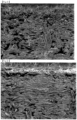
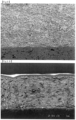
- Fig. 3 shows a sectional image of when the non-woven fabric of the ultrafine fibers obtained in Example 6 was observed with a scanning electron microscope (SEM); and
- Fig. 4 shows a sectional SEM image of the artificial leather substrate obtained by addition of the modifying agent by impregnation.
- Fig. 5 shows a sectional SEM image of the grain-like-finish artificial leather substrate obtained in Example 6.
- Example 8 is a reference example.
- alumina (Al 2 O 3 ) particles instead of the aluminum dialkylphosphinate were added into the composition of the dispersion for the modifying agent prepared in Example 6; and except for the above, a grain-like-finish artificial leather was obtained as in Example 1 and then evaluated. The results are shown in Table 1.
- Example 1 Instead of adding the dispersion for the modifying agent into the non-woven fabric of the ultrafine fibers by impregnation in Example 1, a water-based polyurethane dispersion as the one used in Example 1 was added by impregnation, such that the dispersion became 12.5 mass% as a solid content relative to the non-woven fabric of the ultrafine fibers, and was then dried at 120°C; and except for the above, a grain-like-finish artificial leather was obtained as in Example 1 and then evaluated. The results are shown in Table 1.
- Example 1 Except that the process of adding the modifying agent by impregnation in Example 1 was omitted, a grain-like-finish artificial leather was obtained as in Example 1 and then evaluated. The results are shown in Table 1.
- composition of the dispersion for the modifying agent prepared in Example 1 was adjusted and modifying agents with the compositions and amounts shown in Table 1 were added into the artificial leather substrate by impregnation; and except for the above, grain-like-finish artificial leathers were obtained as in Example 1 and then evaluated. The results are shown in Table 1.
- the apparent density was 0.6 g/cm 3 or more, and also, the suppleness of the grain-like-finish artificial leather corresponded to a stiffness of 1.8 mm or more; and therefore, an artificial leather having fullness and also suppleness was obtained.
- the artificial leather obtained in Comparative Example 1 i.e., a conventional and typical artificial leather, wherein the non-woven fabric was given fullness by addition of the elastic polymer, although the apparent density was 0.6 g/cm 3 or more and allowed fullness, the stiffness was 0.89 mm and suppleness was of a low degree.
- the artificial leather of Example 8 exhibited fullness of a slightly low degree due to the relatively low proportion of the modifying agent, but exhibited suppleness of a remarkably high degree.
- the resin liquid applied since there were voids remaining in the surface of the artificial leather substrate, the resin liquid applied tended to easily seep into the substrate.
- an artificial leather having a supple texture and also fullness, due to addition of the modifying agent as described above into the voids among the fibers of the entangled fiber body, by impregnation.
- a smoothing layer was formed as follows. Specifically, a filler (calcium carbonate with average particle size of 5 ⁇ m) was added into a polyurethane emulsion (LCC Binder UB1770 available from DIC Corporation, solid content: 30 mass%), the amount of the filler being 42.9 parts by mass relative to 100 parts by mass of the solid content in the polyurethane emulsion; and this was followed by addition of a thickener and then stirring and mixing, thereby to prepare a smoothing-layer-forming coating liquid.
- a filler calcium carbonate with average particle size of 5 ⁇ m
- LCC Binder UB1770 available from DIC Corporation, solid content: 30 mass
- a viscosity ⁇ 0.6 measured at 0.6 rotation/sec was 240 Pa ⁇ s
- a viscosity ⁇ 3.0 measured at 3 rotations/sec was 75 Pa ⁇ s
- ⁇ 0.6 / ⁇ 3.0 was 3.2.
- the viscosity ⁇ 0.6 was 4.2 Pa ⁇ s
- the viscosity ⁇ 3.0 was 3.0 Pa ⁇ s
- ⁇ 0.6 / ⁇ 3.0 was 1.4.
- the smoothing-layer-forming coating liquid was applied to the surface of the artificial leather substrate obtained in Example 6, at 140 g/m 2 with a reverse coater, followed by drying, thereby to form a 45 ⁇ m-thick smoothing layer.
- the surface water absorption rate of the smoothing layer formed as such was measured by a method as below. As a result, the surface water absorption rate was 180 seconds or more. The results are shown in Table 2.
- Measurement was conducted in compliance with the water drop method of JIS L1907-7.1.1. Specifically, the artificial leather substrate was cut into a size of about 200 mm ⁇ 200 mm to prepare a test piece. The prepared test piece was attached to a test piece-holding frame, which was then placed between a light source and the observer; and then, adjustment was made so that the height from the surface on the smoothing layer side of the test piece to the tip of the burette became 10 mm.
- Example 1 a colorcoat layer with a film thickness of 14 ⁇ m as in Example 1 was formed on the surface of the smoothing layer on the artificial leather substrate. Then, milling treatment was further conducted at 40 to 50°C for 2 to 4 hours. Then, as in Example 1, by using embossing rollers at 125°C and 50 kg/cm 2 , embossing processing was conducted on the surface layer, at a line velocity of 7.0 m/min. Then, as in Example 1, a topcoat with a film thickness of 13.5 ⁇ m was formed. As such, a grain-like-finish artificial leather with a mass per unit area of 665 g/m 2 and an apparent density of 0.629 g/cm 3 was obtained. Fig.
- Example 6 shows an SEM image of an oblique sectional surface of the artificial leather substrate obtained in Example 13, before formation of the smoothing layer; and Fig. 7 shows an SEM image of an oblique sectional surface thereof after formation of the smoothing surface. Moreover, Fig. 8 shows a sectional SEM image of the grain-like-finish artificial leather substrate obtained in Example 13.
- the sinking amount (g/m 2 ) was calculated from the difference between the applied amount when forming the smoothing layer and the film thickness when the smoothing layer was actually formed. However, when the value obtained was smaller than 0, the value was regarded as 0. Moreover, the results for stiffness and texture are shown in Table 2. [Table 2] Example No.
- a filler (vinylidene chloride nitrile-based plastic balloon with average particle size of 30 ⁇ m) was added into the polyurethane emulsion, the amount of the filler being 1.5 parts by mass relative to 100 parts by mass of the solid content in the polyurethane emulsion and being 50% in volume ratio; and except for the above, a smoothing-layer-forming coating liquid was prepared as in Example 13; and except that the smoothing-layer-forming coating liquid adjusted as such was used, a grain-like-finish artificial leather was obtained as in Example 13.
- Table 2 shows an SEM image of an oblique sectional surface of the artificial leather substrate obtained in Example 22, after formation of the smoothing layer; and Fig. 10 shows a sectional SEM image of the grain-like-finish artificial leather substrate obtained in Example 22.
- the artificial leather of the present invention can be used as a leather-like material for applications in footwear, clothing, gloves, bags, balls, interior decoration, vehicle upholstering, and the like.
Landscapes
- Engineering & Computer Science (AREA)
- Textile Engineering (AREA)
- Chemical & Material Sciences (AREA)
- Chemical Kinetics & Catalysis (AREA)
- Dispersion Chemistry (AREA)
- Life Sciences & Earth Sciences (AREA)
- Wood Science & Technology (AREA)
- Inorganic Chemistry (AREA)
- Synthetic Leather, Interior Materials Or Flexible Sheet Materials (AREA)
- Treatments For Attaching Organic Compounds To Fibrous Goods (AREA)
Claims (14)
- Substrat en cuir artificiel comprenant :un corps de fibres enchevêtrées ; etune première charge, un premier polymère élastique et une huile non volatile sous forme liquide, tous ajoutées dans le corps de fibres enchevêtrées par imprégnation, dans lequel la première charge comprend au moins une charge parmi une charge inorganique, une charge métallique, une charge d'oxyde métallique, une charge d'oxyde semi-métallique, une charge ignifugeante et une charge à base de carbone, et l'huile non volatile est un liquide ayant un point d'ébullition de 150 °C ou plus qui ne se dissoust sensiblement pas dans un solvant polaire,dans lequel une teneur en première charge est de 50 à 97 % en masse, de la quantité totale de la première charge, du premier polymère élastique et de l'huile non volatile.
- Substrat en cuir artificiel selon la revendication 1, dans lequel l'huile non volatile comprend au moins une huile choisie parmi la paraffine liquide, l'huile de silicone, l'huile minérale et les esters de phtalate.
- Substrat en cuir artificiel selon la revendication 1, dans lequel le corps de fibres enchevêtrées est un tissu non tissé de fibres ultrafines ayant une finesse de 0,9 dtex ou moins.
- Substrat en cuir artificiel selon la revendication 1, dans lequel une teneur en première charge est de 1 à 60 % en masse et une teneur en huile non volatile est de 0,5 à 10 % en masse, par rapport au corps de fibres enchevêtrées.
- Substrat en cuir artificiel selon la revendication 1, dans lequel de 1 à 15 % en masse du premier polymère élastique sont présents par rapport au corps de fibres enchevêtrées.
- Substrat en cuir artificiel selon la revendication 5, dans lequel une teneur en première charge, huile non volatile et premier polymère élastique au total, par rapport au corps de fibres enchevêtrées, est de 10 à 30 % en masse.
- Substrat en cuir artificiel selon la revendication 6, dans lequel une teneur en premier polymère élastique de la quantité totale de la première charge, de l'huile non volatile et du premier polymère élastique, est de 1 à 20 % en masse,
- Substrat en cuir artificiel selon la revendication 1 ayant une densité apparente de 0,60 g/cm3 ou plus.
- Substrat en cuir artificiel selon la revendication 1 comprenant en outre une couche de lissage pour lisser une surface,
la couche de lissage étant une couche comprenant un deuxième polymère élastique et une deuxième charge et ayant une épaisseur de 10 à 100 µm. - Substrat en cuir artificiel selon la revendication 9, dans lequel la couche de lissage comprend de 1 à 50 % en masse de la deuxième charge.
- Substrat en cuir artificiel selon la revendication 9, dans lequel un taux d'absorption d'eau de surface conformément à la méthode de la goutte d'eau de JIS L1907-7.1.1 est de 100 secondes ou plus.
- Cuir artificiel au fini grainé formé en empilant en outre une couche de résine sur la couche de lissage dans le substrat en cuir artificiel selon la revendication 9.
- Procédé de production d'un substrat en cuir artificiel, le procédé étant destiné au substrat en cuir artificiel selon la revendication 9 et comprenant :une étape de préparation d'un tissu initial du substrat en cuir artificiel selon la revendication 1 ; etune étape de formation de la couche de lissage ayant une épaisseur de 10 à 100 µm, par application d'un liquide de revêtement formant une couche de lissage sur une surface du tissu initial, suivie d'un séchage,le liquide de revêtement formant une couche de lissage comprenant le deuxième polymère élastique et la deuxième charge, en tant que contenu solide ; et ayant un indice thixotropique de 2 à 4, l'indice thixotropique étant un rapport entre une viscosité η0.6 et une viscosité n3,0 (η0,6/η3,0), la viscosité η0,6 étant mesurée à 0,6 rotation/s et la viscosité η3,0 étant mesurée à 3 rotations/s en utilisant un viscosimètre rotatif de type B à une température de 25 °C.
- Agent de modification pour un substrat en cuir artificiel, l'agent de modification comprenant :de 3 à 50 % en masse d'une huile non volatile sous forme liquide en tant que composant non volatil ; etde 50 à 97 % en masse de : une première charge ; et de 0 à 20 % en masse d'un premier polymère élastique, dans lequel l'huile non volatile est un liquide ayant un point d'ébullition de 150 °C ou plus qui ne se dissout sensiblement pas dans un solvant polaire, etla première est au moins une charge choisie parmi une charge inorganique, une charge métallique, une charge d'oxyde métallique, une charge d'oxyde semi-métallique, une charge ignifugeante et une charge à base de carbone.
Applications Claiming Priority (2)
| Application Number | Priority Date | Filing Date | Title |
|---|---|---|---|
| JP2013037475 | 2013-02-27 | ||
| PCT/JP2014/000991 WO2014132630A1 (fr) | 2013-02-27 | 2014-02-25 | Substrat en cuir artificiel, cuir artificiel à fausse fleur, procédé de fabrication d'un substrat en cuir artificiel et agent de modification de substrat en cuir artificiel |
Publications (4)
| Publication Number | Publication Date |
|---|---|
| EP2966218A1 EP2966218A1 (fr) | 2016-01-13 |
| EP2966218A4 EP2966218A4 (fr) | 2016-09-07 |
| EP2966218C0 EP2966218C0 (fr) | 2024-08-28 |
| EP2966218B1 true EP2966218B1 (fr) | 2024-08-28 |
Family
ID=51427907
Family Applications (1)
| Application Number | Title | Priority Date | Filing Date |
|---|---|---|---|
| EP14756855.4A Active EP2966218B1 (fr) | 2013-02-27 | 2014-02-25 | Substrat en cuir artificiel, cuir artificiel à fausse fleur, procédé de fabrication d'un substrat en cuir artificiel et agent de modification de substrat en cuir artificiel |
Country Status (7)
| Country | Link |
|---|---|
| US (1) | US20160002846A1 (fr) |
| EP (1) | EP2966218B1 (fr) |
| JP (1) | JP6473412B2 (fr) |
| KR (1) | KR102128640B1 (fr) |
| CN (1) | CN105026640B (fr) |
| TW (1) | TWI651198B (fr) |
| WO (1) | WO2014132630A1 (fr) |
Families Citing this family (22)
| Publication number | Priority date | Publication date | Assignee | Title |
|---|---|---|---|---|
| JP6429790B2 (ja) * | 2013-11-01 | 2018-11-28 | 株式会社クラレ | ヌバック調皮革様シート及びその製造方法 |
| JP6263321B2 (ja) * | 2014-06-20 | 2018-01-17 | 株式会社クラレ | 人工皮革基材、人工皮革、及び皮革調三次元成形体 |
| JP6346873B2 (ja) * | 2015-06-08 | 2018-06-20 | 株式会社クラレ | 人工皮革 |
| KR102297731B1 (ko) * | 2015-07-31 | 2021-09-03 | 도레이 카부시키가이샤 | 레더라이크 포백 |
| US20180245282A1 (en) * | 2015-09-07 | 2018-08-30 | Seiren Co., Ltd. | Nubuck-like artificial leather, and method for producing nubuck-like artificial leather |
| JP6688593B2 (ja) * | 2015-10-28 | 2020-04-28 | 株式会社クラレ | 人工皮革基材、人工皮革及び人工皮革基材の製造方法 |
| EP3456875B1 (fr) * | 2016-05-09 | 2022-03-02 | Kuraray Co., Ltd. | Similicuir grainé |
| JP6870616B2 (ja) * | 2016-06-28 | 2021-05-12 | 東レ株式会社 | 複合シート状物およびその製造方法 |
| EP3480356B1 (fr) * | 2016-06-29 | 2023-08-02 | Toray Industries, Inc. | Matériau de surface de tableau de bord de véhicule automobile et son procédé de fabrication |
| WO2018203494A1 (fr) | 2017-05-01 | 2018-11-08 | 株式会社クラレ | Matériau de base en cuir artificiel et cuir artificiel à grains |
| US11499266B2 (en) | 2017-05-31 | 2022-11-15 | Kuraray Co., Ltd. | Grained artificial leather and method for manufacturing grained artificial leather |
| JP7265354B2 (ja) * | 2018-12-28 | 2023-04-26 | 株式会社クラレ | 立毛人工皮革及びそれを用いたコンポジット材 |
| JP7265355B2 (ja) * | 2018-12-28 | 2023-04-26 | 株式会社クラレ | 立毛人工皮革及びコンポジット材 |
| KR102249133B1 (ko) * | 2019-08-30 | 2021-05-07 | 주식회사 한진실리콘 | 기능성 섬유용 코팅제 및 이를 이용한 코팅 원단 |
| US20210222359A1 (en) * | 2020-01-22 | 2021-07-22 | San Fang Chemical Industry Co., Ltd. | Leather material and manufacturing method thereof |
| CN113637397B (zh) * | 2021-08-27 | 2022-02-22 | 苏州贝斯特装饰新材料有限公司 | 一种水性表面处理剂、高柔性肤感pvc皮革及制备方法 |
| TWI795906B (zh) * | 2021-09-14 | 2023-03-11 | 南亞塑膠工業股份有限公司 | 未具有發泡結構的聚氯乙烯人造革 |
| KR102390946B1 (ko) * | 2021-09-15 | 2022-04-27 | 주식회사 인비트윈드림스 | 토목섬유를 이용한 가방용 섬유재료 및 이의 제조방법 |
| TWI792594B (zh) * | 2021-09-30 | 2023-02-11 | 三芳化學工業股份有限公司 | 具視覺穿透性之人工皮革及其製造方法 |
| CN114263048B (zh) * | 2021-12-25 | 2024-02-06 | 杭州崇耀科技发展有限公司 | 有机硅合成革面层、制备方法及有机硅合成革 |
| CN117148809B (zh) * | 2023-10-31 | 2023-12-29 | 南通中奥车用新材料有限公司 | 用于人造革生产设备的工艺优化方法及系统 |
| CN117702504B (zh) * | 2024-02-01 | 2024-05-07 | 永固纺织科技有限公司 | 一种浮纹涂层面料及其制备工艺 |
Citations (1)
| Publication number | Priority date | Publication date | Assignee | Title |
|---|---|---|---|---|
| JP2007291565A (ja) * | 2006-04-26 | 2007-11-08 | Kuraray Co Ltd | 皮革様シート |
Family Cites Families (29)
| Publication number | Priority date | Publication date | Assignee | Title |
|---|---|---|---|---|
| US3203921A (en) * | 1962-10-16 | 1965-08-31 | Dublon Inc | Polyolefin compositions containing mineral oil and mineral fillers |
| BE692652A (fr) * | 1966-07-13 | 1967-07-17 | ||
| JPS5350303A (en) * | 1976-10-18 | 1978-05-08 | Toray Industries | Production of improved suede like artificial leather |
| JP2813410B2 (ja) * | 1990-03-30 | 1998-10-22 | 株式会社クラレ | ヌバック調皮革様シート |
| JPH04168200A (ja) * | 1990-10-30 | 1992-06-16 | Henkel Hakusui Kk | 革用柔軟充填剤 |
| CN1095899A (zh) * | 1993-05-29 | 1994-12-07 | 陈德兰 | 低胆固醇、高富硒、维生素e禽蛋 |
| DE4444306C2 (de) * | 1993-12-13 | 2000-05-31 | Deuter Sport & Leder | Mehrschichtmaterial als Lederimitat |
| JPH09313418A (ja) | 1996-05-31 | 1997-12-09 | Asahi Chem Ind Co Ltd | ワイピングシート及びその製造法 |
| US6322851B1 (en) * | 1998-06-30 | 2001-11-27 | Kuraray Co., Ltd. | Manufacturing process for leather-like sheet |
| JP4025425B2 (ja) * | 1998-06-30 | 2007-12-19 | 株式会社クラレ | 皮革様シート状物の製造方法 |
| TW476834B (en) * | 1999-08-23 | 2002-02-21 | Kuraray Co | Oil tone artificial leather sheet |
| JP2002030580A (ja) * | 2000-07-17 | 2002-01-31 | Kuraray Co Ltd | 皮革様シートおよびその製造方法 |
| JP2002302879A (ja) * | 2001-04-05 | 2002-10-18 | Kuraray Co Ltd | 皮革様シート |
| JP4686057B2 (ja) * | 2001-06-08 | 2011-05-18 | 大日本印刷株式会社 | 離型紙及びそれを用いて製造された合成皮革 |
| JP2003025248A (ja) | 2001-07-10 | 2003-01-29 | Max Co Ltd | シートステープルの送り機構 |
| JP2003089986A (ja) * | 2001-09-19 | 2003-03-28 | Kuraray Co Ltd | 難燃性銀付調人工皮革およびその製造方法 |
| US8007890B2 (en) * | 2002-05-20 | 2011-08-30 | Kuraray Co., Ltd. | Article in a sheet form and method for preparation thereof |
| JP4198523B2 (ja) * | 2002-05-20 | 2008-12-17 | 株式会社クラレ | 皮革様シートおよびその製造方法 |
| JP4330320B2 (ja) * | 2002-09-27 | 2009-09-16 | 大日本印刷株式会社 | マット層形成用組成物およびそれを用いた離型シート |
| JP4242693B2 (ja) * | 2003-04-25 | 2009-03-25 | 帝人テクノプロダクツ株式会社 | 皮革様シート状物の製造方法 |
| JP2009512792A (ja) * | 2005-10-20 | 2009-03-26 | ダウ ライヒホールド スペシャルティ ラテックス,エルエルシー | 複合革材料 |
| JP2007119936A (ja) | 2005-10-26 | 2007-05-17 | Toray Ind Inc | 皮革様シート状物用基材およびその製造方法 |
| EP2025806B1 (fr) * | 2006-05-30 | 2013-05-22 | Kuraray Co., Ltd. | Matériau de base pour cuir artificiel et cuir artificiel grainé |
| US8883662B2 (en) | 2007-03-30 | 2014-11-11 | Kuraray Co., Ltd. | Leather-like sheet bearing grain finish and process for producing the same |
| EP2287395B1 (fr) * | 2008-04-10 | 2019-03-06 | Kuraray Co., Ltd. | Feuille analogue à du cuir ayant d'excellentes performances de préhension et produit de cuir artificiel l'utilisant |
| US10465337B2 (en) * | 2009-02-27 | 2019-11-05 | Kuraray Co., Ltd. | Artificial leather, entangled web of filaments, and process for producing these |
| CN102812176A (zh) * | 2010-03-31 | 2012-12-05 | 可乐丽股份有限公司 | 皮革样片 |
| EP2426174A1 (fr) * | 2010-09-03 | 2012-03-07 | SK Innovation Co. Ltd. | Composition de résine pour produits en feuilles |
| JP2012117154A (ja) * | 2010-11-29 | 2012-06-21 | Kuraray Co Ltd | 通気性に優れた皮革様シート及びその皮革様シートの製造方法 |
-
2014
- 2014-02-25 EP EP14756855.4A patent/EP2966218B1/fr active Active
- 2014-02-25 KR KR1020157025692A patent/KR102128640B1/ko active Active
- 2014-02-25 WO PCT/JP2014/000991 patent/WO2014132630A1/fr not_active Ceased
- 2014-02-25 JP JP2015502775A patent/JP6473412B2/ja active Active
- 2014-02-25 CN CN201480010882.8A patent/CN105026640B/zh active Active
- 2014-02-25 US US14/769,632 patent/US20160002846A1/en not_active Abandoned
- 2014-02-27 TW TW103106652A patent/TWI651198B/zh active
Patent Citations (1)
| Publication number | Priority date | Publication date | Assignee | Title |
|---|---|---|---|---|
| JP2007291565A (ja) * | 2006-04-26 | 2007-11-08 | Kuraray Co Ltd | 皮革様シート |
Also Published As
| Publication number | Publication date |
|---|---|
| EP2966218C0 (fr) | 2024-08-28 |
| JP6473412B2 (ja) | 2019-02-20 |
| TW201500200A (zh) | 2015-01-01 |
| KR102128640B1 (ko) | 2020-06-30 |
| KR20150121105A (ko) | 2015-10-28 |
| EP2966218A1 (fr) | 2016-01-13 |
| TWI651198B (zh) | 2019-02-21 |
| CN105026640B (zh) | 2019-03-08 |
| EP2966218A4 (fr) | 2016-09-07 |
| WO2014132630A1 (fr) | 2014-09-04 |
| CN105026640A (zh) | 2015-11-04 |
| US20160002846A1 (en) | 2016-01-07 |
| JPWO2014132630A1 (ja) | 2017-02-02 |
Similar Documents
| Publication | Publication Date | Title |
|---|---|---|
| EP2966218A1 (fr) | Substrat en cuir artificiel, cuir artificiel à fausse fleur, procédé de fabrication d'un substrat en cuir artificiel et agent de modification de substrat en cuir artificiel | |
| JP6449775B2 (ja) | 立毛調人工皮革及びその製造方法 | |
| KR102372954B1 (ko) | 은부조 인공 피혁 | |
| US12571158B2 (en) | Napped artificial leather | |
| WO2011121940A1 (fr) | Feuille de similicuir | |
| JP6163422B2 (ja) | 皮革様シート及びその製造方法 | |
| JP6346873B2 (ja) | 人工皮革 | |
| JP2016044375A (ja) | 難燃性人工皮革基材、難燃性銀付調人工皮革及び難燃性銀付調人工皮革の製造方法 | |
| JPWO2018003459A1 (ja) | 複合シート状物およびその製造方法 | |
| TWI769259B (zh) | 粒面狀人工皮革及粒面狀人工皮革之製造方法 | |
| JP6263321B2 (ja) | 人工皮革基材、人工皮革、及び皮革調三次元成形体 | |
| JP2015034355A (ja) | パーフォレーション皮革様シート | |
| JP2015158030A (ja) | 人工皮革、及び人工皮革の製造方法 | |
| KR102747128B1 (ko) | 입모 인공 피혁 및 복합 재료 | |
| JP7265354B2 (ja) | 立毛人工皮革及びそれを用いたコンポジット材 | |
| JP2012017541A (ja) | 銀付調人工皮革 | |
| JP5959394B2 (ja) | 銀付調人工皮革 | |
| JP7671150B2 (ja) | 銀付調人工皮革及びその製造方法 | |
| JP6087073B2 (ja) | 銀付調人工皮革及びその製造方法 | |
| WO2019058924A1 (fr) | Cuir synthétique gratté | |
| JP2018193659A (ja) | 皮革様シート及びその製造方法 |
Legal Events
| Date | Code | Title | Description |
|---|---|---|---|
| PUAI | Public reference made under article 153(3) epc to a published international application that has entered the european phase |
Free format text: ORIGINAL CODE: 0009012 |
|
| 17P | Request for examination filed |
Effective date: 20150925 |
|
| AK | Designated contracting states |
Kind code of ref document: A1 Designated state(s): AL AT BE BG CH CY CZ DE DK EE ES FI FR GB GR HR HU IE IS IT LI LT LU LV MC MK MT NL NO PL PT RO RS SE SI SK SM TR |
|
| AX | Request for extension of the european patent |
Extension state: BA ME |
|
| DAX | Request for extension of the european patent (deleted) | ||
| A4 | Supplementary search report drawn up and despatched |
Effective date: 20160808 |
|
| RIC1 | Information provided on ipc code assigned before grant |
Ipc: D06M 15/564 20060101ALI20160801BHEP Ipc: D06N 3/14 20060101ALI20160801BHEP Ipc: D06M 15/643 20060101ALI20160801BHEP Ipc: D06M 13/02 20060101ALI20160801BHEP Ipc: D06N 3/00 20060101AFI20160801BHEP Ipc: D06M 23/08 20060101ALI20160801BHEP Ipc: D06M 13/224 20060101ALI20160801BHEP |
|
| TPAC | Observations filed by third parties |
Free format text: ORIGINAL CODE: EPIDOSNTIPA |
|
| STAA | Information on the status of an ep patent application or granted ep patent |
Free format text: STATUS: EXAMINATION IS IN PROGRESS |
|
| 17Q | First examination report despatched |
Effective date: 20201014 |
|
| GRAP | Despatch of communication of intention to grant a patent |
Free format text: ORIGINAL CODE: EPIDOSNIGR1 |
|
| STAA | Information on the status of an ep patent application or granted ep patent |
Free format text: STATUS: GRANT OF PATENT IS INTENDED |
|
| INTG | Intention to grant announced |
Effective date: 20240313 |
|
| GRAS | Grant fee paid |
Free format text: ORIGINAL CODE: EPIDOSNIGR3 |
|
| GRAA | (expected) grant |
Free format text: ORIGINAL CODE: 0009210 |
|
| STAA | Information on the status of an ep patent application or granted ep patent |
Free format text: STATUS: THE PATENT HAS BEEN GRANTED |
|
| AK | Designated contracting states |
Kind code of ref document: B1 Designated state(s): AL AT BE BG CH CY CZ DE DK EE ES FI FR GB GR HR HU IE IS IT LI LT LU LV MC MK MT NL NO PL PT RO RS SE SI SK SM TR |
|
| REG | Reference to a national code |
Ref country code: GB Ref legal event code: FG4D |
|
| RIN1 | Information on inventor provided before grant (corrected) |
Inventor name: SUGIURA, HIDEO Inventor name: HASHIMOTO, KOJI Inventor name: FUJISAWA, MICHINORI Inventor name: YOSHIMOTO, SHINICHI |
|
| REG | Reference to a national code |
Ref country code: CH Ref legal event code: EP |
|
| REG | Reference to a national code |
Ref country code: DE Ref legal event code: R096 Ref document number: 602014090766 Country of ref document: DE |
|
| REG | Reference to a national code |
Ref country code: IE Ref legal event code: FG4D |
|
| U01 | Request for unitary effect filed |
Effective date: 20240917 |
|
| U07 | Unitary effect registered |
Designated state(s): AT BE BG DE DK EE FI FR IT LT LU LV MT NL PT RO SE SI Effective date: 20241009 |
|
| PG25 | Lapsed in a contracting state [announced via postgrant information from national office to epo] |
Ref country code: NO Free format text: LAPSE BECAUSE OF FAILURE TO SUBMIT A TRANSLATION OF THE DESCRIPTION OR TO PAY THE FEE WITHIN THE PRESCRIBED TIME-LIMIT Effective date: 20241128 |
|
| PG25 | Lapsed in a contracting state [announced via postgrant information from national office to epo] |
Ref country code: GR Free format text: LAPSE BECAUSE OF FAILURE TO SUBMIT A TRANSLATION OF THE DESCRIPTION OR TO PAY THE FEE WITHIN THE PRESCRIBED TIME-LIMIT Effective date: 20241129 Ref country code: PL Free format text: LAPSE BECAUSE OF FAILURE TO SUBMIT A TRANSLATION OF THE DESCRIPTION OR TO PAY THE FEE WITHIN THE PRESCRIBED TIME-LIMIT Effective date: 20240828 |
|
| PG25 | Lapsed in a contracting state [announced via postgrant information from national office to epo] |
Ref country code: IS Free format text: LAPSE BECAUSE OF FAILURE TO SUBMIT A TRANSLATION OF THE DESCRIPTION OR TO PAY THE FEE WITHIN THE PRESCRIBED TIME-LIMIT Effective date: 20241228 |
|
| PG25 | Lapsed in a contracting state [announced via postgrant information from national office to epo] |
Ref country code: HR Free format text: LAPSE BECAUSE OF FAILURE TO SUBMIT A TRANSLATION OF THE DESCRIPTION OR TO PAY THE FEE WITHIN THE PRESCRIBED TIME-LIMIT Effective date: 20240828 |
|
| PG25 | Lapsed in a contracting state [announced via postgrant information from national office to epo] |
Ref country code: RS Free format text: LAPSE BECAUSE OF FAILURE TO SUBMIT A TRANSLATION OF THE DESCRIPTION OR TO PAY THE FEE WITHIN THE PRESCRIBED TIME-LIMIT Effective date: 20241128 Ref country code: ES Free format text: LAPSE BECAUSE OF FAILURE TO SUBMIT A TRANSLATION OF THE DESCRIPTION OR TO PAY THE FEE WITHIN THE PRESCRIBED TIME-LIMIT Effective date: 20240828 |
|
| PG25 | Lapsed in a contracting state [announced via postgrant information from national office to epo] |
Ref country code: RS Free format text: LAPSE BECAUSE OF FAILURE TO SUBMIT A TRANSLATION OF THE DESCRIPTION OR TO PAY THE FEE WITHIN THE PRESCRIBED TIME-LIMIT Effective date: 20241128 Ref country code: PL Free format text: LAPSE BECAUSE OF FAILURE TO SUBMIT A TRANSLATION OF THE DESCRIPTION OR TO PAY THE FEE WITHIN THE PRESCRIBED TIME-LIMIT Effective date: 20240828 Ref country code: NO Free format text: LAPSE BECAUSE OF FAILURE TO SUBMIT A TRANSLATION OF THE DESCRIPTION OR TO PAY THE FEE WITHIN THE PRESCRIBED TIME-LIMIT Effective date: 20241128 Ref country code: IS Free format text: LAPSE BECAUSE OF FAILURE TO SUBMIT A TRANSLATION OF THE DESCRIPTION OR TO PAY THE FEE WITHIN THE PRESCRIBED TIME-LIMIT Effective date: 20241228 Ref country code: HR Free format text: LAPSE BECAUSE OF FAILURE TO SUBMIT A TRANSLATION OF THE DESCRIPTION OR TO PAY THE FEE WITHIN THE PRESCRIBED TIME-LIMIT Effective date: 20240828 Ref country code: GR Free format text: LAPSE BECAUSE OF FAILURE TO SUBMIT A TRANSLATION OF THE DESCRIPTION OR TO PAY THE FEE WITHIN THE PRESCRIBED TIME-LIMIT Effective date: 20241129 Ref country code: ES Free format text: LAPSE BECAUSE OF FAILURE TO SUBMIT A TRANSLATION OF THE DESCRIPTION OR TO PAY THE FEE WITHIN THE PRESCRIBED TIME-LIMIT Effective date: 20240828 |
|
| U20 | Renewal fee for the european patent with unitary effect paid |
Year of fee payment: 12 Effective date: 20250107 |
|
| PG25 | Lapsed in a contracting state [announced via postgrant information from national office to epo] |
Ref country code: SM Free format text: LAPSE BECAUSE OF FAILURE TO SUBMIT A TRANSLATION OF THE DESCRIPTION OR TO PAY THE FEE WITHIN THE PRESCRIBED TIME-LIMIT Effective date: 20240828 |
|
| PG25 | Lapsed in a contracting state [announced via postgrant information from national office to epo] |
Ref country code: CZ Free format text: LAPSE BECAUSE OF FAILURE TO SUBMIT A TRANSLATION OF THE DESCRIPTION OR TO PAY THE FEE WITHIN THE PRESCRIBED TIME-LIMIT Effective date: 20240828 |
|
| PG25 | Lapsed in a contracting state [announced via postgrant information from national office to epo] |
Ref country code: SK Free format text: LAPSE BECAUSE OF FAILURE TO SUBMIT A TRANSLATION OF THE DESCRIPTION OR TO PAY THE FEE WITHIN THE PRESCRIBED TIME-LIMIT Effective date: 20240828 |
|
| PLBE | No opposition filed within time limit |
Free format text: ORIGINAL CODE: 0009261 |
|
| STAA | Information on the status of an ep patent application or granted ep patent |
Free format text: STATUS: NO OPPOSITION FILED WITHIN TIME LIMIT |
|
| 26N | No opposition filed |
Effective date: 20250530 |
|
| PG25 | Lapsed in a contracting state [announced via postgrant information from national office to epo] |
Ref country code: MC Free format text: LAPSE BECAUSE OF FAILURE TO SUBMIT A TRANSLATION OF THE DESCRIPTION OR TO PAY THE FEE WITHIN THE PRESCRIBED TIME-LIMIT Effective date: 20240828 |
|
| REG | Reference to a national code |
Ref country code: CH Ref legal event code: PL |
|
| PG25 | Lapsed in a contracting state [announced via postgrant information from national office to epo] |
Ref country code: CH Free format text: LAPSE BECAUSE OF NON-PAYMENT OF DUE FEES Effective date: 20250228 |
|
| PG25 | Lapsed in a contracting state [announced via postgrant information from national office to epo] |
Ref country code: IE Free format text: LAPSE BECAUSE OF NON-PAYMENT OF DUE FEES Effective date: 20250225 |
|
| U20 | Renewal fee for the european patent with unitary effect paid |
Year of fee payment: 13 Effective date: 20260106 |
|
| PGFP | Annual fee paid to national office [announced via postgrant information from national office to epo] |
Ref country code: GB Payment date: 20260106 Year of fee payment: 13 |