EP2974939B1 - Système de gestion de train - Google Patents
Système de gestion de train Download PDFInfo
- Publication number
- EP2974939B1 EP2974939B1 EP14177525.4A EP14177525A EP2974939B1 EP 2974939 B1 EP2974939 B1 EP 2974939B1 EP 14177525 A EP14177525 A EP 14177525A EP 2974939 B1 EP2974939 B1 EP 2974939B1
- Authority
- EP
- European Patent Office
- Prior art keywords
- train
- timetable
- unit
- track
- signalling
- Prior art date
- Legal status (The legal status is an assumption and is not a legal conclusion. Google has not performed a legal analysis and makes no representation as to the accuracy of the status listed.)
- Active
Links
Images






Classifications
-
- B—PERFORMING OPERATIONS; TRANSPORTING
- B61—RAILWAYS
- B61L—GUIDING RAILWAY TRAFFIC; ENSURING THE SAFETY OF RAILWAY TRAFFIC
- B61L27/00—Central railway traffic control systems; Trackside control; Communication systems specially adapted therefor
- B61L27/10—Operations, e.g. scheduling or time tables
- B61L27/16—Trackside optimisation of vehicle or train operation
-
- B—PERFORMING OPERATIONS; TRANSPORTING
- B61—RAILWAYS
- B61L—GUIDING RAILWAY TRAFFIC; ENSURING THE SAFETY OF RAILWAY TRAFFIC
- B61L15/00—Indicators provided on the vehicle or train for signalling purposes
- B61L15/0018—Communication with or on the vehicle or train
-
- B—PERFORMING OPERATIONS; TRANSPORTING
- B61—RAILWAYS
- B61L—GUIDING RAILWAY TRAFFIC; ENSURING THE SAFETY OF RAILWAY TRAFFIC
- B61L15/00—Indicators provided on the vehicle or train for signalling purposes
- B61L15/0072—On-board train data handling
-
- B—PERFORMING OPERATIONS; TRANSPORTING
- B61—RAILWAYS
- B61L—GUIDING RAILWAY TRAFFIC; ENSURING THE SAFETY OF RAILWAY TRAFFIC
- B61L21/00—Station blocking between signal boxes in one yard
- B61L21/06—Vehicle-on-line indication; Monitoring locking and release of the route
- B61L21/065—Vehicle-on-line indication; Monitoring locking and release of the route for signals, including signals actuated by the vehicle
-
- B—PERFORMING OPERATIONS; TRANSPORTING
- B61—RAILWAYS
- B61L—GUIDING RAILWAY TRAFFIC; ENSURING THE SAFETY OF RAILWAY TRAFFIC
- B61L23/00—Control, warning or like safety means along the route or between vehicles or trains
- B61L23/34—Control, warning or like safety means along the route or between vehicles or trains for indicating the distance between vehicles or trains by the transmission of signals therebetween
Definitions
- the present invention relates to a train management system, and in particular, but not exclusively, to such a system that makes use of a driver advisory system of a railway vehicle.
- a Driver Advisory System can calculate an optimized driving speed profile for a given train based on the train location, track information, the train route and the train timetable.
- the DAS can then present driving advice to the train driver based on the calculation.
- Such systems are becoming increasingly important for environmental and cost-saving reasons because of the potential, if a driver follows the advice, for improvements in safety and punctuality, and reductions in energy consumption and brake maintenance costs.
- WO 98/30426 proposes a method for controlling the speed of a rail vehicle.
- the present invention provides a train management system according to claim 1.
- the driver can be presented with real-time speed profile advice that not only takes into account the latest signal settings, but also takes into account the latest timetable for the train.
- inconsistencies between the advice and the signals can be reduced or eliminated, improving train safety.
- the train can be driven at a speed which is optimised in terms of ride comfort, reduced mechanical wear and tear, and overall network utilisation.
- the calculation module can be a part of the on-board server unit.
- the railway operating centre may further include an interface unit which, while the given train is running, sends the latest updated timetable and the latest updated signals to the on-board server unit.
- the interface unit may further include a signalling management module which checks if the signalling settings in front of the given train have changed, the interface unit sending the updated signals to the on-board server unit only when the signalling settings in front of the train have changed.
- the railway operating centre further include an interface unit, and for the calculation module to be a part of that interface unit, which sends the recommended speed profile to the on-board server unit.
- the interface unit can also send the latest updated timetable and the latest updated signals to the on-board server unit.
- the on-board server unit may also display the latest updated timetable and the latest updated signals as advice for the driver of the train.
- the railway operating centre may further include a track description database which contains information on maximum track speeds.
- the calculation module can then calculate the recommended speed profile for the given train compatible with the latest updated timetable and the latest updated signals but not exceeding the maximum speeds.
- the interface unit can send the information on maximum speeds to the on-board server unit.
- the track description database typically also contains information on track gradients and curves. The recommended speed profile can be calculated to be compatible with this information as well.
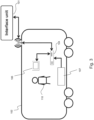
- Figure 1 shows an operational background of the invention.
- Figure 1 shows trackside equipment (208), an interface unit (101), a train (102), a communication antenna (103), and an on-board server unit (104) which includes a driver-machine interface (106) (i.e. a display).
- a driver-machine interface (106) i.e. a display
- the trackside equipment (208) typically include, for example, signals, points, train detection equipment, and train protection equipment. Based on timetables and the train locations detected by the train detection equipment, signalling settings to be enacted by the signals of the trackside equipment are decided.
- a railway operating centre (105) collects the signalling settings and the running statuses of all the trains in a pre-defined geographical region, which can contain one or multiple railway routes.
- the interface unit (101) provides a communications link using the communication antenna (103) between the on-board server unit (104) and a railway Traffic Management System (TMS) in the rail operating centre (105).
- TMS Traffic Management System
- the on-board server unit (104) has a calculation module which processes data obtained from the interface unit (101) and optionally also processes data obtained from other train-borne devices.
- the on-board server unit (104) calculates driving advice for the train driver according to the obtained data, and displays the advice on the driver-machine interface (106).
- the calculation of the driving advice is performed by a calculation module of the interface unit (101), which then sends the advice for display by the driver-machine interface (106) of the on-board server unit (104).
- the present invention enables the creation and display of such driving advice while the train is being run. In this way, the advice available to the driver can be continuously refreshed.
- the interface unit (101) can receive information from the on-board server unit (104) so that the TMS is informed of train statuses. This information can be used to improve management decisions by the TMS.
- Figure 2 illustrates the system architecture inside the railway operating centre (105).
- the railway operating centre (105) includes a timetable planning unit (209), a track description database (206) and the TMS (201).
- a track monitoring unit (207) within the TMS has two main functions. Firstly it automatically monitors real-time train locations and statuses of trackside equipment (208) by monitoring an interlocking unit (not shown) that controls the trackside equipment (208). Secondly the track monitoring unit sets routes for each train and creates signalling settings for the signals to avoid route conflicts based on the real-time train locations and trackside equipment statuses. The track monitoring unit sends the train routes and signalling settings to the interlocking unit.
- a timetable updating unit (202) within the TMS (201) updates the train running timetable, which is originally prepared by the timetable planning unit (209).
- the train running timetable created by the timetable planning unit (209) includes departure and arrival times of trains from timing points, including train stations. Under undisrupted running situations, trains run according to the planned timetable. Under disruption, the timetable updating unit (202) predicts feasible arrival and departure times and automatically creates an updated timetable.
- the timetable updating unit (202) can include a human interface having a display unit and an input unit. A human operator can then view the updated timetable on the display unit, and can adjust the timetable via the input unit if necessary. In this way, a finally updated timetable is created in the timetable updating unit (202).
- Track description database (206) stores and manages data about the railway lines.
- the track description database may be located in the railway operating centre (105).
- the railway line data can include starting and ending points of track sections, lengths of track sections, connectivities of track sections, locations of points, locations of timing points, locations of signal lights, maximum line speeds of track sections, temporary speed restrictions, track gradients, starting and ending points of track gradients, track curves, starting and ending points of track curves.
- the timetable updating unit (202) receives track description data from the track description database (206), and uses the data for creating the updated timetable.
- the interface unit (101) receives the updated timetable from the timetable updating unit (202) and signal updates from the track monitoring unit (207).
- the interface unit (101) can also receive track description data from the track description database server (206).
- the interface unit (101) can connect to the train through GSM-R, the international wireless communications standard for railway operations.
- FIG 3 shows on-board components of a driver advisory system (DAS).
- a Driver Machine Interface (DMI) (106) is placed inside the driver's cab. It provides the driver (110) with advice about optimal driving speeds and other relevant information.
- the DMI can also display upcoming real-time signaling settings received via the train interface unit (101), updated timetables, track speed limits, track gradients, other trains' locations, etc. in order to provide the driver with assistive information.
- the on-board server unit (104) receives input from the interface unit (101).
- the on-board server unit (104) also receives input such as instantaneous train speed and GPS location from other on-board equipment (107).
- the on-board server unit (104) calculates a recommended speed and a recommended speed profile (303).
- the interface unit (101) calculates a recommended speed and a recommended speed profile which are sent to the on-board server unit (104). Either way, the calculation results are displayed by the DMI (106).
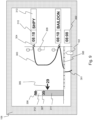
- Figure 9 illustrates an example of display contents shown by the DMI.
- the rectangular bar on the left is a speed indicator.
- the line speed limit is represented by the height of a white bar (312).
- the exact value of the speed limit (306) is displayed at the top of the white bar.
- the displayed line speed limit is dynamic, depending on the section of track the train is travelling on.
- the speed limit (306) can be sent from the track description database (206) via the interface unit (101).
- the current speed (311) is represented by the height of a shaded bar (311) overlayed on the white bar (312). The exact value of the current speed (307) can be displayed at the top of the shaded bar.
- the current speed (311) can be sent from the on-board equipment (107).
- the recommended speed (305) is indicated by an arrow, and the exact value of the recommended speed is displayed by the side of the arrow.
- a horizontal current location line (308) indicates the current location of the train (102) against a vertical journey line indicating upcoming track sections.
- the markers on the horizontal line are speed markers.
- the recorded speed profile (301) is indicated by a bold line below the current location line (308).
- the recommended speed profile (303) is indicated by a bold line above the current location line.
- the recorded speed profile is dependent historical record of the actual speed of the train.
- the recommended speed profile is calculated by the on-board server unit (104) or the interface unit (101), depending on the updated timetable, the track description data, the signal updates, and optionally train conditions.
- Timing point locations (304) are indicated by small triangles on the vertical line indicating upcoming track sections.
- the name (313) and scheduled time (310) for each TIPLOC is displayed next to the TIPLOC symbol. Names of the TIPLOCs can be extracted from the updated timetable. Although often abbreviated, TIPLOC names are familiar to qualified drivers.
- the current time (302) is displayed to the right of the current location line (308).
- Indicators (309) for upcoming signalling lights are displayed along the vertical journey line at appropriate positions.
- the updated signals can be displayed on the signal indicators in the display.
- real-time signal changes can be reflected in real-time changes on the DMI display.
- Driving advice such as new recommended speed profiles, new recommended speeds and updated signals, are re-calculated by the on-board server unit (104) or the the interface unit (101) when the timetable is updated and/or any signalling settings change.
- FIG. 4 illustrates the architecture of functional modules of the interface unit (101).
- a communication and control module (113) handles all internal communications between functional modules, and all external communications with other units.
- the main incoming data from the railway operating centre (105) are track descriptions from the track description database server (206), planned and updated timetables (211) from the timetable updating unit (202), and an interlocking data file (212) from the track monitoring unit (207).
- a signal management module (114) receives and processes the real-time signalling settings (212). Updated signals are extracted from the signalling settings and sent to relevant trains.
- a timetable management module (115) receives and processes the updated timetable (211). Relevant timetables are extracted from all the updated timetables and send to relevant trains.
- a train register module (116) keeps a list of train IDs of those trains in the TMS controlled area.
- a track data management module (117) manages track data of the controlled area. For example, the module can keep a copy of the track data. When any track data are changed, the update is sent to the module (117) from the track description database (206).
- a train running management module (118) keeps train running statuses, including latest received locations, speeds and predicted arrival times.
- a time synchronisation module (119) adjusts the system time when the interface unit application is started.
- a communication and control module (113) manages incoming and outgoing messages with the trains that are in the control area. It also manages internal communications between the above-mentioned functional modules (114-119).
- FIG. 5 shows the working arrangement of the signal management module (114).
- the track monitoring unit (207) in the TMS sends the interlocking data file (212) to the communication and control module (113), which sends it to the signal management module (114).
- the signal management module (114) then returns an acknowledgement to the track monitoring unit (207).
- a comparison function (121) within the the signal management module compares the incoming interlocking data with the last received interlocking data. If there is no change, the signal management module waits for another regular interlocking data update.
- the signal management module (114) calls the train register module (116) to obtain a copy of the list of trains that are currently in the control area.
- the signal management module (114) then loops over each train in the control area to check if the signals in front of this train have changed using a comparing function (123). If the signals have changed for the train being considered, relevant signal updates are prepared by the output function (122) to be sent to the train via the communication and control module (113). The same process continues to other trains in the current list until all the trains in the control area have been tested.
- the signal management module waits for another interlocking data update.
- Figure 6 shows how the comparing function (123) identifies whether the signals in front of a given train have changed.
- the function first calls train running module (118), which returns the GPS location of the train to the function.
- the function then calls the track management module (117) with the GPS location as argument.
- the track management module returns the signal IDs in front of the given location.
- the comparing function then compares the signals' settings.
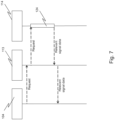
- Figure 7 shows a sequence diagram illustrating a signal update process.
- the on-board server unit (104) may request signal updates from the interface unit (101).
- the module (113) forwards the request to the signal management module (114).
- the signal management module search function (124) searches for the requested signal and returns the relevant data to the on-board server unit (104) via the communication and control module (113).
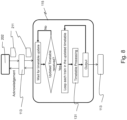
- FIG 8 shows the working arrangement of the timetable management module (115).
- the timetable updating unit (202) in the TMS prepares and sends updated timetables (211) to the communication and control module (113), which send them to the timetable management module (115).
- the timetable management module (115) then returns an acknowledgement to the timetable updating unit (202).
- An updated timetable (211) does not have to be a full timetable. It may only relate to trains whose timetables are changed.
- the timetable management module (115) loops over each train that is specified in the updated timetable.
- the timetable processing function (131) prepares data for each affected train. The data is output to the communication and control module (113), which sends it to corresponding trains.
- the updated timetable and the updated signals are displayed by the DMI, and are also used to calculate a recommended speed profile which is displayed by the DMI.
- the signal indicators (309) shown by the DMI can show not only the upcoming signal positions but also updated signal settings.
- a vertical line on a given signal can indicate a green signal, a tilted line an amber signal and ahorizontal line a red signal.
- the updated signal colours can be indicated directly by the colour of the signal indicator circle.
- the recommended speed profile (303) can be calculated by a module of the on-board server unit (104), depending on the updated timetable, the track description data, the signalling updates and optionally locomotive conditions.
- the on-board server unit (104) extracts the scheduled time of each TIPLOC (SHPY and BAILDON) from the updated timetable.
- the on-board server unit (104) also extracts the line speed limit (312) from the track description database, and the updated signalling setting of each signal indicator in front of the train.
- the recommended speed profile (303) is calculated so that the train arrives at each TIPLOC on time, the train speed does not exceed the line speed limit (312), and the signals are obeyed.
- the recommended speed profile (303) can be calculated so that the train can avoid unnecessary acceleration and braking, thereby improving ride comfort and reducing energy consumption.
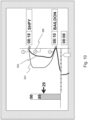
- Figure 10 illustrates the display contents shown by the DMI when the signal settings change without a timetable change.
- the setting changes are reflected by the signal indicators (309), and the recommended speed profile (303) is adjusted to reflect the changed signal settings.
- the middle signal indicator (309) shows amber, changed from green, and the upper signal indicator shows red, changed from green.
- the recommended speed profile (303) is adjusted to a slower speed profile, because the amber signal could change to red. Without this updated signalling information, the DMI would continue to display the original recommended speed profile (323). Then, if a driver drove according to the original recommended speed profile (323) and did not observe the amber signal, a safety system may have to be actuated to force a stop to avoid running through a red signal. This is undesirable, not only from a compromised safety viewpoint, but also because it reduces ride comfort, wastes energy and increases brake wear and tear.
- Figure 11 illustrates the display contents shown by the DMI when the upper and middle signal indicators (309) display red signals, changed from green, and the lower signal indicator shows amber, changed from green.
- the recommended speed profile (303) is now adjusted to even slower speeds and advises a stop at the middle signal. Again, without the updated signalling information, the DMI would mislead the driver.
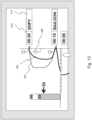
- Figure 12 illustrates the display contents shown by the DMI when there is a timetable update.
- the DMI displays the updated timetable using the scheduled time indicator (310), and the on-board server unit (104) recalculates and adjusts the recommended speed profile (303) which is also displayed on the DMI.
- the updated timetable changes the scheduled time (310) of TIPLOC SHPY (304), from 08:18 to 08:26.
- the recommended speed profile (303) is changed to a slower speed compatible with the later scheduled time, and thereby reduces energy consumption.
- the train stops at TIPLOC SHPY for a relatively short time. This reduced stop time increases the possibilities for other train to maneouver using the available track and recover faster from disruption, hence the overall reliability of the railway network can be improved.
- the DMI would still display the original timetable and the original speed profile (323) based on the original timetable. If the driver drove according to the original advice, the train would accelerate to a higher speed compatible with the original timetable (08:18). The train would then stop at SHPY until the updated timetable time (08:26) was reached. Therefore, the train would reach to SHPY too early and waste energy.
- the DMI shows the same display as described above in relation to Figures 9 to 12 .
- this calculation can be performed for each train by a further module of the interface unit (101).
- the recommended speed profile can then be transmitted to each train, along with the relevant updated timetable, updated signals and track description data, via the communication and control module (113).
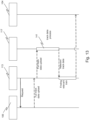
- Figure 13 is a sequence diagram showing an initialisation process of the track data.
- the communication and control module (113) sends a request to the railway operating centre (105).
- the railway operating centre (105) sends the full track data from the track description database (206) to the communication and control module (113), which forwards the data to the track data management module (117).
- the track data management module (117) processes the track data and prepares for each train in the control area the relevant track data.
- the relevant data is forwarded to the individual on-board server unit (104) via the communication and control module (113).
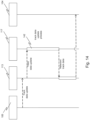
- Figure 14 is a sequence diagram showing an update process of the track data.
- update process of the track data When there is any update of the track data, especially temporary speed restrictions or emergency speed restrictions, such updates are sent to the track data management module (117) via the communication and control module (113).
- the track data management module (117) processes the updated track data and prepares for each train in the control area affected by the track data update the relevant track data.
- the relevant data is forwarded to the individual on-board server unit (104) via the communication and control module (113).
- the track data management module (117) stores the links between GPS coordinates and positions on track sections. If GPS coordinates are input to the module (117), the module returns the upcoming signals and track data.
- Figure 15 is a sequence diagram showing the process of searching for train-related signals.
- the track data management module (117) searches the relevant track section and returns to the signalling management module the relevant track data, including signal and upcoming track details.
- a more integrated option is for the track data management module (117) to make a query to the track description database (206) when necessary, but not to store track data itself.
- the train register module (116) maintains a list of train IDs of those trains in the TMS controlled area.
- the train register module (116) can store a copy of the train list from the TMS.
- Another option is for the train register module (116) to monitor the boundary of the controlled area. The module can then add a train ID to the list when a train arrives at the boundary, and remove a train ID from the list when a train leaves the controlled area form the boundary.
- the train register module can maintain a record of the on-board server unit (104) connection details for each currently registered trains.
- the on-board server unit (104) can send the current location of the train to the interface unit (101).
- the communication and control module (113) forwards such data to the train running module (118).
- the signalling management module (114) checks whether the signal settings are changed for the train in question, it first calls the train running management module (118) to get the location of the train. When contacted, the train running management module (118) returns the GPS location of train to the signalling management module.
- the on-board server unit (104) or the interface unit (101) can predict the running time of train, based on the recommended speed profile. The predicted running time may be sent to the train running module (118). The module can then forward such information to the TMS.
- the on-board server unit (104) or the interface unit (101) can send to the train running module (118) a message to indicate whether the timetable can be achieved by the train.
- the train running module can also forward such information to the TMS.
Landscapes
- Engineering & Computer Science (AREA)
- Mechanical Engineering (AREA)
- Train Traffic Observation, Control, And Security (AREA)
- Electric Propulsion And Braking For Vehicles (AREA)
- Management, Administration, Business Operations System, And Electronic Commerce (AREA)
Claims (6)
- Système de gestion de trains comprenant :une unité serveur embarquée (104) d'un train donné (102) ; etun centre opérationnel ferroviaire (105) qui comprend :(i) une unité de surveillance de voie (207) configurée pour : surveiller des emplacements de trains et des états d'un équipement de signalisation en bordure de voie (208), et créer des paramètres de signalisation à adopter par l'équipement de signalisation en bordure de voie sur la base des emplacements actuels des trains et des états actuels de l'équipement de signalisation en bordure de voie,(ii) une unité de mise à jour d'horaires (202) configurée pour : mettre à jour des horaires des trains sur la base des emplacements actuels des trains, les horaires mis à jour par l'unité de mise à jour d'horaires comprenant des heures de départ et d'arrivée des trains à partir de points de synchronisation comprenant des gares ;dans lequel le système de gestion de trains comprend en outre un module de calcul configuré pour, pendant que le train donné circule, calculer de manière répétée un profil de vitesse recommandé pour le train donné compatible avec le dernier horaire mis à jour pour le train donné et des derniers signaux mis à jour à partir des paramètres de signalisation ; etdans lequel l'unité serveur embarquée est configurée pour afficher le dernier profil de vitesse recommandé en tant que conseil pour un conducteur du train donné.
- Système de gestion de trains selon la revendication 1, dans lequel le centre opérationnel ferroviaire comprend en outre une unité d'interface (101) configurée pour, pendant que le train donné circule, envoyer le dernier horaire mis à jour et les derniers signaux mis à jour à l'unité serveur embarquée ; et
dans lequel le module de calcul fait partie de l'unité serveur embarquée. - Système de gestion de trains selon la revendication 2, dans lequel l'unité d'interface comprend en outre un module de gestion de signalisation (114) configuré pour vérifier si les paramètres de signalisation à l'avant du train donné ont changé, et l'unité d'interface est configurée pour envoyer les signaux mis à jour à l'unité serveur embarquée uniquement lorsque les paramètres de signalisation à l'avant du train ont changé.
- Système de gestion de trains selon la revendication 1, dans lequel le centre opérationnel ferroviaire comprend en outre une unité d'interface (101) ; et
dans lequel le module de calcul fait partie de l'unité d'interface, qui est configurée pour envoyer le profil de vitesse recommandé à l'unité serveur embarquée. - Système de gestion de trains selon l'une quelconque des revendications précédentes, dans lequel l'unité serveur embarquée est en outre configurée pour afficher le dernier horaire mis à jour et les derniers signaux mis à jour en tant que conseil pour le conducteur du train donné.
- Système de gestion de trains selon l'une quelconque des revendications précédentes, dans lequel le centre opérationnel ferroviaire comprend en outre une base de données de description de voie (206) configurée pour contenir des informations sur les vitesses maximales de voie, et le module de calcul est configuré pour calculer le profil de vitesse recommandé pour le train donné compatible avec le dernier horaire mis à jour et les derniers signaux mis à jour, mais ne dépassant pas les vitesses maximales de voie.
Priority Applications (4)
| Application Number | Priority Date | Filing Date | Title |
|---|---|---|---|
| EP14177525.4A EP2974939B1 (fr) | 2014-07-17 | 2014-07-17 | Système de gestion de train |
| US14/798,875 US20160016598A1 (en) | 2014-07-17 | 2015-07-14 | Device for interfacing railway driver advisory system |
| JP2015140251A JP6125574B2 (ja) | 2014-07-17 | 2015-07-14 | 列車管理システム |
| CN201510418892.1A CN105270446B (zh) | 2014-07-17 | 2015-07-16 | 列车管理系统 |
Applications Claiming Priority (1)
| Application Number | Priority Date | Filing Date | Title |
|---|---|---|---|
| EP14177525.4A EP2974939B1 (fr) | 2014-07-17 | 2014-07-17 | Système de gestion de train |
Publications (2)
| Publication Number | Publication Date |
|---|---|
| EP2974939A1 EP2974939A1 (fr) | 2016-01-20 |
| EP2974939B1 true EP2974939B1 (fr) | 2023-06-07 |
Family
ID=51178807
Family Applications (1)
| Application Number | Title | Priority Date | Filing Date |
|---|---|---|---|
| EP14177525.4A Active EP2974939B1 (fr) | 2014-07-17 | 2014-07-17 | Système de gestion de train |
Country Status (4)
| Country | Link |
|---|---|
| US (1) | US20160016598A1 (fr) |
| EP (1) | EP2974939B1 (fr) |
| JP (1) | JP6125574B2 (fr) |
| CN (1) | CN105270446B (fr) |
Families Citing this family (21)
| Publication number | Priority date | Publication date | Assignee | Title |
|---|---|---|---|---|
| WO2014011887A1 (fr) * | 2012-07-11 | 2014-01-16 | Carnegie Mellon University | Système de verrouillage de voie ferrée à commande répartie |
| JP6153882B2 (ja) * | 2014-03-27 | 2017-06-28 | 日立建機株式会社 | 車両走行システム及び運行管理サーバ |
| TW201737856A (zh) * | 2016-02-25 | 2017-11-01 | 威廉 袁 | 智慧型服裝 |
| DE102016203675A1 (de) * | 2016-03-07 | 2017-09-07 | Siemens Aktiengesellschaft | Vorrichtung zur Erzeugung streckenbezogener Betriebsdaten |
| EP3219576B1 (fr) * | 2016-03-15 | 2021-11-10 | KNORR-BREMSE Systeme für Schienenfahrzeuge GmbH | Commande de train integre et systeme conseillant le conducteur |
| JP2017165237A (ja) * | 2016-03-16 | 2017-09-21 | 株式会社日立製作所 | 列車運転支援システム |
| WO2018232129A1 (fr) * | 2017-06-15 | 2018-12-20 | Westinghouse Air Brake Technologies Corporation | Système et procédé de réglage d'avertissement de croisement |
| JP7066365B2 (ja) * | 2017-10-16 | 2022-05-13 | 株式会社日立製作所 | ダイヤ作成装置および自動列車制御システム |
| CN108032876B (zh) * | 2017-11-13 | 2020-02-14 | 北京全路通信信号研究设计院集团有限公司 | 一种车站运输调度方法和系统 |
| CN108189870A (zh) * | 2017-12-29 | 2018-06-22 | 中车株洲电力机车研究所有限公司 | 一种基于智轨列车的调度方法和设备 |
| JP7273531B2 (ja) | 2019-02-18 | 2023-05-15 | 株式会社東芝 | 列車制御システム及び方法 |
| DE102019203919A1 (de) * | 2019-03-22 | 2020-09-24 | Siemens Mobility GmbH | Verfahren zum Betrieb eines Fahrerassistenzsystems für ein spurgebundenes Fahrzeug |
| CN111114598A (zh) * | 2019-12-31 | 2020-05-08 | 卡斯柯信号有限公司 | 一种有轨电车信号系统预测计划自动调整方法 |
| CN112398558B (zh) * | 2020-11-24 | 2023-04-07 | 中铁第一勘察设计院集团有限公司 | 适用于地铁列车全自动驾驶检修区域的登车信息提示系统 |
| CN112960016B (zh) * | 2021-03-05 | 2023-04-18 | 国网北京市电力公司 | 非侵入式轨道交通列车运行态势感知方法与装置 |
| IT202200010823A1 (it) * | 2022-05-24 | 2023-11-24 | Hitachi Rail Sts S P A | Metodo di controllo per un sistema di controllo di un impianto di trasporto ferroviario e detto sistema di controllo di un impianto di trasporto ferroviario |
| CN114954575B (zh) * | 2022-06-29 | 2024-03-12 | 宁波极晋科技开发有限公司 | 一种车地信息传输系统及精确定位方法 |
| CN115366954B (zh) * | 2022-07-20 | 2023-08-29 | 卡斯柯信号有限公司 | 一种tacs与cbtc兼容运行的系统及方法 |
| FR3146865A1 (fr) * | 2023-03-21 | 2024-09-27 | SNCF Voyageurs | Systeme et procede d’assistance a la conduite des trains d’un reseau ferroviaire |
| ES3009577B2 (es) * | 2023-09-27 | 2026-01-27 | Limmat M&M S L | Método y sistema para la mejora de la seguridad en la circulación ferroviaria |
| KR102741276B1 (ko) * | 2023-12-19 | 2024-12-11 | (주)테크빌 | Ktcs 차상 신호 장치를 이용한 열차 에너지 효율 향상을 위한 열차 주행 최적화 장치 및 방법과 이를 이용한 열차 제어 시스템 |
Citations (6)
| Publication number | Priority date | Publication date | Assignee | Title |
|---|---|---|---|---|
| WO1998030426A1 (fr) | 1997-01-13 | 1998-07-16 | Siemens Aktiengesellschaft | Procede d'asservissement de vitesse d'un vehicule ferroviaire |
| WO2007111768A2 (fr) | 2006-03-20 | 2007-10-04 | General Electric Company | Systeme et procede d'optimisation de trajet pour train |
| WO2008042516A2 (fr) | 2006-10-02 | 2008-04-10 | General Electric Company | Système et procédé d'optimisation des paramètres de véhicules ferroviaires multiples opérant sur des réseaux à voies ferrées multiples formant des intersections |
| US7558740B2 (en) | 1994-09-01 | 2009-07-07 | Harris Corporation | System and method for scheduling and train control |
| WO2010102898A1 (fr) | 2009-03-12 | 2010-09-16 | Siemens Aktiengesellschaft | Procédé d'exploitation d'un dispositif permettant d'influencer les trains, unité électronique côté voie et balise pour un dispositif permettant d'influencer les trains ainsi que dispositif permettant d'influencer les trains |
| DE102010024800A1 (de) | 2009-06-25 | 2011-01-13 | Knorr-Bremse Systeme für Schienenfahrzeuge GmbH | Anzeigevorrichtung und Verfahren zum Betreiben einer Anzeigevorrichtung |
Family Cites Families (10)
| Publication number | Priority date | Publication date | Assignee | Title |
|---|---|---|---|---|
| JPH08156794A (ja) * | 1994-10-05 | 1996-06-18 | Hitachi Ltd | 運転曲線作成方法及びその装置 |
| AT410531B (de) * | 1999-05-25 | 2003-05-26 | Bernard Ing Douet | Verfahren und system zur automatischen erfassung bzw. überwachung der position wenigstens eines schienenfahrzeugs |
| JP3089240B1 (ja) * | 1999-06-01 | 2000-09-18 | 株式会社京三製作所 | 自動ダイヤ整理装置 |
| JP2006511394A (ja) * | 2002-12-20 | 2006-04-06 | ユニオン スイッチ アンド シグナル インコーポレーテッド | 動的最適化交通プランニング方法及びシステム |
| JP4521230B2 (ja) * | 2004-08-05 | 2010-08-11 | 株式会社東芝 | 路面電車の運行支援装置 |
| US8126601B2 (en) * | 2006-03-20 | 2012-02-28 | General Electric Company | System and method for predicting a vehicle route using a route network database |
| US8370006B2 (en) * | 2006-03-20 | 2013-02-05 | General Electric Company | Method and apparatus for optimizing a train trip using signal information |
| JP5355495B2 (ja) * | 2010-01-13 | 2013-11-27 | 株式会社日立製作所 | 信号保安システム |
| DE102012206859A1 (de) * | 2012-04-25 | 2013-10-31 | Siemens Ag | Verfahren zum Erzeugen von Handlungsempfehlungen für den Führer eines Schienenfahrzeugs oder Steuersignalen für das Schienenfahrzeug mittels eines Fahrerassistenzsystems und Fahrassistenzsystem |
| CN107364434A (zh) * | 2013-09-03 | 2017-11-21 | 梅特罗姆铁路公司 | 铁路车辆信号执行和分离控制 |
-
2014
- 2014-07-17 EP EP14177525.4A patent/EP2974939B1/fr active Active
-
2015
- 2015-07-14 JP JP2015140251A patent/JP6125574B2/ja active Active
- 2015-07-14 US US14/798,875 patent/US20160016598A1/en not_active Abandoned
- 2015-07-16 CN CN201510418892.1A patent/CN105270446B/zh active Active
Patent Citations (6)
| Publication number | Priority date | Publication date | Assignee | Title |
|---|---|---|---|---|
| US7558740B2 (en) | 1994-09-01 | 2009-07-07 | Harris Corporation | System and method for scheduling and train control |
| WO1998030426A1 (fr) | 1997-01-13 | 1998-07-16 | Siemens Aktiengesellschaft | Procede d'asservissement de vitesse d'un vehicule ferroviaire |
| WO2007111768A2 (fr) | 2006-03-20 | 2007-10-04 | General Electric Company | Systeme et procede d'optimisation de trajet pour train |
| WO2008042516A2 (fr) | 2006-10-02 | 2008-04-10 | General Electric Company | Système et procédé d'optimisation des paramètres de véhicules ferroviaires multiples opérant sur des réseaux à voies ferrées multiples formant des intersections |
| WO2010102898A1 (fr) | 2009-03-12 | 2010-09-16 | Siemens Aktiengesellschaft | Procédé d'exploitation d'un dispositif permettant d'influencer les trains, unité électronique côté voie et balise pour un dispositif permettant d'influencer les trains ainsi que dispositif permettant d'influencer les trains |
| DE102010024800A1 (de) | 2009-06-25 | 2011-01-13 | Knorr-Bremse Systeme für Schienenfahrzeuge GmbH | Anzeigevorrichtung und Verfahren zum Betreiben einer Anzeigevorrichtung |
Non-Patent Citations (6)
| Title |
|---|
| ANONYMOUS: "ATO OVER ETCS GLOSSARY, version 1.6", ERTMS USERS GROUP; EUG REFERENCE: 13E154, 3 May 2018 (2018-05-03), XP093136401, [retrieved on 20240229] |
| LüTHI MARCO: "Improving the efficiency of heavily used railway networks through integrated real-time rescheduling", IVT SCHRIFTENREIHE, DISSERTATION ETH, INSTITUT FüR VERKEHRSPLANUNG UND TRANSPORTSYSTEME (IVT), ETH ZüRICH, no. 18615, 1 January 2009 (2009-01-01), XP055781314, ISBN: 978-3-905826-11-1, DOI: 10.3929/ethz-a-005911895 |
| PANOU KONSTANTINOS, TZIEROPOULOS PANOS; EMERY DANIEL: "Railway driver advice systems: Evaluation of methods, tools and systems", JOURNAL OF RAIL TRANSPORT PLANNING & MANAGEMENT, ELSEVIER, vol. 3, no. 4, 1 November 2013 (2013-11-01), pages 150 - 162, XP093171309, ISSN: 2210-9706, DOI: 10.1016/j.jrtpm.2013.10.005 |
| ULLA METZGER, JOCHEN VORDEREGGER: "Human Factors und Ergonomie im ERTMS/ETCS - Einheitliche Anzeige und Bedienung", SIGNAL UND DRAHT: SIGNALLING & DATACOMMUNICATION, EURAILPRESS, DE, no. 12, 1 January 2004 (2004-01-01), DE , pages 35 - 40, XP009554683, ISSN: 0037-4997 |
| ULRICH LINDEN: "Optimierung von Fahrweisen im spurgeführten Verkehr und deren Umsetzung", BERLIN, 1 January 2004 (2004-01-01), Berlin , XP055062319, Retrieved from the Internet <URL:http://opus.kobv.de/tuberlin/volltexte/2004/790/pdf/linder_ulrich.pdf> [retrieved on 20130508] |
| YOUNG MARK S, STANTON NEVILLE A; WALKER GUY H: "In loco intellegentia: human factors for the future European train driver", INTERNATIONAL JOURNAL OF INDUSTRIAL AND SYSTEMS ENGINEERING, vol. 1, no. 4, 1 January 2006 (2006-01-01), pages 485, XP093171325, ISSN: 1748-5037, DOI: 10.1504/IJISE.2006.010388 |
Also Published As
| Publication number | Publication date |
|---|---|
| JP6125574B2 (ja) | 2017-05-10 |
| EP2974939A1 (fr) | 2016-01-20 |
| CN105270446A (zh) | 2016-01-27 |
| JP2016022950A (ja) | 2016-02-08 |
| CN105270446B (zh) | 2017-07-18 |
| US20160016598A1 (en) | 2016-01-21 |
Similar Documents
| Publication | Publication Date | Title |
|---|---|---|
| EP2974939B1 (fr) | Système de gestion de train | |
| US9916759B2 (en) | Signal light priority system utilizing estimated time of arrival | |
| US9428202B2 (en) | Train safety system | |
| US9302687B2 (en) | Light rail vehicle monitoring and stop bar overrun system | |
| US6459965B1 (en) | Method for advanced communication-based vehicle control | |
| EP3219573A1 (fr) | Système d'assistance à la conduite de train | |
| AU2015264896B2 (en) | Railroad control system having onboard management | |
| CN112758135B (zh) | 一种基于5g网络和车联网的车辆控制系统及其控制方法 | |
| KR101653771B1 (ko) | 열차 관제 시스템 | |
| CN117508268B (zh) | 一种地铁工程车辅助安全驾驶系统 | |
| JP3553466B2 (ja) | 列車運行管理システム | |
| JP2012020712A (ja) | 列車運転支援システム | |
| EP4655188A1 (fr) | Système et procédé pour un signal d'approche virtuelle | |
| KR101051793B1 (ko) | 작업 열차의 이동을 도와주는 방법과 시스템 | |
| CN109625036B (zh) | 一种非通信车车次窗的推算处理方法 | |
| CN214565379U (zh) | 一种基于5g网络和车联网的车辆控制系统 | |
| RU2676597C2 (ru) | Описание схемы параллельных путей | |
| RU120620U1 (ru) | Система для обеспечения технологической дисциплины диспетчерского управления движением поездов | |
| JP2010009374A (ja) | 交差点無停止走行制御システム | |
| JP2003200828A (ja) | 鉄道車両の運行監視方法および運行監視システム | |
| WO2025096887A1 (fr) | Système et procédé de gestion de trains | |
| WO2025083890A1 (fr) | Système de création de diagramme de résultats réels | |
| CN112572548A (zh) | 车辆运行信息显示方法及系统 |
Legal Events
| Date | Code | Title | Description |
|---|---|---|---|
| PUAI | Public reference made under article 153(3) epc to a published international application that has entered the european phase |
Free format text: ORIGINAL CODE: 0009012 |
|
| 17P | Request for examination filed |
Effective date: 20140731 |
|
| AK | Designated contracting states |
Kind code of ref document: A1 Designated state(s): AL AT BE BG CH CY CZ DE DK EE ES FI FR GB GR HR HU IE IS IT LI LT LU LV MC MK MT NL NO PL PT RO RS SE SI SK SM TR |
|
| AX | Request for extension of the european patent |
Extension state: BA ME |
|
| STAA | Information on the status of an ep patent application or granted ep patent |
Free format text: STATUS: EXAMINATION IS IN PROGRESS |
|
| 17Q | First examination report despatched |
Effective date: 20180511 |
|
| REG | Reference to a national code |
Ref country code: DE Ref legal event code: R079 Ref document number: 602014087112 Country of ref document: DE Free format text: PREVIOUS MAIN CLASS: B61L0027000000 Ipc: B61L0027160000 |
|
| GRAP | Despatch of communication of intention to grant a patent |
Free format text: ORIGINAL CODE: EPIDOSNIGR1 |
|
| STAA | Information on the status of an ep patent application or granted ep patent |
Free format text: STATUS: GRANT OF PATENT IS INTENDED |
|
| RIC1 | Information provided on ipc code assigned before grant |
Ipc: B61L 27/16 20220101AFI20221205BHEP |
|
| INTG | Intention to grant announced |
Effective date: 20230105 |
|
| GRAS | Grant fee paid |
Free format text: ORIGINAL CODE: EPIDOSNIGR3 |
|
| GRAA | (expected) grant |
Free format text: ORIGINAL CODE: 0009210 |
|
| STAA | Information on the status of an ep patent application or granted ep patent |
Free format text: STATUS: THE PATENT HAS BEEN GRANTED |
|
| AK | Designated contracting states |
Kind code of ref document: B1 Designated state(s): AL AT BE BG CH CY CZ DE DK EE ES FI FR GB GR HR HU IE IS IT LI LT LU LV MC MK MT NL NO PL PT RO RS SE SI SK SM TR |
|
| REG | Reference to a national code |
Ref country code: GB Ref legal event code: FG4D |
|
| REG | Reference to a national code |
Ref country code: CH Ref legal event code: EP Ref country code: AT Ref legal event code: REF Ref document number: 1574157 Country of ref document: AT Kind code of ref document: T Effective date: 20230615 Ref country code: DE Ref legal event code: R096 Ref document number: 602014087112 Country of ref document: DE |
|
| REG | Reference to a national code |
Ref country code: LT Ref legal event code: MG9D |
|
| REG | Reference to a national code |
Ref country code: NL Ref legal event code: MP Effective date: 20230607 |
|
| PG25 | Lapsed in a contracting state [announced via postgrant information from national office to epo] |
Ref country code: SE Free format text: LAPSE BECAUSE OF FAILURE TO SUBMIT A TRANSLATION OF THE DESCRIPTION OR TO PAY THE FEE WITHIN THE PRESCRIBED TIME-LIMIT Effective date: 20230607 Ref country code: NO Free format text: LAPSE BECAUSE OF FAILURE TO SUBMIT A TRANSLATION OF THE DESCRIPTION OR TO PAY THE FEE WITHIN THE PRESCRIBED TIME-LIMIT Effective date: 20230907 Ref country code: ES Free format text: LAPSE BECAUSE OF FAILURE TO SUBMIT A TRANSLATION OF THE DESCRIPTION OR TO PAY THE FEE WITHIN THE PRESCRIBED TIME-LIMIT Effective date: 20230607 |
|
| REG | Reference to a national code |
Ref country code: AT Ref legal event code: MK05 Ref document number: 1574157 Country of ref document: AT Kind code of ref document: T Effective date: 20230607 |
|
| PG25 | Lapsed in a contracting state [announced via postgrant information from national office to epo] |
Ref country code: RS Free format text: LAPSE BECAUSE OF FAILURE TO SUBMIT A TRANSLATION OF THE DESCRIPTION OR TO PAY THE FEE WITHIN THE PRESCRIBED TIME-LIMIT Effective date: 20230607 Ref country code: NL Free format text: LAPSE BECAUSE OF FAILURE TO SUBMIT A TRANSLATION OF THE DESCRIPTION OR TO PAY THE FEE WITHIN THE PRESCRIBED TIME-LIMIT Effective date: 20230607 Ref country code: LV Free format text: LAPSE BECAUSE OF FAILURE TO SUBMIT A TRANSLATION OF THE DESCRIPTION OR TO PAY THE FEE WITHIN THE PRESCRIBED TIME-LIMIT Effective date: 20230607 Ref country code: LT Free format text: LAPSE BECAUSE OF FAILURE TO SUBMIT A TRANSLATION OF THE DESCRIPTION OR TO PAY THE FEE WITHIN THE PRESCRIBED TIME-LIMIT Effective date: 20230607 Ref country code: HR Free format text: LAPSE BECAUSE OF FAILURE TO SUBMIT A TRANSLATION OF THE DESCRIPTION OR TO PAY THE FEE WITHIN THE PRESCRIBED TIME-LIMIT Effective date: 20230607 Ref country code: GR Free format text: LAPSE BECAUSE OF FAILURE TO SUBMIT A TRANSLATION OF THE DESCRIPTION OR TO PAY THE FEE WITHIN THE PRESCRIBED TIME-LIMIT Effective date: 20230908 |
|
| PG25 | Lapsed in a contracting state [announced via postgrant information from national office to epo] |
Ref country code: FI Free format text: LAPSE BECAUSE OF FAILURE TO SUBMIT A TRANSLATION OF THE DESCRIPTION OR TO PAY THE FEE WITHIN THE PRESCRIBED TIME-LIMIT Effective date: 20230607 |
|
| PG25 | Lapsed in a contracting state [announced via postgrant information from national office to epo] |
Ref country code: SK Free format text: LAPSE BECAUSE OF FAILURE TO SUBMIT A TRANSLATION OF THE DESCRIPTION OR TO PAY THE FEE WITHIN THE PRESCRIBED TIME-LIMIT Effective date: 20230607 |
|
| PG25 | Lapsed in a contracting state [announced via postgrant information from national office to epo] |
Ref country code: IS Free format text: LAPSE BECAUSE OF FAILURE TO SUBMIT A TRANSLATION OF THE DESCRIPTION OR TO PAY THE FEE WITHIN THE PRESCRIBED TIME-LIMIT Effective date: 20231007 |
|
| PG25 | Lapsed in a contracting state [announced via postgrant information from national office to epo] |
Ref country code: SM Free format text: LAPSE BECAUSE OF FAILURE TO SUBMIT A TRANSLATION OF THE DESCRIPTION OR TO PAY THE FEE WITHIN THE PRESCRIBED TIME-LIMIT Effective date: 20230607 Ref country code: SK Free format text: LAPSE BECAUSE OF FAILURE TO SUBMIT A TRANSLATION OF THE DESCRIPTION OR TO PAY THE FEE WITHIN THE PRESCRIBED TIME-LIMIT Effective date: 20230607 Ref country code: RO Free format text: LAPSE BECAUSE OF FAILURE TO SUBMIT A TRANSLATION OF THE DESCRIPTION OR TO PAY THE FEE WITHIN THE PRESCRIBED TIME-LIMIT Effective date: 20230607 Ref country code: PT Free format text: LAPSE BECAUSE OF FAILURE TO SUBMIT A TRANSLATION OF THE DESCRIPTION OR TO PAY THE FEE WITHIN THE PRESCRIBED TIME-LIMIT Effective date: 20231009 Ref country code: IS Free format text: LAPSE BECAUSE OF FAILURE TO SUBMIT A TRANSLATION OF THE DESCRIPTION OR TO PAY THE FEE WITHIN THE PRESCRIBED TIME-LIMIT Effective date: 20231007 Ref country code: EE Free format text: LAPSE BECAUSE OF FAILURE TO SUBMIT A TRANSLATION OF THE DESCRIPTION OR TO PAY THE FEE WITHIN THE PRESCRIBED TIME-LIMIT Effective date: 20230607 Ref country code: CZ Free format text: LAPSE BECAUSE OF FAILURE TO SUBMIT A TRANSLATION OF THE DESCRIPTION OR TO PAY THE FEE WITHIN THE PRESCRIBED TIME-LIMIT Effective date: 20230607 Ref country code: AT Free format text: LAPSE BECAUSE OF FAILURE TO SUBMIT A TRANSLATION OF THE DESCRIPTION OR TO PAY THE FEE WITHIN THE PRESCRIBED TIME-LIMIT Effective date: 20230607 |
|
| REG | Reference to a national code |
Ref country code: DE Ref legal event code: R119 Ref document number: 602014087112 Country of ref document: DE |
|
| PG25 | Lapsed in a contracting state [announced via postgrant information from national office to epo] |
Ref country code: PL Free format text: LAPSE BECAUSE OF FAILURE TO SUBMIT A TRANSLATION OF THE DESCRIPTION OR TO PAY THE FEE WITHIN THE PRESCRIBED TIME-LIMIT Effective date: 20230607 |
|
| REG | Reference to a national code |
Ref country code: CH Ref legal event code: PL |
|
| PG25 | Lapsed in a contracting state [announced via postgrant information from national office to epo] |
Ref country code: MC Free format text: LAPSE BECAUSE OF FAILURE TO SUBMIT A TRANSLATION OF THE DESCRIPTION OR TO PAY THE FEE WITHIN THE PRESCRIBED TIME-LIMIT Effective date: 20230607 |
|
| PLBI | Opposition filed |
Free format text: ORIGINAL CODE: 0009260 |
|
| REG | Reference to a national code |
Ref country code: BE Ref legal event code: MM Effective date: 20230731 |
|
| PLAX | Notice of opposition and request to file observation + time limit sent |
Free format text: ORIGINAL CODE: EPIDOSNOBS2 |
|
| PG25 | Lapsed in a contracting state [announced via postgrant information from national office to epo] |
Ref country code: LU Free format text: LAPSE BECAUSE OF NON-PAYMENT OF DUE FEES Effective date: 20230717 |
|
| PG25 | Lapsed in a contracting state [announced via postgrant information from national office to epo] |
Ref country code: MC Free format text: LAPSE BECAUSE OF FAILURE TO SUBMIT A TRANSLATION OF THE DESCRIPTION OR TO PAY THE FEE WITHIN THE PRESCRIBED TIME-LIMIT Effective date: 20230607 Ref country code: LU Free format text: LAPSE BECAUSE OF NON-PAYMENT OF DUE FEES Effective date: 20230717 |
|
| 26 | Opposition filed |
Opponent name: KNORR-BREMSE SYSTEME FUER NUTZFAHRZEUGE GMBH Effective date: 20240307 Opponent name: SIEMENS MOBILITY GMBH Effective date: 20240307 |
|
| REG | Reference to a national code |
Ref country code: IE Ref legal event code: MM4A |
|
| PG25 | Lapsed in a contracting state [announced via postgrant information from national office to epo] |
Ref country code: DK Free format text: LAPSE BECAUSE OF FAILURE TO SUBMIT A TRANSLATION OF THE DESCRIPTION OR TO PAY THE FEE WITHIN THE PRESCRIBED TIME-LIMIT Effective date: 20230607 Ref country code: DE Free format text: LAPSE BECAUSE OF NON-PAYMENT OF DUE FEES Effective date: 20240201 Ref country code: CH Free format text: LAPSE BECAUSE OF NON-PAYMENT OF DUE FEES Effective date: 20230731 |
|
| PG25 | Lapsed in a contracting state [announced via postgrant information from national office to epo] |
Ref country code: SI Free format text: LAPSE BECAUSE OF FAILURE TO SUBMIT A TRANSLATION OF THE DESCRIPTION OR TO PAY THE FEE WITHIN THE PRESCRIBED TIME-LIMIT Effective date: 20230607 |
|
| PG25 | Lapsed in a contracting state [announced via postgrant information from national office to epo] |
Ref country code: SI Free format text: LAPSE BECAUSE OF FAILURE TO SUBMIT A TRANSLATION OF THE DESCRIPTION OR TO PAY THE FEE WITHIN THE PRESCRIBED TIME-LIMIT Effective date: 20230607 Ref country code: BE Free format text: LAPSE BECAUSE OF NON-PAYMENT OF DUE FEES Effective date: 20230731 |
|
| PG25 | Lapsed in a contracting state [announced via postgrant information from national office to epo] |
Ref country code: IE Free format text: LAPSE BECAUSE OF NON-PAYMENT OF DUE FEES Effective date: 20230717 |
|
| PLBB | Reply of patent proprietor to notice(s) of opposition received |
Free format text: ORIGINAL CODE: EPIDOSNOBS3 |
|
| PG25 | Lapsed in a contracting state [announced via postgrant information from national office to epo] |
Ref country code: IE Free format text: LAPSE BECAUSE OF NON-PAYMENT OF DUE FEES Effective date: 20230717 Ref country code: FR Free format text: LAPSE BECAUSE OF NON-PAYMENT OF DUE FEES Effective date: 20230807 |
|
| P01 | Opt-out of the competence of the unified patent court (upc) registered |
Free format text: CASE NUMBER: APP_42923/2024 Effective date: 20240722 |
|
| PG25 | Lapsed in a contracting state [announced via postgrant information from national office to epo] |
Ref country code: BG Free format text: LAPSE BECAUSE OF FAILURE TO SUBMIT A TRANSLATION OF THE DESCRIPTION OR TO PAY THE FEE WITHIN THE PRESCRIBED TIME-LIMIT Effective date: 20230607 |
|
| PG25 | Lapsed in a contracting state [announced via postgrant information from national office to epo] |
Ref country code: BG Free format text: LAPSE BECAUSE OF FAILURE TO SUBMIT A TRANSLATION OF THE DESCRIPTION OR TO PAY THE FEE WITHIN THE PRESCRIBED TIME-LIMIT Effective date: 20230607 |
|
| PGFP | Annual fee paid to national office [announced via postgrant information from national office to epo] |
Ref country code: GB Payment date: 20250529 Year of fee payment: 12 |
|
| PG25 | Lapsed in a contracting state [announced via postgrant information from national office to epo] |
Ref country code: CY Free format text: LAPSE BECAUSE OF FAILURE TO SUBMIT A TRANSLATION OF THE DESCRIPTION OR TO PAY THE FEE WITHIN THE PRESCRIBED TIME-LIMIT; INVALID AB INITIO Effective date: 20140717 |
|
| PG25 | Lapsed in a contracting state [announced via postgrant information from national office to epo] |
Ref country code: HU Free format text: LAPSE BECAUSE OF FAILURE TO SUBMIT A TRANSLATION OF THE DESCRIPTION OR TO PAY THE FEE WITHIN THE PRESCRIBED TIME-LIMIT; INVALID AB INITIO Effective date: 20140717 |
|
| PGFP | Annual fee paid to national office [announced via postgrant information from national office to epo] |
Ref country code: IT Payment date: 20250623 Year of fee payment: 12 |
|
| PG25 | Lapsed in a contracting state [announced via postgrant information from national office to epo] |
Ref country code: TR Free format text: LAPSE BECAUSE OF FAILURE TO SUBMIT A TRANSLATION OF THE DESCRIPTION OR TO PAY THE FEE WITHIN THE PRESCRIBED TIME-LIMIT Effective date: 20230607 |
|
| PLAB | Opposition data, opponent's data or that of the opponent's representative modified |
Free format text: ORIGINAL CODE: 0009299OPPO |
|
| REG | Reference to a national code |
Ref country code: CH Ref legal event code: L10 Free format text: ST27 STATUS EVENT CODE: U-0-0-L10-L00 (AS PROVIDED BY THE NATIONAL OFFICE) Effective date: 20260128 |
|
| R26 | Opposition filed (corrected) |
Opponent name: SIEMENS MOBILITY GMBH Effective date: 20240307 |
|
| APBP | Date of receipt of notice of appeal recorded |
Free format text: ORIGINAL CODE: EPIDOSNNOA2O |
|
| APAH | Appeal reference modified |
Free format text: ORIGINAL CODE: EPIDOSCREFNO |
|
| APAW | Appeal reference deleted |
Free format text: ORIGINAL CODE: EPIDOSDREFNO |
|
| APBM | Appeal reference recorded |
Free format text: ORIGINAL CODE: EPIDOSNREFNO |
|
| APBP | Date of receipt of notice of appeal recorded |
Free format text: ORIGINAL CODE: EPIDOSNNOA2O |