EP2980052A2 - Composition pyrotechnique - Google Patents
Composition pyrotechnique Download PDFInfo
- Publication number
- EP2980052A2 EP2980052A2 EP15178603.5A EP15178603A EP2980052A2 EP 2980052 A2 EP2980052 A2 EP 2980052A2 EP 15178603 A EP15178603 A EP 15178603A EP 2980052 A2 EP2980052 A2 EP 2980052A2
- Authority
- EP
- European Patent Office
- Prior art keywords
- gunpowder
- weight
- metal carbonate
- pyrotechnic composition
- optionally
- Prior art date
- Legal status (The legal status is an assumption and is not a legal conclusion. Google has not performed a legal analysis and makes no representation as to the accuracy of the status listed.)
- Withdrawn
Links
- 239000000203 mixture Substances 0.000 title claims abstract description 92
- 239000003721 gunpowder Substances 0.000 claims abstract description 91
- 229910052751 metal Inorganic materials 0.000 claims abstract description 45
- 239000002184 metal Substances 0.000 claims abstract description 45
- BVKZGUZCCUSVTD-UHFFFAOYSA-L Carbonate Chemical compound [O-]C([O-])=O BVKZGUZCCUSVTD-UHFFFAOYSA-L 0.000 claims abstract description 32
- 239000007789 gas Substances 0.000 claims description 40
- FGIUAXJPYTZDNR-UHFFFAOYSA-N potassium nitrate Chemical compound [K+].[O-][N+]([O-])=O FGIUAXJPYTZDNR-UHFFFAOYSA-N 0.000 claims description 31
- ZLNQQNXFFQJAID-UHFFFAOYSA-L magnesium carbonate Chemical compound [Mg+2].[O-]C([O-])=O ZLNQQNXFFQJAID-UHFFFAOYSA-L 0.000 claims description 30
- 239000001095 magnesium carbonate Substances 0.000 claims description 30
- 229910000021 magnesium carbonate Inorganic materials 0.000 claims description 30
- 229910052799 carbon Inorganic materials 0.000 claims description 15
- 238000000034 method Methods 0.000 claims description 15
- 150000004649 carbonic acid derivatives Chemical class 0.000 claims description 12
- VTYYLEPIZMXCLO-UHFFFAOYSA-L Calcium carbonate Chemical group [Ca+2].[O-]C([O-])=O VTYYLEPIZMXCLO-UHFFFAOYSA-L 0.000 claims description 8
- VYPSYNLAJGMNEJ-UHFFFAOYSA-N Silicium dioxide Chemical compound O=[Si]=O VYPSYNLAJGMNEJ-UHFFFAOYSA-N 0.000 claims description 6
- XLYOFNOQVPJJNP-UHFFFAOYSA-N water Substances O XLYOFNOQVPJJNP-UHFFFAOYSA-N 0.000 claims description 6
- 239000000654 additive Substances 0.000 claims description 4
- 230000000996 additive effect Effects 0.000 claims description 4
- 229910000019 calcium carbonate Inorganic materials 0.000 claims description 4
- 229910000009 copper(II) carbonate Inorganic materials 0.000 claims description 4
- 239000011646 cupric carbonate Substances 0.000 claims description 4
- BWHMMNNQKKPAPP-UHFFFAOYSA-L potassium carbonate Chemical compound [K+].[K+].[O-]C([O-])=O BWHMMNNQKKPAPP-UHFFFAOYSA-L 0.000 claims description 4
- 239000011667 zinc carbonate Substances 0.000 claims description 4
- 229910000010 zinc carbonate Inorganic materials 0.000 claims description 4
- OVFCVRIJCCDFNQ-UHFFFAOYSA-N carbonic acid;copper Chemical compound [Cu].OC(O)=O OVFCVRIJCCDFNQ-UHFFFAOYSA-N 0.000 claims description 3
- ONIOAEVPMYCHKX-UHFFFAOYSA-N carbonic acid;zinc Chemical compound [Zn].OC(O)=O ONIOAEVPMYCHKX-UHFFFAOYSA-N 0.000 claims description 3
- 230000002209 hydrophobic effect Effects 0.000 claims description 3
- 229910000015 iron(II) carbonate Inorganic materials 0.000 claims description 3
- 239000011736 potassium bicarbonate Substances 0.000 claims description 3
- 229910000028 potassium bicarbonate Inorganic materials 0.000 claims description 3
- TYJJADVDDVDEDZ-UHFFFAOYSA-M potassium hydrogencarbonate Chemical compound [K+].OC([O-])=O TYJJADVDDVDEDZ-UHFFFAOYSA-M 0.000 claims description 3
- 238000000518 rheometry Methods 0.000 claims description 3
- 239000000377 silicon dioxide Substances 0.000 claims description 3
- -1 (CaMg)(CO3)2 Inorganic materials 0.000 claims description 2
- 230000002708 enhancing effect Effects 0.000 claims description 2
- 239000012535 impurity Substances 0.000 claims description 2
- 230000002401 inhibitory effect Effects 0.000 claims description 2
- 229910000027 potassium carbonate Inorganic materials 0.000 claims description 2
- 238000006243 chemical reaction Methods 0.000 description 12
- 238000012360 testing method Methods 0.000 description 10
- 239000002360 explosive Substances 0.000 description 8
- 239000000463 material Substances 0.000 description 7
- IJGRMHOSHXDMSA-UHFFFAOYSA-N Atomic nitrogen Chemical compound N#N IJGRMHOSHXDMSA-UHFFFAOYSA-N 0.000 description 6
- 229910001873 dinitrogen Inorganic materials 0.000 description 6
- 230000006378 damage Effects 0.000 description 5
- 208000027418 Wounds and injury Diseases 0.000 description 4
- 238000004880 explosion Methods 0.000 description 4
- 230000000977 initiatory effect Effects 0.000 description 4
- 208000014674 injury Diseases 0.000 description 4
- 230000000670 limiting effect Effects 0.000 description 4
- 229910001220 stainless steel Inorganic materials 0.000 description 4
- 239000010935 stainless steel Substances 0.000 description 4
- RYGMFSIKBFXOCR-UHFFFAOYSA-N Copper Chemical compound [Cu] RYGMFSIKBFXOCR-UHFFFAOYSA-N 0.000 description 3
- 230000015572 biosynthetic process Effects 0.000 description 3
- 150000001875 compounds Chemical class 0.000 description 3
- 229910052802 copper Inorganic materials 0.000 description 3
- 239000010949 copper Substances 0.000 description 3
- 238000005755 formation reaction Methods 0.000 description 3
- 238000013101 initial test Methods 0.000 description 3
- 239000003380 propellant Substances 0.000 description 3
- SPSSULHKWOKEEL-UHFFFAOYSA-N 2,4,6-trinitrotoluene Chemical compound CC1=C([N+]([O-])=O)C=C([N+]([O-])=O)C=C1[N+]([O-])=O SPSSULHKWOKEEL-UHFFFAOYSA-N 0.000 description 2
- CURLTUGMZLYLDI-UHFFFAOYSA-N Carbon dioxide Chemical compound O=C=O CURLTUGMZLYLDI-UHFFFAOYSA-N 0.000 description 2
- 239000004411 aluminium Substances 0.000 description 2
- 229910052782 aluminium Inorganic materials 0.000 description 2
- XAGFODPZIPBFFR-UHFFFAOYSA-N aluminium Chemical compound [Al] XAGFODPZIPBFFR-UHFFFAOYSA-N 0.000 description 2
- 238000000354 decomposition reaction Methods 0.000 description 2
- 238000009472 formulation Methods 0.000 description 2
- 235000014380 magnesium carbonate Nutrition 0.000 description 2
- 239000000126 substance Substances 0.000 description 2
- 239000000015 trinitrotoluene Substances 0.000 description 2
- RNFJDJUURJAICM-UHFFFAOYSA-N 2,2,4,4,6,6-hexaphenoxy-1,3,5-triaza-2$l^{5},4$l^{5},6$l^{5}-triphosphacyclohexa-1,3,5-triene Chemical compound N=1P(OC=2C=CC=CC=2)(OC=2C=CC=CC=2)=NP(OC=2C=CC=CC=2)(OC=2C=CC=CC=2)=NP=1(OC=1C=CC=CC=1)OC1=CC=CC=C1 RNFJDJUURJAICM-UHFFFAOYSA-N 0.000 description 1
- 239000004277 Ferrous carbonate Substances 0.000 description 1
- 229910000831 Steel Inorganic materials 0.000 description 1
- NINIDFKCEFEMDL-UHFFFAOYSA-N Sulfur Chemical compound [S] NINIDFKCEFEMDL-UHFFFAOYSA-N 0.000 description 1
- 239000005864 Sulphur Substances 0.000 description 1
- FMRLDPWIRHBCCC-UHFFFAOYSA-L Zinc carbonate Chemical compound [Zn+2].[O-]C([O-])=O FMRLDPWIRHBCCC-UHFFFAOYSA-L 0.000 description 1
- 230000002411 adverse Effects 0.000 description 1
- 230000000712 assembly Effects 0.000 description 1
- 238000000429 assembly Methods 0.000 description 1
- 230000009172 bursting Effects 0.000 description 1
- HHSPVTKDOHQBKF-UHFFFAOYSA-J calcium;magnesium;dicarbonate Chemical compound [Mg+2].[Ca+2].[O-]C([O-])=O.[O-]C([O-])=O HHSPVTKDOHQBKF-UHFFFAOYSA-J 0.000 description 1
- 230000001914 calming effect Effects 0.000 description 1
- 239000001569 carbon dioxide Substances 0.000 description 1
- 229910002092 carbon dioxide Inorganic materials 0.000 description 1
- 150000005323 carbonate salts Chemical class 0.000 description 1
- 239000003610 charcoal Substances 0.000 description 1
- 238000002485 combustion reaction Methods 0.000 description 1
- 230000000052 comparative effect Effects 0.000 description 1
- GEZOTWYUIKXWOA-UHFFFAOYSA-L copper;carbonate Chemical compound [Cu+2].[O-]C([O-])=O GEZOTWYUIKXWOA-UHFFFAOYSA-L 0.000 description 1
- 235000019854 cupric carbonate Nutrition 0.000 description 1
- 230000000694 effects Effects 0.000 description 1
- RAQDACVRFCEPDA-UHFFFAOYSA-L ferrous carbonate Chemical compound [Fe+2].[O-]C([O-])=O RAQDACVRFCEPDA-UHFFFAOYSA-L 0.000 description 1
- 235000019268 ferrous carbonate Nutrition 0.000 description 1
- 239000000835 fiber Substances 0.000 description 1
- 239000003063 flame retardant Substances 0.000 description 1
- 238000004519 manufacturing process Methods 0.000 description 1
- 238000005065 mining Methods 0.000 description 1
- 210000004237 neck muscle Anatomy 0.000 description 1
- 235000015497 potassium bicarbonate Nutrition 0.000 description 1
- 230000002829 reductive effect Effects 0.000 description 1
- 239000011435 rock Substances 0.000 description 1
- 238000011076 safety test Methods 0.000 description 1
- 239000010959 steel Substances 0.000 description 1
- 235000004416 zinc carbonate Nutrition 0.000 description 1
Images

Classifications
-
- C—CHEMISTRY; METALLURGY
- C06—EXPLOSIVES; MATCHES
- C06B—EXPLOSIVES OR THERMIC COMPOSITIONS; MANUFACTURE THEREOF; USE OF SINGLE SUBSTANCES AS EXPLOSIVES
- C06B23/00—Compositions characterised by non-explosive or non-thermic constituents
- C06B23/04—Compositions characterised by non-explosive or non-thermic constituents for cooling the explosion gases including antifouling and flash suppressing agents
-
- C—CHEMISTRY; METALLURGY
- C06—EXPLOSIVES; MATCHES
- C06B—EXPLOSIVES OR THERMIC COMPOSITIONS; MANUFACTURE THEREOF; USE OF SINGLE SUBSTANCES AS EXPLOSIVES
- C06B23/00—Compositions characterised by non-explosive or non-thermic constituents
- C06B23/007—Ballistic modifiers, burning rate catalysts, burning rate depressing agents, e.g. for gas generating
-
- C—CHEMISTRY; METALLURGY
- C06—EXPLOSIVES; MATCHES
- C06B—EXPLOSIVES OR THERMIC COMPOSITIONS; MANUFACTURE THEREOF; USE OF SINGLE SUBSTANCES AS EXPLOSIVES
- C06B31/00—Compositions containing an inorganic nitrogen-oxygen salt
- C06B31/02—Compositions containing an inorganic nitrogen-oxygen salt the salt being an alkali metal or an alkaline earth metal nitrate
- C06B31/04—Compositions containing an inorganic nitrogen-oxygen salt the salt being an alkali metal or an alkaline earth metal nitrate with carbon or sulfur
-
- B—PERFORMING OPERATIONS; TRANSPORTING
- B60—VEHICLES IN GENERAL
- B60R—VEHICLES, VEHICLE FITTINGS, OR VEHICLE PARTS, NOT OTHERWISE PROVIDED FOR
- B60R21/00—Arrangements or fittings on vehicles for protecting or preventing injuries to occupants or pedestrians in case of accidents or other traffic risks
- B60R21/02—Occupant safety arrangements or fittings, e.g. crash pads
- B60R21/16—Inflatable occupant restraints or confinements designed to inflate upon impact or impending impact, e.g. air bags
- B60R21/26—Inflatable occupant restraints or confinements designed to inflate upon impact or impending impact, e.g. air bags characterised by the inflation fluid source or means to control inflation fluid flow
- B60R21/264—Inflatable occupant restraints or confinements designed to inflate upon impact or impending impact, e.g. air bags characterised by the inflation fluid source or means to control inflation fluid flow using instantaneous generation of gas, e.g. pyrotechnic
-
- C—CHEMISTRY; METALLURGY
- C06—EXPLOSIVES; MATCHES
- C06D—MEANS FOR GENERATING SMOKE OR MIST; GAS-ATTACK COMPOSITIONS; GENERATION OF GAS FOR BLASTING OR PROPULSION (CHEMICAL PART)
- C06D5/00—Generation of pressure gas, e.g. for blasting cartridges, starting cartridges, rockets
- C06D5/06—Generation of pressure gas, e.g. for blasting cartridges, starting cartridges, rockets by reaction of two or more solids
-
- B—PERFORMING OPERATIONS; TRANSPORTING
- B60—VEHICLES IN GENERAL
- B60R—VEHICLES, VEHICLE FITTINGS, OR VEHICLE PARTS, NOT OTHERWISE PROVIDED FOR
- B60R21/00—Arrangements or fittings on vehicles for protecting or preventing injuries to occupants or pedestrians in case of accidents or other traffic risks
- B60R2021/0065—Type of vehicles
- B60R2021/0093—Aircraft
Definitions
- the present invention relates to a pyrotechnic composition. More particularly, the present invention relates to a pyrotechnic composition for providing gases to inflatable bodies, for example inflatable air bags or life rafts.
- Inflatable bodies are used at least when it is desirable to prevent damage to a human or animal body when impacted by a force.
- Non-limiting examples of inflatable bodies are inflatable side beams used in ejection seats. Further non-limiting examples of inflatable bodies are those used in air bags (in cars and other vehicles).
- a rocket motor or other propulsion system causes the seat to be propelled upwardly out of the cockpit.
- a parachute subsequently deploys and the ejection seat and its occupant return to the ground safely.
- the sudden propulsion of the seat out of the cockpit imparts a significant force on the occupant, tending to cause the occupant's head to tilt downwards towards their chest.
- the neck muscles may not be able adequately to resist the force to maintain the head upright.
- the ejection seat subsequently exits the space of the cockpit, it enters into the wind blast passing over the cockpit, which imparts a sudden force on the pilot's head toward the head rest.
- the helmet and any ancillary items mounted on the helmet further increase the surface area facing the wind blast. As a result, the head is then caused suddenly, and often violently, to be pushed backwards into the headrest. This extent of this sudden travel of the head can cause injuries to the occupant.
- the occupant might not be seated in the ejection seat in the optimal position.
- the occupant might be leaning forwards in the seat, or the occupant's head might be angled with respect to the centre of the seat.
- Such undesirable positioning of the occupant's body or head is referred to as being "out of position”.
- the inflatable side beams of the known headrest assemblies were inflated using a gas source, for example a pressurised canister containing nitrogen gas.
- a gas source for example a pressurised canister containing nitrogen gas.
- the pressurised nitrogen gas was permitted to inflate the inflatable side beams so as to support portions of the ejected person's body, for example the head, to force or retain the body into or near an optimal position throughout the ejection procedure.
- a pressurised canister containing nitrogen gas for this purpose typically contains nitrogen gas at 4,000 psi (2.7579 x 10 7 Pa). Over time, pressurised canisters containing nitrogen gas lose nitrogen gas to atmosphere. This lowers the pressure available to the inflatable side beams and risks the user leaving a cockpit "out of position" because, on initiation of an ejection seat, sufficient pressure of gas is not produced to sufficiently inflate the side beams.
- the present invention is concerned with providing a pyrotechnic composition which provides a more reliable source of gas for inflatable bodies, for example inflatable side beams in an ejection seat.
- Inflatable side beams in an ejection seat preferably inflate within 10 milliseconds and remain inflated for more than 20 milliseconds, preferably up to, or longer than, 200 milliseconds. If inflatable side beams remain inflated for less than 20 milliseconds, a user may become "out of position" during the ejection process.
- Most pyrotechnic compositions do not provide compressed gas for such a length of time; the gas pressure peaks at 10 milliseconds and falls off to near zero at 20 milliseconds.
- most pyrotechnic compositions provide gases at a temperature of around 3,000K. Such high temperatures are likely to puncture the material of most, if not all, inflatable side beams, for example KevlarTM fibre.
- double-based propellants to provide pressurised gas was considered but they were found to be unstable and decompose relatively quickly, i.e. within 3 to 6 months, at the relatively high temperatures (up to around 93°C) experienced in the vicinity of inflatable side beams.
- a pyrotechnic composition which is stable and provides pressurised gases for more than 20 milliseconds, preferably up to, or longer than, 200 milliseconds, for example to inflate side beams in an ejection seat.
- a pyrotechnic composition comprising:
- the pyrotechnic composition consists essentially of, or consists of:
- the ratio of gunpowder to metal carbonate, by weight is from 45:55 to 35:65 (gunpowder:metal carbonate).
- the ratio of gunpowder to metal carbonate, by weight is from 40:60 to 35:65 (gunpowder:metal carbonate).
- the ratio of gunpowder to metal carbonate, by weight is 35:65 (gunpowder:metal carbonate).
- the pyrotechnic composition further comprises or includes up to 1%, by weight, of a silica based hydrophobic additive for enhancing rheology and inhibiting moisture ingress into the pyrotechnic composition.
- the metal carbonate is CaCO 3 , MgCO 3 , ZnCO 3 , CuCO 3 , (CaMg)(CO 3 ) 2 , FeCO 3 , KHCO 3 , K 2 CO 3 or a mixture of any two, three, four, five, six or seven of these metal carbonates.
- the metal carbonate is MgCO 3 .
- the MgCO 3 is anhydrous MgCO 3 .
- anhydrous MgCO 3 contains no more than 5, 4, 3, 2 or 1 % water by weight percentage.
- the gunpowder is G7, G12, G20 or G40 gunpowder, wherein the number following the G in each case refers to the holes per inch (per 2.54 cm) in a mesh through which the particular grade of gunpowder passes.
- the gunpowder has a composition, by weight, of 40-90% KNO 3 , 10-45% C and 0-15% S.
- the gunpowder has a composition, by weight, of 65-85% KNO 3 , 10-20% C and 5-15% S.
- the gunpowder has a composition, by weight, of 75% KNO 3 , 15% C and 10% S; optionally wherein the weight percentages of each component can differ by ⁇ 10%, ⁇ 5%, ⁇ 4%, ⁇ 3%, ⁇ 2% or ⁇ 1%.
- the gunpowder is sulfur-free gunpowder; optionally, wherein the sulfur-free gunpowder has a composition, by weight, of 40-90% KNO 3 and 10-60% C.
- a method of inflating an inflatable body comprising the steps of:
- the inflatable body is an inflatable side beam for an ejection seat or an air bag.
- the inflatable body is an inflatable side beam for an ejection seat or an air bag.
- the inflatable body is for use in an ejection seat.
- the inflatable body is a life raft.
- an ejection seat comprising a pyrotechnic composition according to any one of the above.
- Gunpowder is a chemical explosive.
- Gunpowder is a mixture of sulphur (S), charcoal (C) and potassium nitrate (KNO 3 ).
- Gunpowder used in the present specification can have a composition, by weight, of 40-90% KNO 3 , 10-45% C and 0-15% S.
- gunpowder used in the present specification can have a composition, by weight, of 65-85% KNO 3 , 10-20% C and 5-15% S.
- the gunpowder used in the present specification can have a composition, by weight, of 75% KNO 3 , 15% C and 10% S; optionally wherein the weight percentages of each component can differ by ⁇ 10%, ⁇ 5%, ⁇ 4%, ⁇ 3%, ⁇ 2% or ⁇ 1 %.
- gunpowder When gunpowder explodes, it produces a large amount of heat and a large volume of gas. Hence, gunpowder is widely used as a propellant.
- gunpowder An example of commercially available gunpowder is that sold in the UK by Orica UK Ltd.
- Gunpowder is classed as a low explosive because it has a relatively slow (compared to other explosives, for example trinitrotoluene (often referred to as TNT)) decomposition rate and consequently low shattering capability (sometimes referred to as brisance).
- TNT trinitrotoluene
- brisance low shattering capability
- G7, G12, G20 and G40 different grades of gunpowder are referred to, namely, G7, G12, G20 and G40.
- G refers to gunpowder and number following “G” refers to the holes per inch (per 2.54 cm) in a mesh through which the particular grade passes.
- G7 grains are, on average, larger than G40 grains.
- SFG sulfur-free gunpowder
- SFG sulfur-free gunpowder
- Sulfur-free gunpowder has a composition, by weight, of 40-90% KNO 3 and 10-60% C.
- Metal carbonates are the carbonate salt of any particular metal.
- the most common metal carbonates in nature are calcium carbonate, calcium-magnesium carbonate and iron (II) carbonate.
- Other examples of metal carbonates include, but are not limited to, magnesium carbonate, zinc carbonate, copper (II) carbonate and potassium bicarbonate.
- anhydrous in this specification when referring to a compound, means the compound contains substantially no water. By containing substantially no water, the compound contains no more than 5, 4, 3, 2, or preferably no more than 1 % water by weight percentage.
- Gunpowder typically ignites at approximately 300°C at atmospheric pressure (101,325 Pa). The reaction is exothermic and produces gases at around 3,000K. Approximately 300 cm 3 of gas (in total) is produced per one gram of gunpowder ignited at atmospheric pressure. Typically, gunpowder is used to provide as much energy as possible, for example to fire a bullet out of a gun or to break rock formations during mining operations.
- the present inventors sought to harness the quick formation of gases that gunpowder provides; whilst prolonging the time over which gases are formed, reducing the temperature at which gases are formed and reducing the pressure of the gases, so that the gases could be used to inflate hollow bodies, for example inflatable side beams in ejection seats.
- Gunpowder is useful for this purpose because it does not decompose under standard atmospheric temperatures and pressures (as other propellants do).
- Pyrotechnic compositions according to the present invention utilise a combination of gunpowder with one or more metal carbonates. Without wishing to be bound by theory, the metal carbonates act to slow down the explosive gunpowder reaction, thereby prolonging the reaction and spreading the formation of heat and gases over a longer time period.
- the metal carbonates take in energy from the burning gunpowder to decompose at approximately 350°C and produce carbon dioxide gas as a product of their decomposition. In so doing, the temperature of the pyrotechnically derived gases is lowered at the same time as producing extra (cool, relative to the pyrotechnically derived gases) gases from the decomposing metal carbonates.
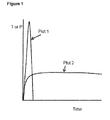
- the y-axis qualitatively illustrates either the temperature or pressure of the reaction.
- the x-axis qualitatively illustrates the time after the explosion starts.
- Plot 1 illustrates a typical gunpowder explosion, where a peak in temperature of around 3000K occurs within approximately 10 milliseconds of initiating the explosion and drops back to its starting point within approximately 20 milliseconds.
- Plot 2 illustrates an explosion profile using the pyrotechnic compositions of the present invention. Using the pyrotechnic composition of the present invention, a plateau of pressure is reached within approximately 10 milliseconds and this is maintained for more than 20 milliseconds; preferably up to, or more than, 200 milliseconds.
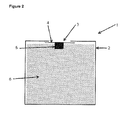
- FIG. 2 shows a cross-section of a non-limiting canister arrangement 1.
- the canister arrangement 1 can be used to provide gas products from an explosive reaction to an inflatable body.
- the canister arrangement 1 includes a receptacle 2 having an opening 3.
- the receptacle is generally cylindrical and formed of a material which can withstand high pressures, for example stainless steel.
- the opening 3 is closed to atmosphere by a burst disc 4.
- the burst disc 4 is formed of a material which bursts under a threshold pressure, for example stainless steel.
- the threshold pressure can be chosen by a user depending on the pressure of gas desired to be delivered through the opening 3.
- the burst disc 4 is attached to a igniter 5. Alternatively (not shown), the igniter 5 is in any other position within the receptacle 2.
- the igniter 5 is preferably formed of pure gunpowder. Alternatively, the igniter 5 is formed of any material capable of igniting gunpowder. The igniter 5 can be ignited, for example by applying a voltage to the igniter through a metal fuse (not shown).
- a pyrotechnic formulation 6 held within the canister 2 is a pyrotechnic formulation 6 according to the present invention. Ignition of the igniter 5 ignites the pyrotechnic formulation 6 so that gases are formed within the canister 2. When a critical amount of pressure builds up behind the burst disc 4, the burst disc 4 ruptures permitting the gases to exit the canister 2 through the opening 3.
- the igniter and the burst disc are separated by a steel wire mesh.
- the opening 3 is connected to a hollow body (not shown) (optionally, through a nozzle (not shown)) and the gases inflate the hollow body.
- the opening 3 is connected to a hollow body within an ejection seat, for example a side beam, and the ignition of the pyrotechnic composition 6 forms part of the ejection procedure of the ejection seat so that one or more air blades or air bags are inflated and remain inflated for a desired length of time to keep an ejected person in or near an optimal position throughout an ejection procedure.
- a generally cylindrical heavy weight pressure chamber (similar to the canister shown schematically in figure 2 ) was used to test different pyrotechnic compositions.
- the internal dimensions of the heavy weight pressure chamber were 22mm diameter by 30 mm length. Burst disc material was 0.003" (0.0762 mm) stainless steel.
- the weight of pyrotechnic in each case was 12.66g.
- Table 1 summarises the results: Table 1 Pyrotechnic Vent diameter Peak pressure (psi) Time to peak pressure (msec) G7 6 mm. 14,040 7.1 G12 6 mm. 21,251 3.9 G20 6 mm. 23,200 2.3 G40 6 mm.
- All gunpowders used in the examples had a composition, by weight, of 75% KNO 3 , 15% C and 10% S.
- MgCO 3 anhydrous was the most effective carbonate in calming the explosive reaction of gunpowder.
- MgCO 3 anhydrous reduced peak pressure by approximately 50% with a loss of only approximately 13% overall performance for the addition of only 10% by weight.
- G7 gunpowder performs well enough as a gas generator with the most benign pressure region of the 4 grains sizes trialled - this may be due to its greater average grain size.
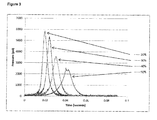
- the traces results from compositions of certain percentages by weight (the percentages specified with arrows) anhydrous MgCO 3 mixed with G20 gunpowder (the balance to 100% being G20 gunpowder).
- anhydrous MgCO 3 the higher the percentage of anhydrous MgCO 3 , the sooner the profile peaks and the higher the maximum generated pressure.
- composition A comprises G20 gunpowder (35 weight %) and MgCO 3 (65 weight %) (the G20 gunpowder used had a composition, by weight, of 75% KNO 3 , 15% C and 10% S). It was found that a composition having this proportional combination of components, when used in a canister arrangement (similar to that shown in figure 2 ), provides enough heated gas to safely inflate an inflatable side beam within an ejection seat, whilst not rupturing the side beam. In other applications, i.e. where the hollow body is either larger or smaller than an inflatable side beam, and/or where it is desired to provide gas quicker or slower, different proportions of gunpowder to MgCO 3 may be preferred.
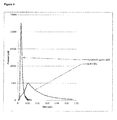
- Figure 4 shows a comparative test of pure gunpowder and composition A (composition A is referred to as M-B C 001 in Figure 4 ). These plots were produced using a canister arrangement (similar to that shown in figure 2 ), having a burst disc 0.004" (0.102 mm) of aluminium and a vent diameter of 3.0 mm.
- Figure 4 shows that a composition according to the present invention provides pressurised gases for more than 20 milliseconds, whilst pure gunpowder provides pressurised gases at a higher pressure and for a shorter amount of time. Comparing figures 3 and 4 , the composition with 65 weight % anhydrous MgCO 3 burns nearly ten times longer and with a peak pressure more than twice that of a composition of 50 weight % anhydrous MgCO 3 .
- compositions according to the present invention are particularly suited for providing gases to inflatable bodies, for example inflatable air bags.
- composition A can be ignited under heavy confinement, for example as in the canister 2 discussed with reference to figure 2 . Tests show that composition A, under standard temperature and pressure and on contact with a flame, does not ignite. On the contrary, composition A could be used as a flame retardant.
- composition A self-extinguished.
- Table 2 shows the results when composition A was fired in a combustion chamber: Table 2 Test Conditions Composition Mass (g (gr)) Vent Diameter mm (in) Burst Disc Ignition g (gr) G20 Peak Pressure psi +20°C (+68°F) 96.5 (1489) 5.0 (0.20) 0.005" (0.127 mm) copper 1.5 (23.1) 4266 +93°C (+200°F) 96.5 (1489) 5.0 (0.20) 0.005" (0.127 mm) copper 1.5 (23.1) 5339 -40°C (-40°F) 96.5 (1489) 5.0 (0.20) 0.005" (0.127 mm) copper 1.5 (23.1) 3699
- Figure 5 shows the performance of composition A when stored and fired at three different temperatures. In these tests, composition A was fired using an electric fusehead.
- composition A does not pose a hazard under conditions usually experienced by an ejection seat and does not decompose. Therefore, composition A is suitable for use in a canister fitted to an ejection seat to provide gases to inflatable bodies.
- compositions of the present invention may additionally include 1 weight % or less of a silica based hydrophobic additive, for example AerosilTM R202 as sold by EvonikTM.
- a silica based hydrophobic additive for example AerosilTM R202 as sold by EvonikTM. This additive enhances rheology of the composition for easier handling and inhibits moisture ingress into the composition.
- anhydrous metal carbonates preferably anhydrous MgCO 3
Landscapes
- Chemical & Material Sciences (AREA)
- Organic Chemistry (AREA)
- Engineering & Computer Science (AREA)
- Physics & Mathematics (AREA)
- Fluid Mechanics (AREA)
- Mechanical Engineering (AREA)
- Chemical Kinetics & Catalysis (AREA)
- Combustion & Propulsion (AREA)
- Inorganic Chemistry (AREA)
- Air Bags (AREA)
Applications Claiming Priority (1)
| Application Number | Priority Date | Filing Date | Title |
|---|---|---|---|
| GB1413502.4A GB2528719B (en) | 2014-07-30 | 2014-07-30 | Pyrotechnic composition |
Publications (2)
| Publication Number | Publication Date |
|---|---|
| EP2980052A2 true EP2980052A2 (fr) | 2016-02-03 |
| EP2980052A3 EP2980052A3 (fr) | 2016-02-10 |
Family
ID=51587467
Family Applications (1)
| Application Number | Title | Priority Date | Filing Date |
|---|---|---|---|
| EP15178603.5A Withdrawn EP2980052A3 (fr) | 2014-07-30 | 2015-07-28 | Composition pyrotechnique |
Country Status (3)
| Country | Link |
|---|---|
| US (1) | US20160031768A1 (fr) |
| EP (1) | EP2980052A3 (fr) |
| GB (1) | GB2528719B (fr) |
Family Cites Families (19)
| Publication number | Priority date | Publication date | Assignee | Title |
|---|---|---|---|---|
| US172547A (en) * | 1876-01-18 | Charles felhoen | ||
| GB173781A (en) * | 1922-01-07 | 1923-04-09 | Wilhelm Kochmann | Improvements in combustible mixtures for generating gases under pressure |
| GB190100984A (en) * | 1901-01-15 | 1901-11-02 | Charles Herbert Curtis | Improvements in Explosives |
| GB487400A (en) * | 1936-09-18 | 1938-06-20 | Wilhelm Kochmann | Improvements in or relating to means for generating and regulating pressure gas from chemical reactions |
| US3638573A (en) * | 1968-03-25 | 1972-02-01 | Ncr Co | Self-destructible honeycomb laminates |
| US3532359A (en) * | 1968-07-22 | 1970-10-06 | Chrysler Corp | Inflatable device |
| US3647393A (en) * | 1970-05-11 | 1972-03-07 | Chrysler Corp | Gas-generating apparatus |
| US3773351A (en) * | 1971-08-02 | 1973-11-20 | Timmerman H | Gas generator |
| US3897285A (en) * | 1973-09-10 | 1975-07-29 | Allied Chem | Pyrotechnic formulation with free oxygen consumption |
| US3912562A (en) * | 1973-09-10 | 1975-10-14 | Allied Chem | Low temperature gas generator propellant |
| GB9307799D0 (en) * | 1993-03-15 | 1993-06-02 | Secr Defence | Two part ammunition round |
| NL1004618C2 (nl) * | 1996-11-26 | 1998-05-27 | Tno | Gas genererend preparaat en toepassing daarvan in een airbag. |
| US20020004470A1 (en) * | 1998-10-06 | 2002-01-10 | Melvin Wright | Black powder - gun bore, cartridge, and parts cleaning solution |
| US8784583B2 (en) * | 2004-01-23 | 2014-07-22 | Ra Brands, L.L.C. | Priming mixtures for small arms |
| JP5085926B2 (ja) * | 2006-12-21 | 2012-11-28 | 株式会社ダイセル | ガス発生剤組成物 |
| CN101633519B (zh) * | 2009-08-07 | 2010-12-01 | 北京工业大学 | 一种纯相超细纳米晶CuO块体材料的制备方法 |
| EP2673243B1 (fr) * | 2011-02-07 | 2021-07-07 | Nederlandse Organisatie voor toegepast- natuurwetenschappelijk onderzoek TNO | Générateur de dioxyde de carbone gazeux chimique |
| JP5663369B2 (ja) * | 2011-03-31 | 2015-02-04 | 株式会社ダイセル | ガス発生剤組成物 |
| CN103694071B (zh) * | 2013-12-17 | 2016-08-17 | 江西省李渡烟花集团有限公司 | 一种烟花萤火虫药 |
-
2014
- 2014-07-30 GB GB1413502.4A patent/GB2528719B/en active Active
-
2015
- 2015-07-28 EP EP15178603.5A patent/EP2980052A3/fr not_active Withdrawn
- 2015-07-29 US US14/812,235 patent/US20160031768A1/en not_active Abandoned
Non-Patent Citations (1)
| Title |
|---|
| None * |
Also Published As
| Publication number | Publication date |
|---|---|
| US20160031768A1 (en) | 2016-02-04 |
| EP2980052A3 (fr) | 2016-02-10 |
| GB2528719B (en) | 2020-09-16 |
| GB2528719A (en) | 2016-02-03 |
| GB201413502D0 (en) | 2014-09-10 |
Similar Documents
| Publication | Publication Date | Title |
|---|---|---|
| US20090301601A1 (en) | Apparatus and Method for Using Tetrazine-Based Energetic Material | |
| JP2824769B2 (ja) | 多孔性プロペラント粒およびその製造方法 | |
| US6513602B1 (en) | Gas generating device | |
| US3785674A (en) | Crash restraint nitrogen generating inflation system | |
| US6702033B1 (en) | Hybrid fire extinguisher | |
| JP2855086B2 (ja) | エア/安全バッグを有する膨張式安全システムのインフレータ及びその作動方法 | |
| EP0333945B1 (fr) | Charge propulsive à combustion rapide pour dispositifs de gonflage de sac d'air de voiture, ou pour moteurs de roquette et ses allumeurs | |
| US8453575B2 (en) | Pyrotechnical method for dual-mode gas generation and related pyrotechnical generator | |
| JPH09175313A (ja) | インフレーター | |
| US6254129B1 (en) | Arrangements and methods for inflatable device formation of inflation gas | |
| EP0595668A1 (fr) | Allumeur à deux composants pour compositions génératrices de gaz | |
| US8967284B2 (en) | Liquid-augmented, generated-gas fire suppression systems and related methods | |
| US9545531B2 (en) | Fire suppression system including an integral time delay and output starter with attach and detach firing pin assembly | |
| JPH06278565A (ja) | 安全開口部を備えた火工式ガス発生器 | |
| JPH11286254A (ja) | 花火式膨らませ器を有する二重式膨らませ装置 | |
| US7695007B2 (en) | Device for deployment of an element, particularly a safety element, for the protection of goods and/or people | |
| US6007097A (en) | Flammable gas initiated pyrotechnic inflator | |
| JP4813751B2 (ja) | ガス発生装置 | |
| KR20230000052U (ko) | 압전소자를 이용한 소화장치 | |
| JP2014151663A (ja) | ガスボンベ開孔装置 | |
| EP2980052A2 (fr) | Composition pyrotechnique | |
| JP5426062B2 (ja) | 自動車のエアバッグ・インフレータ装置で使用される発泡点火物質 | |
| EP1767248A1 (fr) | Extincteur hybride | |
| US6843869B2 (en) | Porous igniter for automotive airbag applications | |
| US6143101A (en) | Chlorate-free autoignition compositions and methods |
Legal Events
| Date | Code | Title | Description |
|---|---|---|---|
| PUAL | Search report despatched |
Free format text: ORIGINAL CODE: 0009013 |
|
| PUAI | Public reference made under article 153(3) epc to a published international application that has entered the european phase |
Free format text: ORIGINAL CODE: 0009012 |
|
| AK | Designated contracting states |
Kind code of ref document: A2 Designated state(s): AL AT BE BG CH CY CZ DE DK EE ES FI FR GB GR HR HU IE IS IT LI LT LU LV MC MK MT NL NO PL PT RO RS SE SI SK SM TR |
|
| AX | Request for extension of the european patent |
Extension state: BA ME |
|
| AK | Designated contracting states |
Kind code of ref document: A3 Designated state(s): AL AT BE BG CH CY CZ DE DK EE ES FI FR GB GR HR HU IE IS IT LI LT LU LV MC MK MT NL NO PL PT RO RS SE SI SK SM TR |
|
| AX | Request for extension of the european patent |
Extension state: BA ME |
|
| RIC1 | Information provided on ipc code assigned before grant |
Ipc: C06D 5/06 20060101ALI20160105BHEP Ipc: C06B 23/04 20060101AFI20160105BHEP |
|
| 17P | Request for examination filed |
Effective date: 20160630 |
|
| RBV | Designated contracting states (corrected) |
Designated state(s): AL AT BE BG CH CY CZ DE DK EE ES FI FR GB GR HR HU IE IS IT LI LT LU LV MC MK MT NL NO PL PT RO RS SE SI SK SM TR |
|
| 17Q | First examination report despatched |
Effective date: 20180228 |
|
| STAA | Information on the status of an ep patent application or granted ep patent |
Free format text: STATUS: THE APPLICATION IS DEEMED TO BE WITHDRAWN |
|
| 18D | Application deemed to be withdrawn |
Effective date: 20180711 |