EP2980628B1 - Verres portables et procédé d'affichage d'image via les verres portables - Google Patents
Verres portables et procédé d'affichage d'image via les verres portables Download PDFInfo
- Publication number
- EP2980628B1 EP2980628B1 EP15179242.1A EP15179242A EP2980628B1 EP 2980628 B1 EP2980628 B1 EP 2980628B1 EP 15179242 A EP15179242 A EP 15179242A EP 2980628 B1 EP2980628 B1 EP 2980628B1
- Authority
- EP
- European Patent Office
- Prior art keywords
- wearable glasses
- user
- image
- display
- inclination
- Prior art date
- Legal status (The legal status is an assumption and is not a legal conclusion. Google has not performed a legal analysis and makes no representation as to the accuracy of the status listed.)
- Active
Links
Images




























Classifications
-
- G—PHYSICS
- G06—COMPUTING OR CALCULATING; COUNTING
- G06F—ELECTRIC DIGITAL DATA PROCESSING
- G06F3/00—Input arrangements for transferring data to be processed into a form capable of being handled by the computer; Output arrangements for transferring data from processing unit to output unit, e.g. interface arrangements
- G06F3/01—Input arrangements or combined input and output arrangements for interaction between user and computer
- G06F3/011—Arrangements for interaction with the human body, e.g. for user immersion in virtual reality
- G06F3/013—Eye tracking input arrangements
-
- G—PHYSICS
- G02—OPTICS
- G02B—OPTICAL ELEMENTS, SYSTEMS OR APPARATUS
- G02B27/00—Optical systems or apparatus not provided for by any of the groups G02B1/00 - G02B26/00, G02B30/00
- G02B27/01—Head-up displays
- G02B27/017—Head mounted
-
- G—PHYSICS
- G02—OPTICS
- G02B—OPTICAL ELEMENTS, SYSTEMS OR APPARATUS
- G02B27/00—Optical systems or apparatus not provided for by any of the groups G02B1/00 - G02B26/00, G02B30/00
- G02B27/0093—Optical systems or apparatus not provided for by any of the groups G02B1/00 - G02B26/00, G02B30/00 with means for monitoring data relating to the user, e.g. head-tracking, eye-tracking
-
- G—PHYSICS
- G02—OPTICS
- G02B—OPTICAL ELEMENTS, SYSTEMS OR APPARATUS
- G02B27/00—Optical systems or apparatus not provided for by any of the groups G02B1/00 - G02B26/00, G02B30/00
- G02B27/01—Head-up displays
- G02B27/017—Head mounted
- G02B27/0172—Head mounted characterised by optical features
-
- G—PHYSICS
- G02—OPTICS
- G02B—OPTICAL ELEMENTS, SYSTEMS OR APPARATUS
- G02B27/00—Optical systems or apparatus not provided for by any of the groups G02B1/00 - G02B26/00, G02B30/00
- G02B27/01—Head-up displays
- G02B27/0179—Display position adjusting means not related to the information to be displayed
-
- G—PHYSICS
- G02—OPTICS
- G02C—SPECTACLES; SUNGLASSES OR GOGGLES INSOFAR AS THEY HAVE THE SAME FEATURES AS SPECTACLES; CONTACT LENSES
- G02C11/00—Non-optical adjuncts; Attachment thereof
- G02C11/10—Electronic devices other than hearing aids
-
- G—PHYSICS
- G06—COMPUTING OR CALCULATING; COUNTING
- G06T—IMAGE DATA PROCESSING OR GENERATION, IN GENERAL
- G06T19/00—Manipulating three-dimensional [3D] models or images for computer graphics
- G06T19/006—Mixed reality
-
- G—PHYSICS
- G06—COMPUTING OR CALCULATING; COUNTING
- G06V—IMAGE OR VIDEO RECOGNITION OR UNDERSTANDING
- G06V40/00—Recognition of biometric, human-related or animal-related patterns in image or video data
- G06V40/10—Human or animal bodies, e.g. vehicle occupants or pedestrians; Body parts, e.g. hands
- G06V40/18—Eye characteristics, e.g. of the iris
- G06V40/193—Preprocessing; Feature extraction
-
- G—PHYSICS
- G02—OPTICS
- G02B—OPTICAL ELEMENTS, SYSTEMS OR APPARATUS
- G02B27/00—Optical systems or apparatus not provided for by any of the groups G02B1/00 - G02B26/00, G02B30/00
- G02B27/01—Head-up displays
- G02B27/0101—Head-up displays characterised by optical features
- G02B2027/0138—Head-up displays characterised by optical features comprising image capture systems, e.g. camera
-
- G—PHYSICS
- G02—OPTICS
- G02B—OPTICAL ELEMENTS, SYSTEMS OR APPARATUS
- G02B27/00—Optical systems or apparatus not provided for by any of the groups G02B1/00 - G02B26/00, G02B30/00
- G02B27/01—Head-up displays
- G02B27/0101—Head-up displays characterised by optical features
- G02B2027/014—Head-up displays characterised by optical features comprising information/image processing systems
-
- G—PHYSICS
- G02—OPTICS
- G02B—OPTICAL ELEMENTS, SYSTEMS OR APPARATUS
- G02B27/00—Optical systems or apparatus not provided for by any of the groups G02B1/00 - G02B26/00, G02B30/00
- G02B27/01—Head-up displays
- G02B27/017—Head mounted
- G02B2027/0178—Eyeglass type
-
- G—PHYSICS
- G02—OPTICS
- G02B—OPTICAL ELEMENTS, SYSTEMS OR APPARATUS
- G02B27/00—Optical systems or apparatus not provided for by any of the groups G02B1/00 - G02B26/00, G02B30/00
- G02B27/01—Head-up displays
- G02B27/0179—Display position adjusting means not related to the information to be displayed
- G02B2027/0187—Display position adjusting means not related to the information to be displayed slaved to motion of at least a part of the body of the user, e.g. head, eye
Definitions
- Apparatuses and methods consistent with one or more exemplary embodiments relate to image display apparatuses and methods, and more particularly, to head mounted displays such as wearable glasses and methods of displaying images on the wearable glasses.
- a head mounted display is mounted on the head of a user and displays an image in front of (e.g., directly in front of) the eyes of the user.
- an HMD may have a shape of eyeglasses.
- wearable glasses which are an eyeglasses-type HMD, will be described in detail hereinafter.
- one or more other exemplary embodiments are not limited to wearable glasses.
- one or more other exemplary embodiments may be applicable to various types of HMDs that are partially or wholly fixed to the head of a user and display information within the viewing angle of the user.
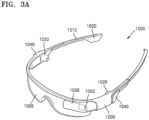
- the wearable glasses 1000 of FIG. 3A may include a frame 1010, a processor 1200, a camera 1050 (e.g., first camera), audio output units 1020 (e.g., audio outputters or audio output devices), a display 1030, user input units 1040 (e.g., user inputters or user input device), and a power supply unit 1600 (e.g., power supply or power supplier). It is understood that more or less components than those illustrated in FIG. 3A may be included in the wearable glasses 1000.
- a camera 1050 e.g., first camera
- audio output units 1020 e.g., audio outputters or audio output devices
- a display 1030 e.g., user inputters or user input device
- user input units 1040 e.g., user inputters or user input device
- a power supply unit 1600 e.g., power supply or power supplier
- the camera 1050 may be included in the display 1030, or may be separate from the display 1030 and disposed on the frame 1010.
- the camera 1050 may be a camera for use in smartphones, or a small camera such as a webcam.
- the camera 1050 may be mounted on a location that is predetermined to be suitable to acquire an image corresponding to a gesture of the hands of a user.
- the camera 1050 may be mounted on a location adjacent to an eye of the user to thereby capture an image that is similar to an image recognized via the eyes of the user.
- the wearable glasses 1000 may further include an eye tracking camera 1070 that faces the user.
- the eye tracking camera 1070 may include an infrared camera.
- the eye tracking camera 1070 may detect user's eyes by tracking the iris of the user.
- the location of the eye tracking camera 1070 is not limited to the location shown in FIG. 3B , and may be any of various other locations according to the shapes of the wearable glasses 1000 in one or more other exemplary embodiments.
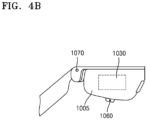
- the wearable glasses 1000 may include the camera 1060 that faces of the user.
- the wearable glasses 1000 may adjust an image that is displayed on the display 1030, based on an image of an eye of the user captured by the camera 1060.
- the location of the camera 1060 is not limited to the location shown in FIG. 4B , and may be any of various other locations according to the shapes of the wearable glasses 1000 in one or more other exemplary embodiments.
- the wearable glasses 1000 may acquire the wear state information representing the state in which the user currently wears the wearable glasses 1000.
- the wearable glasses 1000 may acquire the wear state information.
- the predetermined reference wear state information represents a state in which the user wears the wearable glasses 1000 at a location that is the most appropriate to receive an image, and thus the reference wear state information may be pre-stored as a default value or may be set by the user.
- a method in which a user sets a reference wear state will be described in detail below with reference to FIG. 33 .
- a method of determining the inclination of the wearable glasses 1000 from the image of the body part will be described in detail below with reference to FIGS. 12 through 17 .
- the left-right inclination of the wearable glasses 1000 denotes an angle at which the wearable glasses 1000 are rotated from the reference location about the z-axis.
- the z-axis may be an axis that is perpendicular to the x-axis and the y-axis.
- a method of determining the inclination of the wearable glasses 1000 with respect to the user by using the wear state information of the user will be described in detail below with reference to FIGS. 12 through 17 .
- the wearable glasses 1000 may photograph a body part of the user in order to acquire information about a state in which the user currently wears the wearable glasses 1000.
- the wearable glasses 1000 may acquire wear state information including an image of an eye of a user who is wearing the wearable glasses 1000.
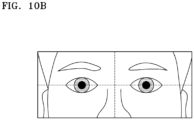
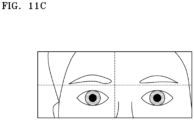
- FIGS.10A , 10B , 11A , 11B , and 11C are examples of images of the eyes of a user captured via the wearable glasses 1000, according to one or more exemplary embodiments.
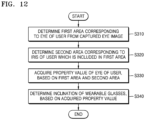
- the wearable glasses 1000 may determine a second area corresponding to an iris of the user from the eye image.
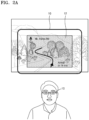
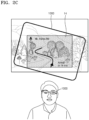
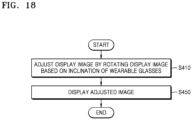
- the wearable glasses 1000 may adjust a display image by rotating the display image based on the inclination of the wearable glasses 1000.
- the wearable glasses 1000 may rotate the display image according to an inclination (e.g., a top-bottom inclination) at which the wearable glasses 1000 are rotated about an axis parallel to the eye direction in which the user sees straight ahead, based on the reference wear state.
- an inclination e.g., a top-bottom inclination
- a pixel 2215 denotes a predetermined pixel within the image 2211 that is being displayed.
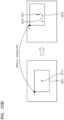
- FIG. 22B illustrates a case of moving the image 2211 being displayed by k in the x-axis direction and by 1 in the y-axis direction.
- the pixel 2215 within the image 2211 being displayed may be moved by k in the x-axis direction and by 1 in the y-axis direction and thus may be remapped as a pixel 2217 on the display 1030.
- the wearable glasses 1000 may determine that the adjusted image deviates from the area where the wearable glasses 1000 may display an image.
- the wearable glasses 1000 may determine that the adjusted image deviates from the area where the wearable glasses 1000 may display an image.
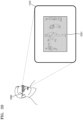
- the wearable glasses 1000 may output an image that guides the user to correct the location of the HMD 1000.
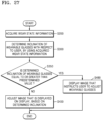
- the wearable glasses 1000 determine whether the inclination of the wearable glasses 1000 determined in operation S300 is equal to or greater than a predetermined value.
- the predetermined value may be a pre-stored value or a value set by the user.
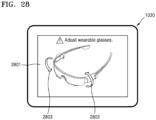
- the wearable glasses 1000 may display a guide image that guides the user to adjust the wearable glasses 1000. According to another exemplary embodiment, the wearable glasses 1000 may simply display an image (e.g., an icon, a flashing icon, etc.) that alerts the user to adjust the wearable glasses 1000.
- an image e.g., an icon, a flashing icon, etc.
- the guide image 2905 may be an image that provides information about the reference wear state.
- the image 2905 may guide a direction in which the wearable glasses 1000 are to be adjusted such that the state in which the user currently wears the wearable glasses 1000 becomes the reference wear state.
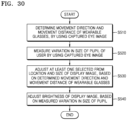
- FIG. 30 is a flowchart of a method in which the wearable glasses 1000 adjust a display image, according to an exemplary embodiment.
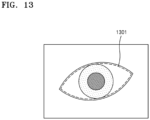
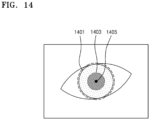
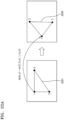
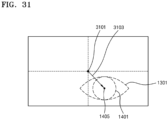
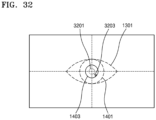
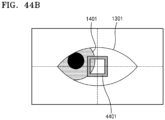
- FIG. 31 illustrates a first area 1301 corresponding to an eye of a user and a second area 1401 corresponding to an iris of the user, wherein the first area 1301 and the second area 1401 are determined from an eye image of the user.
- FIG. 31 illustrates a case in which the wearable glasses 1000 determine a movement direction and a movement distance of the wearable glasses 1000 based on a value representing the location of the iris of the user. For example, the wearable glasses 1000 may determine the location of a center 1405 of the second area 1401 corresponding to the iris of the user, as the value representing the location of the iris.
- the wearable glasses 1000 may display a display image of which brightness has been adjusted based on the variation in the size of the pupil of the user. For example, when the size of the pupil of the user is increased, the wearable glasses 1000 may determine that the brightness around the wearable glasses 1000 is decreased, and thus decrease the brightness of the display image. When the size of the pupil of the user is decreased, the wearable glasses 1000 may determine that the brightness around the wearable glasses 1000 is increased, and thus increase the brightness of the display image.
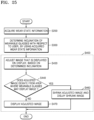
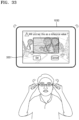
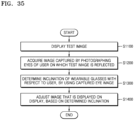
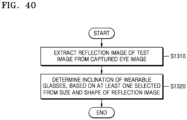
- FIG. 35 is a flowchart of a method in which the wearable glasses 1000 correct a display image based on a test image that is reflected from the eyes of a user, according to an exemplary embodiment.
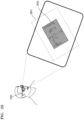
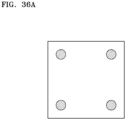
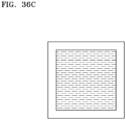
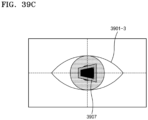
- FIGS. 36A , 36B , and 36C illustrate examples of a test image, according to one or more exemplary embodiments.
- the wearable glasses 1000 may display a test image including a polygon of a predetermined color.
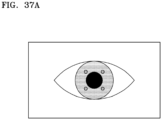
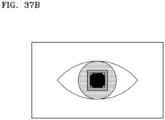
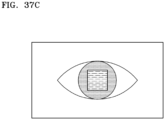
- the wearable glasses 1000 acquire an image captured by photographing the eyes of the user on which the test image is reflected.
- the wearable glasses 1000 may acquire the eye image of the user on which the test image is reflected, as information about a state in which the user currently wears the wearable glasses 1000.
- operation S200 of FIG. 6 may be applied to operation S1200 of FIG. 35 .
- a redundant description of operation S1200 of FIG. 35 is omitted below.
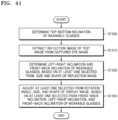
- a method of determining an inclination of the wearable glasses 1000 with respect to a user by using an eye image of the user will be described in detail below with reference to FIGS. 40 through 42 and 43A through 43C .
- the wearable glasses 1000 adjust an image that is displayed on the display 1030, based on the determined inclination.
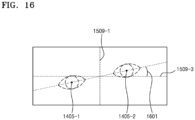
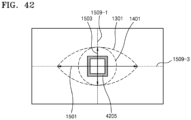
- the wearable glasses 1000 may determine as the minor axis a line segment 1503 that perpendicularly bisects the line segment 1501, and determine a length of the line segment 1503 as a length of the minor axis.
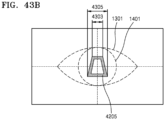
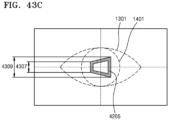
- the wearable glasses 1000 may determine the left-right inclination of the wearable glasses 1000, based on a ratio between the lengths of two sides, namely, an upper side 4307 and a lower side 4309, included in the reflection image 4205. For example, when the test image has a rectangular shape and the reflection image 4205 has a shape of a 90°-rotated trapezoidal, the left-right inclination of the wearable glasses 1000 with respect to the user may be determined to increase with an increase in the ratio between the lengths of the upper side 4307 and the lower side 4309.
- FIG. 45 is a schematic diagram for explaining a method in which the wearable glasses 1000 adjust a display image based on a gesture of a user, according to an exemplary embodiment.
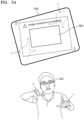
- the wearable glasses 1000 may adjust the display image based on a gesture of hands 7 of the user.
- the wearable glasses 1000 may acquire the information about the gesture of the user by using the sensing unit included in the wearable glasses 1000 or acquire the information about the gesture of the user from an external device.
- the wearable glasses 1000 may acquire the information about the gesture of the user by using at least one of a magnetic sensor, an acceleration sensor, a gyroscope sensor, a proximity sensor, an optical sensor, a depth sensor, an infrared sensor, an ultrasonic sensor, or the like, which is included in the wearable glasses 1000.
- the wearable glasses 1000 may acquire information about a touch gesture of the user that is received via the user input unit 1040 included in the wearable glasses 1000.
- the wearable glasses 1000 may acquire information about a gesture of the user that is used to compensate for an inclination of the wearable glasses 1000.
- the wearable glasses 1000 may acquire the information about the gesture of the user.
- the wearable glasses 1000 may determine that the location of the wearable glasses 1000 with respect to the user is highly likely to be changed.
- the wearable glasses 1000 may acquire the information about the gesture of the user.
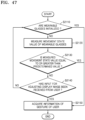
- a method of acquiring the information about the gesture of the user will be described in more detail later with reference to FIGS. 47 through 49 .
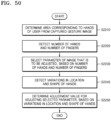
- the adjustment value is used to adjust a display image.
- the adjustment value may be a value for adjusting at least one of the rotation angle, the size, and the shape of the display image.
- the adjustment value may be a value for adjusting the brightness of the display image, a location on the display 1030 where the display image is displayed, or a color of the display image.
- the display 1030 of the wearable glasses 1000 is constructed as a semi-transparent optical waveguide (for example, a prism)
- the adjustment value may be the location of a focal point on which light output from the projector of the display 1030 of the wearable glasses 1000 is focused.
- the wearable glasses 1000 may perform image adjustment based on the adjustment value (for example, horizontal translation, vertical translation, keystoning, and/or various types of image processing in which a display image is corrected so that a user may be provided with a nondistorted image).
- the adjustment value for example, horizontal translation, vertical translation, keystoning, and/or various types of image processing in which a display image is corrected so that a user may be provided with a nondistorted image.
- the wearable glasses 1000 may adjust the location of a focal point on which light output from the projector of the display 1030 is focused, based on the inclination of the wearable glasses 1000.
- a semi-transparent optical waveguide for example, a prism
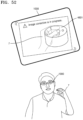
- FIG. 51 is a schematic diagram for explaining a method in which the wearable glasses 1000 detect a hand gesture of a user, according to an exemplary embodiment.
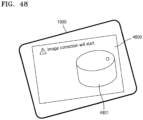
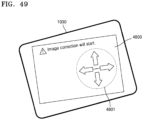
- the wearable glasses 1000 may output a guide image that guides the user to take a gesture of moving the virtual input interface 4801 with the hand 7.
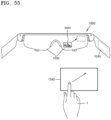
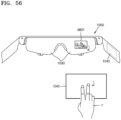
- the wearable glasses 1000 may adjust a display image based on a distance by which the hand 7 of the user is moved or an angle at which the hand 7 of the user is rotated.
- the wearable glasses 1000 may adjust at least one of a rotation angle, a size, a location, a brightness, and a shape of the display image according to various touch inputs of the user.
- the wearable glasses 1000 may adjust the location of a focal point on which light output from the projector of the display 1030 is focused, based on the touch input of the user.
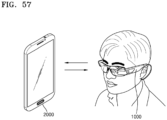
- Examples of the device 2000 may include, but are not limited to, a smartphone, a tablet personal computer (PC), a PC, a smart TV, a mobile phone, a PDA, a laptop, a media player, a micro-server, a global positioning system (GPS) device, an electronic book terminal, a digital broadcasting terminal, a navigation device, a kiosk, an MP3 player, a digital camera, and other mobile or non-mobile computing devices.
- the device 2000 may also include various apparatuses capable of receiving a touch input, such as, an electronic blackboard and a touch table.
- the device 2000 may be a wearable device including a communication function and a data processing function. However, it is understood that one or more other exemplary embodiments are not limited thereto, and the device 1000 may be any kind of apparatus capable of receiving or transmitting data from or to the wearable glasses 1000 via a network.
- the device 2000 and the wearable glasses 1000 may be connected to each other via a network, and the network may be a wired network, such as a local area network (LAN), a wide area network (WAN), or a value added network (VAN), or any kind of wireless network, such as a mobile radio communication network, a satellite communication network, etc.
- LAN local area network
- WAN wide area network
- VAN value added network
- wireless network such as a mobile radio communication network, a satellite communication network, etc.
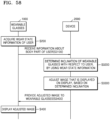
- the wear state information received by the device 2000 from the wearable glasses 1000 in operation S3100 may be information acquired by the wearable glasses 1000.
- Operation S200 of FIG. 58 corresponds to operation S200 of FIG. 6 , and thus a redundant description thereof is omitted below.
- the wearable glasses 1000 may determine an inclination of the wearable glasses 1000 with respect to the user, by using the received information about the body part of the user.
- the device 2000 may determine the inclination of the wearable glasses 1000 with respect to the user by comparing predetermined reference wear state information with the wear state information received from the wearable glasses 1000.
- the reference wear state information is information representing the location of the wearable glasses 1000 that is the most appropriate to provide an image to a user.
- the reference wear state information may be pre-stored or may be set by the user.
- the wear state information may include an image of the body part of the user.
- the device 2000 may detect an area corresponding to the body part from the image of the body part and acquire a property value of the body part from the detected area.
- the device 2000 may acquire a property value associated with the location, the shape, or the size of the area corresponding to the body part detected from the image of the body part.
- the device 2000 may determine the inclination by comparing the acquired property value with a reference value included in the reference wear state information.
- the reference value included in the reference wear state information may be a property value detected from an image of a body part acquired in the reference wear state.
- the device 2000 may adjust various parameters of an image that is provided to the user via the display 1030.
- the device 2000 may further adjust at least one of the brightness of the image that is displayed on the display 1030, a location on the display 1030 on which the image is displayed, and the color of the image that is displayed on the display 1030.
- the device 2000 may adjust the location of a focal point on which light output from the projector of the display 1030 is focused, based on the inclination of the wearable glasses 1000.
- the device 2000 may provide an adjusted image obtained in operation S3300 to the wearable glasses 1000.
- the adjusted image provided by the device 2000 to the wearable glasses 1000 may be displayed via the wearable glasses 1000.
- any of the methods described above may be applied.
- any method described above, in which the wearable glasses 1000 adjusts a display image may be applied to the case where the device 2000 adjusts an image that is displayed on the wearable glasses 1000 according to one or more exemplary embodiment.
- a redundant description of the case where the device 2000 adjusts an image that is displayed on the wearable glasses 1000 is omitted below.
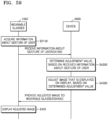
- the information about the gesture of the user may be information that is used to determine an adjustment value for adjusting a display image.
- the information about the gesture acquired by the wearable glasses 1000 may include information about at least one of the head, the hands, the eyes, and the mouth of the user.
- the information about the gesture acquired by the wearable glasses 1000 may also include an image of the body part that takes the gesture.
- the information about the gesture received by the device 2000 from the wearable glasses 1000 in operation S4100 may be information acquired by the wearable glasses 1000.
- Operation S2100 of FIG. 59 corresponds to operation S2100 of FIG. 46 , and thus a redundant description thereof is omitted below.
- the device 2000 may adjust a display image, based on the determined adjustment value.
- the wearable glasses 1000 may adjust at least one of a rotation angle, a size, and a shape of the display image, based on the determined adjustment value.
- the device 2000 may provide an adjusted image obtained in operation S4300 to the wearable glasses 1000.
- the adjusted image provided by the device 2000 to the wearable glasses 1000 may be displayed via the wearable glasses 1000.
- the method described above with reference to FIGS. 45 through 56 may be applied.
- the method described above with reference to FIGS. 45 through 56 in which the wearable glasses 1000 adjusts a display image, may be applied to the case where the device 2000 adjusts an image that is displayed on the wearable glasses 1000 according to an exemplary embodiment.
- a redundant description of the case where the device 2000 adjusts an image that is displayed on the wearable glasses 1000 is omitted below.
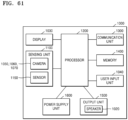
- FIG. 60 is a block diagram of the wearable glasses 1000, according to an exemplary embodiment.
- the wearable glasses 1000 may include a sensing unit 1100 (e.g., sensor), a processor 1200, and a display 1030. Other and/or additional components than those illustrated in FIG. 60 may be included in the wearable glasses 1000. The components included in the wearable glasses 1000 may be arranged on a frame that is used to wear the wearable glasses 1000 on the head of a user.
- the display 1030 shows an image to the user.
- the display 1030 displays information that is processed by the wearable glasses 1000.
- the display 1030 may display an image that has been adjusted based on an inclination of the wearable glasses 1000 or a gesture of the user.
- the display 1030 may display at least one of a user interface (UI) for setting a reference value that is used to adjust a display image, a UI for inducing a gesture of the user that is used to adjust the display image, and a UI for providing the user with information associated with adjustment of the display image.
- UI user interface
- the sensing unit 1100 may acquire information about a body part of the user or information about a gesture of the user.
- the information about the body part of the user may include an image of the body part
- the information about the gesture of the user may include an image of a body part of the user that takes the gesture.
- the sensing unit 1100 may acquire an image of the eyes of the user or an image of the hands of the user.
- the cameras 1050, 1060, and 1070 photograph or capture an image of an object in an actual space.
- Object images captured by the cameras 1050, 1060, and 1070 may be moving picture images or consecutive still images.
- the wearable glasses 1000 may be an eyeglasses-type device including a communication operation and a data processing operation.
- the camera 1050 in the wearable glasses 1000 may face the user and photograph the object of the actual space.
- the camera 1060 may photograph the eyes of the user.
- the camera 1060 in the wearable glasses 1000 may face the face of the user and photograph the eyes of the user.
- the communication unit 1300 may transmit or receive information that is used when the wearable glasses 1000 display an image and adjust a display image, to or from the device 2000, peripheral devices, or a server.
- the memory 1400 stores the information that is used when the wearable glasses 1000 display an image and adjust the image based on an inclination of the wearable glasses 1000.
- the memory 1400 may store information about a reference wear state representing a state in which the wearable glasses 1000 are worn by the user on a location that is the most appropriate for the user to receive an image.
- the memory 1400 may store reference wear state information including an image of a body part of the user that is acquired in a reference wear state, and a property value that is detected from the image of the body part of the user acquired in the reference wear state.
- the user input unit 1040 receives a user unit for controlling the wearable glasses 1000.
- the user input unit 1040 may receive a touch input with respect to the wearable glasses 1000 and a key input with respect to the wearable glasses 1000.
- the user input unit 1040 may also receive a gesture input of the user that is photographed by the camera 1050.
- the power supply unit 1600 supplies power for operating the wearable glasses 1000, to each component.
- the power supply unit 1600 may include a baterry capable of charging, and a cable or cable port capable of receiving power from an external source.
- the wearable glasses 1000 may be connected to the device 2000 and may receive information about a display image from the device 2000 to thereby display an image on the display 1030 of the wearable glasses 1000.
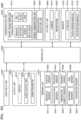
- FIGS. 62 and 63 are block diagrams of devices 2000 according to one or more exemplary embodiments.
- the device 2000 may include a user input unit 6100, an output unit 6200, a controller 6300, and a communication unit 6500. More or less components than those illustrated in FIG. 62 may be included the device 2000.
- the device 2000 may further include a sensing unit 6400 (e.g., sensor), an audio/video (A/V) input unit 6600 (e.g., AfV inputter or A/V input device), and a memory 6700, in addition to the user input unit 6100 (e.g., user inputter or user input device), the output unit 6200 (e.g., outputter or output device), the controller 6300, and the communication unit 6500 (e.g., communicator).
- a sensing unit 6400 e.g., sensor
- A/V input unit 6600 e.g., AfV inputter or A/V input device
- a memory 6700 in addition to the user input unit 6100 (e.g., user inputter or user input device), the output unit 6200 (e.g., outputter or output device), the controller 6300, and the communication unit 6500 (e.g., communicator).
- the user input unit 6100 e.g., user inputter or user input device
- the user input unit 6100 denotes a unit via which a user inputs data for controlling the device 2000.
- the user input unit 6100 may be, but not limited to, a key pad, a dome switch, a touch pad (e.g., a capacitive overlay type, a resistive overlay type, an infrared beam type, an integral strain gauge type, a surface acoustic wave type, a piezo electric type, or the like), a jog wheel, or a jog switch.
- the output unit 6200 may output an audio signal, a video signal, or a vibration signal, and may include a display 6210, an audio output unit 6220 (e.g., speaker, audio ouptutter, audio jack, audio output device), and a vibration motor 6230.
- the display 6210 may be used as an input device as well as an output device.
- the display 6210 may include at least one of a liquid crystal display (LCD), a thin film transistor-liquid crystal display (TFT-LCD), an organic light-emitting diode (OLED), a flexible display, a 3D display, and an electrophoretic display.
- the device 2000 may include at least two displays 6210.
- the at least two displays 6210 may be disposed to face each other by using a hinge.
- the controller 6300 receives a user input for controlling an operation of the wearable glasses 1000.
- the user input may be, for example, a touch input, a button input, or a voice input, but is not limited thereto.
- the controller 6300 may receive a user input with respect to the wearable glasses 1000, from the wearable glasses 1000.
- the short-range wireless communication unit 1510 may include, but is not limited to, a Bluetooth communicator, a Bluetooth Low Energy (BLE) communicator, a near field communication (NFC) unit, a wireless local area network (WLAN) (e.g., Wi-Fi) communicator, a ZigBee communicator, an infrared Data Association (IrDA) communicator, a Wi-Fi direct (WFD) communicator, an ultra wideband (UWB) communicator, and the like.
- BLE Bluetooth Low Energy
- NFC near field communication
- WLAN wireless local area network
- IrDA infrared Data Association
- WFD Wi-Fi direct
- UWB ultra wideband
- the mobile communication unit 6520 may exchange a wireless signal with at least one selected from a base station, an external terminal, and a server on a mobile communication network.
- Examples of the wireless signal may include a voice call signal, a video call signal, and various types of data generated during a short message service (SMS)/multimedia messaging service (MMS).
- SMS short message service
- MMS multimedia messaging service
- the A/V input unit 6600 inputs an audio signal or a video signal, and may include a camera 6610 and a microphone 6620.
- the camera 6610 may acquire an image frame, such as a still image or a moving picture, via an image sensor in a video call mode or a photography mode.
- An image captured via the image sensor may be processed by the controller 6300 or a separate image processor.
- the microphone 6620 receives an external audio signal and converts the external audio signal into electrical audio data.
- the microphone 6620 may receive an audio signal from an external device or a speaking person.
- the microphone 6620 may use various noise removal algorithms in order to remove noise that is generated while receiving the external audio signal.
- the memory 6700 may store a program used by the controller 6300 to perform processing and control, and may also store data that is input to or output from the device 2000.
- the programs stored in the memory 6700 may be classified into a plurality of modules according to their functions, for example, a UI module 6710, a touch screen module 6720, and a notification module 6730.
- a sensor used to detect the real touch or the proximity touch on the touch screen is a proximity sensor.
- the notification module 6730 may generate a signal for notifying that an event has been generated in the device 2000. Examples of the event generated in the device 2000 may include call signal receiving, message receiving, a key signal input, schedule notification, and the like.
- the notification module 6730 may output a notification signal in the form of a video signal via the display 6210, in the form of an audio signal via the audio output unit 6220, or in the form of a vibration signal via the vibration motor 6230.
- embodiments of the present invention can be realized in the form of hardware, software or a combination of hardware and software.
- An exemplary embodiment can also be embodied as a storage medium including instruction codes executable by a computer such as a program module executed by the computer.
- a computer-readable recording medium can be any usable medium which can be accessed by the computer and includes all volatile/non-volatile and removable/non-removable media. Further, the computer-readable recording medium may include all computer storage and communication media.
- the computer storage medium includes all volatile/non-volatile and removable/non-removable media embodied by a certain method or technology for storing information such as computer-readable instruction code, a data structure, a program module or other data.
Landscapes
- Physics & Mathematics (AREA)
- General Physics & Mathematics (AREA)
- Engineering & Computer Science (AREA)
- Optics & Photonics (AREA)
- Theoretical Computer Science (AREA)
- General Engineering & Computer Science (AREA)
- Health & Medical Sciences (AREA)
- Human Computer Interaction (AREA)
- Ophthalmology & Optometry (AREA)
- General Health & Medical Sciences (AREA)
- Computer Hardware Design (AREA)
- Computer Graphics (AREA)
- Software Systems (AREA)
- Otolaryngology (AREA)
- Computer Vision & Pattern Recognition (AREA)
- Multimedia (AREA)
- Acoustics & Sound (AREA)
- User Interface Of Digital Computer (AREA)
- Controls And Circuits For Display Device (AREA)
- Eyeglasses (AREA)
Claims (15)
- Lunettes portables (1000) comprenant :un dispositif d'affichage (1030) configuré pour afficher (5100) une image test (3403) ;un capteur (1100) configuré pour acquérir (S200) des informations d'état de port représentant un état dans lequel un utilisateur porte couramment les lunettes portables (1000), lesdites informations d'état de port comprenant l'image d'un oeil de l'utilisateur sur laquelle l'image test est réfléchie ; etun processeur (1200) configuré pour :comparer (S1300) au moins une parmi une taille et une forme de l'image de réflexion, acquise par le réfléchissement d'une partie de la lumière constituant l'image test depuis le globe oculaire de l'utilisateur, à des informations d'état de port de référence prédéfinies,déterminer (S300, S1300) une inclinaison des lunettes portables (1000) en fonction d'un résultat de la comparaison, etrégler (S400), en fonction de l'inclinaison déterminée, une image qui est affichée sur le dispositif d'affichage (1030).
- Lunettes portables (1000) selon la revendication 1, lesdites informations d'état de port comprenant en outre des informations concernant une partie du corps de l'utilisateur ; et
ledit processeur (1200) étant configuré pour déterminer l'inclinaison des lunettes portables (1000) par rapport à l'utilisateur en comparant les informations concernant une partie du corps de l'utilisateur aux informations d'état de port de référence prédéfinies. - Lunettes portables (1000) selon la revendication 2, lesdites informations concernant une partie du corps de l'utilisateur comprenant une image de la partie du corps ; et
ledit processeur (1200) étant configuré pour détecter une zone correspondant à la partie du corps à partir de l'image de la partie du corps, pour acquérir une valeur de propriété à partir de la zone détectée, et pour comparer la valeur de propriété acquise à une valeur de référence comprise dans les informations d'état de port de référence afin de déterminer l'inclinaison. - Lunettes portables (1000) selon la revendication 1, ledit processeur (1200) étant configuré pour acquérir au moins une valeur parmi une longueur d'un axe principal (1501) de l'oeil, une longueur d'un axe secondaire (1503) de l'oeil, un angle (1505) de l'axe principal de l'oeil, un angle (1507) de l'axe secondaire de l'oeil, et une valeur de localisation d'un iris (1401) de l'utilisateur à partir de l'image de l'oeil, pour comparer ladite au moins une valeur acquise à au moins une valeur de référence prédéfinie, et pour déterminer l'inclinaison en fonction du résultat de la comparaison.
- Lunettes portables selon la revendication 1, ledit processeur (1200) étant configuré pour détecter une zone correspondant à l'œil de l'utilisateur à partir de l'image de l'oeil, et pour obtenir (S1310) l'image de réflexion de l'image test (3403) dans la zone détectée correspondant à l'oeil.
- Lunettes portables (1000) selon l'une quelconque des revendications précédentes, ledit capteur (1100) étant configuré pour obtenir (S220) une valeur d'état représentant un état de déplacement des lunettes portables et pour acquérir (S250) les informations d'état de port lorsque la valeur d'état obtenue est supérieure ou égale à une valeur prédéfinie.
- Lunettes portables (1000) selon l'une quelconque des revendications précédentes, ledit processeur (1200) étant configuré pour :déterminer (S350) si l'inclinaison déterminée est supérieure ou égale à une valeur prédéfinie ;déterminer que l'inclinaison déterminée est inférieure à la valeur prédéfinie, etcommander au dispositif d'affichage (1030) d'afficher (S430) l'image réglée obtenue en fonction de l'inclinaison déterminée ; etlorsque le processeur (1200) détermine que l'inclinaison déterminée est supérieure ou égale à la valeur prédéfinie, ledit processeur (1200) étant configuré pour commander au dispositif d'affichage (1030) d'afficher (S480) une image suggérant à l'utilisateur d'ajuster les lunettes portables (1000).
- Procédé d'affichage d'une image par l'intermédiaire des lunettes portables (1000), le procédé comprenant :l'affichage (S100), sur un dispositif d'affichage (1030) des lunettes portables (1000), d'une image test (3403) ;l'acquisition (S200) d'informations d'état de port représentant un état dans lequel un utilisateur porte couramment les lunettes portables (1000), lesdites informations d'état de port comprenant une image d'un oeil de l'utilisateur sur laquelle l'image test est réfléchie ;la comparaison (S1300) d'au moins une parmi une taille et une forme de l'image de réflexion acquise en réfléchissant une partie de la lumière constituant l'image test depuis le globe oculaire de l'utilisateur, à des informations d'état de port de référence prédéfinies ;la détermination (S300, S1300) d'une inclinaison des lunettes portables (1000) en fonction d'un résultat de la comparaison ; etle réglage (S400), en fonction de l'inclinaison déterminée, d'une image qui est affichée sur le dispositif d'affichage.
- Procédé selon la revendication 8, lesdites informations d'état de port comprenant en outre des informations concernant une partie du corps de l'utilisateur ; et
ladite détermination de l'inclinaison comprenant en outre la détermination de l'inclinaison des lunettes portables (1000) par rapport à l'utilisateur en comparant les informations d'état de port acquises aux informations d'état de port de référence prédéfinies. - Procédé selon la revendication 9, lesdites informations concernant une partie du corps de l'utilisateur comprenant une image de la partie du corps ; et
ladite détermination de l'inclinaison comprenant en outre :la détection d'une zone correspondant à la partie du corps à partir de l'image de la partie du corps,l'acquisition d'une valeur de propriété à partir de la zone détectée, etla comparaison de la valeur de propriété acquise à une valeur de référence comprise dans les informations d'état de port de référence afin de déterminer l'inclinaison. - Procédé selon la revendication 8, ladite détermination de l'inclinaison comprenant :l'acquisition d'au moins une valeur parmi une longueur d'un axe principal (1501) de l'oeil, une longueur d'un axe secondaire (1503) de l'oeil, un angle (1505) de l'axe principal de l'oeil, un angle (1507) de l'axe secondaire de l'oeil, et une valeur de localisation d'un iris (1401) de l'utilisateur à partir de l'image de l'oeil,la comparaison de ladite au moins une valeur acquise à au moins une valeur de référence prédéfinie, et la détermination de l'inclinaison en fonction du résultat de la comparaison.
- Procédé selon la revendication 8, ladite détermination de l'inclinaison comprenant :la détection d'une zone correspondant à l'oeil de l'utilisateur à partir de l'image de l'oeil, etl'obtention de l'image de réflexion de l'image test dans la zone détectée correspondant à l'œil.
- Procédé selon l'une quelconque des revendications 8 à 12, ladite acquisition d'informations d'état de port comprenant :l'obtention (S220) d'une valeur d'état représentant un état de déplacement des lunettes portables (1000) ; etl'acquisition (S250) des informations d'état de port lorsque la valeur d'état obtenue est supérieure ou égale à une valeur prédéfinie.
- Procédé selon l'une quelconque des revendications 8 à 13, ledit réglage de l'image comprenant :la détermination (S350) pour savoir si l'inclinaison déterminée est supérieure ou égale à une valeur prédéfinie ;si l'inclinaison déterminée est supérieure ou égale à la valeur prédéfinie selon la détermination, l'affichage (S480) d'une image suggérant à l'utilisateur d'ajuster les lunettes portables ; etsi l'inclinaison déterminée est inférieure à la valeur prédéfinie selon la détermination, le réglage (S430) de l'image qui est affichée sur le dispositif d'affichage, en fonction de l'inclinaison déterminée.
- Support de stockage non transitoire lisible par ordinateur sur lequel est incorporé au moins un programme comprenant des commandes permettant d'exécuter un procédé d'affichage d'une image par l'intermédiaire de lunettes portables (1000), ledit procédé comprenant :l'affichage (S100) d'une image test (3403) qui est fournie par les lunettes portables (1000) ;l'acquisition (S200) d'informations d'état de port représentant un état dans lequel un utilisateur porte couramment les lunettes portables, lesdites informations d'état de port comprenant une image d'un oeil de l'utilisateur sur laquelle l'image test est réfléchie ;la comparaison (S1300) d'au moins une parmi une taille et une forme de l'image de réflexion, acquise en réfléchissant une partie de la lumière constituant l'image test depuis le globe oculaire de 1 utilisateur, à des informations d'état de port de référence prédéfinies ;la détermination (S300, S1300) d'une inclinaison des lunettes portables (1000) en fonction d'un résultat de la comparaison ; etle réglage d'une image qui est fournie par les lunettes portables en fonction de l'inclinaison déterminée.
Priority Applications (1)
| Application Number | Priority Date | Filing Date | Title |
|---|---|---|---|
| EP23177871.3A EP4235259A3 (fr) | 2014-07-31 | 2015-07-31 | Verres portables et procédé d'affichage d'image via les verres portables |
Applications Claiming Priority (2)
| Application Number | Priority Date | Filing Date | Title |
|---|---|---|---|
| KR20140098630 | 2014-07-31 | ||
| KR1020150020288A KR102361025B1 (ko) | 2014-07-31 | 2015-02-10 | 웨어러블 글래스 및 웨어러블 글래스를 통하여 영상을 디스플레이하는 방법 |
Related Child Applications (2)
| Application Number | Title | Priority Date | Filing Date |
|---|---|---|---|
| EP23177871.3A Division EP4235259A3 (fr) | 2014-07-31 | 2015-07-31 | Verres portables et procédé d'affichage d'image via les verres portables |
| EP23177871.3A Division-Into EP4235259A3 (fr) | 2014-07-31 | 2015-07-31 | Verres portables et procédé d'affichage d'image via les verres portables |
Publications (2)
| Publication Number | Publication Date |
|---|---|
| EP2980628A1 EP2980628A1 (fr) | 2016-02-03 |
| EP2980628B1 true EP2980628B1 (fr) | 2023-07-19 |
Family
ID=53773298
Family Applications (2)
| Application Number | Title | Priority Date | Filing Date |
|---|---|---|---|
| EP23177871.3A Pending EP4235259A3 (fr) | 2014-07-31 | 2015-07-31 | Verres portables et procédé d'affichage d'image via les verres portables |
| EP15179242.1A Active EP2980628B1 (fr) | 2014-07-31 | 2015-07-31 | Verres portables et procédé d'affichage d'image via les verres portables |
Family Applications Before (1)
| Application Number | Title | Priority Date | Filing Date |
|---|---|---|---|
| EP23177871.3A Pending EP4235259A3 (fr) | 2014-07-31 | 2015-07-31 | Verres portables et procédé d'affichage d'image via les verres portables |
Country Status (4)
| Country | Link |
|---|---|
| US (3) | US9965030B2 (fr) |
| EP (2) | EP4235259A3 (fr) |
| CN (2) | CN112213856B (fr) |
| WO (1) | WO2016018070A1 (fr) |
Families Citing this family (91)
| Publication number | Priority date | Publication date | Assignee | Title |
|---|---|---|---|---|
| CN103353667B (zh) * | 2013-06-28 | 2015-10-21 | 北京智谷睿拓技术服务有限公司 | 成像调整设备及方法 |
| CN103353663B (zh) | 2013-06-28 | 2016-08-10 | 北京智谷睿拓技术服务有限公司 | 成像调整装置及方法 |
| CN103353677B (zh) | 2013-06-28 | 2015-03-11 | 北京智谷睿拓技术服务有限公司 | 成像装置及方法 |
| CN103424891B (zh) | 2013-07-31 | 2014-12-17 | 北京智谷睿拓技术服务有限公司 | 成像装置及方法 |
| CN103439801B (zh) | 2013-08-22 | 2016-10-26 | 北京智谷睿拓技术服务有限公司 | 视力保护成像装置及方法 |
| CN103500331B (zh) | 2013-08-30 | 2017-11-10 | 北京智谷睿拓技术服务有限公司 | 提醒方法及装置 |
| CN103605208B (zh) | 2013-08-30 | 2016-09-28 | 北京智谷睿拓技术服务有限公司 | 内容投射系统及方法 |
| US9965030B2 (en) | 2014-07-31 | 2018-05-08 | Samsung Electronics Co., Ltd. | Wearable glasses and method of displaying image via the wearable glasses |
| EP3278174B1 (fr) | 2015-04-02 | 2023-06-07 | Essilor International | Système de surveillance de la position d'un dispositif monté sur la tête |
| JP6367166B2 (ja) * | 2015-09-01 | 2018-08-01 | 株式会社東芝 | 電子機器及び方法 |
| JP6662599B2 (ja) * | 2015-10-05 | 2020-03-11 | ミツミ電機株式会社 | 表示装置 |
| US10895760B2 (en) * | 2015-12-09 | 2021-01-19 | Brian Reynolds | Hands-free binocular device |
| CN105487232A (zh) * | 2016-01-18 | 2016-04-13 | 京东方科技集团股份有限公司 | 一种智能穿戴设备 |
| US10969301B2 (en) * | 2016-02-12 | 2021-04-06 | Shamir Optical Industry Ltd. | Self-administrated testing of eyeglasses |
| US10783835B2 (en) * | 2016-03-11 | 2020-09-22 | Lenovo (Singapore) Pte. Ltd. | Automatic control of display brightness |
| DE102016205307A1 (de) * | 2016-03-31 | 2017-10-05 | Robert Bosch Gmbh | Verfahren und Vorrichtung zum Lokalisieren eines Kopfes eines Fahrzeuginsassen |
| US9897811B2 (en) * | 2016-04-07 | 2018-02-20 | Google Llc | Curved eyepiece with color correction for head wearable display |
| CN105898275A (zh) * | 2016-04-28 | 2016-08-24 | 乐视控股(北京)有限公司 | 虚拟现实图像校准方法及装置 |
| CN105975064A (zh) * | 2016-04-28 | 2016-09-28 | 乐视控股(北京)有限公司 | 虚拟现实头盔歪带的监测方法及装置 |
| US10514756B2 (en) * | 2016-05-06 | 2019-12-24 | Visteon Global Technologies, Inc. | Adjusting an electronic display based on gaze tracking |
| CN106095102A (zh) * | 2016-06-16 | 2016-11-09 | 深圳市金立通信设备有限公司 | 一种虚拟现实显示界面处理的方法及终端 |
| GB2557569B (en) * | 2016-09-09 | 2022-07-06 | Displaylink Uk Ltd | Adjusting display data |
| KR102402467B1 (ko) | 2016-10-05 | 2022-05-25 | 매직 립, 인코포레이티드 | 혼합 현실 교정을 위한 안구주위 테스트 |
| TW202549210A (zh) | 2016-10-12 | 2025-12-16 | 美商思娜公司 | 充電裝置及由裝置執行充電之方法 |
| US10354140B2 (en) | 2017-01-31 | 2019-07-16 | Microsoft Technology Licensing, Llc | Video noise reduction for video augmented reality system |
| US10504397B2 (en) | 2017-01-31 | 2019-12-10 | Microsoft Technology Licensing, Llc | Curved narrowband illuminant display for head mounted display |
| US11187909B2 (en) * | 2017-01-31 | 2021-11-30 | Microsoft Technology Licensing, Llc | Text rendering by microshifting the display in a head mounted display |
| US10298840B2 (en) | 2017-01-31 | 2019-05-21 | Microsoft Technology Licensing, Llc | Foveated camera for video augmented reality and head mounted display |
| KR102544062B1 (ko) * | 2017-02-21 | 2023-06-16 | 삼성전자주식회사 | 가상 이미지 표시 방법, 저장 매체 및 이를 위한 전자 장치 |
| JP2018142857A (ja) * | 2017-02-28 | 2018-09-13 | セイコーエプソン株式会社 | 頭部装着型表示装置、プログラム、及び頭部装着型表示装置の制御方法 |
| US10194225B2 (en) * | 2017-03-05 | 2019-01-29 | Facebook Technologies, Llc | Strap arm of head-mounted display with integrated audio port |
| KR101983279B1 (ko) * | 2017-03-23 | 2019-05-30 | 사회복지법인 삼성생명공익재단 | 가상현실을 이용한 신경질환 진단 장치 및 방법 |
| US20180284932A1 (en) * | 2017-03-31 | 2018-10-04 | Honda Motor Co., Ltd. | Transparent display for resilient vehicle surfaces |
| JP7332573B2 (ja) * | 2017-07-18 | 2023-08-23 | エシロール・アンテルナシオナル | 人の姿勢及び視覚行動を判定する方法 |
| GB201714349D0 (en) * | 2017-09-06 | 2017-10-18 | Xyz Reality Ltd | A method and equipment for setting out a construction site |
| CN107941463B (zh) * | 2017-10-26 | 2020-11-10 | 深圳多哚新技术有限责任公司 | 头戴设备水平缺陷检测方法及系统 |
| US10839576B2 (en) * | 2017-10-27 | 2020-11-17 | Magic Leap, Inc. | Virtual reticle for augmented reality systems |
| EP3750029A1 (fr) | 2018-02-09 | 2020-12-16 | Pupil Labs GmbH | Dispositifs, systèmes et procédés de prédiction de paramètres liés au regard à l'aide d'un réseau neuronal |
| US11393251B2 (en) | 2018-02-09 | 2022-07-19 | Pupil Labs Gmbh | Devices, systems and methods for predicting gaze-related parameters |
| EP3750028B1 (fr) | 2018-02-09 | 2022-10-19 | Pupil Labs GmbH | Dispositifs, systèmes et procédés de prédiction de paramètres liés au regard |
| EP3766004A4 (fr) * | 2018-03-16 | 2021-12-15 | Magic Leap, Inc. | Expressions faciales obtenues à partir de caméras de suivi oculaire |
| US20190324283A1 (en) * | 2018-04-19 | 2019-10-24 | Htc Corporation | Display device and display method |
| KR102462678B1 (ko) * | 2018-05-18 | 2022-11-04 | 삼성전자주식회사 | 주변 조도에 기반하여 디스플레이에 표시되는 콘텐트의 위치를 조절하는 전자 장치와 이의 동작 방법 |
| US10921595B2 (en) * | 2018-06-29 | 2021-02-16 | International Business Machines Corporation | Contextual adjustment to augmented reality glasses |
| CN108600644B (zh) * | 2018-07-17 | 2021-01-29 | 广东小天才科技有限公司 | 一种拍照方法、装置及可穿戴设备 |
| US10838203B2 (en) * | 2018-07-17 | 2020-11-17 | Apple Inc. | Adjustable electronic device system with facial mapping |
| JP7382387B2 (ja) | 2018-07-24 | 2023-11-16 | マジック リープ, インコーポレイテッド | ディスプレイとユーザの眼との間の位置合わせを決定するためのディスプレイシステムおよび方法 |
| JP7445653B2 (ja) | 2018-11-09 | 2024-03-07 | ベックマン コールター, インコーポレイテッド | 選択的データ提供を備えた修理グラス |
| US10942565B2 (en) * | 2018-12-17 | 2021-03-09 | Intel Corporation | Virtual reality adaptive display control |
| KR20250126853A (ko) | 2018-12-20 | 2025-08-25 | 스냅 인코포레이티드 | 입체 이미지들을 생성하기 위한 듀얼 카메라들을 갖는 가요성 안경류 디바이스 |
| WO2020214897A1 (fr) | 2019-04-18 | 2020-10-22 | Beckman Coulter, Inc. | Sécurisation de données d'objets dans un environnement de laboratoire |
| US11676422B2 (en) | 2019-06-05 | 2023-06-13 | Pupil Labs Gmbh | Devices, systems and methods for predicting gaze-related parameters |
| EP3987380B1 (fr) | 2019-06-18 | 2024-10-16 | Pupil Labs GmbH | Systèmes et procédés pour déterminer un ou plusieurs paramètres de l'oeil d'un utilisateur |
| CN110930518A (zh) * | 2019-08-29 | 2020-03-27 | 广景视睿科技(深圳)有限公司 | 基于增强现实技术的投影方法及投影设备 |
| JP7330827B2 (ja) * | 2019-09-10 | 2023-08-22 | 株式会社日立製作所 | データ処理装置、データ処理方法、およびデータ処理プログラム |
| CN112506335B (zh) * | 2019-09-16 | 2022-07-12 | Oppo广东移动通信有限公司 | 头戴式设备及其控制方法、装置、系统和存储介质 |
| CN110769351A (zh) * | 2019-10-29 | 2020-02-07 | 歌尔科技有限公司 | 音频设备的控制方法、音频设备及存储介质 |
| US11614797B2 (en) | 2019-11-05 | 2023-03-28 | Micron Technology, Inc. | Rendering enhancement based in part on eye tracking |
| US20210132689A1 (en) * | 2019-11-05 | 2021-05-06 | Micron Technology, Inc. | User interface based in part on eye movement |
| US10965931B1 (en) | 2019-12-06 | 2021-03-30 | Snap Inc. | Sensor misalignment compensation |
| CN110933390B (zh) * | 2019-12-16 | 2022-01-07 | Oppo广东移动通信有限公司 | 基于图像投影的显示方法及装置 |
| CN114730103B (zh) * | 2020-01-10 | 2024-06-25 | 依视路国际公司 | 眼睛配戴物设备的镜片的位置变化 |
| US11157086B2 (en) * | 2020-01-28 | 2021-10-26 | Pison Technology, Inc. | Determining a geographical location based on human gestures |
| US11199908B2 (en) * | 2020-01-28 | 2021-12-14 | Pison Technology, Inc. | Wrist-worn device-based inputs for an operating system |
| EP3973346B1 (fr) | 2020-02-19 | 2024-12-25 | Pupil Labs GmbH | Module d'oculométrie et dispositif pouvant être porté sur la tête |
| CN111401092B (zh) * | 2020-03-20 | 2022-02-08 | 合肥联宝信息技术有限公司 | 一种扫描器及基于挠性屏的信息显示方法 |
| US12233291B2 (en) | 2020-04-30 | 2025-02-25 | Kailash C. Vasudeva | Face mask with smart features and functions |
| CN111505827B (zh) * | 2020-05-22 | 2022-07-12 | Oppo广东移动通信有限公司 | 光学显示组件和智能穿戴设备 |
| CN112023391B (zh) * | 2020-09-02 | 2024-01-16 | 杭州瞳阳科技有限公司 | 一种用于游戏vr的控制系统及其方法 |
| US11422380B2 (en) * | 2020-09-30 | 2022-08-23 | Snap Inc. | Eyewear including virtual scene with 3D frames |
| US20220105356A1 (en) * | 2020-10-01 | 2022-04-07 | Osram Opto Semiconductors Gmbh | Portable device for treating a patient with light and method for operating the portable device |
| US11209656B1 (en) * | 2020-10-05 | 2021-12-28 | Facebook Technologies, Llc | Methods of driving light sources in a near-eye display |
| WO2022109754A1 (fr) * | 2020-11-30 | 2022-06-02 | Vasudeva Kailash C | Masque facial à caractéristiques et fonctions intelligentes |
| US11536945B2 (en) | 2020-12-23 | 2022-12-27 | Brian Reynolds | Wearable, adjustable, hands-free binocular device |
| CN115407949B (zh) * | 2021-05-11 | 2025-11-04 | 中强光电股份有限公司 | 显示影像调整方法及扩增实境显示装置 |
| CN115458521B (zh) | 2021-05-21 | 2026-04-10 | 联华电子股份有限公司 | 微发光二极管布局结构及其制作方法 |
| CN113438466B (zh) * | 2021-06-30 | 2022-10-14 | 东风汽车集团股份有限公司 | 车外视野拓宽方法、系统、设备及计算机可读存储介质 |
| JP2024525638A (ja) | 2021-07-12 | 2024-07-12 | エイヴギャント コーポレイション | 眼鏡のためのディスプレイシステム |
| CN113808283A (zh) * | 2021-09-06 | 2021-12-17 | 歌尔光学科技有限公司 | 眼镜佩戴姿态调节方法、装置、眼镜及存储介质 |
| CN114356081B (zh) * | 2021-12-20 | 2025-03-21 | 歌尔科技有限公司 | 图像校正方法、装置、电子设备及头戴显示设备 |
| CN114564105A (zh) * | 2022-02-24 | 2022-05-31 | Oppo广东移动通信有限公司 | 近眼显示方法、设备及计算机可读存储介质 |
| CN114677639B (zh) * | 2022-03-17 | 2025-04-04 | 广东省电信规划设计院有限公司 | 基于静电手环系统的静电风险监控方法及装置 |
| US12366920B2 (en) | 2022-09-26 | 2025-07-22 | Pison Technology, Inc. | Systems and methods for gesture inference using transformations |
| US12366923B2 (en) | 2022-09-26 | 2025-07-22 | Pison Technology, Inc. | Systems and methods for gesture inference using ML model selection |
| US12340627B2 (en) | 2022-09-26 | 2025-06-24 | Pison Technology, Inc. | System and methods for gesture inference using computer vision |
| US11727892B1 (en) | 2022-11-09 | 2023-08-15 | Meta Platforms Technologies, Llc | Eye-tracking based foveation control of displays |
| US11972047B1 (en) | 2023-03-20 | 2024-04-30 | Tencent America LLC | Control method and device for near eye display system |
| CN116718175A (zh) * | 2023-05-04 | 2023-09-08 | 湖北星纪魅族科技有限公司 | 眼镜姿态调节方法、电子设备和存储介质 |
| US12502110B2 (en) | 2023-10-24 | 2025-12-23 | Pison Technology, Inc. | Systems and methods for determining physiological state based on surface biopotentials |
| CN118748710A (zh) * | 2024-05-28 | 2024-10-08 | 珠海莫界科技有限公司 | 图像显示方法、装置、设备及存储介质 |
| KR20260043275A (ko) * | 2024-09-24 | 2026-03-31 | 삼성전자주식회사 | 전자 장치 및 이의 제어 방법 |
Family Cites Families (45)
| Publication number | Priority date | Publication date | Assignee | Title |
|---|---|---|---|---|
| US5331149A (en) | 1990-12-31 | 1994-07-19 | Kopin Corporation | Eye tracking system having an array of photodetectors aligned respectively with an array of pixels |
| US5481622A (en) | 1994-03-01 | 1996-01-02 | Rensselaer Polytechnic Institute | Eye tracking apparatus and method employing grayscale threshold values |
| JP2002014300A (ja) | 2000-06-28 | 2002-01-18 | Seiko Epson Corp | 頭部装着型表示装置 |
| US20020044152A1 (en) * | 2000-10-16 | 2002-04-18 | Abbott Kenneth H. | Dynamic integration of computer generated and real world images |
| JP3805231B2 (ja) | 2001-10-26 | 2006-08-02 | キヤノン株式会社 | 画像表示装置及びその方法並びに記憶媒体 |
| EP1699237B1 (fr) * | 2003-12-26 | 2012-12-05 | Nikon Corporation | Dispositif afficheur proche de l'oeil, casque a ecouteur, et systeme ainsi pourvu |
| US8159526B2 (en) * | 2004-09-17 | 2012-04-17 | Seiko Epson Corporation | Stereoscopic image display system |
| US7522344B1 (en) * | 2005-12-14 | 2009-04-21 | University Of Central Florida Research Foundation, Inc. | Projection-based head-mounted display with eye-tracking capabilities |
| IL174170A (en) | 2006-03-08 | 2015-02-26 | Abraham Aharoni | Device and method for two-eyed tuning |
| US9323055B2 (en) * | 2006-05-26 | 2016-04-26 | Exelis, Inc. | System and method to display maintenance and operational instructions of an apparatus using augmented reality |
| US20100149073A1 (en) | 2008-11-02 | 2010-06-17 | David Chaum | Near to Eye Display System and Appliance |
| EP2486450B1 (fr) * | 2008-11-02 | 2021-05-19 | David Chaum | Système et appareil d'affichage proche de l' il |
| JP2011071898A (ja) * | 2009-09-28 | 2011-04-07 | Panasonic Corp | 立体映像表示装置および立体映像表示方法 |
| US8537174B2 (en) * | 2009-10-06 | 2013-09-17 | Palm, Inc. | Techniques for adaptive brightness control of a display |
| TWI497247B (zh) * | 2010-01-28 | 2015-08-21 | Chi Mei Comm Systems Inc | 實現亮度調節的資料處理設備及方法 |
| KR20110098253A (ko) | 2010-02-26 | 2011-09-01 | 삼성전자주식회사 | 디스플레이 시스템 및 그 제어방법 |
| WO2011106797A1 (fr) * | 2010-02-28 | 2011-09-01 | Osterhout Group, Inc. | Déclenchement de projection par un repère externe dans des lunettes intégrales |
| US20120206334A1 (en) * | 2010-02-28 | 2012-08-16 | Osterhout Group, Inc. | Ar glasses with event and user action capture device control of external applications |
| JP2011180843A (ja) * | 2010-03-01 | 2011-09-15 | Sony Corp | 情報処理装置、情報処理方法、およびプログラム |
| JP2012034229A (ja) | 2010-07-30 | 2012-02-16 | Toshiba Corp | 立体映像表示システム、表示装置及び立体映像用眼鏡 |
| US20120113235A1 (en) * | 2010-11-08 | 2012-05-10 | Sony Corporation | 3d glasses, systems, and methods for optimized viewing of 3d video content |
| JP5704313B2 (ja) | 2010-11-16 | 2015-04-22 | セイコーエプソン株式会社 | 映像表示装置及び映像表示方法 |
| US20120200676A1 (en) * | 2011-02-08 | 2012-08-09 | Microsoft Corporation | Three-Dimensional Display with Motion Parallax |
| DE112012001032T5 (de) * | 2011-02-28 | 2014-01-30 | Osterhout Group, Inc. | Lichtsteuerung in am Kopf zu tragenden Displays |
| JP2012244453A (ja) | 2011-05-20 | 2012-12-10 | Panasonic Corp | 画像表示装置、画像表示システム、及び3次元眼鏡 |
| CN103380625A (zh) * | 2011-06-16 | 2013-10-30 | 松下电器产业株式会社 | 头戴式显示器及其位置偏差调整方法 |
| US20130021374A1 (en) * | 2011-07-20 | 2013-01-24 | Google Inc. | Manipulating And Displaying An Image On A Wearable Computing System |
| US8629815B2 (en) | 2011-08-09 | 2014-01-14 | Google Inc. | Laser alignment of binocular head mounted display |
| US9342610B2 (en) * | 2011-08-25 | 2016-05-17 | Microsoft Technology Licensing, Llc | Portals: registered objects as virtualized, personalized displays |
| JP6144681B2 (ja) * | 2011-08-30 | 2017-06-07 | マイクロソフト テクノロジー ライセンシング,エルエルシー | 虹彩スキャン・プロファイリング機能を有する頭部装着ディスプレイ |
| GB2494907A (en) * | 2011-09-23 | 2013-03-27 | Sony Corp | A Head-mountable display with gesture recognition |
| EP2761362A2 (fr) * | 2011-09-26 | 2014-08-06 | Microsoft Corporation | Modification d'affichage vidéo sur la base d'une entrée de capteur pour dispositif d'affichage près de l' il semi-transparent |
| JP2013125247A (ja) | 2011-12-16 | 2013-06-24 | Sony Corp | ヘッドマウントディスプレイ及び情報表示装置 |
| US8810600B2 (en) | 2012-01-23 | 2014-08-19 | Microsoft Corporation | Wearable display device calibration |
| US9147111B2 (en) * | 2012-02-10 | 2015-09-29 | Microsoft Technology Licensing, Llc | Display with blocking image generation |
| JP5983056B2 (ja) * | 2012-06-04 | 2016-08-31 | セイコーエプソン株式会社 | 画像表示装置およびヘッドマウントディスプレイ |
| US20130342572A1 (en) * | 2012-06-26 | 2013-12-26 | Adam G. Poulos | Control of displayed content in virtual environments |
| US20140024971A1 (en) * | 2012-07-17 | 2014-01-23 | Frank E. Bunn | Assessment and cure of brain concussion and medical conditions by determining mobility |
| US9256987B2 (en) * | 2013-06-24 | 2016-02-09 | Microsoft Technology Licensing, Llc | Tracking head movement when wearing mobile device |
| US10007336B2 (en) * | 2013-09-10 | 2018-06-26 | The Board Of Regents Of The University Of Texas System | Apparatus, system, and method for mobile, low-cost headset for 3D point of gaze estimation |
| TWI516804B (zh) * | 2014-01-02 | 2016-01-11 | 廣達電腦股份有限公司 | 頭戴式顯示裝置及其背光調整方法 |
| US9965030B2 (en) * | 2014-07-31 | 2018-05-08 | Samsung Electronics Co., Ltd. | Wearable glasses and method of displaying image via the wearable glasses |
| US10515284B2 (en) * | 2014-09-30 | 2019-12-24 | Qualcomm Incorporated | Single-processor computer vision hardware control and application execution |
| US9652047B2 (en) * | 2015-02-25 | 2017-05-16 | Daqri, Llc | Visual gestures for a head mounted device |
| JP6582604B2 (ja) * | 2015-06-23 | 2019-10-02 | 富士通株式会社 | 瞳孔検出プログラム、瞳孔検出方法、瞳孔検出装置および視線検出システム |
-
2015
- 2015-07-28 US US14/810,652 patent/US9965030B2/en active Active
- 2015-07-29 WO PCT/KR2015/007933 patent/WO2016018070A1/fr not_active Ceased
- 2015-07-31 EP EP23177871.3A patent/EP4235259A3/fr active Pending
- 2015-07-31 CN CN202010966048.3A patent/CN112213856B/zh active Active
- 2015-07-31 CN CN201510463690.9A patent/CN105319718B/zh active Active
- 2015-07-31 EP EP15179242.1A patent/EP2980628B1/fr active Active
-
2018
- 2018-03-30 US US15/941,069 patent/US10303250B2/en active Active
-
2019
- 2019-04-11 US US16/381,203 patent/US10983593B2/en active Active
Also Published As
| Publication number | Publication date |
|---|---|
| EP2980628A1 (fr) | 2016-02-03 |
| CN112213856A (zh) | 2021-01-12 |
| US10983593B2 (en) | 2021-04-20 |
| US20180224934A1 (en) | 2018-08-09 |
| EP4235259A2 (fr) | 2023-08-30 |
| CN105319718B (zh) | 2020-10-16 |
| EP4235259A3 (fr) | 2023-09-20 |
| US20160034032A1 (en) | 2016-02-04 |
| US20190235625A1 (en) | 2019-08-01 |
| US9965030B2 (en) | 2018-05-08 |
| CN105319718A (zh) | 2016-02-10 |
| WO2016018070A1 (fr) | 2016-02-04 |
| US10303250B2 (en) | 2019-05-28 |
| CN112213856B (zh) | 2023-03-31 |
Similar Documents
| Publication | Publication Date | Title |
|---|---|---|
| EP2980628B1 (fr) | Verres portables et procédé d'affichage d'image via les verres portables | |
| KR102411100B1 (ko) | 디바이스를 이용한 화면 처리 방법 및 장치 | |
| TWI671552B (zh) | 穿戴式眼鏡、顯示影像方法以及非暫時性電腦可讀取儲存媒體 | |
| US10585288B2 (en) | Computer display device mounted on eyeglasses | |
| EP3717992B1 (fr) | Dispositif de fourniture de service de réalité augmentée et son procédé de fonctionnement | |
| EP3382510B1 (fr) | Procédé d'amélioration de la visibilité basé sur l'oculométrie, support de stockage lisible par machine et dispositif électronique | |
| US9904360B2 (en) | Head tracking based gesture control techniques for head mounted displays | |
| KR20150093054A (ko) | 변형 가능한 디스플레이를 포함하는 전자 장치 및 그의 운용 방법 | |
| EP3220196B1 (fr) | Dispositif portatif | |
| US11366318B2 (en) | Electronic device and control method thereof | |
| KR20180004112A (ko) | 안경형 단말기 및 이의 제어방법 | |
| KR102614047B1 (ko) | 플렉서블 디스플레이를 포함하는 전자 장치 | |
| KR20160027813A (ko) | 글래스형 단말기 |
Legal Events
| Date | Code | Title | Description |
|---|---|---|---|
| PUAI | Public reference made under article 153(3) epc to a published international application that has entered the european phase |
Free format text: ORIGINAL CODE: 0009012 |
|
| AK | Designated contracting states |
Kind code of ref document: A1 Designated state(s): AL AT BE BG CH CY CZ DE DK EE ES FI FR GB GR HR HU IE IS IT LI LT LU LV MC MK MT NL NO PL PT RO RS SE SI SK SM TR |
|
| AX | Request for extension of the european patent |
Extension state: BA ME |
|
| 17P | Request for examination filed |
Effective date: 20160729 |
|
| RBV | Designated contracting states (corrected) |
Designated state(s): AL AT BE BG CH CY CZ DE DK EE ES FI FR GB GR HR HU IE IS IT LI LT LU LV MC MK MT NL NO PL PT RO RS SE SI SK SM TR |
|
| STAA | Information on the status of an ep patent application or granted ep patent |
Free format text: STATUS: EXAMINATION IS IN PROGRESS |
|
| 17Q | First examination report despatched |
Effective date: 20190918 |
|
| GRAP | Despatch of communication of intention to grant a patent |
Free format text: ORIGINAL CODE: EPIDOSNIGR1 |
|
| STAA | Information on the status of an ep patent application or granted ep patent |
Free format text: STATUS: GRANT OF PATENT IS INTENDED |
|
| INTG | Intention to grant announced |
Effective date: 20230321 |
|
| GRAS | Grant fee paid |
Free format text: ORIGINAL CODE: EPIDOSNIGR3 |
|
| GRAA | (expected) grant |
Free format text: ORIGINAL CODE: 0009210 |
|
| STAA | Information on the status of an ep patent application or granted ep patent |
Free format text: STATUS: THE PATENT HAS BEEN GRANTED |
|
| AK | Designated contracting states |
Kind code of ref document: B1 Designated state(s): AL AT BE BG CH CY CZ DE DK EE ES FI FR GB GR HR HU IE IS IT LI LT LU LV MC MK MT NL NO PL PT RO RS SE SI SK SM TR |
|
| REG | Reference to a national code |
Ref country code: GB Ref legal event code: FG4D |
|
| REG | Reference to a national code |
Ref country code: CH Ref legal event code: EP |
|
| REG | Reference to a national code |
Ref country code: DE Ref legal event code: R096 Ref document number: 602015084621 Country of ref document: DE |
|
| REG | Reference to a national code |
Ref country code: IE Ref legal event code: FG4D |
|
| REG | Reference to a national code |
Ref country code: LT Ref legal event code: MG9D |
|
| REG | Reference to a national code |
Ref country code: NL Ref legal event code: MP Effective date: 20230719 |
|
| REG | Reference to a national code |
Ref country code: AT Ref legal event code: MK05 Ref document number: 1590048 Country of ref document: AT Kind code of ref document: T Effective date: 20230719 |
|
| PG25 | Lapsed in a contracting state [announced via postgrant information from national office to epo] |
Ref country code: NL Free format text: LAPSE BECAUSE OF FAILURE TO SUBMIT A TRANSLATION OF THE DESCRIPTION OR TO PAY THE FEE WITHIN THE PRESCRIBED TIME-LIMIT Effective date: 20230719 |
|
| PG25 | Lapsed in a contracting state [announced via postgrant information from national office to epo] |
Ref country code: GR Free format text: LAPSE BECAUSE OF FAILURE TO SUBMIT A TRANSLATION OF THE DESCRIPTION OR TO PAY THE FEE WITHIN THE PRESCRIBED TIME-LIMIT Effective date: 20231020 |
|
| PG25 | Lapsed in a contracting state [announced via postgrant information from national office to epo] |
Ref country code: IS Free format text: LAPSE BECAUSE OF FAILURE TO SUBMIT A TRANSLATION OF THE DESCRIPTION OR TO PAY THE FEE WITHIN THE PRESCRIBED TIME-LIMIT Effective date: 20231119 |
|
| PG25 | Lapsed in a contracting state [announced via postgrant information from national office to epo] |
Ref country code: SE Free format text: LAPSE BECAUSE OF FAILURE TO SUBMIT A TRANSLATION OF THE DESCRIPTION OR TO PAY THE FEE WITHIN THE PRESCRIBED TIME-LIMIT Effective date: 20230719 Ref country code: RS Free format text: LAPSE BECAUSE OF FAILURE TO SUBMIT A TRANSLATION OF THE DESCRIPTION OR TO PAY THE FEE WITHIN THE PRESCRIBED TIME-LIMIT Effective date: 20230719 Ref country code: PT Free format text: LAPSE BECAUSE OF FAILURE TO SUBMIT A TRANSLATION OF THE DESCRIPTION OR TO PAY THE FEE WITHIN THE PRESCRIBED TIME-LIMIT Effective date: 20231120 Ref country code: NO Free format text: LAPSE BECAUSE OF FAILURE TO SUBMIT A TRANSLATION OF THE DESCRIPTION OR TO PAY THE FEE WITHIN THE PRESCRIBED TIME-LIMIT Effective date: 20231019 Ref country code: LV Free format text: LAPSE BECAUSE OF FAILURE TO SUBMIT A TRANSLATION OF THE DESCRIPTION OR TO PAY THE FEE WITHIN THE PRESCRIBED TIME-LIMIT Effective date: 20230719 Ref country code: LT Free format text: LAPSE BECAUSE OF FAILURE TO SUBMIT A TRANSLATION OF THE DESCRIPTION OR TO PAY THE FEE WITHIN THE PRESCRIBED TIME-LIMIT Effective date: 20230719 Ref country code: IS Free format text: LAPSE BECAUSE OF FAILURE TO SUBMIT A TRANSLATION OF THE DESCRIPTION OR TO PAY THE FEE WITHIN THE PRESCRIBED TIME-LIMIT Effective date: 20231119 Ref country code: HR Free format text: LAPSE BECAUSE OF FAILURE TO SUBMIT A TRANSLATION OF THE DESCRIPTION OR TO PAY THE FEE WITHIN THE PRESCRIBED TIME-LIMIT Effective date: 20230719 Ref country code: GR Free format text: LAPSE BECAUSE OF FAILURE TO SUBMIT A TRANSLATION OF THE DESCRIPTION OR TO PAY THE FEE WITHIN THE PRESCRIBED TIME-LIMIT Effective date: 20231020 Ref country code: FI Free format text: LAPSE BECAUSE OF FAILURE TO SUBMIT A TRANSLATION OF THE DESCRIPTION OR TO PAY THE FEE WITHIN THE PRESCRIBED TIME-LIMIT Effective date: 20230719 Ref country code: AT Free format text: LAPSE BECAUSE OF FAILURE TO SUBMIT A TRANSLATION OF THE DESCRIPTION OR TO PAY THE FEE WITHIN THE PRESCRIBED TIME-LIMIT Effective date: 20230719 |
|
| PG25 | Lapsed in a contracting state [announced via postgrant information from national office to epo] |
Ref country code: PL Free format text: LAPSE BECAUSE OF FAILURE TO SUBMIT A TRANSLATION OF THE DESCRIPTION OR TO PAY THE FEE WITHIN THE PRESCRIBED TIME-LIMIT Effective date: 20230719 |
|
| REG | Reference to a national code |
Ref country code: CH Ref legal event code: PL |
|
| REG | Reference to a national code |
Ref country code: BE Ref legal event code: MM Effective date: 20230731 |
|
| PG25 | Lapsed in a contracting state [announced via postgrant information from national office to epo] |
Ref country code: LU Free format text: LAPSE BECAUSE OF NON-PAYMENT OF DUE FEES Effective date: 20230731 |
|
| PG25 | Lapsed in a contracting state [announced via postgrant information from national office to epo] |
Ref country code: LU Free format text: LAPSE BECAUSE OF NON-PAYMENT OF DUE FEES Effective date: 20230731 |
|
| REG | Reference to a national code |
Ref country code: DE Ref legal event code: R097 Ref document number: 602015084621 Country of ref document: DE |
|
| REG | Reference to a national code |
Ref country code: IE Ref legal event code: MM4A |
|
| PG25 | Lapsed in a contracting state [announced via postgrant information from national office to epo] |
Ref country code: ES Free format text: LAPSE BECAUSE OF FAILURE TO SUBMIT A TRANSLATION OF THE DESCRIPTION OR TO PAY THE FEE WITHIN THE PRESCRIBED TIME-LIMIT Effective date: 20230719 |
|
| PG25 | Lapsed in a contracting state [announced via postgrant information from national office to epo] |
Ref country code: SM Free format text: LAPSE BECAUSE OF FAILURE TO SUBMIT A TRANSLATION OF THE DESCRIPTION OR TO PAY THE FEE WITHIN THE PRESCRIBED TIME-LIMIT Effective date: 20230719 Ref country code: RO Free format text: LAPSE BECAUSE OF FAILURE TO SUBMIT A TRANSLATION OF THE DESCRIPTION OR TO PAY THE FEE WITHIN THE PRESCRIBED TIME-LIMIT Effective date: 20230719 Ref country code: ES Free format text: LAPSE BECAUSE OF FAILURE TO SUBMIT A TRANSLATION OF THE DESCRIPTION OR TO PAY THE FEE WITHIN THE PRESCRIBED TIME-LIMIT Effective date: 20230719 Ref country code: EE Free format text: LAPSE BECAUSE OF FAILURE TO SUBMIT A TRANSLATION OF THE DESCRIPTION OR TO PAY THE FEE WITHIN THE PRESCRIBED TIME-LIMIT Effective date: 20230719 Ref country code: DK Free format text: LAPSE BECAUSE OF FAILURE TO SUBMIT A TRANSLATION OF THE DESCRIPTION OR TO PAY THE FEE WITHIN THE PRESCRIBED TIME-LIMIT Effective date: 20230719 Ref country code: CZ Free format text: LAPSE BECAUSE OF FAILURE TO SUBMIT A TRANSLATION OF THE DESCRIPTION OR TO PAY THE FEE WITHIN THE PRESCRIBED TIME-LIMIT Effective date: 20230719 Ref country code: SK Free format text: LAPSE BECAUSE OF FAILURE TO SUBMIT A TRANSLATION OF THE DESCRIPTION OR TO PAY THE FEE WITHIN THE PRESCRIBED TIME-LIMIT Effective date: 20230719 Ref country code: CH Free format text: LAPSE BECAUSE OF NON-PAYMENT OF DUE FEES Effective date: 20230731 Ref country code: MC Free format text: LAPSE BECAUSE OF FAILURE TO SUBMIT A TRANSLATION OF THE DESCRIPTION OR TO PAY THE FEE WITHIN THE PRESCRIBED TIME-LIMIT Effective date: 20230719 |
|
| PLBE | No opposition filed within time limit |
Free format text: ORIGINAL CODE: 0009261 |
|
| STAA | Information on the status of an ep patent application or granted ep patent |
Free format text: STATUS: NO OPPOSITION FILED WITHIN TIME LIMIT |
|
| PG25 | Lapsed in a contracting state [announced via postgrant information from national office to epo] |
Ref country code: IT Free format text: LAPSE BECAUSE OF FAILURE TO SUBMIT A TRANSLATION OF THE DESCRIPTION OR TO PAY THE FEE WITHIN THE PRESCRIBED TIME-LIMIT Effective date: 20230719 Ref country code: BE Free format text: LAPSE BECAUSE OF NON-PAYMENT OF DUE FEES Effective date: 20230731 |
|
| 26N | No opposition filed |
Effective date: 20240422 |
|
| PG25 | Lapsed in a contracting state [announced via postgrant information from national office to epo] |
Ref country code: IE Free format text: LAPSE BECAUSE OF NON-PAYMENT OF DUE FEES Effective date: 20230731 |
|
| PG25 | Lapsed in a contracting state [announced via postgrant information from national office to epo] |
Ref country code: IE Free format text: LAPSE BECAUSE OF NON-PAYMENT OF DUE FEES Effective date: 20230731 Ref country code: SI Free format text: LAPSE BECAUSE OF FAILURE TO SUBMIT A TRANSLATION OF THE DESCRIPTION OR TO PAY THE FEE WITHIN THE PRESCRIBED TIME-LIMIT Effective date: 20230719 |
|
| PG25 | Lapsed in a contracting state [announced via postgrant information from national office to epo] |
Ref country code: BG Free format text: LAPSE BECAUSE OF FAILURE TO SUBMIT A TRANSLATION OF THE DESCRIPTION OR TO PAY THE FEE WITHIN THE PRESCRIBED TIME-LIMIT Effective date: 20230719 |
|
| PG25 | Lapsed in a contracting state [announced via postgrant information from national office to epo] |
Ref country code: BG Free format text: LAPSE BECAUSE OF FAILURE TO SUBMIT A TRANSLATION OF THE DESCRIPTION OR TO PAY THE FEE WITHIN THE PRESCRIBED TIME-LIMIT Effective date: 20230719 |
|
| PGFP | Annual fee paid to national office [announced via postgrant information from national office to epo] |
Ref country code: GB Payment date: 20250624 Year of fee payment: 11 |
|
| PGFP | Annual fee paid to national office [announced via postgrant information from national office to epo] |
Ref country code: FR Payment date: 20250624 Year of fee payment: 11 |
|
| PG25 | Lapsed in a contracting state [announced via postgrant information from national office to epo] |
Ref country code: CY Free format text: LAPSE BECAUSE OF FAILURE TO SUBMIT A TRANSLATION OF THE DESCRIPTION OR TO PAY THE FEE WITHIN THE PRESCRIBED TIME-LIMIT; INVALID AB INITIO Effective date: 20150731 |
|
| PG25 | Lapsed in a contracting state [announced via postgrant information from national office to epo] |
Ref country code: HU Free format text: LAPSE BECAUSE OF FAILURE TO SUBMIT A TRANSLATION OF THE DESCRIPTION OR TO PAY THE FEE WITHIN THE PRESCRIBED TIME-LIMIT; INVALID AB INITIO Effective date: 20150731 |
|
| PGFP | Annual fee paid to national office [announced via postgrant information from national office to epo] |
Ref country code: DE Payment date: 20250624 Year of fee payment: 11 |
|
| PG25 | Lapsed in a contracting state [announced via postgrant information from national office to epo] |
Ref country code: TR Free format text: LAPSE BECAUSE OF FAILURE TO SUBMIT A TRANSLATION OF THE DESCRIPTION OR TO PAY THE FEE WITHIN THE PRESCRIBED TIME-LIMIT Effective date: 20230719 |