EP2989671B1 - Siox/si/c-verbundwerkstoff und verfahren zur herstellung davon sowie anode für lithium-ionen-batterien mit diesem verbundwerkstoff - Google Patents
Siox/si/c-verbundwerkstoff und verfahren zur herstellung davon sowie anode für lithium-ionen-batterien mit diesem verbundwerkstoff Download PDFInfo
- Publication number
- EP2989671B1 EP2989671B1 EP13882787.8A EP13882787A EP2989671B1 EP 2989671 B1 EP2989671 B1 EP 2989671B1 EP 13882787 A EP13882787 A EP 13882787A EP 2989671 B1 EP2989671 B1 EP 2989671B1
- Authority
- EP
- European Patent Office
- Prior art keywords
- siox
- composite material
- composite
- sio
- composite particles
- Prior art date
- Legal status (The legal status is an assumption and is not a legal conclusion. Google has not performed a legal analysis and makes no representation as to the accuracy of the status listed.)
- Active
Links
Images




Classifications
-
- H—ELECTRICITY
- H01—ELECTRIC ELEMENTS
- H01M—PROCESSES OR MEANS, e.g. BATTERIES, FOR THE DIRECT CONVERSION OF CHEMICAL ENERGY INTO ELECTRICAL ENERGY
- H01M4/00—Electrodes
- H01M4/02—Electrodes composed of, or comprising, active material
- H01M4/36—Selection of substances as active materials, active masses, active liquids
- H01M4/362—Composites
- H01M4/366—Composites as layered products
-
- C—CHEMISTRY; METALLURGY
- C04—CEMENTS; CONCRETE; ARTIFICIAL STONE; CERAMICS; REFRACTORIES
- C04B—LIME, MAGNESIA; SLAG; CEMENTS; COMPOSITIONS THEREOF, e.g. MORTARS, CONCRETE OR LIKE BUILDING MATERIALS; ARTIFICIAL STONE; CERAMICS; REFRACTORIES; TREATMENT OF NATURAL STONE
- C04B35/00—Shaped ceramic products characterised by their composition; Ceramics compositions; Processing powders of inorganic compounds preparatory to the manufacturing of ceramic products
- C04B35/622—Forming processes; Processing powders of inorganic compounds preparatory to the manufacturing of ceramic products
- C04B35/626—Preparing or treating the powders individually or as batches ; preparing or treating macroscopic reinforcing agents for ceramic products, e.g. fibres; mechanical aspects section B
- C04B35/62605—Treating the starting powders individually or as mixtures
- C04B35/6261—Milling
- C04B35/62615—High energy or reactive ball milling
-
- C—CHEMISTRY; METALLURGY
- C04—CEMENTS; CONCRETE; ARTIFICIAL STONE; CERAMICS; REFRACTORIES
- C04B—LIME, MAGNESIA; SLAG; CEMENTS; COMPOSITIONS THEREOF, e.g. MORTARS, CONCRETE OR LIKE BUILDING MATERIALS; ARTIFICIAL STONE; CERAMICS; REFRACTORIES; TREATMENT OF NATURAL STONE
- C04B35/00—Shaped ceramic products characterised by their composition; Ceramics compositions; Processing powders of inorganic compounds preparatory to the manufacturing of ceramic products
- C04B35/622—Forming processes; Processing powders of inorganic compounds preparatory to the manufacturing of ceramic products
- C04B35/626—Preparing or treating the powders individually or as batches ; preparing or treating macroscopic reinforcing agents for ceramic products, e.g. fibres; mechanical aspects section B
- C04B35/628—Coating the powders or the macroscopic reinforcing agents
- C04B35/62802—Powder coating materials
- C04B35/62828—Non-oxide ceramics
- C04B35/62839—Carbon
-
- C—CHEMISTRY; METALLURGY
- C04—CEMENTS; CONCRETE; ARTIFICIAL STONE; CERAMICS; REFRACTORIES
- C04B—LIME, MAGNESIA; SLAG; CEMENTS; COMPOSITIONS THEREOF, e.g. MORTARS, CONCRETE OR LIKE BUILDING MATERIALS; ARTIFICIAL STONE; CERAMICS; REFRACTORIES; TREATMENT OF NATURAL STONE
- C04B35/00—Shaped ceramic products characterised by their composition; Ceramics compositions; Processing powders of inorganic compounds preparatory to the manufacturing of ceramic products
- C04B35/622—Forming processes; Processing powders of inorganic compounds preparatory to the manufacturing of ceramic products
- C04B35/626—Preparing or treating the powders individually or as batches ; preparing or treating macroscopic reinforcing agents for ceramic products, e.g. fibres; mechanical aspects section B
- C04B35/628—Coating the powders or the macroscopic reinforcing agents
- C04B35/62884—Coating the powders or the macroscopic reinforcing agents by gas phase techniques
-
- C—CHEMISTRY; METALLURGY
- C04—CEMENTS; CONCRETE; ARTIFICIAL STONE; CERAMICS; REFRACTORIES
- C04B—LIME, MAGNESIA; SLAG; CEMENTS; COMPOSITIONS THEREOF, e.g. MORTARS, CONCRETE OR LIKE BUILDING MATERIALS; ARTIFICIAL STONE; CERAMICS; REFRACTORIES; TREATMENT OF NATURAL STONE
- C04B35/00—Shaped ceramic products characterised by their composition; Ceramics compositions; Processing powders of inorganic compounds preparatory to the manufacturing of ceramic products
- C04B35/622—Forming processes; Processing powders of inorganic compounds preparatory to the manufacturing of ceramic products
- C04B35/626—Preparing or treating the powders individually or as batches ; preparing or treating macroscopic reinforcing agents for ceramic products, e.g. fibres; mechanical aspects section B
- C04B35/628—Coating the powders or the macroscopic reinforcing agents
- C04B35/62897—Coatings characterised by their thickness
-
- H—ELECTRICITY
- H01—ELECTRIC ELEMENTS
- H01M—PROCESSES OR MEANS, e.g. BATTERIES, FOR THE DIRECT CONVERSION OF CHEMICAL ENERGY INTO ELECTRICAL ENERGY
- H01M10/00—Secondary cells; Manufacture thereof
- H01M10/05—Accumulators with non-aqueous electrolyte
- H01M10/052—Li-accumulators
- H01M10/0525—Rocking-chair batteries, i.e. batteries with lithium insertion or intercalation in both electrodes; Lithium-ion batteries
-
- H—ELECTRICITY
- H01—ELECTRIC ELEMENTS
- H01M—PROCESSES OR MEANS, e.g. BATTERIES, FOR THE DIRECT CONVERSION OF CHEMICAL ENERGY INTO ELECTRICAL ENERGY
- H01M4/00—Electrodes
- H01M4/02—Electrodes composed of, or comprising, active material
- H01M4/04—Processes of manufacture in general
- H01M4/0402—Methods of deposition of the material
- H01M4/0421—Methods of deposition of the material involving vapour deposition
- H01M4/0428—Chemical vapour deposition
-
- H—ELECTRICITY
- H01—ELECTRIC ELEMENTS
- H01M—PROCESSES OR MEANS, e.g. BATTERIES, FOR THE DIRECT CONVERSION OF CHEMICAL ENERGY INTO ELECTRICAL ENERGY
- H01M4/00—Electrodes
- H01M4/02—Electrodes composed of, or comprising, active material
- H01M4/13—Electrodes for accumulators with non-aqueous electrolyte, e.g. for lithium-accumulators; Processes of manufacture thereof
- H01M4/139—Processes of manufacture
- H01M4/1395—Processes of manufacture of electrodes based on metals, Si or alloys
-
- H—ELECTRICITY
- H01—ELECTRIC ELEMENTS
- H01M—PROCESSES OR MEANS, e.g. BATTERIES, FOR THE DIRECT CONVERSION OF CHEMICAL ENERGY INTO ELECTRICAL ENERGY
- H01M4/00—Electrodes
- H01M4/02—Electrodes composed of, or comprising, active material
- H01M4/36—Selection of substances as active materials, active masses, active liquids
- H01M4/362—Composites
-
- H—ELECTRICITY
- H01—ELECTRIC ELEMENTS
- H01M—PROCESSES OR MEANS, e.g. BATTERIES, FOR THE DIRECT CONVERSION OF CHEMICAL ENERGY INTO ELECTRICAL ENERGY
- H01M4/00—Electrodes
- H01M4/02—Electrodes composed of, or comprising, active material
- H01M4/36—Selection of substances as active materials, active masses, active liquids
- H01M4/362—Composites
- H01M4/364—Composites as mixtures
-
- H—ELECTRICITY
- H01—ELECTRIC ELEMENTS
- H01M—PROCESSES OR MEANS, e.g. BATTERIES, FOR THE DIRECT CONVERSION OF CHEMICAL ENERGY INTO ELECTRICAL ENERGY
- H01M4/00—Electrodes
- H01M4/02—Electrodes composed of, or comprising, active material
- H01M4/36—Selection of substances as active materials, active masses, active liquids
- H01M4/38—Selection of substances as active materials, active masses, active liquids of elements or alloys
- H01M4/386—Silicon or alloys based on silicon
-
- H—ELECTRICITY
- H01—ELECTRIC ELEMENTS
- H01M—PROCESSES OR MEANS, e.g. BATTERIES, FOR THE DIRECT CONVERSION OF CHEMICAL ENERGY INTO ELECTRICAL ENERGY
- H01M4/00—Electrodes
- H01M4/02—Electrodes composed of, or comprising, active material
- H01M4/36—Selection of substances as active materials, active masses, active liquids
- H01M4/48—Selection of substances as active materials, active masses, active liquids of inorganic oxides or hydroxides
-
- H—ELECTRICITY
- H01—ELECTRIC ELEMENTS
- H01M—PROCESSES OR MEANS, e.g. BATTERIES, FOR THE DIRECT CONVERSION OF CHEMICAL ENERGY INTO ELECTRICAL ENERGY
- H01M4/00—Electrodes
- H01M4/02—Electrodes composed of, or comprising, active material
- H01M4/36—Selection of substances as active materials, active masses, active liquids
- H01M4/48—Selection of substances as active materials, active masses, active liquids of inorganic oxides or hydroxides
- H01M4/483—Selection of substances as active materials, active masses, active liquids of inorganic oxides or hydroxides for non-aqueous cells
-
- H—ELECTRICITY
- H01—ELECTRIC ELEMENTS
- H01M—PROCESSES OR MEANS, e.g. BATTERIES, FOR THE DIRECT CONVERSION OF CHEMICAL ENERGY INTO ELECTRICAL ENERGY
- H01M4/00—Electrodes
- H01M4/02—Electrodes composed of, or comprising, active material
- H01M4/36—Selection of substances as active materials, active masses, active liquids
- H01M4/58—Selection of substances as active materials, active masses, active liquids of inorganic compounds other than oxides or hydroxides, e.g. sulfides, selenides, tellurides, halogenides or LiCoFy; of polyanionic structures, e.g. phosphates, silicates or borates
- H01M4/583—Carbonaceous material, e.g. graphite-intercalation compounds or CFx
-
- C—CHEMISTRY; METALLURGY
- C04—CEMENTS; CONCRETE; ARTIFICIAL STONE; CERAMICS; REFRACTORIES
- C04B—LIME, MAGNESIA; SLAG; CEMENTS; COMPOSITIONS THEREOF, e.g. MORTARS, CONCRETE OR LIKE BUILDING MATERIALS; ARTIFICIAL STONE; CERAMICS; REFRACTORIES; TREATMENT OF NATURAL STONE
- C04B2235/00—Aspects relating to ceramic starting mixtures or sintered ceramic products
- C04B2235/02—Composition of constituents of the starting material or of secondary phases of the final product
- C04B2235/30—Constituents and secondary phases not being of a fibrous nature
- C04B2235/34—Non-metal oxides, non-metal mixed oxides, or salts thereof that form the non-metal oxides upon heating, e.g. carbonates, nitrates, (oxy)hydroxides, chlorides
- C04B2235/3418—Silicon oxide, silicic acids or oxide forming salts thereof, e.g. silica sol, fused silica, silica fume, cristobalite, quartz or flint
-
- C—CHEMISTRY; METALLURGY
- C04—CEMENTS; CONCRETE; ARTIFICIAL STONE; CERAMICS; REFRACTORIES
- C04B—LIME, MAGNESIA; SLAG; CEMENTS; COMPOSITIONS THEREOF, e.g. MORTARS, CONCRETE OR LIKE BUILDING MATERIALS; ARTIFICIAL STONE; CERAMICS; REFRACTORIES; TREATMENT OF NATURAL STONE
- C04B2235/00—Aspects relating to ceramic starting mixtures or sintered ceramic products
- C04B2235/02—Composition of constituents of the starting material or of secondary phases of the final product
- C04B2235/30—Constituents and secondary phases not being of a fibrous nature
- C04B2235/40—Metallic constituents or additives not added as binding phase
- C04B2235/401—Alkaline earth metals
-
- C—CHEMISTRY; METALLURGY
- C04—CEMENTS; CONCRETE; ARTIFICIAL STONE; CERAMICS; REFRACTORIES
- C04B—LIME, MAGNESIA; SLAG; CEMENTS; COMPOSITIONS THEREOF, e.g. MORTARS, CONCRETE OR LIKE BUILDING MATERIALS; ARTIFICIAL STONE; CERAMICS; REFRACTORIES; TREATMENT OF NATURAL STONE
- C04B2235/00—Aspects relating to ceramic starting mixtures or sintered ceramic products
- C04B2235/02—Composition of constituents of the starting material or of secondary phases of the final product
- C04B2235/30—Constituents and secondary phases not being of a fibrous nature
- C04B2235/42—Non metallic elements added as constituents or additives, e.g. sulfur, phosphor, selenium or tellurium
- C04B2235/428—Silicon
-
- C—CHEMISTRY; METALLURGY
- C04—CEMENTS; CONCRETE; ARTIFICIAL STONE; CERAMICS; REFRACTORIES
- C04B—LIME, MAGNESIA; SLAG; CEMENTS; COMPOSITIONS THEREOF, e.g. MORTARS, CONCRETE OR LIKE BUILDING MATERIALS; ARTIFICIAL STONE; CERAMICS; REFRACTORIES; TREATMENT OF NATURAL STONE
- C04B2235/00—Aspects relating to ceramic starting mixtures or sintered ceramic products
- C04B2235/02—Composition of constituents of the starting material or of secondary phases of the final product
- C04B2235/50—Constituents or additives of the starting mixture chosen for their shape or used because of their shape or their physical appearance
- C04B2235/54—Particle size related information
- C04B2235/5418—Particle size related information expressed by the size of the particles or aggregates thereof
- C04B2235/5436—Particle size related information expressed by the size of the particles or aggregates thereof micrometer sized, i.e. from 1 to 100 micron
-
- C—CHEMISTRY; METALLURGY
- C04—CEMENTS; CONCRETE; ARTIFICIAL STONE; CERAMICS; REFRACTORIES
- C04B—LIME, MAGNESIA; SLAG; CEMENTS; COMPOSITIONS THEREOF, e.g. MORTARS, CONCRETE OR LIKE BUILDING MATERIALS; ARTIFICIAL STONE; CERAMICS; REFRACTORIES; TREATMENT OF NATURAL STONE
- C04B2235/00—Aspects relating to ceramic starting mixtures or sintered ceramic products
- C04B2235/02—Composition of constituents of the starting material or of secondary phases of the final product
- C04B2235/50—Constituents or additives of the starting mixture chosen for their shape or used because of their shape or their physical appearance
- C04B2235/54—Particle size related information
- C04B2235/5463—Particle size distributions
- C04B2235/5472—Bimodal, multi-modal or multi-fraction
-
- H—ELECTRICITY
- H01—ELECTRIC ELEMENTS
- H01M—PROCESSES OR MEANS, e.g. BATTERIES, FOR THE DIRECT CONVERSION OF CHEMICAL ENERGY INTO ELECTRICAL ENERGY
- H01M2220/00—Batteries for particular applications
- H01M2220/30—Batteries in portable systems, e.g. mobile phone, laptop
-
- H—ELECTRICITY
- H01—ELECTRIC ELEMENTS
- H01M—PROCESSES OR MEANS, e.g. BATTERIES, FOR THE DIRECT CONVERSION OF CHEMICAL ENERGY INTO ELECTRICAL ENERGY
- H01M4/00—Electrodes
- H01M4/02—Electrodes composed of, or comprising, active material
- H01M4/13—Electrodes for accumulators with non-aqueous electrolyte, e.g. for lithium-accumulators; Processes of manufacture thereof
- H01M4/139—Processes of manufacture
- H01M4/1391—Processes of manufacture of electrodes based on mixed oxides or hydroxides, or on mixtures of oxides or hydroxides, e.g. LiCoOx
-
- H—ELECTRICITY
- H01—ELECTRIC ELEMENTS
- H01M—PROCESSES OR MEANS, e.g. BATTERIES, FOR THE DIRECT CONVERSION OF CHEMICAL ENERGY INTO ELECTRICAL ENERGY
- H01M4/00—Electrodes
- H01M4/02—Electrodes composed of, or comprising, active material
- H01M4/36—Selection of substances as active materials, active masses, active liquids
- H01M4/58—Selection of substances as active materials, active masses, active liquids of inorganic compounds other than oxides or hydroxides, e.g. sulfides, selenides, tellurides, halogenides or LiCoFy; of polyanionic structures, e.g. phosphates, silicates or borates
- H01M4/583—Carbonaceous material, e.g. graphite-intercalation compounds or CFx
- H01M4/587—Carbonaceous material, e.g. graphite-intercalation compounds or CFx for inserting or intercalating light metals
-
- H—ELECTRICITY
- H01—ELECTRIC ELEMENTS
- H01M—PROCESSES OR MEANS, e.g. BATTERIES, FOR THE DIRECT CONVERSION OF CHEMICAL ENERGY INTO ELECTRICAL ENERGY
- H01M4/00—Electrodes
- H01M4/02—Electrodes composed of, or comprising, active material
- H01M4/62—Selection of inactive substances as ingredients for active masses, e.g. binders, fillers
- H01M4/624—Electric conductive fillers
- H01M4/625—Carbon or graphite
-
- Y—GENERAL TAGGING OF NEW TECHNOLOGICAL DEVELOPMENTS; GENERAL TAGGING OF CROSS-SECTIONAL TECHNOLOGIES SPANNING OVER SEVERAL SECTIONS OF THE IPC; TECHNICAL SUBJECTS COVERED BY FORMER USPC CROSS-REFERENCE ART COLLECTIONS [XRACs] AND DIGESTS
- Y02—TECHNOLOGIES OR APPLICATIONS FOR MITIGATION OR ADAPTATION AGAINST CLIMATE CHANGE
- Y02E—REDUCTION OF GREENHOUSE GAS [GHG] EMISSIONS, RELATED TO ENERGY GENERATION, TRANSMISSION OR DISTRIBUTION
- Y02E60/00—Enabling technologies; Technologies with a potential or indirect contribution to GHG emissions mitigation
- Y02E60/10—Energy storage using batteries
Definitions
- the present invention relates to a process for producing a SiOx/Si/C composite material composite material.
- the present invention relates to a process for producing a SiOx/Si/C composite material for an anode of lithium ion battery.
- the present invention also relates to a SiOx/Si/C composite material manufactured by the said process and the use thereof in lithium ion battery.
- the present invention further relates to a composite material and the use thereof in the producing of SiOx/Si/C composite materials.
- Lithium ion batteries are widely used as the ubiquitous power source for portable electronic devices, such as cell phones and laptop computers.
- Graphite is the most widely used negative electrode material for the rechargeable lithium ion batteries.
- the energy density of graphite is relative low, i.e. only 372 mAh g -1 .
- silicon based anode materials due to their high lithium storage capacity.
- the main problem of these materials is pulverization and loss of electronic conductivity of the electrode resulted from huge volumetric change during lithiation/delithiation.
- nanosized and porous structured materials are chosen to buffer the volume expansion related to the alloying with lithium, and thereby overcome the mechanical failure of the electrode.
- Si based anode materials investigated and explored silicon monoxide (SiO) appears particularly promising because of its long cycle life and low cost.
- the better cycling performance of SiO is originated from the formation of lithium oxide and lithium silicate, acting as buffer layers to minimize the volume changes during the charging and discharging.
- the volume expansion of SiO is about 200% upon electrochemical lithiation of about 2600 mAh g -1 , comparing with silicon, which is 400% for lithiation of 4000 mAh g -1 . Since the volume explain of SiO during lithiation is suppressed by the formation of lithium oxide (Li 2 O) and lithium silicate (Li 4 SiO 4 ), the high cycling performance of SiO could be easier to achieve than that of silicon. And for practical application, anode capacity of 1000 -1500 mAh g -1 would be enough for current cathode materials. Therefore, many research groups focus on SiO materials as anode of lithium ion battery, e.g.
- the inventors tried to embed a small amount of high reversible capacity nano-silicon into silicon monoxide via a partial reduction reaction between silicon monoxide (SiO) and a reductant under milling.
- SiO silicon monoxide
- the Si:O ratio of SiO material is increased, in other words, the oxygen content is reduced by the reduction reaction during milling process.
- the capacity of the resulting SiOx/Si composite material is larger than those of the prior art results.
- content of Li 2 O and Li 4 SiO 4 formed during lithiation process can be controlled so as to maximize the volume buffer effect at a controllable capacity cost.
- a SiOx/Si/C composite material comprising SiOx/Si composite particles and a carbon coating layer coated on said SiOx/Si composite particles, wherein 0 ⁇ x ⁇ 2, and said SiOx/Si composite particles have a Si:O molar ratio of 3:1 - 1.1:1, preferably 2:1 - 1.2:1, and wherein carbon said coating layer has a thickness of 2 - 15 nm, preferably 4 - 12 nm, more preferably 6-10 nm.
- said SiOx/Si composite particles comprises nano-silicon crystallites embedded in a SiOx amorphous matrix phase.
- said SiOx/Si composite particles have a D50 particle size of no more than 10.0 ⁇ m, preferably no more than 5.0 ⁇ m, more preferably no more than 2.0 ⁇ m, still more preferably no more than 1.1 ⁇ m.
- said SiOx/Si composite particles have a D90 particle size of no more than 20.0 ⁇ m, preferably no more than 11.1 ⁇ m.
- said SiOx/Si composite particles have a D10 particle size of no less than 0.1 ⁇ m, preferably no less than 0.3 ⁇ m.
- said metal reductant is selected from the group consisting of Mg, Al, Zn, Li and the combination thereof.
- SiOx/Si/C composite material produced by said process.
- anode for lithium ion battery comprising said SiOx/Si/C composite material.
- a lithium ion battery comprising said anode.
- the invention provides a SiOx/Si/C composite material, comprising SiOx/Si composite particles and a carbon coating layer coated on said SiOx/Si composite particles, wherein 0 ⁇ x ⁇ 2.
- 0 ⁇ x ⁇ 2 means that the Si atoms of SiOx exist in a valency of +4, +3, +2, +1 and the combination thereof.
- the structure of the SiOx/Si/C composite material can be schematically illustrated as in Fig. 1 .
- the SiOx/Si composite particles comprise nano-silicon crystallites embedded in a SiOx amorphous matrix phase, and the nano-silicon crystallites are uniformly distributed in the SiOx amorphous matrix phase.
- the SiOx/Si particles are surrounded by a carbon coating layer.
- the SiOx/Si composite particles have a Si:O molar ratio of about 3:1 - 1.1:1, preferably about 2:1 - 1.2:1.
- the nano-silicon crystallites have a particle size of about 1 - about 50 nm, preferably about 4 - about 20 nm.
- the SiOx/Si composite particles may have a D50 particle size within the range of no more than 10.0 ⁇ m, preferably no more than 5.0 ⁇ m, more preferably no more than 2.0 ⁇ m, still more preferably no more than 1.1 ⁇ m.
- the D90 particle size of the SiOx/Si composite particles may be within the range of no more than 20.0 ⁇ m, preferably no more than 11.1 ⁇ m, and the D10 particle size may be within the range of no less than 0.1 ⁇ m, preferably no less than 0.3 ⁇ m.
- the specified value, e.g. 50, 90 and 10 used herein may be by mass, weight, length, etc, depending on the test equipment and method used.
- the D50, D90 and D10 particle sizes used herein are by volume, and they can be obtained by the commonly used volume averaged particle size distribution curve.
- the SiOx/Si composite particles may have a particle distribution ranging from about 0.1 - about 1000 ⁇ m.
- the invention provides a process for producing a SiOx/Si/C composite material of the invention, wherein 0 ⁇ x ⁇ 2, comprising:
- the metal reductant is selected from the group consisting of Mg, Al, Zn, Li and the combination thereof.
- step a) the SiO powder is milled by a high energy ball milling process in advance for 0 - about 15 h, and further milled together with said metal reductant for about 3 - about 20 h.
- step C) is carried out by chemical vapor deposition or pyrolysis to achieve a carbon coating layer having a thickness of about 2 - about 15 nm, preferably about 4 - about 12 nm, more preferably about 6 - about 10 nm.
- the starting SiO powder in step a) may be commercially available or prepared from Si and SiO 2 at high temperatures according to the processes known in the prior art.
- the particle size of the starting SiO powder includes, but not limited to about 200 mesh to about 500 mesh, preferably about 200 mesh to about 400 mesh.
- Representative commercially available SiO powders can be commercially purchased from Aldrich (325 mesh) and Aladdin (200 mesh).
- the method for conducting milling includes, but not limited to ball milling.
- the milling is conducted by high energy ball-milling (high energy mechanical milling) using a commercially available planetary balling mill including zirconica vial and hardened stainless vial.
- the operation parameters including the duration time, the rotation speed, the number and size of the zirconica balls or stainless steel balls of the ball mill may be adopted according to the instruction of the manufacturer, and a person skilled in the art can easily adjust these operation parameters of milling.
- the SiO powder is pre-milled in a planetary balling mill at a rotation speed of about 400 rpm for about 0 - about 15 h, preferably about 5 - about 15 h in an alternative pretreatment step before step a).
- a reductant used herein means a substance capable of reducing the higher oxidation states of silicon, e.g. Si 4+ to a lower state, and not negatively affecting in the milling process.
- the reductant used herein includes, but not limited to metals, such as Mg, Al, Zn, Li and the combination thereof.
- the molar ratio of SiO to the reductant may be in the range of about 1.25:1 - about 10:1, preferably about 2:1 - about 5:1.
- Mg is used as the reductant
- Mg is used in the form of powder having a particle size from about 50 to about 200 mesh, preferably from about 100 to about 200 mesh.
- the commercial available Mg powders can be commercially available from Sinopharm Chemical Reagent Co.,Ltd (100-200 mesh) and from Aladdin (100-200 mesh).
- the molar ratio of SiO to Mg was about 5:1.
- the treatment of totally removing the oxidation product of the reductant in step a) is conducted by immersing the oxidation product in an acid solution.
- an acid solution used herein means those dissolving the oxidized product of the reductant, but inert to SiO. Accordingly, the acid solution is selected from the solution of hydrochloric acid, perchloric acid, nitric acid, sulfuric acid, phosphoric acid and the combination thereof. Hydrofluoric acid will be avoided to use in the invention due to its possible reactivity in material containing Si.
- the acid solution may be in the form of diluted or concentrated solution, as long as it can dissolve the oxidized product of the reductant, e.g.
- the concentration of the acid solution includes, but not limited to about 0.5 M- about 5 M, preferably about 1 M- about 2 M.
- the acid solution will be a 2 M hydrochloric acid solution if the oxidized product of the reductant is MgO.
- the term "totally removing" used herein means that at least about 90%, preferably about 95%, more preferably about 99% of the oxidized product of the reductant is substantially dissolved and removed.
- the acid immersing period is not limited as long as such an amount of oxidized product can be removed. Preferably, the acid immersing period holds about 1 - about 12 h, more preferably, about 4- about 6 h.
- the resulting mixture may be optionally washed by a washing reagent.
- the selection of the washing reagent is not limited, and it may include ethanol, deionized water or combinations thereof. Taking account of the ease to handle and cost-efficiency, in a particular embodiment of the invention, deionized water is used to wash off the dissolved salt produced in step b) from the SiOx/Si material.
- the washed SiOx/Si material may be optionally dried in order to obtain the final product.
- the method for conducting drying includes, but not limited to vacuum drying.
- the drying parameters, such as temperature and duration time can be easily adjusted by a person skilled in the art.
- the drying temperature includes but not limited to about 50°C - about 100°C.
- the drying duration may hold for about 4 - about 12 h depending on the temperature used in the drying process.
- the washed SiOx/Si material is vacuum dried at about 60 °C for about 10 h.
- the carbon coating of an anode material for lithium ion battery has been demonstrated in the art to have many advantages, such as electrical conductivity, chemical and electrochemical stability, unique physical properties and low cost.
- the SiOx/Si material obtained by the above process is further coated with a carbon-containing material in step c).
- a carbon-containing material there are various carbon coating methods known in the art, such as chemical vapor deposition (CVD) method, pyrolysis, etc.
- the carbon source includes, but not limited to toluene, acetylene, polyvinyl chloride, polyvinylidene fluoride, citric acide, glucose, pitch and combinations thereof.
- the coating process comprises substeps of 1) providing the SiOx/Si composite material obtained above in a reaction chamber, and 2) introducing a precursor gas having toluene into the reaction chamber, and maintaining a temperature at about 200 °C - about 1000 °C.
- the coating duration includes, but not limited to about 0.3 - about 2 h depending on the temperature used in the carbon coating process.
- the process produces a SiOx/Si/C material which having a weight ratio of carbon to the sum of silicon monoxide and silicon is from about 5% - about 20%, and preferably from about 12.5% - about 20%.
- the carbon coating layer has a thickness of about 2 - about 15 nm, preferably about 4 - about 12 nm, more preferably about 6 - about 10 nm.
- the inventors have conducted the following instrumental tests to characterize the SiOx/Si/C composite material produced in Examples.
- the method for testing the atom ratio of Si/O is conducted by an energy dispersive spectrometer (EDS).
- EDS energy dispersive spectrometer
- TEM transmission electron microscope
- JEM-100CX manufactured by JOEL
- the SEM image as shown in Fig. 2 is obtained by FESEM, JEOL JSM-7401F.
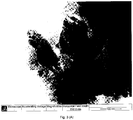
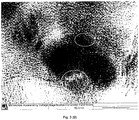
- TEM images as shown in Figs. 3 and 10 are obtained by JOEL JEM-100CX.
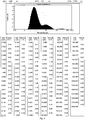
- the particle size distribution of the SiOx/Si composite particles as shown in Fig. 4 is obtained by MASTERSIZER 2000.
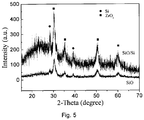
- XRD profiles as shown in Fig. 5 are obtained by Rigaku D/max-2200/PC, Cu.
- Figs. 6 (A) and (B) are obtained by Brunauer-Emmett-Teller (BET) measurement, Micromeritics Inc ASAP 2010 M+C.
- XPS spectra as shown in Fig. 9 are obtained by Kratos Axis Ultra DLD .
- the SiOx/Si composite material was synthesized by high energy ball-milling process with a Planetary Mono Mill P-6 (Fritsch, Germany) at a rotation speed of 400 rpm for 25 h.
- 0.218 g of Mg powder 200mesh, from Sinopharm Chemical Reagent Co., Ltd, was added and it was further ball milled for 15 h.
- the SiOx/Si/C composite material having a D50 particle size of about 1.0 ⁇ m, a D90 particle size of about 11.0 ⁇ m, and a D10 particle size of about 0.4 ⁇ m was obtained (as shown in Fig. 4 ).
- the obtained powder (SiOx/Si/MgO) was first immersed by 2 M HCI solution for 12 h to remove MgO, followed by washing with deionized water and finally vacuum dried at 60 °C for 10 h.
- the obtained SiOx/Si composite material has a Si:O molar ratio of about 1.25:1.
- the obtained SiOx/Si powder (0.2 g) was loaded in an alundum boat and placed at the center of a quartz tube furnace. Next, the precursor gas (argon and toluene) was introduced into the furnace. Then, the furnace temperature was increased from room temperature to 800°C at a rate of 10°C ⁇ min -1 and kept at 800°C for 60 min. The furnace was cooled slowly to room temperature. At high temperature, the toluene decomposed quickly and deposited onto the surface SiOx/Si particles. As a result, the SiOx/Si/C composite material with a carbon coating having an average thickness of about 10 nm, which is shown in Fig. 10 , was obtained. The coated carbon content in the composite was determined to be 12.5%.
- the SiOx/Si/C composite material was produced as in the same method used in Example 1, except that 2.0 g of SiO powder and 0.545 g of Mg powder were loaded in the ball-milling process. As a result, the obtained SiOx/Si composite material has a Si:O molar ratio of about 2:1.
- the SiOx/Si/C composite material was produced as in the same method used in Example 1, except that 2.0 g of SiO powder and 0.872 g of Mg powder were loaded in the ball-milling process. As a result, the obtained SiOx/Si composite material has a Si:O molar ratio of about 5:1.
- the SiOx/Si/C composite material was produced as in the same method used in Example 1, except that the furnace temperature was increased from room temperature to 800°C at a rate of 10°C ⁇ min -1 and kept at 800°C for 90 min. As a result, the SiOx/Si/C composite material with a carbon coating having an average thickness of about 10 nm was obtained. The coated carbon content in the composite was determined to be about 15.2%.
- the SiOx/Si/C composite material was produced as in the same method used in Example 1, except that the furnace temperature was increased from room temperature to 800°C at a rate of 10°C ⁇ min -1 and kept at 800°C for 30 min. As a result, the SiOx/Si/C composite material with a carbon coating having an average thickness of about 5 nm was obtained. The coated carbon content in the composite was determined to be about 5.6%.
- the SiO/C material was produced by coating the pristine SiO/C material with carbon as in the same method used in Example 1, but without ball milling and Mg powder addition.
- the as purchased SiO was directly loaded into an alundum boat and placed at the center of a quartz tube furnace for carbon coating.
- the SiO/C composite material was produced as in the same method used in Example 1, except that no Mg powder was charged in the ball-milling process.
- the as purchased SiO was loaded into milling machine and milled for 25 hours under 400 rpm. Then the product was loaded into an alundum boat and placed at the center of a quartz tube furnace for carbon coating.
- the electrochemical performances of the as-prepared composites in Examples 1-5 and Comparative Examples 1 and 2 were tested using two-electrode coin-type cells.
- the working electrodes were prepared by pasting a mixture of active material, Super P conductive carbon black (40 nm, Timical) and styrene butadiene rubber/sodium carboxymethyl cellulose (SBR/SCMC, 3:5 by weight) as binder at a weight ratio of 70:20:10. After coating the mixture onto pure Cu foil, the electrodes were dried, cut to ⁇ 12 mm sheets, pressed at 3 MPa, and then further dried at 50 °C in vacuum for 4 h.
- the CR2016 coin cells were assembled in an argon-filled glove box (MB-10 compact, MBraun) using 1M LiPF 6 /EC+DMC (1:1 by volume, ethylene carbonate (EC), dimethyl carbonate (DMC)) as electrolyte, including 2wt.% vinylene carbonate (VC), ENTEK ET20-26 as separator, and pure lithium foil as counter electrode.
- the cycling performances were evaluated on a LAND battery test system (Wuhan Kingnuo Electronics Co., Ltd., China) at 25 °C with a current density of 100 mA g -1 or 300 mA g -1 .
- the cut-off voltage was 0.01 V versus Li/Li + for discharge (Li insertion) and 1.2 V versus Li/Li + for charge (Li extraction).
- the test results are shown in Figs. 7 and 8 .
- Example 2 As shown in Fig. 2 , the particles of SiOx/Si/C composite according to Example 1 are small and distribute uniformly, which demonstrates the schematic structure shown in Fig. 1 . In addition, Examples 2-5 also have the similar structures as that of Example 1.
- Figs. 3 (A) and (B) some crystallites can be found in the SiOx/Si/C composite of Example 1. They are within the sizes of 5-10 nm and were confirmed as silicon phases, assigned a Si (111) d-spacing value of 3.1 ⁇ . Accordingly, silicon nanocrystallites embedded in an amorphous matrix phase, which further demonstrates the schematic structure shown in Fig. 1 . In addition, Examples 2-5 have the similar structures as that of Example 1.
- the main diffraction peaks of SiO and SiOx/Si composite material in Example 1 are similar.
- SiO exhibited weak diffraction patterns of silicon phases from the disproportionation of SiO during the ball milling process.
- the diffraction pattern of silicon increased. It is presumed that the SiO partially reacted with the Mg and was reduced to silicon nanocrystallites.
- a set of tetragonal ZrO 2 peaks after the ball milling are detected. The oxide contaminant must have come from the grinding medium (vial and ZrO 2 balls).
- the specific surface area of the SiOx/Si composite material in Example 1 is 24.5 m 2 g -1 .
- the pores are mainly obtained from the etching MgO reduction product.
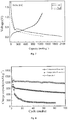
- Fig. 7 shows the first two discharge/charge curves of SiOx/Si/C composite material according to Example 1.
- the coin cell was discharged at 100 mA g -1 between 0.01 and 1.2V vs Li/Li + .
- the first two discharge/charge curves of SiOx/Si/C composite at current density of 100 mA g -1 .
- the discharge and charge capacity of SiOx/Si/C composite is 2080 mAh g -1 and 1286.8 mAh g -1 , respectively, with an initial Coulombic efficiency of 61.9% in the first cycle.
- Fig. 8 shows the cycling performance of the SiO/C material according to Comparative Example 1, the SiO/C material according to Comparative Example 2 and the SiOx/Si/C composite material according to Example 1.
- the coin cell was discharged at 100 mA g -1 for the five cycles and 300 mA g -1 in the following cycles between 0.01 and 1.2 V vs Li/Li + .
- the cycling performance of the SiO/C material according to Comparative Example 2 is increased.
- its reversible capacity is still relative low, only 900 mAh g -1 .
- the reversible capacity of the SiOx/Si/C composite according to Example 1 is further improved from about 900 mAh g -1 (Comparative Example 2) to over 1200 mAh g -1 (Example 1).
- SiOx/Si/C anode according to Example 1 delivers better cycle stability and larger reversible capacity.
- Fig. 9 shows the XPS spectra of the pristine SiO milled 10 h (m-SiO) and the SiOx/Si/C composite material according to Example 1 (m-SiOx/Si).
- Table 1 gives the abundance ratios for the Si oxidation states of Si 2p spectra for m-SiO and m-SiOx/Si.
- Table 1 Abundance ratios for Si oxidation states of Si 2p spectra with m-SiO and m-SiOx/Si. Sample Si 0 (%) Si + (%) Si 2+ (%) Si 3+ (%) Si 4+ (%) m-SiO 9.0 1.5 2.7 17.8 69.0 m-SiOx/Si 11.2 5.8 3.7 46.3 33.0
- the abundance ratio of Si 4+ is significantly decreased while lower oxidation states, i.e. Si 0 , Si + , Si 2+ and Si 3+ are increased. Consequently, in the SiOx/Si/C composite material produced by the inventive process, the amount of Si in the higher oxidation state, i.e. Si 4+ has been reduced by the reductant, and the amount of Si in the lower oxidation states is increased, and thus improves the cycle stability and obtains a larger reversible capacity.
Landscapes
- Chemical & Material Sciences (AREA)
- Engineering & Computer Science (AREA)
- Manufacturing & Machinery (AREA)
- Electrochemistry (AREA)
- Chemical Kinetics & Catalysis (AREA)
- General Chemical & Material Sciences (AREA)
- Ceramic Engineering (AREA)
- Inorganic Chemistry (AREA)
- Materials Engineering (AREA)
- Composite Materials (AREA)
- Structural Engineering (AREA)
- Organic Chemistry (AREA)
- Battery Electrode And Active Subsutance (AREA)
- Silicon Compounds (AREA)
Claims (13)
- SiOx/Si/C-Verbundmaterial, umfassend SiOx/Si-Verbundpartikel und eine Kohlenstoffbeschichtung, die auf die SiOx/Si-Verbundpartikel geschichtet ist, wobei 0 < x ≤ 2 und die SiOx/Si-Verbundpartikel ein Si:O-Molverhältnis von 5:1 bis 1,1:1, vorzugsweise 2:1 bis 1,2:1, aufweisen und wobei die Kohlenstoffbeschichtung eine Dicke von 2-15 nm, vorzugsweise 4-12 nm, bevorzugter 6-10 nm, aufweist.
- SiOx/Si/C-Verbundmaterial gemäß Anspruch 1, wobei die Si-Ox/Si-Verbundpartikel Nano-Siliciumkristallite, die in einer amorphen SiOx-Matrixphase eingebettet sind, umfassen.
- SiOx/Si/C-Verbundmaterial gemäß Anspruch 2, wobei die Nano-Siliciumkristallite eine Partikelgröße von 1-50 nm, vorzugsweise 4-20 nm, aufweisen.
- SiOx/Si/C-Verbundmaterial gemäß einem der Ansprüche 1 bis 3, wobei die SiOx/Si-Verbundpartikel eine D50-Partikelgröße von nicht mehr als 10,0 µm, vorzugsweise nicht mehr als 5,0 µm, bevorzugter nicht mehr als 2,0 µm, noch bevorzugter nicht mehr als 1,1 µm, aufweisen.
- SiOx/Si/C-Verbundmaterial gemäß einem der Ansprüche 1 bis 4, wobei die SiOx/Si-Verbundpartikel eine D90-Partikelgröße von nicht mehr als 20,0 µm, vorzugsweise nicht mehr als 11,1 µm, aufweisen.
- SiOx/Si/C-Verbundmaterial gemäß einem der Ansprüche 1 bis 5, wobei die SiOx/Si-Verbundpartikel eine D10-Partikelgröße von nicht weniger als 0,1 µm, vorzugsweise nicht weniger als 0,3 µm, aufweisen.
- Verfahren zur Herstellung eines SiOx/Si/C-Verbundmaterials, wobei 0 < x ≤ 2, wobei das Verfahren die Schritte umfasst:a) Mahlen von SiO-Pulver zusammen mit einem Metall-Reduktionsmittel in einem Molverhältnis von 1,25:1 bis 10:1, vorzugsweise 2:1 bis 5:1,b) vollständiges Entfernen des Oxidationsprodukts des Metall-Reduktionsmittels, um SiOx/Si-Verbundpartikel zu erhalten,c) Beschichten der SiOx/Si-Verbundpartikel mit Kohlenstoff, um das SiOx/Si/C-Verbundmaterial zu erhalten,wobei Schritt c) durch chemische Dampfabscheidung oder Pyrolyse durchgeführt wird, um eine Kohlenstoffbeschichtung mit einer Dicke von 2-15 nm, vorzugsweise 4-12 nm, bevorzugter 6-10 nm, zu erhalten.
- Verfahren gemäß Anspruch 7, wobei das Metall-Reduktionsmittel ausgewählt ist aus der Gruppe bestehend aus Mg, Al, Zn, Li und der Kombination davon.
- Verfahren gemäß Anspruch 7 oder 8, wobei während Schritt a) das SiO-Pulver durch ein Hochenergie-Kugelmahlverfahren 0-15 h vorgemahlen gemahlen und zusammen mit dem Metall-Reduktionsmittel 3-20 h weitergemahlen wird.
- Verfahren gemäß einem der Ansprüche 7 bis 9, wobei die chemische Dampfabscheidung oder Pyrolyse unter Verwendung eines Vorläuferstoffs oder einer Kohlenstoffquelle ausgewählt aus Toluol, Acetylen, Polyvinylchlorid, Polyvinylidenfluorid, Citronensäure, Glucose, Pech und der Kombination davon durchgeführt wird.
- SiOx/Si/C-Verbundmaterial, hergestellt durch das Verfahren gemäß einem der Ansprüche 7 bis 10.
- Anode für eine Lithiumionenbatterie, umfassend das Si-Ox/Si/C-Verbundmaterial gemäß einem der Ansprüche 1 bis 6 und 11.
- Lithiumionenbatterie, umfassend die Anode gemäß Anspruch 12.
Priority Applications (1)
| Application Number | Priority Date | Filing Date | Title |
|---|---|---|---|
| PL13882787T PL2989671T3 (pl) | 2013-04-27 | 2013-04-27 | MATERIAŁ KOMPOZYTOWY SiOx/Si/C I SPOSÓB JEGO WYTWARZANIA, I ANODA DO AKUMULATORA LITOWO-JONOWEGO ZAWIERAJĄCA WSPOMNIANY MATERIAŁ KOMPOZYTOWY |
Applications Claiming Priority (1)
| Application Number | Priority Date | Filing Date | Title |
|---|---|---|---|
| PCT/CN2013/074886 WO2014172914A1 (en) | 2013-04-27 | 2013-04-27 | SiOx/Si/C COMPOSITE MATERIAL AND PROCESS OF PRODUCING THEREOF, AND ANODE FOR LITHIUM ION BATTERY COMPRISING SAID COMPOSITE MATERIAL |
Publications (4)
| Publication Number | Publication Date |
|---|---|
| EP2989671A1 EP2989671A1 (de) | 2016-03-02 |
| EP2989671A4 EP2989671A4 (de) | 2016-11-23 |
| EP2989671B1 true EP2989671B1 (de) | 2019-01-09 |
| EP2989671B8 EP2989671B8 (de) | 2019-03-20 |
Family
ID=51791030
Family Applications (1)
| Application Number | Title | Priority Date | Filing Date |
|---|---|---|---|
| EP13882787.8A Active EP2989671B8 (de) | 2013-04-27 | 2013-04-27 | Siox/si/c-verbundwerkstoff und verfahren zur herstellung davon sowie anode für lithium-ionen-batterien mit diesem verbundwerkstoff |
Country Status (6)
| Country | Link |
|---|---|
| US (1) | US9972836B2 (de) |
| EP (1) | EP2989671B8 (de) |
| JP (1) | JP6133493B2 (de) |
| CN (1) | CN105409035B (de) |
| PL (1) | PL2989671T3 (de) |
| WO (1) | WO2014172914A1 (de) |
Families Citing this family (58)
| Publication number | Priority date | Publication date | Assignee | Title |
|---|---|---|---|---|
| US9601228B2 (en) | 2011-05-16 | 2017-03-21 | Envia Systems, Inc. | Silicon oxide based high capacity anode materials for lithium ion batteries |
| US9780358B2 (en) | 2012-05-04 | 2017-10-03 | Zenlabs Energy, Inc. | Battery designs with high capacity anode materials and cathode materials |
| US9893353B2 (en) | 2013-05-23 | 2018-02-13 | Shin-Etsu Chemical Co., Ltd. | Negative electrode material for nonaqueous electrolyte secondary batteries, and secondary battery |
| US10886526B2 (en) | 2013-06-13 | 2021-01-05 | Zenlabs Energy, Inc. | Silicon-silicon oxide-carbon composites for lithium battery electrodes and methods for forming the composites |
| WO2015024004A1 (en) | 2013-08-16 | 2015-02-19 | Envia Systems, Inc. | Lithium ion batteries with high capacity anode active material and good cycling for consumer electronics |
| US10483529B2 (en) | 2014-12-23 | 2019-11-19 | Umicore | Composite powder for use in an anode of a lithium ion battery, method of preparing such a composite powder and method for analysing such a composite powder |
| JP6625646B2 (ja) | 2014-12-23 | 2019-12-25 | ユミコア | 粉末、このような粉末を含む電極および電池 |
| JP6625647B2 (ja) | 2014-12-23 | 2019-12-25 | ユミコア | 粉末、このような粉末を含む電極及び電池 |
| JP6448525B2 (ja) * | 2015-02-26 | 2019-01-09 | 信越化学工業株式会社 | 非水電解質二次電池用負極活物質、非水電解質二次電池用負極、及び非水電解質二次電池、並びに非水電解質二次電池用負極材の製造方法 |
| KR101981609B1 (ko) * | 2015-09-24 | 2019-05-24 | 주식회사 엘지화학 | 리튬 이차전지용 음극활물질 및 그 제조방법 |
| CN107735888B (zh) * | 2015-09-24 | 2020-12-29 | 株式会社Lg化学 | 锂二次电池用负极活性材料及其制备方法 |
| KR101816400B1 (ko) * | 2016-05-12 | 2018-01-09 | 에스케이이노베이션 주식회사 | 이차전지용 활물질의 평가방법 |
| KR101918815B1 (ko) * | 2016-08-23 | 2018-11-15 | 넥시온 엘티디. | 이차 전지용 음극 활물질 및 이의 제조 방법 |
| JP7099325B2 (ja) | 2016-11-22 | 2022-07-12 | 三菱ケミカル株式会社 | 非水系二次電池用負極材、非水系二次電池用負極及び非水系二次電池 |
| WO2018179111A1 (ja) * | 2017-03-28 | 2018-10-04 | 日立化成株式会社 | リチウムイオン二次電池用負極活物質、リチウムイオン二次電池用負極及びリチウムイオン二次電池 |
| GB201803983D0 (en) | 2017-09-13 | 2018-04-25 | Unifrax I Llc | Materials |
| CN111816854B (zh) * | 2017-09-22 | 2022-03-22 | 苏州锦艺新材料科技股份有限公司 | 一种锂离子电池 |
| CN107959012B (zh) * | 2017-11-17 | 2021-02-26 | 力信(江苏)能源科技有限责任公司 | 一种单层/双层包覆硅氧化物复合负极材料及其制备方法 |
| CN108054366B (zh) * | 2017-12-12 | 2021-07-23 | 贝特瑞新材料集团股份有限公司 | 一种锂离子电池负极材料及其制备方法 |
| US11094925B2 (en) | 2017-12-22 | 2021-08-17 | Zenlabs Energy, Inc. | Electrodes with silicon oxide active materials for lithium ion cells achieving high capacity, high energy density and long cycle life performance |
| US11152613B2 (en) | 2018-01-19 | 2021-10-19 | Amprius, Inc. | Stabilized, prelithiated silicon oxide particles for lithium ion battery anodes |
| CN111656584A (zh) | 2018-01-31 | 2020-09-11 | 日立化成株式会社 | 锂离子二次电池用负极活性物质、锂离子二次电池用负极和锂离子二次电池 |
| JP6451916B1 (ja) * | 2018-01-31 | 2019-01-16 | 日立化成株式会社 | リチウムイオン二次電池用負極活物質、リチウムイオン二次電池用負極及びリチウムイオン二次電池 |
| WO2019150511A1 (ja) * | 2018-01-31 | 2019-08-08 | 日立化成株式会社 | リチウムイオン二次電池用負極活物質、リチウムイオン二次電池用負極及びリチウムイオン二次電池 |
| EP3544099A1 (de) | 2018-03-21 | 2019-09-25 | Borregaard AS | Dispergiermittel und bindemittel für lithium-ionen-batterien auf basis von modifiziertem lignin und carboxymethylcellulose |
| CN112313171A (zh) | 2018-04-29 | 2021-02-02 | 株式会社Kit | 复合组合物 |
| JP7058333B2 (ja) * | 2018-08-27 | 2022-04-21 | 株式会社大阪チタニウムテクノロジーズ | SiO粉末製造方法及び球形粒子状SiO粉末 |
| CN109309220B (zh) * | 2018-10-10 | 2021-03-23 | 成都爱敏特新能源技术有限公司 | 一种锂离子电池所用补锂多孔一氧化硅负极材料及其制备方法 |
| CN112840476A (zh) | 2018-10-12 | 2021-05-25 | 雅宝公司 | 包含硅和锂的颗粒 |
| TWI711208B (zh) * | 2018-11-16 | 2020-11-21 | 國家中山科學研究院 | 一種矽氧化物與非晶碳層包覆以多層石墨烯為載體之奈米矽的負極材料及其製備方法 |
| JP7159838B2 (ja) * | 2018-12-13 | 2022-10-25 | 昭和電工マテリアルズ株式会社 | リチウムイオン二次電池用負極活物質、リチウムイオン二次電池用負極及びリチウムイオン二次電池 |
| JP7159839B2 (ja) * | 2018-12-13 | 2022-10-25 | 昭和電工マテリアルズ株式会社 | リチウムイオン二次電池用負極活物質、リチウムイオン二次電池用負極及びリチウムイオン二次電池 |
| JP7159840B2 (ja) * | 2018-12-13 | 2022-10-25 | 昭和電工マテリアルズ株式会社 | リチウムイオン二次電池用負極活物質、リチウムイオン二次電池用負極及びリチウムイオン二次電池 |
| CN109686941B (zh) * | 2018-12-21 | 2022-02-01 | 安徽工业大学 | 一种制备锂离子动力电池用硅碳负极材料的方法 |
| CN111453737B (zh) * | 2019-01-22 | 2021-08-03 | 成都博达爱福科技有限公司 | 一种由mq硅树脂制备氧化亚硅的方法 |
| TWI699033B (zh) * | 2019-04-03 | 2020-07-11 | 國家中山科學研究院 | 一種含SiOx之負極材料的製造方法 |
| CN112018334A (zh) * | 2019-05-28 | 2020-12-01 | 贝特瑞新材料集团股份有限公司 | 一种硅氧化物/碳复合负极材料及其制备方法和锂离子电池 |
| US11973178B2 (en) | 2019-06-26 | 2024-04-30 | Ionblox, Inc. | Lithium ion cells with high performance electrolyte and silicon oxide active materials achieving very long cycle life performance |
| CN112151788B (zh) * | 2019-06-26 | 2024-10-01 | 伊翁布洛克斯有限公司 | 具有高性能电解质和氧化硅活性材料的锂离子电池 |
| CN110265650A (zh) * | 2019-06-30 | 2019-09-20 | 山东华亿比科新能源股份有限公司 | 一种锂离子电池用纳米多孔复合负极材料及其制备方法 |
| CN110474030B (zh) * | 2019-07-29 | 2022-10-21 | 孙旭阳 | 一种锂离子电池碳复合硅系负极材料制备方法 |
| CN110993907B (zh) * | 2019-11-25 | 2021-05-07 | 宁波广新纳米材料有限公司 | 一种纳米晶硅-氧化亚硅-碳复合粉体的制备方法 |
| CN113130858B (zh) * | 2019-12-31 | 2022-12-30 | 华为技术有限公司 | 硅基负极材料及其制备方法、电池和终端 |
| JP7457824B2 (ja) * | 2020-02-21 | 2024-03-28 | ユミコア | 電池の負極に使用するための粉末、かかる粉末の調製方法及びかかる粉末を含む電池 |
| US12355079B2 (en) | 2020-07-02 | 2025-07-08 | Ionblox, Inc. | Lithium ion cells with silicon based active materials and negative electrodes with water-based binders having good adhesion and cohesion |
| CN111816862A (zh) * | 2020-07-31 | 2020-10-23 | 广东凯金新能源科技股份有限公司 | 一种高稳定的硅碳负极材料及其制备方法 |
| KR20220065124A (ko) * | 2020-11-12 | 2022-05-20 | 에스케이온 주식회사 | 코어-쉘 복합체를 포함하는 음극 활물질 및 이의 제조방법 |
| CN112563502A (zh) * | 2020-12-07 | 2021-03-26 | 广东凯金新能源科技股份有限公司 | 一种高首效多元包覆硅基复合材料、其制备方法及其应用 |
| WO2022124172A1 (ja) * | 2020-12-08 | 2022-06-16 | Dic株式会社 | 負極活物質及び非水電解質二次電池 |
| CN116568633A (zh) * | 2020-12-08 | 2023-08-08 | Dic株式会社 | 负极活性物质和非水电解质二次电池 |
| CN112599733B (zh) * | 2020-12-09 | 2022-07-12 | 南昌大学 | 一种磷元素掺杂的Si/SiOx/C负极材料的合成方法 |
| CN113675385B (zh) * | 2021-07-13 | 2022-12-09 | 厦门理工学院 | 一种纳米级硅碳复合负极材料、制备方法及锂离子电池 |
| JPWO2023074217A1 (de) * | 2021-10-27 | 2023-05-04 | ||
| JP7563367B2 (ja) * | 2021-11-29 | 2024-10-08 | トヨタ自動車株式会社 | 負極層 |
| KR20230174597A (ko) * | 2022-06-21 | 2023-12-28 | 에스케이온 주식회사 | 리튬 이차 전지용 음극 활물질 및 이를 포함하는 제조된 리튬 이차 전지 |
| JP2026503142A (ja) * | 2023-08-30 | 2026-01-27 | エルジー エナジー ソリューション リミテッド | 負極組成物、負極組成物を含むリチウム二次電池用負極、およびこれを含むリチウム二次電池 |
| WO2025215894A1 (ja) * | 2024-04-12 | 2025-10-16 | 株式会社大阪チタニウムテクノロジーズ | 酸化ケイ素の粉体 |
| FR3162313A1 (fr) * | 2024-05-15 | 2025-11-21 | HPQ Silicium Inc. | Appareil et procede pour la production continue ou semi-continue d’un materiau a base de silicium adapte a la fabrication d’anode de batterie li-ion |
Family Cites Families (12)
| Publication number | Priority date | Publication date | Assignee | Title |
|---|---|---|---|---|
| JP4401984B2 (ja) * | 2004-03-08 | 2010-01-20 | 三星エスディアイ株式会社 | リチウム二次電池用負極活物質、リチウム二次電池用負極活物質、およびリチウム二次電池 |
| JP4985949B2 (ja) * | 2006-03-27 | 2012-07-25 | 信越化学工業株式会社 | 珪素−珪素酸化物−リチウム系複合体の製造方法、並びに非水電解質二次電池用負極材 |
| KR101375328B1 (ko) | 2007-07-27 | 2014-03-19 | 삼성에스디아이 주식회사 | Si/C 복합물, 이를 포함하는 음극활물질 및 리튬전지 |
| JP5555978B2 (ja) | 2008-02-28 | 2014-07-23 | 信越化学工業株式会社 | 非水電解質二次電池用負極活物質、及びそれを用いた非水電解質二次電池 |
| JP5245592B2 (ja) | 2008-07-14 | 2013-07-24 | 信越化学工業株式会社 | 非水電解質二次電池用負極材、ならびにリチウムイオン二次電池及び電気化学キャパシタ |
| JP2010225494A (ja) | 2009-03-25 | 2010-10-07 | Shin-Etsu Chemical Co Ltd | 非水電解質二次電池用負極材及びその製造方法、ならびにリチウムイオン二次電池 |
| US7964172B2 (en) | 2009-10-13 | 2011-06-21 | Alexander Mukasyan | Method of manufacturing high-surface-area silicon |
| JP5411780B2 (ja) * | 2010-04-05 | 2014-02-12 | 信越化学工業株式会社 | 非水電解質二次電池用負極材及び非水電解質二次電池用負極材の製造方法並びにリチウムイオン二次電池 |
| JP5476273B2 (ja) * | 2010-10-27 | 2014-04-23 | 信越化学工業株式会社 | 非水電解液二次電池 |
| CN102208634B (zh) | 2011-05-06 | 2014-04-16 | 北京科技大学 | 一种多孔硅/碳复合材料及其制备方法 |
| CN102593426A (zh) | 2011-05-07 | 2012-07-18 | 天津锦美碳材科技发展有限公司 | SiOx/C复合材料的制备方法及制得的锂离子电池硅碳负极材料 |
| CN102800851A (zh) | 2012-08-17 | 2012-11-28 | 奇瑞汽车股份有限公司 | 一种硅碳复合材料及其制备方法、含该材料的锂离子电池 |
-
2013
- 2013-04-27 US US14/787,431 patent/US9972836B2/en active Active
- 2013-04-27 JP JP2016509250A patent/JP6133493B2/ja active Active
- 2013-04-27 PL PL13882787T patent/PL2989671T3/pl unknown
- 2013-04-27 EP EP13882787.8A patent/EP2989671B8/de active Active
- 2013-04-27 CN CN201380076042.7A patent/CN105409035B/zh active Active
- 2013-04-27 WO PCT/CN2013/074886 patent/WO2014172914A1/en not_active Ceased
Non-Patent Citations (1)
| Title |
|---|
| None * |
Also Published As
| Publication number | Publication date |
|---|---|
| EP2989671A4 (de) | 2016-11-23 |
| JP6133493B2 (ja) | 2017-05-24 |
| EP2989671A1 (de) | 2016-03-02 |
| CN105409035A (zh) | 2016-03-16 |
| JP2016522139A (ja) | 2016-07-28 |
| US20160079591A1 (en) | 2016-03-17 |
| CN105409035B (zh) | 2018-05-22 |
| PL2989671T3 (pl) | 2019-12-31 |
| US9972836B2 (en) | 2018-05-15 |
| WO2014172914A1 (en) | 2014-10-30 |
| EP2989671B8 (de) | 2019-03-20 |
Similar Documents
| Publication | Publication Date | Title |
|---|---|---|
| EP2989671B1 (de) | Siox/si/c-verbundwerkstoff und verfahren zur herstellung davon sowie anode für lithium-ionen-batterien mit diesem verbundwerkstoff | |
| Wang et al. | Magnetron sputtering enabled synthesis of nanostructured materials for electrochemical energy storage | |
| Li et al. | Stable Silicon Anodes for Lithium-Ion Batteries Using Mesoporous Metallurgical Silicon. | |
| Xiao et al. | Large-scale synthesis of Si@ C three-dimensional porous structures as high-performance anode materials for lithium-ion batteries | |
| Yang et al. | Cathodically induced antimony for rechargeable Li-ion and Na-ion batteries: The influences of hexagonal and amorphous phase | |
| Zhao et al. | A Yolk-Shell Fe^ sub 3^ O^ sub 4^@ C Composite as an Anode Material for High-Rate Lithium Batteries | |
| Hu et al. | Bead-curtain shaped SiC@ SiO2 core-shell nanowires with superior electrochemical properties for lithium-ion batteries | |
| KR101751787B1 (ko) | 리튬이차전지용 실리콘 복합재 음극활물질, 이의 제조방법 및 이를 포함하는 리튬이차전지 | |
| EP4112548A1 (de) | Verfahren zur herstellung von porösem silicium und anodenaktivmaterial für sekundärbatterie damit | |
| Zhou et al. | Enhanced lithium ion battery performance of nano/micro-size Si via combination of metal-assisted chemical etching method and ball-milling | |
| WO2017214882A1 (en) | Porous silicon particles and a method for producing silicon particles | |
| Ensafi et al. | Metal (Ni and Bi) coated porous silicon nanostructure, high-performance anode materials for lithium ion batteries with high capacity and stability | |
| Zhang et al. | Sequential-template synthesis of hollowed carbon polyhedron@ SiC@ Si for lithium-ion battery with high capacity and electrochemical stability | |
| Chen et al. | Superior wide-temperature lithium storage in a porous cobalt vanadate | |
| KR101604003B1 (ko) | 리튬이차전지용 실리콘 복합재 음극활물질, 이의 제조방법 및 이를 포함하는 리튬이차전지 | |
| Cui et al. | Porous Al/Al2O3 two-phase nanonetwork to improve electrochemical properties of porous C/SiO2 as anode for Li-ion batteries | |
| WO2015010230A1 (en) | Method for preparing hollow silicon spheres as well as hollow silicon spheres prepared therefrom | |
| Pan et al. | Controllable synthesis of electric double-layer capacitance and pseudocapacitance coupled porous carbon cathode material for zinc-ion hybrid capacitors | |
| Xu et al. | Deficient TiO 2− x coated porous SiO anodes for high-rate lithium-ion batteries | |
| Hong et al. | Fabrication of porous SiOx/nanoSi@ C composites with homogeneous silicon distribution for high-performance Li-ion battery anodes | |
| Issatayev et al. | Three-dimensional carbon coated and high mass-loaded NiO@ Ni foam anode with high specific capacity for lithium ion batteries | |
| Zhang et al. | Improved sodium-ion storage properties by fabricating nanoporous CuSn alloy architecture | |
| KR101722960B1 (ko) | 리튬 이차 전지용 음극 활물질, 이의 제조 방법 및 이를 포함하는 리튬 이차 전지 | |
| Abzal et al. | Exploring the electrochemical performance of layered Bi 2 Se 3 hexagonal platelets as the anode material for lithium-ion batteries | |
| Lin et al. | Facile preparation of Cr2O3@ Ag2O composite as high performance lithium storage material |
Legal Events
| Date | Code | Title | Description |
|---|---|---|---|
| PUAI | Public reference made under article 153(3) epc to a published international application that has entered the european phase |
Free format text: ORIGINAL CODE: 0009012 |
|
| 17P | Request for examination filed |
Effective date: 20151127 |
|
| AK | Designated contracting states |
Kind code of ref document: A1 Designated state(s): AL AT BE BG CH CY CZ DE DK EE ES FI FR GB GR HR HU IE IS IT LI LT LU LV MC MK MT NL NO PL PT RO RS SE SI SK SM TR |
|
| AX | Request for extension of the european patent |
Extension state: BA ME |
|
| DAX | Request for extension of the european patent (deleted) | ||
| A4 | Supplementary search report drawn up and despatched |
Effective date: 20161020 |
|
| RIC1 | Information provided on ipc code assigned before grant |
Ipc: H01M 4/36 20060101ALI20161014BHEP Ipc: H01M 4/1391 20100101ALI20161014BHEP Ipc: H01M 4/1395 20100101ALI20161014BHEP Ipc: C04B 35/626 20060101ALI20161014BHEP Ipc: H01M 4/38 20060101AFI20161014BHEP Ipc: H01M 10/0525 20100101ALI20161014BHEP Ipc: H01M 4/48 20060101ALI20161014BHEP Ipc: H01M 4/587 20100101ALI20161014BHEP Ipc: H01M 4/62 20060101ALI20161014BHEP Ipc: H01M 4/1397 20100101ALI20161014BHEP Ipc: C04B 35/628 20060101ALI20161014BHEP |
|
| STAA | Information on the status of an ep patent application or granted ep patent |
Free format text: STATUS: REQUEST FOR EXAMINATION WAS MADE |
|
| GRAP | Despatch of communication of intention to grant a patent |
Free format text: ORIGINAL CODE: EPIDOSNIGR1 |
|
| STAA | Information on the status of an ep patent application or granted ep patent |
Free format text: STATUS: GRANT OF PATENT IS INTENDED |
|
| RIC1 | Information provided on ipc code assigned before grant |
Ipc: H01M 4/48 20100101ALI20180615BHEP Ipc: H01M 4/1397 20100101ALI20180615BHEP Ipc: C04B 35/628 20060101ALI20180615BHEP Ipc: H01M 10/0525 20100101ALI20180615BHEP Ipc: C04B 35/626 20060101ALI20180615BHEP Ipc: H01M 4/1395 20100101ALI20180615BHEP Ipc: H01M 4/38 20060101AFI20180615BHEP Ipc: H01M 4/587 20100101ALI20180615BHEP Ipc: H01M 4/36 20060101ALI20180615BHEP Ipc: H01M 4/1391 20100101ALI20180615BHEP Ipc: H01M 4/62 20060101ALI20180615BHEP |
|
| INTG | Intention to grant announced |
Effective date: 20180703 |
|
| GRAJ | Information related to disapproval of communication of intention to grant by the applicant or resumption of examination proceedings by the epo deleted |
Free format text: ORIGINAL CODE: EPIDOSDIGR1 |
|
| STAA | Information on the status of an ep patent application or granted ep patent |
Free format text: STATUS: REQUEST FOR EXAMINATION WAS MADE |
|
| GRAJ | Information related to disapproval of communication of intention to grant by the applicant or resumption of examination proceedings by the epo deleted |
Free format text: ORIGINAL CODE: EPIDOSDIGR1 |
|
| GRAP | Despatch of communication of intention to grant a patent |
Free format text: ORIGINAL CODE: EPIDOSNIGR1 |
|
| GRAJ | Information related to disapproval of communication of intention to grant by the applicant or resumption of examination proceedings by the epo deleted |
Free format text: ORIGINAL CODE: EPIDOSDIGR1 |
|
| GRAP | Despatch of communication of intention to grant a patent |
Free format text: ORIGINAL CODE: EPIDOSNIGR1 |
|
| GRAJ | Information related to disapproval of communication of intention to grant by the applicant or resumption of examination proceedings by the epo deleted |
Free format text: ORIGINAL CODE: EPIDOSDIGR1 |
|
| GRAP | Despatch of communication of intention to grant a patent |
Free format text: ORIGINAL CODE: EPIDOSNIGR1 |
|
| GRAR | Information related to intention to grant a patent recorded |
Free format text: ORIGINAL CODE: EPIDOSNIGR71 |
|
| GRAS | Grant fee paid |
Free format text: ORIGINAL CODE: EPIDOSNIGR3 |
|
| STAA | Information on the status of an ep patent application or granted ep patent |
Free format text: STATUS: GRANT OF PATENT IS INTENDED |
|
| GRAA | (expected) grant |
Free format text: ORIGINAL CODE: 0009210 |
|
| STAA | Information on the status of an ep patent application or granted ep patent |
Free format text: STATUS: THE PATENT HAS BEEN GRANTED |
|
| INTC | Intention to grant announced (deleted) | ||
| AK | Designated contracting states |
Kind code of ref document: B1 Designated state(s): AL AT BE BG CH CY CZ DE DK EE ES FI FR GB GR HR HU IE IS IT LI LT LU LV MC MK MT NL NO PL PT RO RS SE SI SK SM TR |
|
| INTG | Intention to grant announced |
Effective date: 20181205 |
|
| REG | Reference to a national code |
Ref country code: GB Ref legal event code: FG4D |
|
| REG | Reference to a national code |
Ref country code: CH Ref legal event code: EP Ref country code: AT Ref legal event code: REF Ref document number: 1088444 Country of ref document: AT Kind code of ref document: T Effective date: 20190115 |
|
| REG | Reference to a national code |
Ref country code: IE Ref legal event code: FG4D |
|
| REG | Reference to a national code |
Ref country code: DE Ref legal event code: R096 Ref document number: 602013049750 Country of ref document: DE |
|
| REG | Reference to a national code |
Ref country code: CH Ref legal event code: PK Free format text: BERICHTIGUNG B8 |
|
| REG | Reference to a national code |
Ref country code: NL Ref legal event code: MP Effective date: 20190109 |
|
| REG | Reference to a national code |
Ref country code: LT Ref legal event code: MG4D |
|
| PG25 | Lapsed in a contracting state [announced via postgrant information from national office to epo] |
Ref country code: NL Free format text: LAPSE BECAUSE OF FAILURE TO SUBMIT A TRANSLATION OF THE DESCRIPTION OR TO PAY THE FEE WITHIN THE PRESCRIBED TIME-LIMIT Effective date: 20190109 |
|
| REG | Reference to a national code |
Ref country code: AT Ref legal event code: MK05 Ref document number: 1088444 Country of ref document: AT Kind code of ref document: T Effective date: 20190109 |
|
| PG25 | Lapsed in a contracting state [announced via postgrant information from national office to epo] |
Ref country code: LT Free format text: LAPSE BECAUSE OF FAILURE TO SUBMIT A TRANSLATION OF THE DESCRIPTION OR TO PAY THE FEE WITHIN THE PRESCRIBED TIME-LIMIT Effective date: 20190109 Ref country code: ES Free format text: LAPSE BECAUSE OF FAILURE TO SUBMIT A TRANSLATION OF THE DESCRIPTION OR TO PAY THE FEE WITHIN THE PRESCRIBED TIME-LIMIT Effective date: 20190109 Ref country code: SE Free format text: LAPSE BECAUSE OF FAILURE TO SUBMIT A TRANSLATION OF THE DESCRIPTION OR TO PAY THE FEE WITHIN THE PRESCRIBED TIME-LIMIT Effective date: 20190109 Ref country code: PT Free format text: LAPSE BECAUSE OF FAILURE TO SUBMIT A TRANSLATION OF THE DESCRIPTION OR TO PAY THE FEE WITHIN THE PRESCRIBED TIME-LIMIT Effective date: 20190509 Ref country code: NO Free format text: LAPSE BECAUSE OF FAILURE TO SUBMIT A TRANSLATION OF THE DESCRIPTION OR TO PAY THE FEE WITHIN THE PRESCRIBED TIME-LIMIT Effective date: 20190409 Ref country code: FI Free format text: LAPSE BECAUSE OF FAILURE TO SUBMIT A TRANSLATION OF THE DESCRIPTION OR TO PAY THE FEE WITHIN THE PRESCRIBED TIME-LIMIT Effective date: 20190109 |
|
| PG25 | Lapsed in a contracting state [announced via postgrant information from national office to epo] |
Ref country code: RS Free format text: LAPSE BECAUSE OF FAILURE TO SUBMIT A TRANSLATION OF THE DESCRIPTION OR TO PAY THE FEE WITHIN THE PRESCRIBED TIME-LIMIT Effective date: 20190109 Ref country code: HR Free format text: LAPSE BECAUSE OF FAILURE TO SUBMIT A TRANSLATION OF THE DESCRIPTION OR TO PAY THE FEE WITHIN THE PRESCRIBED TIME-LIMIT Effective date: 20190109 Ref country code: LV Free format text: LAPSE BECAUSE OF FAILURE TO SUBMIT A TRANSLATION OF THE DESCRIPTION OR TO PAY THE FEE WITHIN THE PRESCRIBED TIME-LIMIT Effective date: 20190109 Ref country code: BG Free format text: LAPSE BECAUSE OF FAILURE TO SUBMIT A TRANSLATION OF THE DESCRIPTION OR TO PAY THE FEE WITHIN THE PRESCRIBED TIME-LIMIT Effective date: 20190409 Ref country code: IS Free format text: LAPSE BECAUSE OF FAILURE TO SUBMIT A TRANSLATION OF THE DESCRIPTION OR TO PAY THE FEE WITHIN THE PRESCRIBED TIME-LIMIT Effective date: 20190509 Ref country code: GR Free format text: LAPSE BECAUSE OF FAILURE TO SUBMIT A TRANSLATION OF THE DESCRIPTION OR TO PAY THE FEE WITHIN THE PRESCRIBED TIME-LIMIT Effective date: 20190410 |
|
| REG | Reference to a national code |
Ref country code: DE Ref legal event code: R097 Ref document number: 602013049750 Country of ref document: DE |
|
| PG25 | Lapsed in a contracting state [announced via postgrant information from national office to epo] |
Ref country code: EE Free format text: LAPSE BECAUSE OF FAILURE TO SUBMIT A TRANSLATION OF THE DESCRIPTION OR TO PAY THE FEE WITHIN THE PRESCRIBED TIME-LIMIT Effective date: 20190109 Ref country code: DK Free format text: LAPSE BECAUSE OF FAILURE TO SUBMIT A TRANSLATION OF THE DESCRIPTION OR TO PAY THE FEE WITHIN THE PRESCRIBED TIME-LIMIT Effective date: 20190109 Ref country code: SK Free format text: LAPSE BECAUSE OF FAILURE TO SUBMIT A TRANSLATION OF THE DESCRIPTION OR TO PAY THE FEE WITHIN THE PRESCRIBED TIME-LIMIT Effective date: 20190109 Ref country code: AL Free format text: LAPSE BECAUSE OF FAILURE TO SUBMIT A TRANSLATION OF THE DESCRIPTION OR TO PAY THE FEE WITHIN THE PRESCRIBED TIME-LIMIT Effective date: 20190109 Ref country code: CZ Free format text: LAPSE BECAUSE OF FAILURE TO SUBMIT A TRANSLATION OF THE DESCRIPTION OR TO PAY THE FEE WITHIN THE PRESCRIBED TIME-LIMIT Effective date: 20190109 Ref country code: RO Free format text: LAPSE BECAUSE OF FAILURE TO SUBMIT A TRANSLATION OF THE DESCRIPTION OR TO PAY THE FEE WITHIN THE PRESCRIBED TIME-LIMIT Effective date: 20190109 Ref country code: IT Free format text: LAPSE BECAUSE OF FAILURE TO SUBMIT A TRANSLATION OF THE DESCRIPTION OR TO PAY THE FEE WITHIN THE PRESCRIBED TIME-LIMIT Effective date: 20190109 Ref country code: AT Free format text: LAPSE BECAUSE OF FAILURE TO SUBMIT A TRANSLATION OF THE DESCRIPTION OR TO PAY THE FEE WITHIN THE PRESCRIBED TIME-LIMIT Effective date: 20190109 |
|
| PLBE | No opposition filed within time limit |
Free format text: ORIGINAL CODE: 0009261 |
|
| STAA | Information on the status of an ep patent application or granted ep patent |
Free format text: STATUS: NO OPPOSITION FILED WITHIN TIME LIMIT |
|
| PG25 | Lapsed in a contracting state [announced via postgrant information from national office to epo] |
Ref country code: SM Free format text: LAPSE BECAUSE OF FAILURE TO SUBMIT A TRANSLATION OF THE DESCRIPTION OR TO PAY THE FEE WITHIN THE PRESCRIBED TIME-LIMIT Effective date: 20190109 |
|
| REG | Reference to a national code |
Ref country code: CH Ref legal event code: PL |
|
| 26N | No opposition filed |
Effective date: 20191010 |
|
| REG | Reference to a national code |
Ref country code: BE Ref legal event code: MM Effective date: 20190430 |
|
| GBPC | Gb: european patent ceased through non-payment of renewal fee |
Effective date: 20190427 |
|
| PG25 | Lapsed in a contracting state [announced via postgrant information from national office to epo] |
Ref country code: LU Free format text: LAPSE BECAUSE OF NON-PAYMENT OF DUE FEES Effective date: 20190427 Ref country code: MC Free format text: LAPSE BECAUSE OF FAILURE TO SUBMIT A TRANSLATION OF THE DESCRIPTION OR TO PAY THE FEE WITHIN THE PRESCRIBED TIME-LIMIT Effective date: 20190109 |
|
| PG25 | Lapsed in a contracting state [announced via postgrant information from national office to epo] |
Ref country code: CH Free format text: LAPSE BECAUSE OF NON-PAYMENT OF DUE FEES Effective date: 20190430 Ref country code: LI Free format text: LAPSE BECAUSE OF NON-PAYMENT OF DUE FEES Effective date: 20190430 Ref country code: GB Free format text: LAPSE BECAUSE OF NON-PAYMENT OF DUE FEES Effective date: 20190427 |
|
| PG25 | Lapsed in a contracting state [announced via postgrant information from national office to epo] |
Ref country code: BE Free format text: LAPSE BECAUSE OF NON-PAYMENT OF DUE FEES Effective date: 20190430 Ref country code: SI Free format text: LAPSE BECAUSE OF FAILURE TO SUBMIT A TRANSLATION OF THE DESCRIPTION OR TO PAY THE FEE WITHIN THE PRESCRIBED TIME-LIMIT Effective date: 20190109 |
|
| PG25 | Lapsed in a contracting state [announced via postgrant information from national office to epo] |
Ref country code: TR Free format text: LAPSE BECAUSE OF FAILURE TO SUBMIT A TRANSLATION OF THE DESCRIPTION OR TO PAY THE FEE WITHIN THE PRESCRIBED TIME-LIMIT Effective date: 20190109 |
|
| PG25 | Lapsed in a contracting state [announced via postgrant information from national office to epo] |
Ref country code: IE Free format text: LAPSE BECAUSE OF NON-PAYMENT OF DUE FEES Effective date: 20190427 |
|
| PG25 | Lapsed in a contracting state [announced via postgrant information from national office to epo] |
Ref country code: CY Free format text: LAPSE BECAUSE OF FAILURE TO SUBMIT A TRANSLATION OF THE DESCRIPTION OR TO PAY THE FEE WITHIN THE PRESCRIBED TIME-LIMIT Effective date: 20190109 |
|
| PG25 | Lapsed in a contracting state [announced via postgrant information from national office to epo] |
Ref country code: HU Free format text: LAPSE BECAUSE OF FAILURE TO SUBMIT A TRANSLATION OF THE DESCRIPTION OR TO PAY THE FEE WITHIN THE PRESCRIBED TIME-LIMIT; INVALID AB INITIO Effective date: 20130427 Ref country code: MT Free format text: LAPSE BECAUSE OF FAILURE TO SUBMIT A TRANSLATION OF THE DESCRIPTION OR TO PAY THE FEE WITHIN THE PRESCRIBED TIME-LIMIT Effective date: 20190109 |
|
| PG25 | Lapsed in a contracting state [announced via postgrant information from national office to epo] |
Ref country code: MK Free format text: LAPSE BECAUSE OF FAILURE TO SUBMIT A TRANSLATION OF THE DESCRIPTION OR TO PAY THE FEE WITHIN THE PRESCRIBED TIME-LIMIT Effective date: 20190109 |
|
| PGFP | Annual fee paid to national office [announced via postgrant information from national office to epo] |
Ref country code: FR Payment date: 20220420 Year of fee payment: 10 |
|
| PGFP | Annual fee paid to national office [announced via postgrant information from national office to epo] |
Ref country code: PL Payment date: 20220414 Year of fee payment: 10 |
|
| PG25 | Lapsed in a contracting state [announced via postgrant information from national office to epo] |
Ref country code: FR Free format text: LAPSE BECAUSE OF NON-PAYMENT OF DUE FEES Effective date: 20230430 |
|
| PG25 | Lapsed in a contracting state [announced via postgrant information from national office to epo] |
Ref country code: PL Free format text: LAPSE BECAUSE OF NON-PAYMENT OF DUE FEES Effective date: 20230427 |
|
| PG25 | Lapsed in a contracting state [announced via postgrant information from national office to epo] |
Ref country code: PL Free format text: LAPSE BECAUSE OF NON-PAYMENT OF DUE FEES Effective date: 20230427 |
|
| PGFP | Annual fee paid to national office [announced via postgrant information from national office to epo] |
Ref country code: DE Payment date: 20250624 Year of fee payment: 13 |