EP2995134B1 - Method for an improved cell selection/reselection by a user equipment trying to camp on a radio cell of a public land mobile network - Google Patents
Method for an improved cell selection/reselection by a user equipment trying to camp on a radio cell of a public land mobile network Download PDFInfo
- Publication number
- EP2995134B1 EP2995134B1 EP14720143.8A EP14720143A EP2995134B1 EP 2995134 B1 EP2995134 B1 EP 2995134B1 EP 14720143 A EP14720143 A EP 14720143A EP 2995134 B1 EP2995134 B1 EP 2995134B1
- Authority
- EP
- European Patent Office
- Prior art keywords
- cell
- user equipment
- base station
- radio
- station entity
- Prior art date
- Legal status (The legal status is an assumption and is not a legal conclusion. Google has not performed a legal analysis and makes no representation as to the accuracy of the status listed.)
- Active
Links
Images
Classifications
-
- H—ELECTRICITY
- H04—ELECTRIC COMMUNICATION TECHNIQUE
- H04W—WIRELESS COMMUNICATION NETWORKS
- H04W48/00—Access restriction; Network selection; Access point selection
- H04W48/20—Selecting an access point
-
- H—ELECTRICITY
- H04—ELECTRIC COMMUNICATION TECHNIQUE
- H04W—WIRELESS COMMUNICATION NETWORKS
- H04W36/00—Hand-off or reselection arrangements
- H04W36/08—Reselecting an access point
-
- H—ELECTRICITY
- H04—ELECTRIC COMMUNICATION TECHNIQUE
- H04W—WIRELESS COMMUNICATION NETWORKS
- H04W74/00—Wireless channel access
- H04W74/08—Non-scheduled access, e.g. ALOHA
- H04W74/0833—Random access procedures, e.g. with 4-step access
-
- H—ELECTRICITY
- H04—ELECTRIC COMMUNICATION TECHNIQUE
- H04W—WIRELESS COMMUNICATION NETWORKS
- H04W74/00—Wireless channel access
- H04W74/08—Non-scheduled access, e.g. ALOHA
Definitions
- the present invention relates inter alia to a method for an improved cell selection and/or cell reselection handling by an user equipment that is trying to camp on a radio cell of a public land mobile network, the improved cell selection and/or cell reselection handling being related to an uplink access procedure in dependency of attempts, by the user equipment, to get connected with the public land mobile network using a random access channel of the first base station entity and/or of the second base station entity.
- the present invention relates to a public land mobile network or telecommunications network for an improved cell selection and/or cell reselection handling by an user equipment that is trying to camp on a radio cell of a public land mobile network, the improved cell selection and/or cell reselection handling being related to an uplink access procedure in dependency of attempts, by the user equipment, to get connected with the public land mobile network using a random access channel of the first base station entity and/or of the second base station entity.
- the present invention relates to an user equipment for an improved cell selection and/or cell reselection handling in case that the user equipment tries to camp on a radio cell of a public land mobile network, the improved cell selection and/or cell reselection handling being related to an uplink access procedure in dependency of attempts, by the user equipment, to get connected with the public land mobile network using a random access channel of the first base station entity and/or of the second base station entity.
- user equipments In public land mobile networks, user equipments get initial access to the telecommunications network by means of monitoring a broadcast channel emitted by the base station entity of the concerned radio cell in the vicinity of the current location of the user equipment.
- Detailed requirements for user equipment procedures are defined in 3GPP documents 3GPP TS 36.304 and 3GPP TS 36.331.
- RACH random access channel
- the user equipment tries - after an initial failure of accessing the random access channel of the selected target radio cell, i.e. the radio cell being top-ranked based on the signal strength and/or signal quality of the radio signals received by the user equipment - to access the selected/target radio cell, i.e. its random access channel, again (with especially a maximum number of attempts as defined via information obtained from the selected/targeted radio cell, especially distributed or broadcast on the broadcast control channel, BCCH).
- Further attempts to register with the selected or targeted radio cell after an initial failure of the uplink access procedure by an user equipment can involve using a higher transmission power by the user equipment (especially a higher RACH-power value), especially in case power ramping is used. However, if this further attempt fails or even if these further attempts fail as well, a new cell search procedure has to be initiated.
- the cell selection and/or cell reselection procedure is likely to again select the targeted radio cell of the previous connection attempt, which further connection attempt might end with the same result as the preceding one.
- the location of the user equipment is not changed (i.e. the user equipment is not moved), e.g.
- An object of the present invention is to provide a method for an improved cell selection and/or cell reselection handling by an user equipment that is trying to camp on a radio cell of a public land mobile network in order to get connected that avoids the drawbacks of the prior art and provides network connectivity and customer service even in situations of problematic radio conditions and/or constellations under which the behaviour of current user equipments can result in not obtaining network connectivity at all.
- the object of the present invention is achieved by a method for an improved cell selection and/or cell reselection handling according to claim 1.
- the method according to the present invention allows the user equipment - by using the modified cell selection and/or cell reselection procedure proposed - to leave (temporarily) the targeted cell (determined by the user equipment as a result of the cell selection and/or cell reselection and/or cell reselection process in idle mode) on which the user equipment is camped, in case that an access attempt (i.e. the uplink access attempt on the random access channel) with respect to this cell has not been successful either once or after a defined number of such attempts.
- the proposed method is applicable to any cellular radio network technology, e.g. GSM, UMTS, but aims to provide improvements especially in E-UTRAN (LTE).
- the modified cell selection and/or cell reselection procedure such that the targeted radio cell, top-ranked based on the unmodified cell selection and/or cell reselection procedure, will be treated by the user equipment - at least temporally - in a manner such that the user equipment reduces the priority (or the ranking) of that initially targeted radio cell, i.e. the user equipment makes the originally (by applying the unmodified cell selection and/or reselection procedure) top-ranked cell "artificially" worse (in the ranking or prioritization, i.e.
- the user equipment de-prioritizes that radio cell) than it is (originally, according to the unmodified cell selection and/or reselection procedure) such that, based on the modified ranking or prioritization of the available radio cells, a cell selection and/or cell reselection to a neighboring cell is triggered where access is (at least potentially) possible.
- mobility i.e. cell selection and/or reselection of the user equipment
- mobility is controlled by the user equipment, especially based on measurements conducted by the user equipments about the signal strength and/or signal quality of radio signals, especially the broadcast control channel, received from different base station entities in the vicinity of the current position of the user equipment.
- the user equipment determines whether the radio signal received from a base station entity fulfills the so-called S-criterion or cell selection criterion.
- the radio signals of a plurality of base station entities in one or a plurality of frequencies and/or frequency bands and/or using one or a plurality of different radio access technologies
- the radio signals of a plurality of base station entities in one or a plurality of frequencies and/or frequency bands and/or using one or a plurality of different radio access technologies
- the user equipment has to decide which one of a plurality of suitable base station entities should be the targeted base station entity.
- the user equipment attempts to connect with the public land mobile network using one specific of the suitable base station entities; the one specific (or targeted) base station entity being determined based on the current radio environment of the user equipment and being top-ranked (of all suitable base station entities).
- the top-ranked base station entity is also called the first base station entity and another suitable (but initially not top-ranked) base station entity is also called the second base station entity.
- the inventive method proposes - i.e. in a situation after initially having performed, in a first step, the cell selection and/or cell reselection procedure in unmodified form (i.e.
- the user equipment which leads to the result that both the first radio cell and the second radio cell fulfill the cell selection criterion but the first radio cell being prioritized (or top-ranked or higher-ranked) with regard to the second radio cell
- unsuccessfully trying, in a second step to get connected with the public land mobile network using the random access channel of the first base station entity - to apply the modified cell selection and/or cell reselection procedure such that (despite unchanged radio conditions regarding the first base station entity, the second base station entity, and the user equipment) the attempt to access the random access channel is directed to the second base station entity instead of the first base station entity.
- the first base station entity is de-prioritized or penalized during the modified cell selection and/or cell reselection procedure according to the present invention.
- the scenario can also be applied to the second base station entity, i.e. in case that an attempt to access the random access channel of the second base station entity is (once or repeatedly) not successful, also the second base station entity might be de-prioritized (to the profit of a further base station entity / third base station entity).
- the first and second cells are typically neighboring cells having an at least partly overlapping radio coverage area or at least a geographical area in common where the broadcast radio signals can be received by user equipments.
- Neighboring cells are cells in close proximity with each other, either on the same frequency or the same frequency band (of the same radio access technology) or on a different frequency.
- the modified cell selection and/or cell reselection procedure is conducted by the user equipment applying a penalty information with respect to the first radio cell, the application of the penalty information with respect to the first radio cell resulting - at least potentially - in a lower priority (or rank) of the first radio cell compared to the priority (or rank) of the second radio cell.
- the penalty information comprises an offset information, wherein at least one of the following values:
- the penalty information can also refer to a relative modification - i.e. for example a multiplication by 90% or by 80% or the like - of the measured value of the signal strength of the first base station entity or the first cell.
- the penalty information can also lead to a complete exclusion of the first radio cell from the cell selection and/or cell reselection procedure.
- the penalty information comprises a penalty related timer information, wherein the offset information of the penalty information is applied, when conducting modified cell selection and/or cell reselection procedure, with respect to the first radio cell during a penalty time interval of the length indicated by the penalty related timer information, the penalty time interval starting after the failure, in the second step, of the user equipment trying to get connected with the public land mobile network using the random access channel of the first base station entity.
- the cell selection and/or cell reselection procedure is conducted by the user equipment without applying the penalty information with respect to the first radio cell.
- the modified cell selection and/or reselection procedure is applied as seldom as possible, and preferably in view to reduce occurrences of user equipments that are unable to be connected to the public land mobile network based on the unmodified cell selection and/or reselection procedure.
- the penalty information is transmitted by the first base station entity to the user equipment, preferably on a broadcast channel.
- the base station entity indicates - by the base station entity to the user equipment - the penalty information such that all user equipments in the respective radio cell can be flexibly informed, i.e. the penalty information can differ from one base station entity (or radio cell) to another.
- the penalty information is stored in the user equipment, preferably in a firmware-associated memory of the user equipment.
- the present invention also relates to a public land mobile network for an improved cell selection and/or cell reselection handling according to claim 6.
- the present invention relates to an user equipment for an improved cell selection and/or cell reselection handling according to claim 7.
- the present invention relates to a program comprising a computer readable program code according to claim 10.
- the present invention also relates to computer program product according to claim 11.
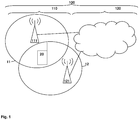
- Figure 1 schematically illustrates an example of a telecommunications network, comprising a core network, a radio access network, an user equipment, and a first and second radio cell.
- a public land mobile network 100 i.e. mobile communication network 100
- the public land mobile network 100 comprises a radio access network 110 and a core network 120.
- the public land mobile network 100 is a cellular telecommunications network comprising a plurality of network cells or radio cells, three of which are represented in Figure 1 by means of a solid line and reference signs 11, 12, respectively.
- each of the radio cells 11, 12 is produced by or corresponds to a base station entity.
- Two base station entities 111, 121 are represented in Figure 1 .
- a plurality of user equipments are camping on the public land mobile network 100 within the network cells 11, 12, i.e.
- the base station entities111, 121 are typically a base station, e.g. BTS (base transceiver station), NodeB or an eNodeB base station.
- BTS base transceiver station
- NodeB base transceiver station
- eNodeB eNodeB base station.
- the radio cells 11, 12 typically overlap. Furthermore, overlap of the radio cells 11, 12 is provided to ensure coverage of a certain geographical area not only with respect of one radio access technology but with respect to a plurality of radio access technologies, hereinafter also called different layers of radio coverage.
- Such a network architecture creates a multi-RAT (or multilayer) and/or multifrequency radio environment in the public land mobile network 100, where an user equipment 20, represented exemplarily in Figure 1 , is located such that it is able to have radio coverage with respect to different radio access technologies and/or with respect to different frequencies or frequency bands of one radio access technology or of different radio access technologies such as GSM (Global System of Mobile communications), GPRS (General Packet Radio System), UMTS (Universal Mobile Telecommunications System), EPS/LTE (Evolved Packet System / Long Term Evolution).
- GSM Global System of Mobile communications
- GPRS General Packet Radio System
- UMTS Universal Mobile Telecommunications System
- EPS/LTE Evolved Packet System / Long Term Evolution
- the user equipment 20 typically has a plurality of possibilities to be connected to the public land mobile network 100 which is represented in Figure 1 by means of the first radio cell 11 and the second radio cell 12, and the respective base station entities 111, 121, i.e. the first base station entity 111 and the second base station entity 121.
- the first base station entity 111 or first radio cell 11 is assumed to provide the strongest/best radio signal for the user equipment 20 (compared with the second base station entity 121 (or second radio cell 12); this can even be realized in case that the first base station entity 111 is farther away from the user equipment 20 than the second base station entity.
- the first base station entity 111 is sufficiently spaced from the user equipment 20, then the user equipment might be unable to transmit a correctly timed random access request to first base station entity 111.
- the first base station entity 111 would still provide the strongest radio signal and the user equipment is incited not to switch to the second base station entity 121, i.e. the user equipment 20 could be trapped in an infinity loop of still further requests but no successful result.
- the present invention to apply a penalty to the ranking of the first radio cell, by an offset value to the failed selected cell (first radio cell) and to store this value for a configurable time period within the memory of the user equipment.
- the penalty value can be a configurable offset in dB (e.g. 5 dB or 10 dB or 15 dB or 20 dB or 25 dB) or-alternatively - a special value representing the complete exclusion of the so marked cell (first radio cell 11) within the following cell selection process or plurality of cell selection processes.
- the penalty information is broadcast to the user equipment via the broadcast control channel (e.g.
- the penalty information can be fixed coded in a memory of the user equipment, especially in a firmware memory of the user equipment.
- the penalty information shall be applicable in both the cell-selection methods or procedures according to the Basic Biasing as well as according to the Absolute Priorities method.
- the penalty information shall be considered as long as the penalty related timer is not expired and shall finally exclude or worsen the marked cell from/within the newly started selection process.
- This penalty-setting procedure is not limited to a single cell, which means that if also the next uplink-access to an other cell (e.g. to the second radio cell 12) fails, this second radio cell 12 and the first radio cell 11 have to be de-prioritized (or even excluded) from the next run of the cell selection and/or cell reselection process as long as their individual timers are not expired.
- a further option according to the present invention includes that as long as the next failed cell is from the same frequency band and radio access technology as the marked cell(s) as before, also their penalty related timer (or penalty time intervals) have to be restarted.
- Still a further option according to the present invention includes that the complete list of cells with penalties shall not be permanently stored. This means that, e.g. after a switch off or reset of the user equipment, the list is emptied.
- the exclusion of the first radio cell 11 shall not be permanent, because it might be that the radio conditions, network parameters etc. are changed within the next cell selection cycle. Therefore it is proposed to solve this exclusion with support of a configurable time interval (indicated by the penalty timer information), e.g. 3 minutes.
- This time interval might be a fixed defined value in the 3GPP specifications or can be a configurable parameter broadcasted to the user equipment using the broadcast control channel of the first and/or second radio cell 11, 12. or can be fixedly coded in the firmware of the user equipment.
- the cell shall not be taken into account within the next cell selection process(es) or an extra offset [in dB] shall be added.
- Excluded cells can be stored together with time stamps and positions of the user equipment (if available) from the failed network access as part of the MDT-process and transmitted to the public land mobile network after a successful access has been performed.
- the offset is be removed.
- the proposed method comprises especially the following steps: In case an user equipment is camped on a suitable cell, the user equipment performs the following steps:
Landscapes
- Engineering & Computer Science (AREA)
- Computer Networks & Wireless Communication (AREA)
- Signal Processing (AREA)
- Computer Security & Cryptography (AREA)
- Mobile Radio Communication Systems (AREA)
Description
- The present invention relates inter alia to a method for an improved cell selection and/or cell reselection handling by an user equipment that is trying to camp on a radio cell of a public land mobile network, the improved cell selection and/or cell reselection handling being related to an uplink access procedure in dependency of attempts, by the user equipment, to get connected with the public land mobile network using a random access channel of the first base station entity and/or of the second base station entity.
- Furthermore, the present invention relates to a public land mobile network or telecommunications network for an improved cell selection and/or cell reselection handling by an user equipment that is trying to camp on a radio cell of a public land mobile network, the improved cell selection and/or cell reselection handling being related to an uplink access procedure in dependency of attempts, by the user equipment, to get connected with the public land mobile network using a random access channel of the first base station entity and/or of the second base station entity.
- Additionally, the present invention relates to an user equipment for an improved cell selection and/or cell reselection handling in case that the user equipment tries to camp on a radio cell of a public land mobile network, the improved cell selection and/or cell reselection handling being related to an uplink access procedure in dependency of attempts, by the user equipment, to get connected with the public land mobile network using a random access channel of the first base station entity and/or of the second base station entity.
- In public land mobile networks, user equipments get initial access to the telecommunications network by means of monitoring a broadcast channel emitted by the base station entity of the concerned radio cell in the vicinity of the current location of the user equipment.
- In standardization documents of the Third Generation Partnership Project (3GPP, www.3gpp.org), it is described in detail which procedure the user equipments or mobile terminals have to follow to get initial access to the public land mobile network realized as a cellular mobile network, like for example GSM (Global System for Mobile Communications), UMTS (Universal Mobile Telecommunication System), or E-UTRAN (LTE, Long Term Evolution).
- An essential part, beside the radio cell selection and/or cell reselection procedure itself, is the method of accessing the random access channel of the target base station entity (of the target radio cell). Detailed requirements for user equipment procedures are defined in 3GPP documents 3GPP TS 36.304 and 3GPP TS 36.331.
- In practice, experience within public land mobile networks shows that the procedure of accessing the random access channel (RACH), hereinafter also called RACH procedure, - which is typically the first access of an user equipment or terminal towards the base station entity or basestation, e.g. in order to place a call - fails from time to time. There can be different reasons which prevent an user equipment from finally getting access to the targeted radio cell or the targeted base station entity (that should - after a successful registration of the user equipment - become the "serving" cell or serving base station entity, e.g. the cell with the best radio signal the user equipment receives). Examples of such reasons include, e.g., a wrong or mismatching uplink cell range configuration in the targeted radio cell, too much pathloss which can not be compensated by the user equipment, etc.
- Especially during the initial network access of an user equipment towards the public land mobile network, situations appear where
- -- sufficient downlink field-strengths can be measured from different cells of the same or different radio access technologies (RATs) or from the same or different frequency bands than the targeted radio cell (i.e. all these different radio cells (or the corresponding radio signals received by the user equipment) fulfill the so-called S-criterion and hence allow the user equipment to camp on such cells),
- -- but the uplink-access procedure (typically using the random access channel, RACH) to the selected serving cell (i.e. the one radio cell (or respective base station entity) chosen in dependency of especially the signal strength and/or signal quality of the different radio signals received by the user equipment, thereby being prioritized according to a ranking) fails, finally.
- According to the 3GPP specifications, the user equipment tries - after an initial failure of accessing the random access channel of the selected target radio cell, i.e. the radio cell being top-ranked based on the signal strength and/or signal quality of the radio signals received by the user equipment - to access the selected/target radio cell, i.e. its random access channel, again (with especially a maximum number of attempts as defined via information obtained from the selected/targeted radio cell, especially distributed or broadcast on the broadcast control channel, BCCH). Further attempts to register with the selected or targeted radio cell after an initial failure of the uplink access procedure by an user equipment can involve using a higher transmission power by the user equipment (especially a higher RACH-power value), especially in case power ramping is used. However, if this further attempt fails or even if these further attempts fail as well, a new cell search procedure has to be initiated.
- In case that the physical conditions - especially the situation of the radio environment, the geographic respective locations of the user equipment, and technical parameters such as, e.g., the cell selection and/or cell reselection related parameters, typically broadcast via the broadcast control channel (BCCH) to the user equipment - did not change, the cell selection and/or cell reselection procedure is likely to again select the targeted radio cell of the previous connection attempt, which further connection attempt might end with the same result as the preceding one. Especially in case that the location of the user equipment is not changed (i.e. the user equipment is not moved), e.g. that the UE is a fixed installed (LTE) router, the subscriber will possibly not get any network access at all which can have serious drawbacks that might prove costly to the operator of the public land mobile network. Further state of the art can be found in document
US 2006/0084443 A1 which discloses a method for cell reselection that takes into consideration whether a mobile station had previously been unsuccessful in reselecting a particular cell. DocumentUS 2004/082328 A1 discloses a use of modified cell selection criteria after an unsuccessful cell reselection attempt. DocumentUS 2008/220784 A1 teaches various methods for adjusting a reselection timer and cell ranking criteria and documentUS 20011/151867 A1 teaches a system where the cell selection is based on reception quality and an additional offset information. - An object of the present invention is to provide a method for an improved cell selection and/or cell reselection handling by an user equipment that is trying to camp on a radio cell of a public land mobile network in order to get connected that avoids the drawbacks of the prior art and provides network connectivity and customer service even in situations of problematic radio conditions and/or constellations under which the behaviour of current user equipments can result in not obtaining network connectivity at all.
- The object of the present invention is achieved by a method for an improved cell selection and/or cell reselection handling according to claim 1.
- According to the present invention it is advantageously possible to ensure customer service continuation also in problematic radio conditions and/or constellations. The method according to the present invention allows the user equipment - by using the modified cell selection and/or cell reselection procedure proposed - to leave (temporarily) the targeted cell (determined by the user equipment as a result of the cell selection and/or cell reselection and/or cell reselection process in idle mode) on which the user equipment is camped, in case that an access attempt (i.e. the uplink access attempt on the random access channel) with respect to this cell has not been successful either once or after a defined number of such attempts. The proposed method is applicable to any cellular radio network technology, e.g. GSM, UMTS, but aims to provide improvements especially in E-UTRAN (LTE).
- According to the present invention, it is advantageously possible to provide the modified cell selection and/or cell reselection procedure such that the targeted radio cell, top-ranked based on the unmodified cell selection and/or cell reselection procedure, will be treated by the user equipment - at least temporally - in a manner such that the user equipment reduces the priority (or the ranking) of that initially targeted radio cell, i.e. the user equipment makes the originally (by applying the unmodified cell selection and/or reselection procedure) top-ranked cell "artificially" worse (in the ranking or prioritization, i.e. the user equipment de-prioritizes that radio cell) than it is (originally, according to the unmodified cell selection and/or reselection procedure) such that, based on the modified ranking or prioritization of the available radio cells, a cell selection and/or cell reselection to a neighboring cell is triggered where access is (at least potentially) possible.
- In idle mode of the user equipments, mobility (i.e. cell selection and/or reselection of the user equipment) is controlled by the user equipment, especially based on measurements conducted by the user equipments about the signal strength and/or signal quality of radio signals, especially the broadcast control channel, received from different base station entities in the vicinity of the current position of the user equipment. Based on these measurements, the user equipment determines whether the radio signal received from a base station entity fulfills the so-called S-criterion or cell selection criterion. Typically, the radio signals of a plurality of base station entities (in one or a plurality of frequencies and/or frequency bands and/or using one or a plurality of different radio access technologies) in the vicinity of the user equipment fulfill the cell selection criterion. In this situation, the user equipment has to decide which one of a plurality of suitable base station entities should be the targeted base station entity. According to the 3GPP standardization documents, the user equipment attempts to connect with the public land mobile network using one specific of the suitable base station entities; the one specific (or targeted) base station entity being determined based on the current radio environment of the user equipment and being top-ranked (of all suitable base station entities). In the following, the top-ranked base station entity is also called the first base station entity and another suitable (but initially not top-ranked) base station entity is also called the second base station entity. As described above, situations occur where no radio connection with the top-ranked (or first) base station entity is possible to establish at all (even repeatedly), especially no uplink access to the random access channel of the top-ranked base station entity is available. In such a situation, the inventive method proposes - i.e. in a situation after initially having performed, in a first step, the cell selection and/or cell reselection procedure in unmodified form (i.e. according to the standardization) is performed by the user equipment (which leads to the result that both the first radio cell and the second radio cell fulfill the cell selection criterion but the first radio cell being prioritized (or top-ranked or higher-ranked) with regard to the second radio cell), and after unsuccessfully trying, in a second step, to get connected with the public land mobile network using the random access channel of the first base station entity - to apply the modified cell selection and/or cell reselection procedure such that (despite unchanged radio conditions regarding the first base station entity, the second base station entity, and the user equipment) the attempt to access the random access channel is directed to the second base station entity instead of the first base station entity. Thus, the first base station entity is de-prioritized or penalized during the modified cell selection and/or cell reselection procedure according to the present invention. Of course, the scenario can also be applied to the second base station entity, i.e. in case that an attempt to access the random access channel of the second base station entity is (once or repeatedly) not successful, also the second base station entity might be de-prioritized (to the profit of a further base station entity / third base station entity).
- The first and second cells are typically neighboring cells having an at least partly overlapping radio coverage area or at least a geographical area in common where the broadcast radio signals can be received by user equipments. Neighboring cells are cells in close proximity with each other, either on the same frequency or the same frequency band (of the same radio access technology) or on a different frequency.
- According to the present invention, the modified cell selection and/or cell reselection procedure is conducted by the user equipment applying a penalty information with respect to the first radio cell, the application of the penalty information with respect to the first radio cell resulting - at least potentially - in a lower priority (or rank) of the first radio cell compared to the priority (or rank) of the second radio cell.
- Thereby it is advantageously possible, that by simply lowering or reducing, e.g. the measured value of the signal strength of the first base station entity or the first cell, a de-prioritization of the first cell takes (probably) place.
- Furthermore, according to the present invention, the penalty information comprises an offset information, wherein at least one of the following values:
- -- the cell selection RX level value (Srxlev),
- -- the cell selection quality value (Squal),
- -- the measured cell RX level value (RSRP),
- -- the measured cell quality value (RSRQ),
- Thereby, it is advantageously possible according to the present invention that by reducing one of these values by preferably an offset value (being indicated by the offset information), it is possible to de-prioritize the first radio cell or the first base station entity in a simple and easy manner. Alternatively, the penalty information can also refer to a relative modification - i.e. for example a multiplication by 90% or by 80% or the like - of the measured value of the signal strength of the first base station entity or the first cell. Alternatively, the penalty information can also lead to a complete exclusion of the first radio cell from the cell selection and/or cell reselection procedure.
- Still furthermore, it is preferred according to the present invention that the penalty information comprises a penalty related timer information, wherein the offset information of the penalty information is applied, when conducting modified cell selection and/or cell reselection procedure, with respect to the first radio cell during a penalty time interval of the length indicated by the penalty related timer information, the penalty time interval starting after the failure, in the second step, of the user equipment trying to get connected with the public land mobile network using the random access channel of the first base station entity.
- Thereby, it is advantageously possible according to the present invention, to apply the offset information during a predetermined time interval such that indefinite loops of access attempts (comprising cell selection and/or reselection as well as uplink access attempts to the random access channel) can be avoided.
- According to another preferred embodiment of the present invention, after the expiration of the penalty time interval, the cell selection and/or cell reselection procedure is conducted by the user equipment without applying the penalty information with respect to the first radio cell.
- Thereby, it is advantageously possible according to the present invention that the modified cell selection and/or reselection procedure is applied as seldom as possible, and preferably in view to reduce occurrences of user equipments that are unable to be connected to the public land mobile network based on the unmodified cell selection and/or reselection procedure.
- Furthermore, it is preferred according to the present invention that the penalty information is transmitted by the first base station entity to the user equipment, preferably on a broadcast channel.
- Thereby, it is advantageously possible to indicate - by the base station entity to the user equipment - the penalty information such that all user equipments in the respective radio cell can be flexibly informed, i.e. the penalty information can differ from one base station entity (or radio cell) to another.
- Alternatively or cumulatively (to transmitting the penalty information by the first base station entity to the user equipment), it is preferred according to the present invention that the penalty information is stored in the user equipment, preferably in a firmware-associated memory of the user equipment.
- Thereby, it is advantageously possible to provide user equipments that are more robust in establishing a connection to the public land mobile network even in adverse conditions of the radio environment.
- The present invention also relates to a public land mobile network for an improved cell selection and/or cell reselection handling according to claim 6.
- Thereby it is advantageously possible according to the present invention to ensure customer service continuation also in problematic radio conditions and/or constellations.
- Furthermore, the present invention relates to an user equipment for an improved cell selection and/or cell reselection handling according to claim 7.
- It is especially preferred according to the present invention
- -- that the penalty information is transmitted by at least the first base station entity to the user equipment, preferably on a broadcast channel, and/or
- -- that the penalty information is stored in the user equipment, preferably in a firmware-associated memory of the user equipment.
- Furthermore, the present invention relates to a program comprising a computer readable program code according to claim 10.
- The present invention also relates to computer program product according to
claim 11. - These and other characteristics, features and advantages of the present invention will become apparent from the following detailed description, taken in conjunction with the accompanying drawings, which illustrate, by way of example, the principles of the invention. The description is given for the sake of example only, without limiting the scope of the invention. The reference figures quoted below refer to the attached drawings.
-
Figure 1 schematically illustrates an example of a telecommunications network, comprising a core network, a radio access network, an user equipment, and a first and second radio cell. - The present invention will be described with respect to particular embodiments and with reference to certain drawings but the invention is not limited thereto but only by the claims. The drawings described are only schematic and are non-limiting. In the drawings, the size of some of the elements may be exaggerated and not drawn on scale for illustrative purposes.
- Where an indefinite or definite article is used when referring to a singular noun, e.g. "a", "an", "the", this includes a plural of that noun unless something else is specifically stated.
- Furthermore, the terms first, second, third and the like in the description and in the claims are used for distinguishing between similar elements and not necessarily for describing a sequential or chronological order. It is to be understood that the terms so used are interchangeable under appropriate circumstances and that the embodiments of the invention described herein are capable of operation in other sequences than described or illustrated herein.
- In
Figure 1 , a public landmobile network 100, i.e.mobile communication network 100, is schematically shown. The public landmobile network 100 comprises aradio access network 110 and acore network 120. The public landmobile network 100 is a cellular telecommunications network comprising a plurality of network cells or radio cells, three of which are represented inFigure 1 by means of a solid line andreference signs radio cells base station entities Figure 1 . In the public landmobile network 100, typically a plurality of user equipments are camping on the public landmobile network 100 within thenetwork cells base station entities respective cell radio cells radio cells mobile network 100, where anuser equipment 20, represented exemplarily inFigure 1 , is located such that it is able to have radio coverage with respect to different radio access technologies and/or with respect to different frequencies or frequency bands of one radio access technology or of different radio access technologies such as GSM (Global System of Mobile communications), GPRS (General Packet Radio System), UMTS (Universal Mobile Telecommunications System), EPS/LTE (Evolved Packet System / Long Term Evolution). Therefore, theuser equipment 20 typically has a plurality of possibilities to be connected to the public landmobile network 100 which is represented inFigure 1 by means of thefirst radio cell 11 and thesecond radio cell 12, and the respectivebase station entities base station entity 111 and the secondbase station entity 121. - Situations of access failure of the user equipments to the public land
mobile network 100, especially leading to an infinity loop can, e.g., occur in the following situation: The firstbase station entity 111 orfirst radio cell 11 is assumed to provide the strongest/best radio signal for the user equipment 20 (compared with the second base station entity 121 (or second radio cell 12); this can even be realized in case that the firstbase station entity 111 is farther away from theuser equipment 20 than the second base station entity. In case the firstbase station entity 111 is sufficiently spaced from theuser equipment 20, then the user equipment might be unable to transmit a correctly timed random access request to firstbase station entity 111. However, the firstbase station entity 111 would still provide the strongest radio signal and the user equipment is incited not to switch to the secondbase station entity 121, i.e. theuser equipment 20 could be trapped in an infinity loop of still further requests but no successful result. - To solve the explained case of an "infinity loop" within e.g. the initial cell selection process, it is proposed by the present invention to apply a penalty to the ranking of the first radio cell, by an offset value to the failed selected cell (first radio cell) and to store this value for a configurable time period within the memory of the user equipment. The penalty value can be a configurable offset in dB (e.g. 5 dB or 10 dB or 15 dB or 20 dB or 25 dB) or-alternatively - a special value representing the complete exclusion of the so marked cell (first radio cell 11) within the following cell selection process or plurality of cell selection processes. Preferably, the penalty information is broadcast to the user equipment via the broadcast control channel (e.g. using System Information Block 3 or 4 in a cellular network using the UTRAN standard [3GPP TS 25.331] or System Information Block 3 using an E-UTRAN standard [3GPP TS 36.331]) and can be configured in a cell-individual manner. Alternatively, the penalty information can be fixed coded in a memory of the user equipment, especially in a firmware memory of the user equipment.
- According to the present invention, the penalty information shall be applicable in both the cell-selection methods or procedures according to the Basic Biasing as well as according to the Absolute Priorities method.
- In the following cell selection process(es), the penalty information shall be considered as long as the penalty related timer is not expired and shall finally exclude or worsen the marked cell from/within the newly started selection process. This penalty-setting procedure is not limited to a single cell, which means that if also the next uplink-access to an other cell (e.g. to the second radio cell 12) fails, this
second radio cell 12 and thefirst radio cell 11 have to be de-prioritized (or even excluded) from the next run of the cell selection and/or cell reselection process as long as their individual timers are not expired. - A further option according to the present invention includes that as long as the next failed cell is from the same frequency band and radio access technology as the marked cell(s) as before, also their penalty related timer (or penalty time intervals) have to be restarted.
- Still a further option according to the present invention includes that the complete list of cells with penalties shall not be permanently stored. This means that, e.g. after a switch off or reset of the user equipment, the list is emptied.
- The exclusion of the
first radio cell 11 shall not be permanent, because it might be that the radio conditions, network parameters etc. are changed within the next cell selection cycle. Therefore it is proposed to solve this exclusion with support of a configurable time interval (indicated by the penalty timer information), e.g. 3 minutes. This time interval might be a fixed defined value in the 3GPP specifications or can be a configurable parameter broadcasted to the user equipment using the broadcast control channel of the first and/orsecond radio cell - Excluded cells can be stored together with time stamps and positions of the user equipment (if available) from the failed network access as part of the MDT-process and transmitted to the public land mobile network after a successful access has been performed.
- Furthermore, according to the present invention, if the cell access to a marked cell is successful (e.g. the user equipment moves into significant better radio conditions), then the offset is be removed.
- The proposed method comprises especially the following steps:
In case an user equipment is camped on a suitable cell, the user equipment performs the following steps - -- Initial access to the RACH of said cell
- -- Retry of RACH access according to the current specifications
- -- Analyze of the RACH Access Response messages; estimation of a RACH overload situation in the serving cell
- -- If RACH overload situation is detected: Reading out access penalty offset value and optionally penalty time
- -- IF RACH is estimated to be not overloaded: Reading out access penalty offset value.
- -- Applying said penalty offset to the current serving cell
- -- Performing cell reselection process according current specifications
- -- Perform cell reselection to other neighbor cell of same frequency, or different frequency or different radio access technology
- -- Re-perform access to RACH in new cell
- -- Continue service operation in new cell as normally.
- -- If during the normal cell reselection procedure, the cell with the penalty offset is selected and the RACH access was successful, the penalty offset can be removed from the list of cells with penalties
- -- If configurable timer has been defined:
- -- Remove penalty offset from old cell
- -- Perform cell reselection process
Claims (11)
- Method for an improved cell selection and/or cell reselection handling by a user equipment (20) that is trying to camp on a radio cell of a public land mobile network (100), wherein the public land mobile network (100) comprises at least a first radio cell (11) with a first base station entity (111) and a second radio cell (12) with a second base station entity (121), the improved cell selection and/or cell reselection handling being related to an uplink access procedure in dependency of attempts, by the user equipment (20), to get connected with the public land mobile network (100) using a random access channel of the first base station entity (111) and/or of the second base station entity (121), wherein the method comprises the following steps:-- in a first step, the cell selection and/or cell reselection procedure is performed by the user equipment (20), leading to the result that both the first radio cell (11) and the second radio cell (12) fulfill a cell selection criterion, wherein the first radio cell (11) is prioritized with regard to the second radio cell (12),-- in a second step, the user equipment (20) tries to get connected with the public land mobile network (100) using the random access channel of the first base station entity (111) which fails,-- in a third step, a modified cell selection and/or cell reselection procedure is performed by the user equipment (20), wherein - despite unchanged radio conditions regarding the first base station entity (111), the second base station entity (121), and the user equipment (20) - the user equipment (20) tries to get connected with the public land mobile network (100) using a random access channel of the second base station entity (111), characterized in that the modified cell selection and/or cell reselection procedure is conducted by the user equipment (20) applying a penalty information with respect to the first radio cell (11), wherein the penalty information with respect to at least the first radio cell (11) is transmitted to the user equipment (20), the application of the penalty information with respect to the first radio cell (11) resulting - at least potentially - in a lower priority of the first radio cell (11) compared to the priority of the second radio cell (12), wherein the penalty information comprises an offset information, wherein at least one of the following values:-- the cell selection RX level value, Srxlev,-- the cell selection quality value, Squal,-- the measured cell RX level value, RSRP,-- the measured cell quality value, RSRQ,is/are reduced, by applying the offset information, with respect to the first radio cell (11).
- Method according to claim 1, wherein the penalty information comprises a penalty related timer information, wherein the offset information of the penalty information is applied, when conducting modified cell selection and/or cell reselection procedure, with respect to the first radio cell (11) during a penalty time interval of the length indicated by the penalty related timer information, the penalty time interval starting after the failure, in the second step, of the user equipment (20) trying to get connected with the public land mobile network (100) using the random access channel of the first base station entity (111).
- Method according to one of the preceding claims, wherein after the expiration of the penalty time interval, the cell selection and/or cell reselection procedure is conducted by the user equipment (20) without applying the penalty information with respect to the first radio cell (11).
- Method according to one of the preceding claims, wherein the penalty information is transmitted by the first base station entity (121) to the user equipment (20), preferably on a broadcast channel.
- Method according to one of the preceding claims, wherein the penalty information is stored in the user equipment (20), preferably in a firmware-associated memory of the user equipment (20).
- Public land mobile network (100) for an improved cell selection and/or cell reselection handling by an user equipment (20) that is trying to camp on a radio cell of a public land mobile network (100), wherein the public land mobile network (100) comprises at least a first radio cell (11) with a first base station entity (111) and a second radio cell (12) with a second base station entity (121), the improved cell selection and/or cell reselection handling being related to an uplink access procedure in dependency of attempts, by the user equipment (20), to get connected with the public land mobile network (100) using a random access channel of the first base station entity (111) and/or of the second base station entity (121), wherein the public land mobile network (100) is configured such that a penalty information with respect to at least the first radio cell (11) is transmitted to the user equipment (20), wherein the penalty information causes the user equipment (20) to apply a modified cell selection and/or cell reselection procedure in case that:-- a previous cell selection and/or cell reselection procedure has been performed by the user equipment (20), leading to the result that both the first radio cell (11) and the second radio cell (12) fulfill a cell selection criterion, the first radio cell (11) being prioritized with regard to the second radio cell (12), and-- the user equipment (20) having unsuccessfully tried to get connected with the public land mobile network (100) using the random access channel of the first base station entity (111),wherein the modified cell selection and/or cell reselection procedure results - despite unchanged radio conditions regarding the first base station entity (111), the second base station entity (121), and the user equipment (20) - in the user equipment (20) trying to get connected with the public land mobile network (100) using a random access channel of the second base station entity (111), characterized in that the user equipment (20) is configured to apply a penalty information with respect to the first radio cell (11) to conduct a modified cell selection and/or cell reselection procedure, the application of the penalty information with respect to the first radio cell (11) resulting - at least potentially - in a lower priority of the first radio cell (11) compared to the priority of the second radio cell (12), wherein the penalty information comprises an offset information, wherein at least one of the following values:-- the cell selection RX level value, Srxlev,-- the cell selection quality value, Squal,-- the measured cell RX level value, RSRP,-- the measured cell quality value, RSRQ,
is/are reduced, by applying the offset information, with respect to the first radio cell (11). - User equipment (20) for an improved cell selection and/or cell reselection handling in case that the user equipment (20) tries to camp on a radio cell of a public land mobile network (100), wherein the public land mobile network (100) comprises at least a first radio cell (11) with a first base station entity (111) and a second radio cell (12) with a second base station entity (121), the improved cell selection and/or cell reselection handling being related to an uplink access procedure in dependency of attempts, by the user equipment (20), to get connected with the public land mobile network (100) using a random access channel of the first base station entity (111) and/or of the second base station entity (121), wherein the user equipment (20) is configured such that a modified cell selection and/or cell reselection procedure is applied by the user equipment (20) in case that:-- a previous cell selection and/or cell reselection procedure has been performed by the user equipment (20), leading to the result that both the first radio cell (11) and the second radio cell (12) fulfill a cell selection criterion, the first radio cell (11) being prioritized with regard to the second radio cell (12), and-- the user equipment (20) having unsuccessfully tried to get connected with the public land mobile network (100) using the random access channel of the first base station entity (111),wherein the modified cell selection and/or cell reselection procedure results - despite unchanged radio conditions regarding the first base station entity (111), the second base station entity (121), and the user equipment (20) - in the user equipment (20) trying to get connected with the public land mobile network (100) using a random access channel of the second base station entity (111), characterized in that the user equipment (20) is configured to apply a penalty information with respect to the first radio cell (11) to conduct a modified cell selection and/or cell reselection procedure, wherein the user equipment (20) is configured such that the penalty information with respect to at least the first radio cell (11) is received by the user equipment (20), the application of the penalty information with respect to the first radio cell (11) resulting - at least potentially - in a lower priority of the first radio cell (11) compared to the priority of the second radio cell (12), wherein the penalty information comprises an offset information, wherein at least one of the following values:-- the cell selection RX level value, Srxlev,-- the cell selection quality value, Squal,-- the measured cell RX level value, RSRP,-- the measured cell quality value, RSRQ,
is/are reduced, by applying the offset information, with respect to the first radio cell (11). - User equipment (20) according to claim 7, wherein the penalty information is transmitted by at least the first base station entity (121) to the user equipment (20), preferably on a broadcast channel.
- User equipment (20) according to claim 7 or 8, wherein the penalty information is stored in the user equipment (20), preferably in a firmware-associated memory of the user equipment (20).
- Program comprising a computer readable program code which, when executed on a user equipment (20), causes the user equipment (20) to perform a method according to one of claims 1 to 5.
- Computer program product for using a public land mobile network (100), the computer program product comprising a computer program stored on a storage medium, the computer program comprising program code which, when executed on a user equipment (20), causes the user equipment (20) to perform a method according one of claims 1 to 5.
Priority Applications (6)
| Application Number | Priority Date | Filing Date | Title |
|---|---|---|---|
| SI201431714T SI2995134T1 (en) | 2013-05-06 | 2014-04-29 | Method for an improved cell selection/reselection by a user equipment trying to camp on a radio cell of a public land mobile network |
| RS20201377A RS61059B1 (en) | 2013-05-06 | 2014-04-29 | Method for an improved cell selection/reselection by a user equipment trying to camp on a radio cell of a public land mobile network |
| HRP20201878TT HRP20201878T1 (en) | 2013-05-06 | 2014-04-29 | METHOD FOR IMPROVED CELL SELECTION / RE-SELECTION USING USER EQUIPMENT ATTEMPTING TO CONNECT TO A PUBLIC TERRESTRIAL MOBILE NETWORK RADIO CELL |
| EP14720143.8A EP2995134B1 (en) | 2013-05-06 | 2014-04-29 | Method for an improved cell selection/reselection by a user equipment trying to camp on a radio cell of a public land mobile network |
| PL14720143T PL2995134T3 (en) | 2013-05-06 | 2014-04-29 | Method for an improved cell selection/reselection by a user equipment trying to camp on a radio cell of a public land mobile network |
| EP17204315.0A EP3322224B1 (en) | 2013-05-06 | 2014-04-29 | Method for an improved cell selection and/or cell reselection handling by a user equipment that is trying to camp on a radio cell of a public land mobile network, public land mobile network, and user equipment |
Applications Claiming Priority (3)
| Application Number | Priority Date | Filing Date | Title |
|---|---|---|---|
| EP13166650 | 2013-05-06 | ||
| PCT/EP2014/058714 WO2014180714A1 (en) | 2013-05-06 | 2014-04-29 | Method for an improved cell selection/reselection by a user equipment trying to camp on a radio cell of a public land mobile network |
| EP14720143.8A EP2995134B1 (en) | 2013-05-06 | 2014-04-29 | Method for an improved cell selection/reselection by a user equipment trying to camp on a radio cell of a public land mobile network |
Related Child Applications (2)
| Application Number | Title | Priority Date | Filing Date |
|---|---|---|---|
| EP17204315.0A Division EP3322224B1 (en) | 2013-05-06 | 2014-04-29 | Method for an improved cell selection and/or cell reselection handling by a user equipment that is trying to camp on a radio cell of a public land mobile network, public land mobile network, and user equipment |
| EP17204315.0A Division-Into EP3322224B1 (en) | 2013-05-06 | 2014-04-29 | Method for an improved cell selection and/or cell reselection handling by a user equipment that is trying to camp on a radio cell of a public land mobile network, public land mobile network, and user equipment |
Publications (2)
| Publication Number | Publication Date |
|---|---|
| EP2995134A1 EP2995134A1 (en) | 2016-03-16 |
| EP2995134B1 true EP2995134B1 (en) | 2020-09-02 |
Family
ID=48366162
Family Applications (2)
| Application Number | Title | Priority Date | Filing Date |
|---|---|---|---|
| EP17204315.0A Active EP3322224B1 (en) | 2013-05-06 | 2014-04-29 | Method for an improved cell selection and/or cell reselection handling by a user equipment that is trying to camp on a radio cell of a public land mobile network, public land mobile network, and user equipment |
| EP14720143.8A Active EP2995134B1 (en) | 2013-05-06 | 2014-04-29 | Method for an improved cell selection/reselection by a user equipment trying to camp on a radio cell of a public land mobile network |
Family Applications Before (1)
| Application Number | Title | Priority Date | Filing Date |
|---|---|---|---|
| EP17204315.0A Active EP3322224B1 (en) | 2013-05-06 | 2014-04-29 | Method for an improved cell selection and/or cell reselection handling by a user equipment that is trying to camp on a radio cell of a public land mobile network, public land mobile network, and user equipment |
Country Status (17)
| Country | Link |
|---|---|
| US (2) | US11006336B2 (en) |
| EP (2) | EP3322224B1 (en) |
| JP (1) | JP6330030B2 (en) |
| KR (1) | KR101817494B1 (en) |
| CN (1) | CN105210426B (en) |
| BR (1) | BR112015027169B1 (en) |
| DK (1) | DK2995134T3 (en) |
| ES (2) | ES2818598T3 (en) |
| HR (1) | HRP20201878T1 (en) |
| HU (1) | HUE052488T2 (en) |
| LT (1) | LT2995134T (en) |
| MX (1) | MX350042B (en) |
| PL (2) | PL3322224T3 (en) |
| PT (1) | PT2995134T (en) |
| RS (1) | RS61059B1 (en) |
| SI (1) | SI2995134T1 (en) |
| WO (1) | WO2014180714A1 (en) |
Families Citing this family (14)
| Publication number | Priority date | Publication date | Assignee | Title |
|---|---|---|---|---|
| WO2015010287A1 (en) * | 2013-07-24 | 2015-01-29 | 华为技术有限公司 | Cell reselection method, device and system |
| CN104918297B (en) * | 2014-03-13 | 2018-07-27 | 中国移动通信集团公司 | A kind of cell accessing method and equipment |
| CN106658613B (en) * | 2015-11-03 | 2020-04-14 | 中国移动通信集团公司 | Cell reselection method and device |
| US20170238221A1 (en) * | 2016-02-12 | 2017-08-17 | Qualcomm Incorporated | Cell avoidance associated with lower layer failures |
| EP3399788A1 (en) | 2017-05-04 | 2018-11-07 | Telefonaktiebolaget LM Ericsson (publ) | Handling of performance degradation in a communications system |
| US11184826B2 (en) * | 2017-06-15 | 2021-11-23 | Lg Electronics Inc. | Method and apparatus for handling failure of system information request |
| EP4319458A3 (en) * | 2018-04-05 | 2024-05-01 | Nokia Technologies Oy | Improving cell access procedure |
| CN108235397A (en) * | 2018-04-10 | 2018-06-29 | 奇酷互联网络科技(深圳)有限公司 | Control method, device and the mobile terminal of random access |
| US11653241B2 (en) | 2018-06-01 | 2023-05-16 | Telefonaktiebolaget Lm Ericsson (Publ) | Reporting performance degradation in a communications system |
| US11985565B2 (en) * | 2019-01-16 | 2024-05-14 | Lg Electronics Inc. | Method and apparatus for mobility management in wireless communication system |
| EP3984294A1 (en) * | 2019-06-11 | 2022-04-20 | Nokia Technologies Oy | Power-efficient measurement reporting for multi/dual connectivity in cellular communication networks |
| WO2021204212A1 (en) * | 2020-04-07 | 2021-10-14 | Guangdong Oppo Mobile Telecommunications Corp., Ltd. | Method and user equipment for adjusting cell measurement |
| CN114980239B (en) * | 2021-02-25 | 2024-05-14 | 荣耀终端有限公司 | Cell reselection method and terminal equipment |
| US11792712B2 (en) | 2021-12-23 | 2023-10-17 | T-Mobile Usa, Inc. | Cell reselection priority assignment based on performance triggers |
Family Cites Families (17)
| Publication number | Priority date | Publication date | Assignee | Title |
|---|---|---|---|---|
| FI104780B (en) * | 1997-02-28 | 2000-03-31 | Nokia Mobile Phones Ltd | Cell prioritization in a cellular radio system |
| US6978138B2 (en) | 2002-10-28 | 2005-12-20 | Qualcomm Incorporated | Inter-RAT cell reselection in a wireless communication network |
| US7127253B2 (en) * | 2003-02-13 | 2006-10-24 | Asustek Computer Inc. | Penalty of cell reselection for a wireless device |
| CA2534277C (en) * | 2003-08-22 | 2012-10-02 | Samsung Electronics Co., Ltd. | Cell reselection method for receiving packet data in a mobile communication system supporting mbms |
| US7483702B2 (en) * | 2004-10-20 | 2009-01-27 | Nokia Corporation | Cell reselection for improving network interconnection |
| EP2135474A1 (en) * | 2007-03-09 | 2009-12-23 | Interdigital Technology Corporation | Method and apparatus for adjusting a reselection timer and cell ranking criteria, and reporting degraded signal measurement of a serving cell |
| BRPI0808232A2 (en) * | 2007-03-13 | 2014-07-22 | Interdigital Tech Corp | CELL SELECTION PROCESS FOR WIRELESS COMMUNICATIONS. |
| GB0713391D0 (en) * | 2007-07-11 | 2007-08-22 | Vodafone Plc | Measurement and reselection in idle mode |
| CN101572921B (en) * | 2008-04-29 | 2013-07-31 | 株式会社Ntt都科摩 | Method and device for cell reselection in mobile communication system |
| US8588773B2 (en) * | 2008-08-04 | 2013-11-19 | Qualcomm Incorporated | System and method for cell search and selection in a wireless communication system |
| US20110151867A1 (en) * | 2008-09-19 | 2011-06-23 | Panasonic Corporation | Mobile terminal, macro base station, and cell selection system |
| IN2012DN04906A (en) * | 2010-01-08 | 2015-09-25 | Interdigital Patent Holdings | |
| MX2013005674A (en) * | 2010-11-30 | 2013-09-26 | Research In Motion Ltd | Cell re-selection in a cellular telecommunications network. |
| WO2012072716A1 (en) * | 2010-11-30 | 2012-06-07 | Research In Motion Limited | Cell re-selection using a ranking algorithm |
| US9008659B1 (en) * | 2011-03-10 | 2015-04-14 | Marvell International Ltd. | Cell reselection methods based on tracking area for cellular systems |
| KR101781864B1 (en) * | 2011-04-13 | 2017-09-26 | 엘지전자 주식회사 | Method of efficient Cell Reselction for increasing chance of successful Random Access in a Wireless Access System |
| GB2506888B (en) * | 2012-10-10 | 2015-03-11 | Broadcom Corp | Reselection |
-
2014
- 2014-04-29 PL PL17204315.0T patent/PL3322224T3/en unknown
- 2014-04-29 ES ES14720143T patent/ES2818598T3/en active Active
- 2014-04-29 PL PL14720143T patent/PL2995134T3/en unknown
- 2014-04-29 RS RS20201377A patent/RS61059B1/en unknown
- 2014-04-29 JP JP2016512290A patent/JP6330030B2/en active Active
- 2014-04-29 KR KR1020157034636A patent/KR101817494B1/en active Active
- 2014-04-29 HU HUE14720143A patent/HUE052488T2/en unknown
- 2014-04-29 MX MX2015014616A patent/MX350042B/en active IP Right Grant
- 2014-04-29 US US14/888,940 patent/US11006336B2/en active Active
- 2014-04-29 EP EP17204315.0A patent/EP3322224B1/en active Active
- 2014-04-29 LT LTEP14720143.8T patent/LT2995134T/en unknown
- 2014-04-29 SI SI201431714T patent/SI2995134T1/en unknown
- 2014-04-29 ES ES17204315T patent/ES2967522T3/en active Active
- 2014-04-29 DK DK14720143.8T patent/DK2995134T3/en active
- 2014-04-29 WO PCT/EP2014/058714 patent/WO2014180714A1/en not_active Ceased
- 2014-04-29 PT PT147201438T patent/PT2995134T/en unknown
- 2014-04-29 EP EP14720143.8A patent/EP2995134B1/en active Active
- 2014-04-29 BR BR112015027169-3A patent/BR112015027169B1/en active IP Right Grant
- 2014-04-29 HR HRP20201878TT patent/HRP20201878T1/en unknown
- 2014-04-29 CN CN201480025803.0A patent/CN105210426B/en active Active
-
2021
- 2021-04-12 US US17/227,444 patent/US11997555B2/en active Active
Non-Patent Citations (1)
| Title |
|---|
| None * |
Also Published As
| Publication number | Publication date |
|---|---|
| MX2015014616A (en) | 2016-03-01 |
| DK2995134T3 (en) | 2020-09-28 |
| EP3322224A1 (en) | 2018-05-16 |
| HUE052488T2 (en) | 2021-05-28 |
| US11997555B2 (en) | 2024-05-28 |
| JP2016521513A (en) | 2016-07-21 |
| WO2014180714A1 (en) | 2014-11-13 |
| ES2967522T3 (en) | 2024-04-30 |
| SI2995134T1 (en) | 2021-01-29 |
| EP3322224B1 (en) | 2023-12-13 |
| US11006336B2 (en) | 2021-05-11 |
| BR112015027169A2 (en) | 2017-07-25 |
| EP2995134A1 (en) | 2016-03-16 |
| JP6330030B2 (en) | 2018-05-23 |
| LT2995134T (en) | 2020-10-26 |
| CN105210426B (en) | 2019-06-11 |
| ES2818598T3 (en) | 2021-04-13 |
| KR101817494B1 (en) | 2018-01-11 |
| MX350042B (en) | 2017-08-24 |
| PT2995134T (en) | 2020-11-05 |
| BR112015027169B1 (en) | 2023-03-07 |
| PL3322224T3 (en) | 2024-04-29 |
| HRP20201878T1 (en) | 2021-01-22 |
| PL2995134T3 (en) | 2021-02-08 |
| RS61059B1 (en) | 2020-12-31 |
| US20160088539A1 (en) | 2016-03-24 |
| US20210235346A1 (en) | 2021-07-29 |
| CN105210426A (en) | 2015-12-30 |
| KR20160005747A (en) | 2016-01-15 |
Similar Documents
| Publication | Publication Date | Title |
|---|---|---|
| US11997555B2 (en) | Cell selection/reselection by a user equipment trying to camp on a radio cell of a public land mobile network | |
| CN110859011B (en) | A communication method and related equipment | |
| EP2241130B1 (en) | Method and user equipment in a communication network | |
| US9826451B2 (en) | Method for communicating in wireless communication system supporting multiple access network and apparatus supporting same | |
| US12549984B2 (en) | Method and apparatus for relaxed radio resource management measurement | |
| US9084162B2 (en) | Forced DRX during automatic neighbor relation (ANR) in LTE | |
| US9713069B2 (en) | Method for steering traffic in wireless communications system and apparatus for supporting same | |
| EP2953397B1 (en) | Method for steering traffic in wireless communications system and apparatus for supporting same | |
| US20160119959A1 (en) | Method for processing emergency call in wireless communication system and apparatus for supporting same | |
| WO2014069890A1 (en) | Cell reselection method based on priority handling in wireless communication system, and apparatus for supporting same | |
| EP2200374A1 (en) | Method of handling cell selection for in a wireless communication system and related mobile device | |
| WO2014073940A1 (en) | Method for reselecting cell in wireless communication system and apparatus supporting same | |
| CN113473440B (en) | Method and wireless communication device for idle mode mobility management | |
| CN114190114A (en) | Cell reselection method and related communication equipment | |
| WO2009114988A1 (en) | Method, device and system for notifying heterogeneous system neighbor cell information to user terminal | |
| US9913306B2 (en) | Communication terminal and method for establishing a CSFB call | |
| WO2025163296A1 (en) | A method of a user equipment managing cell barring in a telecommunications network during cell selection and/or reselection, a user equipment and a computer program |
Legal Events
| Date | Code | Title | Description |
|---|---|---|---|
| PUAI | Public reference made under article 153(3) epc to a published international application that has entered the european phase |
Free format text: ORIGINAL CODE: 0009012 |
|
| 17P | Request for examination filed |
Effective date: 20151207 |
|
| AK | Designated contracting states |
Kind code of ref document: A1 Designated state(s): AL AT BE BG CH CY CZ DE DK EE ES FI FR GB GR HR HU IE IS IT LI LT LU LV MC MK MT NL NO PL PT RO RS SE SI SK SM TR |
|
| AX | Request for extension of the european patent |
Extension state: BA ME |
|
| DAX | Request for extension of the european patent (deleted) | ||
| STAA | Information on the status of an ep patent application or granted ep patent |
Free format text: STATUS: EXAMINATION IS IN PROGRESS |
|
| 17Q | First examination report despatched |
Effective date: 20170428 |
|
| GRAP | Despatch of communication of intention to grant a patent |
Free format text: ORIGINAL CODE: EPIDOSNIGR1 |
|
| STAA | Information on the status of an ep patent application or granted ep patent |
Free format text: STATUS: GRANT OF PATENT IS INTENDED |
|
| RIC1 | Information provided on ipc code assigned before grant |
Ipc: H04W 48/20 20090101AFI20200309BHEP Ipc: H04W 74/08 20090101ALN20200309BHEP |
|
| INTG | Intention to grant announced |
Effective date: 20200324 |
|
| GRAS | Grant fee paid |
Free format text: ORIGINAL CODE: EPIDOSNIGR3 |
|
| GRAA | (expected) grant |
Free format text: ORIGINAL CODE: 0009210 |
|
| STAA | Information on the status of an ep patent application or granted ep patent |
Free format text: STATUS: THE PATENT HAS BEEN GRANTED |
|
| AK | Designated contracting states |
Kind code of ref document: B1 Designated state(s): AL AT BE BG CH CY CZ DE DK EE ES FI FR GB GR HR HU IE IS IT LI LT LU LV MC MK MT NL NO PL PT RO RS SE SI SK SM TR |
|
| REG | Reference to a national code |
Ref country code: GB Ref legal event code: FG4D |
|
| REG | Reference to a national code |
Ref country code: AT Ref legal event code: REF Ref document number: 1310296 Country of ref document: AT Kind code of ref document: T Effective date: 20200915 Ref country code: CH Ref legal event code: EP |
|
| REG | Reference to a national code |
Ref country code: DE Ref legal event code: R096 Ref document number: 602014069644 Country of ref document: DE |
|
| REG | Reference to a national code |
Ref country code: DK Ref legal event code: T3 Effective date: 20200924 |
|
| REG | Reference to a national code |
Ref country code: IE Ref legal event code: FG4D |
|
| REG | Reference to a national code |
Ref country code: SE Ref legal event code: TRGR |
|
| REG | Reference to a national code |
Ref country code: RO Ref legal event code: EPE |
|
| REG | Reference to a national code |
Ref country code: PT Ref legal event code: SC4A Ref document number: 2995134 Country of ref document: PT Date of ref document: 20201105 Kind code of ref document: T Free format text: AVAILABILITY OF NATIONAL TRANSLATION Effective date: 20201029 |
|
| REG | Reference to a national code |
Ref country code: NO Ref legal event code: T2 Effective date: 20200902 |
|
| REG | Reference to a national code |
Ref country code: FI Ref legal event code: FGE |
|
| REG | Reference to a national code |
Ref country code: HR Ref legal event code: TUEP Ref document number: P20201878T Country of ref document: HR Ref country code: NL Ref legal event code: FP |
|
| REG | Reference to a national code |
Ref country code: SK Ref legal event code: T3 Ref document number: E 35256 Country of ref document: SK |
|
| REG | Reference to a national code |
Ref country code: GR Ref legal event code: EP Ref document number: 20200403083 Country of ref document: GR Effective date: 20201215 |
|
| REG | Reference to a national code |
Ref country code: HR Ref legal event code: T1PR Ref document number: P20201878 Country of ref document: HR |
|
| REG | Reference to a national code |
Ref country code: ES Ref legal event code: FG2A Ref document number: 2818598 Country of ref document: ES Kind code of ref document: T3 Effective date: 20210413 |
|
| PG25 | Lapsed in a contracting state [announced via postgrant information from national office to epo] |
Ref country code: EE Free format text: LAPSE BECAUSE OF FAILURE TO SUBMIT A TRANSLATION OF THE DESCRIPTION OR TO PAY THE FEE WITHIN THE PRESCRIBED TIME-LIMIT Effective date: 20200902 Ref country code: SM Free format text: LAPSE BECAUSE OF FAILURE TO SUBMIT A TRANSLATION OF THE DESCRIPTION OR TO PAY THE FEE WITHIN THE PRESCRIBED TIME-LIMIT Effective date: 20200902 |
|
| REG | Reference to a national code |
Ref country code: HR Ref legal event code: ODRP Ref document number: P20201878 Country of ref document: HR Payment date: 20210426 Year of fee payment: 8 |
|
| REG | Reference to a national code |
Ref country code: HU Ref legal event code: AG4A Ref document number: E052488 Country of ref document: HU |
|
| PG25 | Lapsed in a contracting state [announced via postgrant information from national office to epo] |
Ref country code: IS Free format text: LAPSE BECAUSE OF FAILURE TO SUBMIT A TRANSLATION OF THE DESCRIPTION OR TO PAY THE FEE WITHIN THE PRESCRIBED TIME-LIMIT Effective date: 20210102 Ref country code: AL Free format text: LAPSE BECAUSE OF FAILURE TO SUBMIT A TRANSLATION OF THE DESCRIPTION OR TO PAY THE FEE WITHIN THE PRESCRIBED TIME-LIMIT Effective date: 20200902 |
|
| REG | Reference to a national code |
Ref country code: DE Ref legal event code: R097 Ref document number: 602014069644 Country of ref document: DE |
|
| PLBE | No opposition filed within time limit |
Free format text: ORIGINAL CODE: 0009261 |
|
| STAA | Information on the status of an ep patent application or granted ep patent |
Free format text: STATUS: NO OPPOSITION FILED WITHIN TIME LIMIT |
|
| 26N | No opposition filed |
Effective date: 20210603 |
|
| PG25 | Lapsed in a contracting state [announced via postgrant information from national office to epo] |
Ref country code: MC Free format text: LAPSE BECAUSE OF FAILURE TO SUBMIT A TRANSLATION OF THE DESCRIPTION OR TO PAY THE FEE WITHIN THE PRESCRIBED TIME-LIMIT Effective date: 20200902 |
|
| PG25 | Lapsed in a contracting state [announced via postgrant information from national office to epo] |
Ref country code: LU Free format text: LAPSE BECAUSE OF NON-PAYMENT OF DUE FEES Effective date: 20210429 |
|
| REG | Reference to a national code |
Ref country code: AT Ref legal event code: UEP Ref document number: 1310296 Country of ref document: AT Kind code of ref document: T Effective date: 20200902 |
|
| REG | Reference to a national code |
Ref country code: HR Ref legal event code: ODRP Ref document number: P20201878 Country of ref document: HR Payment date: 20220415 Year of fee payment: 9 |
|
| PG25 | Lapsed in a contracting state [announced via postgrant information from national office to epo] |
Ref country code: IS Free format text: LAPSE BECAUSE OF FAILURE TO SUBMIT A TRANSLATION OF THE DESCRIPTION OR TO PAY THE FEE WITHIN THE PRESCRIBED TIME-LIMIT Effective date: 20210102 |
|
| REG | Reference to a national code |
Ref country code: HR Ref legal event code: ODRP Ref document number: P20201878 Country of ref document: HR Payment date: 20230420 Year of fee payment: 10 |
|
| PG25 | Lapsed in a contracting state [announced via postgrant information from national office to epo] |
Ref country code: CY Free format text: LAPSE BECAUSE OF FAILURE TO SUBMIT A TRANSLATION OF THE DESCRIPTION OR TO PAY THE FEE WITHIN THE PRESCRIBED TIME-LIMIT Effective date: 20200902 |
|
| P01 | Opt-out of the competence of the unified patent court (upc) registered |
Effective date: 20230528 |
|
| PG25 | Lapsed in a contracting state [announced via postgrant information from national office to epo] |
Ref country code: MK Free format text: LAPSE BECAUSE OF FAILURE TO SUBMIT A TRANSLATION OF THE DESCRIPTION OR TO PAY THE FEE WITHIN THE PRESCRIBED TIME-LIMIT Effective date: 20200902 |
|
| REG | Reference to a national code |
Ref country code: HR Ref legal event code: ODRP Ref document number: P20201878 Country of ref document: HR Payment date: 20240424 Year of fee payment: 11 |
|
| PG25 | Lapsed in a contracting state [announced via postgrant information from national office to epo] |
Ref country code: MT Free format text: LAPSE BECAUSE OF FAILURE TO SUBMIT A TRANSLATION OF THE DESCRIPTION OR TO PAY THE FEE WITHIN THE PRESCRIBED TIME-LIMIT Effective date: 20200902 |
|
| PGFP | Annual fee paid to national office [announced via postgrant information from national office to epo] |
Ref country code: NO Payment date: 20241217 Year of fee payment: 12 |
|
| PGFP | Annual fee paid to national office [announced via postgrant information from national office to epo] |
Ref country code: NL Payment date: 20241217 Year of fee payment: 12 Ref country code: PL Payment date: 20241213 Year of fee payment: 12 Ref country code: BE Payment date: 20241218 Year of fee payment: 12 Ref country code: PT Payment date: 20241213 Year of fee payment: 12 Ref country code: GR Payment date: 20241216 Year of fee payment: 12 Ref country code: FI Payment date: 20241212 Year of fee payment: 12 |
|
| PGFP | Annual fee paid to national office [announced via postgrant information from national office to epo] |
Ref country code: FR Payment date: 20241220 Year of fee payment: 12 Ref country code: BG Payment date: 20241213 Year of fee payment: 12 |
|
| PGFP | Annual fee paid to national office [announced via postgrant information from national office to epo] |
Ref country code: LV Payment date: 20241213 Year of fee payment: 12 |
|
| PGFP | Annual fee paid to national office [announced via postgrant information from national office to epo] |
Ref country code: CZ Payment date: 20241213 Year of fee payment: 12 Ref country code: HR Payment date: 20241220 Year of fee payment: 12 |
|
| PGFP | Annual fee paid to national office [announced via postgrant information from national office to epo] |
Ref country code: SK Payment date: 20241217 Year of fee payment: 12 |
|
| PGFP | Annual fee paid to national office [announced via postgrant information from national office to epo] |
Ref country code: SE Payment date: 20241212 Year of fee payment: 12 |
|
| PGFP | Annual fee paid to national office [announced via postgrant information from national office to epo] |
Ref country code: SI Payment date: 20241216 Year of fee payment: 12 |
|
| PGFP | Annual fee paid to national office [announced via postgrant information from national office to epo] |
Ref country code: IT Payment date: 20241216 Year of fee payment: 12 |
|
| PGFP | Annual fee paid to national office [announced via postgrant information from national office to epo] |
Ref country code: RS Payment date: 20250129 Year of fee payment: 12 |
|
| PGFP | Annual fee paid to national office [announced via postgrant information from national office to epo] |
Ref country code: TR Payment date: 20250102 Year of fee payment: 12 |
|
| REG | Reference to a national code |
Ref country code: HR Ref legal event code: ODRP Ref document number: P20201878 Country of ref document: HR Payment date: 20241220 Year of fee payment: 12 |
|
| PGFP | Annual fee paid to national office [announced via postgrant information from national office to epo] |
Ref country code: DE Payment date: 20241212 Year of fee payment: 12 |
|
| PGFP | Annual fee paid to national office [announced via postgrant information from national office to epo] |
Ref country code: ES Payment date: 20250519 Year of fee payment: 12 Ref country code: DK Payment date: 20250423 Year of fee payment: 12 |
|
| PGFP | Annual fee paid to national office [announced via postgrant information from national office to epo] |
Ref country code: LT Payment date: 20250416 Year of fee payment: 12 |
|
| PGFP | Annual fee paid to national office [announced via postgrant information from national office to epo] |
Ref country code: HU Payment date: 20250429 Year of fee payment: 12 |
|
| PGFP | Annual fee paid to national office [announced via postgrant information from national office to epo] |
Ref country code: CH Payment date: 20250501 Year of fee payment: 12 |
|
| PGFP | Annual fee paid to national office [announced via postgrant information from national office to epo] |
Ref country code: RO Payment date: 20250428 Year of fee payment: 12 Ref country code: AT Payment date: 20250416 Year of fee payment: 12 |
|
| PGFP | Annual fee paid to national office [announced via postgrant information from national office to epo] |
Ref country code: IE Payment date: 20250428 Year of fee payment: 12 |
|
| PGFP | Annual fee paid to national office [announced via postgrant information from national office to epo] |
Ref country code: GB Payment date: 20260324 Year of fee payment: 13 |