EP2995374A1 - Materiau composite comprenant des fibres organique et des nanoparticule de fer zero-valent et son utilisation comme catalyseur - Google Patents
Materiau composite comprenant des fibres organique et des nanoparticule de fer zero-valent et son utilisation comme catalyseur Download PDFInfo
- Publication number
- EP2995374A1 EP2995374A1 EP14184322.7A EP14184322A EP2995374A1 EP 2995374 A1 EP2995374 A1 EP 2995374A1 EP 14184322 A EP14184322 A EP 14184322A EP 2995374 A1 EP2995374 A1 EP 2995374A1
- Authority
- EP
- European Patent Office
- Prior art keywords
- nzvi
- iron
- composite material
- iron particles
- fibrous
- Prior art date
- Legal status (The legal status is an assumption and is not a legal conclusion. Google has not performed a legal analysis and makes no representation as to the accuracy of the status listed.)
- Granted
Links
Images



Classifications
-
- B—PERFORMING OPERATIONS; TRANSPORTING
- B01—PHYSICAL OR CHEMICAL PROCESSES OR APPARATUS IN GENERAL
- B01J—CHEMICAL OR PHYSICAL PROCESSES, e.g. CATALYSIS OR COLLOID CHEMISTRY; THEIR RELEVANT APPARATUS
- B01J35/00—Catalysts, in general, characterised by their form or physical properties
- B01J35/30—Catalysts, in general, characterised by their form or physical properties characterised by their physical properties
- B01J35/391—Physical properties of the active metal ingredient
- B01J35/393—Metal or metal oxide crystallite size
-
- B—PERFORMING OPERATIONS; TRANSPORTING
- B01—PHYSICAL OR CHEMICAL PROCESSES OR APPARATUS IN GENERAL
- B01J—CHEMICAL OR PHYSICAL PROCESSES, e.g. CATALYSIS OR COLLOID CHEMISTRY; THEIR RELEVANT APPARATUS
- B01J23/00—Catalysts comprising metals or metal oxides or hydroxides, not provided for in group B01J21/00
- B01J23/70—Catalysts comprising metals or metal oxides or hydroxides, not provided for in group B01J21/00 of the iron group metals or copper
- B01J23/74—Iron group metals
- B01J23/745—Iron
-
- B—PERFORMING OPERATIONS; TRANSPORTING
- B01—PHYSICAL OR CHEMICAL PROCESSES OR APPARATUS IN GENERAL
- B01J—CHEMICAL OR PHYSICAL PROCESSES, e.g. CATALYSIS OR COLLOID CHEMISTRY; THEIR RELEVANT APPARATUS
- B01J23/00—Catalysts comprising metals or metal oxides or hydroxides, not provided for in group B01J21/00
- B01J23/70—Catalysts comprising metals or metal oxides or hydroxides, not provided for in group B01J21/00 of the iron group metals or copper
- B01J23/74—Iron group metals
- B01J23/755—Nickel
-
- B—PERFORMING OPERATIONS; TRANSPORTING
- B01—PHYSICAL OR CHEMICAL PROCESSES OR APPARATUS IN GENERAL
- B01J—CHEMICAL OR PHYSICAL PROCESSES, e.g. CATALYSIS OR COLLOID CHEMISTRY; THEIR RELEVANT APPARATUS
- B01J23/00—Catalysts comprising metals or metal oxides or hydroxides, not provided for in group B01J21/00
- B01J23/70—Catalysts comprising metals or metal oxides or hydroxides, not provided for in group B01J21/00 of the iron group metals or copper
- B01J23/89—Catalysts comprising metals or metal oxides or hydroxides, not provided for in group B01J21/00 of the iron group metals or copper combined with noble metals
- B01J23/8906—Iron and noble metals
-
- B—PERFORMING OPERATIONS; TRANSPORTING
- B01—PHYSICAL OR CHEMICAL PROCESSES OR APPARATUS IN GENERAL
- B01J—CHEMICAL OR PHYSICAL PROCESSES, e.g. CATALYSIS OR COLLOID CHEMISTRY; THEIR RELEVANT APPARATUS
- B01J35/00—Catalysts, in general, characterised by their form or physical properties
- B01J35/30—Catalysts, in general, characterised by their form or physical properties characterised by their physical properties
- B01J35/33—Electric or magnetic properties
-
- B—PERFORMING OPERATIONS; TRANSPORTING
- B01—PHYSICAL OR CHEMICAL PROCESSES OR APPARATUS IN GENERAL
- B01J—CHEMICAL OR PHYSICAL PROCESSES, e.g. CATALYSIS OR COLLOID CHEMISTRY; THEIR RELEVANT APPARATUS
- B01J35/00—Catalysts, in general, characterised by their form or physical properties
- B01J35/40—Catalysts, in general, characterised by their form or physical properties characterised by dimensions, e.g. grain size
- B01J35/45—Nanoparticles
-
- B—PERFORMING OPERATIONS; TRANSPORTING
- B01—PHYSICAL OR CHEMICAL PROCESSES OR APPARATUS IN GENERAL
- B01J—CHEMICAL OR PHYSICAL PROCESSES, e.g. CATALYSIS OR COLLOID CHEMISTRY; THEIR RELEVANT APPARATUS
- B01J35/00—Catalysts, in general, characterised by their form or physical properties
- B01J35/50—Catalysts, in general, characterised by their form or physical properties characterised by their shape or configuration
- B01J35/58—Fabrics or filaments
-
- B—PERFORMING OPERATIONS; TRANSPORTING
- B01—PHYSICAL OR CHEMICAL PROCESSES OR APPARATUS IN GENERAL
- B01J—CHEMICAL OR PHYSICAL PROCESSES, e.g. CATALYSIS OR COLLOID CHEMISTRY; THEIR RELEVANT APPARATUS
- B01J37/00—Processes, in general, for preparing catalysts; Processes, in general, for activation of catalysts
- B01J37/02—Impregnation, coating or precipitation
- B01J37/0201—Impregnation
-
- B—PERFORMING OPERATIONS; TRANSPORTING
- B01—PHYSICAL OR CHEMICAL PROCESSES OR APPARATUS IN GENERAL
- B01J—CHEMICAL OR PHYSICAL PROCESSES, e.g. CATALYSIS OR COLLOID CHEMISTRY; THEIR RELEVANT APPARATUS
- B01J37/00—Processes, in general, for preparing catalysts; Processes, in general, for activation of catalysts
- B01J37/16—Reducing
-
- C—CHEMISTRY; METALLURGY
- C02—TREATMENT OF WATER, WASTE WATER, SEWAGE, OR SLUDGE
- C02F—TREATMENT OF WATER, WASTE WATER, SEWAGE, OR SLUDGE
- C02F1/00—Treatment of water, waste water, or sewage
- C02F1/28—Treatment of water, waste water, or sewage by sorption
- C02F1/288—Treatment of water, waste water, or sewage by sorption using composite sorbents, e.g. coated, impregnated, multi-layered
-
- C—CHEMISTRY; METALLURGY
- C07—ORGANIC CHEMISTRY
- C07C—ACYCLIC OR CARBOCYCLIC COMPOUNDS
- C07C37/00—Preparation of compounds having hydroxy or O-metal groups bound to a carbon atom of a six-membered aromatic ring
- C07C37/60—Preparation of compounds having hydroxy or O-metal groups bound to a carbon atom of a six-membered aromatic ring by oxidation reactions introducing directly hydroxy groups on a =CH-group belonging to a six-membered aromatic ring with the aid of other oxidants than molecular oxygen or their mixtures with molecular oxygen
-
- B—PERFORMING OPERATIONS; TRANSPORTING
- B01—PHYSICAL OR CHEMICAL PROCESSES OR APPARATUS IN GENERAL
- B01J—CHEMICAL OR PHYSICAL PROCESSES, e.g. CATALYSIS OR COLLOID CHEMISTRY; THEIR RELEVANT APPARATUS
- B01J2235/00—Indexing scheme associated with group B01J35/00, related to the analysis techniques used to determine the catalysts form or properties
-
- B—PERFORMING OPERATIONS; TRANSPORTING
- B01—PHYSICAL OR CHEMICAL PROCESSES OR APPARATUS IN GENERAL
- B01J—CHEMICAL OR PHYSICAL PROCESSES, e.g. CATALYSIS OR COLLOID CHEMISTRY; THEIR RELEVANT APPARATUS
- B01J2235/00—Indexing scheme associated with group B01J35/00, related to the analysis techniques used to determine the catalysts form or properties
- B01J2235/15—X-ray diffraction
-
- B—PERFORMING OPERATIONS; TRANSPORTING
- B01—PHYSICAL OR CHEMICAL PROCESSES OR APPARATUS IN GENERAL
- B01J—CHEMICAL OR PHYSICAL PROCESSES, e.g. CATALYSIS OR COLLOID CHEMISTRY; THEIR RELEVANT APPARATUS
- B01J2235/00—Indexing scheme associated with group B01J35/00, related to the analysis techniques used to determine the catalysts form or properties
- B01J2235/30—Scanning electron microscopy; Transmission electron microscopy
-
- B—PERFORMING OPERATIONS; TRANSPORTING
- B01—PHYSICAL OR CHEMICAL PROCESSES OR APPARATUS IN GENERAL
- B01J—CHEMICAL OR PHYSICAL PROCESSES, e.g. CATALYSIS OR COLLOID CHEMISTRY; THEIR RELEVANT APPARATUS
- B01J37/00—Processes, in general, for preparing catalysts; Processes, in general, for activation of catalysts
- B01J37/0072—Preparation of particles, e.g. dispersion of droplets in an oil bath
-
- C—CHEMISTRY; METALLURGY
- C02—TREATMENT OF WATER, WASTE WATER, SEWAGE, OR SLUDGE
- C02F—TREATMENT OF WATER, WASTE WATER, SEWAGE, OR SLUDGE
- C02F2101/00—Nature of the contaminant
- C02F2101/006—Radioactive compounds
-
- C—CHEMISTRY; METALLURGY
- C02—TREATMENT OF WATER, WASTE WATER, SEWAGE, OR SLUDGE
- C02F—TREATMENT OF WATER, WASTE WATER, SEWAGE, OR SLUDGE
- C02F2101/00—Nature of the contaminant
- C02F2101/10—Inorganic compounds
- C02F2101/103—Arsenic compounds
-
- C—CHEMISTRY; METALLURGY
- C02—TREATMENT OF WATER, WASTE WATER, SEWAGE, OR SLUDGE
- C02F—TREATMENT OF WATER, WASTE WATER, SEWAGE, OR SLUDGE
- C02F2101/00—Nature of the contaminant
- C02F2101/10—Inorganic compounds
- C02F2101/20—Heavy metals or heavy metal compounds
-
- C—CHEMISTRY; METALLURGY
- C02—TREATMENT OF WATER, WASTE WATER, SEWAGE, OR SLUDGE
- C02F—TREATMENT OF WATER, WASTE WATER, SEWAGE, OR SLUDGE
- C02F2101/00—Nature of the contaminant
- C02F2101/10—Inorganic compounds
- C02F2101/20—Heavy metals or heavy metal compounds
- C02F2101/22—Chromium or chromium compounds, e.g. chromates
-
- C—CHEMISTRY; METALLURGY
- C02—TREATMENT OF WATER, WASTE WATER, SEWAGE, OR SLUDGE
- C02F—TREATMENT OF WATER, WASTE WATER, SEWAGE, OR SLUDGE
- C02F2101/00—Nature of the contaminant
- C02F2101/30—Organic compounds
- C02F2101/36—Organic compounds containing halogen
Definitions
- the present invention relates to novel composite material useful as reactive magnetic filters containing zerovalent iron, the preparation and use thereof.
- Nanoscale zerovalent iron (NZVI) particles is highly promising reactive material used for the removal of a wide range of chemicals like arsenic, halogenated hydrocarbons, organic compounds, anions, heavy metals, radionuclides and microbial contaminants from contaminated waters ( Kharisov, B. I., H. V. R. Dias, et al. (2012). "Iron-containing nanomaterials: synthesis, properties, and environmental applications.” Rsc Advances 2(25): 9325-9358 .; Noubactep, C., S. Care, et al. (2012). "Nanoscale Metallic Iron for Environmental Remediation: Prospects and Limitations.” Water Air and Soil Pollution 223(3): 1363-1382 .).
- NZVI Despite being extremely effective against several harmful contaminants, NZVI exhibits several physical weaknesses that limit the spectrum of its application in a broader range of bioremediation scenarios mainly in treatment of waste and drinking water.
- the known limitations are intimately connected to its high tendency towards aggregation, rapid sedimentation and spontaneous oxidation. These properties lead to a decrease in activity of NZVI after exposure to the pollutants, a factor that can restrict its extensive use in industrial scale.
- Organic-fiber materials are cost effective, usually biodegradable, flexible, ecofriendly and oxygen rich ( Samir, M. A. S. A., F. Alloin, et al. (2005). "Review of recent research into cellulosic whiskers, their properties and their application in nanocomposite field.” Biomacromolecules 6(2): 612-626 ). They are in general formed by a porous scaffold composed of ⁇ -cellulose or other types of fibers.
- the present invention relates to a composite material containing nanoscale zerovalent iron particles (NZVI) which comprises a fibrous host material and nanoscale zerovalent iron particles.
- NZVI nanoscale zerovalent iron particles
- the fibrous host material is preferably organic-fiber based material. More preferably, the fibers are polysaccharide (e.g. cellulose), cotton or linen fibers. Most preferably, the host material is a cotton-fiber cloth, a linen-fiber cloth, or a filter paper, in particular ash-free filter paper.
- polysaccharide e.g. cellulose
- cotton or linen fibers Most preferably, the host material is a cotton-fiber cloth, a linen-fiber cloth, or a filter paper, in particular ash-free filter paper.
- the NZVIs are zerovalent iron (i.e., Fe 0 ) particles or bimetallic particles (e.g., Fe+Pt, Fe+Pd, Fe+Ag, Fe+Ni, Fe+Cu, etc., or their combinations) having the dimensions (e.g., diameter for approximately spherical particles) of about 5 to about 500 nm, preferably about 100 nm.
- the resulting material is ferromagnetic, i.e., responsive to an external magnet, which facilitates its removal from treated mixtures when used for removal of pollutants.
- the present invention further provides a method of preparation of the material containing nanoscale zerovalent iron particles, wherein fibrous material is impregnated with an alcoholic or aqueous iron (i.e., ferric or ferrous) salt solution, optionally with addition of metals such as Pt, Pd, Ag, Ni, Cu in the form of their salts, and subsequently the impregnated fibrous material is subjected to reduction to convert in situ the metal ions, i.e. the ferric/ferrous ions and optionally the ions of the other metals, present in the solution to nanoscale zerovalent iron particles.
- an alcoholic or aqueous iron (i.e., ferric or ferrous) salt solution optionally with addition of metals such as Pt, Pd, Ag, Ni, Cu in the form of their salts
- the iron salt can be any iron salt of inorganic acid, or iron salt of organic acid, wherein said salt is soluble in water and/or alcohol.
- the iron salt is ferric halogenide. More preferably, the iron salt is ferric chloride or ferric bromide, most preferably it is ferric chloride hexahydrate or ferric bromide hexahydrate.
- iron salt includes also hydrates and other suitable solvates of said salts.
- the salts containing other metals can be any salts soluble in water and/or alcohol, preferably the metal salt is halogenide or halogenanion (e.g. K 2 PdCl 6 in the case of Pd).
- the alcohol is C1-C4 alcohol or their mixture, more preferably methanol or ethanol.
- the impregnation may be carried out by immersing the fibrous material in the metal salt (i.e., iron salt or mixture of iron salt and another metal salt) solution, or by spraying the metal salt solution over the fibrous material, or by applying the metal salt solution using a suitable tool, e.g., a brush.
- the metal salt i.e., iron salt or mixture of iron salt and another metal salt
- the reduction is carried out using a reduction agent such as sodium borohydride (NaBH 4 ).
- a reduction agent such as sodium borohydride (NaBH 4 ).
- NaBH 4 sodium borohydride
- the successful coating of the fibrous material with ferric/ferrous cations (or ferric/ferrous plus other metal cations) and their reduction process to NZVIs can be easily monitored by bare eyes, since the impregnation of filter paper with the iron salt (or iron plus other metal salts) leads to formation of a bright-yellow material, which upon reduction turns black and it is then responsible to an external magnet.
- the present invention thus relates to a composite material containing nanoscale zerovalent iron particles which comprises a fibrous host material and nanoscale zerovalent iron particles and which is obtainable by the above-described process.
- any fibrous material pre-treatment There is no need for any fibrous material pre-treatment.
- the preparation method is straightforward and does not rely on any costly starting materials or complex procedures.
- Any desired shape of the resulting material or any desired pattern of NZVIs in the resulting materials can be very easily achieved by cutting suitable shapes from the starting fibrous material or from the resulting composite material, or by applying the iron salt to the fibrous material with the relevant pattern.
- the present invention thus allows selective patterning of NZVI over large areas on FP which could be useful in systems with unusual shapes to optimize the available surface area.
- the NZVI remained highly stable in air for at least one month and no special care has to be taken while storing or handling the composite material at room temperature or lower.
- the loading of NZVI is easily controllable by adjusting the initial concentration of the iron salt used for the impregnation. It appears that the predominant phase of zerovalent iron present in the composite material is body-centered cubic alpha-Fe phase.
- the composite material of the present invention may be used as a filter for wastewater treatment, in particular for remediation of heavy metals; or as a catalyst, in particular as a catalyst in hydroxylation reactions.
- the present invention allows the usage of reactive magnetic filters for the remediation of metals such as Cr(VI) or arsenic, or metal oxoanions such as arsenic oxoanion (AsO 4 3- ), and organic compounds such as phenols via simple filtration.
- the material should display more than one of the following properties: i) high removal/remediation per material unit; ii) quick removal per time; iii) little disturbance to the host system; iv) recyclability; and v) easy adaptation to current and future host systems.
- the state-of-art technologies such as NZVI on polymers fulfills items i and ii; NZVI on zeolites fulfills i, ii, iv; NZVI on clays fulfills items i, ii, listed above.
- the material of the present invention displays all five required properties.
- UV-Vis spectroscopy was used for the determination of aqueous hexavalent chromium Cr(VI) by the 1,5-diphenylcarbazide method.
- Dissolved Cr(VI) reacts with diphenylcarbazide in acidic solution to form a red-purple "chromium 1,5-diphenylcarbohydrazide complex" that shows absorbance maximum at 542 nm.
- Diphenylcarbazide solution (10 mM) was prepared by dissolving 0.025 g 1,5-diphenylcarbohydrazide in 10 mL acetone. The solution was stored in a closed flask at 4 °C up to 7 days.
- Phosphoric acid solution was prepared by diluting 0.5 mL concentrated phosphoric acid in 10 mL deionized water. To each tested solution (3 mL) 120 ⁇ L of the diphenylcarbazide solution and 60 ⁇ L of the phosphoric acid solution were added. The solution was stirred and left for 10 minutes to allow complexation between Cr(VI) and diphenylcarbazide, resulting in a noticeable color change from colorless to violet. The calibration curves were initially determined by using the absorbance spectra of standard chromium solutions. Determinations of arsenic concentrations were carried out by atomic absorption spectroscopy (AAS) method.
- AAS atomic absorption spectroscopy
- Composite material containing nanoscale zerovalent iron (NZVI) particles which comprises a fibrous host material and nanoscale zerovalent iron particles (5 wt% of NZVI) was used as filtration membrane for the remediation of Cr(VI) and As(V).
- the filtrate is again passed through the same membrane. This procedure is repeated for 3 times.
- the filtrate obtained after 3 cycles was separated and tested by UV-Vis absorption spectroscopy to determine unreduced Cr(VI) by the 1,5-diphenylcarbazide method.
- NZVI nanoscale zerovalent iron
- the composite material containing nanoscale zerovalent iron (NZVI) particles which comprises a fibrous host material and nanoscale zerovalent iron particles (5 wt% of NZVI) was sonicated for 2 minutes in ethanol.
- the obtained dispersion was drop casted on a carbon-coated copper grid.
- TEM images were taken employing a JEOL 2010F microscope operated at 200 kV (LaB 6 cathode, resolution 0.19 nm) using carbon coated copper grid.
- Scanning electron microscopy (SEM) images were captured on a Hitachi 6600 FEG microscope operating in the secondary electron mode and using an accelerating voltage of 5 kV.
- Zero-field 57 Fe Mössbauer spectrum of the studied sample was recorded at 300 K employing a Mössbauer spectrometer operating at a constant acceleration mode and equipped with a 50 mCi 57 Co(Rh) source.
- the in-field 57 Fe Mössbauer spectrum was measured at 5 K by placing the sample into a cryomagnetic system (Oxford Instruments) and exposed to an external magnetic field of 5 T, applied parallel to the direction of ⁇ -rays propagation. The values of the isomer shift are reported with respect to ⁇ -Fe.
- a superconducting quantum interference device (SQUID, MPMS XL-7, Quantum Design) has been used for the magnetic measurements.
- the hysteresis loops were collected at a temperature of 5 K and 300 K in external magnetic fields from - 5 T to + 5 T.
- the zero-field-cooled (ZFC) and field-cooled (FC) magnetization curves were recorded on warming in the temperature range from 5 to 300 K and in an external magnetic field of 0.01 T after cooling in a zero magnetic field and a field of 0.01 T, respectively.
- phenol conversion was monitored by a gas chromatograph (GC) Agilent 6820 equipped with capillary column Agilent DB-5 under the operation parameters: Inlet temperature: 300 °C, FID temperature: 300 °C, temperature ramp of the oven: 80 °C to 250 °C at a rate of 10 °C/min.
- GC gas chromatograph
- hydroxylated products were identified by gas chromatography-mass spectrometry (GC-MS). The presence of hydroxyl group(s) was proved by chemical conversion to respective trimethylsilyl ethers performed as follows: 50 ⁇ L of aqueous sample solution was acidified with 20 ⁇ L of trifluoroacetic acid and derivatized-extracted with 500 ⁇ L of hexamethyldisilazane (HMDS) for 10 min.
- HMDS hexamethyldisilazane
- HMDS (upper) phase was analyzed by GC-MS using gas chromatograph Agilent 7890 A and mass selective detector Agilent 5976 C equipped with capillary column HP-5ms, 30 m x 0.25 mm x 0.25 ⁇ m under the operation parameters: Inlet temperature 280 °C, injection volume 1 ⁇ L, injection pulse 0.2 min at 20 Psi, temperature program 50 °C - 2 min - 10 °C/min - 300 °C - 15 min, electron ionization (70 eV), mass scan 29-520 m/z. Mass spectral library NIST 08 as well as mass spectra and retention times obtained from analysis of standards under identical conditions were used for reliable identification.
- NZVI embedded in filtration paper consisted of two simple steps, first one involving the impregnation of FP with ferric chloride salt followed by the chemical reduction with NaBH 4 .
- 0.25 g of ferric chloride hexahydrate was dissolved in 2 mL ethanol.
- the reducing agent was prepared by dissolving 0.5 g of NaBH 4 in 100 mL of deionized water.
- the Fe 3+ ions-coated FP was simply dipped in the NaBH 4 solution for 45 min, giving rise to a black colored magnetic paper ( Figure 1 ).
- the composite was washed thoroughly with deionized water, then with absolute ethanol and finally dried under vacuum.
- the amount of NZVI in the FP was found to be ⁇ 12 mg (i.e., 5% of the total weight of the composite).
- NZVI over FP various loadings were prepared by using appropriate amounts of FeCl 3 ⁇ 6H 2 O and NaBH 4 with following proportions, e.g., 0.125 g of ferric chloride hexahydrate and 0.5 g of NaBH 4 gave ⁇ 2.5% NZVI loading, 0.2 g of ferric chloride hexahydrate and 0.5 g of NaBH 4 gave ⁇ 4% NZVI loading.
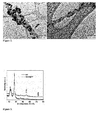
- the nano-sized nature of the trapped NZVI particles was further validated by transmission electron microscopy (TEM) that revealed the entrapment of NZVI by the cellulose fibers ( Figure 2 ).
- TEM transmission electron microscopy
- the chemical nature, crystallinity and magnetic characteristics of composite were evaluated with the aid of several techniques, in particular X-ray diffraction (XRD), Mössbauer spectroscopy and SQUID magnetization measurements.
- XRD X-ray diffraction
- Mössbauer spectroscopy Mössbauer spectroscopy
- SQUID magnetization measurements The XRD pattern of NZVI-containing filtration paper showed the characteristic peak at 52.5° (2 ⁇ , deg), signature that correspond to the (110) diffraction of body-centered cubic (bcc) of ⁇ -Fe phase ( Figure 3 ).
- the (110) diffraction peak increased in intensity upon increasing the amount of the iron salt used within the initial FP immersion cycle and following NaBH 4 reduction. Therefore, through such simple synthetic procedure, it was possible to derive from the bottom-up approach the effective amount of NZVI loaded into FP (from 2.5% to 5% in weight for our tested composites). Diffraction signal due to other iron oxide phases (e.g., ⁇ -Fe 2 O 3 /Fe 3 O 4 , ⁇ -Fe 2 O 3 ) were absent in all tested preparations. These findings suggested that the NZVI nanoparticles intimately embedded into FP were less prone to undergo fast surface-passivation at ambient air, due to the emergence of some interactions between surface exposed iron nanoparticles and cellulose fibers.
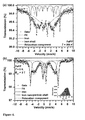
- the second magnetically split component reflected a fraction of Fe 0 interacting with the sugar support ( Figure 4 , magenta-line) with B eff , of 19.7 T, ⁇ of 0.22 mm/s, and zero quadrupole splitting ⁇ E Q .
- the NZVI-containing filtration paper can be described as composed by nanoparticles with a pseudo core-shell configuration, having the core formed by purely zero-valent iron and the shell of zero-valent iron in nature but with altered electronic features as also derived from the room-temperature Mössbauer spectrum.
- the dual nature of the electronic behaviour associated to the Fe 0 in the NZVI-core and surface-exposed Fe 0 located on the NZVI-shell was also confirmed in the composite's magnetic response by bulk susceptibility measurements.
- NZVI-containing filtration paper The effectiveness of NZVI-containing filtration paper was tested in three scenarios, (i) reduction of the toxic hexavalent chromium into the environmentally friendlier Cr(III), (ii) proclivity of NZVI-containing filtration paper to activate hydroxylation reactions, in particular the in-situ conversion of phenols to catechols, and (iii) removal of As(V) by its reduction and sorption on NZVI-containing filtration paper.
- the results obtained for the Cr(VI) removal by simple filtration of gravity-feed solutions over the NZVI-containing filtration paper are shown in Figure 6 .
- the NZVI+FP material was generated by simple impregnation of FP with separately and freshly synthesized NZVI nanoparticles (prepared by the following NaBH 4 reduction method: 1 g of FeCl 3 ⁇ 6H 2 O was dissolved in 50 mL of ethanol; the reducing agent was prepared by dissolving 1 g of NaBH 4 in 50 mL of deionized water and added drop-wise to the Fe 3+ solution; the mixture was allowed to settle for 15 min and the particles recovered via magnet were washed three times with absolute ethanol and then dried under vacuum; the FP was soaked in 40 mg of NZVI powder in 10 mL of EtOH and the material was sonicated for 15 min, followed by washing with ethanol and drying under vacuum; the amount of NZVI present in the FP was found to be ⁇ 8 mg, equal to 3% of the total weight of the composite).
- NZVI+FP ex-situ synthesis
- the use of the NZVI-containing filtration paper allowed to reach the remarkable value of 64% after just three filtration cycles ( Figure 6 ).
- the ex-situ material (NZVI+FP) showed, in such set-up, a decreased ability to reduce Cr(VI), and only 7.5% of hexavalent chromium could be successfully removed.
- NZVI-containing filtration paper The ability of NZVI-containing filtration paper to act as catalyst in hydroxylation reactions was tested using the simple phenol as benchmark, which is a highly toxic organic pollutant with suspected mutagenic and carcinogenic properties, and by employing hydrogen peroxide as green-oxidant. The reaction conditions in those materials required the use of high temperatures, low pH and prolonged times.
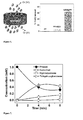
- NZVI-containing filtration paper was capable to promote conversion of phenol into less toxic catechols already at low temperature (40 °C), at neutral pH and after short time via simple filtration steps.
- Figure 7 summarizes the experimental findings with NZVI-containing filtration paper (5 wt % of NZVI) used as a membrane catalyst.
- NZVI-containing filtration paper for removal of As(V) is depicted on Figure 8 .
- a freshly prepared stock solution of As(V) (1 mg/L, 200 mL) was slowly poured through NZVI-containing filtration paper (5 cycles) and the filtrate was collected after each step and characterized by AAS to determine the residual amount of As(V). The nearly complete removal of arsenic was observed after fourth cycle.
- NZVI embedded in cotton-fiber cloth The preparation of NZVI embedded in cotton-fiber cloth according to the two-step procedure described in Example 1.
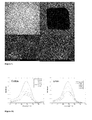
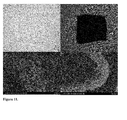
- the macroscopic optical changes of the cotton cloth are shown in Figure 9 (top) and the detailed scanning-electron microscopy (SEM) characterization is presented on Figure 9 (bottom) showing NZVI particles with a mean size of 300 nm.
- SEM scanning-electron microscopy
- a freshly prepared stock solution of Cr(VI) (6.5 mg/L, 30 mL) was slowly poured through NZVI-containing cotton cloth and the filtrate was collected and characterized by UV-Vis absorption spectroscopy to determine the residual amount of Cr(VI).
- the observed efficiency in the Cr(VI) reduction by NZVI-containing cotton cloth is illustrated on Figure 10 (left).
Landscapes
- Chemical & Material Sciences (AREA)
- Organic Chemistry (AREA)
- Engineering & Computer Science (AREA)
- Chemical Kinetics & Catalysis (AREA)
- Materials Engineering (AREA)
- Life Sciences & Earth Sciences (AREA)
- Hydrology & Water Resources (AREA)
- Environmental & Geological Engineering (AREA)
- Water Supply & Treatment (AREA)
- Solid-Sorbent Or Filter-Aiding Compositions (AREA)
- Catalysts (AREA)
Priority Applications (2)
| Application Number | Priority Date | Filing Date | Title |
|---|---|---|---|
| EP14184322.7A EP2995374B1 (fr) | 2014-09-10 | 2014-09-10 | Materiaux composite composee d'un materiaux composee des fibres cellulose et des nanoparticule de fer zero-valent et son procede de preparation et utilisation comme catalyseur |
| ES14184322T ES2836738T3 (es) | 2014-09-10 | 2014-09-10 | Material compuesto que consiste en un material huésped fibroso de celulosa y nanopartículas de hierro cerovalente y su preparación y uso como catalizador |
Applications Claiming Priority (1)
| Application Number | Priority Date | Filing Date | Title |
|---|---|---|---|
| EP14184322.7A EP2995374B1 (fr) | 2014-09-10 | 2014-09-10 | Materiaux composite composee d'un materiaux composee des fibres cellulose et des nanoparticule de fer zero-valent et son procede de preparation et utilisation comme catalyseur |
Publications (2)
| Publication Number | Publication Date |
|---|---|
| EP2995374A1 true EP2995374A1 (fr) | 2016-03-16 |
| EP2995374B1 EP2995374B1 (fr) | 2020-09-23 |
Family
ID=51535346
Family Applications (1)
| Application Number | Title | Priority Date | Filing Date |
|---|---|---|---|
| EP14184322.7A Not-in-force EP2995374B1 (fr) | 2014-09-10 | 2014-09-10 | Materiaux composite composee d'un materiaux composee des fibres cellulose et des nanoparticule de fer zero-valent et son procede de preparation et utilisation comme catalyseur |
Country Status (2)
| Country | Link |
|---|---|
| EP (1) | EP2995374B1 (fr) |
| ES (1) | ES2836738T3 (fr) |
Cited By (7)
| Publication number | Priority date | Publication date | Assignee | Title |
|---|---|---|---|---|
| CN107670646A (zh) * | 2017-09-22 | 2018-02-09 | 中国科学院合肥物质科学研究院 | 一种串珠结构纳米零价铁/纤维素复合材料及其应用 |
| CN108689472A (zh) * | 2017-04-11 | 2018-10-23 | 香港大学 | 一种包覆型纳米零价铁材料及其制备方法和应用 |
| CN111620318A (zh) * | 2020-06-08 | 2020-09-04 | 东北农业大学 | 一种纳米零价铁粒子负载泡沫炭复合材料的制备方法 |
| CN112156810A (zh) * | 2020-09-17 | 2021-01-01 | 齐鲁工业大学 | 可催化降解4-硝基苯酚的纳米纤维素膜及其制备方法与应用 |
| CN114538557A (zh) * | 2022-02-28 | 2022-05-27 | 中南大学 | 一种纤维素纳米晶负载纳米零价铁复合材料、及其制备方法和应用 |
| CN115304149A (zh) * | 2022-08-03 | 2022-11-08 | 南开大学 | 一种滴定法合成焦性没食子酸改性纳米零价铁有效去除六价铬的方法 |
| US11739770B2 (en) | 2018-12-11 | 2023-08-29 | Robert D. Kline | Variable output, hydraulic drive system |
Citations (3)
| Publication number | Priority date | Publication date | Assignee | Title |
|---|---|---|---|---|
| EP0233776A1 (fr) * | 1986-02-18 | 1987-08-26 | Minnesota Mining And Manufacturing Company | Fibre céramique modifiée à l'intérieur |
| US20120064332A1 (en) * | 2010-09-14 | 2012-03-15 | Applied Nanostructured Solutions, Llc | Glass substrates having carbon nanotubes grown thereon and methods for production thereof |
| CN104014812A (zh) * | 2014-06-09 | 2014-09-03 | 上海理工大学 | 制备活性炭负载纳米零价铁的复合材料的方法 |
Family Cites Families (2)
| Publication number | Priority date | Publication date | Assignee | Title |
|---|---|---|---|---|
| US7431862B2 (en) * | 2004-04-30 | 2008-10-07 | Coldwatt, Inc. | Synthesis of magnetic, dielectric or phosphorescent NANO composites |
| CO6880015A1 (es) * | 2012-08-28 | 2014-02-28 | Univ Ind De Santander | Material util en la remocion de contaminantes en matrices liquidas |
-
2014
- 2014-09-10 ES ES14184322T patent/ES2836738T3/es active Active
- 2014-09-10 EP EP14184322.7A patent/EP2995374B1/fr not_active Not-in-force
Patent Citations (3)
| Publication number | Priority date | Publication date | Assignee | Title |
|---|---|---|---|---|
| EP0233776A1 (fr) * | 1986-02-18 | 1987-08-26 | Minnesota Mining And Manufacturing Company | Fibre céramique modifiée à l'intérieur |
| US20120064332A1 (en) * | 2010-09-14 | 2012-03-15 | Applied Nanostructured Solutions, Llc | Glass substrates having carbon nanotubes grown thereon and methods for production thereof |
| CN104014812A (zh) * | 2014-06-09 | 2014-09-03 | 上海理工大学 | 制备活性炭负载纳米零价铁的复合材料的方法 |
Non-Patent Citations (12)
| Title |
|---|
| ALI, I.: "New Generation Adsorbents for Water Treatment", CHEMICAL REVIEWS, vol. 112, no. 10, 2012, pages 5073 - 5091 |
| HOCH, L. B.; E. J. MACK ET AL.: "Carbothermal Synthesis of Carbon-supported Nanoscale Zero-valent Iron Particles for the Remediation of Hexavalent Chromium", ENVIRONMENTAL SCIENCE & TECHNOLOGY, vol. 42, no. 7, 2008, pages 2600 - 2605 |
| HUANG, Q.; X. SHI ET AL.: "Tunable Synthesis and Immobilization of Zero-Valent Iron Nanoparticles for Environmental Applications", ENVIRONMENTAL SCIENCE & TECHNOLOGY, vol. 42, no. 23, 2008, pages 8884 - 8889 |
| HWANG, Y.; Y. C. LEE ET AL.: "Nanoscale zero-valent iron (nZVI) synthesis in a Mg-aminoclay solution exhibits increased stability and reactivity for reductive decontamination", APPLIED CATALYSIS B-ENVIRONMENTAL, vol. 147, 2014, pages 748 - 755 |
| JABEEN, H.; V. CHANDRA ET AL.: "Enhanced Cr(VI) removal using iron nanoparticle decorated graphene", NANOSCALE, vol. 3, no. 9, 2011, pages 3583 - 3585 |
| KHARISOV, B. I.; H. V. R. DIAS ET AL.: "Iron-containing nanomaterials: synthesis, properties, and environmental applications", RSC ADVANCES, vol. 2, no. 25, 2012, pages 9325 - 9358 |
| NESRIN HORZUM ET AL: "Chitosan fiber-supported zero-valent iron nanoparticles as a novel sorbent for sequestration of inorganic arsenic", RSC ADVANCES, vol. 3, no. 21, 1 January 2013 (2013-01-01), pages 7828, XP055170460, ISSN: 2046-2069, DOI: 10.1039/c3ra23454a * |
| NOUBACTEP, C.; S. CARE ET AL.: "Nanoscale Metallic Iron for Environmental Remediation: Prospects and Limitations", WATER AIR AND SOIL POLLUTION, vol. 223, no. 3, 2012, pages 1363 - 1382 |
| PETALA, E.; K. DIMOS ET AL.: "Nanoscale zero-valent iron supported on mesoporous silica: Characterization and reactivity for Cr(VI) removal from aqueous solution", JOURNAL OF HAZARDOUS MATERIALS, vol. 261, no. 0, 2013, pages 295 - 306 |
| PONDER, S. M.; J. G. DARAB ET AL.: "Remediation of Cr(VI) and Pb(II) aqueous solutions using supported, nanoscale zero-valent iron", ENVIRONMENTAL SCIENCE & TECHNOLOGY, vol. 34, no. 12, 2000, pages 2564 - 2569 |
| SAMIR, M. A. S. A.; F. ALLOIN ET AL.: "Review of recent research into cellulosic whiskers, their properties and their application in nanocomposite field", BIOMACROMOLECULES, vol. 6, no. 2, 2005, pages 612 - 626 |
| SHILI XIAO ET AL: "Immobilization of Zerovalent Iron Nanoparticles into Electrospun Polymer Nanofibers: Synthesis, Characterization, and Potential Environmental Applications", JOURNAL OF PHYSICAL CHEMISTRY C, vol. 113, no. 42, 22 October 2009 (2009-10-22), pages 18062 - 18068, XP055170462, ISSN: 1932-7447, DOI: 10.1021/jp905542g * |
Cited By (10)
| Publication number | Priority date | Publication date | Assignee | Title |
|---|---|---|---|---|
| CN108689472A (zh) * | 2017-04-11 | 2018-10-23 | 香港大学 | 一种包覆型纳米零价铁材料及其制备方法和应用 |
| CN107670646A (zh) * | 2017-09-22 | 2018-02-09 | 中国科学院合肥物质科学研究院 | 一种串珠结构纳米零价铁/纤维素复合材料及其应用 |
| CN107670646B (zh) * | 2017-09-22 | 2020-03-10 | 中国科学院合肥物质科学研究院 | 一种串珠结构纳米零价铁/纤维素复合材料及其应用 |
| US11739770B2 (en) | 2018-12-11 | 2023-08-29 | Robert D. Kline | Variable output, hydraulic drive system |
| CN111620318A (zh) * | 2020-06-08 | 2020-09-04 | 东北农业大学 | 一种纳米零价铁粒子负载泡沫炭复合材料的制备方法 |
| CN111620318B (zh) * | 2020-06-08 | 2023-04-25 | 东北农业大学 | 一种纳米零价铁粒子负载泡沫炭复合材料的制备方法 |
| CN112156810A (zh) * | 2020-09-17 | 2021-01-01 | 齐鲁工业大学 | 可催化降解4-硝基苯酚的纳米纤维素膜及其制备方法与应用 |
| CN114538557A (zh) * | 2022-02-28 | 2022-05-27 | 中南大学 | 一种纤维素纳米晶负载纳米零价铁复合材料、及其制备方法和应用 |
| CN114538557B (zh) * | 2022-02-28 | 2023-10-03 | 中南大学 | 一种纤维素纳米晶负载纳米零价铁复合材料、及其制备方法和应用 |
| CN115304149A (zh) * | 2022-08-03 | 2022-11-08 | 南开大学 | 一种滴定法合成焦性没食子酸改性纳米零价铁有效去除六价铬的方法 |
Also Published As
| Publication number | Publication date |
|---|---|
| ES2836738T3 (es) | 2021-06-28 |
| EP2995374B1 (fr) | 2020-09-23 |
Similar Documents
| Publication | Publication Date | Title |
|---|---|---|
| EP2995374B1 (fr) | Materiaux composite composee d'un materiaux composee des fibres cellulose et des nanoparticule de fer zero-valent et son procede de preparation et utilisation comme catalyseur | |
| Wu et al. | Core-shell magnetic Fe3O4@ Zn/Co-ZIFs to activate peroxymonosulfate for highly efficient degradation of carbamazepine | |
| Zhao et al. | Introduction of a Fe3O4 core enhances the photocatalytic activity of MIL‐100 (Fe) with tunable shell thickness in the presence of H2O2 | |
| Huang et al. | Ascorbate-promoted surface iron cycle for efficient heterogeneous Fenton alachlor degradation with hematite nanocrystals | |
| Wang | Adsorption of aqueous neodymium, europium, gadolinium, terbium, and yttrium ions onto nZVI-montmorillonite: kinetics, thermodynamic mechanism, and the influence of coexisting ions | |
| Xu et al. | Identifying the role of surface hydroxyl on FeOCl in bridging electron transfer toward efficient persulfate activation | |
| Li et al. | FexCo3− xO4 nanocages derived from nanoscale metal–organic frameworks for removal of bisphenol A by activation of peroxymonosulfate | |
| Prasad et al. | Bio inspired green synthesis of Ni/Fe3O4 magnetic nanoparticles using Moringa oleifera leaves extract: a magnetically recoverable catalyst for organic dye degradation in aqueous solution | |
| Wan et al. | Adsorption and heterogeneous degradation of rhodamine B on the surface of magnetic bentonite material | |
| Gautam et al. | Synthesis of bimetallic Fe–Zn nanoparticles and its application towards adsorptive removal of carcinogenic dye malachite green and Congo red in water | |
| Yang et al. | Rapid and highly efficient preconcentration of Eu (III) by core–shell structured Fe3O4@ humic acid magnetic nanoparticles | |
| Shahwan et al. | Green synthesis of iron nanoparticles and their application as a Fenton-like catalyst for the degradation of aqueous cationic and anionic dyes | |
| Wen et al. | Bimetal cobalt-Iron based organic frameworks with coordinated sites as synergistic catalyst for fenton catalysis study and antibacterial efficiency | |
| Elwakeel et al. | Adsorption of toxic acidic dye from aqueous solution onto diethylenetriamine functionalized magnetic glycidyl methacrylate-N, N′-methylenebisacrylamide | |
| Zhou et al. | Fabrication of magnetic carbon composites from peanut shells and its application as a heterogeneous Fenton catalyst in removal of methylene blue | |
| Fang et al. | Selective perfluorooctanoic acid (PFOA) and perfluorooctane sulfonate (PFOS) adsorption by nanoscale zero-valent iron (nZVI): performance and mechanisms | |
| Wang et al. | Graphene-based magnetic metal organic framework nanocomposite for sensitive colorimetric detection and facile degradation of phenol | |
| Perrotti et al. | Green iron nanoparticles supported on amino-functionalized silica for removal of the dye methyl orange | |
| Kumarathilaka et al. | Insights into Starch Coated Nanozero Valent Iron‐Graphene Composite for Cr (VI) Removal from Aqueous Medium | |
| Datta et al. | NZVI modified magnetic filter paper with high redox and catalytic activities for advanced water treatment technologies | |
| Zhang et al. | Synthesis of KMnO4-treated magnetic graphene oxide nanocomposite (Fe3O4@ GO/MnO x) and its application for removing of Cu2+ ions from aqueous solution | |
| Nasehi et al. | Cadmium adsorption using novel MnFe 2 O 4-TiO 2-UIO-66 magnetic nanoparticles and condition optimization using a response surface methodology | |
| Upoma et al. | Bio-inspired immobilization of silver and gold on magnetic graphene oxide for rapid catalysis and recyclability | |
| Deng et al. | Removal of Tl (I) Ions From Aqueous Solution Using Fe@ Fe2O3 Core‐Shell Nanowires | |
| Li et al. | An enhanced reduction–adsorption strategy for cr (VI): fabrication and application of l-Cysteine-doped Carbon@ Polypyrrole with a Core/Shell Composite structure |
Legal Events
| Date | Code | Title | Description |
|---|---|---|---|
| PUAI | Public reference made under article 153(3) epc to a published international application that has entered the european phase |
Free format text: ORIGINAL CODE: 0009012 |
|
| AK | Designated contracting states |
Kind code of ref document: A1 Designated state(s): AL AT BE BG CH CY CZ DE DK EE ES FI FR GB GR HR HU IE IS IT LI LT LU LV MC MK MT NL NO PL PT RO RS SE SI SK SM TR |
|
| AX | Request for extension of the european patent |
Extension state: BA ME |
|
| 17P | Request for examination filed |
Effective date: 20160819 |
|
| RBV | Designated contracting states (corrected) |
Designated state(s): AL AT BE BG CH CY CZ DE DK EE ES FI FR GB GR HR HU IE IS IT LI LT LU LV MC MK MT NL NO PL PT RO RS SE SI SK SM TR |
|
| STAA | Information on the status of an ep patent application or granted ep patent |
Free format text: STATUS: EXAMINATION IS IN PROGRESS |
|
| 17Q | First examination report despatched |
Effective date: 20190208 |
|
| GRAP | Despatch of communication of intention to grant a patent |
Free format text: ORIGINAL CODE: EPIDOSNIGR1 |
|
| STAA | Information on the status of an ep patent application or granted ep patent |
Free format text: STATUS: GRANT OF PATENT IS INTENDED |
|
| INTG | Intention to grant announced |
Effective date: 20200415 |
|
| GRAS | Grant fee paid |
Free format text: ORIGINAL CODE: EPIDOSNIGR3 |
|
| GRAA | (expected) grant |
Free format text: ORIGINAL CODE: 0009210 |
|
| STAA | Information on the status of an ep patent application or granted ep patent |
Free format text: STATUS: THE PATENT HAS BEEN GRANTED |
|
| AK | Designated contracting states |
Kind code of ref document: B1 Designated state(s): AL AT BE BG CH CY CZ DE DK EE ES FI FR GB GR HR HU IE IS IT LI LT LU LV MC MK MT NL NO PL PT RO RS SE SI SK SM TR |
|
| REG | Reference to a national code |
Ref country code: GB Ref legal event code: FG4D |
|
| REG | Reference to a national code |
Ref country code: CH Ref legal event code: EP |
|
| REG | Reference to a national code |
Ref country code: DE Ref legal event code: R096 Ref document number: 602014070423 Country of ref document: DE |
|
| REG | Reference to a national code |
Ref country code: IE Ref legal event code: FG4D |
|
| REG | Reference to a national code |
Ref country code: AT Ref legal event code: REF Ref document number: 1315833 Country of ref document: AT Kind code of ref document: T Effective date: 20201015 |
|
| PG25 | Lapsed in a contracting state [announced via postgrant information from national office to epo] |
Ref country code: GR Free format text: LAPSE BECAUSE OF FAILURE TO SUBMIT A TRANSLATION OF THE DESCRIPTION OR TO PAY THE FEE WITHIN THE PRESCRIBED TIME-LIMIT Effective date: 20201224 Ref country code: NO Free format text: LAPSE BECAUSE OF FAILURE TO SUBMIT A TRANSLATION OF THE DESCRIPTION OR TO PAY THE FEE WITHIN THE PRESCRIBED TIME-LIMIT Effective date: 20201223 Ref country code: BG Free format text: LAPSE BECAUSE OF FAILURE TO SUBMIT A TRANSLATION OF THE DESCRIPTION OR TO PAY THE FEE WITHIN THE PRESCRIBED TIME-LIMIT Effective date: 20201223 Ref country code: SE Free format text: LAPSE BECAUSE OF FAILURE TO SUBMIT A TRANSLATION OF THE DESCRIPTION OR TO PAY THE FEE WITHIN THE PRESCRIBED TIME-LIMIT Effective date: 20200923 Ref country code: FI Free format text: LAPSE BECAUSE OF FAILURE TO SUBMIT A TRANSLATION OF THE DESCRIPTION OR TO PAY THE FEE WITHIN THE PRESCRIBED TIME-LIMIT Effective date: 20200923 Ref country code: HR Free format text: LAPSE BECAUSE OF FAILURE TO SUBMIT A TRANSLATION OF THE DESCRIPTION OR TO PAY THE FEE WITHIN THE PRESCRIBED TIME-LIMIT Effective date: 20200923 |
|
| REG | Reference to a national code |
Ref country code: SK Ref legal event code: T3 Ref document number: E 36067 Country of ref document: SK |
|
| REG | Reference to a national code |
Ref country code: AT Ref legal event code: MK05 Ref document number: 1315833 Country of ref document: AT Kind code of ref document: T Effective date: 20200923 |
|
| PG25 | Lapsed in a contracting state [announced via postgrant information from national office to epo] |
Ref country code: LV Free format text: LAPSE BECAUSE OF FAILURE TO SUBMIT A TRANSLATION OF THE DESCRIPTION OR TO PAY THE FEE WITHIN THE PRESCRIBED TIME-LIMIT Effective date: 20200923 Ref country code: RS Free format text: LAPSE BECAUSE OF FAILURE TO SUBMIT A TRANSLATION OF THE DESCRIPTION OR TO PAY THE FEE WITHIN THE PRESCRIBED TIME-LIMIT Effective date: 20200923 |
|
| REG | Reference to a national code |
Ref country code: NL Ref legal event code: MP Effective date: 20200923 |
|
| REG | Reference to a national code |
Ref country code: LT Ref legal event code: MG4D |
|
| PG25 | Lapsed in a contracting state [announced via postgrant information from national office to epo] |
Ref country code: PT Free format text: LAPSE BECAUSE OF FAILURE TO SUBMIT A TRANSLATION OF THE DESCRIPTION OR TO PAY THE FEE WITHIN THE PRESCRIBED TIME-LIMIT Effective date: 20210125 Ref country code: NL Free format text: LAPSE BECAUSE OF FAILURE TO SUBMIT A TRANSLATION OF THE DESCRIPTION OR TO PAY THE FEE WITHIN THE PRESCRIBED TIME-LIMIT Effective date: 20200923 Ref country code: LT Free format text: LAPSE BECAUSE OF FAILURE TO SUBMIT A TRANSLATION OF THE DESCRIPTION OR TO PAY THE FEE WITHIN THE PRESCRIBED TIME-LIMIT Effective date: 20200923 Ref country code: SM Free format text: LAPSE BECAUSE OF FAILURE TO SUBMIT A TRANSLATION OF THE DESCRIPTION OR TO PAY THE FEE WITHIN THE PRESCRIBED TIME-LIMIT Effective date: 20200923 Ref country code: RO Free format text: LAPSE BECAUSE OF FAILURE TO SUBMIT A TRANSLATION OF THE DESCRIPTION OR TO PAY THE FEE WITHIN THE PRESCRIBED TIME-LIMIT Effective date: 20200923 Ref country code: EE Free format text: LAPSE BECAUSE OF FAILURE TO SUBMIT A TRANSLATION OF THE DESCRIPTION OR TO PAY THE FEE WITHIN THE PRESCRIBED TIME-LIMIT Effective date: 20200923 |
|
| PG25 | Lapsed in a contracting state [announced via postgrant information from national office to epo] |
Ref country code: AT Free format text: LAPSE BECAUSE OF FAILURE TO SUBMIT A TRANSLATION OF THE DESCRIPTION OR TO PAY THE FEE WITHIN THE PRESCRIBED TIME-LIMIT Effective date: 20200923 Ref country code: AL Free format text: LAPSE BECAUSE OF FAILURE TO SUBMIT A TRANSLATION OF THE DESCRIPTION OR TO PAY THE FEE WITHIN THE PRESCRIBED TIME-LIMIT Effective date: 20200923 Ref country code: PL Free format text: LAPSE BECAUSE OF FAILURE TO SUBMIT A TRANSLATION OF THE DESCRIPTION OR TO PAY THE FEE WITHIN THE PRESCRIBED TIME-LIMIT Effective date: 20200923 Ref country code: IS Free format text: LAPSE BECAUSE OF FAILURE TO SUBMIT A TRANSLATION OF THE DESCRIPTION OR TO PAY THE FEE WITHIN THE PRESCRIBED TIME-LIMIT Effective date: 20210123 |
|
| REG | Reference to a national code |
Ref country code: DE Ref legal event code: R097 Ref document number: 602014070423 Country of ref document: DE |
|
| REG | Reference to a national code |
Ref country code: ES Ref legal event code: FG2A Ref document number: 2836738 Country of ref document: ES Kind code of ref document: T3 Effective date: 20210628 |
|
| PLBE | No opposition filed within time limit |
Free format text: ORIGINAL CODE: 0009261 |
|
| STAA | Information on the status of an ep patent application or granted ep patent |
Free format text: STATUS: NO OPPOSITION FILED WITHIN TIME LIMIT |
|
| PG25 | Lapsed in a contracting state [announced via postgrant information from national office to epo] |
Ref country code: DK Free format text: LAPSE BECAUSE OF FAILURE TO SUBMIT A TRANSLATION OF THE DESCRIPTION OR TO PAY THE FEE WITHIN THE PRESCRIBED TIME-LIMIT Effective date: 20200923 Ref country code: SI Free format text: LAPSE BECAUSE OF FAILURE TO SUBMIT A TRANSLATION OF THE DESCRIPTION OR TO PAY THE FEE WITHIN THE PRESCRIBED TIME-LIMIT Effective date: 20200923 |
|
| 26N | No opposition filed |
Effective date: 20210624 |
|
| REG | Reference to a national code |
Ref country code: DE Ref legal event code: R119 Ref document number: 602014070423 Country of ref document: DE |
|
| REG | Reference to a national code |
Ref country code: CH Ref legal event code: PL |
|
| REG | Reference to a national code |
Ref country code: SK Ref legal event code: MM4A Ref document number: E 36067 Country of ref document: SK Effective date: 20210910 |
|
| REG | Reference to a national code |
Ref country code: BE Ref legal event code: MM Effective date: 20210930 |
|
| GBPC | Gb: european patent ceased through non-payment of renewal fee |
Effective date: 20210910 |
|
| PG25 | Lapsed in a contracting state [announced via postgrant information from national office to epo] |
Ref country code: MC Free format text: LAPSE BECAUSE OF FAILURE TO SUBMIT A TRANSLATION OF THE DESCRIPTION OR TO PAY THE FEE WITHIN THE PRESCRIBED TIME-LIMIT Effective date: 20200923 Ref country code: CZ Free format text: LAPSE BECAUSE OF NON-PAYMENT OF DUE FEES Effective date: 20210910 |
|
| PG25 | Lapsed in a contracting state [announced via postgrant information from national office to epo] |
Ref country code: SK Free format text: LAPSE BECAUSE OF NON-PAYMENT OF DUE FEES Effective date: 20210910 Ref country code: LU Free format text: LAPSE BECAUSE OF NON-PAYMENT OF DUE FEES Effective date: 20210910 Ref country code: IE Free format text: LAPSE BECAUSE OF NON-PAYMENT OF DUE FEES Effective date: 20210910 Ref country code: GB Free format text: LAPSE BECAUSE OF NON-PAYMENT OF DUE FEES Effective date: 20210910 Ref country code: FR Free format text: LAPSE BECAUSE OF NON-PAYMENT OF DUE FEES Effective date: 20210930 Ref country code: DE Free format text: LAPSE BECAUSE OF NON-PAYMENT OF DUE FEES Effective date: 20220401 Ref country code: BE Free format text: LAPSE BECAUSE OF NON-PAYMENT OF DUE FEES Effective date: 20210930 |
|
| PG25 | Lapsed in a contracting state [announced via postgrant information from national office to epo] |
Ref country code: LI Free format text: LAPSE BECAUSE OF NON-PAYMENT OF DUE FEES Effective date: 20210930 Ref country code: CH Free format text: LAPSE BECAUSE OF NON-PAYMENT OF DUE FEES Effective date: 20210930 |
|
| REG | Reference to a national code |
Ref country code: ES Ref legal event code: FD2A Effective date: 20221102 |
|
| PG25 | Lapsed in a contracting state [announced via postgrant information from national office to epo] |
Ref country code: ES Free format text: LAPSE BECAUSE OF NON-PAYMENT OF DUE FEES Effective date: 20210911 |
|
| PG25 | Lapsed in a contracting state [announced via postgrant information from national office to epo] |
Ref country code: HU Free format text: LAPSE BECAUSE OF FAILURE TO SUBMIT A TRANSLATION OF THE DESCRIPTION OR TO PAY THE FEE WITHIN THE PRESCRIBED TIME-LIMIT; INVALID AB INITIO Effective date: 20140910 |
|
| PG25 | Lapsed in a contracting state [announced via postgrant information from national office to epo] |
Ref country code: IT Free format text: LAPSE BECAUSE OF NON-PAYMENT OF DUE FEES Effective date: 20210930 Ref country code: CY Free format text: LAPSE BECAUSE OF FAILURE TO SUBMIT A TRANSLATION OF THE DESCRIPTION OR TO PAY THE FEE WITHIN THE PRESCRIBED TIME-LIMIT Effective date: 20200923 |
|
| PG25 | Lapsed in a contracting state [announced via postgrant information from national office to epo] |
Ref country code: MK Free format text: LAPSE BECAUSE OF FAILURE TO SUBMIT A TRANSLATION OF THE DESCRIPTION OR TO PAY THE FEE WITHIN THE PRESCRIBED TIME-LIMIT Effective date: 20200923 |
|
| PG25 | Lapsed in a contracting state [announced via postgrant information from national office to epo] |
Ref country code: TR Free format text: LAPSE BECAUSE OF FAILURE TO SUBMIT A TRANSLATION OF THE DESCRIPTION OR TO PAY THE FEE WITHIN THE PRESCRIBED TIME-LIMIT Effective date: 20200923 |
|
| PG25 | Lapsed in a contracting state [announced via postgrant information from national office to epo] |
Ref country code: MT Free format text: LAPSE BECAUSE OF FAILURE TO SUBMIT A TRANSLATION OF THE DESCRIPTION OR TO PAY THE FEE WITHIN THE PRESCRIBED TIME-LIMIT Effective date: 20200923 |