EP0233776A1 - Fibre céramique modifiée à l'intérieur - Google Patents
Fibre céramique modifiée à l'intérieur Download PDFInfo
- Publication number
- EP0233776A1 EP0233776A1 EP19870301350 EP87301350A EP0233776A1 EP 0233776 A1 EP0233776 A1 EP 0233776A1 EP 19870301350 EP19870301350 EP 19870301350 EP 87301350 A EP87301350 A EP 87301350A EP 0233776 A1 EP0233776 A1 EP 0233776A1
- Authority
- EP
- European Patent Office
- Prior art keywords
- fiber
- phase
- ceramic
- fibers
- metal
- Prior art date
- Legal status (The legal status is an assumption and is not a legal conclusion. Google has not performed a legal analysis and makes no representation as to the accuracy of the status listed.)
- Granted
Links
- 239000000835 fiber Substances 0.000 title claims abstract description 173
- 239000000919 ceramic Substances 0.000 title claims abstract description 55
- 229910052751 metal Inorganic materials 0.000 claims abstract description 27
- 239000002184 metal Substances 0.000 claims abstract description 27
- 239000002245 particle Substances 0.000 claims abstract description 11
- 239000008187 granular material Substances 0.000 claims abstract description 3
- 239000004005 microsphere Substances 0.000 claims abstract description 3
- 239000000203 mixture Substances 0.000 claims description 27
- 239000002243 precursor Substances 0.000 claims description 18
- 239000012298 atmosphere Substances 0.000 claims description 15
- 239000012141 concentrate Substances 0.000 claims description 14
- 238000010304 firing Methods 0.000 claims description 14
- 239000007788 liquid Substances 0.000 claims description 14
- 238000009987 spinning Methods 0.000 claims description 14
- 238000000034 method Methods 0.000 claims description 13
- VYPSYNLAJGMNEJ-UHFFFAOYSA-N silicon dioxide Inorganic materials O=[Si]=O VYPSYNLAJGMNEJ-UHFFFAOYSA-N 0.000 claims description 11
- 239000000377 silicon dioxide Substances 0.000 claims description 9
- GWEVSGVZZGPLCZ-UHFFFAOYSA-N Titan oxide Chemical compound O=[Ti]=O GWEVSGVZZGPLCZ-UHFFFAOYSA-N 0.000 claims description 8
- 239000011195 cermet Substances 0.000 claims description 5
- 150000002736 metal compounds Chemical class 0.000 claims description 4
- 230000003301 hydrolyzing effect Effects 0.000 claims description 2
- 238000007493 shaping process Methods 0.000 claims description 2
- 239000002759 woven fabric Substances 0.000 claims 1
- 239000011159 matrix material Substances 0.000 abstract description 26
- 239000011324 bead Substances 0.000 abstract description 6
- -1 flakes Substances 0.000 abstract description 5
- XEEYBQQBJWHFJM-UHFFFAOYSA-N iron Substances [Fe] XEEYBQQBJWHFJM-UHFFFAOYSA-N 0.000 description 22
- 239000003570 air Substances 0.000 description 17
- XLYOFNOQVPJJNP-UHFFFAOYSA-N water Substances O XLYOFNOQVPJJNP-UHFFFAOYSA-N 0.000 description 13
- 229910052742 iron Inorganic materials 0.000 description 11
- 235000008504 concentrate Nutrition 0.000 description 10
- 239000000463 material Substances 0.000 description 9
- 239000000243 solution Substances 0.000 description 9
- UQSXHKLRYXJYBZ-UHFFFAOYSA-N Iron oxide Chemical compound [Fe]=O UQSXHKLRYXJYBZ-UHFFFAOYSA-N 0.000 description 8
- 238000001354 calcination Methods 0.000 description 8
- 239000000839 emulsion Substances 0.000 description 8
- 229910044991 metal oxide Inorganic materials 0.000 description 8
- 150000004706 metal oxides Chemical class 0.000 description 8
- 238000001035 drying Methods 0.000 description 7
- ZMXDDKWLCZADIW-UHFFFAOYSA-N N,N-Dimethylformamide Chemical compound CN(C)C=O ZMXDDKWLCZADIW-UHFFFAOYSA-N 0.000 description 6
- 238000010438 heat treatment Methods 0.000 description 6
- 239000011368 organic material Substances 0.000 description 6
- 239000007787 solid Substances 0.000 description 6
- MCMNRKCIXSYSNV-UHFFFAOYSA-N ZrO2 Inorganic materials O=[Zr]=O MCMNRKCIXSYSNV-UHFFFAOYSA-N 0.000 description 5
- 229910052799 carbon Inorganic materials 0.000 description 5
- PXHVJJICTQNCMI-UHFFFAOYSA-N nickel Substances [Ni] PXHVJJICTQNCMI-UHFFFAOYSA-N 0.000 description 5
- 230000008569 process Effects 0.000 description 5
- OKTJSMMVPCPJKN-UHFFFAOYSA-N Carbon Chemical compound [C] OKTJSMMVPCPJKN-UHFFFAOYSA-N 0.000 description 4
- 230000015572 biosynthetic process Effects 0.000 description 4
- 239000006185 dispersion Substances 0.000 description 4
- JVTAAEKCZFNVCJ-UHFFFAOYSA-N lactic acid Chemical compound CC(O)C(O)=O JVTAAEKCZFNVCJ-UHFFFAOYSA-N 0.000 description 4
- 239000007858 starting material Substances 0.000 description 4
- 239000000126 substance Substances 0.000 description 4
- 239000004753 textile Substances 0.000 description 4
- VXUYXOFXAQZZMF-UHFFFAOYSA-N titanium(IV) isopropoxide Chemical compound CC(C)O[Ti](OC(C)C)(OC(C)C)OC(C)C VXUYXOFXAQZZMF-UHFFFAOYSA-N 0.000 description 4
- RTZKZFJDLAIYFH-UHFFFAOYSA-N Diethyl ether Chemical compound CCOCC RTZKZFJDLAIYFH-UHFFFAOYSA-N 0.000 description 3
- UFHFLCQGNIYNRP-UHFFFAOYSA-N Hydrogen Chemical compound [H][H] UFHFLCQGNIYNRP-UHFFFAOYSA-N 0.000 description 3
- YXFVVABEGXRONW-UHFFFAOYSA-N Toluene Chemical compound CC1=CC=CC=C1 YXFVVABEGXRONW-UHFFFAOYSA-N 0.000 description 3
- 239000007864 aqueous solution Substances 0.000 description 3
- 239000002131 composite material Substances 0.000 description 3
- 239000000945 filler Substances 0.000 description 3
- 239000001257 hydrogen Substances 0.000 description 3
- 229910052739 hydrogen Inorganic materials 0.000 description 3
- 229910052759 nickel Inorganic materials 0.000 description 3
- 238000012545 processing Methods 0.000 description 3
- RMAQACBXLXPBSY-UHFFFAOYSA-N silicic acid Chemical compound O[Si](O)(O)O RMAQACBXLXPBSY-UHFFFAOYSA-N 0.000 description 3
- 239000002904 solvent Substances 0.000 description 3
- 239000000758 substrate Substances 0.000 description 3
- XKRFYHLGVUSROY-UHFFFAOYSA-N Argon Chemical compound [Ar] XKRFYHLGVUSROY-UHFFFAOYSA-N 0.000 description 2
- IJGRMHOSHXDMSA-UHFFFAOYSA-N Atomic nitrogen Chemical compound N#N IJGRMHOSHXDMSA-UHFFFAOYSA-N 0.000 description 2
- 239000004215 Carbon black (E152) Substances 0.000 description 2
- 241001441571 Hiodontidae Species 0.000 description 2
- WYURNTSHIVDZCO-UHFFFAOYSA-N Tetrahydrofuran Chemical compound C1CCOC1 WYURNTSHIVDZCO-UHFFFAOYSA-N 0.000 description 2
- 238000002441 X-ray diffraction Methods 0.000 description 2
- 239000000654 additive Substances 0.000 description 2
- 229910052782 aluminium Inorganic materials 0.000 description 2
- PNEYBMLMFCGWSK-UHFFFAOYSA-N aluminium oxide Inorganic materials [O-2].[O-2].[O-2].[Al+3].[Al+3] PNEYBMLMFCGWSK-UHFFFAOYSA-N 0.000 description 2
- KGBXLFKZBHKPEV-UHFFFAOYSA-N boric acid Chemical compound OB(O)O KGBXLFKZBHKPEV-UHFFFAOYSA-N 0.000 description 2
- 239000004327 boric acid Substances 0.000 description 2
- 239000003054 catalyst Substances 0.000 description 2
- 239000003795 chemical substances by application Substances 0.000 description 2
- 238000001816 cooling Methods 0.000 description 2
- 239000004744 fabric Substances 0.000 description 2
- 239000012530 fluid Substances 0.000 description 2
- 239000011521 glass Substances 0.000 description 2
- 230000005484 gravity Effects 0.000 description 2
- 229930195733 hydrocarbon Natural products 0.000 description 2
- 150000002430 hydrocarbons Chemical class 0.000 description 2
- 239000012784 inorganic fiber Substances 0.000 description 2
- 229910052500 inorganic mineral Inorganic materials 0.000 description 2
- 239000004310 lactic acid Substances 0.000 description 2
- 235000014655 lactic acid Nutrition 0.000 description 2
- 238000004519 manufacturing process Methods 0.000 description 2
- 150000001247 metal acetylides Chemical class 0.000 description 2
- 239000011707 mineral Substances 0.000 description 2
- 238000002156 mixing Methods 0.000 description 2
- 150000004767 nitrides Chemical class 0.000 description 2
- 229910052755 nonmetal Inorganic materials 0.000 description 2
- 230000003287 optical effect Effects 0.000 description 2
- 230000001590 oxidative effect Effects 0.000 description 2
- 239000011049 pearl Substances 0.000 description 2
- 238000000634 powder X-ray diffraction Methods 0.000 description 2
- 238000002360 preparation method Methods 0.000 description 2
- 239000002994 raw material Substances 0.000 description 2
- 239000011214 refractory ceramic Substances 0.000 description 2
- 239000012798 spherical particle Substances 0.000 description 2
- 235000015096 spirit Nutrition 0.000 description 2
- 238000003756 stirring Methods 0.000 description 2
- 150000003568 thioethers Chemical class 0.000 description 2
- NVJUHMXYKCUMQA-UHFFFAOYSA-N 1-ethoxypropane Chemical compound CCCOCC NVJUHMXYKCUMQA-UHFFFAOYSA-N 0.000 description 1
- QJMYXHKGEGNLED-UHFFFAOYSA-N 5-(2-hydroxyethylamino)-1h-pyrimidine-2,4-dione Chemical compound OCCNC1=CNC(=O)NC1=O QJMYXHKGEGNLED-UHFFFAOYSA-N 0.000 description 1
- QTBSBXVTEAMEQO-UHFFFAOYSA-N Acetic acid Chemical compound CC(O)=O QTBSBXVTEAMEQO-UHFFFAOYSA-N 0.000 description 1
- ZOXJGFHDIHLPTG-UHFFFAOYSA-N Boron Chemical compound [B] ZOXJGFHDIHLPTG-UHFFFAOYSA-N 0.000 description 1
- VEXZGXHMUGYJMC-UHFFFAOYSA-M Chloride anion Chemical compound [Cl-] VEXZGXHMUGYJMC-UHFFFAOYSA-M 0.000 description 1
- 229920000742 Cotton Polymers 0.000 description 1
- 241001146209 Curio rowleyanus Species 0.000 description 1
- WQZGKKKJIJFFOK-GASJEMHNSA-N Glucose Natural products OC[C@H]1OC(O)[C@H](O)[C@@H](O)[C@@H]1O WQZGKKKJIJFFOK-GASJEMHNSA-N 0.000 description 1
- GRYLNZFGIOXLOG-UHFFFAOYSA-N Nitric acid Chemical compound O[N+]([O-])=O GRYLNZFGIOXLOG-UHFFFAOYSA-N 0.000 description 1
- CTQNGGLPUBDAKN-UHFFFAOYSA-N O-Xylene Chemical compound CC1=CC=CC=C1C CTQNGGLPUBDAKN-UHFFFAOYSA-N 0.000 description 1
- 239000005062 Polybutadiene Substances 0.000 description 1
- 239000004372 Polyvinyl alcohol Substances 0.000 description 1
- 229920000297 Rayon Polymers 0.000 description 1
- 240000006394 Sorghum bicolor Species 0.000 description 1
- HDYRYUINDGQKMC-UHFFFAOYSA-M acetyloxyaluminum;dihydrate Chemical compound O.O.CC(=O)O[Al] HDYRYUINDGQKMC-UHFFFAOYSA-M 0.000 description 1
- 239000002253 acid Substances 0.000 description 1
- 230000009471 action Effects 0.000 description 1
- 230000000996 additive effect Effects 0.000 description 1
- 239000002671 adjuvant Substances 0.000 description 1
- 230000004075 alteration Effects 0.000 description 1
- XAGFODPZIPBFFR-UHFFFAOYSA-N aluminium Chemical compound [Al] XAGFODPZIPBFFR-UHFFFAOYSA-N 0.000 description 1
- 229940009827 aluminum acetate Drugs 0.000 description 1
- 239000012080 ambient air Substances 0.000 description 1
- 229910052786 argon Inorganic materials 0.000 description 1
- QVGXLLKOCUKJST-UHFFFAOYSA-N atomic oxygen Chemical compound [O] QVGXLLKOCUKJST-UHFFFAOYSA-N 0.000 description 1
- LZLOFGMGFADIKQ-UHFFFAOYSA-N benzene;1,4-dioxane Chemical compound C1COCCO1.C1=CC=CC=C1 LZLOFGMGFADIKQ-UHFFFAOYSA-N 0.000 description 1
- WQZGKKKJIJFFOK-VFUOTHLCSA-N beta-D-glucose Chemical compound OC[C@H]1O[C@@H](O)[C@H](O)[C@@H](O)[C@@H]1O WQZGKKKJIJFFOK-VFUOTHLCSA-N 0.000 description 1
- 238000007664 blowing Methods 0.000 description 1
- 229910052796 boron Inorganic materials 0.000 description 1
- 239000001913 cellulose Substances 0.000 description 1
- 229920002678 cellulose Polymers 0.000 description 1
- 229910010293 ceramic material Inorganic materials 0.000 description 1
- 238000006243 chemical reaction Methods 0.000 description 1
- 150000001805 chlorine compounds Chemical class 0.000 description 1
- 229910052804 chromium Inorganic materials 0.000 description 1
- 239000010941 cobalt Substances 0.000 description 1
- 229910017052 cobalt Inorganic materials 0.000 description 1
- GUTLYIVDDKVIGB-UHFFFAOYSA-N cobalt atom Chemical compound [Co] GUTLYIVDDKVIGB-UHFFFAOYSA-N 0.000 description 1
- 229910000428 cobalt oxide Inorganic materials 0.000 description 1
- IVMYJDGYRUAWML-UHFFFAOYSA-N cobalt(ii) oxide Chemical compound [Co]=O IVMYJDGYRUAWML-UHFFFAOYSA-N 0.000 description 1
- 239000000084 colloidal system Substances 0.000 description 1
- 150000001875 compounds Chemical class 0.000 description 1
- 235000009508 confectionery Nutrition 0.000 description 1
- 239000000470 constituent Substances 0.000 description 1
- 239000000356 contaminant Substances 0.000 description 1
- 238000011109 contamination Methods 0.000 description 1
- 238000007796 conventional method Methods 0.000 description 1
- 229910052802 copper Inorganic materials 0.000 description 1
- 239000010949 copper Substances 0.000 description 1
- 229940120693 copper naphthenate Drugs 0.000 description 1
- SEVNKWFHTNVOLD-UHFFFAOYSA-L copper;3-(4-ethylcyclohexyl)propanoate;3-(3-ethylcyclopentyl)propanoate Chemical compound [Cu+2].CCC1CCC(CCC([O-])=O)C1.CCC1CCC(CCC([O-])=O)CC1 SEVNKWFHTNVOLD-UHFFFAOYSA-L 0.000 description 1
- 239000002178 crystalline material Substances 0.000 description 1
- 238000007872 degassing Methods 0.000 description 1
- 239000008367 deionised water Substances 0.000 description 1
- 229910021641 deionized water Inorganic materials 0.000 description 1
- 230000002542 deteriorative effect Effects 0.000 description 1
- 238000011161 development Methods 0.000 description 1
- QDOXWKRWXJOMAK-UHFFFAOYSA-N dichromium trioxide Chemical compound O=[Cr]O[Cr]=O QDOXWKRWXJOMAK-UHFFFAOYSA-N 0.000 description 1
- 229960004132 diethyl ether Drugs 0.000 description 1
- 230000000694 effects Effects 0.000 description 1
- 230000005670 electromagnetic radiation Effects 0.000 description 1
- 230000003028 elevating effect Effects 0.000 description 1
- 238000001125 extrusion Methods 0.000 description 1
- 239000011152 fibreglass Substances 0.000 description 1
- 238000005187 foaming Methods 0.000 description 1
- 230000004927 fusion Effects 0.000 description 1
- 239000008103 glucose Substances 0.000 description 1
- 235000001727 glucose Nutrition 0.000 description 1
- 229910052734 helium Inorganic materials 0.000 description 1
- 239000001307 helium Substances 0.000 description 1
- SWQJXJOGLNCZEY-UHFFFAOYSA-N helium atom Chemical compound [He] SWQJXJOGLNCZEY-UHFFFAOYSA-N 0.000 description 1
- 230000007062 hydrolysis Effects 0.000 description 1
- 238000006460 hydrolysis reaction Methods 0.000 description 1
- 238000009413 insulation Methods 0.000 description 1
- 230000001788 irregular Effects 0.000 description 1
- 239000012705 liquid precursor Substances 0.000 description 1
- 239000000155 melt Substances 0.000 description 1
- 238000002844 melting Methods 0.000 description 1
- 230000008018 melting Effects 0.000 description 1
- 239000012528 membrane Substances 0.000 description 1
- 239000007769 metal material Substances 0.000 description 1
- 239000002923 metal particle Substances 0.000 description 1
- 150000002739 metals Chemical class 0.000 description 1
- 238000012986 modification Methods 0.000 description 1
- 230000004048 modification Effects 0.000 description 1
- 229910052750 molybdenum Inorganic materials 0.000 description 1
- GEMHFKXPOCTAIP-UHFFFAOYSA-N n,n-dimethyl-n'-phenylcarbamimidoyl chloride Chemical compound CN(C)C(Cl)=NC1=CC=CC=C1 GEMHFKXPOCTAIP-UHFFFAOYSA-N 0.000 description 1
- 229910017604 nitric acid Inorganic materials 0.000 description 1
- 229910052757 nitrogen Inorganic materials 0.000 description 1
- 125000005474 octanoate group Chemical group 0.000 description 1
- 239000003960 organic solvent Substances 0.000 description 1
- NDLPOXTZKUMGOV-UHFFFAOYSA-N oxo(oxoferriooxy)iron hydrate Chemical compound O.O=[Fe]O[Fe]=O NDLPOXTZKUMGOV-UHFFFAOYSA-N 0.000 description 1
- 239000001301 oxygen Substances 0.000 description 1
- 229910052760 oxygen Inorganic materials 0.000 description 1
- 150000003018 phosphorus compounds Chemical class 0.000 description 1
- 230000000704 physical effect Effects 0.000 description 1
- 239000000049 pigment Substances 0.000 description 1
- 239000004033 plastic Substances 0.000 description 1
- 229920003023 plastic Polymers 0.000 description 1
- 229920002857 polybutadiene Polymers 0.000 description 1
- 229920000642 polymer Polymers 0.000 description 1
- 229920002451 polyvinyl alcohol Polymers 0.000 description 1
- 235000019422 polyvinyl alcohol Nutrition 0.000 description 1
- 229920000036 polyvinylpyrrolidone Polymers 0.000 description 1
- 239000001267 polyvinylpyrrolidone Substances 0.000 description 1
- 235000013855 polyvinylpyrrolidone Nutrition 0.000 description 1
- 230000002028 premature Effects 0.000 description 1
- 230000001681 protective effect Effects 0.000 description 1
- 239000002964 rayon Substances 0.000 description 1
- 230000009467 reduction Effects 0.000 description 1
- 239000011819 refractory material Substances 0.000 description 1
- 239000003870 refractory metal Substances 0.000 description 1
- 230000002787 reinforcement Effects 0.000 description 1
- 239000011347 resin Substances 0.000 description 1
- 229920005989 resin Polymers 0.000 description 1
- 230000000717 retained effect Effects 0.000 description 1
- 238000012552 review Methods 0.000 description 1
- 238000000518 rheometry Methods 0.000 description 1
- 238000000935 solvent evaporation Methods 0.000 description 1
- 241000894007 species Species 0.000 description 1
- 238000003860 storage Methods 0.000 description 1
- 239000006188 syrup Substances 0.000 description 1
- 235000020357 syrup Nutrition 0.000 description 1
- 239000008399 tap water Substances 0.000 description 1
- 235000020679 tap water Nutrition 0.000 description 1
- YLQBMQCUIZJEEH-UHFFFAOYSA-N tetrahydrofuran Natural products C=1C=COC=1 YLQBMQCUIZJEEH-UHFFFAOYSA-N 0.000 description 1
- ZCUFMDLYAMJYST-UHFFFAOYSA-N thorium dioxide Chemical compound O=[Th]=O ZCUFMDLYAMJYST-UHFFFAOYSA-N 0.000 description 1
- 239000004408 titanium dioxide Substances 0.000 description 1
- 229910052721 tungsten Inorganic materials 0.000 description 1
- 230000004580 weight loss Effects 0.000 description 1
- 238000004804 winding Methods 0.000 description 1
- 239000008096 xylene Substances 0.000 description 1
Images
Classifications
-
- C—CHEMISTRY; METALLURGY
- C03—GLASS; MINERAL OR SLAG WOOL
- C03C—CHEMICAL COMPOSITION OF GLASSES, GLAZES OR VITREOUS ENAMELS; SURFACE TREATMENT OF GLASS; SURFACE TREATMENT OF FIBRES OR FILAMENTS MADE FROM GLASS, MINERALS OR SLAGS; JOINING GLASS TO GLASS OR OTHER MATERIALS
- C03C13/00—Fibre or filament compositions
- C03C13/06—Mineral fibres, e.g. slag wool, mineral wool, rock wool
-
- C—CHEMISTRY; METALLURGY
- C04—CEMENTS; CONCRETE; ARTIFICIAL STONE; CERAMICS; REFRACTORIES
- C04B—LIME, MAGNESIA; SLAG; CEMENTS; COMPOSITIONS THEREOF, e.g. MORTARS, CONCRETE OR LIKE BUILDING MATERIALS; ARTIFICIAL STONE; CERAMICS; REFRACTORIES; TREATMENT OF NATURAL STONE
- C04B35/00—Shaped ceramic products characterised by their composition; Ceramics compositions; Processing powders of inorganic compounds preparatory to the manufacturing of ceramic products
- C04B35/622—Forming processes; Processing powders of inorganic compounds preparatory to the manufacturing of ceramic products
- C04B35/62227—Forming processes; Processing powders of inorganic compounds preparatory to the manufacturing of ceramic products obtaining fibres
- C04B35/62231—Forming processes; Processing powders of inorganic compounds preparatory to the manufacturing of ceramic products obtaining fibres based on oxide ceramics
-
- D—TEXTILES; PAPER
- D01—NATURAL OR MAN-MADE THREADS OR FIBRES; SPINNING
- D01F—CHEMICAL FEATURES IN THE MANUFACTURE OF ARTIFICIAL FILAMENTS, THREADS, FIBRES, BRISTLES OR RIBBONS; APPARATUS SPECIALLY ADAPTED FOR THE MANUFACTURE OF CARBON FILAMENTS
- D01F9/00—Artificial filaments or the like of other substances; Manufacture thereof; Apparatus specially adapted for the manufacture of carbon filaments
- D01F9/08—Artificial filaments or the like of other substances; Manufacture thereof; Apparatus specially adapted for the manufacture of carbon filaments of inorganic material
-
- Y—GENERAL TAGGING OF NEW TECHNOLOGICAL DEVELOPMENTS; GENERAL TAGGING OF CROSS-SECTIONAL TECHNOLOGIES SPANNING OVER SEVERAL SECTIONS OF THE IPC; TECHNICAL SUBJECTS COVERED BY FORMER USPC CROSS-REFERENCE ART COLLECTIONS [XRACs] AND DIGESTS
- Y10—TECHNICAL SUBJECTS COVERED BY FORMER USPC
- Y10S—TECHNICAL SUBJECTS COVERED BY FORMER USPC CROSS-REFERENCE ART COLLECTIONS [XRACs] AND DIGESTS
- Y10S264/00—Plastic and nonmetallic article shaping or treating: processes
- Y10S264/19—Inorganic fiber
-
- Y—GENERAL TAGGING OF NEW TECHNOLOGICAL DEVELOPMENTS; GENERAL TAGGING OF CROSS-SECTIONAL TECHNOLOGIES SPANNING OVER SEVERAL SECTIONS OF THE IPC; TECHNICAL SUBJECTS COVERED BY FORMER USPC CROSS-REFERENCE ART COLLECTIONS [XRACs] AND DIGESTS
- Y10—TECHNICAL SUBJECTS COVERED BY FORMER USPC
- Y10S—TECHNICAL SUBJECTS COVERED BY FORMER USPC CROSS-REFERENCE ART COLLECTIONS [XRACs] AND DIGESTS
- Y10S264/00—Plastic and nonmetallic article shaping or treating: processes
- Y10S264/39—Treatment of clay before and after molding
-
- Y—GENERAL TAGGING OF NEW TECHNOLOGICAL DEVELOPMENTS; GENERAL TAGGING OF CROSS-SECTIONAL TECHNOLOGIES SPANNING OVER SEVERAL SECTIONS OF THE IPC; TECHNICAL SUBJECTS COVERED BY FORMER USPC CROSS-REFERENCE ART COLLECTIONS [XRACs] AND DIGESTS
- Y10—TECHNICAL SUBJECTS COVERED BY FORMER USPC
- Y10T—TECHNICAL SUBJECTS COVERED BY FORMER US CLASSIFICATION
- Y10T442/00—Fabric [woven, knitted, or nonwoven textile or cloth, etc.]
- Y10T442/30—Woven fabric [i.e., woven strand or strip material]
- Y10T442/3146—Strand material is composed of two or more polymeric materials in physically distinct relationship [e.g., sheath-core, side-by-side, islands-in-sea, fibrils-in-matrix, etc.] or composed of physical blend of chemically different polymeric materials or a physical blend of a polymeric material and a filler material
- Y10T442/3171—Strand material is a blend of polymeric material and a filler material
-
- Y—GENERAL TAGGING OF NEW TECHNOLOGICAL DEVELOPMENTS; GENERAL TAGGING OF CROSS-SECTIONAL TECHNOLOGIES SPANNING OVER SEVERAL SECTIONS OF THE IPC; TECHNICAL SUBJECTS COVERED BY FORMER USPC CROSS-REFERENCE ART COLLECTIONS [XRACs] AND DIGESTS
- Y10—TECHNICAL SUBJECTS COVERED BY FORMER USPC
- Y10T—TECHNICAL SUBJECTS COVERED BY FORMER US CLASSIFICATION
- Y10T442/00—Fabric [woven, knitted, or nonwoven textile or cloth, etc.]
- Y10T442/60—Nonwoven fabric [i.e., nonwoven strand or fiber material]
- Y10T442/637—Including strand or fiber material which is a monofilament composed of two or more polymeric materials in physically distinct relationship [e.g., sheath-core, side-by-side, islands-in-sea, fibrils-in-matrix, etc.] or composed of physical blend of chemically different polymeric materials or a physical blend of a polymeric material and a filler material
- Y10T442/642—Strand or fiber material is a blend of polymeric material and a filler material
Definitions
- This invention relates to an internally modified multicomponent ceramic fiber comprising a continuous ceramic phase and at least one discontinuous phase. In another aspect, it relates to a process for preparing ceramic fibers from a blend of two distinct precursor liquids.
- Bicomponent fibers are known in the textile art.
- U.S. Patent No. 2,313,296 teaches bicomponent sheath and core fibers or filaments of glass.
- alumina-silica fibers are disclosed in U.S. Patent No. 4,047,965; alumina-boria-silica fibers are taught in U.S. Patent No. 3,795,524; titanium dioxide fibers are disclosed in U.S. Patent No. 4,166,147; zirconia-silica fibers are disclosed in U.S. Patent No. 3,709,706.
- the present invention provides a multicomponent ceramic article which can be a fiber or particle comprising a continuous ceramic matrix phase and at least one in situ-generated discontinuous ceramic or metal phase.
- Particles can include shapes in the form of beads, flakes, granules, and microspheres.
- the discontinuous phase can be any metal (e.g. Ni, Fe, Co, Cut etc. or combinations thereof) or ceramic (e.g. FeO, A1 2 0 3 , Zr0 2 , etc.).
- metal e.g. Ni, Fe, Co, Cut etc. or combinations thereof
- ceramic e.g. FeO, A1 2 0 3 , Zr0 2 , etc.
- a spinning process for forming a ceramic fiber from an emulsion of two or more precursor systems.
- One of the precursor systems is a spinnable matrix composition with a second phase dispersed therein.
- the emulsion is extruded through spinnerette orifices to form a multicomponent fiber comprising a continuous ceramic phase and at least one in situ-generated discontinuous ceramic or metal phase.
- the ceramic multicomponent fibers of the present invention are made by a non-melt process comprising shaping a viscous concentrate which is an emulsion of at least two immiscible precursor liquids into a fiber form and then dehydratively or evaporatively gelling or hydrolyzing the drawn or spun fibers to result in "green" non-refractory fibers. Heating and firing the shaped green fiber removes water, decomposes and volatilizes undesired constituents, and converts it into the refractory fiber of the invention.
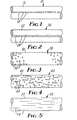
- FIG. 1 shows fiber 10 having continuous ceramic matrix phase 12 and a discontinuous phase 14 in the form of a "string" of pearls.
- FIG. 2 depicts fiber 20 having a continuous ceramic matrix phase 22 and a discontinuous phase 24 which is a string of beads and rod-like particles.
- FIG. 3 shows fiber 30 having a continuous ceramic phase 32 and dispersed therein a discontinuous phase 34 of randomly arranged beads and elongated particles.
- FIG. 4 shows fiber 40 having continuous ceramic matrix phase 42 and dispersed therein a discontinuous phase 44 of randomly arranged elongated ovoid and rod-like particles.
- FIG. 5 shows fiber 50 having continuous ceramic matrix phase 52 and discontinuous phase of fibrils 54.
- the multicomponent ceramic fibers of the present invention comprise a continuous ceramic matrix first phase and at least one in situ-generated discontinuous second phase, the second phase having a diameter of at least 1 micrometer.
- the discontinuous second phase is a metal such as Ni, Fe, Co, Cu, W, Mo, Cr, or combinations thereof, or a ceramic phase such as iron oxide, alumina, or zirconia.
- the second phase can be present in an amount in the range of 0.05 to 50 weight percent.
- the second phase is fibers, it preferably is present in an amount in the range of 0.05 to 10 weight percent, more preferably 0.05 to 3 weight percent.
- the fiber which has a heterogeneous composition and structure is prepared from a spinning sol which is a system comprising at least two immiscible liquid precursor compositions. Prior to spinning, the two compositions are blended together so that one is an emulsion in the other. After spinning, the second phase can have varying shapes, e.g., beads, rods, fibrils, fibers, or anything in between, such as tear-drop shape, etc.
- the viscosity or rheology of the second phase should be similar to that of the matrix phase in the precursor form.
- the second phase to be in the shape of droplets or beads, dissimilar viscosity or rheological properties of the two phases are preferred.
- the continuous ceramic matrix of the fiber can be any refractory ceramic fiber known in the art.
- Ceramic matrices of fibers can be made from precursor liquids for zirconia, silica, alumina, titania, chromia, and thoria, and the like, as individual sols, or in combination, for example, as aluminum borosilicate.
- the discontinuous metal phase can be derived from metal-containing organic precursors such as napthanates and octoates dissolved in hydrocarbon solvents such as mineral spirits as the carrier liquid.
- the spinning sol contains the emulsion droplets in highly concentrated form with metal organics as the droplets. Higher viscosity sols will form fibers (fibrils) whereas lower viscosity sols form spheres and tear drops.
- An alternate to the higher concentration of metal organics in the emulsion droplets is to add a low molecular weight hydrocarbon polymer (e.g., polybutadiene) to the metal solution to enhance the fiber-forming quality for fibers within a fiber.
- a low molecular weight hydrocarbon polymer e.g., polybutadiene
- the starting material used to prepare the refractory matrix fiber of this invention can be prepared by admixing an aqueous silica sol with an aqueous solution or dispersion of an aluminum compound and, where used, other oxide precursors, such as boron and phosphorus compounds, to obtain a uniform dispersion without formation of a gel.
- a compatible heat fugitive acid such as acetic or nitric acid
- Compatible heat fugitive organic agents can be incorported as adjuvants in the fiber starting material to improve shelf-life of the subsequently concentrated dispersion or to improve the fiberizing nature of the latter.
- Such organic agents representatively include polyvinylpyrrolidone, polyvinyl alcohol, lactic acid, glucose (e.g. corn syrup), and mixtures thereof, these additives being oxidized and removed during the firing of the green fibers produced from such systems.
- aqueous solutions or disperions which are used to make the refractory matrix fibers of this invention optionally can also contain various other water-miscible metal compounds (calcinable to metal oxide) or sols which will impart additional desired properties to the refractory fibers.
- an optional compound can be used to reduce weight loss, adjust refractive index or increase the modulus of elasticity.
- a ferric oxide-containing refractory can be reduced in a hydrogen atmosphere, the resulting reduced iron oxide or iron imparting a black color to the refractory and making it attractive to a magnet.
- the amount of such other optional metal oxide in the refractory matrix component can vary, depending upon the property effect desired, but generally will be an amount in the range of as low as 0.05 to 0.5 to as high as 10 weight percent, preferably as high as 3 weight percent, based on the total weight of the component in the refractory fiber.
- the larger amounts of optional metal oxide additive may cause the fibers to become friable or give rise to contamination problems when the fibers are used in a particular environment.
- the precursors of the other metal oxides should be other than chlorides if they are used in significant amounts since the combination of boric acid and high chloride levels (which can be determined empirically) in the starting material can result in frangible fibers.
- the matrix fiber precursor materials will be a relatively dilute liquid, generally containing about 10 to 30 weight percent equivalent oxide or carbide solids, which can be calculated from a knowledge of the equivalent solids in the raw materials and the amounts thereof used, or determined by calcining samples of the raw materials or fiber starting material.
- the concentration step can be carried out by techniques known in the art, e.g., see said U.S. Pat. No. 3,795,524.
- a spinning precursor composition can comprise an emulsion of immiscible aqueous or organic solutions, sols, or mixtures thereof, which are prepared as is known in the art; see for example, U.S. Patent Nos. 3,795,524 and 4,047,965.
- the precursor liquid composition is spun through the orifices of a spinnerette.
- the multicomponent fiber is spun from the dies, which can have a multiplicity of orifices, into a drying tower from which they are collected and fired.
- multicomponent fibers can be prepared by a method described in U.S. Patent No. 4,101,615 in which the green fibers are spun from fiberizable organic solutions, followed by hydrolysis, and subsequent calcination to the ceramic form.
- the concentrated viscous emulsion can be extruded through a plurality of orifices (e.g., 30 to 400) from a stationary head and the resulting green fibers allowed to fall in air by the force of gravity or drawn mechanically in air by means of drawing rolls or a drum or winding device at a speed faster than the rate of extrusion.
- a plurality of orifices e.g., 30 to 400
- the concentrate can also be extruded through orifices from a stationary or rotating head and blown by parallel, oblique or tangential streams of air, such as in the making of cotton candy, the resulting blown green fibers being in staple form or short form with lengths generally 25 cm or lens (rather than in long or continuous form) and collected on a screen or the like in the form of a mat.
- Any of these forces exerted on the extruded, green fibers e.g., gravity, drawing, or air streams, cause attenuation or stretching oi the fibers, reducing their diameter by about 50 to 90 percent or more and increasing their length by about 300 to 10,000 percent or more and serving to hasten or aid the drying of the green fibers.
- the dehydrative gelling of the green fibers can be carried out in ambient air, or heated air can be used if desirable or necessary to obtain fast drying.
- the drying rate assists in controlling of the shape of the fiber. It has been found that too rapid drying may cause distortion of the shape of the fiber.
- the relative humidity of such air should be controlled since large amounts of moisture will cause the gelled or shaped green fibers to stick together, and excessively dry atmosphere can lead to fiber breakage.
- air with relative humidity in the range of 20 to 60 percent can be used, at temperatures of 15° to 30°C, though such air can be heated subsequently to about 70°C or higher.
- the fibers or strand can be treated with a size to prevent the fibers from sticking together.
- the fibers in their green or unfired gel form generally comprise about 25 to 60 weight percent equivalent oxide or carbide solids (as determined by calcining a sample) and are dry in the sense that they do not adhere or stick to one another or other substrates and feel dry to the touch. But the "dry” fibers still contain substantial amounts of water and organic material, e.g., 40 to 75 weight percent, and it is necessary to calcine or fire the green fibers in order to remove further water and organic material and convert the fibers into refractory fibers.
- the term "dehydrative gelling" (or “evaporative gelling”), as used herein, therefore does not mean that all the water in the green fibers is removed. Thus, in a sense, this step can be called partial dehydrative gelling.
- the green fibers are relatively strong enough for further processing and can be collected and fired without significant breakage.
- a furnace or kiln preferably an electric resistance furnace
- this heating being carried out usually in air or other oxidizing atmosphere at temperatures below the fusion or melting point of the ceramic mixture and usually at about 800°C, or higher if desired, e.g., to 1400°C.
- Calcination can be accomplished in a number of ways, for example by heating in a single step from a low or room temperature to a desired elevated temperature (e.g., from room temperture to 1000°C in 20-60 minutes or more) or by heating in a series of steps at progressively higher temperatures, with or without cooling or storage between steps.
- the second phase When the second phase is added to the precursor mix as a metal sol, it may be desirable to fire or calcine in an inert or reducing atmosphere without prior firing in an oxidizing atmosphere. It may be desirable to fire this resultant cermet fiber in air to oxidize to an oxide fiber.
- the green fibers can be calcined in a batch or continuous manner in an oriented form, such as strands or continous yarn (a plurality of untwisted or slightly twisted parallel-aligned, virtually endless, continuous fibers) or hanks (continuous fibers or strands in coiled form), or tows (group of continuous fibers without definite twist and collected in loose form) or calcined in an irregular or random order, such as a mat of intermeshed, mechanically interlocked or tangled fibers, or calcined in the form of staple fiber.
- an oriented form such as strands or continous yarn (a plurality of untwisted or slightly twisted parallel-aligned, virtually endless, continuous fibers) or hanks (continuous fibers or strands in coiled form), or tows (group of continuous fibers without definite twist and collected in loose form) or calcined in an irregular or random order, such as a mat of intermeshed, mechanically interlocked or tangled fibers
- the green fibers In firing the green fibers, care should be exercised to avoid ignition of combustible material in or evolved from the fibers, for example, by controlling the firing atmosphere or by starting out at a low temperature, e.g., room temperature, and then elevating the temperature at a slow rate, since such ignition may cause the formation of opaque, fragile fibers. If the green fibers are not to be fired completely in one operation or are not to be fired immediately or soon after their formation, it may be desirable or necessary to store the green fibers in a relatively dry or protective atmosphere to prevent them from picking up moisture or contaminants and deteriorating or sticking together.
- a low temperature e.g., room temperature
- the green fibers in their continuous form are preferably gathered or collected in the form of a strand, the strand then accumulated in a relaxed, loose, unrestrained configuration of offset or superimposed loops (as in a "figure 8") on a substrate and calcined in that configuration.
- the strand is thereafter pulled in a straight or linear form through a furnace at higher temperature, to produce refractory strands, a plurality of which can be formed into continuous yarn. This procedure is described in said U.S. Patent 3,760,049.
- green fibers Rather than firing the green fibers at ambient conditions to remove water and organic material, they can be heated in an autoclave in an inert atmosphere, e.g., 6.9 x l0 5 to 138 x 10 5 Pa (100-2000 psi) helium, argon, or nitrogen, for example, at 300 to 500°C, in order to form porous refractory fibers. Then, they can be refired in air to remove residual carbon, e.g., at 500 to 900°C, and converted into a refractory ceramic oxide essentially free of carbon. It may be desirable to further fire this porous oxide fiber in a reducing atmosphere which then results in a porous cermet fiber.
- an inert atmosphere e.g., 6.9 x l0 5 to 138 x 10 5 Pa (100-2000 psi) helium, argon, or nitrogen, for example, at 300 to 500°C, in order to form porous refractory fibers.
- the calcining step when done in air volatilizes the balance of the water, decomposes and volatilizes organic material, and burns off carbon, the resultant refractory being an essentially carbon-free ceramic refractory.
- This calcining heating step also causes some shrinkage which is generally about 50 percent of its volume or more (linear shrinkage generally being less than 25 percent).
- the shape of the fibers during firing remains essentially the same as the unfired fibers and of essentially continuous length. Carbon can be retained by firing in an inert atmosphere.
- the refractory material resulting from firing the green fibers at about 900° to 1000° generally comprises crystalline material discernible by x-ray powder diffraction.
- the continuous ceramic matrix component has at least one microcrystalline phase or can be amorphous and convertible to at least one microcrystalline phase on further firing.
- the matrix component fibers of this invention may also be polycrystalline and contain amorphous species.
- the fibers of this invention which have diameters in the range of 1 to 50 micrometers, preferably 5 to 15 micrometers, have properties which enable their use in many environments. These fibers may be exposed to high temperatures (e.g., for prolonged periods at temperatures up to 1150°C and for short periods for temperatures up to at least 1400°C) and may remain strong, flexible and continuous.
- the multicomponent fibers may be subjected to ordinary textile processing to produce multifilament textile structures (e.g., rovings, cords, yarns, etc.) and can be worked into non-woven, woven and knitted fabrics by conventional techniques as either staple or continuous fibers.
- the fired fibers are continuous, uniformly round or oval, rbid-like, or ribbon-like, strong, flexible, smooth, glossy, refractory, polycrystalline or amorphous.
- the fibers are useful in making refractory textile fabric or as fillers or reinforcement for plastic composites.
- Multicomponent fibers are highly desirable for many uses because they may be magnetic, absorb electromagnetic radiation, or can be used as catalysts or supports, or filler or pigments. These properties and others result from the different physical properties of the components in the multiphase fiber.
- the fibers are particularly useful for high temperture insulation, as catalyst supports, as an open substrate to be infiltrated by resins, glasses or metals, or mixed with ceramics in a composite.
- the discontinuous phase contains metal oxide
- firing the fibers in a reducing atmosphere such as hydrogen may provide a fiber with magnetic properties or which is attractive to a magnet.
- a basic alumina-boria-silica 3:1:2 (ABS 3-1-2) sol having a molecular equivalent oxide ratio of 3Al 2 O 3 :1B 2 O 3 :2SiO 2 was prepared as follows:
- the extruded fibers were collected on a round paper container about 1 meter below the spinnerette and were dried by infra-red lamps as they passed between the spinnerette and the collector. These fibers were fired in air from room temperature to 850°C over two hours time. After heat treatment for 1/2 hour, the fibers were withdrawn from the furnace and examined under an optical microscope. Dark brown fibrils about 3 to 6 micrometers long and 1 to 6 micrometers in diameter, oriented in a lengthwise direction, were observed to be within the fibers. Most of the iron oxide material was in a fibril form but in several cases strings of spherical particles or continuous lines of connected spheroidal shapes were present. The resulted fibers were not attracted to a magnet.
- a Ti0 2 sol was prepared according to the teaching of U.S. Patent 4,166,147.
- TPT tetraisopropyltitanate
- 560 g. was added slowly to 100 g. concentrated HC1 (37%) with continuous cooling with tap water to control reaction rate.
- the resulting yellowish sol was dried in air at room temperature to a gel containing approx. 62% by wt. Ti0 2 .
- about 50 g of the dry gel was dissolved in 200 mL deionized water.
- the clear sol obtained was filtered through a no. 54 Whatman filter paper.
- the filtered sol, with a pH less that 1.0 was then partially concentrated, using a Rotovapor flask, to a viscosity of about 50,000 cps.
- Fibers were prepared in the same manner as Example 3, except that 0.6 g of cobalt naphthenate solution having an equivalent metal content of 6% cobalt was used.
- the extruded fibers were fired in air from room temperature to 900°C and cooled to room temperature over two hours. The fibers were removed from the furnace and observed under an optical microscope. Within the fibers a second dark blue cobalt oxide phase was present as a string of spherical particles and fibrils, oriented in a lengthwise direction.
Landscapes
- Chemical & Material Sciences (AREA)
- Engineering & Computer Science (AREA)
- Ceramic Engineering (AREA)
- Manufacturing & Machinery (AREA)
- Chemical Kinetics & Catalysis (AREA)
- Materials Engineering (AREA)
- Organic Chemistry (AREA)
- General Chemical & Material Sciences (AREA)
- Structural Engineering (AREA)
- Inorganic Chemistry (AREA)
- Textile Engineering (AREA)
- Life Sciences & Earth Sciences (AREA)
- General Life Sciences & Earth Sciences (AREA)
- Geochemistry & Mineralogy (AREA)
- Inorganic Fibers (AREA)
- Compositions Of Oxide Ceramics (AREA)
- Artificial Filaments (AREA)
Applications Claiming Priority (2)
| Application Number | Priority Date | Filing Date | Title |
|---|---|---|---|
| US830651 | 1986-02-18 | ||
| US06/830,651 US4797378A (en) | 1986-02-18 | 1986-02-18 | Internally modified ceramic fiber |
Publications (2)
| Publication Number | Publication Date |
|---|---|
| EP0233776A1 true EP0233776A1 (fr) | 1987-08-26 |
| EP0233776B1 EP0233776B1 (fr) | 1990-10-24 |
Family
ID=25257400
Family Applications (1)
| Application Number | Title | Priority Date | Filing Date |
|---|---|---|---|
| EP19870301350 Expired - Lifetime EP0233776B1 (fr) | 1986-02-18 | 1987-02-17 | Fibre céramique modifiée à l'intérieur |
Country Status (7)
| Country | Link |
|---|---|
| US (1) | US4797378A (fr) |
| EP (1) | EP0233776B1 (fr) |
| JP (1) | JPS62199818A (fr) |
| KR (1) | KR870007861A (fr) |
| AU (1) | AU586912B2 (fr) |
| CA (1) | CA1290115C (fr) |
| DE (1) | DE3765653D1 (fr) |
Cited By (2)
| Publication number | Priority date | Publication date | Assignee | Title |
|---|---|---|---|---|
| EP2995374A1 (fr) * | 2014-09-10 | 2016-03-16 | Regional Centre of Advanced Technologies and Materials, Palacky University in Olomouc | Materiau composite comprenant des fibres organique et des nanoparticule de fer zero-valent et son utilisation comme catalyseur |
| EP2119500B1 (fr) * | 2007-03-14 | 2016-11-30 | Nissan Motor Co., Ltd. | Structure fibreuse |
Families Citing this family (69)
| Publication number | Priority date | Publication date | Assignee | Title |
|---|---|---|---|---|
| US5041321A (en) * | 1984-11-02 | 1991-08-20 | The Boeing Company | Fiberformed ceramic insulation and method |
| US5589441A (en) * | 1984-11-02 | 1996-12-31 | The Boeing Company | Superconductive fiberform ceramic composite |
| US5398840A (en) * | 1984-11-02 | 1995-03-21 | The Boeing Company | Microparticle enhanced fibrous ceramic baffle for cryogenic liquid containers |
| US5166130A (en) * | 1987-07-03 | 1992-11-24 | Ibiden Co. Ltd. | Superconductive ceramic molded product and a production process thereof |
| US4937212A (en) * | 1988-12-19 | 1990-06-26 | Minnesota Mining And Manufacturing Company | Zirconium oxide fibers and process for their preparation |
| IT1230731B (it) * | 1989-02-17 | 1991-10-29 | Snia Fibre | Fibre ceramiche a base di zro2 e sio2 e procedimento per la loro preparazione. |
| US5888393A (en) * | 1989-07-18 | 1999-03-30 | The Boeing Company | Microparticle enhanced fibrous ceramic baffle for cryogenic liquid containers |
| US5783139A (en) * | 1990-04-18 | 1998-07-21 | Curran; Dennis John Gerard | Ceramic materials |
| GB9122997D0 (en) * | 1991-10-30 | 1991-12-18 | Curran Dennis J G | Ceramic fibres |
| US5240495A (en) * | 1992-04-02 | 1993-08-31 | Cornell Research Foundation, Inc. | In situ formation of metal-ceramic oxide microstructures |
| DE69410050T2 (de) * | 1993-10-13 | 1998-11-12 | Mitsubishi Chem Corp | Geschnittene Stränge aus Kohlenstoffasern und damit verstärkte hydraulische Verbundmaterialien |
| US6043172A (en) | 1998-01-14 | 2000-03-28 | Global Consulting, Inc. | Ceramic fiber insulation material |
| US6080216A (en) | 1998-04-22 | 2000-06-27 | 3M Innovative Properties Company | Layered alumina-based abrasive grit, abrasive products, and methods |
| US6228134B1 (en) | 1998-04-22 | 2001-05-08 | 3M Innovative Properties Company | Extruded alumina-based abrasive grit, abrasive products, and methods |
| US7456571B1 (en) | 2002-05-21 | 2008-11-25 | Imaging Systems Technology | Microsphere plasma display |
| US7923930B1 (en) | 2000-01-12 | 2011-04-12 | Imaging Systems Technology | Plasma-shell device |
| EP1320635A2 (fr) * | 2000-09-28 | 2003-06-25 | 3M Innovative Properties Company | Preformes d'oxyde ceramique, composites a matrices metalliques, et leurs procedes de fabrication |
| US7405516B1 (en) | 2004-04-26 | 2008-07-29 | Imaging Systems Technology | Plasma-shell PDP with organic luminescent substance |
| US8513887B1 (en) | 2002-05-21 | 2013-08-20 | Imaging Systems Technology, Inc. | Plasma-dome article of manufacture |
| US7638943B1 (en) | 2002-05-21 | 2009-12-29 | Imaging Systems Technology | Plasma-disc article of manufacture |
| US8198811B1 (en) | 2002-05-21 | 2012-06-12 | Imaging Systems Technology | Plasma-Disc PDP |
| US7628666B1 (en) | 2002-05-21 | 2009-12-08 | Imaging Systems Technology | Process for manufacturing plasma-dome PDP |
| US7932674B1 (en) | 2002-05-21 | 2011-04-26 | Imaging Systems Technology | Plasma-dome article of manufacture |
| US8198812B1 (en) | 2002-05-21 | 2012-06-12 | Imaging Systems Technology | Gas filled detector shell with dipole antenna |
| US8138673B1 (en) | 2002-05-21 | 2012-03-20 | Imaging Systems Technology | Radiation shielding |
| US7727040B1 (en) | 2002-05-21 | 2010-06-01 | Imaging Systems Technology | Process for manufacturing plasma-disc PDP |
| US7772773B1 (en) | 2003-11-13 | 2010-08-10 | Imaging Systems Technology | Electrode configurations for plasma-dome PDP |
| US8129906B1 (en) | 2004-04-26 | 2012-03-06 | Imaging Systems Technology, Inc. | Lumino-shells |
| US8106586B1 (en) | 2004-04-26 | 2012-01-31 | Imaging Systems Technology, Inc. | Plasma discharge display with fluorescent conversion material |
| US8339041B1 (en) | 2004-04-26 | 2012-12-25 | Imaging Systems Technology, Inc. | Plasma-shell gas discharge device with combined organic and inorganic luminescent substances |
| US8113898B1 (en) | 2004-06-21 | 2012-02-14 | Imaging Systems Technology, Inc. | Gas discharge device with electrical conductive bonding material |
| US7604523B1 (en) | 2004-06-21 | 2009-10-20 | Imaging Systems Technology | Plasma-shell PDP |
| US8368303B1 (en) | 2004-06-21 | 2013-02-05 | Imaging Systems Technology, Inc. | Gas discharge device with electrical conductive bonding material |
| US7332101B2 (en) * | 2004-06-25 | 2008-02-19 | Massachusetts Institute Of Technology | Permanently linked, rigid, magnetic chains |
| US8951608B1 (en) | 2004-10-22 | 2015-02-10 | Imaging Systems Technology, Inc. | Aqueous manufacturing process and article |
| US8299696B1 (en) | 2005-02-22 | 2012-10-30 | Imaging Systems Technology | Plasma-shell gas discharge device |
| US7622866B1 (en) | 2005-02-22 | 2009-11-24 | Imaging Systems Technology | Plasma-dome PDP |
| US7730746B1 (en) | 2005-07-14 | 2010-06-08 | Imaging Systems Technology | Apparatus to prepare discrete hollow microsphere droplets |
| KR20070074344A (ko) * | 2006-01-09 | 2007-07-12 | 삼성전자주식회사 | 박막 트랜지스터 기판과 그 제조 방법 및 이를 포함한 액정표시 장치 |
| US8618733B1 (en) | 2006-01-26 | 2013-12-31 | Imaging Systems Technology, Inc. | Electrode configurations for plasma-shell gas discharge device |
| US7863815B1 (en) | 2006-01-26 | 2011-01-04 | Imaging Systems Technology | Electrode configurations for plasma-disc PDP |
| US8410695B1 (en) | 2006-02-16 | 2013-04-02 | Imaging Systems Technology | Gas discharge device incorporating gas-filled plasma-shell and method of manufacturing thereof |
| US8035303B1 (en) | 2006-02-16 | 2011-10-11 | Imaging Systems Technology | Electrode configurations for gas discharge device |
| US8278824B1 (en) | 2006-02-16 | 2012-10-02 | Imaging Systems Technology, Inc. | Gas discharge electrode configurations |
| US7535175B1 (en) | 2006-02-16 | 2009-05-19 | Imaging Systems Technology | Electrode configurations for plasma-dome PDP |
| US7791037B1 (en) | 2006-03-16 | 2010-09-07 | Imaging Systems Technology | Plasma-tube radiation detector |
| KR100869946B1 (ko) | 2006-04-06 | 2008-11-24 | 삼성전자주식회사 | 컨텐츠 관리 서버 및 그의 컨텐츠 관리방법 |
| CN101631810B (zh) * | 2006-12-29 | 2013-07-24 | 江森自控科技公司 | 聚氨酯泡沫组成、产品及方法 |
| US20120189846A1 (en) * | 2007-01-03 | 2012-07-26 | Lockheed Martin Corporation | Cnt-infused ceramic fiber materials and process therefor |
| US8951631B2 (en) | 2007-01-03 | 2015-02-10 | Applied Nanostructured Solutions, Llc | CNT-infused metal fiber materials and process therefor |
| US20100279569A1 (en) * | 2007-01-03 | 2010-11-04 | Lockheed Martin Corporation | Cnt-infused glass fiber materials and process therefor |
| US9005755B2 (en) | 2007-01-03 | 2015-04-14 | Applied Nanostructured Solutions, Llc | CNS-infused carbon nanomaterials and process therefor |
| US8951632B2 (en) | 2007-01-03 | 2015-02-10 | Applied Nanostructured Solutions, Llc | CNT-infused carbon fiber materials and process therefor |
| US7910514B2 (en) * | 2007-08-09 | 2011-03-22 | Nissan Motor Co., Ltd. | Inorganic fiber catalyst, production method thereof and catalyst structure |
| CN102333906B (zh) * | 2009-02-27 | 2015-03-11 | 应用纳米结构方案公司 | 使用气体预热法的低温cnt生长 |
| US20100227134A1 (en) * | 2009-03-03 | 2010-09-09 | Lockheed Martin Corporation | Method for the prevention of nanoparticle agglomeration at high temperatures |
| CA2756852A1 (fr) * | 2009-04-10 | 2010-10-14 | Applied Nanostructured Solutions, Llc | Appareil et procede de production de nanotubes de carbone sur un substrat avancant en continu |
| US20100272891A1 (en) * | 2009-04-10 | 2010-10-28 | Lockheed Martin Corporation | Apparatus and method for the production of carbon nanotubes on a continuously moving substrate |
| KR20120002980A (ko) * | 2009-04-10 | 2012-01-09 | 어플라이드 나노스트럭처드 솔루션스, 엘엘씨. | 탄소 나노튜브를 섬유에 주입하기 위한 수직로의 사용 방법 및 장치 |
| US20100260998A1 (en) * | 2009-04-10 | 2010-10-14 | Lockheed Martin Corporation | Fiber sizing comprising nanoparticles |
| US20100279010A1 (en) * | 2009-04-30 | 2010-11-04 | Lockheed Martin Corporation | Method and system for close proximity catalysis for carbon nanotube synthesis |
| US9013102B1 (en) | 2009-05-23 | 2015-04-21 | Imaging Systems Technology, Inc. | Radiation detector with tiled substrates |
| WO2011017200A1 (fr) * | 2009-08-03 | 2011-02-10 | Lockheed Martin Corporation | Incorporation de nanoparticules dans des fibres composites |
| US8815408B1 (en) | 2009-12-08 | 2014-08-26 | Imaging Systems Technology, Inc. | Metal syntactic foam |
| BR112013005802A2 (pt) | 2010-09-14 | 2016-05-10 | Applied Nanostructured Sols | substratos de vidro com nanotubos de carbono crescidos sobre os mesmos e métodos para sua produção |
| AU2011305809A1 (en) | 2010-09-22 | 2013-02-28 | Applied Nanostructured Solutions, Llc | Carbon fiber substrates having carbon nanotubes grown thereon and processes for production thereof |
| US9688052B1 (en) | 2013-03-12 | 2017-06-27 | The United States Of America As Represented By The Adminstrator Of The National Aeronautics And Space Administration | Thermal protection supplement for reducing interface thermal mismatch |
| JP6764654B2 (ja) * | 2016-01-18 | 2020-10-07 | 大明化学工業株式会社 | 金属粒子担持繊維および金属粒子担持繊維の製造方法 |
| US11274065B2 (en) | 2018-06-13 | 2022-03-15 | Fuelcell Energy, Inc. | Ceramic felt material for high-temperature fuel cells |
Citations (3)
| Publication number | Priority date | Publication date | Assignee | Title |
|---|---|---|---|---|
| DE2233037A1 (de) * | 1971-07-05 | 1973-01-11 | Ici Ltd | Metalloxidfasern |
| GB1403863A (en) * | 1971-07-23 | 1975-08-28 | Atomic Energy Authority Uk | Metal powder suspensions |
| EP0171289A2 (fr) * | 1984-08-08 | 1986-02-12 | Minnesota Mining And Manufacturing Company | Corps céramiques ayant un noyau non-poreux et une couche extérieure poreuse |
Family Cites Families (13)
| Publication number | Priority date | Publication date | Assignee | Title |
|---|---|---|---|---|
| BE423831A (fr) * | 1936-09-30 | |||
| US2968622A (en) * | 1958-12-30 | 1961-01-17 | Owens Corning Fiberglass Corp | Magnetic ceramic fibers and method of making same |
| US3385915A (en) * | 1966-09-02 | 1968-05-28 | Union Carbide Corp | Process for producing metal oxide fibers, textiles and shapes |
| US3663182A (en) * | 1968-03-29 | 1972-05-16 | Union Carbide Corp | Metal oxide fabrics |
| US3632709A (en) * | 1968-12-27 | 1972-01-04 | Universal Oil Prod Co | Making alumina fibers from a mixture of alumina sol and hexamethylenetetramine |
| GB1287288A (en) * | 1968-12-27 | 1972-08-31 | Universal Oil Prod Co | Refractory inorganic oxide fibers |
| US3709706A (en) * | 1969-05-16 | 1973-01-09 | Minnesota Mining & Mfg | Refractory fibers and other articles of zirconia and silica mixtures |
| CA1097469A (fr) * | 1969-10-17 | 1981-03-17 | Gerhard Winter | Obtention de fibres inorganiques |
| US3795524A (en) * | 1971-03-01 | 1974-03-05 | Minnesota Mining & Mfg | Aluminum borate and aluminum borosilicate articles |
| GB1455563A (en) * | 1972-11-29 | 1976-11-17 | Ici Ltd | Fibrous mater-als |
| US4101615A (en) * | 1973-02-20 | 1978-07-18 | Sumitomo Chemical Company, Limited | Process for producing alumina fiber or alumina-silica fiber |
| US4166147A (en) * | 1973-04-16 | 1979-08-28 | Minnesota Mining And Manufacturing Company | Shaped and fired articles of tio2 |
| US4047965A (en) * | 1976-05-04 | 1977-09-13 | Minnesota Mining And Manufacturing Company | Non-frangible alumina-silica fibers |
-
1986
- 1986-02-18 US US06/830,651 patent/US4797378A/en not_active Expired - Fee Related
-
1987
- 1987-02-02 CA CA 528716 patent/CA1290115C/fr not_active Expired - Lifetime
- 1987-02-04 AU AU68505/87A patent/AU586912B2/en not_active Ceased
- 1987-02-17 KR KR870001281A patent/KR870007861A/ko not_active Withdrawn
- 1987-02-17 JP JP62032584A patent/JPS62199818A/ja active Pending
- 1987-02-17 EP EP19870301350 patent/EP0233776B1/fr not_active Expired - Lifetime
- 1987-02-17 DE DE8787301350T patent/DE3765653D1/de not_active Expired - Lifetime
Patent Citations (3)
| Publication number | Priority date | Publication date | Assignee | Title |
|---|---|---|---|---|
| DE2233037A1 (de) * | 1971-07-05 | 1973-01-11 | Ici Ltd | Metalloxidfasern |
| GB1403863A (en) * | 1971-07-23 | 1975-08-28 | Atomic Energy Authority Uk | Metal powder suspensions |
| EP0171289A2 (fr) * | 1984-08-08 | 1986-02-12 | Minnesota Mining And Manufacturing Company | Corps céramiques ayant un noyau non-poreux et une couche extérieure poreuse |
Non-Patent Citations (1)
| Title |
|---|
| DERWENT ACCESSION No. 77-80 102y, Questel Telesystemes (WPI) DERWENT PUBLICATIONS LTD., London & JP-A-52 114 727 (AGENCY OF IND. SCI. TECH.) * |
Cited By (2)
| Publication number | Priority date | Publication date | Assignee | Title |
|---|---|---|---|---|
| EP2119500B1 (fr) * | 2007-03-14 | 2016-11-30 | Nissan Motor Co., Ltd. | Structure fibreuse |
| EP2995374A1 (fr) * | 2014-09-10 | 2016-03-16 | Regional Centre of Advanced Technologies and Materials, Palacky University in Olomouc | Materiau composite comprenant des fibres organique et des nanoparticule de fer zero-valent et son utilisation comme catalyseur |
Also Published As
| Publication number | Publication date |
|---|---|
| DE3765653D1 (de) | 1990-11-29 |
| KR870007861A (ko) | 1987-09-22 |
| AU6850587A (en) | 1987-08-20 |
| EP0233776B1 (fr) | 1990-10-24 |
| JPS62199818A (ja) | 1987-09-03 |
| US4797378A (en) | 1989-01-10 |
| AU586912B2 (en) | 1989-07-27 |
| CA1290115C (fr) | 1991-10-08 |
Similar Documents
| Publication | Publication Date | Title |
|---|---|---|
| US4797378A (en) | Internally modified ceramic fiber | |
| US5017316A (en) | Internally modified ceramic fiber | |
| EP0228839B1 (fr) | Fibres biconstituantes en céramique | |
| US4166147A (en) | Shaped and fired articles of tio2 | |
| US3709706A (en) | Refractory fibers and other articles of zirconia and silica mixtures | |
| CA1046537A (fr) | Fibres refractaires d'oxyde d'alumine-chrome-metal (iv) a phase microcristalline | |
| US4047965A (en) | Non-frangible alumina-silica fibers | |
| DE3685639T2 (de) | Feuerfeste cermetkoerper mit abgestufter zusammensetzung. | |
| US4800180A (en) | Ceramic articles containing silicon carbide | |
| US4752515A (en) | Alumina fiber structure | |
| US4883779A (en) | Ceramic articles containing silicon carbide | |
| US3795524A (en) | Aluminum borate and aluminum borosilicate articles | |
| US4824623A (en) | A method of making bicomponent green and ceramic fibers | |
| US4937212A (en) | Zirconium oxide fibers and process for their preparation | |
| NO172453B (no) | Fiberprodukt med i det vesentlige ensrettede uorganiske oksydfibre, samt fremgangsmaate for dets fremstilling | |
| JPS5924206B2 (ja) | 成形焼成したトリア−シリカ−アルミナ−ボリアの連続繊維 | |
| CN110117841B (zh) | 一种电纺双相前驱体制备莫来石纳米纤维的方法 | |
| US4929578A (en) | Refractory fibers of alumina and organic residue | |
| US4801562A (en) | Refractory fibers of alumina and amorphous phosphorus pentoxide | |
| EP0368370B1 (fr) | Fibres réfractaires d'alumine amorphe et résidu organique | |
| CN114773070B (zh) | 一种以羧酸铝溶胶为前驱体的氧化铝连续纤维的制备方法 | |
| KR960005961B1 (ko) | 폴리에스터 섬유의 제조방법 | |
| JPH0637724B2 (ja) | 炭素繊維の製造方法 |
Legal Events
| Date | Code | Title | Description |
|---|---|---|---|
| PUAI | Public reference made under article 153(3) epc to a published international application that has entered the european phase |
Free format text: ORIGINAL CODE: 0009012 |
|
| AK | Designated contracting states |
Kind code of ref document: A1 Designated state(s): DE FR GB IT SE |
|
| 17P | Request for examination filed |
Effective date: 19880222 |
|
| 17Q | First examination report despatched |
Effective date: 19890206 |
|
| ITF | It: translation for a ep patent filed | ||
| GRAA | (expected) grant |
Free format text: ORIGINAL CODE: 0009210 |
|
| AK | Designated contracting states |
Kind code of ref document: B1 Designated state(s): DE FR GB IT SE |
|
| REF | Corresponds to: |
Ref document number: 3765653 Country of ref document: DE Date of ref document: 19901129 |
|
| ET | Fr: translation filed | ||
| PLBE | No opposition filed within time limit |
Free format text: ORIGINAL CODE: 0009261 |
|
| STAA | Information on the status of an ep patent application or granted ep patent |
Free format text: STATUS: NO OPPOSITION FILED WITHIN TIME LIMIT |
|
| 26N | No opposition filed | ||
| ITTA | It: last paid annual fee | ||
| PGFP | Annual fee paid to national office [announced via postgrant information from national office to epo] |
Ref country code: FR Payment date: 19930111 Year of fee payment: 7 |
|
| PGFP | Annual fee paid to national office [announced via postgrant information from national office to epo] |
Ref country code: DE Payment date: 19930112 Year of fee payment: 7 |
|
| PGFP | Annual fee paid to national office [announced via postgrant information from national office to epo] |
Ref country code: SE Payment date: 19930113 Year of fee payment: 7 |
|
| PGFP | Annual fee paid to national office [announced via postgrant information from national office to epo] |
Ref country code: GB Payment date: 19930129 Year of fee payment: 7 |
|
| PG25 | Lapsed in a contracting state [announced via postgrant information from national office to epo] |
Ref country code: GB Effective date: 19940217 |
|
| PG25 | Lapsed in a contracting state [announced via postgrant information from national office to epo] |
Ref country code: SE Effective date: 19940218 |
|
| GBPC | Gb: european patent ceased through non-payment of renewal fee |
Effective date: 19940217 |
|
| PG25 | Lapsed in a contracting state [announced via postgrant information from national office to epo] |
Ref country code: FR Effective date: 19941031 |
|
| PG25 | Lapsed in a contracting state [announced via postgrant information from national office to epo] |
Ref country code: DE Effective date: 19941101 |
|
| REG | Reference to a national code |
Ref country code: FR Ref legal event code: ST |
|
| EUG | Se: european patent has lapsed |
Ref document number: 87301350.2 Effective date: 19940910 |
|
| PG25 | Lapsed in a contracting state [announced via postgrant information from national office to epo] |
Ref country code: IT Free format text: LAPSE BECAUSE OF NON-PAYMENT OF DUE FEES Effective date: 20050217 |