EP2999329B1 - Lysophospholipide und alkyl-lysophospholipide gegen brutkrankheiten der honigbiene - Google Patents
Lysophospholipide und alkyl-lysophospholipide gegen brutkrankheiten der honigbiene Download PDFInfo
- Publication number
- EP2999329B1 EP2999329B1 EP14725994.9A EP14725994A EP2999329B1 EP 2999329 B1 EP2999329 B1 EP 2999329B1 EP 14725994 A EP14725994 A EP 14725994A EP 2999329 B1 EP2999329 B1 EP 2999329B1
- Authority
- EP
- European Patent Office
- Prior art keywords
- compound
- composition
- brood
- use according
- treatment
- Prior art date
- Legal status (The legal status is an assumption and is not a legal conclusion. Google has not performed a legal analysis and makes no representation as to the accuracy of the status listed.)
- Not-in-force
Links
Images

Classifications
-
- A—HUMAN NECESSITIES
- A61—MEDICAL OR VETERINARY SCIENCE; HYGIENE
- A61K—PREPARATIONS FOR MEDICAL, DENTAL OR TOILETRY PURPOSES
- A61K31/00—Medicinal preparations containing organic active ingredients
- A61K31/66—Phosphorus compounds
- A61K31/683—Diesters of a phosphorus acid with two hydroxy compounds, e.g. phosphatidylinositols
- A61K31/685—Diesters of a phosphorus acid with two hydroxy compounds, e.g. phosphatidylinositols one of the hydroxy compounds having nitrogen atoms, e.g. phosphatidylserine, lecithin
-
- A—HUMAN NECESSITIES
- A01—AGRICULTURE; FORESTRY; ANIMAL HUSBANDRY; HUNTING; TRAPPING; FISHING
- A01K—ANIMAL HUSBANDRY; AVICULTURE; APICULTURE; PISCICULTURE; FISHING; REARING OR BREEDING ANIMALS, NOT OTHERWISE PROVIDED FOR; NEW BREEDS OF ANIMALS
- A01K51/00—Appliances for treating beehives or parts thereof, e.g. for cleaning or disinfecting
-
- A—HUMAN NECESSITIES
- A23—FOODS OR FOODSTUFFS; TREATMENT THEREOF, NOT COVERED BY OTHER CLASSES
- A23K—FODDER
- A23K20/00—Accessory food factors for animal feeding-stuffs
- A23K20/10—Organic substances
- A23K20/158—Fatty acids; Fats; Products containing oils or fats
-
- A—HUMAN NECESSITIES
- A23—FOODS OR FOODSTUFFS; TREATMENT THEREOF, NOT COVERED BY OTHER CLASSES
- A23K—FODDER
- A23K50/00—Feeding-stuffs specially adapted for particular animals
- A23K50/90—Feeding-stuffs specially adapted for particular animals for insects, e.g. bees or silkworms
-
- A—HUMAN NECESSITIES
- A61—MEDICAL OR VETERINARY SCIENCE; HYGIENE
- A61K—PREPARATIONS FOR MEDICAL, DENTAL OR TOILETRY PURPOSES
- A61K31/00—Medicinal preparations containing organic active ingredients
- A61K31/66—Phosphorus compounds
- A61K31/683—Diesters of a phosphorus acid with two hydroxy compounds, e.g. phosphatidylinositols
-
- A—HUMAN NECESSITIES
- A61—MEDICAL OR VETERINARY SCIENCE; HYGIENE
- A61K—PREPARATIONS FOR MEDICAL, DENTAL OR TOILETRY PURPOSES
- A61K35/00—Medicinal preparations containing materials or reaction products thereof with undetermined constitution
- A61K35/56—Materials from animals other than mammals
- A61K35/63—Arthropods
- A61K35/64—Insects, e.g. bees, wasps or fleas
- A61K35/644—Beeswax; Propolis; Royal jelly; Honey
Definitions
- the present invention relates to the application of lysophospholipids and alkyl-lysophospholipids (ALP) in honeybee brood diseases.
- Insect pathogen defense mechanisms are commonly attributed to i) the presence of small molecule non-specific acting molecules such as lactic acid, ii) the action of antimicrobial peptides, e.g., apidaecins in honeybees or iii) to specifically induced immune responses that infer an immunological memory.
- antimicrobial peptides e.g., apidaecins in honeybees or iii) to specifically induced immune responses that infer an immunological memory.
- LAB intestinal probiotic lactic acid bacteria
- AZA American foulbrood
- Pl gram-positive sporulating bacterium Paenibacillus larvae
- ERIC I and ERIC II sporulating bacterium Paenibacillus larvae
- the spores of Pl germinate in the larvae's midgut, from where - after proliferation - they invade into the haemocoel [ Yue et al. 2008. Environm Microbiol 10:1612-1620 ]. Infected larvae die from septicaemia and turn into soft masses.
- the sporulation of Pl occurs in the dead remains of the larva when nutrients become scarce. As a consequence of a worker bee's hygienic behaviour, the residues of the larva are removed and spores are transferred to young larvae through nursing, which starts a cycle of reinfection that may end fatal for the bee colony. Tarr [ Tarr. 1937. Ann Appl Biol 24:377-384 ] demonstrated that vegetative stages of Pl are not infectious, however, the spores can remain infectious for long periods being the only infectious form of Pl . Due to its worldwide presence and its high infectiousness, American foulbrood poses a threat to honey production and pollination.
- EFB European foulbrood
- M. pl . Melissococcus plutonius
- This potentially lethal disease has an almost worldwide distribution, which outbreaks that are seasonally and often endemic. [ Forsgren, 2010. J of Invertebr Pathol 103:S5-S9 ].
- EFB leads to bee brood losses within a colony due to the killing of the larvae at an age of 4-5 days.
- the contagion of the larvae with M. pl. takes place through the ingestion of M. pl .-containing food.
- the bacterium multiplies in the honeybee's midgut and is excreted in the faeces during pupation.
- M. pl. grows under microaerophilic to anaerobic conditions and can be cultivated under an enriched carbon dioxide atmosphere.
- M. pl. is a close relative of the bacterium Enterococcus.
- An infection with M. pl. is often associated with other bacterial infections of the midgut of honeybees.
- Honeybee larvae are most susceptible to this bacterium at early larval stages but remain susceptible at any stage.
- Honeybee larval diet is usually protected from spoiling and is kept non-contagious by components which show strong antibacterial activity, e.g., through the presence of the potent antibacterial protein defensin 1 [ Ilyasov et al. 2012. J Apicultural Sci 56:115-124 ].
- WO 2007/027636 A2 describes treatment of conditions such as sepsis, septic shock, systemic inflammatory response syndromes and SIRS, caused by gram-positive bacteria by administration of compositions containing a phospholipid, a neutral lipid and a bile acid or a bile acid salt.
- WO 9926632 A1 discloses that phospholipids such as MPPA and DPPS show an antimicrobial effect against gram-negative and gram-positive bacteria, wherein the phospholipids may be combined with antibiotics, antimicrobials, antifungal, antiviral and antiprotozoal drugs for treatment of infectious diseases.
- Lysophosphatidylcholine was reported to have antimicrobial activity against gram-positive Bacillus subtilis through an autolytic mechanism.
- the antimicrobial activity depends on the carbon-chain length of the acyl moiety in the LPC molecule, being most effective with palmitoyl LPC [ Tsuchido. 1994. Appl Microbiol Biotechnol 41:106-109 ].
- the present invention refers to a compound selected from the group consisting of a lysophospholipid and an alkyl-lysophospholipid (ALP) for use in the treatment or prophylaxis of bee brood diseases caused by gram-positive bacteria according to claim 1.
- ALP alkyl-lysophospholipid
- a subsequent high resolution mass spectrometric analysis then revealed the presence of the 1- O -oleoyl- sn -glycero-3-phosphocholine as compound responsible for antibacterial activity against Pl and M. pl..
- Antibacterial concentrations of lysophosphatidylcholine could also be detected in larvae.
- the presence of lysophosphatidylcholine could also be demonstrated in the midguts of wasps and bumblebees, whose homogenate showed an inhibitory activity against Pl and M. pl. as well.
- lysophosphatidylcholine (LPC)-compound occurring in the honeybee midgut is responsible for the inhibitory activity against Pl and M. pl. was unexpected.
- LPC lysophosphatidylcholine
- lysophosphatidylcholines are well-examined multifunctional molecules that trigger various cellular and genetic mechanisms under physiological and pathological conditions. It must be emphasized that the homeostasis of LPC in tissue is of crucial importance. However, to date, little is known about phospholipid metabolism in insect midguts. Turunen and Kastari [ Turunen & Kastari. 1979. Comp Biochem Physiol 62A:933-937 ] report on the metabolic fate of phosphatidylcholine in the gut of larvae of Pieris brassicae.
- the compound according to the present invention is used in the treatment or prophylaxis of bee brood diseases caused by gram-positive bacteria.
- the disease is American foulbrood which is caused by Paenibacillus larvae ( Pl ).
- the disease is European foulbrood caused by Melissococcus plutonius ( M . pl ).
- lysophospholipid refers to naturally occurring lysophospholipids and synthetic lysophospholipids.
- the lysophospholipid preferably comprises a glycerol backbone to which a polar group (e.g. a phosphocholine group) is bound, a free hydroxy group in position 2 of the glycerol backbone and a saturated or unsaturated fatty acid residue attached to the glycerol backbone.
- the fatty acid residue of the lysophospholipid has a C n -alkyl chain or a C n -alkenyl chain, wherein n>4.
- the lysophospholipid comprises an oxidized fatty acid residue.
- lysophospholipid analogue refers to compounds such as hexadecylphosphocholine (miltefosine) and 1,1-dimethylpiperidinium-4-yl octadecyl phosphate (perifosine) which are structural analogues of alkyl-lysophospholipids.
- the alkyl residue of the alkyl-lysophospholipid has a C n -alkyl chain or a C n -alkenyl chain, wherein n>4.
- the lysophospholipid is a lysophosphatidylcholine (LPC).
- the lysophosphatidylcholine comprises a saturated or an unsaturated C 5 -C 23 fatty acid chain, wherein C 4 -C 24 means that the number (n) of carbon atoms (chain length) is between 3 ⁇ n ⁇ 25.
- the C 4 -C 24 fatty acid chain is attached to position 1 of the glycerol backbone and a free hydroxyl group is at position 2 of the glycerol backbone.
- the lysophosphatidylcholine is selected from the group consisting of 1- O -oleoyl- sn -glycero-3-phosphocholine and 1- O -stearoyl- sn -glycero-3-phosphocholine for which the inventors demonstrated a good in vitro Pl inhibitory activity (see examples below).
- the natural carbohydrate source of adult honeybees is nectar or honeydew collected in the wild. Inside the hive, the water content of these liquids is reduced to 16-20%, and enzymes (invertase, diastase and glucose oxidase) are added. The final content comprises c. 38% fructose, 31% glucose and other di- or trisaccharides.
- adult bees collect pollen, which is processed by fermentation to bee bread with a protein content of c. 2.5-61 %.
- a workerbee consumes up to 3.4-4.3 mg pollen/day.
- Lipids, vitamins and minerals are essential and are exclusively obtained from pollen.
- Larvae are fed with high-quality food secreted from hypopharyngeal glands of nurse bees and traces of nectar and pollen. Therefore, a direct transfer of LPC via nurse bees is questionable.
- an amount of c. 25-35.5 mg protein is needed for the complete larval development.
- Brood food also contains sugars, about 18% (day 1-3) and up to 45% (day 4-5) [Review: Brodschneider & Crailsheim. 2010 Apidologie 41:278-294 ].
- the lysophosphatidylcholine is 1- O -oleoyl- sn -glycero-3-phosphocholine (herein also referred to as oleoyl-LPC) which is the primary lysophospholipid naturally occurring in the midguts of older larvae and adult honeybees. Thus, any adverse effects during treatment are very unlikely.
- Lysophosphatidylcholines with other fatty acid residues than oleic acid are present in bee midguts as well, but only to an extent of less than 10% of the 1- O -oleoyl- sn -glycero-3-phosphocholine content.
- the compound is an alkyl-lysophospholipid (ALP) such as hexadecylphosphocholine (miltefosine) and 1,1-dimethylpiperidinium-4-yl octadecyl phosphate (perifosine).
- ALP alkyl-lysophospholipid
- the compound is hexadecylphosphocholine (miltefosine) or 1,1-dimethylpiperidinium-4-yl octadecyl phosphate (perifosine).
- These compounds also showed a good in vitro Pl and M. pl. inhibitory activity (see below Example 1, Tables 1.1 and 1.2), but are not susceptible to hydrolysis in contrast to, e.g., 1- O -oleoyl- sn -glycero-3-phosphocholine.
- Miltefosine and perifosine are structural analogues of alkyllysophospholipids. Miltefosine is a drug orally used to treat visceral leishmaniasis [ Sindermann et al. 2004. Med Microbiol Immunol 193:173-190 ].
- the compound according to the invention is preferably administered to a honeybee colony in an amount effective to kill the vegetative stage of Paenibacillus larvae and/or to kill vegetative forms of Pl that result from germination of spores.
- the dosage may be any appropriate therapeutically effective and safe dosage, e.g., an active lysophospholipid-concentration of about 0.01-0.05% in a diet composition for the honeybee colony.
- the diet composition is preferably fed to worker honeybees.
- the compound according to the invention is preferably administered to a honeybee colony in an amount effective to kill Melissococcus plutonius.
- the dosage may be any appropriate therapeutically effective and safe dosage, e.g., an active lysophospholipid-concentration of about 0.01-0.05% in a diet composition for the honeybee colony.
- the diet composition is preferably fed to worker honeybees.
- honeybee colony refers to all types of bees present in a bee colony, including e.g. worker honeybees and honeybee larvae.
- the honeybee colony is an aggregation of honeybees with or without queen and with or without brood.
- honeybee colony also refers to a honeybee swarm.
- honeybee colony also encompasses package bees and artificial swarms.
- compositions for use in the treatment or prophylaxis of bee brood diseases caused by gram-positive bacteria wherein the composition comprises a compound as defined above and wherein the composition is administered to a honeybee colony.
- the composition may comprise one compound selected from the group consisting of a lysophospholipid and a lysophospholipid analogue.
- the composition may comprise a mixture of two or more of these compounds.
- the composition is a diet composition or a food additive added to a diet composition for honeybees.
- the compound is an active ingredient in the diet composition fed to the honeybee colony to reduce the overall PI or M. pl. load in a colony and to facilitate a transport of the compound in small amounts into larval food.
- the compound is preferably added in a concentration of about 0.01-0.1%, more preferably about 0.01-0.05%, to any food that could be used to feed bees.
- Food for honey bees is well known in the art and includes e.g.
- the composition is a diet composition for larvae of honeybees (direct contact treatment).
- the composition is a diet composition for nurse bees of honeybees, wherein the composition is fed to honeybee larvae (treatment by feeding, also referred to as trophallaxis).
- the diet composition comprises the compound according to the invention in a concentration of about 0.01-0.1%, preferably in a concentration of about 0.01-0.05%.
- the composition is a sprayable composition comprising a compound as described above for treatment or prophylaxis of bee brood diseases caused by gram-positive bacteria, wherein the sprayable composition is administered to a bee colony by spray application with the intention to be ingested by larvae.
- This sprayable composition is preferably in the form of a solution and may contain emulsifiers, wetting agents, stabilizers, antifoam and antifreeze agents, dispersing agents, water, adjuvant, antisetting agents and enhancers of viscosity. It should preferably lead to a final lysophospholipid or lysophospholipid analogue concentration of about 0.1-100 ⁇ g/brood cell.
- the volume of a worker honeybee brood cell is known to those skilled in the art and, typically, ranges from 250 to 350 ⁇ L.
- composition is a liposome-, microsphere- or nanosphere-based composition comprising a compound as described above for treatment or prophylaxis of bee brood diseases caused by gram-positive bacteria:
- Liposomes, micro- or nanospheres suitable for the present invention result from technical procedures that are sufficiently represented in literature (see, e.g., Kumar, J. Pharm. Pharmaceut. Sci. 3:234-258, 2000 ; Malam, Trends in Pharmacol. Sci. 30:592-599, 2009 ; Collnot, J. Controlled Release 161:235-246, 2012 ).
- the present invention also relates to a dipping solution for brood combs comprising a compound as defined herein, i.e. a lysophospholipid or its analogue, wherein the compound is administered to a bee colony by dipping the brood combs into the dipping solution, resulting in a concentration of the compound in the brood cells of the brood combs effective for treatment or prophylaxis of bee brood diseases caused by gram-positive bacteria.
- the lysophospholipid or its analogue is an active ingredient in the dipping solution for brood combs.
- This dipping solution may further comprise emulsifiers, wetting agents, antifoam agents, stabilizers and enhancers of viscosity.
- Dipping brood combs into the dipping solution should preferably lead to a final concentration of the compound according to the invention of about 0.1-100 ⁇ g/ brood cell.
- the volume of a worker honeybee brood cell is known to those skilled in the art and, typically, ranges from 250 to 350 ⁇ L.
- the present invention also relates to a beeswax composition for use in the treatment or prophylaxis of bee brood diseases caused by gram-positive bacteria, wherein a compound as defined herein, i.e. a lysophospholipid or its analogue, is added as an active ingredient to the beeswax composition, resulting in a concentration of the compound in the brood cells of the brood combs effective for treatment or prophylaxis of bee brood diseases caused by gram-positive bacteria.
- This may be achieved by coating or grouting wax foundations or wax combs with LPC, with the aim to directly administer LPC to allow direct contact of larvae with LPC in the wax via skin contact or via diet.
- wetting agents, emulsifiers and stabilizers is recommended.
- a compound selected from the group consisting of a lysophospholipid and a lysophospholipid analogue as described herein as a disinfectant to kill pathogens causing bee brood diseases.
- the pathogen preferably is a gram-positive bacterium which is preferably selected from the group consisting of Paenibacillus larvae and Melissococcus plutonius.
- the lysophospholipid or its analogue may be the disinfectant component in micro- or nanospheres that are contained in a dipping solution that can be used for the disinfection to prevent bee brood diseases such as American or European foulbrood in brood cells or beekeeping equipment.
- This dipping solution comprises additives to generate micro- and nanospheres such as polyethyleneglycol (PEG), emulsifiers, stabilizers and enhancers of viscosity.
- Example 1 Isolation of 1- O -oleoyl- sn -glycero-3-phosphocholine from adult honeybee midgut.
- Midguts were prepared according to the following method. 10 guts were washed in bee-ringer, touched dry and then 200 ⁇ L of water and 350 ⁇ L of ethanol (96%) were added. For homogenization, ultrasound was applied for 3 s and the homogenate was left overnight. The next morning, the homogenate was centrifuged for 1 min (3000 rpm) and the pellet was discarded. The supernatant was transferred to a new Eppendorf vial and lyophilized. 10 Midguts yielded approximately 5 mg. The lyophilized midgut preparation was kept dry at 4-6 °C until further utilization.
- Protocol for obtaining an enriched fraction ready for preparative HPLC An amount of 10 lyophilized midguts (see above) was dissolved in methanol-water (1:1). An solid phase extraction (SPE, RP-18 phase) was carried out to obtain a fraction of the midgut-lyophilisate with enriched biological activity.
- Phosphatidylcholine as well as lysophosphatidylcholines, lysophosphatidylinositol and fatty acid reference compounds (linoleic, oleic, palmitic and stearic acid) were obtained from Sigma-Aldrich.
- Lipids in pollen are composed of fatty acids and exert antimicrobial properties together with their nutritional value. Palmitic, stearic, oleic, linoleic and linolenic were found in all 577 pollen samples investigated by Manning [ Manning R. 2006. Dissertation. Murdoch University ]. The fact that winterbees, which were kept under a pollen- and lipid-free diet (only sugar solution) did also show activity against Pl in their midgut rules out the possibility that this activity was due to the intake of dietary lipids. Besides, activity against Pl was also found in fully developed bees obtained from natural colonies right before enclosure from their capped cells and in artificially reared bees.
- M. pl. was cultured in liquid Basal Medium (BM) for 4 days at 35°C and from here serial dilutions were carried out to estimate CFU/ml by plating onto BM agar plates. 5 days later CFU were count and concentration was estimated to be 3.46*10 6 CFU/ml.
- BM liquid Basal Medium
- concentration was estimated to be 3.46*10 6 CFU/ml.
- an inoculum of 50 ⁇ l of the liquid culture is added to 1 mL of BM liquid medium.
- a set of different substances were tested in different concentrations (2, 5 and 10 ppm) in order to find out their inhibitory effect against M.pl growth. For substances tested, concentration applied and results see table 1.2. Three replicates per substance were included in the experiment. 5 days after the experiment was started OE (optical extinction) was measured at 600 nm.
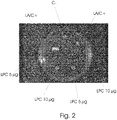
- First instar larvae were transferred into plastic queen cups and fed the following diets: On the first day 10 ⁇ L of diet containing 6% glucose, 6% fructose, 1% yeast extract and 50% royal jelly were fed. Test substances (1- O -oleoyl- sn -glycero-3-phosphocholine (oleoyl-LPC), stearic acid, lysophosphatidylinositol and linoleic acid) were added to the first diet in amounts of 0.5 to 10 ⁇ g/larvae.
- Test substances (1- O -oleoyl- sn -glycero-3-phosphocholine (oleoyl-LPC), stearic acid, lysophosphatidylinositol and linoleic acid) were added to the first diet in amounts of 0.5 to 10 ⁇ g/larvae.
- Pollen is part of the larval diet under natural conditions. Its lipid content, which is highly variable, plays a role in nutrition and cell membrane function. It has been stated that free fatty acids such as linoleic acid, which is present in certain pollen decrease the susceptibility of the larvae towards American foulbrood [ Feldlaufer et al. 1993. Apidologie 24:95-99 ]. Under artificial rearing conditions, the diet is devoid of pollen, therefore, an influence of dietary lipids from pollen can be ruled out.
- Fig. 1 shows the survival rates (Kaplan-Meier curves) of each 48 larvae fed with different substances (see legend: non treated - control; Lino - linoleic acid 12 ⁇ g/larva; Ster - stearic acid 10 ⁇ g/larva; LPI - lysophosphatidylinositol - 5 ⁇ g/larva; LPC10 - 1- O -oleoyl- sn -glycero-3-phosphocholine -10 ⁇ g/larva).
- Example 3 Bacterial assays and spore preparation
- a stock solution containing spores at a known concentration is used to inoculate c. 100 spores / mL medium.
- This assay is carried out in 20 mL cultivation tubes containing 1.0 mL of BHI (brain heart infusion) liquid medium.
- BHI brain heart infusion
- test compounds are added at different concentrations (e.g., 2, 5 and 10 ppm), together with positive control (penicillin G at 5 ppm) and blank control.
- tubes containing BHI + spores are plated out immediately on agar plates to assess the number of colony forming units (CFU) after 6 days of incubation at 34.5 °C.
- test probes For the test probes, bacterial growth is evaluated on day 4 and 6. For those tubes which are negative for bacterial growth, the whole medium (c. 1 mL) is plated onto agar plates and evaluated for CFUs after 2 and 6 days of incubation. CFUs visible after two days result from vegetative forms, while CFUs appearing after 4 days stem from spores.
- results of these tests allow identifying whether the tested compounds have an effect on spore germination in liquid medium and the viability of the spores as assessed by their germination on agar plates.
- Larvae were fed according to a slightly modified rearing method of Aupinel et al., (2005). Larvae were fed for 6 days with different amounts of diets which always contained 50% of an aqueous solution (A, B, C) and 50% royal jelly (w/w).
- each larva was fed with 10 ⁇ L of diet A, on day three with 20 ⁇ L of diet B, on day four (30 ⁇ L), five (40 ⁇ L) and six (50 ⁇ L) with diet C. This way, each larva was supported with a total amount of 160 ⁇ L of food.
- the test compounds (see Table 4) were added each at the respective concentration on day 1, i.e. stearic acid (10 ⁇ g/larva), lysophosphatidylinositol (5 ⁇ g/larva), linoleic acid (12 ⁇ g/larva) and oleyol-LPC (10 ⁇ g/larva). Each larva was checked for its state of health under the binocular before feeding.
- a larva was defined healthy when movements of spiracles could be observed and it was shiny and plump. Cups with dead larvae were removed from the plate to prevent infections. To avoid microbial contamination, feeding took place under a laminar flow. Larvae were incubated at 34.5 °C and 90% RH. The mortality rates of the larvae are given below in table 4.1. Table 4.1. Mortality rate of larvae fed with different lipids vs.
Landscapes
- Life Sciences & Earth Sciences (AREA)
- Health & Medical Sciences (AREA)
- Chemical & Material Sciences (AREA)
- Animal Husbandry (AREA)
- Polymers & Plastics (AREA)
- General Health & Medical Sciences (AREA)
- Veterinary Medicine (AREA)
- Pharmacology & Pharmacy (AREA)
- Epidemiology (AREA)
- Animal Behavior & Ethology (AREA)
- Medicinal Chemistry (AREA)
- Public Health (AREA)
- Insects & Arthropods (AREA)
- Zoology (AREA)
- Environmental Sciences (AREA)
- Engineering & Computer Science (AREA)
- Food Science & Technology (AREA)
- Biodiversity & Conservation Biology (AREA)
- Birds (AREA)
- Medicines Containing Material From Animals Or Micro-Organisms (AREA)
- Pharmaceuticals Containing Other Organic And Inorganic Compounds (AREA)
Claims (17)
- Verbindung ausgewählt aus der Gruppe bestehend aus einem Lysophospholipid und einem Alkyl-Lysophospholipid (ALP) zur Verwendung bei der Behandlung oder Prophylaxe von durch grampositive Bakterien verursachten Bienenbrutkrankheiten.
- Verbindung zur Verwendung gemäß Anspruch 1 bei der Behandlung oder Prophylaxe von Amerikanischer Faulbrut.
- Verbindung zur Verwendung nach Anspruch 1 bei der Behandlung oder Prophylaxe von Europäischer Faulbrut.
- Verbindung zur Verwendung nach einem der Ansprüche 1 bis 3, wobei die Verbindung ein Lysophosphatidylcholin ist.
- Verbindung zur Verwendung nach Anspruch 4, wobei das Lysophosphatidylcholin eine gesättigte oder eine ungesättigte C4-C24-Fettsäurekette umfasst.
- Verbindung zur Verwendung nach Anspruch 4 oder 5, wobei das Lysophosphatidylcholin ausgewählt ist aus der Gruppe bestehend aus 1-O-Oleoyl-sn-glycero-3-phosphocholin und 1-O-Stearoyl-sn-glycero-3-Phosphocholin.
- Verbindung zur Verwendung nach Anspruch 6, wobei das Lysophosphatidylcholin 1-O-Oleoyl-sn-glycero-3-phosphocholin ist.
- Verbindung zur Verwendung nach Anspruch 1, wobei das Alkyl-Lysophospholipid (ALP) Hexadecylphosphocholin (Miltefosin) oder 1,1-Dimethylpiperidinium-4-yl-octadecylphosphat (Perifosin) ist.
- Verbindung zur Verwendung nach Anspruch 2, wobei eine Menge, die wirksam ist, um vegetative Formen von Paenibacillus larvae abzutöten und/oder vegetative Formen von Paenibacillus larvae, die aus der Sporenkeimung resultieren, abzutöten, einem Honigbienenvolk verabreicht wird.
- Verbindung zur Verwendung nach Anspruch 3, wobei eine Menge, die zum Abtöten von Melissococcus plutonius wirksam ist, einem Honigbienenvolk verabreicht wird.
- Zusammensetzung zur Verwendung bei der Behandlung oder Prophylaxe von durch grampositive Bakterien verursachten Bienenbrutkrankheiten, wobei die Zusammensetzung eine Verbindung nach einem der Ansprüche 1 bis 10 umfasst und wobei die Zusammensetzung einem Honigbienenvolk verabreicht wird.
- Zusammensetzung zur Verwendung nach Anspruch 11, wobei die Zusammensetzung eine Diätzusammensetzung oder ein Nahrungsmittelzusatz ist, der zu einer Nahrungszusammensetzung für Honigbienen hinzugefügt ist.
- Zusammensetzung zur Verwendung nach Anspruch 12, umfassend die Verbindung in einer Konzentration von 0,01-0,1%, vorzugsweise 0,01-0,05%.
- Zusammensetzung zur Verwendung nach Anspruch 11, wobei es sich um eine sprühbare Zusammensetzung handelt, die durch Sprühanwendung einem Bienenvolk verabreicht wird.
- Zusammensetzung zur Verwendung nach Anspruch 11, wobei die Zusammensetzung eine Zusammensetzung basierend auf Liposomen, Mikrokügelchen oder Nanokügelchen ist.
- Tauchlösung für Brutwaben zur Verwendung bei der Behandlung oder Prophylaxe von durch grampositive Bakterien hervorgerufenen Bienenbrutkrankheiten, wobei die Tauchlösung eine Verbindung nach einem der Ansprüche 1 bis 10 umfasst, wobei die Verbindung einem Bienenvolk durch Eintauchen der Brutwaben in die Tauchlösung verabreicht wird, was zu einer Konzentration der Verbindung in den Brutzellen der Brutwaben führt, die zur Behandlung oder Prophylaxe von durch grampositive Bakterien verursachten Bienenbrutkrankheiten wirksam ist.
- Bienenwachs-Zusammensetzung zur Verwendung bei der Behandlung oder Prophylaxe von durch grampositive Bakterien verursachten Bienenbrutkrankheiten, wobei der Bienenwachs-Zusammensetzung eine Verbindung nach einem der Ansprüche 1 bis 10 als Wirkstoff zugesetzt wird, was zu einer Konzentration der Verbindung in den Brutzellen der Brutwaben führt, die zur Behandlung oder Prophylaxe von durch grampositive Bakterien verursachten Bienenbrutkrankheiten wirksam ist.
Priority Applications (2)
| Application Number | Priority Date | Filing Date | Title |
|---|---|---|---|
| PL14725994T PL2999329T3 (pl) | 2013-05-22 | 2014-05-22 | Lizofosfolipidy i alkilolizofosfolipidy przeciw chorobom czerwia pszczelego |
| EP14725994.9A EP2999329B1 (de) | 2013-05-22 | 2014-05-22 | Lysophospholipide und alkyl-lysophospholipide gegen brutkrankheiten der honigbiene |
Applications Claiming Priority (3)
| Application Number | Priority Date | Filing Date | Title |
|---|---|---|---|
| EP13168757.6A EP2805612A1 (de) | 2013-05-22 | 2013-05-22 | Lysophospholipide gegen Amerikanische Faulbrut |
| PCT/EP2014/060553 WO2014187906A1 (en) | 2013-05-22 | 2014-05-22 | Lysophospholipids and lysophospholipid analogues against honeybee brood diseases |
| EP14725994.9A EP2999329B1 (de) | 2013-05-22 | 2014-05-22 | Lysophospholipide und alkyl-lysophospholipide gegen brutkrankheiten der honigbiene |
Publications (2)
| Publication Number | Publication Date |
|---|---|
| EP2999329A1 EP2999329A1 (de) | 2016-03-30 |
| EP2999329B1 true EP2999329B1 (de) | 2018-04-11 |
Family
ID=48444268
Family Applications (2)
| Application Number | Title | Priority Date | Filing Date |
|---|---|---|---|
| EP13168757.6A Withdrawn EP2805612A1 (de) | 2013-05-22 | 2013-05-22 | Lysophospholipide gegen Amerikanische Faulbrut |
| EP14725994.9A Not-in-force EP2999329B1 (de) | 2013-05-22 | 2014-05-22 | Lysophospholipide und alkyl-lysophospholipide gegen brutkrankheiten der honigbiene |
Family Applications Before (1)
| Application Number | Title | Priority Date | Filing Date |
|---|---|---|---|
| EP13168757.6A Withdrawn EP2805612A1 (de) | 2013-05-22 | 2013-05-22 | Lysophospholipide gegen Amerikanische Faulbrut |
Country Status (5)
| Country | Link |
|---|---|
| US (1) | US9993492B2 (de) |
| EP (2) | EP2805612A1 (de) |
| ES (1) | ES2676244T3 (de) |
| PL (1) | PL2999329T3 (de) |
| WO (1) | WO2014187906A1 (de) |
Families Citing this family (1)
| Publication number | Priority date | Publication date | Assignee | Title |
|---|---|---|---|---|
| TWI698245B (zh) * | 2017-08-18 | 2020-07-11 | 彥臣生技藥品股份有限公司 | 用於提升昆蟲免疫力之組合物及方法 |
Family Cites Families (10)
| Publication number | Priority date | Publication date | Assignee | Title |
|---|---|---|---|---|
| US5434182A (en) * | 1987-12-31 | 1995-07-18 | Isaacs; Charles E. | Antibacterial fatty acid compositions |
| US5716814A (en) | 1996-02-02 | 1998-02-10 | Biomolecular Products, Inc. | Methods for making lysophosphatidylcholine |
| US6165997A (en) | 1997-11-20 | 2000-12-26 | Statens Serum Institut | Phospholipids having antimicrobial activity with or without the presence of antimicrobials |
| GB9825839D0 (en) * | 1998-11-26 | 1999-01-20 | Univ Cardiff | Foulbrood treatments |
| DE10313272A1 (de) * | 2003-03-24 | 2004-10-21 | Baxter Healthcare S.A. | Verwendung von Miltefosine zur Behandlung von aktinischer oder multiplen aktinischer Keratosen |
| WO2006122716A1 (en) * | 2005-05-18 | 2006-11-23 | Heidelberg Pharma Gmbh | Use of ether-linked lysophosphatidylcholines and alkylphosphocholines for the treatment of papilloma virus induced warts and sarcoids |
| BRPI0615411A2 (pt) | 2005-08-29 | 2012-12-04 | Sepsicure L L C | uso de um ácido da bìlis ou de um sal de ácido da bìlis e um fosfolipìdeo |
| US20070167408A1 (en) * | 2005-12-19 | 2007-07-19 | Zentaris Gmbh | Novel alkyl phospholipid derivatives with reduced cytotoxicity and uses thereof |
| US20080145411A1 (en) * | 2006-10-06 | 2008-06-19 | Kaneka Corporation | Composition of high absorbability for oral administration comprising oxidized coenzyme q10 |
| JP5432563B2 (ja) * | 2009-03-31 | 2014-03-05 | 株式会社ファンケル | ホスファチジルセリン含有カプセル及びカプセル充填用ホスファチジルセリン組成物 |
-
2013
- 2013-05-22 EP EP13168757.6A patent/EP2805612A1/de not_active Withdrawn
-
2014
- 2014-05-22 US US14/892,914 patent/US9993492B2/en active Active
- 2014-05-22 PL PL14725994T patent/PL2999329T3/pl unknown
- 2014-05-22 ES ES14725994.9T patent/ES2676244T3/es active Active
- 2014-05-22 EP EP14725994.9A patent/EP2999329B1/de not_active Not-in-force
- 2014-05-22 WO PCT/EP2014/060553 patent/WO2014187906A1/en not_active Ceased
Also Published As
| Publication number | Publication date |
|---|---|
| WO2014187906A1 (en) | 2014-11-27 |
| ES2676244T3 (es) | 2018-07-18 |
| US20160106768A1 (en) | 2016-04-21 |
| US9993492B2 (en) | 2018-06-12 |
| EP2805612A1 (de) | 2014-11-26 |
| PL2999329T3 (pl) | 2018-09-28 |
| EP2999329A1 (de) | 2016-03-30 |
Similar Documents
| Publication | Publication Date | Title |
|---|---|---|
| US11980660B2 (en) | Edible vaccination against microbial pathogens | |
| Abd-El-Rhman | Antagonism of Aeromonas hydrophila by propolis and its effect on the performance of Nile tilapia, Oreochromis niloticus | |
| Antúnez et al. | Efficacy of natural propolis extract in the control of American Foulbrood | |
| Menezes et al. | The role of useful microorganisms to stingless bees and stingless beekeeping | |
| JP4201349B2 (ja) | 動物の寄生虫症に対する予防的または治療的薬剤として使用するためのオメガ―3―脂肪酸を含む微生物製剤 | |
| WO2019138344A1 (en) | Nutritional solid compositions with acaricide activity for apiculture and their use for the prophylaxis and treatment of varroa infestations | |
| Tejerina et al. | Strains of Lactobacillus spp. reduce chalkbrood in Apis mellifera | |
| NL2021015B1 (en) | Beneficial metschnikowiaceae yeast cells, fragments thereof, or substances produced thereby for animals | |
| GAJGER et al. | Zeolite clinoptilolite as a dietary supplement and remedy for honeybee (Apis mellifera L.) colonies. | |
| US9993492B2 (en) | Lysophospholipids and lysophospholipid analogues against honeybee brood diseases | |
| Yoder et al. | In vitro evaluation of sugar syrups, antibiotics, and miticides on growth of honey bee pathogen, Ascosphaera apis: Emphasis for chalkbrood prevention is on keeping bees healthy | |
| TW201912176A (zh) | 用於提升昆蟲免疫力之組合物及方法 | |
| Milián et al. | Use of microbial additives in apiculture | |
| US20220152128A1 (en) | Bee gut microbial formulation for use as a probiotic for improved bee health and pathogen resistance | |
| Klassen | Effects of prebiotics and probiotics on the parasitic microsporidium Nosema ceranae and honey bee (Apis mellifera) health at the individual and colony levels | |
| Kovalсhuk et al. | Laсtobaсillus сasei imv b-7280 immunobiotic strain influence on the viability of honey bees and the content of microelements in the organism: ст. | |
| Gallois et al. | Testing the efficacy of medium chain fatty acids against rabbit colibacillosis | |
| Zhai et al. | Effects of different levels of dietary surfactin supplementation on intestinal morphology, and intestinal microflora of growth retarded marbled eel juveniles (Anguilla marmaorata) | |
| Pylypets et al. | Effect of Different Doses of Ge Citrate and Probiotic Lactobacillus casei B-7280 on the Phospholipid Composition of Bees Tissues | |
| Abdelhameed et al. | Control of Mycobiota Associated with Honey Bee Developmental Stages and Beeswax Using Sidr Honey, Royal Jelly, and Bee Venom | |
| JP2008533054A (ja) | 吸血シラミの駆除 | |
| US20230329284A1 (en) | Bee antiviral compositions | |
| KR101288380B1 (ko) | 봉독을 유효성분으로 함유하는 양계용 사료 조성물 | |
| Ianiro | Antibiotic and Probiotic activity of Lactic Acid Bacteria isolated from Honeybee gut and Beebread | |
| Orozova et al. | Antimicrobial Activity of the Herbal Product BACTEROMAT HERB Against Paenibacillus larvae and Melissococcus plutonius—Causative Agents of Foulbrood Diseases in Bees |
Legal Events
| Date | Code | Title | Description |
|---|---|---|---|
| PUAI | Public reference made under article 153(3) epc to a published international application that has entered the european phase |
Free format text: ORIGINAL CODE: 0009012 |
|
| 17P | Request for examination filed |
Effective date: 20151201 |
|
| AK | Designated contracting states |
Kind code of ref document: A1 Designated state(s): AL AT BE BG CH CY CZ DE DK EE ES FI FR GB GR HR HU IE IS IT LI LT LU LV MC MK MT NL NO PL PT RO RS SE SI SK SM TR |
|
| AX | Request for extension of the european patent |
Extension state: BA ME |
|
| DAX | Request for extension of the european patent (deleted) | ||
| 17Q | First examination report despatched |
Effective date: 20170428 |
|
| REG | Reference to a national code |
Ref country code: DE Ref legal event code: R079 Ref document number: 602014023706 Country of ref document: DE Free format text: PREVIOUS MAIN CLASS: A01K0051000000 Ipc: A61K0031683000 |
|
| GRAP | Despatch of communication of intention to grant a patent |
Free format text: ORIGINAL CODE: EPIDOSNIGR1 |
|
| RIC1 | Information provided on ipc code assigned before grant |
Ipc: A01K 51/00 20060101ALI20170929BHEP Ipc: A61K 31/685 20060101ALI20170929BHEP Ipc: A61K 31/683 20060101AFI20170929BHEP Ipc: A61K 35/644 20150101ALI20170929BHEP Ipc: A01P 1/00 20060101ALI20170929BHEP Ipc: A23K 20/158 20160101ALI20170929BHEP Ipc: A23K 50/90 20160101ALI20170929BHEP |
|
| INTG | Intention to grant announced |
Effective date: 20171107 |
|
| GRAS | Grant fee paid |
Free format text: ORIGINAL CODE: EPIDOSNIGR3 |
|
| GRAA | (expected) grant |
Free format text: ORIGINAL CODE: 0009210 |
|
| AK | Designated contracting states |
Kind code of ref document: B1 Designated state(s): AL AT BE BG CH CY CZ DE DK EE ES FI FR GB GR HR HU IE IS IT LI LT LU LV MC MK MT NL NO PL PT RO RS SE SI SK SM TR |
|
| REG | Reference to a national code |
Ref country code: GB Ref legal event code: FG4D |
|
| REG | Reference to a national code |
Ref country code: CH Ref legal event code: EP |
|
| REG | Reference to a national code |
Ref country code: AT Ref legal event code: REF Ref document number: 987274 Country of ref document: AT Kind code of ref document: T Effective date: 20180415 |
|
| REG | Reference to a national code |
Ref country code: IE Ref legal event code: FG4D |
|
| REG | Reference to a national code |
Ref country code: DE Ref legal event code: R096 Ref document number: 602014023706 Country of ref document: DE |
|
| REG | Reference to a national code |
Ref country code: FR Ref legal event code: PLFP Year of fee payment: 5 |
|
| REG | Reference to a national code |
Ref country code: ES Ref legal event code: FG2A Ref document number: 2676244 Country of ref document: ES Kind code of ref document: T3 Effective date: 20180718 |
|
| REG | Reference to a national code |
Ref country code: NL Ref legal event code: MP Effective date: 20180411 |
|
| REG | Reference to a national code |
Ref country code: LT Ref legal event code: MG4D |
|
| PG25 | Lapsed in a contracting state [announced via postgrant information from national office to epo] |
Ref country code: NL Free format text: LAPSE BECAUSE OF FAILURE TO SUBMIT A TRANSLATION OF THE DESCRIPTION OR TO PAY THE FEE WITHIN THE PRESCRIBED TIME-LIMIT Effective date: 20180411 |
|
| PG25 | Lapsed in a contracting state [announced via postgrant information from national office to epo] |
Ref country code: LT Free format text: LAPSE BECAUSE OF FAILURE TO SUBMIT A TRANSLATION OF THE DESCRIPTION OR TO PAY THE FEE WITHIN THE PRESCRIBED TIME-LIMIT Effective date: 20180411 Ref country code: SE Free format text: LAPSE BECAUSE OF FAILURE TO SUBMIT A TRANSLATION OF THE DESCRIPTION OR TO PAY THE FEE WITHIN THE PRESCRIBED TIME-LIMIT Effective date: 20180411 Ref country code: NO Free format text: LAPSE BECAUSE OF FAILURE TO SUBMIT A TRANSLATION OF THE DESCRIPTION OR TO PAY THE FEE WITHIN THE PRESCRIBED TIME-LIMIT Effective date: 20180711 Ref country code: AL Free format text: LAPSE BECAUSE OF FAILURE TO SUBMIT A TRANSLATION OF THE DESCRIPTION OR TO PAY THE FEE WITHIN THE PRESCRIBED TIME-LIMIT Effective date: 20180411 Ref country code: BG Free format text: LAPSE BECAUSE OF FAILURE TO SUBMIT A TRANSLATION OF THE DESCRIPTION OR TO PAY THE FEE WITHIN THE PRESCRIBED TIME-LIMIT Effective date: 20180711 Ref country code: FI Free format text: LAPSE BECAUSE OF FAILURE TO SUBMIT A TRANSLATION OF THE DESCRIPTION OR TO PAY THE FEE WITHIN THE PRESCRIBED TIME-LIMIT Effective date: 20180411 |
|
| PG25 | Lapsed in a contracting state [announced via postgrant information from national office to epo] |
Ref country code: RS Free format text: LAPSE BECAUSE OF FAILURE TO SUBMIT A TRANSLATION OF THE DESCRIPTION OR TO PAY THE FEE WITHIN THE PRESCRIBED TIME-LIMIT Effective date: 20180411 Ref country code: LV Free format text: LAPSE BECAUSE OF FAILURE TO SUBMIT A TRANSLATION OF THE DESCRIPTION OR TO PAY THE FEE WITHIN THE PRESCRIBED TIME-LIMIT Effective date: 20180411 Ref country code: HR Free format text: LAPSE BECAUSE OF FAILURE TO SUBMIT A TRANSLATION OF THE DESCRIPTION OR TO PAY THE FEE WITHIN THE PRESCRIBED TIME-LIMIT Effective date: 20180411 |
|
| REG | Reference to a national code |
Ref country code: CH Ref legal event code: PL |
|
| REG | Reference to a national code |
Ref country code: AT Ref legal event code: MK05 Ref document number: 987274 Country of ref document: AT Kind code of ref document: T Effective date: 20180411 |
|
| PG25 | Lapsed in a contracting state [announced via postgrant information from national office to epo] |
Ref country code: PT Free format text: LAPSE BECAUSE OF FAILURE TO SUBMIT A TRANSLATION OF THE DESCRIPTION OR TO PAY THE FEE WITHIN THE PRESCRIBED TIME-LIMIT Effective date: 20180813 |
|
| REG | Reference to a national code |
Ref country code: DE Ref legal event code: R097 Ref document number: 602014023706 Country of ref document: DE |
|
| REG | Reference to a national code |
Ref country code: GR Ref legal event code: EP Ref document number: 20180401858 Country of ref document: GR Effective date: 20190109 |
|
| REG | Reference to a national code |
Ref country code: BE Ref legal event code: MM Effective date: 20180531 |
|
| PG25 | Lapsed in a contracting state [announced via postgrant information from national office to epo] |
Ref country code: AT Free format text: LAPSE BECAUSE OF FAILURE TO SUBMIT A TRANSLATION OF THE DESCRIPTION OR TO PAY THE FEE WITHIN THE PRESCRIBED TIME-LIMIT Effective date: 20180411 Ref country code: MC Free format text: LAPSE BECAUSE OF FAILURE TO SUBMIT A TRANSLATION OF THE DESCRIPTION OR TO PAY THE FEE WITHIN THE PRESCRIBED TIME-LIMIT Effective date: 20180411 Ref country code: EE Free format text: LAPSE BECAUSE OF FAILURE TO SUBMIT A TRANSLATION OF THE DESCRIPTION OR TO PAY THE FEE WITHIN THE PRESCRIBED TIME-LIMIT Effective date: 20180411 Ref country code: DK Free format text: LAPSE BECAUSE OF FAILURE TO SUBMIT A TRANSLATION OF THE DESCRIPTION OR TO PAY THE FEE WITHIN THE PRESCRIBED TIME-LIMIT Effective date: 20180411 Ref country code: SK Free format text: LAPSE BECAUSE OF FAILURE TO SUBMIT A TRANSLATION OF THE DESCRIPTION OR TO PAY THE FEE WITHIN THE PRESCRIBED TIME-LIMIT Effective date: 20180411 Ref country code: RO Free format text: LAPSE BECAUSE OF FAILURE TO SUBMIT A TRANSLATION OF THE DESCRIPTION OR TO PAY THE FEE WITHIN THE PRESCRIBED TIME-LIMIT Effective date: 20180411 Ref country code: CZ Free format text: LAPSE BECAUSE OF FAILURE TO SUBMIT A TRANSLATION OF THE DESCRIPTION OR TO PAY THE FEE WITHIN THE PRESCRIBED TIME-LIMIT Effective date: 20180411 |
|
| PLBE | No opposition filed within time limit |
Free format text: ORIGINAL CODE: 0009261 |
|
| STAA | Information on the status of an ep patent application or granted ep patent |
Free format text: STATUS: NO OPPOSITION FILED WITHIN TIME LIMIT |
|
| REG | Reference to a national code |
Ref country code: IE Ref legal event code: MM4A |
|
| PG25 | Lapsed in a contracting state [announced via postgrant information from national office to epo] |
Ref country code: CH Free format text: LAPSE BECAUSE OF NON-PAYMENT OF DUE FEES Effective date: 20180531 Ref country code: SM Free format text: LAPSE BECAUSE OF FAILURE TO SUBMIT A TRANSLATION OF THE DESCRIPTION OR TO PAY THE FEE WITHIN THE PRESCRIBED TIME-LIMIT Effective date: 20180411 Ref country code: LI Free format text: LAPSE BECAUSE OF NON-PAYMENT OF DUE FEES Effective date: 20180531 |
|
| 26N | No opposition filed |
Effective date: 20190114 |
|
| GBPC | Gb: european patent ceased through non-payment of renewal fee |
Effective date: 20180711 |
|
| PG25 | Lapsed in a contracting state [announced via postgrant information from national office to epo] |
Ref country code: LU Free format text: LAPSE BECAUSE OF NON-PAYMENT OF DUE FEES Effective date: 20180522 |
|
| PG25 | Lapsed in a contracting state [announced via postgrant information from national office to epo] |
Ref country code: GB Free format text: LAPSE BECAUSE OF NON-PAYMENT OF DUE FEES Effective date: 20180711 Ref country code: IE Free format text: LAPSE BECAUSE OF NON-PAYMENT OF DUE FEES Effective date: 20180522 |
|
| PG25 | Lapsed in a contracting state [announced via postgrant information from national office to epo] |
Ref country code: BE Free format text: LAPSE BECAUSE OF NON-PAYMENT OF DUE FEES Effective date: 20180531 Ref country code: SI Free format text: LAPSE BECAUSE OF FAILURE TO SUBMIT A TRANSLATION OF THE DESCRIPTION OR TO PAY THE FEE WITHIN THE PRESCRIBED TIME-LIMIT Effective date: 20180411 |
|
| PG25 | Lapsed in a contracting state [announced via postgrant information from national office to epo] |
Ref country code: MT Free format text: LAPSE BECAUSE OF NON-PAYMENT OF DUE FEES Effective date: 20180522 |
|
| PG25 | Lapsed in a contracting state [announced via postgrant information from national office to epo] |
Ref country code: TR Free format text: LAPSE BECAUSE OF FAILURE TO SUBMIT A TRANSLATION OF THE DESCRIPTION OR TO PAY THE FEE WITHIN THE PRESCRIBED TIME-LIMIT Effective date: 20180411 |
|
| PG25 | Lapsed in a contracting state [announced via postgrant information from national office to epo] |
Ref country code: HU Free format text: LAPSE BECAUSE OF FAILURE TO SUBMIT A TRANSLATION OF THE DESCRIPTION OR TO PAY THE FEE WITHIN THE PRESCRIBED TIME-LIMIT; INVALID AB INITIO Effective date: 20140522 Ref country code: CY Free format text: LAPSE BECAUSE OF FAILURE TO SUBMIT A TRANSLATION OF THE DESCRIPTION OR TO PAY THE FEE WITHIN THE PRESCRIBED TIME-LIMIT Effective date: 20180411 Ref country code: MK Free format text: LAPSE BECAUSE OF NON-PAYMENT OF DUE FEES Effective date: 20180411 |
|
| PG25 | Lapsed in a contracting state [announced via postgrant information from national office to epo] |
Ref country code: IS Free format text: LAPSE BECAUSE OF FAILURE TO SUBMIT A TRANSLATION OF THE DESCRIPTION OR TO PAY THE FEE WITHIN THE PRESCRIBED TIME-LIMIT Effective date: 20180811 |
|
| PGFP | Annual fee paid to national office [announced via postgrant information from national office to epo] |
Ref country code: FR Payment date: 20230526 Year of fee payment: 10 Ref country code: DE Payment date: 20230519 Year of fee payment: 10 Ref country code: IT Payment date: 20230526 Year of fee payment: 10 |
|
| PGFP | Annual fee paid to national office [announced via postgrant information from national office to epo] |
Ref country code: PL Payment date: 20230425 Year of fee payment: 10 Ref country code: GR Payment date: 20230522 Year of fee payment: 10 |
|
| PGFP | Annual fee paid to national office [announced via postgrant information from national office to epo] |
Ref country code: ES Payment date: 20230725 Year of fee payment: 10 |
|
| REG | Reference to a national code |
Ref country code: DE Ref legal event code: R119 Ref document number: 602014023706 Country of ref document: DE |
|
| PG25 | Lapsed in a contracting state [announced via postgrant information from national office to epo] |
Ref country code: GR Free format text: LAPSE BECAUSE OF NON-PAYMENT OF DUE FEES Effective date: 20241204 |
|
| PG25 | Lapsed in a contracting state [announced via postgrant information from national office to epo] |
Ref country code: GR Free format text: LAPSE BECAUSE OF NON-PAYMENT OF DUE FEES Effective date: 20241204 |
|
| PG25 | Lapsed in a contracting state [announced via postgrant information from national office to epo] |
Ref country code: DE Free format text: LAPSE BECAUSE OF NON-PAYMENT OF DUE FEES Effective date: 20241203 |
|
| PG25 | Lapsed in a contracting state [announced via postgrant information from national office to epo] |
Ref country code: FR Free format text: LAPSE BECAUSE OF NON-PAYMENT OF DUE FEES Effective date: 20240531 |
|
| PG25 | Lapsed in a contracting state [announced via postgrant information from national office to epo] |
Ref country code: IT Free format text: LAPSE BECAUSE OF NON-PAYMENT OF DUE FEES Effective date: 20240522 |
|
| REG | Reference to a national code |
Ref country code: ES Ref legal event code: FD2A Effective date: 20250704 |
|
| PG25 | Lapsed in a contracting state [announced via postgrant information from national office to epo] |
Ref country code: PL Free format text: LAPSE BECAUSE OF NON-PAYMENT OF DUE FEES Effective date: 20240522 |
|
| PG25 | Lapsed in a contracting state [announced via postgrant information from national office to epo] |
Ref country code: ES Free format text: LAPSE BECAUSE OF NON-PAYMENT OF DUE FEES Effective date: 20240523 |