EP2999677B1 - Verfahren zur reduzierung der reversiblen wärmedehnung eines graphithaltigen feuerfesten geformten erzeugnisses - Google Patents
Verfahren zur reduzierung der reversiblen wärmedehnung eines graphithaltigen feuerfesten geformten erzeugnisses Download PDFInfo
- Publication number
- EP2999677B1 EP2999677B1 EP14722162.6A EP14722162A EP2999677B1 EP 2999677 B1 EP2999677 B1 EP 2999677B1 EP 14722162 A EP14722162 A EP 14722162A EP 2999677 B1 EP2999677 B1 EP 2999677B1
- Authority
- EP
- European Patent Office
- Prior art keywords
- graphite
- type
- thermal expansion
- form factor
- flake
- Prior art date
- Legal status (The legal status is an assumption and is not a legal conclusion. Google has not performed a legal analysis and makes no representation as to the accuracy of the status listed.)
- Active
Links
Images

Classifications
-
- C—CHEMISTRY; METALLURGY
- C04—CEMENTS; CONCRETE; ARTIFICIAL STONE; CERAMICS; REFRACTORIES
- C04B—LIME, MAGNESIA; SLAG; CEMENTS; COMPOSITIONS THEREOF, e.g. MORTARS, CONCRETE OR LIKE BUILDING MATERIALS; ARTIFICIAL STONE; CERAMICS; REFRACTORIES; TREATMENT OF NATURAL STONE
- C04B35/00—Shaped ceramic products characterised by their composition; Ceramics compositions; Processing powders of inorganic compounds preparatory to the manufacturing of ceramic products
- C04B35/01—Shaped ceramic products characterised by their composition; Ceramics compositions; Processing powders of inorganic compounds preparatory to the manufacturing of ceramic products based on oxide ceramics
- C04B35/013—Shaped ceramic products characterised by their composition; Ceramics compositions; Processing powders of inorganic compounds preparatory to the manufacturing of ceramic products based on oxide ceramics containing carbon
-
- C—CHEMISTRY; METALLURGY
- C04—CEMENTS; CONCRETE; ARTIFICIAL STONE; CERAMICS; REFRACTORIES
- C04B—LIME, MAGNESIA; SLAG; CEMENTS; COMPOSITIONS THEREOF, e.g. MORTARS, CONCRETE OR LIKE BUILDING MATERIALS; ARTIFICIAL STONE; CERAMICS; REFRACTORIES; TREATMENT OF NATURAL STONE
- C04B35/00—Shaped ceramic products characterised by their composition; Ceramics compositions; Processing powders of inorganic compounds preparatory to the manufacturing of ceramic products
- C04B35/01—Shaped ceramic products characterised by their composition; Ceramics compositions; Processing powders of inorganic compounds preparatory to the manufacturing of ceramic products based on oxide ceramics
- C04B35/03—Shaped ceramic products characterised by their composition; Ceramics compositions; Processing powders of inorganic compounds preparatory to the manufacturing of ceramic products based on oxide ceramics based on magnesium oxide, calcium oxide or oxide mixtures derived from dolomite
- C04B35/04—Shaped ceramic products characterised by their composition; Ceramics compositions; Processing powders of inorganic compounds preparatory to the manufacturing of ceramic products based on oxide ceramics based on magnesium oxide, calcium oxide or oxide mixtures derived from dolomite based on magnesium oxide
- C04B35/043—Refractories from grain sized mixtures
-
- C—CHEMISTRY; METALLURGY
- C04—CEMENTS; CONCRETE; ARTIFICIAL STONE; CERAMICS; REFRACTORIES
- C04B—LIME, MAGNESIA; SLAG; CEMENTS; COMPOSITIONS THEREOF, e.g. MORTARS, CONCRETE OR LIKE BUILDING MATERIALS; ARTIFICIAL STONE; CERAMICS; REFRACTORIES; TREATMENT OF NATURAL STONE
- C04B2235/00—Aspects relating to ceramic starting mixtures or sintered ceramic products
- C04B2235/02—Composition of constituents of the starting material or of secondary phases of the final product
- C04B2235/30—Constituents and secondary phases not being of a fibrous nature
- C04B2235/32—Metal oxides, mixed metal oxides, or oxide-forming salts thereof, e.g. carbonates, nitrates, (oxy)hydroxides, chlorides
- C04B2235/3205—Alkaline earth oxides or oxide forming salts thereof, e.g. beryllium oxide
- C04B2235/3206—Magnesium oxides or oxide-forming salts thereof
-
- C—CHEMISTRY; METALLURGY
- C04—CEMENTS; CONCRETE; ARTIFICIAL STONE; CERAMICS; REFRACTORIES
- C04B—LIME, MAGNESIA; SLAG; CEMENTS; COMPOSITIONS THEREOF, e.g. MORTARS, CONCRETE OR LIKE BUILDING MATERIALS; ARTIFICIAL STONE; CERAMICS; REFRACTORIES; TREATMENT OF NATURAL STONE
- C04B2235/00—Aspects relating to ceramic starting mixtures or sintered ceramic products
- C04B2235/02—Composition of constituents of the starting material or of secondary phases of the final product
- C04B2235/30—Constituents and secondary phases not being of a fibrous nature
- C04B2235/32—Metal oxides, mixed metal oxides, or oxide-forming salts thereof, e.g. carbonates, nitrates, (oxy)hydroxides, chlorides
- C04B2235/3217—Aluminum oxide or oxide forming salts thereof, e.g. bauxite, alpha-alumina
-
- C—CHEMISTRY; METALLURGY
- C04—CEMENTS; CONCRETE; ARTIFICIAL STONE; CERAMICS; REFRACTORIES
- C04B—LIME, MAGNESIA; SLAG; CEMENTS; COMPOSITIONS THEREOF, e.g. MORTARS, CONCRETE OR LIKE BUILDING MATERIALS; ARTIFICIAL STONE; CERAMICS; REFRACTORIES; TREATMENT OF NATURAL STONE
- C04B2235/00—Aspects relating to ceramic starting mixtures or sintered ceramic products
- C04B2235/02—Composition of constituents of the starting material or of secondary phases of the final product
- C04B2235/30—Constituents and secondary phases not being of a fibrous nature
- C04B2235/32—Metal oxides, mixed metal oxides, or oxide-forming salts thereof, e.g. carbonates, nitrates, (oxy)hydroxides, chlorides
- C04B2235/3231—Refractory metal oxides, their mixed metal oxides, or oxide-forming salts thereof
- C04B2235/3244—Zirconium oxides, zirconates, hafnium oxides, hafnates, or oxide-forming salts thereof
-
- C—CHEMISTRY; METALLURGY
- C04—CEMENTS; CONCRETE; ARTIFICIAL STONE; CERAMICS; REFRACTORIES
- C04B—LIME, MAGNESIA; SLAG; CEMENTS; COMPOSITIONS THEREOF, e.g. MORTARS, CONCRETE OR LIKE BUILDING MATERIALS; ARTIFICIAL STONE; CERAMICS; REFRACTORIES; TREATMENT OF NATURAL STONE
- C04B2235/00—Aspects relating to ceramic starting mixtures or sintered ceramic products
- C04B2235/02—Composition of constituents of the starting material or of secondary phases of the final product
- C04B2235/30—Constituents and secondary phases not being of a fibrous nature
- C04B2235/34—Non-metal oxides, non-metal mixed oxides, or salts thereof that form the non-metal oxides upon heating, e.g. carbonates, nitrates, (oxy)hydroxides, chlorides
- C04B2235/3418—Silicon oxide, silicic acids or oxide forming salts thereof, e.g. silica sol, fused silica, silica fume, cristobalite, quartz or flint
-
- C—CHEMISTRY; METALLURGY
- C04—CEMENTS; CONCRETE; ARTIFICIAL STONE; CERAMICS; REFRACTORIES
- C04B—LIME, MAGNESIA; SLAG; CEMENTS; COMPOSITIONS THEREOF, e.g. MORTARS, CONCRETE OR LIKE BUILDING MATERIALS; ARTIFICIAL STONE; CERAMICS; REFRACTORIES; TREATMENT OF NATURAL STONE
- C04B2235/00—Aspects relating to ceramic starting mixtures or sintered ceramic products
- C04B2235/02—Composition of constituents of the starting material or of secondary phases of the final product
- C04B2235/30—Constituents and secondary phases not being of a fibrous nature
- C04B2235/42—Non metallic elements added as constituents or additives, e.g. sulfur, phosphor, selenium or tellurium
- C04B2235/422—Carbon
- C04B2235/425—Graphite
-
- C—CHEMISTRY; METALLURGY
- C04—CEMENTS; CONCRETE; ARTIFICIAL STONE; CERAMICS; REFRACTORIES
- C04B—LIME, MAGNESIA; SLAG; CEMENTS; COMPOSITIONS THEREOF, e.g. MORTARS, CONCRETE OR LIKE BUILDING MATERIALS; ARTIFICIAL STONE; CERAMICS; REFRACTORIES; TREATMENT OF NATURAL STONE
- C04B2235/00—Aspects relating to ceramic starting mixtures or sintered ceramic products
- C04B2235/02—Composition of constituents of the starting material or of secondary phases of the final product
- C04B2235/50—Constituents or additives of the starting mixture chosen for their shape or used because of their shape or their physical appearance
- C04B2235/52—Constituents or additives characterised by their shapes
- C04B2235/5296—Constituents or additives characterised by their shapes with a defined aspect ratio, e.g. indicating sphericity
-
- C—CHEMISTRY; METALLURGY
- C04—CEMENTS; CONCRETE; ARTIFICIAL STONE; CERAMICS; REFRACTORIES
- C04B—LIME, MAGNESIA; SLAG; CEMENTS; COMPOSITIONS THEREOF, e.g. MORTARS, CONCRETE OR LIKE BUILDING MATERIALS; ARTIFICIAL STONE; CERAMICS; REFRACTORIES; TREATMENT OF NATURAL STONE
- C04B2235/00—Aspects relating to ceramic starting mixtures or sintered ceramic products
- C04B2235/02—Composition of constituents of the starting material or of secondary phases of the final product
- C04B2235/50—Constituents or additives of the starting mixture chosen for their shape or used because of their shape or their physical appearance
- C04B2235/54—Particle size related information
- C04B2235/5463—Particle size distributions
- C04B2235/5472—Bimodal, multi-modal or multi-fraction
-
- C—CHEMISTRY; METALLURGY
- C04—CEMENTS; CONCRETE; ARTIFICIAL STONE; CERAMICS; REFRACTORIES
- C04B—LIME, MAGNESIA; SLAG; CEMENTS; COMPOSITIONS THEREOF, e.g. MORTARS, CONCRETE OR LIKE BUILDING MATERIALS; ARTIFICIAL STONE; CERAMICS; REFRACTORIES; TREATMENT OF NATURAL STONE
- C04B2235/00—Aspects relating to ceramic starting mixtures or sintered ceramic products
- C04B2235/70—Aspects relating to sintered or melt-casted ceramic products
- C04B2235/74—Physical characteristics
- C04B2235/77—Density
-
- C—CHEMISTRY; METALLURGY
- C04—CEMENTS; CONCRETE; ARTIFICIAL STONE; CERAMICS; REFRACTORIES
- C04B—LIME, MAGNESIA; SLAG; CEMENTS; COMPOSITIONS THEREOF, e.g. MORTARS, CONCRETE OR LIKE BUILDING MATERIALS; ARTIFICIAL STONE; CERAMICS; REFRACTORIES; TREATMENT OF NATURAL STONE
- C04B2235/00—Aspects relating to ceramic starting mixtures or sintered ceramic products
- C04B2235/70—Aspects relating to sintered or melt-casted ceramic products
- C04B2235/96—Properties of ceramic products, e.g. mechanical properties such as strength, toughness, wear resistance
- C04B2235/9607—Thermal properties, e.g. thermal expansion coefficient
-
- C—CHEMISTRY; METALLURGY
- C04—CEMENTS; CONCRETE; ARTIFICIAL STONE; CERAMICS; REFRACTORIES
- C04B—LIME, MAGNESIA; SLAG; CEMENTS; COMPOSITIONS THEREOF, e.g. MORTARS, CONCRETE OR LIKE BUILDING MATERIALS; ARTIFICIAL STONE; CERAMICS; REFRACTORIES; TREATMENT OF NATURAL STONE
- C04B35/00—Shaped ceramic products characterised by their composition; Ceramics compositions; Processing powders of inorganic compounds preparatory to the manufacturing of ceramic products
- C04B35/515—Shaped ceramic products characterised by their composition; Ceramics compositions; Processing powders of inorganic compounds preparatory to the manufacturing of ceramic products based on non-oxide ceramics
- C04B35/52—Shaped ceramic products characterised by their composition; Ceramics compositions; Processing powders of inorganic compounds preparatory to the manufacturing of ceramic products based on non-oxide ceramics based on carbon, e.g. graphite
- C04B35/522—Graphite
Definitions
- the invention relates to a method for reducing the reversible thermal expansion of a shaped graphite-containing, in particular natural graphite-containing, ceramic-fired or unfired refractory product.
- Shaped, fired or unfired refractory products containing graphite generally contain natural flake graphite.
- products containing graphite based on non-basic material granulates such as chamotte, graphite, Al 2 O 3 -C, ZrO 2 -C material granulates and products containing graphite based on basic material granulates such as MgO or AMC.
- the granules of the shaped refractory products are solidified to form a composite by means of binders known per se and / or a ceramic bond.
- Graphite-containing, spinel-forming alumina-magnesia carbon bricks with graphite contents are widespread. B. up to 25% by weight.
- carbon-bonded graphite-containing magnesia carbon bricks MgO-C bricks
- graphite contents e.g. B. up to 25% by weight.
- Flake graphite which is usually used in refractory products containing graphite (hereinafter also referred to as graphite), gives the refractory products z. B. reduction of a result of z. B. slag infiltration occurring wear, improvement of the thermal shock resistance by increasing the thermal conductivity and lowering the reversible thermal expansion with changing temperatures (temperature increases and decreases) and acts as a pressing aid when pressing the shaped refractory products.
- Graphite has a hexagonal structure and consists of a sequence of different layers, the so-called graphene layers, which spread out in an ab-plane and are arranged one above the other in the c-direction and are only held together by weak Van der Waalsche interactions.
- the density of graphite varies greatly depending on its origin (deposit) and degree of comminution. Due to the layer structure, some properties of graphite are strongly direction-dependent, such as electrical conductivity, thermal conductivity and mechanical properties.
- a particular disadvantage of graphite is its poor resistance to oxidation. It increases as the crystallinity of the carbon material increases.
- refractory products containing graphite such as B. in graphite-containing MgO-C bricks is mainly natural graphite, namely i. d.
- grain sizes z. B. between> 200 microns and ⁇ 500 microns and carbon contents z. B. used between 85 and 99 wt .-%.
- Natural products are different depending on where they are stored, especially with regard to their raw material quality such as purity and crystal size. The quality criteria include: Crystal sizes and grain size distribution.
- the coefficient of thermal expansion ⁇ is also meant, which characterizes the reversible thermal expansion. What is not meant is the irreversible elongation and the irreversible shrinkage, but the elongation when the temperature rises, which decreases again when the temperature drops.
- the different refractory materials have different reversible thermal expansions in a temperature range to which they are subjected in situ, ie in a refractory lining of an industrial unit.
- magnesia bricks have a relatively high reversible thermal expansion compared to graphite containing magnesia carbon bricks (MgO-C bricks) and that the reversible thermal expansion of MgO-C bricks is lower, ever more graphite is included. This is due to the far lower reversible thermal expansion of graphite compared to the reversible thermal expansion of MgO.
- the reversible thermal expansion of MgO-C bricks is still so high that in refractory linings, e.g. B. in a pan, expansion joints must be provided when creating the refractory lining with burnout material such. B. with so-called expansion joint cardboard.
- MgO-C bricks depend on the graphite content.
- the relative density has a maximum at 15% by volume of graphite.
- the strengths, the modulus of elasticity and the fracture toughness show a maximum at around 5% by volume of graphite.
- the reversible thermal expansion decreases with increasing graphite content. In this respect, an optimization of properties is not without problems.
- a d 12 value for graphite type A can be determined from the specified grain sizes. This is 0.21 mm. No dx value can be determined for graphite type B. The necessary information is missing for this.
- the thickness of a flake of graphite type A is 7 ⁇ m and the thickness of a flake of graphite type B is 21 ⁇ m.
- the WO 2011/125536 A1 discloses mixtures of different types of flake graphite. It is concerned with minimizing differences in strength and crack propagation.
- the difference in the “average aspect ratio” between the two types of graphite should be as small as possible.
- the "average aspect ratio” should be between 5 and 12, which always results in a difference of ⁇ 10.
- the object of the invention is the reversible thermal expansion or the coefficient of thermal expansion (CTE) of graphite-containing refractory molded products while maintaining the same amount of graphite in the product to lower, and thus to improve the thermal shock resistance, whereby this desired change in properties should not lead to changes, in particular deteriorations, of the other original material properties such as strengths and corrosion resistance.
- CTE coefficient of thermal expansion
- This object is achieved through the use of a homogeneous graphite mixture, namely a flake graphite mixture of at least two flake graphites that differ with regard to a grain size parameter, in particular from natural occurrences, the reversible thermal expansion of the graphite mixture resulting from the difference in the grain size parameter of the two graphites that correlates with the reversible thermal expansion.
- the at least two flake graphites are selected on the basis of a form factor which has been determined beforehand for the respective graphite - also referred to below as graphite type.
- the determined maximum or mean grain size or other specific grain sizes of a graphite type are not suitable for correlating with the reversible thermal expansion, so that with a mixture of at least two graphite types of different grain sizes, the reversible thermal expansion of the mixture is not without further controllable. It has been shown that not every finely divided or coarser type of graphite influences the reversible thermal expansion of another graphite type in the same way, because the reversible thermal expansion of graphite does not only correlate with its fineness.
- a determinable form factor of a graphite type correlates with its reversible thermal expansion.
- the form factor is calculated from a certain grain size determined by a sieve analysis and an average value c, calculated from an optical measurement of the thickness of a large number of flakes of the flake graphite type.
- the number of flakes to be measured results z. B. from statistical Specifications that the specialist knows and z. B. can be found in the ASTM E112 standard.
- the sieve in which 90% by weight of the graphite type passes the sieve (d 90 value) is determined for a first type of graphite by sieving.
- This d 90 value yields z. B. a grain size of 200 microns.
- the reversible thermal expansion of the first type of graphite can be more or less reduced with this type of graphite by mixing with the first type of graphite, depending on the amount added in the mixture .
- the reversible thermal expansion of a graphite type correlates with its form factor, in that with a relatively low form factor of a graphite type there is a relatively high reversible thermal expansion and with a relatively high form factor of a graphite type there is a relatively low reversible thermal expansion.
- the difference between two form factors in a mixture of graphite types is at least 10, in particular at least 50, preferably at least 80.
- the added amount of the other type of graphite, the additional type of graphite depends on the amount of the desired reduction in the reversible thermal expansion of the type of graphite to be changed, which has no significant influence on other properties of the respective refractory product containing a certain amount of graphite, in which, according to the invention, a graphite mixture is now is included, which has a reduced reversible thermal expansion according to the amount of additional graphite types.
- the added amount of the additional graphite type is ⁇ 50% by weight and at least 3% by weight to the graphite mixture and is not dependent on the reversible thermal expansion of the refractory product, which is influenced by the addition of graphite mixture, because the lowering of the reversible thermal expansion of the refractory product based solely on the reversible thermal expansion of the graphite mixture.
- the reversible thermal expansion or the coefficient of thermal expansion of a type of graphite powder is z. B. determined by a cold isostatically pressed graphite specimen is produced and then the thermal expansion is measured.
- B Hexamethylenetetramine created, namely from 95 Ma.% Graphite and 5 Ma.% Resin including 10 Ma.% Hardener, based on the resin.
- Mixing takes place in an intensive mixer (e.g. Eirich countercurrent mixer; 4 min at 1500 rpm.
- the raw mixture is then poured into a latex mold, the mold is closed with a stopper with a valve, and the raw mixture poured in is evacuated using a vacuum pump cold isostatic pressing and curing of the shaped body for 2 hours at 200 ° C.
- the graphite cylinder is placed in a measuring capsule that is filled with petroleum coke to protect against carbon burn-off and to measure the thermal expansion a hood furnace z. B. the company Netzsch used.
- the prepared measuring capsule is installed in the hood furnace and a load of 0.02 MPa is applied and the test specimen is heated up to 1500 ° C.
- the thermal expansion is determined with a recorded expansion curve.
- the coefficient of thermal expansion ⁇ is then calculated from the increase in the expansion curve as a function of the temperature, determined on the basis of DIN-EN 993-19.
- the SEM image ( Fig. 1 ) shows several graphite flakes of a type of flake graphite currently on the market, some of which are labeled "GF".
- the thickness determined optically analogously to ASTM E 112 is indicated with, the measured point being marked with a line.
- the scale of the SEM image is indicated at the foot of the image as 200 ⁇ m.
- An average thickness c of rounded up 25 ⁇ m results from the thickness measurements.
- a mixture of 80% by weight of the first type of flake graphite and 20% by weight of the second type of flake weight graphite resulted in a CTE of 10.2 ⁇ 10 -6 K -1 .
- a mixture of 90% by weight of the first type of flake graphite and 10% by weight of the second type of flake graphite resulted in a CTE of 11.9 ⁇ 10 -6 K -1 .
- a mixture of 70% by weight of the first type of flake graphite and 30% by weight of the second type of flake graphite resulted in a CTE of 8.5 ⁇ 10 -6 K -1 .
- This example shows that the coefficient of thermal expansion and thus the reversible thermal expansion of a type of graphite can be changed in a targeted manner using the form factor FF.
- Fig. 2 shows the correlation of the coefficient of thermal expansion of different types of flake graphite to the shape factor of the types of graphite, with the values on a connecting line that is only slightly bent.
- the correlation with d 90 values of the flake graphite types is shown.
- the same and usable correlation lines result with other d x values up to z. B. d 50 values or x values above 90. The higher this through value, the more precise the correlation.
- the d x value should therefore expediently be between d 50 and d 95 .
- the inventive method for reducing the reversible thermal expansion is particularly effective applicable to pure graphite products, in particular pure refractory graphite products, which consist mainly of graphite, such as crucibles, graphite blocks and other graphite components, because the inventive mixture of at least two different types of flake graphite, z. B. coming from different deposits, flake graphite can be produced with significantly changed reversible thermal expansion. This makes z. B. sense, if you only want to change the reversible thermal expansion of one type of graphite and the other original properties of the graphite product should be retained.
- MgO-C bricks with a composition according to Table 1 were produced as usual, the standard graphite 1 being replaced by 20% by weight of the graphite type 7 of the in Fig. 2 designated graphite has been replaced.
- the proportions in Table 1 below are percentages by weight. ⁇ u> Table 1 ⁇ /u> Composition of the MgO-C bricks raw material Grain fractions [mm] Proportion of [%] Fused MgO 97 2-4 34.00 Fused MgO 97 1-2 22.00 Fused MgO 97 0-1 8:00 pm Fused MgO 97 flour 14.00 Graphite 1 8.00 Graphite 7 2.00 Lot % Phenolic resin 3.00
- graphite types with form factors FF of at least 10, in particular of at least 50 and preferably of at least 100, are preferably used for the production of graphite mixtures.
- At least one refractory material from the following group is preferably used for the refractory material granulates: MgO, Al 2 O 3 , SiO 2 , Zr 2 O 3 , CaO, Cr 2 O 3 but preferably MgO.
Landscapes
- Engineering & Computer Science (AREA)
- Chemical & Material Sciences (AREA)
- Ceramic Engineering (AREA)
- Manufacturing & Machinery (AREA)
- Materials Engineering (AREA)
- Structural Engineering (AREA)
- Organic Chemistry (AREA)
- Compositions Of Oxide Ceramics (AREA)
- Carbon And Carbon Compounds (AREA)
- Furnace Housings, Linings, Walls, And Ceilings (AREA)
- Ceramic Products (AREA)
Description
- Die Erfindung betrifft ein Verfahren zur Reduzierung der reversiblen Wärmedehnung eines geformten Graphit haltigen, insbesondere Naturgraphit haltigen, keramisch gebrannten oder ungebrannten feuerfesten Erzeugnisses.
- Graphit haltige geformte, gebrannte oder ungebrannte feuerfeste Erzeugnisse enthalten i. d. R. natürlichen Flockengraphit. Man unterscheidet dabei zwischen graphithaltigen Erzeugnissen auf Basis nicht basischer Werkstoffgranulate wie Schamotte, Graphit-, Al2O3-C-, ZrO2-C-Werkstoffgranulate und graphithaltigen Erzeugnissen auf Basis basischer Werkstoffgranulate wie MgO oder AMC. Die Granulate der geformten feuerfesten Erzeugnisse sind über an sich bekannte Bindemittel und/oder eine keramische Bindung zu einem Verbund verfestigt.
- Weit verbreitet sind Graphit haltige, Spinell bildende Alumina-Magnesia-Kohlenstoffsteine (AMC-Steine) mit Graphitgehalten z. B. bis 25 Gew.-%. Ebenso weit verbreitet sind kohlenstoffgebundene Graphit haltige Magnesiacarbonsteine (MgO-C-Steine) mit Graphitgehalten z. B. bis 25 Gew.-%.
- Flockengraphit, der üblicherweise in Graphit haltigen feuerfesten Erzeugnissen eingesetzt wird (im Folgenden auch nur Graphit genannt) verleiht den feuerfesten Erzeugnissen z. B. Minderung eines in Folge von z. B. Schlackeninfiltration auftretenden Verschleißes, Verbesserung der Temperaturwechselbeständigkeit durch Erhöhung der Wärmeleitfähigkeit und Absenkung der reversiblen Wärmedehnung bei wechselnden Temperaturen (Temperaturerhöhungen und Temperaturabsenkungen) und wirkt als Presshilfsmittel beim Pressen der geformten feuerfesten Erzeugnisse.
- Graphit hat eine hexagonale Struktur und besteht aus einer Abfolge verschiedener Schichten, den sogenannten Graphenlagen, die sich in einer ab-Ebene ausbreiten, und in c-Richtung übereinander angeordnet sind und dabei nur durch schwache Van der Waalsche-Wechselwirkungen zusammengehalten werden.
- Die Dichte des Graphits schwankt sehr stark in Abhängigkeit von Herkunft (Lagerstätte) und Zerkleinerungsgrad. Bedingt durch die Schichtstruktur sind einige Eigenschaften von Graphit stark richtungsabhängig wie die elektrische Leitfähigkeit, die Wärmeleitfähigkeit und mechanische Eigenschaften.
- Ein besonderer Nachteil des Graphits ist seine geringe Oxidationsbeständigkeit. Sie nimmt mit zunehmender Kristallinität des Kohlenstoffmaterials zu.
- In Graphit haltigen feuerfesten Erzeugnissen wie z. B. in Graphit haltigen MgO-C-Steinen wird hauptsächlich Naturgraphit, und zwar i. d. R. mit Korngrößen z. B. zwischen > 200 µm und < 500 µm und Kohlenstoffgehalten z. B. zwischen 85 und 99 Gew.-% verwendet. Naturprodukte sind lagerstättenbedingt unterschiedlich, insbesondere bezüglich ihrer Rohstoffqualität wie Reinheit und Kristallgröße. Als Gütekriterien gelten u. a. Kristallgrößen und Korngrößenverteilung.
- Wenn im Folgenden die Rede ist von reversibler Wärmedehnung, ist gleichermaßen der Wärmeausdehnungskoeffizient α gemeint, der die reversible Wärmedehnung kennzeichnet. Nicht gemeint ist die irreversible Dehnung und die irreversible Schwindung, sondern die Dehnung bei Temperaturerhöhung, die bei Temperaturerniedrigung wieder gleichermaßen zurückgeht.
- Die unterschiedlichen feuerfesten Werkstoffe weisen unterschiedliche reversible Wärmedehnungen auf in einem Temperaturbereich, dem sie in situ, d. h. in einer feuerfesten Auskleidung eines Industrieaggregats, unterworfen sind.
- In vielen Anwendungsfällen von geformten feuerfesten Erzeugnissen aus feuerfesten Werkstoffgranulaten, bei denen das feuerfeste Erzeugnis hohen Temperaturen und häufigen Temperaturwechseln unterworfen ist, z. B. in einem Industrieaggregat wie einem Konverter oder einer Pfanne oder einem Elektroofen stört eine hohe reversible Wärmedehnung bzw. ein hoher Wärmeausdehnungskoeffizient, weil dadurch Gefügespannungen verursacht werden, die zu Abplatzungen und Rissbildungen führen können, die zumindest eine Reparatur der Auskleidung erfordern.
- Zum Beispiel ist bekannt, dass Magnesiasteine (MgO-Steine) im Vergleich zu Graphit enthaltenden Magnesia-Kohlenstoff-Steinen (MgO-C-Steinen) eine relativ hohe reversible Wärmedehnung aufweisen und dass die reversible Wärmedehnung von MgO-C-Steinen geringer ausfällt, je mehr Graphit enthalten ist. Bedingt ist das durch die weitaus geringere reversible Wärmedehnung des Graphits im Vergleich zur reversiblen Wärmedehnung des MgO. Gleichwohl liegt die reversible Wärmedehnung auch bei MgO-C-Steinen noch so hoch, dass in feuerfesten Auskleidungen, z. B. in einer Pfanne, Dehnfugen vorgesehen werden müssen, die bei der Erstellung der feuerfesten Auskleidung mit ausbrennbarem Material, z. B. mit sogenannter Dehnfugenpappe, ausgefüllt werden.
- Bekannt ist auch, dass die mechanischen Eigenschaften von MgO-C-Steinen vom Graphitgehalt abhängig sind. Zum Beispiel hat die relative Dichte ein Maximum bei 15 Vol.-% Graphit. Die Festigkeiten, der E-Modul und die Bruchzähigkeit zeigen ein Maximum bei etwa 5 Vol.-% Graphit. Andererseits nimmt die reversible Wärmedehnung mit steigendem Graphitgehalt ab. Insofern ist eine Optimierung von Eigenschaften nicht unproblematisch.
- Schließlich ist berichtet worden, dass die Graphitflockengröße einen Einfluss auf die reversible Wärmedehnung hat, wobei diese thermische Dehnung mit geringer werdender Graphitflockengröße abnimmt (Sakaguchi Masayuki et al.: Effect of Graphite Particle Size On Properties Of MgO-C-Bricks, Taikabutsu Overseas Vol. 13 [1] (1993), Seiten 27-29). Der oben beschriebene Einfluss des Graphits bei MgO-C-Steinen ergibt sich auch bei geformten feuerfesten Erzeugnissen aus anderen basischen oder nicht basischen feuerfesten Werkstoffgranulaten.
- Gemäß der
FR 2 542 309 A1 - Die
WO 2011/125536 A1 offenbart Gemische von unterschiedlichen Flockengraphitsorten. Sie befasst sich damit, Festigkeitsunterschiede und den Rissfortschritt zu minimieren. Zudem soll der Unterschied des "average aspect ratio" der beiden Graphitsorten möglichst gering sein. Der "average aspect ratio" ergibt sich aus der Division der mittleren Korngröße [µm] (=d50-Wert) durch die mittlere Dicke [µm]. Insbesondere soll der "average aspect ratio" zwischen 5 und 12 liegen, was immer einen Unterschied < 10 ergibt. - Der Artikel "Properties of graphite composites based on natural and synthetic graphite powders and a phenolic novolac binder" (Journal of Nuclear Materials 436 (2013) 76-83) befasst sich mit der Mischung von zwei Graphitsorten, von die eine flockenartig und die andere nadelartig ist. In dem Artikel sind keinerlei Kornverteilungen der beiden Graphitsorten angegeben.
- Aufgabe der Erfindung ist, die reversible Wärmedehnung bzw. den Wärmeausdehnungskoeffizienten (WAK) von Graphit haltigen feuerfesten geformten Erzeugnissen unter Beibehaltung der gleichen Graphitmenge im Erzeugnis zu senken, und damit die Temperaturwechselbeständigkeit zu verbessern, wobei diese gewollte Eigenschaftsänderung nicht zu Änderungen, insbesondere Verschlechterungen, der weiteren ursprünglichen Werkstoffeigenschaften wie Festigkeiten und Korrosionsbeständigkeit führen sollen.
- Gelöst wird diese Aufgabe durch die Verwendung eines homogenen Graphitgemisches, nämlich eines Flockengraphitgemisches aus mindestens zwei bezüglich eines Korngrößenparameters unterschiedlichen Flockengraphiten, insbesondere aus natürlichen Vorkommen, wobei die reversible Wärmedehnung des Graphitgemisches aus der Differenz des mit der reversiblen Wärmedehnung korrelierenden Korngrößenparameters der beiden Graphite resultiert. Dabei werden die mindestens beiden Flockengraphite ausgewählt aufgrund jeweils eines Formfaktors, der für den jeweiligen Graphit - im Folgenden auch Graphitsorte genannt - vorher ermittelt worden ist.
- Im Rahmen der Erfindung konnte festgestellt werden, dass die ermittelte maximale oder mittlere Korngröße oder andere bestimmte Korngrößen einer Graphitsorte nicht geeignet sind, mit der reversiblen Wärmedehnung zu korrelieren, so dass mit einem Gemisch aus mindestens zwei Graphitsorten unterschiedlicher Korngrößen die reversible Wärmedehnung des Gemisches nicht ohne weiteres steuerbar ist. Es hat sich gezeigt, dass nicht jede feinteiligere oder gröbere Graphitsorte gleichermaßen die reversible Wärmedehnung einer anderen Graphitsorte beeinflusst, weil auch die reversible Wärmedehnung des Graphits nicht ausschließlich mit seiner Feinheit korreliert.
- In überraschender Weise wurde gefunden, dass jeweils ein bestimmbarer Formfaktor einer Graphitsorte mit deren reversiblen Wärmedehnung korreliert. Der Formfaktor errechnet sich aus einer durch eine Siebanalyse ermittelten bestimmten Korngröße und einem Mittelwert c, errechnet aus einer optischen Messung der Dicke einer Vielzahl von Flocken der Flockengraphitsorte. Die Anzahl der dabei zu vermessenden Flocken ergibt sich z. B. aus statistischen Vorgaben, die der Fachmann kennt und z. B. der Norm ASTM E112 zu entnehmen sind.
- Der Formfaktor FF errechnet sich somit aus der folgenden Formel:

- Erfindungsgemäß wird für eine erste Graphitsorte durch Siebung das Sieb ermittelt, bei dem 90 Gew.-% der Graphitsorte das Sieb passieren (d90-Wert). Dieser d90-Wert ergibt z. B. eine Korngröße von 200 µm. Durch eine optische Auswertung von mindestens einer REM-Aufnahme der Graphitsorte wird die durchschnittliche Dicke c (der Mittelwert) durch die Messung der Dicke einer Vielzahl von Flocken bestimmt, mit z. B. 10 µm. Daraus ergibt sich der folgende Wert für den Formfaktor FF dieser ersten Graphitsorte mit
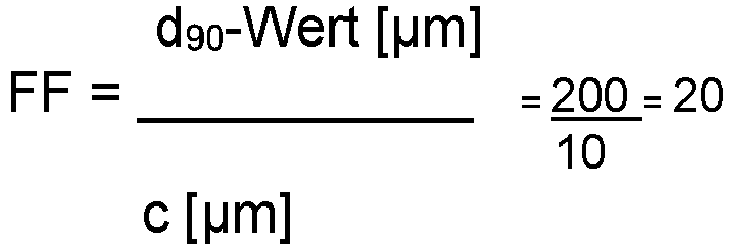
- Wird für eine zweite Graphitsorte ein höherer Wert für den Formfaktor aus deren d90-Wert und gemittelter Dicke c ermittelt, dann kann mit dieser Graphitsorte durch Mischung mit der ersten Graphitsorte die reversible Wärmedehnung der ersten Graphitsorte je nach Zusatzmenge im Gemisch mehr oder weniger gesenkt werden.
- Denn es konnte im Rahmen der Erfindung erst festgestellt werden, dass die reversible Wärmedehnung einer Graphitsorte mit ihrem Formfaktor korreliert, indem bei einem relativ niedrigen Formfaktor einer Graphitsorte eine relativ hohe reversible Wärmedehnung und bei einem relativ hohen Formfaktor einer Graphitsorte eine relativ niedrige reversible Wärmedehnung vorliegt.
- Die Differenz zwischen zwei Formfaktoren in einem Graphitsortengemisch beträgt erfindungsgemäß mindestens 10, insbesondere mindestens 50, vorzugsweise mindestens 80.
- Die zugemischte Menge der anderen Graphitsorte, der Zusatzgraphitsorte, richtet sich nach der Höhe der gewünschten Reduzierung der reversiblen Wärmedehnung der zu verändernden Graphitsorte, die ohne beachtlichen Einfluss auf andere Eigenschaften des jeweiligen, eine bestimmte Graphitmenge enthaltenden feuerfesten Erzeugnisses ist, in welchem erfindungsgemäß nunmehr ein Graphitgemisch enthalten ist, das eine reduzierte reversible Wärmedehnung entsprechend der Zusatzgraphitsortenmenge aufweist. Die zugegebene Menge der Zusatzgraphitsorte beträgt erfindungsgemäß < 50 Gew.-% und minimal 3 Gew.-% zum Graphitgemisch und ist nicht abhängig von der reversiblen Wärmedehnung des feuerfesten Erzeugnisses, die durch den Graphitgemischzusatz beeinflusst wird, weil die Absenkung der reversiblen Wärmedehnung des feuerfesten Erzeugnisses lediglich auf der reversiblen Wärmedehnung des Graphitgemisches beruht.
- Das Folgende verdeutlicht die Unbrauchbarkeit von lediglich Siebdurchgangswerten dx. Eine auf dem Markt erhältliche Graphitsorte wies einen d90-Wert von 30 µm und einen c-Wert von 0,4 µm auf. Eine andere Graphitsorte hatte einen d90-Wert von 154 µm und einen c-Wert von 2,0 µm. Bei beiden Graphitsorten errechneten sich beieinander liegende Formfaktoren von 75 und 77, d. h. beide Graphitsorten weisen bezüglich der möglichen Senkung der reversiblen Wärmedehnung die gleichen Wirkungen bezüglich des oben errechneten Formfaktors von 20 auf, obwohl die d90-Werte und die c-Werte weit auseinander liegen.
- Anhand der Zeichnung wird die Erfindung im Folgenden beispielhaft näher erläutert. Es zeigen:
- Fig. 1
- eine rasterelektronenmikroskopische Aufnahme (REM-Aufnahme) einer auf dem Markt erhältlichen Flockengraphitsorte mit Angaben von einigen optisch gemessenen Flockendicken;
- Fig. 2
- eine grafische Abbildung der Korrelation zwischen dem Wärmeausdehnungskoeffizienten und dem Formfaktor von verschiedenen Graphitsorten bei dem jeweiligen d90-Wert.
- Die reversible Wärmedehnung bzw. der Wärmeausdehnungskoeffizient einer Graphitpulversorte wird z. B. ermittelt, indem ein kaltisostatisch gepresster Graphitprobekörper hergestellt wird und dann die Wärmedehnung gemessen wird.
- Dazu wird eine Mischung des Graphits mit einem Novolak-Pulverharz plus Harzhärter z. B. Hexamethylentetramin erstellt, und zwar aus 95 Ma.% Graphit und 5 Ma.% Harz einschließlich 10 Ma.% Härter, bezogen auf das Harz. Die Mischung erfolgt in einem Intensivmischer (z. B. Eirichgegenstrommischer; 4 min bei 1500 U/min. Danach wird die Rohmischung in eine Latexform eingefüllt, die Form mit einem Stopfen mit Ventil verschlossen, und die eingefüllte Rohmischung mittels Vakuumpumpe evakuiert. Es erfolgt anschließend ein kaltisostatisches Pressen und ein Aushärten des Formkörpers für 2 h bei 200 °C. Aus dem gehärteten Formkörper wird anschließend ein Zylinder ausgebohrt und gesägt mit den Abmessungen d = 40 mm; h = 50 mm.
- Zur Bestimmung der Wärmedehnung am Graphitprobekörper wird der Graphitzylinder in eine Messkapsel eingebracht, die gefüllt ist mit Petrolkoks zum Schutz vor Abbrand des Kohlenstoffs, und für die Messung der Wärmedehnung ein Haubenofen z. B. der Firma Netzsch verwendet. Die präparierte Messkapsel wird in den Haubenofen eingebaut und eine Auflast von 0,02 MPa aufgebracht und der Probekörper bis 1500 °C aufgeheizt. Dabei wird die Wärmedehnung ermittelt mit einer aufgezeichneten Dehnungskurve. Die Berechnung des Wärmeausdehnungskoeffizienten α erfolgt dann aus dem Anstieg der Dehnungskurve in Abhängigkeit von der Temperatur, ermittelt in Anlehnung an DIN-EN 993-19.
- Die REM-Aufnahme (
Fig. 1 ) zeigt mehrere Graphitflocken einer auf dem Markt befindlichen Flockengraphitsorte, von denen einige mit "GF" beschriftet sind. Außerdem ist bei mehreren Graphitflocken die optisch analog ASTM E 112 bestimmte Dicke angegeben mit, wobei die gemessene Stelle mit einem Strich gekennzeichnet ist. Der Maßstab der REM-Aufnahme ist am Fuß der Aufnahme mit 200 µm angegeben. Aus den Dickenmessungen ergibt sich eine gemittelte Dicke c von aufgerundet 25 µm. Die Siebanalyse dieser Graphitsorte ergab einen d90-Wert von 400 µm, woraus ein Formfaktor FF = 16 resultiert. - Eine andere auf dem Markt befindliche Flockengraphitsorte wurde gleichermaßen analysiert und ergab einen Formenfaktor von FF = 94.
- Ein Gemisch aus 80 Gew.-% der ersten Flockengraphitsorte und 20 Gew.-% der zweiten Flockengewichtsgraphitsorte ergab einen WAK 10,2 × 10⁻⁶ K-1. Ein Gemisch aus 90 Gew.-% der ersten Flockengraphitsorte und 10 Gew.-% der zweiten Flockengraphitsorte ergab einen WAK 11,9 × 10⁻⁶ K-1. Ein Gemisch aus 70 Gew.-% der ersten Flockengraphitsorte und 30 Gew.-% der zweiten Flockengraphitsorte ergab einen WAK 8,5 × 10⁻⁶ K-1.
- Dieses Beispiel verdeutlicht, dass der Wärmeausdehnungskoeffizient und damit die reversible Wärmedehnung einer Graphitsorte über den Formfaktor FF gezielt verändert werden kann.
-
Fig. 2 zeigt die Korrelation des Wärmeausdehnungskoeffizienten verschiedener Flockengraphitsorten zum Formfaktor der Graphitsorten, wobei sich die Werte auf einer nur leicht durchgebogenen Verbindungslinie befinden. Dargestellt ist die Korrelation mit d90-Werten der Flockengraphitsorten. Gleiche und brauchbare Korrelationslinien ergeben sich mit anderen dx-Werten bis zu z. B. d50-Werten oder x-Werten über 90. Je höher dieser Durchgangswert liegt, desto genauer ist die Korrelation. Der dx-Wert sollte deshalb zweckmäßigerweise zwischen d50 und d95 liegen. - Erfindungsgemäß wird für die zu analysierenden Flockengraphitsorten der d90-Wert (x = 90) verwendet und anhand des errechneten Formfaktors die Zusatzgraphitsorte bzw. die Zusatzgraphitsorten ausgewählt, mit denen der Wärmeausdehnungskoeffizient einer hauptsächlich verwendeten Graphitsorte durch Zumischen einer Zusatzgraphitsorte deutlich gesenkt werden kann.
- Zweckmäßig ist eine Siebung nach ASTM E11-87 bzw. ISO 565.
- Das erfindungsgemäße Verfahren zur Senkung der reversiblen Wärmedehnung ist besonders effektiv anwendbar auf reine Graphiterzeugnisse, insbesondere reine feuerfeste Graphiterzeugnisse, die hauptsächlich aus Graphit bestehen, wie Tiegel, Graphitblöcke sowie andere Graphitbauteile, weil durch erfindungsgemäße Mischung von mindestens zwei verschiedenen Flockengraphitsorten, z. B. aus unterschiedlichen Lagerstätten stammend, Flockengraphite hergestellt werden können mit deutlich veränderter reversibler Wärmedehnung. Dies macht z. B. Sinn, wenn man lediglich die reversible Wärmedehnung der einen Graphitsorte verändern will und die anderen ursprünglichen Eigenschaften des Graphiterzeugnisses erhalten bleiben sollen.
- Eine Anwendung der erfindungsgemäßen gezielten und wirksamen Änderung der reversiblen Wärmedehnung einer Graphitsorte durch Zumischen einer über den Formfaktor dafür geeignet festgestellten, anderen Flockengraphitsorte ist für alle bekannten graphithaltigen, feuerfesten Erzeugnisse und andere Graphiterzeugnisse möglich. In allen graphithaltigen feuerfesten Erzeugnissen beeinflusst der Graphit die reversible Wärmedehnung grundsätzlich wegen seiner unterschiedlichen reversiblen Wärmedehnung im Vergleich zur Wärmedehnung des feuerfesten Werkstoffes. Zudem besteht eine Abhängigkeit von der Graphitmenge im feuerfesten Erzeugnis, wobei aber unterschiedliche Graphitmengen nicht nur unterschiedliche reversible Wärmedehnungen verursachen, sondern auch andere wesentliche Eigenschaften wie Kaltdruckfestigkeit, Kaltbiegefestigkeit, E-Modul und Temperaturwechselbeständigkeit verändern. Die vorliegende Erfindung schafft Abhilfe, indem nunmehr Graphitgemische als Graphitzusatz in gleicher Menge verwendet werden können, die lediglich die reversible Wärmedehnung verändern, nicht aber die anderen Eigenschaften in einem beachtlichen bzw. erheblichen Maße.
- Im Folgenden wird stellvertretend für andere graphithaltige feuerfeste Erzeugnisse anhand eines Beispiels die Wirksamkeit von Graphitsortengemischen auf den Wärmeausdehnungskoeffizienten bei MgO-C-Steinen verdeutlicht.
- Es wurden MgO-C-Steine mit einer Zusammensetzung gemäß Tabelle 1 wie üblich hergestellt, wobei der Standardgraphit 1 durch 20 Gew.-% der Graphitsorte 7 der in
Fig. 2 bezeichneten Graphite ersetzt worden ist. Die Anteile in der folgenden Tabelle 1 sind Gewichtsprozente.Tabelle 1 Zusammensetzung der MgO-C-Steine Rohstoff Kornfraktionen [mm] Anteil [%] Fused MgO 97 2-4 34.00 Fused MgO 97 1-2 22.00 Fused MgO 97 0-1 20.00 Fused MgO 97 Mehl 14.00 Graphit 1 8.00 Graphit 7 2.00 Menge % Phenolharz 3.00 - Das Ergebnis zeigt die folgende Tabelle 2. Es ergab sich, wie aus der Tabelle 2 ersichtlich, dass der Wärmeausdehnungskoeffizient α von 8,72 auf 7,20 gesenkt werden konnte. Die Messung der thermischen Dehnung wurde in Anlehnung an DIN-EN 993-19 durchgeführt.

- Es liegt auch im Rahmen der Erfindung, mindestens eine synthetische Graphitsorte, insbesondere als Zusatzgraphitsorte zu verwenden.
- Ein erfindungsgemäßes Verfahren zur Reduzierung der reversiblen Wärmedehnung eines Graphit haltigen, insbesondere Naturgraphit haltigen, geformten, feuerfesten Erzeugnisses auf Basis feuerfester Werkstoffgranulate liegt vor, wenn die Granulatkörner der Werkstoffgranulate mit einem an sich bekannten Bindemittel und/oder einer keramischen Bindung zu einem Formkörper verfestigt sind und
- ein Gemisch aus mindestens zwei Flockengraphitsorten mit jeweils unterschiedlichen Wärmeausdehnungskoeffizienten verwendet worden ist, wobei
- eine Graphitsorte mengenmäßig überwiegt und die andere Graphitsorte als Zusatzgraphitsorte fungiert,
- sich die Graphitsorten in einem mit ihrem Wärmeausdehnungskoeffizienten korrelierenden Formfaktor FF unterscheiden, wobei die eine Graphitsorte einen niedrigeren Formfaktor FF aufweist und den überwiegenden Bestandteil des Graphitgemisches ausmacht und die andere Graphitsorte einen höheren Formfaktor FF aufweist, und wobei der Formfaktor FF jeder Graphitsorte vor dem Mischen ermittelt wird,
- jeder Formfaktor FF wie folgt ermittelt wird:
- Siebung der Graphitsorte und Ermittlung der Maschenweite in µm eines Siebes, das eine bestimmte prozentuale Durchgangsmenge x in Gew.-% durchlässt (dx-Wert),
- Ermittlung der aus einer statistisch ausreichenden Anzahl von Messungen von Graphitflocken ermittelten gemittelten Dicke c mit einem optischen Verfahren aus mindestens einer REM-Aufnahme der jeweiligen Graphitsorte,
- Berechnung des Formfaktors FF mit der Formel:

- die Maschenweite unter Verwendung eines x-Wertes von 90 ermittelt wird,
- Graphitsorten für ein Graphitgemisch verwendet werden, deren Differenz zwischen ihren Formfaktoren FF (Δ FF) mindestens 10, vorzugsweise mindestens 50, bevorzugt mindestens 85 beträgt,
- die Zusatzmenge der Graphitsorte mit dem größeren Formfaktor FF zur Graphitsorte mit dem kleineren Formfaktor FF oder umgekehrt, je nachdem welcher Wärmeausdehnungskoeffizient verändert werden soll, minimal 3 und < 50 Gew.-% beträgt und insbesondere zwischen 5 und 30 Gew.-% liegt,
- Vorzugsweise werden zudem Graphitsorten mit Formfaktoren FF von mindestens 10, insbesondere von mindestens 50 und vorzugsweise von mindestens 100 zur Herstellung von Graphitgemischen verwendet.
- Außerdem wird vorzugsweise für die feuerfesten Werkstoffgranulate mindestens ein feuerfester Werkstoff aus der folgenden Gruppe verwendet:
MgO, Al2O3, SiO2, Zr2O3, CaO, Cr2O3 vorzugsweise aber MgO.
Claims (6)
- Verfahren zur Reduzierung der reversiblen Wärmedehnung eines Graphit haltigen, feuerfesten geformten Erzeugnisses auf Basis feuerfester Werkstoffgranulate, wobei die Granulatkörner der Werkstoffgranulate mit einem an sich bekannten Bindemittel und/oder einer keramischen Bindung zu einem Formkörper verfestigt sind und wobei ein Gemenge zumindest aus mindestens einem feuerfesten Werkstoff, mindestens einem Bindemittel und einer bestimmten Menge Flockengraphit hergestellt und geformt wird, wobeials Graphit ein Graphitgemisch aus mindestens zwei Flockengraphitsorten verwendet wird, die sich mit ihrem Wärmeausdehnungskoeffizienten unterscheiden, wobei die eine Flockengraphitsorte mengenmäßig überwiegt im Graphitgemisch und die andere Flockengraphitsorte als Zusatzgraphitsorte fungiert,dadurch gekennzeichnet, dasssich die Flockengraphitsorten in einem mit ihrem Wärmeausdehnungskoeffizienten korrelierenden Formfaktor FF unterscheiden, wobei die eine, den überwiegenden Bestandteil des Graphitgemisches ausmachende, Flockengraphitsorte einen niedrigeren Formfaktor FF aufweist und die Zusatzgraphitsorte einen höheren Formfaktor FF aufweist, und wobei der Formfaktor FF jeder Flockengraphitsorte vor dem Mischen ermittelt wird, wobei jeder Formfaktor FF wie folgt ermittelt wird:- Siebung der Flockengraphitsorte und Ermittlung der Maschenweite in µm eines Siebes, das eine bestimmte prozentuale Durchgangsmenge x in Gew.-% durchlässt (dx-Wert)- Ermittlung der aus einer statistisch ausreichenden Anzahl von Messungen von Graphitflocken ermittelten gemittelten Dicke c mit einem optischen Verfahren aus mindestens einer REM-Aufnahme der jeweiligen Flockengraphitsorte- Berechnung des Formfaktors FF mit der Formel:
 wobei die Maschenweite unter Verwendung eines x-Wertes von x= 90 ermittelt wird,wobei Flockengraphitsorten für das Graphitgemisch verwendet werden, deren Differenz zwischen ihren Formfaktoren FF (Δ FF) mindestens 10 beträgt, undwobei die Zusatzmenge der Zusatzgraphitsorte mit dem größeren Formfaktor FF zur Flockengraphitsorte mit dem kleineren Formfaktor FF minimal 3 und < 50 Gew.-% beträgt und insbesondere zwischen 3 und 30 Gew.-% liegt.
- Verfahren nach Anspruch 1,
dadurch gekennzeichnet, dass
Flockengraphitsorten mit Formfaktoren FF von mindestens 10, insbesondere von mindestens 50, vorzugsweise von mindestens 100 zur Herstellung des Graphitgemisches verwendet werden. - Verfahren nach Anspruch 1 oder 2,
dadurch gekennzeichnet, dass
Flockengraphitsorten für das Graphitgemisch verwendet werden, deren Differenz zwischen ihren Formfaktoren FF (Δ FF) mindestens 50, insbesondere mindestens 85, beträgt. - Verfahren nach einem der vorhergehenden Ansprüche,dadurch gekennzeichnet, dassfür die feuerfesten Werkstoffgranulate mindestens ein feuerfester Werkstoff aus der folgenden Gruppe verwendet wird:
MgO, Al2O3, SiO2, Zr2O3, CaO, Cr2O3 vorzugsweise aber MgO verwendet wird. - Verfahren nach einem der vorhergehenden Ansprüche,
dadurch gekennzeichnet, dass
es sich bei den Flockengraphitsorten um Naturgraphit handelt. - Verfahren nach einem der vorhergehenden Ansprüche,
dadurch gekennzeichnet, dass
der Formfaktor FF der Naturgraphitsorten zwischen 5 und 200, insbesondere zwischen 10 und 100 liegt.
Priority Applications (2)
| Application Number | Priority Date | Filing Date | Title |
|---|---|---|---|
| SI201431911T SI2999677T1 (sl) | 2013-05-23 | 2014-04-30 | Postopek za zmanjševanje reverzibilnega raztezanja ognjevzdržno oblikovanega predmeta, ki vsebuje grafit |
| PL14722162T PL2999677T3 (pl) | 2013-05-23 | 2014-04-30 | Sposób zmniejszania odwracalnej rozszerzalności cieplnej kształtowanego wyrobu ogniotrwałego zawierającego grafit |
Applications Claiming Priority (2)
| Application Number | Priority Date | Filing Date | Title |
|---|---|---|---|
| DE201310008855 DE102013008855B9 (de) | 2013-05-23 | 2013-05-23 | Graphithaltiges feuerfestes Erzeugnis und Verfahren zu seiner Herstellung |
| PCT/EP2014/058854 WO2014187653A1 (de) | 2013-05-23 | 2014-04-30 | Graphit haltiges feuerfestes erzeugnis, verfahren zu seiner herstellung und seine verwendung |
Publications (2)
| Publication Number | Publication Date |
|---|---|
| EP2999677A1 EP2999677A1 (de) | 2016-03-30 |
| EP2999677B1 true EP2999677B1 (de) | 2021-10-13 |
Family
ID=50680024
Family Applications (1)
| Application Number | Title | Priority Date | Filing Date |
|---|---|---|---|
| EP14722162.6A Active EP2999677B1 (de) | 2013-05-23 | 2014-04-30 | Verfahren zur reduzierung der reversiblen wärmedehnung eines graphithaltigen feuerfesten geformten erzeugnisses |
Country Status (11)
| Country | Link |
|---|---|
| US (1) | US9862645B2 (de) |
| EP (1) | EP2999677B1 (de) |
| JP (1) | JP6253768B2 (de) |
| CN (1) | CN105121383B (de) |
| BR (1) | BR112015027276B1 (de) |
| DE (1) | DE102013008855B9 (de) |
| ES (1) | ES2896373T3 (de) |
| PL (1) | PL2999677T3 (de) |
| RU (1) | RU2638075C2 (de) |
| SI (1) | SI2999677T1 (de) |
| WO (1) | WO2014187653A1 (de) |
Families Citing this family (5)
| Publication number | Priority date | Publication date | Assignee | Title |
|---|---|---|---|---|
| US10287210B2 (en) | 2014-12-05 | 2019-05-14 | Kercher Enterprises, Inc. | Production of pellets |
| DE102014019351A1 (de) | 2014-12-22 | 2016-06-23 | Refratechnik Holding Gmbh | Feuerfeste Erzeugnisse und ihre Verwendung |
| DE102014019347A1 (de) * | 2014-12-22 | 2016-06-23 | Refratechnik Holding Gmbh | Feuerfeste Erzeugnisse und ihre Verwendung |
| GB201505769D0 (en) * | 2015-04-02 | 2015-05-20 | Advanced Insulation Plc | Coating material |
| KR102146750B1 (ko) * | 2020-05-15 | 2020-08-21 | (주)포스코케미칼 | 저취 내화물 |
Family Cites Families (9)
| Publication number | Priority date | Publication date | Assignee | Title |
|---|---|---|---|---|
| LU34689A1 (de) * | 1956-12-31 | |||
| JPS59169968A (ja) * | 1983-03-12 | 1984-09-26 | 黒崎窯業株式会社 | 黒鉛含有耐火物 |
| RU1531398C (ru) | 1988-04-25 | 1993-01-07 | Восточный научно-исследовательский и проектный институт огнеупорной промышленности | Способ изготовлени периклазоуглеродистого огнеупора |
| RU2148049C1 (ru) | 1997-10-30 | 2000-04-27 | Открытое акционерное общество "Комбинат Магнезит" | Шпинельно-периклазоуглеродистый огнеупор |
| ES2288772T3 (es) * | 1998-01-28 | 2008-01-16 | Krosaki Corporation | Material refractario de alumina-magnesia-grafito. |
| JP3852261B2 (ja) * | 2000-03-13 | 2006-11-29 | Jfeスチール株式会社 | 金属精錬炉 |
| JP2009221031A (ja) | 2008-03-13 | 2009-10-01 | Kurosaki Harima Corp | ジルコニア−炭素含有耐火物及びその製造方法 |
| WO2011118535A1 (ja) * | 2010-03-25 | 2011-09-29 | 積水化学工業株式会社 | 樹脂組成物、合成樹脂シート、合成樹脂成形品及び合成樹脂積層体 |
| JP2011213519A (ja) | 2010-03-31 | 2011-10-27 | Kurosaki Harima Corp | 厚肉鱗状黒鉛含有耐火物 |
-
2013
- 2013-05-23 DE DE201310008855 patent/DE102013008855B9/de active Active
-
2014
- 2014-04-30 WO PCT/EP2014/058854 patent/WO2014187653A1/de not_active Ceased
- 2014-04-30 US US14/892,669 patent/US9862645B2/en active Active
- 2014-04-30 CN CN201480019955.XA patent/CN105121383B/zh active Active
- 2014-04-30 JP JP2016514318A patent/JP6253768B2/ja active Active
- 2014-04-30 EP EP14722162.6A patent/EP2999677B1/de active Active
- 2014-04-30 RU RU2015144336A patent/RU2638075C2/ru active
- 2014-04-30 PL PL14722162T patent/PL2999677T3/pl unknown
- 2014-04-30 ES ES14722162T patent/ES2896373T3/es active Active
- 2014-04-30 SI SI201431911T patent/SI2999677T1/sl unknown
- 2014-04-30 BR BR112015027276-2A patent/BR112015027276B1/pt active IP Right Grant
Non-Patent Citations (1)
| Title |
|---|
| P.P. MAGAMPA ET AL: "Properties of graphite composites based on natural and synthetic graphite powders and a phenolic novolac binder", JOURNAL OF NUCLEAR MATERIALS, vol. 436, no. 1-3, 4 February 2013 (2013-02-04), pages 76 - 83, XP055157848, ISSN: 0022-3115, DOI: 10.1016/j.jnucmat.2013.01.315 * |
Also Published As
| Publication number | Publication date |
|---|---|
| SI2999677T1 (sl) | 2021-12-31 |
| EP2999677A1 (de) | 2016-03-30 |
| CN105121383A (zh) | 2015-12-02 |
| JP6253768B2 (ja) | 2017-12-27 |
| DE102013008855B9 (de) | 2015-04-23 |
| PL2999677T3 (pl) | 2022-01-17 |
| DE102013008855B4 (de) | 2015-02-05 |
| DE102013008855A1 (de) | 2014-11-27 |
| ES2896373T3 (es) | 2022-02-24 |
| BR112015027276B1 (pt) | 2021-11-16 |
| US9862645B2 (en) | 2018-01-09 |
| US20160122248A1 (en) | 2016-05-05 |
| RU2638075C2 (ru) | 2017-12-11 |
| WO2014187653A1 (de) | 2014-11-27 |
| BR112015027276A2 (pt) | 2017-07-25 |
| RU2015144336A (ru) | 2017-06-27 |
| CN105121383B (zh) | 2018-01-30 |
| JP2016526001A (ja) | 2016-09-01 |
Similar Documents
| Publication | Publication Date | Title |
|---|---|---|
| DE112009000724B4 (de) | Ziegelsteinplatte und Verfahren zu ihrer Herstellung | |
| DE4437558C2 (de) | Verfahren zur Herstellung eines hochfesten isotropen Graphitformkörpers und Kolbenbauteil für Ottomotoren, bestehend aus hochfestem isotropem Graphit | |
| DE102013008855B9 (de) | Graphithaltiges feuerfestes Erzeugnis und Verfahren zu seiner Herstellung | |
| DE102009041940A1 (de) | Herstellungsverfahren für gesinterte Ventilführung | |
| DE10111225A1 (de) | Verbundwerkstoff auf der Basis von Siliciumcarbid und Kohlenstoff, Verfahren zu seiner Herstellung sowie seine Verwendung | |
| DE3409006C2 (de) | ||
| DE68914598T2 (de) | Keramischer Verbundwerkstoff und Verfahren zu seiner Herstellung. | |
| EP4638390A1 (de) | Feuerfestes material, verfahren zur dessen herstellung und verwendung desselben | |
| DE10356376B3 (de) | Kohlenstoffsteine mit geeigneter Porosität und Verfahren zu deren Herstellung | |
| DE112012004408B4 (de) | Korrosionsresistente und abnutzungsresistente Legierung auf Ni -Basis | |
| EP2057106B1 (de) | Gebranntes feuerfestes produkt | |
| DE102006040269B4 (de) | Gebranntes feuerfestes keramisches Produkt | |
| DE102013008856B4 (de) | Graphiterzeugnis und Verfahren zu seiner Herstellung | |
| EP4334054A1 (de) | Sinterkarbid-material | |
| DE102013008854B9 (de) | Graphitpulvergemisch und Verfahren zu seiner Herstellung | |
| DE19925591A1 (de) | Feuerfester Versatz, insbesondere zur Herstellung eines Formkörpers und Verfahren zur Herstellung des Formkörpers | |
| DE102005032331B4 (de) | Mischkeramik mit hoher Bruchzähigkeit, Verfahren zu ihrer Herstellung und ihre Verwendung | |
| DE4409078C1 (de) | Feuerfester Stein | |
| EP4592268A1 (de) | Feuerfestes material, verfahren zur dessen herstel-lung und verwendung desselben | |
| DE2320887C3 (de) | Pumpenteil einer HeiBkammer-Atuminium-Spritzgußmaschine | |
| WO2022199989A1 (de) | Reibbelagzusammensetzung für kupplungen von windkraftanlagen und reibbelag | |
| DE202022102141U1 (de) | Sinterkarbid-Material | |
| EP0755904A1 (de) | Mischkeramik auf Aluminiumoxidbasis | |
| DE102019207762A1 (de) | Verbundwerkstoff enthaltend kohlenstoff und einen werkstoff auf basis von metall | |
| DE102021006541A1 (de) | Sinterkarbid-Material |
Legal Events
| Date | Code | Title | Description |
|---|---|---|---|
| PUAI | Public reference made under article 153(3) epc to a published international application that has entered the european phase |
Free format text: ORIGINAL CODE: 0009012 |
|
| 17P | Request for examination filed |
Effective date: 20151130 |
|
| AK | Designated contracting states |
Kind code of ref document: A1 Designated state(s): AL AT BE BG CH CY CZ DE DK EE ES FI FR GB GR HR HU IE IS IT LI LT LU LV MC MK MT NL NO PL PT RO RS SE SI SK SM TR |
|
| AX | Request for extension of the european patent |
Extension state: BA ME |
|
| DAX | Request for extension of the european patent (deleted) | ||
| STAA | Information on the status of an ep patent application or granted ep patent |
Free format text: STATUS: EXAMINATION IS IN PROGRESS |
|
| 17Q | First examination report despatched |
Effective date: 20170929 |
|
| RAP3 | Party data changed (applicant data changed or rights of an application transferred) |
Owner name: REFRATECHNIK HOLDING GMBH |
|
| REG | Reference to a national code |
Ref country code: DE Ref legal event code: R079 Ref document number: 502014015936 Country of ref document: DE Free format text: PREVIOUS MAIN CLASS: C04B0035010000 Ipc: C04B0035520000 |
|
| GRAP | Despatch of communication of intention to grant a patent |
Free format text: ORIGINAL CODE: EPIDOSNIGR1 |
|
| STAA | Information on the status of an ep patent application or granted ep patent |
Free format text: STATUS: GRANT OF PATENT IS INTENDED |
|
| RIC1 | Information provided on ipc code assigned before grant |
Ipc: C04B 35/043 20060101ALI20210617BHEP Ipc: C04B 35/03 20060101ALI20210617BHEP Ipc: C04B 35/01 20060101ALI20210617BHEP Ipc: C04B 35/52 20060101AFI20210617BHEP |
|
| INTG | Intention to grant announced |
Effective date: 20210705 |
|
| GRAS | Grant fee paid |
Free format text: ORIGINAL CODE: EPIDOSNIGR3 |
|
| GRAA | (expected) grant |
Free format text: ORIGINAL CODE: 0009210 |
|
| STAA | Information on the status of an ep patent application or granted ep patent |
Free format text: STATUS: THE PATENT HAS BEEN GRANTED |
|
| AK | Designated contracting states |
Kind code of ref document: B1 Designated state(s): AL AT BE BG CH CY CZ DE DK EE ES FI FR GB GR HR HU IE IS IT LI LT LU LV MC MK MT NL NO PL PT RO RS SE SI SK SM TR |
|
| REG | Reference to a national code |
Ref country code: GB Ref legal event code: FG4D Free format text: NOT ENGLISH |
|
| REG | Reference to a national code |
Ref country code: CH Ref legal event code: EP |
|
| REG | Reference to a national code |
Ref country code: DE Ref legal event code: R096 Ref document number: 502014015936 Country of ref document: DE |
|
| REG | Reference to a national code |
Ref country code: IE Ref legal event code: FG4D Free format text: LANGUAGE OF EP DOCUMENT: GERMAN |
|
| REG | Reference to a national code |
Ref country code: AT Ref legal event code: REF Ref document number: 1438095 Country of ref document: AT Kind code of ref document: T Effective date: 20211115 |
|
| REG | Reference to a national code |
Ref country code: NL Ref legal event code: FP |
|
| REG | Reference to a national code |
Ref country code: LT Ref legal event code: MG9D |
|
| REG | Reference to a national code |
Ref country code: ES Ref legal event code: FG2A Ref document number: 2896373 Country of ref document: ES Kind code of ref document: T3 Effective date: 20220224 |
|
| PG25 | Lapsed in a contracting state [announced via postgrant information from national office to epo] |
Ref country code: RS Free format text: LAPSE BECAUSE OF FAILURE TO SUBMIT A TRANSLATION OF THE DESCRIPTION OR TO PAY THE FEE WITHIN THE PRESCRIBED TIME-LIMIT Effective date: 20211013 Ref country code: LT Free format text: LAPSE BECAUSE OF FAILURE TO SUBMIT A TRANSLATION OF THE DESCRIPTION OR TO PAY THE FEE WITHIN THE PRESCRIBED TIME-LIMIT Effective date: 20211013 Ref country code: FI Free format text: LAPSE BECAUSE OF FAILURE TO SUBMIT A TRANSLATION OF THE DESCRIPTION OR TO PAY THE FEE WITHIN THE PRESCRIBED TIME-LIMIT Effective date: 20211013 |
|
| PG25 | Lapsed in a contracting state [announced via postgrant information from national office to epo] |
Ref country code: IS Free format text: LAPSE BECAUSE OF FAILURE TO SUBMIT A TRANSLATION OF THE DESCRIPTION OR TO PAY THE FEE WITHIN THE PRESCRIBED TIME-LIMIT Effective date: 20220213 Ref country code: SE Free format text: LAPSE BECAUSE OF FAILURE TO SUBMIT A TRANSLATION OF THE DESCRIPTION OR TO PAY THE FEE WITHIN THE PRESCRIBED TIME-LIMIT Effective date: 20211013 Ref country code: PT Free format text: LAPSE BECAUSE OF FAILURE TO SUBMIT A TRANSLATION OF THE DESCRIPTION OR TO PAY THE FEE WITHIN THE PRESCRIBED TIME-LIMIT Effective date: 20220214 Ref country code: NO Free format text: LAPSE BECAUSE OF FAILURE TO SUBMIT A TRANSLATION OF THE DESCRIPTION OR TO PAY THE FEE WITHIN THE PRESCRIBED TIME-LIMIT Effective date: 20220113 Ref country code: LV Free format text: LAPSE BECAUSE OF FAILURE TO SUBMIT A TRANSLATION OF THE DESCRIPTION OR TO PAY THE FEE WITHIN THE PRESCRIBED TIME-LIMIT Effective date: 20211013 Ref country code: HR Free format text: LAPSE BECAUSE OF FAILURE TO SUBMIT A TRANSLATION OF THE DESCRIPTION OR TO PAY THE FEE WITHIN THE PRESCRIBED TIME-LIMIT Effective date: 20211013 Ref country code: GR Free format text: LAPSE BECAUSE OF FAILURE TO SUBMIT A TRANSLATION OF THE DESCRIPTION OR TO PAY THE FEE WITHIN THE PRESCRIBED TIME-LIMIT Effective date: 20220114 |
|
| REG | Reference to a national code |
Ref country code: DE Ref legal event code: R097 Ref document number: 502014015936 Country of ref document: DE |
|
| PG25 | Lapsed in a contracting state [announced via postgrant information from national office to epo] |
Ref country code: SM Free format text: LAPSE BECAUSE OF FAILURE TO SUBMIT A TRANSLATION OF THE DESCRIPTION OR TO PAY THE FEE WITHIN THE PRESCRIBED TIME-LIMIT Effective date: 20211013 Ref country code: SK Free format text: LAPSE BECAUSE OF FAILURE TO SUBMIT A TRANSLATION OF THE DESCRIPTION OR TO PAY THE FEE WITHIN THE PRESCRIBED TIME-LIMIT Effective date: 20211013 Ref country code: RO Free format text: LAPSE BECAUSE OF FAILURE TO SUBMIT A TRANSLATION OF THE DESCRIPTION OR TO PAY THE FEE WITHIN THE PRESCRIBED TIME-LIMIT Effective date: 20211013 Ref country code: EE Free format text: LAPSE BECAUSE OF FAILURE TO SUBMIT A TRANSLATION OF THE DESCRIPTION OR TO PAY THE FEE WITHIN THE PRESCRIBED TIME-LIMIT Effective date: 20211013 Ref country code: DK Free format text: LAPSE BECAUSE OF FAILURE TO SUBMIT A TRANSLATION OF THE DESCRIPTION OR TO PAY THE FEE WITHIN THE PRESCRIBED TIME-LIMIT Effective date: 20211013 Ref country code: CZ Free format text: LAPSE BECAUSE OF FAILURE TO SUBMIT A TRANSLATION OF THE DESCRIPTION OR TO PAY THE FEE WITHIN THE PRESCRIBED TIME-LIMIT Effective date: 20211013 |
|
| PLBE | No opposition filed within time limit |
Free format text: ORIGINAL CODE: 0009261 |
|
| STAA | Information on the status of an ep patent application or granted ep patent |
Free format text: STATUS: NO OPPOSITION FILED WITHIN TIME LIMIT |
|
| 26N | No opposition filed |
Effective date: 20220714 |
|
| PG25 | Lapsed in a contracting state [announced via postgrant information from national office to epo] |
Ref country code: AL Free format text: LAPSE BECAUSE OF FAILURE TO SUBMIT A TRANSLATION OF THE DESCRIPTION OR TO PAY THE FEE WITHIN THE PRESCRIBED TIME-LIMIT Effective date: 20211013 |
|
| GBPC | Gb: european patent ceased through non-payment of renewal fee |
Effective date: 20220430 |
|
| REG | Reference to a national code |
Ref country code: BE Ref legal event code: MM Effective date: 20220430 |
|
| PG25 | Lapsed in a contracting state [announced via postgrant information from national office to epo] |
Ref country code: MC Free format text: LAPSE BECAUSE OF FAILURE TO SUBMIT A TRANSLATION OF THE DESCRIPTION OR TO PAY THE FEE WITHIN THE PRESCRIBED TIME-LIMIT Effective date: 20211013 Ref country code: LU Free format text: LAPSE BECAUSE OF NON-PAYMENT OF DUE FEES Effective date: 20220430 Ref country code: GB Free format text: LAPSE BECAUSE OF NON-PAYMENT OF DUE FEES Effective date: 20220430 |
|
| PG25 | Lapsed in a contracting state [announced via postgrant information from national office to epo] |
Ref country code: BE Free format text: LAPSE BECAUSE OF NON-PAYMENT OF DUE FEES Effective date: 20220430 |
|
| PG25 | Lapsed in a contracting state [announced via postgrant information from national office to epo] |
Ref country code: IE Free format text: LAPSE BECAUSE OF NON-PAYMENT OF DUE FEES Effective date: 20220430 |
|
| P01 | Opt-out of the competence of the unified patent court (upc) registered |
Effective date: 20230519 |
|
| PG25 | Lapsed in a contracting state [announced via postgrant information from national office to epo] |
Ref country code: HU Free format text: LAPSE BECAUSE OF FAILURE TO SUBMIT A TRANSLATION OF THE DESCRIPTION OR TO PAY THE FEE WITHIN THE PRESCRIBED TIME-LIMIT; INVALID AB INITIO Effective date: 20140430 |
|
| PG25 | Lapsed in a contracting state [announced via postgrant information from national office to epo] |
Ref country code: MK Free format text: LAPSE BECAUSE OF FAILURE TO SUBMIT A TRANSLATION OF THE DESCRIPTION OR TO PAY THE FEE WITHIN THE PRESCRIBED TIME-LIMIT Effective date: 20211013 Ref country code: CY Free format text: LAPSE BECAUSE OF FAILURE TO SUBMIT A TRANSLATION OF THE DESCRIPTION OR TO PAY THE FEE WITHIN THE PRESCRIBED TIME-LIMIT Effective date: 20211013 |
|
| PG25 | Lapsed in a contracting state [announced via postgrant information from national office to epo] |
Ref country code: TR Free format text: LAPSE BECAUSE OF FAILURE TO SUBMIT A TRANSLATION OF THE DESCRIPTION OR TO PAY THE FEE WITHIN THE PRESCRIBED TIME-LIMIT Effective date: 20211013 |
|
| PG25 | Lapsed in a contracting state [announced via postgrant information from national office to epo] |
Ref country code: MT Free format text: LAPSE BECAUSE OF FAILURE TO SUBMIT A TRANSLATION OF THE DESCRIPTION OR TO PAY THE FEE WITHIN THE PRESCRIBED TIME-LIMIT Effective date: 20211013 |
|
| PGFP | Annual fee paid to national office [announced via postgrant information from national office to epo] |
Ref country code: IT Payment date: 20260313 Year of fee payment: 13 |
|
| PGFP | Annual fee paid to national office [announced via postgrant information from national office to epo] |
Ref country code: NL Payment date: 20260312 Year of fee payment: 13 |
|
| PGFP | Annual fee paid to national office [announced via postgrant information from national office to epo] |
Ref country code: FR Payment date: 20260311 Year of fee payment: 13 |
|
| PGFP | Annual fee paid to national office [announced via postgrant information from national office to epo] |
Ref country code: PL Payment date: 20260306 Year of fee payment: 13 |
|
| PGFP | Annual fee paid to national office [announced via postgrant information from national office to epo] |
Ref country code: SI Payment date: 20260306 Year of fee payment: 13 |
|
| PGFP | Annual fee paid to national office [announced via postgrant information from national office to epo] |
Ref country code: BG Payment date: 20260306 Year of fee payment: 13 |
|
| REG | Reference to a national code |
Ref country code: CH Ref legal event code: U11 Free format text: ST27 STATUS EVENT CODE: U-0-0-U10-U11 (AS PROVIDED BY THE NATIONAL OFFICE) Effective date: 20260501 |
|
| PGFP | Annual fee paid to national office [announced via postgrant information from national office to epo] |
Ref country code: ES Payment date: 20260508 Year of fee payment: 13 |
|
| PGFP | Annual fee paid to national office [announced via postgrant information from national office to epo] |
Ref country code: DE Payment date: 20260629 Year of fee payment: 13 |
|
| PGFP | Annual fee paid to national office [announced via postgrant information from national office to epo] |
Ref country code: AT Payment date: 20260310 Year of fee payment: 13 |
|
| PGFP | Annual fee paid to national office [announced via postgrant information from national office to epo] |
Ref country code: CH Payment date: 20260501 Year of fee payment: 13 |