EP3009793B1 - Procédé de fabrication d'un dispositif mems piézoélectrique - Google Patents
Procédé de fabrication d'un dispositif mems piézoélectrique Download PDFInfo
- Publication number
- EP3009793B1 EP3009793B1 EP15189732.9A EP15189732A EP3009793B1 EP 3009793 B1 EP3009793 B1 EP 3009793B1 EP 15189732 A EP15189732 A EP 15189732A EP 3009793 B1 EP3009793 B1 EP 3009793B1
- Authority
- EP
- European Patent Office
- Prior art keywords
- material layer
- electrode material
- top electrode
- layer
- bottom electrode
- Prior art date
- Legal status (The legal status is an assumption and is not a legal conclusion. Google has not performed a legal analysis and makes no representation as to the accuracy of the status listed.)
- Active
Links
Images




Classifications
-
- H—ELECTRICITY
- H10—SEMICONDUCTOR DEVICES; ELECTRIC SOLID-STATE DEVICES NOT OTHERWISE PROVIDED FOR
- H10N—ELECTRIC SOLID-STATE DEVICES NOT OTHERWISE PROVIDED FOR
- H10N30/00—Piezoelectric or electrostrictive devices
- H10N30/80—Constructional details
- H10N30/87—Electrodes or interconnections, e.g. leads or terminals
-
- G—PHYSICS
- G01—MEASURING; TESTING
- G01C—MEASURING DISTANCES, LEVELS OR BEARINGS; SURVEYING; NAVIGATION; GYROSCOPIC INSTRUMENTS; PHOTOGRAMMETRY OR VIDEOGRAMMETRY
- G01C19/00—Gyroscopes; Turn-sensitive devices using vibrating masses; Turn-sensitive devices without moving masses; Measuring angular rate using gyroscopic effects
- G01C19/56—Turn-sensitive devices using vibrating masses, e.g. vibratory angular rate sensors based on Coriolis forces
- G01C19/5719—Turn-sensitive devices using vibrating masses, e.g. vibratory angular rate sensors based on Coriolis forces using planar vibrating masses driven in a translation vibration along an axis
- G01C19/5769—Manufacturing; Mounting; Housings
-
- H—ELECTRICITY
- H10—SEMICONDUCTOR DEVICES; ELECTRIC SOLID-STATE DEVICES NOT OTHERWISE PROVIDED FOR
- H10N—ELECTRIC SOLID-STATE DEVICES NOT OTHERWISE PROVIDED FOR
- H10N30/00—Piezoelectric or electrostrictive devices
- H10N30/01—Manufacture or treatment
- H10N30/06—Forming electrodes or interconnections, e.g. leads or terminals
-
- H—ELECTRICITY
- H10—SEMICONDUCTOR DEVICES; ELECTRIC SOLID-STATE DEVICES NOT OTHERWISE PROVIDED FOR
- H10N—ELECTRIC SOLID-STATE DEVICES NOT OTHERWISE PROVIDED FOR
- H10N30/00—Piezoelectric or electrostrictive devices
- H10N30/01—Manufacture or treatment
- H10N30/08—Shaping or machining of piezoelectric or electrostrictive bodies
- H10N30/082—Shaping or machining of piezoelectric or electrostrictive bodies by etching, e.g. lithography
-
- H—ELECTRICITY
- H10—SEMICONDUCTOR DEVICES; ELECTRIC SOLID-STATE DEVICES NOT OTHERWISE PROVIDED FOR
- H10N—ELECTRIC SOLID-STATE DEVICES NOT OTHERWISE PROVIDED FOR
- H10N30/00—Piezoelectric or electrostrictive devices
- H10N30/30—Piezoelectric or electrostrictive devices with mechanical input and electrical output, e.g. functioning as generators or sensors
-
- H—ELECTRICITY
- H10—SEMICONDUCTOR DEVICES; ELECTRIC SOLID-STATE DEVICES NOT OTHERWISE PROVIDED FOR
- H10N—ELECTRIC SOLID-STATE DEVICES NOT OTHERWISE PROVIDED FOR
- H10N30/00—Piezoelectric or electrostrictive devices
- H10N30/80—Constructional details
- H10N30/87—Electrodes or interconnections, e.g. leads or terminals
- H10N30/875—Further connection or lead arrangements, e.g. flexible wiring boards, terminal pins
-
- H—ELECTRICITY
- H10—SEMICONDUCTOR DEVICES; ELECTRIC SOLID-STATE DEVICES NOT OTHERWISE PROVIDED FOR
- H10N—ELECTRIC SOLID-STATE DEVICES NOT OTHERWISE PROVIDED FOR
- H10N30/00—Piezoelectric or electrostrictive devices
- H10N30/80—Constructional details
- H10N30/87—Electrodes or interconnections, e.g. leads or terminals
- H10N30/877—Conductive materials
-
- H—ELECTRICITY
- H10—SEMICONDUCTOR DEVICES; ELECTRIC SOLID-STATE DEVICES NOT OTHERWISE PROVIDED FOR
- H10N—ELECTRIC SOLID-STATE DEVICES NOT OTHERWISE PROVIDED FOR
- H10N30/00—Piezoelectric or electrostrictive devices
- H10N30/80—Constructional details
- H10N30/87—Electrodes or interconnections, e.g. leads or terminals
- H10N30/877—Conductive materials
- H10N30/878—Conductive materials the principal material being non-metallic, e.g. oxide or carbon based
-
- H—ELECTRICITY
- H10—SEMICONDUCTOR DEVICES; ELECTRIC SOLID-STATE DEVICES NOT OTHERWISE PROVIDED FOR
- H10N—ELECTRIC SOLID-STATE DEVICES NOT OTHERWISE PROVIDED FOR
- H10N30/00—Piezoelectric or electrostrictive devices
- H10N30/704—Piezoelectric or electrostrictive devices based on piezoelectric or electrostrictive films or coatings
Definitions
- the present invention relates to fabrication of piezoelectric MEMS devices.
- a mass is driven to resonate, e.g., in a translational, rotational, flexural, or bulk acoustic mode, by a set of drive electrodes, and motion is detected through a set of sense electrodes.
- Gyroscope errors and performance is determined, in part, by the matching and optimum alignment of the drive and sense electrodes with respect to the mode shape of operation. Photo mask misalignment is one source of these errors if more than one photo mask is used to define the critical layers of the MEMS gyroscope structures.
- an electronic device including a lower electrode; a first piezoelectric film provided on the lower electrode; and an upper electrode provided on the first piezoelectric film. At least one of the lower electrode and the upper electrode is made of an alloy composed primarily of aluminum and doped with at least one element selected from the group consisting of Ni, Co, V, Ta, Mo, W, Ti, Y, and Nd.
- an electronic device includes: a support substrate; a lower electrode provided on the support substrate; a first piezoelectric film provided on the lower electrode; and an upper electrode provided on the first piezoelectric film.
- the lower electrode is made of an alloy composed primarily of aluminum and doped with at least one element selected from the group consisting of Ni, Co, V, Ta, Mo, W, Ti, Y, and Nd.
- United States patent application no. 11/300,585 having publication no. 2007/0069342 discloses a first electrode formed on a semiconductor substrate.
- a second electrode is formed separately at a predetermined interval from the first electrode, and has at least one opening.
- An actuator layer is connected to the second electrode, and drives the second electrode.
- Japanese patent application no. 2008-323650 having publication no. 2010-147285 discloses a MEMS including a flexible portion which includes an insulating layer having a plurality of contact holes formed and a semiconductor layer coming into contact with the insulating layer, and having flexibility; a plurality of conductors formed of a plurality of impurity diffusion regions formed in the semiconductor layer and separated from one another; a piezoelectric layer including a lower electrode layer laminated on a surface of the insulating layer and coming into contact with the conductors through the contact holes, a piezoelectric layer laminated on a surface of the lower electrode layer, and an upper electrode layer laminated on a surface of the piezoelectric layer, the piezoelectric element being positioned on the flexible portion; and a connection means formed of a conductor layer for connecting the upper electrode layer to the conductors through the contact holes formed at the flexible portion.
- a first aspect of the invention provides a device in accordance with claim 1.
- a second aspect of the invention provides a method of fabricating a piezoelectric device in accordance with claim 9.
- a piezoelectric device comprising a top electrode; a piezoelectric element under the top electrode and self-aligned with the top electrode; and a bottom electrode under the piezoelectric element and self-aligned with the top electrode and the piezoelectric element.
- the piezoelectric element may be an aluminum nitride piezoelectric element.
- the top electrode may be a molybdenum electrode.
- the bottom electrode may be an N++ electrode such as a doped polysilicon electrode.
- the piezoelectric device may be a bulk acoustic wave piezoelectric gyroscope.
- the bottom electrode may be formed from a bottom electrode material layer
- the piezoelectric gyroscope may further comprise an isolation trench within the bottom electrode material layer, the isolation trench forming an electrically-isolated anchor in the bottom electrode material layer to which the top electrode is coupled.
- the device may further comprise a first electrical contact to the bottom electrode and a second electrical contact to the electrically-isolated anchor for making an electrical connection to the top electrode, wherein the first and second electrical contacts run underneath the bottom electrode material layer and include conductive vias to the bottom electrode material layer.
- the first and second electrical contacts may be polysilicon electrical contacts.
- the device may further comprise a first metallic bond pad electrically coupled to the first electrical contact and a second metallic bond pad electrically coupled to the second electrical contact, wherein the top electrode is formed from a top electrode material layer, and wherein the first and second metallic bond pads are at a metallic material layer above the top electrode material layer.
- a method of fabricating a piezoelectric device comprising forming a piezoelectric material layer on a bottom electrode material layer; forming a top electrode on the piezoelectric material layer; and etching the piezoelectric material layer and the bottom electrode material layer to produce a piezoelectric element and a bottom electrode self-aligned with the top electrode.
- forming the piezoelectric material layer may involve forming an aluminum nitride material layer.
- Forming the top electrode may involve forming a molybdenum material layer; patterning the molybdenum material layer; and etching the molybdenum material layer to form a molybdenum electrode.
- the bottom electrode material layer may be an N++ material layer such as a doped polysilicon material layer.
- Etching the piezoelectric material layer and the bottom electrode material layer may involve forming an oxide hard mask; patterning the oxide hard mask to expose portions of the piezoelectric material layer to be etched; etching the exposed portions of the piezoelectric material layer to expose portions of the bottom electrode material layer to be etched; and etching the exposed portions of the bottom electrode material layer.
- the method may further involve forming an isolation trench within the bottom electrode material layer, the isolation trench forming an electrically- isolated isolated anchor in the bottom electrode material layer to which the top electrode is coupled.
- the method may further involve forming a first electrical contact to the bottom electrode and forming a second electrical contact to the electrically-isolated anchor for making an electrical connection to the top electrode, wherein the first and second electrical contacts run underneath the bottom electrode material layer and include conductive vias to the bottom electrode material layer.
- Forming the first and second electrical contacts may involve forming polysilicon electrical contacts.
- the method may further involve forming a first metallic bond pad electrically coupled to the first electrical contact and forming a second metallic bond pad electrically coupled to the second electrical contact, wherein the top electrode is formed from a top electrode material layer, and wherein the first and second metallic bond pads are at a metallic material layer above the top electrode material layer.
- Examples of the present invention use a single photo mask to define the three critical layers for the piezoelectric MEMS device, specifically the top electrode layer, the piezoelectric material layer, and the bottom electrode layer.
- Using a single photo mask removes the misalignment source caused by using multiple photo masks.
- all electrical interconnects use underpass interconnect. This simplifies the process for defining the device electrodes and the process sequence for achieving self-alignment between the piezoelectric element and the top and bottom electrodes. This self-alignment is achieved by using an oxide hard mask to etch the critical region of the top electrode, the piezoelectric material, and the bottom electrode with one mask and different etch chemistries depending on the layer being etched.
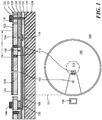
- FIG. 1 is a schematic diagram showing cross-sectional and top views of an exemplary piezoelectric gyroscope 100 in accordance with an example of the present invention. For convenience, these two views are not drawn to the same scale.
- the main components of this exemplary piezoelectric gyroscope are a disk 105 of piezoelectric material, a disk 104 underlying the disk 105 and representing a bottom electrode, and a top electrode 102 overlying a portion of the disk 105.
- the disk 104 is an N++ silicon (e.g., doped silicon) material
- the disk 105 is aluminum nitride (AlN)
- the top electrode 102 is molybdenum (Moly), although other appropriate materials may be used in various alternative embodiments.
- the disk 104 is anchored to an underlying substrate within a hub region 114.
- the top electrode 102 and the bottom electrode 104 must be electrically isolated from one another, which is accomplished in this example by an isolation trench 112 formed through the disk 104.
- the isolation trench 112 is a nitride/oxide (Nit/Ox) lined poly silicon-filled trench, although other appropriate materials may be used in various alternative embodiments.
- the isolated portion 108 of the disk 104 created by the isolation trench 112 provides an anchor and electrical contact to the top electrode 102.
- Electrical contacts (runners) 109 and 110 to the top and bottom electrodes, respectively, are formed from the poly silicon layer 118.
- a bond pad 106 providing for electrical connection to the top electrode via the contact/runner 109 is shown.
- a bond pad 116 for making an electrical connection to the silicon substrate 120 is shown in the cross-sectional view.
- a bond pad providing for electrical connection to the bottom electrode via the contact/runner 110 is not shown, although this bond pad would be formed substantially as the bond pad 106 is formed, i.e., a bond pad formed on top of a Moly 122, AlN 124, N++ 126, oxide 128 stack.
- the bond pads are typically metal.
- the piezoelectric disk 105 can be made to resonate by placing alternating electrical signals on the top and bottom electrodes 102 and 104, and external movements of the gyroscope can be sensed via various sense electrodes that, for convenience, are not shown. Such sense electrodes may be configured to sense in-plane and/or out-of-plane movements of the disk 105 caused by external movements of the gyroscope.
- An etch release hole 150 is discussed more fully below.
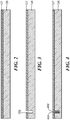
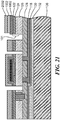
- FIG. 1 An exemplary fabrication process for fabricating the exemplary piezoelectric gyroscope 100 is now described with reference to FIGs. 2-21 .
- this exemplary fabrication process starts building the exemplary piezoelectric gyroscope 100 upside-down from what is shown in FIG. 1 , i.e., fabricating the layers starting with N++ 126 through oxide 132, bonding a silicon wafer 136 onto the oxide layer 132 (e.g., direct silicon bonding or fusion bonding), and then flipping the device over to fabricate the AlN 124 structures, the Moly 122 structures, and bond pads (e.g., 106, 116), e.g., using the silicon wafer 136 as a handling wafer for such "back-side” processing.
- bond pad 116 and its associated poly silicon 134 via to the silicon substrate 136 are not shown, although it will be apparent to persons of ordinary skill in the art how such structures can be formed within the described fabrication process.
- a layer of oxide 127 is deposited onto a substrate of N++ 126.
- the N++ 126 is approximately 750 microns and the oxide 127 is deposited to a thickness of approximately 1 micron.
- an alignment trench 302 is formed by etching through the oxide 127 layer into the N++ 126 layer.
- the alignment trench 302 is approximately 25 microns deep for a 20 micron device layer. In essence, all masking operations in later fabrication steps are aligned using the alignment trench 302 such that the alignment trench 302 represents a fixed reference for masking/etching operations.
- additional oxide 402 is deposited to line the alignment trench 302.
- the lined trench 302 is then filled with polysilicon 404, specifically by depositing polysilicon sufficiently to fill the lined trench 302, which also deposits polysilicon on the surface of the oxide 127, and then blanket etching the polysilicon to remove the polysilicon on the surface of the oxide 127 layer to leave the lined trench filled with polysilicon 404.
- the lined, filled trench 302 is used as an alignment key in later fabrication steps.
- the oxide 127 is removed, and a new oxide layer 128 is deposited and polished through a chemical mechanical polish (CMP) operation.
- CMP chemical mechanical polish
- the additional oxide 128 is formed to a thickness of approximately 2 microns plus or minus 0.2 microns.
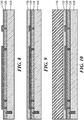
- trenches for the various polysilicon layer 118 "vias" are etched through the oxide 128 layer, specifically by masking and etching through the oxide 128 layer.
- trenches 702 are formed for the portion of the electrical contact 109 underneath the bond pad 106
- trench 704 is formed for the portion of the electrical contact 109 underneath the isolated portion 108
- trench 706 is formed for the portion of the electrical contact 110 for making electrical connection to the bottom electrode 104.
- polysilicon layer 118 is deposited and patterned, specifically by masking and etching, in order to fill the trenches 702, 704, 706 and form the electrical contacts 109 and 110. Deposition of the polysilicon 118 fills the trenches and places a layer of polysilicon onto the oxide 128. This layer of polysilicon is then patterned, specifically by masking and etching.
- a layer of low-stress nitride is deposited over the exposed oxide 128 and polysilicon 118 as an etch stop layer for later fabrication steps.
- an oxide 132 layer is formed on the LSN 130 layer, specifically by deposition and CMP of the oxide 132.
- a silicon wafer substrate 136 is direct wafer bonded to the oxide 132 layer. This silicon wafer substrate 136 is used as a handling wafer for "back-side" processing in which the device is flipped over and fabrication steps are performed on the N++ 126 side of the device.
- FIG. 11 shows the device flipped over for back-side processing.
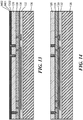
- the N++ layer is ground and polished to the desired device layer thickness (in this example, approximately 20 microns), which also exposes the lined 402, filled 404 alignment trench 302 for use as an alignment key in later fabrication steps.
- a temporary thermal oxide layer 1302 is formed on the N++ 126 layer, and then isolation trench 112 is formed by patterning by masking and etching through the oxide 1302 and N++ 126 layers to the oxide 128 layer.
- the isolation trench 112 is lined and filled in later fabrication processes. As discussed above, the isolated portion of the disk 104 (which is formed of N++ 126 material) created by the isolation trench 112 provides an anchor and electrical contact 108 to the top electrode 102.
- the isolation trench 112 is lined, specifically by depositing a layer of nitride 1401 over the oxide 1302. This nitride layer lines the trench 112. Then, polysilicon 1402 is deposited to fill the lined isolation trench 112 and form a polysilicon 1402 layer on the nitride 1401 layer.
- a series of processes are performed to remove the polysilicon 1402 layer, the surface nitride 1401 layer, and the temporary thermal oxide 1302 layer.
- a blanket polysilicon etch process is used to remove the polysilicon 1402 layer, with the nitride 1401 layer acting as an etch stop layer.
- a hot phosphoric acid etch is performed to remove the surface nitride 1401 layer, and then a timed wet oxide etch is performed to remove the temporary thermal oxide 1302 layer.
- a layer of piezoelectric AlN 124 is deposited and patterned by masking and etching to define contact holes 1502 and 1504. Then, a layer of Moly 122 is deposited.
- metal bond pads including bond pad 106 (shown), bond pad 116 (not shown), and a bond pad for the electrical contact 110 (not shown) are formed on the Moly 122 layer. This involves depositing metal (in this example, aluminum) and then patterning the metal by masking and etching to form the bond pads and optionally a bond ring (not shown) surrounding the resonator if the device is to be capped.
- an oxide hard mask 1802 is deposited, the oxide hard mask 1802 is patterned by masking and etching to expose portions of the Moly 122 to be etched including the portion represented at location 101 in FIGs. 1 and 21 (i.e., any Moly 122 not being etched is covered with oxide 1802), and the Moly 122 is etched using the oxide hard mask 1802 to form the Moly 122 top electrode 102 and other Moly 122 structures.
- various etch release holes 150 may be formed through the Moly 122 top electrode 102 to facilitate release of the piezoelectric disk in later fabrication steps.
- FIG. 18 (which shows a magnified view of a portion of the structures shown in FIG. 17 ), a second oxide hard mask 1902 is deposited.
- a photoresist material layer 2002 is deposited and patterned to expose portions of the second oxide hard mask 1902 that will be etched. This step may expose a portion of the second oxide hard mask 1902 covering any etch release holes 150 formed through the Moly 122 top electrode 102 as discussed above with reference to FIG. 17 (for convenience, this is not shown in FIG. 19 ).
- the thinner second oxide hard mask 1902 is dry etched via an oxide timed etch process to expose portions of the AlN 124 layer that will be etched, including the portion represented at location 101 in FIGs. 1 and 21 and also including any etch release holes 150 formed through the Moly 122 top electrode 102 as discussed above with reference to FIGs. 17 and 19 (for convenience, this is not shown in FIG. 20 ).
- the combination of the first oxide hard mask 1802 and the thinner second oxide hard mask 1902 that is fully etched to expose the AlN 124 layer without fully etching the first oxide hard mask 1802 provides the self-alignment between the edge of the top moly electrode 122 and the piezoelectric layer 124 and the bottom electrode 126.
- AlN and silicon etch operations are performed to etch through the AlN 124 and N++ 126 layers where those layers were exposed through the oxide hard masks.
- these etch operations result in self-alignment of the Moly 122 top electrode 102, the AlN 124 disk 105, and the N++ 126 bottom electrode 104, as represented at location 101 in FIGs. 1 and 21 .
- These etch operations also remove portions of the AlN 124 and N++ 126 layers at any etch release holes 150 formed through the second oxide hard mask 1902 and Moly 122 top electrode 102 (for convenience, this is not shown in FIG. 21 ).
- etch operations also expose portions of the oxide 128 layer (including portions of the oxide 128 layer exposed through any etch release holes 150 formed through the Moly 122, AlN 124, and N++ 126 layers as discussed above), particularly to allow for "release" of the piezoelectric disk. It should be noted that, by running the electrical connections 109 and 110 underneath the resonator, electrical connections can be made to both the top electrode 102 and the bottom electrode 104 without having to cross the open trench that surrounds the resonator and without having to cross a bond ring if present.
- the residual photoresist 2002, oxide 1902, and oxide 1802 are removed using appropriate etching operations.
- the oxide 128 layer is then dry etched (e.g., using vapor HF etchant) through exposed openings (including any etch release holes 150) to remove portions of the oxide 128 layer underlying the bottom electrode 104 and elsewhere. Removing portions of the oxide 128 layer underlying the bottom electrode 104 effectively "releases" the piezoelectric disk. Any etch release holes 150 also facilitate removal of the oxide 128 layer by providing additional locations for the dry etchant to reach the oxide 128 layer.
- the LSN 130 layer acts as an etch-stop layer to prevent etching beyond areas where the oxide 128 layer touches the LSN 130 layer.
- the various masking steps discussed above typically involve use of a photo mask, i.e., deposition of a photoresist material, exposing portions of the photoresist material using a mask to define areas to be etched, removing photoresist material from the areas to be etched, etching one or more underlying material layers through the removed areas of photoresist material, and then removing the residual photoresist material.
- a photo mask i.e., deposition of a photoresist material
- exposing portions of the photoresist material using a mask to define areas to be etched to define areas to be etched
- removing photoresist material from the areas to be etched etching one or more underlying material layers through the removed areas of photoresist material, and then removing the residual photoresist material.
- Using the alignment trench 302 as a reference for masking helps to align the various masking and etching steps to avoid or reduce the above-mentioned issues with photo mask misalignment.
- patterning may include various deposition and etching steps, etc.
- piezoelectric MEMS gyroscope and a piezoelectric element that is a disk
- the present invention is not limited to piezoelectric gyroscopes or piezoelectric disk structures. Rather, examples of the present invention can apply more generally to other types of piezoelectric MEMS devices and/or to piezoelectric MEMS gyroscopes having piezoelectric elements of other shapes.
- the present invention is not limited to fabrication of piezoelectric elements such as resonators or proof masses for a gyroscope or inertial sensor. Rather, examples of the present invention can apply more generally to other types of piezoelectric elements in MEMS device, such as, for example, piezoelectric transducers described in U.S. Patent Application Publication No. 2010/0058861 .
Landscapes
- Engineering & Computer Science (AREA)
- Manufacturing & Machinery (AREA)
- Physics & Mathematics (AREA)
- General Physics & Mathematics (AREA)
- Radar, Positioning & Navigation (AREA)
- Remote Sensing (AREA)
- Gyroscopes (AREA)
Claims (15)
- Dispositif piézoélectrique (100) comprenant :- une couche supérieure de matériau d'électrode (122) ;- une couche de matériau piézoélectrique (124) sous la couche supérieure de matériau d'électrode ;- une couche inférieure de matériau d'électrode (126) sous la couche de matériau piézoélectrique ; et caractérisé par :- une première couche de masque dur d'oxyde (1802) recouvrant la couche supérieure de matériau d'électrode, la première couche de masque dur d'oxyde comportant un motif de gravage qui expose une portion de la couche de matériau piézoélectrique au travers d'une portion gravée de la couche supérieure de matériau d'électrode ; et- une seconde couche de masque dur d'oxyde (1902) recouvrant la première couche de masque dur d'oxyde, dans lequel la seconde couche de masque dur d'oxyde est plus mince que la première couche de masque dur d'oxyde, et dans lequel la seconde couche de masque dur d'oxyde comporte un motif de gravage qui expose la portion de la couche de matériau piézoélectrique au travers du motif de gravage de la première couche de masque dur d'oxyde et de la portion gravée de la couche supérieure de matériau d'électrode.
- Dispositif selon la revendication 1, dans lequel au moins l'une des conditions suivantes s'applique :a) la couche de matériau piézoélectrique est une couche de matériau de nitrure d'aluminium ;b) la couche supérieure de matériau d'électrode est une couche de matériau de molybdène ;c) la couche inférieure de matériau d'électrode est une couche de matériau N++ ;d) la couche inférieure de matériau d'électrode est une couche de matériau de silicium dopé.
- Dispositif selon la revendication 1 ou 2, dans lequel le dispositif comprend en outre une tranchée d'isolation (112) dans la couche inférieure de matériau d'électrode, la tranchée d'isolation formant un ancrage électriquement isolé (108) dans la couche inférieure de matériau d'électrode à laquelle la couche supérieure de matériau d'électrode est couplée.
- Dispositif selon la revendication 3, comprenant en outre :- un premier contact électrique (110) avec la couche inférieure de matériau d'électrode ; et- un second contact électrique (109) avec l'ancrage électriquement isolé pour réaliser une connexion électrique avec la couche supérieure de matériau d'électrode, dans lequel le premier et le second contacts électriques circulent sous la couche inférieure de matériau d'électrode et comportent des chemins conducteurs vers la couche inférieure de matériau d'électrode.
- Dispositif selon la revendication 4, dans lequel le premier et le second contacts électriques sont des contacts électriques polysilicium.
- Dispositif selon la revendication 4 ou 5, comprenant en outre :- un premier plot de liaison métallique électriquement couplé au premier contact électrique ; et- un second plot de liaison métallique (106) électriquement couplé au second contact électrique, dans lequel le premier et le second plots de liaison métallique sont sur une couche de matériau métallique au-dessus de la couche supérieure de matériau d'électrode.
- Dispositif selon l'une quelconque des revendications précédentes, dans lequel le dispositif est un gyroscope piézoélectrique à onde acoustique de volume.
- Dispositif selon l'une quelconque des revendications précédentes, dans lequel les motifs de gravage des première et seconde couches de masque dur d'oxyde sont prévus de sorte que la couche supérieure de matériau d'électrode, la couche de matériau piézoélectrique et la couche inférieure de matériau d'électrode soient gravées de façon à produire un élément piézoélectrique et une électrode inférieure auto-alignée avec une électrode supérieure de façon qu'un bord de l'électrode supérieure soit aligné verticalement avec un bord de l'élément piézoélectrique et un bord de l'électrode inférieure.
- Procédé de fabrication d'un dispositif piézoélectrique, le procédé comprenant les étapes consistant à :- former une couche de matériau piézoélectrique sur une couche inférieure de matériau d'électrode ;- former une couche supérieure de matériau d'électrode sur la couche de matériau piézoélectrique ; et- graver la couche supérieure de matériau d'électrode, la couche de matériau piézoélectrique et la couche inférieure de matériau d'électrode pour produire un élément piézoélectrique, une électrode inférieure et une électrode supérieure,caractérisé en ce que :- la gravure de la couche supérieure de matériau d'électrode, de la couche de matériau piézoélectrique et de la couche inférieure de matériau d'électrode comprend les étapes consistant à :• former une première couche de masque dur d'oxyde recouvrant la couche supérieure de matériau d'électrode ;• profiler la première couche de masque dur d'oxyde pour exposer des portions de la couche de matériau piézoélectrique à graver au travers d'une portion gravée de la couche supérieure de matériau d'électrode ;• former une seconde couche de masque dur d'oxyde recouvrant la première couche de masque dur d'oxyde, dans laquelle la seconde couche de masque dur d'oxyde est plus mince que la première couche de masque dur d'oxyde ;• profiler la seconde couche de masque dur d'oxyde pour exposer la portion de la couche de matériau piézoélectrique à graver au travers du profil de gravage de la première couche de masque dur d'oxyde et de la portion gravée de la couche supérieure de matériau d'électrode ;• graver les portions exposées de la couche de matériau piézoélectrique pour exposer des portions de la couche inférieure de matériau d'électrode à graver ; et• graver les portions exposées de la couche inférieure de matériau d'électrode.
- Procédé selon la revendication 9, dans lequel au moins une des conditions suivantes s'applique :a) la formation de la couche de matériau piézoélectrique comprend la formation d'une couche de matériau de nitrure d'aluminium ;b) la formation de la couche supérieure de matériau d'électrode comprend la formation d'une couche de matériau de molybdène ;c) dans lequel la couche inférieure de matériau d'électrode est une couche de matériau N++ ;d) dans lequel la couche inférieure de matériau d'électrode est une couche de matériau de silicium dopé ;e) le procédé comprend l'utilisation d'un masque photo unique pour définir le bord de la couche supérieure de matériau d'électrode, la couche de matériau piézoélectrique et la couche inférieure de matériau d'électrode.
- Procédé selon l'une quelconque des revendications 9 à 10, comprenant en outre :- la formation d'une tranchée d'isolation dans la couche inférieure de matériau d'électrode, la tranchée d'isolation formant un ancrage isolé électriquement dans la couche inférieure de matériau d'électrode à laquelle l'électrode supérieure est couplée.
- Procédé selon la revendication 11, comprenant en outre :- la formation d'un premier contact électrique avec l'électrode inférieure ; et- la formation d'un second contact électrique avec l'ancrage électriquement isolé et pour réaliser une connexion électrique avec l'électrode supérieure, dans lequel le premier et le second contacts électriques circulent sous la couche inférieure de matériau d'électrode et comportent des chemins conducteurs vers la couche inférieure de matériau d'électrode.
- Procédé selon la revendication 12, dans lequel la formation du premier et du second contacts électriques fait intervenir la formation de contacts électriques polysilicium.
- Procédé selon la revendication 12 ou 13, comprenant en outre :- la formation d'un premier plot métallique de liaison couplé au premier contact électrique ; et- la formation d'un second plot métallique de liaison couplé au second contact électrique, dans lequel l'électrode supérieure est formée à partir d'une couche supérieure de matériau d'électrode, et dans lequel le premier et le second plots de liaison métallique sont sur une couche de matériau métallique au-dessus de la couche supérieure de matériau d'électrode.
- Procédé selon l'une quelconque des revendications 9 à 14, dans lequel la couche supérieure de matériau d'électrode, la couche de matériau piézoélectrique et la couche inférieure de matériau d'électrode sont gravées de façon qu'un bord de l'électrode supérieure soit aligné verticalement avec un bord de l'élément piézoélectrique et un bord de l'électrode inférieure.
Applications Claiming Priority (1)
| Application Number | Priority Date | Filing Date | Title |
|---|---|---|---|
| US14/515,929 US9917243B2 (en) | 2014-10-16 | 2014-10-16 | Method of fabricating piezoelectric MEMS devices |
Publications (2)
| Publication Number | Publication Date |
|---|---|
| EP3009793A1 EP3009793A1 (fr) | 2016-04-20 |
| EP3009793B1 true EP3009793B1 (fr) | 2017-09-27 |
Family
ID=54324883
Family Applications (1)
| Application Number | Title | Priority Date | Filing Date |
|---|---|---|---|
| EP15189732.9A Active EP3009793B1 (fr) | 2014-10-16 | 2015-10-14 | Procédé de fabrication d'un dispositif mems piézoélectrique |
Country Status (2)
| Country | Link |
|---|---|
| US (1) | US9917243B2 (fr) |
| EP (1) | EP3009793B1 (fr) |
Families Citing this family (2)
| Publication number | Priority date | Publication date | Assignee | Title |
|---|---|---|---|---|
| US9862592B2 (en) | 2015-03-13 | 2018-01-09 | Taiwan Semiconductor Manufacturing Co., Ltd. | MEMS transducer and method for manufacturing the same |
| US11527700B2 (en) * | 2019-12-20 | 2022-12-13 | Vanguard International Semiconductor Singapore Pte. Ltd. | Microphone device with single crystal piezoelectric film and method of forming the same |
Family Cites Families (28)
| Publication number | Priority date | Publication date | Assignee | Title |
|---|---|---|---|---|
| GB8404668D0 (en) | 1984-02-22 | 1984-03-28 | Burdess J S | Gyroscopic devices |
| US5767405A (en) | 1992-04-07 | 1998-06-16 | The Charles Stark Draper Laboratory, Inc. | Comb-drive micromechanical tuning fork gyroscope with piezoelectric readout |
| US5616864A (en) | 1995-02-22 | 1997-04-01 | Delco Electronics Corp. | Method and apparatus for compensation of micromachined sensors |
| JPH09116250A (ja) | 1995-10-24 | 1997-05-02 | Tokin Corp | 圧電トランス支持装置 |
| JPH10115526A (ja) | 1996-10-15 | 1998-05-06 | Ngk Insulators Ltd | 振動ジャイロ・センサ及び振動ジャイロ・センサの製造方法 |
| CA2241929A1 (fr) | 1996-10-29 | 1998-05-07 | Mitsui Chemicals, Incorporated | Gyroscope a vibrations |
| JPH10232132A (ja) | 1997-02-20 | 1998-09-02 | Murata Mfg Co Ltd | 振動ジャイロ |
| US6151964A (en) | 1998-05-25 | 2000-11-28 | Citizen Watch Co., Ltd. | Angular velocity sensing device |
| US6438242B1 (en) | 1999-09-07 | 2002-08-20 | The United States Of America As Represented By The Secretary Of The Navy | Acoustic transducer panel |
| US6492222B1 (en) * | 1999-12-22 | 2002-12-10 | Texas Instruments Incorporated | Method of dry etching PZT capacitor stack to form high-density ferroelectric memory devices |
| JP3642026B2 (ja) | 2001-01-12 | 2005-04-27 | 株式会社村田製作所 | 加速度センサおよびその製造方法 |
| US6548943B2 (en) * | 2001-04-12 | 2003-04-15 | Nokia Mobile Phones Ltd. | Method of producing thin-film bulk acoustic wave devices |
| US7089792B2 (en) | 2002-02-06 | 2006-08-15 | Analod Devices, Inc. | Micromachined apparatus utilizing box suspensions |
| EP2325604B1 (fr) | 2002-02-06 | 2013-04-24 | Analog Devices, Inc. | Gyroscope micro-usiné |
| US7382078B2 (en) * | 2002-07-30 | 2008-06-03 | Avago Technologies General Ip (Singapore) Pte. Ltd. | Electrostatic discharge protection of thin-film resonators |
| JP3953017B2 (ja) | 2003-10-06 | 2007-08-01 | 株式会社村田製作所 | 振動ジャイロ用圧電振動子 |
| US7043985B2 (en) | 2004-01-13 | 2006-05-16 | Georgia Tech Research Corporation | High-resolution in-plane tuning fork gyroscope and methods of fabrication |
| WO2006006597A1 (fr) | 2004-07-12 | 2006-01-19 | Sumitomo Precision Products | Capteur de vitesse angulaire |
| US7492241B2 (en) * | 2005-06-02 | 2009-02-17 | The Regents Of The University Of California | Contour-mode piezoelectric micromechanical resonators |
| JP4713990B2 (ja) | 2005-09-13 | 2011-06-29 | 株式会社東芝 | 半導体装置とその製造方法 |
| US7345407B2 (en) | 2005-11-18 | 2008-03-18 | Adaptivenergy, Llc. | Human powered piezoelectric power generating device |
| US7420318B1 (en) | 2006-03-20 | 2008-09-02 | The United States Of America As Represented By The Secretary Of The Army | Lateral piezoelectric microelectromechanical system (MEMS) actuation and sensing device |
| JP2007335977A (ja) | 2006-06-12 | 2007-12-27 | Toshiba Corp | 電子素子 |
| US8056413B2 (en) | 2007-09-11 | 2011-11-15 | Evigia Systems, Inc. | Sensor and sensing method utilizing symmetrical differential readout |
| US8278802B1 (en) * | 2008-04-24 | 2012-10-02 | Rf Micro Devices, Inc. | Planarized sacrificial layer for MEMS fabrication |
| US20100058861A1 (en) | 2008-09-11 | 2010-03-11 | Analog Devices, Inc. | Piezoelectric Transducers and Inertial Sensors using Piezoelectric Transducers |
| JP2010098518A (ja) * | 2008-10-16 | 2010-04-30 | Rohm Co Ltd | Memsセンサの製造方法およびmemsセンサ |
| JP2010147285A (ja) | 2008-12-19 | 2010-07-01 | Yamaha Corp | Mems、振動ジャイロスコープおよびmemsの製造方法 |
-
2014
- 2014-10-16 US US14/515,929 patent/US9917243B2/en active Active
-
2015
- 2015-10-14 EP EP15189732.9A patent/EP3009793B1/fr active Active
Non-Patent Citations (1)
| Title |
|---|
| None * |
Also Published As
| Publication number | Publication date |
|---|---|
| US9917243B2 (en) | 2018-03-13 |
| EP3009793A1 (fr) | 2016-04-20 |
| US20160111625A1 (en) | 2016-04-21 |
Similar Documents
| Publication | Publication Date | Title |
|---|---|---|
| JP7297328B2 (ja) | バルク音響波共振器のパッケージング方法及びパッケージング構造 | |
| CN102134054B (zh) | 用于制造微机电系统装置的方法 | |
| US10107830B2 (en) | Method of forming capacitive MEMS sensor devices | |
| JP7218020B2 (ja) | バルク音響波共振器のパッケージング方法及びパッケージング構造 | |
| CN110636422B (zh) | 半导体器件及其形成方法 | |
| CN111151431B (zh) | 压电微机械超声换能器及其制造方法 | |
| JP5913564B2 (ja) | アウトオブプレーンスペーサが画成する電極 | |
| US8796845B2 (en) | Electronic device covered by multiple layers and method for manufacturing electronic device | |
| US9908771B2 (en) | Inertial and pressure sensors on single chip | |
| JP2021535640A (ja) | バルク音響波共振器のパッケージング方法及びパッケージング構造 | |
| TW201034933A (en) | Microelectromechanical device with isolated microstructures and method of producing same | |
| TWI621242B (zh) | 具有紅外線吸收結構層的氮化鋁(ain)裝置 | |
| JP2000133616A (ja) | 集積デバイスの製造方法および集積デバイス | |
| EP3009793B1 (fr) | Procédé de fabrication d'un dispositif mems piézoélectrique | |
| CN109216268A (zh) | 制造半导体装置的方法 | |
| TWI652728B (zh) | 用於面外間隔體界定電極的磊晶式多晶矽蝕刻停止 | |
| JP4544140B2 (ja) | Mems素子 | |
| JP6813058B2 (ja) | 振動子の製造方法 | |
| JP4852220B2 (ja) | ミクロ構造、およびこれを製造する方法 | |
| US7531424B1 (en) | Vacuum wafer-level packaging for SOI-MEMS devices | |
| US20230219808A1 (en) | Method for producing a bonding pad for a micromechanical sensor element | |
| CN114402448B (zh) | 压电元件及其制造方法 | |
| US8502328B2 (en) | Micro electronic mechanical system structure | |
| JP2007111832A (ja) | Mems素子の製造方法およびmems素子 | |
| JP2015065281A (ja) | 3次元構造集積回路の製造方法 |
Legal Events
| Date | Code | Title | Description |
|---|---|---|---|
| PUAI | Public reference made under article 153(3) epc to a published international application that has entered the european phase |
Free format text: ORIGINAL CODE: 0009012 |
|
| AK | Designated contracting states |
Kind code of ref document: A1 Designated state(s): AL AT BE BG CH CY CZ DE DK EE ES FI FR GB GR HR HU IE IS IT LI LT LU LV MC MK MT NL NO PL PT RO RS SE SI SK SM TR |
|
| AX | Request for extension of the european patent |
Extension state: BA ME |
|
| 17P | Request for examination filed |
Effective date: 20160817 |
|
| RBV | Designated contracting states (corrected) |
Designated state(s): AL AT BE BG CH CY CZ DE DK EE ES FI FR GB GR HR HU IE IS IT LI LT LU LV MC MK MT NL NO PL PT RO RS SE SI SK SM TR |
|
| 17Q | First examination report despatched |
Effective date: 20161005 |
|
| GRAP | Despatch of communication of intention to grant a patent |
Free format text: ORIGINAL CODE: EPIDOSNIGR1 |
|
| INTG | Intention to grant announced |
Effective date: 20170420 |
|
| GRAS | Grant fee paid |
Free format text: ORIGINAL CODE: EPIDOSNIGR3 |
|
| GRAA | (expected) grant |
Free format text: ORIGINAL CODE: 0009210 |
|
| AK | Designated contracting states |
Kind code of ref document: B1 Designated state(s): AL AT BE BG CH CY CZ DE DK EE ES FI FR GB GR HR HU IE IS IT LI LT LU LV MC MK MT NL NO PL PT RO RS SE SI SK SM TR |
|
| REG | Reference to a national code |
Ref country code: GB Ref legal event code: FG4D |
|
| REG | Reference to a national code |
Ref country code: CH Ref legal event code: EP |
|
| REG | Reference to a national code |
Ref country code: AT Ref legal event code: REF Ref document number: 932363 Country of ref document: AT Kind code of ref document: T Effective date: 20171015 |
|
| REG | Reference to a national code |
Ref country code: IE Ref legal event code: FG4D |
|
| REG | Reference to a national code |
Ref country code: DE Ref legal event code: R096 Ref document number: 602015004979 Country of ref document: DE |
|
| PG25 | Lapsed in a contracting state [announced via postgrant information from national office to epo] |
Ref country code: SE Free format text: LAPSE BECAUSE OF FAILURE TO SUBMIT A TRANSLATION OF THE DESCRIPTION OR TO PAY THE FEE WITHIN THE PRESCRIBED TIME-LIMIT Effective date: 20170927 Ref country code: HR Free format text: LAPSE BECAUSE OF FAILURE TO SUBMIT A TRANSLATION OF THE DESCRIPTION OR TO PAY THE FEE WITHIN THE PRESCRIBED TIME-LIMIT Effective date: 20170927 Ref country code: NO Free format text: LAPSE BECAUSE OF FAILURE TO SUBMIT A TRANSLATION OF THE DESCRIPTION OR TO PAY THE FEE WITHIN THE PRESCRIBED TIME-LIMIT Effective date: 20171227 Ref country code: LT Free format text: LAPSE BECAUSE OF FAILURE TO SUBMIT A TRANSLATION OF THE DESCRIPTION OR TO PAY THE FEE WITHIN THE PRESCRIBED TIME-LIMIT Effective date: 20170927 Ref country code: FI Free format text: LAPSE BECAUSE OF FAILURE TO SUBMIT A TRANSLATION OF THE DESCRIPTION OR TO PAY THE FEE WITHIN THE PRESCRIBED TIME-LIMIT Effective date: 20170927 |
|
| REG | Reference to a national code |
Ref country code: NL Ref legal event code: MP Effective date: 20170927 |
|
| REG | Reference to a national code |
Ref country code: LT Ref legal event code: MG4D |
|
| REG | Reference to a national code |
Ref country code: AT Ref legal event code: MK05 Ref document number: 932363 Country of ref document: AT Kind code of ref document: T Effective date: 20170927 |
|
| PG25 | Lapsed in a contracting state [announced via postgrant information from national office to epo] |
Ref country code: RS Free format text: LAPSE BECAUSE OF FAILURE TO SUBMIT A TRANSLATION OF THE DESCRIPTION OR TO PAY THE FEE WITHIN THE PRESCRIBED TIME-LIMIT Effective date: 20170927 Ref country code: BG Free format text: LAPSE BECAUSE OF FAILURE TO SUBMIT A TRANSLATION OF THE DESCRIPTION OR TO PAY THE FEE WITHIN THE PRESCRIBED TIME-LIMIT Effective date: 20171227 Ref country code: GR Free format text: LAPSE BECAUSE OF FAILURE TO SUBMIT A TRANSLATION OF THE DESCRIPTION OR TO PAY THE FEE WITHIN THE PRESCRIBED TIME-LIMIT Effective date: 20171228 Ref country code: LV Free format text: LAPSE BECAUSE OF FAILURE TO SUBMIT A TRANSLATION OF THE DESCRIPTION OR TO PAY THE FEE WITHIN THE PRESCRIBED TIME-LIMIT Effective date: 20170927 |
|
| PG25 | Lapsed in a contracting state [announced via postgrant information from national office to epo] |
Ref country code: NL Free format text: LAPSE BECAUSE OF FAILURE TO SUBMIT A TRANSLATION OF THE DESCRIPTION OR TO PAY THE FEE WITHIN THE PRESCRIBED TIME-LIMIT Effective date: 20170927 |
|
| PG25 | Lapsed in a contracting state [announced via postgrant information from national office to epo] |
Ref country code: CZ Free format text: LAPSE BECAUSE OF FAILURE TO SUBMIT A TRANSLATION OF THE DESCRIPTION OR TO PAY THE FEE WITHIN THE PRESCRIBED TIME-LIMIT Effective date: 20170927 Ref country code: ES Free format text: LAPSE BECAUSE OF FAILURE TO SUBMIT A TRANSLATION OF THE DESCRIPTION OR TO PAY THE FEE WITHIN THE PRESCRIBED TIME-LIMIT Effective date: 20170927 Ref country code: RO Free format text: LAPSE BECAUSE OF FAILURE TO SUBMIT A TRANSLATION OF THE DESCRIPTION OR TO PAY THE FEE WITHIN THE PRESCRIBED TIME-LIMIT Effective date: 20170927 |
|
| PG25 | Lapsed in a contracting state [announced via postgrant information from national office to epo] |
Ref country code: SM Free format text: LAPSE BECAUSE OF FAILURE TO SUBMIT A TRANSLATION OF THE DESCRIPTION OR TO PAY THE FEE WITHIN THE PRESCRIBED TIME-LIMIT Effective date: 20170927 Ref country code: EE Free format text: LAPSE BECAUSE OF FAILURE TO SUBMIT A TRANSLATION OF THE DESCRIPTION OR TO PAY THE FEE WITHIN THE PRESCRIBED TIME-LIMIT Effective date: 20170927 Ref country code: AT Free format text: LAPSE BECAUSE OF FAILURE TO SUBMIT A TRANSLATION OF THE DESCRIPTION OR TO PAY THE FEE WITHIN THE PRESCRIBED TIME-LIMIT Effective date: 20170927 Ref country code: IT Free format text: LAPSE BECAUSE OF FAILURE TO SUBMIT A TRANSLATION OF THE DESCRIPTION OR TO PAY THE FEE WITHIN THE PRESCRIBED TIME-LIMIT Effective date: 20170927 Ref country code: IS Free format text: LAPSE BECAUSE OF FAILURE TO SUBMIT A TRANSLATION OF THE DESCRIPTION OR TO PAY THE FEE WITHIN THE PRESCRIBED TIME-LIMIT Effective date: 20180127 Ref country code: SK Free format text: LAPSE BECAUSE OF FAILURE TO SUBMIT A TRANSLATION OF THE DESCRIPTION OR TO PAY THE FEE WITHIN THE PRESCRIBED TIME-LIMIT Effective date: 20170927 |
|
| REG | Reference to a national code |
Ref country code: DE Ref legal event code: R097 Ref document number: 602015004979 Country of ref document: DE |
|
| PG25 | Lapsed in a contracting state [announced via postgrant information from national office to epo] |
Ref country code: MC Free format text: LAPSE BECAUSE OF FAILURE TO SUBMIT A TRANSLATION OF THE DESCRIPTION OR TO PAY THE FEE WITHIN THE PRESCRIBED TIME-LIMIT Effective date: 20170927 |
|
| REG | Reference to a national code |
Ref country code: IE Ref legal event code: MM4A |
|
| REG | Reference to a national code |
Ref country code: FR Ref legal event code: ST Effective date: 20180629 |
|
| PG25 | Lapsed in a contracting state [announced via postgrant information from national office to epo] |
Ref country code: LU Free format text: LAPSE BECAUSE OF NON-PAYMENT OF DUE FEES Effective date: 20171014 Ref country code: DK Free format text: LAPSE BECAUSE OF FAILURE TO SUBMIT A TRANSLATION OF THE DESCRIPTION OR TO PAY THE FEE WITHIN THE PRESCRIBED TIME-LIMIT Effective date: 20170927 |
|
| PLBE | No opposition filed within time limit |
Free format text: ORIGINAL CODE: 0009261 |
|
| STAA | Information on the status of an ep patent application or granted ep patent |
Free format text: STATUS: NO OPPOSITION FILED WITHIN TIME LIMIT |
|
| REG | Reference to a national code |
Ref country code: BE Ref legal event code: MM Effective date: 20171031 |
|
| PG25 | Lapsed in a contracting state [announced via postgrant information from national office to epo] |
Ref country code: BE Free format text: LAPSE BECAUSE OF NON-PAYMENT OF DUE FEES Effective date: 20171031 Ref country code: PL Free format text: LAPSE BECAUSE OF FAILURE TO SUBMIT A TRANSLATION OF THE DESCRIPTION OR TO PAY THE FEE WITHIN THE PRESCRIBED TIME-LIMIT Effective date: 20170927 Ref country code: FR Free format text: LAPSE BECAUSE OF NON-PAYMENT OF DUE FEES Effective date: 20171127 |
|
| 26N | No opposition filed |
Effective date: 20180628 |
|
| PG25 | Lapsed in a contracting state [announced via postgrant information from national office to epo] |
Ref country code: MT Free format text: LAPSE BECAUSE OF NON-PAYMENT OF DUE FEES Effective date: 20171014 |
|
| PG25 | Lapsed in a contracting state [announced via postgrant information from national office to epo] |
Ref country code: IE Free format text: LAPSE BECAUSE OF NON-PAYMENT OF DUE FEES Effective date: 20171014 |
|
| PG25 | Lapsed in a contracting state [announced via postgrant information from national office to epo] |
Ref country code: SI Free format text: LAPSE BECAUSE OF FAILURE TO SUBMIT A TRANSLATION OF THE DESCRIPTION OR TO PAY THE FEE WITHIN THE PRESCRIBED TIME-LIMIT Effective date: 20170927 |
|
| REG | Reference to a national code |
Ref country code: CH Ref legal event code: PL |
|
| PG25 | Lapsed in a contracting state [announced via postgrant information from national office to epo] |
Ref country code: HU Free format text: LAPSE BECAUSE OF FAILURE TO SUBMIT A TRANSLATION OF THE DESCRIPTION OR TO PAY THE FEE WITHIN THE PRESCRIBED TIME-LIMIT; INVALID AB INITIO Effective date: 20151014 |
|
| PG25 | Lapsed in a contracting state [announced via postgrant information from national office to epo] |
Ref country code: CH Free format text: LAPSE BECAUSE OF NON-PAYMENT OF DUE FEES Effective date: 20181031 Ref country code: LI Free format text: LAPSE BECAUSE OF NON-PAYMENT OF DUE FEES Effective date: 20181031 |
|
| PG25 | Lapsed in a contracting state [announced via postgrant information from national office to epo] |
Ref country code: CY Free format text: LAPSE BECAUSE OF FAILURE TO SUBMIT A TRANSLATION OF THE DESCRIPTION OR TO PAY THE FEE WITHIN THE PRESCRIBED TIME-LIMIT Effective date: 20170927 |
|
| PG25 | Lapsed in a contracting state [announced via postgrant information from national office to epo] |
Ref country code: MK Free format text: LAPSE BECAUSE OF FAILURE TO SUBMIT A TRANSLATION OF THE DESCRIPTION OR TO PAY THE FEE WITHIN THE PRESCRIBED TIME-LIMIT Effective date: 20170927 |
|
| PG25 | Lapsed in a contracting state [announced via postgrant information from national office to epo] |
Ref country code: TR Free format text: LAPSE BECAUSE OF FAILURE TO SUBMIT A TRANSLATION OF THE DESCRIPTION OR TO PAY THE FEE WITHIN THE PRESCRIBED TIME-LIMIT Effective date: 20170927 |
|
| PG25 | Lapsed in a contracting state [announced via postgrant information from national office to epo] |
Ref country code: PT Free format text: LAPSE BECAUSE OF FAILURE TO SUBMIT A TRANSLATION OF THE DESCRIPTION OR TO PAY THE FEE WITHIN THE PRESCRIBED TIME-LIMIT Effective date: 20170927 |
|
| PG25 | Lapsed in a contracting state [announced via postgrant information from national office to epo] |
Ref country code: AL Free format text: LAPSE BECAUSE OF FAILURE TO SUBMIT A TRANSLATION OF THE DESCRIPTION OR TO PAY THE FEE WITHIN THE PRESCRIBED TIME-LIMIT Effective date: 20170927 |
|
| REG | Reference to a national code |
Ref country code: DE Ref legal event code: R082 Ref document number: 602015004979 Country of ref document: DE Representative=s name: TER MEER STEINMEISTER & PARTNER PATENTANWAELTE, DE |
|
| PGFP | Annual fee paid to national office [announced via postgrant information from national office to epo] |
Ref country code: GB Payment date: 20250923 Year of fee payment: 11 |
|
| PGFP | Annual fee paid to national office [announced via postgrant information from national office to epo] |
Ref country code: DE Payment date: 20250923 Year of fee payment: 11 |