EP3010716B1 - Seat for bicycle saddles and the like, and method for its manufacturing - Google Patents
Seat for bicycle saddles and the like, and method for its manufacturing Download PDFInfo
- Publication number
- EP3010716B1 EP3010716B1 EP14738633.8A EP14738633A EP3010716B1 EP 3010716 B1 EP3010716 B1 EP 3010716B1 EP 14738633 A EP14738633 A EP 14738633A EP 3010716 B1 EP3010716 B1 EP 3010716B1
- Authority
- EP
- European Patent Office
- Prior art keywords
- layer
- seat
- natural
- rubber
- fabric
- Prior art date
- Legal status (The legal status is an assumption and is not a legal conclusion. Google has not performed a legal analysis and makes no representation as to the accuracy of the status listed.)
- Active
Links
Images



Classifications
-
- B—PERFORMING OPERATIONS; TRANSPORTING
- B62—LAND VEHICLES FOR TRAVELLING OTHERWISE THAN ON RAILS
- B62J—CYCLE SADDLES OR SEATS; AUXILIARY DEVICES OR ACCESSORIES SPECIALLY ADAPTED TO CYCLES AND NOT OTHERWISE PROVIDED FOR, e.g. ARTICLE CARRIERS OR CYCLE PROTECTORS
- B62J1/00—Saddles or other seats for cycles; Arrangement thereof; Component parts
- B62J1/18—Covers for saddles or other seats; Paddings
-
- B—PERFORMING OPERATIONS; TRANSPORTING
- B29—WORKING OF PLASTICS; WORKING OF SUBSTANCES IN A PLASTIC STATE IN GENERAL
- B29C—SHAPING OR JOINING OF PLASTICS; SHAPING OF MATERIAL IN A PLASTIC STATE, NOT OTHERWISE PROVIDED FOR; AFTER-TREATMENT OF THE SHAPED PRODUCTS, e.g. REPAIRING
- B29C70/00—Shaping composites, i.e. plastics material comprising reinforcements, fillers or preformed parts, e.g. inserts
- B29C70/68—Shaping composites, i.e. plastics material comprising reinforcements, fillers or preformed parts, e.g. inserts by incorporating or moulding on preformed parts, e.g. inserts or layers, e.g. foam blocks
-
- B—PERFORMING OPERATIONS; TRANSPORTING
- B32—LAYERED PRODUCTS
- B32B—LAYERED PRODUCTS, i.e. PRODUCTS BUILT-UP OF STRATA OF FLAT OR NON-FLAT, e.g. CELLULAR OR HONEYCOMB, FORM
- B32B25/00—Layered products comprising a layer of natural or synthetic rubber
- B32B25/10—Layered products comprising a layer of natural or synthetic rubber next to a fibrous or filamentary layer
-
- B—PERFORMING OPERATIONS; TRANSPORTING
- B62—LAND VEHICLES FOR TRAVELLING OTHERWISE THAN ON RAILS
- B62J—CYCLE SADDLES OR SEATS; AUXILIARY DEVICES OR ACCESSORIES SPECIALLY ADAPTED TO CYCLES AND NOT OTHERWISE PROVIDED FOR, e.g. ARTICLE CARRIERS OR CYCLE PROTECTORS
- B62J1/00—Saddles or other seats for cycles; Arrangement thereof; Component parts
- B62J1/002—Saddles having a seating area with a central cavity or depression
-
- B—PERFORMING OPERATIONS; TRANSPORTING
- B29—WORKING OF PLASTICS; WORKING OF SUBSTANCES IN A PLASTIC STATE IN GENERAL
- B29K—INDEXING SCHEME ASSOCIATED WITH SUBCLASSES B29B, B29C OR B29D, RELATING TO MOULDING MATERIALS OR TO MATERIALS FOR MOULDS, REINFORCEMENTS, FILLERS OR PREFORMED PARTS, e.g. INSERTS
- B29K2667/00—Use of polyesters or derivatives thereof for preformed parts, e.g. for inserts
-
- B—PERFORMING OPERATIONS; TRANSPORTING
- B29—WORKING OF PLASTICS; WORKING OF SUBSTANCES IN A PLASTIC STATE IN GENERAL
- B29K—INDEXING SCHEME ASSOCIATED WITH SUBCLASSES B29B, B29C OR B29D, RELATING TO MOULDING MATERIALS OR TO MATERIALS FOR MOULDS, REINFORCEMENTS, FILLERS OR PREFORMED PARTS, e.g. INSERTS
- B29K2705/00—Use of metals, their alloys or their compounds, for preformed parts, e.g. for inserts
-
- B—PERFORMING OPERATIONS; TRANSPORTING
- B29—WORKING OF PLASTICS; WORKING OF SUBSTANCES IN A PLASTIC STATE IN GENERAL
- B29L—INDEXING SCHEME ASSOCIATED WITH SUBCLASS B29C, RELATING TO PARTICULAR ARTICLES
- B29L2031/00—Other particular articles
- B29L2031/771—Seats
-
- B—PERFORMING OPERATIONS; TRANSPORTING
- B32—LAYERED PRODUCTS
- B32B—LAYERED PRODUCTS, i.e. PRODUCTS BUILT-UP OF STRATA OF FLAT OR NON-FLAT, e.g. CELLULAR OR HONEYCOMB, FORM
- B32B2262/00—Composition or structural features of fibres which form a fibrous or filamentary layer or are present as additives
- B32B2262/02—Synthetic macromolecular fibres
-
- B—PERFORMING OPERATIONS; TRANSPORTING
- B32—LAYERED PRODUCTS
- B32B—LAYERED PRODUCTS, i.e. PRODUCTS BUILT-UP OF STRATA OF FLAT OR NON-FLAT, e.g. CELLULAR OR HONEYCOMB, FORM
- B32B2262/00—Composition or structural features of fibres which form a fibrous or filamentary layer or are present as additives
- B32B2262/02—Synthetic macromolecular fibres
- B32B2262/0276—Polyester fibres
-
- B—PERFORMING OPERATIONS; TRANSPORTING
- B32—LAYERED PRODUCTS
- B32B—LAYERED PRODUCTS, i.e. PRODUCTS BUILT-UP OF STRATA OF FLAT OR NON-FLAT, e.g. CELLULAR OR HONEYCOMB, FORM
- B32B2262/00—Composition or structural features of fibres which form a fibrous or filamentary layer or are present as additives
- B32B2262/06—Vegetal fibres
- B32B2262/062—Cellulose fibres, e.g. cotton
-
- B—PERFORMING OPERATIONS; TRANSPORTING
- B32—LAYERED PRODUCTS
- B32B—LAYERED PRODUCTS, i.e. PRODUCTS BUILT-UP OF STRATA OF FLAT OR NON-FLAT, e.g. CELLULAR OR HONEYCOMB, FORM
- B32B2262/00—Composition or structural features of fibres which form a fibrous or filamentary layer or are present as additives
- B32B2262/06—Vegetal fibres
- B32B2262/062—Cellulose fibres, e.g. cotton
- B32B2262/065—Lignocellulosic fibres, e.g. jute, sisal, hemp, flax, bamboo
-
- B—PERFORMING OPERATIONS; TRANSPORTING
- B32—LAYERED PRODUCTS
- B32B—LAYERED PRODUCTS, i.e. PRODUCTS BUILT-UP OF STRATA OF FLAT OR NON-FLAT, e.g. CELLULAR OR HONEYCOMB, FORM
- B32B2262/00—Composition or structural features of fibres which form a fibrous or filamentary layer or are present as additives
- B32B2262/08—Animal fibres, e.g. hair, wool, silk
-
- B—PERFORMING OPERATIONS; TRANSPORTING
- B32—LAYERED PRODUCTS
- B32B—LAYERED PRODUCTS, i.e. PRODUCTS BUILT-UP OF STRATA OF FLAT OR NON-FLAT, e.g. CELLULAR OR HONEYCOMB, FORM
- B32B2307/00—Properties of the layers or laminate
- B32B2307/50—Properties of the layers or laminate having particular mechanical properties
- B32B2307/554—Wear resistance
-
- B—PERFORMING OPERATIONS; TRANSPORTING
- B32—LAYERED PRODUCTS
- B32B—LAYERED PRODUCTS, i.e. PRODUCTS BUILT-UP OF STRATA OF FLAT OR NON-FLAT, e.g. CELLULAR OR HONEYCOMB, FORM
- B32B2307/00—Properties of the layers or laminate
- B32B2307/70—Other properties
-
- B—PERFORMING OPERATIONS; TRANSPORTING
- B32—LAYERED PRODUCTS
- B32B—LAYERED PRODUCTS, i.e. PRODUCTS BUILT-UP OF STRATA OF FLAT OR NON-FLAT, e.g. CELLULAR OR HONEYCOMB, FORM
- B32B2307/00—Properties of the layers or laminate
- B32B2307/70—Other properties
- B32B2307/73—Hydrophobic
-
- B—PERFORMING OPERATIONS; TRANSPORTING
- B32—LAYERED PRODUCTS
- B32B—LAYERED PRODUCTS, i.e. PRODUCTS BUILT-UP OF STRATA OF FLAT OR NON-FLAT, e.g. CELLULAR OR HONEYCOMB, FORM
- B32B2605/00—Vehicles
-
- B—PERFORMING OPERATIONS; TRANSPORTING
- B62—LAND VEHICLES FOR TRAVELLING OTHERWISE THAN ON RAILS
- B62J—CYCLE SADDLES OR SEATS; AUXILIARY DEVICES OR ACCESSORIES SPECIALLY ADAPTED TO CYCLES AND NOT OTHERWISE PROVIDED FOR, e.g. ARTICLE CARRIERS OR CYCLE PROTECTORS
- B62J1/00—Saddles or other seats for cycles; Arrangement thereof; Component parts
Definitions
- the present invention relates to a seat for bicycle saddles.
- the present invention relates to a method for the manufacturing of the seat itself.
- Such rigid supporting elements for example made of a metallic material, are normally provided in the front area and in the rear area of the saddle, and they usually have holes for fixing the seat, for example by rivets, or other similar connection means.
- the seat is for example made by leather which, as known, is a material that gives an optimal comfort to the user sitting, as well as good surface resistance characteristics that guarantee the durability over time.
- the leather seats due to the mechanical features of this material, need an adjustment period to settle and to adapt to the shape of the seat of the user: this may result in an elongation, and a consequent loosening, of the seat itself.
- the front support element also called tip - is connected to other parts of the saddle itself - preferably to the saddle rails - by screw means adjustable by the user.
- the leather seat should conveniently be put in traction, in order to compensate the aforementioned loosening, by acting on these screw means.
- the aforementioned seat is made of another material, for example rubber, which can be natural or synthetic, or a mixture of natural and synthetic rubber, reinforced with a natural or synthetic fabric.
- the same surface features of the rubber are not able to ensure the same strength and durability of the leather.
- the technical aim of the present invention is therefore to improve the state of the art.
- a purpose of the present invention is developing a seat for bicycle saddles having optimal strength and durability surface features.
- Another object of the present invention is to provide a seat for bicycle saddles which suffers in a negligible way of loosening effects due to the standing of the user.
- a further object of the present invention is to provide a seat for bicycle saddles that completely or partially uses renewable origin raw materials, in order to safeguard the environment and the available resources.
- the seat according to the invention comprises a first inner layer made of a rubber-type material, a second layer made of a natural or synthetic fabric-type material, placed over the first layer, a third layer, made of a rubber-type material, placed over the second layer, and a fourth outer layer, made of the natural fabric-type material placed over the third layer.
- the first layer and the third layer are cured together with the second layer and the fourth layer in order to realize a compact composite structure, with new mechanical and physical properties when compared with known seats for saddles.
- the seat may include a reinforcement insert 18 made of metal or of another material interposed between the second layer 15 and third layer 16 at the front portion 5 of the seat itself.
- the seat according to the present invention has the typical surface features of the natural fabric, and therefore pleasing at the user contact, together with the mechanical properties of the reinforced rubber concerning the behaviour of the seat itself under the load of the weight of the user.
- the saddle S comprises, in a per se known manner, means 2 for the connection to a seat post, not shown in the figures.
- connection means 2 are made up, per example, by saddle rails placed along the anterior-posterior axis, but they could also be of another equivalent type.
- the saddle S also comprises elements 3, 4 for the support of the seat 1.
- the support elements 3, 4 of the seat 1 are associated with the connection means 2.
- two support elements are provided, a front one 3 and a rear one 4, respectively positioned at the front portion 5 and at the rear portion 6 of the saddle S.
- the front support element 3 is made up, for example, by a metal plate or cap, or by another equivalent element.
- the front support element 3 can be possibly made of plastic material or another suitable material.
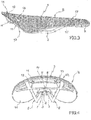
- two front housings 7, for example two blind holes, for inserting the front ends of the connection means 2, are provided, as shown in Figure 4 .
- the rear support element 4 of the seat 1 is made up by a metallic arc that substantially corresponds to the shape of the rear portion 6 of the saddle S, or by another equivalent element.
- the rear support element 4 can be possibly made of plastic material or another suitable material.
- two rear housings 8 for example two blind holes, for inserting the rear ends of the connection means 2, are provided, as shown in Figure 2 .
- Two bushings 8' of polymeric and/or elastomeric material can be interposed between the rear ends of the connection means 2 and the rear housings 8, for the damping of the vibrations and for ensuring a good fitting between the metal parts with tight tolerances and a coupling that allows some relative degrees of freedom.
- the seat 1 of the saddle S comprises through holes 9, 10 for the connection with the front support element 3 and to the rear support element 4.
- a single front through hole 9 for connecting the seat 1 with the front support element 3 is provided.
- through holes 9, 10 affect correspondingly also the front support element 3 and the rear support element 4, as shown for example in Figure 2 .
- Each of these fastening elements 11 comprises, for example, a recessed head screw 12 and a respective nut 13 screwed to the screw 12.
- Both the screw 12 than the nut 13 have the respective heads conveniently flattened formed, in order to do not create excessive protrusions on the surface of the seat 1.
- the seat 1 comprises a first inner layer 14.
- the first inner layer 14 is made of a material of the rubber-type.
- the seat comprises a second layer 15.
- the second layer 15 is placed over the first layer 14.
- the second layer 15 is made of a material of the natural or synthetic fabric-type.
- the natural or synthetic fabric comprises polyester.
- the material of the natural or synthetic fabric-type comprises cotton, hemp, linen, silk or other natural or synthetic fabrics suitably treated to permit the adhesion to the material of the rubber-type or mixtures of the same.
- the seat 1 comprises a third layer 16.
- the third layer 16 is placed over the second layer 15.
- the third layer 16 is made of a material of the rubber-type.
- the seat 1 comprises a fourth outer layer 17.
- the fourth layer 17 is placed over the above mentioned third layer 16.
- the fourth layer 17 is made of a material of the natural fabric-type.
- the fourth layer 17 is in contact with the user.
- the seat 1 can comprise a fifth layer 17'.
- the seat 1 can comprise a fifth layer 17'.
- the fifth layer 17' is superimposed on the first inner layer 14, on the face of the first inner layer 14 opposite to that on which the second layer 15 is present, as shown in figure 8 .
- the fifth layer 17' is made of a material of the natural or synthetic fabric-type.
- the natural or synthetic fabric comprises polyester.
- the natural or synthetic fabric-type material comprises cotton, hemp, linen, silk or other natural or synthetic fabrics that have been suitably treated to allow adhesion to the material of the rubber-type or mixtures thereof.
- the material of the fifth layer 17' can be the same or different than that of the second layer 15.
- the first layer 14 and the third layer 16 are cured together to the aforesaid second layer 15 and fourth layer 17, and possibly together with the fifth layer 17' if present, in such a way to realize a compact composite structure with new characteristics.
- the seat 1 should be realized only by the first inner layer 14, having the second layer 15 overlapping a face of it, and the fourth layer 17, overlapping the opposite face of it, externally placed.
- the second layer 15 and fourth layer 17 are visible from the outside, respectively, from the outer portion of the saddle S and from the inner portion thereof, whereas the seat S is in its use position.
- the first layer 14 is cured together with the aforementioned second layer 15 and fourth layer 17 in such a way as to realize a compact composite structure with new characteristics.
- the first layer 14 of the seat 1 is made of a mixture of natural and synthetic rubber.
- the above mixture of natural and synthetic rubber is prepared with appropriate percentages in order to ensure specific characteristics, and preferably an optimum resistance to atmospheric agents and a good workability to obtain the desired shape in the final product.
- the first layer 14 of the seat 1 should be realized starting from a mixture comprising even other components.
- the first layer 14 should be realized exclusively of natural rubber, or exclusively of synthetic rubber, or even in another material of similar properties.
- the first layer 14 is made up by a thin laminate sheet, with uniform thickness, with homogeneous characteristics.
- the second layer 15 of the seat 1 is made of natural or synthetic fabric with a thickness comprised between 1 mm and 1.5 mm, having a high tensile strength and low ultimate elongation.
- the fabric, of which the second layer 15 is made has a thickness of 1.2 mm.
- polyester fabric having tensile strength of 800 N/cm and an ultimate elongation of about 20% can be employed.
- the characteristics of the second layer 15 in natural or synthetic fabric can be suitably modified according to the specific application needs.
- the natural or synthetic fabric used for the realization of the second layer 15 is developed in such a way that it has a good elasticity and a good adhesion to the rubber.
- the third layer 16 of the seat is made of a mixture of natural or synthetic rubber.
- the third layer 16 of the seat 1 is made of a mixture of natural and synthetic rubber having the same proportions, or substantially the same proportions, than that used to make the first layer 14.
- the third layer 16 therefore, substantially have the same mechanical characteristics of the first layer 14.
- the third layer 16 may be made of a mixture of natural and synthetic rubber characterized by different proportions when compared with the mixture used to make the first layer 14.
- the thickness of the third layer 16 of the seat 1 can be different than that of the first layer 14, according to specific characteristics to be achieved in the final product.
- the fourth layer 17 of the seat 1 is made of a material selected from cotton, linen, silk, and other similar materials.
- the material by which the fourth layer 17 of the seat 1 is made of is a material suitable for ensuring high comfort to the user, in order to eliminate the sometimes unpleasant sensations that the direct contact with the rubber, both natural or synthetic, can determine in some saddles of the known type.
- the fourth layer 17 of the seat 1 comprises a treatment suitable for making it water-repellent, stain-resistant and abrasion resistant.
- this treatment is of the type that is carried out with a solution in water suitable for ensuring water repellence, stain resistance and abrasion resistance to the tissue on which it is carried out.
- the abrasion resistance is obtained thanks to the reduction of the friction coefficient.
- This treatment is suitable for protecting the fibers with an anti-adhesive effect.
- the treatment makes the fibers resistant to variable use temperatures, for example, between -20°C and 80°C.
- the fabric of which the fourth layer 17 is made is washable up to 60°C.
- the product used to carry out the aforementioned treatment has a chemical compliance in accordance with the REACH Regulation (Registration, Evaluation, Authorisation and Restriction of Chemicals), of the European Union, concerning the contact with the user's skin.
- REACH Regulation Registration, Evaluation, Authorisation and Restriction of Chemicals
- the composite structure of the seat S comprising the aforesaid layers has a specific weight of 1,10 kg/dm3 and/or a water absorption during 24 hours less than 1% of water supplied.
- the composite structure of the seat S comprising the aforementioned layers has at least one of the following mechanical properties: ultimate tensile stress (Rm) comprised between 100 and 500 daN/cm, preferably Rm equal to 140 daN/cm; percentage elongation equal to 10% ⁇ 10%.
- Rm ultimate tensile stress
- the tensile strength Rm is calculated over a width of 1 cm of a test specimen of the above composite structure of the saddle S.
- the seat 1 comprises a metal reinforcement insert 18.
- the metal reinforcement insert 18 is interposed between the second layer 15 and third layer 16.
- the metallic insert 18 is interposed between the second layer 15 and the third layer 16 at the front portion 5 of the saddle S, as shown in Figures 6 and 8 .
- the metal insert 18 is interposed between the first layer 14 and second layer 15 at the front portion 5 of the saddle S, as shown in Figure 9 .
- the metal insert 18 has reinforcement function of the anchorage between the seat 1 and the front support element 3.
- this anchorage is preferably carried out by a single fastening element 11, and this could lead during the use, in the absence of the metallic insert 18, to high stresses at the through hole 9 drilled in the seat 1, with consequent risks of damaging or tearing.
- the insert 18 is made of plastic or another suitable material.
- the method comprises a step of providing the first inner layer 14 of the seat.
- the above step of providing the first layer 14 comprises a step of mixing natural and/or synthetic rubber with appropriate percentages in order to ensure certain characteristics, i.e. preferably optimal weather resistance and good machinability.
- this step of providing the first layer 14 comprises a subsequent step of laminating the mixture of natural and/or synthetic rubber in thin constant thickness sheets with homogeneous characteristics.
- the step of providing the first layer 14 then comprises a step of cutting the laminated sheet by a die or other similar cutting organs.
- the perimeter of the first layer 14 is defined, so as to define the shape and dimensions of the finished product using the right amount of rubber blend.
- the method then provides a step of providing the second layer 15 of the seat 1, in natural or synthetic fabric, having the characteristics above described.
- the step of providing the second layer 15 comprises a step of cutting the natural or synthetic fabric with a die or other similar cutting organs, so as to define the shape and dimensions of the finished product using the right amount of fabric.
- the method also provides for a step of providing the third layer 16 of the seat 1.
- the latter step is, from an operational point of view, substantially the same as that one disclosed for the manufacturing of the first layer 14.
- the step of providing the third layer 16 may comprise different operations with respect to the step of providing the first layer 14, according to the characteristics of the product to be obtained.
- the method also comprises a step of providing the fourth outer layer 17 of the seat 1, made of a material of the natural fabric-type.
- the step of providing the fourth layer 17 comprises a cutting step of the natural fabric with a die cutting or other similar cutting organs, so as to define the shape and dimensions of the finished product using the right amount of fabric.
- the manufacturing method then comprises a step of positioning the aforementioned layers 14-17 on each other, in the listed order, within a metal mould, provided with a cavity having the shape of the product to be made.
- the first layer 14 and the third layer 16 are cured together with the second layer 15 and fourth layer 17, thus realizing a compact composite structure, optionally comprising even the metal insert 18.
- the insert 18 is made of plastic or other suitable material, rather than of metal.
- plastic or other suitable material rather than of metal.
- an element is disclosed as made of a metallic material, it is to be understood that possibly it can be realized in plastic material or other suitable material.
- the composite structure thus obtained has new mechanical and physical properties, not discernible from any known product, due to the curing of rubber and the bonding that the latter exerts with the fabrics of the second layer 15 and the fourth layer 17.
- the said step of compressing the layers 14-17 one against the other is carried out, for example, through a press with tonnage of 200 tonnes, or with other equipment with equivalent characteristics.
- the aforementioned predetermined temperature at which is carried out the compression step of the layers 14-17, one on the other is comprised between 100°C and 200°C. In a preferred embodiment of the invention, the predetermined temperature is 160°C.
- the aforementioned predetermined time, during which is carried out the compression of the layers 14-17 one on the other is comprised between 10 minutes and 20 minutes.
- the predetermined time is 15 minutes.
- the manufacturing method then provides a step of treating the fourth layer 17 of natural fabric of the seat 1 with a solution in water suitable for securing specific functional characteristics to the same fourth layer 17.
- such characteristics are preferably the water repellence, stain resistance, abrasion resistance thanks to the low friction coefficient, resistance to sunlight exposure, the resistance to use temperatures between -20°C and 80°C and the washability up to 60°C.
- This step of surface treatment of the fourth layer 17 of the seat 1 can be realized indifferently both before and after the final and full assembly of the seat S, with all its components.
- a step of providing the fifth layer 17' of the seat 1, having the characteristics described above, in natural or synthetic fabric, is provided.
- the step of providing the fifth layer 17' comprises a step of cutting the natural or synthetic fabric with a die or other similar cutting organs, so as to define the shape and dimensions of the finished product using the right amount of fabric.
- the manufacturing method then comprises a step of positioning said fifth layer 17' on said first layer 14, in its inner face opposite to the second layer 15, within a metal mould, provided with a cavity having the form of the product to be made.
- the first layer 14 and the third layer 16 are cured together with the fifth layer 17', the second layer 15 and the fourth layer 17, creating a compact composite structure, possibly including the metal insert 18.
- the composite structure thus obtained has new mechanical and physical properties, not discernible in any known product, due to the curing of the rubber and to the bonding that the latter realizes with the fabrics of the fifth layer 17', of the second layer 15 and of the fourth layer 17.
- the method comprises the steps of providing the first layer 14 of the seat 1.
- the method comprises a subsequent step of laminating the mixture of natural and/or synthetic rubber in thin sheets with constant thickness with homogeneous characteristics.
- the step of providing the first layer 14 then comprises a step of cutting the laminated sheet with a die or other similar cutting organs.
- the perimeter of the first layer 14 is defined, so as to define the shape and dimensions of the finished product using the right amount of rubber blend.
- the method then provides a step of providing the second layer 15 of the seat 1, in natural or synthetic fabric, having the characteristics above disclosed.
- the step of providing the second layer 15 comprises a step of cutting the natural or synthetic fabric with a die or other similar cutting organs, so as to define the shape and dimensions of the finished product using the right amount of fabric.
- the process also involves a step of providing the fourth layer 17 of the seat 1, of natural fabric-type material.
- the step of providing the fourth layer 17 comprises a step of cutting the natural fabric with a die cut or other similar cutting organs, so as to define the shape and dimensions of the finished product using the right amount of fabric.
- the manufacturing method then comprises a step of positioning said layers 14-15-17 one on the other, in the listed order, within a metal mould, provided with a cavity having the shape of the product to be realized.
- the first layer 14 is cured together with the second layer 15 and the fourth layer 17, thus realizing a compact composite structure, possibly including even the metal insert 18.
- the composite structure thus obtained has new mechanical and physical properties, not discernible in any known product, due to the curing of the rubber and the bonding that the latter carries out with the fabrics of the second layer 15 and of the fourth layer 17.
- connection means 2 are fixed with the seat post - in particular, the saddle rails - with front and rear support elements 3, 4.
- the saddle rails 2 are inserted, with their respective front and rear ends, in the front housings 7 of the front support element 3, and in the rear housings 8 of the rear support element 4, thus obtaining the completed saddle S.
- the method comprises a step of inserting bushings 8' of polymeric and/or elastomeric material which will receive the rear ends of the saddle rails, in the rear housings 8, for the vibrations damping and for ensuring a good fit between the metal parts with tight tolerances and a coupling that allows related degrees of freedom.
- FIG 7 another embodiment of the seat 1 according to the present invention, assembled in a saddle S, is shown.
- the seat 1 comprises a substantially slotted central opening 19, which affects all the layers 14-17 or 14-17' or 17-17' or 14-15-17.
- This central opening 19 allows the reduction of the specific pressure on the parts of the user's body that are directly in contact with the fourth outer layer 17 of the seat 1 itself.
- a greater number of openings 19 that affect all the layers 14-17 or 14-17' or 17-17' or 14-15-17 may also be provided.
- the seat according to the present invention has the typical mechanical characteristics of the reinforced rubber concerning the behaviour under the load of the weight of the user.
- the second layer 15 made of natural or synthetic fabric, preferably polyester, limits the compliance of the seat 1, thus preventing the latter from being excessively deformed under the load of the weight of the user.
- the seat 1 is able to immediately offer its comfort features of to maintain them over time contrarily, for example, of previous leather saddles that require an adjustment period to comply with the user.
- the seat 1 thanks to its particular compact composite structure made from layers of materials having certain characteristics and a peculiar arrangement, cured together, does not require a shell or a support structure, to be fixed in use below the seat itself.
- the seat in fact, as disclosed for the various above presented versions, it is self-supporting, thus ensuring a low weight and a good comfort for the user.
- the seat according to the present invention is itself a support structure with a degree of stiffness such as to be sufficiently rigid to be supportive but at the same time sufficiently resilient to ensure comfort, all this being made from a single composite element.
- a further advantage of the seat according to the present invention is the possibility of obtaining some areas with differentiated thickness which allow a more localized deformability of the seat itself.
- the seat 1 according to the invention has the outer surface, intended to come directly in contact with the user, made of a natural fabric, and therefore comfortable to the touch.
- the aforementioned outer surface has excellent characteristics of resistance to weathering, solar radiation, temperature fluctuations and other potentially harmful factors.
- the outer surface is therefore extremely durable and suitable for each condition of use.
- this outer surface has a low coefficient of friction with the surfaces with which it comes in contact, and therefore has high abrasion resistance.
Landscapes
- Engineering & Computer Science (AREA)
- Mechanical Engineering (AREA)
- Chemical & Material Sciences (AREA)
- Composite Materials (AREA)
- Laminated Bodies (AREA)
- Blow-Moulding Or Thermoforming Of Plastics Or The Like (AREA)
- Mattresses And Other Support Structures For Chairs And Beds (AREA)
Applications Claiming Priority (2)
| Application Number | Priority Date | Filing Date | Title |
|---|---|---|---|
| IT000143A ITVR20130143A1 (it) | 2013-06-17 | 2013-06-17 | Seduta per selle di biciclette e simili, e procedimento per la sua fabbricazione. |
| PCT/IB2014/062300 WO2014203165A1 (en) | 2013-06-17 | 2014-06-17 | Seat for bicycle saddles and the like, and method for its manufacturing |
Publications (2)
| Publication Number | Publication Date |
|---|---|
| EP3010716A1 EP3010716A1 (en) | 2016-04-27 |
| EP3010716B1 true EP3010716B1 (en) | 2020-02-26 |
Family
ID=49085181
Family Applications (1)
| Application Number | Title | Priority Date | Filing Date |
|---|---|---|---|
| EP14738633.8A Active EP3010716B1 (en) | 2013-06-17 | 2014-06-17 | Seat for bicycle saddles and the like, and method for its manufacturing |
Country Status (10)
| Country | Link |
|---|---|
| US (1) | US9751580B2 (it) |
| EP (1) | EP3010716B1 (it) |
| JP (1) | JP6410809B2 (it) |
| CN (1) | CN105408110B (it) |
| BR (1) | BR112015031600B1 (it) |
| DK (1) | DK3010716T3 (it) |
| IT (1) | ITVR20130143A1 (it) |
| MY (1) | MY175085A (it) |
| TW (1) | TWI649227B (it) |
| WO (1) | WO2014203165A1 (it) |
Families Citing this family (8)
| Publication number | Priority date | Publication date | Assignee | Title |
|---|---|---|---|---|
| JP6771857B2 (ja) * | 2014-12-25 | 2020-10-21 | 株式会社タチエス | 車両用シート |
| ITUA20162643A1 (it) * | 2016-04-15 | 2017-10-15 | Selle Royal Spa | Elemento di supporto per il corpo umano, quale una sella |
| USD944023S1 (en) * | 2019-10-31 | 2022-02-22 | Selle Italia S.R.L. | Bicycle seat |
| IT202000001699A1 (it) * | 2020-01-29 | 2021-07-29 | Brooks England Ltd | Sella per veicoli, quali biciclette |
| US11981109B2 (en) * | 2020-10-19 | 2024-05-14 | Tetro Ltd. | Hybrid structure having suspension quality |
| US11472504B2 (en) | 2020-11-13 | 2022-10-18 | David Niles | Bicycle saddles with an ischial-perineal suspension region |
| TWI789905B (zh) * | 2021-09-13 | 2023-01-11 | 許秀政 | 複合式自行車坐墊 |
| US20240158038A1 (en) * | 2022-11-11 | 2024-05-16 | Rakstand, Llc | Bicycle seatpost protectors |
Family Cites Families (18)
| Publication number | Priority date | Publication date | Assignee | Title |
|---|---|---|---|---|
| US1358957A (en) * | 1918-07-06 | 1920-11-16 | Jelley James | Method of producing composite rubber and fabric cycle saddle-tops |
| US1499166A (en) * | 1923-12-17 | 1924-06-24 | George S Frazier | Chair-seat pad or cushion |
| GB386054A (en) * | 1931-10-08 | 1933-01-12 | Gough & Co Saddles Ltd | Improvements in motor-cycle and other saddles |
| GB431219A (en) * | 1934-03-19 | 1935-07-03 | Henry Jelley | Improvements in or relating to cycle and like saddles |
| GB686332A (en) * | 1950-06-14 | 1953-01-21 | Frank Cowman | Improvements in or relating to bicycle and like saddles |
| US4842332A (en) * | 1987-02-17 | 1989-06-27 | Conner Jr Donald W | Cushioning seat covering for a cycle saddle |
| US5165752A (en) * | 1991-09-03 | 1992-11-24 | Georgena Terry | Bicycle saddle for women |
| CN2295656Y (zh) * | 1996-05-27 | 1998-10-28 | 专扬企业股份有限公司 | 自行车座垫套 |
| CN2300564Y (zh) * | 1997-09-19 | 1998-12-16 | 维乐工业有限公司 | 自行车座垫套 |
| US5972149A (en) * | 1998-04-20 | 1999-10-26 | Milsco Manufacturing Company | Method for making a seat using a pressured bladder |
| US5911475A (en) * | 1998-06-09 | 1999-06-15 | Nakahara; Toshikazu | Saddle cover for male racing cyclist |
| US6666507B1 (en) * | 1999-01-25 | 2003-12-23 | John B. Ringgard | Seat construction for pedal-operated cycle apparatus |
| US6409865B1 (en) * | 2000-05-01 | 2002-06-25 | Paul M. Yates | Bicycle saddle production method |
| BRPI0407288A (pt) * | 2003-02-05 | 2006-01-31 | Ts Tech Co Ltd | Material de forro para veìculo, assento para veìculos e aparelho de fabricação de assento de veìculo coberto com um material de forro |
| ITVI20050025A1 (it) * | 2005-01-28 | 2006-07-29 | Selle Royal Spa | Struttura di supporto ergonomica in materiale composito, particolarmente per sostenere parti del corpo umano, nonche' metodo di realizzazione della stessa |
| ITVI20070042A1 (it) * | 2007-02-16 | 2008-08-17 | Selle Royal Spa | Struttura di seduta in materiale composito naturale, nonche' metodo di realizzazione della stessa. |
| EP2616314B1 (en) * | 2010-09-16 | 2015-11-25 | Luca Cassani | Method for manufacturing saddles and the like |
| ITVR20110160A1 (it) * | 2011-07-28 | 2013-01-29 | Selle Royal Spa | Supporto per parti di corpo umano e simili |
-
2013
- 2013-06-17 IT IT000143A patent/ITVR20130143A1/it unknown
-
2014
- 2014-06-17 EP EP14738633.8A patent/EP3010716B1/en active Active
- 2014-06-17 DK DK14738633.8T patent/DK3010716T3/da active
- 2014-06-17 WO PCT/IB2014/062300 patent/WO2014203165A1/en not_active Ceased
- 2014-06-17 JP JP2016520785A patent/JP6410809B2/ja active Active
- 2014-06-17 MY MYPI2015704565A patent/MY175085A/en unknown
- 2014-06-17 CN CN201480041402.4A patent/CN105408110B/zh active Active
- 2014-06-17 BR BR112015031600-0A patent/BR112015031600B1/pt active IP Right Grant
- 2014-06-17 US US14/898,913 patent/US9751580B2/en active Active
- 2014-06-17 TW TW103120875A patent/TWI649227B/zh active
Non-Patent Citations (1)
| Title |
|---|
| None * |
Also Published As
| Publication number | Publication date |
|---|---|
| CN105408110A (zh) | 2016-03-16 |
| EP3010716A1 (en) | 2016-04-27 |
| TWI649227B (zh) | 2019-02-01 |
| BR112015031600A2 (pt) | 2017-07-25 |
| JP2016523761A (ja) | 2016-08-12 |
| CN105408110B (zh) | 2018-12-07 |
| JP6410809B2 (ja) | 2018-10-24 |
| US9751580B2 (en) | 2017-09-05 |
| BR112015031600B1 (pt) | 2021-10-26 |
| WO2014203165A1 (en) | 2014-12-24 |
| ITVR20130143A1 (it) | 2014-12-18 |
| US20160368553A1 (en) | 2016-12-22 |
| MY175085A (en) | 2020-06-05 |
| TW201515906A (zh) | 2015-05-01 |
| DK3010716T3 (da) | 2020-05-11 |
Similar Documents
| Publication | Publication Date | Title |
|---|---|---|
| EP3010716B1 (en) | Seat for bicycle saddles and the like, and method for its manufacturing | |
| US6146344A (en) | Lower limb orthotic brace | |
| EP2139751B1 (en) | Seating structure made of natural composite material and process for making same | |
| TWI429551B (zh) | 人體支撐結構,特別是腳踏車車座,以及製造該人體支撐結構的方法 | |
| IT201900018995A1 (it) | Procedimento per la realizzazione di una sella e relativa sella | |
| EP1986843A1 (en) | Process for making integral elastic supports, related mold and support obtained thereby | |
| EP2170688A1 (en) | Elastic human body support and method of making same | |
| US8002345B2 (en) | Ultra light saddle structure, particularly for pedal-driven vehicles and process for making its support frame | |
| US20220409407A1 (en) | Prosthesis socket and method for producing same | |
| TW201531424A (zh) | 自行車用鞍座與其製造方法 | |
| US8746791B2 (en) | Shape-memory saddle structure, particularly for pedal driven vehicles, and process for making such structure | |
| IT202100009659A1 (it) | Procedimento per la realizzazione di uno strato cedevole elasticamente su una superficie rigida e manufatto comprendente tale strato cedevole elasticamente | |
| US20230218412A1 (en) | Prosthetic devices and methods of manufacturing the same | |
| EP1685953B1 (en) | Thermoplastic material, method for producing orthopaedic devices and orthopaedic devices produced therefrom | |
| KR102131594B1 (ko) | 자동차 시트용 다중망 적층 이경도 완충체 | |
| JPH0722932B2 (ja) | シ−トクツシヨンおよびその成形方法 | |
| US20260102261A1 (en) | Prosthetic foot with composite attachment | |
| JP3545523B2 (ja) | 医療用支持材の成形方法 | |
| ITUB20156913A1 (it) | Maschera od occhiale, in particolare sportivo o di protezione |
Legal Events
| Date | Code | Title | Description |
|---|---|---|---|
| PUAI | Public reference made under article 153(3) epc to a published international application that has entered the european phase |
Free format text: ORIGINAL CODE: 0009012 |
|
| 17P | Request for examination filed |
Effective date: 20160114 |
|
| AK | Designated contracting states |
Kind code of ref document: A1 Designated state(s): AL AT BE BG CH CY CZ DE DK EE ES FI FR GB GR HR HU IE IS IT LI LT LU LV MC MK MT NL NO PL PT RO RS SE SI SK SM TR |
|
| AX | Request for extension of the european patent |
Extension state: BA ME |
|
| DAX | Request for extension of the european patent (deleted) | ||
| GRAP | Despatch of communication of intention to grant a patent |
Free format text: ORIGINAL CODE: EPIDOSNIGR1 |
|
| STAA | Information on the status of an ep patent application or granted ep patent |
Free format text: STATUS: GRANT OF PATENT IS INTENDED |
|
| INTG | Intention to grant announced |
Effective date: 20190829 |
|
| GRAS | Grant fee paid |
Free format text: ORIGINAL CODE: EPIDOSNIGR3 |
|
| GRAA | (expected) grant |
Free format text: ORIGINAL CODE: 0009210 |
|
| STAA | Information on the status of an ep patent application or granted ep patent |
Free format text: STATUS: THE PATENT HAS BEEN GRANTED |
|
| AK | Designated contracting states |
Kind code of ref document: B1 Designated state(s): AL AT BE BG CH CY CZ DE DK EE ES FI FR GB GR HR HU IE IS IT LI LT LU LV MC MK MT NL NO PL PT RO RS SE SI SK SM TR |
|
| REG | Reference to a national code |
Ref country code: GB Ref legal event code: FG4D |
|
| REG | Reference to a national code |
Ref country code: CH Ref legal event code: EP |
|
| REG | Reference to a national code |
Ref country code: AT Ref legal event code: REF Ref document number: 1237130 Country of ref document: AT Kind code of ref document: T Effective date: 20200315 |
|
| REG | Reference to a national code |
Ref country code: IE Ref legal event code: FG4D |
|
| REG | Reference to a national code |
Ref country code: DE Ref legal event code: R096 Ref document number: 602014061505 Country of ref document: DE |
|
| REG | Reference to a national code |
Ref country code: DK Ref legal event code: T3 Effective date: 20200507 |
|
| REG | Reference to a national code |
Ref country code: CH Ref legal event code: NV Representative=s name: VALIPAT S.A. C/O BOVARD SA NEUCHATEL, CH |
|
| REG | Reference to a national code |
Ref country code: NL Ref legal event code: FP |
|
| PG25 | Lapsed in a contracting state [announced via postgrant information from national office to epo] |
Ref country code: RS Free format text: LAPSE BECAUSE OF FAILURE TO SUBMIT A TRANSLATION OF THE DESCRIPTION OR TO PAY THE FEE WITHIN THE PRESCRIBED TIME-LIMIT Effective date: 20200226 Ref country code: FI Free format text: LAPSE BECAUSE OF FAILURE TO SUBMIT A TRANSLATION OF THE DESCRIPTION OR TO PAY THE FEE WITHIN THE PRESCRIBED TIME-LIMIT Effective date: 20200226 Ref country code: NO Free format text: LAPSE BECAUSE OF FAILURE TO SUBMIT A TRANSLATION OF THE DESCRIPTION OR TO PAY THE FEE WITHIN THE PRESCRIBED TIME-LIMIT Effective date: 20200526 |
|
| REG | Reference to a national code |
Ref country code: LT Ref legal event code: MG4D |
|
| PG25 | Lapsed in a contracting state [announced via postgrant information from national office to epo] |
Ref country code: LV Free format text: LAPSE BECAUSE OF FAILURE TO SUBMIT A TRANSLATION OF THE DESCRIPTION OR TO PAY THE FEE WITHIN THE PRESCRIBED TIME-LIMIT Effective date: 20200226 Ref country code: IS Free format text: LAPSE BECAUSE OF FAILURE TO SUBMIT A TRANSLATION OF THE DESCRIPTION OR TO PAY THE FEE WITHIN THE PRESCRIBED TIME-LIMIT Effective date: 20200626 Ref country code: SE Free format text: LAPSE BECAUSE OF FAILURE TO SUBMIT A TRANSLATION OF THE DESCRIPTION OR TO PAY THE FEE WITHIN THE PRESCRIBED TIME-LIMIT Effective date: 20200226 Ref country code: BG Free format text: LAPSE BECAUSE OF FAILURE TO SUBMIT A TRANSLATION OF THE DESCRIPTION OR TO PAY THE FEE WITHIN THE PRESCRIBED TIME-LIMIT Effective date: 20200526 Ref country code: HR Free format text: LAPSE BECAUSE OF FAILURE TO SUBMIT A TRANSLATION OF THE DESCRIPTION OR TO PAY THE FEE WITHIN THE PRESCRIBED TIME-LIMIT Effective date: 20200226 Ref country code: GR Free format text: LAPSE BECAUSE OF FAILURE TO SUBMIT A TRANSLATION OF THE DESCRIPTION OR TO PAY THE FEE WITHIN THE PRESCRIBED TIME-LIMIT Effective date: 20200527 |
|
| PG25 | Lapsed in a contracting state [announced via postgrant information from national office to epo] |
Ref country code: ES Free format text: LAPSE BECAUSE OF FAILURE TO SUBMIT A TRANSLATION OF THE DESCRIPTION OR TO PAY THE FEE WITHIN THE PRESCRIBED TIME-LIMIT Effective date: 20200226 Ref country code: PT Free format text: LAPSE BECAUSE OF FAILURE TO SUBMIT A TRANSLATION OF THE DESCRIPTION OR TO PAY THE FEE WITHIN THE PRESCRIBED TIME-LIMIT Effective date: 20200719 Ref country code: SK Free format text: LAPSE BECAUSE OF FAILURE TO SUBMIT A TRANSLATION OF THE DESCRIPTION OR TO PAY THE FEE WITHIN THE PRESCRIBED TIME-LIMIT Effective date: 20200226 Ref country code: RO Free format text: LAPSE BECAUSE OF FAILURE TO SUBMIT A TRANSLATION OF THE DESCRIPTION OR TO PAY THE FEE WITHIN THE PRESCRIBED TIME-LIMIT Effective date: 20200226 Ref country code: CZ Free format text: LAPSE BECAUSE OF FAILURE TO SUBMIT A TRANSLATION OF THE DESCRIPTION OR TO PAY THE FEE WITHIN THE PRESCRIBED TIME-LIMIT Effective date: 20200226 Ref country code: SM Free format text: LAPSE BECAUSE OF FAILURE TO SUBMIT A TRANSLATION OF THE DESCRIPTION OR TO PAY THE FEE WITHIN THE PRESCRIBED TIME-LIMIT Effective date: 20200226 Ref country code: LT Free format text: LAPSE BECAUSE OF FAILURE TO SUBMIT A TRANSLATION OF THE DESCRIPTION OR TO PAY THE FEE WITHIN THE PRESCRIBED TIME-LIMIT Effective date: 20200226 Ref country code: EE Free format text: LAPSE BECAUSE OF FAILURE TO SUBMIT A TRANSLATION OF THE DESCRIPTION OR TO PAY THE FEE WITHIN THE PRESCRIBED TIME-LIMIT Effective date: 20200226 |
|
| REG | Reference to a national code |
Ref country code: AT Ref legal event code: MK05 Ref document number: 1237130 Country of ref document: AT Kind code of ref document: T Effective date: 20200226 |
|
| REG | Reference to a national code |
Ref country code: DE Ref legal event code: R097 Ref document number: 602014061505 Country of ref document: DE |
|
| PLBE | No opposition filed within time limit |
Free format text: ORIGINAL CODE: 0009261 |
|
| STAA | Information on the status of an ep patent application or granted ep patent |
Free format text: STATUS: NO OPPOSITION FILED WITHIN TIME LIMIT |
|
| PG25 | Lapsed in a contracting state [announced via postgrant information from national office to epo] |
Ref country code: MC Free format text: LAPSE BECAUSE OF FAILURE TO SUBMIT A TRANSLATION OF THE DESCRIPTION OR TO PAY THE FEE WITHIN THE PRESCRIBED TIME-LIMIT Effective date: 20200226 Ref country code: AT Free format text: LAPSE BECAUSE OF FAILURE TO SUBMIT A TRANSLATION OF THE DESCRIPTION OR TO PAY THE FEE WITHIN THE PRESCRIBED TIME-LIMIT Effective date: 20200226 |
|
| 26N | No opposition filed |
Effective date: 20201127 |
|
| PG25 | Lapsed in a contracting state [announced via postgrant information from national office to epo] |
Ref country code: PL Free format text: LAPSE BECAUSE OF FAILURE TO SUBMIT A TRANSLATION OF THE DESCRIPTION OR TO PAY THE FEE WITHIN THE PRESCRIBED TIME-LIMIT Effective date: 20200226 Ref country code: SI Free format text: LAPSE BECAUSE OF FAILURE TO SUBMIT A TRANSLATION OF THE DESCRIPTION OR TO PAY THE FEE WITHIN THE PRESCRIBED TIME-LIMIT Effective date: 20200226 |
|
| PG25 | Lapsed in a contracting state [announced via postgrant information from national office to epo] |
Ref country code: LU Free format text: LAPSE BECAUSE OF NON-PAYMENT OF DUE FEES Effective date: 20200617 |
|
| REG | Reference to a national code |
Ref country code: BE Ref legal event code: MM Effective date: 20200630 |
|
| PG25 | Lapsed in a contracting state [announced via postgrant information from national office to epo] |
Ref country code: IE Free format text: LAPSE BECAUSE OF NON-PAYMENT OF DUE FEES Effective date: 20200617 |
|
| PG25 | Lapsed in a contracting state [announced via postgrant information from national office to epo] |
Ref country code: BE Free format text: LAPSE BECAUSE OF NON-PAYMENT OF DUE FEES Effective date: 20200630 |
|
| PG25 | Lapsed in a contracting state [announced via postgrant information from national office to epo] |
Ref country code: TR Free format text: LAPSE BECAUSE OF FAILURE TO SUBMIT A TRANSLATION OF THE DESCRIPTION OR TO PAY THE FEE WITHIN THE PRESCRIBED TIME-LIMIT Effective date: 20200226 Ref country code: MT Free format text: LAPSE BECAUSE OF FAILURE TO SUBMIT A TRANSLATION OF THE DESCRIPTION OR TO PAY THE FEE WITHIN THE PRESCRIBED TIME-LIMIT Effective date: 20200226 Ref country code: CY Free format text: LAPSE BECAUSE OF FAILURE TO SUBMIT A TRANSLATION OF THE DESCRIPTION OR TO PAY THE FEE WITHIN THE PRESCRIBED TIME-LIMIT Effective date: 20200226 |
|
| PG25 | Lapsed in a contracting state [announced via postgrant information from national office to epo] |
Ref country code: MK Free format text: LAPSE BECAUSE OF FAILURE TO SUBMIT A TRANSLATION OF THE DESCRIPTION OR TO PAY THE FEE WITHIN THE PRESCRIBED TIME-LIMIT Effective date: 20200226 Ref country code: AL Free format text: LAPSE BECAUSE OF FAILURE TO SUBMIT A TRANSLATION OF THE DESCRIPTION OR TO PAY THE FEE WITHIN THE PRESCRIBED TIME-LIMIT Effective date: 20200226 |
|
| P01 | Opt-out of the competence of the unified patent court (upc) registered |
Effective date: 20230427 |
|
| PGFP | Annual fee paid to national office [announced via postgrant information from national office to epo] |
Ref country code: DE Payment date: 20250627 Year of fee payment: 12 |
|
| PGFP | Annual fee paid to national office [announced via postgrant information from national office to epo] |
Ref country code: GB Payment date: 20250627 Year of fee payment: 12 Ref country code: DK Payment date: 20250625 Year of fee payment: 12 |
|
| PGFP | Annual fee paid to national office [announced via postgrant information from national office to epo] |
Ref country code: NL Payment date: 20250626 Year of fee payment: 12 |
|
| PGFP | Annual fee paid to national office [announced via postgrant information from national office to epo] |
Ref country code: FR Payment date: 20250625 Year of fee payment: 12 |
|
| PGFP | Annual fee paid to national office [announced via postgrant information from national office to epo] |
Ref country code: IT Payment date: 20250611 Year of fee payment: 12 |
|
| PGFP | Annual fee paid to national office [announced via postgrant information from national office to epo] |
Ref country code: CH Payment date: 20250701 Year of fee payment: 12 |