EP3011838A1 - Alimentat pour animaux comprenant de la farine de colza - Google Patents
Alimentat pour animaux comprenant de la farine de colza Download PDFInfo
- Publication number
- EP3011838A1 EP3011838A1 EP15198565.2A EP15198565A EP3011838A1 EP 3011838 A1 EP3011838 A1 EP 3011838A1 EP 15198565 A EP15198565 A EP 15198565A EP 3011838 A1 EP3011838 A1 EP 3011838A1
- Authority
- EP
- European Patent Office
- Prior art keywords
- feed
- excreta
- rapeseed
- livestock
- test
- Prior art date
- Legal status (The legal status is an assumption and is not a legal conclusion. Google has not performed a legal analysis and makes no representation as to the accuracy of the status listed.)
- Withdrawn
Links
Images


Classifications
-
- A—HUMAN NECESSITIES
- A23—FOODS OR FOODSTUFFS; TREATMENT THEREOF, NOT COVERED BY OTHER CLASSES
- A23K—FODDER
- A23K10/00—Animal feeding-stuffs
- A23K10/30—Animal feeding-stuffs from material of plant origin, e.g. roots, seeds or hay; from material of fungal origin, e.g. mushrooms
- A23K10/37—Animal feeding-stuffs from material of plant origin, e.g. roots, seeds or hay; from material of fungal origin, e.g. mushrooms from waste material
-
- A—HUMAN NECESSITIES
- A23—FOODS OR FOODSTUFFS; TREATMENT THEREOF, NOT COVERED BY OTHER CLASSES
- A23K—FODDER
- A23K50/00—Feeding-stuffs specially adapted for particular animals
- A23K50/10—Feeding-stuffs specially adapted for particular animals for ruminants
-
- A—HUMAN NECESSITIES
- A23—FOODS OR FOODSTUFFS; TREATMENT THEREOF, NOT COVERED BY OTHER CLASSES
- A23K—FODDER
- A23K50/00—Feeding-stuffs specially adapted for particular animals
- A23K50/30—Feeding-stuffs specially adapted for particular animals for swines
-
- A—HUMAN NECESSITIES
- A23—FOODS OR FOODSTUFFS; TREATMENT THEREOF, NOT COVERED BY OTHER CLASSES
- A23K—FODDER
- A23K50/00—Feeding-stuffs specially adapted for particular animals
- A23K50/70—Feeding-stuffs specially adapted for particular animals for birds
- A23K50/75—Feeding-stuffs specially adapted for particular animals for birds for poultry
-
- A—HUMAN NECESSITIES
- A61—MEDICAL OR VETERINARY SCIENCE; HYGIENE
- A61K—PREPARATIONS FOR MEDICAL, DENTAL OR TOILETRY PURPOSES
- A61K36/00—Medicinal preparations of undetermined constitution containing material from algae, lichens, fungi or plants, or derivatives thereof, e.g. traditional herbal medicines
- A61K36/18—Magnoliophyta (angiosperms)
- A61K36/185—Magnoliopsida (dicotyledons)
- A61K36/31—Brassicaceae or Cruciferae (Mustard family), e.g. broccoli, cabbage or kohlrabi
-
- A—HUMAN NECESSITIES
- A61—MEDICAL OR VETERINARY SCIENCE; HYGIENE
- A61K—PREPARATIONS FOR MEDICAL, DENTAL OR TOILETRY PURPOSES
- A61K38/00—Medicinal preparations containing peptides
- A61K38/16—Peptides having more than 20 amino acids; Gastrins; Somatostatins; Melanotropins; Derivatives thereof
- A61K38/168—Peptides having more than 20 amino acids; Gastrins; Somatostatins; Melanotropins; Derivatives thereof from plants
-
- Y—GENERAL TAGGING OF NEW TECHNOLOGICAL DEVELOPMENTS; GENERAL TAGGING OF CROSS-SECTIONAL TECHNOLOGIES SPANNING OVER SEVERAL SECTIONS OF THE IPC; TECHNICAL SUBJECTS COVERED BY FORMER USPC CROSS-REFERENCE ART COLLECTIONS [XRACs] AND DIGESTS
- Y02—TECHNOLOGIES OR APPLICATIONS FOR MITIGATION OR ADAPTATION AGAINST CLIMATE CHANGE
- Y02P—CLIMATE CHANGE MITIGATION TECHNOLOGIES IN THE PRODUCTION OR PROCESSING OF GOODS
- Y02P60/00—Technologies relating to agriculture, livestock or agroalimentary industries
- Y02P60/80—Food processing, e.g. use of renewable energies or variable speed drives in handling, conveying or stacking
- Y02P60/87—Re-use of by-products of food processing for fodder production
Definitions
- the present invention relates to an inventive feed, particularly, a feed having an improved nutrition value and a feed for regulating livestock excreta.
- rapeseed meal made of a residue extracted from rapeseed has been utilized as a livestock feed.
- the rapeseed meal is relatively rich in protein and inexpensive, it has had problems of low energy value (nutritive value) and increase in excreta amount when being used as a feed.
- Patent document 1 Japanese Unexamined Patent Application Publication No. 2003-235470 , Patent document 1
- a livestock/poultry feed containing DATTAN buckwheat Japanese Unexamined Patent Application Publication No. 2006-174790 , Patent document 2
- the present invention provides a feed which is mixed with 0.1 to 30% of rapeseed meal containing 41% or more of protein and 8% or less of crude fiber.
- the inventors also found that a nutrition value of the feed is improved compared with conventional feeds. Therefore, this feed is preferable as a livestock feed having improved nutrition value.
- the present invention provides an innovative livestock feed having an improved nutrition value, which is mixed with 0.1 to 30% of rapeseed meal containing 41% or more of protein and 8% or less of crude fiber.
- % represents weight %.
- this feed remarkably regulates and reduces an excreta amount of the livestock. Therefore, this feed is preferable as a feed regulating excreta of the livestock. Accordingly, the present invention also provides a feed for regulating livestock excreta, which is mixed with 0.1 to 30% of rapeseed meal containing 41% or more of protein and 8% or less of crude fiber.
- the present invention provides a method of feeding livestock, a method of improving nutrition, and a method of regulating an excreta amount, using the above-described feed.
- the livestock feed having an improved nutrition value of the present invention it is possible to obtain an extremely high nutrition value for the livestock.
- a protein amount ingestible to the livestock increases by increasing protein content as a matter of course.
- the feed of the present invention increases digestivity of respective components including protein, fat, and carbohydrate, thereby increasing energy value: ME (nitrogen-corrected metabolizable energy) for chicken and TDN (total digestible nutrients) for pig and cow by 10 to 20% or more.
- ME nitrogen-corrected metabolizable energy
- TDN total digestible nutrients
- excreta With respect to reduction and regulation of excreta by the feed of the present invention, it is not only caused by reduction of indigestible fiber but it effects more than digestivity of administrated rapeseed meal.
- an excreta amount increases.
- the amount decreases compared with the basic feed.
- remarkable excreta regulation effect is found compared with the conventional rapeseed meal. This is because the mixed rapeseed meal is considered to regulate the excreta amount of the total feed.
- Such the excreta regulation effect beyond expectation further decreases labor and cost of excreta disposal and contributes to improvement of hygienic environment of a stall and an environment surrounding the farm.
- a ratio of crude protein and crude fiber in rapeseed meal is important for the rapeseed meal mixed in a feed according to the present invention. Effects are achieved only on condition that both are in specific ranges.
- a protein content of a rapeseed meal is 41% or more, preferably a range of 41% and 60%, more preferably a range of 42.5% and 55%. In a case where the protein content is less than 41%, it is impossible to obtain excreta regulation effect and improvement of energy use efficiency when the rapeseed meal is added to a feed.
- a crude fiber content of the rapeseed meal is 8% or less, preferably a range of 1% and 7%, more preferably a range of 1% and 6%. In a case where the crude fiber content is beyond 8%, it is impossible to obtain excreta regulation effect and improvement of energy use efficiency when the rapeseed meal is added to a feed.
- NDF neutral detergent fiber
- ADF acid detergent fiber
- Lignin is ordinarily 4% or less, preferably 3% or less.
- rapeseed meal As a method of manufacturing the above-described rapeseed meal, a method of shelling rapeseed, a method of concentrating protein by a wash treatment, an enzyme treatment, an alcohol treatment and a sifting treatment, and others may be all employed. Among others, the sifting treatment by a sift with 32 mesh (open 500 ⁇ m) or less is preferable because rapeseed meal satisfying both requirements of protein content and crude fiber is easily obtained.
- a mixture amount of the rapeseed meal in the feed according to the present invention is 0.1 to 30%, preferably 0.5 to 20%, and more preferably 1 to 18%. In a case where a mixture amount is less than 0.1%, excreta regulation effect is not obtained. On the contrary, in a case where it exceeds 30%, an adverse effect due to excessive addition is expected in some cases.
- ingredients other than the rapeseed meal which is mixed in the feed ingredients well known to those skilled in the art are usable without particular limitation depending on types of the livestock.
- examples of such the ingredients are grains including rice, brown rice, rye, wheat, barley, corn, milo, and soy bean; brans including bran, and defatted rice bran; manufacture residues including corn gluten meal, corn germ meal, corn gluten feed, and corn steep liquor; vegetal oil residues including soybean meal, linseed oil meal, and palm oil meal; oils and fats including soybean oil and fat, powder refined beef fat, and animal oil and fat; inorganic salts including magnesium sulfate, ferric sulfate, copper sulfate, zinc sulfate, potassium iodide, cobalt sulfate, calcium carbonate, tricalcium phosphate, natrium chloride, calcium phosphate, and choline chloride; amino acids including lysine and methionine: vitamins including vitamin A, vitamin B1,
- the feed of the present invention is usable to livestock, fishes, crustacean, and others, application to the livestock is preferable.
- livestock are ruminant including cow, goat, and sheep, poultry including chicken, quail, and duck, and pig.
- application to the ruminant is preferable in terms of remarkable reduction of an excreta amount per intake amount.
- Three groups are set up, including a basal diet feeding group where a basal diet shown in Table 1 is provided and two test diet feeding groups where two types of test diets (conventional rapeseed meal-mixed diet and inventive rapeseed meal-mixed diet) are provided.
- the basal diet and one of two types of test subjects (conventional rapeseed-meal product and inventive rapeseed-meal product) shown in Table 2 are mixed at a ratio of 8 to 2.
- the basal diet and the test diets are respectively mixed with 0.1% of chrome oxide as an indicator.
- test chicks Thirty male broiler chicks (chunky) age of about four weeks are prepared. Two test chicks form a group. A group of two test chicks are housed in a cage for metabolism test, and a basal diet is provided to all test chicks for four days so that they become accustomed to a test environment. Subsequently, the basal diet or two types of test diets are assigned to five groups and respective diets are continuously provided for ten days.
- a manure mixture which is excreted for five days since six days after starting provision of respective diets is collected twice a day or morning and evening everyday, and every group.
- a total amount of the mixture is air-dried at approximately 60°C for two days after weighing, an amount for five days is mixed and finely milled, and it is used as a specimen for analysis.
- N nitrogen
- GE gross energy
- Nitrogen-corrected metabolizable energy (ME) of a basal diet and two types of test diets are calculated by an index method ( Standard Tables of Feed Composition in Japan, 2001 ) using chrome oxide as an indicator.
- ME and metabolic rate of two types of test subjects are calculated by a formula described below.
- Test subject ME Mcal / kg Test diet ME - Basal diet ME ⁇ Basal diet mixture ratio 80 % Test subject mixture ratio 20 %
- Test subject Metabolic rate % Test subject ME Mcal / kg Test subject GE Mcal / kg
- ME and metabolic rate of the conventional rapeseed-meal product mixed in the basal diet substantially corresponds with ME (1.69Mcal/kg) and metabolic rate (40.2%) of the rapeseed meal listed in Standard Tables of Feed Composition in Japan, 2001 .
- GE does not change but ME and metabolic rate increase by about 20%.
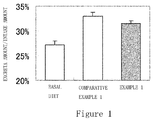
- FIG. 1 A measurement result of air-dried excreta amount per intake amount for the test period is shown in FIG. 1 .
- the result shows that the excreta amount increases by taking in the diet added with the conventional rapeseed-meal product.
- the excreta amount is significantly regulated compared with a case of the conventional rapeseed-meal product.
- Example 4 A test of administration to chicken which is similar to Example 1 is conducted, except for that rapeseed meal in which protein content and fiber content are different as shown in Table 4 is employed. With respect to ingredient of Examples, rapeseed meal classified at 48 mesh (open 300 ⁇ m) or less is used. Evaluation results on the excreta amount are shown in Table 4 together with evaluations of Example 1 and Comparative Example 1.
- excreta reduction effect is found in 41% or more of protein content and 8% or less of fiber content. In a case of protein content more than 41.5% and fiber content less than 6.5%, the excreta reduction effect is especially remarkable.
- Example 2 A test similar to Example 2 is conducted, except for that the mixture amount of rapeseed meal to the diet changes from 20% to an amount shown in Table 5, and an excreta reduction effect is evaluated. A result is shown in Table 5 together with a result of Example 2. [Table 5] Additive amount in diet (%) Excreta reduction effect EXAMPLE 2 20.0 Excellent EXAMPLE 5 0.1 Fair EXAMPLE 6 1.0 Excellent EXAMPLE 7 18.0 Excellent EXAMPLE 8 30.0 Good COMPARATIVE EXAMPLE 4 0.05 Bad COMPARATIVE EXAMPLE 5 40.0 Bad
- addition effect is not found in a mixture amount of less than 0.1%.
- the effect is not found also in a mixture amount of 40% or more, and adverse effect due to excessive addition is expected.
- the effect is especially remarkable in a mixture amount of 1% or more and 20% or less.
- the increase amount of excreta is regulated to less than half, compared with excreta increased by addition of rapeseed meal in Comparative Example 1.
- Three groups are set up, including a basal diet feeding group where a basal diet shown in Table 6 is provided and two test diet feeding groups where two types of test diets (conventional rapeseed meal-mixed diet and inventive rapeseed meal-mixed diet) are provided.
- a basal diet and one of two types of test subjects shown in Table 7 are mixed at a ratio of 7 to 3.
- the basal diet and the test diets are respectively mixed with 0.1% of chrome oxide (Cr 2 O 3 ) as an indicator.
- proximate components (crude protein (CP), crude fat (EE), crude fiber, crude ash, and nitrogen-free extract (NFE)) are analyzed by an analysis method based on Ordinance for Enforcement of the Act on Safety Assurance and Quality Improvement of Feeds (Agriculture and Forestry Ministry Order No.36, July 24,1976 ). Further, gross energy (GE) is analyzed using a bomb colorimeter.
- CP crude protein
- EE crude fat
- NFE nitrogen-free extract
- proximate components and GE are measured by the method described above and Cr 2 O 3 is analyzed by a colorimeter method.
- LW/D-species castrated piglets aged about 3.5 months to 4 months are prepared. These pigs are individually housed in a metabolism cage, all test pigs are provided with a basal diet for five days so that they become accustomed to a test environment. Next, the basal diet and two types of test diets are assigned to every five pigs, and respective diets are provided at constant amount for ten days. Feeding amount of the diet is set to about 3% of a weight of respective test pigs when they are divided, and they are provided with an equal amount twice a day, morning and evening.
- Fresh excreta excreted are individually collected twice a day, morning and evening, for five days since six days after the start of feeding both diets. Thus collected excreta is weighed each time, a total amount is air-dried for two days at about 60°C, subsequently an amount of five days are mixed and finely milled, and an analysis specimen is thus prepared.
- proximate components and GE are measured by the above-described method, and Cr 2 O 3 is analyzed by a colorimeter method.
- Digestivity of respective components of the basal diet and two types of test samples is calculated by a formula of an index method using Cr 2 O 3 as an indicator, and subsequently, digestivity, TDN (total digestible nutrients), and DE (digestible energy) of two types of test subjects are calculated by formulae described below.
- digestivity of test subject % digestible component content of test diet - digestible component content of basal diet ⁇ mixture ratio of basal diet 70 % component content of test subject ⁇ mixture ratio of test subject 30 %
- Test subject TDN % ( test subject CP ⁇ test subject CP digestivity + test subject crude fat ⁇ test subject crude fat digestivity ⁇ 2.25 + test subject crude fiber ⁇ test subject crude fiber digestivity + test subject NFE ⁇ test subject NFE digestivity ) / 100
- Test subject DE Mcal / kg test subject GE ⁇ test subject GE digestivity
- DE of the inventive rapeseed-meal product which is mixed in the diet is 3.49 ⁇ 0.07Mcal/kg. This corresponds with about 1.14 times DE of the conventional rapeseed-meal product mixed in the diet, 3.05 ⁇ 0.08Mcal/kg.
- Digestivity, digestible energy, and TDN of respective components in the two types of test subjects are shown in FIG. 2 .
- digestivity increases in all components, and digestible energy and TDN increase as well.
- FIG. 3 A measurement result of air-dried excreta amount per intake amount during the test period is shown in FIG. 3 . Based on this result, the excreta amount increases by taking in the diet added with the conventional rapeseed-meal product. On the other hand, when the diet mixed with the inventive rapeseed-meal product is taken in, the excreta amount is significantly regulated compared with a case of the conventional rapeseed-meal product.
- Three groups are set up, including a basal diet feeding group where a basal diet shown in Table 8 is provided and two test diet feeding groups where two types of test subjects (conventional rapeseed meal- mixed diet and inventive rapeseed meal-mixed diet) are provided.
- a basal diet and one of two types of test subjects shown in Table 9 are mixed at a ratio of 8 to 2.
- the basal diet and the test diets are respectively mixed with 0.1% of chrome oxide as an indicator.
- Fifteen castrated goats aged about 16 months to 83 months are prepared.
- Test goats are individually housed in a metabolism cage, all the test goats are provided with a basal diet for seven days so that they become accustomed to a test environment.
- every five goats are provided with the basal diet or one of two types of test diets at constant amount for fifteen days.
- Feeding amount of the diet is set about 1.5 to 2.5% of a weight of respective test goats when they are divided, and they are provided with an equal amount twice a day, morning and evening.
- Excreted feces are individually collected twice a day, morning and evening, for seven days since eight days after the start of providing both diets. Thus collected feces are weighed, an amount of one day is incorporated and air-dried for two days at about 60°C, subsequently an amount of seven days are mixed and finely milled, as an analysis specimen.
- proximate components (crude protein (CP), crude fat (EE), crude fiber, crude ash, and nitrogen-free extract (NFE)) are analyzed by an analysis method based on Ordinance for Enforcement of the Act on Safety Assurance and Quality Improvement of Feeds (Agriculture and Forestry Ministry Order No.36, July 24, 1976 ).
- Digestivity of the respective components of the basal diet and the test diets is calculated using a calculation formula of a total excreta collection method, and subsequently digestivity and total digestible nutrients (TDN) of two types of test subjects are calculated using a formula described below. Further, an amount of excreta per diet intake amount is calculated.
- digestivity of test subject % digestible component content of test diet - digestible component content of basal diet ⁇ mixture ratio of basal diet 80 % component content of test subject ⁇ mixture ratio of test subject 20 %
- Test subject TDN % ( test subject CP ⁇ test subject CP digestivity + test subject crude fat ⁇ test subject crude fat digestivity ⁇ 2.25 + test subject crude fiber ⁇ test subject crude fiber digestivity + test subject NFE ⁇ test subject NFE digestivity ) / 100
- FIG. 5 A measurement result of air-dried excreta amount per intake amount during the test period is shown in FIG. 5 . Based on this result, the excreta amount increases by taking in the diet added with the conventional rapeseed-meal product. On the other hand, when the diet mixed with the inventive rapeseed-meal product is taken in, the excreta amount is significantly reduced compared with a case of the conventional rapeseed-meal product and the basal diet.
Landscapes
- Life Sciences & Earth Sciences (AREA)
- Chemical & Material Sciences (AREA)
- Health & Medical Sciences (AREA)
- Polymers & Plastics (AREA)
- Engineering & Computer Science (AREA)
- Animal Husbandry (AREA)
- Birds (AREA)
- Zoology (AREA)
- Food Science & Technology (AREA)
- Botany (AREA)
- Natural Medicines & Medicinal Plants (AREA)
- Medicinal Chemistry (AREA)
- General Health & Medical Sciences (AREA)
- Veterinary Medicine (AREA)
- Public Health (AREA)
- Biotechnology (AREA)
- Mycology (AREA)
- Pharmacology & Pharmacy (AREA)
- Epidemiology (AREA)
- Animal Behavior & Ethology (AREA)
- Gastroenterology & Hepatology (AREA)
- Bioinformatics & Cheminformatics (AREA)
- Immunology (AREA)
- Proteomics, Peptides & Aminoacids (AREA)
- Molecular Biology (AREA)
- Physiology (AREA)
- Microbiology (AREA)
- Alternative & Traditional Medicine (AREA)
- Medical Informatics (AREA)
- Fodder In General (AREA)
- Feed For Specific Animals (AREA)
Applications Claiming Priority (2)
| Application Number | Priority Date | Filing Date | Title |
|---|---|---|---|
| JP2008168843 | 2008-06-27 | ||
| EP09769822.9A EP2289347B1 (fr) | 2008-06-27 | 2009-02-17 | Aliment pour animaux comprenant de la farine de graines de colza |
Related Parent Applications (2)
| Application Number | Title | Priority Date | Filing Date |
|---|---|---|---|
| EP09769822.9A Division-Into EP2289347B1 (fr) | 2008-06-27 | 2009-02-17 | Aliment pour animaux comprenant de la farine de graines de colza |
| EP09769822.9A Division EP2289347B1 (fr) | 2008-06-27 | 2009-02-17 | Aliment pour animaux comprenant de la farine de graines de colza |
Publications (1)
| Publication Number | Publication Date |
|---|---|
| EP3011838A1 true EP3011838A1 (fr) | 2016-04-27 |
Family
ID=41444185
Family Applications (2)
| Application Number | Title | Priority Date | Filing Date |
|---|---|---|---|
| EP09769822.9A Revoked EP2289347B1 (fr) | 2008-06-27 | 2009-02-17 | Aliment pour animaux comprenant de la farine de graines de colza |
| EP15198565.2A Withdrawn EP3011838A1 (fr) | 2008-06-27 | 2009-02-17 | Alimentat pour animaux comprenant de la farine de colza |
Family Applications Before (1)
| Application Number | Title | Priority Date | Filing Date |
|---|---|---|---|
| EP09769822.9A Revoked EP2289347B1 (fr) | 2008-06-27 | 2009-02-17 | Aliment pour animaux comprenant de la farine de graines de colza |
Country Status (9)
| Country | Link |
|---|---|
| US (2) | US20110212219A1 (fr) |
| EP (2) | EP2289347B1 (fr) |
| JP (1) | JP4477700B2 (fr) |
| CN (1) | CN102046024B (fr) |
| AU (1) | AU2009263704B2 (fr) |
| CA (1) | CA2728163C (fr) |
| ES (1) | ES2578602T3 (fr) |
| PL (1) | PL2289347T3 (fr) |
| WO (1) | WO2009157112A1 (fr) |
Families Citing this family (7)
| Publication number | Priority date | Publication date | Assignee | Title |
|---|---|---|---|---|
| CN102046024B (zh) | 2008-06-27 | 2013-09-25 | J-制油株式会社 | 饲料 |
| WO2012018421A1 (fr) * | 2010-08-06 | 2012-02-09 | Icm, Inc. | Systèmes et procédés de récupération de bio-huiles |
| JP6711669B2 (ja) * | 2015-04-14 | 2020-06-17 | 株式会社J−オイルミルズ | 飼料原料の製造方法 |
| EP3413726B1 (fr) * | 2016-02-11 | 2024-03-13 | Société des Produits Nestlé S.A. | Composition de vitamine |
| JP6891146B2 (ja) * | 2018-07-25 | 2021-06-18 | 全国農業協同組合連合会 | 糞量低減のための家禽用飼料 |
| EP3639674A1 (fr) | 2018-10-18 | 2020-04-22 | Mars, Incorporated | Compositions alimentaires pour animaux de compagnie pour la gestion du poids chez des animaux de compagnie avec réaction alimentaire indésirable |
| CN111772053A (zh) * | 2020-08-06 | 2020-10-16 | 遵义师范学院 | 菜籽粕添加谷氨酰胺作鸡饲料蛋白源改善鸡免疫力的方法 |
Citations (6)
| Publication number | Priority date | Publication date | Assignee | Title |
|---|---|---|---|---|
| JPH10229828A (ja) * | 1997-02-17 | 1998-09-02 | Showa Sangyo Co Ltd | 菜種タンパク濃縮物及びそれを用いた海洋性養殖魚用 飼料 |
| JP2003235470A (ja) | 2002-02-20 | 2003-08-26 | Nisshin Shiryo Kk | 養魚用飼料 |
| JP2006174790A (ja) | 2004-12-24 | 2006-07-06 | Kagaku Shiryo Kenkyusho:Kk | 家畜・家禽用飼料 |
| EP1908355A1 (fr) * | 2006-10-03 | 2008-04-09 | Cargill Incorporated | Réduction du contenu en fibres d'oléagineux |
| EP2123178A1 (fr) | 2007-01-24 | 2009-11-25 | J-Oil Mills, Inc. | Procédé de production d'un tourteau de colza |
| EP2289347A1 (fr) | 2008-06-27 | 2011-03-02 | J-Oil Mills, Inc. | Aliment pour animaux |
Family Cites Families (13)
| Publication number | Priority date | Publication date | Assignee | Title |
|---|---|---|---|---|
| US4083836A (en) * | 1974-05-17 | 1978-04-11 | Alfa-Laval Ab | Production of rapeseed protein concentrate for human consumption |
| CA1089849A (fr) * | 1977-10-07 | 1980-11-18 | Canadian Patents And Development Limited | Enlevement de l'enveloppe des graines de colza ou de moutarde dans une farine degraissee |
| JPS5823754A (ja) * | 1981-07-31 | 1983-02-12 | Nisshin Flour Milling Co Ltd | 草食動物用固形飼料 |
| DK80588A (da) * | 1987-02-23 | 1988-08-24 | Suomen Sokeri Oy | Fjerkrae-foder, fodringsmetode og fremgangsmaade til forbedring af fordoejeligheden af fjerkrae-foder |
| JPH02124064A (ja) * | 1988-11-01 | 1990-05-11 | Masahiko Iijima | 膨化飼料及びその製造方法 |
| JPH04166039A (ja) * | 1990-10-26 | 1992-06-11 | Hirotoshi Yokura | ペットフード |
| JPH051296A (ja) * | 1991-06-27 | 1993-01-08 | Nisshin Flour Milling Co Ltd | 菜種の脱皮方法 |
| JP4001695B2 (ja) * | 1999-05-11 | 2007-10-31 | 株式会社J−オイルミルズ | 菜種胚芽の分離方法及び菜種胚芽油脂 |
| JP2001299236A (ja) * | 2000-04-27 | 2001-10-30 | Natl Fedelation Of Agricult Coop Assoc | 豚の糞排泄量の低減方法及びそのための飼料 |
| JP2002065173A (ja) * | 2000-09-01 | 2002-03-05 | Chubu Shiryo Kk | 飼料組成物 |
| JP2004321170A (ja) * | 2003-04-09 | 2004-11-18 | Takushoku Kogyo Kk | ペレット状配合飼料 |
| US9066483B2 (en) * | 2005-08-01 | 2015-06-30 | Her Majesty The Queen In Right Of Canada As Represented By The Minister Of Agriculture And Agri-Food | Low fiber yellow canola seeds comprising high, oleic, low linolenic oil |
| ES2543782T3 (es) * | 2008-05-16 | 2015-08-21 | Siebte Pmi Verwaltungs Gmbh | Concentrados y aislados de proteínas de semillas oleaginosas y procedimientos para la producción de los mismos |
-
2009
- 2009-02-17 CN CN2009801199185A patent/CN102046024B/zh not_active Expired - Fee Related
- 2009-02-17 US US12/996,281 patent/US20110212219A1/en not_active Abandoned
- 2009-02-17 PL PL09769822.9T patent/PL2289347T3/pl unknown
- 2009-02-17 WO PCT/JP2009/000617 patent/WO2009157112A1/fr not_active Ceased
- 2009-02-17 EP EP09769822.9A patent/EP2289347B1/fr not_active Revoked
- 2009-02-17 AU AU2009263704A patent/AU2009263704B2/en not_active Ceased
- 2009-02-17 EP EP15198565.2A patent/EP3011838A1/fr not_active Withdrawn
- 2009-02-17 CA CA2728163A patent/CA2728163C/fr not_active Expired - Fee Related
- 2009-02-17 JP JP2009550182A patent/JP4477700B2/ja active Active
- 2009-02-17 ES ES09769822.9T patent/ES2578602T3/es active Active
-
2017
- 2017-04-27 US US15/499,254 patent/US20170223985A1/en not_active Abandoned
Patent Citations (7)
| Publication number | Priority date | Publication date | Assignee | Title |
|---|---|---|---|---|
| JPH10229828A (ja) * | 1997-02-17 | 1998-09-02 | Showa Sangyo Co Ltd | 菜種タンパク濃縮物及びそれを用いた海洋性養殖魚用 飼料 |
| JP3919866B2 (ja) | 1997-02-17 | 2007-05-30 | 昭和産業株式会社 | 菜種タンパク濃縮物及びそれを用いた海洋性養殖魚用 飼料 |
| JP2003235470A (ja) | 2002-02-20 | 2003-08-26 | Nisshin Shiryo Kk | 養魚用飼料 |
| JP2006174790A (ja) | 2004-12-24 | 2006-07-06 | Kagaku Shiryo Kenkyusho:Kk | 家畜・家禽用飼料 |
| EP1908355A1 (fr) * | 2006-10-03 | 2008-04-09 | Cargill Incorporated | Réduction du contenu en fibres d'oléagineux |
| EP2123178A1 (fr) | 2007-01-24 | 2009-11-25 | J-Oil Mills, Inc. | Procédé de production d'un tourteau de colza |
| EP2289347A1 (fr) | 2008-06-27 | 2011-03-02 | J-Oil Mills, Inc. | Aliment pour animaux |
Non-Patent Citations (8)
| Title |
|---|
| AGRICULTURE AND FORESTRY MINISTRY ORDER NO.36, no. 36, 24 July 1976 (1976-07-24) |
| BULLETIN OF THE NATIONAL INSTITUTE OF ANIMAL INDUSTRY, no. 52, 1992 |
| H.S. BAYLEY: "Nutritional evaluation of low and high fibre fractions of rapeseed meal using chickens and pigs", CAN J. ANIM. SCI, vol. 55, June 1975 (1975-06-01), pages 223 - 232, XP055335551 |
| M CHIBOWSKA ET AL: "Metabolisable energy value of rapeseed meal and its fractions for chickens as affected by oil and fibre content", JOURNAL OF ANIMAL AND FEED SCIENCES, vol. 9, no. 2, 1 January 2000 (2000-01-01), pages 371 - 378, XP055335542, DOI: 10.22358/jafs/68054/2000 * |
| M. CHLBOWSKA: "Metabolisable energy value of rapeseed meal and its fractions for chickens as affected by oil and fibre content", J. ANIMAL AND FEED SCIENCES, vol. 9, no. 2, 2000, pages 371 - 378, XP055335542 |
| MUSTAFA A F; CHRISTENSEN D A; MCKINNON J J: "Chemical characterization and nutrient availability of high and low fiber canola meal", CAN J. ANIM. SCI., vol. 76, December 1996 (1996-12-01), pages 576 - 586, XP055335550 |
| STANDARD TABLES OF FEED COMPOSITION IN JAPAN, 2001 |
| V DANIELSEN ET AL: "Dehulled protein-rich rapeseed meal as a protein source for early weaned piglets", ANIMAL FEED SCIENCE AND TECHNOLOGY, VOL. 46, vol. 46, no. 3-4, 1 January 1994 (1994-01-01), pages 239 - 250, XP055008358, Retrieved from the Internet <URL:http://www.sciencedirect.com/science/journal/03778401/46/3-4> DOI: 10.1016/0377-8401(94)90142-2 * |
Also Published As
| Publication number | Publication date |
|---|---|
| EP2289347B1 (fr) | 2016-03-30 |
| US20110212219A1 (en) | 2011-09-01 |
| CA2728163A1 (fr) | 2009-12-30 |
| ES2578602T3 (es) | 2016-07-28 |
| JPWO2009157112A1 (ja) | 2011-12-08 |
| US20170223985A1 (en) | 2017-08-10 |
| CN102046024A (zh) | 2011-05-04 |
| CN102046024B (zh) | 2013-09-25 |
| CA2728163C (fr) | 2016-01-05 |
| EP2289347A4 (fr) | 2011-11-09 |
| PL2289347T3 (pl) | 2016-10-31 |
| EP2289347A1 (fr) | 2011-03-02 |
| AU2009263704A1 (en) | 2009-12-30 |
| WO2009157112A1 (fr) | 2009-12-30 |
| JP4477700B2 (ja) | 2010-06-09 |
| AU2009263704B2 (en) | 2014-09-04 |
Similar Documents
| Publication | Publication Date | Title |
|---|---|---|
| US20170223985A1 (en) | Feed | |
| EP2124613B1 (fr) | Compositions et méthodes de contrôle du poids chez des animaux | |
| Anderson et al. | Feeding fat from distillers dried grains with solubles to dairy heifers: I. Effects on growth performance and total-tract digestibility of nutrients | |
| EP2931059B1 (fr) | Aliments anti-vieillissement pour animaux de compagnie | |
| Soltani et al. | Interaction of forage provision (alfalfa hay) and sodium butyrate supplementation on performance, structural growth, blood metabolites and rumen fermentation characteristics of lambs during pre-weaning period | |
| Nikolaev et al. | Poultry Product Manufacturing Using By-Products of Fat-and-Oil Industry | |
| EP2931060B1 (fr) | Aliments anti-vieillissement pour animaux de compagnie | |
| KR20220131214A (ko) | 사료 첨가제 조성물 및 이를 포함하는 사료 조성물 | |
| Shirzadegan et al. | The effect of different levels of sesame wastes on performance, milk composition and blood metabolites in Holstein lactating dairy cows | |
| Keady et al. | Effects of silage from maize crops differing in maturity at harvest, grass silage feed value and concentrate feed level on performance of finishing lambs | |
| Vahora et al. | Effect of feeding bypass nutrients to growing buffalo heifers under field conditions | |
| Kumar et al. | Effect of undegradable dietary protein level and plane of nutrition on lactation performance in crossbred cattle | |
| Ali et al. | Use of tomato pomace and/or orange pulp supplemented corn silage for animal feeding | |
| Acheampong-Boateng et al. | Growth performance and carcass characteristics of feedlot cattle fed different levels of macadamia oil cake | |
| Etman et al. | USING A NEW PROTEIN SOURCES IN FEEDING OF RUMINANTS 1-EFFECT OF FEEDING DIFFERENT LEVELS OF GUAR KORMA AS A SOURCE OF PROTEIN ON THE PRODUCTIVE PERFORMANCE OF EGYPTIAN BUFFALOES. | |
| Salama et al. | Nutritional evaluation of some unconventional dietary energy sources in ruminants rations | |
| Jatta et al. | Effect of different dietary levels of concentrate and roughage for optimum growth performance in Thalli lambs. | |
| KR102943828B1 (ko) | 반추동물용 사료 첨가제 조성물 | |
| da Silva Inácio et al. | Effect of supplementation of sorghum silage in weanling fillies during the dry period in Brazil | |
| Ncube et al. | Growth performance of ruminants fed different proportions of maize and sorghum grain | |
| Chiou et al. | Studies on the application of an undegradable protein system to high yielding dairy cattle in Taiwan | |
| Robinson et al. | Influence of ingredient reformulation to reduce diet crude protein level on productivity, and efficiency of dietary nitrogen use, in early lactation dairy cows | |
| KR100877800B1 (ko) | 사육동물의 사료 조성물 | |
| Mousa et al. | Effect of Protected Lysine and Methionine as Feed Additives on the Productive Performance of Some Dairy Animals | |
| Shivakumar et al. | Effect of feeding treated and untreated cotton seed Hull diet on growth and digestibility in calves |
Legal Events
| Date | Code | Title | Description |
|---|---|---|---|
| PUAI | Public reference made under article 153(3) epc to a published international application that has entered the european phase |
Free format text: ORIGINAL CODE: 0009012 |
|
| AC | Divisional application: reference to earlier application |
Ref document number: 2289347 Country of ref document: EP Kind code of ref document: P |
|
| AK | Designated contracting states |
Kind code of ref document: A1 Designated state(s): AT BE BG CH CY CZ DE DK EE ES FI FR GB GR HR HU IE IS IT LI LT LU LV MC MK MT NL NO PL PT RO SE SI SK TR |
|
| STAA | Information on the status of an ep patent application or granted ep patent |
Free format text: STATUS: REQUEST FOR EXAMINATION WAS MADE |
|
| RBV | Designated contracting states (corrected) |
Designated state(s): AT BE BG CH CY CZ DE DK EE ES FI FR GB GR HR HU IE IS IT LI LT LU LV MC MK MT NL NO PL PT RO SE SI SK TR |
|
| 17P | Request for examination filed |
Effective date: 20161021 |
|
| TPAC | Observations filed by third parties |
Free format text: ORIGINAL CODE: EPIDOSNTIPA |
|
| STAA | Information on the status of an ep patent application or granted ep patent |
Free format text: STATUS: EXAMINATION IS IN PROGRESS |
|
| 17Q | First examination report despatched |
Effective date: 20180328 |
|
| GRAP | Despatch of communication of intention to grant a patent |
Free format text: ORIGINAL CODE: EPIDOSNIGR1 |
|
| STAA | Information on the status of an ep patent application or granted ep patent |
Free format text: STATUS: GRANT OF PATENT IS INTENDED |
|
| INTG | Intention to grant announced |
Effective date: 20190118 |
|
| STAA | Information on the status of an ep patent application or granted ep patent |
Free format text: STATUS: THE APPLICATION IS DEEMED TO BE WITHDRAWN |
|
| 18D | Application deemed to be withdrawn |
Effective date: 20190529 |