EP3016741B1 - Verfahren zur herstellung von zeolithen und zeotypen - Google Patents
Verfahren zur herstellung von zeolithen und zeotypen Download PDFInfo
- Publication number
- EP3016741B1 EP3016741B1 EP14736393.1A EP14736393A EP3016741B1 EP 3016741 B1 EP3016741 B1 EP 3016741B1 EP 14736393 A EP14736393 A EP 14736393A EP 3016741 B1 EP3016741 B1 EP 3016741B1
- Authority
- EP
- European Patent Office
- Prior art keywords
- zeolite
- zeotype
- group
- elements
- carbon
- Prior art date
- Legal status (The legal status is an assumption and is not a legal conclusion. Google has not performed a legal analysis and makes no representation as to the accuracy of the status listed.)
- Active
Links
Images




Classifications
-
- C—CHEMISTRY; METALLURGY
- C01—INORGANIC CHEMISTRY
- C01B—NON-METALLIC ELEMENTS; COMPOUNDS THEREOF; METALLOIDS OR COMPOUNDS THEREOF NOT COVERED BY SUBCLASS C01C
- C01B39/00—Compounds having molecular sieve and base-exchange properties, e.g. crystalline zeolites; Their preparation; After-treatment, e.g. ion-exchange or dealumination
- C01B39/02—Crystalline aluminosilicate zeolites; Isomorphous compounds thereof; Direct preparation thereof; Preparation thereof starting from a reaction mixture containing a crystalline zeolite of another type, or from preformed reactants; After-treatment thereof
- C01B39/06—Preparation of isomorphous zeolites characterised by measures to replace the aluminium or silicon atoms in the lattice framework by atoms of other elements, i.e. by direct or secondary synthesis
- C01B39/08—Preparation of isomorphous zeolites characterised by measures to replace the aluminium or silicon atoms in the lattice framework by atoms of other elements, i.e. by direct or secondary synthesis the aluminium atoms being wholly replaced
-
- B—PERFORMING OPERATIONS; TRANSPORTING
- B01—PHYSICAL OR CHEMICAL PROCESSES OR APPARATUS IN GENERAL
- B01J—CHEMICAL OR PHYSICAL PROCESSES, e.g. CATALYSIS OR COLLOID CHEMISTRY; THEIR RELEVANT APPARATUS
- B01J29/00—Catalysts comprising molecular sieves
- B01J29/04—Catalysts comprising molecular sieves having base-exchange properties, e.g. crystalline zeolites
- B01J29/041—Mesoporous materials having base exchange properties, e.g. Si/Al-MCM-41
-
- B—PERFORMING OPERATIONS; TRANSPORTING
- B01—PHYSICAL OR CHEMICAL PROCESSES OR APPARATUS IN GENERAL
- B01J—CHEMICAL OR PHYSICAL PROCESSES, e.g. CATALYSIS OR COLLOID CHEMISTRY; THEIR RELEVANT APPARATUS
- B01J29/00—Catalysts comprising molecular sieves
- B01J29/04—Catalysts comprising molecular sieves having base-exchange properties, e.g. crystalline zeolites
- B01J29/041—Mesoporous materials having base exchange properties, e.g. Si/Al-MCM-41
- B01J29/042—Mesoporous materials having base exchange properties, e.g. Si/Al-MCM-41 containing iron group metals, noble metals or copper
-
- B—PERFORMING OPERATIONS; TRANSPORTING
- B01—PHYSICAL OR CHEMICAL PROCESSES OR APPARATUS IN GENERAL
- B01J—CHEMICAL OR PHYSICAL PROCESSES, e.g. CATALYSIS OR COLLOID CHEMISTRY; THEIR RELEVANT APPARATUS
- B01J29/00—Catalysts comprising molecular sieves
- B01J29/04—Catalysts comprising molecular sieves having base-exchange properties, e.g. crystalline zeolites
- B01J29/041—Mesoporous materials having base exchange properties, e.g. Si/Al-MCM-41
- B01J29/042—Mesoporous materials having base exchange properties, e.g. Si/Al-MCM-41 containing iron group metals, noble metals or copper
- B01J29/043—Noble metals
-
- B—PERFORMING OPERATIONS; TRANSPORTING
- B01—PHYSICAL OR CHEMICAL PROCESSES OR APPARATUS IN GENERAL
- B01J—CHEMICAL OR PHYSICAL PROCESSES, e.g. CATALYSIS OR COLLOID CHEMISTRY; THEIR RELEVANT APPARATUS
- B01J29/00—Catalysts comprising molecular sieves
- B01J29/04—Catalysts comprising molecular sieves having base-exchange properties, e.g. crystalline zeolites
- B01J29/041—Mesoporous materials having base exchange properties, e.g. Si/Al-MCM-41
- B01J29/042—Mesoporous materials having base exchange properties, e.g. Si/Al-MCM-41 containing iron group metals, noble metals or copper
- B01J29/044—Iron group metals or copper
-
- B—PERFORMING OPERATIONS; TRANSPORTING
- B01—PHYSICAL OR CHEMICAL PROCESSES OR APPARATUS IN GENERAL
- B01J—CHEMICAL OR PHYSICAL PROCESSES, e.g. CATALYSIS OR COLLOID CHEMISTRY; THEIR RELEVANT APPARATUS
- B01J29/00—Catalysts comprising molecular sieves
- B01J29/04—Catalysts comprising molecular sieves having base-exchange properties, e.g. crystalline zeolites
- B01J29/041—Mesoporous materials having base exchange properties, e.g. Si/Al-MCM-41
- B01J29/045—Mesoporous materials having base exchange properties, e.g. Si/Al-MCM-41 containing arsenic, antimony, bismuth, vanadium, niobium, tantalum, polonium, chromium, molybdenum, tungsten, manganese, technetium or rhenium
-
- B—PERFORMING OPERATIONS; TRANSPORTING
- B01—PHYSICAL OR CHEMICAL PROCESSES OR APPARATUS IN GENERAL
- B01J—CHEMICAL OR PHYSICAL PROCESSES, e.g. CATALYSIS OR COLLOID CHEMISTRY; THEIR RELEVANT APPARATUS
- B01J29/00—Catalysts comprising molecular sieves
- B01J29/89—Silicates, aluminosilicates or borosilicates of titanium, zirconium or hafnium
-
- B—PERFORMING OPERATIONS; TRANSPORTING
- B01—PHYSICAL OR CHEMICAL PROCESSES OR APPARATUS IN GENERAL
- B01J—CHEMICAL OR PHYSICAL PROCESSES, e.g. CATALYSIS OR COLLOID CHEMISTRY; THEIR RELEVANT APPARATUS
- B01J35/00—Catalysts, in general, characterised by their form or physical properties
- B01J35/60—Catalysts, in general, characterised by their form or physical properties characterised by their surface properties or porosity
- B01J35/64—Pore diameter
- B01J35/647—2-50 nm
-
- B—PERFORMING OPERATIONS; TRANSPORTING
- B01—PHYSICAL OR CHEMICAL PROCESSES OR APPARATUS IN GENERAL
- B01J—CHEMICAL OR PHYSICAL PROCESSES, e.g. CATALYSIS OR COLLOID CHEMISTRY; THEIR RELEVANT APPARATUS
- B01J35/00—Catalysts, in general, characterised by their form or physical properties
- B01J35/60—Catalysts, in general, characterised by their form or physical properties characterised by their surface properties or porosity
- B01J35/64—Pore diameter
- B01J35/651—50-500 nm
-
- B—PERFORMING OPERATIONS; TRANSPORTING
- B01—PHYSICAL OR CHEMICAL PROCESSES OR APPARATUS IN GENERAL
- B01J—CHEMICAL OR PHYSICAL PROCESSES, e.g. CATALYSIS OR COLLOID CHEMISTRY; THEIR RELEVANT APPARATUS
- B01J35/00—Catalysts, in general, characterised by their form or physical properties
- B01J35/60—Catalysts, in general, characterised by their form or physical properties characterised by their surface properties or porosity
- B01J35/66—Pore distribution
- B01J35/69—Pore distribution bimodal
-
- B—PERFORMING OPERATIONS; TRANSPORTING
- B01—PHYSICAL OR CHEMICAL PROCESSES OR APPARATUS IN GENERAL
- B01J—CHEMICAL OR PHYSICAL PROCESSES, e.g. CATALYSIS OR COLLOID CHEMISTRY; THEIR RELEVANT APPARATUS
- B01J37/00—Processes, in general, for preparing catalysts; Processes, in general, for activation of catalysts
- B01J37/0009—Use of binding agents; Moulding; Pressing; Powdering; Granulating; Addition of materials ameliorating the mechanical properties of the product catalyst
- B01J37/0018—Addition of a binding agent or of material, later completely removed among others as result of heat treatment, leaching or washing,(e.g. forming of pores; protective layer, desintegrating by heat)
-
- C—CHEMISTRY; METALLURGY
- C01—INORGANIC CHEMISTRY
- C01B—NON-METALLIC ELEMENTS; COMPOUNDS THEREOF; METALLOIDS OR COMPOUNDS THEREOF NOT COVERED BY SUBCLASS C01C
- C01B39/00—Compounds having molecular sieve and base-exchange properties, e.g. crystalline zeolites; Their preparation; After-treatment, e.g. ion-exchange or dealumination
- C01B39/02—Crystalline aluminosilicate zeolites; Isomorphous compounds thereof; Direct preparation thereof; Preparation thereof starting from a reaction mixture containing a crystalline zeolite of another type, or from preformed reactants; After-treatment thereof
- C01B39/06—Preparation of isomorphous zeolites characterised by measures to replace the aluminium or silicon atoms in the lattice framework by atoms of other elements, i.e. by direct or secondary synthesis
- C01B39/08—Preparation of isomorphous zeolites characterised by measures to replace the aluminium or silicon atoms in the lattice framework by atoms of other elements, i.e. by direct or secondary synthesis the aluminium atoms being wholly replaced
- C01B39/085—Group IVB- metallosilicates
-
- C—CHEMISTRY; METALLURGY
- C07—ORGANIC CHEMISTRY
- C07C—ACYCLIC OR CARBOCYCLIC COMPOUNDS
- C07C2/00—Preparation of hydrocarbons from hydrocarbons containing a smaller number of carbon atoms
- C07C2/54—Preparation of hydrocarbons from hydrocarbons containing a smaller number of carbon atoms by addition of unsaturated hydrocarbons to saturated hydrocarbons or to hydrocarbons containing a six-membered aromatic ring with no unsaturation outside the aromatic ring
- C07C2/64—Addition to a carbon atom of a six-membered aromatic ring
- C07C2/66—Catalytic processes
-
- C—CHEMISTRY; METALLURGY
- C07—ORGANIC CHEMISTRY
- C07C—ACYCLIC OR CARBOCYCLIC COMPOUNDS
- C07C5/00—Preparation of hydrocarbons from hydrocarbons containing the same number of carbon atoms
- C07C5/22—Preparation of hydrocarbons from hydrocarbons containing the same number of carbon atoms by isomerisation
- C07C5/27—Rearrangement of carbon atoms in the hydrocarbon skeleton
- C07C5/2767—Changing the number of side-chains
- C07C5/277—Catalytic processes
- C07C5/2772—Catalytic processes with metal oxides
-
- B—PERFORMING OPERATIONS; TRANSPORTING
- B01—PHYSICAL OR CHEMICAL PROCESSES OR APPARATUS IN GENERAL
- B01J—CHEMICAL OR PHYSICAL PROCESSES, e.g. CATALYSIS OR COLLOID CHEMISTRY; THEIR RELEVANT APPARATUS
- B01J2229/00—Aspects of molecular sieve catalysts not covered by B01J29/00
- B01J2229/10—After treatment, characterised by the effect to be obtained
- B01J2229/18—After treatment, characterised by the effect to be obtained to introduce other elements into or onto the molecular sieve itself
- B01J2229/183—After treatment, characterised by the effect to be obtained to introduce other elements into or onto the molecular sieve itself in framework positions
-
- B—PERFORMING OPERATIONS; TRANSPORTING
- B01—PHYSICAL OR CHEMICAL PROCESSES OR APPARATUS IN GENERAL
- B01J—CHEMICAL OR PHYSICAL PROCESSES, e.g. CATALYSIS OR COLLOID CHEMISTRY; THEIR RELEVANT APPARATUS
- B01J2229/00—Aspects of molecular sieve catalysts not covered by B01J29/00
- B01J2229/60—Synthesis on support
-
- C—CHEMISTRY; METALLURGY
- C07—ORGANIC CHEMISTRY
- C07C—ACYCLIC OR CARBOCYCLIC COMPOUNDS
- C07C2529/00—Catalysts comprising molecular sieves
- C07C2529/04—Catalysts comprising molecular sieves having base-exchange properties, e.g. crystalline zeolites, pillared clays
-
- C—CHEMISTRY; METALLURGY
- C07—ORGANIC CHEMISTRY
- C07C—ACYCLIC OR CARBOCYCLIC COMPOUNDS
- C07C2529/00—Catalysts comprising molecular sieves
- C07C2529/89—Silicates, aluminosilicates or borosilicates of titanium, zirconium or hafnium
Definitions
- the invention concerns a method for making zeolites and zeotypes and the zeolites and zeotypes produced by the method.
- a cation located nearby.
- the cation is usually an alkali metal (such as sodium), alkali earth metal, or possibly a H + ion. If the cation is a proton, the zeolite becomes a strong Bronsted acid. All these characteristics give rise to a lot of uses for zeolites. These applications range from ion exchangers in laundry detergent powder to adsorbent agents and as catalysts, often as solid acid catalyst due to the Bronsted acid sites. Their catalytic applications range from fluid catalytic cracking (FCC), petrochemistry and the synthesis of special chemicals to environmental catalysis.
- FCC fluid catalytic cracking
- zeolites Today, nearly 60 different natural occurring zeolites are known, while 201 can be prepared synthetically [1]. These zeolites have different structures, due to different Si-O-Al linkages, and a different number of Si or Al atoms linked in each "cage". This also creates different pore system of one-, two, or three-dimensions in the zeolite. As the pores are very regular, and around the same size in diameter as molecules, it is possible for zeolites to function as molecular sieves. Due to their chemical structure and molecular sieve properties, zeolite catalysts exhibit high selectivity for a variety of chemical reactions. Since most of the surface area and the active sites are within the zeolite, the shape of the pores and channels give rise to shape selective catalysis. Commonly there is distinguished between three types of molecular sieving effects:
- zeolite synthesis is a crystallization process, where silica and alumina species dissolve and react to give a less soluble crystalline alumina/silicate product.
- the crystallization process is typically performed in a hydrothermal process where these zeolite precursors are added to an autoclave and heated to relatively high temperatures and autogenous pressures. The high pressure is due to the evaporation of water inside the autoclave, and is very important for the synthesis.
- the zeolite precursors are dissolved or suspended in an aqueous solution of a structure directing agent (SDA) and an alkali hydroxide to catalyze the breaking and formation of chemical bonds [4].
- SDA structure directing agent
- the structure directing agents are almost always organic amine cations. Some of the most commonly used organic structure directing agents are tetramethylammonium (TMA), tetraethylammonium (TEA), and tetrapropylammonium (TPA), though compounds as diverse as Choline, 1,6-diaminohexane, and hexanediol have been used.
- TMA tetramethylammonium
- TEA tetraethylammonium
- TPA tetrapropylammonium
- the zeolites form around molecules of the structure directing agent.
- the shape and properties of the structure directing agent causes the zeolites forming around it to take a certain shape. Stoichiometric analysis of samples of ZSM-5 has indicated that one TPA + molecule occupies each intersection between pores in the zeolite [2].
- zeolite precursors amorphous zeolite gel
- the mixture of zeolite precursors is then transferred to an autoclave and heated to a predetermined temperature, often between 120-200 °C. Within days, possibly weeks, the precursors begin to crystallize and form the zeolite.
- the autoclave is cooled to room temperature, and the zeolite material is washed with water and isolated by filtration or centrifugation.
- the zeolite is then calcined at around 500-600 °C to remove residual SDA and framework water.
- the zeolite can be ion exchanged. This can either be done to introduce hydrons, alkali metal, alkali earth metal, lanthanoid or transition metal cations.
- microporous structure of zeolites does not only determine the chemical selectivity, but also play an important role concerning mass transport within the zeolite crystal.
- the micropores can limit the diffusion, molecular mobility and ultimately determine the reaction rate of the overall process [6, 7].
- slow diffusion can cause polymerization of by-products or reaction intermediates blocking catalytic active sites within the microporous channels. For some catalytic applications this may lead to severe deactivation [8].
- the diffusion can be sharply reduced by small amounts of debris in the pores generated during zeolite synthesis or activation and by small amounts of strongly adsorbed molecules.
- Hierarchical zeolites are characterised by porosity in the meso- or macropore range in addition to the micropores [7]. The reason for the increased interest in these materials, is the addition of the improved transport due to the interconnections of a secondary network of inter- or intracrystalline mesopores, while still maintaining the catalytic properties (shape selectivity and hydrothermal stability) associated with the conventional zeolite.
- Mesoporous zeolites are characterized by having connected intracrystalline meso- and micropores.
- the micropores originate from the conventional synthesis of zeolites, but the mesopores can be introduced in numerous ways.
- Demetallation is a non-templating method and involves dissolving part of a conventional zeolite by the use of a chemical reagent. The conditions are typically quite harsh, involving strong acids, bases, hot steam or complexing agents, as zeolites are highly stable.
- templating procedures several types of templates have been utilised for the introduction of mesopores in zeolites. These are grouped into two groups, depending on the interface between the zeolite crystal and the template.
- Soft templating is the use of e.g. surfactants to generate porosity.
- One method is to add a surfactant to the zeolite synthesis gel. This facilitates the assembly of a mesostructured phase from the zeolite seed solution [35, 36]. After the hydrothermal synthesis the soft template is removed by combustion together with the SDA.
- Templates include organic aerogels, polymers, and carbon in different forms. Here, only carbon templates will be mentioned.
- One of the well-known methods is the crystallization of zeolite gel in porous carbon particles. If the amount of synthesis gel relative to the carbon template is sufficient, the zeolite crystals continue to grow after nucleation in the cavities of the carbon. This will allow the zeolite crystal to encapsulate the carbon. Combustion of the carbon particles embedded in the zeolite crystal, will lead to the formation of mesopores [37].
- Several types of carbon nanoparticles have been used [38], including carbon nanotubes [39] and nanofibers.
- mesoporous zeolite As a carbon source it is also possible to apply in situ prepared carbon, typically by carbonization of various precursors. This has been done by e.g. decomposition of various precursors in the pores of ordered mesoporous materials such as MCM-41. The mesoporous material is then dissolved and the resulting carbon is impregnated with the zeolite synthesis gel. After crystallisation and combustion of the carbon, mesoporous zeolite is obtained [40]. Kustova et al. [41] reported a similar synthesis method, only with the use of cheap silica and sucrose as silicon and carbon precursors. This resulted in a crystalline mesoporous zeolite.
- mesoporous zeolites Compared to conventional zeolites, it is not without disadvantages. Introducing mesoporosity in zeolites will cause an increasing portion of the active sites to be available for molecules too large to actually enter the micropore structure. It has been shown, that 2,4-dimethylpyridine probes approximately half the Bronsted acidic sites in a commercial ZSM-5 sample vs. nearly 100% after a strong desilication [54]. In addition the mesopore walls can also be catalytically active [55], allowing the inclusion and catalysis of bulky molecules. This means that shape selectivity of mesoporous zeolites will be reduced compared to microporous zeolites. The design of the mesoporous zeolite must therefore be carefully considered, before it is applied to a given reaction.
- Janssen A H et al. discloses a method for generation of mesopores in zeolite crystals by templating with carbon during synthesis and comprise preparing a catalyst of Ni/SiO 2 by deposition-precipitation using the hydrolysis of urea followed by reducing the Ni catalyst before growing the carbon nanofibers (CNF).
- the CNF's are grown at 550°C in CO/H2/Ar (20/7/73) at 1 bar for 24 hours. Subsequently, the CNF's are refluxed with NaOH to remove the silica support and refluxed with a mixture of HNO 3 and H 2 SO 4 to remove the Ni and to activate the CNF's by forming oxygen containing groups.
- mesoporous zeolites or zeotypes ie. artificial materials based on the structure of zeolites
- the present invention reletes to a method for producing zeolite, zeolite-like or zeotype particles comprising the steps of:
- the present invention also relates to a zeolite, zeolite-like or zeotype particle manufactured by the method according to the present invention with a crystal structure comprising one or more encapsulated metal nanoparticles.
- the invention relates to a method for producing zeolite, zeolite-like or zeotype particles comprising the steps of:
- the zeolite structure can be zeolite beta (BEA), Y (FAU), ZSM-5 (MFI), ZSM-11 (MEL) or ZSM-12 (MTW).
- the method is based on carbon templating (like the sucrose method [41]) but originates from the desire to develop a fast, efficient and cheap method that can be scaled up for industrial application.
- An overview of this synthesis is presented in Figure 2b .
- zeolites when zeolites is mentioned it is meant to comprises zeolites, zeolite-like materials and zeotypes unless other is specifically mentioned.
- zeolite-like non-silicon comprising material.
- zeolite-like materials are non-silicon comprising materials such as aluminium phosphate (AlPO4) molecular sieves, known as AlPO's.
- AlPO4 aluminium phosphate
- the phosphorous compound can be selected from the group consisting of phosphoric acid, phosphate salts and mixtures thereof.
- phosphate salts is meant salts of phosphates, monohydrogen phosphates and dihydrogen phosphates.
- zeolite, zeolite-like and zeotype particle is also meant zeolite, zeolite-like and zeotype crystal or zeolite, zeolite-like and zeotype material.
- metal nanoparticles is also meant metal oxide nanoparticles and metal nitrate nanoparticles.
- the metal or mixture of metal precursors might form into the respective oxides or nitrates. This can happen either during the manufacturing process or in the end product
- Possible silica sources for zeolites may be bulk silica of different quality and alumina contamination, including pure silica, fumed silica, sodium silicate or precipitated silica, tetraethyl orthosilicate ect.
- Possible aluminium sources for zeolites may be aluminum nitrate, aluminum sulphate, aluminum phosphate, sodium aluminate ect.
- a hydrothermal process is a technique of crystallizing substances from high-temperature aqueous solutions at high vapour pressure.
- the inherent micropores in the zeolite structure are also here called primary porosity whereas the ekstra pores created by the method of the present invention are referred to as secondary porosity.
- This secondary porosity can both be micropores or mesopores.
- the first step in the process is to add one or more metal precursors to a silica/alumina source.
- the first step is performed at room temperature.
- the first step is performed at elevated temperatures such as from 50 °C to 150 °C, such as around 80 °C.
- the metal precursors can be added by grinding, impregnation, co-precipitation, deposition-precipitation or chemical vapor deposition.
- Impregnation a solution, e.g. an aqueous or alcoholic solution of one or several transition metal precursors is applied to a silica/alumina source.
- the solution is dryed, e.g. in an oven at 80 °C overnight, whereby water is evaporated and left is the metal on the surface of the silica/alumina source.
- Deposition Precipitation silica and the one or more metal precursors are mixed together in a solution.
- pH or adding chemicals e.g. H 2 O 2
- the character of the metal change to another compound and deposit on the silica.
- the metal or mixture of metals can be in a gas phase or liquid phase. If the metal is in a liquid phase the liquid is heated to the boiling point and passed over the silica where it is deposited. If the metal is in the gas phase, the gas is passed over the silica where it is deposited.
- nickel particles are made volatile by CO and carbonyl compound are created, which are deposited on the silica and creates carbon nanotubes.
- the one or more metal(s) is selected from the group consisting of group 4 elements, group 6 elements, group 7 elements, group 8 elements, group 9 elements, group 10 elements, group 11 elements or group 12 elements or mixtures thereof.
- the group elements are defined by the new IUPAC numbering.
- the one or more metal(s) is selected from the group consisting of titanium, osmium, iridium, platinum, ruthenium, palladium, rhodium, rhenium, copper, nickel, iron, cobalt, silver, gold, cadmium, molybdenium or mixtures thereof.
- the metal is nickel.
- step 1 is performed in a liquid phase, e.g. in an aqueous or alcoholic solution, in a gas phase or in a solid phase.
- the aqueous or alcoholic solution of the one or more metal precursors could comprise nitrates, carbonates, acetates sulphates or chlorides.
- the first step in the process involves impregnating a silica or alumina precursor with an aqueous or alcoholic solution of one or several transition metal precursors.
- the possible metals especially include Fe, Co, Ni, Cu, Ru, Rh, Pd, Ag, Pt, Au, Mo, and mixtures thereof.
- the possible metal precursors include nitrates, carbonates, acetates, sulfates, chlorides and carbonyls.
- the possible metal can also be metal alloy such as gold-platinum, copper-palladium, ruthenium-copper, platinum-iridium, platinum-palladium, platinum-ruthenium, cobalt-molybdenum, nickel-molybdenum, or palladium-gold, where one of the metals in the metal alloy can be present in an amount of from 1 to 50%.
- the optimal weight ratio between the metals in the alloy depends on the metal alloy.
- the second step in the process involves reducing the one or more metal precursors to form metal nanoparticles on the surface of the silica or alumina source.
- the metal precursors are reduced in a reducing atmosphere, for instance in a stream of hydrogen, or decomposed by a thermal treatment to give the corresponding transition metal nanoparticles.
- the transition metal nanoparticles can also be in the form of metal oxide nanoparticles or metal nitrate nanoparticles.
- This reduction step is in one embodiment performed at elevated temperatures, e.g. from 200 to 800 °C such as from 200 to 700 °C, or such as from 200 to 600 °C.
- the third step in the process involves passing a gaseous hydrocarbon, alkyl alcohol or alkyl ether over the silica/alumina source with the impregnated metal nanoparticles, thereby forming a zeolite precursor composition comprising carbon coated metal nanoparticles.
- the physical shape of the the thus deposited carbon (also called carbon template) coating the nanoparticles can vary depending on the process conditions.
- the carbon is in the form of whiskers (nanotubes).
- the carbon is in the form of nanofibers.
- the carbon is in the form of spheres encircling the metal nanoparticles.
- the flow of gaseous hydrocarbon, alkyl alcohol or alkyl ether is in the range of 20 to 500 ml/min, 20 to 400 ml/min, 100 to 400 ml/min, 30 to 100 ml/min, 50 to 90 ml/min, 50 to 70 ml/min or 60 to 70 ml/min.
- the third step of the process involves heating the silica or alumina and metal nanoparticles to 200-1100°C, such as from 200-800 °C, or from 300-1100 °C.
- the hydrocarbon is selected from aliphatic hydrocarbons having 1 to 8 carbon atoms, having 1 to 3 carbon atoms, alkenes having 2 to 6 carbon atoms, aromatic hydrocarbons having 6 to 10 carbon atoms and cyclic hydrocarbons having 3 to 8 carbon atoms.
- the hydrocarbon is selected from methane, propene, xylene or benzene.
- the alkyl alcohol is selected from aliphatic alcohols having 1 to 8 carbon atoms, or having 1 to 3 carbon atoms.
- the alkyl ether is selected from aliphatic ethers having 2 to 8 carbon atoms, or having 2 to 4 carbon atoms.
- alkyl ether is DME (dimethylether).
- the flow of gaseous hydrocarbon, alkyl alcohol or alkyl ether is applied for around 1-5 hours e.g. 2 hours.
- the third step of the process involves heating the silica or alumina and metal nanoparticles to 300-1100 °C in a stream of a simple hydrocarbon gas (1-8 carbon atoms or cyclic hydrocarbons) that decomposes on the metal surface to leave the carbon template deposited on the zeolite precursor composition.
- a simple hydrocarbon gas (1-8 carbon atoms or cyclic hydrocarbons
- the fourth step involves two steps; step 4a is adding a structure directing agent to the carbon template coated zeolite, zeolite-like or zeotype precursor composition thereby creating a zeolite, zeolite-like or zeotype gel composition; and step 4b is crstallization of the zeolite, zeolite-like or zeotype gel composition by subjecting the zeolite, zeolite-like or zeotype gel composition to a hydrothermal treatment.
- the silica or alumina is dissolved in an aqueous alkaline media creating a supersaturated solution from which the zeolite is formed around the carbon template in the presence of a structure directing agent (SDA), preferably a quaternary ammonium salt such as TPAOH (tetrapropylammonium hydroxide) or TBAOH (tetrabutylammonium hydroxide).
- SDA structure directing agent
- TPAOH tetrapropylammonium hydroxide
- TBAOH tetrabutylammonium hydroxide
- the carbon template coated zeolite, zeolite-like or zeotype precursor composition of step 3 is used directly in step 4a without removing the silica or alumina source.
- the silica or alumina source is reused in the following process, which reduces the production cost compared to alternative processes, where it is removed and only the carbon skeleton is used in the further process as seen in e.g. A. H. Janssen et al, Microporous and Mesoporous Materials 65 (2003), page 59-75 .
- the method is simplified.
- the fourth step comprises a hydrothermal treatment of an initially formed zeolite gel wherein the gel is heated to temperatures between 70 and 300 °C, preferably at 180 °C.
- the gel may be under an autogeneous pressure in an autoclave or open flask for 24 hours or more.
- the method of producing a zeolite or zeotype particle comprises adding an Al, Sn, Ti, Zr or Ge source during step 4a.
- the source may be an Al 3+ , Sn 2+ , Sn 4+ , Ti 4+ , Zr or Ge source.
- Sources of Titanium could be e.g. titanium chlorides, titanium sulphates, titanium alkoxides e.g. TEOT (tetraethyl orthotitanate) and TBOT (tetrabutyl orthotitanat).
- Sources of aluminium could be aluminum nitrate, aluminum sulphate, aluminum phosphate, sodium aluminate ect.
- Sources of tin could be tin chlorides, tin oxides or splid tin dissolved in hydrochloric acid.
- Sources of zirconia could be zirconia chloride or zirconia oxide.
- silica source should be applied at this step.
- the source of silica is bulk silica of different quality and alumina contamination, including pure silica, fumed silica, sodium silicate or other soluble silicate salts, precipitated silica, tetraethyl orthosilicate and other alkoxy-silicates, silicic acid, etc.
- Ti-zeotype particles, Sn-zeotype particle, Zr-zeotype particle or Ge-zeotype particles can be manufactured by the present method.
- the catalyst is washed, dried and calcined in air at above 300 °C, preferably between 300-700 °C, preferably between 400-700 °C to remove the structure directing agent and the carbon template. Calcination triggers thermal decomposition of the structure directing agent leaving the zeolite behind. More preferably a controlled combustion is conducted by calcination of the crystalized zeolite in air at 550 °C. The combustion is conducted for e.g. 24 hours or 20 hours. The combustion can also be conducted for more than 24 hours.
- the zeolite crystals obtain a secondary porosity in addition to the inherent zeolite microporous system. The porosity can be modified by changing the type and amount of carbon.
- the metal nanoparticles previously supporting the growth of carbon templates (whiskers, nanotubes etc) during the third step of the process are left behind in the secondary porosity of the zeolites after the fifth step has been carried out.
- These metal nanoparticles are homogeneously distributed throughout the crystalline zeolite structure and are further individually shielded from physical contact with other metal nanoparticles hosted in the zeolite by the walls of the formed pores.
- step 5 The calcination procedure conducted in step 5 is expected to remove the carbon template and remaining amounts of the structure directing agent. However, under certain combinations of reaction parameters the zeolite structure may still contain traces of carbon trapped in pores.
- the first step involves impregnating an aqueous solution of a metal nitrate on the silica.
- the metal nitrate is then reduced in a hydrogen stream to form metal nanoparticles.
- a gaseous hydrocarbon e.g. propene gas is passed over the sample.
- the time of exposure to the hydrocarbon gas, the temperature, the nature of the carbon gas, e.g. propene may cover and encapsulate the metal nanoparticles or deposit as carbon [42, 43]. More carbon will result in more and larger mesopores being formed in the final catalyst.
- the zeolite precursor is mixed with a structuring directing agent (SDA) and a base and put in a Teflon beaker inside a Teflon-lined autoclave containing a sufficient amount of water to generate saturated steam and heated to e.g. 180 °C for e.g. 72 hours.
- SDA structuring directing agent
- the carbon template is removed by combustion. This will lead to uniformed micropores or mesopores in the zeolite, which are modifiable by increasing or decreasing the nanoparticle size.
- the metal nanoparticles may still be present inside the catalyst. These can be removed (e.g. nickel is possible to form soluble complexes with cyanide and amines [44]).
- the carbon template is shaped as carbon nanotubes.
- Carbon formation in the form of whisker carbon is a very common phenomenon with e.g. nickel nanoparticles [42, 43]. This may result in a larger amount of carbon formation than expected if the nanoparticles were simply encapsulated.
- the length, width and amount of carbon, e.g. in the form of whiskers, can be tuned by changing the different parameters, such as gas, temperature and time.
- the one or more metal precursors is added to the silica in an amount of 5 to 20 wt %, from 0.5 to 5 wt %, from 0.5 to 2 wt %, or around 1 wt % during step 1.
- the zeolite precursor has a carbon-to-silica ratio of from 0.30 to 2.00 w/w, 0.30 to 1.00 w/w, 1.00 to 2.00 w/w or from 0.34 to 0.75 w/w. In one example of the method the zeolite precursor has a carbon-to-alumina ratio of from 0.30 to 2.00 w/w, 0.30 to 1.00 w/w, 1.00 to 2.00 w/w or from 0.34 to 0.75 w/w.
- zeolites with a nickel content of 1 wt% were successfully synthesised with consistent size and shape of 1.0-2.5 ⁇ m.
- Mesopores which were visible by SEM were produced and nitrogen physisorption confirmed the presence of mesopores with a pore width of approximately 20 nm, and a microporous system with widths of approximately 2 nm.
- the size of the pores produced in the zeolite according to the present invention were similar to the ones obtained for the mesoporous TS-1, prepared with BP 2000. Overall, the volume of the mesopores and the external surface area for the nickel prepared sample, were greater than the conventional TS-1. EDS analysis of the calcined zeolite showed presence of nickel, titanium, oxygen and silicon.
- the present invention also relates to a zeolite, zeolite-like or zeotype particle manufactured by the method according to the present invention with a crystal structure comprising one or more encapsulated metal nanoparticles.
- the zeolite, zeolite-like or zeotype particle is a hierarchical mesoporous zeolite, zeolite-like or zeotype particle.
- the one or more encapsulated metal nanoparticles comprise one or more metal(s) selected from the group consisting of group 4 elements, group 6 elements, group 7 elements, group 8 elements, group 9 elements, group 10 elements, group 11 elements or group 12 elements or mixtures thereof.
- the group elements are defined by the new IUPAC numbering.
- the one or more encapsulated metal nanoparticles comprise one or more metal(s) is selected from the group consisting of titanium, osmium, iridium, platinum, ruthenium, palladium, rhodium, rhenium, copper, nickel, iron, cobalt, silver, gold, cadmium, molybdenium or mixtures thereof.
- the metal is nickel.
- the particles comprises mesopores in the range from 2 to 50 nm, from 5 to 30 nm, from 10 to 25 nm, from 15 to 25 nm, from 18 to 22 nm, from 19 to 21 nm or around 20 nm. In one example the particles comprises mesopores having sizes around 10 nm.
- the zeolite particles comprises micropores in the range from 0.1 to 2 nm, from 1 to 2 nm or around 2 nm.
- the zeolite, zeolite-like or zeotype particle comprise an Al, Sn, Ti, Zr or Ge source in the framework of the crystal structure.
- the source may be an Al 3+ , Sn 2+ , Sn 4+ , Ti 4+ , Zr or Ge source.
- the source of Al 3+ , Sn 2+ , Sn 4+ , Ti 4+ , Zr or Ge will be part of the framework in the crystal structure. Therefore, the invention also comprises Ti-zeotype particles, Sn-zeotype particle, Zr-zeotype particle or Ge-zeotype particles manufactured by the present method.
- the amount of metal nanoparticles are in the range of 0.1 to 25 wt%, in the range from 0.5 to 20 wt%, from 0.5 to 10 wt%, from 0.5 to 5%, from 1.0 to 5 wt %, from 1 to 2 wt %, or around 1 wt %.
- the amount of metal nanoparticles in the crystallised zeolite structure is preferably more than 80% of the metal loading.
- the zeolite, zeolite-like or zeotype particle has a Vp value in the range of 0.300 to 0.500 cm 3 /g, 0.300 to 0.400 cm 3 /g or around 0.320 cm 3 /g, or around 0.450 cm 3 /g.
- the zeolite, zeolite-like or zeotype particle has an external surface area in the range of 100-400 m 2 /g, or around 170 to 200 m 2 /g or around 190 m 2 /g.
- the zeolite, zeolite-like or zeotype particle has a BET surface area of 300 to 500 m 2 /g or 350 to 400 m 2 /g,
- the size of the crystal structure is in the range of 1.0 to 2.5 ⁇ m.
- the particles may comprise mesopores in the range from 2 to 50 nm, from 5 to 30 nm, from 10 to 25 nm, from 15 to 25 nm, from 18 to 22 nm, from 19 to 21 nm or around 20 nm.
- the particles comprises mesopores having sizes around 10 nm.
- the micropores are in the range from 0.1 to 2 nm, from 1 to 2 nm or around 2 nm.
- the one or more encapsulated metal nanoparticles comprise one or more metal(s) selected from the group consisting of group 4 elements, group 6 elements, group 7 elements, group 8 elements, group 9 elements, group 10 elements, group 11 elements or group 12 elements or mixtures thereof.
- the group elements are defined by the new IUPAC numbering.
- the one or more encapsulated metal nanoparticles comprise one or more metal(s) selected from the group consisting of titanium, osmium, iridium, platinum, ruthenium, palladium, rhodium, rhenium, copper, nickel, iron, cobalt, silver, gold, cadmium, molybdenium or mixtures thereof.
- the metal is nickel.
- the zeolites produced according to the present invention can be used in the selective oxidation of tertiary amines to N-oxides.
- the present invention also comprises the use of the zeolite particles according to the present invention in processes selected from: fluid Catalytic Cracking, hydrocracking, hydroconversion, paraffin isomerisation, paraffin aromatisation, olefin oligomerisation, aromatic alkylation, aromatic disproportionation, aromatic isomerisation, MTG-MTO, hydration, hydrogenation, benzene hydroxylation, phenol hydroxylation, DeNOx stationary sources or synthesis of fine chemicals.
- Ti-zeotype particle in processes selected from: selective oxidation reactions, such as the hydroxylation of phenols, epoxidation of alkenes, and ammoxidation of ketones.
- selective oxidation reactions such as the hydroxylation of phenols, epoxidation of alkenes, and ammoxidation of ketones.
- Sn-zeotype particle in processes selected from: Baeyer-Villiger reaction, Conversion of Sugars to Lactic Acid Derivatives.
- Zr-zeotype particle in processes selected from: Conversion of Sugars to Lactic Acid Derivatives, cyclizations, hydrogenations
- XRPD is a widely used analytic method for structural characterization of crystalline materials. It is used to identify crystal structure and detect impurity phases. The method is based on diffraction, which occurs when an incident radiation interacts with an ordered solid and the wavelength of the electron magnetic radiation is in the same order as the distance between the crystal planes. Most often, the zeolite is analysed in the form of a powder and the obtained powder X-ray diffractogram can be used as a fingerprint unique to the particullar crystalline phase. Due to the small amount of titanium in the sample, it will be difficult to discern by XRPD, whether Ti0 2 has formed. X-ray powder diffraction patterns (XRPD) was measured in transmission mode using Cu-Kcr radiation from a focusing quartz monochromator and a HUBER G670 Guinier camara.
- This analytic technique uses a finely focused high energy beam of electrons are is directed onto the surface of a sample.
- the electrons which are reflected by the surface and emitted secondary electrons, are detected to give a map of the surface topography of the sample.
- the samples may need to be applied with a conductive coating such as gold or graphite, to hinder local surface charging which leads to a decreased quality of SEM images [79].
- TEM is a microscopy technique in which a beam of electrons is transmitted through an ultra-thin specimen, interacting with the specimen as it passes through. An image is formed from the interaction of the electrons transmitted through the specimen; the image is magnified and focused onto an imaging device, such as a fluorescent screen, on a layer of photographic film, or to be detected by a sensor such as a CCD camera.
- an imaging device such as a fluorescent screen, on a layer of photographic film, or to be detected by a sensor such as a CCD camera.
- the elements present in the sample emit characteristic X-rays due to the incident electron beam. These X-rays can be analysed to give a spectrum, and from there give both qualitative and quantitative results of the elements present [79].
- Several precautions must however be made, as it is nigh impossible to get accurate quantitative results with this method on samples such as zeolites. This is because the accuracy of the spectrum is affected by the nature of the sample. X-rays are generated by any atom in the sample that is sufficiently excited by the incident electron beam. The X-rays are emitted in any direction, and so they may not all escape the sample.
- the likelihood of a X-ray escaping the sample depends on the energy of the X-ray and the amount and density of material it has to pass through. This can result in reduced accuracy in porous and rough samples. As zeolites present are porous, the EDS results must be interpreted with caution, and are therefore only used qualitatively. SEM and EDS analysis were performed on a Quanta 200 ESEM FEG. The calcined zeolite samples were placed on a carbon film.
- Type IV isotherms are most common when analysing mesoporous materials.
- the hysteresis loop between the adsorption and desorption branches, is a very characteristic feature for this type of isotherm, and is attributed to capillary condensation taking place in mesopores.
- Type II, III, V and VI are not commonly observed for zeolite materials, since they are typical for non-porous, macroporous or materials with weak forces of adsorption [80].
- UV-Vis ultraviolet-visible
- spectroscopy can be applied to determine the concentration of an analyte.
- important characteristics of the sample are obtainable. It is possible to detect and determine the coordination environment of d-d transitions in the sample, and metal-ligand complexes due to the specific energy required to excite them.
- the incident light can not penetrate the sample and is almost completely diffused. It is therefore not possible to use transmission spectroscopy, instead diffuse reflectance (DR) spectroscopy has to be applied. Overall, this method can serve as a great asset in determining which titanium species is present in the produced catalysts.
- DR UV-Vis spectra were obtained with a CARY 5000 spectrometer employing spectralon® as internal standard.
- Mesoporous silica (Merck, silica gel 100, particle size 0.063-0.200mm, pore diameter 15 nm, pore volume 1.15 ml/g), was used for the synthesis of mesoporous zeolites involving metal nanoparticles. The silica were dried at 80 °C for 24 hours prior to use.
- reagents were of reagent grade and used without further purifications: tetraethylorthosilicate (TEOS, 98 wt%, Aldrich), tetraethylorthotitanate (TEOT, 98 wt%, Aldrich), tetrapropylammonium hydroxide (TPAOH, 40 wt%, Fluka), hydrogen peroxide (H 2 O 2 , 40 wt%, Aldrich).
- TEOS tetraethylorthosilicate
- TEOT tetraethylorthotitanate
- TPAOH tetrapropylammonium hydroxide
- H 2 O 2 40 wt%, Aldrich
- the zeolites prepared by the new synthesis method disclosed in this application may be prepared by the following method using propene to form the carbon template coated zeolite, zeolite-like or zeotype precursor composition: First, 2.5 grams of silica is impregnated to incipient wetness with a metal nitrate solution, eg. nickel nitrate. This is allowed to stand at 80 °C overnight. The solid is subsequently placed in a tube oven and heated to 600 °C in argon flow. A gas mixture of 10% hydrogen in nitrogen is then led over for a total of 4 hours. The temperature is afterwards reduced to 550 °C under argon atmosphere. As an alternative to reducing the temperature to 550 °C under argon atmosphere, it may be increased to 700 °C still under argon atmosphere.
- a metal nitrate solution eg. nickel nitrate
- a mixture of 16.915 g 20% TPAOH, 4.25 ml water, 0.265 g NaOH and 0.095 g TEOT is prepared and stirred until a clear solution was obtained.
- the silica-carbon composite is added and left for 1 hour.
- the gel is then introduced into a stainless steel autoclave which is heated to 180 °C for 72 hours. Afterwards it is filtrated until the rinse water is neutral. The solid is left overnight at room temperature, followed by calcination at 550 °C for 24 hours.
- Zeolites made by this method are nominated Metal-C/SiO2 ratio-TS-1, e.g. Ni-0.74-TS-1.
- the above synthesized zeolite is in the following compared to other mesoporous catalysts prepared through carbon templating and desilication (results presented in figures 4-6 and 8-14 ). This is done to determine the influence the synthesis method has on active species in the catalyst, as well as the effect on the external surface area, and the ability to introduce mesoporosity in addition to the microporosity found in conventional zeolites.
- TS-1 conventional TS-1 catalysts are denoted TS-1 and mesoporous carbon-templated TS-1 (1% Ti) are denoted cTS-1.
- dTS-1 conventional TS-1 that has been desilicated
- cdTS-1 TS-1 that has been prepared with BP-2000 and desilicated
- the mesoporous sample While the surface for the conventional TS-1 is very smooth, the mesoporous sample exhibits a more "sponge"-like shape.
- the desilicated mesoporous TS-1, Figure 6d shows some of the same characteristics as the other desilicated sample. These similarities are the agglomeration of smaller crystals, and no clear structure or size. The shape of the original mesoporous sample can however faintly be seen.
- Figure 8 is a picture of the titanium containing zeolites prepared through the coking of nickel nanoparticles.
- EDS was used to qualitatively determine the elements present in the samples. All TS-1 catalysts synthesised showed the presence of titanium, silicon and oxygen. Furthermore the samples prepared through coking of nickel nanoparticles, also showed presence of nickel. To get an exact value of the nickel present in the sample, a method consisting of dissolution of the zeolite, followed by Inductively Coupled Plasma (ICP) could be applied.
- ICP Inductively Coupled Plasma
- the textural properties of the synthesized materials were determined by adsorption-desorption analysis with nitrogen.
- the observed SBET, external surface areas, Sext, micropore and total pore volumes are collated in Table 2.
- the BET value is less for cdTS-1 and cTS-1.
- cTS-1 has the highest external surface, dTS-1 somewhat lower, and cdTS-1 curiously has a value which corresponds with the average of cTS-1 and dTS-1. The same is the case for the micropore volumes.
- Figure 9 shows the isotherms of the samples.
- the conventional TS-1 has a type I isotherm with a sharp transition in the adsorption branch at P/P 0 ⁇ 0.1 and almost no adsorption at intermediate relative pressures. This is typical for purely microporous materials such as zeolites.
- the mesoporous samples created by carbon templating of TS-1 present hysteresis loops at P/P 0 >0.86 and can be attributed to the interparticle adsorption within the voids formed between the zeolitic particles, or more likely due to creation of some very large pores, which would be in line with observation of large, SEM visible porosity in the cTS-1 sample.
- dTS-1 (and cdTS-1 to a smaller extent) show smaller hysteresis loop closing at P/P 0 >0.42 with less generation of mesopores compared to micropores.
- Barrett-Joyner-Halenda (BJH) analysis of desorption branch further indicate secondary a mesopore distributions in the TS-1 derived catalysts.
- This mesoporosity is created at the expense of the decrease of micropore volume as seen in Table 2, especially for cTS-1 and cdTS-1, and an increase of the external surface compared to the value of TS-1 as mentioned above.
- For cTS-1 calcination of carbon template create mesoporous of around 19 nm and around 59 nm for cdTS-1.
- the dTS-1 catalyst exhibits mesopores around 60 nm but in lesser amount as shown in figure 10 .
- Figure 11 shows the adsorption/desorption isotherms of the zeolite.
- the sample shows a clear type IV isotherm, with hysteresis loops at P/P 0 >0.80, most likely to originate from mesopores.
- the hysteresis loop around P/P 0 >0.18, has still yet to be assigned to a structural property.
- the BJH pore size distribution, Figure 12 confirms the presence of mesopores of the same size (19 nm) as the carbon templated TS-1, but in a much smaller magnitude.
- the size of the micropores are slightly smaller than the conventional TS-1, and similar to the TS-1 zeolites prepared by carbon templated.
- the mesoporosity of the Ni-0.74-TS-1 is also confirmed by the Vp result presented in Table 3. With a value of 0.323 cm 3 /g, this is nearly 1.5 times greater than the conventional TS-1 synthesised.
- the external surface area of Ni-0.74-TS-1 is also larger, at 189 m 2 /g compared to 166m 2 /g of the conventional TS-1.
- Table 3 Nitrogen physisorption data for the synthesised Ni-0.74-TS-1. Sample S BET m 2 /g S ext m 2 /g V Micro cm 3 /g V p cm 3 /g Ni-0.74-TS-1 400 189 0.0854 0.323
- FIG. 13 shows the results of the DR-UV-Vis spectroscopy.
- TS-1 shows a maximum at 47600 cm -1 (210 nm), which is characteristic from the charge transfer of oxygen 2p electron to the empty 3d orbit of framework Ti species in tetrahedral coordination. This band is known as a fingerprint of tetrahedrally coordinated Ti(OSi) 4 species in titanium silicate frameworks.
- the slightly shift to higher wavelengths. at ca. 45500 cm -1 (220 nm) for the desilicated samples suggests the simultaneous presence of tetrahedral tripodal Ti(OSi) 3 OH and tetrapodal Ti(OSi) 4 . This might be a due to an increased surface density of Ti 4+ , due to the desilication process. This effect is only apparent in the desilicated samples, cdTS-1 and dTS-1.
- dTS-1 shows a broad band at 38400-33300 cm -1 (260-300 nm) that can be attributed to the partially polymerized hexacoordinated non-framework Ti species, which contain Ti-O-Ti bonds [84, 85]. This strongly suggest a densitification of titania species, most likely on the outside of the zeolite framework.
- cTS-1 and cdTS-1 also shows a broad band between 31250-29400 cm -1 (320-340 nm), which is typical for larger extraframework TiO 2 particles with a structure similar to anatase.
- the carbon-templating technique might also interfere with the active titania sites to some degree, perhaps by provoking some agglomeration of titania species near the mesopore channels, which could be thought to occur from the creation of hotspots during the carbon burnout.
- the titania species appear less harmed by the carbon-template method compared to the desilication method.
- TS-1 is also shown in Figure 14 .
- Ni-0.74-TS-1 shows a maximum at around 47600 cm -1 (210 nm), just as conventional TS-1.
- it shows the same tendency to absorb in the broad band between 31250-29400 cm -1 (320-340 nm), just like the other carbon templated zeolites.
- the zeolites prepared by the new synthesis method disclosed in this application may be prepared by the following method using methane to form the carbon template coated zeolite, zeolite-like or zeotype precursor composition: First, 5 grams of silica are impregnated to incipient wetness with a nickel nitrate solution. The resulting materials typically contained around 2 wt% of Ni metal. This is allowed to stand overnight. The solid is then placed in a tube oven and heated to 600 °C in argon flow, with a subsequent change of gas to 10% hydrogen in nitrogen for 4 hours. The temperature is reduced to 550 °C under argon. As an alternative to reducing the temperature to 550 °C under argon atmosphere, it may be increased to 700 °C still under argon atmosphere.
- Methane gas is then applied for between 10 minutes and up to 12 hours.
- methane is added for between 2-8 hours, or approximately 6 hours if the temperature is kept at 550 °C. If the temperature is kept at 700 °C, methane is normally applied for a shorter time of 10 minutes to 4 hours, or for 2-3 hours. Afterwards, the oven is cooled to room temperature with a flow of Ar.
- Teflon beaker 0.5 g of the materials from above are impregnated with 2.95 ml of 20% TPAOH (tetrapropylammonium hydroxide) solution. 10-20 ml of water is introduced to a 300 ml stainless steel autoclave. The Teflon beaker is placed in the water in the bottom of the autoclave. The closed autoclave is heated to 180 °C for 72 hours. Afterwards, the solid is washed with demineralized water. The zeolite/carbon composition is then heated to 550 °C for 24 hours to remove the carbon.
- TPAOH tetrapropylammonium hydroxide
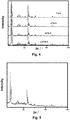
- Figures 17a and Figures 17b the XRPD pattern of MFI zeolite synthesized using methane is displayed, where Figure 17a represents a synthesis method, where the material is heated to 550 °C under argon before methane gas is added and Figure 17b represents a synthesis method, where the material is heated to 700 °C under argon before methane gas is added.
Landscapes
- Chemical & Material Sciences (AREA)
- Organic Chemistry (AREA)
- Chemical Kinetics & Catalysis (AREA)
- Engineering & Computer Science (AREA)
- Materials Engineering (AREA)
- Geology (AREA)
- Life Sciences & Earth Sciences (AREA)
- General Life Sciences & Earth Sciences (AREA)
- Dispersion Chemistry (AREA)
- Crystallography & Structural Chemistry (AREA)
- Inorganic Chemistry (AREA)
- Catalysts (AREA)
- Silicates, Zeolites, And Molecular Sieves (AREA)
- Nanotechnology (AREA)
Claims (15)
- Verfahren zur Herstellung von Zeolith-, zeolithartigen oder Zeotyp-Partikeln umfassend die folgenden Schritte:1) Zugabe von einem oder mehreren Metall-Vorläufern zu einer Siliciumoxid- oder Aluminiumoxidquelle;2) Reduzieren von dem einen oder den mehreren Metall-Vorläufern zur Bildung von metallischen Nanopartikeln auf der Oberfläche der Siliciumoxid- oder Aluminiumoxidquelle;3) Durchlaufen eines gasförmigen Kohlenwasserstoffes, eines Alkylalkohols oder Alkylethers über die Siliciumoxid- oder Aluminiumoxidquelle mit dem unterstützten Nanopartikel zur Bildung einer Kohlenstoffschablone-beschichteten Zeolith-, zeolithartigen oder Zeotyp-Vorläuferzusammensetzung umfassend kohlenstoffbeschichtete metallische Nanopartikel;4a) Zugabe eines Strukturlenkmittels zu der Kohlenstoffschablone-beschichteten Zeolith-, zeolithartigen oder Zeotyp-Vorläuferzusammensetzung, so dass das Siliciumoxid oder Aluminiumoxid in einem wässrigen alkalischen Medium aufgelöst wird, wodurch eine übersättigte Lösung gebildet wird, aus welcher eine Zeolith-, zeolithartige oder Zeotyp-Gelzusammensetzung um die Kohlenstoffschablone herum gebildet wird;4b) Krystallisieren der Zeolith-, zeolithartigen oder Zeotyp-Gelzusammensetzung durch Unterwerfen der Zusammensetzung einer hydrothermischen Behandlung;5) Entfernen der Kohlenstoff-Schablone und des Strukturlenkmittels und Isolieren der sich ergebenden Zeolith-, zeolithartigen oder Zeotyp-Partikel.
- Verfahren zur Herstellung von Zeolith-, zeolithartigen oder Zeotyp-Partikeln nach Anspruch 1, wobei das eine oder die mehreren Metall(e) aus der Gruppe bestehend aus Elementen der Gruppe 4, Elementen der Gruppe 6, Elementen der Gruppe 7, Elementen der Gruppe 8, Elementen der Gruppe 9, Elementen der Gruppe 10, Elementen der Gruppe 11 oder Elementen der Gruppe 12 oder Mischungen davon ausgewählt ist bzw. sind.
- Verfahren zur Herstellung von Zeolith-, zeolithartigen oder Zeotyp-Partikeln nach dem vorgehenden Anspruch, wobei das eine oder die mehreren Metall(e) aus der Gruppe bestehend aus Titan, Osmium, Iridium, Platin, Ruthenium, Palladium, Rhodium, Rhenium, Kupfer, Nickel, Eisen, Kobalt, Silber, Gold, Cadmium, Molybdän oder Mischungen davon ausgewählt ist bzw. sind.
- Verfahren zur Herstellung eines Zeolith-, zeolithartigen oder Zeotyp-Partikels nach einem der vorgehenden Ansprüche, wobei das Verfahren ferner die Zugabe einer Al-, Sn-, Ti-, Zr- oder Ge-Quelle während des Schrittes 4a umfasst.
- Verfahren zur Herstellung von Zeolith-, zeolithartigen oder Zeotyp-Partikeln nach einem der vorgehenden Ansprüche, wobei der Kohlenwasserstoff aus aliphatischen Kohlenwasserstoffen mit 1 bis 8 Kohlenstoffatomen, mit 1 bis 3 Kohlenstoffatomen, Alkenen mit 2 bis 6 Kohlenstoffatomen, aromatischen Kohlenwasserstoffen mit 6 bis 10 Kohlenstoffatomen und zyklischen Kohlenwasserstoffen mit 3 bis 8 Kohlenstoffatomen ausgewählt ist.
- Verfahren zur Herstellung von Zeolith-, zeolithartigen oder Zeotyp-Partikeln nach Anspruch 5, wobei der Kohlenwasserstoff aus Methan, Propen, Xylen oder Benzol ausgewählt ist.
- Verfahren zur Herstellung von Zeolith-, zeolithartigen oder Zeotyp-Partikeln nach einem der vorgehenden Ansprüche, wobei die hydrothermische Behandlung das Erhitzen der Zeolith-, zeolithartigen oder Zeotyp-Gelzusammensetzung auf Temperaturen von zwischen 70 und 300 °C, vorzugsweise bei 180 °C, unter einem autogenen Druck in einem Autoklav oder einer offenen Küvette für 24 Stunden oder mehr umfasst.
- Verfahren zur Herstellung von Zeolith-, zeolithartigen oder Zeotyp-Partikeln nach einem der vorgehenden Ansprüche, wobei während des Schrittes 1 der eine oder die mehreren Metallvorläufer zur Siliciumoxid- oder Aluminiumoxidquelle in einer Menge von 5 bis 20 Gew.-%, von 0,5 bis 5 Gew.-%, von 0,5 bis 2 Gew.-%, oder etwa 1 Gew.-% zugegeben wird bzw. werden.
- Zeolith-, zeolithartiges oder Zeotyp-Partikel, das durch das Verfahren nach einem der Ansprüche 1-8 mit einer Kristallstruktur umfassend ein oder mehrere eingekapseltes bzw. eingekapselten metallisches bzw. metallischen Nanopartikel hergestellt ist.
- Zeolith-, zeolithartiges oder Zeotyp-Partikel nach Anspruch 9, wobei das Partikel ein hierarchisches mesoporöses Zeolith- oder Zeotyp-Partikel ist.
- Zeolith-, zeolithartiges oder Zeotyp-Partikel nach Anspruch 9 oder 10, wobei die Menge von metallischen Nanopartikeln im Bereich von 0,1 bis 25 Gew.-%, im Bereich von 0,5 bis 20 Gew.-%, von 0,5 bis 10 Gew.-%, von 0,5 bis 5 Gew.-%, von 1,0 bis 5 Gew.-%, von 1 bis 2 Gew.-%, oder etwa 1 Gew.-% liegt.
- Zeolith-, zeolithartiges oder Zeotyp-Partikel nach einem der Ansprüche 9-11, wobei das eine oder die mehreren eingekapselte(n) metallische(e) Nanopartikel ein oder mehrere Metall(e) umfasst bzw. umfassen, das bzw. die aus der Gruppe bestehend aus Elementen der Gruppe 4, Elementen der Gruppe 6, Elementen der Gruppe 7, Elementen der Gruppe 8, Elementen der Gruppe 9, Elementen der Gruppe 10, Elementen der Gruppe 11 oder Elementen der Gruppe 12 oder Mischungen davon ausgewählt ist bzw. sind.
- Zeolith-, zeolithartiges oder Zeotyp-Partikel nach einem der Ansprüche 9-12, wobei das eine oder die mehreren eingekapselte(n) metallische(n) Nanopartikel ein oder mehrere Metall(e) umfasst bzw. umfassen, das bzw. die aus der Gruppe bestehend aus Titan, Osmium, Iridium, Platin, Ruthenium, Palladium, Rhodium, Rhenium, Kupfer, Nickel, Eisen, Kobalt, Silber, Gold, Cadmium, Molybdän oder Mischungen davon ausgewählt ist bzw. sind.
- Zeolith-, zeolithartiges oder Zeotyp-Partikel nach einem der Ansprüche 9-13, wobei das Zeolith-, zeolithartige oder Zeotyp-Partikel eine Al-, Sn-, Ti-, Zr- oder Ge-Quelle in dem Gerüst der Kristallstruktur umfasst.
- Verwendung des Zeolith-Partikels nach einem der Ansprüche 9-14 bei Verfahren ausgewählt aus der Gruppe von: Fluid Catalytic Cracking, Hydrocracken, Hydroconversion, Paraffin-Isomerisierung, Paraffin-Aromatisierung, Olefin-Oligomerisierung, aromatischer Alkylierung, aromatischer Disproportionierung, aromatischer Isomerisierung, MTG-MTO, Hydration, Hydrierung, Benzol-Hydroxylierung, Phenol-Hydroxylierung, DeNOx ortsfesten Quellen oder Synthese von Feinchemikalien.
Priority Applications (1)
| Application Number | Priority Date | Filing Date | Title |
|---|---|---|---|
| EP14736393.1A EP3016741B1 (de) | 2013-07-05 | 2014-07-07 | Verfahren zur herstellung von zeolithen und zeotypen |
Applications Claiming Priority (3)
| Application Number | Priority Date | Filing Date | Title |
|---|---|---|---|
| EP13175325 | 2013-07-05 | ||
| EP14736393.1A EP3016741B1 (de) | 2013-07-05 | 2014-07-07 | Verfahren zur herstellung von zeolithen und zeotypen |
| PCT/EP2014/064430 WO2015001123A1 (en) | 2013-07-05 | 2014-07-07 | Method for producing zeolites and zeotypes |
Publications (2)
| Publication Number | Publication Date |
|---|---|
| EP3016741A1 EP3016741A1 (de) | 2016-05-11 |
| EP3016741B1 true EP3016741B1 (de) | 2020-07-01 |
Family
ID=48740983
Family Applications (1)
| Application Number | Title | Priority Date | Filing Date |
|---|---|---|---|
| EP14736393.1A Active EP3016741B1 (de) | 2013-07-05 | 2014-07-07 | Verfahren zur herstellung von zeolithen und zeotypen |
Country Status (7)
| Country | Link |
|---|---|
| US (1) | US10266416B2 (de) |
| EP (1) | EP3016741B1 (de) |
| JP (1) | JP6359651B2 (de) |
| CN (1) | CN105358251B (de) |
| CA (1) | CA2917133A1 (de) |
| DK (1) | DK3016741T3 (de) |
| WO (1) | WO2015001123A1 (de) |
Families Citing this family (65)
| Publication number | Priority date | Publication date | Assignee | Title |
|---|---|---|---|---|
| DK3016740T3 (da) * | 2013-07-05 | 2020-07-27 | Univ Danmarks Tekniske | Fremgangsmåde til fremstilling af indkapslede zeolit-nanopartikler |
| CN104909980B (zh) * | 2015-02-18 | 2017-03-01 | 浙江工业大学 | 一种多级孔Ti‑ZSM‑5分子筛催化剂在合成甲苯、二甲苯中的应用 |
| WO2016140316A1 (ja) * | 2015-03-04 | 2016-09-09 | 国立大学法人九州大学 | シリカガラス前駆体製造方法、シリカガラス前駆体、シリカガラス製造方法、及びシリカガラス |
| WO2017141133A1 (en) * | 2016-02-19 | 2017-08-24 | Sabic Global Technologies B.V. | Hollow zeolites catalysts for the production of alkyl aromatic compounds from aromatic hydrocarbons and olefins |
| US10512904B2 (en) * | 2016-05-25 | 2019-12-24 | The Regents Of The University Of California | Zeolitic materials having encapsulated bimetallic clusters |
| JP6505323B2 (ja) * | 2016-06-23 | 2019-04-24 | 旭化成株式会社 | Mwf型ゼオライト |
| CA3032422A1 (en) * | 2016-07-29 | 2018-02-01 | Ohio State Innovation Foundation | Topical compositions and methods of using thereof |
| US11179707B2 (en) * | 2017-03-31 | 2021-11-23 | Johnson Matthey Catalysts (Germany) Gmbh | Composite material |
| CN110691645A (zh) | 2017-05-31 | 2020-01-14 | 国立大学法人北海道大学 | 功能性结构体以及功能性结构体的制造方法 |
| JP7268963B2 (ja) * | 2017-05-31 | 2023-05-08 | 古河電気工業株式会社 | 自動車用還元触媒構造体及びその製造方法ならびに自動車の排気ガス処理装置 |
| EP3632555A4 (de) * | 2017-05-31 | 2021-01-27 | Furukawa Electric Co., Ltd. | Hydroentschwefelungskatalysatorstruktur, mit dieser katalysatorstruktur versehene hydroentschwefelungsvorrichtung und verfahren zur herstellung einer hydrodesulfurisierungskatalysatorstruktur |
| WO2018221699A1 (ja) * | 2017-05-31 | 2018-12-06 | 古河電気工業株式会社 | アンモニア合成触媒構造体及びその製造方法、アンモニア合成装置並びにアンモニアの合成方法 |
| CN110691650A (zh) * | 2017-05-31 | 2020-01-14 | 古河电气工业株式会社 | 加氢裂化用催化剂结构体、具备该加氢裂化用催化剂结构体的加氢裂化装置以及加氢裂化用催化剂结构体的制造方法 |
| EP3632542A4 (de) * | 2017-05-31 | 2021-01-06 | Furukawa Electric Co., Ltd. | Co-shift- oder reverse-shift-katalysatorstruktur und herstellungsverfahren dafür, co-shift- oder reverse-shift-reaktionsvorrichtung, herstellungsverfahren von kohlendioxid und wasserstoff und herstellungsverfahren von kohlenmonoxid und wasser |
| WO2018221706A1 (ja) | 2017-05-31 | 2018-12-06 | 古河電気工業株式会社 | メタノール改質触媒構造体、メタノール改質用装置、メタノール改質触媒構造体の製造方法及びオレフィンまたは芳香族炭化水素の少なくとも一方の製造方法 |
| JP7295615B2 (ja) * | 2017-05-31 | 2023-06-21 | 古河電気工業株式会社 | 揮発性有機物質用触媒構造体及びその製造方法ならびに揮発性有機物質除去装置 |
| CN110678259A (zh) | 2017-05-31 | 2020-01-10 | 国立大学法人北海道大学 | 功能性结构体以及功能性结构体的制造方法 |
| CN110709165A (zh) * | 2017-05-31 | 2020-01-17 | 国立大学法人北海道大学 | 功能性结构体以及功能性结构体的制造方法 |
| JP7353734B2 (ja) * | 2017-05-31 | 2023-10-02 | 古河電気工業株式会社 | 自動車用還元触媒構造体及びその製造方法ならびに自動車の排気ガス処理装置 |
| JP7328145B2 (ja) | 2017-05-31 | 2023-08-16 | 古河電気工業株式会社 | 水蒸気改質用触媒構造体、該水蒸気改質用触媒構造体を備える改質装置、及び水蒸気改質用触媒構造体の製造方法 |
| JP7361604B2 (ja) * | 2017-05-31 | 2023-10-16 | 古河電気工業株式会社 | フィッシャー・トロプシュ合成触媒構造体、その製造方法及び該触媒構造体を用いた液体炭化水素の製造方法、並びに該触媒構造体を有する炭化水素製造装置 |
| JP7254453B2 (ja) * | 2017-05-31 | 2023-04-10 | 古河電気工業株式会社 | アルカンの脱水素化触媒構造体及びその製造方法、並びに該脱水素化触媒構造体を有するアルケン製造装置 |
| JP7348836B2 (ja) * | 2017-05-31 | 2023-09-21 | 古河電気工業株式会社 | 流動接触分解用構造体及びその製造方法、並びに、これを備える流動接触分解用装置 |
| JP7340198B2 (ja) * | 2017-05-31 | 2023-09-07 | 国立大学法人北海道大学 | 機能性構造体及び機能性構造体の製造方法 |
| US11161101B2 (en) | 2017-05-31 | 2021-11-02 | Furukawa Electric Co., Ltd. | Catalyst structure and method for producing the catalyst structure |
| JP7295614B2 (ja) * | 2017-05-31 | 2023-06-21 | 古河電気工業株式会社 | Fcc副生分解油から生成される芳香族化合物製造用触媒構造体、該触媒構造体を有する芳香族化合物製造装置及び芳香族化合物製造用触媒構造体の製造方法 |
| JP7323115B2 (ja) * | 2017-05-31 | 2023-08-08 | 国立大学法人北海道大学 | 機能性構造体およびその製造方法 |
| CN110730688A (zh) * | 2017-05-31 | 2020-01-24 | 古河电气工业株式会社 | 芳香族烃制造用催化剂结构体、具备该芳香族烃制造用催化剂结构体的芳香族烃制造装置、芳香族烃制造用催化剂结构体的制造方法以及芳香族烃的制造方法 |
| JP7316935B2 (ja) * | 2017-05-31 | 2023-07-28 | 古河電気工業株式会社 | 接触分解用又は水素化脱硫用触媒構造体、該触媒構造体を有する接触分解装置及び水素化脱硫装置、並びに接触分解用又は水素化脱硫用触媒構造体の製造方法 |
| CN110678262A (zh) | 2017-05-31 | 2020-01-10 | 古河电气工业株式会社 | 排气净化用氧化催化剂结构体及其制造方法、汽车的排气处理装置、催化剂成型体以及气体净化方法 |
| JP7316766B2 (ja) * | 2017-05-31 | 2023-07-28 | 古河電気工業株式会社 | N2o分解用触媒構造体及びその製造方法、並びに該n2o分解用触媒構造体を有するn2o除去装置 |
| US10661260B2 (en) | 2017-06-15 | 2020-05-26 | King Fahd University Of Petroleum And Minerals | Zeolite composite catalysts for conversion of heavy reformate to xylenes |
| KR102085652B1 (ko) * | 2017-12-29 | 2020-03-06 | 현대자동차 주식회사 | 규칙적인 메조 기공을 가진 제오라이트 입자에 금속이 함침된 탄화수소 흡착제 및 그 제조방법 |
| US10350585B1 (en) * | 2018-08-14 | 2019-07-16 | Saudi Arabian Oil Company | Methods for synthesizing hierarchical zeolites for catalytic cracking |
| MX2021004084A (es) * | 2018-10-09 | 2021-06-04 | Basf Se | Una moldura que comprende un material zeolitico que tiene un tipo de marco mfi. |
| JP7246040B2 (ja) * | 2018-10-23 | 2023-03-27 | Eneos株式会社 | 触媒、触媒の製造方法、及び合成ガスの製造方法 |
| CN113164937B (zh) * | 2018-12-03 | 2024-08-13 | 古河电气工业株式会社 | 催化剂结构体及其制造方法、以及使用了该催化剂结构体的烃的制造方法 |
| WO2020116468A1 (ja) * | 2018-12-03 | 2020-06-11 | 国立大学法人北海道大学 | 機能性構造体 |
| JP7644926B2 (ja) * | 2018-12-03 | 2025-03-13 | 国立大学法人北海道大学 | 機能性構造体 |
| JPWO2020116470A1 (ja) * | 2018-12-03 | 2021-12-09 | 国立大学法人北海道大学 | 機能性構造体 |
| CN113164933A (zh) * | 2018-12-03 | 2021-07-23 | 国立大学法人北海道大学 | 功能性结构体的前体及功能性结构体 |
| EP3892372A4 (de) * | 2018-12-03 | 2022-08-31 | Furukawa Electric Co., Ltd. | Katalysatorstrukturkörper und verfahren zu seiner herstellung und verfahren zur herstellung von kohlenwasserstoff unter verwendung eines katalysatorstrukturkörpers |
| WO2020116473A1 (ja) * | 2018-12-03 | 2020-06-11 | 古河電気工業株式会社 | 合成ガス製造用触媒構造体及びその前駆体並びに合成ガス製造装置及び合成ガス製造用触媒構造体の製造方法 |
| JP7644925B2 (ja) * | 2018-12-03 | 2025-03-13 | 国立大学法人北海道大学 | 機能性構造体 |
| JP7449525B2 (ja) * | 2018-12-03 | 2024-03-14 | 国立大学法人北海道大学 | 機能性構造体及びその製造方法 |
| MX2021013340A (es) * | 2019-04-29 | 2021-11-17 | Basf Se | Pieza moldeada que comprende un titanosilicato zeolitico tipo mfi y un aglutinante de silice, su proceso de preparacion y uso como catalizador. |
| CN114555525B (zh) * | 2019-08-02 | 2024-08-13 | 巴斯夫公司 | 包括有机和无机结构导向剂的菱沸石合成方法和具有片状形态的菱沸石沸石 |
| US11247196B2 (en) * | 2019-12-04 | 2022-02-15 | Saudi Arabian Oil Company | Zeolite with encapsulated platinum |
| CN112919487B (zh) * | 2019-12-05 | 2022-08-05 | 深圳先进技术研究院 | 一种沸石分子筛硅源的改良方法及应用 |
| US10981160B1 (en) | 2019-12-19 | 2021-04-20 | Saudi Arabian Oil Company | Composite hierarchical zeolite catalyst for heavy reformate conversion to xylenes |
| CN110980760B (zh) * | 2019-12-27 | 2023-05-02 | 上海交通大学 | 一种介孔-微孔分级结构4a分子筛的水热合成方法 |
| KR20220060316A (ko) * | 2020-11-04 | 2022-05-11 | 현대자동차주식회사 | NOx 저장용 촉매 및 이의 제조 방법 |
| US11884615B2 (en) | 2021-01-27 | 2024-01-30 | Saudi Arabian Oil Company | Modified beta zeolitic (*BEA) catalyst for isomerization of alkylated aromatics, and method for isomerization of alkylated aromatics |
| US12195346B2 (en) * | 2021-08-26 | 2025-01-14 | Saudi Arabian Oil Company | Nickel nanoparticle functionalized amine-modified fibrous hierarchical zeolite and method of making the same |
| US11851335B2 (en) * | 2021-08-26 | 2023-12-26 | Saudi Arabian Oil Company | Nickel-containing organometallic functionalized fibrous hierarchical zeolite and method of making the same |
| US12012425B2 (en) | 2021-08-26 | 2024-06-18 | King Abdullah University Of Science And Technology | Nickel nanoparticle functionalized fibrous hierarchical zeolite and method of making the same |
| CN115245838B (zh) * | 2022-06-16 | 2023-06-27 | 天津大学 | T分子筛快速合成方法及催化剂和应用 |
| US12290799B2 (en) | 2022-07-05 | 2025-05-06 | Saudi Arabian Oil Company | Hierarchically ordered crystalline microporous materials with long-range mesoporous order having hexagonal symmetry |
| US12152204B2 (en) | 2022-07-05 | 2024-11-26 | Saudi Arabian Oil Company | Hierarchically ordered crystalline microporous materials with long-range mesoporous order having cubic symmetry |
| US12338130B2 (en) | 2022-07-05 | 2025-06-24 | Saudi Arabian Oil Company | Hierarchically ordered crystalline microporous materials with long-range mesoporous order having lamellar symmetry |
| US12600736B2 (en) | 2022-07-05 | 2026-04-14 | Saudi Arabian Oil Company | Methods for synthesis of hierarchically ordered crystalline microporous materials with long-range mesoporous order |
| US12409445B2 (en) | 2022-07-05 | 2025-09-09 | Saudi Arabian Oil Company | Hierarchically ordered crystalline microporous materials with long-range mesoporous order having cubic symmetry |
| CN115460531B (zh) * | 2022-11-15 | 2023-03-24 | 歌尔股份有限公司 | 沸石颗粒、发声装置和电子设备 |
| CN116553575B (zh) * | 2023-03-02 | 2025-05-02 | 常州大学 | 一种由纳米粒子组装的麦穗状镍掺杂的zsm-22沸石的合成方法和应用 |
| CN116139921B (zh) * | 2023-04-24 | 2023-07-04 | 太原理工大学 | 尾煤基沸石@CDs-TiO2复合光催化剂的制备方法及应用 |
Citations (1)
| Publication number | Priority date | Publication date | Assignee | Title |
|---|---|---|---|---|
| WO2015001122A1 (en) * | 2013-07-05 | 2015-01-08 | Danmarks Tekniske Universitet | Method of producing zeolite encapsulated nanoparticles |
Family Cites Families (11)
| Publication number | Priority date | Publication date | Assignee | Title |
|---|---|---|---|---|
| IT1127311B (it) | 1979-12-21 | 1986-05-21 | Anic Spa | Materiale sintetico,cristallino,poroso costituito da ossidi di silicio e titanio,metodo per la sua preparazione e suoi usi |
| DE60225663T2 (de) * | 2002-01-24 | 2009-04-16 | Haldor Topsoe A/S | Verfahren zur Immobilisierung eines Homogenkatalysators, und katalytisches Material |
| WO2007130395A2 (en) * | 2006-05-03 | 2007-11-15 | Michigan State University | Zeolites with uniform intracrystal textural pores |
| JP5544648B2 (ja) | 2007-12-27 | 2014-07-09 | 国立大学法人広島大学 | 微粒子複合体およびその製造方法、並びに該複合体を含有する触媒 |
| KR100979106B1 (ko) * | 2008-05-30 | 2010-08-31 | 인하대학교 산학협력단 | 금속산화물이 담지된 엠에프아이 결정구조의 메조세공제올라이트 |
| CN101538049B (zh) * | 2008-12-29 | 2011-06-22 | 太原理工大学 | 一种多级孔道β沸石的制备方法 |
| WO2010097108A1 (en) | 2009-02-27 | 2010-09-02 | Haldor Topsøe A/S | Process for the preparation of hybrid zeolite or zeolite-like materials |
| JP5392781B2 (ja) * | 2010-03-11 | 2014-01-22 | 独立行政法人産業技術総合研究所 | ミクロ細孔とメソ・マクロ細孔を有する結晶性ケイ素含有酸化物の製造方法 |
| KR102156875B1 (ko) | 2013-04-22 | 2020-09-16 | 에스케이이노베이션 주식회사 | 구조 붕괴된 제올라이트 내에 금속 클러스터가 함유된 촉매 및 이의 용도 |
| US20140375518A1 (en) | 2013-06-19 | 2014-12-25 | Radio Frequency Systems, Inc. | Amplitude tapered switched beam antenna systems |
| US9333489B2 (en) * | 2013-12-03 | 2016-05-10 | Atomic Energy Council—Institute of Nuclear Energy Research | Confined cell structure and method of making the same |
-
2014
- 2014-07-07 WO PCT/EP2014/064430 patent/WO2015001123A1/en not_active Ceased
- 2014-07-07 CA CA2917133A patent/CA2917133A1/en not_active Abandoned
- 2014-07-07 CN CN201480038193.8A patent/CN105358251B/zh not_active Expired - Fee Related
- 2014-07-07 JP JP2016522657A patent/JP6359651B2/ja not_active Expired - Fee Related
- 2014-07-07 EP EP14736393.1A patent/EP3016741B1/de active Active
- 2014-07-07 US US14/898,656 patent/US10266416B2/en not_active Expired - Fee Related
- 2014-07-07 DK DK14736393.1T patent/DK3016741T3/da active
Patent Citations (1)
| Publication number | Priority date | Publication date | Assignee | Title |
|---|---|---|---|---|
| WO2015001122A1 (en) * | 2013-07-05 | 2015-01-08 | Danmarks Tekniske Universitet | Method of producing zeolite encapsulated nanoparticles |
Also Published As
| Publication number | Publication date |
|---|---|
| EP3016741A1 (de) | 2016-05-11 |
| DK3016741T3 (da) | 2020-07-27 |
| US10266416B2 (en) | 2019-04-23 |
| CN105358251A (zh) | 2016-02-24 |
| WO2015001123A1 (en) | 2015-01-08 |
| CA2917133A1 (en) | 2015-01-08 |
| US20160137516A1 (en) | 2016-05-19 |
| CN105358251B (zh) | 2017-09-08 |
| JP2016529190A (ja) | 2016-09-23 |
| JP6359651B2 (ja) | 2018-07-18 |
Similar Documents
| Publication | Publication Date | Title |
|---|---|---|
| EP3016741B1 (de) | Verfahren zur herstellung von zeolithen und zeotypen | |
| EP3016740B1 (de) | Verfahren zur herstellung von zeolithverkapselten nanopartikeln | |
| EP3129138B1 (de) | Allgemeines verfahren zur einbringung von metallnanopartikeln in zeolithe und zeotype | |
| US9938157B2 (en) | Interzeolite transformation and metal encapsulation in the absence of an SDA | |
| KR20210114942A (ko) | 철-로딩된 작은 기공 알루미노규산염 cha 제올라이트 및 금속-로딩된 작은 기공 알루미노규산염 cha 제올라이트의 제조 방법 | |
| Chen et al. | A reliable protocol for fast and facile constructing multi-hollow silicalite-1 and encapsulating metal nanoparticles within the hierarchical zeolite | |
| Vu et al. | Direct synthesis of nanosized-ZSM-5/SBA-15 analog composites from preformed ZSM-5 precursors for improved catalytic performance as cracking catalyst | |
| Wang et al. | Hierarchical, core–shell meso-ZSM-5@ mesoporous aluminosilicate-supported Pt nanoparticles for bifunctional hydrocracking | |
| RU2715873C1 (ru) | Мелкокристаллические EMM-30 цеолиты с большой площадью поверхности, их синтез и применение | |
| Zhang et al. | One pot synthesis of hierarchically macro/microporous ZSM-5 single crystals | |
| Navascués et al. | Synthesis and adsorption properties of hollow silicalite-1 spheres | |
| Filek et al. | Sonochemically prepared hierarchical MFI-type zeolites as active catalysts for catalytic ethanol dehydration | |
| Huang et al. | Protective dissolution: generating secondary pores in zeolite by mechanochemical reaction | |
| Wang et al. | Synthesis and structure of silicalite-1/SBA-15 composites prepared by carbon templating and crystallization | |
| Babic | Increasing the porosity of zeolites | |
| Ameh et al. | Acylation of Anisole With Benzoyl Chloride Over Rapidly Synthesized Fly Ash–Based HBEA Zeolite | |
| Fiorilli et al. | Aerosol-assisted synthesis of mesoporous aluminosilicate microspheres: the effect of the aluminum precursor | |
| BABIC | Ιncreasing the pοrοsity οf zeοlites | |
| OP et al. | Hierarchical Assembly of Zeolites: A Present Scenario | |
| Gu | Understanding the preparation of hierarchically structured zeolites and their modification for catalytic applications | |
| Deng et al. | Synthesis of Atomically Dispersed Nickel Confined in Hierarchical MFI Zeolite | |
| Kosari | Silica-Based Hollow Functional Spheres for Sustainable Catalytic Processes | |
| Serrano et al. | Synthesis of Ti-MCM-41 from amorphous SiO2-TiO2 xerogels | |
| Taboada et al. | Direct synthesis of mesoporous Fe-MFI zeolite | |
| Wang et al. | Single-Template Synthesis of TUD-C: Hierarchically Structured Composites with Tunable Mesoporosity |
Legal Events
| Date | Code | Title | Description |
|---|---|---|---|
| PUAI | Public reference made under article 153(3) epc to a published international application that has entered the european phase |
Free format text: ORIGINAL CODE: 0009012 |
|
| 17P | Request for examination filed |
Effective date: 20151215 |
|
| AK | Designated contracting states |
Kind code of ref document: A1 Designated state(s): AL AT BE BG CH CY CZ DE DK EE ES FI FR GB GR HR HU IE IS IT LI LT LU LV MC MK MT NL NO PL PT RO RS SE SI SK SM TR |
|
| AX | Request for extension of the european patent |
Extension state: BA ME |
|
| DAX | Request for extension of the european patent (deleted) | ||
| STAA | Information on the status of an ep patent application or granted ep patent |
Free format text: STATUS: EXAMINATION IS IN PROGRESS |
|
| 17Q | First examination report despatched |
Effective date: 20161025 |
|
| GRAP | Despatch of communication of intention to grant a patent |
Free format text: ORIGINAL CODE: EPIDOSNIGR1 |
|
| STAA | Information on the status of an ep patent application or granted ep patent |
Free format text: STATUS: GRANT OF PATENT IS INTENDED |
|
| INTG | Intention to grant announced |
Effective date: 20200129 |
|
| RIN1 | Information on inventor provided before grant (corrected) |
Inventor name: MIELBY, JERRIK JOERGEN Inventor name: KEGNAES, SOEREN Inventor name: ABILDSTROEM, JACOB, OSKAR |
|
| GRAS | Grant fee paid |
Free format text: ORIGINAL CODE: EPIDOSNIGR3 |
|
| GRAA | (expected) grant |
Free format text: ORIGINAL CODE: 0009210 |
|
| STAA | Information on the status of an ep patent application or granted ep patent |
Free format text: STATUS: THE PATENT HAS BEEN GRANTED |
|
| AK | Designated contracting states |
Kind code of ref document: B1 Designated state(s): AL AT BE BG CH CY CZ DE DK EE ES FI FR GB GR HR HU IE IS IT LI LT LU LV MC MK MT NL NO PL PT RO RS SE SI SK SM TR |
|
| REG | Reference to a national code |
Ref country code: AT Ref legal event code: REF Ref document number: 1285639 Country of ref document: AT Kind code of ref document: T Effective date: 20200715 Ref country code: CH Ref legal event code: EP |
|
| REG | Reference to a national code |
Ref country code: IE Ref legal event code: FG4D |
|
| REG | Reference to a national code |
Ref country code: DE Ref legal event code: R096 Ref document number: 602014067234 Country of ref document: DE |
|
| REG | Reference to a national code |
Ref country code: DK Ref legal event code: T3 Effective date: 20200723 |
|
| REG | Reference to a national code |
Ref country code: LT Ref legal event code: MG4D |
|
| PG25 | Lapsed in a contracting state [announced via postgrant information from national office to epo] |
Ref country code: BG Free format text: LAPSE BECAUSE OF FAILURE TO SUBMIT A TRANSLATION OF THE DESCRIPTION OR TO PAY THE FEE WITHIN THE PRESCRIBED TIME-LIMIT Effective date: 20201001 |
|
| REG | Reference to a national code |
Ref country code: NL Ref legal event code: MP Effective date: 20200701 |
|
| REG | Reference to a national code |
Ref country code: AT Ref legal event code: MK05 Ref document number: 1285639 Country of ref document: AT Kind code of ref document: T Effective date: 20200701 |
|
| PG25 | Lapsed in a contracting state [announced via postgrant information from national office to epo] |
Ref country code: LT Free format text: LAPSE BECAUSE OF FAILURE TO SUBMIT A TRANSLATION OF THE DESCRIPTION OR TO PAY THE FEE WITHIN THE PRESCRIBED TIME-LIMIT Effective date: 20200701 Ref country code: PT Free format text: LAPSE BECAUSE OF FAILURE TO SUBMIT A TRANSLATION OF THE DESCRIPTION OR TO PAY THE FEE WITHIN THE PRESCRIBED TIME-LIMIT Effective date: 20201102 Ref country code: CZ Free format text: LAPSE BECAUSE OF FAILURE TO SUBMIT A TRANSLATION OF THE DESCRIPTION OR TO PAY THE FEE WITHIN THE PRESCRIBED TIME-LIMIT Effective date: 20200701 Ref country code: HR Free format text: LAPSE BECAUSE OF FAILURE TO SUBMIT A TRANSLATION OF THE DESCRIPTION OR TO PAY THE FEE WITHIN THE PRESCRIBED TIME-LIMIT Effective date: 20200701 Ref country code: FI Free format text: LAPSE BECAUSE OF FAILURE TO SUBMIT A TRANSLATION OF THE DESCRIPTION OR TO PAY THE FEE WITHIN THE PRESCRIBED TIME-LIMIT Effective date: 20200701 Ref country code: SE Free format text: LAPSE BECAUSE OF FAILURE TO SUBMIT A TRANSLATION OF THE DESCRIPTION OR TO PAY THE FEE WITHIN THE PRESCRIBED TIME-LIMIT Effective date: 20200701 Ref country code: AT Free format text: LAPSE BECAUSE OF FAILURE TO SUBMIT A TRANSLATION OF THE DESCRIPTION OR TO PAY THE FEE WITHIN THE PRESCRIBED TIME-LIMIT Effective date: 20200701 Ref country code: NO Free format text: LAPSE BECAUSE OF FAILURE TO SUBMIT A TRANSLATION OF THE DESCRIPTION OR TO PAY THE FEE WITHIN THE PRESCRIBED TIME-LIMIT Effective date: 20201001 Ref country code: GR Free format text: LAPSE BECAUSE OF FAILURE TO SUBMIT A TRANSLATION OF THE DESCRIPTION OR TO PAY THE FEE WITHIN THE PRESCRIBED TIME-LIMIT Effective date: 20201002 Ref country code: ES Free format text: LAPSE BECAUSE OF FAILURE TO SUBMIT A TRANSLATION OF THE DESCRIPTION OR TO PAY THE FEE WITHIN THE PRESCRIBED TIME-LIMIT Effective date: 20200701 |
|
| PG25 | Lapsed in a contracting state [announced via postgrant information from national office to epo] |
Ref country code: IS Free format text: LAPSE BECAUSE OF FAILURE TO SUBMIT A TRANSLATION OF THE DESCRIPTION OR TO PAY THE FEE WITHIN THE PRESCRIBED TIME-LIMIT Effective date: 20201101 Ref country code: RS Free format text: LAPSE BECAUSE OF FAILURE TO SUBMIT A TRANSLATION OF THE DESCRIPTION OR TO PAY THE FEE WITHIN THE PRESCRIBED TIME-LIMIT Effective date: 20200701 Ref country code: PL Free format text: LAPSE BECAUSE OF FAILURE TO SUBMIT A TRANSLATION OF THE DESCRIPTION OR TO PAY THE FEE WITHIN THE PRESCRIBED TIME-LIMIT Effective date: 20200701 Ref country code: LV Free format text: LAPSE BECAUSE OF FAILURE TO SUBMIT A TRANSLATION OF THE DESCRIPTION OR TO PAY THE FEE WITHIN THE PRESCRIBED TIME-LIMIT Effective date: 20200701 |
|
| REG | Reference to a national code |
Ref country code: CH Ref legal event code: PL |
|
| PG25 | Lapsed in a contracting state [announced via postgrant information from national office to epo] |
Ref country code: NL Free format text: LAPSE BECAUSE OF FAILURE TO SUBMIT A TRANSLATION OF THE DESCRIPTION OR TO PAY THE FEE WITHIN THE PRESCRIBED TIME-LIMIT Effective date: 20200701 Ref country code: MC Free format text: LAPSE BECAUSE OF FAILURE TO SUBMIT A TRANSLATION OF THE DESCRIPTION OR TO PAY THE FEE WITHIN THE PRESCRIBED TIME-LIMIT Effective date: 20200701 |
|
| REG | Reference to a national code |
Ref country code: DE Ref legal event code: R097 Ref document number: 602014067234 Country of ref document: DE |
|
| REG | Reference to a national code |
Ref country code: BE Ref legal event code: MM Effective date: 20200731 |
|
| PG25 | Lapsed in a contracting state [announced via postgrant information from national office to epo] |
Ref country code: IT Free format text: LAPSE BECAUSE OF FAILURE TO SUBMIT A TRANSLATION OF THE DESCRIPTION OR TO PAY THE FEE WITHIN THE PRESCRIBED TIME-LIMIT Effective date: 20200701 Ref country code: IE Free format text: LAPSE BECAUSE OF NON-PAYMENT OF DUE FEES Effective date: 20200707 Ref country code: LI Free format text: LAPSE BECAUSE OF NON-PAYMENT OF DUE FEES Effective date: 20200731 Ref country code: EE Free format text: LAPSE BECAUSE OF FAILURE TO SUBMIT A TRANSLATION OF THE DESCRIPTION OR TO PAY THE FEE WITHIN THE PRESCRIBED TIME-LIMIT Effective date: 20200701 Ref country code: CH Free format text: LAPSE BECAUSE OF NON-PAYMENT OF DUE FEES Effective date: 20200731 Ref country code: LU Free format text: LAPSE BECAUSE OF NON-PAYMENT OF DUE FEES Effective date: 20200707 Ref country code: RO Free format text: LAPSE BECAUSE OF FAILURE TO SUBMIT A TRANSLATION OF THE DESCRIPTION OR TO PAY THE FEE WITHIN THE PRESCRIBED TIME-LIMIT Effective date: 20200701 Ref country code: SM Free format text: LAPSE BECAUSE OF FAILURE TO SUBMIT A TRANSLATION OF THE DESCRIPTION OR TO PAY THE FEE WITHIN THE PRESCRIBED TIME-LIMIT Effective date: 20200701 |
|
| PLBE | No opposition filed within time limit |
Free format text: ORIGINAL CODE: 0009261 |
|
| STAA | Information on the status of an ep patent application or granted ep patent |
Free format text: STATUS: NO OPPOSITION FILED WITHIN TIME LIMIT |
|
| PG25 | Lapsed in a contracting state [announced via postgrant information from national office to epo] |
Ref country code: AL Free format text: LAPSE BECAUSE OF FAILURE TO SUBMIT A TRANSLATION OF THE DESCRIPTION OR TO PAY THE FEE WITHIN THE PRESCRIBED TIME-LIMIT Effective date: 20200701 Ref country code: BE Free format text: LAPSE BECAUSE OF NON-PAYMENT OF DUE FEES Effective date: 20200731 |
|
| 26N | No opposition filed |
Effective date: 20210406 |
|
| PG25 | Lapsed in a contracting state [announced via postgrant information from national office to epo] |
Ref country code: SK Free format text: LAPSE BECAUSE OF FAILURE TO SUBMIT A TRANSLATION OF THE DESCRIPTION OR TO PAY THE FEE WITHIN THE PRESCRIBED TIME-LIMIT Effective date: 20200701 |
|
| PG25 | Lapsed in a contracting state [announced via postgrant information from national office to epo] |
Ref country code: SI Free format text: LAPSE BECAUSE OF FAILURE TO SUBMIT A TRANSLATION OF THE DESCRIPTION OR TO PAY THE FEE WITHIN THE PRESCRIBED TIME-LIMIT Effective date: 20200701 |
|
| PG25 | Lapsed in a contracting state [announced via postgrant information from national office to epo] |
Ref country code: TR Free format text: LAPSE BECAUSE OF FAILURE TO SUBMIT A TRANSLATION OF THE DESCRIPTION OR TO PAY THE FEE WITHIN THE PRESCRIBED TIME-LIMIT Effective date: 20200701 Ref country code: MT Free format text: LAPSE BECAUSE OF FAILURE TO SUBMIT A TRANSLATION OF THE DESCRIPTION OR TO PAY THE FEE WITHIN THE PRESCRIBED TIME-LIMIT Effective date: 20200701 Ref country code: CY Free format text: LAPSE BECAUSE OF FAILURE TO SUBMIT A TRANSLATION OF THE DESCRIPTION OR TO PAY THE FEE WITHIN THE PRESCRIBED TIME-LIMIT Effective date: 20200701 |
|
| PG25 | Lapsed in a contracting state [announced via postgrant information from national office to epo] |
Ref country code: MK Free format text: LAPSE BECAUSE OF FAILURE TO SUBMIT A TRANSLATION OF THE DESCRIPTION OR TO PAY THE FEE WITHIN THE PRESCRIBED TIME-LIMIT Effective date: 20200701 |
|
| P01 | Opt-out of the competence of the unified patent court (upc) registered |
Effective date: 20230525 |
|
| PGFP | Annual fee paid to national office [announced via postgrant information from national office to epo] |
Ref country code: GB Payment date: 20240613 Year of fee payment: 11 |
|
| PGFP | Annual fee paid to national office [announced via postgrant information from national office to epo] |
Ref country code: FR Payment date: 20240621 Year of fee payment: 11 |
|
| PGFP | Annual fee paid to national office [announced via postgrant information from national office to epo] |
Ref country code: DE Payment date: 20240612 Year of fee payment: 11 |
|
| PGFP | Annual fee paid to national office [announced via postgrant information from national office to epo] |
Ref country code: DK Payment date: 20240712 Year of fee payment: 11 |
|
| REG | Reference to a national code |
Ref country code: DE Ref legal event code: R119 Ref document number: 602014067234 Country of ref document: DE |
|
| REG | Reference to a national code |
Ref country code: DK Ref legal event code: EBP Effective date: 20250731 |
|
| GBPC | Gb: european patent ceased through non-payment of renewal fee |
Effective date: 20250707 |
|
| PG25 | Lapsed in a contracting state [announced via postgrant information from national office to epo] |
Ref country code: GB Free format text: LAPSE BECAUSE OF NON-PAYMENT OF DUE FEES Effective date: 20250707 |
|
| PG25 | Lapsed in a contracting state [announced via postgrant information from national office to epo] |
Ref country code: DE Free format text: LAPSE BECAUSE OF NON-PAYMENT OF DUE FEES Effective date: 20260203 |
|
| PG25 | Lapsed in a contracting state [announced via postgrant information from national office to epo] |
Ref country code: FR Free format text: LAPSE BECAUSE OF NON-PAYMENT OF DUE FEES Effective date: 20250731 |