EP3020542A1 - Verfahren zur Steuerung eines Verfahren zur Herstellung von Linsen - Google Patents
Verfahren zur Steuerung eines Verfahren zur Herstellung von Linsen Download PDFInfo
- Publication number
- EP3020542A1 EP3020542A1 EP14306805.4A EP14306805A EP3020542A1 EP 3020542 A1 EP3020542 A1 EP 3020542A1 EP 14306805 A EP14306805 A EP 14306805A EP 3020542 A1 EP3020542 A1 EP 3020542A1
- Authority
- EP
- European Patent Office
- Prior art keywords
- manufacturing
- parameter
- gloss
- lens
- evolution
- Prior art date
- Legal status (The legal status is an assumption and is not a legal conclusion. Google has not performed a legal analysis and makes no representation as to the accuracy of the status listed.)
- Withdrawn
Links
- 238000004519 manufacturing process Methods 0.000 title claims abstract description 119
- 238000000034 method Methods 0.000 title claims abstract description 54
- 230000000903 blocking effect Effects 0.000 claims description 14
- 238000005498 polishing Methods 0.000 claims description 7
- 238000004590 computer program Methods 0.000 claims description 6
- 230000003746 surface roughness Effects 0.000 claims description 5
- 238000005259 measurement Methods 0.000 description 11
- 230000003287 optical effect Effects 0.000 description 7
- 230000015654 memory Effects 0.000 description 6
- 238000005286 illumination Methods 0.000 description 3
- 238000003754 machining Methods 0.000 description 3
- 239000000463 material Substances 0.000 description 3
- 238000003860 storage Methods 0.000 description 3
- NIXOWILDQLNWCW-UHFFFAOYSA-N acrylic acid group Chemical group C(C=C)(=O)O NIXOWILDQLNWCW-UHFFFAOYSA-N 0.000 description 1
- 230000005540 biological transmission Effects 0.000 description 1
- 238000012512 characterization method Methods 0.000 description 1
- 238000000576 coating method Methods 0.000 description 1
- 239000002537 cosmetic Substances 0.000 description 1
- 230000002950 deficient Effects 0.000 description 1
- 230000001419 dependent effect Effects 0.000 description 1
- 238000013461 design Methods 0.000 description 1
- 238000011156 evaluation Methods 0.000 description 1
- 239000011521 glass Substances 0.000 description 1
- 238000009499 grossing Methods 0.000 description 1
- 230000005499 meniscus Effects 0.000 description 1
- 229910052755 nonmetal Inorganic materials 0.000 description 1
- 150000002843 nonmetals Chemical class 0.000 description 1
- 229920003023 plastic Polymers 0.000 description 1
- 239000004033 plastic Substances 0.000 description 1
- 230000000750 progressive effect Effects 0.000 description 1
- 238000004439 roughness measurement Methods 0.000 description 1
- 238000013519 translation Methods 0.000 description 1
Images
Classifications
-
- B—PERFORMING OPERATIONS; TRANSPORTING
- B29—WORKING OF PLASTICS; WORKING OF SUBSTANCES IN A PLASTIC STATE IN GENERAL
- B29D—PRODUCING PARTICULAR ARTICLES FROM PLASTICS OR FROM SUBSTANCES IN A PLASTIC STATE
- B29D11/00—Producing optical elements, e.g. lenses or prisms
- B29D11/00951—Measuring, controlling or regulating
- B29D11/00961—Measuring, controlling or regulating using microprocessors or computers
-
- B—PERFORMING OPERATIONS; TRANSPORTING
- B29—WORKING OF PLASTICS; WORKING OF SUBSTANCES IN A PLASTIC STATE IN GENERAL
- B29D—PRODUCING PARTICULAR ARTICLES FROM PLASTICS OR FROM SUBSTANCES IN A PLASTIC STATE
- B29D11/00—Producing optical elements, e.g. lenses or prisms
- B29D11/00009—Production of simple or compound lenses
- B29D11/0048—Moulds for lenses
Definitions
- the invention relates to a method for controlling a lens manufacturing method, a corresponding control device and a lens manufacturing method controlled by such method.
- the invention further relates to a computer program product comprising one or more stored sequence of instruction that is accessible to a processor and which, when executed by the processor, causes the processor to carry out the steps of the methods according to the invention.
- Optical lenses, and in particular ophthalmic lenses require very high quality standard, therefore very high quality manufacturing method is to be used in order to obtain high quality optical lenses.
- the one by one method consists in checking the manufactured lenses one by one. Such a method does not meet demands of low-cost, high-volume, high-yield rapid production.
- one object of the present invention is to provide a method for controlling the quality of the manufactured lenses while avoiding a cosmetic evaluation without objective criteria.
- the invention proposes a method for controlling a lens manufacturing method comprising the steps of:
- such method allows to reliably checking the quality of the lenses that are produced without having to check each lens individually. Indeed, the evolution of the measured gloss parameter over time will give an indication of the reliability of the manufacturing method, in particular of the manufacturing devices, and therefore the quality of the manufactured lenses.
- the invention further relates to a method for controlling a lens manufacturing method comprising the steps of:
- the method further comprises a step of generating an alert if the received measured values are not between the predetermined tolerance lower and upper thresholds.
- the invention relates to a manufacturing method for manufacturing a lens using a manufacturing device comprising the steps of:
- the invention relates to a control device for controlling a lens manufacturing method, the device comprising:
- the invention further relates to a computer program product comprising one or more stored sequences of instructions that are accessible to a processor and which, when executed by the processor, causes the processor to carry out the steps of the methods according to the invention.
- the invention also relates to a computer-readable storage medium having a program recorded thereon; where the program makes the computer execute the method of the invention.
- the invention further relates to a device comprising a processor adapted to store one or more sequence of instructions and to carry out at least one of the steps of the method according to the invention.
- Embodiments of the present invention may include apparatuses for performing the operations herein.
- This apparatus may be specially constructed for the desired purposes, or it may comprise a general purpose computer or Digital Signal Processor ("DSP") selectively activated or reconfigured by a computer program stored in the computer.
- DSP Digital Signal Processor
- Such a computer program may be stored in a computer readable storage medium, such as, but is not limited to, any type of disk including floppy disks, optical disks, CD-ROMs, magnetic-optical disks, read-only memories (ROMs), random access memories (RAMs) electrically programmable read-only memories (EPROMs), electrically erasable and programmable read only memories (EEPROMs), magnetic or optical cards, or any other type of media suitable for storing electronic instructions, and capable of being coupled to a computer system bus.
- a computer readable storage medium such as, but is not limited to, any type of disk including floppy disks, optical disks, CD-ROMs, magnetic-optical disks, read-only memories (ROMs), random access memories (RAMs) electrically programmable read-only memories (EPROMs), electrically erasable and programmable read only memories (EEPROMs), magnetic or optical cards, or any other type of media suitable for storing electronic instructions, and capable of being coupled to a computer system bus.
- the manufacturing parameters are the setting parameter of the different manufacturing devices involved in the manufacturing method.
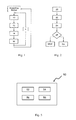
- Figure 1 illustrated the steps of a manufacturing method according to one embodiment of the invention, i.e. susceptible of being controlled by a controlling method according to the invention.
- the manufacturing method for manufacturing a lens using a manufacturing device comprises the steps of:
- the manufacturing steps 10 to 16 are repeated n times. After n repetitions of the manufacturing steps a controlling method according to the invention is processed.
- the manufacturing method according to the invention can be used to manufacture any type of lens, for example ophthalmic lens such as progressive additional lens for example.
- the lens blank provided during the providing step 10 can be a semi-finished lens blank.
- the blocking step 12 can be processed using any blocking devices known from the man skilled in the art.
- the manufacturing step 14 consists in generating a desired design on the unfinished surface of the lens. Generators are common devices known from the man skilled in the art.
- the polishing step 16 consists in smoothing the manufactured surface. Polishing devices are well known in the art.
- the controlling method for controlling a lens manufacturing method comprises the steps of:
- a gloss measuring device is an instrument which is used to measure specular reflection gloss of a surface.
- Such instrument is also called a glossmeter or gloss meter.
- Gloss is determined by projecting a beam of light at a fixed intensity and angle onto a surface and measuring the amount of reflected light at an equal but opposite angle.
- the gloss measuring device provides a quantifiable way of measuring gloss intensity ensuring consistency of measurement by defining the precise illumination and viewing conditions.
- the configuration of both illumination source and observation reception angles allows measurement over a small range of the overall reflection angle.
- the measurement results of a glossmeter are related to the amount of reflected light from a black glass standard with a defined refractive index.
- the ratio of reflected to incident light for the specimen, compared to the ratio for the gloss standard, is recorded as gloss units (GU).
- the evolution of at least one parameter of the manufacturing device used during the lens manufacturing process is checked over time.
- the manufacturing device is a generator or a polishing device.
- the parameter of the manufacturing device or the parameter of the manufacturing method also called “manufacturing parameters" are the setting parameters of the different manufacturing devices involved in the manufacturing method, for example the speed of rotation of a grinding tool or the temperature of the device or the speed or translation of the three axis of the manufacturing devices.
- the evolution over time of at least one gloss parameter of the master article is related with the evolution over time of the manufacturing parameter.
- At least one correlation law is established between measured values of at least one gloss parameter and characterizations of the surface of the master article, for example the surface roughness.
- the master article is a geometric plan lens, ie a flat lens made of CR39.
- the roughness measurement is achieved with high accuracy especially when a positioning device having high accuracy is used. This gives reliable and repeatable measurements.
- the method according to the invention further comprises a step of determining at least one correlation law between the evolution of at least one measured gloss parameter and the evolution of a or each manufacturing parameter.
- the controlling method can help identifying the cause of a drift or shift of a measured parameter.
- the controlling method comprises the measurements and recording of certain manufacturing device parameters.
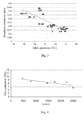
- Figure 4 illustrates an example of plots of gloss parameter over time and the corresponding determined correlation law.
- the master article is a geometric plan lens, ie a flat lens made of CR39.
- the checking of the evolution of the gloss parameter over time can comprise a step for comparing the measured gloss parameter with the determined correlation law and determined tolerance upper and lower thresholds.
- tolerance upper and lower thresholds can be predefined or determined in relation with the determined correlation law.
- the manufacturing method should be stopped in order to not manufacture defective lenses.
- the controlling method further comprises a step of generating an alert if the measured values are not between the predetermined tolerance lower and upper thresholds.
- the master article can have any type of geometry allowing measuring the gloss parameter.
- the master article can have a different geometrical and/or optical parameter than the lenses to be manufactured during the manufacturing method.
- the master article is an optical article.
- the master article can be an ophthalmic lens, a transparent flat lens...
- the master article can be made of a different material than the lenses to be manufactured during the manufacturing method.
- the master article is transparent or semi-transparent.
- the master article can be made of CR39, acrylic material...
- the master article has a surface of revolution.
- the master article has at least a plan surface and the gloss parameter is measured on the plan surface of the master article.
- the master article is a master lens having at least a flat surface on which the gloss parameter is measured.
- the master article is a plano-lens, ie a lens having zero refractive power and whose surfaces may both be flat or equally meniscus in shape.
- the master article can be an optical prism and the gloss parameter can be measured on one of its two major surfaces.
- the gloss parameter is measured in a zone around a predetermined point on a surface of the master article and preferably close to geometrical center. Nevertheless, the predetermined point is different from the geometrical center of the master article.
- the size of the zone around the predetermined point is at least 15mmx4mm.
- the predetermined point can depend on the manufacturing parameter.
- the master article is fixed manually in a predetermined position in order to measure the gloss parameter on its surface.
- several measurements can be made on the surface of the master article and then a mean of the measurements can be calculated.
- the gloss parameter is measured at a predetermined point with an incidence angle between 60° and 90° and preferably about 85° on the surface of the master article.
- the method for controlling a lens manufacturing method further comprises a step of fixing the master article in a predetermined position by using a lens positioning device.
- the master article can be blocked in a blocking plan, for example an horizontal plan and the lens positioning device can comprise means for moving the master article in the blocking plan along two axes X and Y an for moving along an axis Z perpendicular to the blocking plan.
- a blocking plan for example an horizontal plan and the lens positioning device can comprise means for moving the master article in the blocking plan along two axes X and Y an for moving along an axis Z perpendicular to the blocking plan.
- the invention proposes an efficient and reliable method to assure the quality of the manufacturing devices used for manufacturing method and thus the quality of the manufactured lenses.
- Another object of the invention is a control device 50 for controlling a lens manufacturing method adapted to implement the steps of the controlling method previously described.
- control device 50 comprises at least a gloss measuring device 52 adapted to measure at least one gloss parameter of a master article and recording means 54 adapted to record over time the values of the measured gloss parameters and of at least one parameter of the manufacturing device used during the lens manufacturing process.
- the master article can be manufactured according to a manufacturing process using a manufacturing device.
- control device 50 further comprises determining means 56 adapted to determine a correlation law between the evolution of a measured gloss parameter and the evolution of a parameter of the manufacturing device.
- control device 50 further comprises a lens positioning device 58 adapted to fix a master article in a predetermined position.
- the lens positioning device comprises means adapted for blocking the master article in a blocking plan, for example in a horizontal plan. Furthermore, the lens positioning device comprises means for moving the master article in the blocking plan along two axes X and Y an for moving along an axis Z perpendicular to the blocking plan.
- Such a lens positioning device allows using master article having different thickness or diameter.
- the gloss measuring device is in mutual contact with the master article where the measurements should be done.
- the other controlling method for controlling a lens manufacturing method comprises the steps of:
- the other controlling method further comprises a step of generating an alert if the received measured values are not between the predetermined tolerance lower and upper thresholds.
Landscapes
- Engineering & Computer Science (AREA)
- Health & Medical Sciences (AREA)
- Manufacturing & Machinery (AREA)
- Ophthalmology & Optometry (AREA)
- Mechanical Engineering (AREA)
- Microelectronics & Electronic Packaging (AREA)
- Eyeglasses (AREA)
Priority Applications (2)
| Application Number | Priority Date | Filing Date | Title |
|---|---|---|---|
| EP14306805.4A EP3020542A1 (de) | 2014-11-13 | 2014-11-13 | Verfahren zur Steuerung eines Verfahren zur Herstellung von Linsen |
| PCT/EP2015/076135 WO2016075101A1 (en) | 2014-11-13 | 2015-11-10 | Method for controlling a lens manufacturing method |
Applications Claiming Priority (1)
| Application Number | Priority Date | Filing Date | Title |
|---|---|---|---|
| EP14306805.4A EP3020542A1 (de) | 2014-11-13 | 2014-11-13 | Verfahren zur Steuerung eines Verfahren zur Herstellung von Linsen |
Publications (1)
| Publication Number | Publication Date |
|---|---|
| EP3020542A1 true EP3020542A1 (de) | 2016-05-18 |
Family
ID=52002873
Family Applications (1)
| Application Number | Title | Priority Date | Filing Date |
|---|---|---|---|
| EP14306805.4A Withdrawn EP3020542A1 (de) | 2014-11-13 | 2014-11-13 | Verfahren zur Steuerung eines Verfahren zur Herstellung von Linsen |
Country Status (2)
| Country | Link |
|---|---|
| EP (1) | EP3020542A1 (de) |
| WO (1) | WO2016075101A1 (de) |
Cited By (2)
| Publication number | Priority date | Publication date | Assignee | Title |
|---|---|---|---|---|
| WO2017144470A1 (en) * | 2016-02-26 | 2017-08-31 | Automation & Robotics Sa | Method for "real time" in-line quality audit of a digital ophthalmic lens manufacturing process |
| EP3267371A1 (de) * | 2016-07-05 | 2018-01-10 | Automation & Robotics S.A. | Verfahren für echtzeit-inline-qualitätsaudit eines herstellungsverfahrens für digitale ophthalmische linsen |
Families Citing this family (1)
| Publication number | Priority date | Publication date | Assignee | Title |
|---|---|---|---|---|
| CN112084222A (zh) * | 2020-08-25 | 2020-12-15 | 江苏黄金屋光学眼镜有限公司 | 一种可夜视周边离焦镜片的加工工艺 |
Citations (3)
| Publication number | Priority date | Publication date | Assignee | Title |
|---|---|---|---|---|
| US20130084778A1 (en) * | 2007-11-30 | 2013-04-04 | Essilor International (Compagnie Generale D'optique) | Process for Controlling a Lens Manufacturing Process |
| US20130088784A1 (en) * | 2010-04-22 | 2013-04-11 | Mitsubishi Rayon Co., Ltd. | Mold, method of manufacturing the same, article having fine uneven structure on surface, and method of manufacturing the same |
| WO2014173781A1 (en) * | 2013-04-23 | 2014-10-30 | Essilor International (Compagnie Generale D'optique) | Method for controlling a manufacturing device used in an optical lens manufacturing process |
-
2014
- 2014-11-13 EP EP14306805.4A patent/EP3020542A1/de not_active Withdrawn
-
2015
- 2015-11-10 WO PCT/EP2015/076135 patent/WO2016075101A1/en not_active Ceased
Patent Citations (3)
| Publication number | Priority date | Publication date | Assignee | Title |
|---|---|---|---|---|
| US20130084778A1 (en) * | 2007-11-30 | 2013-04-04 | Essilor International (Compagnie Generale D'optique) | Process for Controlling a Lens Manufacturing Process |
| US20130088784A1 (en) * | 2010-04-22 | 2013-04-11 | Mitsubishi Rayon Co., Ltd. | Mold, method of manufacturing the same, article having fine uneven structure on surface, and method of manufacturing the same |
| WO2014173781A1 (en) * | 2013-04-23 | 2014-10-30 | Essilor International (Compagnie Generale D'optique) | Method for controlling a manufacturing device used in an optical lens manufacturing process |
Cited By (3)
| Publication number | Priority date | Publication date | Assignee | Title |
|---|---|---|---|---|
| WO2017144470A1 (en) * | 2016-02-26 | 2017-08-31 | Automation & Robotics Sa | Method for "real time" in-line quality audit of a digital ophthalmic lens manufacturing process |
| US10592840B2 (en) | 2016-02-26 | 2020-03-17 | Automation & Robotics S.A. | Method for “real time” in-line quality audit of a digital ophthalmic lens manufacturing process |
| EP3267371A1 (de) * | 2016-07-05 | 2018-01-10 | Automation & Robotics S.A. | Verfahren für echtzeit-inline-qualitätsaudit eines herstellungsverfahrens für digitale ophthalmische linsen |
Also Published As
| Publication number | Publication date |
|---|---|
| WO2016075101A1 (en) | 2016-05-19 |
Similar Documents
| Publication | Publication Date | Title |
|---|---|---|
| CN101918178B (zh) | 透镜制造过程的控制过程 | |
| US10180316B2 (en) | Method and device for the contactless assessment of the surface quality of a wafer | |
| CN103517784B (zh) | 用于确定制造表面相对于参考表面的位置参数的方法 | |
| US9726572B2 (en) | Method and system for identification of a given geometrical feature of an optical component | |
| CN103459978A (zh) | 用于测量表面的装置和方法 | |
| EP3020542A1 (de) | Verfahren zur Steuerung eines Verfahren zur Herstellung von Linsen | |
| EP2919974B1 (de) | Verfahren zur herstellung einer optischen linse | |
| CN105073395A (zh) | 用于对光学镜片制造工艺中所使用的制造设备进行控制的方法 | |
| EP4189325B1 (de) | Verfahren zur bestimmung geometrischer parameter einer weichen kontaktlinse | |
| US20200240871A1 (en) | Method for evaluating cosmetic defects of an optical device | |
| GB2474913A (en) | Surface measurement instrument and method | |
| CN106575110A (zh) | 用于推导光学物品车床的几何缺陷的方法 | |
| JP6430204B2 (ja) | 表面清浄度判定装置および表面清浄度判定プログラム | |
| CA2612237C (en) | Method and system for measuring the curvature of an optical surface | |
| US20170232575A1 (en) | Method for determining location of a lens machining tool in a turning machine configured for machining ophtalmic lenses | |
| JP2014048242A (ja) | 眼鏡レンズの製造方法及び眼鏡レンズの評価方法 | |
| Baker | Metrics for high-quality specular surfaces | |
| CN106625033B (zh) | 一种确定单点金刚石车削刀痕抛光去除特性的方法 | |
| JP2016024060A (ja) | 計測条件の決定方法および計測装置 | |
| Hayashi et al. | Total angle-resolved scattering: Characterization of microlens mold surface | |
| BR112020007690B1 (pt) | Método para avaliar defeitos estéticos de um dispositivo óptico | |
| Schäfer et al. | Quantification of synthetic lens surface characteristics by an optical measurement system as stylus instrument | |
| JP2014048592A (ja) | 眼鏡レンズの製造方法及び眼鏡レンズの評価方法 |
Legal Events
| Date | Code | Title | Description |
|---|---|---|---|
| PUAI | Public reference made under article 153(3) epc to a published international application that has entered the european phase |
Free format text: ORIGINAL CODE: 0009012 |
|
| AK | Designated contracting states |
Kind code of ref document: A1 Designated state(s): AL AT BE BG CH CY CZ DE DK EE ES FI FR GB GR HR HU IE IS IT LI LT LU LV MC MK MT NL NO PL PT RO RS SE SI SK SM TR |
|
| AX | Request for extension of the european patent |
Extension state: BA ME |
|
| 17P | Request for examination filed |
Effective date: 20161110 |
|
| RBV | Designated contracting states (corrected) |
Designated state(s): AL AT BE BG CH CY CZ DE DK EE ES FI FR GB GR HR HU IE IS IT LI LT LU LV MC MK MT NL NO PL PT RO RS SE SI SK SM TR |
|
| STAA | Information on the status of an ep patent application or granted ep patent |
Free format text: STATUS: THE APPLICATION HAS BEEN WITHDRAWN |
|
| 18W | Application withdrawn |
Effective date: 20170321 |