EP3023954B1 - Monitoring system - Google Patents
Monitoring system Download PDFInfo
- Publication number
- EP3023954B1 EP3023954B1 EP15184121.0A EP15184121A EP3023954B1 EP 3023954 B1 EP3023954 B1 EP 3023954B1 EP 15184121 A EP15184121 A EP 15184121A EP 3023954 B1 EP3023954 B1 EP 3023954B1
- Authority
- EP
- European Patent Office
- Prior art keywords
- dispenser
- data
- hub
- usage
- acknowledgment
- Prior art date
- Legal status (The legal status is an assumption and is not a legal conclusion. Google has not performed a legal analysis and makes no representation as to the accuracy of the status listed.)
- Active
Links
Images



Classifications
-
- G—PHYSICS
- G08—SIGNALLING
- G08B—SIGNALLING SYSTEMS, e.g. PERSONAL CALLING SYSTEMS; ORDER TELEGRAPHS; ALARM SYSTEMS
- G08B21/00—Alarms responsive to a single specified undesired or abnormal condition and not otherwise provided for
- G08B21/18—Status alarms
- G08B21/24—Reminder alarms, e.g. anti-loss alarms
- G08B21/245—Reminder of hygiene compliance policies, e.g. of washing hands
Definitions
- This invention relates to dispenser usage and in particular to a system and a method of monitoring dispenser usage which can be correlated to hand hygiene compliance or other dispenser usage compliance.
- HAI's The spread of healthcare acquired infections also known as HAI's has been an ever increasing challenge in health care facilities.
- HAI's include the transmission of bacteria, viruses and other disease-causing micro-organisms from various sources such as a patient or environmental surfaces to another patient or surface via the hands of healthcare workers which results in an infection of a patient that was previously not infected.
- SARS severe acute respiratory syndrome
- influenza A virus H1N1 pandemic As well, health care facilities have battled MRSA (methicillin-resistant staphylococcus aureus) and VRSA (vancomycin-resistant staphylococcus aureus) and other drug resistant micro-organisms for many years.
- Hand hygiene can be accomplished using liquids such as a sanitizing product which does not require water or rinsing off or alternatively it can be accomplished using a soap and water.
- US 2009/195385 discloses a system consisting of remote identification tag (in the form of wristband) for personnel who must undergo hand hygiene frequently during a day's work, programmed soap and rinse-free disinfectant dispensers, entry-exit sensors for controlled access areas and data transfer stations is used to monitor and record every handwashing procedure along with its thoroughness as well as every hand cleaning event with rinse-free disinfectant.
- remote identification tag in the form of wristband
- entry-exit sensors for controlled access areas
- data transfer stations is used to monitor and record every handwashing procedure along with its thoroughness as well as every hand cleaning event with rinse-free disinfectant.
- Code of Federal Regulations- telecommunication discloses various broadcast and transmission telecommunication channels.
- US 2009/299787 discloses a hand hygiene station and method of monitoring a complete hand hygiene station.
- the complete hand hygiene station may include at least an automated wash cylinder or chamber, a sanitizer dispenser and a lotion dispenser.
- the wash chamber and/or the sanitizer dispenser may be used to provide a user with a hand washing.
- the lotion dispenser may be used to moisturize a user's hands after the usage of the sanitizer dispenser.
- the complete hand hygiene station may be monitored to ensure compliance with one or more hygiene protocols.
- US 2010/155416 discloses a system to allow employers to monitor employee handwashing or hand sanitization compliance in a facility with a plurality of touchless dispensers for metering a cleanser, disinfectant or lotion on the hands of a user.
- Measuring healthcare worker adherence to hand hygiene compliance guidelines is not a simple matter. There are no proven standards or benchmarks that may be used. However there is a very clear need to monitor and measure hand hygiene compliance. Accordingly there is a need to determine whether or not a hand hygiene action occurred when there was an indication for a hand hygiene action.
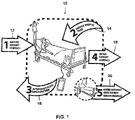
- the five moments for hand hygiene actions in a healthcare setting are shown in figure 1 . These five moments of hand hygiene were developed by the World Health Organization. Hand hygiene actions can be sanitizing with a sanitizing product which does not require water or rinsing off or alternatively it can be washing with soap and water.
- hub refers to any network device capable of sending and receiving packets of information and is not to be interpreted as limited to Ethernet hubs, network hubs, or repeater hubs traditionally described in computer network literature.
- the terms “connected” and “attached” are to be interpreted in an operational sense, and not necessarily a physical sense. For example, if X and Y are devices capable of sending packets to one another either directly or through a network, then X and Y are operably connected. As a further example, if Xis a device and Y is a sensor, and Y is capable of sensing one or more events occurring as a result of the operation of X, then X and Y are operably connected.
- the five moments of hand hygiene action are shown generally at 10. Specifically they are before patient contact 12, before aseptic task 14, after body fluid exposure risk 16, after patient contact 18 and after contact with patient surroundings 20.
- a health care worker When considering compliance, if a health care worker only washes or sanitizers his or her hands 6 out of the 10 times that they should have, they are said to exhibit a compliance rate of 60%.
- this has the advantage of being low cost and it encourages health care workers with respect to hand hygiene self-awareness.
- this type of data collection has poor reliability and most experts in the field consider this method of little, if any, value.
- Dispenser usage data can provide the product volume used per patient day or the number of times the dispenser was used per patient day. This has the advantage of being less costly to monitor. Further, it provides an overall measure of use and it is not subject to selection bias. However, it does not provide feedback for indications or technique. Further, it does not identify low-performing individual staff members. There are a number of further advantages to measuring dispenser usage. Specifically in addition to being less costly it is less resource intense and therefore more efficient than observation. As well it can be done manually or electronically. It allows organization-wide trends to be tracked over time. It can be unobtrusive and designed to take up little additional space. Dispenser usage can be easily measured across all shifts, twenty-four hours a day, and seven days a week. It requires minimal staff training. It can easily be done in many different healthcare settings.
- the dispensers are capable of determining when the dispensers are activated.
- the number of dispenser usage events within a predetermined time period equals the number of times the dispenser has been activated and a plurality of activations within a predetermined activation period is considered a single dispenser usage event. It will be appreciated by those skilled in the art that a plurality of activations within a short period of time will typically mean one user has activated the dispensers a plurality of times rather than multiple users activating the dispenser very close together. Therefore, a plurality of activations within a 1 to 4 second time frame will be considered a single dispenser usage event. For hand soaps and hand sanitizers in a healthcare facility, this will typically be set at 2.5 seconds.
- dispenser usage is being monitored for different types of products indifferent types of facilities, this may be set for a different activation period.
- dispensers are calibrated to dispense a predetermined amount of liquid for each activation. Accordingly, the dispenser activation directly relates to product usage. Accordingly it will be appreciated by those skilled in the art that when determining a dispenser usage compliance index one could measure volume used or dispenser activations.
- dispenser usage alone is used to calculate a dispenser usage compliance index.
- a combination of two or more of dispenser usage data, direct observation data and survey data may be used to provide consolidated hand hygiene information.
- the information would be automated and in real time.
- the system would provide automated multi-modal hand hygiene compliance reports.
- these reports could be presented by unit and or department. Such automated reporting would provide the hospital's management with the tools to give feedback on compliance adherence; target interventions designed to improve compliance; and reward improved performance.
- the hand hygiene compliance index will include a plurality of modes of determining compliance. Specifically it will include data from dispenser usage, observation and/or surveys. Each method is weighted and then combined to create a single index of compliance. The methods are weighted based on, for example, their statistical reliability
- the facility being monitored is provided with a plurality of dispensers.
- the facility may be divided into predetermined groups of interest.
- the facility may be a teaching hospital, a non-teaching hospital, a long term care facility, a rehabilitation facility, a free standing surgical center, a health care professional office, a dental office, a veterinarian facility and a community care facility as well as other health care settings in which hand hygiene compliance is an important issue.
- the system herein may be used in any facility wherein the hand hygiene needs to be monitored such as at various stages in food preparation including abattoirs, preparing precooked foods and restaurants.
- the monitoring system could also be used for monitoring compliance with applying such dispensed lotions as sunscreen.
- the dispenser usage compliance is the dispenser usage events divided by a denominator wherein the denominator includes at least in part the benchmark.
- the benchmark is particular to the predetermined group and particular to the predetermined time period.
- the usage may be measured for each dispenser in the predetermined group in practically real time and the captured data is transmitted electronically. It will be appreciated by those skilled in the art that there is a limited amount of time required for the data to get from the dispenser, to the hub to the server (described below) but this could be set for the messages to be transmitted very frequently.
- the number of hand hygiene events within a predetermined time period equals a number of times the dispenser has been activated and wherein multiple activations within a predetermined activation period are considered a single dispenser usage event. It is not uncommon that when someone uses a dispensing system that rather than merely activating once they activate the dispenser multiple times. Accordingly to accurately determine the correct number of dispenser usage events the number of times the dispenser is activated is determined. However where there are multiple activations within a predetermined activation period that is considered a single dispenser usage event.
- the benchmark is the number of times the dispenser should have been used for a predetermined group over a predetermined time period.
- the benchmark relates to the five moments of hand hygiene for a predetermined group over a predetermined time period.
- the benchmark To determine the benchmark for the predetermined area and time, one needs to determine the hand hygiene occurrences that should occur per patient for the predetermined area and time. This is done with reference to the five moments of hand hygiene as shown in figure 1 .
- the benchmark will be different depending on a number of variables. For example if the healthcare facility is a teaching facility it is likely that more healthcare professionals will need to see the patient and therefore the benchmark may be higher.
- the benchmark may vary if the predetermined period is a night shift versus a day shift; if it is a weekday versus a holiday or weekend.
- the benchmark will likely vary depending on the type of unit. For example an intensive care unit will likely have a higher benchmark than an orthopedic unit.
- the denominator may be dependent on the census data. Specifically to determine the denominator the benchmark is multiplied by the census data.
- the census data will be the bed occupancy. In some health care facilities or in particular units of the facility this may always be close to 100% whereas in other units or facilities this may vary greatly.
- the census data might be the number of patients seen during the shift or over the predetermined time period that is at issue. It may also be the number of bed-hours of care provided during the predetermined time period that is at issue.
- the benchmark may be determined through experiments or other means by the healthcare facility or there may be default benchmarks provided which are provided to the user by the dispenser provider or a central authority.
- the reports can be used to help determine where more or different hand hygiene compliance efforts such as additional training need be implemented.
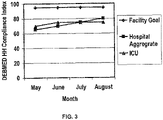
- the reports could be presented in a simple graph format as shown in figures 2 and 3 wherein figure 2 shows the hand hygiene index in the pediatrics unit as compared to the hospital aggregate and the goal or benchmark and figure 3 shows the hand hygiene index in the intensive care unit as compared to the hospital aggregate and the goal or benchmark.
- Figure 4 shows some different reporting options.
- Figure 5 shows a dashboard showing a more comprehensive way of presenting the information.
- the hand hygiene compliance index may be presented in FIG 4 .
- the user may use a default benchmark 102 or a user defined benchmark 104 when determining the dispenser usage compliance.
- the hand hygiene compliance index may be a dispenser usage compliance index on its own 106 or it may include multi-modal data. If it includes multi-modal data the dispenser usage compliance index may be combined with survey data 108; or with direct observation data 110; or with survey data and direct observation data 112.
- the hand hygiene compliance index may be presented as the dispenser usage compliance index on its own 114; or with survey data 116; or with direct observation data 118; or with survey data and direct observation data 120. If the dispenser usage compliance index is combined with other data the data is weighted when it is combined to provide a hand hygiene compliance index.
- the hand hygiene compliance index may be expressed as an equation. Hand hygiene events or dispenser usage events are used for calculation of the HHCI or the dispenser usage compliance index.
- An event is the same as a dispenser activation, except in the case where multiple activations occur within a predetermined activation period.
- the predetermined activation period is between 1 and 4 seconds and preferably 2.5 seconds. Wherein multiple activations occur within the predetermined activation period the total activations occurring within the predetermined activation period constitute a single hand hygiene event. In those cases multiple activations within for example 2.5 seconds are recorded as a single event with n activations.
- the events are what are used for the HHCI numerator.
- Direct observation method observed hand hygiene compliance. A whole number between 0 and 100 representing % compliance.
- Patient survey method patient survey hand hygiene compliance. A whole number between 0 and 100 representing % compliance.
- the numerator is the sum of events for a predetermined time period.
- the denominator represents the total number of expected hand hygiene events for a predetermined time period.
- the weightings are applied by multiplying the weighting by the Hand Hygiene compliance of the component.
- w1 is equal to 1 and there is no observed or survey Hand Hygiene component to the index.
- w1 and w2 or w3 will total to 1, and the index is calculated by multiplying the weighting by the compliance component.
- group monitoring system recorded Hand Hygiene compliance for a period of time is 90 with a weighting of 0.8.
- Patient Survey compliance is 70 with a weighting of 0.2.
- HHCI Hand hygiene compliance index
- Recorded Hand Hygiene Compliance is 90 x 0.8 or 72 and patient survey Hand Hygiene Compliance is 70 x 0.2 or 14.
- the Hand Hygiene Compliance Index for the period of time is 86, or 72 + 14.
- w1 + w2 + w3 will total to 1, and the index is calculated by multiplying the weighting by the compliance component.
- the group monitoring system recorded hand hygiene compliance for a period of time is 90 with a weighting of 0.6.
- Patient survey compliance is 70 with a weighting of 0.2. and observed data compliance of 70 with a weighting of 0.2.
- Recorded hand hygiene compliance is 90 x 0.6 or 54 with patient survey hand hygiene compliance is 70 x 0.2 or 14 and observed compliance is 70 x 0.2 or 14.
- the hand hygiene compliance index for the period of time is 82, or 54 + 14 + 14.
- a sample dashboard is shown at 130 in figure 5 .
- the sample dashboard includes a graphical representation of the usage 132, a summary report 134 and a chart of specific dispenser usage 136.
- Each dispenser has a unique identifier and the unique identifier which may be associated with a soap dispenser versus a sanitizer dispenser. It may be important to differentiate between hand hygiene events using soap versus sanitizer. This would be particularly important where the facility has a particular outbreak that requires soap versus sanitizer or vice versa such as with the disease causing organism clostridium difficile (also known as c. diff.) which is most difficult to eliminate in the spore form and can typically be removed from the hands only with hand washing as there is reliable data that supports the premise that hand sanitizers are not an effective way to kill c. diff. spores.
- the system may be designed wherein the facility has the ability to adjust the benchmark or use a benchmark of its own choosing. It will be appreciated by those skilled in the art that the facility will have a wide range of reports that they can generate. For example it could generate reports by unit; by hospital; compare unit to unit; unit to hospital; or hospital to hospital by way of example. As well it will be appreciated by those skilled in the art that the dispenser usage data may be integrated with the facility purchasing department.
- the system may be connected with a wired system as shown at 30 in figure 6 or in a wireless system as shown at 50 in figure 7 .
- a dispenser 32 is connected to a hub 34 and/or a gateway 36.
- the gateway is connected to the data collation server 38 which in turn is connected to a hand hygiene compliance index calculation server 40.
- data collation server 38 may comprise one or more computers.
- the dispenser 52 is wirelessly connected to a hub 54 and/or a gateway 56.
- the gateway is wirelessly connected to a data collation server 58, preferably over the internet through GSM (Global System for Mobile Communications) or other communications standards and network protocol.
- the data collation server 58 is connected to a hand hygiene compliance index calculation server 60. It will be appreciated by those skilled in the art that the data collation server 58 and the hand hygiene compliance index calculation server 60 may be the same server.
- Each dispenser 52 has a sensor therein that preferably is capable of storing data in regard to up to 100 or more activations. It will be appreciated by those skilled in the art that 100 is by way of example only and that typically each dispenser may need to only store data relating to a few activations.
- the data is sent between the dispenser 52 and hub 54 and the hub 54 and gateway 56 in bursts which are either time or memory dependent.
- data is sent from the gateway 56 to the server 58 in a burst by way of GSM.
- Data may be sent to an offsite server 60 for data processing.
- While the network is described as a plurality of network devices consisting of hubs and gateways, other network devices may be used. Some non-limiting examples include wireless hubs, Ethernet hubs, repeater hubs, switches, ethernet switches, bridges, routers, Ethernet routers, wireless routers, and gateway routers.
- packets may be sent within the aforementioned network using any number of protocols.
- packets may be sent according to the Internet Protocol Suite (IPS), which includes the Transmission Control Protocol (TCP) and the Internet Protocol (IP), often called TCP/IP.
- IPS Internet Protocol Suite
- TCP Transmission Control Protocol
- IP Internet Protocol
- this scheme moves much of the network complexity to the edge of the network, i.e. to each dispenser and to the server.
- dispensers may send packets via either TCP or UDP (User Datagram Protocol), though other transport-layer protocols may be used within the IPS specifications.
- packets sent between dispensers, hubs, and gateways may have a defined format different from those specified in the IPS specifications, and may be eventually repackaged into IPS-compatible packets when to the sent off-site server 60. It may be desirable to send information off-site using the Internet Protocol Suite since existing Internet network infrastructure may be used for transmission.
- Internet Protocol Suite since existing Internet network infrastructure may be used for transmission.
- the system described herein would use an "unlicensed” frequency.
- Frequency Band Power Level (dBm) Power (mW) Notes 216MHz-960MHz ⁇ -10dBm 0.1 Special conditions apply and certain exclusions and exemptions are available 902-928MHz 30dBm 1000 Requires spread spectrum 2400-2484MHz 30dBm 1000 Requires spread spectrum *200uV/m equates to approximately -10dBm when converted.
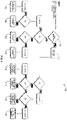
- a flow diagram showing the steps implemented in a low frequency (between 400 and 450 MHz) low power (up to 10 mW) wireless system is shown by way of a non-claimed example generally at 70 in figure 8 .
- a similar flow diagram for a higher frequency (between 850 and 950 MHz), higher power (up to 1 W) wireless system in accordance with the claimed invention is shown generally at 140 in figure 9 .
- a flow diagram showing the steps implemented a low frequency (between 400 and 450 MHz) low power (up to 10 mW) wireless system is shown generally at 70 in figure 8 by way of a non-claimed example.
- the dispenser 52 ID is transmitted to any and all hubs 54 within the transmission distance 72.
- the hub(s) reply with an acknowledgement 74. This is sometimes referred to as a "handshake". If an acknowledgement is not received by the dispenser, the dispenser will retry until it is successful.
- the hub adds a date and time stamp to the ID to produce dispenser usage data.
- the hubs 54 send the dispenser usage data 76 on through the hub network unit it reaches a gateway 56.
- Each successive hub 54 in the chain acknowledges receipt of the dispenser usage data from the previous hub 78. If acknowledgement is not received by the originating hub it will retry until successful.
- the hubs 54 within the transmission distance of the gateway transmit the dispenser usage data through to the gateway 80.
- the activation data is captured by the gateway 56, it transmits an acknowledgement back to the originating hub(s) 82. If an acknowledgement is not received by the originating hub, it will retry until successful.
- the gateway 56 collates all of the data it received from the rest of the system into transmission packets of a predetermined format.
- the predetermined format may specify a predetermined size or a predetermined header size.
- the data is sent to the collation server 58 over the internet and preferably via GSM.
- the data packet is received or captured by the data collation server 58 an acknowledgement is sent back to the gateway 86. If an acknowledgement is not received by the gateway 56, it will retry until successful.
- This type of system is often referred to as a mesh network.
- acknowledgements may be either dedicated packets or may be included in a designated offset within the header of packets.
- acknowledgements may be sent from the server back to the dispenser, rather than between each hub and dispenser.
- each hub would forward the acknowledgement packets to their addressed location, e.g. dispenser or server.
- a higher frequency (between 850 and 950 MHz) and higher power (up to 1W) system is shown generally at 140 in figure 9 in accordance with the claimed invention.
- the dispenser 52 On set up the dispenser 52 sends out a request to the nearest hub 54 for the hub's ID (identification) and a time update 142.
- the hub 54 responds with requested information 144 and this synchronizes to the dispenser. If the response is not received by the dispenser, it will retry until a successful synchronization is achieved.
- the dispenser 52 transmits to its synchronized hub 54 dispenser data including, dispenser ID, time, date of use, dispenser usage events 146.
- the hub On receipt of the dispenser data the hub replies with an acknowledgement 148.
- the acknowledgement contains a time update.
- the hubs collate the data received from the dispensers to form a transmission packet of a predetermined size (predetermined number of bytes) 150.
- the data packet is then transmitted through the hub network until it reaches the gateway 56.
- This acknowledgement also contains a time update. If an acknowledgement is not received by the originating hub it will retry until successful.
- the hubs 54 within transmission distance of the gateway 56, transmits the data packets to the gateway 154. As the data packet is captured by the gateway it transmits and acknowledgement back to the originating hub 156.
- This acknowledgement contains a time update. If acknowledgement is not received by the originating hub it will retry until successful.
- the gateway collates all of the data it received from the rest of the system into a transmission packet of a predetermined size (bytes) 158. This data packet is then transmitted via GSM to the data collection server 58. As the data packet is captured the data collation server transmits an acknowledgement back to the gateway 160. This acknowledgement also contains a time update. If an acknowledgement is not received by the gateway 56, it will retry until successful.
- This type of system is often referred to as a mesh network.
- a plurality of dispensers 52 are positioned around the unit of the facility being monitored.
- a plurality of receivers or hubs 54 are positioned around the unit within range of the dispensers such that each dispenser is in range of at least one receiver.
- the hubs 54 transmit the data to a gateway 56 and then to a server 58.
- the system uses a mesh network.
- a handshake confirms the data is received and instructs the dispenser to delete the information from the memory.
- the server 36 may be on site or off site.
- the system when designing the system herein for healthcare facility usage, for example a hospital, there are a number of competing interests. Specifically the system will require a plurality (100's or more likely 1,000's) of self (battery) powered activation sensors which need to reliably transmit usage data wirelessly around sprawling, cluttered hospital buildings and the data be transmitted via a GSM link(s) to the internet for external data manipulation.
- Each sensor's batteries preferably have long life (5+ years), are physically small ( ⁇ a packet of cards) and preferably the system cost is low. It is preferable that the system not interfere with medical equipment, be legal, and utilize license free radio frequencies.
- a non-claimed example system is to use a low power + low cost + minimal RF interference, this suggests a system along the lines of a Zigbee ® / Z wave ® type network architecture, utilizing ultra-low power transmitters (typically 0.1 mw) with minimal processing power.
- This gives low sensor hardware costs (currently approximately $5/ node) and requires an electrical outlet powered network to be installed in each building to act as a communication and data processing 'backbone'.
- Knowledge of radio frequency propagation within buildings would lead those skilled in the art to select the lowest available frequency to maximize range for a given power output (reduces the hardwired 'backbone' costs and enhances reliable communications) and consequently he would preferably choose between 400 and 450 MHz. This would give a typical indoor range of 50ft.
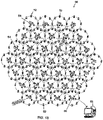
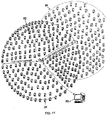
- Such a system is shown by way of example in figure 10 at 90.
- 200 hubs are required as shown in figure 10 .
- each hub will receive data from around 200 dispensers.
- the transmission power is up to 1000 milliwatts.
- higher level data encryption can be used thereby providing a higher level of security than that afforded by the lower frequency system.
- System 96 uses direct sequence spread spectrum transmission techniques which has a reduced rate of interference and is allowed to operate at higher powers as compared to the lower frequency system.
- the higher frequency of the claimed invention generally between 850 and 950 MHz is advantageous over the lower frequency generally between 400 and 450 MHz system.
- the higher frequency system uses higher power and higher frequency which is opposite to conventional wisdom in regard to systems of data distribution of this type. Since the dispenser uses more power, some preliminary processing may be conducted at the dispenser.
- a group monitoring system for dispenser usage compliance within a predetermined group of interest in a predetermined facility comprising the steps of: providing a plurality of dispensers, providing a dispenser data collection system operably connected to each dispenser, capable of providing information, the information including a unique dispenser identifier for each dispenser, a number of dispenser usage events that each dispenser was used; receiving the information from the data collection system and determining the predetermined group with which each dispenser is associated; determining the number of hand hygiene events within the predetermined group within a predetermined time period; determining a benchmark which corresponds to dispenser usage opportunities particular to the predetermined group and particular to the predetermined time period; calculating a dispenser usage compliance index particular to the predetermined group and particular to the predetermined time period by dividing the hand hygiene events for the predetermined group and the predetermined time period by a denominator, wherein the denominator equals the benchmark.
- the number of hand hygiene events within a predetermined time period equals a number of times the dispenser has been activated and wherein multiple activations within a predetermined activation period are considered a single dispenser usage event. It is not uncommon that when someone uses a dispensing system that rather than merely activating once they activate the dispenser multiple times. Accordingly to accurately determine the correct number of times that the dispenser has been used, the number of times the dispenser is activated needs to be determined. However where there are multiple activations within a predetermined activation period that is considered a single dispenser usage event.
- the dispenser usage compliance index may further include at least one of direct observation data or survey data.
- the data used in the dispenser usage compliance index is weighted.
- the predetermined time period may correspond to a shift of the predetermined group in the predetermined facility.
- the benchmark will likely vary depending on the predetermined facility, the type of unit in the facility, the time of day, and the day of the week.
- the denominator may also be the benchmark multiplied by census data.
- the census data will be dependent on the group of interest and may be bed occupancy, patient days, patient visits, the number of bed-hours of care or the staff.
- the predetermined group may be a bed, a room, a ward, a unit, a floor or a facility.
- the dispenser data collection system in a non-claimed example uses a frequency of one of between 400 and 450 MHz system and between 850 and 950 MHz system. According to the invention the dispenser data collection system uses a frequency between 850 and 950 MHz system and has a transmission power of up to 1000 milliwatts. It further includes a plurality of hubs for receiving data from the plurality of dispensers and each hub receives data from one or more dispensers and the distance between each dispenser and its associated hub is generally no greater than 5740 feet. The data between the dispenser and the hub is encrypted.
- the group monitoring system for dispenser usage data collection includes a plurality of dispensers; a plurality of hubs each capable of receiving data from one or more dispensers; and wherein the distance between each dispenser and its associated hub is typically no greater than 5740 feet and the data is transmitted at between 850 and 950 MHz.
- the systems described herein are directed to a dispenser compliance system and by way of example a hand hygiene compliance system.
- embodiments of the present invention are disclosed herein.
- the disclosed embodiments are merely exemplary, and it should be understood that the invention may be embodied in many various and alternative forms.
- the Figures are not to scale and some features may be exaggerated or minimized to show details of particular elements while related elements may have been eliminated to prevent obscuring novel aspects. Therefore, specific structural and functional details disclosed herein are not to be interpreted as limiting but merely as a basis for the claims and as a representative basis for teaching one skilled in the art to variously employ the present invention.
- the illustrated embodiments are directed to a dispenser usage compliance system.
- the terms “comprises” and “comprising” are to be construed as being inclusive and open rather than exclusive. Specifically, when used in this specification including the claims, the terms “comprises” and “comprising” and variations thereof mean that the specified features, steps or components are included. The terms are not to be interpreted to exclude the presence of other features, steps or components.
Landscapes
- Physics & Mathematics (AREA)
- General Physics & Mathematics (AREA)
- General Health & Medical Sciences (AREA)
- Public Health (AREA)
- Business, Economics & Management (AREA)
- Emergency Management (AREA)
- Epidemiology (AREA)
- Health & Medical Sciences (AREA)
- Medical Treatment And Welfare Office Work (AREA)
- Management, Administration, Business Operations System, And Electronic Commerce (AREA)
- Maintenance And Inspection Apparatuses For Elevators (AREA)
- Loading And Unloading Of Fuel Tanks Or Ships (AREA)
- Feedback Control In General (AREA)
- Devices For Dispensing Beverages (AREA)
- Debugging And Monitoring (AREA)
Applications Claiming Priority (3)
| Application Number | Priority Date | Filing Date | Title |
|---|---|---|---|
| US12/823,475 US8427323B2 (en) | 2010-06-25 | 2010-06-25 | Monitoring system |
| PCT/GB2011/051206 WO2011161475A1 (en) | 2010-06-25 | 2011-06-27 | Monitoring system |
| EP11738778.7A EP2586017A1 (en) | 2010-06-25 | 2011-06-27 | Monitoring system |
Related Parent Applications (1)
| Application Number | Title | Priority Date | Filing Date |
|---|---|---|---|
| EP11738778.7A Division EP2586017A1 (en) | 2010-06-25 | 2011-06-27 | Monitoring system |
Publications (2)
| Publication Number | Publication Date |
|---|---|
| EP3023954A1 EP3023954A1 (en) | 2016-05-25 |
| EP3023954B1 true EP3023954B1 (en) | 2022-09-07 |
Family
ID=44462832
Family Applications (2)
| Application Number | Title | Priority Date | Filing Date |
|---|---|---|---|
| EP15184121.0A Active EP3023954B1 (en) | 2010-06-25 | 2011-06-27 | Monitoring system |
| EP11738778.7A Ceased EP2586017A1 (en) | 2010-06-25 | 2011-06-27 | Monitoring system |
Family Applications After (1)
| Application Number | Title | Priority Date | Filing Date |
|---|---|---|---|
| EP11738778.7A Ceased EP2586017A1 (en) | 2010-06-25 | 2011-06-27 | Monitoring system |
Country Status (15)
| Country | Link |
|---|---|
| US (1) | US8427323B2 (pl) |
| EP (2) | EP3023954B1 (pl) |
| JP (1) | JP5668217B2 (pl) |
| CN (1) | CN103069461B (pl) |
| AU (1) | AU2011268676A1 (pl) |
| BR (1) | BR112012032815B1 (pl) |
| CA (1) | CA2801845C (pl) |
| EA (1) | EA201291338A1 (pl) |
| MX (1) | MX2012015244A (pl) |
| NZ (1) | NZ605604A (pl) |
| PH (1) | PH12012502517A1 (pl) |
| PL (1) | PL3023954T3 (pl) |
| SG (1) | SG186323A1 (pl) |
| UA (1) | UA108380C2 (pl) |
| WO (1) | WO2011161475A1 (pl) |
Families Citing this family (41)
| Publication number | Priority date | Publication date | Assignee | Title |
|---|---|---|---|---|
| US11297984B2 (en) | 2006-10-31 | 2022-04-12 | Gpcp Ip Holdings Llc | Automatic napkin dispenser |
| FR2907654B1 (fr) | 2006-10-31 | 2010-01-29 | Georgia Pacific France | Procede, dispositif de fabrication et rouleaux associes formes de feuilles a decoupes et predecoupes alternees |
| USRE48951E1 (en) | 2015-08-05 | 2022-03-01 | Ecolab Usa Inc. | Hand hygiene compliance monitoring |
| WO2011127276A2 (en) | 2010-04-07 | 2011-10-13 | Emory University | Systems for monitoring hand sanitization |
| US10467884B2 (en) | 2010-04-07 | 2019-11-05 | Clean Hands Safe Hands Llc | Systems for monitoring hand sanitization |
| US10223895B2 (en) | 2010-04-07 | 2019-03-05 | Clean Hands Safe Hands Llc | Systems for monitoring hand sanitization |
| US10540881B2 (en) | 2010-04-07 | 2020-01-21 | Clean Hands Safe Hands Llc | Systems and methods for pattern recognition and individual detection |
| US8558701B2 (en) * | 2010-11-08 | 2013-10-15 | Gojo Industries, Inc. | Hygiene compliance module |
| US20140210620A1 (en) | 2013-01-25 | 2014-07-31 | Ultraclenz Llc | Wireless communication for dispenser beacons |
| US9262905B2 (en) * | 2011-04-27 | 2016-02-16 | Gojo Industries, Inc. | Portable compliance dispenser |
| EP2802360A1 (en) * | 2012-01-09 | 2014-11-19 | Judson Smith | Hand hygiene network system |
| US10383489B2 (en) | 2012-02-10 | 2019-08-20 | Gpcp Ip Holdings Llc | Automatic napkin dispenser |
| US9007936B2 (en) * | 2012-03-22 | 2015-04-14 | Debmed Usa Llc | System and method for stabilizing a wireless monitoring network |
| US9183729B2 (en) * | 2013-03-13 | 2015-11-10 | Debmed Usa Llc | Hand care reporting panel |
| US20140279603A1 (en) * | 2013-03-15 | 2014-09-18 | Gojo Industries, Inc. | System for monitoring and recording hand hygiene performance |
| US10282969B2 (en) | 2013-06-19 | 2019-05-07 | Clean Hands Safe Hands | System and methods for wireless hand hygiene monitoring |
| US9604811B2 (en) | 2013-10-01 | 2017-03-28 | Georgia-Pacific Consumer Products Lp | Automatic paper product dispenser with data collection and method |
| AU2014348741A1 (en) * | 2013-11-12 | 2016-05-19 | Deb Ip Limited | Reducing health care-associated infections based on hand hygiene |
| US10636321B2 (en) | 2014-07-02 | 2020-04-28 | Gojo Industries, Inc. | Methods and systems for improving hand hygiene |
| CA2954181C (en) | 2014-07-03 | 2023-01-24 | Zohar Laufer | Personnel proximity detection and tracking system |
| US10276029B2 (en) * | 2014-11-13 | 2019-04-30 | Gojo Industries, Inc. | Methods and systems for obtaining more accurate compliance metrics |
| JP6486088B2 (ja) * | 2014-12-05 | 2019-03-20 | ケーディーアイコンズ株式会社 | システム及びプログラム |
| BR112017016533A2 (pt) | 2015-02-25 | 2018-04-10 | Kimberly Clark Co | sistema e método para desenvolvimento de práticas individuais e coletivas de adequamento em sanitários |
| KR102394131B1 (ko) | 2015-02-25 | 2022-05-04 | 킴벌리-클라크 월드와이드, 인크. | 세면실 사용에 대한 소비자 포상 프로그램을 위한 방법 및 시스템 |
| US9881485B2 (en) | 2015-03-17 | 2018-01-30 | Julio Hajdenberg | Device based hygiene reminder, alarm, and reporting system |
| EP3278296A4 (en) | 2015-03-30 | 2018-10-31 | Kimberly-Clark Worldwide, Inc. | System and method for instructing personnel on washroom maintenance requirements |
| CA2981181C (en) | 2015-04-01 | 2023-10-03 | Ecolab Usa Inc. | Flexible mounting system for hand hygiene dispensers |
| GB201517000D0 (en) * | 2015-09-25 | 2015-11-11 | Deb Ip Ltd | Systems and methods for reducing occupational dermatitis |
| JP6908817B2 (ja) * | 2016-08-31 | 2021-07-28 | キヤノンマーケティングジャパン株式会社 | 情報処理装置と、その処理方法、プログラム及び情報処理システム |
| DE102016217556A1 (de) * | 2016-09-14 | 2018-03-15 | Olympus Winter & Ibe Gmbh | Medizinisches Datenkommunikationssystem, Nachverfolgungssystem für medizinische Geräte und Verfahren zum Betreiben derselben |
| CN106530162B (zh) * | 2016-11-16 | 2019-12-20 | 四川省亚丁胡杨人力资源集团有限公司 | 一种基于智能社区的教育服务系统 |
| US11272815B2 (en) | 2017-03-07 | 2022-03-15 | Ecolab Usa Inc. | Monitoring modules for hand hygiene dispensers |
| CN110494070A (zh) | 2017-05-10 | 2019-11-22 | Gpcp知识产权控股有限责任公司 | 自动纸产品分配器及相关联的方法 |
| CA3076847A1 (en) * | 2017-10-09 | 2019-04-18 | Pathspot Technologies Inc. | Systems and methods for detection of contaminants on surfaces |
| US10529219B2 (en) | 2017-11-10 | 2020-01-07 | Ecolab Usa Inc. | Hand hygiene compliance monitoring |
| US12008504B2 (en) | 2018-05-17 | 2024-06-11 | Ecolab Usa Inc. | Food safety risk and sanitation compliance tracking |
| EP3900307A1 (en) | 2018-12-20 | 2021-10-27 | Ecolab USA, Inc. | Adaptive route, bi-directional network communication |
| WO2020133273A1 (zh) * | 2018-12-28 | 2020-07-02 | 深圳迈瑞生物医疗电子股份有限公司 | 一种分组切换方法、中心监护系统和存储介质 |
| EP4656107A3 (en) | 2019-01-02 | 2026-02-25 | Charles Agnew Osborne | Dispensing and monitoring systems and methods |
| US11056232B2 (en) * | 2019-08-18 | 2021-07-06 | Medigate tech Ltd. | Medication usage auditing based on analysis of infusion pump network traffic |
| WO2022159378A1 (en) | 2021-01-20 | 2022-07-28 | Ecolab Usa Inc. | Product dispenser holder with compliance module |
Family Cites Families (37)
| Publication number | Priority date | Publication date | Assignee | Title |
|---|---|---|---|---|
| US6125482A (en) | 1991-11-22 | 2000-10-03 | H.M.S.I. Limited | Hand washing unit |
| US5370267A (en) | 1993-10-04 | 1994-12-06 | Gojo Industries Inc. | Method and apparatus for measuring dispenser usage |
| US5625659A (en) | 1995-05-19 | 1997-04-29 | Gojo Industries, Inc. | Method and apparatus for electronically measuring dispenser usage |
| US5945910A (en) | 1998-02-11 | 1999-08-31 | Simoniz Usa, Inc. | Method and apparatus for monitoring and reporting handwashing |
| US6404837B1 (en) | 1998-06-11 | 2002-06-11 | Ecolab, Inc. | Usage competent hand soap dispenser with data collection and display capabilities |
| US6065639A (en) | 1999-02-26 | 2000-05-23 | Gojo Industries, Inc. | Multiple use wash counter and timer |
| US6727818B1 (en) | 1999-10-29 | 2004-04-27 | Hill-Rom Services, Inc. | Hygiene monitoring system |
| US6542568B1 (en) | 1999-12-09 | 2003-04-01 | Ecolab Inc. | Soap dispenser having reward program |
| AU2001258354A1 (en) | 2000-04-25 | 2001-11-07 | Johnsondiversey, Inc. | Method and system for supplying management services from a service centre for a plurality of industrial cleaning processes or machines |
| US6577240B2 (en) | 2000-06-30 | 2003-06-10 | David N. Armstrong | Hand antiseptic system and method |
| US6392546B1 (en) | 2000-09-07 | 2002-05-21 | Judson L. Smith | Hand washing compliance measurement and recording system |
| US6975231B2 (en) | 2001-01-23 | 2005-12-13 | Amron Corporation | Systems and methods for improving hand hygiene compliance |
| US8249295B2 (en) * | 2001-03-13 | 2012-08-21 | Johnson Raymond C | System for monitoring hand cleaning compliance |
| US20020135486A1 (en) | 2001-03-23 | 2002-09-26 | Per Brohagen | Device and procedure for surveillance of the use of a hygiene station |
| AU2003220471A1 (en) | 2002-03-22 | 2003-10-13 | Path-X International, Inc. | Hand-washing monitoring system |
| AU2003275297A1 (en) | 2002-09-27 | 2004-04-23 | Hill-Rom Services, Inc. | Universal communications, monitoring, tracking, and control system for a healthcare facility |
| US7242307B1 (en) | 2003-10-20 | 2007-07-10 | Cognetive Systems Incorporated | System for monitoring hygiene appliances |
| US7783380B2 (en) | 2003-12-31 | 2010-08-24 | Kimberly-Clark Worldwide, Inc. | System and method for measuring, monitoring and controlling washroom dispensers and products |
| US20050154612A1 (en) | 2004-01-09 | 2005-07-14 | Steris Inc. | Communication server for an instrument management system |
| GB0406704D0 (en) | 2004-03-25 | 2004-04-28 | Bourne Leisure Ltd | Cleanliness monitoring system and related method |
| US8294584B2 (en) | 2004-10-12 | 2012-10-23 | Plost Gerald N | System, method and implementation for increasing a likelihood of improved hand hygiene in a desirably sanitary environment |
| US20060277065A1 (en) | 2005-06-06 | 2006-12-07 | Guten Sharon M | Method for institutionally effecting hand hygiene practices |
| US7271728B2 (en) * | 2005-06-13 | 2007-09-18 | Gojo Industries, Inc. | Method for assessing improvement in hand hygiene practices |
| US7286057B2 (en) * | 2005-06-20 | 2007-10-23 | Biovigil Llc | Hand cleanliness |
| US7411511B2 (en) | 2006-02-07 | 2008-08-12 | The Procter & Gamble Company | Interactive packaging for development of personal hygiene habits |
| ES2362738T3 (es) | 2006-02-10 | 2011-07-12 | Kieran Richard Hyland | Sistema y método para supervisar cumplimiento de normas de control de higiene. |
| US7825812B2 (en) | 2006-03-16 | 2010-11-02 | Kirk Ogrin | System and method for hand hygiene compliance management and horizontal pump dispenser therefor |
| US7855651B2 (en) * | 2006-04-07 | 2010-12-21 | Cognetive Systems Incorporated | System for monitoring and recording hand hygiene performance |
| US8299896B2 (en) | 2006-05-11 | 2012-10-30 | 3M Innovative Properties Company | Hand hygiene delivery system |
| US9555429B2 (en) | 2007-11-14 | 2017-01-31 | Gojo Industries, Inc. | Method and device for indicating future need for product replacement of random-use dispensing |
| US20090195385A1 (en) | 2008-02-04 | 2009-08-06 | Ching Ching Huang | Proactive hand hygiene monitoring system |
| US8294585B2 (en) * | 2008-04-29 | 2012-10-23 | Resurgent Health & Medical, Llc | Complete hand care |
| EP2329472A2 (en) | 2008-09-03 | 2011-06-08 | Hyginex Inc. | Methods and systems for monitoring hygiene habits |
| GB2492912B (en) | 2008-09-29 | 2013-03-20 | Univ Health Network | Hand hygiene compliance system |
| ES2639429T3 (es) | 2008-11-20 | 2017-10-26 | Braun Gmbh | Dispositivo de higiene personal para el cuerpo |
| US20100173581A1 (en) | 2009-01-02 | 2010-07-08 | Dolan Michael J | Method and apparatus for analysis and improvement of hand hygiene practices |
| US8717177B2 (en) * | 2010-01-11 | 2014-05-06 | Gojo Industries, Inc. | Hygiene compliance monitoring system |
-
2010
- 2010-06-25 US US12/823,475 patent/US8427323B2/en active Active
-
2011
- 2011-06-27 CA CA2801845A patent/CA2801845C/en active Active
- 2011-06-27 EP EP15184121.0A patent/EP3023954B1/en active Active
- 2011-06-27 MX MX2012015244A patent/MX2012015244A/es active IP Right Grant
- 2011-06-27 PL PL15184121.0T patent/PL3023954T3/pl unknown
- 2011-06-27 JP JP2013515971A patent/JP5668217B2/ja active Active
- 2011-06-27 UA UAA201300651A patent/UA108380C2/ru unknown
- 2011-06-27 NZ NZ605604A patent/NZ605604A/en unknown
- 2011-06-27 CN CN201180041085.2A patent/CN103069461B/zh active Active
- 2011-06-27 PH PH1/2012/502517A patent/PH12012502517A1/en unknown
- 2011-06-27 AU AU2011268676A patent/AU2011268676A1/en not_active Abandoned
- 2011-06-27 EA EA201291338A patent/EA201291338A1/ru unknown
- 2011-06-27 EP EP11738778.7A patent/EP2586017A1/en not_active Ceased
- 2011-06-27 WO PCT/GB2011/051206 patent/WO2011161475A1/en not_active Ceased
- 2011-06-27 SG SG2012091500A patent/SG186323A1/en unknown
- 2011-06-27 BR BR112012032815-8A patent/BR112012032815B1/pt active IP Right Grant
Also Published As
| Publication number | Publication date |
|---|---|
| CN103069461A (zh) | 2013-04-24 |
| BR112012032815B1 (pt) | 2020-12-01 |
| BR112012032815A8 (pt) | 2018-02-06 |
| BR112012032815A2 (pt) | 2016-11-08 |
| SG186323A1 (en) | 2013-01-30 |
| JP5668217B2 (ja) | 2015-02-12 |
| CA2801845A1 (en) | 2011-12-29 |
| PH12012502517A1 (en) | 2013-07-08 |
| AU2011268676A1 (en) | 2013-01-31 |
| CN103069461B (zh) | 2014-08-20 |
| HK1179040A1 (en) | 2013-09-19 |
| PL3023954T3 (pl) | 2022-12-12 |
| WO2011161475A1 (en) | 2011-12-29 |
| EP2586017A1 (en) | 2013-05-01 |
| US8427323B2 (en) | 2013-04-23 |
| MX2012015244A (es) | 2013-04-29 |
| CA2801845C (en) | 2014-01-14 |
| EA201291338A1 (ru) | 2013-07-30 |
| US20110316701A1 (en) | 2011-12-29 |
| EP3023954A1 (en) | 2016-05-25 |
| UA108380C2 (ru) | 2015-04-27 |
| JP2013539087A (ja) | 2013-10-17 |
| NZ605604A (en) | 2014-10-31 |
Similar Documents
| Publication | Publication Date | Title |
|---|---|---|
| CA2801845C (en) | Monitoring system | |
| US9007936B2 (en) | System and method for stabilizing a wireless monitoring network | |
| US7855651B2 (en) | System for monitoring and recording hand hygiene performance | |
| JP6407956B2 (ja) | 手指衛生実行の監視及び記録を行うためのシステム | |
| CA2853133C (en) | Systems and methods for effecting good hygiene practices | |
| US9147334B2 (en) | System and method for monitoring hospital workflow compliance with a hand hygiene network | |
| US10282969B2 (en) | System and methods for wireless hand hygiene monitoring | |
| Bal et al. | A system for monitoring hand hygiene compliance based-on Internet-of-Things | |
| AU2017204516B2 (en) | Monitoring system | |
| HK1179040B (en) | Monitoring system | |
| Kutzick | Behavioral monitoring to enhance safety and wellness in old age |
Legal Events
| Date | Code | Title | Description |
|---|---|---|---|
| AC | Divisional application: reference to earlier application |
Ref document number: 2586017 Country of ref document: EP Kind code of ref document: P |
|
| AK | Designated contracting states |
Kind code of ref document: A1 Designated state(s): AL AT BE BG CH CY CZ DE DK EE ES FI FR GB GR HR HU IE IS IT LI LT LU LV MC MK MT NL NO PL PT RO RS SE SI SK SM TR |
|
| PUAI | Public reference made under article 153(3) epc to a published international application that has entered the european phase |
Free format text: ORIGINAL CODE: 0009012 |
|
| STAA | Information on the status of an ep patent application or granted ep patent |
Free format text: STATUS: REQUEST FOR EXAMINATION WAS MADE |
|
| 17P | Request for examination filed |
Effective date: 20161123 |
|
| RBV | Designated contracting states (corrected) |
Designated state(s): AL AT BE BG CH CY CZ DE DK EE ES FI FR GB GR HR HU IE IS IT LI LT LU LV MC MK MT NL NO PL PT RO RS SE SI SK SM TR |
|
| STAA | Information on the status of an ep patent application or granted ep patent |
Free format text: STATUS: EXAMINATION IS IN PROGRESS |
|
| 17Q | First examination report despatched |
Effective date: 20190425 |
|
| GRAP | Despatch of communication of intention to grant a patent |
Free format text: ORIGINAL CODE: EPIDOSNIGR1 |
|
| STAA | Information on the status of an ep patent application or granted ep patent |
Free format text: STATUS: GRANT OF PATENT IS INTENDED |
|
| INTG | Intention to grant announced |
Effective date: 20220114 |
|
| GRAJ | Information related to disapproval of communication of intention to grant by the applicant or resumption of examination proceedings by the epo deleted |
Free format text: ORIGINAL CODE: EPIDOSDIGR1 |
|
| STAA | Information on the status of an ep patent application or granted ep patent |
Free format text: STATUS: EXAMINATION IS IN PROGRESS |
|
| INTC | Intention to grant announced (deleted) | ||
| GRAP | Despatch of communication of intention to grant a patent |
Free format text: ORIGINAL CODE: EPIDOSNIGR1 |
|
| STAA | Information on the status of an ep patent application or granted ep patent |
Free format text: STATUS: GRANT OF PATENT IS INTENDED |
|
| INTG | Intention to grant announced |
Effective date: 20220622 |
|
| GRAS | Grant fee paid |
Free format text: ORIGINAL CODE: EPIDOSNIGR3 |
|
| GRAA | (expected) grant |
Free format text: ORIGINAL CODE: 0009210 |
|
| STAA | Information on the status of an ep patent application or granted ep patent |
Free format text: STATUS: THE PATENT HAS BEEN GRANTED |
|
| AC | Divisional application: reference to earlier application |
Ref document number: 2586017 Country of ref document: EP Kind code of ref document: P |
|
| AK | Designated contracting states |
Kind code of ref document: B1 Designated state(s): AL AT BE BG CH CY CZ DE DK EE ES FI FR GB GR HR HU IE IS IT LI LT LU LV MC MK MT NL NO PL PT RO RS SE SI SK SM TR |
|
| REG | Reference to a national code |
Ref country code: GB Ref legal event code: FG4D |
|
| REG | Reference to a national code |
Ref country code: CH Ref legal event code: EP Ref country code: AT Ref legal event code: REF Ref document number: 1517705 Country of ref document: AT Kind code of ref document: T Effective date: 20220915 |
|
| REG | Reference to a national code |
Ref country code: IE Ref legal event code: FG4D |
|
| REG | Reference to a national code |
Ref country code: DE Ref legal event code: R096 Ref document number: 602011073257 Country of ref document: DE |
|
| REG | Reference to a national code |
Ref country code: SE Ref legal event code: TRGR |
|
| REG | Reference to a national code |
Ref country code: NL Ref legal event code: FP |
|
| REG | Reference to a national code |
Ref country code: LT Ref legal event code: MG9D |
|
| PG25 | Lapsed in a contracting state [announced via postgrant information from national office to epo] |
Ref country code: RS Free format text: LAPSE BECAUSE OF FAILURE TO SUBMIT A TRANSLATION OF THE DESCRIPTION OR TO PAY THE FEE WITHIN THE PRESCRIBED TIME-LIMIT Effective date: 20220907 Ref country code: NO Free format text: LAPSE BECAUSE OF FAILURE TO SUBMIT A TRANSLATION OF THE DESCRIPTION OR TO PAY THE FEE WITHIN THE PRESCRIBED TIME-LIMIT Effective date: 20221207 Ref country code: LV Free format text: LAPSE BECAUSE OF FAILURE TO SUBMIT A TRANSLATION OF THE DESCRIPTION OR TO PAY THE FEE WITHIN THE PRESCRIBED TIME-LIMIT Effective date: 20220907 Ref country code: LT Free format text: LAPSE BECAUSE OF FAILURE TO SUBMIT A TRANSLATION OF THE DESCRIPTION OR TO PAY THE FEE WITHIN THE PRESCRIBED TIME-LIMIT Effective date: 20220907 Ref country code: FI Free format text: LAPSE BECAUSE OF FAILURE TO SUBMIT A TRANSLATION OF THE DESCRIPTION OR TO PAY THE FEE WITHIN THE PRESCRIBED TIME-LIMIT Effective date: 20220907 Ref country code: ES Free format text: LAPSE BECAUSE OF FAILURE TO SUBMIT A TRANSLATION OF THE DESCRIPTION OR TO PAY THE FEE WITHIN THE PRESCRIBED TIME-LIMIT Effective date: 20220907 |
|
| REG | Reference to a national code |
Ref country code: AT Ref legal event code: MK05 Ref document number: 1517705 Country of ref document: AT Kind code of ref document: T Effective date: 20220907 |
|
| PG25 | Lapsed in a contracting state [announced via postgrant information from national office to epo] |
Ref country code: HR Free format text: LAPSE BECAUSE OF FAILURE TO SUBMIT A TRANSLATION OF THE DESCRIPTION OR TO PAY THE FEE WITHIN THE PRESCRIBED TIME-LIMIT Effective date: 20220907 Ref country code: GR Free format text: LAPSE BECAUSE OF FAILURE TO SUBMIT A TRANSLATION OF THE DESCRIPTION OR TO PAY THE FEE WITHIN THE PRESCRIBED TIME-LIMIT Effective date: 20221208 |
|
| PG25 | Lapsed in a contracting state [announced via postgrant information from national office to epo] |
Ref country code: SM Free format text: LAPSE BECAUSE OF FAILURE TO SUBMIT A TRANSLATION OF THE DESCRIPTION OR TO PAY THE FEE WITHIN THE PRESCRIBED TIME-LIMIT Effective date: 20220907 Ref country code: RO Free format text: LAPSE BECAUSE OF FAILURE TO SUBMIT A TRANSLATION OF THE DESCRIPTION OR TO PAY THE FEE WITHIN THE PRESCRIBED TIME-LIMIT Effective date: 20220907 Ref country code: PT Free format text: LAPSE BECAUSE OF FAILURE TO SUBMIT A TRANSLATION OF THE DESCRIPTION OR TO PAY THE FEE WITHIN THE PRESCRIBED TIME-LIMIT Effective date: 20230109 Ref country code: AT Free format text: LAPSE BECAUSE OF FAILURE TO SUBMIT A TRANSLATION OF THE DESCRIPTION OR TO PAY THE FEE WITHIN THE PRESCRIBED TIME-LIMIT Effective date: 20220907 |
|
| PG25 | Lapsed in a contracting state [announced via postgrant information from national office to epo] |
Ref country code: SK Free format text: LAPSE BECAUSE OF FAILURE TO SUBMIT A TRANSLATION OF THE DESCRIPTION OR TO PAY THE FEE WITHIN THE PRESCRIBED TIME-LIMIT Effective date: 20220907 Ref country code: IS Free format text: LAPSE BECAUSE OF FAILURE TO SUBMIT A TRANSLATION OF THE DESCRIPTION OR TO PAY THE FEE WITHIN THE PRESCRIBED TIME-LIMIT Effective date: 20230107 Ref country code: EE Free format text: LAPSE BECAUSE OF FAILURE TO SUBMIT A TRANSLATION OF THE DESCRIPTION OR TO PAY THE FEE WITHIN THE PRESCRIBED TIME-LIMIT Effective date: 20220907 |
|
| REG | Reference to a national code |
Ref country code: DE Ref legal event code: R097 Ref document number: 602011073257 Country of ref document: DE |
|
| PG25 | Lapsed in a contracting state [announced via postgrant information from national office to epo] |
Ref country code: AL Free format text: LAPSE BECAUSE OF FAILURE TO SUBMIT A TRANSLATION OF THE DESCRIPTION OR TO PAY THE FEE WITHIN THE PRESCRIBED TIME-LIMIT Effective date: 20220907 |
|
| P01 | Opt-out of the competence of the unified patent court (upc) registered |
Effective date: 20230531 |
|
| PLBE | No opposition filed within time limit |
Free format text: ORIGINAL CODE: 0009261 |
|
| STAA | Information on the status of an ep patent application or granted ep patent |
Free format text: STATUS: NO OPPOSITION FILED WITHIN TIME LIMIT |
|
| PG25 | Lapsed in a contracting state [announced via postgrant information from national office to epo] |
Ref country code: DK Free format text: LAPSE BECAUSE OF FAILURE TO SUBMIT A TRANSLATION OF THE DESCRIPTION OR TO PAY THE FEE WITHIN THE PRESCRIBED TIME-LIMIT Effective date: 20220907 |
|
| 26N | No opposition filed |
Effective date: 20230608 |
|
| PG25 | Lapsed in a contracting state [announced via postgrant information from national office to epo] |
Ref country code: SI Free format text: LAPSE BECAUSE OF FAILURE TO SUBMIT A TRANSLATION OF THE DESCRIPTION OR TO PAY THE FEE WITHIN THE PRESCRIBED TIME-LIMIT Effective date: 20220907 |
|
| PG25 | Lapsed in a contracting state [announced via postgrant information from national office to epo] |
Ref country code: MC Free format text: LAPSE BECAUSE OF FAILURE TO SUBMIT A TRANSLATION OF THE DESCRIPTION OR TO PAY THE FEE WITHIN THE PRESCRIBED TIME-LIMIT Effective date: 20220907 |
|
| PG25 | Lapsed in a contracting state [announced via postgrant information from national office to epo] |
Ref country code: MC Free format text: LAPSE BECAUSE OF FAILURE TO SUBMIT A TRANSLATION OF THE DESCRIPTION OR TO PAY THE FEE WITHIN THE PRESCRIBED TIME-LIMIT Effective date: 20220907 |
|
| REG | Reference to a national code |
Ref country code: BE Ref legal event code: MM Effective date: 20230630 |
|
| PG25 | Lapsed in a contracting state [announced via postgrant information from national office to epo] |
Ref country code: LU Free format text: LAPSE BECAUSE OF NON-PAYMENT OF DUE FEES Effective date: 20230627 |
|
| PG25 | Lapsed in a contracting state [announced via postgrant information from national office to epo] |
Ref country code: LU Free format text: LAPSE BECAUSE OF NON-PAYMENT OF DUE FEES Effective date: 20230627 |
|
| PG25 | Lapsed in a contracting state [announced via postgrant information from national office to epo] |
Ref country code: IT Free format text: LAPSE BECAUSE OF FAILURE TO SUBMIT A TRANSLATION OF THE DESCRIPTION OR TO PAY THE FEE WITHIN THE PRESCRIBED TIME-LIMIT Effective date: 20220907 Ref country code: BE Free format text: LAPSE BECAUSE OF NON-PAYMENT OF DUE FEES Effective date: 20230630 |
|
| PG25 | Lapsed in a contracting state [announced via postgrant information from national office to epo] |
Ref country code: BG Free format text: LAPSE BECAUSE OF FAILURE TO SUBMIT A TRANSLATION OF THE DESCRIPTION OR TO PAY THE FEE WITHIN THE PRESCRIBED TIME-LIMIT Effective date: 20220907 |
|
| PG25 | Lapsed in a contracting state [announced via postgrant information from national office to epo] |
Ref country code: BG Free format text: LAPSE BECAUSE OF FAILURE TO SUBMIT A TRANSLATION OF THE DESCRIPTION OR TO PAY THE FEE WITHIN THE PRESCRIBED TIME-LIMIT Effective date: 20220907 |
|
| PGFP | Annual fee paid to national office [announced via postgrant information from national office to epo] |
Ref country code: NL Payment date: 20250520 Year of fee payment: 15 |
|
| PGFP | Annual fee paid to national office [announced via postgrant information from national office to epo] |
Ref country code: DE Payment date: 20250520 Year of fee payment: 15 Ref country code: PL Payment date: 20250522 Year of fee payment: 15 |
|
| PGFP | Annual fee paid to national office [announced via postgrant information from national office to epo] |
Ref country code: GB Payment date: 20250520 Year of fee payment: 15 |
|
| PGFP | Annual fee paid to national office [announced via postgrant information from national office to epo] |
Ref country code: FR Payment date: 20250520 Year of fee payment: 15 |
|
| PG25 | Lapsed in a contracting state [announced via postgrant information from national office to epo] |
Ref country code: CY Free format text: LAPSE BECAUSE OF FAILURE TO SUBMIT A TRANSLATION OF THE DESCRIPTION OR TO PAY THE FEE WITHIN THE PRESCRIBED TIME-LIMIT; INVALID AB INITIO Effective date: 20110627 |
|
| PGFP | Annual fee paid to national office [announced via postgrant information from national office to epo] |
Ref country code: CZ Payment date: 20250529 Year of fee payment: 15 |
|
| PGFP | Annual fee paid to national office [announced via postgrant information from national office to epo] |
Ref country code: IE Payment date: 20250522 Year of fee payment: 15 |
|
| PGFP | Annual fee paid to national office [announced via postgrant information from national office to epo] |
Ref country code: SE Payment date: 20250520 Year of fee payment: 15 |
|
| PG25 | Lapsed in a contracting state [announced via postgrant information from national office to epo] |
Ref country code: HU Free format text: LAPSE BECAUSE OF FAILURE TO SUBMIT A TRANSLATION OF THE DESCRIPTION OR TO PAY THE FEE WITHIN THE PRESCRIBED TIME-LIMIT; INVALID AB INITIO Effective date: 20110627 |
|
| PGFP | Annual fee paid to national office [announced via postgrant information from national office to epo] |
Ref country code: CH Payment date: 20250701 Year of fee payment: 15 |
|
| PG25 | Lapsed in a contracting state [announced via postgrant information from national office to epo] |
Ref country code: TR Free format text: LAPSE BECAUSE OF FAILURE TO SUBMIT A TRANSLATION OF THE DESCRIPTION OR TO PAY THE FEE WITHIN THE PRESCRIBED TIME-LIMIT Effective date: 20220907 |