EP3024249B1 - Informationsverarbeitungsvorrichtung und informationsverarbeitungsverfahren - Google Patents
Informationsverarbeitungsvorrichtung und informationsverarbeitungsverfahren Download PDFInfo
- Publication number
- EP3024249B1 EP3024249B1 EP14826072.2A EP14826072A EP3024249B1 EP 3024249 B1 EP3024249 B1 EP 3024249B1 EP 14826072 A EP14826072 A EP 14826072A EP 3024249 B1 EP3024249 B1 EP 3024249B1
- Authority
- EP
- European Patent Office
- Prior art keywords
- image
- information
- file
- audio
- audio data
- Prior art date
- Legal status (The legal status is an assumption and is not a legal conclusion. Google has not performed a legal analysis and makes no representation as to the accuracy of the status listed.)
- Active
Links
Images












Classifications
-
- H—ELECTRICITY
- H04—ELECTRIC COMMUNICATION TECHNIQUE
- H04N—PICTORIAL COMMUNICATION, e.g. TELEVISION
- H04N21/00—Selective content distribution, e.g. interactive television or video on demand [VOD]
- H04N21/20—Servers specifically adapted for the distribution of content, e.g. VOD servers; Operations thereof
- H04N21/23—Processing of content or additional data; Elementary server operations; Server middleware
- H04N21/234—Processing of video elementary streams, e.g. splicing of video streams or manipulating encoded video stream scene graphs
- H04N21/23418—Processing of video elementary streams, e.g. splicing of video streams or manipulating encoded video stream scene graphs involving operations for analysing video streams, e.g. detecting features or characteristics
-
- H—ELECTRICITY
- H04—ELECTRIC COMMUNICATION TECHNIQUE
- H04N—PICTORIAL COMMUNICATION, e.g. TELEVISION
- H04N21/00—Selective content distribution, e.g. interactive television or video on demand [VOD]
- H04N21/20—Servers specifically adapted for the distribution of content, e.g. VOD servers; Operations thereof
- H04N21/23—Processing of content or additional data; Elementary server operations; Server middleware
- H04N21/236—Assembling of a multiplex stream, e.g. transport stream, by combining a video stream with other content or additional data, e.g. inserting a URL [Uniform Resource Locator] into a video stream, multiplexing software data into a video stream; Remultiplexing of multiplex streams; Insertion of stuffing bits into the multiplex stream, e.g. to obtain a constant bit-rate; Assembling of a packetised elementary stream
- H04N21/23614—Multiplexing of additional data and video streams
-
- H—ELECTRICITY
- H04—ELECTRIC COMMUNICATION TECHNIQUE
- H04N—PICTORIAL COMMUNICATION, e.g. TELEVISION
- H04N21/00—Selective content distribution, e.g. interactive television or video on demand [VOD]
- H04N21/20—Servers specifically adapted for the distribution of content, e.g. VOD servers; Operations thereof
- H04N21/23—Processing of content or additional data; Elementary server operations; Server middleware
- H04N21/236—Assembling of a multiplex stream, e.g. transport stream, by combining a video stream with other content or additional data, e.g. inserting a URL [Uniform Resource Locator] into a video stream, multiplexing software data into a video stream; Remultiplexing of multiplex streams; Insertion of stuffing bits into the multiplex stream, e.g. to obtain a constant bit-rate; Assembling of a packetised elementary stream
- H04N21/2368—Multiplexing of audio and video streams
-
- H—ELECTRICITY
- H04—ELECTRIC COMMUNICATION TECHNIQUE
- H04N—PICTORIAL COMMUNICATION, e.g. TELEVISION
- H04N21/00—Selective content distribution, e.g. interactive television or video on demand [VOD]
- H04N21/40—Client devices specifically adapted for the reception of or interaction with content, e.g. set-top-box [STB]; Operations thereof
- H04N21/47—End-user applications
- H04N21/472—End-user interface for requesting content, additional data or services; End-user interface for interacting with content, e.g. for content reservation or setting reminders, for requesting event notification, for manipulating displayed content
- H04N21/4728—End-user interface for requesting content, additional data or services; End-user interface for interacting with content, e.g. for content reservation or setting reminders, for requesting event notification, for manipulating displayed content for selecting a Region Of Interest [ROI], e.g. for requesting a higher resolution version of a selected region
-
- H—ELECTRICITY
- H04—ELECTRIC COMMUNICATION TECHNIQUE
- H04N—PICTORIAL COMMUNICATION, e.g. TELEVISION
- H04N21/00—Selective content distribution, e.g. interactive television or video on demand [VOD]
- H04N21/80—Generation or processing of content or additional data by content creator independently of the distribution process; Content per se
- H04N21/81—Monomedia components thereof
- H04N21/8106—Monomedia components thereof involving special audio data, e.g. different tracks for different languages
-
- H—ELECTRICITY
- H04—ELECTRIC COMMUNICATION TECHNIQUE
- H04N—PICTORIAL COMMUNICATION, e.g. TELEVISION
- H04N21/00—Selective content distribution, e.g. interactive television or video on demand [VOD]
- H04N21/80—Generation or processing of content or additional data by content creator independently of the distribution process; Content per se
- H04N21/81—Monomedia components thereof
- H04N21/816—Monomedia components thereof involving special video data, e.g 3D video
-
- H—ELECTRICITY
- H04—ELECTRIC COMMUNICATION TECHNIQUE
- H04N—PICTORIAL COMMUNICATION, e.g. TELEVISION
- H04N21/00—Selective content distribution, e.g. interactive television or video on demand [VOD]
- H04N21/80—Generation or processing of content or additional data by content creator independently of the distribution process; Content per se
- H04N21/83—Generation or processing of protective or descriptive data associated with content; Content structuring
- H04N21/84—Generation or processing of descriptive data, e.g. content descriptors
-
- H—ELECTRICITY
- H04—ELECTRIC COMMUNICATION TECHNIQUE
- H04N—PICTORIAL COMMUNICATION, e.g. TELEVISION
- H04N21/00—Selective content distribution, e.g. interactive television or video on demand [VOD]
- H04N21/80—Generation or processing of content or additional data by content creator independently of the distribution process; Content per se
- H04N21/83—Generation or processing of protective or descriptive data associated with content; Content structuring
- H04N21/845—Structuring of content, e.g. decomposing content into time segments
- H04N21/8456—Structuring of content, e.g. decomposing content into time segments by decomposing the content in the time domain, e.g. in time segments
-
- H—ELECTRICITY
- H04—ELECTRIC COMMUNICATION TECHNIQUE
- H04N—PICTORIAL COMMUNICATION, e.g. TELEVISION
- H04N21/00—Selective content distribution, e.g. interactive television or video on demand [VOD]
- H04N21/80—Generation or processing of content or additional data by content creator independently of the distribution process; Content per se
- H04N21/85—Assembly of content; Generation of multimedia applications
- H04N21/854—Content authoring
- H04N21/85406—Content authoring involving a specific file format, e.g. MP4 format
-
- H—ELECTRICITY
- H04—ELECTRIC COMMUNICATION TECHNIQUE
- H04N—PICTORIAL COMMUNICATION, e.g. TELEVISION
- H04N5/00—Details of television systems
- H04N5/76—Television signal recording
- H04N5/765—Interface circuits between an apparatus for recording and another apparatus
Definitions
- the present disclosure relates to an information processing device and information processing method, and in particular, to an information processing device and information processing method, capable of recognizing an acquisition position of voice data on an image.
- OTT-V over-the-top video
- MPEG-DASH phase-dynamic adaptive streaming over HTTP
- a delivery server prepares a group of video data having different screen sizes and coding rates for one video content item, and a playback terminal requests a group of video data having an optimal screen size and coding rate depending on transmission line conditions, thus adaptive streaming delivery is achieved.
- Non-Patent Literature 1 MPEG-DASH (Dynamic Adaptive Streaming over HTTP) (URL:http://mpeg.chiariglione.org/standards/mpeg-dash/media- presentation-description-and-segment-formats/text-isoiec-23009-12012-dam-1 )
- the present disclosure is made in view of such circumstances, and is intended to be capable of recognizing an acquisition position of voice data on an image.
- the first aspect of the present disclosure it is possible to transmit information used to recognize an acquisition position of voice data on an image.
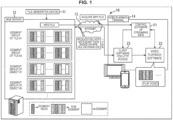
- FIG. 1 is a diagram illustrated to describe an overview of a first embodiment of an information processing system to which the present disclosure is applied.
- An information processing system 10 shown in FIG. 1 is configured to include a Web server 12 and a video playback terminal 14, which are connected to each other through the Internet 13.
- the Web server 12 is connected to a file generation device 11.
- the Web server 12 delivers image data of video content to the video playback terminal 14 in unit of tiles (tiled streaming) using a manner compliant with MPEG-DASH.
- the file generation device 11 acquires the image data of video content and encodes the image data in units of tiles to generate a video stream.
- the file generation device 11 processes the video stream of each tile into a file format at time intervals ranging from several seconds to approximately ten seconds, which is called a segment.
- the file generation device 11 uploads the resulting image file of each tile to the Web server 12.
- the file generation device 11 acquires voice data of video content for each object (described late in detail) and encodes the voice data in unit of objects to generate an audio stream.
- the file generation device 11 processes an audio stream of each object into a file format in unit of segments, and uploads the resulting voice file of each object to the Web server 12.
- the object is a sound source.
- the voice data of each object is acquired through a microphone or other audio equipment attached to the object.
- the object may be a material body such as a fixed microphone stand, or may be a moving body such as a person.
- the file generation device 11 encodes audio metadata including object position information (voice position information) indicating the position of each object (the position at which voice data is acquired) and an object ID that is a unique ID to the object.
- the file generation device 11 processes the encoded data obtained by encoding the audio metadata into a file format in unit of segments, and the file generation device 11 uploads the resulting voice metafile to the Web server 12.
- the file generation device 11 generates a media presentation description (MPD) file (control information) used to manage an image file or a voice file.
- the media presentation description file may contain image frame size information that indicates the frame size of images of video content and contains tile position information that indicates the position of each tile on an image.
- the file generation device 11 uploads the MPD file to the Web server 12.
- the Web server 12 stores the image file, voice file, voice metafile, and MPD file which are uploaded from the file generation device 11.
- the Web server 12 stores a segment group of a plurality of segments composed of image files of a tile with a tile ID "1" and a segment group of a plurality of segments composed of image files of a tile with a tile ID "2".
- the Web server 12 also stores a segment group of a plurality of segments composed of voice files of an object with an object ID "1” and a segment group of a plurality of segments composed of voice files of an object with an object ID "2".
- a segment group composed of voice metafiles is similarly stored.
- tile #i A tile with a tile ID of i is referred to as "tile #i", and an object with an object ID of i is referred to as "object #i”, hereinafter.
- the Web server 12 functions as a transmitter configured to transmit the stored image file, voice file, voice metafile, and MPD file to the video playback terminal 14 in response to a request from the video playback terminal 14.
- the video playback terminal 14 executes, for example, software for control of streaming data (hereinafter, referred to as control software) 21, video playback software 22, and client software for hypertext transfer protocol (HTTP) access (hereinafter, referred to as access software) 23.
- control software software for control of streaming data
- video playback software video playback software 22
- client software for hypertext transfer protocol (HTTP) access hereinafter, referred to as access software 23.
- HTTP hypertext transfer protocol
- the control software 21 is software to control data delivered via streaming from the Web server 12. Specifically, the control software 21 allows the video playback terminal 14 to acquire the MPD file from the Web server 12.
- the control software 21 specifies a tile in a display area based on the display area that is an area in an image used to display video content indicated by the video playback software 22 and the tile position information contained in the MPD file.
- the control software 21 instructs the access software 23 to issue a request to transmit an image file of the specified tile.
- the control software 21 instructs the access software 23 to issue a request to transmit the voice metafile.
- the control software 21 specifies an object corresponding to an image in the display area, based on the display area, the image frame size information contained in the MPD file, and object position information contained in the voice metafile.
- the control software 21 instructs the access software 23 to issue a request to transmit a voice file of the specified object.
- the video playback software 22 is software to play back the image file and voice file acquired from the Web server 12. Specifically, when the user specifies a display area, the video playback software 22 indicates the specified display area to the control software 21. The video playback software 22 decodes the image file and voice file acquired from the Web server 12 in response to the indication, and the video playback software 22 synthesizes the decoded file for output.
- the access software 23 is software to control communication with the Web server 12 via the Internet 13 using HTTP. Specifically, the access software 23 allows the video playback terminal 14 to transmit the request to transmit the image file, voice file, and voice metafile in response to the instruction from the control software 21. The access software 23 allows the video playback terminal 14 to receive the image file, voice file, and voice metafile transmitted from the Web server 12 in response to the transmission request.
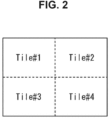
- FIG. 2 is a diagram illustrating an example of a tile.
- an image of video content is partitioned into a plurality of tiles.
- a tile ID that is a sequential number starting from 1 is assigned to each tile.
- an image of video content is partitioned into four tiles #1 to #4.
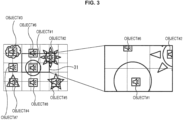
- FIG. 3 is a diagram illustrated to describe an object.
- FIG. 3 illustrates eight voice objects in an image acquired as a voice of video content.
- An object ID that is a sequential number starting from 1 is assigned to each object.
- Objects #1 to #5 are moving bodies, and objects #6 to #8 are stationary material bodies.
- the image of video content is partitioned into 7 (width) ⁇ 5 (height) tiles.
- the video playback terminal 14 may acquire and play back voice files of the objects #1, #2, and #6 from the Web server 12.
- the objects in the display area 31 can be specified based on the image frame size information and the object position information as described above.
- FIG. 4 is a diagram illustrated to describe the object position information.
- the object position information contains a horizontal angle ⁇ A (-180° ⁇ ⁇ A ⁇ 180°), a vertical angle ⁇ A (-90° ⁇ ⁇ A ⁇ 90°), and a distance r A (0 ⁇ r A ).
- a shooting position in the center of an image may be set to an origin (base point) O
- the horizontal direction of the image may be set to X-axis direction
- the vertical direction of the image may be set to Y-axis direction
- the depth direction perpendicular to the X-Y plane may be set to Z-axis direction.
- the horizontal angle ⁇ A is the angle in the horizontal direction formed by the Y-Z plane and the straight line connecting the object 40 and the origin O.
- the vertical angle ⁇ A is the angle in the vertical direction formed by the X-Z plane and the straight line connecting the object 40 and the origin O.
- the distance r A is the distance between the object 40 and the origin O.
- the angle of the left and up rotation is set to a positive angle
- the angle of the right and down rotation is set to a negative angle
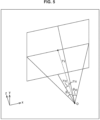
- FIG. 5 is a diagram illustrated to describe image frame size information.
- the image frame size information contains a horizontal angle ⁇ V1 of the left edge, a horizontal angle ⁇ V2 of the right edge, a vertical angle ⁇ V1 of the upper edge, a vertical angle ⁇ V2 of the lower edge, and a distance r V in the image frame.
- a shooting position of the center of an image may be set to the origin O, the horizontal direction of the image may be set to X-axis direction, the vertical direction of the image may be set to Y-axis direction, and the depth direction perpendicular to the X-Y plane may be set to Z-axis direction.
- the horizontal angle ⁇ V1 is the angle in the horizontal direction formed by the Y-Z plane and the straight line connecting the left end of the image frame and the origin O.
- the horizontal angle ⁇ V2 is the angle in the horizontal direction formed by the Y-Z plane and the straight line connecting the right end of the image frame and the origin O.
- the vertical angle ⁇ V1 is the angle formed by the X-Z plane and the straight line connecting between the upper end of the image frame and the origin O
- the vertical angle ⁇ V2 is the angle formed by the X-Z plane and the straight line connecting between the lower end of the image frame and the origin O.
- An angle obtained by combining the vertical angles ⁇ V1 and ⁇ V2 becomes a vertical angle of view.
- the distance r A is the distance between the origin O and the image plane.
- the object position information represents the positional relationship between the object 40 and the origin O
- the image frame size information represents the positional relationship between the image frame and the origin O.
- FIG. 6 is a diagram illustrating the structure of an MPD file.
- the video playback terminal 14 selects an optimum one among attributes of "Representation” contained in "Period” of the MPD file (Media Presentation).
- the video playback terminal 14 acquires a file by referring to a uniform resource locator (URL) or other reference of "Initialization Segment” at the head of the selected "Representation”, and processes the acquired file.
- the video playback terminal 14 acquires a file by referring to a uniform resource locator (URL) or other reference of the subsequent "Media Segment”, and plays back the acquired file.
- URL uniform resource locator
- the MPD file has a hierarchical structure shown in FIG. 8 , starting from the "Period".
- the structure of the MPD file arranged on the time axis becomes the configuration as shown in FIG. 9 .
- FIG. 9 there are a plurality of "Representation" elements in the same segment.
- the video playback terminal 14 selects any one from among these elements adaptively, and thus it is possible to acquire an image file and voice file in the display area selected by the user and to play back the acquired file.
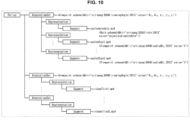
- FIG. 10 is a diagram illustrated to describe the description of MPD file.
- the image frame size information is contained in the MPD file to allow an object in the display area to be specified by the video playback terminal 14.
- Scheme (urn:mpeg:DASH:viewingAngle:2013) used to define new image frame size information (viewing angle) is extended by utilizing a DescriptorType element of Viewpoint, and thus the image frame size information is arranged in an "Adaptation Set” for voice and an "Adaptation Set” for image.
- the image frame size information may be arranged only in the "Adaptation Set” for image.
- the "Representation" for voice metafile is described in the "Adaptation Set” for voice of the MPD file.
- a URL or other reference as information for specifying the voice metafile (audiometadata.mp4) is described in "Segment” of the “Representation”.
- the file to be specified in “Segment” is the voice metafile (objectaudiometadata) by utilizing Role element.
- the "Representation" for voice file of each object is also described in "Adaptation Set” for voice of the MPD file.
- a URL or other reference as information for specifying the voice file (audioObje1.mp4, audioObje5.mp4) of each object is described in "Segment” of the "Representation”.
- object IDs (1 and 5) of the objects corresponding to the voice file are also described by extending Viewpoint.
- the tile position information is arranged in the "Adaptation Set" for image.
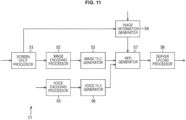
- FIG. 11 is a block diagram illustrating an exemplary configuration of the file generation device 11 shown in FIG. 1 .
- the file generation device 11 shown in FIG. 11 is configured to include a screen split processor 51, an image encoding processor 52, an image file generator 53, an image information generator 54, a voice encoding processor 55, a voice file generator 56, an MPD generator 57, and a server upload processor 58.
- the screen split processor 51 of the file generation device 11 splits image data of video content inputted from the outside into tile units.
- the screen split processor 51 supplies the image information generator 54 with the tile position information.
- the screen split processor 51 supplies the image encoding processor 52 with the image data configured in units of tiles.
- the image encoding processor 52 encodes the image data, which is configured in tile units and is supplied from the screen split processor 51, for each tile to generate a video stream.
- the image encoding processor 52 supplies the image file generator 53 with the video stream of each tile.
- the image file generator 53 processes the video stream of each tile supplied from the image encoding processor 52 into a file format in units of segments and supplies the MPD generator 57 with the resulting image file of each tile.
- the image information generator 54 supplies the MPD generator 57 with the tile position information supplied from the image split processor 51 and with the image frame size information inputted from the outside.
- the voice encoding processor 55 encodes voice data, which is configured in units of objects of video content inputted from the outside, for each object, and generates an audio stream.
- the voice encoding processor 55 encodes the object position information of each object inputted from the outside and the audio metadata that contains the object ID to generate encoded data.
- the voice encoding processor 55 supplies the voice file generator 56 with the audio stream of each object and the encoded data of the audio metadata.
- the voice file generator 56 functions as a voice file generator.
- the voice file generator 56 processes the audio stream of each object supplied from the voice encoding processor 55 into a file format in units of segments and supplies the MPD generator 57 with the resulting voice file of each object.
- the voice file generator 56 functions as a metafile generator.
- the voice file generator 56 processes the encoded data, which is obtained by encoding the audio metadata, supplied from the voice encoding processor 55 into a file format in units of segments, and supplies the MPD generator 57 with the resulting voice metafile.
- the MPD generator 57 determines a URL or other reference of the Web server 12 for storing the image file of each tile supplied from the image file generator 53.
- the MPD generator 57 determines a URL or other reference of the Web server 12 for storing the voice file of each tile and the voice metafile, which are supplied from the voice file generator 56.
- the MPD generator 57 arranges the image information supplied from the image information generator 54 in "AdaptationSet” for image of the MPD file.
- the MPD generator 57 arranges the image frame size information among the image information in "AdaptationSet” for voice of the MPD file.
- the MPD generator 57 arranges a URL or other reference of the image file of each tile in "Segment” of "Representation” for image file of the tile.
- the MPD generator 57 arranges the URL or other reference of the image file of each object in "Segment" of "Representation” for voice file of the object.
- the MPD generator 57 functions as an information generator.
- the MPD generator 57 arranges a URL or other reference as information for specifying a voice metafile in "Segment” of "Representation” for voice metafile.
- the MPD generator 57 supplies the server upload processor 58 with the MPD file in which various types of information are arranged as described above, the image file, the voice file, and the voice metafile.
- the server upload processor 58 uploads the image file of each tile, the voice file of each object, the voice metafile, and the MPD file, which are supplied from the MPD generator 57, to the Web server 12.
- FIG. 12 is a flowchart illustrated to describe a file generation process to be performed by the file generation device 11 shown in FIG. 11 .
- step S11 of FIG. 12 the screen split processor 51 of the file generation device 11 splits image data of video content inputted from the outside into tile units.
- the screen split processor 51 supplies the image information generator 54 with the tile position information.
- the screen split processor 51 supplies the image encoding processor 52 with the image data configured in units of tiles.
- step S12 the image encoding processor 52 encodes the image data, which is configured in tile units and is supplied from the screen split processor 51, for each tile to generate a video stream of each tile.
- the image encoding processor 52 supplies the image file generator 53 with the video stream of each tile.
- step S13 the image file generator 53 processes the video stream of each tile supplied from the image encoding processor 52 into a file format in units of segments to generate an image file of each tile.
- the image file generator 53 supplies the MPD generator 57 with the image file of each tile.
- step S14 the image information generator 54 acquires the image frame size information from the outside.
- step S15 the image information generator 54 generates image information that contains the tile position information supplied from the image split processor 51 and the image frame size information, and supplies the MPD generator 57 with the generated image information.
- step S17 the voice file generator 56 processes the audio stream of each object supplied from the voice encoding processor 55 into a file format in units of segments to generate a voice file of each object.
- the voice file generator 56 processes the encoded data, which is obtained by encoding the audio metadata, supplied from the voice encoding processor 55 into a file format in units of segments to generate a voice metafile.
- the voice file generator 56 supplies the MPD generator 57 with the voice file of each object and the voice metafile.
- step S18 the MPD generator 57 generates an MPD file that contains the image information supplied from the image information generator 54, the URL of each file, or other information.
- the MPD generator 57 supplies the server upload processor 58 with the MPD file, the image file of each tile, the voice file of each object, and the voice metafile.
- step S19 the server upload processor 58 uploads the image file of each tile, the voice file of each object, the voice metafile, and the MPD file, which are supplied from the MPD generator 57, to the Web server 12. Then, the process is terminated.
- FIG. 13 is a block diagram illustrating an exemplary configuration of a streaming playback section implemented by the execution of the control software 21, the video playback software 22, and the access software 23 in the video playback terminal 14 shown in FIG. 1 .
- the streaming playback section 90 shown in FIG. 13 is configured to include an MPD acquisition unit 91, an MPD processor 92, a metafile acquisition unit 93, a voice selector 94, a voice file acquisition unit 95, a voice decoding processor 96, a voice synthesis processor 97, an image selector 98, an image file acquisition unit 99, an image decoding processor 100, and an image synthesis processor 101.
- the MPD acquisition unit 91 of the streaming playback section 90 functions as a receiver.
- the MPD acquisition unit 91 acquires an MPD file from the Web server 12 and supplies the MPD processor 92 with the acquired MPD file.
- the MPD processor 92 extracts information such as a URL, which is described in "Segment” for voice metafile, from the MPD file supplied from the MPD acquisition unit 91, and supplies the metafile acquisition unit 93 with the extracted information.
- the MPD processor 92 extracts image frame size information, which is described in "AdaptationSet” for image, from the MPD file, and supplies the voice selector 94 with the extracted information.
- the MPD processor 92 extracts information such as a URL, which is described in "Segment” for voice file of the object requested from the voice selector 94, from the MPD file. Then, the MPD processor 92 supplies the voice selector 94 with the extracted information.
- the MPD processor 92 extracts the tile position information described in "AdaptationSet” for image from the MPD file and supplies the image selector 98 with the extracted information.
- the MPD processor 92 extracts information such as a URL, which is described in "Segment” for image file of the tile requested from the image selector 98, from the MPD file. Then, the MPD processor 92 supplies the image selector 98 with the extracted information.
- the metafile acquisition unit 93 requests a voice metafile from the Web server 12 based on the information supplied from the MPD processor 92.
- the voice metafile to be requested is specified in a URL among the information supplied from the MPD processor 92. Then, the metafile acquisition unit 93 acquires the voice metafile.
- the metafile acquisition unit 93 supplies the voice selector 94 with object position information contained in the voice metafile.
- the voice selector 94 functions as a position determination unit.
- the voice selector 94 calculates a position of each object on the image, based on the image frame size information supplied from the MPD processor 92 and the object position information supplied from the metafile acquisition unit 93.
- the voice selector 94 selects an object in the display area specified by the user based on the position of each object on the image.
- the voice selector 94 requests information such as a URL of the voice file of the selected object from the MPD processor 92.
- the voice selector 94 supplies the voice file acquisition unit 95 with the information such as a URL supplied from the MPD processor 92 in response to the request.
- the voice file acquisition unit 95 functions as a receiver.
- the voice file acquisition unit 95 requests a voice file in units of objects from the Web server 12 based on the information supplied from the voice selector 94.
- the voice file in units of objects to be requested is specified in a URL among the information supplied from the voice selector 94. Then, the voice file acquisition unit 95 acquires the voice file in units of objects, and supplies the voice decoding processor 96 with the acquired voice file in units of objects.
- the voice decoding processor 96 decodes an audio stream contained in the voice file in units of object supplied from the voice file acquisition unit 95 to generate voice data in units of objects.
- the voice decoding processor 96 supplies the voice synthesis processor 97 with the voice data in units of objects.
- the voice synthesis processor 97 synthesizes the voice data in units of objects supplied from the voice decoding processor 96 and outputs the synthesized data.
- the image selector 98 selects a tile in the display area specified by the user based on the tile position information supplied from the MPD processor 92.
- the image selector 98 requests information such as a URL for the image file of the selected tile from the MPD processor 92.
- the image selector 98 supplies the image file acquisition unit 99 with the information such as a URL supplied from the MPD processor 92 in response to the request.
- the image file acquisition unit 99 requests an image file in units of tiles from the Web server 12 based on the information supplied from the image selector 98.
- the image file in units of tiles to be requested is specified in a URL among the information supplied from the image selector 98. Then, the image file acquisition unit 99 acquires the image file in units of tiles, and supplies the image decoding processor 100 with the acquired image file in units of tiles.
- the image decoding processor 100 decodes a video stream contained in the image file in units of tiles supplied from the image file acquisition unit 99 to generate image data in units of tiles.
- the image decoding processor 100 supplies the image synthesis processor 101 with the image data in units of tiles.
- the image synthesis processor 101 synthesizes the image data in units of tiles supplied from the image decoding processor 100 and outputs the synthesized data.
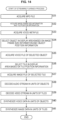
- FIG. 14 is a flowchart illustrated to describe a streaming playback process by the streaming playback section 90 (see FIG. 13 ) of the video playback terminal 14.
- step S31 of FIG. 14 the MPD acquisition unit 91 of the streaming playback section 90 acquires the MPD file from the Web server 12 and supplies the MPD processor 92 with the acquired MPD file.
- step S32 the MPD processor 92 acquires the image frame size information and the tile position information, which are described in "AdaptationSet” for image, from the MPD file supplied from the MPD acquisition unit 91.
- the MPD processor 92 supplies the voice selector 94 with the image frame size information and supplies the image selector 98 with the tile position information.
- the MPD processor 92 extracts information such as a URL described in "Segment” for voice metafile and supplies the metafile acquisition unit 93 with the extracted information.
- step S33 he metafile acquisition unit 93 requests a voice metafile from the Web server 12 based on the information supplied from the MPD processor 92.
- the voice metafile to be requested is specified in a URL among the information supplied from the MPD processor 92.
- the metafile acquisition unit 93 acquires the voice metafile.
- the metafile acquisition unit 93 supplies the voice selector 94 with object position information contained in the voice metafile.
- step S34 the voice selector 94 selects an object in the display area specified by the user, based on the image frame size information supplied from the MPD processor 92 and the object position information supplied from the metafile acquisition unit 93.
- the voice selector 94 requests the information such as a URL for the voice file of the selected object from the MPD processor 92.
- the MPD processor 92 extracts information such as a URL, which is described in "Segment" for voice file of the object requested from the voice selector 94, from the MPD file. Then, the MPD processor 92 supplies the voice selector 94 with the extracted information. The voice selector 94 supplies the voice file acquisition unit 95 with the information such as a URL supplied from the MPD processor 92.
- step S35 the voice file acquisition unit 95 requests and acquires, based on the information such as a URL supplied from the voice selector 94, a voice file of the selected object specified in the URL from the Web server 12. Then, the voice file acquisition unit 95 supplies the voice decoding processor 96 with the acquired voice file in units of objects.
- step S36 the image selector 98 selects a tile in the display area specified by the user based on the tile position information supplied from the MPD processor 92.
- the image selector 98 requests information such as a URL for the image file of the selected tile from the MPD processor 92.
- the MPD processor 92 extracts information such as a URL, which is described in "Segment" for image file of the object requested from the image selector 98, from the MPD file, and the MPD processor 92 supplies the image selector 98 with the extracted information.
- the image selector 98 supplies the image file acquisition unit 99 with the information such as a URL supplied from the MPD processor 92.
- step S37 the image file acquisition unit 99 requests an image file in units of tiles from the Web server 12 based on the information supplied from the image selector 98.
- the image file in selected tiles to be requested is specified in a URL among the information supplied from the image selector 98.
- the image file acquisition unit 99 acquires the image file in units of tiles, and supplies the image decoding processor 100 with the acquired image file in units of tiles.
- step S38 the voice decoding processor 96 decodes an audio stream contained in the voice file in units of object supplied from the voice file acquisition unit 95 to generate voice data in units of objects.
- the voice decoding processor 96 supplies the voice synthesis processor 97 with the voice data in units of objects.
- step S39 the image decoding processor 100 decodes a video stream contained in the image file in units of tiles supplied from the image file acquisition unit 99 to generate image data in units of tiles.
- the image decoding processor 100 supplies the image synthesis processor 101 with the image data in units of tiles.
- step S40 the voice synthesis processor 97 synthesizes the voice data in units of objects supplied from the voice decoding processor 96 and outputs the synthesized data.
- step S41 the image synthesis processor 101 synthesizes the image data in units of tiles supplied from the image decoding processor 100 and outputs the synthesized data. Then, the process is terminated.
- the Web server 12 transmits the image frame size information and the object position information.
- the video playback terminal 14 can specify an object in the display area to acquire selectively a voice file of the specified object so that the voice file corresponds to the image in the display area. This allows the video playback terminal 14 to acquire only a necessary voice file, which leads to the improvement of transmission efficiency.
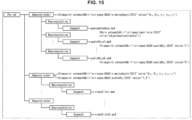
- an object ID (object specifying information) may be described in "AdaptationSet" for an image of the MPD file.
- This object ID may be used as information for specifying an object corresponding to the voice that is intended to be played back simultaneously with the image of the MPD file.
- the object ID may be described by extending Scheme (urn:mpeg:DASH:audioObj:2013) for defining new object ID information (audioObj) by utilizing a DescriptorType element of Viewpoint.
- the video playback terminal 14 selects a voice file of the object corresponding to the object ID described in "AdaptationSet” for image, and acquires the voice file for playback.
- the encoded data (Audio object) of each object is arranged, as a subsample, in an "mdat” box of the voice file (hereinafter, also referred to as voice media file, as appropriate) acquired by referring to "Media Segment" of the MPD file.
- voice media file hereinafter, also referred to as voice media file, as appropriate
- data is arranged in the voice media file in units of subsegments that are any time shorter than a segment.
- the position of data in units of subsegments is specified by a "sidx" box.
- the data in units of subsegments is composed of moof and mdat boxes.
- the mdat box is composed of a plurality of samples, and the encoded data of each object as each subsample of the sample is arranged.
- a gsiz box in which information on sample is described is placed next to the sidx box of the voice media file.
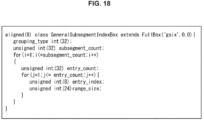
- a grouping_type for indicating the types of Sample group entry composed of one or more samples or subsamples managed by the gsix box is described in the gsix box, as shown in FIG. 18 .
- the type of the Sample group entry is "obja".
- the gsix box of a plurality of grouping_type is arranged in the voice media file, as shown in FIG. 17 .
- an index (entry_index) of each Sample group entry and a byte range as data position information indicating the position in the voice media file are described in the gsix box.
- the index (entry_index) is zero, the corresponding byte range indicates a byte range of the moof box (a1 in the example of FIG. 17 ).
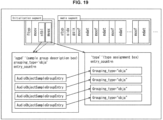
- this information is indicated by using a type assignment box (typa), which is associated with AudioObjectSampleGroupEntry of a sample group description box (sgpd) in a sbtl box of the voice initialization file.
- type assignment box (typa)
- sgpd sample group description box
- an object ID (audio_object_id) corresponding to the encoded data contained in the sample is described in each AudioObjectSampleGroupEntry box.
- an object ID such as, for example, 1, 2, 3, and 4 is described in each of four AudioObjectSampleGroupEntry boxes.
- an index as a parameter (grouping_type_parameter) of the Sample group entry corresponding to the AudioObjectSampleGroupEntry is described in each AudioObjectSampleGroupEntry.
- the voice media file and the voice initialization file are configured as described above.
- the AudioObjectSampleGroupEntry in which the object ID of the selected object is described is retrieved from the stbl box of the voice initialization file.
- an index of the Sample group entry corresponding to the retrieved AudioObjectSampleGroupEntry is read from the mvex box.
- the position of data in units of subsegments is read from the sidx box of the voice file, and the byte range of the Sample group entry of the read index is read from the gsix box.
- the encoded data arranged in the mdat box is acquired based on the position of data in units of subsegments and the byte range. This allows encoded data of the selected object to be acquired.
- the index of Sample group entry and the object ID of AudioObjectSampleGroupEntry are associated with each other through the mvex box, they can be associated with each other directly. When they are associated with each other directly, the index of Sample group entry is described in the AudioObjectSampleGroupEntry.
- the sgpd box can be stored in the mvex box, which allows the sgpd box to be shared among tracks.
- FIG. 22 is a diagram illustrated to describe an overview of a second embodiment of the information processing system to which the present disclosure is applied.
- FIG. 22 the same elements as those shown in FIG. 3 are denoted with the same reference signs.
- the display area 31 when the user specifies the display area 31 composed of 3 (width) ⁇ 2 (height) tiles, the display area 31 is converted (extended) to an area having the same size as the size of the image of video content, resulting in a display image 111 in the second embodiment as shown in FIG. 22 .
- the voices of the objects #1 to #8 are synthesized based on the positions of the objects #1 to #8 in the display image 111 and are outputted along with the display image 111. In other words, voices of the objects #3 to #5, #7, and #8, which are outside the display area 31, are outputted, in addition to the voices of the objects #1, #2, and #6, which are inside the display area 31.
- the configuration of the second embodiment of the information processing system to which the present disclosure is applied is the same as the configuration of the information processing system 10 shown in FIG. 1 except for the configuration of the streaming playback section, and thus the following description will be given only of the streaming playback section.
- FIG. 23 is a block diagram illustrating an exemplary configuration of the streaming playback section of the information processing system to which the present disclosure is applied.
- FIG. 23 the same configurations as those shown in FIG. 13 are denoted with the same reference signs, and repeated description is omitted as appropriate.
- a streaming playback section 120 shown in FIG. 23 is provided with an MPD processor 121, a voice synthesis processor 123, and an image synthesis processor 124 instead of the MPD processor 92, the voice synthesis processor 97, and the image synthesis processor 101, respectively, and the streaming playback section 120 is configured to further include a position determination unit 122, which is different from the streaming playback section 90 shown in FIG. 13 .
- the MPD processor 121 of the streaming playback section 120 extracts information such as a URL, which is described in "Segment” for voice metafile, from the MPD file supplied from the MPD acquisition unit 91, and supplies the metafile acquisition unit 93 with the extracted information.
- the MPD processor 121 extracts image frame size information of an image of the video content (hereinafter, referred to as content image frame size information) that is described in "AdaptationSet” for image from the MPD file and supplies the position determination unit 122 with the extracted information.
- the MPD processor 121 extracts information such as a URL, which is described in "Segment” for voice file of all objects, from the MPD file, and supplies the voice file acquisition unit 95 with the extracted information.
- the MPD processor 121 extracts the tile position information described in "AdaptationSet” for image from the MPD file and supplies the image selector 98 with the extracted information.
- the MPD processor 121 extracts information such as a URL, which is described in "Segment” for image file of the tile requested from the image selector 98, from the MPD file. Then, the MPD processor 121 supplies the image selector 98 with the extracted information.
- the position determination unit 122 acquires object position information that is contained in the voice metafile obtained by the metafile acquisition unit 93 and the content image frame size information that is supplied from the MPD processor 121.
- the position determination unit 122 acquires display area image frame size information that is the image frame size information of the display area specified by the user.
- the position determination unit 122 determines (recognizes) the position of objects in the display area, based on the object position information, the content image frame size information, and the display area image frame size information.
- the position determination unit 122 supplies the voice synthesis processor 123 with the determined position of the object.
- the voice synthesis processor 123 synthesizes voice data in units of objects supplied from the voice decoding processor 96 based on the object position supplied from the position determination unit 122. Specifically, the voice synthesis processor 123 determines voice data to be assigned to each speaker for each object based on the object position and the position of each speaker that outputs sound. The voice synthesis processor 123 synthesizes voice data of each object for each speaker and outputs the synthesized voice data as voice data for each speaker.
- a detailed description of the method of synthesizing voice data of each object based on the object position is disclosed, for example, in Ville Pulkki: "Virtual Sound Source Positioning Using Vector Base Amplitude Panning", Journal of AES, vol. 45, no. 6, pp. 456-466, 1997 .
- the image synthesis processor 124 synthesizes image data in units of tiles supplied from the image decoding processor 100.
- the image synthesis processor 124 functions as a converter.
- the image synthesis processor 124 converts the size of the image corresponding to the synthesized image data to the size of the video content to generate a display image.
- the image synthesis processor 124 outputs the display image.
- FIGS. 24 to 26 are diagrams illustrated to describe a method of determining a position of an object by the position determination unit 122 shown in FIG. 23 .
- the display area 31 is extracted from the video content and the size of the display area 31 is converted to the size equivalent to that of the video content, and then a display image 111 is generated.
- the display image 111 has the size equivalent to the size obtained by shifting the center C of the display area 31 to the center C' of the display image 111 as shown in FIG. 24 and by converting the size of the display area 31 to the size of the video content as shown in FIG. 25 .
- the position determination unit 122 calculates a shift amount ⁇ shift in horizontal direction when the center O of the display area 31 is shifted to the center O' of the display image 111.
- This calculation uses the following Equation (1).
- Equation (1) ⁇ v1 ' is the horizontal angle at the left edge in the display area 31 contained in the display area image frame size information, and ⁇ v2 ' is the horizontal angle at the right edge in the display area 31 of the display area image frame size information.
- ⁇ v1 is a horizontal angle at the left edge of the content image frame size information, and ⁇ v2 is a horizontal angle at the right edge contained in the content image frame size information.
- the position determination unit 122 calculates a horizontal angle at the left edge ⁇ v1_shift ' and a horizontal angle at the right edge ⁇ v2_shift ' in the display area 31 after the center O of the display area 31 is shifted to the center O' of the display image 111.
- This calculation uses the shift amount ⁇ shift and is obtained by the following Equation (2).
- the horizontal angle ⁇ v1_shift ' and the horizontal angle ⁇ V2 shift ' are calculated so that they do not exceed the range of -180° to 180°.
- the display image 111 has the size equivalent to the size obtained by shifting the center O of the display area 31 to the center O' of the display image 111 and by converting the size of the display area 31 to the size of the video content.
- Equation (3) is satisfied for the horizontal angles ⁇ v1 and ⁇ v2 .
- Equation (4) ⁇ Ai is the horizontal angle of an object #i contained in the object position information. According to Equation (4), the horizontal angle ⁇ Ai_shift is calculated so that it does not exceed the range of -180° to 180°.
- the position determination unit 122 calculates a horizontal angle ⁇ Ai ' of an object #i in the display image 111 using the following Equation (5).
- the horizontal angle ⁇ Ai ' is calculated by extending the distance between the position of an object #i in the display image 111 and the center C' of the display image 11 depending on the ratio between the sizes of the display area 31 and the display image 111.
- the position determination unit 122 calculates the horizontal angle ⁇ Ai ' of an object #i in the display image 111 using the following Equation (6).
- Equation (6) when an object #i is present in a position 151 on the right side of the display area 31 (-180° ⁇ ⁇ Ai_shift ⁇ ⁇ v2_shift ') as shown in FIG. 26 , the horizontal angle ⁇ Ai ' is calculated by extending the horizontal angle ⁇ Ai_shift depending on the ratio between angles R1 and R2.
- the angle R1 is the angle measured from the right edge of the display image 111 to the position 154 just behind a viewer 153.
- the angle R2 is the angle measured from the right edge of the display area 31 whose center is shifted to the position 154.
- Equation (6) when an object #i is present in a position 155 on the left side of the display area 31 ( ⁇ v1_shift ' ⁇ ⁇ Ai_shift ⁇ 180°), the horizontal angle ⁇ Ai ' is calculated by extending the horizontal angle ⁇ Ai_shift depending on the ratio between angles R3 and R4.
- the angle R3 is the angle measured from the left edge of the display image 111 to the position 154.
- the angle R4 is the angle measured from the left edge of the display area 31 whose center is shifted to the position 154.
- the position determination unit 122 calculates a vertical angle ⁇ Ai ' of an object #i in the display image 111 based on the horizontal angles ⁇ Ai and ⁇ Ai '. Specifically, when the object #i is located in front of the viewer, the position determination unit 122 calculates the vertical angle ⁇ Ai ' in a similar way to the horizontal angle ⁇ Ai '.
- the extension of the display area 31 allows the position of the object #i indicated by the horizontal angle ⁇ Ai to be shifted to the position just behind the viewer.
- the vertical angle ⁇ Ai ' is calculated in a similar way to the horizontal angle ⁇ Ai ', the position indicated by the vertical angle ⁇ Ai contained in the object position information of the object #i is shifted to the position just above or just below the viewer.
- the position determination unit 122 calculates the vertical angle ⁇ Ai ' using the following Equation (7).
- ⁇ Ai ′ ⁇ v 2 ′ + 90 ° ⁇ v 2 + 90 ° ⁇ ⁇ Ai + 90 ° ⁇ 90 ° for ⁇ 90 ° ⁇ ⁇ Ai ⁇ ⁇ v 2 ⁇ v 1 ′ + ⁇ v 2 ′ ⁇ v 1 ⁇ ⁇ v 2 ⁇ ⁇ Ai ⁇ ⁇ v 1 ′ + ⁇ v 2 ′ 2 for ⁇ v 2 ⁇ ⁇ Ai ⁇ ⁇ v 1 90 ° ⁇ ⁇ v 1 ′ 90 ° ⁇ ⁇ v 1 ⁇ ⁇ Ai ⁇ ⁇ v 1 + ⁇ v 1 ′ for ⁇ v 1 ⁇ ⁇ Ai ⁇ 90 ° ° ⁇ v 1 ′ for ⁇ v 1 ⁇ ⁇ Ai ⁇ 90 ° ° ⁇ v 1 ⁇ ⁇ Ai ⁇ ⁇ v 1 + ⁇ v 1 ′ for ⁇ v 1 ⁇ ⁇
- Equation (7) ⁇ v1 ' is the vertical angle at the upper edge in the display area 31 contained in the display area image frame size information, and ⁇ v2 ' is the vertical angle at the lower edge.
- ⁇ v1 is the vertical angle at the upper edge contained in the content image frame size information, and ⁇ v2 is the vertical angle at the lower edge.
- the position determination unit 122 calculates the vertical angle ⁇ Ai ' as described below.
- the object #i is shifted from a position in front of the viewer to a position behind the viewer, or is shifted from a position behind the viewer to a position in front of the viewer.
- the calculation procedure be split into two stages.
- One stage is to allow the horizontal angle of an object #i to have a range between an angle indicating the position of the object #i in front of the viewer and the angle of 90° that is the angle indicating the left side of the viewer or the angle of -90° indicating the right side of the viewer.
- the other stage is to allow the horizontal angle of an object #i to have a range between the angle of 90° or -90° and an angle indicating the position of the object #i behind the viewer.
- the position determination unit 122 sets the shift amount of the vertical angle ⁇ Ai in the stage in which the horizontal angle of the object #i has a range between 90° or -90° and an angle indicating the position of the object #i behind the viewer to be equal to zero.
- the position determination unit 122 calculates the shift amount of the vertical angle ⁇ Ai in the stage in which the horizontal angle of an object #i has a range between an angle indicating the position of the object #i in front of the viewer and the angle of 90° that is an angle indicating the left side of the viewer or the angle of -90° indicating the right side of the viewer in a similar way to Equation (7).
- ⁇ Ai ′ ⁇ v 2 f ′ + 90 ° ⁇ v 2 f + 90 ° ⁇ ⁇ Ai + 90 ° ⁇ 90 ° for ⁇ 90 ° ⁇ ⁇ Ai ⁇ ⁇ v 2 f ⁇ v 1 f ′ - ⁇ v 2 f ′ ⁇ v 1 f ⁇ ⁇ v 2 f ⁇ ⁇ Ai ⁇ ⁇ v 1 f ′ + ⁇ v 2 f ′ 2 for ⁇ v 2 f ⁇ ⁇ Ai ⁇ ⁇ v 1 f 90 ° ⁇ ⁇ v 1 f ′ 90 ° ⁇ ⁇ v 1 f ⁇ ⁇ Ai ⁇ ⁇ v 1 f + ⁇ v 1 f ′ for ⁇ v 1 f ⁇ ⁇ Ai ⁇ ⁇ Ai ⁇ 90 ° [Math.
- F side indicates the ratio between the vertical angle of the display area 31 and the vertical angle of the display image 111 when the horizontal angle of the object #i is 90° or -90°, and is calculated using the following Equation (11).
- F side 180 ° ⁇ 90 ° 180 ° ⁇ ⁇ Ai ⁇ 180 ° ⁇ ⁇ v 1 ⁇ v 1 ⁇ TransForm_Factor for ⁇ Ai ⁇ 0 ° 90 ° 180 ° + ⁇ Ai ⁇ 180 ° + ⁇ v 2 ⁇ 180 ° ⁇ v 2 ⁇ TransForm_Factor for ⁇ Ai ⁇ 0 °
- F side is calculated by multiplying the ratio between the vertical angle of the display area 31 and the vertical angle of the display image 111 when the horizontal angle of the object #i is 90° or -90° by TransForm_Factor.
- the variation in the vertical angle of the object #i becomes equal to a variation when the horizontal angle of the object #i is shifted from the horizontal angle ⁇ Ai to the angle of 90° or -90°.
- the variation in the vertical angle of the object #i becomes equal to a variation when the horizontal angle of the object #i is shifted from the angle of 90° or -90° to the horizontal angle ⁇ Ai '.
- the vertical angle ⁇ v1 in Equation (7) becomes equal to the product of Fside and the vertical angle ⁇ v1
- the vertical angle ⁇ v2 in Equation (7) becomes equal to the product of Fside and the vertical angle ⁇ v2 .
- the vertical angle may be set to change in the same direction as the horizontal angle.
- the position indicated by the vertical angle when the position indicated by the horizontal angle is shifted to a position just behind the viewer, the position indicated by the vertical angle also may be shifted to a position just behind the viewer.
- the position indicated by the vertical angle when the position indicated by the horizontal angle is shifted to a position right in front of the viewer, the position indicated by the vertical angle also may be shifted to a position right in front of the viewer.
- the position determination unit 122 may set the distance r Ai ' of the object #i in the display image 111 to the distance r Ai contained in the object position information of the object #i.
- the position determination unit 122 supplies the horizontal angle ⁇ Ai ', vertical angle ⁇ Ai ', and distance r Ai of the object #i which are obtained as described above to the voice synthesis processor 123, which accepts these values as the position of the object #i.
- FIG. 27 is a graph illustrating the relationship between the horizontal angle ⁇ Ai and the horizontal angle ⁇ Ai '.
- the horizontal axis represents the horizontal angle ⁇ Ai
- the vertical axis represents the horizontal angle ⁇ Ai '.
- FIG. 28 is a graph illustrating the relationship between the vertical angle ⁇ y1 ' and the vertical angle ⁇ Ai '.
- the horizontal axis represents the vertical angle ⁇ v1 ' and the vertical axis represents the vertical angle ⁇ Ai '.
- the horizontal angle ⁇ Ai and the vertical angle ⁇ Ai are both 45°.
- the vertical angles ⁇ v1 and ⁇ v2 are changed in the same ratio as the horizontal angles ⁇ v1 and ⁇ v2 .
- TransForm_Factor is equal to 1.
- the angles ⁇ v1 , ⁇ v2 , ⁇ v1 , and ⁇ v2 are equal to 29°, -29°, 17.5°, and -17.5°, respectively.
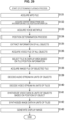
- FIG. 29 is a flowchart illustrated to describe the streaming playback process to be performed by the streaming playback section 120 of FIG. 23 .
- step S131 of FIG. 29 the MPD acquisition unit 91 of the streaming playback section 120 acquires the MPD file from the Web server 12 and supplies the MPD processor 121 with the acquired MPD file.
- step S132 the MPD processor 121 acquires the content image frame size information and the tile position information, which are described in "AdaptationSet” for image, from the MPD file supplied from the MPD acquisition unit 91.
- the MPD processor 121 supplies the position determination unit 122 with the image frame size information and supplies the image selector 98 with the tile position information.
- the MPD processor 121 extracts information such as a URL described in "Segment” for voice metafile and supplies the metafile acquisition unit 93 with the extracted information.
- step S133 he metafile acquisition unit 93 requests a voice metafile from the Web server 12 based on the information supplied from the MPD processor 92.
- the voice metafile to be requested is specified in a URL among the information supplied from the MPD processor 92.
- the metafile acquisition unit 93 acquires the voice metafile.
- the metafile acquisition unit 93 supplies the voice selector 94 with object position information contained in the voice metafile.
- step S135 the MPD processor 121 extracts information such as a URL, which is described in "Segment" for voice file of all objects, from the MPD file. Then, the MPD processor 121 supplies the voice file acquisition unit 95 with the extracted information.
- step S136 the voice file acquisition unit 95 requests and acquires, based on the information such as a URL supplied from the MPD processor 121, voice files of all the objects specified in the URL from the Web server 12. Then, the voice file acquisition unit 95 supplies the voice decoding processor 96 with the acquired voice file in units of objects.
- steps S137 to S140 is substantially similar to the process in steps S36 to S39 of FIG. 14 , and thus a description thereof is omitted.
- step S141 the voice synthesis processor 123 synthesizes voice data in units of objects supplied from the voice decoding processor 96 based on the object position supplied from the position determination unit 122 and outputs the synthesized voice data.
- step S142 the image synthesis processor 124 synthesizes image data in units of tiles supplied from the image decoding processor 100.
- step S143 the image synthesis processor 124 converts the size of the image corresponding to the synthesized image data to the size of the video content to generate a display image.
- the image synthesis processor 124 outputs the display image, and then the process is terminated.
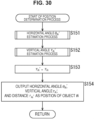
- FIG. 30 is a flowchart illustrated to describe in more detail the position determination process in step S134 of FIG. 29 .
- the position determination process is performed, for example, for each object.
- step S151 of FIG. 30 the position determination unit 122 performs a horizontal angle ⁇ Ai ' estimation process of estimating the horizontal angle ⁇ Ai ' in a display image.
- the detailed description of the horizontal angle ⁇ Ai ' estimation process will be given later with reference to FIG. 31 .
- step S152 the position determination unit 122 performs a vertical angle ⁇ Ai ' estimation process of estimating the vertical angle ⁇ Ai ' in a display image.
- the detailed description of the vertical angle ⁇ Ai ' estimation process is similar to the horizontal angle ⁇ Ai ' estimation process in step S151 except that the vertical direction is used in place of the horizontal direction, and thus a detailed description thereof will be omitted.
- step S153 the position determination unit 122 sets the distance r Ai ' in a display image to be equal to the distance r Ai contained in the object position information supplied from the metafile acquisition unit 93.
- step S154 the position determination unit 122 outputs the horizontal angle ⁇ Ai ', vertical angle ⁇ Ai ', and distance r Ai to the voice synthesis processor 123, which accepts these values as the position of the object #i. Then, the process returns to step S134 of FIG. 29 and proceeds to step S135.
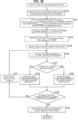
- FIG. 31 is a flowchart illustrated to describe in detail the horizontal angle ⁇ Ai ' estimation process in step S151 of FIG. 30 .
- step S171 of FIG. 31 the position determination unit 122 acquires the horizontal angle ⁇ Ai contained in the object position information supplied from the metafile acquisition unit 93.
- step S172 the position determination unit 122 acquires the content image frame size information supplied from the MPD processor 121 and the display area image frame size information specified by the user.
- step S173 the position determination unit 122 calculates the shift amount ⁇ shift by the above-mentioned Equation (1) based on the content image frame size information and the display area image frame size information.
- step S174 the position determination unit 122 calculates the horizontal angles ⁇ v1_shift ' and ⁇ v2_shift ' by the above-mentioned Equation (2) using the shift amount ⁇ shift and the display area image frame size.
- step S175 the position determination unit 122 calculates the horizontal angle ⁇ Ai_shift by the above-mentioned Equation (4) using the horizontal angle ⁇ Ai and the shift amount ⁇ shift .
- step S176 the position determination unit 122 determines whether the object #i is located in the display area 31 (the horizontal angle of the object #i ranges between horizontal angles at both edges of display area 31) or whether the condition of ⁇ v2_shift ' ⁇ ⁇ Ai_shift ⁇ ⁇ v1_shift ' is satisfied.
- step S176 If it is determined in step S176 that the object #i is located in the display area 31 or that the condition of ⁇ v2_shift ' ⁇ ⁇ Ai_shift ⁇ ⁇ v1_shift ' is satisfied, the process proceeds to step S177.
- step S177 the position determination unit 122 calculates the horizontal angle ⁇ Ai ' by the above-mentioned Equation (5) based on the content image frame size information, horizontal angles ⁇ v1_shift ' and ⁇ v2_shift ', and vertical angle ⁇ Ai_shift '.
- step S176 the position determination unit 122 calculates the horizontal angle ⁇ Ai ' by the above-mentioned Equation (6) based on the content image frame size information, horizontal angle ⁇ v1_shift ' or ⁇ v2_shift ', and horizontal angle ⁇ Ai_shift '.
- step S177 and 178 When the process in steps S177 and 178 is performed, the process returns to step S151 of FIG. 30 and proceeds to step S152.
- the size of the display image is set to be equal to the size of the video content in the second embodiment, the size of both may be different from each other.
- voice data of some objects may be synthesized and outputted, rather than the voice data of all objects is synthesized and outputted.
- a method of selecting an object of voice data to be outputted may be determined in advance or may be decided by the user.
- a third embodiment of the information processing system to which the present disclosure is applied is substantially similar to the second embodiment except for a method of determining a position of an object in a display area by the position determination unit 122 of FIG. 23 .
- a description will be given only of a method of determining a position of an object in a display area by the position determination unit 122 of FIG. 23 .
- the change in a distance from the viewer to the image frame causes the angle of the image frame viewed from the viewer to be changed accordingly. For example, as the viewer approaches the image frame, the image frame is visible larger. As the viewer is away from the image frame, the image frame is visible smaller.
- the change in size of the display area or the image frame can be represented by the movement of the viewer.
- the change in size of the display area is represented by the movement of the viewer.
- FIGS. 32 to 35 are diagrams illustrated to describe a method of determining a position of an object in a display area according to the third embodiment of the information processing system to which the present disclosure is applied.
- FIGS. 32 and 33 are diagrams illustrated to describe a state in which the size of the display area 31 in the video content is changed.
- FIG. 32 is a top view seen from the top of the head of the viewer, and
- FIG. 32 is a side view seen from the right side of the viewer.
- FIGS. 34 and 35 are diagrams illustrated to describe a state in which the viewer is moved and the size of the display area 31 seen from the viewer is equal to the size of the video content with the movement of the viewer.
- FIG. 34 is a top view seen from the top of the head of the viewer
- FIG. 35 is a side view seen from the right side of the viewer.
- the position determination unit 122 estimates object position information when the size of the display area 31 is changed to be equal to the size of the video content, i.e., object position information in the display image, by obtaining object position information of the object changed by the movement of the viewer.
- the position determination unit 122 calculates a horizontal width Screen Width in the display area 31 before the movement, a width Screen Leftwidth extending between the left edge and the center, and a height Screen TopHeight extending between the top edge and the center, using the following Equation (13).
- Screen LeftWidth r v ⁇ tan ⁇ v 1 ′
- Screen TopHeight r v ⁇ tan ⁇ v 1 ′
- Screen Width r v ⁇ tan ⁇ v 1 ′ ⁇ tan ⁇ v 2 ′
- Equation (13) r v is the distance from the viewer to the image frame, ⁇ v1 ' is the horizontal angle at the left edge in the display area 31 contained in the display area image frame size information, ⁇ v2 ' is the horizontal angle at the right edge, and ⁇ v1 ' is the vertical angle at the upper edge.
- Equation (14) ⁇ v1 is the horizontal angle at the left edge contained in the display area image frame size information of the display area 31 after the movement, i.e., the content image frame size information, and ⁇ v2 is the horizontal angle at the right edge.
- the position determination unit 122 estimates a shift amount Length shift in the back and forth direction of the viewer, a shift amount Width shif in the side-to-side direction of the viewer, and a shift amount Height shift in the up-and-down direction of the viewer when the size of the display area 31 seen from the viewer is equal to the size of the video content with the movement of the viewer.
- This estimation is performed using the following Equation (15).
- Equation (15) vertical angle ⁇ v1 is the vertical angle at the upper edge contained in the display area image frame size information of the display area 31 after the movement, i.e., the content image frame size information.
- F Aspect_ratio is the factor indicating the variation of the ratio between the width in the vertical direction and the width in the horizontal direction of the display area 31 seen from the viewer before and after the movement, and is expressed by the following Equation (16). This factor F Aspect_ratio allows the variation in width in the vertical direction corresponding to the variation in width in the horizontal direction to be estimated. [Math.
- Equation (16) ⁇ v2 is the vertical angle at the lower edge contained in the display area image frame size information of the display area 31 after the movement, i.e., the content image frame size information, and ⁇ v2 ' is the vertical angle at the lower edge contained in the display area image frame size information of the display area 31.
- the position determination unit 122 estimates the object position information of the object in the display image using the obtained information as described above.
- the position determination unit 122 estimates the object position information in the display image using the following Equation (17).
- Equation (17) ⁇ Ai ' is the horizontal angle of the object #1 after the movement, ⁇ Ai is the horizontal angle of the object #1 before the movement, ⁇ A1 ' is the vertical angle of the object #1 after the movement, and a vertical angle ⁇ Ai is the horizontal angle of the object #1 before the movement.
- r Ai ' is the distance of the object #1 after the movement and r Ai is the distance of the object #1 before the movement.
- the position determination unit 122 estimates the object position information in the display image using the following Equation (18). [Math.
- Equation (18) may be modified like the following equation (19).
- Equation (19) x Ai ', y v1 ', and z Ai ' are positions in the back and forth direction (depth direction), in the side-to-side direction, and in the up-and-down direction, respectively, in the xyz coordinate system of the object #i after the movement. Equation (19) is obtained as a modification of Equation (18), and Equations (18) and (19) are equivalent to each other.
- the object position information after the movement is estimated using the distance r v from the viewer to the image frame and the distance r Ai of the object #i before the movement.
- a restriction that r v ' calculated by Equation (14) does not exceed 2 * r v may be provided to prevent the shift amount in the back and forth direction of the viewer from exceeding r v .
- a streaming playback process to be performed by the streaming playback section according to the third embodiment of the information processing system to which the present disclosure is applied is the same as the streaming playback process shown in FIG. 29 except for the position determination process in step S134, and thus the following description will be given only of the position determination process.
- FIG. 36 is a flowchart illustrated to describe in detail the position determination process according to the third embodiment of the information processing system to which the present disclosure is applied.
- step S181 of FIG. 36 the position determination unit 122 acquires the display area image frame size information and the content image frame size information of the display area 31 before the movement. Specifically, the position determination unit 122 acquires the horizontal angle ⁇ v1 ' at the left edge, horizontal angle ⁇ v2 ' at the right edge, vertical angle ⁇ v1 ' at the upper edge, and vertical angle ⁇ v2 ' at the lower edge, of the image frame in the display area 31 before the movement.
- the position determination unit 122 also acquires the horizontal angle ⁇ v1 at the left edge, horizontal angle ⁇ v2 at the right edge, vertical angle ⁇ v1 at the upper edge, vertical angle ⁇ v2 ' at the lower edge, and distance r v , of the image frame of the video content.
- step S182 the position determination unit 122 calculates a horizontal width Screen Width , a width Screen Leftwidth , and a height Screen TopHeight by the above-mentioned Equation (13) using the horizontal angles ⁇ v1 ' and ⁇ v2 ', vertical angle ⁇ v1 ', and distance r v .
- step S183 the position determination unit 122 estimates a distance r v ' after the movement by the above-mentioned Equation (14) using the horizontal width Screen Width and horizontal angles ⁇ v1 and ⁇ v2 .
- step S184 the position determination unit 122 estimates the shift amounts Length shift , Width shift , and Height shift of the viewer by the above-mentioned Equations (15) and (16) using the width Screen LeftWidth , height Screen TopHeight , distances r v and r v ', horizontal angles ⁇ v1 , ⁇ v2 , ⁇ v1 ', and ⁇ v2 ', and vertical angles ⁇ vi , ⁇ v2 , ⁇ v1 ', and ⁇ v2 '.
- step S185 the position determination unit 122 selects an object #i as a first target to be played.
- step S186 the position determination unit 122 acquires a horizontal angle ⁇ Ai , a vertical angle ⁇ Ai , and a distance r Ai that are object position information before the movement of the selected object #i.
- step S187 the position determination unit 122 determines whether the object #i is located in the display area 31, i.e., whether the condition of ⁇ v2 ' ⁇ ⁇ Ai ⁇ ⁇ v1 ' and ⁇ v2 ' ⁇ ⁇ Ai ⁇ ⁇ v1 ' is satisfied.
- step S187 If it is determined in step S187 that the object #i is located in the display area 31, i.e., the condition of ⁇ v2 ' ⁇ ⁇ Ai ⁇ ⁇ v1 ' and ⁇ v2 ' ⁇ ⁇ Ai ⁇ ⁇ v1 ' is satisfied, the process proceeds to step S188.
- step S188 the position determination unit 122 estimates object position information of the object #i in the display image by the above-mentioned Equation (17) using the shift amounts Width shif and Height shift , distances r v and r v ', horizontal angles ⁇ Ai and ⁇ Ai ', and vertical angles ⁇ Ai and ⁇ Ai '. Then, the process proceeds to step S190.
- step S187 if it is not determined in step S187 that the object #i is located in the display area 31, i.e., the condition of ⁇ v2 ' ⁇ ⁇ Ai ⁇ ⁇ v1 ' and ⁇ v2 ' ⁇ ⁇ Ai ⁇ ⁇ v1 ' is not satisfied, the process proceeds to step S189.
- step S189 the position determination unit 122 estimates object position information of the object #i in the display image by the above-mentioned Equation (18) using the shift amounts Length shift , Width shift and Height shift , the distance r Ai , horizontal angles ⁇ Ai and ⁇ Ai ', and vertical angles ⁇ Ai and ⁇ Ai '. Then, the process proceeds to step S190.
- step S190 the position determination unit 122 determines whether the object position information for all the objects to be played is estimated. If it is not determined in step S190 that the object position information for all the objects to be played is estimated, the process proceeds to step S191.
- step S191 the position determination unit 122 selects an object following the currently selected object among objects to be played, and then the process returns to step S186.
- step S190 determines whether the object position information for all the objects is estimated. If it is determined in step S190 that the object position information for all the objects is estimated, the process proceeds to step S192.
- step S192 the position determination unit 122 outputs the object position information for all the objects to be played in the display image to the voice synthesis processor 123. After the process in step S192, the process returns to step S134 of FIG. 29 , and then proceeds to step S135.
- the size of the display image is set to be equal to the size of the video content in the second embodiment, the size of both may be different from each other.
- voice data of some objects may be synthesized and outputted, rather than the voice data of all objects to be played is synthesized and outputted.
- a method of selecting an object of voice data to be outputted may be determined in advance or may be decided by the user.
- the series of processes by the Web server 12 described above can be executed by hardware or software.
- a program constituting the software is installed in a computer.
- the computer includes a computer incorporated into dedicated hardware, a general-purpose personal computer, for example, that can execute various functions by installing various programs, and the like.
- FIG. 37 is a block diagram illustrating an example of a hardware configuration of a computer which executes the above-described series of processes by the Web server 12 using a program.
- a central processing unit (CPU) 201 In the computer, a central processing unit (CPU) 201, a read only memory (ROM) 202, and a random access memory (RAM) 203 are connected to one another by a bus 204.
- CPU central processing unit
- ROM read only memory
- RAM random access memory
- the bus 204 is further connected with an input and output interface 205.
- the input and output interface 205 is connected with an input unit 206, an output unit 207, a storage unit 208, a communication unit 209, and a drive 210.
- the input unit 206 includes a keyboard, a mouse, a microphone, or the like.
- the output unit 207 includes a display, a speaker, or the like.
- the storage unit 208 includes a hard disk, a non-volatile memory, or the like.
- the communication unit 209 includes a network interface or the like.
- the drive 210 drives a removable medium 211 such as a magnetic disk, an optical disc, a magneto-optical disc, or a semiconductor memory.
- the program executed by the computer (CPU 201) can be provided by being recorded in the removable medium 211 serving as, for example, a package medium or the like.
- the program can be provided via a wired or wireless transmission medium such as a local area network, the Internet, or digital satellite broadcasting.
- the program can be installed in the storage unit 208 of the computer using the input and output interface 205 by loading the removable medium 211 in the drive 210.
- the program can be received by the communication unit 209 and installed in the storage unit 208 via the wired or wireless transmission medium. Further, the program can be installed in advance in the ROM 202 or the storage unit 208.
- the program executed by the computer may be a program which performs the processes in a time series manner in the order described in the present specification, or may be a program which performs the processes in parallel or at necessary timings when they are invoked, or the like.
- the video playback terminal 14 may have hardware configuration that is substantially similar to that of the computer shown in FIG. 37 .
- the CPU 201 may execute the control software 21, the video playback software 22, and the access software 23. Processing by the video playback terminal 14 may be executed using hardware.
- a system has the meaning of a set of a plurality of configured elements (such as an apparatus or a module (part)), and does not take into account whether or not all the configured elements are in the same casing. Therefore, the system may be either a plurality of apparatuses, stored in separate casings and connected through a network, or a plurality of modules within a single casing.
- the file generation device 11 may be configured to generate a video stream by multiplexing encoded data of all tiles rather than the generation of an image file in units of tiles to generate a single image file.
- the voice corresponding to the display area 31 may include a voice from a fixed object outside the display area 31 in addition to the voice from an object within the display area 31.
- the voice data may include voice data of channel audio, voice data of higher-order ambisonics (HOA) audio, voice data of spatial audio object coding, and metadata of voice data (scene information and dynamic or static metadata), in addition to voice data in units of objects.
- voice data of channel audio voice data of higher-order ambisonics (HOA) audio
- voice data of spatial audio object coding voice data of spatial audio object coding
- metadata of voice data scene information and dynamic or static metadata
Landscapes
- Engineering & Computer Science (AREA)
- Multimedia (AREA)
- Signal Processing (AREA)
- Databases & Information Systems (AREA)
- Human Computer Interaction (AREA)
- Computer Security & Cryptography (AREA)
- Two-Way Televisions, Distribution Of Moving Picture Or The Like (AREA)
- Information Transfer Between Computers (AREA)
Claims (4)
- Informationsverarbeitungsvorrichtung (11) zur Verwendung mit MPEG-DASH-Inhalten, die Vorrichtung umfassend:einen Bildschirmteilungsprozessor (51), der konfiguriert ist, um Bilddaten von MPEG-DASH-Videoinhalten in Kacheleinheiten zu teilen und Kachelpositionsinformationen zu erzeugen;einen Bildcodierungsprozessor (52), der konfiguriert ist, um die Bilddaten für jede Kachel zu codieren, um einen Videostrom zu erzeugen;einen Bilddateigenerator (53), der konfiguriert ist, um den Videostrom jeder Kachel in ein Dateiformat in Segmenteinheiten zu verarbeiten und eine resultierende Bilddatei jeder Kachel zu erzeugen;einen Bildinformationsgenerator (54), der konfiguriert ist, um einem Informationsgenerator (57) die Kachelpositionsinformationen und Bildrahmengrößeninformationen zu liefern, wobei die Bildrahmengrößeninformationen eine Bildrahmengröße von Bilddaten angeben;einen Audiodateigenerator (56), der konfiguriert ist, um eine Audiodatei zu erzeugen, einschließlich Audiodaten einer Vielzahl der Objekte und Audiopositionsinformationen, die eine Position jedes der Objekte in der Audiodatei der Audiodaten angeben;einen Metadateigenerator (56), der konfiguriert ist, um eine Metadatendatei der Audiodaten, einschließlich der Audiopositionsinformationen, zu erzeugen;den Informationsgenerator (57), der konfiguriert ist, um, als eine MPD-Datei, Informationen, die verwendet werden, um die Bildrahmengrößeninformationen, Kachelgrößeninformationen und die Metadatendatei zu spezifizieren, zu erzeugen; undeinen Sender (58), der konfiguriert ist, um die MPD-Datei, die durch den Informationsgenerator erzeugt wird, und die Metadatendatei, die durch den Metadateigenerator erzeugt wird, zu senden, wobei die Bildrahmengrößeninformationen als Informationen, die einen Blickwinkel in horizontaler und vertikaler Richtung der Bilddaten und einen Abstand zwischen einem Basispunkt des Blickwinkels und einer Bildebene angeben, konfiguriert sind,wobei die Audiopositionsinformationen als Informationen konfiguriert sind, die einen Winkel in horizontaler und vertikaler Richtung einer Linie angeben, die eine Position, an der die Audiodaten erfasst werden, und einen Basispunkt sowie einen Abstand zwischen der Position, an der die Audiodaten erfasst werden, und den Basispunkt, verbindet,wobei der Sender konfiguriert ist, um die Audiodaten zu senden, die einem Anzeigebereich entsprechen, der ein Bereich ist, der in einem Bild, das den Bilddaten entspricht, angezeigt werden soll, wobei die Audiodaten basierend auf den Bildrahmengrößeninformationen und den Audiopositionsinformationen angefordert werden,wobei die Audiodaten Audiodaten in Objekteinheiten sind, undwobei der Sender konfiguriert ist, um Audiodaten des Objekts, das dem Anzeigebereich entspricht, zu senden.
- Informationsverarbeitungsverfahren zur Verwendung mit MPEG-DASH-Inhalten, das Verfahren umfassend:Teilen von Bilddaten von MPEG-DASH-Videoinhalten in Kacheleinheiten und Erzeugen von Kachelpositionsinformationen;Codieren der Bilddaten für jede Kachel, um einen Videostrom zu erzeugen;Verarbeiten des Videostroms jeder Kachel in ein Dateiformat in Segmenteinheiten und Erzeugen einer resultierenden Bilddatei jeder Kachel;Liefern der Kachelpositionsinformationen und der Bildrahmengrößeninformationen, wobei die Bildrahmengrößeninformationen eine Bildrahmengröße von Bilddaten angeben;Erzeugen einer Audiodatei, einschließlich Audiodaten einer Vielzahl der Objekte und Audiopositionsinformationen, die eine Position jedes der Objekte in der Audiodatei der Audiodaten angeben;Erzeugen einer Metadatendatei der Audiodaten, einschließlich der Audiopositionsinformationen;Erzeugen, als eine MPD-Datei, von Informationen, die verwendet werden, um die Bildrahmengrößeninformationen und die Metadatendatei zu spezifizieren;Senden der MPD-Datei, die durch den Informationsgenerator erzeugt wird, und der Metadatendatei; undSenden der Audiodaten, die einem Anzeigebereich entsprechen, der ein Bereich ist, der in einem Bild, das den Bilddaten entspricht, angezeigt werden soll, wobei die Audiodaten basierend auf den Bildrahmengrößeninformationen und den Audiopositionsinformationen angefordert werden,wobei die Bildrahmengrößeninformationen als Informationen, die einen Blickwinkel in horizontaler und vertikaler Richtung der Bilddaten und einen Abstand zwischen einem Basispunkt des Blickwinkels und einer Bildebene angeben, konfiguriert sind,wobei die Audiopositionsinformationen als Informationen konfiguriert sind, die einen Winkel in horizontaler und vertikaler Richtung einer Linie angeben, die eine Position, an der die Audiodaten erfasst werden, und einen Basispunkt sowie einen Abstand zwischen der Position, an der die Audiodaten erfasst werden, und den Basispunkt, verbindet,wobei die Audiodaten Audiodaten in Objekteinheiten sind, undwobei der Sender konfiguriert ist, um Audiodaten des Objekts, das dem Anzeigebereich entspricht, zu senden.
- Informationsverarbeitungsvorrichtung (90) zur Verwendung mit MPEG-DASH-Inhalten, die Vorrichtung umfassend:einen Empfänger (91), der konfiguriert ist, um eine MPD-Datei zu empfangen;einen MPD-Prozessor (92), der konfiguriert ist, um Bildrahmengrößeninformationen und Kachelgrößeninformationen aus der MPD-Datei zu extrahieren, wobei die Bildrahmengrößeninformationen eine Bildrahmengröße von Bilddaten angeben;eine Metadateierfassungseinheit (93), die konfiguriert ist, um eine Metadatei basierend auf den Informationen, die von dem MPD-Prozessor geliefert werden, anzufordern, die Metadatei umfassend Audiodaten, einschließlich der Audiopositionsinformationen, wobei die Audiopositionsinformationen eine Erfassungsposition von Audiodaten angeben;eine Positionsbestimmungseinheit (94), die konfiguriert ist, um eine Erfassungsposition der Audiodaten zu einem Bild, das den Bilddaten entspricht, basierend auf den Bildrahmengrößeninformationen der Bilddaten und den Audiopositionsinformationen jedes der Objekte zu bestimmen;einen Audioselektor (94), der konfiguriert ist, um Audiodaten des Objekts auszuwählen, die einem Anzeigebereich entsprechen, der ein Bereich ist, der in einem Bild, das den Bilddaten entspricht, angezeigt werden soll, basierend auf der Erfassungsposition der Audiodaten jedes der Objekte, die durch die Positionsbestimmungseinheit bestimmt wird; undeinen Bildselektor (98), der konfiguriert ist, um eine Kachel in dem Anzeigebereich, der durch den Benutzer spezifiziert wird, basierend auf den Kachelpositionsinformationen, die von dem MPD-Prozessor geliefert werden, auszuwählen, wobei der Empfänger konfiguriert ist, um die Audiodaten, die durch den Audioselektor ausgewählt werden, zu empfangen,wobei die Bildrahmengrößeninformationen als Informationen, die einen Blickwinkel in horizontaler und vertikaler Richtung der Bilddaten und einen Abstand zwischen einem Basispunkt des Blickwinkels und einer Bildebene angeben, konfiguriert sind,wobei die Audiopositionsinformationen als Informationen konfiguriert sind, die einen Winkel in horizontaler und vertikaler Richtung einer Linie angeben, die eine Position, an der die Audiodaten erfasst werden, und einen Basispunkt sowie einen Abstand zwischen der Position, an der die Audiodaten erfasst werden, und den Basispunkt, verbindet, undwobei die Audiodaten Audiodaten in Objekteinheiten sind.
- Informationsverarbeitungsverfahren zur Verwendung mit MPEG-DASH-Inhalten, das Verfahren umfassend:einen Empfangsschritt (S31) zum Empfangen einer MPD-Datei;Extrahieren von Bildrahmengrößeninformationen und Kachelgrößeninformationen aus der MPD-Datei, wobei die Bildrahmengrößeninformationen eine Bildrahmengröße von Bilddaten angeben;Anfordern einer Metadatei basierend auf den extrahierten Bildrahmengrößeninformationen und Kachelgrößeninformationen, die Metadatei umfassend Audiodaten, einschließlich der Audiopositionsinformationen, wobei die Audiopositionsinformationen eine Erfassungsposition von Audiodaten angeben;einen Positionsbestimmungsschritt (S32) zum Bestimmen einer Erfassungsposition der Audiodaten zu einem Bild, das den Bilddaten entspricht, basierend auf den Bildrahmengrößeninformationen der Bilddaten und den Audiopositionsinformationen jedes der Objekte;Auswählen von Audiodaten des Objekts, die einem Anzeigebereich entsprechen, der ein Bereich ist, der in einem Bild, das den Bilddaten entspricht, angezeigt werden soll, basierend auf der Erfassungsposition der Audiodaten jedes der Objekte, die durch den Positionsbestimmungsschritt bestimmt wird;Auswählen einer Kachel in dem Anzeigebereich, der durch den Benutzer spezifiziert wird, basierend auf den Kachelpositionsinformationen,Empfangen der ausgewählten Audiodaten,wobei die Bildrahmengrößeninformationen als Informationen, die einen Blickwinkel in horizontaler und vertikaler Richtung der Bilddaten und einen Abstand zwischen einem Basispunkt des Blickwinkels und einer Bildebene angeben, konfiguriert sind,wobei die Audiopositionsinformationen als Informationen konfiguriert sind, die einen Winkel in horizontaler und vertikaler Richtung einer Linie angeben, die eine Position, an der die Audiodaten erfasst werden, und einen Basispunkt sowie einen Abstand zwischen der Position, an der die Audiodaten erfasst werden, und den Basispunkt, verbindet, undwobei die Audiodaten Audiodaten in Objekteinheiten sind.
Applications Claiming Priority (4)
| Application Number | Priority Date | Filing Date | Title |
|---|---|---|---|
| JP2013151020 | 2013-07-19 | ||
| PCT/JP2014/063752 WO2015008538A1 (ja) | 2013-07-19 | 2014-05-23 | 情報処理装置および情報処理方法 |
| PCT/JP2014/066321 WO2015008576A1 (ja) | 2013-07-19 | 2014-06-19 | 情報処理装置および情報処理方法 |
| PCT/JP2014/067508 WO2015008613A1 (ja) | 2013-07-19 | 2014-07-01 | 情報処理装置および情報処理方法 |
Publications (3)
| Publication Number | Publication Date |
|---|---|
| EP3024249A1 EP3024249A1 (de) | 2016-05-25 |
| EP3024249A4 EP3024249A4 (de) | 2017-03-01 |
| EP3024249B1 true EP3024249B1 (de) | 2025-05-07 |
Family
ID=52346013
Family Applications (1)
| Application Number | Title | Priority Date | Filing Date |
|---|---|---|---|
| EP14826072.2A Active EP3024249B1 (de) | 2013-07-19 | 2014-07-01 | Informationsverarbeitungsvorrichtung und informationsverarbeitungsverfahren |
Country Status (5)
| Country | Link |
|---|---|
| US (1) | US10523975B2 (de) |
| EP (1) | EP3024249B1 (de) |
| JP (1) | JP6384480B2 (de) |
| CN (1) | CN105379302B (de) |
| WO (3) | WO2015008538A1 (de) |
Families Citing this family (14)
| Publication number | Priority date | Publication date | Assignee | Title |
|---|---|---|---|---|
| CN114242081B (zh) * | 2014-05-30 | 2025-11-07 | 索尼公司 | 信息处理装置和信息处理方法 |
| CN108271068B (zh) * | 2016-12-30 | 2020-04-03 | 华为技术有限公司 | 一种基于流媒体技术的视频数据的处理方法及装置 |
| JP6843655B2 (ja) * | 2017-03-09 | 2021-03-17 | キヤノン株式会社 | 送信装置、受信装置、情報処理方法及びプログラム |
| US11024305B2 (en) * | 2017-08-07 | 2021-06-01 | Dolbey & Company, Inc. | Systems and methods for using image searching with voice recognition commands |
| FR3074591A1 (fr) * | 2017-12-05 | 2019-06-07 | Orange | Procede de gestion des connexions d'un dispositif electronique. |
| CN108156499A (zh) * | 2017-12-28 | 2018-06-12 | 武汉华星光电半导体显示技术有限公司 | 一种语音图像采集编码方法及装置 |
| WO2019155930A1 (ja) * | 2018-02-07 | 2019-08-15 | ソニー株式会社 | 送信装置、送信方法、処理装置および処理方法 |
| JP7237927B2 (ja) * | 2018-03-15 | 2023-03-13 | ソニーグループ株式会社 | 情報処理装置、情報処理装置およびプログラム |
| US11533348B2 (en) * | 2018-03-29 | 2022-12-20 | Sony Group Corporation | Information processing apparatus, information processing method, and program |
| US20220038517A1 (en) * | 2018-10-02 | 2022-02-03 | Sony Corporation | Information processing apparatus, information processing method, and program |
| JP7236914B2 (ja) * | 2019-03-29 | 2023-03-10 | 日本放送協会 | 受信装置、配信サーバ及び受信プログラム |
| CN117635815A (zh) * | 2019-06-28 | 2024-03-01 | 上海交通大学 | 基于三维点云的初始视角控制和呈现方法及系统 |
| JP6882584B1 (ja) * | 2020-09-02 | 2021-06-02 | Kddi株式会社 | コンテンツ再生装置及びプログラム |
| CN114822568A (zh) * | 2022-06-02 | 2022-07-29 | 深圳创维-Rgb电子有限公司 | 音频播放方法、装置、设备及计算机可读存储介质 |
Citations (2)
| Publication number | Priority date | Publication date | Assignee | Title |
|---|---|---|---|---|
| EP1035732A1 (de) * | 1998-09-24 | 2000-09-13 | Fourie Inc. | Verfahren und vorrichtung zur bild- und tonpresentation |
| US20090128617A1 (en) * | 2006-07-25 | 2009-05-21 | Huawei Technologies Co., Ltd. | Method and apparatus for obtaining acoustic source location information and a multimedia communication system |
Family Cites Families (11)
| Publication number | Priority date | Publication date | Assignee | Title |
|---|---|---|---|---|
| JPH06301390A (ja) * | 1993-04-12 | 1994-10-28 | Sanyo Electric Co Ltd | 立体音像制御装置 |
| AU2187400A (en) * | 1999-01-04 | 2000-07-24 | Thomson Licensing S.A. | Television remote control system with a picture-outside-picture display |
| JP2001197598A (ja) * | 2000-01-05 | 2001-07-19 | Mitsubishi Electric Corp | 映像音声再生装置 |
| US6912695B2 (en) * | 2001-09-13 | 2005-06-28 | Pixia Corp. | Data storage and retrieval system and method |
| US20030160862A1 (en) * | 2002-02-27 | 2003-08-28 | Charlier Michael L. | Apparatus having cooperating wide-angle digital camera system and microphone array |
| JP2004007211A (ja) * | 2002-05-31 | 2004-01-08 | Victor Co Of Japan Ltd | 臨場感信号の送受信システム、臨場感信号伝送装置、臨場感信号受信装置、及び臨場感信号受信用プログラム |
| JP2004266343A (ja) * | 2003-02-05 | 2004-09-24 | Matsushita Electric Ind Co Ltd | 画像サーバーと画像サーバーシステム、そのプログラム及び記録媒体 |
| JP2007027846A (ja) * | 2005-07-12 | 2007-02-01 | Oki Electric Ind Co Ltd | 動画再生システム及び動画再生方法 |
| JP5230096B2 (ja) * | 2006-12-27 | 2013-07-10 | キヤノン株式会社 | 映像音声出力装置及び映像音声出力方法 |
| US20110058683A1 (en) * | 2009-09-04 | 2011-03-10 | Glenn Kosteva | Method & apparatus for selecting a microphone in a microphone array |
| JP5992210B2 (ja) * | 2012-06-01 | 2016-09-14 | 任天堂株式会社 | 情報処理プログラム、情報処理装置、情報処理システム、および情報処理方法 |
-
2014
- 2014-05-23 WO PCT/JP2014/063752 patent/WO2015008538A1/ja not_active Ceased
- 2014-06-19 WO PCT/JP2014/066321 patent/WO2015008576A1/ja not_active Ceased
- 2014-07-01 WO PCT/JP2014/067508 patent/WO2015008613A1/ja not_active Ceased
- 2014-07-01 JP JP2015527242A patent/JP6384480B2/ja active Active
- 2014-07-01 EP EP14826072.2A patent/EP3024249B1/de active Active
- 2014-07-01 US US14/904,232 patent/US10523975B2/en active Active
- 2014-07-01 CN CN201480039825.2A patent/CN105379302B/zh active Active
Patent Citations (2)
| Publication number | Priority date | Publication date | Assignee | Title |
|---|---|---|---|---|
| EP1035732A1 (de) * | 1998-09-24 | 2000-09-13 | Fourie Inc. | Verfahren und vorrichtung zur bild- und tonpresentation |
| US20090128617A1 (en) * | 2006-07-25 | 2009-05-21 | Huawei Technologies Co., Ltd. | Method and apparatus for obtaining acoustic source location information and a multimedia communication system |
Also Published As
| Publication number | Publication date |
|---|---|
| CN105379302B (zh) | 2019-10-18 |
| US10523975B2 (en) | 2019-12-31 |
| EP3024249A4 (de) | 2017-03-01 |
| CN105379302A (zh) | 2016-03-02 |
| WO2015008538A1 (ja) | 2015-01-22 |
| WO2015008613A1 (ja) | 2015-01-22 |
| JP6384480B2 (ja) | 2018-09-05 |
| JPWO2015008613A1 (ja) | 2017-03-02 |
| EP3024249A1 (de) | 2016-05-25 |
| US20160156944A1 (en) | 2016-06-02 |
| WO2015008576A1 (ja) | 2015-01-22 |
Similar Documents
| Publication | Publication Date | Title |
|---|---|---|
| EP3024249A1 (de) | Informationsverarbeitungsvorrichtung und informationsverarbeitungsverfahren | |
| EP3151240B1 (de) | Informationsverarbeitungsvorrichtung und informationsverarbeitungsverfahren | |
| US20210326378A1 (en) | Information processing apparatus and information processing method | |
| EP3151242B1 (de) | Informationsprozessor und informationsverarbeitungsverfahren | |
| CN105612743A (zh) | 编码的媒体的音频视频回放同步 | |
| US20180176650A1 (en) | Information processing apparatus and information processing method | |
| EP3422702B1 (de) | Dateierstellungsvorrichtung, dateierstellungsverfahren, wiedergabevorrichtung und wiedergabeverfahren | |
| EP3422731B1 (de) | Dateierstellungsvorrichtung, dateierstellungsverfahren, wiedergabevorrichtung und wiedergabeverfahren | |
| KR101769353B1 (ko) | 증강 방송 스트림 송출 장치 및 방법, 및 증강 방송 서비스 제공 장치 및 방법 | |
| WO2020137876A1 (ja) | 生成装置、3次元データ送信装置、及び3次元データ再生装置 | |
| EP3742747B1 (de) | Informationsverarbeitungsapparat und informationsverarbeitungsverfahren | |
| EP4013042A1 (de) | Informationsverarbeitungsvorrichtung, wiedergabeverarbeitungsvorrichtung und informationsverarbeitungsverfahren | |
| WO2019187434A1 (ja) | 情報処理装置、情報処理方法、及びプログラム | |
| WO2019187437A1 (ja) | 情報処理装置、情報処理方法、及びプログラム | |
| WO2026005047A1 (ja) | 情報処理方法、情報処理システム、並びにプログラム |
Legal Events
| Date | Code | Title | Description |
|---|---|---|---|
| PUAI | Public reference made under article 153(3) epc to a published international application that has entered the european phase |
Free format text: ORIGINAL CODE: 0009012 |
|
| 17P | Request for examination filed |
Effective date: 20160112 |
|
| AK | Designated contracting states |
Kind code of ref document: A1 Designated state(s): AL AT BE BG CH CY CZ DE DK EE ES FI FR GB GR HR HU IE IS IT LI LT LU LV MC MK MT NL NO PL PT RO RS SE SI SK SM TR |
|
| AX | Request for extension of the european patent |
Extension state: BA ME |
|
| DAX | Request for extension of the european patent (deleted) | ||
| A4 | Supplementary search report drawn up and despatched |
Effective date: 20170131 |
|
| RIC1 | Information provided on ipc code assigned before grant |
Ipc: H04N 5/91 20060101ALI20170125BHEP Ipc: H04N 21/439 20110101ALI20170125BHEP Ipc: H04N 21/4728 20110101ALI20170125BHEP Ipc: H04N 5/765 20060101ALI20170125BHEP Ipc: H04N 21/84 20110101AFI20170125BHEP Ipc: H04N 21/845 20110101ALI20170125BHEP |
|
| STAA | Information on the status of an ep patent application or granted ep patent |
Free format text: STATUS: EXAMINATION IS IN PROGRESS |
|
| 17Q | First examination report despatched |
Effective date: 20190227 |
|
| RAP3 | Party data changed (applicant data changed or rights of an application transferred) |
Owner name: SONY GROUP CORPORATION |
|
| GRAP | Despatch of communication of intention to grant a patent |
Free format text: ORIGINAL CODE: EPIDOSNIGR1 |
|
| STAA | Information on the status of an ep patent application or granted ep patent |
Free format text: STATUS: GRANT OF PATENT IS INTENDED |
|
| INTG | Intention to grant announced |
Effective date: 20241205 |
|
| RIN1 | Information on inventor provided before grant (corrected) |
Inventor name: YAMAMOTO, YUKI Inventor name: TSUJI, MINORU Inventor name: SHI, RUNYU Inventor name: CHINEN, TORU Inventor name: NAKAGAMI, OHJI Inventor name: HIRABAYASHI, MITSUHIRO Inventor name: HATTORI, SHINOBU |
|
| GRAS | Grant fee paid |
Free format text: ORIGINAL CODE: EPIDOSNIGR3 |
|
| GRAA | (expected) grant |
Free format text: ORIGINAL CODE: 0009210 |
|
| STAA | Information on the status of an ep patent application or granted ep patent |
Free format text: STATUS: THE PATENT HAS BEEN GRANTED |
|
| P01 | Opt-out of the competence of the unified patent court (upc) registered |
Free format text: CASE NUMBER: APP_13602/2025 Effective date: 20250319 |
|
| AK | Designated contracting states |
Kind code of ref document: B1 Designated state(s): AL AT BE BG CH CY CZ DE DK EE ES FI FR GB GR HR HU IE IS IT LI LT LU LV MC MK MT NL NO PL PT RO RS SE SI SK SM TR |
|
| REG | Reference to a national code |
Ref country code: GB Ref legal event code: FG4D |
|
| REG | Reference to a national code |
Ref country code: CH Ref legal event code: EP |
|
| REG | Reference to a national code |
Ref country code: DE Ref legal event code: R096 Ref document number: 602014091901 Country of ref document: DE |
|
| REG | Reference to a national code |
Ref country code: IE Ref legal event code: FG4D |
|
| REG | Reference to a national code |
Ref country code: NL Ref legal event code: FP |
|
| PGFP | Annual fee paid to national office [announced via postgrant information from national office to epo] |
Ref country code: GB Payment date: 20250619 Year of fee payment: 12 |
|
| PGFP | Annual fee paid to national office [announced via postgrant information from national office to epo] |
Ref country code: FR Payment date: 20250620 Year of fee payment: 12 |
|
| PGFP | Annual fee paid to national office [announced via postgrant information from national office to epo] |
Ref country code: NL Payment date: 20250723 Year of fee payment: 12 |
|
| PG25 | Lapsed in a contracting state [announced via postgrant information from national office to epo] |
Ref country code: PT Free format text: LAPSE BECAUSE OF FAILURE TO SUBMIT A TRANSLATION OF THE DESCRIPTION OR TO PAY THE FEE WITHIN THE PRESCRIBED TIME-LIMIT Effective date: 20250908 Ref country code: FI Free format text: LAPSE BECAUSE OF FAILURE TO SUBMIT A TRANSLATION OF THE DESCRIPTION OR TO PAY THE FEE WITHIN THE PRESCRIBED TIME-LIMIT Effective date: 20250507 Ref country code: ES Free format text: LAPSE BECAUSE OF FAILURE TO SUBMIT A TRANSLATION OF THE DESCRIPTION OR TO PAY THE FEE WITHIN THE PRESCRIBED TIME-LIMIT Effective date: 20250507 |
|
| PGFP | Annual fee paid to national office [announced via postgrant information from national office to epo] |
Ref country code: DE Payment date: 20250620 Year of fee payment: 12 |
|
| REG | Reference to a national code |
Ref country code: LT Ref legal event code: MG9D |
|
| PG25 | Lapsed in a contracting state [announced via postgrant information from national office to epo] |
Ref country code: NO Free format text: LAPSE BECAUSE OF FAILURE TO SUBMIT A TRANSLATION OF THE DESCRIPTION OR TO PAY THE FEE WITHIN THE PRESCRIBED TIME-LIMIT Effective date: 20250807 Ref country code: GR Free format text: LAPSE BECAUSE OF FAILURE TO SUBMIT A TRANSLATION OF THE DESCRIPTION OR TO PAY THE FEE WITHIN THE PRESCRIBED TIME-LIMIT Effective date: 20250808 |
|
| PG25 | Lapsed in a contracting state [announced via postgrant information from national office to epo] |
Ref country code: PL Free format text: LAPSE BECAUSE OF FAILURE TO SUBMIT A TRANSLATION OF THE DESCRIPTION OR TO PAY THE FEE WITHIN THE PRESCRIBED TIME-LIMIT Effective date: 20250507 |
|
| REG | Reference to a national code |
Ref country code: AT Ref legal event code: MK05 Ref document number: 1793807 Country of ref document: AT Kind code of ref document: T Effective date: 20250507 |
|
| PG25 | Lapsed in a contracting state [announced via postgrant information from national office to epo] |
Ref country code: BG Free format text: LAPSE BECAUSE OF FAILURE TO SUBMIT A TRANSLATION OF THE DESCRIPTION OR TO PAY THE FEE WITHIN THE PRESCRIBED TIME-LIMIT Effective date: 20250507 |
|
| PG25 | Lapsed in a contracting state [announced via postgrant information from national office to epo] |
Ref country code: HR Free format text: LAPSE BECAUSE OF FAILURE TO SUBMIT A TRANSLATION OF THE DESCRIPTION OR TO PAY THE FEE WITHIN THE PRESCRIBED TIME-LIMIT Effective date: 20250507 |
|
| PG25 | Lapsed in a contracting state [announced via postgrant information from national office to epo] |
Ref country code: AT Free format text: LAPSE BECAUSE OF FAILURE TO SUBMIT A TRANSLATION OF THE DESCRIPTION OR TO PAY THE FEE WITHIN THE PRESCRIBED TIME-LIMIT Effective date: 20250507 |
|
| PG25 | Lapsed in a contracting state [announced via postgrant information from national office to epo] |
Ref country code: RS Free format text: LAPSE BECAUSE OF FAILURE TO SUBMIT A TRANSLATION OF THE DESCRIPTION OR TO PAY THE FEE WITHIN THE PRESCRIBED TIME-LIMIT Effective date: 20250807 |
|
| PG25 | Lapsed in a contracting state [announced via postgrant information from national office to epo] |
Ref country code: IS Free format text: LAPSE BECAUSE OF FAILURE TO SUBMIT A TRANSLATION OF THE DESCRIPTION OR TO PAY THE FEE WITHIN THE PRESCRIBED TIME-LIMIT Effective date: 20250907 |
|
| PG25 | Lapsed in a contracting state [announced via postgrant information from national office to epo] |
Ref country code: LV Free format text: LAPSE BECAUSE OF FAILURE TO SUBMIT A TRANSLATION OF THE DESCRIPTION OR TO PAY THE FEE WITHIN THE PRESCRIBED TIME-LIMIT Effective date: 20250507 |
|
| PG25 | Lapsed in a contracting state [announced via postgrant information from national office to epo] |
Ref country code: DK Free format text: LAPSE BECAUSE OF FAILURE TO SUBMIT A TRANSLATION OF THE DESCRIPTION OR TO PAY THE FEE WITHIN THE PRESCRIBED TIME-LIMIT Effective date: 20250507 Ref country code: SM Free format text: LAPSE BECAUSE OF FAILURE TO SUBMIT A TRANSLATION OF THE DESCRIPTION OR TO PAY THE FEE WITHIN THE PRESCRIBED TIME-LIMIT Effective date: 20250507 |
|
| PG25 | Lapsed in a contracting state [announced via postgrant information from national office to epo] |
Ref country code: CZ Free format text: LAPSE BECAUSE OF FAILURE TO SUBMIT A TRANSLATION OF THE DESCRIPTION OR TO PAY THE FEE WITHIN THE PRESCRIBED TIME-LIMIT Effective date: 20250507 |
|
| PG25 | Lapsed in a contracting state [announced via postgrant information from national office to epo] |
Ref country code: EE Free format text: LAPSE BECAUSE OF FAILURE TO SUBMIT A TRANSLATION OF THE DESCRIPTION OR TO PAY THE FEE WITHIN THE PRESCRIBED TIME-LIMIT Effective date: 20250507 |
|
| PG25 | Lapsed in a contracting state [announced via postgrant information from national office to epo] |
Ref country code: RO Free format text: LAPSE BECAUSE OF FAILURE TO SUBMIT A TRANSLATION OF THE DESCRIPTION OR TO PAY THE FEE WITHIN THE PRESCRIBED TIME-LIMIT Effective date: 20250507 Ref country code: SK Free format text: LAPSE BECAUSE OF FAILURE TO SUBMIT A TRANSLATION OF THE DESCRIPTION OR TO PAY THE FEE WITHIN THE PRESCRIBED TIME-LIMIT Effective date: 20250507 |
|
| PG25 | Lapsed in a contracting state [announced via postgrant information from national office to epo] |
Ref country code: IT Free format text: LAPSE BECAUSE OF FAILURE TO SUBMIT A TRANSLATION OF THE DESCRIPTION OR TO PAY THE FEE WITHIN THE PRESCRIBED TIME-LIMIT Effective date: 20250507 |
|
| REG | Reference to a national code |
Ref country code: DE Ref legal event code: R097 Ref document number: 602014091901 Country of ref document: DE |
|
| REG | Reference to a national code |
Ref country code: CH Ref legal event code: H13 Free format text: ST27 STATUS EVENT CODE: U-0-0-H10-H13 (AS PROVIDED BY THE NATIONAL OFFICE) Effective date: 20260224 |
|
| PLBE | No opposition filed within time limit |
Free format text: ORIGINAL CODE: 0009261 |
|
| STAA | Information on the status of an ep patent application or granted ep patent |
Free format text: STATUS: NO OPPOSITION FILED WITHIN TIME LIMIT |
|
| PG25 | Lapsed in a contracting state [announced via postgrant information from national office to epo] |
Ref country code: LU Free format text: LAPSE BECAUSE OF NON-PAYMENT OF DUE FEES Effective date: 20250701 |
|
| REG | Reference to a national code |
Ref country code: CH Ref legal event code: L10 Free format text: ST27 STATUS EVENT CODE: U-0-0-L10-L00 (AS PROVIDED BY THE NATIONAL OFFICE) Effective date: 20260318 |
|
| REG | Reference to a national code |
Ref country code: BE Ref legal event code: MM Effective date: 20250731 |
|
| 26N | No opposition filed |
Effective date: 20260210 |
|
| PG25 | Lapsed in a contracting state [announced via postgrant information from national office to epo] |
Ref country code: BE Free format text: LAPSE BECAUSE OF NON-PAYMENT OF DUE FEES Effective date: 20250731 |
|
| PG25 | Lapsed in a contracting state [announced via postgrant information from national office to epo] |
Ref country code: CH Free format text: LAPSE BECAUSE OF NON-PAYMENT OF DUE FEES Effective date: 20250731 |