EP3029007A1 - Ferritsinterkörper, ferritkern und spulenkomponente - Google Patents
Ferritsinterkörper, ferritkern und spulenkomponente Download PDFInfo
- Publication number
- EP3029007A1 EP3029007A1 EP13890719.1A EP13890719A EP3029007A1 EP 3029007 A1 EP3029007 A1 EP 3029007A1 EP 13890719 A EP13890719 A EP 13890719A EP 3029007 A1 EP3029007 A1 EP 3029007A1
- Authority
- EP
- European Patent Office
- Prior art keywords
- mass
- sintered body
- ferrite
- ferrite sintered
- terms
- Prior art date
- Legal status (The legal status is an assumption and is not a legal conclusion. Google has not performed a legal analysis and makes no representation as to the accuracy of the status listed.)
- Granted
Links
Images
Classifications
-
- H—ELECTRICITY
- H01—ELECTRIC ELEMENTS
- H01F—MAGNETS; INDUCTANCES; TRANSFORMERS; SELECTION OF MATERIALS FOR THEIR MAGNETIC PROPERTIES
- H01F27/00—Details of transformers or inductances, in general
- H01F27/24—Magnetic cores
- H01F27/255—Magnetic cores made from particles
-
- C—CHEMISTRY; METALLURGY
- C04—CEMENTS; CONCRETE; ARTIFICIAL STONE; CERAMICS; REFRACTORIES
- C04B—LIME, MAGNESIA; SLAG; CEMENTS; COMPOSITIONS THEREOF, e.g. MORTARS, CONCRETE OR LIKE BUILDING MATERIALS; ARTIFICIAL STONE; CERAMICS; REFRACTORIES; TREATMENT OF NATURAL STONE
- C04B35/00—Shaped ceramic products characterised by their composition; Ceramics compositions; Processing powders of inorganic compounds preparatory to the manufacturing of ceramic products
- C04B35/01—Shaped ceramic products characterised by their composition; Ceramics compositions; Processing powders of inorganic compounds preparatory to the manufacturing of ceramic products based on oxide ceramics
- C04B35/26—Shaped ceramic products characterised by their composition; Ceramics compositions; Processing powders of inorganic compounds preparatory to the manufacturing of ceramic products based on oxide ceramics based on ferrites
-
- C—CHEMISTRY; METALLURGY
- C01—INORGANIC CHEMISTRY
- C01G—COMPOUNDS CONTAINING METALS NOT COVERED BY SUBCLASSES C01D OR C01F
- C01G53/00—Compounds of nickel
- C01G53/40—Complex oxides containing nickel and at least one other metal element
-
- C—CHEMISTRY; METALLURGY
- C01—INORGANIC CHEMISTRY
- C01G—COMPOUNDS CONTAINING METALS NOT COVERED BY SUBCLASSES C01D OR C01F
- C01G53/00—Compounds of nickel
- C01G53/80—Compounds containing nickel, with or without oxygen or hydrogen, and containing one or more other elements
- C01G53/82—Compounds containing nickel, with or without oxygen or hydrogen, and containing two or more other elements
-
- H—ELECTRICITY
- H01—ELECTRIC ELEMENTS
- H01F—MAGNETS; INDUCTANCES; TRANSFORMERS; SELECTION OF MATERIALS FOR THEIR MAGNETIC PROPERTIES
- H01F1/00—Magnets or magnetic bodies characterised by the magnetic materials therefor; Selection of materials for their magnetic properties
- H01F1/01—Magnets or magnetic bodies characterised by the magnetic materials therefor; Selection of materials for their magnetic properties of inorganic materials
-
- H—ELECTRICITY
- H01—ELECTRIC ELEMENTS
- H01F—MAGNETS; INDUCTANCES; TRANSFORMERS; SELECTION OF MATERIALS FOR THEIR MAGNETIC PROPERTIES
- H01F1/00—Magnets or magnetic bodies characterised by the magnetic materials therefor; Selection of materials for their magnetic properties
- H01F1/01—Magnets or magnetic bodies characterised by the magnetic materials therefor; Selection of materials for their magnetic properties of inorganic materials
- H01F1/03—Magnets or magnetic bodies characterised by the magnetic materials therefor; Selection of materials for their magnetic properties of inorganic materials characterised by their coercivity
- H01F1/12—Magnets or magnetic bodies characterised by the magnetic materials therefor; Selection of materials for their magnetic properties of inorganic materials characterised by their coercivity of soft-magnetic materials
- H01F1/34—Magnets or magnetic bodies characterised by the magnetic materials therefor; Selection of materials for their magnetic properties of inorganic materials characterised by their coercivity of soft-magnetic materials non-metallic substances, e.g. ferrites
- H01F1/342—Oxides
- H01F1/344—Ferrites, e.g. having a cubic spinel structure (X2+O)(Y23+O3), e.g. magnetite Fe3O4
-
- H—ELECTRICITY
- H01—ELECTRIC ELEMENTS
- H01F—MAGNETS; INDUCTANCES; TRANSFORMERS; SELECTION OF MATERIALS FOR THEIR MAGNETIC PROPERTIES
- H01F17/00—Fixed inductances of the signal type
- H01F17/04—Fixed inductances of the signal type with magnetic core
- H01F17/045—Fixed inductances of the signal type with magnetic core with core of cylindric geometry and coil wound along its longitudinal axis, i.e. rod or drum core
-
- H—ELECTRICITY
- H01—ELECTRIC ELEMENTS
- H01F—MAGNETS; INDUCTANCES; TRANSFORMERS; SELECTION OF MATERIALS FOR THEIR MAGNETIC PROPERTIES
- H01F27/00—Details of transformers or inductances, in general
- H01F27/28—Coils; Windings; Conductive connections
- H01F27/2823—Wires
-
- H—ELECTRICITY
- H01—ELECTRIC ELEMENTS
- H01F—MAGNETS; INDUCTANCES; TRANSFORMERS; SELECTION OF MATERIALS FOR THEIR MAGNETIC PROPERTIES
- H01F3/00—Cores, Yokes, or armatures
- H01F3/08—Cores, Yokes, or armatures made from powder
-
- C—CHEMISTRY; METALLURGY
- C01—INORGANIC CHEMISTRY
- C01P—INDEXING SCHEME RELATING TO STRUCTURAL AND PHYSICAL ASPECTS OF SOLID INORGANIC COMPOUNDS
- C01P2002/00—Crystal-structural characteristics
- C01P2002/50—Solid solutions
-
- C—CHEMISTRY; METALLURGY
- C01—INORGANIC CHEMISTRY
- C01P—INDEXING SCHEME RELATING TO STRUCTURAL AND PHYSICAL ASPECTS OF SOLID INORGANIC COMPOUNDS
- C01P2006/00—Physical properties of inorganic compounds
- C01P2006/40—Electric properties
-
- C—CHEMISTRY; METALLURGY
- C01—INORGANIC CHEMISTRY
- C01P—INDEXING SCHEME RELATING TO STRUCTURAL AND PHYSICAL ASPECTS OF SOLID INORGANIC COMPOUNDS
- C01P2006/00—Physical properties of inorganic compounds
- C01P2006/42—Magnetic properties
-
- C—CHEMISTRY; METALLURGY
- C04—CEMENTS; CONCRETE; ARTIFICIAL STONE; CERAMICS; REFRACTORIES
- C04B—LIME, MAGNESIA; SLAG; CEMENTS; COMPOSITIONS THEREOF, e.g. MORTARS, CONCRETE OR LIKE BUILDING MATERIALS; ARTIFICIAL STONE; CERAMICS; REFRACTORIES; TREATMENT OF NATURAL STONE
- C04B2235/00—Aspects relating to ceramic starting mixtures or sintered ceramic products
- C04B2235/02—Composition of constituents of the starting material or of secondary phases of the final product
- C04B2235/30—Constituents and secondary phases not being of a fibrous nature
- C04B2235/32—Metal oxides, mixed metal oxides, or oxide-forming salts thereof, e.g. carbonates, nitrates, (oxy)hydroxides, chlorides
- C04B2235/3205—Alkaline earth oxides or oxide forming salts thereof, e.g. beryllium oxide
- C04B2235/3208—Calcium oxide or oxide-forming salts thereof, e.g. lime
-
- C—CHEMISTRY; METALLURGY
- C04—CEMENTS; CONCRETE; ARTIFICIAL STONE; CERAMICS; REFRACTORIES
- C04B—LIME, MAGNESIA; SLAG; CEMENTS; COMPOSITIONS THEREOF, e.g. MORTARS, CONCRETE OR LIKE BUILDING MATERIALS; ARTIFICIAL STONE; CERAMICS; REFRACTORIES; TREATMENT OF NATURAL STONE
- C04B2235/00—Aspects relating to ceramic starting mixtures or sintered ceramic products
- C04B2235/02—Composition of constituents of the starting material or of secondary phases of the final product
- C04B2235/30—Constituents and secondary phases not being of a fibrous nature
- C04B2235/32—Metal oxides, mixed metal oxides, or oxide-forming salts thereof, e.g. carbonates, nitrates, (oxy)hydroxides, chlorides
- C04B2235/3231—Refractory metal oxides, their mixed metal oxides, or oxide-forming salts thereof
- C04B2235/3232—Titanium oxides or titanates, e.g. rutile or anatase
-
- C—CHEMISTRY; METALLURGY
- C04—CEMENTS; CONCRETE; ARTIFICIAL STONE; CERAMICS; REFRACTORIES
- C04B—LIME, MAGNESIA; SLAG; CEMENTS; COMPOSITIONS THEREOF, e.g. MORTARS, CONCRETE OR LIKE BUILDING MATERIALS; ARTIFICIAL STONE; CERAMICS; REFRACTORIES; TREATMENT OF NATURAL STONE
- C04B2235/00—Aspects relating to ceramic starting mixtures or sintered ceramic products
- C04B2235/02—Composition of constituents of the starting material or of secondary phases of the final product
- C04B2235/30—Constituents and secondary phases not being of a fibrous nature
- C04B2235/32—Metal oxides, mixed metal oxides, or oxide-forming salts thereof, e.g. carbonates, nitrates, (oxy)hydroxides, chlorides
- C04B2235/3231—Refractory metal oxides, their mixed metal oxides, or oxide-forming salts thereof
- C04B2235/3244—Zirconium oxides, zirconates, hafnium oxides, hafnates, or oxide-forming salts thereof
-
- C—CHEMISTRY; METALLURGY
- C04—CEMENTS; CONCRETE; ARTIFICIAL STONE; CERAMICS; REFRACTORIES
- C04B—LIME, MAGNESIA; SLAG; CEMENTS; COMPOSITIONS THEREOF, e.g. MORTARS, CONCRETE OR LIKE BUILDING MATERIALS; ARTIFICIAL STONE; CERAMICS; REFRACTORIES; TREATMENT OF NATURAL STONE
- C04B2235/00—Aspects relating to ceramic starting mixtures or sintered ceramic products
- C04B2235/02—Composition of constituents of the starting material or of secondary phases of the final product
- C04B2235/30—Constituents and secondary phases not being of a fibrous nature
- C04B2235/32—Metal oxides, mixed metal oxides, or oxide-forming salts thereof, e.g. carbonates, nitrates, (oxy)hydroxides, chlorides
- C04B2235/3231—Refractory metal oxides, their mixed metal oxides, or oxide-forming salts thereof
- C04B2235/3256—Molybdenum oxides, molybdates or oxide forming salts thereof, e.g. cadmium molybdate
-
- C—CHEMISTRY; METALLURGY
- C04—CEMENTS; CONCRETE; ARTIFICIAL STONE; CERAMICS; REFRACTORIES
- C04B—LIME, MAGNESIA; SLAG; CEMENTS; COMPOSITIONS THEREOF, e.g. MORTARS, CONCRETE OR LIKE BUILDING MATERIALS; ARTIFICIAL STONE; CERAMICS; REFRACTORIES; TREATMENT OF NATURAL STONE
- C04B2235/00—Aspects relating to ceramic starting mixtures or sintered ceramic products
- C04B2235/02—Composition of constituents of the starting material or of secondary phases of the final product
- C04B2235/30—Constituents and secondary phases not being of a fibrous nature
- C04B2235/32—Metal oxides, mixed metal oxides, or oxide-forming salts thereof, e.g. carbonates, nitrates, (oxy)hydroxides, chlorides
- C04B2235/3231—Refractory metal oxides, their mixed metal oxides, or oxide-forming salts thereof
- C04B2235/3258—Tungsten oxides, tungstates, or oxide-forming salts thereof
-
- C—CHEMISTRY; METALLURGY
- C04—CEMENTS; CONCRETE; ARTIFICIAL STONE; CERAMICS; REFRACTORIES
- C04B—LIME, MAGNESIA; SLAG; CEMENTS; COMPOSITIONS THEREOF, e.g. MORTARS, CONCRETE OR LIKE BUILDING MATERIALS; ARTIFICIAL STONE; CERAMICS; REFRACTORIES; TREATMENT OF NATURAL STONE
- C04B2235/00—Aspects relating to ceramic starting mixtures or sintered ceramic products
- C04B2235/02—Composition of constituents of the starting material or of secondary phases of the final product
- C04B2235/30—Constituents and secondary phases not being of a fibrous nature
- C04B2235/32—Metal oxides, mixed metal oxides, or oxide-forming salts thereof, e.g. carbonates, nitrates, (oxy)hydroxides, chlorides
- C04B2235/3262—Manganese oxides, manganates, rhenium oxides or oxide-forming salts thereof, e.g. MnO
- C04B2235/3267—MnO2
-
- C—CHEMISTRY; METALLURGY
- C04—CEMENTS; CONCRETE; ARTIFICIAL STONE; CERAMICS; REFRACTORIES
- C04B—LIME, MAGNESIA; SLAG; CEMENTS; COMPOSITIONS THEREOF, e.g. MORTARS, CONCRETE OR LIKE BUILDING MATERIALS; ARTIFICIAL STONE; CERAMICS; REFRACTORIES; TREATMENT OF NATURAL STONE
- C04B2235/00—Aspects relating to ceramic starting mixtures or sintered ceramic products
- C04B2235/02—Composition of constituents of the starting material or of secondary phases of the final product
- C04B2235/30—Constituents and secondary phases not being of a fibrous nature
- C04B2235/32—Metal oxides, mixed metal oxides, or oxide-forming salts thereof, e.g. carbonates, nitrates, (oxy)hydroxides, chlorides
- C04B2235/327—Iron group oxides, their mixed metal oxides, or oxide-forming salts thereof
- C04B2235/3279—Nickel oxides, nickalates, or oxide-forming salts thereof
-
- C—CHEMISTRY; METALLURGY
- C04—CEMENTS; CONCRETE; ARTIFICIAL STONE; CERAMICS; REFRACTORIES
- C04B—LIME, MAGNESIA; SLAG; CEMENTS; COMPOSITIONS THEREOF, e.g. MORTARS, CONCRETE OR LIKE BUILDING MATERIALS; ARTIFICIAL STONE; CERAMICS; REFRACTORIES; TREATMENT OF NATURAL STONE
- C04B2235/00—Aspects relating to ceramic starting mixtures or sintered ceramic products
- C04B2235/02—Composition of constituents of the starting material or of secondary phases of the final product
- C04B2235/30—Constituents and secondary phases not being of a fibrous nature
- C04B2235/32—Metal oxides, mixed metal oxides, or oxide-forming salts thereof, e.g. carbonates, nitrates, (oxy)hydroxides, chlorides
- C04B2235/3281—Copper oxides, cuprates or oxide-forming salts thereof, e.g. CuO or Cu2O
-
- C—CHEMISTRY; METALLURGY
- C04—CEMENTS; CONCRETE; ARTIFICIAL STONE; CERAMICS; REFRACTORIES
- C04B—LIME, MAGNESIA; SLAG; CEMENTS; COMPOSITIONS THEREOF, e.g. MORTARS, CONCRETE OR LIKE BUILDING MATERIALS; ARTIFICIAL STONE; CERAMICS; REFRACTORIES; TREATMENT OF NATURAL STONE
- C04B2235/00—Aspects relating to ceramic starting mixtures or sintered ceramic products
- C04B2235/02—Composition of constituents of the starting material or of secondary phases of the final product
- C04B2235/30—Constituents and secondary phases not being of a fibrous nature
- C04B2235/32—Metal oxides, mixed metal oxides, or oxide-forming salts thereof, e.g. carbonates, nitrates, (oxy)hydroxides, chlorides
- C04B2235/3284—Zinc oxides, zincates, cadmium oxides, cadmiates, mercury oxides, mercurates or oxide forming salts thereof
-
- C—CHEMISTRY; METALLURGY
- C04—CEMENTS; CONCRETE; ARTIFICIAL STONE; CERAMICS; REFRACTORIES
- C04B—LIME, MAGNESIA; SLAG; CEMENTS; COMPOSITIONS THEREOF, e.g. MORTARS, CONCRETE OR LIKE BUILDING MATERIALS; ARTIFICIAL STONE; CERAMICS; REFRACTORIES; TREATMENT OF NATURAL STONE
- C04B2235/00—Aspects relating to ceramic starting mixtures or sintered ceramic products
- C04B2235/02—Composition of constituents of the starting material or of secondary phases of the final product
- C04B2235/30—Constituents and secondary phases not being of a fibrous nature
- C04B2235/34—Non-metal oxides, non-metal mixed oxides, or salts thereof that form the non-metal oxides upon heating, e.g. carbonates, nitrates, (oxy)hydroxides, chlorides
- C04B2235/3418—Silicon oxide, silicic acids or oxide forming salts thereof, e.g. silica sol, fused silica, silica fume, cristobalite, quartz or flint
-
- C—CHEMISTRY; METALLURGY
- C04—CEMENTS; CONCRETE; ARTIFICIAL STONE; CERAMICS; REFRACTORIES
- C04B—LIME, MAGNESIA; SLAG; CEMENTS; COMPOSITIONS THEREOF, e.g. MORTARS, CONCRETE OR LIKE BUILDING MATERIALS; ARTIFICIAL STONE; CERAMICS; REFRACTORIES; TREATMENT OF NATURAL STONE
- C04B2235/00—Aspects relating to ceramic starting mixtures or sintered ceramic products
- C04B2235/02—Composition of constituents of the starting material or of secondary phases of the final product
- C04B2235/50—Constituents or additives of the starting mixture chosen for their shape or used because of their shape or their physical appearance
- C04B2235/54—Particle size related information
- C04B2235/5418—Particle size related information expressed by the size of the particles or aggregates thereof
- C04B2235/5436—Particle size related information expressed by the size of the particles or aggregates thereof micrometer sized, i.e. from 1 to 100 micron
-
- C—CHEMISTRY; METALLURGY
- C04—CEMENTS; CONCRETE; ARTIFICIAL STONE; CERAMICS; REFRACTORIES
- C04B—LIME, MAGNESIA; SLAG; CEMENTS; COMPOSITIONS THEREOF, e.g. MORTARS, CONCRETE OR LIKE BUILDING MATERIALS; ARTIFICIAL STONE; CERAMICS; REFRACTORIES; TREATMENT OF NATURAL STONE
- C04B2235/00—Aspects relating to ceramic starting mixtures or sintered ceramic products
- C04B2235/02—Composition of constituents of the starting material or of secondary phases of the final product
- C04B2235/50—Constituents or additives of the starting mixture chosen for their shape or used because of their shape or their physical appearance
- C04B2235/54—Particle size related information
- C04B2235/5418—Particle size related information expressed by the size of the particles or aggregates thereof
- C04B2235/5445—Particle size related information expressed by the size of the particles or aggregates thereof submicron sized, i.e. from 0,1 to 1 micron
-
- C—CHEMISTRY; METALLURGY
- C04—CEMENTS; CONCRETE; ARTIFICIAL STONE; CERAMICS; REFRACTORIES
- C04B—LIME, MAGNESIA; SLAG; CEMENTS; COMPOSITIONS THEREOF, e.g. MORTARS, CONCRETE OR LIKE BUILDING MATERIALS; ARTIFICIAL STONE; CERAMICS; REFRACTORIES; TREATMENT OF NATURAL STONE
- C04B2235/00—Aspects relating to ceramic starting mixtures or sintered ceramic products
- C04B2235/70—Aspects relating to sintered or melt-casted ceramic products
- C04B2235/80—Phases present in the sintered or melt-cast ceramic products other than the main phase
- C04B2235/85—Intergranular or grain boundary phases
Definitions
- the present invention relates to a ferrite sintered body, a ferrite core formed of the ferrite sintered body, and a coil component produced by winding a metal wire around the ferrite core.
- Ferrite sintered bodies composed of Ni-Zn ferrite materials having high resistivity are widely used as cores of inductors, transformers, ballasts, electromagnets, etc.
- PTL 1 proposes a Ni-Zn ferrite including a main component containing 48% to 50% by mole of Fe in terms of Fe 2 O 3 , 15% or more and less than 30% by mole of Zn in terms of ZnO, 7% to 35% by mole of Ni in terms of NiO, and 2% to 7% by mole of Cu in terms of CuO, and 0.16 to 1.0 part by weight of Ti in terms of TiO 2 relative to 100 parts by weight of the main component.
- PTL 2 proposes a Ni ferrite having a main composition of 49.0% to 50.0% by mole of Fe 2 O 3 , 10.0% to 15.0% by mole of NiO, 5.0% to 8.0% by mole of CuO, and the balance being ZnO, in which the Ni-Zn ferrite includes a sub-component containing 0.1% by weight or less (excluding 0) of Ti in terms of TiO 2 .
- Ni-Zn ferrite proposed in PTL 1 and PTL 2 can decrease core loss at high temperatures as a result of the incorporation of Ti.
- Ni-Zn ferrite is required to have a high permeability, and in particular, Ni-Zn ferrite functioning as a core of a noise filter is required to have a high permeability in addition to a high resistivity.
- An object of the present invention is to provide a ferrite sintered body and a ferrite core that have a high permeability.
- Another object of the present invention is to provide a coil component produced by winding a metal wire around a ferrite core formed of a ferrite sintered body having a high resistivity and a high permeability.
- a ferrite sintered body of the present invention includes a crystal grain of a Ni-Zn ferrite and a grain boundary thereof, in which Ti is unevenly distributed in an outer region of the crystal grain, the outer region extending from an interface of the crystal grain to a length of 20% of a major axis of the crystal grain.
- a ferrite core of the present invention includes the above ferrite sintered body.
- a coil component of the present invention is produced by winding a metal wire around the above ferrite core.
- a noise filter of the present invention includes the above coil component.
- Ti is unevenly distributed in an outer region extending from an interface of a crystal grain of a Ni-Zn ferrite to a length of 20% of a major axis of the crystal grain. Accordingly, a ferrite sintered body having a high permeability can be provided.
- the ferrite core of the present invention is formed of a ferrite sintered body having a high permeability. Accordingly, a ferrite core having good characteristics can be provided.
- the coil component of the present invention is produced by winding a metal wire around a ferrite core formed of a ferrite sintered body having a high resistivity and a high permeability. Accordingly, when the coil component is used as a noise filter, a good noise removing performance can be achieved.
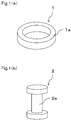
- Fig. 1(a) is a perspective view of a toroidal core
- Fig. 1(b) is a perspective view of a bobbin core, the toroidal core and the bobbin core showing examples of a ferrite sintered body of the present embodiment.
- a ferrite sintered body of the present invention, a ferrite core of the present invention, and a coil component of the present invention produced by winding a metal wire around a ferrite core will now be described.
- a ferrite sintered body of the present embodiment is used in, for example, an inductor, a transformer, a ballast, or an electromagnet for insulation or voltage transformation or in a noise filter for noise removal or the like in the form of a ferrite core (hereinafter may be simply referred to as "core”) formed of the ferrite sintered body alone or as a coil component produced by winding a metal wire around the ferrite core.
- the ferrite sintered body functioning as a core may have various shapes. Examples thereof include a ring-shaped toroidal core 1 shown in the perspective view of Fig. 1(a) and a bobbin-shaped bobbin core 2 shown in the perspective view of Fig. 1(b) .
- This ferrite sintered body is required to have a high permeability.
- a ferrite sintered body that satisfies this requirement is preferably a ferrite sintered body including crystal grains of a Ni-Zn ferrite and grain boundaries thereof, in which Ti is unevenly distributed in an outer region of a crystal grain, the outer region extending from an interface of the crystal grain to a length of 20% of a major axis of the crystal grain.
- the Ni-Zn ferrite includes an oxide of Fe, an oxide of Zn, and an oxide of Ni or an oxide of Fe, an oxide of Zn, an oxide of Ni, and an oxide of Cu.
- the "outer region extending from an interface of a crystal grain composed of a Ni-Zn ferrite to a length of 20% of a major axis of the crystal grain" refers to a portion extending from an interface of one crystal grain composed of a Ni-Zn ferrite to a length of 20% of a major axis in the one crystal grain composed of the Ni-Zn ferrite and selected from a cross section of a ferrite sintered body.
- the “major axis” refers to the length in the longest direction of a target grain (crystal grain composed of a Ni-Zn ferrite), as described in JIS R 1670-2006.
- the "length of 20% of a major axis” refers to a value calculated by multiplying the length of the major axis by 0.2.
- the "one crystal grain composed of a Ni-Zn ferrite and selected from a cross section of a ferrite sintered body” refers to a crystal grain having a size in the range of D 40 to D 60 when an average crystal grain diameter calculated in the cross section of the ferrite sintered body is represented by D 50 . This is based on the following assumption. In the ferrite sintered body of the present embodiment, the state of the presence of Ti in a crystal grain composed of a Ni-Zn ferrite is specified. On the other hand, a cross section of the ferrite sintered body includes individual crystal grains that are partially cut. Accordingly, by selecting a crystal grain having a size in the range of D 40 to D 60 , a crystal grain whose central portion is assumed to be cut is used as a target crystal grain.
- the term "uneven distribution” means that when an outer region and an inner region other than the outer region are viewed in a crystal grain, the amount of Ti present in the outer region is larger than that in the inner region. Also in the case where the inner region does not contain Ti, titanium is considered to be unevenly distributed.
- the inventors of the present invention found that the position of Ti present in a crystal grain affects the permeability, though the reason why the ferrite sintered body of the present embodiment has a high permeability is not clear.
- the permeability of a sample may be measured using an LCR meter at a frequency of 100 kHz.
- the sample may be prepared by, for example, winding a covered conducting wire having a wire diameter of 0.2 mm ten times over the entire circumference of a winding portion 1a of a ring-shaped toroidal core 1 shown in Fig. 1(a) , the toroidal core 1 being composed of a ferrite sintered body and having an outer diameter of 13 mm, an inner diameter of 7 mm, and a thickness of 3 mm.
- Whether or not Ti is unevenly distributed in a crystal grain composed of a Ni-Zn ferrite may be determined as follows. On a surface of a ferrite sintered body subjected to a process such as polishing, a crystal grain having a crystal grain diameter of D 40 to D 60 is selected. Mapping of characteristic X-ray intensity of Ti is then performed by using a wavelength-dispersive X-ray microanalyzer (EPMA). The number of counts of the characteristic X-ray intensity of Ti in the inner region of the crystal grain is compared with the number of counts of the characteristic X-ray intensity in the outer region.
- EPMA wavelength-dispersive X-ray microanalyzer
- a sample is observed with a transmission electron microscope (TEM), and a spot (diameter ⁇ : 1 nm) is directed on the inner region and the outer region of a crystal grain by using an energy-dispersive X-ray spectrometer (EDS) attached to the TEM.
- EDS energy-dispersive X-ray spectrometer
- the amount (mass ratio) of Ti when the mass in the spot having a diameter ⁇ of 1 nm is assumed to be 100% by mass may be compared between the inner region and the outer region.
- the amount of Ti is determined at three positions in each of the inner region and the outer region. The average of the amount of Ti present in the inner region and the average of the amount of Ti present in the outer region are then determined, and compared.
- not only the amount of Ti but also, for example, the amounts of Fe, Zn, Ni, Cu, Ti, and O when the mass in the spot having a diameter ⁇ of 1 nm is assumed to be 100% by mass can be determined.
- the ferrite sintered body of the present embodiment preferably contains Fe, Zn, Ni, Cu, and Ti.
- a composition of the ferrite sintered body of the present embodiment is preferably 48% by mole or more and 50% by mole or less of Fe in terms of Fe 2 O 3 , 29% by mole or more and 31% by mole or less of Zn in terms of ZnO, 14% by mole or more and 16% by mole or less of Ni in terms of NiO, and 5% by mole or more and 7% by mole or less of Cu in terms of CuO.
- the ferrite sintered body of the present embodiment preferably contains 0.05% by mass or more and 0.30% by mass or less of Ti in terms of TiO 2 relative to total 100% by mass of the components.
- a ferrite sintered body having a high resistivity and a high permeability can be obtained.
- the components contained in the ferrite sintered body preferably account for 98% by mass or more when all components constituting the ferrite sintered body is assumed to be 100% by mass.
- the resistivity may be measured by using, for example, a flat plate-shaped sample having a diameter ⁇ of 10 to 20 mm and a thickness of 0.5 to 2 mm with a super megohmmeter (manufactured by TOA Corporation, DSM-8103) in a measurement environment at an application voltage of 1,000 V, at a temperature of 26°C, and at a humidity of 36% by a three-terminal method (JIS K6271; double ring electrode method).
- a super megohmmeter manufactured by TOA Corporation, DSM-8103
- the composition of the above components may be calculated by the following method.
- the contents of Fe, Zn, Ni, and Cu are determined by using an inductively coupled plasma (ICP) emission spectrophotometer or an X-ray fluorescence spectrometer, and the contents of Fe, Zn, Ni, and Cu are respectively converted to the contents of Fe 2 O 3 , ZnO, NiO, and CuO.
- the molar values are then calculated from the corresponding molecular weights.
- the ratio of each component relative to total 100% by mole is calculated.
- the content of Ti may be determined as follows.
- the content of Ti is determined by using an ICP emission spectrophotometer or an X-ray fluorescence spectrometer, and the content of Ti is then converted to the content of TiO 2 .
- the ratio of TiO 2 relative to 100% by mass of the above components is then calculated.
- an amount of Ti present in the outer region is preferably 0.5% by mass or more and 5% by mass or less.
- the amount of Ti is within the above range, a ferrite sintered body having a higher permeability can be obtained.
- the amount of Ti present in the outer region is the amount determined by the above-described measurement using a TEM.
- the amount of Ti present in the outer region is not the content in all components constituting the ferrite sintered body or the content relative to 100% by mass of components constituting a crystal grain composed of a Ni-Zn ferrite.
- the Ti content relative to 100% by mass of components constituting a crystal grain composed of a Ni-Zn ferrite is 0.2% by mass in terms of TiO 2
- the content is 0.12% by mass in terms of Ti.
- Ti may be present in an amount of more than 0.12% by mass in the outer region of the crystal grain composed of the Ni-Zn ferrite because Ti is unevenly distributed.
- a portion having a characteristic X-ray intensity of Ni higher than that in a crystal grain of the Ni-Zn ferrite is preferably present in a grain boundary of the crystal grain of the Ni-Zn ferrite, and the area occupancy ratio of the portion is preferably 0.01% or more and 2.0% or less.
- the portion having a higher characteristic X-ray intensity of Ni refers to the following portion.
- mapping of characteristic X-ray intensity of Ni is performed in a field of view, for example, an area of 4,900 ⁇ m 2 of 70 ⁇ m ⁇ 70 ⁇ m.
- a portion that shows the number of counts as being not less than 20% higher than the number of counts of characteristic X-ray intensity of Ni in a crystal grain of the Ni-Zn ferrite is referred to as a portion having a higher characteristic X-ray intensity of Ni.
- the area occupancy ratio refers to a value determined by dividing the area of the portion showing the number of counts as being not less than 20% higher than the number of counts of characteristic X-ray intensity of Ni in a crystal grain of the Ni-Zn ferrite by 4,900 ⁇ m 2 which is the area of the field of view, and expressing the result as a percentage.
- the ferrite sintered body of the resent embodiment preferably contains Mn, and a Mn content is preferably 0.05% by mass or more and 0.5% by mass or less in terms of MnO 2 relative to total 100% by mass of the above components.
- Mn can take a plurality of valences, during firing, oxygen deficiency of crystal grains of the Ni-Zn ferrite is compensated by excess oxygen due to a change in the valence. Consequently, oxygen deficiency of crystal grains of the Ni-Zn ferrite is reduced.
- the ferrite sintered body of the resent embodiment preferably contains at least one of Mo and W, and a Mo content and a W content are preferably respectively 0.01% by mass or more and 0.15% by mass or less in terms of MoO 3 and 0.01% by mass or more and 0.15% by mass or less in terms of WO 3 relative to total 100% by mass of the above components.
- a ferrite sintered body having a higher permeability can be obtained. It is believed that these elements affect the length of the domain wall of crystal grains of the Ni-Zn ferrite, though the reason for this is not clear.
- the contents in terms of MnO 2 , MoO 3 , and WO 3 may be determined as follows.
- the contents of Mn, Mo, and W are determined by using an ICP emission spectrophotometer or an X-ray fluorescence spectrometer, and the contents of Mn, Mo, and W are respectively converted to the contents of MnO 2 , MoO 3 , and WO 3 .
- the values relative to 100% by mass of the above components may then be calculated.
- oxides of Fe, Zn, and Ni or metal salts such as carbonates and/or nitrates that produce oxides of Fe, Zn, and Ni by firing are prepared as starting materials.
- oxides of Fe, Zn, and Ni or metal salts such as carbonates and/or nitrates that produce oxides of Fe, Zn, and Ni by firing are prepared as starting materials.
- ZnO zinc oxide
- NiO nickel oxide
- the average particle diameters of these starting materials are each preferably 0.5 ⁇ m or more and 5 ⁇ m or less.
- the ferrite material is a Ni-Zn ferrite containing an oxide of Cu
- an oxide of Cu or a metal salt such as a carbonate or a nitrate that produces an oxide of Cu by firing is prepared.
- the average particle diameter of this starting material is preferably 0.5 ⁇ m or more and 5 ⁇ m or less.
- silicon oxide (SiO 2 ) having an average particle diameter of 0.5 to 10 ⁇ m is added to the starting materials.
- the starting materials and silicon oxide are each weighed to have a predetermined amount, and are pulverized and mixed using a ball mill, a vibration mill, or the like.
- the resulting mixture is then calcined at a temperature of 600°C or higher and 800°C or lower for two hours or more to prepare a synthesized calcined body.
- the starting materials are preferably weighed so that, for example, when the total of components of Fe, Zn, Ni, and Cu in terms of oxides thereof is assumed to be 100% by mole, the composition becomes 48% by mole or more and 50% by mole or less of Fe in terms of Fe 2 O 3 , 29% by mole or more and 31% by mole or less of Zn in terms of ZnO, 14% by mole or more and 16% by mole or less of Ni in terms of NiO, and 5% by mole or more and 7% by mole or less of Cu in terms of CuO.
- Silicon oxide is preferably weighed so that the amount of silicon oxide is 0.3% by mass or less (excluding 0% by mass) relative to 100% by mass of the above components.
- the weighing is preferably performed so that the amount of Ti becomes 0.05% by mass or more and 0.3% by mass or less in terms of TiO 2 relative to 100% by mass of the above components.
- the oxide or the metal salt is put in a ball mill, a vibration mill, or the like together with the calcined body and mixed.
- a predetermined amount of a binder is then added to the resulting mixture to prepare a slurry.
- the slurry is granulated by using a spray granulator (spray dryer) to prepare spherical granules.
- Ti can be unevenly distributed in outer regions of crystal grains of the Ni-Zn ferrite.
- the resistivity can also be increased by incorporating silicon oxide.
- silicon oxide is added after calcination synthesis, or Ti is added to the starting materials, the effect of increasing the permeability, the effect being achieved by unevenly distributing Ti in outer regions of crystal grains of the Ni-Zn ferrite, cannot be obtained.
- press forming is performed using the spherical granules to prepare a compact having a predetermined shape.
- the compact is subjected to a binder-removing process in a degreasing furnace in the range of 400°C to 800°C to prepare a degreased body.
- the degreased body is fired in a firing furnace by being maintained at a maximum temperature of 1,000°C to 1,200°C for two to five hours.
- a ferrite sintered body of the present embodiment can be obtained.
- the temperature increasing rate in the range of 800°C to 1,000°C in the firing step is set to 150°C/h or more and 500°C/h or less.
- a Ni powder is weighed so that the amount of Ni becomes 0.001% by mole or more and 0.03% by mole or less in terms of NiO and is added after the calcination synthesis.
- the Ni powder added after the calcination synthesis preferably has an average particle diameter of 0.5 ⁇ m or more and 1 ⁇ m or less. In the case where a Ni powder is added after the calcination synthesis, in weighing the starting material, the amount of starting material from which the amount to be added after the calcination synthesis is subtracted is weighed.
- an oxide of Mn or a metal salt such as a carbonate or a nitrate that produces an oxide of Mn by firing is weighed so that the amount of Mn becomes 0.05% by mass or more and 0.5% by mass or less in terms of MnO 2 relative to total 100% by mass of the above components, and added after the calcination synthesis.
- At least one oxide of Mo and/or W or at least one metal salt such as a carbonate or a nitrate that produces an oxide of Mo and/or W by firing is weighed so that the amount of Mo becomes 0.01% by mass or more and 0.15% by mass or less in terms of MoO 3 and the amount of W becomes 0.01% by mass or more and 0.15% by mass or less in terms of WO 3 relative to total 100% by mass of the above components, and added after the calcination synthesis.
- the ferrite sintered body of the present embodiment may contain CaO and ZrO 2 . Incorporation of CaO and ZrO 2 can increase resistivity.
- CaO and ZrO 2 are each preferably contained in an amount of less than 0.2% by mass relative to 100% by mass of the above components.
- At least one oxide of Ca and/or Zr or at least one metal salt such as a carbonate or a nitrate that produces an oxide of Ca and/or Zr by firing is weighed so that the amount of Ca in terms of CaO and the amount of Zr in terms of ZrO 2 become 0.2% by mass or less in total, relative to total 100% by mass of the above components, and added after the calcination synthesis.
- Ferrite sintered bodies in which the composition, the production method, etc. of a Ni-Zn ferrite were varied were prepared, and the permeability of each of the ferrite sintered bodies was measured.
- iron oxide, zinc oxide, nickel oxide, copper oxide, and silicon oxide each having an average particle diameter of 1 ⁇ m were prepared as starting materials.
- the iron oxide, zinc oxide, nickel oxide, and copper oxide were weighed so as to have the compositions shown in Table 1, and pulverized and mixed in a ball mill. Each of the resulting mixtures was then calcined at a temperature of 700°C or lower for two hours. Thus, synthesized calcined bodies were prepared.
- the iron oxide, zinc oxide, nickel oxide, copper oxide, and silicon oxide were weighed so as to have the compositions shown in Table 2, and pulverized and mixed in a ball mill. Each of the resulting mixtures was then calcined at a temperature of 700°C or lower for two hours. Thus, synthesized calcined bodies were prepared. The silicon oxide was weighed so that the content thereof was 0.05% by mass relative to total 100% by mass of the iron oxide, zinc oxide, nickel oxide, and copper oxide.
- titanium oxide was weighed so as to have contents shown in Tables 1 and 2 relative to total 100% by mass of the iron oxide, zinc oxide, nickel oxide, and copper oxide.
- the titanium oxide was put in a ball mill together with each calcined body and mixed.
- a predetermined amount of a binder was then added to each of the resulting mixtures to prepare slurries.
- Each of the slurries was granulated using a spray granulator to prepare spherical granules. Press forming was then performed by using the spherical granules to prepare compacts having the shape of the toroidal core 1 shown in Fig. 1 .
- the compacts were subjected to a binder-removing process in a degreasing furnace at a maximum temperature of 600°C for five hours to prepare degreased bodies.
- the degreased bodies were fired in a firing furnace in an air atmosphere by being maintained at a maximum temperature of 1,100°C for two hours.
- the resulting sintered bodies were then ground to obtain toroidal-shaped ferrite sintered bodies (Sample Nos. 1 to 44) having an outer diameter of 13 mm, an inner diameter of 7 mm, and a thickness of 3 mm.
- the temperature increasing rate in the range of 800°C to 1,000°C in the firing step was 600°C.
- Sample No. 1 in Table 1 and Sample No. 23 in Table 2 differ in terms of the addition or non-addition of silicon oxide to the starting materials.
- Sample Nos. 2 to 22 correspond to Sample Nos. 24 to 44, respectively.
- a covered copper wire having a wire diameter of 0.2 mm was wound over the entire circumference of a winding portion 10a of each of the samples ten times.
- the permeability of each of the resulting samples at a frequency of 100 kHz was measured with an LCR meter.
- Tables 1 and 2 show the results.
- a value calculated by a formula ( ⁇ 2 - ⁇ 1)/ ⁇ 1 ⁇ 100 is shown in Table 2 as a ratio of improvement in permeability where ⁇ 1 represents a permeability of a sample to which silicon oxide was added to the starting materials and which is shown in Table 1 and ⁇ 2 represents a permeability of a sample (for example, Sample No. 23 in Table 2 when the sample in Table 1 is Sample No. 1) to which silicon oxide was added after calcination synthesis and which is shown in Table 2.
- Measurement samples having a diameter ⁇ of 16 mm and a thickness of 1 mm were separately prepared by the same method as the method for producing the above samples except for the shape.
- the resistivity of each of the measurement samples was measured with a super megohmmeter (manufactured by TOA Corporation, DSM-8103) in an environment at an application voltage of 1,000 V, at a temperature of 26°C, and at a humidity of 36% by a three-terminal method (JIS K6271; double ring electrode method).
- a cut surface of each sample was mirror-finished and observed with a TEM.
- a spot (diameter ⁇ : 1 nm) was directed on three positions in each of the inner region and the outer region of a crystal grain by using an EDS attached to the TEM, and the average of the amount of Ti present in each of the regions was calculated.
- the presence or absence of uneven distribution of Ti was examined.
- the difference between the average of the amount of Ti present in the outer region and the average of the amount of Ti present in the inner region was 0.5% or more, it was determined that Ti was unevenly distributed. In the case where the difference was less than 0.5%, it was determined that Ti was not unevenly distributed.
- the amounts of elemental metals of Fe, Zn, Ni, and Cu were determined by using an X-ray fluorescence spectrometer, and the contents of Fe, Zn, Ni, and Cu were respectively converted to the contents of Fe 2 O 3 , ZnO, NiO, and CuO.
- the molar values were then calculated from the corresponding molecular weights.
- the ratio of each of the components relative to total 100% by mole was calculated and shown in Tables 1 and 2.
- the amounts of Si and Ti were measured by using an X-ray fluorescence spectrometer, and the contents of Si and Ti were then respectively converted to the contents of SiO 2 and TiO 2 .
- the permeability could be increased when Ti was unevenly distributed in an outer region of a crystal grain, the outer region extending from an interface of the crystal grain of a Ni-Zn ferrite to a length of 20% of a major axis of the crystal grain. It was also found that ferrite sintered bodies each having a high resistivity and a high permeability could be obtained when the following conditions were satisfied. Specifically, the ferrite sintered bodies each contained Fe, Zn, Ni, Cu, and Ti.
- a composition of each of the ferrite sintered bodies was 48% by mole or more and 50% by mole or less of Fe in terms of Fe 2 O 3 , 29% by mole or more and 31% by mole or less of Zn in terms of ZnO, 14% by mole or more and 16% by mole or less of Ni in terms of NiO, and 5% by mole or more and 7% by mole or less of Cu in terms of CuO.
- the ferrite sintered bodies each contained 0.05% by mass or more and 0.30% by mass or less of Ti in terms of TiO 2 relative to total 100% by mass of the above components.
- samples having the same compositions were prepared by adding silicon oxide after calcination synthesis or adding Ti to the starting materials.
- a permeability substantially the same as those of samples prepared by conducing calcination synthesis after the addition of silicon oxide to the starting materials, and adding Ti after the calcination synthesis could not be obtained.
- the ferrite sintered bodies of Sample Nos. 25, 26, 34, 36, 38, 40, and 42 were used as cores, and a metal wire was wound around each of the cores to produce coil components.
- the coil components were used as noise filters installed in control devices of an electric car, a hybrid car, or the like, the control devices requiring complex control. According to the results, a good noise removing performance was achieved.
- samples in which the temperature increasing rate in the range of 800°C to 1,000°C in the firing step was varied were prepared, and the permeability of each of the samples was measured.
- the samples were prepared by the same method as in Example 1 except that the temperature increasing rate in the range of 800°C to 1,000°C was changed as shown in Table 3.
- Sample No. 45 is the same as Sample No. 40.
- the permeability was measured by the same method as in Example 1. Table 3 shows the results. [Table 3] Sample Fe 2 O 3 ZnO NiO CuO TiO 2 Presence or absence of Temperature increasing rate Amount of Ti present Permeability uneven No.
- samples were prepared in which a Ni powder was added after calcination synthesis so that the Ni content became the values shown in Table 4 in terms of NiO.
- the hardness and the permeability of each of the samples were measured.
- the samples were prepared by the same method as in the preparation of Sample No. 47 of Example 3 except that a Ni powder was added after calcination synthesis so that the Ni content became the values shown in Table 4 in terms of NiO.
- samples were prepared in which manganese oxide was added after calcination synthesis so that the Mn content became the values shown in Table 5 in terms of MnO 2 .
- the permeability of each of the samples was measured.
- the samples were prepared by the same method as in the preparation of Sample No. 47 of Example 3 except that manganese oxide was added after calcination synthesis so that the Mn content became the values shown in Table 5 in terms of MnO 2 .
- the content in terms of MnO 2 was calculated by the same method as in Example 1.
- the permeability was measured by the same method as in Example 1. Table 5 shows the results. [Table 5] Sample No.
- ferrite sintered bodies each having a higher permeability were obtained when the ferrite sintered bodies contained Mn, and the Mn content was 0.05% by mass or more and 0.5% by mass or less in terms of MnO 2 relative to total 100% by mass of components of Fe, Zn, Ni, and Cu in terms of oxides thereof.
- samples were prepared in which molybdenum oxide and/or tungsten oxide was added after calcination synthesis so that the Mo content became the values shown in Table 6 in terms of MoO 3 and the W content became the values shown in Table 6 in terms of WO 3 .
- the permeability of each of the samples was measured.
- the samples were prepared by the same method as in the preparation of Sample No. 62 of Example 4 except that molybdenum oxide and/or tungsten oxide was added after calcination synthesis so that the Mo content became the values shown in Table 6 in terms of MoO 3 and the W content became the values shown in Table 6 in terms of WO 3 .
- the content in terms of MoO 3 and the content in terms of WO 3 were calculated by the same method as in Example 1.
- ferrite sintered bodies each having a higher permeability were obtained when the sintered bodies contained at least one of Mo and W, and the Mo content and the W content were respectively 0.01% by mass or more and 0.15% by mass or less in terms of MoO 3 and 0.01% by mass or more and 0.15% by mass or less in terms of WO 3 relative to total 100% by mass of components of Fe, Zn, Ni, and Cu in terms of oxides thereof.
Landscapes
- Engineering & Computer Science (AREA)
- Chemical & Material Sciences (AREA)
- Power Engineering (AREA)
- Organic Chemistry (AREA)
- Ceramic Engineering (AREA)
- Inorganic Chemistry (AREA)
- Manufacturing & Machinery (AREA)
- Materials Engineering (AREA)
- Structural Engineering (AREA)
- Dispersion Chemistry (AREA)
- Microelectronics & Electronic Packaging (AREA)
- Magnetic Ceramics (AREA)
- Soft Magnetic Materials (AREA)
Applications Claiming Priority (1)
| Application Number | Priority Date | Filing Date | Title |
|---|---|---|---|
| PCT/JP2013/071011 WO2015015636A1 (ja) | 2013-08-02 | 2013-08-02 | フェライト焼結体およびフェライトコアならびにコイル部品 |
Publications (3)
| Publication Number | Publication Date |
|---|---|
| EP3029007A1 true EP3029007A1 (de) | 2016-06-08 |
| EP3029007A4 EP3029007A4 (de) | 2017-03-29 |
| EP3029007B1 EP3029007B1 (de) | 2019-10-30 |
Family
ID=52431208
Family Applications (1)
| Application Number | Title | Priority Date | Filing Date |
|---|---|---|---|
| EP13890719.1A Active EP3029007B1 (de) | 2013-08-02 | 2013-08-02 | Ferritsinterkörper, ferritkern und spulenkomponente |
Country Status (5)
| Country | Link |
|---|---|
| US (1) | US9607751B2 (de) |
| EP (1) | EP3029007B1 (de) |
| JP (1) | JP5960904B2 (de) |
| CN (1) | CN104507890B (de) |
| WO (1) | WO2015015636A1 (de) |
Families Citing this family (10)
| Publication number | Priority date | Publication date | Assignee | Title |
|---|---|---|---|---|
| CN107077948A (zh) * | 2014-11-06 | 2017-08-18 | 株式会社村田制作所 | 层叠线圈部件 |
| KR102052765B1 (ko) * | 2014-11-21 | 2019-12-09 | 삼성전기주식회사 | 페라이트 및 이를 적용한 칩 전자부품 |
| JP2017186206A (ja) * | 2016-04-07 | 2017-10-12 | 京セラ株式会社 | フェライト焼結体およびインダクタ |
| WO2018048394A1 (en) | 2016-09-07 | 2018-03-15 | South Dakota Board Of Regents | Thermally stabilized redox materials and applications thereof |
| CN110785892B (zh) * | 2017-06-13 | 2022-08-02 | 日立金属株式会社 | 线圈装置及天线 |
| KR102463333B1 (ko) * | 2017-10-24 | 2022-11-04 | 삼성전기주식회사 | 코일 전자 부품 |
| JP7259822B2 (ja) * | 2020-09-29 | 2023-04-18 | 株式会社村田製作所 | フェライト焼結体およびコイル部品 |
| CN115108821A (zh) * | 2021-03-19 | 2022-09-27 | 日立金属株式会社 | NiZn系铁氧体 |
| JP2022145508A (ja) * | 2021-03-19 | 2022-10-04 | 日立金属株式会社 | NiZn系フェライト |
| CN113636838A (zh) * | 2021-09-15 | 2021-11-12 | 横店集团东磁股份有限公司 | 一种镍锌铁氧体材料及制备方法和应用 |
Family Cites Families (8)
| Publication number | Priority date | Publication date | Assignee | Title |
|---|---|---|---|---|
| JP2002141215A (ja) * | 2000-11-07 | 2002-05-17 | Sumitomo Metal Ind Ltd | 酸化物磁性材料とその製造方法および積層チップインダクタ |
| JP2002321971A (ja) | 2001-04-20 | 2002-11-08 | Nippon Ceramic Co Ltd | Ni系フェライト |
| JP2004269316A (ja) | 2003-03-10 | 2004-09-30 | Kyocera Corp | フェライト材料及びこれを用いたフェライトコア |
| JP4799808B2 (ja) * | 2003-06-30 | 2011-10-26 | Tdk株式会社 | フェライト組成物、磁心及び電子部品 |
| JP5734078B2 (ja) * | 2010-04-27 | 2015-06-10 | 京セラ株式会社 | フェライト焼結体およびこれを備えるノイズフィルタ |
| EP2602236B1 (de) * | 2010-08-03 | 2018-02-14 | Kyocera Corporation | Ferrit-sinterkörper und rauschfilter damit |
| JP5733995B2 (ja) * | 2011-01-25 | 2015-06-10 | 京セラ株式会社 | フェライト焼結体およびこれを備えるノイズフィルタ |
| JP5836887B2 (ja) | 2011-05-30 | 2015-12-24 | 京セラ株式会社 | フェライト焼結体およびこれを備えるノイズフィルタ |
-
2013
- 2013-08-02 CN CN201380037575.4A patent/CN104507890B/zh active Active
- 2013-08-02 EP EP13890719.1A patent/EP3029007B1/de active Active
- 2013-08-02 WO PCT/JP2013/071011 patent/WO2015015636A1/ja not_active Ceased
- 2013-08-02 US US14/422,121 patent/US9607751B2/en active Active
- 2013-08-02 JP JP2015502423A patent/JP5960904B2/ja active Active
Also Published As
| Publication number | Publication date |
|---|---|
| JPWO2015015636A1 (ja) | 2017-03-02 |
| US9607751B2 (en) | 2017-03-28 |
| JP5960904B2 (ja) | 2016-08-02 |
| CN104507890A (zh) | 2015-04-08 |
| EP3029007A4 (de) | 2017-03-29 |
| WO2015015636A1 (ja) | 2015-02-05 |
| CN104507890B (zh) | 2016-08-24 |
| US20150228395A1 (en) | 2015-08-13 |
| EP3029007B1 (de) | 2019-10-30 |
Similar Documents
| Publication | Publication Date | Title |
|---|---|---|
| EP3029007B1 (de) | Ferritsinterkörper, ferritkern und spulenkomponente | |
| CN102219491B (zh) | 铁氧体组合物及电子零件 | |
| JP6024843B1 (ja) | フェライト組成物および電子部品 | |
| US10839995B2 (en) | Ferrite composition and multilayer electronic component | |
| US11373789B2 (en) | Ferrite sintered body and electronic component using thereof | |
| JP5898313B2 (ja) | フェライト焼結体およびフェライトコアならびにコイル部品 | |
| JP2020123616A (ja) | フェライト組成物および積層電子部品 | |
| JP5734078B2 (ja) | フェライト焼結体およびこれを備えるノイズフィルタ | |
| KR101274368B1 (ko) | 페라이트 소결체 및 그 제조 방법 | |
| JP2022039923A (ja) | NiZn系フェライト | |
| CN103717551B (zh) | 铁氧体烧结体及具备它的铁氧体磁芯 | |
| JP5836887B2 (ja) | フェライト焼結体およびこれを備えるノイズフィルタ | |
| JP2020121916A (ja) | フェライト組成物および積層電子部品 | |
| JP5733995B2 (ja) | フェライト焼結体およびこれを備えるノイズフィルタ | |
| JP6649799B2 (ja) | フェライトコア、およびフェライトコアの製造方法 | |
| JP5952123B2 (ja) | フェライト焼結体およびこれを備えるノイズフィルタ | |
| JP5882811B2 (ja) | フェライト焼結体およびこれを備えるパルストランス用コア | |
| CN111484323B (zh) | 铁氧体组合物和层叠电子部件 | |
| JP2022078141A (ja) | NiZn系フェライト | |
| US20250299856A1 (en) | Multilayer coil device | |
| JP5672974B2 (ja) | フェライト焼結体および電子部品 | |
| JP2008184364A (ja) | 酸化物磁性材料 | |
| CN115108821A (zh) | NiZn系铁氧体 | |
| JP6408323B2 (ja) | フェライト焼結体およびフェライトコアならびにコイル部品 | |
| JP2009263196A (ja) | NiCuZn系フェライトおよびそれを用いた電子部品 |
Legal Events
| Date | Code | Title | Description |
|---|---|---|---|
| PUAI | Public reference made under article 153(3) epc to a published international application that has entered the european phase |
Free format text: ORIGINAL CODE: 0009012 |
|
| 17P | Request for examination filed |
Effective date: 20150210 |
|
| AK | Designated contracting states |
Kind code of ref document: A1 Designated state(s): AL AT BE BG CH CY CZ DE DK EE ES FI FR GB GR HR HU IE IS IT LI LT LU LV MC MK MT NL NO PL PT RO RS SE SI SK SM TR |
|
| AX | Request for extension of the european patent |
Extension state: BA ME |
|
| DAX | Request for extension of the european patent (deleted) | ||
| RIC1 | Information provided on ipc code assigned before grant |
Ipc: C01G 53/00 20060101ALI20170216BHEP Ipc: H01F 1/34 20060101ALI20170216BHEP Ipc: H01F 3/08 20060101ALI20170216BHEP Ipc: C04B 35/30 20060101AFI20170216BHEP Ipc: C04B 35/26 20060101ALI20170216BHEP Ipc: H01F 17/04 20060101ALI20170216BHEP |
|
| A4 | Supplementary search report drawn up and despatched |
Effective date: 20170224 |
|
| STAA | Information on the status of an ep patent application or granted ep patent |
Free format text: STATUS: EXAMINATION IS IN PROGRESS |
|
| 17Q | First examination report despatched |
Effective date: 20181102 |
|
| GRAP | Despatch of communication of intention to grant a patent |
Free format text: ORIGINAL CODE: EPIDOSNIGR1 |
|
| STAA | Information on the status of an ep patent application or granted ep patent |
Free format text: STATUS: GRANT OF PATENT IS INTENDED |
|
| INTG | Intention to grant announced |
Effective date: 20190517 |
|
| GRAS | Grant fee paid |
Free format text: ORIGINAL CODE: EPIDOSNIGR3 |
|
| GRAA | (expected) grant |
Free format text: ORIGINAL CODE: 0009210 |
|
| STAA | Information on the status of an ep patent application or granted ep patent |
Free format text: STATUS: THE PATENT HAS BEEN GRANTED |
|
| AK | Designated contracting states |
Kind code of ref document: B1 Designated state(s): AL AT BE BG CH CY CZ DE DK EE ES FI FR GB GR HR HU IE IS IT LI LT LU LV MC MK MT NL NO PL PT RO RS SE SI SK SM TR |
|
| REG | Reference to a national code |
Ref country code: GB Ref legal event code: FG4D |
|
| REG | Reference to a national code |
Ref country code: CH Ref legal event code: EP |
|
| REG | Reference to a national code |
Ref country code: DE Ref legal event code: R096 Ref document number: 602013062382 Country of ref document: DE |
|
| REG | Reference to a national code |
Ref country code: AT Ref legal event code: REF Ref document number: 1195947 Country of ref document: AT Kind code of ref document: T Effective date: 20191115 |
|
| REG | Reference to a national code |
Ref country code: IE Ref legal event code: FG4D |
|
| REG | Reference to a national code |
Ref country code: LT Ref legal event code: MG4D |
|
| PG25 | Lapsed in a contracting state [announced via postgrant information from national office to epo] |
Ref country code: PT Free format text: LAPSE BECAUSE OF FAILURE TO SUBMIT A TRANSLATION OF THE DESCRIPTION OR TO PAY THE FEE WITHIN THE PRESCRIBED TIME-LIMIT Effective date: 20200302 Ref country code: BG Free format text: LAPSE BECAUSE OF FAILURE TO SUBMIT A TRANSLATION OF THE DESCRIPTION OR TO PAY THE FEE WITHIN THE PRESCRIBED TIME-LIMIT Effective date: 20200130 Ref country code: FI Free format text: LAPSE BECAUSE OF FAILURE TO SUBMIT A TRANSLATION OF THE DESCRIPTION OR TO PAY THE FEE WITHIN THE PRESCRIBED TIME-LIMIT Effective date: 20191030 Ref country code: NO Free format text: LAPSE BECAUSE OF FAILURE TO SUBMIT A TRANSLATION OF THE DESCRIPTION OR TO PAY THE FEE WITHIN THE PRESCRIBED TIME-LIMIT Effective date: 20200130 Ref country code: LV Free format text: LAPSE BECAUSE OF FAILURE TO SUBMIT A TRANSLATION OF THE DESCRIPTION OR TO PAY THE FEE WITHIN THE PRESCRIBED TIME-LIMIT Effective date: 20191030 Ref country code: SE Free format text: LAPSE BECAUSE OF FAILURE TO SUBMIT A TRANSLATION OF THE DESCRIPTION OR TO PAY THE FEE WITHIN THE PRESCRIBED TIME-LIMIT Effective date: 20191030 Ref country code: NL Free format text: LAPSE BECAUSE OF FAILURE TO SUBMIT A TRANSLATION OF THE DESCRIPTION OR TO PAY THE FEE WITHIN THE PRESCRIBED TIME-LIMIT Effective date: 20191030 Ref country code: LT Free format text: LAPSE BECAUSE OF FAILURE TO SUBMIT A TRANSLATION OF THE DESCRIPTION OR TO PAY THE FEE WITHIN THE PRESCRIBED TIME-LIMIT Effective date: 20191030 Ref country code: PL Free format text: LAPSE BECAUSE OF FAILURE TO SUBMIT A TRANSLATION OF THE DESCRIPTION OR TO PAY THE FEE WITHIN THE PRESCRIBED TIME-LIMIT Effective date: 20191030 Ref country code: GR Free format text: LAPSE BECAUSE OF FAILURE TO SUBMIT A TRANSLATION OF THE DESCRIPTION OR TO PAY THE FEE WITHIN THE PRESCRIBED TIME-LIMIT Effective date: 20200131 |
|
| REG | Reference to a national code |
Ref country code: NL Ref legal event code: MP Effective date: 20191030 |
|
| PG25 | Lapsed in a contracting state [announced via postgrant information from national office to epo] |
Ref country code: HR Free format text: LAPSE BECAUSE OF FAILURE TO SUBMIT A TRANSLATION OF THE DESCRIPTION OR TO PAY THE FEE WITHIN THE PRESCRIBED TIME-LIMIT Effective date: 20191030 Ref country code: RS Free format text: LAPSE BECAUSE OF FAILURE TO SUBMIT A TRANSLATION OF THE DESCRIPTION OR TO PAY THE FEE WITHIN THE PRESCRIBED TIME-LIMIT Effective date: 20191030 Ref country code: IS Free format text: LAPSE BECAUSE OF FAILURE TO SUBMIT A TRANSLATION OF THE DESCRIPTION OR TO PAY THE FEE WITHIN THE PRESCRIBED TIME-LIMIT Effective date: 20200229 |
|
| PG25 | Lapsed in a contracting state [announced via postgrant information from national office to epo] |
Ref country code: AL Free format text: LAPSE BECAUSE OF FAILURE TO SUBMIT A TRANSLATION OF THE DESCRIPTION OR TO PAY THE FEE WITHIN THE PRESCRIBED TIME-LIMIT Effective date: 20191030 |
|
| PG25 | Lapsed in a contracting state [announced via postgrant information from national office to epo] |
Ref country code: DK Free format text: LAPSE BECAUSE OF FAILURE TO SUBMIT A TRANSLATION OF THE DESCRIPTION OR TO PAY THE FEE WITHIN THE PRESCRIBED TIME-LIMIT Effective date: 20191030 Ref country code: RO Free format text: LAPSE BECAUSE OF FAILURE TO SUBMIT A TRANSLATION OF THE DESCRIPTION OR TO PAY THE FEE WITHIN THE PRESCRIBED TIME-LIMIT Effective date: 20191030 Ref country code: EE Free format text: LAPSE BECAUSE OF FAILURE TO SUBMIT A TRANSLATION OF THE DESCRIPTION OR TO PAY THE FEE WITHIN THE PRESCRIBED TIME-LIMIT Effective date: 20191030 Ref country code: CZ Free format text: LAPSE BECAUSE OF FAILURE TO SUBMIT A TRANSLATION OF THE DESCRIPTION OR TO PAY THE FEE WITHIN THE PRESCRIBED TIME-LIMIT Effective date: 20191030 Ref country code: ES Free format text: LAPSE BECAUSE OF FAILURE TO SUBMIT A TRANSLATION OF THE DESCRIPTION OR TO PAY THE FEE WITHIN THE PRESCRIBED TIME-LIMIT Effective date: 20191030 |
|
| REG | Reference to a national code |
Ref country code: DE Ref legal event code: R097 Ref document number: 602013062382 Country of ref document: DE |
|
| REG | Reference to a national code |
Ref country code: AT Ref legal event code: MK05 Ref document number: 1195947 Country of ref document: AT Kind code of ref document: T Effective date: 20191030 |
|
| PG25 | Lapsed in a contracting state [announced via postgrant information from national office to epo] |
Ref country code: SM Free format text: LAPSE BECAUSE OF FAILURE TO SUBMIT A TRANSLATION OF THE DESCRIPTION OR TO PAY THE FEE WITHIN THE PRESCRIBED TIME-LIMIT Effective date: 20191030 Ref country code: IT Free format text: LAPSE BECAUSE OF FAILURE TO SUBMIT A TRANSLATION OF THE DESCRIPTION OR TO PAY THE FEE WITHIN THE PRESCRIBED TIME-LIMIT Effective date: 20191030 Ref country code: SK Free format text: LAPSE BECAUSE OF FAILURE TO SUBMIT A TRANSLATION OF THE DESCRIPTION OR TO PAY THE FEE WITHIN THE PRESCRIBED TIME-LIMIT Effective date: 20191030 |
|
| PLBE | No opposition filed within time limit |
Free format text: ORIGINAL CODE: 0009261 |
|
| STAA | Information on the status of an ep patent application or granted ep patent |
Free format text: STATUS: NO OPPOSITION FILED WITHIN TIME LIMIT |
|
| 26N | No opposition filed |
Effective date: 20200731 |
|
| PG25 | Lapsed in a contracting state [announced via postgrant information from national office to epo] |
Ref country code: AT Free format text: LAPSE BECAUSE OF FAILURE TO SUBMIT A TRANSLATION OF THE DESCRIPTION OR TO PAY THE FEE WITHIN THE PRESCRIBED TIME-LIMIT Effective date: 20191030 Ref country code: SI Free format text: LAPSE BECAUSE OF FAILURE TO SUBMIT A TRANSLATION OF THE DESCRIPTION OR TO PAY THE FEE WITHIN THE PRESCRIBED TIME-LIMIT Effective date: 20191030 |
|
| PG25 | Lapsed in a contracting state [announced via postgrant information from national office to epo] |
Ref country code: MC Free format text: LAPSE BECAUSE OF FAILURE TO SUBMIT A TRANSLATION OF THE DESCRIPTION OR TO PAY THE FEE WITHIN THE PRESCRIBED TIME-LIMIT Effective date: 20191030 |
|
| REG | Reference to a national code |
Ref country code: CH Ref legal event code: PL |
|
| GBPC | Gb: european patent ceased through non-payment of renewal fee |
Effective date: 20200802 |
|
| PG25 | Lapsed in a contracting state [announced via postgrant information from national office to epo] |
Ref country code: LU Free format text: LAPSE BECAUSE OF NON-PAYMENT OF DUE FEES Effective date: 20200802 Ref country code: CH Free format text: LAPSE BECAUSE OF NON-PAYMENT OF DUE FEES Effective date: 20200831 Ref country code: LI Free format text: LAPSE BECAUSE OF NON-PAYMENT OF DUE FEES Effective date: 20200831 |
|
| REG | Reference to a national code |
Ref country code: BE Ref legal event code: MM Effective date: 20200831 |
|
| PG25 | Lapsed in a contracting state [announced via postgrant information from national office to epo] |
Ref country code: FR Free format text: LAPSE BECAUSE OF NON-PAYMENT OF DUE FEES Effective date: 20200831 |
|
| PG25 | Lapsed in a contracting state [announced via postgrant information from national office to epo] |
Ref country code: BE Free format text: LAPSE BECAUSE OF NON-PAYMENT OF DUE FEES Effective date: 20200831 Ref country code: IE Free format text: LAPSE BECAUSE OF NON-PAYMENT OF DUE FEES Effective date: 20200802 Ref country code: GB Free format text: LAPSE BECAUSE OF NON-PAYMENT OF DUE FEES Effective date: 20200802 |
|
| PG25 | Lapsed in a contracting state [announced via postgrant information from national office to epo] |
Ref country code: TR Free format text: LAPSE BECAUSE OF FAILURE TO SUBMIT A TRANSLATION OF THE DESCRIPTION OR TO PAY THE FEE WITHIN THE PRESCRIBED TIME-LIMIT Effective date: 20191030 Ref country code: MT Free format text: LAPSE BECAUSE OF FAILURE TO SUBMIT A TRANSLATION OF THE DESCRIPTION OR TO PAY THE FEE WITHIN THE PRESCRIBED TIME-LIMIT Effective date: 20191030 Ref country code: CY Free format text: LAPSE BECAUSE OF FAILURE TO SUBMIT A TRANSLATION OF THE DESCRIPTION OR TO PAY THE FEE WITHIN THE PRESCRIBED TIME-LIMIT Effective date: 20191030 |
|
| PG25 | Lapsed in a contracting state [announced via postgrant information from national office to epo] |
Ref country code: MK Free format text: LAPSE BECAUSE OF FAILURE TO SUBMIT A TRANSLATION OF THE DESCRIPTION OR TO PAY THE FEE WITHIN THE PRESCRIBED TIME-LIMIT Effective date: 20191030 |
|
| P01 | Opt-out of the competence of the unified patent court (upc) registered |
Effective date: 20230505 |
|
| PGFP | Annual fee paid to national office [announced via postgrant information from national office to epo] |
Ref country code: DE Payment date: 20250702 Year of fee payment: 13 |