EP3029084B1 - Composition de résine thermodurcissable, élément coulissant et procédé pour la production d'un élément coulissant - Google Patents
Composition de résine thermodurcissable, élément coulissant et procédé pour la production d'un élément coulissant Download PDFInfo
- Publication number
- EP3029084B1 EP3029084B1 EP14832721.6A EP14832721A EP3029084B1 EP 3029084 B1 EP3029084 B1 EP 3029084B1 EP 14832721 A EP14832721 A EP 14832721A EP 3029084 B1 EP3029084 B1 EP 3029084B1
- Authority
- EP
- European Patent Office
- Prior art keywords
- compound
- resin composition
- epoxy
- content amount
- dicyanate
- Prior art date
- Legal status (The legal status is an assumption and is not a legal conclusion. Google has not performed a legal analysis and makes no representation as to the accuracy of the status listed.)
- Active
Links
Images


Classifications
-
- C—CHEMISTRY; METALLURGY
- C08—ORGANIC MACROMOLECULAR COMPOUNDS; THEIR PREPARATION OR CHEMICAL WORKING-UP; COMPOSITIONS BASED THEREON
- C08G—MACROMOLECULAR COMPOUNDS OBTAINED OTHERWISE THAN BY REACTIONS ONLY INVOLVING UNSATURATED CARBON-TO-CARBON BONDS
- C08G18/00—Polymeric products of isocyanates or isothiocyanates
- C08G18/06—Polymeric products of isocyanates or isothiocyanates with compounds having active hydrogen
- C08G18/28—Polymeric products of isocyanates or isothiocyanates with compounds having active hydrogen characterised by the compounds used containing active hydrogen
- C08G18/40—High-molecular-weight compounds
- C08G18/58—Epoxy resins
-
- C—CHEMISTRY; METALLURGY
- C10—PETROLEUM, GAS OR COKE INDUSTRIES; TECHNICAL GASES CONTAINING CARBON MONOXIDE; FUELS; LUBRICANTS; PEAT
- C10M—LUBRICATING COMPOSITIONS; USE OF CHEMICAL SUBSTANCES EITHER ALONE OR AS LUBRICATING INGREDIENTS IN A LUBRICATING COMPOSITION
- C10M133/00—Lubricating compositions characterised by the additive being an organic non-macromolecular compound containing nitrogen
- C10M133/02—Lubricating compositions characterised by the additive being an organic non-macromolecular compound containing nitrogen having a carbon chain of less than 30 atoms
- C10M133/38—Heterocyclic nitrogen compounds
- C10M133/40—Six-membered ring containing nitrogen and carbon only
- C10M133/42—Triazines
-
- C—CHEMISTRY; METALLURGY
- C08—ORGANIC MACROMOLECULAR COMPOUNDS; THEIR PREPARATION OR CHEMICAL WORKING-UP; COMPOSITIONS BASED THEREON
- C08G—MACROMOLECULAR COMPOUNDS OBTAINED OTHERWISE THAN BY REACTIONS ONLY INVOLVING UNSATURATED CARBON-TO-CARBON BONDS
- C08G59/00—Polycondensates containing more than one epoxy group per molecule; Macromolecules obtained by polymerising compounds containing more than one epoxy group per molecule using curing agents or catalysts which react with the epoxy groups
- C08G59/18—Macromolecules obtained by polymerising compounds containing more than one epoxy group per molecule using curing agents or catalysts which react with the epoxy groups ; e.g. general methods of curing
- C08G59/20—Macromolecules obtained by polymerising compounds containing more than one epoxy group per molecule using curing agents or catalysts which react with the epoxy groups ; e.g. general methods of curing characterised by the epoxy compounds used
- C08G59/32—Epoxy compounds containing three or more epoxy groups
- C08G59/3236—Heterocylic compounds
-
- C—CHEMISTRY; METALLURGY
- C08—ORGANIC MACROMOLECULAR COMPOUNDS; THEIR PREPARATION OR CHEMICAL WORKING-UP; COMPOSITIONS BASED THEREON
- C08G—MACROMOLECULAR COMPOUNDS OBTAINED OTHERWISE THAN BY REACTIONS ONLY INVOLVING UNSATURATED CARBON-TO-CARBON BONDS
- C08G59/00—Polycondensates containing more than one epoxy group per molecule; Macromolecules obtained by polymerising compounds containing more than one epoxy group per molecule using curing agents or catalysts which react with the epoxy groups
- C08G59/18—Macromolecules obtained by polymerising compounds containing more than one epoxy group per molecule using curing agents or catalysts which react with the epoxy groups ; e.g. general methods of curing
- C08G59/40—Macromolecules obtained by polymerising compounds containing more than one epoxy group per molecule using curing agents or catalysts which react with the epoxy groups ; e.g. general methods of curing characterised by the curing agents used
- C08G59/4007—Curing agents not provided for by the groups C08G59/42 - C08G59/66
- C08G59/4014—Nitrogen containing compounds
-
- C—CHEMISTRY; METALLURGY
- C08—ORGANIC MACROMOLECULAR COMPOUNDS; THEIR PREPARATION OR CHEMICAL WORKING-UP; COMPOSITIONS BASED THEREON
- C08G—MACROMOLECULAR COMPOUNDS OBTAINED OTHERWISE THAN BY REACTIONS ONLY INVOLVING UNSATURATED CARBON-TO-CARBON BONDS
- C08G59/00—Polycondensates containing more than one epoxy group per molecule; Macromolecules obtained by polymerising compounds containing more than one epoxy group per molecule using curing agents or catalysts which react with the epoxy groups
- C08G59/18—Macromolecules obtained by polymerising compounds containing more than one epoxy group per molecule using curing agents or catalysts which react with the epoxy groups ; e.g. general methods of curing
- C08G59/40—Macromolecules obtained by polymerising compounds containing more than one epoxy group per molecule using curing agents or catalysts which react with the epoxy groups ; e.g. general methods of curing characterised by the curing agents used
- C08G59/4007—Curing agents not provided for by the groups C08G59/42 - C08G59/66
- C08G59/4014—Nitrogen containing compounds
- C08G59/4028—Isocyanates; Thioisocyanates
-
- C—CHEMISTRY; METALLURGY
- C08—ORGANIC MACROMOLECULAR COMPOUNDS; THEIR PREPARATION OR CHEMICAL WORKING-UP; COMPOSITIONS BASED THEREON
- C08G—MACROMOLECULAR COMPOUNDS OBTAINED OTHERWISE THAN BY REACTIONS ONLY INVOLVING UNSATURATED CARBON-TO-CARBON BONDS
- C08G59/00—Polycondensates containing more than one epoxy group per molecule; Macromolecules obtained by polymerising compounds containing more than one epoxy group per molecule using curing agents or catalysts which react with the epoxy groups
- C08G59/18—Macromolecules obtained by polymerising compounds containing more than one epoxy group per molecule using curing agents or catalysts which react with the epoxy groups ; e.g. general methods of curing
- C08G59/40—Macromolecules obtained by polymerising compounds containing more than one epoxy group per molecule using curing agents or catalysts which react with the epoxy groups ; e.g. general methods of curing characterised by the curing agents used
- C08G59/4007—Curing agents not provided for by the groups C08G59/42 - C08G59/66
- C08G59/4014—Nitrogen containing compounds
- C08G59/4042—Imines; Imides
-
- C—CHEMISTRY; METALLURGY
- C08—ORGANIC MACROMOLECULAR COMPOUNDS; THEIR PREPARATION OR CHEMICAL WORKING-UP; COMPOSITIONS BASED THEREON
- C08K—Use of inorganic or non-macromolecular organic substances as compounding ingredients
- C08K5/00—Use of organic ingredients
- C08K5/16—Nitrogen-containing compounds
- C08K5/20—Carboxylic acid amides
-
- C—CHEMISTRY; METALLURGY
- C08—ORGANIC MACROMOLECULAR COMPOUNDS; THEIR PREPARATION OR CHEMICAL WORKING-UP; COMPOSITIONS BASED THEREON
- C08K—Use of inorganic or non-macromolecular organic substances as compounding ingredients
- C08K5/00—Use of organic ingredients
- C08K5/16—Nitrogen-containing compounds
- C08K5/34—Heterocyclic compounds having nitrogen in the ring
- C08K5/3467—Heterocyclic compounds having nitrogen in the ring having more than two nitrogen atoms in the ring
- C08K5/3477—Six-membered rings
- C08K5/3492—Triazines
-
- C—CHEMISTRY; METALLURGY
- C08—ORGANIC MACROMOLECULAR COMPOUNDS; THEIR PREPARATION OR CHEMICAL WORKING-UP; COMPOSITIONS BASED THEREON
- C08L—COMPOSITIONS OF MACROMOLECULAR COMPOUNDS
- C08L27/00—Compositions of homopolymers or copolymers of compounds having one or more unsaturated aliphatic radicals, each having only one carbon-to-carbon double bond, and at least one being terminated by a halogen; Compositions of derivatives of such polymers
- C08L27/02—Compositions of homopolymers or copolymers of compounds having one or more unsaturated aliphatic radicals, each having only one carbon-to-carbon double bond, and at least one being terminated by a halogen; Compositions of derivatives of such polymers not modified by chemical after-treatment
- C08L27/12—Compositions of homopolymers or copolymers of compounds having one or more unsaturated aliphatic radicals, each having only one carbon-to-carbon double bond, and at least one being terminated by a halogen; Compositions of derivatives of such polymers not modified by chemical after-treatment containing fluorine atoms
- C08L27/18—Homopolymers or copolymers or tetrafluoroethene
-
- C—CHEMISTRY; METALLURGY
- C08—ORGANIC MACROMOLECULAR COMPOUNDS; THEIR PREPARATION OR CHEMICAL WORKING-UP; COMPOSITIONS BASED THEREON
- C08L—COMPOSITIONS OF MACROMOLECULAR COMPOUNDS
- C08L63/00—Compositions of epoxy resins; Compositions of derivatives of epoxy resins
- C08L63/06—Triglycidylisocyanurates
-
- C—CHEMISTRY; METALLURGY
- C08—ORGANIC MACROMOLECULAR COMPOUNDS; THEIR PREPARATION OR CHEMICAL WORKING-UP; COMPOSITIONS BASED THEREON
- C08L—COMPOSITIONS OF MACROMOLECULAR COMPOUNDS
- C08L71/00—Compositions of polyethers obtained by reactions forming an ether link in the main chain; Compositions of derivatives of such polymers
-
- C—CHEMISTRY; METALLURGY
- C09—DYES; PAINTS; POLISHES; NATURAL RESINS; ADHESIVES; COMPOSITIONS NOT OTHERWISE PROVIDED FOR; APPLICATIONS OF MATERIALS NOT OTHERWISE PROVIDED FOR
- C09D—COATING COMPOSITIONS, e.g. PAINTS, VARNISHES OR LACQUERS; FILLING PASTES; CHEMICAL PAINT OR INK REMOVERS; INKS; CORRECTING FLUIDS; WOODSTAINS; PASTES OR SOLIDS FOR COLOURING OR PRINTING; USE OF MATERIALS THEREFOR
- C09D163/00—Coating compositions based on epoxy resins; Coating compositions based on derivatives of epoxy resins
- C09D163/06—Triglycidylisocyanurates
-
- C—CHEMISTRY; METALLURGY
- C09—DYES; PAINTS; POLISHES; NATURAL RESINS; ADHESIVES; COMPOSITIONS NOT OTHERWISE PROVIDED FOR; APPLICATIONS OF MATERIALS NOT OTHERWISE PROVIDED FOR
- C09J—ADHESIVES; NON-MECHANICAL ASPECTS OF ADHESIVE PROCESSES IN GENERAL; ADHESIVE PROCESSES NOT PROVIDED FOR ELSEWHERE; USE OF MATERIALS AS ADHESIVES
- C09J175/00—Adhesives based on polyureas or polyurethanes; Adhesives based on derivatives of such polymers
- C09J175/04—Polyurethanes
-
- C—CHEMISTRY; METALLURGY
- C10—PETROLEUM, GAS OR COKE INDUSTRIES; TECHNICAL GASES CONTAINING CARBON MONOXIDE; FUELS; LUBRICANTS; PEAT
- C10M—LUBRICATING COMPOSITIONS; USE OF CHEMICAL SUBSTANCES EITHER ALONE OR AS LUBRICATING INGREDIENTS IN A LUBRICATING COMPOSITION
- C10M107/00—Lubricating compositions characterised by the base-material being a macromolecular compound
- C10M107/38—Lubricating compositions characterised by the base-material being a macromolecular compound containing halogen
-
- C—CHEMISTRY; METALLURGY
- C10—PETROLEUM, GAS OR COKE INDUSTRIES; TECHNICAL GASES CONTAINING CARBON MONOXIDE; FUELS; LUBRICANTS; PEAT
- C10M—LUBRICATING COMPOSITIONS; USE OF CHEMICAL SUBSTANCES EITHER ALONE OR AS LUBRICATING INGREDIENTS IN A LUBRICATING COMPOSITION
- C10M133/00—Lubricating compositions characterised by the additive being an organic non-macromolecular compound containing nitrogen
- C10M133/02—Lubricating compositions characterised by the additive being an organic non-macromolecular compound containing nitrogen having a carbon chain of less than 30 atoms
- C10M133/24—Nitriles
-
- C—CHEMISTRY; METALLURGY
- C10—PETROLEUM, GAS OR COKE INDUSTRIES; TECHNICAL GASES CONTAINING CARBON MONOXIDE; FUELS; LUBRICANTS; PEAT
- C10M—LUBRICATING COMPOSITIONS; USE OF CHEMICAL SUBSTANCES EITHER ALONE OR AS LUBRICATING INGREDIENTS IN A LUBRICATING COMPOSITION
- C10M133/00—Lubricating compositions characterised by the additive being an organic non-macromolecular compound containing nitrogen
- C10M133/02—Lubricating compositions characterised by the additive being an organic non-macromolecular compound containing nitrogen having a carbon chain of less than 30 atoms
- C10M133/38—Heterocyclic nitrogen compounds
- C10M133/44—Five-membered ring containing nitrogen and carbon only
-
- C—CHEMISTRY; METALLURGY
- C10—PETROLEUM, GAS OR COKE INDUSTRIES; TECHNICAL GASES CONTAINING CARBON MONOXIDE; FUELS; LUBRICANTS; PEAT
- C10M—LUBRICATING COMPOSITIONS; USE OF CHEMICAL SUBSTANCES EITHER ALONE OR AS LUBRICATING INGREDIENTS IN A LUBRICATING COMPOSITION
- C10M145/00—Lubricating compositions characterised by the additive being a macromolecular compound containing oxygen
- C10M145/18—Macromolecular compounds obtained otherwise than by reactions only involving carbon-to-carbon unsaturated bonds
- C10M145/20—Condensation polymers of aldehydes or ketones
-
- C—CHEMISTRY; METALLURGY
- C10—PETROLEUM, GAS OR COKE INDUSTRIES; TECHNICAL GASES CONTAINING CARBON MONOXIDE; FUELS; LUBRICANTS; PEAT
- C10M—LUBRICATING COMPOSITIONS; USE OF CHEMICAL SUBSTANCES EITHER ALONE OR AS LUBRICATING INGREDIENTS IN A LUBRICATING COMPOSITION
- C10M169/00—Lubricating compositions characterised by containing as components a mixture of at least two types of ingredient selected from base-materials, thickeners or additives, covered by the preceding groups, each of these compounds being essential
- C10M169/04—Mixtures of base-materials and additives
-
- C—CHEMISTRY; METALLURGY
- C10—PETROLEUM, GAS OR COKE INDUSTRIES; TECHNICAL GASES CONTAINING CARBON MONOXIDE; FUELS; LUBRICANTS; PEAT
- C10M—LUBRICATING COMPOSITIONS; USE OF CHEMICAL SUBSTANCES EITHER ALONE OR AS LUBRICATING INGREDIENTS IN A LUBRICATING COMPOSITION
- C10M169/00—Lubricating compositions characterised by containing as components a mixture of at least two types of ingredient selected from base-materials, thickeners or additives, covered by the preceding groups, each of these compounds being essential
- C10M169/04—Mixtures of base-materials and additives
- C10M169/044—Mixtures of base-materials and additives the additives being a mixture of non-macromolecular and macromolecular compounds
-
- F—MECHANICAL ENGINEERING; LIGHTING; HEATING; WEAPONS; BLASTING
- F16—ENGINEERING ELEMENTS AND UNITS; GENERAL MEASURES FOR PRODUCING AND MAINTAINING EFFECTIVE FUNCTIONING OF MACHINES OR INSTALLATIONS; THERMAL INSULATION IN GENERAL
- F16C—SHAFTS; FLEXIBLE SHAFTS; ELEMENTS OR CRANKSHAFT MECHANISMS; ROTARY BODIES OTHER THAN GEARING ELEMENTS; BEARINGS
- F16C33/00—Parts of bearings; Special methods for making bearings or parts thereof
- F16C33/02—Parts of sliding-contact bearings
- F16C33/04—Brasses; Bushes; Linings
- F16C33/20—Sliding surface consisting mainly of plastics
- F16C33/201—Composition of the plastic
-
- C—CHEMISTRY; METALLURGY
- C08—ORGANIC MACROMOLECULAR COMPOUNDS; THEIR PREPARATION OR CHEMICAL WORKING-UP; COMPOSITIONS BASED THEREON
- C08G—MACROMOLECULAR COMPOUNDS OBTAINED OTHERWISE THAN BY REACTIONS ONLY INVOLVING UNSATURATED CARBON-TO-CARBON BONDS
- C08G2101/00—Manufacture of cellular products
-
- C—CHEMISTRY; METALLURGY
- C08—ORGANIC MACROMOLECULAR COMPOUNDS; THEIR PREPARATION OR CHEMICAL WORKING-UP; COMPOSITIONS BASED THEREON
- C08G—MACROMOLECULAR COMPOUNDS OBTAINED OTHERWISE THAN BY REACTIONS ONLY INVOLVING UNSATURATED CARBON-TO-CARBON BONDS
- C08G2650/00—Macromolecular compounds obtained by reactions forming an ether link in the main chain of the macromolecule
- C08G2650/28—Macromolecular compounds obtained by reactions forming an ether link in the main chain of the macromolecule characterised by the polymer type
- C08G2650/38—Macromolecular compounds obtained by reactions forming an ether link in the main chain of the macromolecule characterised by the polymer type containing oxygen in addition to the ether group
- C08G2650/40—Macromolecular compounds obtained by reactions forming an ether link in the main chain of the macromolecule characterised by the polymer type containing oxygen in addition to the ether group containing ketone groups, e.g. polyarylethylketones, PEEK or PEK
-
- F—MECHANICAL ENGINEERING; LIGHTING; HEATING; WEAPONS; BLASTING
- F16—ENGINEERING ELEMENTS AND UNITS; GENERAL MEASURES FOR PRODUCING AND MAINTAINING EFFECTIVE FUNCTIONING OF MACHINES OR INSTALLATIONS; THERMAL INSULATION IN GENERAL
- F16C—SHAFTS; FLEXIBLE SHAFTS; ELEMENTS OR CRANKSHAFT MECHANISMS; ROTARY BODIES OTHER THAN GEARING ELEMENTS; BEARINGS
- F16C2208/00—Plastics; Synthetic resins, e.g. rubbers
- F16C2208/80—Thermosetting resins
- F16C2208/86—Epoxy resins
-
- F—MECHANICAL ENGINEERING; LIGHTING; HEATING; WEAPONS; BLASTING
- F16—ENGINEERING ELEMENTS AND UNITS; GENERAL MEASURES FOR PRODUCING AND MAINTAINING EFFECTIVE FUNCTIONING OF MACHINES OR INSTALLATIONS; THERMAL INSULATION IN GENERAL
- F16C—SHAFTS; FLEXIBLE SHAFTS; ELEMENTS OR CRANKSHAFT MECHANISMS; ROTARY BODIES OTHER THAN GEARING ELEMENTS; BEARINGS
- F16C2220/00—Shaping
- F16C2220/60—Shaping by removing material, e.g. machining
- F16C2220/70—Shaping by removing material, e.g. machining by grinding
-
- F—MECHANICAL ENGINEERING; LIGHTING; HEATING; WEAPONS; BLASTING
- F16—ENGINEERING ELEMENTS AND UNITS; GENERAL MEASURES FOR PRODUCING AND MAINTAINING EFFECTIVE FUNCTIONING OF MACHINES OR INSTALLATIONS; THERMAL INSULATION IN GENERAL
- F16C—SHAFTS; FLEXIBLE SHAFTS; ELEMENTS OR CRANKSHAFT MECHANISMS; ROTARY BODIES OTHER THAN GEARING ELEMENTS; BEARINGS
- F16C33/00—Parts of bearings; Special methods for making bearings or parts thereof
- F16C33/02—Parts of sliding-contact bearings
- F16C33/04—Brasses; Bushes; Linings
- F16C33/06—Sliding surface mainly made of metal
- F16C33/10—Construction relative to lubrication
- F16C33/1095—Construction relative to lubrication with solids as lubricant, e.g. dry coatings, powder
Definitions
- the present invention relates to a thermosetting (thermo-curable) resin composition for forming a self-lubricating liner of a sliding member such as an unlubricated sliding bearing and a reamer bolt, a sliding member provided with the self-lubricating liner, and a method for producing the sliding member.
- a thermosetting (thermo-curable) resin composition for forming a self-lubricating liner of a sliding member such as an unlubricated sliding bearing and a reamer bolt, a sliding member provided with the self-lubricating liner, and a method for producing the sliding member.
- a sliding bearing in which a shaft of rotary motion or translational motion is held by a sliding surface has been widely used.
- an unlubricated sliding bearing using no lubricating oil for a sliding surface has been used for applications requiring low friction coefficient, high durability, high load capacity, high heat resistance, high oil resistance, and the like, such as vessel or ship application and aircraft application.
- Patent Literature 1 discloses a spherical bearing for high-load application including an outer race member having a concave first bearing surface and an inner race member having a convex second bearing surface slidably movable relative to the first bearing surface.
- one of the outer race member and the inner race member is made of titanium alloy which has a bearing surface made of titanium nitride and formed on the titanium alloy surface by a physical vapor deposition method (PVD).
- the bearing surface of the other member includes a self-lubricating liner made from resin.
- the self-lubricating liner is composed of a fabric including fibers of polytetrafluoroethylene (PTFE) and polyaramid. The fabric is saturated with a phenol resin composition.
- Patent Literature 2 discloses a self-lubricating coating composed of a thermosetting acrylic composition in which dipentaerythritol pentaacrylate is contained in an amount of 20% by weight or more and a solid lubricant such as polytetrafluoroethylene is contained in an amount of 10% by weight or more with respect to the entire amount of the thermosetting acrylic composition.
- Patent Literature 2 discloses that 20% by weight or more of triethylene glycol dimethacrylate and 1% by weight or less of aramid pulp may be added to the self-lubricating coating.
- Patent Literature 2 also discloses a sleeve bearing in which the self-lubricating coating is applied, as a liner, on the inner circumferential surface of an outer race.
- Patent Literature 3 by the applicant of the present application discloses a sliding bearing suitable for the aircraft application and the like.
- the sliding bearing includes a self-lubricating liner formed on a sliding surface of the sliding bearing, and the self-lubricating liner is composed of a self-lubricating resin composition obtained by mixing 60% by weight to 80% by weight of polyether ketone resin, 10% by weight to 30% by weight of PTFE, 5% by weight to 15% by weight of carbon fiber, and 15% by weight or less of aramid fiber.
- the total content amount of the carbon fiber and the aramid fiber is 10% by weight to 25% by weight in the self-lubricating resin composition.
- a metal surface on which the self-lubricating liner is formed has a surface roughness Ra (average centerline roughness) of 4.0 ⁇ m or more and an Rmax (maximum height) of 30.0 ⁇ m or more.
- US 6 225 377 B1 discusses a process for the production of a flame-resistant, purable, latently reactive, phenolically curably epoxy resin molding material for the encapsulating of electronic components.
- the self-lubricating three-layer compound material is of a three-layer compound structure comprising self-lubricating resin-based solid powder coating as a surface layer, spherical copper powder as an intermediate layer and a metal substrate, wherein the self-lubricating resin-based solid powder coating is formed through an electrostatic spraying and coating process, thus an ultrathin and abrasion-resistant surface layer can be obtained.
- EP 2 842 970 A1 discusses a resin composition for a machinable liner of a sliding member.
- An ultraviolet curable resin composition for a self-lubricating liner contains a (meth)acrylate compound having an isocyanuric acid ring.
- JP S62 184014 A discusses a resin composition which can be cured quickly by a relatively simple operation and can give a cured product which has good heat resistance that it is stable at temperatures over 250 degrees celsius and is excellent in electrical insulating property, by mixing a reaction product of a specified epoxy compound with allylphenol with a polymaleimide compound.
- US 2004/058828 discusses a sliding member having excellent wear resistance and frictional properties even when used at a high PV value can be obtained by using a thermosetting resin as a base resin in a proportion of 50 to 80 vol % and adding thereto a PTFE with a molecular weight of 3,000,000 or more in a proportion of 10 to 40 vol % and bismuth and/or a bismuth alloy in a proportion of 1 to 20 vol %.
- JP-A-2010100803 discloses epoxy resin compositions which may contain dicyanate and maleimide components used in the preparation of composite materials.
- the unlubricated sliding bearings disclosed in Patent Literatures 1 to 3 are used by being incorporated into an aircraft and the like, the unlubricated sliding bearings are required to have low friction coefficient, high load capacity, heat resistance, oil resistance, and the like as described above. Further, from the side of manufacturers of airframe structure of the aircraft and the like, there is such a demand that in a step of assembling a sliding bearing such as a sleeve bearing into the body structure, the manufactures wish to perform fitting adjustment of the sliding bearing through cutting or grinding of a sliding surface of the sliding bearing instead of performing a size adjustment on the side of a shaft.
- the self-lubricating coating based on thermosetting acrylic resin and described in Patent Literature 2 has wear resistance and friction coefficient under a high temperature which are not sufficient to be used by being incorporated into the aircraft and the like. There is a demand for a self-lubricating coating having further higher wear resistance and further lower friction coefficient under a high temperature. Further, when the size adjustment is performed through grinding or cutting of the sliding surface of the sliding bearing, it is preferable that the thickness of the self-lubricating coating is thick so that the size adjustment can be performed in a wide range.
- thermosetting acrylic resin subjected to a relatively large thermal contraction (thermal shrinkage) during the thermo-curing process is used to form a thick self-lubricating coating, it is possible to occur a film separation, a film cracking or the like.
- the self-lubricating liner described in Patent Literature 3 is based on the polyether ketone resin which is thermoplastic resin, and thus the self-lubricating liner can be produced by an injection molding method achieving high productivity.
- the self-lubricating liner in order to improve the adhesion of the liner to the inner circumferential surface of the outer race, it is required that a shot blasting process for increasing the surface roughness of the inner circumferential surface of the outer race be performed beforehand.
- PTFE is blended as a solid lubricant with the thermoplastic resin such as the polyether ketone resin
- PTFE is required to be blended in an amount of less than 30% by weight with respect to the entire amount of the thermoplastic resin, due to the following reason.
- PTFE During the kneading of resin and the injection molding, PTFE generates decomposition gas because it is heated to above its melting point by being exposed to high temperature and high pressure. From the viewpoint of safety, the generation of such decomposition gas should be prevented. Accordingly, the addition amount of PTFE should be limited. On the other hand, in order to improve the lubricating property of the liner, it is desirable that the addition amount of PTFE be increased.
- An object of the present invention is to provide a resin composition for forming a self-lubricating liner which has low friction coefficient, high durability, high load capacity, high heat resistance and high oil resistance, as well as which can be subjected to a size adjustment through grinding or cutting after being cured, and for which a process for roughening the base surface is not indispensable.
- Another object of the present invention is to provide a sliding member with the self-lubricating liner composed of the resin composition.
- thermosetting resin composition including: an epoxy compound having an isocyanuric acid ring represented by the following formula (1):
- thermosetting resin composition contains only the dicyanate compound among the dicyanate compound and the bismaleimide compound, namely, in a case that the thermosetting resin compound does not contain the bismaleimide compound
- the total content amount (L+M) of the content amount (L) of the epoxy compound having the isocyanuric acid ring and the content amount (M) of the dicyanate compound may be in the range of 20% by weight to 90% by weight
- the solid lubricant preferably contains polytetrafluoroethylene resin.
- the epoxy compound having the isocyanuric acid ring preferably may contain an epoxy compound in which all of the X, Y and Z in the formula (1) are each the group containing the epoxy ring, an epoxy compound in which two of the X, Y and Z in the formula (1) are each the group containing the epoxy ring, and an epoxy compound in which one of the X, Y and Z in the formula (1) is the group containing the epoxy ring.
- the epoxy compound having the isocyanuric acid ring contains may be 1,3,5-tris(2,3-epoxypropyl)-1,3,5-triazine-2,4,6(1H, 3H, 5H)-trione, and/or may be an addition reaction product of the 1,3,5-tris(2,3-epoxypropyl)-1,3,5-triazine-2,4,6(1H, 3H, 5H)-trione and propionic acid anhydride.
- the epoxy compound having the isocyanuric acid ring may contain both of: the 1,3,5-tris(2,3-epoxypropyl)-1,3,5-triazine-2,4,6(1H, 3H, 5H)-trione; and the addition reaction product of the 1,3,5-tris(2,3-epoxypropyl)-1,3,5-triazine-2,4,6(1H, 3H, 5H)-trione and the propionic acid anhydride.
- the dicyanate compound may be an aromatic dicyanate compound.
- the dicyanate compound may be a compound represented by the following formula (6): in the formula (6), R is a substituted or unsubstituted alkylene group.
- dicyanate compound may be 2,2-bis(4-cyanatophenyl)propane.
- the thermosetting resin composition may contain the dicyanate compound and the bismaleimide compound; and the dicyanate compound and the bismaleimide compound may react with each other to form a bismaleimide triazine resin.
- the bismaleimide compound may be an aromatic bismaleimide compound. Further, the bismaleimide compound may be 4,4-bismaleimide diphenylmethane.
- thermosetting resin composition may further contain a thermoplastic resin.
- the thermoplastic resin may be polyether ether ketone.
- a sliding member including: a sliding surface; and a self-lubricating liner formed on the sliding surface by the thermosetting resin composition related to the first aspect.
- the sliding member may be a sliding bearing.
- the sliding bearing may be a spherical bearing.
- the sliding member may include a head portion, a shaft portion, and a thread portion; wherein the self-lubricating liner may be formed on an outer circumferential surface of the shaft portion.
- thermosetting resin composition an epoxy compound having an isocyanuric acid ring represented by the following formula (1):
- the thermosetting resin composition may contain, for example, polytetrafluoroethylene resin in an amount of 10% by weight to 70% by weight in the thermosetting resin composition.
- the content amount (M) of the dicyanate compound and a content amount (N) of the bismaleimide compound is in a range of 20% by weight to 90% by weight, and a weight ratio (M/L) of the content amount (M) of the dicyanate compound to the content amount (L) of the epoxy compound having the isocyanuric acid ring, or a weight ratio ((M+N)/L) of a total of the content amount (M) of the dicyanate compound and the content amount (N)
- the method for producing the sliding member of this aspect may further include cutting or grinding the self-lubricating resin layer so that the self-lubricating resin layer has a desired size.
- thermosetting resin composition related to the present invention can be applied on the sliding surface and then cured by heating. During the curing, any high temperature and high pressure conditions are not required, unlike in a case of using a thermoplastic resin. Accordingly, there is no such a concern, for example, that polytetrafluoroethylene resin is heated to the melting point or more of the polytetrafluoroethylene resin while being exposed to high pressure and thereby causes the polytetrafluoroethylene resin to generate any decomposition gas, and thus a relatively large amount of polytetrafluoroethylene resin as the solid lubricant can be blended safely to the thermosetting resin composition.
- the cured resin composition adheres quite firmly to the surface(base surface) to which is applied, it is also possible to eliminate the process for previously roughening the base surface. Obviously, when a higher adhesive hardness is required, it is allowable to roughen the base surface and then to apply the thermosetting resin composition related to the present invention on the base surface and to cure the applied thermosetting resin composition. Due to the above advantages, the safety of operation and the power saving performance can be improved, and the equipment cost also can be reduced. Furthermore, since the cured resin composition can be easily cut and/or ground, it is possible to provide a machinable liner for which an after-processing such as size adjustment can be performed.
- sliding members such as a reamer bolt, a spherical bearing, and the like having a self-lubricating liner provided on a sliding surface thereof, easily and with low cost and high precision.
- thermosetting resin composition related to the present invention and a sliding member provided with a self-lubricating liner made from the thermosetting resin composition.
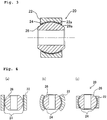
- a sleeve bearing 10 shown in Figs. 1(a) and 1(b) includes a cylindrical outer race member (body) 12 which is made of metal such as bearing steel, stainless steel, duralumin material, titanium alloy and the like, and a self-lubricating liner layer 14 which is formed on the inner circumferential surface (sliding surface) of the outer race member 12.
- the self-lubricating liner layer 14 is a resin layer having a self-lubricating property, and is formed by applying the thermosetting resin composition related to the present invention, which will be described below, on the inner circumferential surface of the outer race member 12 and then curing the applied thermosetting resin composition.
- the size adjustment of the self-lubricating liner can be easily performed by grinding and/or cutting. Accordingly, in this sense, the self-lubricating liner is also referred to as a "machinable liner (processable liner)" as appropriate.
- the sliding member is not particularly limited provided that the sliding member has a sliding surface at least a portion or part thereof.
- the sliding member includes not only a sleeve bearing used for rotary motion or translational (linear) motion but also various sliding members such as a spherical bearing and a reamer bolt which will be described later. These sliding members are also included in an object of the present invention.
- thermosetting resin composition contains, as a component mainly composing the resin, an epoxy compound having an isocyanuric acid ring represented by the following formula (1):
- At least one of X, Y and Z is a group containing an epoxy ring, and when X, Y or Z contains no epoxy ring, X, Y or Z containing no epoxy ring is an atom of H, a group composed only of C and H, or a group composed only of C, H and O.
- the epoxy compound having the isocyanuric acid ring represented by the formula (1) is an epoxy compound wherein all of the X, Y and Z in the formula (1) are each the group containing the epoxy ring, an epoxy compound wherein two of the X, Y and Z in the formula (1) are each the group containing the epoxy ring, or an epoxy compound wherein one of the X, Y and Z in the formula (1) is the group containing the epoxy ring.
- the X, Y and Z in the formula (1) are each the group containing the epoxy ring
- the X, Y and Z are not particularly limited provided that each of the X, Y and Z is the group containing the epoxy ring.
- the X, Y and Z are each preferably a group containing the epoxy ring and composed only of H, C and O.
- each of the X, Y and Z may be an epoxy group; an alkyl group substituted by the epoxy group, such as a glycidyl group; or an aryl group substituted by the epoxy group.
- the X, Y and Z may be groups which are same with one another, or mutually different groups.
- the epoxy compound having the isocyanuric acid ring is preferably a compound applicable to a sliding surface and capable of forming a self-lubricating liner which hardly wears after being cured.
- the group containing the epoxy ring is preferably the glycidyl group.
- An epoxy compound in which all the X, Y and Z in the formula (1) are each the glycidyl group is 1,3,5-tris(2,3-epoxypropyl)-1,3,5-triazine-2,4,6(1H, 3H, 5H)-trione, represented by the following formula (2) (also known under a different name of: trisepoxy propyl isocyanurate; tris(2,3-epoxypropyl) isocyanurate, hereinafter referred to as "TEPIC” (trademark), as appropriate).
- formula (2) also known under a different name of: trisepoxy propyl isocyanurate; tris(2,3-epoxypropyl) isocyanurate, hereinafter referred to as "TEPIC” (trademark), as appropriate).
- each of the two groups containing the epoxy ring is not particularly limited provided that each of the two groups contains the epoxy ring, in a similar manner as the compound wherein all of the X, Y and Z in the formula (1) are each the group containing the epoxy ring.
- each of the two groups containing the epoxy ring is preferably a group containing the epoxy ring and composed only of H, C and O, and more preferably a glycidyl group.
- X, Y or Z containing no epoxy ring is an atom of H, a group composed only of C and H, or a group composed only of C, H and O.
- the group composed only of C and H, and the group composed only of C, H and O can be exemplified by a substituted or unsubstituted alkyl group, a substituted or unsubstituted aryl group, and the like.
- the X, Y or Z not containing the epoxy ring is preferably a unsubstituted alkyl group, or is preferably a group composed only of C, H and O having an acrylic acid ester structure, or a group composed only of C, H and O having a methacrylic acid ester structure.
- the compound wherein two of the X, Y and Z in the formula (1) are each the group containing the epoxy ring can be exemplified by: 1-methyl-3,5-bis-oxiranyl methyl-[1,3,5] triazine-2,4,6-trione represented by the following formula (3); acrylic acid 2-(3,5-bis-oxiranyl methyl-2,4,6-trioxo-[1,3,5] triazine-1-yl)ethyl ester represented by the following formula (4); and 2-methyl-acrylic acid 2-(3,5-bis-oxiranyl methyl-2,4,6-trioxo-[1,3,5] triazine-1-yl)ethyl ester represented by the following formula (5).
- the compound represented by the formula (3) is an epoxy compound in which two of the X, Y and Z in the formula (1) are each a glycidyl group, and a remaining one is a methyl group.
- the compound represented by the formula (4) is an epoxy compound in which two of the X, Y and Z in the formula (1) are each a glycidyl group, and a remaining one has an acrylic acid ester structure.
- the compound represented by the formula (5) is an epoxy compound in which two of the X, Y and Z in the formula (1) are each a glycidyl group, and the remaining one has a methacrylic acid ester structure.
- the group containing the epoxy ring is not particularly limited provided that the group contains the epoxy ring, in a similar manner as the compound describe above wherein all of the X, Y and Z in the formula (1) are each the group containing the epoxy ring.
- the group containing the epoxy ring is preferably a group containing the epoxy ring and composed only of H, C and O, and more preferably a glycidyl group.
- X, Y and Z in the formula (1) is the group containing the epoxy ring
- X, Y or Z containing no epoxy ring is a group composed only of C and H, a group composed only of C, H and O, or an atom of H, in a similar manner as the compound wherein two of the X, Y and Z in the formula (1) are each the group containing the epoxy ring.
- the epoxy compound having the isocyanuric acid ring related to the present invention may use the three kinds of compounds, namely, the compound wherein all of the X, Y and Z in the formula (1) are each the group containing the epoxy ring, the compound wherein two of the X, Y and Z in the formula (1) are each the group containing the epoxy ring, and the compound wherein one of the X, Y and Z in the formula (1) is the group containing the epoxy ring, either singly or as a mixture of two kinds of or three kinds (all) of these three compounds by mixing the compounds at any mixing ratio.
- the epoxy compound having the isocyanuric acid ring it is allowable to use an addition reaction product of the compound wherein all of the X, Y and Z in the formula (1) are each the group containing the epoxy ring, and acid anhydride.
- the epoxy ring and the acid anhydride By subjecting the epoxy ring and the acid anhydride to addition reaction, the epoxy ring is opened, thereby making it possible to eliminate the epoxy ring from one group of, or two groups of the X, Y and Z.
- the addition reaction product of the compound wherein all of the X, Y and Z in the formula (1) are each the group containing the epoxy ring and the acid anhydride is a mixture of the compound wherein two of the X, Y and Z in the formula (1) are each the group containing the epoxy ring and the compound wherein one of the X, Y and Z in the formula (1) is the group containing the epoxy ring.
- the mixture can be exemplified by an addition reaction product of TEPIC (trademark) represented by the formula (2) as described above and propionic acid anhydride.
- the epoxy compound having the isocyanuric acid ring related to the present invention it is possible to use a mixture of TEPIC (trademark) and the addition reaction product of TEPIC (trademark) and the propionic acid anhydride.
- the mixture of TEPIC (trademark) and the addition reaction product of TEPIC (trademark) and the propionic acid anhydride is a mixture of the epoxy compound wherein all of the X, Y and Z in the formula (1) are each the group containing the epoxy ring, the epoxy compound wherein two of the X, Y and Z in the formula (1) are each the group containing the epoxy ring, and the epoxy compound wherein one of the X, Y and Z in the formula (1) is the group containing the epoxy ring.
- the epoxy compound having the isocyanuric acid ring represented by the formula (1) has quite excellent heat resistance in addition to having the thermosetting (thermo-curable) property, and thus is suitable for a self-lubricating liner of a sliding member, and the like.
- the compound for a compound to be used as the sliding member incorporated in an aircraft, the compound is required to have a heat resistance of 163 degrees Celsius or more.
- the epoxy compound having the isocyanuric acid ring is also suitable for such an application.
- the epoxy compound having the isocyanuric acid ring has a small thermal compression during the thermo-curing, any film separation and/or any film cracking can be suppressed during the thermal curing, which in turn makes it possible to obtain a cured product with a great thickness. Since the cured product with a large thickness can be obtained, in a case of performing the size adjustment of a machinable liner through cutting and/or grinding, it is possible to set a wide range for the size adjustment.
- the content amount of the epoxy compound having the isocyanuric acid ring in the thermosetting resin composition is preferably in a range of 5% by weight to 60% by weight. In a case that the content amount of the epoxy compound having the isocyanuric acid ring in the thermosetting resin composition is less than 5% by weight, the fluidity of the resin may become insufficient and that the application of the epoxy compound may become difficult. Also, the strength of the liner may become insufficient. On the other hand, in a case that the content amount of the epoxy compound having the isocyanuric acid ring in the thermosetting resin composition exceeds 60% by weight, the content amount of a solid lubricant (as will be described later on) becomes small, and the lubricating property is lowered.
- the thermosetting resin composition related to the present invention further contains a dicyanate compound, or a mixture of the dicyanate compound and a bismaleimide compound.
- the dicyanate compound is not particularly limited provided that the dicyanate compound is a compound having two cyanate groups in the molecule, the dicyanate compound is preferably an aromatic dicyanate compound having an aromatic ring in the molecule, from the viewpoint of mechanical strength and heat resistance.
- a compound represented by the following formula (6) can be used.
- R is a substituted or unsubstituted alkylene group.
- the compound represented by the formula (6) can be exemplified by 2,2-bis(4-cyanatophenyl)propane (also known under a different name of: bisphenol A dicyanate) represented by the following formula (7).
- the dicyanate compound is trimerized to form a triazine structure (isocyanuric acid ring), thereby becoming a triazine resin.
- the triazine resin co-polymerizes and cross-links also with the above-described epoxy compound having the isocyanuric acid ring, thereby forming a cured product.
- the dicyanate compound functions in a manner similar to that of a curing agent which thermally cures the epoxy compound having the isocyanuric acid ring.
- the resin composition related to the present invention does not need to contain any curing agent, despite that the resin composition contains the epoxy compound.
- the cured product of the epoxy compound having the isocyanuric acid ring and the dicyanate compound is a cured product having a high cross-linking density with an excellent wear resistance, and has a high heat resistance of 300 degrees Celsius or more.
- the thermosetting resin composition related to the present invention may use a mixture of the dicyanate compound and the bismaleimide compound, rather than using the dicyanate compound.
- the dicyanate compound used in the mixture it is possible to use a substance similar to the above-described dicyanate compound.
- the bismaleimide compound is not particularly limited provided that the bismaleimide compound is a compound having two maleimide structures, it is possible to use, for example, a compound represented by the following formula (8).
- R is a substituted or unsubstituted alkylene group, or a substituted or unsubstituted aryl group.
- the bismaleimide compound is preferably an aromatic bismaleimide compound having an aromatic ring in the molecule, from the viewpoint of mechanical strength and heat resistance.
- the bismaleimide compound may be a compound wherein the R in the above formula (8) is a substituted or unsubstituted aryl group.
- the aromatic bismaleimide compound can be exemplified, for example, by 4,4-bismaleimide diphenylmethane represented by the following formula (9).
- the triazine resin is formed by the dicyanate compound, as described above. Further, since the bismaleimide compound has a terminal-unsaturated double bond structure forming a ladder structure with a triazine ring of the triazine resin, the bismaleimide compound is heated to thereby form a complex cross-linking with the triazine resin, forming a bismaleimide-triazine resin (hereinafter referred to as "BT resin" as appropriate) having an interpenetrating polymer network (IPN) in which the molecules of the bismaleimide compound and the triazine resin are entangled with each other.
- IPN interpenetrating polymer network
- the BT resin crosslinks also with the epoxy compound having the isocyanuric acid ring to thereby form the cured product.
- the BT resin similarly to the dicyanate compound, the BT resin also functions in a manner similar to that of the curing agent which thermally cures the epoxy compound having the isocyanuric acid ring.
- the cured product of the epoxy compound having the isocyanuric acid ring and the BT resin is a cured product having a high cross-linking density with an excellent wear resistance similarly to the above-described cured product of the epoxy compound having the isocyanuric acid ring and the dicyanate compound, and has a high heat resistance of 300 degrees Celsius or more.
- the content amount of the dicyanate compound, or the content amount of the mixture of the dicyanate compound and the bismaleimide compound in the thermosetting resin composition may be, for example, in a range of 10% by weight to 50% by weight.
- the weight ratio (M/L) of the content amount (M) of the dicyanate compound to the content amount (L) of the epoxy compound having the isocyanuric acid ring is in a range of 0.65 to 4.00, or a weight ratio ((M+N)/L) of a total of the content amount (M) of the dicyanate compound and the content amount (N) of the bismaleimide compound to the content amount (L) of the epoxy compound having the isocyanuric acid ring is in a range of 0.65 to 4.00.
- the above-described weight ratio is less than 0.65, any incomplete curing of the resin occurs, and the heat resistance and strength of the resin are lowered; in another case that the above-described weight ratio exceeds 4.00, the curing speed is extremely lowered.
- the mechanical strength of the resin may be lowered; in another case that the above-described total content amount (L+M) or (L+M+N) exceeds 90% by weight, the wear resistance of the resin may be lowered.
- the resin composition related to the present invention contains a solid lubricant.
- the resin composition related to the present invention contains polytetrafluoroethylene resin (hereinafter abbreviated as "PTFE”), as the solid lubricant, preferably in an amount of 10% by weight to 70% by weight in the resin composition, and more preferably in an amount of 30% by weight to 60% by weight in the resin composition. It is allowable to use any form of PTFE, such as powdery PTFE, fibrous PTFE, and the like, either singly or in combination thereof.
- PTFE polytetrafluoroethylene resin
- the resin composition related to the present invention when using the resin composition related to the present invention as a self-lubricating liner, it is possible to suppress any separation or detaching of the particles and fibers of PTFE from the self-lubricating liner during the sliding movement, thereby making it possible to reduce a wear amount (abrasion loss) of the self-lubricating liner.
- the average particle diameter or fiber length of PTFE is preferably within a range of 75 ⁇ m to 180 ⁇ m. By doing so, even when the blending amount of PTFE is increased, PTFE hardly aggregates, which in turn increase the area ratio of PTFE present in the surface after the curing and allows PTFE to be distributed uniformly. In a case that the average particle diameter or fiber length of PTFE is less than 75 ⁇ m, PTFE easily aggregates when the resin having viscosity is being kneaded, which in turn hinders any uniform distribution of PTFE on the surface of the resin after the curing. Further, in a case that the average particle diameter or fiber length of PTFE is outside the range of 75 ⁇ m to 180 ⁇ m, the wear amount of the self-lubricating liner becomes relatively large.
- a solid lubricant other than PTFE can be used.
- the resin composition related to the present invention may contain graphite, melamine cyanurate, or the like.
- melamine cyanurate is preferably contained in an amount of 30% by weight or less in the resin composition. In a case that the content amount of melamine cyanurate exceeds 30% by weight, although the friction coefficient of the self-lubricating liner is lowered, the wear amount tends to be increased.
- Melamine cyanurate has a structure in which melamine molecules and cyanuric acid molecules each having a six-membered ring structure are bonded by the hydrogen bond, and are arranged in a planar form.
- the planes of the bonded melamine molecules and cyanuric acid molecules are overlapped with each other in a layered (laminated) form by a weak bonding, thereby forming a cleavage slip structure such as that of molybdenum disulfide (MoS 2 ), graphite or the like.
- MoS 2 molybdenum disulfide
- thermosetting resin composition related to the present invention may contain a thermoplastic resin, in addition to the solid lubricant, in order to obtain satisfactory sliding property and toughness.
- a particulate thermo-plastic resin has effects of imparting the sliding property to a cured product of the thermosetting resin composition and thereby lowering the friction coefficient thereof.
- the particulate thermoplastic resin has the wear resistance as well. Accordingly, in a case that the blending amount of the solid lubricant is great, the solid lubricant and the particulate thermoplastic resin can be used together to thereby improve the sliding property while suppressing any lowering in the mechanical strength of the cured product.
- the particulate thermoplastic resin it is possible to use, for example, a crystalline resin such as polyether ether ketone (hereinafter referred to as "PEEK" as appropriate) of which average particle diameter (D50) is in a range of 20 ⁇ m to 50 ⁇ m, nylon 6 (PA6) of which average particle diameter (D50) is in a range of 5 ⁇ m to 10 ⁇ m, nylon 12 (PA12) of which average particle diameter (D50) is in a range of 13 ⁇ m to 20 ⁇ m, and the like.
- PEEK polyether ether ketone
- a cured product obtained from a thermosetting resin composition using PTFE and PEEK in combination has a coefficient of linear expansion smaller than in a cured product obtained from a thermosetting resin composition containing only PTFE. Accordingly, in a case of forming, from the thermosetting resin composition using PTFE and PEEK in combination, the self-lubricating liner layer 14 on the inner circumferential surface of the outer race member 12 as shown in Figs. 1(a) and 1(b) described above, the internal stress in the self-lubricating liner layer 14 accompanying with the thermal expansion or thermal compression of the metallic outer race 12 is lowered, and thus the size change amount of the self-lubricating liner layer 14 can be suppressed.
- the particulate thermoplastic resin is preferably contained in an amount of 30% by weight or less in the thermosetting resin composition.
- PEEK has effects of raising the glass transition point of the cured product of the resin composition and to improve the heat resistance of the cured product. From the viewpoint of improving the heat resistance of the cured product of the resin composition, PEEK is preferably contained in an amount of 10% by weight to 30% by weight in the thermosetting resin composition.
- the resin composition related to the present invention may be added with glass fiber, for the purpose of improving the strength of the self-lubricating liner.
- glass fiber it is possible to use a circular cross-sectional glass fiber having a circular cross section, or irregular shape (non-circular) cross-sectional glass fiber having a non-circular cross section.
- the resin composition related to the present invention may contain an inorganic fiber such as carbon fiber, aramid fiber, potassium titanate whisker, and the like, as reinforcing fiber, in addition to the glass fiber.
- the resin composition related to the present invention may further contain phosphate.
- the phosphate is capable of improving the initial conformability when using the resin composition as the self-lubricating liner, and of stabilizing the friction coefficient quicker than in a case that the phosphate is not blended in the resin composition.
- the phosphate is preferably contained in an amount of 5% by weight or less in the resin composition.
- the phosphate can be phosphate of alkali metal or alkali earth metal exemplified by: tertiary phosphate, secondary phosphate, pyrophosphate, phosphite, or metaphosphate.
- the phosphate can be exemplified by: trilithium phosphate, lithium dihydrogen phosphate, dibasic sodium phosphate, lithium pyrophosphate, tricalcium phosphate, calcium monohydrogen phosphate, calcium pyrophosphate, lithium metaphosphate, magnesium metaphosphate, calcium metaphosphate, and the like.
- the resin composition related to the present invention may contain fumed silica.
- the fumed silica is used to impart the thixotropy to the resin composition.
- a resin composition with any insufficient thixotropy is applied on the sliding surface, such a resin composition drops off from the sliding surface as drips, which in turn makes the formation of the liner be difficult.
- the fumed silica can be added to thereby adjust the thixotropy.
- the fumed silica is preferably added in an amount of 5% by weight or less with respect to the entire amount of the resin composition. In a case that the blending amount of the fumed silica exceeds 5% by weight, the wear amount of the liner is increased, which is not desired.
- the thermosetting resin composition related to the present invention may further contain a diluent so as to lower the viscosity of the resin composition so that the resin composition can be easily applied on the sliding surface.
- the diluent is preferably a reactive diluent such as: 1,2-epoxy-3-(tolyloxy)propane, alkyl glycidyl ether, phenyl glycidyl ether, cresyl glycidyl ether, n-butyl glycidyl ether, versatic acid glycidyl ether, styrene oxide, ethylhexyl glycidyl ether, butyl phenyl glycidyl ether, 1,6-hexandiol diglycidyl ether, neopentyl glycol diglycidyl ether, diethylene glycol diglycidyl ether, trimethylolpropane triglycidyl
- the weight ratio of the diluent to the epoxy compound having the isocyanuric acid ring namely, the weight ratio: (diluent)/(epoxy compound having the isocyanuric acid ring) is preferably 0.65 or less.
- the resin composition related to the present invention is preferably in a liquid form at room temperature. With this, the resin composition can be easily applied on the sliding surface of the sliding member, and can be cured by being heated after the application.
- the glass transition point Tg of the resin composition related to the present invention is preferably 150 degrees Celsius or more, due to the following two reasons, namely: the heat resistance required by AS81934 standard (to be descried later on) needs to be satisfied; and the heat resistance same as or greater than that of the resin liner based on polyether ketone disclosed in Patent Literature 3 (Japanese Patent Application Laid-open No. 2011-247408 ) is desired to be secured.
- the resin composition related to the present invention uses a liquid thermosetting resin as the base for the resin, the solid lubricant containing PTFE can be easily mixed, and PTFE, or PTFE together with particulate thermoplastic resin, can be added in a high blending amount in the range of 10% by weight to 70% by weight that could not been added in the case of using the thermoplastic resin as the base resin. Accordingly, it is possible to produce a self-lubricating liner with a lower friction coefficient and with less wear.
- the present invention also provides a manufacturing method for producing a sliding member formed with a self-lubricating liner by: applying, on a sliding surface of a body of the sliding member, a thermosetting resin composition containing an epoxy compound having the isocyanuric acid ring represented by the above-described formula (1), and the dicyanate compound, or the mixture of the dicyanate compound and the bismaleimide compound; and curing the applied thermosetting resin composition by heating the applied thermosetting resin composition so as to form the self-lubricating liner.
- the self-lubricating liner becomes a machinable liner which can be subjected to an after-processing through cutting and/or grinding so that the self-lubricating liner can have a desired size.
- the sliding member related to the present invention may be a spherical bearing provided with an outer race member having a concave first bearing surface and an inner race member having a convex second bearing surface slidably movable on the first bearing surface.
- the thermosetting resin composition according to the present invention is applied on the first bearing surface or the second bearing surface as the sliding surfaces.
- the thermosetting resin composition applied on the first or second bearing surface is heated to be primarily cured.
- the inner race member is inserted in the outer race member and the outer race member is pressed to be plastically deformed so as to follow the convex surface of the inner race member.
- the thermosetting resin composition is heated to be secondarily cured. Accordingly, the self-lubricating liner can be formed.
- a resin composition related to the present invention and a sliding member provided with a self-lubricating liner composed of the resin composition related to the present invention will be explained based on the following examples. However, the present invention is not limited to the following examples.
- thermosetting resin compositions ⁇ Manufacture of thermosetting resin compositions>
- each of the liquid resin compositions of Examples 1 to 16 had the composition of resin composition as shown in TABLE 1 as follows by uniformly mixing: the epoxy resin compound having the isocyanuric acid ring represented by the above-described formula (1), and the dicyanate compound or the mixture of the dicyanate compound and the bismaleimide compound, and a solid lubricant, and further, as necessary, a diluent, a thermoplastic resin, glass fiber, dibasic sodium phosphate and fumed silica.
- the epoxy compound is a mixture of the compound represented by the formula (2) as described above (TEPIC (trademark)) and the addition reaction product of TEPIC (trademark) and the propionic acid anhydride.
- the dicyanate compound (DC compound) is 2,2-bis(4-cyanatophenyl) propane (also known under a different name of: bisphenol A dicyanate) represented by the above-described formula (7); and the bismaleimide compound (BMI compound) is 4,4-bismaleimide diphenylmethane represented by the above-described formula (9) .
- Comparative Examples 1 to 5 are each a resin composition composed by using the epoxy resin compound having the isocyanuric acid ring represented by the above-described formula (1), and the dicyanate compound or the mixture of the dicyanate compound and the bismaleimide compound.
- resin compositions in a liquid form of Comparative Examples 1 to 5 so that each of the liquid resin compositions of Comparative Examples 1 to 5 had the composition of resin composition as shown in TABLE 2 as follows by uniformly mixing: the epoxy resin compound having the isocyanuric acid ring represented by the above-described formula (1), the dicyanate compound or the mixture of the dicyanate compound and the bismaleimide compound, and a solid lubricant, and further, as necessary, a diluent, a thermoplastic resin, glass fiber, dibasic sodium phosphate and fumed silica. Note that in TABLE 2, the epoxy compound, the dicyanate compound and the bismaleimide compound that are same as those used in Examples 1 to 16 were used also for Comparative Examples 1 to 5.
- Comparative Example 6 is a resin composition composed by using a bisphenol A type epoxy compound, rather than using the epoxy resin compound having the isocyanuric acid ring represented by the above-described formula (1), and the dicyanate compound or the mixture of the dicyanate compound and the bismaleimide compound that were used in Examples 1 to 16.
- a resin composition in a liquid state of Comparative Example 6 was prepared by uniformly mixing: bisphenol A diglyceride ether (DGEBA) as the bisphenol A type epoxy compound; methyltetrahydrophthalic acid anhydride (Me-THPA) as the curing agent; tetraphenyl phosphonium bromide (TPP-PB) as the cure accelerator; glass fiber (manufactured by NITTO BOSEKI CO., LTD., product name: PF80E-401, average fiber length: 80 ⁇ m ⁇ average diameter ⁇ : 11 ⁇ m); polytetrafluoroethylene (PTFE) (manufactured by KITAMURA LIMITED, product name: KT-60); and fumed silica (manufactured by NIPPON AEROSIL CO., LTD., product name: AEROSIL (trademark) R805), so that Comparative Example 6 had the composition of resin composition indicated in TABLE 3 as follows.
- DGEBA bisphenol A diglyceride ether
- Comparative Example 7 is a urethane resin composition using a urethane methacrylate, rather than using the epoxy resin compound having the isocyanuric acid ring represented by the above-described formula (1), and the dicyanate compound or the mixture of the dicyanate compound and the bismaleimide compound that were used in Examples 1 to 16.
- a resin composition in a liquid state of Comparative Example 7 was prepared by uniformly mixing: urethane methacrylate (manufactured by HENKEL JAPAN LTD., product name: LOCTITE (trademark) 648); polytetrafluoroethylene (PTFE) (manufactured by DU PONT KABUSHIKI KAISHA, product name: MP-1300-J); molybdenum disulfide (MoS 2 )(manufactured by DAITOU CO.
- urethane methacrylate manufactured by HENKEL JAPAN LTD., product name: LOCTITE (trademark) 648
- PTFE polytetrafluoroethylene
- MoS 2 molybdenum disulfide
- Comparative Example 8 is an acrylic resin composition using acrylate, rather than using the epoxy resin compound having the isocyanuric acid ring represented by the above-described formula (1), and the dicyanate compound or the mixture of the dicyanate compound and the bismaleimide compound that were used in Examples 1 to 16.
- a resin composition in a liquid state of Comparative Example 8 was prepared by uniformly mixing: dipentaerythritol pentaacrylate (manufactured by SARTOMER JAPAN KABUSHIKI KAISHA, product name: SR399); triethylene glycol dimethacrylate (manufactured by SARTOMER JAPAN KABUSHIKI KAISHA, product name: SR205); aramid fiber (manufactured by DU PONT KABUSHIKI KAISHA, product name: Kevlar (trademark) Pulp DRY, 0.8mm); curing agent (manufactured by NORAC, INC., product name: BENOX (trademark) L-40LV); cure accelerator (manufactured by SIGMA-ALDRICH CO.
- Comparative Example 8 had the composition of resin composition indicated in TABLE 5 as follows.
- a cylindrical sleeve bearing (width (length in the axial direction): 12.7 mm, outer diameter: 30.2 mm, inner diameter: 24.9 mm) as shown in Figs. 1(a) and 1(b) was manufactured by using a material obtained by subjecting SUS630 stainless steel to heat treatment under H1150 condition.
- Each of the resin compositions prepared in Examples 1 to 16 and Comparative Examples 1 to 8 was uniformly applied on the inner circumferential surface of this sleeve bearing by using a dispenser. Subsequently, the applied resin composition was heated to cure the resin composition, and thus a self-lubricating resin layer was formed in the inner circumferential surface of the sleeve bearing.
- any film (liner) eligible for performing the evaluative test therefor could not be formed from the resin composition of Comparative Example 3. Accordingly, the machinable liners formed of the resin compositions of Examples 1 to 16 and Comparative Examples 1, 2 and 4 to 8, excluding Comparative Example 3, were subjected to performance evaluation by Evaluations 1 to 5 as explained below. TABLE 7 and TABLE 8 indicate the results of Evaluations 1 to 5 and the results of overall evaluation.
- TABLE 7 and TABLE 8 also indicate the weight ratio of the content amount of the mixture of the dicyanate compound and the bismaleimide compound to the content amount of the epoxy compound having the isocyanuric acid ring, namely, the weight ratio: (the mixture of the dicyanate compound and the bismaleimide compound)/(the epoxy compound) in Examples 1, 2, 4, 5, 7 to 10, 12 and 14 to 16 and Comparative Examples 1 to 3 and 5, and the weight ratio of the content amount of the dicyanate compound to the content amount of the epoxy compound having the isocyanuric acid ring, namely, the weight ratio: (the dicyanate compound)/(the epoxy compound) in Examples 3,6,11 and 13 and Comparative Examples 4.
- TABLE 7 and TABLE 8 indicate the total content amount (% by weight) of the epoxy compound having the isocyanuric acid ring and the dicyanate compound, or the total content amount (% by weight) of the epoxy compound having the isocyanuric acid ring and the mixture of the dicyanate compound and the bismaleimide compound, in the thermosetting resin compositions prepared in Examples 1 to 16 and Comparative Examples 1 to 5.
- the radial static limit load is defined based on the material (aluminum alloy and stainless steel) and the inner diameter size of the sleeve bearing. According to the material and the size of the sleeve bearing used in Examples 1 to 16 and Comparative Examples 1 to 8, the sleeve bearing corresponds to part number M81934/1-16C016 described in TABLE 6, and thus the maximum test load was determined to be 140 kN (31,400 lb). TABLE 6 Part No.
- the sleeve bearing 10 is set on a test jig T first.
- the test jig T includes a base portion 40 which has a H-shaped cross section and which supports a shaft member 32, a weight 41 which applies the load in the radial direction of the sleeve bearing 10 into which the shaft member 32 is inserted, and a dial gauge 42 which is provided below the base portion 40.
- the shaft member 32 made of carbon steel is fitted to the inner circumferential surface of the sleeve bearing 10 to apply a load in the radial direction.
- the load is gradually increased up to a radial static limit load value 140 kN (31,400 lb). After reaching the radial static limit load value, the load is gradually removed.
- this permanent deformation amount (maximum permissible permanent deformation amount after applying the radial static limit load) should be 0.051 mm (0.002 in) or less.
- An oscillation test is performed at normal temperature, and at a high temperature that is a temperature of 163 degrees Celsius (+6 degrees Celsius/-0 degrees Celsius).
- AS81934 standard required in this oscillation test is that regarding the oscillation test at the normal temperature, the upper limit value of permissible wear amount of a liner after 1,000 cycles is 0.089 mm (0.0035 in), after 5,000 cycles is 0.102 mm (0.0040 in), and after 25,000 cycles is 0.114 mm (0.0045 in); and that regarding the oscillation test at the high temperature, the upper limit value of permissible wear amount of the liner after 25,000 cycles is 0.152 mm (0.0060 in).
- the oscillation test at normal temperature was performed as follows.
- a sleeve bearing 10 was set on the test jig T as shown in Fig. 2 , and the load of 73.5 kN (16,500 lb) required in AS81934 standard as indicated in the right column of TABLE 6 was applied in the radial direction and maintained statically for 15 minutes.
- the amount of displacement in the dial gauge 42 was set to zero and the oscillation of the shaft 32 was started.
- the shaft member 32 was oscillated within an angular range of ⁇ 25 degrees. The oscillating movement of the shaft member 32 going from the angle position 0 degrees to +25 degrees and coming back to 0 degrees, and then going to -25 degrees and coming back again to 0 degrees was counted as 1 cycle.
- An oscillation rate should be set to 10 cycles per minute (10 CPM) or more. In the performed test, the oscillation rate was set to 20 cycles per minute. During this oscillation test, the wear amount was read from the dial gauge 42 and recorded.
- the oscillation test at high temperature was performed in a similar manner as in the oscillation test at normal temperature, except that the shaft 32 and the liner in the test jig T of Fig. 2 were maintained at the temperature of 163 degrees Celsius (+6 degrees Celsius/-0 degrees Celsius).
- the wear amount after 25,000 cycles in the oscillation test at normal temperature was 0.114 mm or less in Examples 1 to 16 and Comparative Examples 6 to 8, and thus satisfying the requirement of AS81934 standard.
- the wear amount after 25,000 cycles in the oscillation test at normal temperature in Comparative Examples 1, 2, 4 and 5 exceeded 0.114 mm and thus did not satisfy the requirement of AS81934 standard.
- Comparative Example 5 it is presumed that a cured product (liner) having the wear resistance could not be obtained in Comparative Example 5 since the content amount of PTFE was small and the content amount of the epoxy compound having the isocyanuric acid ring and the content amount of the mixture of the dicyanate compound and the bismaleimide compound were high and thus any sufficient lubricating property could not be obtained in Comparative Example 5.
- the wear amount after 25,000 cycles in the oscillation test at high temperature was 0.152 mm or less in all of Examples 1 to 16 and in Comparative Example 7, and thus satisfying the requirement of AS81934 standard.
- the wear amount after 25,000 cycles in the oscillation test at high temperature exceeded 0.152 mm in Comparative Examples 1, 2, 4, 5, 6 and 8, and thus did not satisfy the requirement of AS81934 standard.
- the self-lubricating liner formed by using the bisphenol A type epoxy resin composition prepared in Comparative Example 6, and the self-lubricating liner formed by using the acrylic resin composition prepared in Comparative Example 8 satisfied the requirement of AS81934 standard in the oscillation test at the normal temperature, but could not satisfy AS81934 standard in the oscillation test at the high temperature that was the severer test.
- AS81934 standard required in this oil resistance validation test is that the upper limit value of permissible wear amount of a liner after the oil resistance validation test is 0.152 mm (0.0060 in).
- Sleeve bearings 10 respectively having the machinable liners manufactured as described above were immersed in each of oils of six kinds of "a” to "f", as indicated below, at temperature of 71 degrees Celsius ⁇ 3 degrees Celsius for 24 hours, and then taken out from each of the oils, and subjected to the above-descripted oscillation test at the normal temperature within 30 minutes or less after being taken out from the oil.
- the used oils were as follows.
- the wear amount after 25,000 cycles in the oscillation test at normal temperature after the immersion in the oil for 24 hours was 0.152 mm or less regarding all the oils "a” to “f” in all of Examples 1 to 16 and in Comparative Examples 6 to 8, and satisfying the requirement of AS81934 standard and indicated with the sign "+” in TABLE 7 and TABLE 8.
- Comparative Examples 1, 2, 4 and 5 the wear amount after 25,000 cycles in the oscillation test at normal temperature after the immersion in the oil for 24 hours exceeded 0.152 mm regarding all the oils "a” to "f", and thus not satisfying the requirement of AS81934 standard and indicated with the sign "-” in TABLE 8.
- the friction coefficient of each of Comparative Examples 6 to 8 was in a range of 0.043 to 0.051.
- the average value of the friction coefficients of Examples 1 to 16 was 0.036 that is a value lower by 10% or more as compared with the value of the coefficient friction of each of Comparative Examples 6 to 8.
- the resin composition in each of Examples 1 to 16 contained PTFE as the solid lubricant in a range of 10% by weight to, maximally, 70% by weight.
- Example 5 containing a large amount of PTFE (70% by weight) had a quite low friction coefficient of 0.018.
- the overall evaluation was determined to be "+” in a case that all of the requirements of AS81934 standard were satisfied in Evaluations 1 to 3 and that the wear amount in the oscillation test at 200 degrees Celsius in Evaluation 4 was 0.152 mm or less.
- the overall evaluation was determined to be "-" in a case that the requirement of AS81934 standard was not satisfied in any one of Evaluations 1 to 3 or that the wear amount in the oscillation test at 200 degrees Celsius in Evaluation 4 exceeded 0.152 mm.
- Comparative Example 3 in which a film (liner) appropriate for performing the evaluative test could not be obtained received an overall evaluation of "-".
- the results of overall evaluation are shown in TABLE 7 and TABLE 8. The overall evaluation was "+” in all of Examples 1 to 16, whereas the overall evaluation was "-" in all of Comparative Examples 1 to 8.
- test samples were manufactured in the following manner. Namely, before applying the resin composition on each of the cylindrical sleeve bearings (width: 12.7 mm, outer diameter: 30.2 mm, inner diameter: 24.9 mm) used in the above-described evaluations, the inner circumferential surface of each of the sleeve bearings was roughened by the sand blasting process so that the inner circumferential surface had one of the four kinds of surface roughness as indicated in the following TABLE 9.
- the resin composition prepared in the above-described Example 1 was applied on the inner circumferential surface, and the heating was performed under a heating condition similar to that in the case of manufacturing the machinable liners used in the above-described tests, to thereby form a self-lubricating resin layer.
- the self-lubricating resin layer was subjected to cutting and grinding until the thickness of the self-lubricating resin layer became 0.25 mm, and the inner diameter of the sleeve bearing was finished to be 25.4 mm.
- TABLE 9 indicates the results of the separation test (comparative test of surface roughness of base surface). In TABLE 9, a sign "+” means that no separation was present, whereas a sign "-" means that separation was present.
- sleeve bearings each provided with a machinable liner on the inner circumferential surface of which surface roughness was one of the four kinds of surface roughness as described above, were manufactured in a similar manner as described above, except that the machinable liner was formed by using a resin composition containing a thermoplastic resin instead of the thermosetting resin.
- the resin composition containing the thermoplastic resin was obtained in accordance to the method described in Example 1 of Japanese Patent Application Laid-open No. 2011-247408 by the applicant of the present invention. Namely, 70% by weight of polyether ketone, 10% by weight of a PAN-based carbon fiber and 20% by weight of PTFE were mixed.
- the obtained mixture was applied on the inner circumferential surface of the sleeve bearing by the injection molding to form a machinable liner, and the machinable liner was subjected to cutting and grinding until the machinable liner had a thickness of 0.25 mm.
- the test regarding the adhesion property was performed also for this machinable liner, and the results of the test is indicated in TABLE 10.
- the machinable liner formed by the resin composition according to the present invention is capable of realizing a satisfactory adhesion property without depending on the roughness of the base surface, and that the process for roughening the base surface is not necessary for forming the self-lubricating liner in accordance with the present invention.
- test samples were manufactured in the following manner. Namely, the resin compositions prepared in Examples 1, 2 and 3 and in Comparative Example 7 were applied by using a dispenser on the sleeve bearings (width: 12.7 mm, outer diameter: 30.2 mm, inner diameter: 24.9 mm) used in the above-described tests, so that each of the sleeve bearings was applied with one of the resin compositions prepared in Examples 1, 2 and 3 and in Comparative Example 7 of which thickness was 0.3 mm, 0.5 mm, 0.7 mm, 1.0 mm or 2.0 mm.
- the applied resin compositions were heated to be thermally cured under the same heating condition as that in the formation of the machinable liners used in the above-described tests, so as to form a self-lubricating liner on the inner circumferential surface of each of the sleeve bearings.
- the sleeve bearings provided with these 20 kinds of liners, respectively, manufactured in such a manner the presence or absence of any resin separation or resin cracking due to the shrinking during the thermal curing was visually evaluated. The results of the evaluation is indicated in TABLE 11.
- the resin composition prepared in Example 8 is a resin composition containing 30% by weight of PTFE as the solid lubricant and 10% by weight of PEEK with the diameter of 23 ⁇ m; the resin composition prepared in Example 9 is a resin composition containing 30% by weight of PTFE and 10% by weight of PEEK with the diameter of 50 ⁇ m; the resin composition prepared in Example 15 is a resin composition containing 30% by weight of PTFE and does not contain any PEEK; and the resin composition prepared in Example 16 is a resin composition containing 40% by weight of PTFE and does not contain any PEEK.
- Example 16 PTFE 30wt% PTFE 30wt% PTFE 30wt% PTFE 40wt% PEEK(23 ⁇ m) 10wt% PEEK(50 ⁇ m) 10wt% PEEK 0wt% PEEK 0wt% 1,000 0.004 0.003 0.003 0.003 5,000 0.021 0.018 0.023 0.025 10,000 0.042 0.035 0.043 0.047 15,000 0.061 0.053 0.065 0.068 20,000 0.082 0.07 0.086 0.088 25,000 0.103 0.088 0.108 0.115
- Example 8 and 9 containing 30% by weight of PTFE and further containing 10% by weight of PEEK had a lower friction coefficient than that of Example 15 containing 30% by weight of PTFE but containing no PEEK.
- Example 16 containing 40% by weight of PTFE but containing no PEEK the friction coefficient of Example 8 at 25,000 cycles were similar to that of Example 16; and the friction coefficient of Example 9 at 25,000 cycles was lower than that of Example 16. From these results, PEEK as the particulate thermoplastic resin is presumed to have the effect of lowering the friction coefficient at a high temperature (300 degrees Celsius), similarly to the effect obtained by the solid lubricant.
- each of Examples 8 and 9 containing PTFE and further containing PEEK had smaller wear amount than those of Comparative Examples 15 and 16 each containing PTFE but containing no PEEK.
- the tensile strength of PTFE is in a range of 13.7 MPa to 34.3 MPa (literature data), and the tensile strength of PEEK is 92 MPa (literature data) that is greater than the tensile strength of PTFE. From these results and facts, it is presumed that PEEK as the particulate thermoplastic resin has an effect of improving the wear resistance.
- the cured product has the absorption peaks derived from the BT resin approximately at 833 cm -1 , 1,015 cm -1 1,507 cm -1 and 1,564 cm -1 , and has the absorption peak derived from the isocyanuric acid ring in the range of 1,690 cm -1 to 1,720 cm -1 , the cured product can be distinguished from epoxy resins of the different kinds by using the measurement of infrared absorption spectrum, and can be identified.
- the resin composition related to the present invention was applied to the sleeve bearing with the shape as shown in Fig. 1 .
- the application of the resin composition related to the present invention is not limited to the sleeve bearing of this shape, and it is possible to apply the resin composition related to the present invention to sliding members having a variety of shapes and structures.
- a spherical bearing 20 includes an outer race (outer ring) 22 having a concave spherical inner circumferential surface 22a, an inner race (inner ring) 26 having a convex spherical outer circumferential surface 26a, and a machinable liner 24 formed between the inner circumferential surface 22a and the outer circumferential surface 26a.
- the thickness of the liner may be, for example, about 0.25 mm.
- the spherical bearing 20 can be manufactured by a process using swage process, for example, as shown in Fig. 4(a) to Fig. 4(c) .
- a resin composition 24 prepared in Example 2 is applied on the inner circumferential surface (sliding surface) 22a of the outer race (body) 22, and the resin composition is primarily cured by being heated. Accordingly, the machinable liner (24) is formed.
- the inner race 26 is inserted into the outer race 22 ( Fig. 4(a) ).
- the outer race 22 is plastically deformed with a press so as to follow the outer circumferential surface of the inner race 26 ( Fig. 4(b) ).
- the machinable liner 24 is secondarily cured by being heated. Subsequently, the outside of the outer race 22 is finished by cutting process to thereby make it possible to complete the spherical bearing 20 ( Fig. 4(c) ).
- the resin composition After the resin composition has been primarily cured, the resin composition is allowed to follow the deformation of the outer race in the swage process. Accordingly, it is possible to form a liner having a uniform thickness in the spherical bearing.
- Figs. 5(a) and 5(b) each show an exemplary rod end spherical bearing 60 in which the spherical bearing 20 is incorporated into a rod end body 50.
- the rod end body 50 is composed of a head portion 52 having a through hole 52a into which the spherical bearing 20 is incorporated, and a shaft portion 54 provided with a female or male thread 56.
- the shaft portion 54 is a body in a substantially cylindrical shape extending from the head portion 52 in a radial direction of the through hole 52a.
- a V-shaped groove (not shown) formed at the edge of the through hole 52a is swaged, so that the spherical bearing 20 is fixed to the rod end body 50.
- a reamer bolt 70 as shown in Fig. 6 includes a main body portion composed of a head portion 72, a shaft portion 74 having a large diameter and a male thread portion 76 having a small diameter, and a machinable liner 74a provided on the outer circumference surface (sliding surface) of the shaft portion 74.
- the machinable liner 74a is formed by uniformly applying and curing the resin composition of any one of Examples 1 to 16 as described above with the method described in Examples 1 to 16 as described above.
- the main body portion of the reamer bolt 70 is formed, for example, by SUS630 stainless steel.
- the thickness of the machinable liner 74a may be in the range of about 0.25 mm to about 0.5 mm.
- the reamer bolt 70 is used in important connection portions transmitting a high torque, such as a propeller shaft of vessels or ships, a flight control surface (movable vane) of aircraft, and a connecting rod of automobile engines.
- the reamer bolt 70 used in such important connection portions is required to be fitted to a bolt hole with high precision without any play. Therefore, the shaft portion 74 of the reamer bolt 70 is finished with high precision, but even so, it is advantageous that the size adjustment of the bolt can be performed at the time of assembly. Since the reamer bolt related to the present invention includes the machinable liner 74a, the user can easily adjust the size of outer diameter of the shaft portion (body portion) even after curing of the resin.
- the reamer bolt related to the present invention includes the self-lubricating machinable liner 74a on the shaft portion 74, and thus even when the bolt is inserted or removed at the time of assembly or disassembly, any galling and the like do not occur, resulting in a reamer bolt 70 with a long service life.
- the self-lubricating liner is formed on the inner circumferential surface of an outer race of a spherical bearing and a rod end spherical bearing.
- the self-lubricating liner may be formed on the outer circumferential surface of an inner race of the spherical bearing and the rod end spherical bearing.
- the present invention is not limited to these bearings and bolt, and the present invention can be applied to any sliding member provided that the sliding member includes the self-lubricating liner.
- the sliding member related to the present invention includes not only that for the rotary motion but also a sliding member used for sliding motion, of a member or part, in any direction such as translational motion (linear motion), oscillating motion, and any combination thereof.
- the resin composition related to the present invention can be used as the self-lubricating liner by being applied on the sliding surface of the sliding member and being cured by being heated. Since the adhesion of the cured resin composition to the base surface is extremely strong, the process for roughening the base surface can be omitted. Therefore, a relatively large amount of PTFE can be contained while ensuring the safety of work, and also the equipment cost can be reduced.
- the self-lubricating liner manufactured as described above can be formed in various sliding members including sliding bearings such as a sleeve bearing and a spherical bearing.
- the sliding member By making the sliding member have the self-lubricating liner made from the resin composition related to the present invention, the surface of the liner can be subjected to the cutting, the grinding, and the like, which makes it possible to perform the fine-adjustment of inner diameter size of the bearing when the shaft is installed by an end-user. Therefore, the resin composition related to the present invention and the sliding member provided with the self-lubricating liner made from the resin composition related to the present invention are very useful in wide fields such as vessels, aircraft, automobiles, electronic products, home electric appliances, and the like.
Landscapes
- Chemical & Material Sciences (AREA)
- Organic Chemistry (AREA)
- Chemical Kinetics & Catalysis (AREA)
- Health & Medical Sciences (AREA)
- Medicinal Chemistry (AREA)
- Polymers & Plastics (AREA)
- General Chemical & Material Sciences (AREA)
- Oil, Petroleum & Natural Gas (AREA)
- Engineering & Computer Science (AREA)
- General Engineering & Computer Science (AREA)
- Materials Engineering (AREA)
- Wood Science & Technology (AREA)
- Life Sciences & Earth Sciences (AREA)
- Mechanical Engineering (AREA)
- Sliding-Contact Bearings (AREA)
- Compositions Of Macromolecular Compounds (AREA)
- Support Of The Bearing (AREA)
- Pivots And Pivotal Connections (AREA)
- Polyurethanes Or Polyureas (AREA)
- Epoxy Resins (AREA)
- Lubricants (AREA)
Claims (15)
- Composition de résine thermodurcissable comprenant :
un composé époxy ayant un cycle acide isocyanurique représenté par la formule (1) suivante : où dans la formule (1), au moins l'un de X, Y et Z est un groupe contenant un cycle époxy, et lorsque X, Y ou Z ne contient pas de cycle époxy, X, Y ou Z ne contenant pas de cycle époxy est un atome de H, un groupe composé uniquement de C et H, ou un groupe composé uniquement de C, H et O ;un lubrifiant solide ; etun composé dicyanate, ou le composé dicyanate et un composé bismaléimide ;le lubrifiant solide étant contenu dans une quantité de 10 % en poids à 70 % en poids dans la composition de résine thermodurcissable ;une quantité de teneur totale (L+M) d'une quantité de teneur (L) du composé époxy ayant le cycle acide isocyanurique et une quantité de teneur (M) du composé dicyanate, ou une quantité de teneur totale (L+M+N) de la quantité de teneur (L) du composé époxy ayant le cycle acide isocyanurique, de la quantité de teneur (M) du composé dicyanate, et d'une quantité de teneur (N) du composé bismaléimide est dans une plage de 20 % en poids à 90 % en poids ; etun rapport en poids (M/L) entre la quantité de teneur (M) du composé dicyanate et la quantité de teneur (L) du composé époxy ayant le cycle acide isocyanurique, ou un rapport en poids ((M+N)/L) entre un total de la quantité de teneur (M) du composé dicyanate et de la quantité de teneur (N) du composé bismaléimide et la quantité de teneur (L) du composé époxy ayant le cycle acide isocyanurique est dans une plage de 0,65 à 4,00.
 - Composition de résine thermodurcissable selon la revendication 1, dans laquelle le lubrifiant solide contient une résine de polytétrafluoroéthylène.
- Composition de résine thermodurcissable selon la revendication 1 ou 2, dans laquelle soit :(a) la composition de résine thermodurcissable contient le composé dicyanate ;la quantité de teneur totale (L+M) de la quantité de teneur (L) du composé époxy ayant le cycle acide isocyanurique et de la quantité de teneur (M) du composé dicyanate est dans la plage de 2à % en poids à 90 % en poids ; etle rapport en poids (M/L) entre la quantité de teneur (M) du composé dicyanate et la quantité de teneur (L) du composé époxy ayant le cycle acide isocyanurique est dans la plage de (M/L) = 0,65 à 4,00 ; ou(b) la composition de résine thermodurcissable contient le composé dicyanate et le composé bismaléimide ;la quantité de teneur totale (L+M+N) de la quantité de teneur (L) du composé époxy ayant le cycle acide isocyanurique, de la quantité de teneur (M) du composé dicyanate, et de la quantité de teneur (N) du composé bismaléimide est dans la plage de 20 % en poids à 90 % en poids ; etle rapport en poids ((M+N)/L) entre le total de la quantité de teneur (M) du composé dicyanate et de la quantité de teneur (N) du composé bismaléimide et la quantité de teneur (L) du composé époxy ayant le cycle acide isocyanurique est dans la plage de 0,65 à 4,00.
- Composition de résine thermodurcissable selon l'une quelconque des revendications 1 à 3, dans laquelle le composé époxy ayant le cycle acide isocyanurique contient un composé époxy dans lequel l'ensemble de X, Y et Z dans la formule (1) sont chacun le groupe contenant le cycle époxy ; i, composé époxy dans lequel deux de X, Y et Z dans la formule (1) sont chacun le groupe contenant le cycle époxy, et un composé époxy dans lequel l'un de X, Y et Z dans la formule (1) est le groupe contenant le cycle époxy.
- Composition de résine thermodurcissable selon l'une quelconque des revendications 1 à 4, dans laquelle :(a) le composé époxy ayant le cycle acide isocyanurique contient l'un ou les deux de :la 1,3,5-tris(2,3-époxypropyl)-1,3,5-triazine-2,4,6(1H, 3H, 5H)-trione ; etun produit de réaction d'addition de la 1,3,5-tris(2,3-époxypropyl)-1,3,5-triazine-2,4,6(1H, 3H, 5H)-trione et d'un anhydride d'acide propionique ; ou(b) le composé époxy ayant le cycle acide isocyanurique contient :la 1,3,5-tris(2,3-époxypropyl)-1,3,5-triazine-2,4,6(1H, 3H, 5H)-trione ; etun produit de réaction d'addition de la 1,3,5-tris(2,3-époxypropyl)-1,3,5-triazine-2,4,6(1H, 3H, 5H)-trione et d'un anhydride d'acide propionique.
- Composition de résine thermodurcissable selon l'une quelconque des revendications 1 à 5, dans laquelle le composé dicyanate est un composé dicyanate aromatique.
- Composition de résine thermodurcissable selon la revendication 6, dans laquelle le composé dicyanate est un composé représenté par la formule (6) suivante :

- Composition de résine thermodurcissable selon la revendication 7, dans laquelle le composé dicyanate est le 2,2-bis(4-cyanatophényl)propane.
- Composition de résine thermodurcissable selon l'une quelconque des revendications 3 à 8, la composition de résine thermodurcissable contenant le composé dicyanate et le composé bismaléimide ; et en outre dans laquelle(i) le composé dicyanate et le composé bismaléimide réagissent l'un avec l'autre pour former une résine de bismaléimide triazine ; et/ou(ii) le composé bismaléimide est un composé bismaléimide aromatique.
- Composition de résine thermodurcissable selon la revendication 9, dans laquelle le composé bismaléimide est le 4,4-bismaléimide diphénylméthane.
- Composition de résine thermodurcissable selon l'une quelconque des revendications 1 à 1-, comprenant en outre une résine thermoplastique, éventuellement dans laquelle la résine thermoplastique est la polyétheréthercétone.
- Organe de glissement comprenant :un corps ayant une surface de glissement ; etun revêtement autolubrifiant formé sur la surface de glissement par les compositions de résine thermodurcissable telles que définies dans l'une quelconque des revendications 1 à 11 et formé sur la surface de glissement.
- Organe de glissement selon la revendication 12, dans lequel :(i) l'organe de glissement est un palier lisse, éventuellement dans lequel le palier lisse est un palier sphérique ; ou(ii) l'organe de glissement comporte une partie de tête, une partie d'arbre, et une partie de filet, et le revêtement autolubrifiant est formé sur une surface circonférentielle externe de la partie d'arbre.
- Procédé de production d'un organe de glissement comprenant :l'application d'une composition de résine thermodurcissable sur une surface de glissement d'un corps de l'organe de glissement ; etle durcissement de la composition de résine thermodurcissable appliquée sur la surface de glissement pour former une couche de résine autolubrifiante,dans lequel la composition de résine thermodurcissable contient :
un composé époxy ayant un cycle isocyanurique représenté par la formule (1) suivante : où dans la formule (1), au moins l'un de X, Y et Z est un groupe contenant un cycle époxy, et lorsque X, Y ou Z ne contient pas de cycle époxy, X, Y ou Z ne contenant pas de cycle époxy est un atome de H, un groupe composé uniquement de C et H, ou un groupe composé uniquement de C, H et O ;un lubrifiant solide ; etun composé dicyanate, ou le composé dicyanate et un composé bismaléimide.
 - Procédé de production de l'organe de glissement selon la revendication 14, comprenant en outre le découpage ou le meulage de la couche de résine autolubrifiante à une taille souhaitée.
Applications Claiming Priority (2)
| Application Number | Priority Date | Filing Date | Title |
|---|---|---|---|
| JP2013159976 | 2013-07-31 | ||
| PCT/JP2014/070256 WO2015016323A1 (fr) | 2013-07-31 | 2014-07-31 | Composition de résine thermodurcissable, élément coulissant et procédé pour la production d'un élément coulissant |
Publications (3)
| Publication Number | Publication Date |
|---|---|
| EP3029084A1 EP3029084A1 (fr) | 2016-06-08 |
| EP3029084A4 EP3029084A4 (fr) | 2017-03-08 |
| EP3029084B1 true EP3029084B1 (fr) | 2020-07-22 |
Family
ID=52431850
Family Applications (1)
| Application Number | Title | Priority Date | Filing Date |
|---|---|---|---|
| EP14832721.6A Active EP3029084B1 (fr) | 2013-07-31 | 2014-07-31 | Composition de résine thermodurcissable, élément coulissant et procédé pour la production d'un élément coulissant |
Country Status (4)
| Country | Link |
|---|---|
| US (1) | US10308890B2 (fr) |
| EP (1) | EP3029084B1 (fr) |
| JP (1) | JP6060262B2 (fr) |
| WO (1) | WO2015016323A1 (fr) |
Families Citing this family (5)
| Publication number | Priority date | Publication date | Assignee | Title |
|---|---|---|---|---|
| WO2020236614A1 (fr) * | 2019-05-17 | 2020-11-26 | Saint-Gobain Performance Plastics Corporation | Adhésif et palier comprenant l'adhésif |
| CN110591568A (zh) * | 2019-08-15 | 2019-12-20 | 怀宁吉利来精密机械科技有限公司 | 一种轴承板材用粘合剂、自润滑轴承板材及其制备方法 |
| CN111440432A (zh) * | 2020-04-10 | 2020-07-24 | 烟台瑞特橡塑有限公司 | 一种耐低温高强度聚氨酯轮胎及其制备工艺 |
| GB2614017B (en) * | 2020-09-12 | 2024-02-07 | Wen Yi Hsu Roger | Methods and systems for making an optical functional film |
| EP4283147A1 (fr) * | 2022-05-24 | 2023-11-29 | Roller Bearing Company of America, Inc. | Système de palier résistant à l'usure |
Family Cites Families (12)
| Publication number | Priority date | Publication date | Assignee | Title |
|---|---|---|---|---|
| JPS62184014A (ja) * | 1986-02-10 | 1987-08-12 | Nippon Shokubai Kagaku Kogyo Co Ltd | 耐熱性,電気絶縁性にすぐれた硬化物を与える樹脂組成物 |
| JP2841747B2 (ja) * | 1990-06-26 | 1998-12-24 | 日本曹達株式会社 | 硬化性樹脂組成物 |
| DE4223632A1 (de) * | 1992-07-17 | 1994-01-20 | Siemens Ag | Verfahren zur Herstellung einer flammwidrig eingestellten Epoxidharzformmasse |
| JPH09324108A (ja) * | 1996-06-07 | 1997-12-16 | Sumitomo Bakelite Co Ltd | 難燃性樹脂組成物およびこれを用いた積層板 |
| US6180574B1 (en) | 1998-12-16 | 2001-01-30 | Rexnord Corporation | Self-lubricating bearing and coating |
| JP2001048982A (ja) * | 1999-08-09 | 2001-02-20 | Mitsubishi Gas Chem Co Inc | 感光性樹脂。 |
| JP2004115577A (ja) * | 2002-09-24 | 2004-04-15 | Daido Metal Co Ltd | 摺動組成物及び摺動部材 |
| JP2007255712A (ja) | 2006-03-21 | 2007-10-04 | Roller Bearing Co Of America Inc | ライナー及び表面処理面を有するチタン球面滑り軸受け |
| JP2010100803A (ja) * | 2008-09-24 | 2010-05-06 | Sekisui Chem Co Ltd | エポキシ系樹脂組成物、シート状成形体、プリプレグ、硬化体、積層板及び多層積層板 |
| JP5759239B2 (ja) | 2010-04-27 | 2015-08-05 | ミネベア株式会社 | 自己潤滑性ライナーを有する無潤滑滑り軸受 |
| CN102390139A (zh) * | 2011-02-23 | 2012-03-28 | 上海大学 | 自润滑型三层复合材料及其制备方法 |
| EP3208283B1 (fr) * | 2012-04-26 | 2020-07-29 | Minebea Co., Ltd. | Composition de résine durcissable aux ultraviolets, élément coulissant et procédé de production d'un élément coulissant |
-
2014
- 2014-07-31 WO PCT/JP2014/070256 patent/WO2015016323A1/fr not_active Ceased
- 2014-07-31 JP JP2015529623A patent/JP6060262B2/ja active Active
- 2014-07-31 EP EP14832721.6A patent/EP3029084B1/fr active Active
-
2016
- 2016-01-28 US US15/009,083 patent/US10308890B2/en active Active
Non-Patent Citations (1)
| Title |
|---|
| None * |
Also Published As
| Publication number | Publication date |
|---|---|
| US10308890B2 (en) | 2019-06-04 |
| US20160145527A1 (en) | 2016-05-26 |
| EP3029084A1 (fr) | 2016-06-08 |
| JP6060262B2 (ja) | 2017-01-11 |
| WO2015016323A1 (fr) | 2015-02-05 |
| EP3029084A4 (fr) | 2017-03-08 |
| JPWO2015016323A1 (ja) | 2017-03-02 |
Similar Documents
| Publication | Publication Date | Title |
|---|---|---|
| EP3029105B1 (fr) | Composition de résine thermodurcissable, élément coulissant et procédé de production dudit élément coulissant | |
| EP2842970B1 (fr) | Composition de résine pouvant durcir aux ultraviolets, élément coulissant et son procédé de fabrication | |
| EP3029084B1 (fr) | Composition de résine thermodurcissable, élément coulissant et procédé pour la production d'un élément coulissant | |
| US9540584B2 (en) | Ultraviolet curable resin composition, sliding member, and method for producing sliding member | |
| EP2025954B1 (fr) | Procédé de fixation de composants en utilisant un système de fixation composite en deux pièces, et la pièce assemblée | |
| EP2960535B1 (fr) | Bague de palier à double structure et ensemble palier la comprenant | |
| KR20040089076A (ko) | 슬라이딩 부재 및 펌프 | |
| JP2008038070A (ja) | エポキシ接着剤、それを用いた注型品およびエポキシ接着剤を用いた注型品の製造方法 | |
| Pıhtılı | Effects of Sliding Distance Speed and Load on Wear and Temperature in Different Matrix and Fiber-Reinforced Composite Materials | |
| KR20250176521A (ko) | 복합 부품, 엘라스토머 베어링 및 그 복합 부품의 용도 | |
| JP2017082157A (ja) | 光カチオン硬化性樹脂組成物及び摺動部材 |
Legal Events
| Date | Code | Title | Description |
|---|---|---|---|
| PUAI | Public reference made under article 153(3) epc to a published international application that has entered the european phase |
Free format text: ORIGINAL CODE: 0009012 |
|
| 17P | Request for examination filed |
Effective date: 20160202 |
|
| AK | Designated contracting states |
Kind code of ref document: A1 Designated state(s): AL AT BE BG CH CY CZ DE DK EE ES FI FR GB GR HR HU IE IS IT LI LT LU LV MC MK MT NL NO PL PT RO RS SE SI SK SM TR |
|
| AX | Request for extension of the european patent |
Extension state: BA ME |
|
| DAX | Request for extension of the european patent (deleted) | ||
| A4 | Supplementary search report drawn up and despatched |
Effective date: 20170208 |
|
| RIC1 | Information provided on ipc code assigned before grant |
Ipc: C08L 27/18 20060101ALI20170201BHEP Ipc: C08L 63/06 20060101ALI20170201BHEP Ipc: F16C 33/20 20060101ALI20170201BHEP Ipc: C08G 59/32 20060101ALI20170201BHEP Ipc: C08G 18/58 20060101ALI20170201BHEP Ipc: F16C 23/04 20060101ALI20170201BHEP Ipc: C09D 163/06 20060101ALI20170201BHEP Ipc: C08G 59/40 20060101AFI20170201BHEP Ipc: C08L 71/10 20060101ALI20170201BHEP |
|
| RIC1 | Information provided on ipc code assigned before grant |
Ipc: C08G 59/40 20060101AFI20200210BHEP |
|
| GRAP | Despatch of communication of intention to grant a patent |
Free format text: ORIGINAL CODE: EPIDOSNIGR1 |
|
| STAA | Information on the status of an ep patent application or granted ep patent |
Free format text: STATUS: GRANT OF PATENT IS INTENDED |
|
| INTG | Intention to grant announced |
Effective date: 20200325 |
|
| GRAS | Grant fee paid |
Free format text: ORIGINAL CODE: EPIDOSNIGR3 |
|
| GRAA | (expected) grant |
Free format text: ORIGINAL CODE: 0009210 |
|
| STAA | Information on the status of an ep patent application or granted ep patent |
Free format text: STATUS: THE PATENT HAS BEEN GRANTED |
|
| AK | Designated contracting states |
Kind code of ref document: B1 Designated state(s): AL AT BE BG CH CY CZ DE DK EE ES FI FR GB GR HR HU IE IS IT LI LT LU LV MC MK MT NL NO PL PT RO RS SE SI SK SM TR |
|
| REG | Reference to a national code |
Ref country code: GB Ref legal event code: FG4D |
|
| REG | Reference to a national code |
Ref country code: CH Ref legal event code: EP |
|
| REG | Reference to a national code |
Ref country code: DE Ref legal event code: R096 Ref document number: 602014068097 Country of ref document: DE |
|
| REG | Reference to a national code |
Ref country code: AT Ref legal event code: REF Ref document number: 1293326 Country of ref document: AT Kind code of ref document: T Effective date: 20200815 |
|
| REG | Reference to a national code |
Ref country code: IE Ref legal event code: FG4D |
|
| REG | Reference to a national code |
Ref country code: LT Ref legal event code: MG4D |
|
| REG | Reference to a national code |
Ref country code: AT Ref legal event code: MK05 Ref document number: 1293326 Country of ref document: AT Kind code of ref document: T Effective date: 20200722 |
|
| PG25 | Lapsed in a contracting state [announced via postgrant information from national office to epo] |
Ref country code: ES Free format text: LAPSE BECAUSE OF FAILURE TO SUBMIT A TRANSLATION OF THE DESCRIPTION OR TO PAY THE FEE WITHIN THE PRESCRIBED TIME-LIMIT Effective date: 20200722 Ref country code: SE Free format text: LAPSE BECAUSE OF FAILURE TO SUBMIT A TRANSLATION OF THE DESCRIPTION OR TO PAY THE FEE WITHIN THE PRESCRIBED TIME-LIMIT Effective date: 20200722 Ref country code: LT Free format text: LAPSE BECAUSE OF FAILURE TO SUBMIT A TRANSLATION OF THE DESCRIPTION OR TO PAY THE FEE WITHIN THE PRESCRIBED TIME-LIMIT Effective date: 20200722 Ref country code: HR Free format text: LAPSE BECAUSE OF FAILURE TO SUBMIT A TRANSLATION OF THE DESCRIPTION OR TO PAY THE FEE WITHIN THE PRESCRIBED TIME-LIMIT Effective date: 20200722 Ref country code: PT Free format text: LAPSE BECAUSE OF FAILURE TO SUBMIT A TRANSLATION OF THE DESCRIPTION OR TO PAY THE FEE WITHIN THE PRESCRIBED TIME-LIMIT Effective date: 20201123 Ref country code: FI Free format text: LAPSE BECAUSE OF FAILURE TO SUBMIT A TRANSLATION OF THE DESCRIPTION OR TO PAY THE FEE WITHIN THE PRESCRIBED TIME-LIMIT Effective date: 20200722 Ref country code: GR Free format text: LAPSE BECAUSE OF FAILURE TO SUBMIT A TRANSLATION OF THE DESCRIPTION OR TO PAY THE FEE WITHIN THE PRESCRIBED TIME-LIMIT Effective date: 20201023 Ref country code: NO Free format text: LAPSE BECAUSE OF FAILURE TO SUBMIT A TRANSLATION OF THE DESCRIPTION OR TO PAY THE FEE WITHIN THE PRESCRIBED TIME-LIMIT Effective date: 20201022 Ref country code: BG Free format text: LAPSE BECAUSE OF FAILURE TO SUBMIT A TRANSLATION OF THE DESCRIPTION OR TO PAY THE FEE WITHIN THE PRESCRIBED TIME-LIMIT Effective date: 20201022 Ref country code: AT Free format text: LAPSE BECAUSE OF FAILURE TO SUBMIT A TRANSLATION OF THE DESCRIPTION OR TO PAY THE FEE WITHIN THE PRESCRIBED TIME-LIMIT Effective date: 20200722 |
|
| PG25 | Lapsed in a contracting state [announced via postgrant information from national office to epo] |
Ref country code: RS Free format text: LAPSE BECAUSE OF FAILURE TO SUBMIT A TRANSLATION OF THE DESCRIPTION OR TO PAY THE FEE WITHIN THE PRESCRIBED TIME-LIMIT Effective date: 20200722 Ref country code: PL Free format text: LAPSE BECAUSE OF FAILURE TO SUBMIT A TRANSLATION OF THE DESCRIPTION OR TO PAY THE FEE WITHIN THE PRESCRIBED TIME-LIMIT Effective date: 20200722 Ref country code: LV Free format text: LAPSE BECAUSE OF FAILURE TO SUBMIT A TRANSLATION OF THE DESCRIPTION OR TO PAY THE FEE WITHIN THE PRESCRIBED TIME-LIMIT Effective date: 20200722 Ref country code: IS Free format text: LAPSE BECAUSE OF FAILURE TO SUBMIT A TRANSLATION OF THE DESCRIPTION OR TO PAY THE FEE WITHIN THE PRESCRIBED TIME-LIMIT Effective date: 20201122 |
|
| REG | Reference to a national code |
Ref country code: CH Ref legal event code: PL |
|
| PG25 | Lapsed in a contracting state [announced via postgrant information from national office to epo] |
Ref country code: NL Free format text: LAPSE BECAUSE OF FAILURE TO SUBMIT A TRANSLATION OF THE DESCRIPTION OR TO PAY THE FEE WITHIN THE PRESCRIBED TIME-LIMIT Effective date: 20200722 |
|
| REG | Reference to a national code |
Ref country code: DE Ref legal event code: R097 Ref document number: 602014068097 Country of ref document: DE |
|
| REG | Reference to a national code |
Ref country code: BE Ref legal event code: MM Effective date: 20200731 |
|
| PG25 | Lapsed in a contracting state [announced via postgrant information from national office to epo] |
Ref country code: LI Free format text: LAPSE BECAUSE OF NON-PAYMENT OF DUE FEES Effective date: 20200731 Ref country code: LU Free format text: LAPSE BECAUSE OF NON-PAYMENT OF DUE FEES Effective date: 20200731 Ref country code: MC Free format text: LAPSE BECAUSE OF FAILURE TO SUBMIT A TRANSLATION OF THE DESCRIPTION OR TO PAY THE FEE WITHIN THE PRESCRIBED TIME-LIMIT Effective date: 20200722 Ref country code: RO Free format text: LAPSE BECAUSE OF FAILURE TO SUBMIT A TRANSLATION OF THE DESCRIPTION OR TO PAY THE FEE WITHIN THE PRESCRIBED TIME-LIMIT Effective date: 20200722 Ref country code: SM Free format text: LAPSE BECAUSE OF FAILURE TO SUBMIT A TRANSLATION OF THE DESCRIPTION OR TO PAY THE FEE WITHIN THE PRESCRIBED TIME-LIMIT Effective date: 20200722 Ref country code: EE Free format text: LAPSE BECAUSE OF FAILURE TO SUBMIT A TRANSLATION OF THE DESCRIPTION OR TO PAY THE FEE WITHIN THE PRESCRIBED TIME-LIMIT Effective date: 20200722 Ref country code: CH Free format text: LAPSE BECAUSE OF NON-PAYMENT OF DUE FEES Effective date: 20200731 Ref country code: CZ Free format text: LAPSE BECAUSE OF FAILURE TO SUBMIT A TRANSLATION OF THE DESCRIPTION OR TO PAY THE FEE WITHIN THE PRESCRIBED TIME-LIMIT Effective date: 20200722 Ref country code: DK Free format text: LAPSE BECAUSE OF FAILURE TO SUBMIT A TRANSLATION OF THE DESCRIPTION OR TO PAY THE FEE WITHIN THE PRESCRIBED TIME-LIMIT Effective date: 20200722 Ref country code: IT Free format text: LAPSE BECAUSE OF FAILURE TO SUBMIT A TRANSLATION OF THE DESCRIPTION OR TO PAY THE FEE WITHIN THE PRESCRIBED TIME-LIMIT Effective date: 20200722 |
|
| PLBE | No opposition filed within time limit |
Free format text: ORIGINAL CODE: 0009261 |
|
| STAA | Information on the status of an ep patent application or granted ep patent |
Free format text: STATUS: NO OPPOSITION FILED WITHIN TIME LIMIT |
|
| PG25 | Lapsed in a contracting state [announced via postgrant information from national office to epo] |
Ref country code: AL Free format text: LAPSE BECAUSE OF FAILURE TO SUBMIT A TRANSLATION OF THE DESCRIPTION OR TO PAY THE FEE WITHIN THE PRESCRIBED TIME-LIMIT Effective date: 20200722 Ref country code: BE Free format text: LAPSE BECAUSE OF NON-PAYMENT OF DUE FEES Effective date: 20200731 |
|
| GBPC | Gb: european patent ceased through non-payment of renewal fee |
Effective date: 20201022 |
|
| 26N | No opposition filed |
Effective date: 20210423 |
|
| PG25 | Lapsed in a contracting state [announced via postgrant information from national office to epo] |
Ref country code: SK Free format text: LAPSE BECAUSE OF FAILURE TO SUBMIT A TRANSLATION OF THE DESCRIPTION OR TO PAY THE FEE WITHIN THE PRESCRIBED TIME-LIMIT Effective date: 20200722 |
|
| PG25 | Lapsed in a contracting state [announced via postgrant information from national office to epo] |
Ref country code: FR Free format text: LAPSE BECAUSE OF NON-PAYMENT OF DUE FEES Effective date: 20200922 |
|
| PG25 | Lapsed in a contracting state [announced via postgrant information from national office to epo] |
Ref country code: IE Free format text: LAPSE BECAUSE OF NON-PAYMENT OF DUE FEES Effective date: 20200731 Ref country code: GB Free format text: LAPSE BECAUSE OF NON-PAYMENT OF DUE FEES Effective date: 20201022 Ref country code: SI Free format text: LAPSE BECAUSE OF FAILURE TO SUBMIT A TRANSLATION OF THE DESCRIPTION OR TO PAY THE FEE WITHIN THE PRESCRIBED TIME-LIMIT Effective date: 20200722 |
|
| REG | Reference to a national code |
Ref country code: NL Ref legal event code: MP Effective date: 20200722 |
|
| PG25 | Lapsed in a contracting state [announced via postgrant information from national office to epo] |
Ref country code: TR Free format text: LAPSE BECAUSE OF FAILURE TO SUBMIT A TRANSLATION OF THE DESCRIPTION OR TO PAY THE FEE WITHIN THE PRESCRIBED TIME-LIMIT Effective date: 20200722 Ref country code: MT Free format text: LAPSE BECAUSE OF FAILURE TO SUBMIT A TRANSLATION OF THE DESCRIPTION OR TO PAY THE FEE WITHIN THE PRESCRIBED TIME-LIMIT Effective date: 20200722 Ref country code: CY Free format text: LAPSE BECAUSE OF FAILURE TO SUBMIT A TRANSLATION OF THE DESCRIPTION OR TO PAY THE FEE WITHIN THE PRESCRIBED TIME-LIMIT Effective date: 20200722 |
|
| PG25 | Lapsed in a contracting state [announced via postgrant information from national office to epo] |
Ref country code: MK Free format text: LAPSE BECAUSE OF FAILURE TO SUBMIT A TRANSLATION OF THE DESCRIPTION OR TO PAY THE FEE WITHIN THE PRESCRIBED TIME-LIMIT Effective date: 20200722 |
|
| PGFP | Annual fee paid to national office [announced via postgrant information from national office to epo] |
Ref country code: DE Payment date: 20250722 Year of fee payment: 12 |