EP3034273A1 - Procede et dispositif destines a disposer une feuille sur une surface - Google Patents
Procede et dispositif destines a disposer une feuille sur une surface Download PDFInfo
- Publication number
- EP3034273A1 EP3034273A1 EP15003563.2A EP15003563A EP3034273A1 EP 3034273 A1 EP3034273 A1 EP 3034273A1 EP 15003563 A EP15003563 A EP 15003563A EP 3034273 A1 EP3034273 A1 EP 3034273A1
- Authority
- EP
- European Patent Office
- Prior art keywords
- carrier
- film
- holding
- negative pressure
- attraction
- Prior art date
- Legal status (The legal status is an assumption and is not a legal conclusion. Google has not performed a legal analysis and makes no representation as to the accuracy of the status listed.)
- Withdrawn
Links
Images

Classifications
-
- B—PERFORMING OPERATIONS; TRANSPORTING
- B29—WORKING OF PLASTICS; WORKING OF SUBSTANCES IN A PLASTIC STATE IN GENERAL
- B29C—SHAPING OR JOINING OF PLASTICS; SHAPING OF MATERIAL IN A PLASTIC STATE, NOT OTHERWISE PROVIDED FOR; AFTER-TREATMENT OF THE SHAPED PRODUCTS, e.g. REPAIRING
- B29C63/00—Lining or sheathing, i.e. applying preformed layers or sheathings of plastics; Apparatus therefor
- B29C63/0043—Fixing the layers by electrostatic charges, by the use of structured surfaces or by mechanical means
-
- B—PERFORMING OPERATIONS; TRANSPORTING
- B32—LAYERED PRODUCTS
- B32B—LAYERED PRODUCTS, i.e. PRODUCTS BUILT-UP OF STRATA OF FLAT OR NON-FLAT, e.g. CELLULAR OR HONEYCOMB, FORM
- B32B38/00—Ancillary operations in connection with laminating processes
- B32B38/18—Handling of layers or the laminate
- B32B38/1825—Handling of layers or the laminate characterised by the control or constructional features of devices for tensioning, stretching or registration
- B32B38/1833—Positioning, e.g. registration or centering
- B32B38/1841—Positioning, e.g. registration or centering during laying up
-
- B—PERFORMING OPERATIONS; TRANSPORTING
- B29—WORKING OF PLASTICS; WORKING OF SUBSTANCES IN A PLASTIC STATE IN GENERAL
- B29L—INDEXING SCHEME ASSOCIATED WITH SUBCLASS B29C, RELATING TO PARTICULAR ARTICLES
- B29L2031/00—Other particular articles
- B29L2031/30—Vehicles, e.g. ships or aircraft, or body parts thereof
- B29L2031/3055—Cars
-
- B—PERFORMING OPERATIONS; TRANSPORTING
- B32—LAYERED PRODUCTS
- B32B—LAYERED PRODUCTS, i.e. PRODUCTS BUILT-UP OF STRATA OF FLAT OR NON-FLAT, e.g. CELLULAR OR HONEYCOMB, FORM
- B32B37/00—Methods or apparatus for laminating, e.g. by curing or by ultrasonic bonding
- B32B37/10—Methods or apparatus for laminating, e.g. by curing or by ultrasonic bonding characterised by the pressing technique, e.g. using action of vacuum or fluid pressure
- B32B2037/1063—Methods or apparatus for laminating, e.g. by curing or by ultrasonic bonding characterised by the pressing technique, e.g. using action of vacuum or fluid pressure using an electrostatic force
-
- B—PERFORMING OPERATIONS; TRANSPORTING
- B32—LAYERED PRODUCTS
- B32B—LAYERED PRODUCTS, i.e. PRODUCTS BUILT-UP OF STRATA OF FLAT OR NON-FLAT, e.g. CELLULAR OR HONEYCOMB, FORM
- B32B2605/00—Vehicles
- B32B2605/08—Cars
-
- B—PERFORMING OPERATIONS; TRANSPORTING
- B32—LAYERED PRODUCTS
- B32B—LAYERED PRODUCTS, i.e. PRODUCTS BUILT-UP OF STRATA OF FLAT OR NON-FLAT, e.g. CELLULAR OR HONEYCOMB, FORM
- B32B37/00—Methods or apparatus for laminating, e.g. by curing or by ultrasonic bonding
- B32B37/0007—Methods or apparatus for laminating, e.g. by curing or by ultrasonic bonding involving treatment or provisions in order to avoid deformation or air inclusion, e.g. to improve surface quality
- B32B37/003—Methods or apparatus for laminating, e.g. by curing or by ultrasonic bonding involving treatment or provisions in order to avoid deformation or air inclusion, e.g. to improve surface quality to avoid air inclusion
-
- B—PERFORMING OPERATIONS; TRANSPORTING
- B32—LAYERED PRODUCTS
- B32B—LAYERED PRODUCTS, i.e. PRODUCTS BUILT-UP OF STRATA OF FLAT OR NON-FLAT, e.g. CELLULAR OR HONEYCOMB, FORM
- B32B38/00—Ancillary operations in connection with laminating processes
- B32B38/18—Handling of layers or the laminate
- B32B38/1858—Handling of layers or the laminate using vacuum
Definitions
- the present invention relates to a method and a device for, in particular cohesive, arranging a film on a surface, in particular of a motor vehicle, in particular an outer surface of a body of the motor vehicle.
- An object of an embodiment of the present invention is to improve the placement of a film on a surface, in particular of a motor vehicle.
- Claim 10 protects a device which is set up for carrying out a method described here.
- Advantageous embodiments of the invention are the subject of the dependent claims.
- a device for arranging a film on a surface, in particular of a motor vehicle, for implementing a method described here is set up and / or has a carrier; Means for holding the film by means of negative pressure at a first holding area of the carrier; Means for placing the carrier over the surface; Means for applying an electrostatic and / or pneumatic attraction between the film and the surface; and Means for reducing the negative pressure and / or increasing the attraction such that the film transitions at least partially from the first holding region of the carrier to the surface.
- the film can advantageously be arranged on the surface, in particular with high precision, in particular with fewer air bubbles or inclusions, and / or with a high process speed, in particular at least partially automated.
- Step a) can be carried out in one embodiment before, simultaneously with or after step b) and / or step c).
- first of all the film can be arranged on the carrier, subsequently the carrier with the film held on or held above the surface can be arranged, and beforehand, during or subsequently the attraction can be applied.
- the film can also be arranged on the support already arranged above the surface and held there by it and in advance, thereby or subsequently the attraction can be applied.
- the film is a paint film or film which at least partially replaces or supplements a surface finish. Accordingly, in one embodiment, the film is a film which is provided for permanent retention on the surface and / or forms an outer surface, in particular of a motor vehicle.
- the film is an adhesive, in particular self-adhesive, foil or has on its surface facing the underside an adhesive which in a Continuing education, for example by infrared radiation is activated. Additionally or alternatively, prior to arranging the film on the surface or the transition of the film from the carrier to the surface, an adhesive may be disposed on the surface. Accordingly, in one embodiment, the film is firmly bonded to the surface, in particular adhesively bonded to it, if or after it has been arranged thereon or transferred to it.
- the surface is in one embodiment a surface of a motor vehicle, in particular an outer surface of a body of the motor vehicle, in particular a roof top of a body roof, a hood or trunk top of a body engine hood or a body trunk lid, or a lateral outer surface of the body.
- the motor vehicle is in one embodiment, a passenger car.
- the negative pressure in particular a pressure difference to an ambient air pressure, in step a) or for holding the film at least 0.1 bar, in particular at least 0.25 bar, in particular at least 0.5 bar, and / or at most 50% , in particular at most 25%, in particular at most 10% of the ambient air pressure and / or at least 10%, in particular at least 25%, in particular at least 50% of the ambient air pressure.
- the product of the negative pressure multiplied by the surface of the film is at least 1.5 times, in particular at least twice the weight of the film.
- an electrostatic attraction means in particular an attractive Coulomb force between the film and the surface which are electrically charged differently or have different electrical potentials, in particular analogously to a negative pressure the Coulomb force divided by or related to a holding surface of the carrier.
- a pneumatic attraction means in particular, a negative pressure between the film and the surface, in particular a pressure difference to an ambient air pressure.
- a pneumatic attraction is a vacuum-based attraction between the film and the surface.
- a space between film or carrier and the surface, in particular by a sleeve, is or is sealed against the ambient air pressure.
- the attraction in step c) is at most 90%, in particular at most 75%, and / or at least 10%, in particular at least 25% of the (carrier-directed) negative pressure in step a).
- the vacuum (or vacuum) applied by it to the film in a holding region of the carrier prior to reducing the (carrier-directed) vacuum and / or increasing the attraction exceeds such that the film at least partially separates from the holding region the wearer transfers to the surface, the attraction or the force of attraction exerted on the film by the surface in this holding region of the support.
- the (supported) vacuum is reduced in one embodiment by separating one or more nozzles of the carrier communicating with its holding region from one or more vacuum sources and / or connecting this nozzle (s) to ambient pressure.
- a means for holding the film by means of negative pressure at a holding region of the carrier has one or more nozzles which communicate with this holding region and can be connected to one or more sources of negative pressure, a means for reducing the vacuum one or more control valves for selectively connecting and / or or separating this nozzle (s) with or from negative pressure source (s) and / or ambient pressure.
- a control valve may in one embodiment have two or more discrete positions or be continuously adjustable.
- a means for applying a pneumatic attraction comprises one or more nozzles communicating with a, in particular sealed, space between foil and the surface and connectable to one or more sources of negative pressure, means for increasing the attraction one or more Control valves for selectively connecting and / or separating this nozzle (s) with or from a vacuum source (s) and / or ambient pressure and / or one or more controllable, in particular controllable, pumps, in particular vacuum pumps, which communicate with these nozzles.
- the carrier with the film held thereon can be arranged manually, in particular by a frame, or mechanically, in particular by a robot, above the surface.
- a means for arranging the carrier over the surface comprises a frame to which the carrier is fastened and / or movably guided, and / or a robot which guides the carrier.
- the electrostatic attraction is applied in step c) in one embodiment by connecting the foil and the surface to different electrical potentials.
- the surface can be at a zero potential.
- a means for applying an electrostatic attraction between the foil and the surface in step c) comprises a voltage or charge source which is or can be connected electrically, in particular connected, to the foil and / or the surface.
- a means for increasing the electrostatic attraction comprises voltage control, in particular regulation, for increasing an electrical voltage between the foil and the surface.
- step c) in particular once, an electrostatic attraction is applied, in particular by brushing over, with a small distance ionization bar or the like, and passing the film from the carrier to the surface only by reducing the controlled this holding (carrier-directed) negative pressure, in particular regulated.
- an electrostatic attraction is applied, in particular by brushing over, with a small distance ionization bar or the like, and passing the film from the carrier to the surface only by reducing the controlled this holding (carrier-directed) negative pressure, in particular regulated.
- a pneumatic attraction is applied, in particular by at least partially vacating a, in particular sealed, space between the film or the support and the surface, and passing the film from the support controlled on the surface only by a reduction of these holding (carrier-directed) negative pressure, in particular regulated.
- a (carrier-directed) negative pressure is applied in step b), in particular once, and controlled the transition of the film from the carrier to the surface only by increasing the electrostatic and / or pneumatic attraction, in particular regulated.
- the application of the (carrier-directed) negative pressure can be simplified.
- the transition of the film from the carrier to the surface is effected both by a reduction in the negative pressure that holds the latter and in a counter-synchronous manner, Increasing the attraction controlled, in particular regulated. In this way, in one embodiment, advantageously the transition of the film from the carrier to the surface can be improved.
- the film passes from the backing to the surface, the backing and the film retained thereon are spaced from the surface. Accordingly, in one embodiment, the film is completely or partially removed from the holding region of the carrier and comes wholly or partially, in particular cohesively, in particular adhesive, in contact with the surface when it passes from the holding region of the carrier to the surface. Likewise, the film may already at least partially contact or contact the surface as it transitions from the carrier to the surface. Then, passing over the film from a partial region of the carrier to the surface comprises a complete or partial release of the holder by the carrier and complete or partial attachment of the film to the surface, in particular materially, in particular by gluing. In both cases, the film is at least partially, in particular cohesively, attached to the surface, in particular by gluing when it passes to the surface or after it has passed over to the surface.
- step a) the film is additionally held by means of negative pressure at one or more further holding regions of the carrier and in one or more steps e), which step d) and, if appropriate, are downstream of one another, the reduced pressure is reduced and / or increased electrostatic and / or pneumatic attraction such that the film at least partially, in particular sequentially, passes from the one or more holding areas of the carrier to the surface.
- the film in step a) can be held by means of (carrier-directed) underpressure on the first holding region of the carrier and additionally on a first further holding region of the carrier and in a further development on a second further holding region of the carrier and initially in steps d) of ( carrier-directed) reduced negative pressure and / or the electrostatic and / or pneumatic attraction are increased such that the film at least partially from the first holding areas of the carrier on the surface passes, then in a first further step e), which step d) downstream in time is, reduces the (supported) negative pressure and / or the electrostatic and / or pneumatic attraction are increased so that the film at least partially from the first further holding portion of the carrier to the surface passes, and in the development in a second step e) , which according to the first step e) is stored, the (carrier-directed) negative pressure reduced so and / or the electrostatic and / or pneumatic attraction are increased such that the film at least partially passes from the second further holding region of the carrier to the surface.
- the device comprises means for holding the film by means of negative pressure at one or more further holding regions of the carrier and means for reducing the negative pressure and / or increasing the electrostatic and / or pneumatic attraction such that the film at least partially from the further holding region of the carrier goes over to the surface.
- the transition of the film from the carrier to the surface can be carried out sequentially or successively in regions.
- Means for reducing the (carrier-directed) negative pressure such that the film transitions at least partially from the first holding region of the carrier to the surface; and means for reducing the (carrier-directed) negative pressure such that the film is at least partially separated from the one or more further holding regions of the carrier on the surface then have in one embodiment in each case one or more control valves for selectively connecting and / or separating this nozzle (s) with or from vacuum source (s) and / or ambient pressure and / or a control to, in particular sequential or successively, connecting or disconnecting these nozzles. Accordingly, in one embodiment, nozzles of the carrier, which communicate with different holding areas of the carrier, can be controlled separately, in particular by correspondingly controllable control valves.
- Means for increasing the electrostatic attraction such that the film at least partially transitions from the first holding region of the carrier to the surface, and means for increasing the electrostatic attraction such that the film at least partially extends from the one or more further holding regions of the carrier to the substrate Surface passes have one in each embodiment Voltage control, in particular regulation, for increasing a local electrical voltage between the foil and the surface.
- Means for increasing the pneumatic attraction such that the film at least partially transitions from the first holding region of the carrier to the surface; and means for increasing the pneumatic attraction such that the film at least partially extends from the one or more further holding regions of the carrier to the carrier Surface passes, in one embodiment, respectively, a pressure control, in particular -regulation, for increasing a local negative pressure between the film and the surface.
- two or more of the support areas of the carrier to each other, in particular in pairs, adjacent, in particular the first holding area and a (first) further holding area and / or a first further holding area and a second further holding area.
- one or more of the holding regions of the carrier each surround one or more of the holding regions of the carrier, in particular concentrically.
- the film can advantageously be arranged sequentially or in regions from the inside to the outside on the surface. Accordingly, in a further development in steps d) and e) the (carrier-directed) negative pressure is reduced and / or the attraction increased such that the film is first at least partially surrounded by a holding region of the carrier and then at least partially by a surrounding holding region of the Carrier goes over to the surface.
- the (carrier-directed) negative pressure can be reduced and / or the attraction can be increased in such a way that the film initially at least partially passes from an innermost first holding region to the surface, then from a surrounding further (first) holding region and in a further development from a (second) further holding area which in turn surrounds it, optionally followed by further holding areas.
- one or more of the support areas of the carrier are each bounded by a seal, in particular delimited from one another.
- one or more of the support portions of the support are each at least substantially circular.
- the sequential region-wise transition of the film which is explained here, can be carried out from the carrier to the surface concentrically from the inside to the outside and thus be carried out in particular with fewer air bubbles or inclusions.
- the carrier at least locally, in particular at least one of its holding regions, a smaller curvature than the surface. Additionally or alternatively, the carrier, in particular at least one of its holding regions, be at least substantially planar. As a result, in one embodiment, the holding of the film to the carrier and / or its arrangement over the surface can be improved.
- Fig. 1 shows a paint film 1, a surface to be bonded to the film 1 in the form of an outer surface 2 of a body roof of a passenger car, otherwise not shown, and a device with a carrier 3, means for holding the film 1 by means of negative pressure at a first holding portion A of the carrier in Form of a nozzle 4A, which is connectable via a line 4 with a vacuum source (not shown), means for holding the film 1 by means of negative pressure at a first further holding portion B of the carrier in the form of two nozzles 4B, via the line 4 with the vacuum source can be connected, means for holding the film 1 by means of negative pressure at a second further holding portion C of the carrier in the form of two nozzles 4C, which are connectable via the line 4 to the vacuum source, means for reducing the film to the respective holding area A, B or C holding negative pressure in the form of separately controllable control valves 5A, 5B and 5C and one se actuating control (not shown) for separating the nozzles 4A, 4B
- the film 1 is sucked by means of negative pressure through the nozzles 4A-4C to the first holding area A, the first further holding area B and the second further holding area C of the carrier 3 and thus held thereon.
- the holding areas A, B, and C are circular and flat and have a smaller curvature than the surface 2. They are each separated by a seal 7 from each other.
- the first further holding region B surrounds the first holding region A concentrically
- the second further holding region C in turn concentrically surrounds the first further holding region B.
- step b the carrier 3 above the surface 2 spaced therefrom and applied by the voltage source 6 in a step c) an electrostatic attraction between the film 1 and the surface 2.
- the control valve 5A switched so that it separates the nozzle 4A from the line 4 and the vacuum source and connects with ambient pressure.
- the negative pressure or the pressure difference to the ambient pressure is reduced to zero, so that the film 1 passes from the first holding region A of the carrier to the surface 2 and adheres to it.
- step e the control valves 5B switched so that they separate the nozzles 4B from the line 4 and the vacuum source and connect to ambient pressure.
- the negative pressure or the pressure difference with respect to the ambient pressure is reduced to zero, so that the film 1 now also passes from the first further holding region B of the carrier to the surface 2 and adheres to it.
- a second step e the control valves 5C are switched so that they separate the nozzles 4C from the line 4 or the vacuum source and connect them to ambient pressure.
- the negative pressure or the pressure difference with respect to the ambient pressure is reduced to zero, so that the film 1 now also transfers from the second further holding region C of the carrier to the surface 2 and adheres to it.
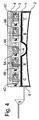
- Fig. 4 shows in Fig. 2 Similarly, a step of arranging a film on a surface by means of a device according to another embodiment of the present invention.
- Corresponding features are identified by identical reference numerals, so that reference is made to the above description and will be discussed below only differences.
- a pneumatic attraction between the film 1 and the surface 2 is applied in a step c).
- a space between the film 1 or the carrier 3 and the surface 2 by a sleeve. 8 sealed and therein generates a surface-directed negative pressure between the film 1 and the surface 2, in the exemplary embodiment by means of a vacuum or vacuum pump.
- the carrier-directed negative pressure which holds the film 1 to the support 3 is reduced, so that the film 1 successively passes from the carrier 3 to the surface 2.
- the surface-directed negative pressure can be increased in an analogous manner, for example by appropriately activating the pump 9.
Landscapes
- Engineering & Computer Science (AREA)
- Manufacturing & Machinery (AREA)
- Lining Or Joining Of Plastics Or The Like (AREA)
- Application Of Or Painting With Fluid Materials (AREA)
Applications Claiming Priority (1)
| Application Number | Priority Date | Filing Date | Title |
|---|---|---|---|
| DE102014019326.8A DE102014019326A1 (de) | 2014-12-20 | 2014-12-20 | Verfahren und Vorrichtung zum Anordnen einer Folie auf einer Oberfläche |
Publications (1)
| Publication Number | Publication Date |
|---|---|
| EP3034273A1 true EP3034273A1 (fr) | 2016-06-22 |
Family
ID=55022246
Family Applications (1)
| Application Number | Title | Priority Date | Filing Date |
|---|---|---|---|
| EP15003563.2A Withdrawn EP3034273A1 (fr) | 2014-12-20 | 2015-12-15 | Procede et dispositif destines a disposer une feuille sur une surface |
Country Status (2)
| Country | Link |
|---|---|
| EP (1) | EP3034273A1 (fr) |
| DE (1) | DE102014019326A1 (fr) |
Cited By (2)
| Publication number | Priority date | Publication date | Assignee | Title |
|---|---|---|---|---|
| EP3882040A1 (fr) * | 2020-03-20 | 2021-09-22 | Akzenta Paneele + Profile GmbH | Procédé d'application d'une feuille à un support au moyen d'une charge électrostatique |
| WO2023041213A1 (fr) * | 2021-09-14 | 2023-03-23 | Carl Zeiss Smt Gmbh | Système de lithographie euv comprenant un composant de liaison gazeuse sous la forme d'un film |
Citations (4)
| Publication number | Priority date | Publication date | Assignee | Title |
|---|---|---|---|---|
| DE4307816A1 (de) * | 1993-03-12 | 1994-09-15 | Buerkle Gmbh & Co Robert | Vorrichtung zur Beschichtung von dreidimensionalen Körpern |
| AT504620A1 (de) * | 2006-12-07 | 2008-06-15 | Peter Lisec | Verfahren sowie vorrichtung zum positionieren von einem glaselement und einer kunststofffolie aufeinander |
| DE102007057175A1 (de) * | 2007-11-26 | 2009-05-28 | Tesa Ag | Anlage zum automatisierten Applizieren einer selbsthaftenden Schutzfolie |
| DE102008027368A1 (de) * | 2008-06-09 | 2009-12-10 | Tesa Se | Verfahren zum Eindecken eines Gegenstands mit einer Schutzfolie |
-
2014
- 2014-12-20 DE DE102014019326.8A patent/DE102014019326A1/de not_active Withdrawn
-
2015
- 2015-12-15 EP EP15003563.2A patent/EP3034273A1/fr not_active Withdrawn
Patent Citations (4)
| Publication number | Priority date | Publication date | Assignee | Title |
|---|---|---|---|---|
| DE4307816A1 (de) * | 1993-03-12 | 1994-09-15 | Buerkle Gmbh & Co Robert | Vorrichtung zur Beschichtung von dreidimensionalen Körpern |
| AT504620A1 (de) * | 2006-12-07 | 2008-06-15 | Peter Lisec | Verfahren sowie vorrichtung zum positionieren von einem glaselement und einer kunststofffolie aufeinander |
| DE102007057175A1 (de) * | 2007-11-26 | 2009-05-28 | Tesa Ag | Anlage zum automatisierten Applizieren einer selbsthaftenden Schutzfolie |
| DE102008027368A1 (de) * | 2008-06-09 | 2009-12-10 | Tesa Se | Verfahren zum Eindecken eines Gegenstands mit einer Schutzfolie |
Cited By (6)
| Publication number | Priority date | Publication date | Assignee | Title |
|---|---|---|---|---|
| EP3882040A1 (fr) * | 2020-03-20 | 2021-09-22 | Akzenta Paneele + Profile GmbH | Procédé d'application d'une feuille à un support au moyen d'une charge électrostatique |
| WO2021185656A1 (fr) * | 2020-03-20 | 2021-09-23 | Akzenta Paneele + Profile Gmbh | Procédé de production d'un panneau décoratif comprenant l'application d'un film sur un substrat au moyen d'une charge électrostatique |
| CN115315358A (zh) * | 2020-03-20 | 2022-11-08 | 阿卡曾塔板材型材有限公司 | 包括通过静电充电将膜施加到基板上生产装饰面板的方法 |
| KR20220151682A (ko) * | 2020-03-20 | 2022-11-15 | 악첸타 파넬레 + 프로필레 게엠베하 | 정전기적 대전에 의해 기판에 필름을 도포하는 것을 포함하는 장식 패널의 제조 방법 |
| US12304234B2 (en) | 2020-03-20 | 2025-05-20 | Akzenta Paneele + Profile Gmbh | Method for producing a decorative panel comprising the application of a film to a substrate by means of electrostatic charging |
| WO2023041213A1 (fr) * | 2021-09-14 | 2023-03-23 | Carl Zeiss Smt Gmbh | Système de lithographie euv comprenant un composant de liaison gazeuse sous la forme d'un film |
Also Published As
| Publication number | Publication date |
|---|---|
| DE102014019326A1 (de) | 2016-06-23 |
Similar Documents
| Publication | Publication Date | Title |
|---|---|---|
| EP2953733B1 (fr) | Procédé de peinture | |
| DE102010061912B4 (de) | Vorrichtung zum selbsttätigen Auftragen von Klebstoff | |
| DE102016014953A1 (de) | Lackieranlage und entsprechendes Lackierverfahren | |
| WO2018059776A1 (fr) | Ensemble effecteur terminal | |
| EP1733799A1 (fr) | Robot équipé de plusieurs appareils de pulvérisation | |
| DE60009308T2 (de) | Verfahren und vorrichtung zur montage einer baugruppe aus mindestens einer beschichtungsmaterialversprüheinrichtung, die auf einem bewegbaren teil eines roboters angeordnet ist | |
| DE102018217921A1 (de) | Applikationseinheit und Verfahren zur Verarbeitung von selbstklebenden Stanzteilen zum Verschluss von Öffnungen in einem Fahrzeugelement | |
| DE102011114015A1 (de) | Endeffektor | |
| DE102012015666A1 (de) | Verfahren und Vorrichtung zur Montage von Spanten an einem Hautfeld bei der Herstellung eines Rumpfschalenbauteils für ein Flugzeug, sowie Verfahren zur Herstellung eines Rumpfschalenbauteils für ein Flugzeug | |
| DE102021130056A1 (de) | System und verfahren zur installation von emblemen | |
| EP3034273A1 (fr) | Procede et dispositif destines a disposer une feuille sur une surface | |
| DE202020003593U1 (de) | Materialauftragssystem | |
| DE102013104209A1 (de) | Verfahren und Vorrichtung zum exakten Legen von Beschichtungsmaterial auf in einer Presse zu beschichtenden Trägerplatten | |
| EP3587084B1 (fr) | Procédé de fabrication d'un composant en matière plastique | |
| DE102011078538B4 (de) | Vorrichtung zum Auftragen von Klebstoff und zum Herstellen von Bauteilen mit einer beflockten Oberfläche | |
| DE102018201850B4 (de) | Verfahren zum Kaschieren einer Oberseite eines Trägerbauteils mit einer Kaschiermateriallage und zugehörige Vorrichtung | |
| EP3390554B1 (fr) | Procédé pour revêtir une pièce en matière plastique avec un adhésif fusible | |
| DE102021005730B4 (de) | Greifereinheit | |
| WO1999032231A1 (fr) | Procede et dispositif pour isoler un milieu en ecoulement electroconducteur | |
| DE102008063984A1 (de) | Verfahren und Vorrichtung zum Aufbringen einer Lackfolie als Flüssigfolie | |
| DE102015211480A1 (de) | Satellit zum Entfernen von Weltraumschrott und Einheit für einen solchen Satelliten | |
| EP1975064A1 (fr) | Aéronef | |
| DE102015013595A1 (de) | Greifvorrichtung zum Bewegen wenigstens eines Bauelements für einen Kraftwagen bei dessen Herstellung | |
| DE3344826A1 (de) | Verfahren zur herstellung kaschierter formteile fuer die innenverkleidung von pkw's oder dergleichen und vorrichtung zur durchfuehrung des verfahrens | |
| DE102014012013A1 (de) | Vorrichtung zum Klebstoffauftrag |
Legal Events
| Date | Code | Title | Description |
|---|---|---|---|
| PUAI | Public reference made under article 153(3) epc to a published international application that has entered the european phase |
Free format text: ORIGINAL CODE: 0009012 |
|
| AK | Designated contracting states |
Kind code of ref document: A1 Designated state(s): AL AT BE BG CH CY CZ DE DK EE ES FI FR GB GR HR HU IE IS IT LI LT LU LV MC MK MT NL NO PL PT RO RS SE SI SK SM TR |
|
| AX | Request for extension of the european patent |
Extension state: BA ME |
|
| 17P | Request for examination filed |
Effective date: 20161222 |
|
| RBV | Designated contracting states (corrected) |
Designated state(s): AL AT BE BG CH CY CZ DE DK EE ES FI FR GB GR HR HU IE IS IT LI LT LU LV MC MK MT NL NO PL PT RO RS SE SI SK SM TR |
|
| GRAP | Despatch of communication of intention to grant a patent |
Free format text: ORIGINAL CODE: EPIDOSNIGR1 |
|
| RIC1 | Information provided on ipc code assigned before grant |
Ipc: B29L 31/30 20060101ALN20200421BHEP Ipc: B32B 37/10 20060101ALN20200421BHEP Ipc: B29C 63/00 20060101AFI20200421BHEP |
|
| INTG | Intention to grant announced |
Effective date: 20200507 |
|
| GRAS | Grant fee paid |
Free format text: ORIGINAL CODE: EPIDOSNIGR3 |
|
| STAA | Information on the status of an ep patent application or granted ep patent |
Free format text: STATUS: THE APPLICATION IS DEEMED TO BE WITHDRAWN |
|
| 18D | Application deemed to be withdrawn |
Effective date: 20200918 |